
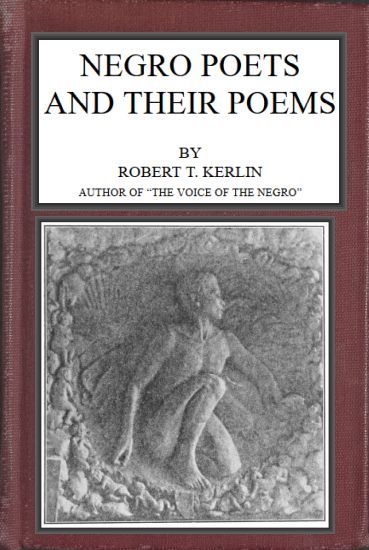
The Project Gutenberg eBook of Negro Poets and Their Poems
Title: Negro Poets and Their Poems
Author: Robert Thomas Kerlin
Release date: July 28, 2019 [eBook #60003]
Most recently updated: October 17, 2024
Language: English
Credits: Produced by Tim Lindell, Chuck Greif and the Online
Distributed Proofreading Team at http://www.pgdp.net (This
file was produced from images generously made available
by The Internet Archive/American Libraries.)
|
Contents. (etext transcriber's note) |
NEGRO POETS
AND THEIR POEMS
NEGRO POETS
AND THEIR POEMS
BY
ROBERT T. KERLIN
AUTHOR OF “THE VOICE OF THE NEGRO”
As came the olden gods, in dreams.
J. Mord Allen.
ILLUSTRATED
ASSOCIATED PUBLISHERS, Inc.,
WASHINGTON, D. C.
Copyright, 1923,
By
THE ASSOCIATED PUBLISHERS, Inc.
To the Black and Unknown Bards who gave to the world the priceless treasure of those “canticles of love and woe,” the camp-meeting Spirituals; more particularly, to those untaught singers of the old plantations of the South, whose melodious lullabies to the babes of both races entered with genius-quickening power into the souls of Poe and Lanier, Dunbar and Cotter: to them, for whom any monument in stone or bronze were but mockery, I dedicate this monument of verse, budded by the children of their vision.
CONTENTS
| PAGE | ||||
| Preface | xiii | |||
| CHAPTER I | ||||
|---|---|---|---|---|
| The Present-Day Negro Heritage of Song | 1 | |||
| I. | Untaught Melodies: Folk Song | 4 | ||
| 1. | The Spirituals | 6 | ||
| 2. | The Seculars | 12 | ||
| II. | The Earlier Poetry of Art | 20 | ||
| 1. | Jupiter Hammon and Phillis Wheatley | 20 | ||
| 2. | Charles L. Reason | 24 | ||
| 3. | George Moses Horton | 25 | ||
| 4. | Mrs. Frances E. W. Harper | 26 | ||
| 5. | James Madison Bell and Albery A. Whitman | 32 | ||
| 6. | Paul Laurence Dunbar | 37 | ||
| 7. | J. Mord Allen | 48 | ||
| CHAPTER II | ||||
| The Present Renaissance of the Negro | 51 | |||
| I. | A Glance at the Field | 51 | ||
| II. | Some Representatives of the Present Era | 70 | ||
| 1. | The Cotters, Father and Son | 70 | ||
| 2. | James David Corrothers | 85 | ||
| 3. | A Group of Singing Johnsons: | |||
| James Weldon Johnson | 90 | |||
| Charles Bertram Johnson | 95 | |||
| Fenton Johnson | 99 | |||
| Adolphus Johnson | 104 | |||
| 4. | William Stanley Braithwaite | 105 | ||
| 5. | George Reginald Margetson | 109 | ||
| 6. | William Moore | 111 | ||
| 7. | Joshua Henry Jones, Jr. | 113 | ||
| 8. | Walter Everette Hawkins | 119 | ||
| 9. | Claude McKay | 126 | ||
| 10. | Leslie Pinckney Hill | 131 | ||
| CHAPTER III | ||||
| The Heart of Negro Womanhood | 139 | |||
| 1. | Miss Eva A. Jessye | 139 | ||
| 2. | Mrs. J. W. Hammond | 142 | ||
| 3. | Mrs. Alice Dunbar-Nelson | 144 | ||
| 4. | Mrs. Georgia Douglas Johnson | 148 | ||
| 5. | Miss Angelina W. Grimké | 152 | ||
| 6. | Mrs. Anne Spencer | 156 | ||
| 7. | Miss Jessie Fauset | 160 | ||
| CHAPTER IV | ||||
| Ad Astra per Aspera | 163 | |||
| I. | Per Aspera | 163 | ||
| 1. | Edward Smythe Jones | 163 | ||
| 2. | Raymond Garfield Dandridge | 169 | ||
| 3. | George Marion McClellan | 173 | ||
| 4. | Charles P. Wilson | 179 | ||
| 5. | Leon R. Harris | 180 | ||
| 6. | Irvin W. Underhill | 185 | ||
| II. | Ad Astra | 187 | ||
| 1. | James C. Hughes | 187 | ||
| 2. | Leland Milton Fisher | 189 | ||
| 3. | W. Clarence Jordan | 190 | ||
| 4. | Roscoe C. Jamison | 191 | ||
| CHAPTER V | ||||
| The New Forms of Poetry | 197 | |||
| I. | Free Verse | 197 | ||
| 1. | Will Sexton | 197 | ||
| 2. | Andrea Razafkeriefo | 197 | ||
| 3. | Langston Hughes | 200 | ||
| II. | Prose Poems | 201 | ||
| 1. | W. E. Burghardt DuBois | 201 | ||
| 2. | Kelly Miller | 206 | ||
| 3. | Charles H. Conner | 209 | ||
| 4. | William Edgar Bailey | 213 | ||
| 5. | R. Nathaniel Dett | 214 | ||
| CHAPTER VI | ||||
| Dialect Verse | 218 | |||
| 1. | Waverly Turner Carmichael | 219 | ||
| 2. | Joseph S. Cotter, Sr. | 220 | ||
| 3. | Raymond Garfield Dandridge | 221 | ||
| 4. | Sterling M. Means | 222 | ||
| 5. | J. Mord Allen | 223 | ||
| 6. | James Weldon Johnson | 226 | ||
| 7. | Theodore Henry Shackleford | 228 | ||
| CHAPTER VII | ||||
| The Poetry of Protest | 229 | |||
| Lucian B. Watkins | 237 | |||
| CHAPTER VIII | ||||
| Miscellaneous | 243 | |||
| I. | Eulogistic Poems | 243 | ||
| II. | Commemorative and Occasional Poems | 254 | ||
| Index of Authors, with Biographical and Bibliographical Notes | 269 | |||
| Index of Titles: A, B, C, D, E, F, G, H, I, J, L, M, N, O, P, R, S, T, V, W, Y, Z | 281 | |||
ILLUSTRATIONS
PREFACE
Ad astra per aspera—that is the old Roman adage. Magnificent is it, and magnificently is it being in these days exemplified by the American Negroes, particularly by the increasing number of educated and talented American Negroes, and most particularly by those who feel the urge to express in song the emotions and aspirations of their people. A surprisingly large number is this class. Without exhausting the possibilities of selection I have quoted in this anthology of contemporary Negro poetry sixty odd writers of tolerable verse that exhibits, besides form, at least one fundamental quality of poetry, namely, passion.
The mere number, large as it is, would of course not signify by itself. Nor does the phrase “tolerable verse,” cautiously chosen, seem to promise much. What this multitude means, and whether the verse be worthy of a more complimentary description, I leave to the reader’s judgment. Quality of expression and character of content are of course the prepotent considerations.
While, in a preliminary section, I have passed in review the poetry of the Negro up to and including Dunbar, not neglecting the old religious songs of the plantation, or “Spirituals,” and the dance, play, and nursery rhymes, or “Seculars,” yet strictly speaking this is a representation of new Negro voices, an anthology of present-day Negro verse, with biographical items and critical, or at least appreciative comment.
I wish most heartily to express my obligations to the publishers and authors of the volumes I have drawn upon for selections. They are named in the Index and Biographical and Bibliographical Notes at the end of the text. But for the reader’s convenience I collect their names here:
Richard E. Badger, publisher of Walter Everette Hawkins’s Chords and Discords; A. B. Caldwell, Atlanta, Ga., publisher of Sterling M. Means’ The Deserted Cabin and Other Poems; the Cornhill Company, publishers of Waverley Turner Carmichael’s From the Heart of a Folk; Joseph S. Cotter’s The Band of Gideon; Georgia Douglas Johnson’s The Heart of a Woman; Charles Bertram Johnson’s Songs of My People; James Weldon Johnson’s Fifty Years and Other Poems; Joshua Henry Jones’s Poems of the Four Seas; Dodd, Mead and Company, publishers of Dunbar’s Poems; the Grafton Press, publishers of H. Cordelia Ray’s Poems; Harcourt, Brace & Company, publishers of W. E. Burghardt DuBois’s Darkwater; Pritchard and Ovington’s The Upward Path; the Macmillan Company, publishers of Thomas W. Talley’s Negro Folk Rhymes; the Neale Publishing Company, publishers of Kelley Miller’s Out of the House of Bondage; J. L. Nichols & Company, Naperville, Ill., publishers of Mrs. Dunbar-Nelson’s The Dunbar Speaker and Entertainer, and The Life and Works of Paul Laurence Dunbar; the Stratford Company, publishers of Joshua Henry Jones’s The Heart of the World and Other Poems; and Leslie Pinckney Hill’s The Wings of Oppression. It is with their kind permission I am privileged to use selections from the books named. To The Crisis, The Favorite Magazine, and The Messenger, I am indebted for several selections, which I gratefully acknowledge.
To readers who are disposed to study the poetry of the Negro I would commend Dr. James Weldon Johnson’s The Book of American Negro Poetry (Harcourt, Brace & Co.) and Mr. Arthur A. Schomburg’s A Bibliographical Checklist of American Negro Poetry (Charles F. Hartman, New York). I am indebted to both these books and authors. To Mr. Schomburg I am also indebted for the loan of many of the pictures of the earlier poets.
R. T. K.
West Chester, Pa.
March 22, 1923.
NEGRO POETS AND
THEIR POEMS
CHAPTER I
THE NEGROES HERITAGE OF SONG
As an empire may grow up within an empire without observation so a republic of letters within a republic of letters. That thing is happening today in this land of ours. A literature of significance on many accounts, and not without various and considerable merits. Its producers are Negroes. Culture, talent, genius—or something very like it—are theirs. Nor is it “the mantle of Dunbar” they wrap themselves in, but an unborrowed singing robe, that better fits “the New Negro.” The list of names in poetry alone would stretch out, were I to start telling them over, until I should bring suspicion upon myself as no trustworthy reporter. Besides, the mere names would mean nothing, since, as intimated, this little republic has grown up unobserved in our big one.
It may be more for the promise held forth by their thin little volumes than for the intrinsic merit of their performance that we should esteem the verse-makers represented in this survey of contemporary Negro poetry. Yet on many grounds they should receive candid attention, both from the students of literature and the students of sociology. Recognition of real literary merit will be accorded by the one class of students, and recognition of new aspects of the most serious race problem of the ages will be forced upon the second class. Justification enough for the present survey and exhibition will be acknowledged by all who are earnestly concerned either with literature or with life.
Perhaps, unconsciously, in my comments and estimates I have not steadfastly kept before me absolute standards of poetry. But where and when was this ever done? Doubtless in critiques of master poets by master critics, and only there. In writing of contemporary verse, by courtesy called poetry, we compromise, our estimates are relative, we make allowances, our approvals and disapprovals are toned according to the known circumstances of production. And this is right.
If the prospective reader opens this volume with the demand in his mind for novelty of language, form, imagery, idea—novelty and quaintness, perhaps amusing “originality”, or grotesqueness—let him reflect how unreasonable a similar demand on the part of English critics was a century ago relative to the beginnings of American poetry. Were not American poets products of the same culture as their contemporaries in England? What other language had they than the language of Shakespeare and Wordsworth, Keats and Tennyson? The same is essentially true of the American Negro—or the Negro American, if you choose. He is the heir of Anglo-Saxon culture, he has been nurtured in the same spiritual soil as his contemporary of the white race, the same traditions of language, form, imagery, and idea are his. Everything possible has been done to stamp out his own African traditions and native propensities. Therefore, let no unreasonable demand be laid upon these Negro rhymers.
Notwithstanding, something distinctive, and something uniquely significant, may be discerned in these verse productions to reward the perusal. But this may not be the reader’s chief reward. That may be his discovery, that, after all, a wonderful likeness rather than unlikeness to the poetry of other races looks forth from this poetry of the children of Ham. A valuable result would this be, should it follow.
Before attempting a survey of the field of contemporary verse it will advantage us to cast a backward glance upon the poetic traditions of the Negro, to see what is the present-day Negro poet’s heritage of song. These traditions will be reviewed in two sections: 1. Untaught Melodies; 2. The Poetry of Art. This backward glance will comprehend all that was sung or written by colored people from Jupiter Hammon to Paul Laurence Dunbar.
I. Untaught Melodies
The Negro might well be expected to exhibit a gift for poetry. His gift for oratory has long been acknowledged. The fact has been accepted without reflection upon its significance. It should have been foreseen that because of the close kinship between oratory and poetry the Negro would some day, with more culture, achieve distinction in the latter art, as he had already achieved distinction in the former art. The endowments which make for distinction in these two great kindred arts, it must also be remarked, have not been properly esteemed in the Negro. In other races oratory and poetry have been accepted as the tokens of noble qualities of character, lofty spiritual gifts. Such they are, in all races. They spring from mankind’s supreme spiritual impulses, from mankind’s loftiest aspirations—the aspirations for freedom, for justice, for virtue, for honor and distinction.
That these impulses, these aspirations, and these endowments are in the American Negro and are now exhibiting themselves in verse—it is this I wish to show to the skeptically minded. It will readily be admitted that the Negro nature is endowed above most others, if not all others, in fervor of feeling, in the completeness of self-surrender to emotion. Hence we see that marvelous display of rhythm in the individual and in the group. This capacity of submission to a higher harmony, a grander power, than self, affords the explanation of mankind’s highest reaches of thought, supreme insights, and noblest expressions. Rhythm is its manifestation. It is the most central and compulsive law of the universe. The rhythmic soul falls into harmony and co-operation with the universal creative energy. It therefore becomes a creative soul. Rhythm visibly takes hold of the Negro and sways his entire being. It makes him one with the universal Power that Goethe describes, in famous lines, as “at the roaring loom of time, weaving for God the garment thou seest him by.”
But fervor of feeling must have some originating cause. That cause is a conception—the vivid, concrete presentation of an object or idea to the mind. The Negro has this endowment also. Ideas enter his mind with a vividness and power which betoken an extraordinary faculty of imagination. The graphic originality of language commonly exhibited by the Negro would be sufficient proof of this were other proof wanting. No one will deny to the Negro this gift. Whoever has listened to a colored preacher’s sermon, either of the old or the new school, will recall perhaps more than one example of poetic phrasing, more than one word-picture, that rendered some idea vivid beyond vanishing. It no doubt has been made, in the ignorant or illiterate, an object of jest, just as the other two endowments have been; but these three gifts are the three supreme gifts of the poet, and the poet is the supreme outcome of the race: power of feeling, power of imagination, power of expression—and these make the poet.
1. The Spirituals
As a witness of the Negro’s untutored gift for song there are the Spirituals, his “canticles of love and woe,” chanted wildly, in that darkness which only a few rays from heaven brightened. Since they afford, as it were, a background for the song of cultured art which now begins to appear, I must here give a word to these crude old plantation songs. They are one of the most notable contributions of any people, similarly circumstanced, to the world’s treasury of song, altogether the most appealing. Their significance for history and for art—more especially for art—awaits interpretation. There are signs that this interpretation is not far in the future. Dvorak, the Bohemian, aided by the Negro composer, Harry T. Burleigh, may have heralded, in his “New World Symphony,” the consummate achievement of the future which shall be entirely the Negro’s. Had Samuel Coleridge-Taylor been an American instead of an English Negro, this theme rather than the Indian theme might have occupied his genius—the evidence whereof is that, removed as he was from the scenes of plantation life and the tribulations of the slaves, yet that life and those tribulations touched his heart and found a place, though a minor one, in his compositions.
But the sister art of poetry may anticipate music in the great feat of embodying artistically the yearning, suffering, prayerful soul of the African in those centuries when he could only with patience endure and trust in God—and wail these mournfullest of melodies. Some lyrical drama like “Prometheus Bound,” but more touching as being more human; some epic like “Paradise Lost,” but nearer to the common heart of man, and more lyrical; some “Divina Commedia,” that shall be the voice of those silent centuries of slavery, as Dante’s poem was the voice of the long-silent epoch preceding it, or some lyrical “passion play” like that of Oberammergau, is the not improbable achievement of some descendant of the slaves.
In a poem of tender appeal, James Weldon Johnson has celebrated the “black and unknown bards,” who, without art, and even without letters, produced from their hearts, weighed down with sorrows, the immortal Spirituals: