
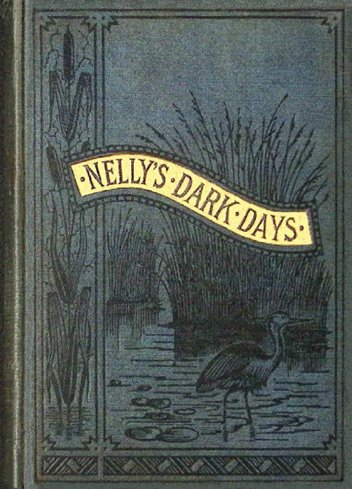
The Project Gutenberg eBook of Nelly's dark days
Title: Nelly's dark days
Author: Hesba Stretton
Release date: December 17, 2025 [eBook #77483]
Language: English
Original publication: Glasgow: Scottish Temperance League, 1891
Transcriber's note: Unusual and inconsistent spelling is as printed.
WAITING FOR FATHER.
Nelly's Dark Days.
BY THE AUTHOR OF
"JESSICA'S FIRST PRAYER," "LITTLE MEG'S CHILDREN,"
"ALONE IN LONDON," &c.
[Hesba Stretton]
One hundred and fifth thousand.
GLASGOW:
SCOTTISH TEMPERANCE LEAGUE.
LONDON: HOULSTON & SONS;
AND NATIONAL TEMPERANCE LEAGUE.
EDINBURGH: JOHN MENZIES & CO.
1891.
CONTENTS.
————
A STREET CORNER
LOCKED OUT
MORNING FEARS
ONLY A DOLL
VIOLETS
THE PRICE OF A DRAM
HALF MEASURES
A SORROWFUL FACT
FOUND DROWNED
DEEPER STILL
THE ONLY REFUGE
TRUE TO A PROMISE
DEAD AND ALIVE AGAIN
NELLY'S DARK DAYS.
————————
CHAPTER I.
A STREET CORNER.
IT was nearly twelve o'clock at night on the first Sunday of the New Year. The churches and chapels had all been closed for some hours; and none of the better class of shops had been opened during the day. Business had been set on one side, even by those workmen and labourers who lived from hand to mouth, and scarcely knew beforehand where the day's meals were to come from. There had been, as usual, a prevailing feeling that the day was not a day for work or traffic of any kind; and what had been done had been, more or less, away from the public scrutiny. But though midnight was close at hand, the streets in the lower parts of Liverpool were neither quiet nor dark. Up higher, farther away from the long line of docks and the troubled stream of the mighty river, there was silence in the deserted streets where the wealthier classes had their comfortable homes; but where the poor dwelt, and wherever there was a corner of a street which afforded a good situation for traffic, or wherever it was supposed there was an "immense drinking neighbourhood capable of improvement," * there stood a gin-palace still open, with its bright gas-lights sparkling down each dark row of dingy houses with a show of cheery welcome not easy to resist.
* "Capital Spirit Vaults to Let, in an Immense Drinking Neighbourhood,
capable of great improvement by an industrious man and his wife."
(Newspaper Advt.)
At one spot where four roads met, each corner house was thus brilliantly lit up; and the doors, which swung to and fro readily and noiselessly, were constantly moving, and giving a passing glimpse, but no more, of what was going on within. The streets were so light here that a pin lying on the flagged pavement was plainly seen. So were the rags of a child who stood in the full glare of the most popular of the gin-palaces, leaning against a lamp-post, with her face turned towards the often-opening door. It was a small, meagre face, yet pretty, with a mingled and wistful expression of anxiety and happiness. The anxiety was visible whenever the door stood ajar; when it was closed, the happiness came uppermost. The secret of her brief, new-born happiness was very simple, but very deep to the child. She clasped tenderly, but carefully, in her thin bare arms a gaily dressed doll, whose finery contrasted strongly with her own rags. When the door remained closed for a few minutes, she passed the time in timid, half-fearful caresses of her shining doll; as soon as it opened she peered, with heedful and searching eyes, to the farthest corner of the interior.
"Nelly!" said a clear, shrill voice, which startled the child from an anxious gaze. "You here at this time! How's poor mother to-night?"
"Very bad," said the child sadly.
"And father's in there, I reckon?"
"Yes," said Nelly, "and oh! I want him to come home so, because mother says she'd go to sleep maybe if father was home."
The girl who had spoken to her—a bright, brisk-looking girl—pushed open the door a little way, and glancing in turned back with a decisive shake of her head.
"No use, Nelly," she said; "he won't come as long as he can stay. Well, I'll nurse you a bit to keep you warm; it's very bitter to-night. I don't much wonder at father drinking to-night, I don't."
All day long the wind had been blowing keenly from the north-east, bringing a fine, piercing sleet with it, and at nightfall the bitter cold had increased. The girl sat down on a door-step, and drew the shivering child into her lap, covering her as well as she could with her own scanty clothing.
"Father didn't use to get drunk once, did he, Bessie?" asked the child, plaintively.
"Oh dear, no!" answered Bessie, in a cheery voice.
"Tell me all about that time," said Nelly, nestling closer to Bessie.
It was an old story, often told, but neither the girl nor the child ever grew weary of it.
"It's ever so many years ago, before you was born," said Bessie; "and he lived in a beautiful house, with a parlour in front, and a kitchen behind, and two rooms upstairs, all full of beautiful furniture. Everybody that I knew called him Mister Rodney then; but I was nothing but a poor ragged little girl, raggeder than you, Nelly, selling matches in the streets. And this was how I come to know him. I was hanging about the basket-women, down by the stages, running errands for 'em, and one day, almost as cold as this, my foot slipped, and down I fell into the water. Oh! It was so cold; and I seemed to be sinking down, down, down."
"And father jumped in after you and fetched you out," interrupted Nelly, eagerly.
"Ay! He did, though he knew nothing of me, and I was nothing to him, only a little, dirty match-girl. And then he carried me all the way to his own house in his arms."
"He never, never carried me in his arms," cried the child, "they aren't strong enough now."
"No; but he was as strong as strong then," continued Bessie, "and he clipped me so fast I wasn't a bit afraid. That's how I'm never afraid of him now, Nelly. He's a good man, and kind, and clever, when he's himself; and I love him, and you love him; don't we?"
"Yes," said Nelly, drawing a long breath, "mother says she's going to heaven soon, where the other children are, and there 'll be nobody left but me to take care of father. I don't much mind, though I'd rather go with mother. Will he go on getting drunk always and always?"
"If he could only see the gentleman I saw!" exclaimed Bessie. "It's six years ago, and I was a big, grown girl, ready to push in anywhere, and I see a lot of boys and girls crowding into a great hall, and I pushed in with them, nobody stopping me. And then they sang a lot of songs, oh! beautiful songs, and some gentlemen spoke to 'em about drink, and how they'd grow up good, decent men and women if they'd keep from it. And I was one of the very last to come away, the place was so nice, and a gentleman come up to me, and he said,—
"'My girl, what is your name?'
"And I said, 'Bessie Dingle, sir.'
"And he said, 'Can you read?'
"And I said, 'No, sir.'
"And he said, 'That's a pity. Do you ever drink what will make you drunk?'
"And I was ashamed to say yes, so I answered him nothing.
"And he said, looking me full in the face with eyes as kind as kind could be, 'I wish you'd promise me never to taste it till you see me again.'
"And I said, 'Yes, I will promise, sir.'"
"And when did you see him again?" asked Nelly.
"Never!" she answered. "He wrote down on a bit of paper where he lived, and said any of the p'leece would show me where it was; and that very night I fell sick with fever and they took me to the workhouse, and the slip of paper got lost. Anyhow, I never could find it or the place, and I've never seen him again. He's sure to think I broke my promise, and did not care for him; he's almost sure to think that, but I never did."
She raised her head and looked down the long street, where the gloom seemed to press darkly against the glare of the gas-lights; it was very cheerless beyond the light, and the girl's face grew darker for a minute or two.
"It's no wonder they drink as long as the place is open," she said; "I'd like to be inside there, where it's light and warm. I wonder why the shops are all shut, and those places open. That gentleman, he said to me,—
"'My girl, you've got sharp eyes of your own; you just look round and see what makes the most mischief among the people about you, and tell me when I see you again.'
"I know what I'd say if he stood here this minute."
"Did you ever tell father about him?" asked Nelly.
"Scores and scores of times," she answered, emphatically; "and sometimes he cries and wishes he knew him, and could make him a promise like me; and sometimes he curses and calls me an idiot. If he could only see him, Nelly!"
They sat silent for a minute or two, Bessie nursing the child as tenderly as she nursed her doll. At last, the girl touched the doll with the tip of her finger, and said cheerfully,—
"Why, wherever did you get this grand plaything from?"
"It's a lady doll, and it's my very own," answered Nelly, opening her rags to display it fully; "there was a Christmas-tree at our school, and this was the very best thing there, and teacher gave it me because she said I was the best child. Isn't it a beauty, Bessie?"
"It's wonderful!" said Bessie, in a voice of admiration.
"I take such care of it," continued Nelly, eagerly, "only I'm afraid of nursing it when there are children about, for fear they should snatch it from me, you know."
As the child spoke, the clocks in the town struck twelve, and a trail of lingerers crept reluctantly out of each brilliant gin-palace. Bessie kept Nelly back from springing forward to meet her father, and then seeing him take his way homewards, she followed at a little distance, clasping the child's hand warmly in her own.
CHAPTER II.
LOCKED OUT.
THE figure which staggered on before them had once been that of a tall, well-built man, strong and upright, with a firm tread and a steady hand. Bessie had known him in his better days; but such as he was now—feeble and bent, with reddened eyes and shaking hands—Nelly had never known him otherwise. Rodney loved Nelly with all that was left to him of a heart. It was perhaps the last link which bound him in nature to God and his fellow-men. She was his latest-born, and the only child remaining to him; and though he had lost the sense of all other affections, this one still glimmered and lived within him. Such as he was now, he was sure of her love for him, for she could not compare him with any better self in happier times. The state to which he had reduced himself was the only one she knew; and the drunkard felt that there was no reproach mingled with the little child's kisses upon his parched lips.
Rodney floundered on through the narrow streets leading homewards, unconscious that he was followed by the silent and noiseless girls, whose ill-shod feet made no sound upon the slushy pavement. His progress was slow and uncertain; but at length he turned down a short passage, and paused, with labouring breath, at the foot of a flight of stone steps leading to the upper flat of the building in which he lived. It was to see him safe up this perilous staircase that Bessie had come so far out of her own way. A false step here, or a giddy lurch, might be death to him. They ventured nearer to him between the dark and narrow walls as he climbed up before them; and as soon as he reached the landing, upon which several doors opened, their hearts were at rest, now all danger was over. He groped his way on from door to door until he gained his own, and then with an unexpected quickness and steadiness of hand he lifted the latch and passed in, slamming the door behind him, and turning the key noisily in the lock. Nelly sprang forward with a sudden cry.
"Oh! Bessie," she cried, wringing her small hands in distress, "whatever are I to do? When father's like that, I durstn't let him see me nor hear me, for mother says maybe he'd kill me. And mother durstn't stir to open the door or he'd nearly kill her. And it's so cold out here, and all the neighbours gone to bed, and it 'ud kill me to stay out of doors all night, wouldn't it, Bessie? Whatever are I to do?"
It was too dark for Bessie to see the terror upon the child's wan face, but she could hear it in her voice, and she could feel the little creature trembling and shivering beside her.
"Never mind," she said, soothingly, "I'm not afraid of him. He's a kind man, and he'll open the door for me, I know; or else you shall come home with me, Nelly, and I'll carry you all the way. Hegh! Mr. Rodney, sir, please to open the door again."
She knocked sharply and decisively at the door, and called out in a shrill voice, which made itself heard through all the din he was making inside. He was silent for a moment, listening, and Bessie went on in the same clear tones,—
"You've locked Nelly out, Mr. Rodney, as has been waiting and watching ever so long for you; and it's bitter cold to-night, and she's tired to death. Please unfasten the door and I'll bring her in."
There was no sound for a minute or so except the hollow and suppressed cough of the mother, who was struggling to hush the noise she made, lest it should arouse the drunken fury of her husband. Then Rodney shouted with an oath that he would not open the door again that night for any one.
"It's me, father!" sobbed the child. "Little Nelly, and its snowing out here. You didn't use to be so bad to me. Please to let me in."
She was beating now with both hands at the door, and crying aloud with cold and terror, while her mother's low cough sounded faintly within; but she dare not rise from her bed and open the door for her little girl.
"It'll teach you to come waiting and watching for me," cried Rodney, savagely; "get off from there, and be quiet, or I'll break every bone in your body. Now, I've said it!"
Nelly's hands dropped down, and she crouched upon the door-sill in silent agony; but Bessie knocked again bravely.
"Never you mind, Mrs. Rodney," she said, "I'll take Nelly home with me, and carry her every inch of the road. And, Mr. Rodney, sir, you'll be as sorry as sorry can be as soon as you come to yourself. Good-night, now; and don't you fret. Nelly's here, up in my arms, safe and sound; and I'll take care of her."
Bessie had lifted the child into her arms, but still lingered in the hope that the door would open. But it did not; and turning away with a sorrowful and heavy heart, and with Nelly sobbing herself to sleep on her bosom, she made her way toilsomely along, under her burden, and through the thickening snow, to her own poor lodging.
CHAPTER III.
MORNING FEARS.
WHEN Rodney awoke in the morning, he had a vague remembrance of the night before, which made him raise his aching head, and look with a sharp prick of anxiety to see if his little child was in bed beside her mother. His wife, who had been lying awake all night, had now fallen into a profound slumber, and her hollow face, with the skin drawn tightly across it, and with a hectic flush upon her cheeks, was turned towards him; but Nelly was not there. What was it he had done the night before? In his dull and clouded mind there was a dawning recollection of having heard little hands beat against the door, and a piteous voice call to him to open it. It was quite impossible that the child could be concealed in the room, for it was very bare of furniture, and there was no corner in its narrow space where she could hide.
Through the broken panes of the uncurtained window he could see the snow lying thickly upon the roofs; and he was himself benumbed by the biting breath of the frost, which found its way, in rime and fog, through the crazy casement. Could it by any possibility have happened that he had driven out his little daughter, Nelly, who did not shrink from kissing and fondling him yet, drunkard as he was, into the deadly cold of such a winter's night? He crept quietly across the room, and unlocked the door, letting in a keener draft of the bitter wind as he opened it.
His wife moved restlessly in her sleep, and began to cough a little. He drew the door behind him, and stood looking down over the railings which protected the gallery upon which the houses opened, into the street below. The snow that had fallen during the darkness was already trodden and sullied by many footsteps; but wherever the northern wind had blown, it had drifted it into every cranny and crevice, in pure white streaks. A few boys were snow-balling one another along the street; but all the house doors, which usually stood open, were closed, and the neighbours were keeping within. If any of them had been open, he could have asked carelessly if they knew where his Nelly could be; but he did not like to knock formally at any one of them. In which of the houses at hand could he inquire for her, without exposing himself to the anger and contempt of the inhabitants?
He could not make up his mind to inquire anywhere. He was afraid of almost any answer he could get. More than once he had beaten his little girl; but they had made it up again, he and Nelly, with many tears and kisses, and he knew she had borne no malice in her heart against him. But he had never driven her out of her home before—a little creature, not eight years old, in the wild, wintry night; at midnight too, when every other shelter would be closed. Where could she be at this moment? What if she had been frozen to death in some corner, where she had tried to shield herself from the snow-storm? He wandered along the street, casting fearful glances down each flight of cellar-steps, where a child might creep for refuge, until he reached the wider thoroughfares, and the numerous gin-palaces in them.
But just now Rodney's heart was too full of his missing child to feel the temptation strongly. He fumbled mechanically in his pockets for any odd pence that might be there; but he was thinking too much of Nelly to have more than a faint, instinctive desire for the stimulus. He was cold, miserable, and downcast; but he had not as yet sunk so low that anything except the assurance that his little daughter was alive and well, could revive him. With bowed head he went on in a blind search for her, along the snowy streets, looking under archways, and up covered passages, wherever she might have found a shelter for the little face and form, which were dearer than all the world to him, cruel as he had been to them.
He turned home again at length, worn out and despondent, wishing himself dead and forgotten by all those whom he had made miserable, and more than half tempted to make an end of it altogether in the great, strong river, whose tide would sweep him out to sea. Swept away from the face of the earth—that would be the best thing for them and for him! If he only had courage to do it; but his courage was all gone, had oozed away from him, and left him only the husk of a man, fearful of his own shadow, except when he was drunk. He scarcely knew whether he trembled from cold or dread as he loitered homewards; and he could hardly climb the worn steps which he must ascend to reach his house, for the throbbing of his heart and the tremor in his limbs. He was afraid of facing his dying wife, and telling her that he could not find their last little child, the only one that she would have had to leave behind her.
But as he came within sight of the door, he saw that it stood open an inch or two, and his eye caught the gleam of a handful of fire kindled in the grate. Before his hand could touch it, the door was quickly but quietly opened, and Nelly herself stood within, her hand raised to warn him not to make any noise.
"Hush!" she whispered. "Mother's asleep still, and you're yourself again. Bessie said you'd be yourself again, and I needn't be afraid. Come in and let me warm you, daddy."
She drew him gently to the broken chair on the hearth, and began to rub his numbed fingers between her own little hands; while Rodney sunk helplessly into the seat, and leaned his head upon her small shoulder.
"Never mind, father," said Nelly, "you didn't mean to do it. Bessie says you'd never have done it of your own self. It's only the drink that does it; and I wasn't hurt, daddy; not hurt a bit. Bessie carried me all the way to her home, like you carried her once, she says. Did you ever carry Bessie, when you were a strong man, in your own arms, a long, long way?"
"Ay! I did," said Rodney, with a heavy sigh, "and now I can scarcely lift you upon my knee. Do you love poor, old father, Nelly?"
SHE DREW HIM GENTLY TO THE BROKEN CHAIR.
"To be sure I do," said the child, earnestly, "why, when mother's dead, there 'll be nobody left but me to take care of you, you know. You mustn't ever turn me out of doors then, or you might hurt yourself, and there 'd be nobody to see when you're drunk."
"I'll never get drunk again," cried Rodney, "and I'll never be cruel to you again, Nelly. Give me a kiss, and let it be a bargain."
Nelly covered his fevered face with kisses, in all a child's hopefulness and gladness; and told her mother the good news the moment she awoke. But neither the wife, nor Rodney himself, dared to believe he would have strength to keep the promise he had made.
CHAPTER IV.
ONLY A DOLL.
AS the night drew on, and the time at which he was accustomed to seek the excitement of the spirit-vaults or beer-shops, a sore conflict began within Rodney's soul. With the darkness came a cold, thick fog from the river, which penetrated into the ill-built houses, and wrapped freezingly about their poorly-clad inmates. What few pence he had saved from the scanty wages of the previous week, he had spent earlier in the day in buying a little food for Nelly, and some medicine to lull his wife's racking cough. There was no light in his house, and the fire was sparingly fed with tiny lumps of coal or cinder, which gave little warmth, and no brightness to his hearth. The sick woman had stayed in bed all day, and had only strength enough to speak to him from time to time; while Nelly, who was also suffering from cold, and hunger but half-satisfied, grew dull as the darkness deepened, and rocked her doll silently to and fro, as she sat on the floor in front of the fire, where the gleams of red light from the embers fell upon her. Not far away was the brilliant gin-palace, where the light fell in rainbow colours on the glittering prisms of the gas pendants, to which his dim and drunken eyes were so often lifted in stupid admiration.
A chilly depression hung about Rodney, which by and by gave place to an intense, unutterable craving for the excitement of drink, which fastened upon him, and which he felt no power to shake off. As time dreary minutes dragged by, he pictured to himself the warmth and comfort that were within a stone's-throw of him. But there was no money now in his pocket, and nothing that was worth pawning in the house. He almost repented of having spent the poor sum that had been his in food and medicine; for Nelly was still hungry, and her mother's cough had not ceased. That cough irritated him almost to frenzy; and he felt that he should die, perish that night of cold and misery, if he could not buy one dram to warm and comfort him.
He peered anxiously around, in the gloom, upon the few beggarly possessions remaining to him, and groaned aloud as he confessed to himself that they were worthless. His wandering glance fell upon Nelly, curled up sleepily on the hearth, with her doll lying on her arm. That looked gay and attractive in the red light, its blue dress and scarlet sash showing up brightly against Nelly's dingy rags.
Rodney's conscience smote him for a moment as he thought that the toy, fresh and unsoiled still, might fetch enough, if sold, to satisfy his more immediate craving this evening—but the idea once in his mind, he could not banish it. To-morrow he would work, and earn money enough to buy Nelly another quite as good as this one. If he had not spent his money for her and her mother, he would not now be driven to taking her plaything from her; and it was only a toy, nothing necessary to her, as it was necessary to get warmth, and what was more to him than food. She would not be any colder or hungrier without her doll; and she would not mind it much, as it was for him. He did not mean to take it from her against her will; but she would give it up, he knew. Leaning forward, he laid his shaking hand upon her cheek.
"Nelly," he said, in his kindest tones, "Nelly, you've got a pretty plaything there."
"Oh, yes!" she answered, opening her eyes wide, and hugging the doll closer to her. "But it isn't a plaything, father. It's a lady that has come to live with me."
"A lady, is it?" said Rodney, laughing. "Why, it's a queer place for a lady to live in. Would you mind lending her to me for a little while, Nelly?"
"What for?" asked Nelly, her eyes growing large with terror, and her hands fastening more closely around her treasure.
"No harm," he answered softly, "no harm at all, my little woman. I only want to show it to a friend of mine that's got a little girl like you that's fond of dolls. I'll bring it back very soon, all right."
"Oh! I cannot let her go!" cried Nelly, bursting into tears, and creeping away from him towards the bed where her mother lay.
"John," murmured the mother, in feeble and tremulous tones, "let the child keep her doll. It's the only comfort she's got."
Rodney sat still for another half-hour, the numbness and depression gaining upon him every minute. Nelly had sought refuge by her mother's side, and the dreary room was awfully silent. At last, he could endure it no longer; and with a hard resolution in his heart, he stirred the fire till a flickering light played about the bare walls, and then he strode across to the bedside.
"Look here, Nelly," he said, in a harsh voice, "I promised that friend of mine to show his little girl your doll; so you'd better give it up quietly, or I must take it off you. What are you afraid of? I'm not going to do you any harm, but have the doll I must. I'll bring it back again with me, if you'll only lend it me without, any more words."
"Nelly," said the mother, tenderly, "you must let him take it, my darling."
Nelly sat up in bed, rocking herself to and fro in a passion of grief and dread. Yet her father had promised to bring it back, and she had still some childish faith in him. The doll lay upon the ragged pillow, but she could not muster courage enough to give it herself into her father's hands, and with a bitter sob she pushed it, towards her mother.
"You give it him," she said.
For a minute or two, Rodney's wife looked up steadily into his face, for some sign of relenting, but though his eyes fell, and his head sank, he still held out his hand for the toy, which she gave to him, murmuring, "God have mercy upon you!"
For a second Rodney stood irresolute, but the flickering flame died out, and darkness hid him from his wife and Nelly. Without speaking again, he groped his way to the door and passed out into the street.
THE PAWNBROKER AND THE DOLL.
It proved a very paltry, insufficient satisfaction after all. The toy, handsome as it seemed to him, did not sell for as much as he expected at the pawn-shop, where they refused altogether to take it in pledge. He could only drink enough to stupify him for a little while, but not sufficient to give him the savage courage to go back and meet Nelly without her doll. What he had taken only served to quicken the stings of his conscience, which made it a difficult thing to return home at all.
The night was even keener than the last when Nelly watched for him at the door of the gin-palace, yet he dare not go back till she was fast asleep, and in the morning he could readily pacify her by promising to buy another doll. He hung about the entrances of the spirit-vaults with a listless hope that some liberal comrade might offer him a glass; and as long as there was any chance of it, he loitered in the streets. But they were closed at last, the brilliant lights extinguished, and the shutters put up; and Rodney was forced to return home tenfold more miserable than when he left it.
His hope that Nelly would be asleep was ill-founded. He could not see her; but the instant his foot struck against the door-sill, he heard her eager voice calling to him to bring the doll back to her. His own voice, when he answered her, was broken by a whimper, and a sob which he could not control,—
"Father couldn't bring it home," he answered; "my friend's little girl wouldn't part with it to-night. But it will come home to-morrow, Nelly."
"Oh! I know it never will," wailed the child. "I shall never see my lady any more; never any more. They've stolen her off me; and I shall never, never have her again."
He could hear her sobbing far into the night; and after she had cried herself to sleep, her breath came in long and troubled sighs. He cursed himself bitterly, vowing a hundred times that Nelly should have a doll again to-morrow. But when the day came, the daily temptation came with it; and though he found work, and borrowed a shilling from a fellow-workman, the money went where his money had gone for many a past month and year.
For some days his child was dull and quiet—bearing malice, Rodney called it, when she gave no response to his fits of fondness. But neither she nor his wife spoke to him of the lost plaything, and before long, it had passed away altogether from his weakened memory.
CHAPTER V.
VIOLETS.
ALL the neighbours said it was a mystery how the Rodneys lived for the next three months, for Rodney was away for days together, only coming home now and then during his sober intervals; but it was no mystery at all. The wondrous kindness which the poor show to the poor was at work for them. Mrs. Rodney needed little food, and Nelly was always welcome to share the stinted meals in any house near at hand. Every day at dusk Bessie came in, and if she had been lucky in selling her flowers or fruit in the streets, she did not fail to bring some small, cheap dainty with her to tempt the sick woman's appetite. So the depth of the winter passed by; and the spring drew near, with its Easter week of holiday and gladness.
It was the day before Good Friday, when Rodney was returning, with lagging steps and a heavy heart, to his wretched home, after an absence of several days. Every nerve in his body was jarring, and every limb ached. He could scarcely climb the narrow and steep staircase; and when he reached his door, he was obliged to lean against it, breathing hardly after the exertion. It seemed very silent within, awfully still and silent. He listened for Nelly's chatter, or her mother's cough, which had sounded incessantly in his ears before he had left home; but there was no breath or whisper to be heard. Yet the door yielded readily to his touch, and with faint and weary feet he crossed the threshold, to find the room empty.
It was his first impression that it was empty; but when he looked round again with his dim, red eyes, whose sight was failing, they fell upon one awful occupant of the desolate room. Even that one he could not discern all at once, not till he had crossed the floor and laid his hand upon the strange object resting upon the old bed—the poor, rough shell of a coffin which the parish had provided for his wife's burial. She was not in it yet, but lay beyond it, in its shadow; her white, fixed face, very hollow and rigid, at rest upon the pillow, and her wasted hands crossed upon her breast. The neighbours had furnished their best to dress her for the grave, and a white cap covered her gray hair; while between her hands, on the heart that would beat no more, Bessie had laid a bunch of fresh spring violets.
Rodney sank down on his knees, with his arms stretched over the coffin towards his dead wife. Some of the deep, hard lines had vanished from her face, and an expression of rest and peace had settled upon it, which made her look more like the girl he had loved and married twenty years ago. How happy they had been then! And how truly he had loved her! If any man had told him to what a wretched end he would bring her, he would have asked indignantly, "Am I a dog, that I should do this thing?"
The memory of their first years together swept over him like a flood: their pleasant home, of which she had been so proud; their first-born child, and their plans and schemes for his future; the respect in which he had been held by all who knew him; and he had thrown them all away to indulge a shameful sin! And now she was dead; and even if he had the power to break through the hateful chain which fettered him body and soul, he could never make amends to her. He had killed her as surely, but more slowly and cruelly, than if he had stained his hands with her blood. God, if not man, would charge him with her murder.
The twilight came on as he knelt there, and for a few minutes the white features looked whiter and more ghastly before the darkness hid them from him. Then the night fell. It seemed more terrible than ever now—this stillness in the room which was not empty. His mind wandered in bewilderment; he could not fix his thoughts upon one subject for a minute together, not even on his wife, who was lying dead within reach of his hand. His head ached, and his brain was clouded. One dram would set him right again, and give him the courage to seek his neighbours, and inquire after Nelly; but he dared not meet them as he was. He could not bear to meet their accusing eyes, and listen to their rough reproaches, and hear how his wife had died in want, and neglect, and desertion. He must get something to drink, or he should go mad.
There was nothing in the room of any value—he knew that; yet there was one thing might give him the means of gratifying his quenchless drouth. He knew a man, serving at the counter of one of the nearest spirit-vaults, who had a love for flowers; and there was the bunch of sweet violets withering in the dead hands of his wife. For a minute or two the miserable drunkard's brain grew steady and clear, and he shuddered at the thought of thus robbing the dead; but the better moments passed quickly away. The scent of the flowers brought back to his troubled memory the lanes and hedgerows where he had rambled with her, under the showery and sunny skies of April, to gather violets—so long ago that surely it must have been in some other and happier life, and he must have been another and far better man. How happy the days had been! No poverty then; no aching limbs and wandering thoughts. He had believed in God, and loved his fellow-men. Now there was not a cur in the streets that was not a happier and nobler creature than himself.
Still, underneath the surface of these thoughts, his purpose strengthened steadily to exchange the fresh, sweet flowers for one draught of the poison which was destroying him—he knew it—body and soul. But the darkness had grown so dense that he could not, with all the straining of his be-dimmed eyes, trace the white outline of the dead face and hands; and his skin crept at the thought of touching, with his hot hand, the deathly chill of the corpse. The flowers were there; but how was he to snatch them away from the frigid grasp which held them without feeling her fingers touch his? But the pangs of his thirst gathered force from minute to minute, until overpowered by them, he stretched out his feverish and trembling hands across the coffin in the darkness, and laid them upon the dead hands of his wife.
The cold struck through him with an icy chill that he would never forget, but he would not now fail in his purpose. He loosed the violets from her fingers, and rushed away from the place, not daring to pause for an instant till he had reached the gin-palace where he could sell them.
CHAPTER VI.
THE PRICE OF A DRAM.
RODNEY had not left the house many minutes when Bessie Dingle entered it, shading with her hand a candle which she had borrowed from a neighbour. She stepped softly across the room, and looked down with tearful eyes upon her friend's corpse. The hands had been disturbed, and the flowers were gone. Bessie started back for an instant with terror, but guessing instinctively what had happened, and whither the miserable man had gone, without hesitation she drew her shawl over her head, and ran down the street in the direction he had taken.
She had to peep into three or four gin-palaces before she found him, lolling against the counter, and slowly draining the last few drops of the dram he had bought. There were not many customers yet in the place, for it was still early in the night; and the man behind the counter was fastening into his button-hole the bunch of violets, with their delicate white blossoms, and the broad green leaf behind them. Bessie did not pause in her hurried steps, and she threw herself half across the counter, speaking in clear and eager tones.
"You don't know where those vi'lets come from," she cried; "he's taken 'em out of the hands of his poor dead wife, where I put 'em only this afternoon, because she loved 'em so, and I thought they'd be buried with her. I think she knows what he's done, I do. Her face is gone sadder—ever so—since I saw it this afternoon; for he's stolen the posy from her, I tell you, and she lying dead!"
Bessie's voice faltered with her eagerness and grief; and the people present gathered about her and Rodney, listening with curious and awed faces; while the purchaser of the flowers laid them down quickly upon the counter.
"Dead!" he exclaimed. "Come straight from a dead woman to me!"
"Ay!" said Bessie. "Straight! And she loving him so to the very last, and telling me when she could hardly speak, 'Take care of him, take care of him!' And he goes and robs her of the only thing I could give her. That's what you make of a man," she continued, more and more eagerly; "you give him drink till there isn't a brute beast as bad; and he was a kind man to begin with, I can tell you."
"It's his own fault, my girl," said the man, in a pacifying tone; "he comes here of his own accord. We don't force him to come."
"But you do all you can to 'tice him in," answered Bessie; "if it wasn't standing here so handy, and bright, and pleasant, he wouldn't come in. There's something wrong somewhere, or Mr. Rodney 'ud never be like that, or do such a thing as that, I know. Look at him! And when I was a little girl, he jumped into the river after me, and saved my life."
She pointed towards him as he was trying to slink away through the ring that encircled them, bowing his head with a terrified and hang-dog look. The little crowd was beginning to sneer and hiss at him, but Bessie drew his hand through her own strong, young arm, and faced them with flashing eyes and a glance of indignation, before which they were silent.
"You're just as bad, every one of you," she cried; "you take the bread out of your children's mouths, and that's as bad as stealin' vi'lets from your poor, dead wife. It doesn't do her any real harm, but you starve and pinch, and cheat little children, and it harms them ev'ry day they live. None of you have any call to throw stones at him."
She thrust her way through them, and was leading Rodney to the door, when the man behind the counter called to her to take away the flowers.
"Do you think I'd take 'em from such a place as this?" she asked, more vehemently than before. "Could I go and put 'em back into her poor, dead hands, after he'd bought a glass o' gin with 'em? No, no; keep 'em, and carry 'em home with you, and tell everybody you see what your customers will do for drink. I'd sooner cut my fingers off than touch them again."
The courage her agitation had given her was well-nigh spent now, and she was glad to get Rodney out of the place. She trembled almost as much as he did, and the tears rained down her face. She did not try to speak to him until Rodney began to talk to her in a whimpering and querulous voice.
"Hush!" she said. "Hush! Don't go to say you couldn't help it, and she loving you so to the very last minute of her life. 'If he'd only pray to God to help him!' she said. And then, just before she was going away, she said, 'Bessie, you take care of him and Nelly.' And I'm going to do it, Mr. Rodney. You saved me once, and I'm going to try to save you now, if God 'll only help me. It shan't be for want of praying to Him, I promise you. Oh! If you'd only give it up now at once before you get worse and worse."