
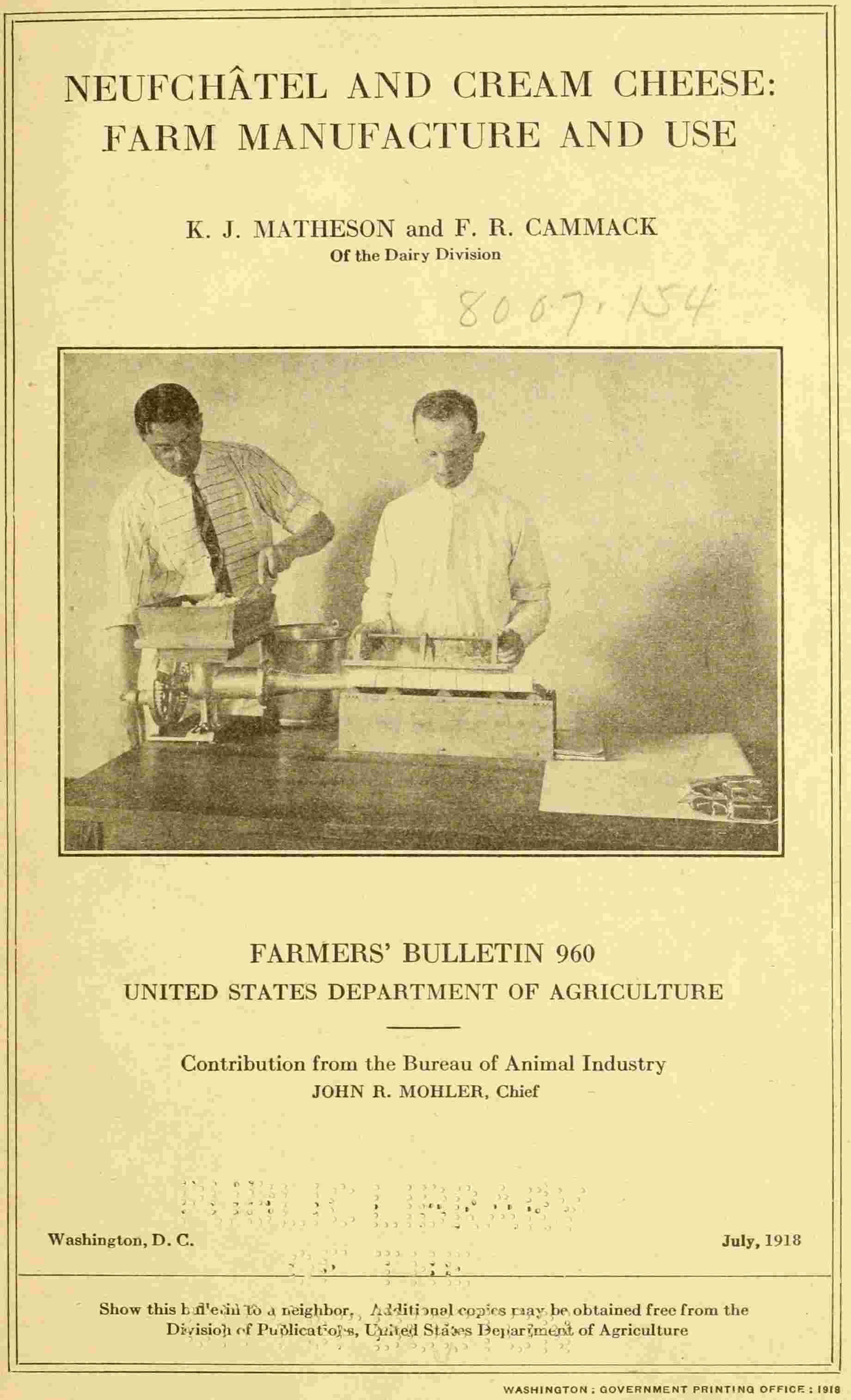
EQUIPMENT FOR MAKING NEUFCHÂTEL AND CREAM CHEESES.
Little equipment is needed for making these cheeses for home consumption, and many satisfactory substitutes may be found for that mentioned. When the cheese is marketed on a large scale a greater outlay is desirable in order to handle it efficiently.
Floating dairy thermometer.—The use of a reliable and accurate thermometer is imperative if uniform results are to be obtained. A thermometer of this kind is not expensive, and when not in use should always be kept in the case.
Starter bottles.—Pint milk bottles, which may be covered with glass tumblers, are needed for holding the starter, although the size of the containers depends, of course, upon the quantity of cheese made. Pint fruit jars also can be used; and may be covered with bowls.
Shotgun cans.—These cans are usually 9 inches in diameter, 20 inches high, and hold about 4 gallons of milk. For work on a small scale a 10-quart, heavily tinned or enameled pail may be used satisfactorily.
Rennet and pepsin.—Commercial liquid rennet and powdered pepsin have been found to be satisfactory curdling agents. Fresh junket tablets also produce good results.
Milk agitator.—A stirrer is desirable to cause a uniform distribution of rennet or starter and to aid in preventing a too rapid rising of the cream. A long-handled spoon may be used if only a small quantity of cheese is made.
Draining rack.—The rack shown in figure 1 is rectangular, 13 inches wide, 36 inches long, and 10 inches deep. The corner posts extend 1½ inches beyond the strips at top and bottom, with the top rounded, so that a ring may fit over them. The bottom slats fit loosely into notches and are removable for washing purposes. The materials required are 4 corner posts 1½ by 1½ by 10 inches, 9 strips 1 by ⅜ by 36 inches, and 6 strips 1 by ⅜ by 12¼ inches, notched to receive bottom slats, all made of pine. A cloth is fastened upon each frame and the contents of one can poured upon each cloth. For small-scale operations an orange crate or a boiler or pail may serve the same purpose.
Drain cloth.—Unbleached cotton sheeting is recommended for this purpose. A fine-meshed cloth gives strength and aids in preventing losses of fat and casein. The size of the cloth depends upon the nature of the draining rack. Each cloth should be 45 inches long and a yard wide, with the ends hemmed. After use each should be quickly and carefully washed and dried in order to increase the period of its usefulness.
Press.—If a screw press is available, its use is to be recommended. A 50 or 60 pound weight, such as a can of water or bucket of stones, left upon the curd overnight usually proves to be satisfactory. (See figs. 2 and 3.)
Curd worker.—For small-scale operations a bread mixer or a potato masher may be used to give the curd proper consistence and to incorporate the salt. When working on a larger scale a butterworker or food chopper will serve the same purpose. Food chopper.—A food chopper with special attachments and a hopper are essential for molding the cheese into the desired forms. Depending upon the quantity of cheese handled, satisfactory food choppers may be obtained in three sizes, costing about $2, $5, and $8.50. (See fig. 8.) The smaller machines may be used in handling Neufchâtel and pimiento-cream cheese, but cream cheese requires the large size for making the customary flat packages. The large machine is to be recommended if the weekly output of cheese amounts to a few hundred pounds, although the medium-sized machine would probably do the work as effectively, only more slowly and with more labor.
Cheese hopper.—The hopper consists of an open box 3 inches deep, made of maple, with sides sloping outward about half an inch. The box has a hole in the bottom 3⅛ by 3⅝ inches. To the bottom of the box a board five-eighths of an inch thick is screwed, which has a hole corresponding to that of the box. The hopper is fastened to the food chopper by means of a beveled strip of wood and button, as indicated in figure 9. The base of the box will probably have to be grooved in order to allow the wheel to turn without friction. The materials required are (1) two quadrangular-shaped pieces of wood 3 inches high, five-eighths of an inch in thickness, and whose tops measure 9⅜ inches and the bottoms 8 inches; (2) two pieces of similar shape, except that the tops measure 11½ inches and the bases 10¼ inches; (3) one piece 10⅞ inches long, 10⅛ inches wide, and three-quarters of an inch thick; (4) one piece 9⅜ inches long, 7 inches wide, and three-quarters of an inch thick: and (5) one piece 7 inches long, 4⅜ inches wide, and five-eighths of an inch thick.
Neufchâtel attachment.—The attachment for molding Neufchâtel and pimiento-cream cheeses consists of a tin form having a conical shape with a tube attached. The cone has a 2¼-inch base which gradually tapers down to a tube whose diameter is 1½ inches. (See fig. 10.) The distance from the base of the cone to the tube attached is 3¼ inches: the tube is about 5 inches long. A vertical lip about one-quarter of an inch across makes it possible to connect the tube to the food chopper; the attachment fits into the ring of the chopper.
Cream-cheese attachment.—The cream-cheese attachment consists of a ring to which a rectangular-shaped molding tube is soldered. (See fig. 10.) The base of the tube is 2⅛ inches wide and fifteen-sixteenths of an inch thick. The delivery end of the tube, which is 2⅛ inches wide and three-quarters of an inch thick, is cut back one-third of an inch at each corner and V-shaped pieces of tin removed. The lips of the tube are then drawn together until there is about one-sixteenth of an inch of free space at each corner.
Belt conveyer.—The belt conveyer used in removing the cheese as it leaves the attachment is shown in fig. 11. It is a rectangular-shaped box, 20 inches long, 6 inches wide, and 4¾ inches deep, with the ends and top removed. Five bearings fit into the notches on one side and holes on the other side in two strips of iron fastened to the upper edges of the two open ends of the box. A 3½-inch canvas belt runs snugly though not tightly upon the rollers. The materials required are two pieces of maple 4¾ inches wide, one-half inch thick and 20 inches long; four oak rollers 4⅜ inches long and 1¾ inches in diameter; one oak roller 4⅜ inches long and 1½ inches in diameter. The rollers have a one-sixteenth-inch clearance and are beveled one-eighth of an inch from bearing to outer face. In addition, two 20-inch strips of galvanized iron 1 inch wide and one-eighth of an inch thick are needed. In both ends of one of these strips of iron there are four outward-slanting notches which are one-half inch deep and one-eighth inch wide, and evenly spaced between the ends there are three additional vertical notches of the same size. There are 11 one-eighth-inch holes in the second iron strip, corresponding to, parallel with, and of the same height as the bottom of the notches of the first strip. The boards and strips of iron are joined together by means of screws.
Cheese cutter.—A cheese cutter consists of a rectangular framework of poplar over which 7 fine wires are drawn. (See fig. 12.) The wires are fastened by means of iron pegs or screws to the outer edge of two half-inch strips 15 inches long. The strips are 5 inches apart, parallel, and are supported by 3 vertical pieces of wood 5 inches long, 3 inches wide, and one-half inch thick. Each of these supports is hollowed out in order to give plenty of space for cutting the cheese. The vertical supports are held in place by means of a single flat strip 13¾ inches long, seven-eighths inch wide, and one-quarter inch thick. The wires are placed 2½ inches apart and the supports 6¾ inches apart. All connections are made with 1-inch screws.
Tin-foil paper.—Tin foil covered with parchment paper is generally used to wrap the cheese (cream or Neufchâtel), although of late aluminum foil has been used quite extensively. The dimensions of the foil are 4½ by 6 inches, and it is purchased by the pound.