
SUMMARY OF DIRECTIONS.
The following outline for making the Neufchâtel group of cheeses is based on 30 pounds or 3½ gallons of milk.
Except as noted, the process is the same for Neufchâtel as for cream cheese. For Neufchâtel cheese use whole milk that tests 4 per cent, and for cream cheese use milk standardized to 6 per cent.
If it is desired to pasteurize, heat the milk to 145° F., hold at that temperature for 30 minutes, then cool to 80° F. for Neufchâtel and 83° F. for cream cheese. If the milk is pasteurized, a starter must be added.
Add half a pint of a good starter or clean-flavored sour milk and stir well. Rennet is then added at the rate of one-third of a cubic centimeter (about eight drops), diluted in a cup of cold water, stirred in thoroughly, and the milk set aside to curdle. In place of rennet, powdered pepsin (one-half the size of a pea) dissolved in a cup of cold water, or one-third of a junket tablet dissolved in a like quantity of water, may be added. In making cream cheese it is advisable to use a very slightly larger quantity of the curdling agent than for Neufchâtel.
If the milk is not pasteurized, warm or cool it to the temperatures mentioned above, add starter and rennet as described, and set away to curdle.
If starter is not used, the milk is set away for several hours, at the temperature described, before the rennet or other curdling agent is added. After thoroughly stirring, the milk is set away at the same temperature to curdle. In either process the time necessary for proper curdling is from 16 to 18 hours. It is often convenient to set the milk to curdle overnight.
Pour the coagulum or curdled milk upon the drain cloth and allow it to drain from 2 to 4 hours, or until practically no whey drips from the cloth and the curd is comparatively dry.
Scrape the curd toward the center of the cloth and tie the diagonal corners of the cloth together to facilitate handling.
If ice is available place the bag of curd in crushed ice and leave it for 3 hours or longer. If ice is not available allow the curd to drain an extra hour or more.
Place the bag of curd between two clean boards, put a 50-pound weight upon it, and let it stand. Pressing should cease when there is a yield of about 4½ pounds of Neufchâtel or about 5½ pounds of cream cheese. This will take about 6 or 8 hours. If a cider or other screw press is available the time required for pressing is about 1½ hours.
Remove the curd from the cloth into a pail, sprinkle two level tablespoonfuls of fine salt over the curd, and thoroughly mix with a potato masher until it has a smooth, buttery consistence. Running the cheese through a food chopper or working it with a butterworker produces the same result.
Place the cheese in a crock or enameled dish until ready for use.
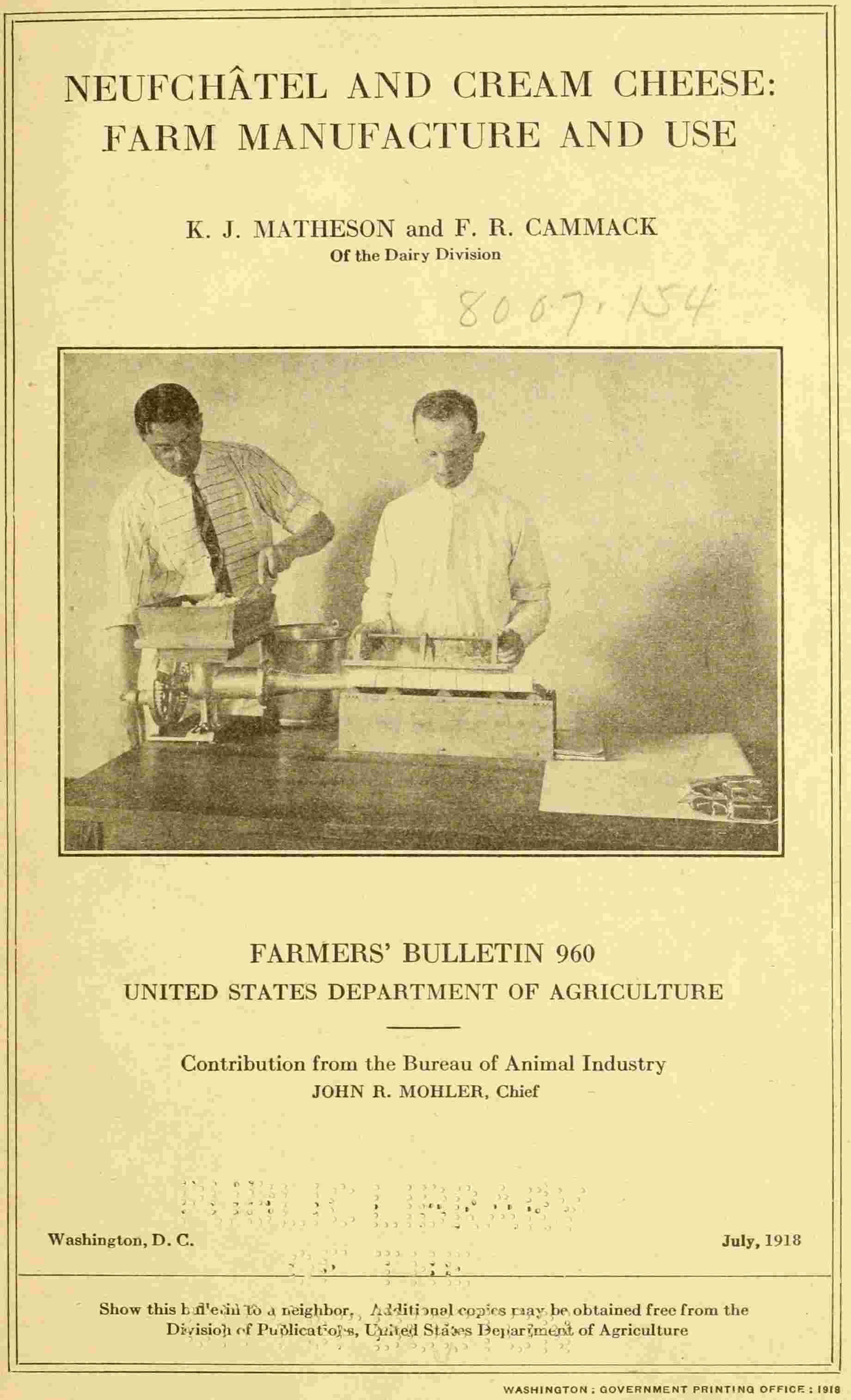
Mold the cheese into commercial packages by means of the food chopper, special attachment, and cheese cutter.
Wrap in tin foil or aluminum foil, or pack in glass jars.
Keep the cheese at a temperature of 50° F. or below until consumed. At that temperature Neufchâtel and cream cheese should keep from 6 to 12 days, and pimiento-cream cheese should keep nearly a month.