
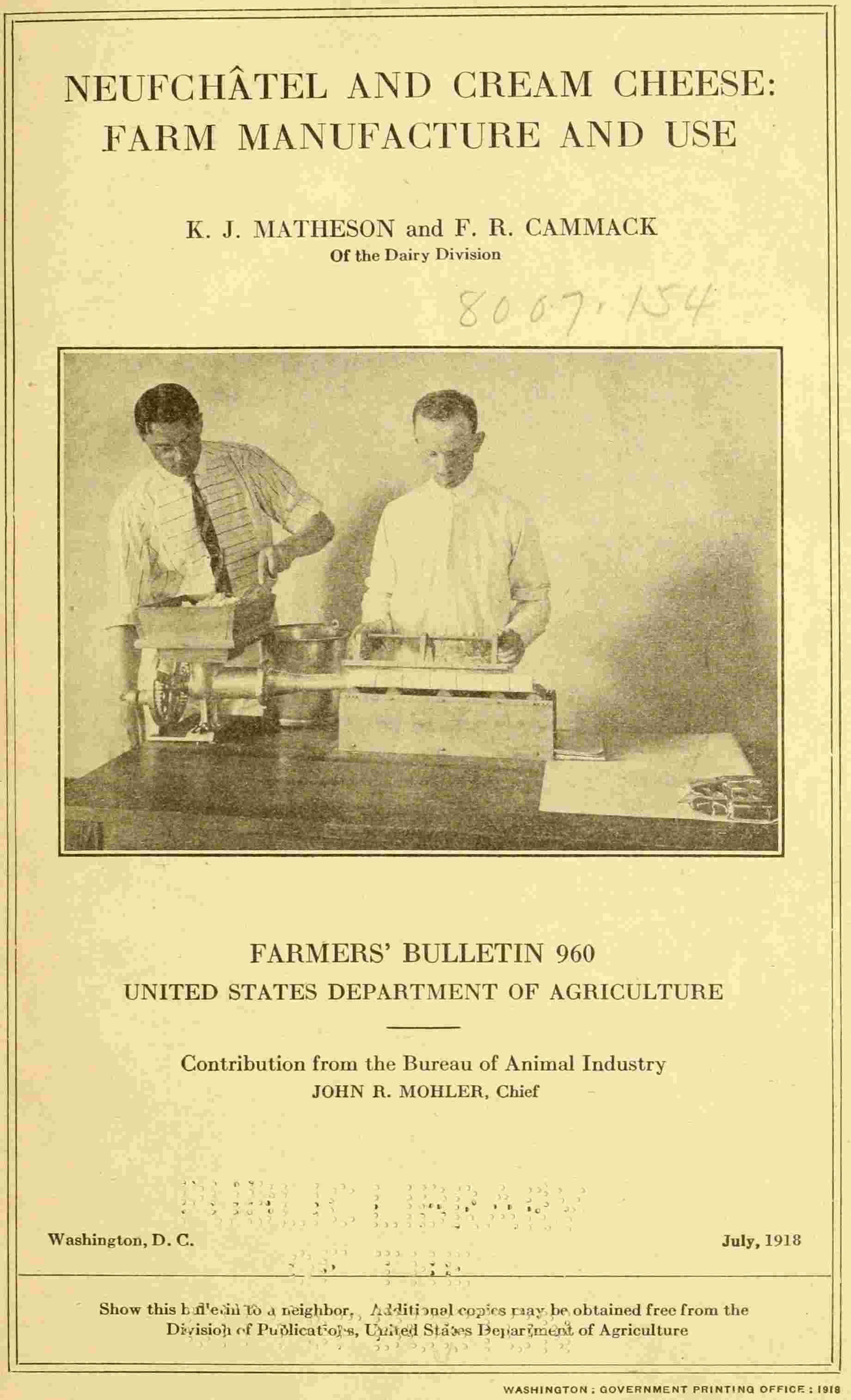
THE MANUFACTURE OF NEUFCHÂTEL AND CREAM CHEESE.
In this bulletin the production of the Neufchâtel group of cheese is considered from two points of view, (1) for home consumption and (2) for marketing on a small scale.
QUALITY OF MILK.
The quality of milk is the first consideration in the production of good Neufchâtel or cream cheese. Milk which is sour or has undergone any abnormal fermentation should not be used. By the use of fresh, unripened milk without any perceptible change in the acidity, the normal fermentations which are necessary for cheese of high quality can be controlled. Milk for cheesemaking should not be allowed to absorb any odors or taints, and the garlic flavor, especially, should be guarded against.
CLEAN UTENSILS.
Cleanliness of utensils is another essential in producing cheese of high quality. The following system is advised in washing milk and cheese utensils:
- After using, rinse with cold water.
- Wash with hot water to which a washing powder has been added. Always use a brush.
- Rinse in hot water at a temperature above 150° F.
- Steam or immerse in boiling water for five minutes.
- Do not dry the utensils with a cloth but place them in a clean place free from dust.
RIPENING THE MILK.
The cheese is made by allowing the acid and rennet, or other curdling agent, to act simultaneously upon the milk. If great care has been used in the production and subsequent handling of the milk, the cheese may be made by adding rennet and allowing the milk to sour normally. A rather rapid development of acid is most desirable, as this tends to eliminate undesirable flavors, hastens the making process, and prevents losses of the curd. The lack of uniformity in ripening often requires a more definite means of controlling the acid fermentation, which may be accomplished by the use of a “starter.”
THE USE OF STARTERS.
A “starter” is a quantity of milk that has soured and which contains large numbers of acid-forming bacteria. If the cheese is made in small quantities for home consumption, a starter is probably not advisable. The advantages of a starter over the natural souring are:
- It hastens the coagulation of the milk.
- It suppresses undesirable fermentations that may cause excessive losses of fat and curd.
- It aids in suppressing undesirable flavors and produces more uniform cheese.
A starter of Bacillus bulgaricus may be used instead of the ordinary lactic-acid starter, but it is recommended only when there is a special demand for it.
STANDARDIZING THE MILK.
In making cream cheese for the market, milk testing about 6 per cent butterfat is most satisfactory. With 4 per cent milk available, if one-third of the quantity is run through a cream separator and the cream added to the remaining two-thirds, milk testing approximately 6 per cent is obtained. If the milk tests only 3 per cent it will be necessary to separate one-half of the quantity and add the cream to the remaining half. This method gives satisfactory results for home manufacture, but for more extensive operations it is advisable to use a Babcock tester in order to standardize the milk accurately.
The following diagram illustrates an easy method of determining the proportions of milk and cream of different per cent of fat needed to make up 6 per cent milk:
34 per cent cream. 2 parts cream.
The desired per cent of fat in the milk, in this case 6, is placed in the center of the square. At the upper left-hand corner the per cent of fat in the available cream is placed, in this instance 34. Immediately below, in the lower left-hand corner, the per cent of fat in the available milk is placed, which in the instance cited is 4. Next subtract diagonally across the square the smaller from the larger numbers and place the differences in the upper and lower right-hand corners respectively. In the upper right-hand corner 2 represents the number of parts of 34 per cent cream, and in the lower right-hand corner 28 represents the number of parts of 4 per cent milk necessary to make 6 per cent milk. If it is desired to make up a definite quantity of 6 per cent milk, for example, 60 pounds, the procedure is as follows: 2 added to 28 makes a total of 30 parts of 6 per cent milk. The quantity of 34 per cent cream necessary is 2/30 × 60, or 4 pounds, while the quantity of 4 per cent milk is 28/30 × 60, or 56 pounds.
PASTEURIZATION.
It is not always practicable to pasteurize the milk to make cheese for home use, but if the cheese is to be marketed it is very desirable to do so. When milk is pasteurized for cheesemaking it becomes absolutely essential to use a “starter” to obtain uniform results. It is advisable, also, to use the milk as soon as possible after pasteurization. Ordinarily, pasteurization is accomplished by heating the milk in a pail, can, or vat to a temperature of 145° F., and holding at that temperature for 30 minutes, after which it should be quickly cooled to 80° F. before adding the starter for ripening. The advantages of pasteurization are as follows:
- It destroys disease-producing organisms.
- It tends to reduce losses and increase the yield.
- It aids in eliminating undesirable flavors.
- Quality of cheese is more nearly uniform from day to day.
MAKING THE CHEESE.
The process described is identical for Neufchâtel and cream cheese, except for a few minor differences which will be mentioned.
Setting.—Unless otherwise noted, 30 pounds, or about 3½ gallons of milk, is the unit used in these directions; that quantity can be handled conveniently in a shotgun can. For smaller quantities any enameled or heavily tinned pail is satisfactory.
If a starter is added, it is advisable to use a quantity equal to 1 or 1½ per cent of the milk; while smaller quantities may be used, the proportions suggested are usually the most satisfactory.
Neufchâtel is made from ordinary milk, while the cream cheese requires milk containing about 6 per cent of butterfat. Milk for Neufchâtel is warmed to 80° F., and one-half pint of starter is added and thoroughly stirred in with a long-handled spoon or milk agitator. Then 8 or 10 drops of commercial liquid rennet, diluted in half a cupful of cold water, is added to the mixture, thoroughly stirred, and the can of milk set away to coagulate at 80° F. Powdered pepsin, which is cheaper than rennet, may be used instead, in which case a quantity equal to one-half of a medium-sized pea, dissolved in a cupful of cold water, is used. Fresh junket tablets also may be substituted for rennet. One tablet is dissolved in 10 tablespoonfuls of cold water and 3 tablespoonfuls of the solution used. For cream cheese a slightly larger quantity of the curdling agent is desirable. For cream cheese the milk is warmed to 83° F., the process being the same in other respects. When starter is not used in making either kind of cheese, the process is unchanged except that after thoroughly stirring the milk it is set away, at the temperature described, for several hours before the rennet or other curdling agent is added.
After the milk has been set away to coagulate it should be kept as nearly as possible at the same temperature. Under normal conditions, after about 15 or 18 hours, about one-half inch of whey collects upon the surface of the curd or coagulum; on the top of the whey a scum of fine white curd particles sometimes collects. This formation of whey indicates a normal fermentation. When the fermentation is abnormal, the coagulum is more or less convex, puffed, or inflated, and there is little, if any, whey on the surface.
A gassy fermentation of the curd does not necessarily render a cheese unfit for consumption; but for best results, both as to flavor and economy in handling, that condition should be prevented. Under ideal conditions the milk usually begins to coagulate in the course of a few hours, but is allowed to stand undisturbed for from 15 to 18 hours. It is advisable to set it so that the curdling occurs during the night, and if the cans are not provided with covers they should be covered with a close-meshed cheesecloth in order to exclude dirt.
Draining.—After the setting period, when whey has collected upon the surface of the coagulum, or when the milk is firmly clabbered, the contents of the can or pail are poured upon a strong drain cloth. (See fig. 1.) The can may be shaken slightly before pouring, in order to loosen any curd which has a tendency to adhere to the sides or bottom. Unbleached cotton sheeting, which can be obtained in yard widths, has proved to be the most satisfactory material for drain cloths. For a small-scale operation the cloth may be thrown over a pail, can, or wash boiler and the ends tied securely about the draining receptacle. The curd or coagulum should remain undisturbed in the cloth for 3 or 4 hours, after which it should be worked toward the center of the cloth in order to hasten the draining and get it in better condition for handling. Drainage is allowed to continue until most of the visible whey has escaped and the curd appears rather dry as compared with its former mushy condition. Then the four corners of the cloth should be drawn diagonally across and tied. For home consumption, and especially when it is not cooled, the curd should be allowed to drain for a longer time before pressing.
Cooling the curd.—While the cooling of the curd is very desirable, it is not absolutely necessary. The object of cooling is to facilitate the more rapid expulsion of whey during pressing. Cooling also seems to harden the curd so that it does not pass so readily into the meshes of the drain cloth and thereby interfere with and retard the expulsion of the whey. The bags of curd are placed on ice, or cracked ice is placed about them and left for a few hours.
Pressing.—After cooling, several bags of the curd are piled together between two boards and a weight of 50 pounds placed on top. (See fig. 2.) Frequent rearrangement of the bags will hasten the process. After this weight has been left on the cheese overnight, the curd should be in flat cakes. For Neufchâtel it is preferable to press the curd from 30 pounds of milk until the pressed curd weighs 4½ pounds, while for cream cheese it should weigh about 5½ pounds. Special care should be taken in determining the yield of cheese in order to obtain a uniform quality from day to day, which can be done by weighing the curd. The manner and length of time of pressing determines, in a large measure, the texture of the cheese. By using a screw press the curd may become too dry and gummy, but under ordinary conditions there is little danger if improvised equipment is used. (See fig. 3.)
Working and salting.—After having been properly pressed the cakes of curd are salted and worked with a potato masher or butterworker, or run through a food chopper to produce a smooth, buttery consistence.
Fine, dry salt is sprinkled over the curd at the rate of about 2 or 2½ ounces to 10 pounds of curd, or about two level tablespoonfuls to the curd from 30 pounds of milk. (See fig. 4.) The quantity of salt may be varied to suit the individual taste; the quantities recommended, however, usually give the best satisfaction. If the curd is worked with a potato masher the addition of salt aids in obtaining the proper smoothness of the cheese.
When cheese is made for home consumption it may be placed in a glazed crock or porcelain dish immediately after salting and held at a temperature as near 50° F. as possible until consumed. Under favorable conditions it will keep in good condition for from 6 to 12 days. When cheese is kept a few days at a temperature of 60° to 70° F., it will become disagreeably sour. It is most palatable immediately after it is made, for then it is fresh, soft, and sweet. When very cold, or after having been kept for some time, it does not have so fine a flavor.
Combinations with Neufchâtel and cream cheeses.—Finely chopped pimiento peppers may be mixed with either Neufchâtel or cream cheese at the time of salting. Such cheese has a mild though pronounced flavor and is very popular for sandwiches and salads. The pimientos seem to have a certain preservative effect and tend to cover up “off flavors” that may develop. About 1 pound of the chopped pimientos is added to 12 pounds of cheese, or about one-half pound for the cheese from 30 pounds of milk.
While there are numerous other cream-cheese combinations, there are two that are worthy of especial note—olive-pimiento cream and Roquefort cream cheese. Both of these flavoring ingredients should be added at the rate of 1 part to 10 parts of cream cheese. When Roquefort cheese is uniformly incorporated with cream cheese it gives to the combination a rich and pleasing flavor very similar to Roquefort cheese, though milder.
Molding.—Cheese for home consumption need not be molded. When marketed a special device is necessary in order to shape the cheese into a commercial package. Neufchâtel, cream, and pimiento cheeses require a special style of package. While there are numerous devices for molding, many of them are not suited for meeting market demands. As a result of considerable experimenting the attachments described below were devised to fit the ordinary food chopper and proved to be very satisfactory for handling the several kinds of cheese.
For molding small quantities of cheese the following equipment is desirable: (See figs. 8 to 12.)
- A food chopper.
- A hopper.
- Two molding attachments for chopper.
- A cheese conveyer.
- A cheese cutter.
When used for molding, both the knives and the plate should be removed from the chopper; otherwise the cheese will go through with great difficulty. The cheese hopper is a boxlike arrangement clamped to the top of the food chopper to prevent the scattering of particles of cheese upon the worktable. The cheese is poured into the hopper at short intervals, since it is not advisable to keep the hopper more than half full, or the feed screw will not force the cheese so readily through the hopper. If the hopper is full the cheese may become too “gummy” and will not only be difficult to force through the chopper, but will adhere to the long-handled spoon used to push the lumps of curd into the machine. It is advisable to use a spoon in order to keep one corner of the hopper free of the cheese and, by allowing the escape of air, facilitate the grinding of the cheese.
The lips of the molding attachment are fastened to the chopper by means of a ring. The attachment for molding Neufchâtel cheese is cylindrical and is about 1½ inches in diameter at its delivery end. The cheese, forced through this attachment, comes out in the form of a roll or cylinder.
Pimiento cheese is forced into a special glass jar smaller than a jelly glass or a paraffined wood-fiber container held horizontally over the end of the Neufchâtel attachment so that the cheese reaches the end of the container and flattens out without difficulty. (See fig. 5.) If the pimiento cheese is to be used in a short time, the wood-fiber containers are especially recommended, as they are less expensive than glass jars. If the cheese is marketed directly to the consumer, the glass jars may be returned and used again.
The attachment for cream cheese is rectangular at its delivery end. By its use the cheese may be molded into smooth, ribbonlike bands which, as in the case of Neufchâtel cheese, may be cut with a wire into pieces of the desired size.
The cheese is delivered from the attachment on a canvas conveyer, supported by rollers, which turn with sufficient friction to cause the plastic curd to be firmly pressed together as the cheese is automatically pushed forward. (See fig. 6.) The first cheese that passes through the attachment often “frills”; that is, it presents an irregular surface, but later the difficulty becomes less marked, and the cheese comes out with a surface well defined and smooth. “Frilling” occurs more often in molding cream cheese than in Neufchâtel.
Cutting the cheese.—Cream cheese and Neufchâtel cheese may be cut into cakes of the desired size by means of fine wires drawn over a rectangular-shaped framework. (See fig. 11.) The use of this simple equipment makes it possible to cut half a dozen cheeses simultaneously and prevents delay, so that one person may do the grinding while another cuts and wraps the cakes.
Wrapping the cheese.—After cutting the cakes they are slowly carried along by the carrier and eventually fall upon a flat form upon which tin-foil wrapping papers are laid. These papers may be held in place by a cleat or clamp. In many cases it is more convenient to take the cheese directly from the carrier, but when the person who does the wrapping is kept very busy the platform may serve as a place where several cakes may accumulate, thus allowing the grinding operations to be continued. While one person is engaged in filling the hopper and molding the cheese another is kept busy cutting and wrapping. In wrapping, the cheese is placed in the center of the paper, each side of the paper folded over, and the ends turned down, to cover the cheese completely. (See fig. 10.)
Yield.—One hundred pounds of milk containing 4 per cent fat should yield from 14 to 16 pounds of Neufchâtel cheese, while 6 per cent milk should give an average yield of from 17 to 19 pounds of cream cheese. With milk testing less than the above, a smaller yield and a lower grade of cheese will be obtained. Although there may be slight seasonal fluctuations in the solids of milk, yet for the most part the yield of cheese, other conditions being equal, is almost directly proportional to the per cent of fat. There may be variations in yield of cheese, however, due to mechanical factors, such as longer pressing.
Neufchâtel cheese is sometimes made from skim milk, in which case it is used for cooking and baking purposes. Commercially, there are other grades of Neufchâtel made from one-half or two-thirds skim milk. Such cheeses are labeled as made from “partially skimmed milk” or “skimmed milk” as the case may be.
Packages.—Tin-foil or aluminum-foil wrapping paper which has a parchment paper inside is generally used in wrapping cream and Neufchâtel cheeses, since it gives each package a bright, uniform, and attractive appearance. (See fig. 7.) Great care should be taken to wrap each cake neatly and securely in order to exclude the air as much as possible. Any “frilling” or other irregularities may be corrected by drawing the foil tightly about the cheese. Careful and skillful wrapping tends to increase the length of time the cheese is salable. The yellow or amber-colored mold which often spreads over the cheese should be prevented as much as possible, not because it may render the food harmful or poisonous, but because it causes deterioration and renders the cheese less appetizing.
The standard Neufchâtel package is cylindrical, about 1½ inches in diameter by 2½ inches long, and weighs about 2½ ounces net. Standard packages of cream cheese are about 3 by 2 inches and 1 inch thick, and have a net weight of about 3 ounces. The pimiento cheese is marketed in 3 or 4 ounce glass jars, each packed full and covered with a disk of paraffined paper and screw cap.