
The Project Gutenberg eBook of New Hampshire, A Poem; with Notes and Grace Notes
Title: New Hampshire, A Poem; with Notes and Grace Notes
Author: Robert Frost
Illustrator: Julius J. Lankes
Release date: January 4, 2019 [eBook #58611]
Language: English
Credits: Produced by Al Haines, Mark Akrigg, Stephen Hutcheson &
the online Distributed Proofreaders Canada team at
http://www.pgdpcanada.net
By ROBERT FROST
- A BOY’S WILL
- NORTH OF BOSTON
- MOUNTAIN INTERVAL
- SELECTED POEMS
- NEW HAMPSHIRE
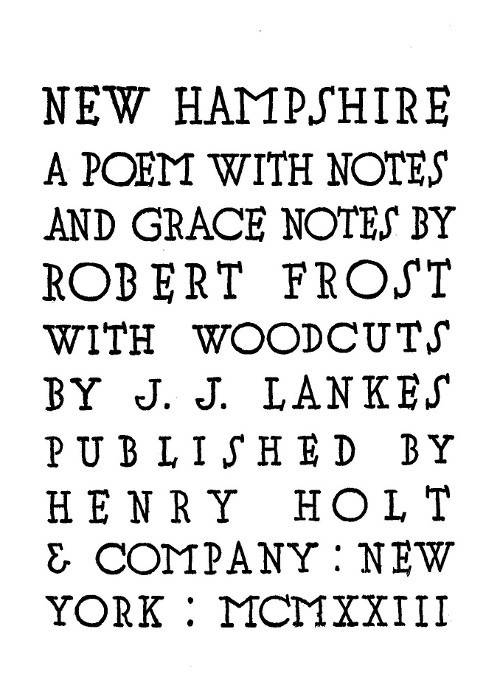
NEW HAMPSHIRE
A POEM WITH NOTES
AND GRACE NOTES BY
ROBERT FROST
WITH WOODCUTS
BY J. J. LANKES
PUBLISHED BY
HENRY HOLT
& COMPANY : NEW
YORK : MCMXXIII
Copyright, 1923
BY
HENRY HOLT AND COMPANY
First Printing, October, 1923
Second Printing, January, 1924
Third Printing, May, 1924
Fourth Printing, November, 1924
Fifth Printing, December, 1926
Sixth Printing, April, 1928
To
VERMONT AND MICHIGAN
CONTENTS
- PAGE
- NEW HAMPSHIRE
- New Hampshire 3
- NOTES
- A Star in a Stone-boat 21
- The Census-taker 24
- The Star-splitter 27
- Maple 31
- The Axe-helve 37
- The Grindstone 41
- Paul’s Wife 44
- Wild Grapes 49
- Place for a Third 53
- Two Witches 56
- I. The Witch of Coös 56
- II. The Pauper Witch of Grafton 61
- An Empty Threat 65
- A Fountain, a Bottle, a Donkey’s Ears and Some Books 67
- I Will Sing You One-O 73
- GRACE NOTES
- Fragmentary Blue 79
- Fire and Ice 80
- In a Disused Graveyard 81
- Dust of Snow 82
- To E. T. 83
- Nothing Gold Can Stay 84
- The Runaway 85
- The Aim was Song 86
- Stopping by Woods on a Snowy Evening 87
- For Once, Then, Something 88
- Blue-Butterfly Day 89
- The Onset 90
- To Earthward 91
- Good-Bye and Keep Cold 93
- Two Look at Two 95
- Not to Keep 97
- A Brook in the City 98
- The Kitchen Chimney 99
- Looking for a Sunset Bird in Winter 100
- A Boundless Moment 101
- Evening in a Sugar Orchard 102
- Gathering Leaves 103
- The Valley’s Singing Day 104
- Misgiving 105
- A Hillside Thaw 106
- Plowmen 108
- On a Tree Fallen Across the Road 109
- Our Singing Strength 110
- The Lockless Door 112
- The Need of Being Versed in Country Things 113
NEW HAMPSHIRE
NEW HAMPSHIRE
I met a lady from the South who said
(You won’t believe she said it, but she said it):
“None of my family ever worked, or had
A thing to sell.” I don’t suppose the work
Much matters. You may work for all of me.
I’ve seen the time I’ve had to work myself.
The having anything to sell[1] is what
Is the disgrace in man or state or nation.
I met a traveller from Arkansas
Who boasted of his state as beautiful
For diamonds and apples. “Diamonds
And apples in commercial quantities?”
I asked him, on my guard. “Oh yes,” he answered,
Off his. The time was evening in the Pullman.
“I see the porter’s made your bed,” I told him.
I met a Californian who would
Talk California—a state so blessed,
He said, in climate none had ever died there
A natural death, and Vigilance Committees
Had had to organize to stock the graveyards
And vindicate the state’s humanity.
“Just the way Steffanson runs on,” I murmured,
“About the British Arctic. That’s what comes
Of being in the market with a climate.”
I met a poet from another state,
A zealot full of fluid inspiration,
Who in the name of fluid inspiration,
But in the best style of bad salesmanship,
Angrily tried to make me write a protest
(In verse I think) against the Volstead Act.
He didn’t even offer me a drink
Until I asked for one to steady him.
This is called having an idea to sell.
It never could have happened in New Hampshire.
The only person really soiled with trade
I ever stumbled on in old New Hampshire
Was someone who had just come back ashamed
From selling things in California.
He’d built a noble mansard roof with balls
On turrets like Constantinople, deep
In woods some ten miles from a railroad station,
As if to put forever out of mind
The hope of being, as we say, received.
I found him standing at the close of day
Inside the threshold of his open barn,
Like a lone actor on a gloomy stage—
And recognized him through the iron grey
In which his face was muffled to the eyes
As an old boyhood friend, and once indeed
A drover with me on the road to Brighton.
His farm was “grounds,” and not a farm at all;
His house among the local sheds and shanties
Rose like a factor’s at a trading station.
And he was rich, and I was still a rascal.
I couldn’t keep from asking impolitely,
Where had he been and what had he been doing?
How did he get so? (Rich was understood.)
In dealing in “old rags” in San Francisco.
Oh it was terrible as well could be.
We both of us turned over in our graves.
Just specimens is all New Hampshire has,
One each of everything as in a show-case
Which naturally she doesn’t care to sell.
She had one President (pronounce him Purse,
And make the most of it for better or worse.
He’s your one chance to score against the state).
She had one Daniel Webster. He was all
The Daniel Webster ever was or shall be.
She had the Dartmouth needed to produce him.
I call her old. She has one family
Whose claim is good to being settled here
Before the era of colonization,
And before that of exploration even.
John Smith remarked them as he coasted by
Dangling their legs and fishing off a wharf
At the Isles of Shoals, and satisfied himself
They weren’t Red Indians but veritable
Pre-primitives of the white race, dawn people,
Like those who furnished Adam’s sons with wives;
However uninnocent they may have been
In being there so early in our history.
They’d been there then a hundred years or more.
Pity he didn’t ask what they were up to
At that date with a wharf already built,
And take their name. They’ve since told me their name—
Today an honored one in Nottingham.
As for what they were up to more than fishing—
Suppose they weren’t behaving Puritanly,
The hour had not yet struck for being good,
Mankind had not yet gone on the Sabbatical.
It became an explorer of the deep
Not to explore too deep in others’ business.
Did you but know of him, New Hampshire has
One real reformer who would change the world
So it would be accepted by two classes,
Artists the minute they set up as artists,
Before, that is, they are themselves accepted,
And boys the minute they get out of college.
I can’t help thinking those are tests to go by.
And she has one I don’t know what to call him,
Who comes from Philadelphia every year
With a great flock of chickens of rare breeds
He wants to give the educational
Advantages of growing almost wild
Under the watchful eye of hawk and eagle—
Dorkings because they’re spoken of by Chaucer,
Sussex because they’re spoken of by Herrick.
She has a touch of gold. New Hampshire gold—[2]
You may have heard of it. I had a farm
Offered me not long since up Berlin way
With a mine on it that was worked for gold;
But not gold in commercial quantities.
Just enough gold to make the engagement rings
And marriage rings of those who owned the farm.
What gold more innocent could one have asked for?
One of my children ranging after rocks
Lately brought home from Andover or Canaan
A specimen of beryl with a trace
Of radium. I know with radium
The trace would have to be the merest trace
To be below the threshold of commercial,
But trust New Hampshire not to have enough
Of radium or anything to sell.
A specimen of everything, I said.
She has one witch—old style.[3] She lives in Colebrook.
(The only other witch I ever met
Was lately at a cut-glass dinner in Boston.
There were four candles and four people present.
The witch was young, and beautiful (new style),
And open-minded. She was free to question
Her gift for reading letters locked in boxes.
Why was it so much greater when the boxes
Were metal than it was when they were wooden?
It made the world seem so mysterious.
The S’ciety for Psychical Research
Was cognizant. Her husband was worth millions.
I think he owned some shares in Harvard College.)
New Hampshire used to have at Salem
A company we called the White Corpuscles,
Whose duty was at any hour of night
To rush in sheets and fool’s caps where they smelled
A thing the least bit doubtfully perscented
And give someone the Skipper Ireson’s Ride.
One each of everything as in a show-case.
More than enough land for a specimen
You’ll say she has, but there there enters in
Something else to protect her from herself.
There quality[4] makes up for quantity.
Not even New Hampshire farms are much for sale.
The farm I made my home on in the mountains
I had to take by force rather than buy.
I caught the owner outdoors by himself
Raking up after winter, and I said,
“I’m going to put you off this farm: I want it.”
“Where are you going to put me? In the road?”
“I’m going to put you on the farm next to it.”
“Why won’t the farm next to it do for you?”
“I like this better.” It was really better.
Apples? New Hampshire has them, but unsprayed,
With no suspicion in stem-end or blossom-end
Of vitriol or arsenate of lead,
And so not good for anything but cider.
Her unpruned grapes are flung like lariats
Far up the birches out of reach of man.[5]
A state producing precious metals, stones,
And—writing; none of these except perhaps
The precious literature in quantity
Or quality to worry the producer
About disposing of it. Do you know,
Considering the market, there are more
Poems produced than any other thing?[6]
No wonder poets sometimes have to seem
So much more business-like than business men.
Their wares are so much harder to get rid of.
She’s one of the two best states in the Union.
Vermont’s the other. And the two have been
Yoke-fellows in the sap-yoke from of old
In many Marches.[7] And they lie like wedges,
Thick end to thin end and thin end to thick end,
And are a figure of the way the strong
Of mind and strong of arm should fit together,
One thick where one is thin and vice versa.
New Hampshire raises the Connecticut
In a trout hatchery near Canada,
But soon divides the river with Vermont.
Both are delightful states for their absurdly
Small towns—Lost Nation, Bungey, Muddy Boo,
Poplin, Still Corners (so called not because
The place is silent all day long, nor yet
Because it boasts a whisky still—because
It set out once to be a city and still
Is only corners, cross-roads in a wood).
And I remember one whose name appeared
Between the pictures on a movie screen
Election[8] night once in Franconia,
When everything had gone Republican
And Democrats were sore in need of comfort:
Easton goes Democratic, Wilson 4
Hughes 2. And everybody to the saddest
Laughed the loud laugh, the big laugh at the little.
New York (five million) laughs at Manchester,
Manchester (sixty or seventy thousand) laughs
At Littleton (four thousand), Littleton
Laughs at Franconia (seven hundred), and
Franconia laughs, I fear,—did laugh that night—
At Easton. What has Easton left to laugh at,
And like the actress exclaim, “Oh my God” at?
There’s Bungey; and for Bungey there are towns,
Whole townships named but without population.[9]
Anything I can say about New Hampshire
Will serve almost as well about Vermont,
Excepting that they differ in their mountains.
The Vermont mountains stretch extended straight;
New Hampshire mountains curl up in a coil.
I had been coming to New Hampshire mountains.
And here I am and what am I to say?
Here first my theme becomes embarrassing.
Emerson said, “The God who made New Hampshire
Taunted the lofty land with little men.”
Another Massachusetts poet said,
“I go no more to summer in New Hampshire.
I’ve given up my summer place in Dublin.”
But when I asked to know what ailed New Hampshire,
She said she couldn’t stand the people in it,
The little men (it’s Massachusetts speaking).
And when I asked to know what ailed the people,
She said, “Go read your own books and find out.”
I may as well confess myself the author
Of several books against the world in general.
To take them as against a special state
Or even nation’s to restrict my meaning.
I’m what is called a sensibilitist,
Or otherwise an environmentalist.
I refuse to adapt myself a mite
To any change from hot to cold, from wet
To dry, from poor to rich, or back again.
I make a virtue of my suffering
From nearly everything that goes on round me.[10]
In other words, I know wherever I am,
Being the creature of literature I am,
I shall not lack for pain to keep me awake.
Kit Marlowe taught me how to say my prayers:
“Why this is Hell, nor am I out of it.”
Samoa, Russia, Ireland I complain of,
No less than England, France and Italy.
Because I wrote my novels in New Hampshire
Is no proof that I aimed them at New Hampshire.
When I left Massachusetts years ago
Between two days, the reason why I sought
New Hampshire, not Connecticut,
Rhode Island, New York, or Vermont was this:
Where I was living then, New Hampshire offered
The nearest boundary to escape across.
I hadn’t an illusion in my hand-bag
About the people being better there
Than those I left behind. I thought they weren’t.
I thought they couldn’t be. And yet they were.
I’d sure had no such friends in Massachusetts
As Hall of Windham, Gay of Atkinson,[11]
Bartlett of Raymond (now of Colorado),
Harris of Derry, and Lynch of Bethlehem.
The glorious bards of Massachusetts seem
To want to make New Hampshire people over.
They taunt the lofty land with little men.
I don’t know what to say about the people.
For art’s sake one could almost wish them worse[12]
Rather than better. How are we to write
The Russian novel in America
As long as life goes so unterribly?
There is the pinch from which our only outcry
In literature to date is heard to come.
We get what little misery we can
Out of not having cause for misery.
It makes the guild of novel writers sick
To be expected to be Dostoievskis
On nothing worse than too much luck and comfort.
This is not sorrow, though; it’s just the vapors,
And recognized as such in Russia itself
Under the new régime, and so forbidden.
If well it is with Russia, then feel free
To say so or be stood against the wall
And shot. It’s Pollyanna now or death.
This, then, is the new freedom we hear tell of;
And very sensible. No state can build
A literature that shall at once be sound
And sad on a foundation of wellbeing.
To show the level of intelligence
Among us; it was just a Warren farmer
Whose horse had pulled him short up in the road
By me, a stranger. This is what he said,
From nothing but embarrassment and want
Of anything more sociable to say:
“You hear those hound-dogs sing on Moosilauke?[13]
Well they remind me of the hue and cry
We’ve heard against the Mid-Victorians
And never rightly understood till Bryan
Retired from politics and joined the chorus.
The matter with the Mid-Victorians
Seems to have been a man named John L. Darwin.”[14]
“Go ’long,” I said to him, he to his horse.
I knew a man who failing as a farmer
Burned down his farmhouse for the fire insurance,
And spent the proceeds on a telescope[15]
To satisfy a life-long curiosity
About our place among the infinities.
And how was that for other-worldliness?
If I must choose which I would elevate—
The people or the already lofty mountains,
I’d elevate the already lofty mountains.
The only fault I find with old New Hampshire
Is that her mountains aren’t quite high enough.
I was not always so; I’ve come to be so.
How, to my sorrow, how have I attained
A height from which to look down critical
On mountains? What has given me assurance
To say what height becomes New Hampshire mountains,
Or any mountains? Can it be some strength
I feel as of an earthquake in my back
To heave them higher to the morning star?
Can it be foreign travel in the Alps?
Or having seen and credited a moment
The solid moulding of vast peaks of cloud
Behind the pitiful reality
Of Lincoln, Lafayette and Liberty?
Or some such sense as says how high shall jet
The fountain in proportion to the basin?
No, none of these has raised me to my throne
Of intellectual dissatisfaction,
But the sad accident of having seen
Our actual mountains given in a map
Of early times as twice the height they are—
Ten thousand feet instead of only five—
Which shows how sad an accident may be.
Five thousand is no longer high enough.
Whereas I never had a good idea
About improving people in the world,
Here I am over-fertile in suggestion,
And cannot rest from planning day or night
How high I’d thrust the peaks in summer snow
To tap the upper sky and draw a flow
Of frosty night air on the vale below
Down from the stars to freeze the dew as starry.
The more the sensibilitist I am
The more I seem to want my mountains wild;
The way the wiry gang-boss liked the log-jam.[16]
After he’d picked the lock and got it started,
He dodged a log that lifted like an arm
Against the sky to break his back for him,
Then came in dancing, skipping, with his life
Across the roar and chaos, and the words
We saw him say along the zigzag journey
Were doubtless as the words we heard him say
On coming nearer: “Wasn’t she an i-deal
Son-of-a-bitch? You bet she was an i-deal.”
For all her mountains fall a little short,
Her people not quite short enough for Art,
She’s still New Hampshire, a most restful state.
Lately in converse with a New York alec
About the new school of the pseudo-phallic,
I found myself in a close corner where
I had to make an almost funny choice.
“Choose you which you will be—a prude, or puke,
Mewling and puking in the public arms.”
“Me for the hills where I don’t have to choose.”[17]
“But if you had to choose, which would you be?”
I wouldn’t be a prude afraid of nature.
I know a man who took a double axe
And went alone against a grove of trees;
But his heart failing him, he dropped the axe
And ran for shelter quoting Matthew Arnold:
“Nature is cruel, man is sick of blood;
There’s been enough shed without shedding mine.
Remember Birnam Wood! The wood’s in flux!”
He had a special terror of the flux
That showed itself in dendrophobia.
The only decent tree had been to mill
And educated into boards, he said.
He knew too well for any earthly use
The line where man leaves off and nature starts,[18]
And never over-stepped it save in dreams.
He stood on the safe side of the line talking;
Which is sheer Matthew Arnoldism,
The cult of one who owned himself “a foiled,
Circuitous wanderer,” and “took dejectedly
His seat upon the intellectual throne.”
Agreed in frowning on these improvised
Altars the woods are full of nowadays,
Again as in the days when Ahaz sinned
By worship under green trees in the open.
Scarcely a mile but that I come on one,
A black-cheeked stone and stick of rain-washed charcoal.
Even to say the groves were God’s first temples
Comes too near to Ahaz’ sin for safety.
Nothing not built with hands of course is sacred.
But here is not a question of what’s sacred;
Rather of what to face or run away from.
I’d hate to be a runaway from nature.
And neither would I choose to be a puke
Who cares not what he does in company,
And, when he can’t do anything, falls back
On words, and tries his worst to make words speak
Louder than actions, and sometimes achieves it.
It seems a narrow choice the age insists on.
How about being a good Greek, for instance?
That course, they tell me, isn’t offered this year.
“Come, but this isn’t choosing—puke or prude?”
Well, if I have to choose one or the other,
I choose to be a plain New Hampshire farmer
With an income in cash of say a thousand
(From say a publisher in New York City).
It’s restful to arrive at a decision,
And restful just to think about New Hampshire.
At present I am living in Vermont.
NOTES
A STAR IN A STONE-BOAT
(For Lincoln MacVeagh)
Never tell me that not one star of all
That slip from heaven at night and softly fall
Has been picked up with stones to build a wall.
Some laborer found one faded and stone cold,
And saving that its weight suggested gold,
And tugged it from his first too certain hold,
He noticed nothing in it to remark.
He was not used to handling stars thrown dark
And lifeless from an interrupted arc.
He did not recognize in that smooth coal
The one thing palpable besides the soul
To penetrate the air in which we roll.
He did not see how like a flying thing
It brooded ant-eggs, and had one large wing,
One not so large for flying in a ring,
And a long Bird of Paradise’s tail,
(Though these when not in use to fly and trail
It drew back in its body like a snail);
Nor know that he might move it from the spot
The harm was done; from having been star-shot
The very nature of the soil was hot
And burning to yield flowers instead of grain,
Flowers fanned and not put out by all the rain
Poured on them by his prayers prayed in vain.
He moved it roughly with an iron bar,
He loaded an old stone-boat with the star
And not, as you might think, a flying car,
Such as even poets would admit perforce
More practical than Pegasus the horse
If it could put a star back in its course.
He dragged it through the ploughed ground at a pace
But faintly reminiscent of the race
Of jostling rock in interstellar space.
It went for building stone, and I, as though
Commanded in a dream, forever go
To right the wrong that this should have been so.
Yet ask where else it could have gone as well,
I do not know—I cannot stop to tell:
He might have left it lying where it fell.
From following walls I never lift my eye
Except at night to places in the sky
Where showers of charted meteors let fly.
Some may know what they seek in school and church,
And why they seek it there; for what I search
I must go measuring stone walls, perch on perch;
Sure that though not a star of death and birth,
So not to be compared, perhaps, in worth
To such resorts of life as Mars and Earth,
Though not, I say, a star of death and sin,
It yet has poles, and only needs a spin
To show its worldly nature and begin
To chafe and shuffle in my calloused palm
And run off in strange tangents with my arm
As fish do with the line in first alarm.
Such as it is, it promises the prize
Of the one world complete in any size
That I am like to compass, fool or wise.
THE CENSUS-TAKER
I came an errand one cloud-blowing evening
To a slab-built, black-paper-covered house
Of one room and one window and one door,
The only dwelling in a waste cut over
A hundred square miles round it in the mountains:
And that not dwelt in now by men or women
(It never had been dwelt in, though, by women,
So what is this I make a sorrow of?)
I came as census-taker to the waste
To count the people in it and found none,
None in the hundred miles, none in the house,
Where I came last with some hope, but not much
After hours’ overlooking from the cliffs
An emptiness flayed to the very stone.
I found no people that dared show themselves,
None not in hiding from the outward eye.
The time was autumn, but how anyone
Could tell the time of year when every tree
That could have dropped a leaf was down itself
And nothing but the stump of it was left
Now bringing out its rings in sugar of pitch;
And every tree up stood a rotting trunk
Without a single leaf to spend on autumn,
Or branch to whistle after what was spent.
Perhaps the wind the more without the help
Of breathing trees said something of the time
Of year or day the way it swung a door
Forever off the latch, as if rude men
Passed in and slammed it shut each one behind him
For the next one to open for himself.
I counted nine I had no right to count
(But this was dreamy unofficial counting)
Before I made the tenth across the threshold.
Where was my supper? Where was anyone’s?
No lamp was lit. Nothing was on the table.
The stove was cold—the stove was off the chimney—
And down by one side where it lacked a leg.
The people that had loudly passed the door
Were people to the ear but not the eye.
They were not on the table with their elbows.
They were not sleeping in the shelves of bunks.
I saw no men there and no bones of men there.
I armed myself against such bones as might be
With the pitch-blackened stub of an axe-handle
I picked up off the straw-dust covered floor.
Not bones, but the ill-fitted window rattled.
The door was still because I held it shut
While I thought what to do that could be done—
About the house—about the people not there.
This house in one year fallen to decay
Filled me with no less sorrow than the houses
Fallen to ruin in ten thousand years
Where Asia wedges Africa from Europe.
Nothing was left to do that I could see
Unless to find that there was no one there
And declare to the cliffs too far for echo
“The place is desert and let whoso lurks
In silence, if in this he is aggrieved,
Break silence now or be forever silent.
Let him say why it should not be declared so.”
The melancholy of having to count souls
Where they grow fewer and fewer every year
Is extreme where they shrink to none at all.
It must be I want life to go on living.
THE STAR-SPLITTER
“You know Orion always comes up sideways.
Throwing a leg up over our fence of mountains,
And rising on his hands, he looks in on me
Busy outdoors by lantern-light with something
I should have done by daylight, and indeed,
After the ground is frozen, I should have done
Before it froze, and a gust flings a handful
Of waste leaves at my smoky lantern chimney
To make fun of my way of doing things,
Or else fun of Orion’s having caught me.
Has a man, I should like to ask, no rights
These forces are obliged to pay respect to?”
So Brad McLaughlin mingled reckless talk
Of heavenly stars with hugger-mugger farming,
Till having failed at hugger-mugger farming,
He burned his house down for the fire insurance
And spent the proceeds on a telescope
To satisfy a life-long curiosity
About our place among the infinities.
“What do you want with one of those blame things?”
I asked him well beforehand. “Don’t you get one!”
“Don’t call it blamed; there isn’t anything
More blameless in the sense of being less
A weapon in our human fight,” he said.
“I’ll have one if I sell my farm to buy it.”
There where he moved the rocks to plow the ground
And plowed between the rocks he couldn’t move
Few farms changed hands; so rather than spend years
Trying to sell his farm and then not selling,
He burned his house down for the fire insurance
And bought the telescope with what it came to.
He had been heard to say by several:
“The best thing that we’re put here for’s to see;
The strongest thing that’s given us to see with’s
A telescope. Someone in every town
Seems to me owes it to the town to keep one.
In Littleton it may as well be me.”
After such loose talk it was no surprise
When he did what he did and burned his house down.
Mean laughter went about the town that day
To let him know we weren’t the least imposed on,
And he could wait—we’d see to him to-morrow.
But the first thing next morning we reflected
If one by one we counted people out
For the least sin, it wouldn’t take us long
To get so we had no one left to live with.
For to be social is to be forgiving.
Our thief, the one who does our stealing from us,
We don’t cut off from coming to church suppers,
But what we miss we go to him and ask for.
He promptly gives it back, that is if still
Uneaten, unworn out, or undisposed of.
It wouldn’t do to be too hard on Brad
About his telescope. Beyond the age
Of being given one’s gift for Christmas,
He had to take the best way he knew how
To find himself in one. Well, all we said was
He took a strange thing to be roguish over.
Some sympathy was wasted on the house,
A good old-timer dating back along;
But a house isn’t sentient; the house
Didn’t feel anything. And if it did,
Why not regard it as a sacrifice,
And an old-fashioned sacrifice by fire,
Instead of a new-fashioned one at auction?
Out of a house and so out of a farm
At one stroke (of a match), Brad had to turn
To earn a living on the Concord railroad,
As under-ticket-agent at a station
Where his job, when he wasn’t selling tickets,
Was setting out up track and down, not plants
As on a farm, but planets, evening stars
That varied in their hue from red to green.
He got a good glass for six hundred dollars.
His new job gave him leisure for star-gazing.
Often he bid me come and have a look
Up the brass barrel, velvet black inside,
At a star quaking in the other end.
I recollect a night of broken clouds
And underfoot snow melted down to ice,
And melting further in the wind to mud.
Bradford and I had out the telescope.
We spread our two legs as we spread its three,
Pointed our thoughts the way we pointed it,
And standing at our leisure till the day broke,
Said some of the best things we ever said.[19]
That telescope was christened the Star-splitter,
Because it didn’t do a thing but split
A star in two or three the way you split
A globule of quicksilver in your hand
With one stroke of your finger in the middle.
It’s a star-splitter if there ever was one
And ought to do some good if splitting stars
’Sa thing to be compared with splitting wood.
We’ve looked and looked, but after all where are we?
Do we know any better where we are,
And how it stands between the night to-night
And a man with a smoky lantern chimney?
How different from the way it ever stood?