
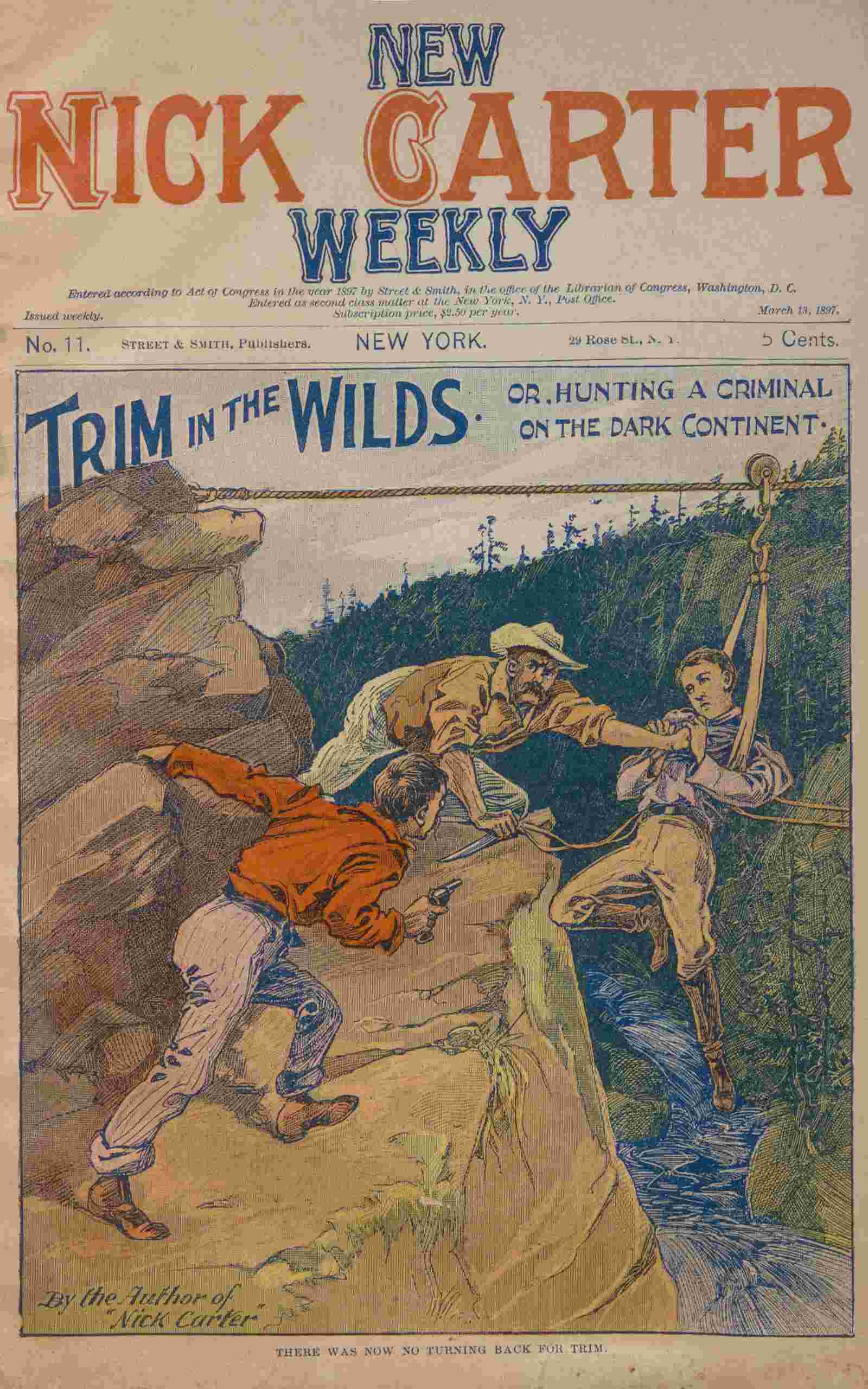
The Project Gutenberg eBook of New Nick Carter weekly, No. 11, March 13, 1897: Trim in the wilds; or, hunting a criminal on the dark continent
Title: New Nick Carter weekly, No. 11, March 13, 1897: Trim in the wilds; or, hunting a criminal on the dark continent
Author: Nicholas Carter
Release date: May 15, 2024 [eBook #73636]
Language: English
Original publication: New York: Street & Smith, 1897
Credits: David Edwards and the Online Distributed Proofreading Team at https://www.pgdp.net (This file was produced from images generously made available by The Internet Archive)
Entered according to Act of Congress in the year 1897 by Street & Smith, in the Office of the Librarian of Congress, Washington, D. C.
Entered as second class Matter at the New York, N. Y., Post Office.
Issued weekly. Subscription price, $2.50 per year. March 13, 1897.
No. 11. Street & Smith, Publishers. NEW YORK. 29 Rose St., N. Y. 5 Cents.
TRIM IN THE WILDS;
OR,
HUNTING A CRIMINAL ON THE DARK CONTINENT.
By the Author of “NICK CARTER.”
CHAPTER I.
THE KING OF THE NARUGAS.
“Well, young man, I think we can tell you where Miller has gone and that is about all the good it’ll do us or you either!”
“If I know where he is I can get him!”
“That’s what you Yankees call a bluff, isn’t it?”
“I’ll show my cards if you call my hand!” was the dry response.
“What do you mean by that?”
“I see that you have never played poker, chief. If you did you’d understand the meaning of the word bluff.
“I’m simply telling you if you think I’m bluffing all you’ve got to do is to give me a chance to show whether I mean what I say or not; and to make it perfectly plain I’ll say again that if you know where Miller is I shall be able to go and get him.”
Trim was in police headquarters at Kimberley, South Africa.
He was talking with the chief of police and the subject of their conversation was a plan that Trim had proposed for the capture of a dangerous criminal who was wanted, not only by the police of Kimberley, but of Cape Town also.
Trim had had two experiences with this criminal, whose name was Jemmy Miller.
In the first instance Miller, who was a steeple climber by trade, had attempted to murder Trim, and failing, had escaped capture at the time by the exercise of his wonderful skill in climbing.
An account of this matter has been published in “Trim in Cape Town,” No. 9 New Nick Carter Weekly.
Detective business had brought Trim to Kimberley, where he had exposed a gang of robbers who had obtained possession of a vast quantity of diamonds.
During the investigation of this matter he had again come across Miller and it was certain that the steeple climber was connected with the diamond thieves.
He had given them warning of Trim’s approach and while the young detective and the old sailor, who was his companion in Africa, were busy with other members of the gang, Miller had made good his escape.
After all the other members of the gang had been captured Trim had made up his mind that for his own satisfaction[Pg 2] he would undertake to put Miller behind the bars.
When he returned from an all-night chase after the last of the robbers, he told the chief of police that if his local detectives would make an effort to find in which direction Miller had gone he, Trim, would undertake to give chase and bring the fellow to justice.
The chief had willingly consented to this plan and on the following morning Trim called at headquarters to learn what progress had been made.
After a long sleep the boy felt as fresh and active as ever and eager to begin work. It therefore made him impatient when the chief sneered at his confidence in his ability to catch Miller.
“I’ve heard of the great American game of poker,” remarked the chief, “but I have never played it, so I won’t try to talk about bluffing again.
“What I mean to say is that while we all admire your courage and shrewdness and while we are willing to admit that you’ve done the colony a great service I must say that you are now undertaking something that is beyond your powers.
“It would be a more sensible thing for you to drop it entirely. Miller won’t trouble us again and besides that——”
The chief paused and Trim said:
“Speak up, chief, you needn’t be afraid of hurting my feelings.”
“Well, then, you Americans think that you’re about as smart a nation as there is in the world, and that you can do everything.
“I’d have you understand that we are no spring chickens down here in Africa, and what you’re trying to do we have tried and given up.
“It would be just as well for your reputation and for us, if you would drop the matter.
“Amuse yourself in Kimberley as long as you like for you will always be welcome, and admit that there’s one detective problem that you can’t solve.”
“You make me dead crazy to get to work,” retorted Trim. “What is this problem that you fellows haven’t been able to solve? I thought that Miller was comparatively a new criminal to you.”
“So he is. We never heard of him until he skipped up from Cape Town to escape you.
“The problem existed long before we ever heard of Miller, and I’ll tell you all about it.”
“I wish you would, for you have stirred up my curiosity.”
“All right, then, it’s not a long story. It begins back about ten years ago.
“This town was more of a frontier settlement then than it is now, and it was not such an easy thing to preserve order. I had been on the police force for some time and had gained the rank of sergeant.
“There was always plenty to do in those days, for the diamond diggings attracted desperate characters from all parts of the world.”
“Just like any mining camp in that respect,” remarked Trim.
“Undoubtedly, although I’ve never had experience in any other.
“Well, we were doing our best to shape things into some kind of order and we thought we were getting along pretty well, when there was a series of the most outrageous and terrifying crimes.
“It seemed as if a perfect fiend had broken loose and taken up his residence in Kimberley. You’ve heard about Jack the Ripper, I suppose?”
“Certainly!” answered Trim.
“This fellow was not a Jack the Ripper, but I speak of that famous criminal simply because our fiend and Jack were alike in two respects.
“Each was bloodthirsty, and each was wonderfully successful in escaping capture.
“The victims of our fiend were all men, however, so that there was no other resemblance to the savage who gave London such a scare a few years ago.
“I don’t suppose it is necessary for me to go into the details of the various crimes that startled, bewildered, and exasperated us.
“I will only say that murder was the object in every case and that the crime was committed by strangulation.”
“Did he choke his victims with his fingers?” asked Trim.
The chief shook his head.
“I think not,” he said. “There were marks upon the victim’s throat that proved strangulation beyond any shadow[Pg 3] of doubt, but they were not finger marks.”
“What were they, then?”
“We have always supposed that they were made by a bowstring.”
“That suggests,” said Trim, “that the murderer was a Chinese or a Malay, or some such fellow?”
“No. We thought that for a time, too, and every Chinese in the colony was under suspicion. We learned better. The murderer was a white man——”
“Then you finally got on to him?”
“Oh, yes. We learned a good deal about him and we know now where he is.”
“And you don’t try to capture him?”
“No.”
“Well, that is interesting. Excuse my interruptions and go on.”
The chief smiled.
“I thought you’d see before long,” he remarked, “that we have a very pretty problem here in Kimberley and that it takes more than a young American’s pluck and shrewdness to solve it.
“It would take too long to tell how, after seven or eight murders had been committed within the space of as many months and all without doubt by the same man, how we finally got on the right track.
“So let it pass for the present that we did get started and that we found the murderer to be a man named Mulvey.
“Mulvey was an ex-convict. He had been a soldier and I think also a sailor, for it is certain that he had knocked about the world much more than most men.
“His object in committing murder in such a wholesale manner may have been partly robbery, but I’m inclined to think that it was more a mania for killing.
“The important thing is, however, that Mulvey discovered that he was suspected just about as soon as we began to think that he was our man.
“Then he disappeared. Of course we took that fact as positive proof that he was the man we were after.
“We telegraphed to all parts of the southern continent where the telegraph reached, to have the police look out for him.
“The authorities of neighboring countries like the Orange Free State and the Dutch Republic gladly united with us in an effort to run him down.
“If he had gone from Kimberley to any civilized town we certainly should have known it, for we had his picture and description complete. He could not have escaped us.
“After some weeks of vain looking for him in the white settlements we were forced to conclude that Mulvey had either become a solitary wanderer or hermit, or that he had joined a tribe of savages.
“Meantime we had been looking up his past record as far as possible, and from that we came to the conclusion that he had joined the savages rather than become a solitary wanderer.”
“What was his record?” asked Trim.
“As I said, he had been a soldier and a convict but previously to his turning up in Kimberley we learned that he had been living in Central Africa, and that he was on mighty good terms to say the least, with the Narugas.
“The Narugas are a small tribe who live in Gordonia in the western part of Bechuanaland.
“Gordonia is several hundred miles from here and to reach it one has to travel across an unsettled country and cross the lands of several uncivilized tribes.
“Most of the natives there are peaceful enough now, for they have had their fill of resisting John Bull’s soldiers.
“I speak of that because if you wish to travel to Gordonia there is no very great difficulty in your way.
“I don’t think that any of the tribes would resist your progress, although it is possible always that some of them should be up to mischief.
“I’m getting ahead of my story and will return to the time when we came to the conclusion that Mulvey had joined a native tribe.
“We learned, as I say, that he had been on good terms with the Narugas.
“His crimes had been so horrible and many that it was determined to make every effort to capture him.
“Accordingly, a squad of police was organized for the purpose of going to the Narugas to learn whether Mulvey was there and to bring him back.
“We went. It was a long, tiresome[Pg 4] journey and we came back empty-handed.”
“Did the Narugas show fight?”
“Not exactly. They were too shrewd for that.
“They knew that fight meant war and that war meant the overrunning of their territory by the British army. They avoided that but they pursued a policy of retreat and hiding in such a way that we could never come up to more than two or three of them at a time.
“They live in an extremely mountainous district where it is very difficult to make one’s way through the forest.
“Naturally they know every foot of the ground and can get about much easier than white men. We had our knapsacks and other baggage to lug along. They had none.
“We were so satisfied that Mulvey was with them somewhere that we made prisoners of two or three and kept them with us trying to induce them to tell the truth.
“We didn’t succeed, but we became more and more satisfied that Mulvey was one of them.
“They referred to their chief as Malva and it is our belief that that is their way of pronouncing Mulvey.
“After we had scoured the mountains as well as we could we came back to Kimberley.
“The authorities here were not altogether satisfied with what we had done and sent out another expedition. I was with the second expedition, also.
“We went so far as to capture two or three of the tribe’s men and start back to Kimberley with them, intending to use them as hostages.
“We let it be understood among the Narugas that if they wanted their men back again they must surrender Mulvey.
“This, you must understand, was only after another thorough campaign among the hills in which, as before, we would learn of the existence of a village only to go there and find it deserted.
“We could never come across more than two or three natives at one time.
“We had started back to Kimberley, taking our prisoners with us. After being on the march about three days a messenger overtook us.
“He gave us a note written on the bark of a tree in very bad English, but if you had seen it your skill as a detective would have told you that the bad English was merely a disguise.
“The man who wrote it understood English as well as we do. It was an attempt on his part to pretend that he was a savage chief who had learned a little of our language from missionaries.
“We had not then, and I have not now, the slightest doubt that Mulvey wrote that note.”
“What did it say?” asked Trim.
“It was to the effect that if we didn’t release his men he would see to it that the bowstring should be applied in Kimberley and that more than one man would come to the town for the purpose of committing murder.
“It was quite a long note. It contained a promise that if the tribe were let alone Mulvey would give us no more trouble.
“If we persisted in bothering the tribe the savages would send every year several of its members to Kimberley for the purpose of committing secret murder.
“Well, we thought it over and continued on to Kimberley with our prisoners, telling the messenger that we would send him word after we had seen the great chiefs of the city.
“The great chiefs thought it over. It was certain beyond a doubt that Mulvey had joined the Narugas. That was one thing.
“There wasn’t much doubt that he would put his scheme of revenge into operation if we persisted in pursuing them.
“The Narugas live, as I have told you, at a distance of several hundred miles. We had their promise that the crimes with which we had been troubled should cease entirely.
“That promise might not amount to anything, but as we had already spent a great deal of money and energy in trying to get hold of Mulvey, it was decided that it would be worth while to test that promise.
“If the crimes ceased altogether and Mulvey never returned to civilization we would be so much the gainer.
“He was as harmless to us out there as if we had hanged him in the prison yard.
“On the other hand if there should be so much as one more crime of that character that could be traced to Mulvey or his tribe we would then be justified in asking the military authorities to take action and simply wipe the Narugas off the earth.
“On the whole, as I have said, it seemed better to give this white chief a chance to keep his promise, so we sent our captives back to Gordonia with a message to their chief telling him our decision.
“The promise has been kept.”
“And haven’t you had any further trouble with Mulvey?” asked Trim.
“Not a particle; but there is one thing in the case that we don’t like.”
“What is that?”
“Mulvey’s little kingdom has become the refuge of some of the worst criminals in this part of the country.
“When a murderer, for example, finds that the officers are after him so sharply that he can’t escape them by any other means, he lights out for Gordonia.
“When he gets there I suppose that he is received by King Mulvey and made a member of the tribe. At any rate we never hear of him again.
“Up to date we have not felt much like disturbing the Narugas on this account because it would mean a war of extermination, and as it was with Mulvey so it is with every other criminal who goes there.
“Once he gets among the Narugas we have no further trouble with him, so perhaps the city is just as well off as if we caught and hanged every murderer that we tried to.
“At the same time, if it could be done without calling out the military forces, we should all be very glad to have Mulvey and his white companions brought back.”
“How many whites are there with him?” asked Trim.
“There are four desperate men whom we know of that we suppose are now among the Narugas with him. Miller will make the fifth.”
“Ah! Then he has started for Gordonia, has he?”
“Without the shadow of a doubt! We have traced his steps to the extent that we are satisfied that he has gone there.
“He had twenty-four hours’ start. If we should send a hundred horsemen out after him and scatter them over a big extent of territory we might perhaps overtake him, but it strikes me that the most sensible thing is to let him go.
“Once he gets started toward Gordonia, as our experience shows, we shall have no further trouble with him.”
“But you say that you’d like to have Mulvey and Miller and the other whites brought to justice?”
“Well, if it could be done without a war it would make things look better. Yes, we should like it.”
“Then,” said Trim, rising, “I’m going to take an excursion to the Narugas and see what I can do.”
CHAPTER II.
HALTED BY SAVAGES.
The chief leaned back in his chair and drew a long breath.
“That will mean,” he said, “one smart American the less in the world.”
“Well, I don’t think,” retorted Trim. “If you fellows could go out there and come back alive I don’t see why I shouldn’t.”
The chief shrugged his shoulders.
“Our expedition,” he said, “was made up of older men than you are, and when a fellow gets old enough to have a beard on his face he understands that caution is quite as important to success as courage.”
“I suppose you’re thinking,” responded Trim, “that I shall go out there and hit the first head I see?”
“Well, it doesn’t strike me as if you would be able to get along without a row. You don’t seem to be a fellow who will stand very much nonsense, and I just give you warning that these savages in Central Africa often make trouble for travelers and unless they are handled carefully the result is likely to be bloodshed.”
“You don’t know me,” remarked Trim. “I shall come back alive unless I’m carried off by a fever or an accident.”
“Of course I hope you’ll succeed in coming back alive.
“There isn’t the remotest chance that[Pg 6] you’ll be able to get hold of Mulvey or any of his white men, although it is possible that you may run across Miller if you start at once.
“It’ll take him some time to go to Gordonia, and he may lose his way. If you should come across him I advise you to come back with him and let the others go.”
“I’ll see about that, chief, if it happens that I find Miller on the way.
“Meantime, if you have got any pointers that you can give about the roads and so on, I will be glad to have them.”
The chief rather unwillingly told Trim about the various travelers’ routes across Bechuanaland, and gave him, also, some little information about the many tribes whose territory he would have to pass.
At the end of the conversation Trim returned to his hotel where his old friend, Dobbin, was awaiting him, and together they made preparations for a journey westward.
Although Dobbin had learned to have confidence in Trim’s judgment, he was nevertheless a little in doubt about this excursion to the Narugas.
“What’s the good of it, lad?” he asked. “Why don’t ee take things easy a bit?”
“I don’t see any fun in sitting still, old fellow,” was Trim’s response.
“No, that ee don’t.”
“Would you rather stay quietly here in Kimberley until I come back?”
“Bless yer brave heart, no, lad. I could not sleep of nights if I thought ee was trampin’ across the wilderness without me by to look out for ee.”
“Well, if you can stand the journey I certainly hope you’ll come along.”
“I don’t suppose I can stan’ it as well as I could if there was a good ship’s deck under me feet, an’ perhaps I’ll not be able to walk as fast as you like, anyway——”
“I don’t think we shall do much walking!” interrupted Trim. “We shall travel by donkey.”
“Donkeys, is it?”
“Yes. It seems that is the animal that is used in this part of the world for long journeys.”
“Well, then, if the donkeys can stan’ it I fancy an old sailor like me can.”
As it was necessary that they should have a party of attendants as well as a large supply of provisions and a quantity of articles like glass beads to give to the savages, they were kept very busy for a full day in making ready.
Trim did not regard the time as lost, for he had no hope whatever of overtaking Miller, the man he was especially interested in, before arriving at the country of the Narugas.
Besides that his ambition was thoroughly aroused now. He would not be content to return with Miller alone.
His American pride had been touched by the chief’s sneers and he wanted to return to Kimberley either with all the white criminals who had escaped justice or at least with information that they were no longer alive.
It was for the reason that he hoped to bring back a number of prisoners that he engaged a rather large party of attendants.
Two of these were white men whom he had picked out as fellows likely to be daring and faithful and the others were half-civilized natives who had made many similar journeys as the carriers and servants of ordinary travelers.
The party started early in the morning. The single railway that runs through Kimberley was of no use to them, as its general direction is north and south.
For a long distance they were to proceed almost due west, and therefore from the very start they traveled upon donkeys.
Little needs be said of the first three days of their march. During that time they traveled upon a well-beaten road and passed several settlements of white men.
As long as they were in the boundaries of Cape Colony there was no probability that they would be interfered with by natives, or that they would meet with other than ordinary adventures.
This proved to be the case and it was not until they were well over the borders of Bechuanaland that their journey became especially interesting.
It was all interesting to Trim, however, because he was seeing a new part of the world and getting acquainted with methods of life that were unfamiliar to him.
At the end of the third day they camped near a small stream.
They had hardly begun to make their arrangements for the night when three black men appeared from the edge of the forest not far away and slowly approached them.
“Those be different lookin’ niggers than any we have seen yet, lad,” remarked Dobbin, eying the newcomers suspiciously.
“I reckon you’ll find them much the same as the rest,” responded Trim. “They’re probably curious about us and take the same sort of interest in us that children do in a circus parade.”
This, in fact, had been the kind of attention they had received thus far in the journey.
Wherever they went the black men whom they passed stared at them open-mouthed, and when they went into camp or paused for dinner they were often watched at a little distance by groups of natives.
Up to this time no natives had spoken to them.
These three came straight up to the camp and stopped at a little distance from Trim and Dobbin, who were seated carelessly upon a box.
One of the black men made a motion with his hand. Trim did not know what it meant, but he promptly imitated the motion and stood up.
“I presume that means how do you do,” he said to Dobbin.
The black then said a few words in his own language.
Among Trim’s party there were several who could act as interpreters, and Trim beckoned one of them to his side.
“What has the dark-complexioned gentleman got to say?” asked Trim.
“He demands to know,” was the reply, “who you are and what your purpose is in being here.”
“Ask him who he is and by what right he makes such a demand?” said Trim.
The interpreter spoke to the black man, who replied promptly in words that the interpreter translated as follows:
“We are elders of the tribe of Pombas. We live at peace with all men and trouble none who don’t come bringing war.
“We own this land, although the great white queen has asked for it. We have no trouble with the great white queen, but we still have the right to live here.”
“The great white queen,” added the interpreter, “is her Majesty, the Queen of England.”
“I suppose so,” responded Trim, “and they seem to have a good deal of respect for her. I reckon we shan’t have any trouble with them.
“Tell them that we are the sons of the western stars and that we are passing through their country simply on our way to where the stars have their thrones.
“Let them understand that we don’t intend to give them any trouble, and that we shall return by this same way at a later day.”
The interpreter delivered this speech which the black men received with solemn interest. Then they conversed together for a moment.
At length, facing again toward Trim, they made another speech through their spokesman.
The interpreter grinned as he turned to his employer to translate it.
“They say,” he said, “‘that it is the custom of well-meaning travelers to pay for the privilege of camping in this territory.’”
“We’ll settle that quick enough, then,” responded Trim. “Tell them that they shall be liberally rewarded.”
With this he opened the box upon which he and Dobbin had been sitting, and took from it a handful of the cheapest kind of beads and other such ornaments.
The eyes of the savages glistened as they saw the trinkets.
Trim gave them each a few of these articles and then held his hands over their heads, making gestures slowly and solemnly.
“Tell them,” he said to the interpreter, “that the western stars look kindly at them.”
The interpreter did as directed, whereupon the savages dropped upon their knees, touched their foreheads to the earth, mumbling all the time, and then departed.
“See here, Dobbin,” exclaimed Trim. “You’ve got to keep a straight face at such times as this!”
“Lord bless ee, lad,” returned Dobbin; “how could a man keep straight when ye was goin’ all through that monkey business?”
“It meant everything to them,” responded Trim, “and if you don’t stop grinning when such fellows are around you’ll break the snap.”
“I’ll be as sober as a deacon after this,” Dobbin declared.
They saw no more savages that night and met none during the next day’s journey.
On the day following, however, as it came on toward evening they observed that they were followed by half a dozen blacks who seemed to be doubtful whether they should come up to the party or not.
Trim did not like their actions and was prepared in his own mind for trouble.
He consulted a map of the territory that he had taken with him and found that he was now in the land of the Massais.
“In times past,” he said to himself, “the Massais have given a good deal of trouble to the great white queen and we are now so far from any white settlement that we may have to look sharp.”
The blacks followed along after them for several miles.
At last the travelers made ready to camp at the shore of a small lake.
As before Trim and Dobbin sat upon a box while their employees did the work.
Trim kept his eyes upon the blacks, who now approached rapidly.
When they came up their leader spoke in loud tones and in what appeared to be a threatening manner.
The interpreter whom Trim summoned was evidently uneasy.
“It’s the same question,” he said. “They demand to know by what right you are traveling here and why you camp in this spot?”
“Give them the same answer back,” responded Trim.
“Tell them I want to know what right they have to ask questions, anyhow.”
So the interpreter spoke, and after the black had answered he said:
“They say that they are warriors belonging to the tribe of Massais.”
“Is that all they say?”
“That is all.”
Trim reflected quickly.
“The very fact that they announce themselves as warriors is a threat. I shall have to meet them on their own ground.”
He arose and spoke to the blacks as if they could understand him. His voice was loud and stern.
“Go back to your tribe!” he said. “I will not waste words with warriors. If your tribe has anything to say to me it will send its elders.”
The blacks listened in evident surprise at the boy’s tones and manner.
When the interpreter had translated his remarks they looked still more surprised.
They conversed with each other for a moment and then slowly departed.
“That was a good bluff!” remarked Trim, with a long breath.
“I don’t half understand it, lad,” said Dobbin, seriously.
“The point is,” explained Trim, “that these tribes are governed by men whom they call elders, and as I understand them, the warriors have no right to act without the advice of the elders.
“If the elders should make up their minds that we ought to be slaughtered our case would be hopeless, but it’s my opinion that when they threaten the only way to meet them is by keeping up a bold front and giving them threats in return.
“As long as the stock of glass beads holds out I am willing to buy peace from all the tribes of Africa, but that must be done through the elders and not through the warriors.”
“I suppose ye are right, lad. In fact I have no doubt of it, but if it was to come to a fight with those chaps——”
“You and I could do up that little party single-handed!” interrupted Trim; “but if it came to two or three thousand of them where would we be then?”
Dobbin threw up his hands in despair.
“I hope they don’t come back!” he said.
About an hour later supper had been eaten and the travelers were preparing to bunk for the night, when they saw a larger party of blacks approaching.
Among them were the warriors who had addressed them. The blacks came[Pg 9] close up to the camp and this conversation followed, the speeches being translated of course, by an interpreter.
“You have sent for the elders of the Massais,” began the chief black man, “and we are here.”
“You are mistaken,” Trim responded. “We didn’t send for the elders, but that is no matter. We are glad to see you. You are welcome.”
“Who are you and why are you here?” asked the black.
“We are travelers, as you see. We are at peace with the Massais and simply intend to cross their territory.”
“We think you don’t mean peace.”
“But we do mean peace! We have no wish to trouble the Massais and we are willing to make gifts to the elders to show our good will.”
As in the previous case Trim and Dobbin opened the box and took out a quantity of trinkets.
They approached the savages with these.
The eyes of the black men glistened with interest as they saw the trinkets, but they did not put out their hands to receive them. Trim accordingly laid the trinkets at their feet.
“You see,” he said, “we come as friends.”
The speaker for the black men looked doubtful.
“We will take your presents,” he said, after a moment, “and let you go in peace, but you must go back, not forward!”
Trim answered sternly to this.
“We shall go forward, not back! The Massais must not stand in our way!”
Trim’s determined manner evidently made an impression upon the blacks, for the elders consulted together for several minutes.
The warriors in the party meantime strolled impudently within the camp itself and having untied one of the donkeys, were starting off with it.
“Stop that!” commanded Trim. “Bring that animal back or there’ll be trouble right here!”
The elders called to the warriors, who unwillingly brought the donkey back and then withdrew to a little distance.
“We’ll think it over,” said the spokesman, finally, “but the white man must not go from this place until we have had more talk.”
With this they gathered up their trinkets and marched away.
Trim paced up and down for several minutes in anxious thought after they had gone.
“Be ee goin’ to turn back, lad?” asked Dobbin.
“No, I’m not!” answered Trim; “but I’ll admit that the situation is serious.
“We cannot afford to make enemies of this big tribe, and we cannot afford to show them that we are afraid of them, either.
“Perhaps I ought to have offered them another handful of playthings. We’ll try that on in the morning.
“Somehow or other, Dobbin, I’m going to make these fellows give us a free pass to the furthest side of their territory.
“If those mischief-making warriors can be kept quiet for another day I think we shall be all right.
“One thing is certain: we shall have to stay in camp here until we get the permission of the elders to go forward.”
CHAPTER III.
THE SPIT OF PEACE.
The camp was not troubled by the savages during the night.
Trim waked up several times to take a look around and on each occasion the pickets told him that they had seen watchmen of the savages approach near enough to the camp to see that it was quiet, and then retire again.
It was clear, therefore, that the Massais were simply watching Trim to see that he did not go without their permission.
When morning came he found that several hundred blacks were gathered at a spot a little way from the camp, and directly upon the route that he would have followed had he proceeded with his journey to the westward.
The savages were making no noise, and but for the bows and spears they had with them would have seemed like an ordinary crowd of curiosity seekers.
Trim rightly judged that this was a part at least of the native army.
There could be no mistaking their purpose in gathering at that particular place.
It was their intention to prevent the white man from going on.
The half-civilized blacks employed by Trim were nervous at this spectacle, but the lad ordered them to go about preparations for breakfast just as if nothing had happened.
Breakfast was eaten in the camp, not one of the white men there appearing to pay the least attention to the Massai warriors.
After breakfast Trim stretched himself upon the ground and waited for what might happen next.
Presently three blacks approached from the direction of the army; Trim recognized them as the elders with whom he had talked the evening before.
He arose promptly, stepped forward to meet the elders, bowing and making broad gestures with his arms to indicate his respect; then he held out his hand for the chief elder to shake.
The elder took the hand solemnly, grasped it, muttered a few words, then let it go.
“Tell him,” said Trim to the interpreter, “that the white traveler is anxious to go on, and that he is waiting because he wishes to do so without giving the Massais unnecessary trouble.”
The interpreter spoke as directed, and the elder after listening gravely replied:
“He says,” translated the interpreter, “that he admires the white traveler and does not wish him to come to harm; he thinks, therefore, that the white traveler had better face to the rising sun and so escape.
“He assures you that if you do so no one of his warriors will be permitted to touch you.”
“Tell him,” said Trim, sternly, “that the white traveler proposes to go toward the setting sun, and that there must be no delay about it.”
“Those warriors,” suggested the interpreter, timidly, “could overcome the whole of us easily.”
“Tell him what I said!” exclaimed Trim, sharply.
The interpreter therefore turned to the elder and while he was speaking Trim and Dobbin reopened the box of trinkets.
They took out double handfuls of them and brought them to the elders, who on this occasion received the articles from the white man’s hands.
They were evidently greatly pleased, although they tried to look serious and unmoved.
Many of the trinkets were intended for wearing as if they were jewelry.
The elders could not resist the temptation of stringing the beads around their necks, putting the cheap bracelets on their arms, etc., to see how they looked.
This done, they strutted up and down for several minutes, speaking to each other and apparently discussing the wonderful value of the articles.
The chief elder went to one of the others, took a bracelet from his arm and put it on his own; the other jabbered at him apparently in indignation, whereupon the chief elder took the smallest string of beads from his own neck and gave it to the one from whom he had taken the bracelet.
“I reckon,” remarked Trim to Dobbin, “that the scheme is working pretty well; these fellows are like children after all.
“The leader is bound to have the best of it, and the others are more likely to quarrel with him than with us.”
Presently the elder put on a very solemn expression, marched up to Trim and held out his hand.
Trim took and shook it gravely.
“He says he likes you better than before,” said the interpreter.
“Tell him,” responded Trim, “that the white traveler considers that he is the greatest man in this country, and that if he will wait a minute the white traveler will present him with the most important offering of respect that he possesses.”
The interpreter translated and the elder’s eyes fairly burned with excited curiosity.
“Ee’ve got him all right when he shakes hands with ee, haven’t ee, lad?” asked Dobbin.
“Shaking hands is not enough for these people,” Trim replied, “if they were whites a handshake might be a sign of faithful friendship; as it is, I’ve got to wait for a stronger expression from them.”
Saying this he was rummaging in the box of trinkets.
Down at the bottom was an opera hat that Trim had put in with the idea that it might come handy for just such an emergency.
It may be explained that an opera hat is an article very commonly worn by swells in civilized life.
It is a hat that has springs in the crown by means of which it can be crushed as flat and very similar in appearance to a platter.
Work the springs in the opposite way, and the hat becomes a regulation stove-pipe.
It has not the shiny appearance of the tall silk hat, but in other respects it is exactly like it.
The hat lay in its flat condition at the bottom of the box.
When Trim took it out and approached the elder the latter looked surprised and disappointed; he had evidently hoped for something bright, and he would have probably been tickled with a baby’s rattle.
Trim stood before the elder and handed his own hat to Dobbin; then he worked the springs of the opera hat, almost bursting with laughter as he saw the elder’s eyes bulge with surprise at the change that occurred in the article.
Very gravely Trim then placed the hat on his own head; after leaving it there a moment he took it off and set it on the head of the savage.
The black man swelled with pride, he puffed out his cheeks and strutted up and down before his companions with the most comical air of importance.
Dobbin was so nearly overcome with a desire to laugh that he coughed violently, and had to hide in Trim’s tent to keep from spoiling the effect of the proceeding.
Pretty soon the elder put his hands up to the hat and took it from his head with great care; he seemed to be afraid that it would drop and break.
He felt of the crown, looked inside, and was apparently very puzzled.
Trim saw what was in the great man’s mind, so he stepped up to the elder, held out his hand for the hat, took it, and with a smart blow pushed the top of the crown down to the rim, thus restoring the hat to the shape of a platter.
The elder’s jaw dropped as if he feared that the beauty and usefulness of the thing had been destroyed.
Trim quickly worked the springs again in the opposite direction, and again the hat assumed its stove-pipe appearance.
Then the lad handed the hat back to the elder. The latter timidly pressed his hand against the top of the crown. He was a little afraid of it at first, but presently he had crushed it, and the next moment he had worked the springs outward.
Then for at least a dozen times he amused himself in opening and shutting the hat, while his two companions looked on with admiring and envious curiosity. At length the chief elder put the hat on his head and held out his hand to Trim, at the same time jabbering rapidly.
It was a long speech. The interpreter translated it all to Trim, but the long and short of it was that while the elder was very grateful and had the biggest sort of respect for the young white traveler, he was still of the opinion that it would be better if the white traveler should face about and go to the east.
“Well,” thought Trim, “he hasn’t withdrawn his army yet, but I’ve made some progress; he isn’t threatening any longer, but on the other hand he seems to be advising me.
“I wonder if he fears that his army won’t obey him?”
After a moment of reflection, Trim said to the interpreter:
“Tell him that it is very important for the white traveler to go on to the west; it would be impossible for him to turn back, even if by going on he should go to certain death.
“Ask him if he knows any reason why the white traveler should be afraid to go on.”
After this had been translated to the elder there was another long speech.
“He says,” translated the interpreter, “that he thinks the white traveler is not like other travelers.”
“He believes that you are going to see a man, and he is very certain that that man will make trouble for you.”
“What does he care about that?” exclaimed[Pg 12] Trim, wonderingly. “What business is it of his whether I get into trouble beyond his country or not?”
“From what he says,” responded the interpreter, “I think he means that he has some kind of an arrangement with the Narugas for stopping an expedition like this.”
“I began to think it was something of that kind,” said Trim.
“Tell him that I fear no trouble, and that I shall go on whether he gives permission or not.”
When this had been translated the elder looked solemnly at Trim for a moment, and then held out his hand.
“Third time never fails,” remarked Dobbin, who was watching the scene from the shelter of the tent.
Trim was not yet satisfied, however. He knew that three handshakes from this tribe was not enough to be a promise of friendship.
“Tell him I’d like to look at his army,” he said.
This was translated and the elder promptly turned toward the big crowd of blacks and beckoned to Trim to go with him.
Trim promptly followed, and Dobbin fearing that his young friend was about to be led into a trap got up from the tent and ran after.
The interpreter went along also, and Trim made a number of complimentary remarks about the appearance of the soldiers.
“I believe,” he thought, as he looked the crowd over, “that half a dozen pistol shots would scatter this gang, but what good would that do if one of their poisoned arrows should happen to scratch my skin?
“We must get out of this peacefully, and I think we shall manage to do it.”
The elder told about the courage of his men, and how they had fought all surrounding tribes successfully, and how they had yielded to the great white queen because of her magnificent presents to them, and not because of her armies.
Trim took it all in as soberly as possible, and told the chief elder that this meeting was one of the greatest pleasures of his life.
At length the chief elder addressed the army, saying but a few words and waving his hand commandingly. At that the soldiers, most of whom had been squatted on the ground, rose and began slowly to go away.
They had no more than started when the chief elder once more extended his hand to Trim, and, having grasped it, spat upon the lad.
“By all that’s decent!” roared Dobbin, in a great rage, “I won’t stan’ that, not even if he is the king of all Africa!”
The old sailor started forward with his fists doubled up to revenge the insult. He would have mauled the chief elder to a pulp before the army could have had time to shoot an arrow if it had not been for Trim.
“Hold on, Dobbin!” he cried, sternly. “Keep your shirt on and go back to camp. This is the best thing that could have happened.”
“Hey!” answered Dobbin, stopping short not so much because of Trim’s stern command as because of the perfect amazement with which he saw Trim give the chief elder’s hand a hearty shake and then spit upon him.
After that the chief elder shook Trim’s hand again, made three or four gestures and walked away.
“Now we can go on,” said Trim, turning to the astonished Dobbin. “And we shan’t have any trouble from the Massais.”
“Whoever heard of a white man letting a nigger spit on him?” exclaimed the sailor.
“Well, I have,” returned Trim. “I heard of it before I started on this trip, and it was what I was waiting for.
“When the Massai shakes hands and spits on you it means that he is forever at peace with you, and nothing could induce him to do you an injury; so I say we’re all right now, and we’ll break camp and lose no more time here.”
CHAPTER IV.
AN EXECUTION.
It proved that Trim was entirely right.
They passed several Massai villages during that forenoon’s march, but in none of them were they interrupted in the least.
Trim told the men to push their donkeys[Pg 13] on as fast as possible, for now that he had time to think of it it struck him that the adventure with these savages had a good deal of meaning for him.
The elder did not regard him as an ordinary traveler. The elder was quite certain that he was going to find a man who would make trouble.
“Now what does that mean?” thought Trim. “These tribes see white travelers once in a while. How can they learn to tell a trader or some scientific explorer from a man who is going out on detective business?
“There’s only one explanation to it, and that is that Miller, while on his way to the Narugas, warned the Massais that he might be pursued.
“If these savages have some kind of an arrangement with the Narugas, what is more likely than that they would try to scare a pursuer back?
“We have got out of the trouble with them peacefully, but some of those warriors who interfered with us first were evidently disappointed at the orders to let us go on.
“Now it would not be at all surprising if one or two of those same fellows should go ahead and warn the Narugas that we are coming.
“If the Narugas are really as desperate as the Kimberley police think, we may have loads of trouble with them before we get through.”
This prophecy was well justified by later results, but the Narugas were yet a long way off, and Trim found plenty to interest him before he arrived at the borders of their territory.
On the second day after the adventure with the Massais they came to the Orange River.
This river is one of the greatest in the world. It flows westward into the Atlantic Ocean.
Trim’s men told him that a great deal of time and trouble would be saved by floating down the river on rafts for somewhat more than a hundred miles.
It would take him a little out of his course to do this, and yet it would bring him to the borders of the Narugas’ territory.
It would save time because if he proceeded overland he would have to cross several mountain ranges where there were no roads, and where the climbing would be very difficult even for the well trained donkeys.
This seemed to Trim to be a sensible suggestion, especially as traveling by raft is one of the common ways of journeying in Africa.
Accordingly, he went into camp there and during the rest of the day and a part of the night he and his men worked at making two rafts.
It was not a very difficult matter, for the rafts consisted principally of trees cut down, stripped of their branches, and bound together with tough vines that grew along the banks of the river in abundance.
Less than a whole day was lost in this operation, and when the rafts were done it was found that they would easily hold the entire party, donkeys included.
The current of the river at that spot was not swift, and when the journey was resumed the men had no difficulty at all in guiding the rafts by means of poles so that they kept in mid stream and avoided rocks and shallow places.
Later in the day they came to rapids, and there they had more trouble.
It was nothing of a very serious nature, but it required their men to keep on the jump all the time in order to prevent the rafts from bumping against rocks or being thrown against the banks of the river which there was very crooked.
The most serious difficulty came when one of the donkeys was pitched overboard as the second raft whirled rapidly around a big rock in the very middle of the river.
Trim was on the first raft. He looked back when he heard the cries of his men and saw the donkey struggling helplessly in the current.
The men were for letting the little beast go, but Trim thought differently.
“Each donkey,” he said, “is of as much use as a man, and that one must be saved.”
He accordingly steered his raft to shore and ordered the second one to halt just below the rapids where the water ran smoothly. Then he waded into the middle of the stream and waited for the donkey to come down to him.
The frightened beast was struggling with the current trying desperately to make for the shore, but being carried along by the force of the water in spite of all he could do.
“If the little rascal could get his feet on the ground,” thought Trim, “he’d get out.”
The donkey didn’t succeed in getting a foothold, and before long he came tumbling along to where Trim stood waist deep waiting for him.
Trim caught the donkey around the neck and tried to drag him toward his own raft near the shore.
The donkey evidently did not understand Trim’s plan, and more than that he had a mind of his own, such as it was.
He brayed and bellowed while he kicked and struggled to get loose from Trim’s clutch. The lad held on like death.
“Keep quiet, you idiot!” he shouted. “If you want to get drowned, this is the surest way of doing it. Let me alone and I’ll get you out of this.”
It need not be said that the donkey did not understand these remarks.
Trim spoke just as any one will in dealing with animals, hardly conscious of the fact that animals have no language.
He laughed even as he did so at the thought of the peculiar spectacle he presented struggling in the middle of a river with a frightened donkey.
It had its funny side, but it was a hard struggle just the same, for Mr. Donkey was bound that he would kick himself free and make for the opposite shore, while Trim was equally determined that he should yield and go to the raft.
In the course of the struggle the donkey’s head went under the surface. When it came up his bray gurgled and he threw out two or three quarts of water.
“Behave yourself!” roared Trim, who the next instant was carried under.
“I’ll bet a shillin’ on the donkey,” shouted Dobbin, who was howling with laughter from his position on the raft near the shore.
“Even money on the man!” cried one of the whites who was on the other raft further down stream.
“If you fellows would shut up your hollering and come out here,” shouted Trim, “we might get the durned beast out of it.”
“I wouldn’t let a donkey duck me, not I,” cried Dobbin.
“That’s all right,” retorted Trim, “I’ll save the little rascal, see if I don’t.”
Between the force of the current and the struggles of the donkey Trim found it impossible to keep his footing or to make any progress toward the shore.
He was being borne gradually, though steadily, down the stream. Meantime the donkey did not cease his efforts to make for the other shore, and Trim kept his arm around the beast’s neck as desperately as if his own life depended on success.
So they went stumbling and slipping down stream until at length they were at the bottom of the rapids and thus near the second raft.
One of the men there held out a pole to Trim which he grasped and so was pulled alongside.
The water there was so deep that he could not touch bottom, and it was useless to try to lift the donkey out. The only thing to do was to push the raft into shallow water near shore.
This was done, and after not a little splashing and obstinate resistance on the part of the donkey, the beast was finally hauled on board, where he shook himself and uttered a long-drawn bray.
“That may mean joy because he got out,” said Trim, “but it certainly doesn’t mean gratitude to me for saving him.”
Seeing how the affair was coming out, Dobbin had had the first raft pushed from shore, and he was now abreast of the second.
“When we get to England, lad,” he cried, “I’ll have the humane society give ee a brass medal for kindness to animals.”
“I’d be proud of it,” retorted Trim, as he leaped across to his own raft.
On the evening of that day they went into camp at a place where the river was broad and where there was level land on each bank.
During the most of the journey they had been floating between rugged mountains, and for many a mile they would[Pg 15] have found it difficult to make a landing.
Some distance down the river Trim saw smoke rising. One of his native employees told him that there was a village there, and that the people who lived in it had been beaten in war by the Narugas.
“The Narugas must be near by, then,” remarked Trim.
“Yes,” replied the black man, “they’re not very far away; in fact, you might call this their land.”
“How so?”
“Because the tribe that live here, the Bangwas, are now under the power of the Narugas.
“The Bangwas once upon a time were a powerful tribe, but there are not many of them left now, and when they made war on the Narugas a few years ago, they were badly beaten.
“It would have been possible for the Narugas to kill them all off, but they didn’t do so; instead they allowed the chief to return to this village, where he rules his tribe as if he were independent, but in reality he is under control of the king of the Narugas.”
“I shall have to get acquainted with that chief,” thought Trim.
Aloud he said:
“Are the Bangwas peaceable toward white men?”
“Enough so,” was the reply. “They would make no resistance if we were passing down the river, but it’s just as well that they shouldn’t see us on land.
“If we stay in camp here through the night, we can pass their village early to-morrow morning on the rafts without attracting their attention.”
Trim nodded and turned away. He had learned enough to convince him that he ought to make an effort to see the Bangwas, for if they were under the control of the Narugas it was almost certain that some of the latter tribe would be in the village.
He said nothing to his companions about his thoughts, but after the camp was quiet for the night he cautiously left it alone and started along the bank of the river toward the distant village.
Before going he had taken the precaution to arrange his revolvers in his sleeves.
Usually when traveling in the wilderness, Trim did not carry his revolvers in this fashion, as they might have been in his way when it was necessary to do rough work.
It seemed to him now that it would be well to be prepared for trouble because it was more than likely that information about his approach had been carried on ahead, either by Miller himself, or by some of the Massais.
Although it was long after sundown when Trim set out, he had no difficulty in locating the village of the Bangwas, for the savages had built a huge fire which threw its light far up into the sky.
Trim approached it cautiously, for it struck him that the building of a fire meant that some kind of celebration was in progress, and that all the natives would be stirring.
He had no wish to be seen by them until he had had a chance to observe them and make up his mind what he ought to do.
He found that the village was not built close to the river bank, but on higher land two or three hundred yards away.
This, he learned later, was because the river overflowed its banks at certain seasons of the year.
Between the village and the river there was a broad stretch of open land from which all trees and bushes had been cleared away.
When Trim came to this he could see the fire at the head of this open stretch, and he had no difficulty in distinguishing the forms of natives who were circling slowly around it.
As they did so they kept up a strange kind of singing, accompanied by a peculiar beating upon an instrument like a drum.
Trim supposed that this was some kind of religious ceremony.
For fear that the light of the fire would reveal him if he ventured into the open space, he made his way toward the village through the underbrush, always keeping near enough to the edge to see the fire.
He had come within a few rods of the fire and could not have gone much further without entering the village itself, when the singing ceased.
The men who had been circling around the fire gathered in a group at one side.
From one of the huts a savage, who was evidently their king, came out and began to speak in a loud voice.
A moment later three or four others brought from another hut a man whose hands were bound behind his back.
They made this man kneel before the king. The latter then continued his speech, which the others interrupted occasionally with loud shouts.
At the end of the speech, all except the man who was kneeling waved spears and clubs in the air.