
Trim was very much interested. As yet he had no idea of the meaning of this ceremony, but he had not long to wait before it was horribly clear.
After the spears and clubs had been waved and the men had shouted several times, the king stepped back a few paces.
Trim could see that he was still engaged in looking on and directing whatever work was in hand.
One of the men in the party dropped his spear and climbed a small tree that grew not far from the fire.
Soon the tree began to shake and bend under his weight, and still the man climbed up. The tree bent lower and lower until at last the man was hanging to its topmost branches, his feet dangling downward.
His weight bent the tree double, and some of his companions reaching up, caught him by the feet and pulled him down.
He still clung to the tree, so that its top was bent clear down to the level of the ground.
Several others then laid hold of the tree and kept it from springing back to its upright position.
Meantime the man who had been kneeling put his head forward upon the ground and cried out in evident terror.
Trim, of course, could not understand the words used by the savages, but it was very plain that this fellow was badly frightened.
While the savages were busy in bending the tree over, the frightened man began to crawl toward the king.
The latter raised his arm, evidently as a signal, for several of the others leaped upon the kneeling man and dragged him to the spot where the top of the tree was held down.
For a moment, then, Trim could not see what was going on, because the savages were gathered in such a thick group.
After a moment most of them near the treetop withdrew to the edge of the fire, leaving only three or four of their companions and the kneeling man by the treetop. Those who were left were evidently still holding the tree down.
There was a moment of perfect silence. Then the king raised his arm again and uttered one word in a terrible voice.
Immediately the men who were holding down the treetop sprung aside. At the same moment Trim realized what was being done and was so horrified and excited that he jumped from his concealment and began to go across the open space toward the house.
He was too late. The tree sprung back to its upright position, carrying with it the body of the man who had been kneeling.
A cord had been fastened about his neck and tied to the treetop. The result of the operation was that his neck was broken.
Trim had witnessed an execution; whether of a criminal or simply of someone who had displeased the king, or of some member of a neighboring tribe, he could not tell.
CHAPTER V.
SURPRISED IN CAMP BY A STRANGE
ENEMY.
The victim’s body had not ceased to sway back and forth with the motion of the tree before the savages discovered the presence of a stranger.
Trim’s first feeling had been that he would prevent that execution, but he saw he was too late, at the same time that he saw that he had been observed. He therefore walked calmly forward, as if he was familiar with the place and had no fear of the savages.
His boldness served him a good turn, for if he had made a hostile movement the savages undoubtedly would have fallen upon him at once and made an end of him.
As it was three or four of them armed[Pg 17] with spears strolled out from the circle around the fire and confronted him.
Trim halted at once and remarked quietly:
“I wish to speak with the king.”
The warriors looked at him in astonishment. One of them turned about and said something to the king, who motioned with his hand toward the group at the fire.
At this signal another man left the group, came forward and addressed Trim in broken English.
“What you want?” he asked.
“I am a traveler,” Trim replied, “and I came to your village because I saw the light of the fire. I should like to buy food and pay my respects to the mighty king of the Bangwas.”
The interpreter translated this speech to the king, who thought a moment, made a reply, and walked into his hut.
“His majesty,” said the interpreter, “wishes you to come in.”
The warriors stood aside and Trim advanced to the king’s house. It was nothing more than a shanty such as no western miner would have put up with.
The king was seated on the ground. Trim remained standing while the interpreter came in and stood at his side.
For a moment the king looked Trim over, scowling, and then spoke to the interpreter, who translated.
“His majesty say you very young and that more white men must be with you somewhere.”
“That is true,” Trim responded.
The king then asked what Trim was there for, and he answered much as he had in the case of the other savages who had questioned him. He concluded by promising the king valuable presents for food.
Of course Trim needed no provisions, but this way seemed to be the best for getting on good terms with the tribe.
The king thought a long time and at length said, through the interpreter:
“You saw the execution?”
Trim admitted this.
“You intend to tell the English people about it,” remarked the king.
Trim saw that the king was very much disturbed and he understood the reason.
The English who control that part of Africa try to make the savages live according to civilized laws. The king believed that if a description of this execution should be given to the English there would be trouble for him and his tribe.
Trim was thinking fast in order to find out what to say that should cause the king to be less suspicious, when a warrior hastily entered the hut, knelt before the king and spoke rapidly.
The king was evidently greatly interested.
He glanced at Trim with more curiosity than ever, and at length said, through the interpreter:
“I know now why you are here. You’re going to make war on the Narugas.”
“I don’t intend to harm any black man or any black tribe,” responded Trim.
“It doesn’t matter,” retorted the king, “you are an enemy to the Narugas.”
He then gave a command which was not translated, but Trim understood it well enough when two warriors entered the hut, took him by the shoulders and ran him rapidly out to the fire.
The boy made no resistance, but he was on the alert for he knew that trouble was coming.
He was left at the edge of the fire while all the savages who had been standing there withdrew to one side.
The two warriors who had rushed him to the spot then took up their positions in front of the king’s house, while one of them took a bow that was hanging on the wall of the hut, and selected an arrow from a quiver that leaned beside it.
“Tell the king,” said Trim to the interpreter, who appeared in the door of the hut, “that I know what he intends to do. Tell him that the Bangwas’ arrows cannot hurt me!”
This remark was translated to the king, who merely grunted and evidently gave a command to the warriors, one of whom raised the bow and aimed the arrow directly at Trim.
The boy stood still, apparently not alarmed, and watched the savage as he took careful aim.
A moment later there was a twang as the savage let go the string and an arrow[Pg 18] shot forward. At that instant Trim raised his right arm suddenly.
There was a loud report, and the arrow, broken in two, fell harmlessly mid-way between him and the savage who had shot it.
A cry of wonder went up from the crowd.
They had not seen the weapon which Trim had fired, but they had seen the flash that seemed to come from his empty hand.
They saw him now standing as before at the edge of the fire with both hands at his sides.
The king got up and stood at the door of his hut looking on with as much wonder as the rest of them.
“It would be just as well,” thought Trim, “to sneak out of this while they are paralyzed with surprise, because they might jab one of those poisoned arrows into me while I’m not looking.”
So he said aloud:
“The king made a mistake in trying to kill me. I shall return now to my people. If you let me alone I shall not harm you, but if you try to kill me I shall come again with my people and death will leap from both my hands.”
Saying this he raised his arm again quickly, and fired one of the concealed revolvers in such a way that the bullet broke the point of a spear that was held by a warrior near the king’s house.
This time the savages drew back, muttering with more astonishment.
Trim walked slowly toward the river and as he went the savages were careful to get out of his way.
As soon as he arrived at the edge of the underbrush he went quickly in among the small trees for fear that if he continued down the open stretch arrows might be sent after him from behind.
Once among the trees he turned around and looked back at the fire. He saw the savages still standing motionless with surprise.
The boy watched them for a moment wondering what they would do and was about to start on again when he saw all the savages turn their heads toward the further side of the fire.
Immediately after that they all knelt and a moment later a man came striding into view, who in spite of the darkness Trim recognized as a white man.
“Ah!” thought Trim. “Perhaps I shall learn something here, after all.”
The white man spoke in a loud voice so that Trim caught his words.
“What was that shot?” he said.
Trim then saw the king and the interpreter approach the white man and answer him.
Their words could not be distinguished, and when the white man spoke again he lowered his voice.
Trim could see that the white man made a quick movement of surprise, and turned his head in the direction of the river.
“I’ll bet a string of glass beads, old chap,” said Trim to himself, “that you’re wondering who I am and where I am.
“Great Scott! Suppose this fellow should be King Mulvey himself! What a snap it would be to disable him with just one little pistol shot and run him back to Kimberley as a prisoner.
“That wouldn’t do, though. Miller is the man I’m after, and besides Mulvey there are four others who are wanted in Kimberley, and I shan’t feel that I’ve kept up my reputation if I don’t succeed in bringing them all back.
“No, Mulvey, if that’s your name, I shall have to let you go for the present, but I’ll see you later, or I’m no American.”
Trim watched the scene until the white man withdrew into the darkness beyond the fire and the savages went to their huts.
The boy was sorely tempted to make an attempt at the capture of the white man.
“I could talk with him,” he thought, “and with him in my possession there would be more chance of my getting at the rest of his gang unobserved.”
He stood up and looked around him. It was a dark night, but just beyond the village he could see the outlines of steep hills. They were without doubt thickly wooded.
“It would be a mighty foolish thing to do,” he concluded, “to try for that man in the night, and in a strange woods, and without the slightest idea of where he is going.
“No, the best thing will be to stick to the other course.”
So he turned to the river and came at length to his own camp.
Early in the morning Trim was aroused by the sounds of his men making ready for departure.
He opened his eyes long enough to give orders for all to breakfast on shore, and to awaken him again when they were ready to start.
Then he turned over and the next second was sound asleep again.
Dobbin looked after the arrangements. He had just finished his own breakfast and was preparing to help drive the donkeys on to the raft when his attention was attracted by a strange sound at a distance.
All the others listened also.
“It’s an elephant,” said one of the blacks.
“Never heard an elephant trumpet like that before,” replied Dobbin, doubtfully.
“It’s an elephant, though,” insisted the black, slapping one of the donkeys and driving him hurriedly onto the raft.
“We’d better get aboard as soon as possible.”
“May be no danger,” remarked another black.
The first black shook his head.
“That elephant has must.”
“Must what?” asked Dobbin.
The blacks then explained to him that must is the word for a strange madness that sometimes attacks elephants. They then become like maniacs and destroy everything that comes in their way.
At such times elephants are the most dangerous animals in the world.
One of the blacks ran to the top of a low knoll near the river’s edge and immediately hurried back crying:
“It’s a big bull and he’s coming straight for this spot.”
“By Jove! Yes!” cried one of the white employees. “You can tell by the marks around here that this is an elephant’s ford. They are in the habit of coming here, and we are in their way.”
The men hustled the donkeys on to the rafts and one was pushed off from shore with most of the party aboard.
Dobbin ran up to Trim, who was sleeping peacefully, and shook him.
“Wake up, lad!” he cried, hastily. “They say there’s an insane elephant making for ee.”
“A what?” demanded Trim, sleepily.
“There’s an elephant amuck, lad. Stir your steps or he’ll stamp on ee.”
Even then there came the sound of furious trumpeting just over the knoll beyond the camp.
Trim had read enough about elephants to know that when they are troubled with this madness it is well to be out of their way, and seeing that everything was ready for departure he jumped up and hurried to the raft.
Half a dozen blacks were on board with poles ready to push the raft into mid stream.
Just as Trim landed he discovered that his pocket spyglass which often proved of use to him, had slipped from his pocket and was back on the bank.
“Push out!” he cried, as he leaped again for shore. “I’ll be after you in a minute.”
“Lord bless ee, lad!” cried Dobbin, in terror. “Don’t do that. Come back!”
Then seeing that Trim was determined to go back to the camp, which was but a few yards away, Dobbin also made an effort to get on the land. The men on the raft held him back.
“I’ll be all right!” shouted Trim.
He dashed to the spot where he had been lying, picked up his spyglass and started back to the raft.
Just as he was stooping to pick up the glass the elephant appeared over the brow of the knoll. He was trumpeting madly and swinging his trunk from side to side.
Trim’s foot caught in a vine as he neared the water’s edge and he fell full length. The elephant saw him and he came tearing down the slope after him.
“Lord save us!” cried Dobbin. “He’ll stamp the poor lad’s life out!”
Trim was on his feet in an instant, and facing the giant beast.
He drew his revolver, although he knew how poor a weapon it was in fighting such an animal.
A pistol bullet could not do more than pierce the tough skin of the creature. Nevertheless, he shot and his hand was never steadier or his nerves cooler.
The elephant rose on his hind legs, trumpeting with pain. Trim had put out one of his eyes.
The lad then thought that he could make for the raft, but in his fall he had got to the edge of the river where there was deep, thick mud.
He knew that he could not leap across it, and if he attempted to walk across he would get stuck there.
There was nothing for it but that he must run up the shore a few paces to a point where the ground was harder at the water’s edge.
This kept him directly in front of the enraged elephant, but the risk had to be taken.
He would have fired at the elephant’s other eye if he could have had an opportunity to aim at it. The great beast was raging about and swinging his trunk so that there was no getting a mark of any kind that would be useful.
The elephant’s trunk happened to crash against a tree that grew near the bank. Instantly the elephant coiled his trunk about the tree and with a mighty wrench tore it roots and all from the ground and hurled it aside.
This would have been Trim’s opportunity if it had not been that the tree in being thrown by the elephant brushed against him and knocked him over.
Dobbin and the blacks upon the raft were watching the scene in helpless terror.
The elephant then evidently got his well eye on Trim, for he bounded forward with his trunk upraised. He brought it down just as Trim was struggling to his feet.
“I’m not going to let you step on me, you brute!” thought Trim, desperately, as he threw both arms about the elephant’s trunk.
The boy had not a very clear idea of what he could do by this, but he felt that it gave him his only chance to keep out from under the giant animal’s feet.
The elephant bellowed and pranced about wildly. He coiled his trunk around Trim, who did not need to hang on, for it held him fast and raised him high up into the air.
The blacks on the raft fell upon their knees and put their faces in their hands.
They were perfectly certain of what would happen. The elephant intended to dash Trim to the ground with such force that every bone in his body would be broken.
He held the boy poised in air for an instant, just as a ball player sometimes holds the ball in his hand at arm’s length before he throws; then he swayed his trunk backward and forward more and more each time. Finally, with another terrific roar he whirled the trunk back as far as he could and then let it shoot forward.
Trim had kept his eyes open during all this, and his mind was at work as rapidly and clearly as ever. He, too, realized what the insane beast wanted to do.
Just as the trunk began to shoot forward he fired his revolver into the finger-like end of the trunk.
The flesh there is soft and sensitive.
The elephant’s roar changed to a snort of pain, the grip of the trunk was released, and Trim, instead of being hurled down to the ground, shot outward from the swaying trunk, flew through the air not less than forty feet and fell into the river.
He prepared himself for the dive as he went, and consequently struck the water in such a way that the breath was not knocked out of him.
He went under, but came up again almost at once, as gracefully as if he had dived from a plank into a mill pond.
“Push out from shore, you frightened chumps!” he shouted, “and take me aboard.”
The blacks on the raft, amazed at hearing his voice behind them, when they supposed that he was being dashed to pieces upon the ground, jumped to their poles and pushed out.
A moment later Trim climbed on board and laid hold of the poles with them, for he thought it still possible that the elephant might pursue and as long as there was shallow water the big beast might make things hot for them.
The big beast evidently had enough of it, however. He stood on the bank, raising his huge feet up and down, swinging his trunk, and trumpeting loudly.
The men on the rafts got into mid stream, where the water was deep, and[Pg 21] then allowed the current to push them on.
The last they saw of the elephant he had waded into the river and crouched down there apparently trying to ease his wounded eye and trunk by holding them under water.
CHAPTER VI.
THE BATTLE IN THE MEADOW.
It was not long after the adventure with the elephant when Trim took out the pocket spyglass that he had risked his life to save and looked through it at the top of a distant hill on the northern side of the river.
“Ee took big chances to get that play-thing, lad,” remarked Dobbin, solemnly.
“Huh!” grunted Trim.
“If ee keep up that kind of fool play,” continued the old sailor, “ye’ll never live long enough to be hanged.”
Trim grunted again.
“Come, lad,” persisted Dobbin; “do let an ole fellow like me give ee a bit of advice. It’s all well enough to be brave an’ do ee duty to the law an’ hunt down criminals, but ee have got yer own life to think of an’ ee shouldn’t forget that ee have friends and relations, perhaps, who think well of ee.
“It would be a sore day for ole Dobbin, to mention the poorest of your friends, if he should have to go back thinkin’ of ee as stamped to death by an elephant or murdered by these heathen savages.”
“Dobbin,” said Trim, suddenly, putting down the glass; “you’re not the least of my friends. You are one of the best I ever had, and I have got relations, too, that I haven’t seen for a long time.
“I’ll give you my word that I will try to be careful in the future for your sake and for theirs, and I’ll promise, too, that after we get through with this case I won’t be persuaded to do any more detective work of any kind until I get back to America.”
“It does me heart good to hear ee say that, lad!” exclaimed Dobbin.
“Just the same,” continued Trim, “I’m glad I went back after this spyglass.”
“Aye! I suppose ee thinks a good deal of the little thing.”
“It’s almost as useful to me as my revolver. Take it, Dobbin, and bring it to bear on the top of that rocky hill off to the north.”
Dobbin looked as directed, and after a minute he exclaimed:
“Well, well!”
“What do you see?” asked Trim.
“It’s a white man, lad.”
“That’s right, and he’s looking at us, isn’t he?”
“I think so.”
Dobbin handed the glass back to Trim.
“Now, then,” said Trim, “just think a minute. We are hundreds of miles from the nearest white settlement. This part of Africa is so little known that the maps don’t pretend to give the courses of rivers.
“Mighty few explorers have been here, and the long and short of it is that that white man off on the hill is one of the men we want to meet!”
“Ee think he’s one of those that have joined the Narugas, lad?”
“I haven’t a doubt of it. Let’s see what the blacks have to say.”
Trim questioned his men and learned from them that although the Narugas’ territory had not been reached, nevertheless they were not many miles from it.
They told him that the place where they expected to make a landing would be reached by another day’s journey.
Further questions brought out the fact that the second expedition of the police against Mulvey and the Narugas had landed at that spot.
“That settles it, then,” said Trim. “We won’t land there.
“By this time Miller certainly has reached them unless he has been prevented from doing so by savage tribes. That isn’t likely, for it looks as if the Massais, at least, had helped him on.
“Now the white men who came to the drunken camp undoubtedly learned that a party of white travelers had been there.
“This fellow off on the hilltop may be the same man. If not he’s at least one of them who is on the lookout and who is therefore aware of our approach.
“That being the case, the most natural thing in the world for Mulvey and his men would be to prepare an ambush at the landing or near it where the second police expedition went ashore.”
Trim believed that he and his party were better armed than the Narugas would be, and that therefore, if it came to a battle the chances would be in his favor.
Of course he did not wish to have bloodshed, if it could be avoided. He was especially anxious that none of his own men should be injured as a result of the undertaking.
He thought, therefore, that it would be not only better to avoid a battle at the landing, but that it would be a good plan to go on shore and force a way through the wilderness in the hope of coming on the Narugas who might be in waiting at the landing.
“The chances are,” so his thoughts ran, “that Mulvey and his white companions will be there, and if they prepare an ambush for us it will be the best chance in the world to bag the whole lot of them by surprising the ambush.”
Trim determined to make a try for this, and accordingly after the rafts had drifted down stream until they were out of sight of the hill, where he had seen the white man watching him, ordered his men to make a landing.
They had to go down stream several miles further before they could find a place where there seemed to be any possibility of driving the donkeys through the forest and over the hills.
Even at the place where they finally landed the forest was so dense that it was impossible to ride the donkeys through it. The little beasts were therefore loaded with the baggage of the expedition, while the men walked beside them.
By referring to his map Trim found that it was about here that the Orange River made an immense curve in shape somewhat like a horseshoe.
Trim’s party had landed at one toe of this horseshoe, so to speak, and the spot where his men had intended to land was at the other toe.
To reach the other toe by river would mean a journey of many miles, whereas to go there in a straight line overland would be but a few miles.
These few miles by land, however, lay across steep and thickly-wooded mountains. It would doubtless take longer to go by land than it would by water.
This fact did not disappoint Trim at all. On the other hand it seemed to him to be very much in his favor, for he was anxious to give the white criminals who were the leaders of the Narugas time to go down to the other landing and prepare their ambush, if that should be their plan.
On the theory that they would do this Trim reasoned that they would wait there for the party on the rafts to appear.
If the rafts did not appear they would simply keep on waiting and so give Trim time to cross the mountains and fall upon them from the rear.
He was thinking over this plan while the party was preparing to start into the forest, and just before the start was made he cut the cords that bound the rafts to the bank and with one of the long poles pushed them both out into the current.
“I suppose that’s all right, lad,” Dobbin remarked, “but seems to me it’s possible we may want to use those rafts again.”
“It is possible,” returned Trim.
“You see,” continued Dobbin, “we may find we cannot force a way over these mountains.”
“Well, if we can’t,” said Trim, “we can make new rafts.
“Meantime, if those two float down the river, as I hope they will, they may help us.”
Dobbin was unable to see how this was possible, and Trim was too busy just then to explain.
The worst of their journey overland was at the very beginning, for the undergrowth in the forest was so dense that in many places it was necessary to stop and cut a path with hatchets.
This made progress extremely slow, and when it came nightfall they were not more than half way up the mountain slope.
Fortunately for Trim his men were a contented lot. They admired his courage and determination, and were perfectly willing to do anything that he wished.
It often happens to travelers in Central Africa that their natives desert them. If this had happened to Trim he would have been indeed in a bad way, but his employees were faithful.
Early the next morning Trim climbed[Pg 23] a tall tree and made an examination of the surrounding country.
His experience in the wild districts of America proved of use to him now, for his trained eyes discovered signs of a pass between the mountains that was certain to be easier than the course they were taking over them.
Accordingly he led the party through the forest along the side of the mountain until they came to a gully that seemed to extend far inland.
It was the bed of what had once been a stream. A little brook was even now trickling through it to the river, but for the most part the gully was dry.
The sure-footed donkeys had no difficulty whatever in climbing along this natural path, and the result was that for several miles the party made comparatively rapid progress.
As they went further up the gully became smaller, and at last they had to force their way again through a section of forest.
The undergrowth here was not as thick as it was at the river bank, and it was not long before they crossed the highest point of the ledge and began to descend.
Shortly after that they came as Trim had hoped they would to another stream.
This time the bed of the stream was not dry but it nevertheless allowed of a much easier passage down the mountain than could have been found by going directly through the forest.
They followed along this stream sometimes upon its banks, sometimes wading in it, until they came to the top of a waterfall.
There Trim called to the party to halt until he should be able to find a way down the ledge.
There was a descent of about fifty feet and the spray that came up from below hung like a cloud over the edge of the precipice.
Glad of a chance to rest, the men threw themselves upon the ground while Trim wandered along the edge of the cliff.
He had no sooner got beyond the cloud of spray than he stopped abruptly and took out his spyglass. The spray rising from the waterfall had concealed the country lying around completely.
From where he now stood he could see the Orange River less than a mile away. It took little reflection to show him that the river at this point reached the other toe of the horseshoe to which he was going.
He could see that from the base of the cliff the mountain sloped gently to the river bank, and he could also see a spot where undoubtedly the former police expedition had landed.
It was a meadow on which not a single tree grew. This meadow was not broad but it extended inland for something like half a mile.
What aroused Trim’s interest most, however, was not the meadow which afforded such a convenient place for landing but two specks floating down the river.
A glance through his glass showed him that they were the rafts upon which he and his party had been sailing.
“Now,” he thought, “if that doesn’t bring the enemy from under cover I shan’t know where to find them.”
He turned his glass to the edges of the meadow, moving it slowly so as to inspect its entire length from the river bank to where it ended in the forest again.
He had not long to look before he saw something that satisfied him greatly. Several men were coming out from the edge of the forest and crossing the meadow toward the river.
Trim could see that their attention had been taken by the empty rafts. There was no doubt that they had been in hiding at the meadow’s edge waiting for the white travelers to land from their rafts at that convenient point.
Seeing the rafts floating down empty they had come from under their cover as Trim had hoped that they would, and were approaching the river doubtless wondering what had become of the travelers.
“Perhaps they’ll think that we were slaughtered by that drunken tribe,” thought Trim, but he immediately reflected that this could not be, for by this time the Narugas and their white leaders could have been informed as to the escape of the travelers at that point.
“Anyhow,” thought Trim, as he looked at the men through his glass, “there are three whites in that gang[Pg 24] down there which proves that I was not much mistaken in my theory as to what they would do.
“There aren’t more than a dozen blacks with them. It’s too good a chance to lose. I must get our net out and make an effort to snare that entire party.”
Trim hurried along the edge of the cliff until he found a place where the donkeys could descend. Then he went back to the edge of the falls and told his men what he had seen and what he wished to do.
They were perfectly willing and ready to make the attempt with him. Working as rapidly as possible they got the donkeys and all the baggage of the expedition down to the bottom of the cliff, where they found it necessary to proceed along its base toward the waterfall because the ground was too steep and the forest too thick to proceed further just there.
Trim had seen that from the bottom of the falls the ground sloped gently.
“We don’t want the donkeys with us,” he said to the men, “and we might as well leave them here.”
There was a great hollow in the cliff back of the falls.
This is often the case in waterfalls, and Trim was not surprised to find that he could make his way in there without difficulty.
It took some coaxing to get the donkeys to go in, for they were apparently frightened at the roar of the falling water. Once inside, however, they were quiet enough and Trim left them tied to the rough edges of rocks so that they might not slip away and fall into the stream.
It was really a good hiding place, for back of the donkeys and the baggage which was also taken in there was a mountain ledge.
In front was the sheet of falling water, and the only way in was at the sides by a passage that only one or two men could enter at a time, and which could not be seen from outside without hunting for it.
It did not take long to get the donkeys and the baggage in place. Then Trim and his men went out into the open air again and started down toward the meadow.
They went cautiously, for there was no telling but that the white men and their black companions might be hid somewhere in their course.
Trim and his party arrived at the edge of the meadow without meeting anybody.
Pausing there and looking toward the river they saw that the party whom Trim had seen from the top of the cliff were on the bank of the river.
They had managed somehow to catch one of the rafts and had dragged it to the shore.
“No doubt they’re wondering,” said Trim to Dobbin, “what has become of the men who were traveling on it.
“Now, men, we must keep in the edge of the woods and get down as close to the river as we can before they realize what we are up to. Then we’ll see if we can stampede them.
“If we succeed, as we probably shall, drive off the blacks and capture the white men.”
Trim’s men understood so well what his object was that they did not need more definite instructions. They were all excited and anxious for success.
They kept just far enough from the edge of the forest to be concealed by the trees and yet not so far that they could not look out upon the meadow and see what the enemy were doing.
Trim grew more and more hopeful as they advanced, but he had not yet come to the point that he wanted to reach before making his attack when he saw that the enemy were turning about and starting up the meadow on the opposite side.
The boy was badly disappointed.
“They’re half facing us now,” he thought, “and so we can’t catch them so much by surprise. Maybe, too, they are already suspicious of what has happened, though I don’t much think they’re as shrewd as all that.
“At all events, it is no use of our trying to keep concealed any longer, for with every step they take they get further away from us.”
“Now, men,” he said aloud; “we must make a charge. Remember, I want you to scatter the blacks, but not slaughter them.
“Don’t shoot to kill unless I say the word!”
There was just an instant’s pause for every man to get ready for the charge, then Trim gave the command in ringing tones and the entire party pushed from under cover of the forest and made for the blacks and their white leaders.
There was no question about the surprise with which the attack was received. The entire body of the enemy stood still.
“Surrender!” shouted Trim at the top of his voice, while he aimed his revolver at one of the whites.
The blacks in the enemy’s party immediately took to their heels and made for the other side of the meadow.
At the same instant one of the white men in Trim’s party lost his head through the excitement of the affair and fired at the retreating blacks.
He stood almost beside Trim at the moment and the smoke from his rifle shut out the view for the fraction of a second.
That brief time completely changed the whole affair. It might have gone just as Trim had planned it, although it is possible, too, that the three whites might have made a stubborn fight. However, what happened was this:
Trim called to his man angrily not to fire until he was ordered to do so, and jumped aside in order to get out of the smoke where he could see clearly.
He jumped just in time to escape a bullet that was sent by one of the white enemies for that spot.
The bullet missed Trim and struck the faithful Dobbin in the shoulder.
“Ah, lad, I’m hit!” cried Dobbin, as he stumbled and fell to the ground.
Trim’s heart sank like lead. It seemed to him at that instant as if the capture of all the criminals in the world was not worth the life of his faithful old friend.
He turned from the enemy and bent hastily over Dobbin.
“It’s not a fatal wound, old fellow!” he cried. “Keep your courage up! I shall take care of you whatever happens.”
“Don’t mind me, lad, fight it out!” groaned Dobbin.
“Fire, men!” cried Trim, now thoroughly aroused to make a fight in behalf of his wounded companion.
The men needed no second bidding, but before they had fired a shot the three whites had turned about and ran for the cover of the forest.
Trim’s men shot wildly. None of the whites were hit, and the little battle ended therefore with a complete upsetting of Trim’s plans and with the only damage inflicted upon his side.
“It’s another case of retreat,” he said to himself. “If I don’t get Dobbin out of this the poor old fellow will be done for.
“We’ve got to get under cover ourselves and get out of this.”
He called one of the whites to him and between them they got Dobbin under the shelter of one of the trees. The old sailor groaned with pain, and Trim saw that his wound needed a good deal of attention.
“If it wasn’t for this,” he said, “I’d make a break for those fellows on the other side of the meadow and we’d settle this thing here and now. But I’ve got to take care of Dobbin first.
“We must go back to the hiding-place under the falls; then we’ll see what the rest of us can do.”
CHAPTER VII.
HOLDING THE FORT.
Dobbin was carried by the two white men in the party up the mountain slope to the base of the falls. Trim and the blacks marched in the rear in order to resist any attack that might be made upon them by the Narugas.
“It seems to me,” thought Trim, “that Mulvey and his men won’t stop now until they have made an effort at least to slaughter us or drive us out of the country.
“Miller is undoubtedly with them, and has told them what he knows or thinks he knows of me. They will understand, therefore, that I’m not regularly connected with the British police, and that in fighting me they are not necessarily fighting against the English Government.
“For that reason they won’t have so much hesitation about shooting us down.
“When the chief of the Kimberley police was here leading an expedition against them, the Narugas, under their white leader, took great pains not to kill their enemies.
“That was because they did not want to excite the English authorities into sending a powerful army into this country; so at that time they pursued a policy of retreat and hiding.
“It’s almost certain to be different with me. They think that they have defeated us in this little skirmish on the meadow and there’s no denying that they’re right.
“That will lead them to follow up their advantage by making an attack on us while we are supposed to be frightened and disabled.
“Well, let them come on. As long as I can get Dobbin into a place of safety I don’t care much what happens.”
Progress up the mountain was slow because the men had to go carefully in order to save Dobbin from injury.
His wound was a painful one, and in spite of his pluck, he showed that he was suffering intensely.
There were frequent halts for rest, therefore, and Trim began to fear that the Narugas might come up and detect them before they had reached the falls.
This did not happen, however, but just as the party came close to the base of the falls he looked back and caught a glimpse of a part of the meadow.
He then saw that a very large body of blacks was crossing it.
The blacks were going slowly and were scattered over a considerable portion of the meadow.
“That shows,” said Trim to himself, “that they are directed by intelligent white men.
“They think that we are hiding in the forest at the edge of the meadow, they don’t exactly know where; therefore they scatter their men so that if we opened fire on them we should not be able to do as much damage as if the men went forward in a bunch.
“That’s the white man’s style of warfare. They won’t find us down there, and they’ll probably come further up the mountain.
“There must be three or four hundred of them. I don’t believe that many of the blacks have firearms. Even if they have, I reckon that we fellows will be able to give them a hot afternoon’s work.”
Trim said nothing to his companions about the advancing party of Narugas until Dobbin had been taken under the falls and made comfortable upon a dry shelving rock there.
Then Trim explained the situation to the two white men, and told them what he thought was the best plan for meeting the attack.
There were weapons enough in the party to give each man either a revolver or a rifle.
Not more than three men at the very most could stand together at either of the entrances to the cave beneath the falls.
Trim stationed a white man and two blacks at each of these entrances.
“Now then,” he said, “I’m going to attend to Dobbin’s wound. The enemy can’t possibly get at us through the falls. The only way that they can get in here is by coming in the same way that we did.
“Three men at each entrance is as good as a thousand.
“When they come up, if they attack, fire at them until you have emptied every cartridge, then stand back and let three other men take your places.
“Those who have fired will reload at once, ready to jump in again as soon as the second three have fired.
“In this way,” Trim concluded, “we can keep up a battle as long as we have got a cartridge left, and I should be surprised if our ammunition doesn’t hold out as long as theirs does.”
“We’ve got a big advantage in shooting from under cover,” remarked one of the whites.
“Yes,” responded Trim, “but they outnumber us a good many times. If the savages are as desperate as savages sometimes are, they may force an entrance in spite of anything.”
“Let them try it!” muttered the white man, looking carefully at his rifle.
The blacks in the party were silent, but Trim knew that they could be depended on.
They were not experienced fighters, but they were in a situation where it was perfectly certain that they had got to fight for their lives, and he therefore had faith that they would stand to their guns manfully. Having arranged his men for the attack, Trim gave all his own attention to Dobbin.
From his earliest boyhood Trim had[Pg 27] had experience in the western parts of America in caring for men who were injured, either by accident or as a result of shooting affairs.
He knew therefore just what to do for Dobbin, and he had been wise enough to include in the baggage taken by the party a quantity of bandages, salves, and other matters that were necessary for the proper dressing of wounds.
It appeared that the ball had entered Dobbin’s shoulder, struck a bone, turned upward, and passed out.
This made a long, irregular wound which was very painful, but which, as Trim soon saw, was not dangerous, provided it were treated right.
It gave him a great relief to discover that the ball had gone out.
“If I had to pick lead out of you, Dobbin,” he said, cheerfully, “there wouldn’t be so much fun in it.”
“Perhaps ee calls it fun to lie here with a broken shoulder, lad?” returned Dobbin.
“Oh, no. I know it isn’t fun, but you’re not going to die, and more than that, your shoulder isn’t broken.”
“Not broken, hey? Then why can’t I move my right arm, and what makes that horrible ache along the bone there?”
“The bullet has plowed all along the bone, and of course that hurts, but I’m sure nothing is broken, and if you’ll be patient, I’ll have you fixed up in a few minutes so that you’ll be more comfortable.”
“I’ve got all the patience there is, lad. I only wish that I could be up and take a hand in the fight!”
“There wouldn’t be room for you,” responded Trim.
Meantime he was busy cutting away Dobbin’s clothing, and applying bandages and cleansing the wound.
“Ye work like a regular saw-bones, lad,” muttered Dobbin, after a time.
“I’ve done this sort of thing before,” he responded.
With all his skill and speed it took Trim a good many minutes to get the shoulder so bandaged that Dobbin could be left alone.
The task was not quite completed when one of the blacks came to him and said:
“The Narugas are coming up the mountain, and we have just seen them through the trees a little way below.”
“I wonder if they’ll think that we’re in here?” Trim reflected.
Aloud he said:
“Tell the men at each entrance not to fire until attacked. Let the enemy go by if they will.”
It proved that the attacking party had not suspected the hiding-place of Trim and his companions.
They had never noticed the entrance to the big cavern under the falls. As they went further up the mountainside they were more and more puzzled to think what had become of their foes.
The white man who guarded the entrance through which the donkeys had been driven saw a dozen or more blacks pass within a hundred feet of him and examine the ground.
It was evident that they saw the tracks of the donkeys. It was just as clear that they were puzzled because the tracks all pointed in one direction.
They stopped a moment and consulted, and then began to follow the tracks along, gradually approaching the falls.
Trim, still busy with Dobbin’s needs, did not know what was happening until he heard the report of firearms at one of the entrances.
The white man in charge there had waited until the savages were less than fifty feet away. It seemed to him that the very next instant they would discover the hiding-place and make an attack.
He believed it to be right and wise to get in the first blow; accordingly, he told the blacks who were keeping watch with him to fire.
One of the blacks had a shotgun, the other a revolver, the white had a fine rifle.
The three weapons went off together, and evidently each shot took effect, for three of the attacking party staggered back and fell to the ground.
The others stood stock still in amazement for just a second and then began to dash down the slope.
“Ye’re needed where the fight is, lad,” said Dobbin. “Go and help the fellows an’ don’t mind me.”
“Well,” returned Trim, “you can rest for a few minutes anyway. I’ll go and see what’s up and come back.”
He hurried to the entrance to the cave and found the three guards exulting over their easy victory. “I’ll bet,” exclaimed the white, “that they were surprised when they saw shots coming from the waterfall. I don’t believe they saw us at all, and probably they can’t tell exactly where we are.
“I shouldn’t wonder if they think that the waterfall is enchanted.”
“Perhaps they do!” responded Trim; “but the white leaders will know better. The fight is only just begun.”
Even at that moment they heard a voice somewhere down among the trees shouting angrily.
The words could not be understood, for they were spoken in the Naruga language, but Trim was certain that the voice was that of a white man.
It proved that he was not mistaken when a moment later a large number of savages were seen approaching up the hill toward the falls and among them he distinguished one of the whites whom he had seen on the meadow.
It looked as if the blacks were alarmed and were advancing unwillingly.
The white kept up his shouting, from which it was easy to guess that he was determined that Trim and all of his companions should be slaughtered. “Give me room there,” he said, quietly, to one of the guards.
The guard stepped back and Trim took his place at the mouth of the cave.
The mist rising from the waterfall floated before him, and it was often so dense that he could not see through it.
He waited until the light breeze that was blowing cleared away the cloud of spray for a moment, and then drew upon the white leader of the Narugas.
At that moment the leader was standing perhaps two hundred feet away looking in the direction of the falls. He was trying to locate the enemy.
“This is where we are, boss!” shouted Trim, as he pulled the trigger.
The leader apparently caught sight of Trim just as the revolver spoke, for he leaped aside and made for a tree.
He was too late. The pistol ball sped faster than he could, and it struck him as Trim had intended, in the right arm.
“He won’t shoot again to-day,” thought Trim, “unless he’s left-handed.”
The shot caused a panic among the savages who had been driven on to the attack by their leader. Trim could see them turning about and getting down hill as fast as they could on their hands and knees. Not one of them ventured to rise.
Trim’s companions wanted to fire after them, but the boy forbade them.
“There’s no sense in killing them unnecessarily,” he said; “let them scoot if they want to. A scare is just as good for them as a beating.”
At that moment there was a sound of firing at the other entrance to the cave.
Leaving his guards with orders to fight off any further attack that might be made, Trim hurried around under the falls, passing Dobbin and the donkeys, until he came to the other entrance.
That was even narrower than the first, and much more difficult of use.
The water came down so close to the side of the ledge there that the guards stationed at that point were wet to the skin by the splashing of drops and spray.
Much the same thing had happened there as at the first entrance. A party of savages had come up on that side of the stream and the guards had opened fire on them. The result was that the blacks retreated. Trim heard there also the tones of a voice shouting angry commands. He tried in vain to get a glimpse of the man, and presently became aware from the direction from which the voice came that the speaker was making his way across the stream to the other side of the falls.
As there were no savages in sight, Trim returned to the first entrance and again took the place of one of the guards there.
He could see that the man whom he had shot had struggled to his feet and was now leaning against a tree in such a way that the greater part of his body was protected.
Presently he recognized the voice that he had heard issuing commands upon the other side of the falls, and then he saw a white man striding toward the wounded man with a rifle in his hands.
“What’s the matter now?” cried the new-comer, in plain English. “You cowardly sneak! why didn’t you lead your men up to the falls as I told you to?”
“They went back on me,” was the reply, “and I won’t be called a sneak, either!”
It was difficult to see exactly what happened because the men were so far down among the trees, but there was the sound of two shots fired almost together. After that all was still.
“I wonder,” thought Trim, “if these two have had a long standing quarrel and have now shot each other? I shall have to find out about it.”
CHAPTER VIII.
KING MULVEY’S BRIDGE.
He returned to Dobbin, finished what was necessary to do in caring for the sailor’s wound, and then took a look at the guards at each entrance.
Everything seemed to be in as good condition as could be asked, for the men were as determined as ever to repel any and all attacks upon them.
Not a sound had been heard from the savages outside.
“I’m going to make an exploration,” said Trim to the white man on guard at the first entrance, “and I may not get back until after dark.
“When I do I’ll give you a signal so that you may be sure not to fire at me.
“Your best plan will be to call any one to a halt who approaches, and if he doesn’t say Kimberley, shoot him down; if he says Kimberley, you can know that it is me.”
The guards told him that they understood, and Trim accordingly left the cavern. He went down the slope to the spot where he had heard the two shots.
There he found the bodies of two whites. One was dead, and the other, the man whom he had wounded was dying from a second wound inflicted by his companion.
“Give me something to drink,” this man groaned as he saw Trim.
Trim placed a flask of liquor to the man’s lips immediately. It revived him to a considerable extent, but Trim could see that he had not long to live.
“I suppose you’re the plucky American detective?” this man muttered. “I’m glad to set eyes on you before I die.”
“What do you know about me?” asked Trim.
“I know all that Jem Miller could tell,” was the faint reply. “He came out to join us, and told such tremendous stories of what you could do that all the blacks were scared half to death.
“They were still more frightened when shortly after Miller came a couple of fellows that belonged to the Massais tribe arrived with still more stories.
“I confess I was rather frightened myself and I advised Mulvey and the others to light out for the west coast and let you waste your time hunting for us among the mountains.
“They wouldn’t have it so. They got the idea that I was treacherous, and that’s why Starkey shot me.”
“Is Starkey the dead man there?”
“Yes. I knew he would lay for me, and I tried to get the drop on him first. Well, I’ve got to go. I know that well enough, and I can tell you, young fellow, that you’ve still got a big job ahead of you if you imagine that you are going to break up Mulvey’s rule here or get your man Miller.”
“I’m going to see Mulvey now.”
“You are, hey? Where do you think you’ll find him?”
“I think you’ll tell me just where to go.”
The dying man looked at Trim with a curious smile.
“Well now,” he muttered at length, “if I could only live to see the fun. I can’t do that, but I won’t spoil it.
“Go down to the end of the meadow and you’ll find a trail leading up the mountain at the other side. Follow that trail straight up the rocks and you’ll come to Mulvey’s palace.
“Miller will be there, and so will the others by the time you get there. You’ll have a good time.”
The dying man muttered a few words that Trim could not distinguish, his strength failed rapidly and a moment later his heart stopped beating.
“I haven’t a doubt,” thought Trim, as he went on down the mountain, “that that chap gave me the right steer; at the same time he probably means that I shall step right into the lion’s den, so to speak, and a good time I’m likely to have to be sure in keeping the beasts off.”
He kept eyes and ears open as he[Pg 30] went down the mountain for any sign or sound of the enemy.
When he came to the edge of the meadow he looked out toward the river and saw a number of blacks hurrying toward the bank where apparently they were boarding a raft.
“It looks as if the blacks were being scared out of the country,” thought Trim. “That is not surprising when one thinks that fears have been so stirred up by the stories of Miller and the Massais and by the shots that came at them from the waterfall.”
Believing that he had nothing to fear from the blacks now, he went directly across the meadow without attempting to conceal himself, and at the end found just such a trail as the dying criminal had told him about.
It led up a very steep mountain, and at times he had to cling to roots and bushes in order to get along; sometimes it led along the very face of a precipice, and at others he had to pull himself up by gripping the edge of the rock above his head.
It was a strange path, but he was sure that he was making no mistake, for he could see many marks to show that others had taken exactly the same course.
There were scratches evidently made by the nails in men’s boots, and many a bush and root was rubbed almost bare where it had been grasped by many hands.
He came at length to the edge of a precipice that dropped sheer down at least three hundred feet.
He could not tell for a moment which way the path ran here, but he followed along the edge of the precipice in the same general direction in which he had been traveling until he came to a point where less than fifty feet away was another steep wall of rock.
Between him and the second wall was a deep chasm. It reminded him of the canyons with which he had become familiar in Western America.
He recalled also the small canyon that he had managed to cross during one of his adventures in Australia, but in this place there were no trees large enough to enable him to climb them and bend the tops down until he could drop down on the other side.
“I’m not so certain, anyway,” he said to himself, “that I want to get across. Yes, I am, though, and I see the way.”
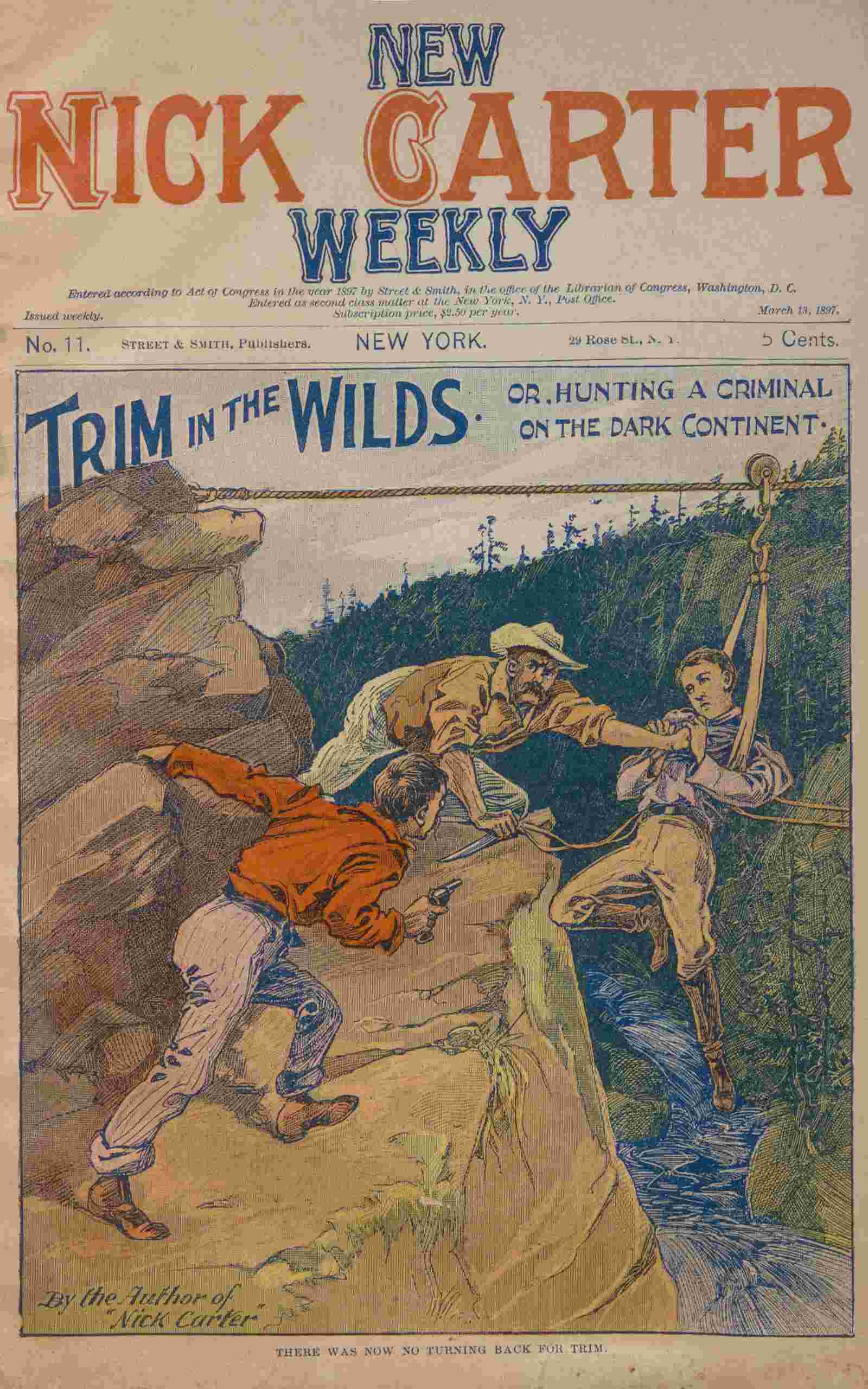
A little further away he saw that there was a rope stretched directly from one side of the chasm to the other.
He now proceeded very cautiously for the presence of that rope there showed him that he was on the track of white men. He listened constantly for any sound of human beings, but heard none.
At last he came to the spot where the rope was fastened at his side of the chasm. It was made fast upon a tree trunk which grew at the very edge, and five or six feet below it there was a little shelf of rock just big enough for a man to stand on.
The rope went straight across to the other side of the chasm, where it was fastened above a broader shelf of rock. The shelving at this side would have held three or four men comfortably.
“This is their bridge,” thought Trim. “I wonder if they get across by a hand-over-hand act. If they do they are all good athletes.”
He saw that there was a small cord lying along the side of the rope across the chasm. He pulled this cord and found that it yielded.
He kept on pulling until he had drawn across to this side a pulley block that rolled upon the larger rope.
There was a hook attached to this, and Trim saw that by catching to this hook he could swing himself out over the chasm and be carried then by his own weight so far toward the other side that he could at least get his feet upon the shelf of rock there.
“This pulley block may be for freight purposes only,” he thought, “but I’ll make a passenger car out of it this time.”
It occurred to Trim that if he should take hold of the hook with his hands, he might be at disadvantage if anything should happen that would make it necessary for him to use his hands. He thought of making a sling out of two or three handkerchiefs, which he could slip under his shoulders and tie to the hook, but he feared that handkerchiefs would not be strong enough to sustain his weight.
While he was thinking of this matter he saw another cord lying at the edge of a rock.
He went to this and found that it had been left there evidently for just the purpose that he needed.
At the end of it was a long piece of stout cloth that could be used for a sling, and from the marks upon it, it was apparent that this was what it had been used for.
The ends of the cloth were tied to an iron ring. It seemed clear that the members of Mulvey’s gang in crossing the chasm were in the habit of fastening this sling under their arms, hitching the ring to the pulley hook and so sliding across the rope.
The rope tied to the sling was undoubtedly for throwing or drawing the sling from one side of the chasm to the other; so Trim put the sling under his arms, hung the ring upon the hook and jumped with all his force out over the chasm.
The wheel in the pulley block worked easily along the rope, and he slid therefore rapidly toward the other side.
He was just about half way across the chasm when two white men suddenly appeared around the corner of the ledge on the opposite side and jumped down to the shelf where he intended to land.
They were armed with knives, and were as desperate looking characters as it had ever been his misfortune to meet.
They watched him coming with savage grins. There was no turning back for Trim; once started on that peculiar kind of journey, he was obliged to go as far as the pulley block would take him.
He uttered a loud scream and began to kick his legs about as if he were trying to stop the pulley. The men on the shelf roared with laughter.
They believed that Trim was frightened out of his senses. This was exactly what he wanted them to believe, and it was for that reason that he screamed and kept on screaming while the sliding block brought him nearer and nearer to the shelf.