
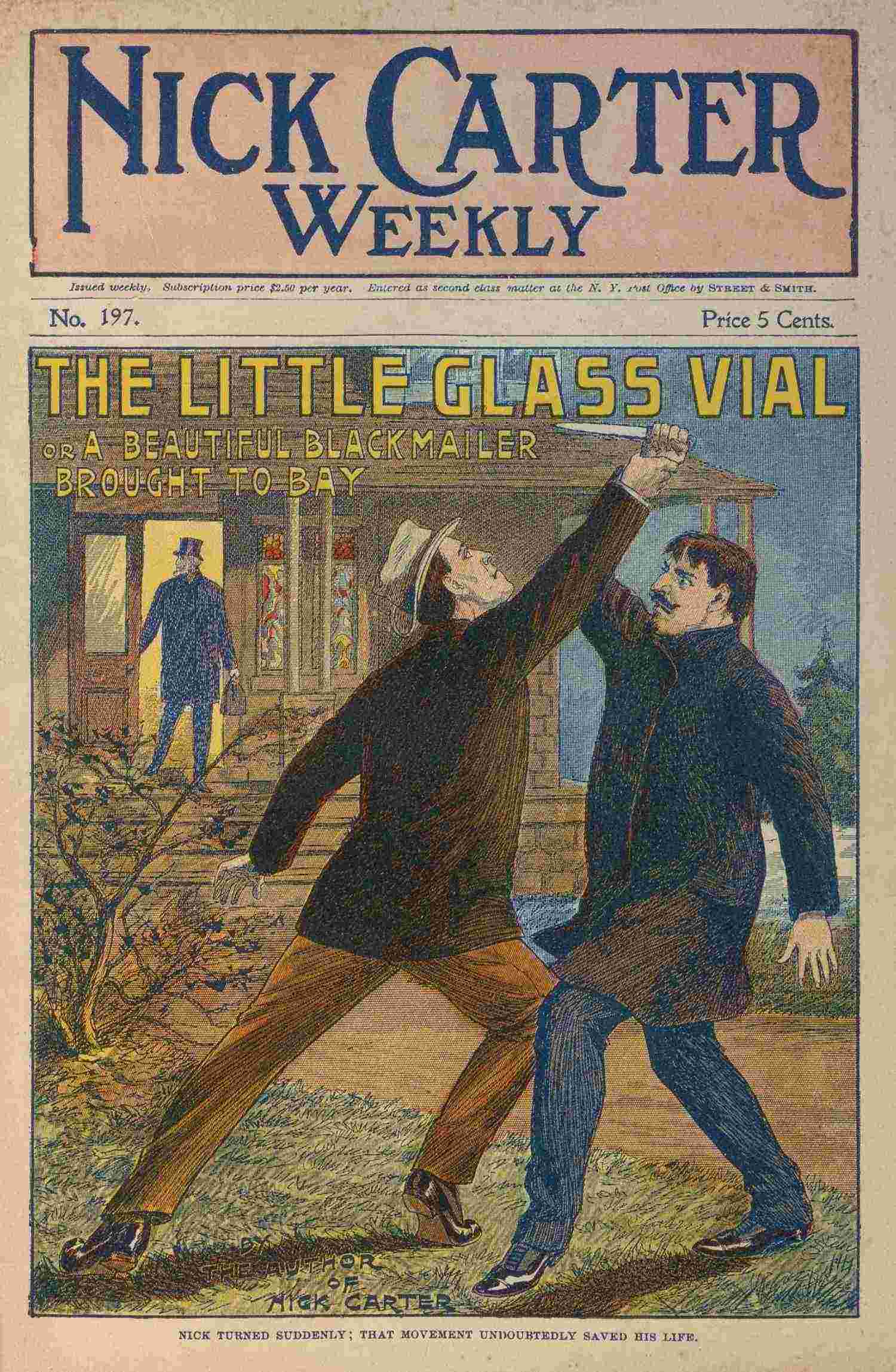
The Project Gutenberg eBook of New Nick Carter weekly no. 197: The little glass vial; or A beautiful blackmailer brought to bay
Title: New Nick Carter weekly no. 197: The little glass vial; or A beautiful blackmailer brought to bay
Author: Nicholas Carter
Release date: January 7, 2023 [eBook #69735]
Language: English
Original publication: United States: Street & Smith, 1897
Credits: David Edwards, Chuck Greif and the Online Distributed Proofreading Team at https://www.pgdp.net (Northern Illinois University Digital Library)
Entered according to Act of Congress in the year 1900 by Street & Smith, in the Office of the Librarian of Congress, Washington, D. C.
Entered as second class Matter at the New York, N. Y., Post Office.
Issued weekly. Subscription price, $2.50 per year. October 6, 1900.
No. 197. Street & Smith, Publishers. NEW YORK. 228 William St., N. Y. 5 Cents.
The Little Glass Vial;
OR,
A BEAUTIFUL BLACKMAILER BROUGHT TO BAY.
By the Author of "NICK CARTER." [Pg 2]
CHAPTER I.
THE VIAL IN THE SNOW.
"Well, old man," said Nick Carter, as he shook the snow from his overcoat, "what’s the news? Anything strange since this morning?"
He was addressing Chick, his assistant, who, to use his own expression, was "acting the chamber lawyer" for the day.
"Yes. Two small cases have come in; but there is a telegram from Boston that may be of importance."
"Let’s see it, my lad!" said the great detective, throwing his overcoat on a chair and seating himself. He took the dispatch in his hands and read it slowly.
"H’m! Yes, there’s something in this, Chick. What time is it?"
"Five-forty."
"Good! I can catch the Providence[Pg 3] boat. Telegraph anything you have to say to the Adams House!" and in another moment the noted detective had left the office.
The snow lay heavy upon the ground when Nick Carter arrived in Boston next morning. Nothing eventful happened during his journey, and he felt rested and ripe for his work—whatever it was.
He was about to step into a cab, when his eyes caught sight of a small vial, half buried in the snow, which he picked up and placed in one of his overcoat pockets, then addressing the hackman, he said:
"When did the snow stop falling?"
"Just after the train for New York pulled out last night, sir."
"You had a heavy fall?"
"Yes, sir."
"Do you know where Mr. Samuel Rogers lives in Dorchester?"[Pg 4]
"Of course I do, sir."
"Well, take me there."
Half an hour later the cab stopped at an old-fashioned mansion, which stood in a beautifully kept lawn, in the most fashionable part of Dorchester.
"I wish to see Mr. Samuel Rogers, junior," said the detective to the colored man who answered his ring.
"What name shall I say?" asked the domestic.
"Oh, never mind the name. Tell him that a friend from New York wishes to see him."
A few minutes afterward a good-looking young fellow entered the room.
"Mr. Rogers, I presume?" said Nick.
"Yes, sir. That is my name."
"I received a telegram from you yesterday," rejoined Nick Carter.
"Oh!" said Rogers. "You are Mr. Nick Carter?"
"Yes."
"Won’t you be seated?" continued the young man. "I wished to see you upon a very sad and mysterious matter."
The detective watched him keenly as he spoke; but did not interrupt.
"My father lies dead in the next room. The doctors say he died of heart disease, but I have a different opinion."
"Ah!" sighed Nick. "And what may your opinion be, Mr. Rogers?"
"I believe he was murdered."
"Murdered?"
"Yes."
"Upon what do you base this suspicion?"
"This letter," said Rogers, handing the detective an envelope, which bore the Boston postmark of the previous day.[Pg 5]
Nick opened it and read as follows:
"Mr. Rogers: Your father did not die of heart disease. He was murdered. Have the body thoroughly examined before burial. You will find that the murderer is nearer home than you imagine.
"One Who Knows."
Nick looked from the letter to Rogers’ face.
In a searching glance, he seemed to learn what he wanted.
"You wish me to unravel this mystery?" he asked.
"Yes, sir," replied Rogers.
The detective placed the letter in his pocket and said:
"Have you had a private examination of your father’s body?"
"No, sir. I waited until I had consulted with you."
"You did quite right," said Nick, "and now, Mr. Rogers, will you be good enough to let me see your father’s remains?"
The only watcher in the death chamber was the colored man who had admitted Nick Carter.
Nick looked at the corpse and noticed that the face had a peculiar grayish hue.
Turning to Rogers, he said:
"Was the body embalmed?"
"No, sir. Dr. Lord wished to have it embalmed yesterday; but I objected."
"Why did you object?" asked Carter, narrowly watching his companion’s face.
"That letter," said Rogers; but before making any further explanation, he ordered Jones—the colored man—to leave the room.
"What about the letter?" inquired Nick, when Jones had gone.[Pg 6]
"I received it by the afternoon mail, just before the doctor made his examination. I then telegraphed to you, and decided that, until you arrived, I would not allow any interference with the body."
"Was the coroner notified?" asked Nick.
"No, sir. Dr. Lord has given a certificate of death from heart disease."
Just then the servant summoned young Rogers to receive a visitor.
The moment he was gone Nick took a hasty inventory of the surroundings.
As the young fellow had said, it was quite apparent that nothing in the room had been disturbed since the old man died.
During his examination of the body his hand touched something with a sharp point.
It lay within the folds of the coat, and Nick made an exclamation of surprise when he discovered that it was a lady’s hat-pin, with a curious haliotis shell head. This he put in his pocket.
He had almost finished his examination of the body, rearranged the clothing, and was just placing the hands in the position in which he found them, when his keen eye detected a slight discoloration of the left wrist.
Upon close examination, he discovered a very small wound—almost a pin-hole.
An almost imperceptible discoloration extended from this wound up along the wrist.
In a moment Nick produced a small surgical pincers and drew from the little wound a needle-like piece of silver.
It was the point of a hypodermic syringe.[Pg 7]
This he stowed away with the hat-pin.
A few moments afterward young Rogers made his appearance.
"There is a mystery here," said Nick.
"What have you learned?"
"That I cannot tell even you, sir—at least not yet. But I shall have to ask you a few questions. Remember, if you do not answer them truthfully, or if you keep back any information concerning this matter, I shall not be responsible for the consequences."
"Mr. Carter," cried Rogers, "what do you mean?"
"Exactly what I say. You must trust me with all your secrets, if I require to know them. Otherwise, you will never know how your father died."
The young man became pale and flushed in turn. He seemed to be suffering from intense mental disturbance.
But, at last, he regained his composure, and said:
"I shall not conceal anything from you, Mr. Carter. But," he falteringly continued, "publicity must only be given to those matters that directly concern my father’s death."
"Good!" said Nick. "And now, Mr. Rogers, let us be seated; for I have much to learn from you. Had your father ever suffered from any complaint that would need hypodermic injections?"
Rogers looked at him in amazement and answered:
"Yes. He complained of neuralgic rheumatism for some years."
"And sought relief by injections of morphine, no doubt."
"Yes, sir. Dr. Lord prescribed it."
"Are you quite sure that he used only morphine?"[Pg 8]
"Certain."
"Did he use the hypodermic syringe himself?" asked Nick.
"No, sir."
"Who gave him the injections?"
"Dr. Lord."
"Was Dr. Lord here on the evening preceding his death?"
"Yes; he had dinner here that evening."
"Then he is a friend of the family?"
"Yes, sir. He is engaged to be married to my sister."
Nick’s face brightened; but he pretended not to notice the announcement which young Rogers had just made.
Continuing, he said:
"When did Dr. Lord leave here that evening?"
"Shortly after dinner. He had an urgent call to a patient at Roxbury."
"And your father retired shortly after?"
"No; he did not go to his room until ten o’clock."
"When did you discover that he was dead?"
"When Jones went to bring him his chocolate, at seven o’clock yesterday morning."
"What happened then?"
"We sent for Dr. Lord, who examined him and pronounced it heart disease. He went away then, and returned shortly afterward with another doctor."
"Did the strange doctor agree with Dr. Lord?"
"Yes. Dr. White also said heart disease."
"Who was in the house besides your father, sister, the colored man, and yourself after Dr. Lord went away?"[Pg 9]
Rogers became nervous, which fact Nick immediately noticed.
The young man replied:
"My sister was not here. She is in Philadelphia."
"Does she know of your father’s death?"
"Yes. But my uncle has prevailed upon her not to return just now."
"Is your uncle coming to the funeral?"
"Yes; he will be here this afternoon."
"You have not told me," said Nick, "who was in the house the night before last after Dr. Lord went away."
Rogers became disconcerted again; but he replied:
"My father, Jones, the cook, chamber-maid, and myself."
"You are sure there was no one else?"
The young fellow again faltered and became very pale. And then, with an effort, he replied:
"Yes; I am quite certain of it."
"When was the marriage of your sister to Dr. Lord to have taken place?" asked Carter.
Rogers breathed freely again as he answered:
"Father wanted it to take place next month."
"And was it fixed for that date?"
"Well, no," hesitatingly.
"Was there some barrier?"
"The fact is, Mr. Carter, I am also engaged to be married, and my sister and I decided to have the two events come off together."
"A capital idea!" said Nick. "But why couldn’t you have arranged it so?"
"Well, we—that is, I hadn’t fixed upon any particular time. Miss Bland and I are not in a hurry, you know."[Pg 10]
"And your sister? Was she anxious for her wedding day?"
"Not exactly," hurriedly cried Rogers. "She is not head over heels in love with Lord; but father was anxious for the match."
"And how does the doctor feel about it?"
"Oh, he is very ardent in his suit."
"I see," mused Nick. "Tell me," he continued, "did your father make a will?"
"Yes, sir."
"Do you know its contents?"
"Yes."
"What are the provisions?"
"It is very simple, but a little curious."
"In what way is it curious?"
"It stipulates that his entire property is to be divided equally between Aimee and me, upon certain conditions. The estate is valued at about three hundred thousand dollars, and the only strange condition of the will is that, in the event of his death before Aimee’s marriage with Dr. Lord she is to get one-half of his entire estate if she marries him within six months of his, my father’s, decease. But that, in the event of this marriage not taking place within that time she is only to receive the interest upon twenty thousand dollars for life."
"And what becomes of the balance?"
"It reverts to me absolutely."
"Does Dr. Lord know the provisions of your father’s will?"
"Yes, sir. He has seen it."
"Does he know that you telegraphed for me?"
"No."
"Very well. Now, I shall have to leave you," said Nick; "but I shall probably[Pg 11] return in the afternoon. In the meantime do not disclose my presence or identity to anybody."
And as he moved toward the door, he added:
"I think you might send for the undertaker, and have the body placed in the coffin at once."
Nick immediately walked in the direction of the telegraph office.
Having arrived there, he sent the following telegram in usual cipher:
"Mrs. Nicholas Carter, New York City: Send Ida to Philadelphia immediately. Tell her to stop at usual hotel. I will telegraph her instructions this evening."
From here he walked slowly toward the cars, and was just about to board one bound for Boston, when he stopped and said:
"I must see that doctor."
He retraced his steps and entered the nearest drug store.
"Can you tell me where Dr. Lord lives?" he inquired from the clerk.
"Certainly, sir. Straight up the road opposite. I forget the number; but you cannot make a mistake, for you will see a brass plate, with his name, on the garden gate."
"Thank you," said Nick. "But perhaps that is not the Dr. Lord I want."
"It must be," said the clerk, laughing, "for he is the only Lord in Dorchester."
A few minutes afterward Nick Carter was ushered into the reception-room of Mr. Rogers’ physician.
Apparently the reception-room was also used as a kind of auxiliary surgery; for, upon a table, were a number of surgical instruments of various kinds.
Nick noticed this with satisfaction, and[Pg 12] he moved over toward the table in order to more closely inspect the contents.
Just then the servant entered the room and announced that the doctor would be disengaged in a few minutes.
"You’re in luck, Nick!" muttered the detective, as he forthwith proceeded to inspect the surgical instruments. There were forceps, and lancets, and clinical thermometers by the dozen; but what attracted Nick’s eye were four hypodermic syringe cases.
He opened them one after another, and when he got to the last—which was smaller than the others—he held it in his hand only for a moment; then opening the case, he found a small syringe from which the pointer needle had been broken off at the base.
Taking from his pocket the point which he had removed from Mr. Rogers’ wrist, he was not surprised to find that it fitted exactly.
He quickly replaced the broken syringe in its case and resumed his seat.
Shortly after a tall, dark, good-looking man entered the room.
Nick recognized him from a photograph he had seen at Rogers’.
"Dr. Lord, I presume," he remarked.
"Yes, sir. What can I do for you?" said the medical gentleman, with a pleasant voice.
"Have you any surgical instruments to be repaired?" said Nick.
"No, sir," politely replied the doctor. "When surgical instruments need repairing it is generally time to get new ones. I am sorry I have nothing in your line to-day."
As he said this he was very courteously[Pg 13] opening the door for his visitor; but Nick was not so easily dismissed.
"You will excuse me, sir," he said, "but while I was waiting I took the liberty of looking over your instruments yonder. They are beautiful tools; but I noticed that a remarkably fine hypodermic syringe has the point broken off."
"By the way," said the doctor, interrupting him, "I wish I knew where that came from. It isn’t mine. It is of a very curious pattern, too."
"Yes, doctor," said Nick, "it is a curious little syringe. But it is remarkable that it could have found its way here without your knowledge."
The doctor did not quite like this remark. He showed it in his face, which Nick was intently watching.
"I would like to buy it from you," said the pretended surgical instrument maker, not noticing the doctor’s look of impatience.
"Oh," said the latter, "it is not mine to sell. I found it upon my table yesterday evening, and I cannot possibly trace an ownership for it among my callers."
"It is of Spanish make," said Nick, who was carefully examining it.
But this did not enlighten Dr. Lord. He was beginning to tire of the pertinacity of his visitor, and finally, to get rid of him, he said:
"Well, you can take it away with you. It is useless to me, and as it is also useless to whoever left it here, I dare say they won’t return for it."
Nick was profuse in his thanks, and was hurrying toward Boston in a very few moments.
He had noticed that the graduated[Pg 14] cylinder of the syringe contained a small quantity of some kind of liquid, and he determined to have it analyzed.
At the same time he remembered the small vial which he had found in the snow, at the Providence depot; and, upon his arrival at the city analyst’s, he handed that gentleman the two articles.
He gave him his card, and the moment the analyst recognized the name of the great New York detective he became particularly attentive, and after a careful examination, he pronounced the contents of the syringe to be the same as the vial, and a deadly poison it was.
"Supposing some of it was injected into a man’s wrist, what would happen?" said Nick.
"Happen? Why, the man would be dead in ten second or less. This is a South American poison, Mr. Carter. It is, perhaps, the most deadly in existence, and the peculiar thing about it is the fact that in doing its work in the human system, it so quickly assimilates with the blood that it is next to impossible to trace it. Another strange thing about it is that it acts directly upon the heart, and in such a manner that the most experienced physician will imagine the victim died from heart disease."
Nick thanked the analyst, and went at once to the Adams House for letters and telegrams from Chick. The coincidence of the fluids contained in the hypodermic syringe and in the vial, which he picked up in the snow at the Providence depot, being the same was remarkable, and, as he walked along, he mused:
"One hundred and fifty thousand dollars and a pretty girl is a big stake to lose, Dr. Lord. But it wasn’t a man of science who[Pg 15] placed that syringe point in man’s wrist!"
CHAPTER II.
THE CUBAN GIRL.
When Nick had attended to Chick’s messages he sent a long letter to Ida, in which he instructed her to find out the private address of James Rogers; to go there; try to ascertain whether or not Aimee Rogers really loved Dr. Lord, and to telegraph to him the moment she got the required information.
Darkness was now setting in, and Nick Carter strolled along Washington street. As he went by the passage that leads to Parke’s restaurant, he decided to take his dinner there, and accordingly, five minutes later, he was seated at a corner table, waiting for his order.
At a large table, close to him, four fashionably dressed young men were dining. The dishes had all been removed, and they were now enjoying their cigars over some black coffee and brandy.
Nick Carter soon disposed of the plain course which he had ordered, and was about to leave the restaurant when he heard one of the young fellows say:
"Sad about Sam Rogers’ governor, wasn’t it?"
"Waiter! Bring me a cup of coffee!" said Nick.
He then took a newspaper from his pocket and pretended to read it.
While listening attentively to the conversation of the four young fellows, he heard one of them say:
"I dare say old Rogers’ death will postpone Sam’s marriage with Miss Bland."
"I shouldn’t be surprised," said another.[Pg 16]
"Lucky dog," said the first speaker. "They say that Lucy Bland is worth fully half a million."
"At least," rejoined his friend. "But look here, Porter, when did you see Sam’s other girl, the olive-tinted loved one? That girl will give him some trouble, if he is not more careful."
"See her? My dear fellow, I saw her last night."
"Where?"
"At the Providence depot, just as the snow stopped falling."
Nick Carter took a deep drink of his coffee and listened very intently now.
"What was she doing?" asked one of the speakers. "Going to New York?"
"Precisely. I bowed to her and asked if I could be of any service. She simply asked me the best hotel to stop at in Providence. I told her, and said, ‘You are surely not going to stop at that awful hole.’"
"You have cheek," interrupted one of the diners.
"Oh, you be blowed!" said the gentleman named Porter. "The girl laughed at the idea of remaining in Providence. She said that she merely intended stopping there for the night, and that she was going to New York by the nine o’clock boat to-day."
"If Rogers hears that you are interesting yourself in that girl, Porter, it will be pistols and coffee for two. By the way, what’s the divinity’s name?"
"Alvarez. I think she is a Cuban, or South American, or something of that kind."
Nick didn’t wait to hear any more.[Pg 17]
He hurriedly paid his bill and left the restaurant.
It was now five o’clock.
"I have just time to notify Chick," he said.
In two minutes he was at the telegraph office, in the Parker House, writing the following dispatch to his faithful assistant:
"Meet boat left Providence nine o’clock this morning. Observe handsome Cuban lady named Alvarez. Keep her within distance until you hear from me.
"Nick."
He then returned to his hotel and wrote a letter to Chick, directing him to shadow his woman, find out all about her, and, if possible, discover what her business was.
Half an hour later he rang the bell at the Rogers mansion.
The door was opened by young Rogers in person, who led the way to the parlor.
"Is Dr. Lord here?" asked Nick, before the young man could say a word.
"Yes. He is with my uncle, who has also arrived."
"Well, he mustn’t see me. He might recognize me if we keep talking here."
"Recognize you?" said Rogers, when he had conducted Nick to his own bed chamber. "What do you mean, Mr. Carter? Does he know you?"
"I don’t think so; but, you know, doctors and detectives often meet under peculiar circumstances."
Rogers gave him a puzzled look.
He clearly did not understand Nick Carter’s ways.
And Nick clearly determined that he should not.
As they proceeded to another room, Nick asked:[Pg 18]
"When did you see the woman Alvarez last?"
"Mr. Carter!" cried Rogers, turning deathly pale, "where on earth did you learn anything about her?"
"I have many channels from which to gather my information," said Nick, coolly. "But you have not answered my question. When did you see her last?"
"The evening before my father died."
"Was she in the house after Dr. Lord went away?"
"In the name of goodness, what have you learned?" asked Rogers, in apparent terror.
"A good deal about your relations with her, my dear young sir," said Nick, who was narrowly watching the perturbation of his companion.
The young fellow’s eyes twitched nervously; he was trembling, Nick saw plainly.
He altered his tactics, and said:
"Look here, Mr. Rogers, you told me this morning that you would conceal nothing from me. Do you think you are treating me fairly?"
"Well," said the young fellow, who was crushed from amazement more than anything else, "I shall make a clean breast of it."
CHAPTER III.
"ANOTHER CUBAN."
"What I am about to disclose to you, you will promise to keep as secret as the grave?"
"I make no promise and must use my own judgment," replied Nick.
"Well, then, the woman whom you call Alvarez is my wife."[Pg 19]
"Your wife?" said Nick, with real surprise.
"Unhappily, it is so."
"I thought you said you were engaged to be married to Miss Bland?" interjected Nick.
"Yes, sir. But I shall have to explain everything to you. When I was in Florida last winter I met her. She was very beautiful, and threw herself in my way. I became infatuated, and one night, while slightly intoxicated, I consented to marry her secretly. Her brother, who was present, insisted upon the marriage taking place at once. I discovered a few days afterward that the brother was one of a gang of desperate gamblers. Ever since that night my life has been a misery."
"Have you lived with her?" asked Nick.
"No; but she has continually blackmailed me upon threat of making public the marriage. Finally I confessed to my father, who was urging me to marry Miss Bland—to whom I have been engaged for nearly three years. He sent for her, and asked her to put in writing the terms upon which she would consent to a divorce."
"When did this happen, Mr. Rogers?"
"A few days ago."
"On the day before your father was murdered?"
"No; on the day preceding that she came to see him."
"Were you present at the interview?"
"Yes."
"Good! Now tell me exactly what occurred at that meeting."
"She said that she would consent to a divorce for fifty thousand dollars. Father[Pg 20] agreed to pay that sum in exchange for the certificate of divorce, and to pay her expenses to California and allow her a certain amount to live there until the divorce was granted."
"Well, what then?"
"He asked her to put it in writing. She called the next evening, after Dr. Lord had left, and said she would not do it for less than one hundred thousand dollars.
"My father told her that this was impossible. He read for her his will, and explained that by conceding fifty thousand dollars he was robbing my sister and myself of a large part of our heritage."
"Did he read for her the clause connected with your sister losing her portion if she did not marry the doctor within six months?"
"Yes, sir—every word of it."
"What then?" asked Nick.
"She produced a written document, of which this is a copy."
Nick took the document and glanced it over. Turning to Rogers, he said:
"Do you know, sir, that this bond holds as good against your father’s estate, upon the production of the certificate of divorce, as if he had lived."
"Yes, I do."
"But you don’t seem to recognize that she can continue her blackmailing scheme all the same, without annulling this instrument. It is a clever document, Mr. Rogers—very clever. In fact, I do not believe the woman ever drew up such an instrument herself."
"Then what do you believe?"
"I cannot tell you just yet. But I want you to answer me one more question:[Pg 21] Did you have any conversation with her after your father signed that bond?"
"Yes."
"What was it about?"
"I promised her twenty-five thousand dollars on my own account."
"Did she leave the house then?"
"Yes. I accompanied her to the railway station."
Nick looked puzzled.
"Had your father retired to his room before you left the house?" he asked.
"No. But he had gone before I returned."
"And you never saw him alive again?"
"No, sir."
"Who let you in when you got back from the railway station?"
"Jones."
"Have you perfect confidence in that colored man, Mr. Rogers?" asked Nick.
"Absolute. He has been with us for over ten years."
"Did he accompany the family to Florida last winter?"
"Yes."
Nick Carter became silent.
He seemed to be buried in deep thought.
At length he looked intently at Rogers and said:
"Have you anything more to say, Mr. Rogers?"
"Nothing that I can think of."
"Very well. I shall now bid you good-night. I shall call upon you again to-morrow, and remember, silence is a necessity."
"The funeral takes place to-morrow morning at ten o’clock, Mr. Carter, but I shall be home again about two."[Pg 22]
"I shall call after that hour. Good-night, Mr. Rogers."
When he had got a little away from the house, Nick stopped and looked back.
"I wish the moon would come out," he muttered. "I should like to explore the road between here and the next railway station."
At that instant his sharp ears detected a soft footfall in the snow behind him.
He turned suddenly.
That movement undoubtedly saved his life.
By the dim light that came from one of the windows of the house, he saw, outlined against the snow, the form of a man, who, with uplifted hand, was about to plunge a knife into his back.
In a second the would-be assassin found his wrist held by an iron grasp, and with a smothered cry of pain, the knife fell from his hand.
At the same moment the hall door was opened, and a flood of light rushed out upon the scene, revealing the features of Nick’s assailant. Dr. Lord was coming out.
As Nick did not wish to see the doctor, or rather, as he did not wish to be seen by him, he flung the would-be assassin from him, picked up the knife and stepped into the shadow of the shrubbery. When the doctor had passed out of the lawn, Nick came from his hiding-place and went toward the nearest railway station, saying, as he walked:
"Another Cuban!"
CHAPTER IV.
IT WORKED LIKE A CHARM.
When he arrived at the Adams House, he found a telegram from Chick, which read:[Pg 23]
"Alvarez at Spanish-American Hotel. Dining with the Cuban, Moreno. Shall endeavor to overhear conversation. If important, will report at Boston and put Patsy on the case here."
"Good!" said Nick. "The fellow who tried to knock me out must be one of Moreno’s gang. I must warn Chick."
He forthwith sent the following cipher telegram:
"Telegram received. Moreno’s gang have discovered I am on case. One of them made attempt on my life. Act cautiously, and come on if anything important.
Nick."
He handed this to the operator in the hotel corridor, and, feeling satisfied that nothing more could be done that night, he retired to his room.
Early in the morning he was awakened by a loud knocking at the door.
"A telegram for you, sir!" said a voice.
"Push it under the door!" cried Nick.
He tore open the dispatch and seemed to be completely mystified by the contents. It read:
"Rogers case. Watch Lord. Am writing. Important news.
Chick."
He dressed himself hurriedly, and immediately telegraphed to Chick:
"Received telegram. Come on at once. Put Patsy in charge.
Nick."
After breakfast he took the train to Dorchester.
It was now nine o’clock, and the funeral was to take place at ten.
He wandered up the road where Lord’s house was situated, and was just making up his mind to call when he saw a carriage stop at the gate.
"Too late," said Nick. "The fellow is just going up to Rogers’ place."[Pg 24]
Nevertheless, he lolled about in the shadow of the trees.
In a few minutes Dr. Lord’s door was opened, and Nick Carter saw a sight that surprised even him.
Walking down the garden path, apparently in earnest conversation, were the doctor and the Cuban who had attempted to assassinate him the night before. Dr. Lord got into the carriage; but the Cuban, taking off his hat respectfully, turned from the place and walked down the road, followed by Nick at a safe distance, who saw his man enter a street car bound toward Boston.
Nick hailed a cab near at hand.
He merely showed the driver his badge and said:
"Keep that car in sight; but do not pass it!"
"Trust me, sir," said the hackman, with a knowing wink.
When his fare stepped out of the cab, at the corner of Kneeland and Washington streets, the driver nearly lost his balance from the shock.
A lively-looking chap got into the cab in Dorchester, and a staid-looking clergyman paid him his fare in Washington street.
The Cuban had left the street car at the next block, and Nick hurried after him on foot.
The man entered the United States Hotel, and immediately went to the office.
Nick Carter was close at his elbow.
"Any letters or telegrams for Gonzales?" inquired the Cuban.
"Yes, sir. One telegram," said the clerk, who handed it to him.[Pg 25]
He tore open the envelope and began to read the dispatch.
Nick was watching him intently, although he was apparently studying a time-table.
The Cuban seemed to be puzzled about something in that telegram.
He looked around uneasily, still holding the message in his hand.
Finally his eyes rested on the clergyman, and he approached him.
"Excuse me, sir," he said, with a pronounced foreign accent. "I am a stranger. I have just received this telegram."
Here he handed the dispatch to Nick and added:
"What is the meaning of Bay State, Worcester?"
Nick Carter looked up from the telegram and replied, in a well-disguised voice:
"There is a hotel in Worcester called the Bay State; but this message tells you to ask somebody named Rogers about it."
The Cuban laughed and said:
"No, no! You no understand. But I thank you for explain hotel."
Whereupon he took the telegram from Nick, lifted his hat courteously, and disappeared in the direction of the bar.
The moment he was out of sight, Nick said to himself:
"That worked like a charm. The dispatch must have been from Moreno."
He immediately took off his disguise and ordered a cab.
"To police headquarters!" was his instruction to the driver.
When he arrived there, he asked to see the chief.[Pg 26]
"Why, Mr. Carter, how do you do?" cordially welcomed the head of Boston’s police.
"I want you to do me a favor," said Nick.
"Certainly, my dear sir. Got some important case on, I’ll wager."
"Yes," mildly returned Nick. "It is a very mysterious case. I want you to arrest a Cuban named Gonzales, and hold him without examination for me. If you do this secretly you will oblige me, as his detention may be of much importance."
"With pleasure," said the chief, as he touched a bell.
An officer answered instantly.
"Send Waldo here at once."
"Yes, sir.
"Waldo," said the chief, when the detective entered, "go with this gentleman and arrest the party he will point out. Ask no questions, and bring your prisoner. Do you understand?"
"Yes, sir."
At the United States Hotel, Waldo, who spoke Spanish fluently, asked for Gonzales.
He was in his room.
Waldo ascended to the Cuban’s apartment, and returned in about ten minutes with his prisoner. Nobody in the hotel corridor imagined for a moment that an arrest had been made, so friendly did the pair seem to be.
Only one person understood the situation.
That was Nick, who anxiously watched them from the paper stand, fearful that the Cuban might make a break for liberty.
But Waldo knew his business too well.[Pg 27]
He hailed a cab, ordered Gonzales to get in, and, having taken a seat opposite his prisoner, he directed the cabman to drive to police headquarters.
When they had gone, Nick consulted his watch.
It was half-past one.
"Now for young Rogers!" he cried.
CHAPTER V.
A TERRIBLE POISON.
"Mr. Rogers," said Nick, when he was alone with that young gentleman, "can you come with me for about two hours?"
"Now?"
"Yes; at once."
"Where are you going?" asked the young man.
"To police headquarters."
"Police headquarters?" exclaimed Rogers, in dismay. "What on earth do you want me to go there for, Mr. Carter. You surely have not placed this matter in the hands of the police?"
"No, sir. The suspicion or fact that your father has been murdered is unknown to a single soul, outside you and me."
"But won’t my going to police headquarters attract attention?"
"I have arranged that no one shall know of your visit. If it was not of great importance, I should not ask you to leave the house at such a time."
"Very well, sir," said Rogers. "Let us go at once, as my uncle will be back at five o’clock for dinner. He goes away by the six-thirty train."
"Where is he now?" asked Nick.
"With the lawyer, in Boston. My father left him sole executor."[Pg 28]
When they arrived at police headquarters, they were met by the chief, who ushered them into his private room.
"We wish to see the prisoner without being observed by him," said Nick. "Use the screen."
"All right," said the chief.
He requested his visitors to stand behind a large screen, in which there were several small holes.
A few minutes afterward Gonzales appeared, accompanied by Waldo. Nick now directed Rogers to look through one of the holes in the screen.
The young man did so, and immediately drew back with a visible shudder. He seemed to be extremely agitated upon recognizing the Cuban, and was about to say something to Nick, when that gentleman put his finger to his lips and signaled him to be silent.
At that moment the chief said to the prisoner:
"What is your name?"
"Manuel Gonzales."
"Write your name in this book."
This was in compliance with a request which Nick had made.
When the prisoner had been removed, Rogers turned quickly to Nick Carter and exclaimed:
"That was her brother. His name is Alvarez, not Gonzales."
"When did you see this man last?" asked Nick, when they got outside.
"Last winter. At Tampa, Florida."
"Are you quite certain you have not seen him since then?"
"Absolutely certain. But how on earth did you get hold of him, and for what?"
"You will know that later, Mr. Rogers."[Pg 29]
They were now driving rapidly toward Dorchester, and Nick decided to discontinue his investigations until he was safely closeted with his companion in the latter’s home.
Having arrived there, Nick asked him abruptly:
"Was Dr. Lord at Tampa with you last winter?"
"Yes."
"Did he also meet this fellow Alvarez?"
"I am not certain; but I think he must have seen him, as he and I frequently went to the gambling rooms where Alvarez did business."
"Tell me," said Nick. "Would it not be to your interest if your sister did not marry Dr. Lord?"
This sudden question confused young Rogers.
"I do not know what you mean, Mr. Carter," he faltered.
"I will put it plainer. Do you wish your sister to marry Dr. Lord?"
"I do."
"Now, Mr. Rogers, I want you to answer me truthfully: Are you afraid of your wife?"
"I do not understand."
"Come, sir, are you not afraid that the price of her secrecy about your marriage will be a perpetual blackmail?"
The young man became very nervous; but he answered:
"Yes; I do fear that she will continue to blackmail me."
"For that reason," said Nick, "would you not like to have the one hundred and thirty thousand dollars which your sister would lose if she did not marry Dr. Lord?"
"I assure you, Mr. Carter, that, no mat[Pg 30]ter what that woman—my wife—wishes, I sincerely hope to see my sister married to the doctor."
Nick noticed that he put particular emphasis upon the words, "no matter what that woman wishes," and he did not ask the young man another question.
Ten minutes later he rang the bell at Dr. Lord’s door and was admitted.
"Well, sir," said the doctor, who was visibly displeased when he saw Nick, "I thought I told you yesterday that I had no surgical instruments that wanted repairing."
"So you did, doctor; but I have made a discovery that may interest you."
"What is it?" asked the doctor. "I am in a hurry, for I have to visit a patient."
"It is this," said Nick, producing the hypodermic syringe case.
The doctor became interested.
"Oh, you have discovered something about that, have you?"
"Yes, doctor."
"Have you found the owner?"
"No," said Nick, intently watching his listener’s face. "I have not discovered the owner; but I have found the point that was broken off."
"Let me see it," said the doctor.
Nick handed it to him.
"Yes," said the medical man; "this is certainly the missing point. Where did you find it?"
"Ah, that’s a secret, doctor. But I believe you know the person to whom it belongs."
"Absurd! If I did, I should not have given it to you."
"It was well you did," said Nick, "or[Pg 31] we might never have been able to locate where this point came from."
"It makes very little difference one way or the other," said the doctor, who was now beginning to feel bored.
"Don’t you remember," said Nick, "that I said it was of Spanish make?"
"Well, what of that?"
"Had you not a Spanish visitor the day before yesterday?"
The doctor started.
"What do you mean?" he cried.
"I was thinking that perhaps he might have left it behind. And if you gave me his address, doctor, I would call upon him and offer to mend it."
Dr. Lord laughed and said:
"Yes, I had a Spanish visitor the day before yesterday. But it wasn’t a man. It was a lady."
"I found a new kind of fluid in this little syringe, doctor," said Nick, adroitly changing the subject.
"Indeed?"
"Yes. You know that people who understand surgical instruments usually go in for a little chemistry, too. When I examined the cylinder of this syringe I noticed a small quantity of colorless liquid in it; so I took it out and analyzed it."
The doctor was now becoming interested again, and Nick continued:
"I found it was a terrible poison."
"What?" cried Dr. Lord.
"Yes, doctor. That little syringe contained enough poison to kill a dozen men."
"You astonish me!" said the doctor.
"I have a little vial of the same drug here," said Nick, producing the one which he had picked up in the snow.[Pg 32]
Dr. Lord took it in his hand and examined it curiously.
"You are certain that this is the same fluid?" he said, looking inquiringly at Nick.
"Absolutely certain, doctor. And it strikes me that it is a rather dangerous one to give a hypodermic injection with."
"You forget," said the doctor, "that all drugs are greatly diluted before being used for injection purposes."
"That is true," said Nick, apologetically.
"However," said Dr. Lord, "I shall consider it a favor if you will allow me to examine this. I have never seen anything like it before."
"You may do so," said Nick, and he continued: "Perhaps you would like to know where I discovered the point of the syringe?"
"Yes. Where did you find it?"
"In a dead man’s wrist!"
"What?" cried the doctor.
"It is as I have said," calmly rejoined Nick. "And now, doctor, I shall not detain you any longer from your patient. I shall call for the vial to-morrow."
CHAPTER VI.
"CAN HE SUSPECT?"
When Nick Carter reached the Adams House, it was just six o’clock.
A tall, clerical-looking man met him in the hallway.
It was Chick, Nick’s assistant.
"Well, Chick," said Nick, when they were seated in his room, "what’s the news?"
"The woman who claims to be Mrs. Rogers is already married to Moreno."[Pg 33]
"His wife?"
"Yes."
"Did you learn their game?"
"Yes. Blackmail."
"I know that; but what else?"
"I dined at the next table to theirs last night, and learned that they have some deep scheme to prevent a man named Lord from getting married. Her brother was to have seen him this morning. That was why I sent the second telegram."
"Yes, yes. Go ahead," cried Nick.
"I think young Rogers is in the deal."
"No, he isn’t," said Nick. "Is that all?"
"Yes."
"Good, Chick!"
At that moment there was a knock at the door and a bell-boy handed in a telegram.
It was from Patsy, and read: