
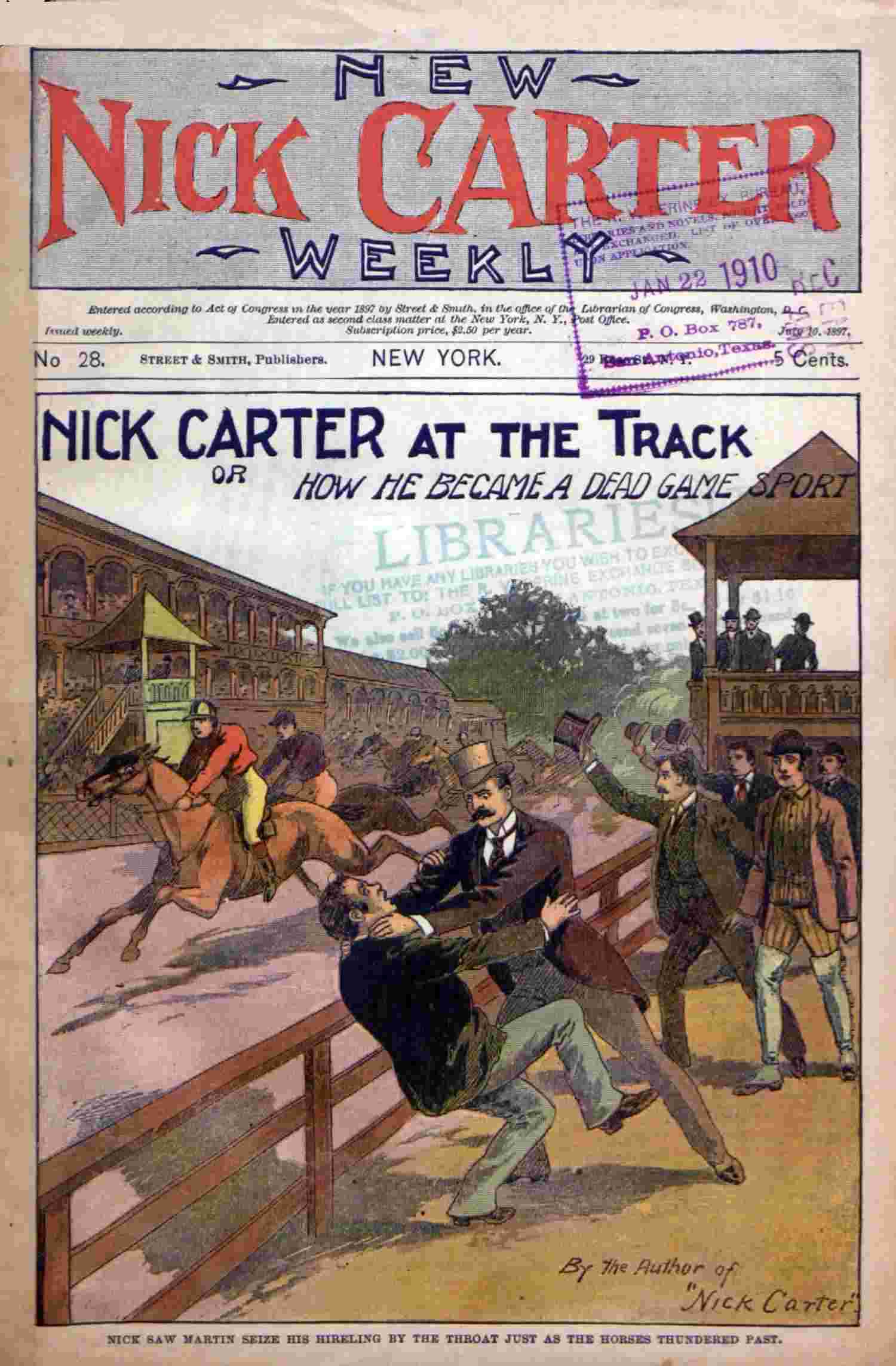
The Project Gutenberg eBook of New Nick Carter weekly; No. 28. July 10, 1897; Nick Carter at the track; or, How he became a dead game sport.
Title: New Nick Carter weekly; No. 28. July 10, 1897; Nick Carter at the track; or, How he became a dead game sport.
Author: Nicholas Carter
Release date: October 7, 2022 [eBook #69108]
Most recently updated: October 19, 2024
Language: English
Original publication: United States: Street & Smith, 1897
Credits: David Edwards and the Online Distributed Proofreading Team at https://www.pgdp.net (Northern Illinois University Digital Library)
|
Some typographical errors have been corrected;
a list follows the text. (etext transcriber's note) |
Entered according to Act of Congress in the year 1897 by Street & Smith, in the Office of the Librarian of Congress, Washington, D. C.
Entered as second class Matter at the New York, N. Y., Post Office.
Issued weekly. Subscription price, $2.50 per year. July 10, 1897.
No. 28. Street & Smith, Publishers. NEW YORK. 29 Rose St., N. Y. 5 Cents.
Nick Carter at the Track;
OR,
HOW HE BECAME A DEAD GAME SPORT.
By the Author of “NICK CARTER.” {2}
CHAPTER I.
DENVER BAY.
“And so, you see, I stand to lose twenty thousand dollars.”
“That’s a large sum.”
“Yes, Mr. Carter, it’s a large sum; but a middle-aged gentleman like yourself ought to be aware that risks are sometimes forced upon people who handle money in large sums.”
The celebrated detective smiled as he looked into the excited countenance of the Wall Street man before him.
Half an hour before, if the broker had seen him at all, he would hardly have referred to him as “a middle-aged business man.”
The detective had just returned from an expedition to the upper part of the city, during which he had appeared as a{3} verdant country boy of an inquiring turn of mind.
“Of course,” the detective said, slowly, “people who handle money for the profit of others are expected to keep it in motion—honestly in motion.”
He glanced keenly into his visitor’s face as he emphasized the last three words.
“My case is hardly what you suppose it to be,” said Mr. James Wheeler, broker. “The money I handle belongs to two heirs—both minors. With that, however, you have nothing to do.”
“You’re mistaken,” said Nick Carter, coldly. “If I am to handle your case I must have your fullest confidence.”
“Regarding my present venture, certainly, but I fail to see how past complications can interest you.{4}”
“I have always made it a point,” said the detective, rising to his feet, “not to engage in any case which is not entirely square and above-board. You come here with a statement that you have risked twenty thousand dollars belonging to two innocent children in the next Brooklyn Handicap, an illegal proceeding, and if you have done this for your own personal gain you have taken the first step toward a crime, and in that case I refuse to have anything to do with the matter.”
“Do you remember,” said Wheeler, putting out a hand to restrain the detective, who seemed about to leave the room, “about the recent daylight robbery in Wall Street, which resulted in the loss of twenty thousand dollars in cash?”
“Now you talk like a man of sense,” said the detective, resuming his seat and drawing a note-book from his pocket.
“Three weeks ago yesterday,” he continued, referring to the book, “the office of Mr. James Wheeler, broker, was entered during the noon hour by two men who claimed to be Texans seeking an investment. The broker was absent, and his clerks were careless.
“Result, when the Texans left, the broker was short exactly twenty thousand dollars. Have I stated the case correctly?”
The Wall Street man, sitting with his hands on his knees, stared in the detective’s face with a look of surprise mingled with consternation.
“Great God!” he exclaimed at length. “The matter wasn’t even reported to the police.”
“Very true. Perhaps you will have the kindness to tell me the reason why.{5}”
“It would have ruined me. My creditors, and especially the friends of these heirs, would have pounced down upon me in less than twenty-four hours.”
“And so, instead of facing the matter like a man, you endeavor to play even by staking money on the next handicap?”
“That’s it exactly, and I pledge you my word of honor that in doing so I only sought to restore to the children the money of which they have been robbed.”
“And now they are likely to lose forty thousand instead of twenty.”
“I’m afraid so.”
“What reason had you for supposing when you staked the money that Denver Bay would win the race?”
“To tell the truth, I was half crazy when I made the investment. In doing so I only followed the drift of public opinion regarding the horse.”
“Did you make the bet in the regular pool-room way?”
“Certainly not. The odds were two to one on Denver Bay, and no bookmaker would have taken such chances so long before the race. The bet was made with a down-town sporting man, for whom I frequently do business in a small way.”
“His name?”
“Peter Johnson.”
“One of the most notorious race-track sharpers in the country.”
“I was not aware of that at the time.”
“Well,” said Nick, with a smile, “I never knew a horse to win a race with such an outside bet on him, and all in the hands of one man, and that man a professional trickster.”
“I can see now how foolish it was, and I wish to place the matter entirely in{6} your hands. I am certain that the horse is to be fixed in some way so that he cannot win.”
“What makes you think that?”
“I have no definite information on the subject, it is true. As we say on the street, ‘It is in the air.’ No sporting man will touch the brute now, and those supposed to be on the inside are warning their friends not to risk their money on him.”
“It does look pretty black.”
“It looks pretty black, but I have every confidence in your ability to run the rumors down, and either see that there is a fair race or that the horse does not start at all.”
“It’s a risky business, and will cost considerable money.”
“I expect that; will you take the case?”
“I will take it on one condition.”
“Name it.”
“It in this: If you recover this money you will take the whole amount belonging to these heirs and invest it in some place where it will be beyond the reach of New York thieves and race-track sharpers.”
“You have my word on that. That is exactly the course I had decided upon.”
“Then there’s one other condition.”
“If it is not more difficult than the other I accede to it in advance.”
“That is, that if we discover crookedness on the part of these horsemen, you are not to drop the matter as soon as you are made whole. You are to stand up to the rack and help me to have justice done to them.”
“I will do that willingly.{7}”
“It may cause you some trouble in your brokerage business.”
“That doesn’t matter.”
“That is all at present, then. You may see me at your office to-morrow. If a man calls and asks to see you in regard to Lackawanna admit him to your private room at once. You may not recognize me, but you can trust the man that mentions that word.”
After the departure of the broker the detective busied himself for some moments in the examination of a list of the many pool-rooms in the lower part of the city.
“It’s a tough job,” he thought, “but it will give me a chance to see the inside of some of these dens again.”
He stepped into an inner room, and in a few minutes returned in the guise of a cattle drover from the far West.
When he left his office shortly afterward he took the direction of Barclay Street, and soon entered one of the disreputable pool-rooms in the vicinity of that thoroughfare.
The place he entered was in a basement, and was foul, musty, and suffocating.
The place was crowded with men and boys of high and low degree, all half crazed with the gambling spirit.
The time was early in the afternoon.
From his position behind a large desk a tough-looking clerk was drawling out the names of horses with the odds which the proprietor of the place would bet against them.
It is generally supposed by the public that these pool-rooms merely conduct a commission business, and that the odds{8} offered there are the ones posted at the race track.
But this is by no means the case. The proprietors of the places bet according to their private ideas of the proper odds.
The rustling of greenbacks and the clinking of gold and silver were heard throughout the place as the detective entered.
“The race in which Denver Bay is entered takes place the day after to-morrow,” mused the detective, “and I’ll just see how he stands in this locality.”
“Say, podner,” he said, advancing toward a heavily-built man behind the railing, whom he knew to be the proprietor, “what odds d’ye give on Denver Bay?”
“Guess you’re from the West,” was the answer.
“Right from the West, and any time you want to know about the price o’ cattle just drop a line to Sol White to the Denver post-office.”
“Denver Bay’s from the West, too, isn’t he?”
“You bet he is, and he’s a good little hoss. What odds will you give me on him?”
“The Bay don’t count much of a figure on my books. The race ain’t on yet, you know, and you can’t tell yet what horses will start. But I’ll make a bet of two to one.”
“You can’t do business with me at that figger,” said Nick, turning away.
“Hold on!” said the sharper, pretending to look over the leaves of a note-book in his hand. “I’ll give you five to one if you want to back your favorite.”
“Ten to one would be nearer right.{9}”
“You can’t have much confidence in your horse.”
“’Tain’t my horse. I thought I’d drop fifty or a hundred just for luck.”
“A thousand to a hundred is a pretty wild bet.”
“You don’t have ter make it. Tell you what I’ll do. If you’ll make it fifteen to one I’ll go you a hundred.”
Nick Carter watched the face of the bookmaker as he made this proposition, and saw at once that he was pleased to get a bet even at such odds.
“All right,” said the bookmaker. “Put up your dust. Here’s your ticket.”
“If the horse don’t start, now,” said Nick, counting out the money, “I get this back, I suppose.”
“That’ll be all right,” said the other, in a non-committal sort of way.
“When I sell my cattle,” said Nick, resolved to learn still more regarding the pool-room idea of the horse, “I may want to bet some more.”
“I’ll take all the bets you want to make at that rate.”
“Will they let me see the horse?”
“You’ll have to settle that with the trainer.”
“Where is he?”
“In one of the stables near the track, I suppose.”
“Well, I guess I’ll go over to-morrow and see him. I’ll bet the hoss’ll know me like a book. Why, podner, I’ve rode behind him many a time.”
“W’at’s dat ye’re givin’ us?” asked one of the plug-uglies who infest that part of the city, crowding up against the detective.
In paying over the money Nick had{10} purposely exhibited a large roll of bills. He was positive that such a course would attract the attention of some of the sharpers about the place and would lead to some sort of conversation.
“I was jest a-sayin’,” he said, turning to the bully with a benevolent look, “that I’ve rode behind Denver Bay many a time.”
“Good little horse,” said the other, “but I think I can give yer a pointer or two on him.”
“Don’t give it away here,” said Nick, in a whisper.
“I don’t give nuthin’ away. I gets money fer pointers—I does.”
As he spoke he took the detective by the arm and led him to the meanly furnished bar-room in the rear of the place.
“I’ll jest tell you,” he said, as they stood at the bar with liberal glasses of whisky before them, “that yer want ter play dat hoss fer second place.”
“I’ve been playin’ him fer winner.”
“Well, you jest take my tip, an’ go ahead on it. It’s all right.”
The detective paid for the drinks, and turned away, but the other caught him fiercely by the arm.
“Hold on here!” he said, with an ugly look. “That tip’ll cost you just ten dollars.”
“I didn’t ask you for no tip,” said the assumed countryman, with a stare.
“Well, you got it just the same, an’ you’ll get somethin’ else, too, if you don’t cash up.”
“You won’t get no ten dollars from me.”
The bully struck viciously at the de{11}tective, who dodged away from him in a clumsy sort of way.
Nick was perfectly aware that the man meant business, and had no idea of coming to close quarters with him.
He well knew that a clinch of any kind would be likely to disarrange his disguise and thus expose his true identity.
With an oath the bully advanced again and struck a savage blow at the detective’s face.
Nick simply dodged his head this time, and striking before the other could resume his guard, laid his opponent senseless on the floor.
CHAPTER II.
A LITTLE CIRCUS.
The knockdown created very little excitement in the room.
Reports from the races were coming in every few minutes, and nearly every one there had more or less money at stake.
A few collected about the fallen man, however, and Nick had no difficulty in slipping quietly out of the way.
He had no idea, however, of leaving the place.
His bet had started a little ripple of talk regarding Denver Bay, and he knew that by remaining he might hear something to his advantage.
At the end of the basement farthest from the street were a number of stalls used by sporting men and others for private consultation.
As the crowd was now congregated around the main desk in front many of these stalls were empty.
Nick stepped noiselessly into one of them, and closed the door.{12}
A moment later any one glancing into the stall would have seen a half intoxicated countryman sitting with his chair tipped back against the wall, his hat pulled down over an inflamed face, and his feet resting upon the table.
Not a single trace of the well-to-do cattle drover remained.
“I may have to stay here a long time,” he thought, “and may as well have some cigars. Besides a whisky glass properly placed on the table can do no harm.”
The order was given and promptly filled.
The waiter by no means suspected that his seemingly inebriated customer was the person in quest of whom the now infuriated bully was roaring about.
Before leaving home Nick had left a note addressed to Chick, instructing him to call at the place toward which he was directing his steps, and he now awaited with some impatience the arrival of his assistant.
The afternoon passed slowly away.
The races were over, and the stalls were filling up.
In some of them people were dividing and spending the money won during the day, while in others angry losers were laying plans by which they might account for their sudden lack of funds.
After a time two men, evidently none too sober, entered the stall next to the one occupied by the detective, and ordered more drinks.
“It’s a bloomin’ shame for a feller ter drop his wad like that,” said one, in a maudlin tone, “specially when he’s on de inside an’ oughter know. But you lost{13} more’n I did, an’ I sympathize with you.”
“I don’t want none o’ your sympathy,” said the other, evidently a little nearer sober than his companion; “I’m broke now, but I can get plenty of money when I get over to the stable.”
“You’re a liar! you’re always workin’ that bluff about the stable. You don’t get any more stuff’n I do. Wot you got to do wid de stable, say?”
“W’at I got to do wid de stable?” said the other, in as sarcastic a tone as he could command. “I’m chambermaid for Denver Bay, I am.”
“You’re a nice man to be around a racing stable,” said the other, with an oath. “W’at do you know about a hoss?”
“You’re a sucker,” said the other. “You wait till the Denver Bay runs, and I’ll show you a wad.”
“You won’t get it on Denver Bay. You’re drunk, that’s what’s the matter with you. Doncher talk to me no more. You’re drunk.”
“You’re drunk yourself. You smell like a sour apple. Stan’ up like a man. Why doncher pack yer whisky like me?”
The last drinks had evidently been too much for the men, for Nick heard a fall as the speaker attempted to stand on his feet to show how sober he was.
Nick stood upon a chair and carefully raised his head above the narrow partition between the two stalls.
In his fall the one had carried the other down with him, and they were now clawing, chewing and punching one another in a drunken way.
In a moment they lay still, and after mumbling a curse or two fell asleep.{14}
“I’m in for it now,” thought the detective, again seating himself in a position so that the men could not leave their stall without being seen by him. “I must stay here all night if necessary in order to cultivate the acquaintance of that fellow who acts as ‘chambermaid’ for Denver Bay.”
Just at that moment the door of his stall was opened, and a greasy looking jockey shoved his face inside.
“You don’t mean ter say you’re goin’ ter smoke them cigars?” he said, taking one from the table, and breaking it in order to inspect its contents.
“Hardly. How long have you been here?”
“Oh, just about long enough to nose around in search of a certain green countryman,” said Chick, sitting down in a chair.
“Isn’t that a bold costume for this place?”
“Bold, why?”
“These people may want to know what stable you belong to.”
“Oh, that’s all right. I’m from the South, and I never rode a horse with a record.”
“That’ll do first rate. Just skip around in there, and see what you can find out about Denver Bay; but before you go take a look at the men in the next stall. We may have further business with them.”
Chick opened the door and looked in.
“Purty drunk, I should say.”
“Yes, and I’ve got to wait around here until they get sober enough to make friends with. One of them works at a stable I want to know something about.{15}”
Chick now left the stall and hung about the place engaging in conversation with any one who would talk with him.
In a half hour he was back with his report.
“There’s some scheme afloat in regard to Denver Bay,” he said. “They’re having great sport over an old sucker who came in here this afternoon and put up a hundred on him at fifteen to one.”
“Yes, I’m the sucker. Well, find out all you can. Don’t go far away.”
After a time Nick heard faint sounds in the adjoining stalls as though the drunken men were regaining consciousness.
As he peered cautiously over the partition one of them raised himself on his elbow, eyed his companion curiously for a moment, and then asked, in a sarcastic tone:
“W’ats de matter wid you? Had a death in de family? Or did yer gal run off wid de coachman?
“Oh, you’ve never been broke before. Well, you’d better keep quiet an’ let ’spectable people sleep, or I’ll put a charge of ’sturbin’ de peace on you. See? Hello, pardner,” he continued, as some one opened the door and walked in, “why don’t yer send in yer card?”
“You’re a couple of nice blokes!” said the new-comer. “I was afraid when you came over town that you’d get drunk. I’ll have you both run in if you don’t look out.”
“Run in nothin’. Dey can’t convict a man but once fer an offense, an’ I was put in jail thirty years ago for this same drunk. I’ll swear I haven’t been sober since. Just de same drunk all de time.{16}”
“How long has Amos been here?”
“All the afternoon.”
“Has he done any talking?”
“Naw. His tongue’s as thick as a Congressman’s head.”
“Well, you go out somewhere and get some supper. I want to talk with him.”
As the fellow slouched out, very much improved by his brief nap, the new-comer seized the man on the floor by the shoulder and shook him roughly.
“Wake up, here!” he shouted, in a shrill voice, in his ear.
Amos opened his eyes, and finally raised himself into a chair.
“What have you been saying this afternoon?” asked the other, sharply.
“Nothin’.”
“Did you tell that drunken brute, Hazelton, anything?”
“Not a thing, s’elp me!”
The man passed out of the stall and inspected the rooms on each side.
He found one stall empty, and in the other there was only a drunken countryman sleeping with his feet on the table and his chair tipped back against the wall.
“Now, then,” he said, sitting down again, “are you sober enough to understand what I say?”
“I’m all right now,” said Amos, who really appeared to be in fair shape. “Talk away, Martin.”
Martin talked in a low tone, which, however, was loud enough to be understood by the detective.
“It’s all fixed. The horse is to be let alone and remain in good shape until the last moment. He is to be fixed after he is brought upon the track.{17}”
“I don’t see how I’m going to do that.”
“It’s easy enough. The dose isn’t larger than a marble, and it’s rolled up in sugar, so he’ll take it fast enough. You can put it in his mouth just as you let go of the bridle at the start.”
“Is the owner posted?”
“Hardly,” said the other, with an oath. “The fool expects the horse to win the race.”
“Does he suspect anything?”
“No; he’s heard the talk, of course, but he thinks it a trick of the pool-rooms to keep his horse back.”
“How are de jockeys?”
“Why,” said the other, with another oath, “what do you suppose I got you in that stable for? If the owner had been in with the game, or if there’d been a jockey I could have depended on, I shouldn’t have needed you.”
“Well, I don’t like it a little bit. What effect will it have on de hoss?”
“It’ll just set him crazy for a minute or two, and he’ll bolt and kick and buck around just enough to lose the race.
“He probably will be all right in five minutes.
“You understand about keeping him away from the judges’ stand as long as possible, of course?”
“I ain’t goin’ ter ride him,” said the other, sullenly. “I only hope the boy that does won’t get his neck broken.”
“Oh, the boy’ll be all right. You just rush down the track when you see the break made, and fool around after the boy stops him until he has a little chance to get over the dose, so the judge won’t suspect anything. You understand now?{18}”
“Yes,” said the other; “I understand. I wish I hadn’t had anything to do with it. Have you got any money? I’m broke.”
“You won’t drink any more to-night?”
“Not a drop.”
“Well, here’s twenty-five dollars. I may not see you again till just before the race comes off.”
“I believe,” said Amos, as he took the money, “that Denver Bay would win that race if you’d let him alone.”
“In that case it would cost my man just forty thousand dollars.”
As Martin passed out of the stall the door was left open for an instant, and Amos stood directly in front of it with the greenbacks still in his hands.
Neither he nor Martin observed the greedy look which two shabby-looking fellows who were passing at the time cast upon the money.
But Nick Carter, from his position, took it all in.
“I’m in great luck again,” he thought. “If those two loafers are the kind of fellows I think they are I’ll have a chance to help that man out of a scrape before long.”
The next moment the two men advanced to the door of the stall occupied by Amos, and stepped inside.
It was now after dark, and the part of the room in which the stalls were situated was but dimly lighted.
There was still excitement enough around the cashier’s desk to attract the attention of those who still lingered in the place.
So there was really very little risk in{19} what the two men evidently intended doing.
As they advanced Nick leaped to the top of his table, but remained in such a position that no part of his body could be seen from the other side.
“Hello, pard,” said one of them, putting his hand familiarly upon Amos’ shoulder, “you’ve been lucky enough to-day to buy the drinks.”
“Yes, an’ hurry up!” added the other. “I’m mighty dry!”
“I lost every dollar I put up.”
“You’re lucky then to have such a fly-lookin’ chap hand you a roll like that.”
Amos sprang back and drew up his fist.
“If you come a step nearer I’ll knock you down first,” he said, “and then I’ll call the police.”
Both men drew billies and advanced toward him.
Just then a most unexpected thing occurred.
Nick Carter leaped lightly over the partition, landed upon the table between the combatants, and at once settled one of the ruffians by a well-directed kick under the chin.
The other, too astonished for a moment to make any movement of defense, was piled on top of his companion by a fist blow under his ear.
“Now, then,” said Nick, addressing the astonished horseman, “those fellows won’t lay long in that way, and we’d better get out o’ here mighty quick!{20}”
CHAPTER III.
A LARGE BET.
The detective and Amos passed out of the stall and out of the place, leaving the two ruffians lying unconscious upon the floor.
As they reached the street Amos pointed with his finger toward the place they had just left.
“There’ll be a big racket down there,” he said.
“We won’t be in it,” was the reply. “Those fellows are two of the toughest thieves in the city.”
“You know them, then?”
“They were pointed out to me one day.”
“Well, I don’t think they’ll want to be pointed out to you again. You did some of the quickest work there I ever saw.”
“‘Quick’ work was necessary about that time.”
“You did me a good turn anyway. If I ever get a chance I’ll do as much for you.”
“You ain’t liable to get a chance. I’m going away in a few days.”
“You don’t live here, then?”
“I’m a farmer.”
“Where are you stopping?”
“’Most anywhere.”
“Why not come over and stay with me to-night?”
“Don’t mind if I do.”
Nick was more than pleased at his good fortune in getting within reach of the tricky sporting men’s tool so soon.
He suspected, however, that the man he was with would be followed by his scheming employers from that time until the race was over.
He was fully aware that men who commit crimes and engage others to assist them in their nefarious work never trust their tools implicitly.{21}
His first idea was to ascertain whether spies had actually been set upon his companion.
He also desired to know whether Chick was in a position to be within reach if needed.
In order to do all this it was necessary for him to leave Amos alone for at least a few moments.
“Look here,” he said, as they were starting up the street, “I’m a little anxious about those men down there. I’d like to know whether they are hurt much.”
“Well, we’ll go back if you like.”
“No, you step into this saloon, and I’ll go back alone. They know you there, but they don’t know me.”
Amos did as requested, and Nick started rapidly down the street.
In a moment he ran across Chick.
“I was looking for you,” said Nick, shortly.
“Here I am.”
“Did you see me leave the place with that man?”
“Sure; and it was a heap of fun to see the proprietor and the waiters wondering over the two men you left in the stall.”
“Are they badly hurt?”
“No, you can’t kill people of that stamp. One’s got a black eye and the other a lame neck.”
“Did any one shadow us out?”
“Yes.”
“Who?”
“The man who was in the stall before the two bums went in.”
“How is he dressed?”
“The same as before, only that he now has a light overcoat over his cutaway, and wears a slouch hat instead of the silk tie.”
“It’s just as I expected,” mused Nick. “The fellow is working for a man who has a good deal of money at stake, and he’ll never leave my man until he has him safe in bed.{22}
“Well, hustle into that saloon,” he finally said to Chick, pointing out the place where he had left Amos, “and see if you can find our man Martin in there.”
“You mean the man with the light overcoat and slouch hat?”
“Certainly. If he is in there, find out what he is doing. If he’s with Amos, get back here as quick as possible.”
“You want to keep those two fellows apart to-night?”
“Yes.”
The young fellow hastened into the place, only to dart out again the next moment.
“He’s in there giving Amos the razzle-dazzle.”
“What is he saying?”
“Why, Amos wants to get away from him, and he swears he means to stay with him until after some race or other.”
This was a puzzle.
Nick had made every calculation upon going to the stables with the fellow whom he had assisted. He wanted to know the place where Denver Bay was in training.
He had not yet decided upon what course to pursue after reaching the field of action, but was positive that once on the ground some means could be found by which the plotters could be circumvented.
By this time the detective had made up his mind to give the tricky sporting men a very hard deal. He was firmly of the opinion that Denver Bay would be the best horse in the race.
He believed that word had been passed around the inner circle of gamblers and sporting men that the Western horse would not be permitted to win, and he reasoned that they would lay almost any odds against the horse.
He thought that the best way to punish them would be to meet them on their own ground, and win their money.
Nick Carter is by no means a gamester or sporting man.{23}
He derives an immense income from his detective work, and has no inclination to make a break for sudden fortune.
In fact, were he worth as many millions as a Vanderbilt or a Gould he would still, for the very love of the business, be a detective.
“Well,” said Nick, at length, “if I do the work I have laid out for myself to-night we must separate those two men.”
“But how?”
“Well, I have a report to make to the fellow, and I’ll go in and call him aside. If he wants to get away from that chap I won’t have any trouble arranging it.”
“But if he doesn’t?”
“Then one of us’ll have to go over to the stables on his own hook.”
“Do you know where they are?”
“Oh, they’re out there by the track somewhere.”
Nick walked boldly into the saloon, and called Amos aside.
Martin did not allow the two men to get very far away from him, and he watched them as closely as a cat would a mouse every moment they were talking together.
“Those two men are in bad shape,” Nick said.
“Well, you did the hitting, I didn’t.”
“That won’t make any difference. We’d both have to stand trial if we should get caught.”
“Oh, come off! Nothing can be done to a man for knocking out a highway robber.”
“Ah!” thought Nick, “he has been getting some advice from my friend Martin.”
“Look here,” said Martin, advancing to where the two men were standing, and addressing Nick, “this man and I have an engagement to-night, and we don’t intend to have any outsiders forced upon us. If you have transacted your business with him you’d better walk away.”
“That’s right,” said Amos, now com{24}pletely under the control of the master mind; “you did me a good turn in there, and I’m much obliged to you, but I’ve got business with this man just now.”
Nick regarded both men with a countrified stare for a moment, and then walked away.
“It’s a good thing,” he thought, “that I tumbled to the racket before we got started for the stables. The man would certainly have suspected something.
“Now, then,” he said to Chick, as the two again stood together, “you follow these men over and locate the horse. You may report to me at the house at eight o’clock in the morning.”
As Chick placed himself in a position to watch every movement of the men he was shadowing, Nick stepped into a restaurant and ordered a liberal meal. This concluded, he walked into a saloon next door and sat down in a private stall.
Five minutes later a respectable-looking, middle-aged business man walked out of the stall and took his way toward one of the most popular gambling dens in that portion of the city.
The place was crowded, and faro, roulette, and stud-poker tables were running full blast.
As Nick supposed it would be, the talk was all about the race.
He bought a stack of white chips, and sat down at the end of a faro table, playing very slowly and listening to every word that was said around him.
“Well, old sport,” said the dealer, familiarly, to a well-dressed gentleman who entered and bought a stack of yellows, “you must have struck luck to-day. Any news?”
“No,” said the person addressed, with a laugh, “nothing except that a fellow bought Denver Bay for a hundred at fifteen to one.”
“That ain’t so bad,” said a player at the opposite end of the table. “The horse may win.{25}”
“I’ll tell you what I’ll do,” said the man behind the yellow chips, “I’ll go you twenty to one that the horse don’t get a show.”
The man subsided, and Nick shoved a fifty-dollar bill toward the speaker.
“I’ll take that bet,” he said, coolly.
“All right,” said the player, taking out a roll of bills. “Here’s the money. Who’ll hold the stakes?”
Nick called up one of the proprietors, stated the bet, and put the money into his hand.
“Now, then,” said the other, with a sneer, “I’m not used to betting against such odds, but I’ll put up ten thousand against a thousand that Denver Bay don’t win.”
“I’m your huckleberry,” said Nick, producing the money.
“Of course I haven’t the money with me, but I’ll put up a forfeit of a thousand against a hundred of yours, and we’ll make the bet at ten o’clock in the morning.”
“That’s satisfactory,” said Nick, handing the money to the stake-holder.
With this the two men parted, and Nick sat down in a corner, and was soon apparently deeply interested in a newspaper.
The man with whom he had made the bets returned to the faro table, and in a few moments cashed in his chips.
“That’s the first move,” thought the detective. “The fellow’s next move will be to find out if there’s anything wrong about the scheme they have put up on Denver Bay.”
Nick had made these two bets not so much for the purpose of winning the money, but because he believed that a bluff of that sort would send the sporting man back to the headquarters of the crooked crowd to see if there had been any change in the programme.
After cashing in his chips the man lit{26} a cigar, and turned hastily toward the door.
Nick at once started along after him.
“You won’t forget about that bet in the morning,” he said.
“I should say not. I haven’t got any thousand dollars to throw away that way.”
“Well,” said Nick, as the other passed down the stairs, “I’ll light a cigar and go home.”
Instead of immediately passing into the street with the man Nick stood in the entrance a moment, so as to give the man no indication of being followed, and then hastened away after him.
The fellow turned into a stairway on William Street which, as Nick was well aware, led to another gambling room.
The stairway was dark and deserted as the detective reached it.
In a very few moments the green countryman who had struck such effective blows in the pool-room stepped into the lighted hall above, and tapped cautiously at the door.
“Any game goin’ on?” he said, as the wicket in the door was opened and a black face peered out upon him.
The door was softly opened, and Nick stepped into a small, half-lighted hallway.
“Guess you nebber bin heah befo’, boss,” said the negro, with a grin.
“No,” said Nick, “I’m from Grand Rapids, Michigan. I thought I’d like to look around.”
“Well, you go right in dat door,” said the darky, pointing to one at the end of the hall.
Nick had been in the place many times, and he knew it to be one of the toughest gambling houses in town.
In fact, it was just the sort of place for crooked work of all kinds to be planned.
The apartment into which he had been shown was but a small part of the den.
The rooms in which the schemes were hatched, and where the gamblers spent{27} their leisure hours, opened from the opposite end of the hall.
The detective’s object now was to gain a position from which he could overhear what was going on there.
Seating himself in the outer room he called for glass after glass of whisky until he appeared to be in the last stage of intoxication.
Each time he paid the waiter from a large roll of bills.
“Here’s a seat at the table if you want to play,” said a man behind the roulette wheel.
“Guesh I’m too full t’ pla; guesh I’ll go to the hotel ’n go t’ bed,” said the man from Grand Rapids, Michigan.
“You’ll get run in if you go out on the street now. You’d better go back there and lay down a while. Pompey!”
Nick could hardly restrain a chuckle as he was led away by the obliging darky.
“They don’t let any one out of here with a roll of money like that,” he thought.
He was shown into a small room containing a couch, a mirror, and a small table.
As the negro left the room the detective heard a key turned in the lock.
Nick lost no time in making a close examination of the apartment.
He had sized up the negro carefully, and in five minutes he was a pretty good counterfeit of that sable gentleman.
A sound of voices now came faintly from the direction opposite from the entrance to the room he was in.
It was very indistinct, however, and after a moment’s inspection of the room beyond through the keyhole, the detective applied his pick-lock, and soon found himself in a small dark room from which he could hear the voices quite distinctly.
“I tell you it’s all right,” said a voice, with an oath.
“Well, it’s mighty strange that bets{28} should be picked up in two places in one day.”
The voice was that of the man with whom the detective had made the bets.
“You’re a suspicious chap, Brower,” said the first voice. “Ever since you made that twenty-thousand dollar daylight haul down on Wall Street you think everybody in town is after your money.”
“Well, I’ll go and make the bet in the morning, then.”
Nick, anxious to get a view of the man whose voice he did not recognize, stepped lightly on a table to look through the transom.
The table gave way beneath his weight, and fell to the floor with a crash.
In a moment the men in the room beyond were on their feet.
Nick sprang to the door through which he had entered the room, closed and locked it after him, and made a dash for the outer room.
At the door he was met by two employees of the place whose attention had been attracted by the noise of the fall.
“What’s the matter, Pomp?” one of them asked, excitedly.
“That ain’t Pomp,” shouted the other, reaching for his pistol; “that’s some spy.”
Nick struck out hard and quick, and both men went down.
Before the men at the table could get upon their feet, or get where they could make any effort to stop him, the detective was at the outer door confronting the negro who had admitted him.
The darky sprang to the door as though to bar his exit.
The next moment he felt the cold muzzle of a revolver pressed against his temple, and sank trembling to the floor.
As Nick stepped out and bounded down the stairs a bullet struck the wall just above his head.
“I shall have to fine myself for that{29} error,” he thought, as he hastened away from the stairway into the crowd.
“If I had kept on my countryman’s uniform they would have regarded that break I made as the result of curiosity on the part of a country chump out to see the town, and I might have learned something more about that twenty-thousand-dollar daylight haul on Wall Street.”
CHAPTER IV.
A HOWLING SWELL.
Promptly at eight o’clock next morning Chick made his appearance at Nick Carter’s private office.
He had the appearance of a man who had had a hard night of it, but was still full of pluck.
“Did everything go all right?” Nick asked.
“Yes, I was reasonably successful.”
“Well, for my part, I don’t think I scored any very brilliant success after we separated. After a good deal of hard work I struck just the place I wanted, and then a table broke down with me, and I got out of the joint just ahead of a bullet.”
After receiving his assistant’s report Nick dressed himself in the costume in which he had first met the Wall Street man, and took his way to that gentleman’s office.
“Tell Mr. Wheeler,” he said to the clerk in the outer office, “that I want to see him in regard to that Lackawanna deal.”
“You’re to be shown in at once,” said the clerk, opening the door to the inner room.
The broker appeared to be awaiting the arrival of the detective, and was in anything but a calm frame of mind.
“You were right,” the detective said, “in supposing that undue means would{30} be employed to prevent the horse winning the race.”
“I’ve been hoping almost against hope that my suspicions were unfounded. I wish I had pocketed my former loss, and let this matter alone.”
“There is still a chance to save yourself without taking any risk.”
“What do you mean?”
“The horse can be kept out of the race.”
Nick eyed the broker keenly as he made this suggestion.
“I’ve been thinking about that.”
“It’s easy enough done, and in that case you will recover your stakes.”
“And still that leaves me just where I started in.”
“Why didn’t you think of that before taking the steps you did last night?”
“You’re mistaken. I’ve done nothing at all in the matter since seeing you.”
“You have not been at the stables since leaving my house yesterday afternoon?”
“I have not.”
“You have authorized some one to go there?”
“I have not.”
Nick reflected a moment before speaking.
“You could have no motive in deceiving me,” he said, at length, “but it’s very singular for all that.”
“I don’t understand you.”
“It isn’t necessary at the present time that you should.”
“But I’m deeply interested in the matter, and——”
“Never mind that now. I am not here to be cross-questioned.”
“But I infer from your remark that something unusual took place at the stables last night.”
“Not that I am aware of.”
“You talk in riddles.”
“One of my men simply learned the true condition of affairs there, that’s all.”
“Does it affect me?{31}”
“Slightly.”
“Then I ought to know.”
“Not if you adhere to the resolution expressed yesterday afternoon, to let the horse go in the race.”
“It isn’t any use to try to pump you, I see,” said the broker, with a smile. “You will have your own way.”
“I usually do.”
“You’re lucky.”
“Now to business,” said Nick, taking a slip of paper from his pocket. “If you still desire the case to go on as originally mapped out you must go to this address at ten o’clock with nine hundred dollars in currency, and stake it on Denver Bay.”
“But, my dear sir, I have too much money on Denver Bay now.”
“Count this as part of the expenses of the case, then. I put up a hundred as a forfeit last night against a thousand.”
“In other words, ten thousand dollars will be staked against a thousand.”
“That’s it.”
“You have a great deal of confidence in the horse, and also in your ability to make the race a square one.”
“I never copper my own bets.”
The broker took the required amount of money from the safe and put it into his pocket.
“What sort of a place is it?”
“It’s a gambling house, but you will be used respectfully, and any money staked there in the regular way is safe.”
“Shall I find you here when I return?”
“No; I’m going a part of the way with you.”
“Why not all the way?”
“I have reasons of my own for not doing so.”
The two men passed out of the office together, and were soon in the vicinity of the gambling house.
The broker passed up the stairs, and Nick stood in a neighboring doorway carelessly smoking a cigar.
In a few moments the broker reap{32}peared, and was about to approach the spot where Nick stood when a quick motion informed him that he was to pass on without recognition.
“Did he make the bet?” Nick asked, seeming to address no one in particular.
The broker nodded and went on.
Before long the man with whom Nick had conversed the previous evening passed down the stairs, and took his way to a neighboring pool-room.
The detective followed until there was no doubt as to where the man was going, and then walked about the street for some moments in deep thought.
When he finally entered the pool-room the man stood at the desk talking with the proprietor.
“There is no doubt in my mind,” Nick heard the latter say, “regarding the horse’s ability to win. The only question is whether the boys will do their work well.”
“You can’t gamble on anybody’s honesty when it comes to dollars and cents,” was the reply. “The other side has the age now, and can afford to put up a lot of money to have things go their way.”
“Well, you’ll have to take your own chances.”
“I suppose so.”
“You’re too old a sport to get bluffed into a bet of that size.”
“Yes, I ought not to have done it.”
“There may be some way out of it yet.”
“I’ll try and find some way,” said the other, with a scowl as he turned away.
After leaving the place the sport, whom the proprietor addressed as Brower, took his way to a messenger office, sent a boy out with a note, and then hastened to a fashionable saloon in the neighborhood.
“Now, then,” thought Nick, as he took a seat not far from him out of the range of his sight, “I’ll soon find out{33} how many different games they are playing over at the stables.”
The sport settled himself down behind a paper as though he had some time to wait.
So Nick left him there, and passed out into the street, and ten minutes later, disguised as a howling swell, sauntered into the place, stared about through his one eye glass, and finally took a seat near the waiting man.
At the end of half an hour the sport became restless, and began walking nervously up and down the room.
Just then a rough-looking fellow entered, and in response to a signal seated himself at a table in the rear end of the place.
“Hello, Steve,” said the sport, advancing to the table and taking a seat, “are the races going your way this season?”
“About the same old thing,” was the careless response.
Both men glanced keenly about, and the next moment were engaged in earnest conversation.
Nick strolled around toward the back part of the room, stupidly gazing at the handsome paintings hung upon the walls.
But the men, evidently very suspicious, dropped their voices to whispers whenever he came near them.
“This won’t do,” thought Nick. “I must find out what those fellows are talking about.”
Every effort to overhear them, however, failed, and he finally gave it up.
After a long talk, during which Nick saw some money pass from the sport to his companion, the former left the place.
“Well, Steve,” said one of the helpers about the saloon, “have you got any pointers about the race to-morrow?”
“I can tell you about that to-morrow.”
“Aw,” said the dude, advancing toward the two men, “were you talking about the races, you know?{34}”
“That’s what,” said Steve, winking at his companion. “Do you want to make your everlasting fortune?”
“Aw, I might put up a couple of hundred.”
“That’s the cheese,” said Steve, with another wink. “I’ll bet you’re a dead-game sport.”
“It isn’t good form to be a sport, doncher know.”
“You bet it ain’t, but it’s good form to win money, eh?”
Steve poked the dude slyly in the ribs as he spoke.
“All the boys bet, doncher know.”
“Well, you follow my steer, and you’ll have a wad as big as yer head day after to-morrow.”
“But, my deah sir, I don’t see any steah. How can I follah a steah if there is no steah?”
“You’re a good un; you come wid me an’ I’ll show you de steer.”
“Is it fah? I cawn’t walk in these gaiters, doncher know.”
“Just a little ways, pard.”
“Then we must have a cawwiage. Waitah, will you call a cawwiage?”
Steve almost choked over the glass of whisky he was drinking as the carriage drove up and the dude started for the door.
Before entering the carriage he gave his instructions to the driver in a low tone of voice.
The carriage was driven around several blocks, and finally drew up at a low pool-room which was only a short distance from the starting place.
“Take a chair, Charlie,” said Steve, as they entered, “and I’ll find out what de boss has got ter say ’bout de races.”
“I’ve got a sucker,” he said to the clerk in a low tone. “W’at do I get if he bets a couple o’ hundred?”
“What’ll he bet on?”
“Oh, anything.”
“Twenty per cent; is that enough?{35}”
“’Tain’t ’nuff, but I s’pose it’s all I’ll get.”
“Suppose I put him on Denver Bay even?”
“Don’t do that,” said the other, hastily, “because if the horse shouldn’t——”
The fellow hesitated with some confusion in his manner.
“What’s that?” demanded the pool-room man, sharply. “Are there any new tricks over that horse?”
“I don’t know anythin’ about any tricks.”
“Well, if you don’t no man in New York does.”
“That’s all right, but I didn’t come here to talk about that. Let’s get down to business.”
Nick’s sharp ear had taken in every word of the conversation, and he at once resolved to test the fellow’s knowledge of Denver Bay’s standing.
“Aw,” he said, advancing toward the desk, “I see Denver Bay is on the board. I’ll bet on him.”
“I wouldn’t do that,” said Steve.
“Why not, me deah boy?”
“You came down here to take my steer, didn’t you?”
“Aw, get away from de desk wid yer dude!”
A couple of bullies shoved themselves between Nick and the desk, and one of them took occasion to drop a quid of tobacco on one of his nicely polished shoes as he passed him.
“Look heah, fellah, no gentleman would do that, doncher know.”
“Who ain’t a gentleman?” demanded the bully, doubling up his fists.
“These people are weal coarse,” said Nick, turning to Steve; “I shall leave the place.”
By this time the clerk was endeavoring by shaking his head and other motions to induce the roughs to let his customer alone until the bet had been made, but{36} the fellows were half intoxicated, and were bent on having a crack at the dude.
“Take dat wid ye!” said one of them, aiming a blow at Nick’s face.
Nick’s guard was up in a moment, and a second later two astonished loafers were rolling over each other on the floor.
“I like that,” said Steve, with a hearty laugh. “You’re a brick, if you are a dude. If you’ll drive me over to de track I’ll show you de hosses. I’ve got a date over there about this time.”
The toughs did not appear anxious to renew the contest, so Nick and his new friend left the place and were driven away.