
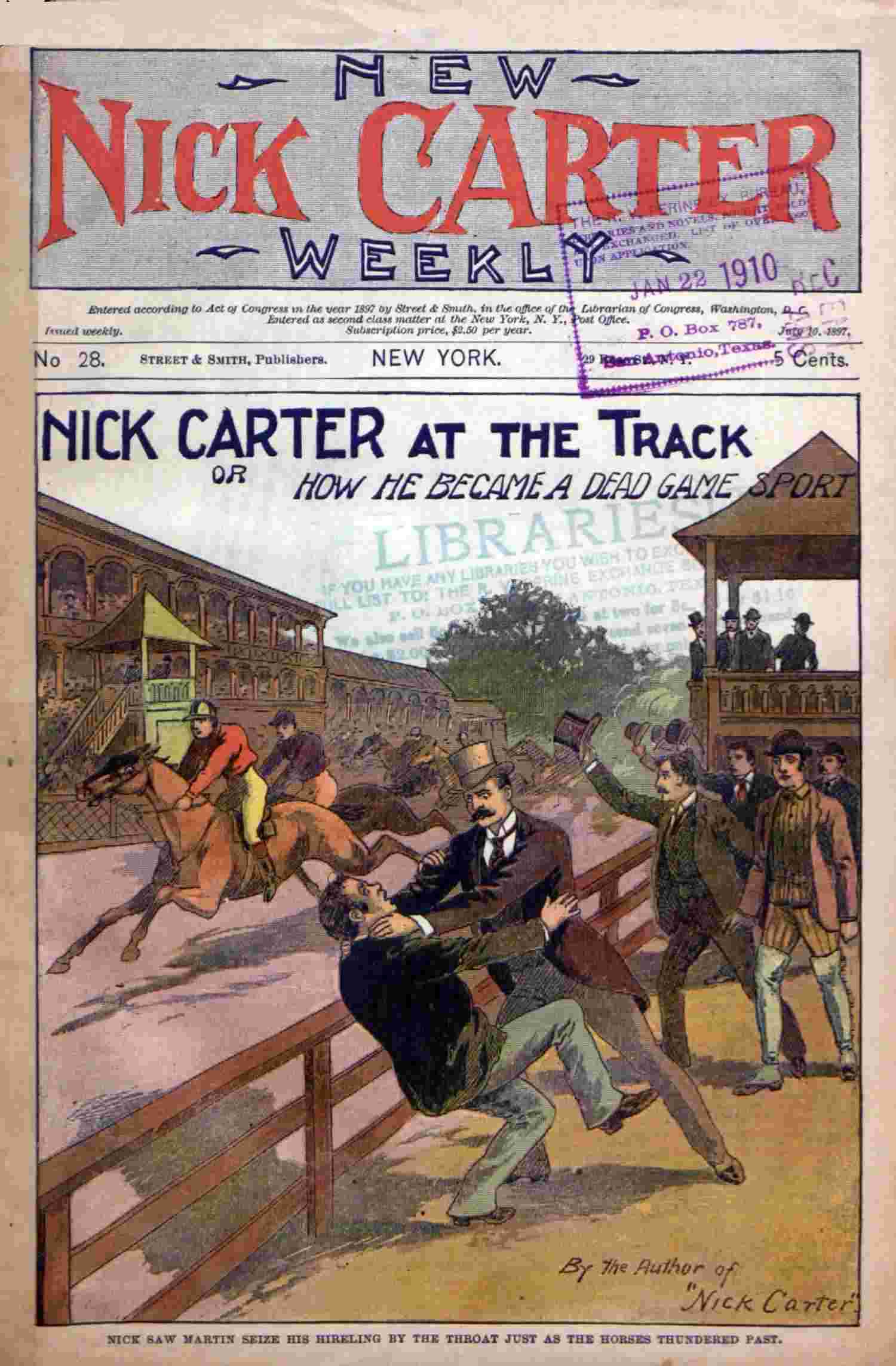
CHAPTER V.
A JOCKEY IN TROUBLE.
The carriage containing the dude and the man Morris whom he had picked up at the saloon stopped at a roadhouse a short distance from the stables.
Nick was not yet posted regarding the conference at the saloon between Morris and the man Brower, who had summoned him there.
He was satisfied that some scheme was on foot which had nothing to do with the plot engineered by Johnson, who had staked forty thousand dollars against twenty thousand of James Wheeler’s money that Denver Bay would not win the race.
Johnson wanted the horse to run and be beaten.
The detective did not know exactly what the Brower crowd did want.
He went over to the stables in company with Morris to find out.
The dude and the roughly-dressed horseman attracted some attention as they walked into the quiet little bar-room.
The men outside seemed to regard it as a good joke that Morris had picked up such a companion.{37}
“He’ll skin the dude all right enough,” said one of them from a lazy position at the watering trough.
“You bet he will,” added another. “If the dude has any money left after Morris gets through betting with him he’s in luck.”
“If he has any money left,” said another, “Morris will probably take him down and take it away from him.”
“I dunno ’bout dat. Did you notice the dude’s neck and shoulders?”
While the men outside were talking, Nick and his companion seated themselves in a small room opening from the bar-room.
Nick ordered drinks and cigars liberally, and Morris was soon on the road to a high old time.
“Say, young feller,” he said, lighting a cigar and turning away just long enough to permit Nick to empty his fourth glass of whisky into a spittoon, “you knocked them fellows around pretty lively over there.”
“I was dooced scared, doncher know.”
“Well you acted to me just like a man who enjoyed it.”
“I weally didn’t know when I hit them. Dooced lucky, wasn’t I?”
“’Twasn’t all luck, I guess,” said Morris, eyeing the dude suspiciously.
“Oh, come now. You mustn’t talk that way to a fellah.”
“Hello, there,” shouted one of the loafers from the outside, pushing the door open with his foot, “be you fellers goin’ on de retired list?”
“We’re busy just now,” said Morris, angrily.
“All right,” said the other, with a loud guffaw, “work de dude fer all dere is in it.”
Morris started excitedly to his feet.
“What do you want here anyhow?” he demanded.
“No offense,” said the other, with a{38} smile, “I just thought I’d look in and ask about the news over town.”
“It’s too early for news over town. There ain’t much going on there till afternoon. You mean about the races, of course?”
“I’d like to know how to win a couple of hundred.”
“You won’t find out from me if you stand there all day.”
“Well, so long,” said the other, closing the door with a bang. “I didn’t know but what de dude might stand treat,” he added, sneaking back to his companion.
“Aw,” said Nick, as the fellow disappeared. “Just touch the bell and we’ll have something more to drink.”
By this time Morris was considerably under the influence of liquor.
He swallowed his whisky sullenly, and looked at his companion after the wise manner of half-drunken men.
“You didn’t get a bet yet,” he said, with a hiccough.
“That’s what I’m waiting for. You promised, you know.”
“Tell you, pardner, I took you into that pool-room to do you out of a couple of hundred, and I’d a got forty fer doin’ it.”
“That’s quite awful!” exclaimed Nick, throwing up his hands in astonishment.
“But I liked the way you bumped those toughies up there, and you have acted square in bringing me here, so that I’m goin’ ter give you a tip.”
“Weally, now?”
“Yes; you’re a man of your word, ain’t you?”
“’Pon honah!”
“Well, then, I want you to promise me that you will give me half a century after you get your money.”
“Weally, now, isn’t that too much?”
“You can make enny amount you like, pard.”
“I might lose, you know.{39}”
“Will you give me fifty if yer win?”
“Why, yes.”
“Well, den, you bet on Daisy for de handicap to-morrow.”
“But, my deah sir, what’s the mattah with Denver Bay?”
“De hoss ain’t in it.”
“But his name is on the cah’d, deah boy.”
“I tell you,” said the other, pounding his fist on the table in drunken impatience, “de hoss ain’t in it!”
“But, my deah boy, I’ve got money bet on Denver Bay now.”
“You’ll get dat back.”
“I don’t see how.”
“If de hoss don’t start all de bets will be declared off, won’t dey?”
Nick sat for some moments in silence.
“Here are the two schemes,” he thought. “Johnson wants the horse to run and be beaten, and Brower does not want the beast to start.”
“Wa’t do you say?”
Nick was thinking fast, and did not answer for some time.
“I’m responsible for the Brower end of the scheme,” he thought. “The fellow doesn’t dare to risk his ten thousand dollars.”
The detective smiled as he thought how little confidence crooked sporting men have in each other’s word.
“In this case,” he thought, “it may be that Brower doubts Johnson’s ability to fix the horse. He’s afraid of some failure in the plan at the last moment.”
The detective now had two plans to select from.
He could defeat the Johnson and Brower plots, and see that the race would be a square one, or he could allow Brower to have his way, and thus cause all bets to be declared off.
The first plan, if the horse should win, would place his client in an excellent position.
On the other hand, if the horse should{40} lose after all it would only increase his difficulty.
The second plan would release Wheeler’s twenty thousand dollar stake money, and leave him just as he stood before engaging in the enterprise.
This plan of preventing the horse from entering the race had been more than hinted at when Chick had appeared at the stables as a jockey on the previous night.
His report on the matter that morning had caused Nick to talk as he had at the broker’s office.
From that conversation with Wheeler, every word of which was still fresh in his mind, Nick had satisfied himself that the broker was anxious to let the stake remain if there was any prospect of securing a fair race.
This was one point in favor of the project of balking the rascals in their efforts to keep the horse out.
Another strong point in the mind of the detective was to teach Johnson and his gang of criminal pool sellers a salutary lesson.
“What they aimed at in their dealings with Wheeler,” he mused, “was robbery, pure and simple. They thought to take his twenty thousand dollars without even as much as giving him a show for it.”
“Well,” said Morris, at length, “how much are you going to put up on Daisy?”
“Weally, now, I’d be betting against myself, doncher see?”
“Didn’t I tell you you’d get the money staked on Denver Bay back again?”
“Why don’t Denver Bay run?”
“Now, look here, if you’re goin’ ’round tellin’ that Denver Bay isn’t goin’ ter start you won’t be doin’ yerself enny good, and will get me into trouble. You don’t want to do that, I suppose?”
“My deah boy, of course I wouldn’t cause you any trouble.”
“If you do,” began Morris, pounding his fist upon the table, “I’ll{41}——”
Just then the scene in the pool-room came to his mind, and glancing at the muscular form of the pretended dude he finished the sentence in a different way from that at first intended.
“I’ll lose my place.”
“Deah boy,” said the dude, who appeared to be struggling with a very deep thought, “couldn’t you make Denver Bay win the race?”
“Denver Bay,” said Morris, solemnly, “is by long odds the best horse entered for the race. He could win de purse wid half a show.”
“Weally now?”
“It’s de surest thing in the world.”
“Then,” said the dude, rising to his feet, “I’ll go and book some more money on him.”
“You’re a chump if you do.”
“But I weally must, you know.”
Morris had as yet given no intimation as to what means would be resorted to to keep the horse off the track.
This was a point upon which the detective desired further information. For this reason he continued the talk about the horse still being a possibility.
“But, deah boy, the ownah tells me that the horse will be run, and will do his best.”
“Damn the owner! He’s de biggest sucker in de whole deal.”
“But, chappie, he’s a friend of mine.”
“Well, it’s a purty pair you are, then, that’s all I’ve got to say.”
Nick rose to his feet as if about to leave the room.
“Hold on! Are you goin’ out to bet more money on Denver Bay?”
“Aw—aw—I thought I would.”
“Well, it won’t do you no good. The money will only lay in de pool-room till after de race, and den you’ll get it back.”
“Has the horse got hurt, deah boy?”
“He’s liable to get hurt before to-morrow morning.{42}”
“Quite shocking!” said the dude, innocently. “The ownah ought to know it.”
“Damn the owner. If he wants to set around here and let his horse be used up right before his eyes let him do it. It’s no affair of mine or yours.”
“The secret is out,” thought Nick. “The brutes intend to steal into the stable to-night and cripple the beast in some way.”
“Come, young fellow,” said Morris, “I’ve talked myself dry again. Fill up de glasses once more, and we’ll get out.”
Nick gave the required order, and the fellow took down his whisky without seeing that Nick threw the contents of his glass upon the floor.
“Now, mind what I’ve told you,” said Morris, as they stood in the doorway, “and don’t give me away. I shouldn’t have said anything about it if it hadn’t been for the whisky you throwed into me.”
“’Pon me honah! I’ll not mention it to a living soul.”
As the two passed into the bar-room the sound of excited voices came from the street in front of the house.
Nick was now anxious to get away, but he paused for a moment and listened as the sounds became louder.
In a moment a small boy, clad in the costume of a jockey, dashed in at the front door, and dodged behind tables and chairs in his efforts to keep out of the reach of a red-faced fellow, who, riding whip in hand, was pursuing him.
The boy succeeded in eluding his pursuer for some moments, much to the delight of the bystanders.
At length the little fellow, in leaping backward, stumbled over a chair and fell to the floor.
Before he could rise to his feet the man had hold of his collar, and was brandishing his whip high in air.
“I’ll teach you to play your pranks on{43} me,” he shouted, bringing the whip down upon the boy’s shrinking form.
The crowd seemed to enjoy the scene hugely, but it was not in the nature of Nick Carter to stand by and see the boy cruelly beaten.
He was about to interfere when the boy succeeded in releasing himself from the man’s hold, and sprang sobbing behind the detective for protection.
The brute made another dash at him, but the detective’s sturdy frame barred the way.
“My deah fellah,” he said, “don’t hurt the boy. What has he done?”
“He’s done enough, you confounded dude. Stand out of the way!”
“If you touch the boy again,” drawled Nick, “I shall strike you.”
The man raised the whip as though about to give the detective a lash in the face.
The crowd laughed and cheered, and made the most of the rather humorous situation.
The next moment their smiles changed to looks of astonishment.
With a quick movement, the seeming dude secured possession of the whip.
He then passed one arm half around the fellow’s head and neck, and gave him a sudden whirl that sent him spinning about the room like a top.
As he spun around the detective applied the whip with no gentle hand, and fairly whirled and lashed the fellow out of the room.
“Hurrah for de dude!” yelled a chorus of voices, as the defeated man stood outside, swearing and shaking his fists.
“I thought dere’d be some fun w’en de duller raised his whip on de dude,” said Morris. “You oughter seen him clean out a couple of plug-uglies in de pool-room to-day.”
Nick paid no attention to the remarks that were being made about him, but devoted his whole attention to the boy.{44}
“Where do you work?” he asked, hurriedly.
“Over dere in de stables.”
“What horses are there in the stables?”
“Oh, Daisy, an’ Denver Bay, an’ a whole lot of ’em.”
“Can you get away about dark?”
“Yes, sir.”
“Well, show yourself in the road there just below the house about dusk, and I’ll pick you up in a carriage. Will you come?”
“You bet I’ll come. Dat man would ’a’ killed me if it hadn’t been for you.”
“I’m making up now for last night’s bad luck,” thought Nick, as he turned around with an insipid stare and in a drawl asked the bystanders to join him in a drink.
As he turned away from the bar a moment later he noticed a well-dressed man entering the front door and hastening directly up-stairs, as though desirous of remaining unnoticed.
The man was Brower, with whom Nick had, in the disguise of a business man, made the ten-thousand dollar bet the night before.
CHAPTER VI.
WANTED—A DEPUTY SHERIFF.
About two o’clock in the afternoon of the same day the sheriff was somewhat surprised at seeing a dudish-looking fellow walking into his private office unannounced.
He glanced up impatiently from his writing, but immediately resumed his work.
“Transact your business in the outer office, please,” he said.
“Aw,” said the dude, gazing stupidly through his one eye-glass, “are you the person in powah?”
“Transact your business in the outer office,” repeated the sheriff, peremptorily.
“Cawn’t do it, me deah boy.{45}”
The sheriff threw himself angrily around in his revolving chair and faced the intruder.
“What do you want?” he demanded.
The dude closed the office door carefully and threw himself into a chair in front of the irate official.
“I have an idea,” he said, in his natural tone of voice, “that there may be a racket at the racing stables to-night, and I want an understanding with your men.”
“Who are you?”
“Nick Carter, at your service.”
“Well, well!” exclaimed the sheriff, extending his hand, “you would deceive your own mother in that rig.”
“All in the way of business,” said Nick, with a smile.
“I begin to recognize you now, although it has been a long time since I have had the pleasure of putting eyes on you.”
“I’ve been rather busy, and the fact of the matter is that I am rather crowded for time now. You have men at the track, I suppose?”
“Certainly. The police are supposed to keep order there, but we always have men on hand to look out for pickpockets and notorious criminals who are wanted here and in other places.”
“Shall you have men at the stables to-night?”
“There are half a dozen there, I believe, who have been engaged to look after the safety of the horses.”
“Will you be kind enough to give me a note to one of them?”
“Certainly, I’ll drive over with you if you think it necessary.”
“I think it would be better not. I’m handling a peculiar case in which I have constituted myself judge, jury, and executioner, and I think it will be better for me to go alone.”
“As you choose. You know, Mr.{46} Carter, that you can command me in any way.”
“Well, it may be necessary for me to make an arrest there to-night. If so, I want to have one of your men within reach so that I can place the prisoner into his hands at once.”
“That’s easily accomplished. I will write you a note which will place all the deputies in that vicinity directly under your charge.”
“After the arrest—if one is made—I want the prisoner hustled away and lodged in jail without any fuss being made over it.”
“In other words, you don’t want the people around there to know that an arrest has been made.”
“That’s it exactly.”
The sheriff wrote busily for some moments, and then handed the detective a slip of paper, which he had placed into an unsealed envelope.
“There you are,” he said. “Show that to any man you see wearing my badge and your orders will be promptly obeyed.”
Thanking the sheriff for his assistance, Nick hastened away.
At dusk that night a carriage drove slowly along in front of the road house.
A few yards from the front of the house a young boy in a jockey uniform was standing.
“Here you are, boy,” called a voice from the carriage. “Jump in quick.”
The boy sprang nimbly into the vehicle.
As he took his seat he glanced hastily at the only other occupant, and started back in alarm.
“You’re looking for the dude who saved you a thrashing this morning?”
“Yes, sir. Did he send you?”
“Yes,” said Nick, nodding to the driver to proceed. “Are you employed at the stable where Denver Bay is kept?”
“Yes, sir.”
“Well, I want to sleep there to-night.{47}”
The boy glanced keenly at the coarse and ill-fitting garments of the pretended countryman who sat on the seat beside him, and asked:
“Ain’t you got no other place to stay?”
“Never mind that. I have taken a notion to sleep in the stable to-night.”
“You don’t mean no harm?”
“Not a bit, my boy.”
“Well, I guess I can slide you in, but there’d be an awful racket if they should find out.”
“I’ll take all the chances on the racket.”
“Be you the duffer what give the man a whippin’ this mornin’?”
“Do I look like him?”
“Not a bit.”
“Well, I’m the same man, and if I did you a favor to-day you must do me one to-night.”
“Ain’t I goin’ to let you into the stables?”
“You must do more than that.”
“What is it?”
“You must never say a word about my being in there—never speak or hint of it to a living soul.”
“You bet I won’t if you don’t want me to.”
“Does any one watch the stables at night?”
“Oh, dere’s folks around dere, but dey don’t watch very close.”
“Is any one supposed to sleep anywhere near Denver Bay?”
“No, sir—not very near.”
“What time can you let me in?”
“You come to the big doors about ten o’clock. Den if any one sees you dey’ll think you’re one of de men working around there.”
“That’s just the thing. When I get in point out Denver Bay’s stall, and go away as if nothing had happened.”
“Is de Bay goin’ to win de race to-morrow?{48}”
“I hope so.”
“I hope so, too. He’s a dandy horse.”
After some further conversation the detective let the boy out of the carriage, and a few moments later left it himself.
The night was quite dark, and the lights still burning about the stables had very little effect at ten o’clock, when the detective made his appearance at the place indicated by the boy.
The jockey was in waiting for him, and soon had him snugly stowed away under Denver Bay’s manger.
The horse did not seem to relish this invasion of his private domain to any great extent, but save a few snorts and an emphatic stamp or two, he paid little attention to his unbidden guest.
There were sounds of voices about the place for some time after the detective had secured his position, but just before midnight all grew still.
Now and then a steady footstep sounded in the distance, but in the immediate vicinity all was quiet.
“Now I wonder,” thought Nick, “if that sheriff’s officer is attending strictly to business. He seems to be an intelligent and nervy sort of chap, and I guess I can trust him.”
After what seemed hours to the waiting detective, he heard an inner door opened cautiously and the footfalls of two persons were heard stealthily advancing toward the place where he lay concealed.
“That’s the horse over there,” said a voice which he had no difficulty in recognizing as that of Morris.
“You take the iron and do the work,” said Brower, in a whisper.
“Not much. I’m not laming race horses for a living just now.”
“You’ve done worse than that before now.”
“Well, everything I ever tackled had some sort of a show.”
“Will you obey my orders?”
“I will not.{49}”
“Then I’ll do it myself. You stand here and watch.”
“Now, then,” thought Nick, “I wonder if that deputy sheriff is near the door.”
Just then the low yelp of a dog sounded from the outside.
“That’s he!” he thought.
“Hark!” whispered Brower, “what was that noise?”
“Some dog hunting for a bone or a place to sleep, I suppose.”
“Hunting us, probably.”
“You’re a coward.”
“The fact is, I don’t like this sort of thing.”
“Then leave it.”
“And leave my ten-thousand dollar stake against a thousand? Not much.”
“You were a fool to make that bet.”
“I know that as well as you do, but I was crowded into it.”
“You’re better at lifting money from a Wall Street office than at anything else, I guess.”
“Hush! you had your share of the money, didn’t you?”
“Yes, I had it until you got me into a poker game.”
“Well, I presume the broker has made twenty thousand since that time. So it don’t matter.”
“This is no place to talk over such things. Do your work, and let’s get out of here.”
“I hope the Bay will kick his head off,” thought Nick, as the man approached the head of the stall.
“Now, gentlemen,” spoke a voice from out the darkness, “I have the drop on you, and if you make a move until I say the word I’ll blow your brains out.”
Nick spoke the last word in a loud tone of voice, and in response to the signal the door swung open and a bright light flashed into the place.
Behind the light was an officer’s badge, and at the right of the badge was a steady arm carrying a cocked revolver.{50}
Before the two culprits could recover from their astonishment or lift a hand, the cool voice in the darkness continued:
“You see how it is, gentlemen, two men have the drop on you, so you may as well give in.”
“Hold steady there, Mr. Officer, while I slip on the bracelets.”
Almost before the men could realize their true position, they were handcuffed and helpless.
“It’s just this way,” said Nick, still keeping in the shadow, “nothing is to be said about your attempt to lame Denver Bay.”
“What are we arrested for, then?” gasped Brower.
“For the larceny of twenty thousand dollars from James Wheeler’s office in Wall Street not long ago.”
“Where is your proof?”
“Never mind the proof now. There is a carriage waiting outside. If you make any noise here, or in the future give any intimation of the place of your arrest, it will only damage your case with the court.”
They offered no further remonstrance, and were soon in a carriage on their way to the county jail in charge of two deputy sheriffs.
A few men lounging about the place saw the men enter the carriage, but no one suspected that the elegantly attired gentleman and the rough-looking hostler were handcuffed together.
As Nick stood watching the carriage when it was driven off he felt a soft pull at his coat.
“My!” said the voice of a jockey, “wasn’t that a slick job?”
“You little scamp!” said Nick, with a smile, “did you see that?”
“You bet I did. Don’t you s’pose I wanted to know what you was stayin’ in dere for?”
“Suppose I had stayed there all night?{51}”
“Den I wouldn’t have got no sleep.”
“Suppose I had hurt the horse?”
“Then I’d have clawed your eyes out.”
“You think a good deal of that horse, don’t you?”
“Course I does.”
“Then you stick close to him to-morrow.”
“You bet I will. I’m goin’ to ride him.”
“Well, if you see a new hostler hanging around him on the track, you ask him if he doesn’t think he’s a dude. If he says he was a dude yesterday you go on about your business and let him alone. Understand?”
“All right. Guess I know who de new man’ll be.”
“Well, don’t you open your mouth about what has taken place here to-night, and keep equally still about to-morrow’s work.”
The boy nodded and turned away.
“And now,” thought Nick, as he walked toward the hotel, “I’ve got the biggest scheme of all to face in the morning.”
CHAPTER VII.
A FOOT RACE.
“There’s something mysterious going on.”
Martin was the speaker, and Amos was listening, all attention.
“Anything new?”
“Why, there’s rumors around the stables of strange happenings last night, but no one seems to know anything definite.”
“In what way?”
“That’s what I can’t find out. People were seen to pass out late in the night and drive hurriedly away in a carriage.”
“Nobody knows who they were?”
“The jockey who is to ride Denver Bay was seen talking to one of the strangers, but you can’t get a word out of him.{52}”
“That’s strange.”
“It’s more than strange—it’s suspicious. But, after all, we have our own scheme to work, and I have every confidence in that.”
“You have the medicine?”
“Yes.”
“Well, you’d better give it to me now. There is no knowing when we will be together again.”
Martin took a small box from his pocket, opened it, and exhibited a white, sugar-coated pill about the size of a marble.
“You can’t be too careful with this,” he said. “I had work enough getting it.”
“Is it poisonous?”
“No. It’s a compound known only to one or two people, and they charge mighty high for it. That little pill cost me a hundred round dollars.”
“It’ll make the horse stop, bolt and kick, will it?”
“It certainly will. I didn’t go into this thing without seeing it tried.”
“And the horse’ll be all right in five minutes, eh?”
“Yes, the pain will subside in less time than that. The beast will be a trifle weak for a while, but no one will notice that.”
“Isn’t there some danger of killing the jockey?”
“Let the jockey take care of himself.”
As the two men arose from the table at which they had been sitting, in a room at the hotel which the detective had visited on the previous day, Martin stopped a moment with his hand on the door and listened.
“What’s that noise?” he asked, in a startled tone.
“What noise?”
“What is that bumping sound? I’ve heard it several times lately.”
“I heard it, too,” said Amos, with a laugh, “and listened. It’s some one{53} bumping against the wall in the next room.”
“Well, here we part for the present,” said Martin. “You do your work and I’ll do mine. You are sure you can get the pill in the hoarse’s mouth unobserved? It must be done on the track at the last moment.”
“That’s easy enough. The last thing I do is to sponge his mouth.”
“Well, don’t make any mistake. There has been an impression that Denver Bay is sure to win, and the pool boxes are just loaded down with bets.”
Thus talking, the men passed out of the room, closing and locking the door behind them. No sooner had they disappeared than there was a sudden upheaval of a long couch in one corner of the room, and Nick Carter crept from underneath it.
“Whew!” he said, drawing a long breath and wiping the perspiration from his face, “I think I should have died in there in five minutes more.”
The celebrated detective had, as a matter of fact, been concealed in the narrow space between the sofa bottom and the floor for four long hours.
Early in the day he had heard Martin engage the room, and give explicit orders that no one should be allowed to occupy it during the day.
Not long after, he had heard him make an appointment with Amos at that place.
By the use of his pick-lock Nick had entered the room and concealed himself.
He was already aware of Martin’s plans as they had stood two days before, but he thought that a change might have been made since the details were arranged in the pool-room stall, and wanted to make sure of his ground.
“They stick to their original plan,” he thought, “and I’ve had this long watch for nothing; but, after all, I was not in a position to take chances.”
He wore the dress and had the appear{54}ance of the ordinary employee of the racing stable.
He had procured badges admitting him to all parts of the grounds, the track, and the judges’ stand as well, and the little jockey had provided him with a ribbon bearing the name of Denver Bay.
This would enable him to work around the horse after he appeared upon the track.
“I imagine,” thought the detective, as he listened with his ear at the door, “that there’ll be a performance on the track to-day not down on their bills. If I’m not mistaken, Mr. Johnson will go home to-night sixty thousand dollars poorer than he thinks he will.”
The hall outside the door appeared to be deserted, and the detective pressed back the bolt, and passed out, closing the door softly after him.
The coast was clear, and he lost no time in getting outside and mingling with the crowd.
An he stepped along the walk, he felt a touch upon his arm, and turned to find Chick standing before him, still in the disguise of a jockey.
The two walked along together until they reached a secluded place, and then Nick asked:
“Did you see the sheriff?”
“Yes. Everything is all right at the jail. Brower and Morris are locked up in separate cells, and no one is the wiser for their being there.”
“Have they done any talking or sent out for friends?”
“They talk most of the time, threatening all sorts of things, and Brower has been trying all the morning to send a messenger over town to call that ten thousand dollar bet off.”
“The sheriff didn’t allow him to send out any word, did he?”
“Of course he didn’t. He understands as well as we do that that is Wheeler’s money.{55}”
“You gave the sheriff my note, of course?”
“Yes, and he had a great laugh over it.”
“He couldn’t imagine yesterday what I wanted his men for. I suppose he knows now.”
“Then you didn’t tell him?”
“No, I didn’t tell him. I got what I wanted without doing that.”
“Now,” said Nick, “I want you on the track this afternoon when the handicap starts, and as close to Denver Bay as you can get without attracting attention.”
“Is there liable to be a scrap?”
“It strikes me that I have been in about enough scraps in this case.”
After some further conversation the detective and his assistant parted, and the former walked slowly back to the hotel.
Amos was nowhere in sight when he reached the crowd lounging about the place.
Five minutes later Nick stood in front of the counter of a small drug store a short distance from the track.
The clerk in charge came out from behind the prescription screen to wait upon him.
“I want a sugar pill,” said Nick, with a smile.
The clerk reached out his hand and took down a jar of homeopathic pellets.
“Hold on,” said Nick, “those are too small. Besides, they are medicated, are they not?”
“Nothing but pure sugar,” said the clerk, putting a few into his mouth and chewing them with evident relish.
“That ain’t what I want,” said Nick, stepping around to the show case where a line of marbles and toys were displayed. “I want just one about the size of one of those marbles. It must be perfectly round and smooth and hard. Can you make one?”
“I certainly can.”
“Well, do so at once.{56}”
The clerk retired behind the screen, and in a few minutes came out and stood behind the counter facing the detective.
“I’ve got it made just as you ordered, but it will take a few moments to dry.”
“It will be hard, will it?”
“As hard as a rock.”
Nick purchased some cigars, and sat down by the window to smoke.
As he did so, Amos passed along on the opposite side of the street and entered a small livery stable.
“What sort of place is that over there?” Nick asked.
“Rather a tough joint, I should say. They have very little business when there are no races on.”
Nick removed the badge indicating that he was a follower of Denver Bay, and pinned the steel badge of a deputy sheriff upon his vest.
“Here’s your pill. It’s big enough to sweeten a cup of coffee with.”
“I’ll sweeten more than that with it,” said Nick, as he took it, paid the bill, and hastened off to the livery stable.
Amos sat on a bench near the driveway, conversing with several attaches of the place.
“Here comes a new deputy,” said one of the loungers, as Nick stepped up. “You haven’t been on the force long, have you, partner?”
“Just got on this morning.”
“I thought I hadn’t seen you around before.”
“As I was saying,” broke in Amos, evidently continuing a conversation, “the fellow is the best jumper I ever saw. I don’t know how far his jump was, but it must have been a clean twelve feet.”
“Speaking about jumping,” said Nick, “I can do a little of that myself.”
Nick, in his present disguise was rather a green-looking specimen, and the loafers scented some fun at once.
“How far can you jump?” asked one.
“I don’t know.”
“Let’s go back in the barn and try,” suggested another.
Nick walked back into the barn without saying another word, and took off his coat and vest.
“That’s purty good,” said Amos, as Nick sprang lightly out, making only a fair jump, “but I can beat it.{57}”
“I’ll bet you five dollars you can’t.”
As Amos started to take off his coat and vest, Nick picked up his own.
When Amos threw his garments down Nick threw his own on top of them.
The money was staked, and Amos won easily.
“That’s hard luck,” said Nick. “Can you run as well as you can jump?”
“I can do some running,” said one of the men.
“I want to get my money back on this jumper,” said Nick, throwing himself down on the pile of clothes. “I’ll bet five dollars that he can beat any man in the party for a block.”
“I can’t do it,” said Amos, “but I’ll try it if you make the bet.”
He winked at the others as he spoke.
They had found a sucker, and they would divide the money, Amos, of course, losing.
The loafers all rushed to the door as the two rushed down the street, and Nick followed with a coat and a vest in his hand.
He remained behind the rest, however, and seemed to have some particular business with the pocket of the vest he held in his hand.
“You’re beat,” said one, as the runners reached the corner.
“I guess I ain’t no good,” said Nick, as Amos came back.
“Hello, there,” said Amos, all out of breath, “you’re trying to put on my vest.”
“That’s so,” said Nick, with a wink. “It looks a little newer than mine.”
Amos put on the garment, threw on his coat, and hastened to the rear end of the barn, where Nick plainly saw him fumbling with a box which he had taken from the vest pocket.
“You’ll find a pill there, all right enough,” thought Nick, as he walked away, “but not one calculated to make a horse lose a race. In the meantime,” he added, rolling a hard, round substance in his pocket, “I’ll keep this and have it analyzed.{58}”
CHAPTER VIII.
A SURPRISE.
The race track is all excitement.
People fight their way through the crowd to the bookmakers, and deposit their money, many of them placing it on Denver Bay.
Finally the rakes and brooms are called from the track.
The crowd rushes up the stairways, and the next moment a splendid bay horse comes around the head of the stretch.
“Denver Bay! Denver Bay!” is the cry.
Close behind him come other favorites.
They go down the paddock, followed in a straggling way by the rest of the field.
The jockeys and helpers crowd about their mounts, and excitement is everywhere.
“Hello,” shouts Denver Bay’s jockey, as a man, wearing the horse’s colors, moves up to him. “Don’t you think you are a dude?”
“I was a dude yesterday,” is the sullen reply.
“No monkeying there,” shouts Amos, walking up to the horse with a sponge in his hand. “They are about ready.”
The detective watches the man closely, and smiles as he sees something white glistening in his palm.
There is a flash of colors and a gleam of steel down in the paddock, as the jockeys mount their horses, and the entire field moves out to the track.
Denver Bay leads.
He minces along with a knowing air, as though thoroughly realizing his importance.
The rest of the field follows in single file, their glossy hides shining in the sun like satin.
The horses take their places in a long, irregular line.
Clouds of dust follow several false breaks and hang over the starting point.
The signal comes, and down the stretch of track come the bright shirts of the jockeys.
Denver Bay gives a sudden plunge or two, jumps off something like two lengths, and goes sailing away in the lead.{59}
There is a grand shout of voices and a shuffling of nervous feet, and shrill cries of “Denver Bay! Denver Bay!”
They sweep past the stand, past the long rows of excited faces, around the turn and away.
Then there is silence for a moment, but only for a moment.
“Daisy falls back!” shouts one, swinging his field glass aloft.
“Denver Bay leads!” shouts another, amid the wildest cheers.
Nick Carter stands close by the side of Amos as the horses turn into the home-stretch.
The detective sees that the man’s face is as pale as death, and that his hands are trembling.
“You beat me on the jumping match,” said Nick, turning to the excited man, “but I’ll bet you an even ten that Denver Bay wins the race.”
Amos makes no reply.
He pushes his way hither and yon in the crowd, muttering incoherently to himself.
“It must be time,” Nick hears him say, as the thunder of hoofs grows louder. “If it don’t happen, they’ll all blame me.”
With straining muscles and glaring eyes, the horses pound up the track, Denver Bay still in the lead.
“This is ruin!” gasps Amos, now utterly regardless of the people about him.
The horses are only a few rods away.
Then Nick sees the excited man grasped by the throat, and realizes that Martin, desperate and unable to control his passion, is fighting with his tool, as dogs fight in the gutter.
The horses thunder past, and Denver Bay wins by a good length.
The great handicap race is over and Denver Bay is officially declared the winner.
As the crowd surges around the winning horse and the jockey is being weighed, there is a cry from the grand stand that some one has fainted.
Nick sees that the excitement is about the spot the Wall Street broker selected as his seat, and hastens in that direction.
As he reaches the place Wheeler slowly opens his eyes and reaches out his hand.{60}
“Not a word here,” whispers the detective, as he bends over him. “Are you able to walk?”
“I think so. You see, it rather knocked me out.”
“Well, get a carriage here and drive away.”
Nick places the broker in a carriage, and then turns back toward the track.
“You did nobly,” he says to the jockey, a moment later. “Keep what took place last night to yourself, and come to this address to-morrow forenoon.”
The detective hands the boy the broker’s card and hastens away.
“Now, then,” he says to the broker, as they drive slowly along, “I want to tell you, now that it is all over, that I don’t like these kind of cases.”
“But you have saved my reputation, and have saved the property of two innocent children. Besides this, you have defeated one of the wickedest conspiracies ever put on the turf.”
“Yes, but I don’t like it for all that. I don’t like the idea of mixing up in these affairs of the turf. My business is to assist the officers of the law in bringing criminals to justice.”
“If the note you sent me this morning is correct you have also done this.”
“How is that?”
“In defeating the race-track gamblers you have captured the men who robbed me of twenty thousand dollars.”
“That is all that makes me feel in any way easy about my part in the transaction.”
“You have even recovered ten thousand dollars of the stolen money.”
“Yes, but that part of it was all involuntary—I did not set out to catch the thieves or to recover the stolen money.”
“You did both, though,” said Wheeler, heartily, “and I am seventy thousand dollars ahead by reason of your good work. For without your assistance I should have lost the twenty thousand stake money, and would never have recovered the ten thousand.”
“You should have faced the loss of the twenty thousand dollars like a man, and not resorted to the race track to get even. Don’t come to me if you ever get into another scrape of the same sort. You re{61}member the promise you made me when I entered upon the case?”
“What was it?”
“You promised that if I would assist you in saving your money that you would invest the money belonging to these heirs in some safe and secure manner, where it would be beyond your reach.”
“And you may rest assured that I will do all that and more. They shall have all the money I have won by the use of their money.”
“There is one thing more. I want you to give the little jockey a thousand dollars when he comes to your office to-morrow. I leave my compensation entirely to yourself.”
“It shall be ten thousand dollars, if it is a cent. Come around in the morning and get the check.”
“You’d better collect in all your bets this afternoon,” said Nick, as the two men parted, “for the pool-rooms have been hit hard. I just won a few hundred myself; not because I wanted to win the money, but because I found myself in places where I had to bet. I have a private charity fund, however, which will care for that.”
Wheeler collected his money without any difficulty, and Nick Carter received his very liberal fee next day.
The little jockey nearly went wild when he was presented with a thousand dollars.
Brower and Morris were convicted of grand larceny, and sentenced to long terms.
And now, when the celebrated detective feels particularly pleasant, he explains to his companions how, for once in his life, he became a “dead-game” sport, saved the patrimony of two innocent children, and won the famous handicap.
[THE END.]
The next number of the New Nick Carter Weekly will contain “Trim in the Dark; or, A Long Road That Has No Turning.{62}”
NICK
CARTER’S
QUARTERLY.
Our readers will be pleased to learn that we have issued No. 1 of Nick Carter’s Quarterly, containing Nos. 1 to 13 of the New Nick Carter Weekly bound in one volume, with all the original colored illustrations—a splendid collection of good detective stories.
PRICE 50 CENTS.
For sale by all newsdealers, or sent postpaid by mail on receipt of price by
STREET & SMITH, Publishers,
New York.
BOOKS
FOR EVERYBODY
TEN CENTS EACH.
The following list of books will be found useful, entertaining, and full of instructive information for all. They are handsomely bound in attractive covers, printed on good quality paper, illustrated, and are marvels of excellence. These books have never before been offered at such a low figure. The price, 10 cents each includes postage.
USEFUL AND INSTRUCTIVE INFORMATION.
Album Writer’s Assistant.
Short Hand for Everybody.
How to Do Business.
Amateur’s Manual of Photography.
Mills’ Universal Letter-Writer.
Boys’ Own Book of Boats.
The Book of Knowledge.
Everyday Cook Book.
The Taxidermist Manual.
Good Housekeeping.
GAMES AND SPORTS.
The Hunter and Angler.
The Complete Angler.
Riding and Driving.
Poe’s Foot-Ball.
Campbell’s Lawn Tennis.
The Complete Checker Player.
Backgammon and Bagatelle.
Out Door Sports.
The Young Gymnast.
The International Cricket Guide.
Amateur and Professional Oarsman’s Manual.
Complete Training Guide for Amateur.
Dunn’s Fencing Instructor.
Capt. Webb’s Swimming Instructor.
Aquatic Guide; or, Yachting and Sailing.
FORTUNE-TELLING.
Napoleon’s Book of Fate.
Cupid’s Dream Book.
Zola’s Dream Book.
TRICKS.
Herrman’s Black Art.
The Way to Do Magic.
Heller’s Hand Book of Magic.
Herrman’s Tricks with Cards.
RECITATIONS AND READINGS.
The Peerless Reciter.
The Young Elocutionist.
Select Recitations and Readings.
The Standard Reciter.
These books will be sent prepaid upon receipt of 10 cents each: When ordering, please be particular to send the full title of the book desired, also your full name and address. The books are 10 cents each, postage free. Address
MANUAL LIBRARY, 25 Rose st., New York.{63}
BOOK OF KNOWLEDGE.
One thousand facts worth remembering will be found in this book. It is a guide to rapid wealth, the secrets of trade, etc. In the druggist department will be found cures for all complaints and how to compound them. Also contains chapters on manufacturing all household and toilet articles. Arts and Sciences, Dyes, Printing Inks, Horses, Mixing Paints, and all general recipes. The book contains over one hundred pages, and will be sent postpaid to any address on receipt of ten cents. Address
MANUAL LIBRARY, 25 Rose street, New York.
AMATEUR PHOTOGRAPHY.
Many people imagine that a photographer’s camera is a difficult machine to handle, and that the work is dirty and disagreeable. All this is a mistake. Photography is a clean, light, and pleasant accomplishment, within the reach of all. The camera will prove a friend, reporter, and helper. With a very inexpensive camera any boy or girl can now learn not only to take good pictures, but pictures that there is everywhere a demand for at remunerative prices. A complete guide to this fascinating art, entitled Amateur Manual of Photography, will be sent on receipt of ten cents.
MANUAL LIBRARY, 25 Rose street, New York.
HOW TO DO BUSINESS.
This book is a guide to success in life, embracing Principles of Business, Choice of Pursuit, Buying and Selling, General Management, Mechanical Trades, Manufacturing, Bookkeeping, Causes of Success and Failure, Business Maxims and Forms, etc. It also contains an appendix of complete business forms and a dictionary of commercial terms. No young man should be without this valuable book. It gives complete information about trades, professions and occupations in which any young man is interested. Price ten cents. Address
MANUAL LIBRARY, 25 Rose street, New York.
WRESTLING.
History tells us that wrestling was the first form of athletic pastime. Without doubt, it gives strength and firmness, combined with quickness and pliability, to the limbs, vigor to the body, coolness and discrimination to the head and elasticity to the temper, the whole forming an energetic combination of the greatest power to be found in man. The book is entitled Professor Muldoon’s Wrestling. It is fully illustrated, and will be sent postpaid on receipt of ten cents. Address
MANUAL LIBRARY, 25 Rose street, New York.
Tip Top Quarterlies.
416 Large Pages. Fifty Cents Each.
Numbers 1, 2 and 3 of the Tip Top Quarterlies are now ready, each containing in one volume thirteen of the famous Frank Merriwell stories complete and unabridged, and thirteen illuminated photo-engraved illustrations.
THE FRANK MERRIWELL STORIES
detail the pranks, trials and bravery of a true-hearted American lad—brave to the core. They have received universal commendation, and the Tip Top Quarterlies are issued in response to numerous inquiries for a complete series of the Merriwell stories.
For sale by newsdealers everywhere, or sent by mail, postpaid, on receipt of price, by the publishers.
STREET & SMITH, New York.{64}
The following is a list of all the NICK CARTER LIBRARIES now in print:
87—Nick Carter’s Quick Decision.
88—Chicago’s Carnival of Crime.
89—Looted in Transit.
90—9-19-29.
91—The Coin Cuff Button.
92—The Highwaymen Side-Tracked.
93—The New York Post Office Thugs.
94—Skipped from Custody.
95—The Letter Z.
96—The Electric Drill.
97—Nick Carter at Mount Vernon.
98—The Identity of Daly.
99—The Book-maker’s Crime.
100—Nick Carter’s Greatest Puzzle.
101—The Knave of Diamonds.
102—The Foot-pads of the Fair.
103—The Little Knocker Out.
104—Nick Carter and the Circus Crooks.
105—The Elevated Railroad Mystery.
106—Nick Carter’s Presence of Mind.
107—The Murder in the Sleeping Car.
108—Nick Carter’s Walk Over.
109—Nick Carter After Bob Dalton.
110—Among the Fire Bugs.
111—Nick Carter’s Second Sight.
112—Nick Carter Among the Poisoners.
113—The Mysterious Assassin.
114—Nick Carter’s Vacation.
115—The Great Detective’s Mascot.
116—The Train Robbery at Kessler Switch.
117—Nick Carter on Time.
118—The Train Robber’s Wind-up.
119—A Murder in the Park.
120—Nick Carter’s Mouse Trap.
121—A Trio of Blackmailers.
122—A Millionaire Fraud.
123—A Dead Man’s Hand.
124—The Fate of Burglar Joe.
125—Nick Carter’s Best Six Hours’ Work.
126—The Heir of Doctor Quartz.
127—A Startling Theft.
128—Nick Carter’s London Mystery.
129—The Eye of Fire.
130—The Meerschaum Pipe.
131—The Path of a Bullet.
132—Three Brass Balls.
133—The Doctor’s Tenant.
134—The Golden Blackmailing Case.
135—Nick Carter’s Fair Play.
136—The Pricks of a Needle.
137—Two Little Girls in Blue.
138—The Great Fur Mystery.
139—The Five Kernels of Corn.
140—The Check in the Grave.
141—The Head of a Lizard.
142—A Personal in the Herald.
143—Nick Carter in Court.
144—The Crime of the French Cafe.
145—The Man Who Stole Millions.
146—The Writing on the Mirror.
147—Nick’s Special Train.
148—Wanted for Murder.
149—The Man with an Extra Finger.
150—The Case of the Burned Ear.
151—The Stolen Race-Horse.
152—The Face at the Window.
153—A Bite of an Apple.
154—Nick Carter’s Ghost Story.
155—A Fatal Knot.
156—The State Street Bond Robbery.
157—The Photograph Clew.
158—Laundry List No. 4575.
159—The Stolen Railroad Train.
160—The Violet Ink Clew.
161—Nick Carter at the Wheel.
162—‘Frisco Jim’s Fatal Error.
163—A Lead Pipe Cinch.
164—The Hip Ling Secret Society.
165—The Coroner Outwitted.
166—The Broken Arm.
167—After the Badger Gang.
168—The Pullman Plot.
169—The Little Glass Vial.
170—The Wooden Finger.
171—Nick Carter’s Sub-Treasury Express.
172—The Acquia Creek Train Robbery.
173—Nick Carter Under the Knife.
174—Nick Carter after the Cook Gang.
175—Nick Carter and the Forest Fires.
176—The Texas and Pacific Express Robbery.
177—The Beautiful Shop-Lifter.
178—The Great Life Insurance Fraud.
179—The Counterfeiter’s Gold Tooth.
180—Pardoned by the President.
181—The Cook Gang at Blackstone Switch.
182—Tracked to Union Station.
183—Safety Deposit Vault No. 39.
{66}184—Who Answered the Personal?
185—Ida, The Woman Detective.
186—The Passenger in the Lower Berth.
187—One Against Twenty-One.
188—Discharged from Custody.
189—The Tramp’s Password.
190—A Crime by Telephone.
191—The Doctor’s Dangerous Experiment.
192—The Hole in the Bank.
193—The Cipher Letter.
194—Saved from the Flames.
195—The Mystery of the Yellow Cab.
196—The Man with the Big Head.
197—Run Down in Toronto.
198—The Wizard of the Cue.
199—A Swindler in Petticoats.
200—Nick Carter’s Quick Work.
201—Blackmailed for Thousands.
202—A Million Dollar Check.
203—Nick Carter’s Name at Stake.
204—Nick Carter in Philadelphia.
205—A Confession by Mistake.
206—Old Thunderbolt Locomotive.
207—Nick Carter’s Double Header.
208—Nick Carter Before the Mast.
209—The Tyburn T.
210—A Man with Four Identities.
211—From Hotel to Prison Cell.
212—Nick Carter’s Double Game.
213—’Mid Flying Bullets.
214—Nick Carter in Boston.
215—Worse than Murder.
216—Brockwell, the Counterfeiter.
217—Nick Carter on the Wheel.
218—Patsy’s Clever Capture.
219—Check 777.
220—Patsy and the Mountain Outlaw.
221—Three Thousand Miles by Freight.
222—Patsy Among the Nihilists.
223—The Thirteens’ Oath of Vengeance.
224—Patsy’s Fight with the Professor.
225—The Fate of Doctor Quartz.
226—Patsy in Russia.
227—Package “17A.”
228—Patsy in England.
229—Nick Carter’s Greatest Peril.
230—Patsy at Home Again.
231—The Great Detective Defied.
232—Patsy in the William Street Den.
233—Patsy on the Terry Murder Case.
234—The Little Giant’s Task.
235—Patsy and the Diamond Mystery.
236—Brought to Bay at Last.
237—Patsy Breaks the Record.
238—Nick Carter’s Celebrated Case.
239—Patsy’s String of Fish.
240—The Little Giant on Deck.
241—Patsy Under Arrest.
242—Young Hercules, Nick Carter’s Assistant.
243—Patsy in Paris.
244—Nick Carter in San Francisco.
245—Patsy Before the Alamo.
246—Nick Carter in Chicago.
247—Patsy at Thompson Ranch.
248—Nick Carter’s Mysterious Case.
249—Patsy’s Strangest Case.
250—Mad Madge, the Queen of Crooks.
251—Patsy at Cripple Creek.
252—A Dead Man’s Grip.
253—Patsy’s Bag of Game.
254—Nick Carter in Kansas City.
255—Patsy’s Millionaire Partner.
256—Mysterious Mail Bag Robbery.
257—Patsy and the Suburban Mystery.
258—Young Hercules in Mexico City.
259—Patsy’s Journey to Boston.
260—Ninety Miles an Hour.
261—Patsy in Baltimore.
262—Nick Carter in St. Louis.
263—Patsy in St. Louis.
264—Nick Carter in Baltimore.
265—Patsy at the Sea Shore.
266—Nick Carter in New Orleans.
267—Patsy in a Canter.
268—Three Times Dead.
269—Patsy’s Queer Advice.
270—The Great Jewel Robbery.
271—Patsy in Chicago.
272—The Fourfold Murder.
273—Patsy’s Supposed Failure.
274—The Letters on the Floor.
275—Patsy and the Double Shuffle Club.
276—Nick Carter On His Mettle.
277—Patsy in Philadelphia.
278—Nick Carter in Jeopardy.
279—Patsy’s Long Disappearance.
280—The Gold Brick Swindlers.
281—Patsy’s Live Wire and the Way it Worked with a Visitor.
282—Nick Carter on the Bowery.
{67}
Any of the above list of Nick Carter stories will be sent by mail, postpaid, on receipt of price (five cents) by the publishers,
STREET & SMITH, New York.
{69}{68}
Thirty-two Pages. Price, 5 Cents. Illuminated Cover.
THE LATEST AND BEST LIBRARY OF DETECTIVE STORIES.
Trim Carter, son of the famous “Chick Carter,” is the leading character in these fascinating stories, and his adventures form the most interesting tales of detective work ever written.
Back Numbers always on hand. Price, post-paid, Five cents each.
{70}