
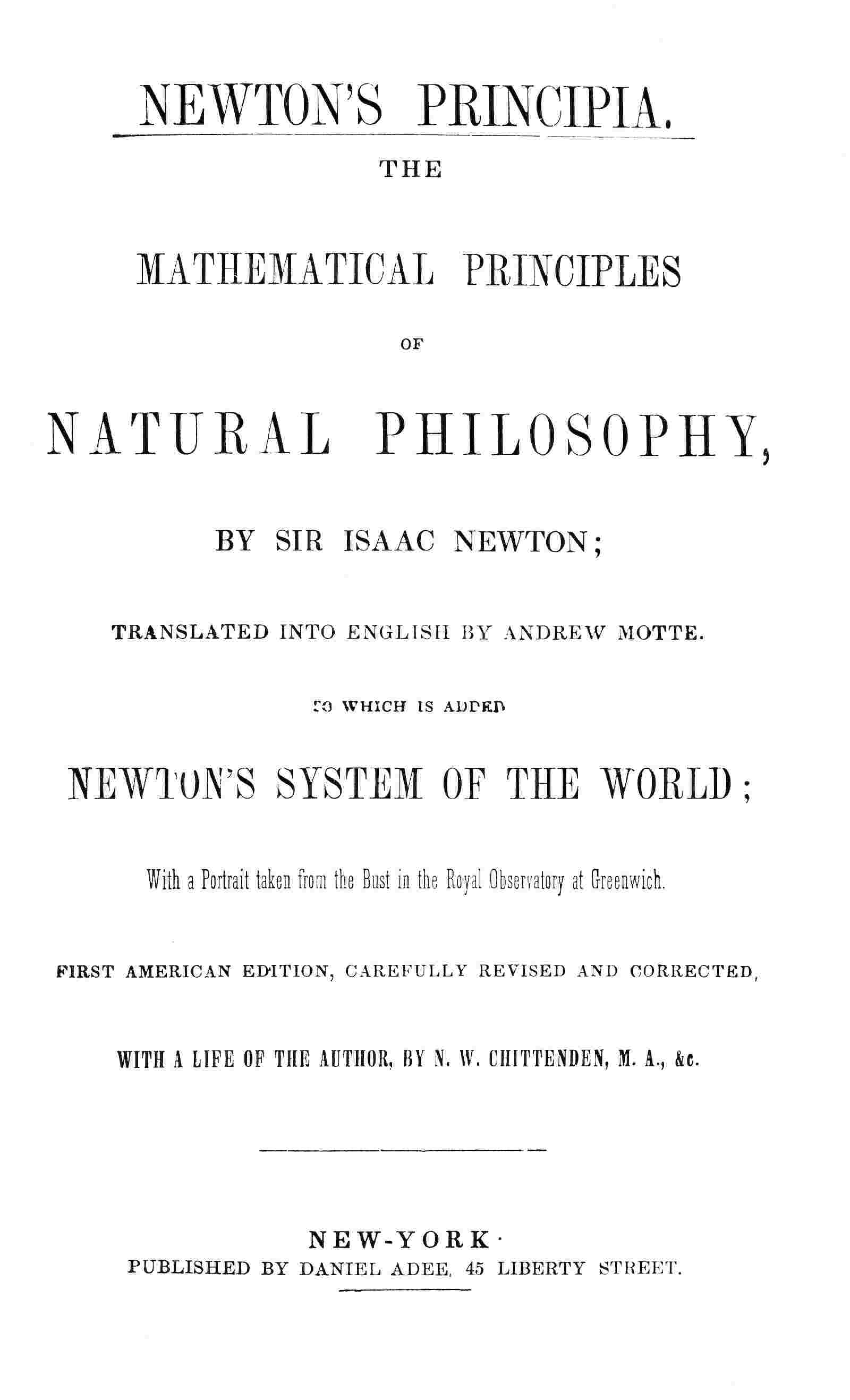
BOOK I.
OF THE MOTION OF BODIES.
SECTION I.
Of the method of first and last ratios of quantities, by the help whereof we demonstrate the propositions that follow.
LEMMA I.
Quantities, and the ratios of quantities, which in any finite time converge continually to equality, and before the end of that time approach nearer the one to the other than by any given difference, become ultimately equal.
If you deny it, suppose them to be ultimately unequal, and let D be their ultimate difference. Therefore they cannot approach nearer to equality than by that given difference D; which is against the supposition.
LEMMA II.
If in any figure AacE, terminated by the right lines Aa, AE, and the curve acE, there be inscribed any number of parallelograms Ab, Bc, Cd, &c., comprehended under equal bases AB, BC, CD, &c., and the sides, Bb, Cc, Dd, &c., parallel to one side Aa of the figure; and the parallelograms aKbl, bLcm, cMdn, &c., are completed. Then if the breadth of those parallelograms be supposed to be diminished, and their number to be augmented in infinitum; I say, that the ultimate ratios which the inscribed figure AKbLcMdD, the circumscribed figure AalbmcndoE, and curvilinear figure AabcdE, will have to one another, are ratios of equality.
For the difference of the inscribed and circumscribed figures is the sum of the parallelograms Kl, Lm, Mn, Do, that is (from the equality of all their bases), the rectangle under one of their bases Kb and the sum of their altitudes Aa, that is, the rectangle ABla. But this rectangle, because its breadth AB is supposed diminished in infinitum, becomes less than any given space. And therefore (by Lem. I) the figures inscribed and circumscribed become ultimately equal one to the other; and much more will the intermediate curvilinear figure be ultimately equal to either. Q.E.D.
LEMMA III.
The same ultimate ratios are also ratios of equality, when the breadths, AB, BC, DC, &c., of the parallelograms are unequal, and are all diminished in infinitum.
For suppose AF equal to the greatest breadth, and complete the parallelogram FAaf. This parallelogram will be greater than the difference of the inscribed and circumscribed figures; but, because its breadth AF is diminished in infinitum, it will become less than any given rectangle. Q.E.D.
COR. 1. Hence the ultimate sum of those evanescent parallelograms will in all parts coincide with the curvilinear figure.
COR. 2. Much more will the rectilinear figure comprehended under the chords of the evanescent arcs ab, bc, CD, &c., ultimately coincide with the curvilinear figure.
COR. 3. And also the circumscribed rectilinear figure comprehended under the tangents of the same arcs.
COR. 4. And therefore these ultimate figures (as to their perimeters acE) are not rectilinear, but curvilinear limits of rectilinear figures.
LEMMA IV.
If in two figures AacE, PprT, you inscribe (as before) two ranks of parallelograms, an equal number in each rank, and, when their breadths are diminished in infinitum, the ultimate ratios of the parallelograms in one figure to those in the other, each to each respectively, are the same; I say, that those two figures AacE, PprT, are to one another in that same ratio.
For as the parallelograms in the one are severally to the parallelograms in the other, so (by composition) is the sum of all in the one to the sum of all in the other; and so is the one figure to the other; because (by Lem. III) the former figure to the former sum, and the latter figure to the latter sum, are both in the ratio of equality. Q.E.D.
COR. Hence if two quantities of any kind are any how divided into an equal number of parts, and those parts, when their number is augmented, and their magnitude diminished in infinitum, have a given ratio one to the other, the first to the first, the second to the second, and so on in order, the whole quantities will be one to the other in that same given ratio. For if, in the figures of this Lemma, the parallelograms are taken one to the other in the ratio of the parts, the sum of the parts will always be as the sum of the parallelograms; and therefore supposing the number of the parallelograms and parts to be augmented, and their magnitudes diminished in infinitum, those sums will be in the ultimate ratio of the parallelogram in the one figure to the correspondent parallelogram in the other; that is (by the supposition), in the ultimate ratio of any part of the one quantity to the correspondent part of the other.
LEMMA V.
In similar figures, all sorts of homologous sides, whether curvilinear or rectilinear, are proportional; and the areas are in the duplicate ratio of the homologous sides.
LEMMA VI.
If any arc ACB, given in position is subtended by its chord AB, and in any point A, in the middle of the continued curvature, is touched by a right line AD, produced both ways; then if the points A and B approach one another and meet, I say, the angle BAD, contained between the chord and the tangent, will be diminished in infinitum, and ultimately will vanish.
For if that angle does not vanish, the arc ACB will contain with the tangent AD an angle equal to a rectilinear angle; and therefore the curvature at the point A will not be continued, which is against the supposition.
LEMMA VII.
The same things being supposed, I say that the ultimate ratio of the arc, chord, and tangent, any one to any other, is the ratio of equality.
For while the point B approaches towards the point A, consider always AB and AD as produced to the remote points b and d, and parallel to the secant BD draw bd: and let the arc Acb be always similar to the arc ACB. Then, supposing the points A and B to coincide, the angle dAb will vanish, by the preceding Lemma; and therefore the right lines Ab, Ad (which are always finite), and the intermediate arc Acb, will coincide, and become equal among themselves. Wherefore, the right lines AB, AD, and the intermediate arc ACB (which are always proportional to the former), will vanish, and ultimately acquire the ratio of equality. Q.E.D.
COR. 1. Whence if through B we draw BF parallel to the tangent, always cutting any right line AF passing through A in F, this line BF will be ultimately in the ratio of equality with the evanescent arc ACB; because, completing the parallelogram AFBD, it is always in a ratio of equality with AD.
COR. 2. And if through B and A more right lines are drawn, as BE, BD, AF, AG, cutting the tangent AD and its parallel BF; the ultimate ratio of all the abscissas AD, AE, BF, BG, and of the chord and arc AB, any one to any other, will be the ratio of equality.
COR. 3. And therefore in all our reasoning about ultimate ratios, we may freely use any one of those lines for any other.
LEMMA VIII.
If the right lines AR, BR, with the arc ACB, the chord AB, and the tangent AD, constitute three triangles RAB, RACB, RAD, and the points A and B approach and meet: I say, that the ultimate form of these evanescent triangles is that of similitude, and their ultimate ratio that of equality.
For while the point B approaches towards the point A, consider always AB, AD, AR, as produced to the remote points b, d, and r, and rbd as drawn parallel to RD, and let the arc Acb be always similar to the arc ACB. Then supposing the points A and B to coincide, the angle bAd will vanish; and therefore the three triangles rAb, rAcb, rAd (which are always finite), will coincide, and on that account become both similar and equal. And therefore the triangles RAB, RACB, RAD which are always similar and proportional to these, will ultimately become both similar and equal among themselves. Q.E.D.
COR. And hence in all reasonings about ultimate ratios, we may indifferently use any one of those triangles for any other.
LEMMA IX.
If a right line AE, and a curve line ABC, both given by position, cut each other in a given angle, A; and to that right line, in another given angle, BD, CE are ordinately applied, meeting the curve in B, C; and the points B and C together approach towards and meet in the point A: I say, that the areas of the triangles ABD, ACE, will ultimately be one to the other in the duplicate ratio of the sides.
For while the points B, C, approach towards the point A, suppose always AD to be produced to the remote points d and e, so as Ad, Ae may be proportional to AD, AE; and the ordinates db, ec, to be drawn parallel to the ordinates DB and EC, and meeting AB and AC produced in b and c. Let the curve Abc be similar to the curve ABC, and draw the right line Ag so as to touch both curves in A, and cut the ordinates DB, EC, db, ec, in F, G, f, g. Then, supposing the length Ae to remain the same, let the points B and C meet in the point A; and the angle cAg vanishing, the curvilinear areas Abd, Ace will coincide with the rectilinear areas Afd, Age; and therefore (by Lem. V) will be one to the other in the duplicate ratio of the sides Ad, Ae. But the areas ABD, ACE are always proportional to these areas; and so the sides AD, AE are to these sides. And therefore the areas ABD, ACE are ultimately one to the other in the duplicate ratio of the sides AD, AE. Q.E.D.
LEMMA X.
The spaces which a body describes by any finite force urging it, whether that force is determined and immutable, or is continually augmented or continually diminished, are in the very beginning of the motion one to the other in the duplicate ratio of the times.
Let the times be represented by the lines AD, AE, and the velocities generated in those times by the ordinates DB, EC. The spaces described with these velocities will be as the areas ABD, ACE, described by those ordinates, that is, at the very beginning of the motion (by Lem. IX), in the duplicate ratio of the times AD, AE. Q.E.D.
COR. 1. And hence one may easily infer, that the errors of bodies describing similar parts of similar figures in proportional times, are nearly as the squares of the times in which they are generated; if so be these errors are generated by any equal forces similarly applied to the bodies, and measured by the distances of the bodies from those places of the similar figures, at which, without the action of those forces, the bodies would have arrived in those proportional times.
COR. 2. But the errors that are generated by proportional forces, similarly applied to the bodies at similar parts of the similar figures, are as the forces and the squares of the times conjunctly.
COR. 3. The same thing is to be understood of any spaces whatsoever described by bodies urged with different forces; all which, in the very beginning of the motion, are as the forces and the squares of the times conjunctly.
COR. 4. And therefore the forces are as the spaces described in the very beginning of the motion directly, and the squares of the times inversely.
COR. 5. And the squares of the times are as the spaces described directly, and the forces inversely.
SCHOLIUM.
If in comparing indetermined quantities of different sorts one with another, any one is said to be as any other directly or inversely, the meaning is, that the former is augmented or diminished in the same ratio with the latter, or with its reciprocal. And if any one is said to be as any other two or more directly or inversely, the meaning is, that the first is augmented or diminished in the ratio compounded of the ratios in which the others, or the reciprocals of the others, are augmented or diminished. As if A is said to be as B directly, and C directly, and D inversely, the meaning is, that A is augmented or diminished in the same ratio with , that is to say, that and are one to the other in a given ratio.
LEMMA XI.
The evanescent subtense of the angle of contact, in all curves which at the point of contact have a finite curvature, is ultimately in the duplicate ratio of the subtense of the conterminate arc.
CASE 1. Let AB be that arc, AD its tangent, BD the subtense of the angle of contact perpendicular on the tangent, AB the subtense of the arc. Draw BG perpendicular to the subtense AB, and AG to the tangent AD, meeting in G; then let the points D, B, and G, approach to the points d, b, and g, and suppose J to be the ultimate intersection of the lines BG, AG, when the points D, B, have come to A. It is evident that the distance GJ may be less than any assignable. But (from the nature of the circles passing through the points A, B, G, A, b, g,) , and ; and therefore the ratio of to is compounded of the ratios of AG to Ag, and of Bd to bd. But because GJ may be assumed of less length than any assignable, the ratio of AG to Ag may be such as to differ from the ratio of equality by less than any assignable difference; and therefore the ratio of to may be such as to differ from the ratio of BD to bd by less than any assignable difference. Therefore, by Lem. I, the ultimate ratio of to is the same with the ultimate ratio of BD to bd. Q.E.D.
CASE 2. Now let BD be inclined to AD in any given angle, and the ultimate ratio of BD to bd will always be the same as before, and therefore the same with the ratio of to . Q.E.D.
CASE 3. And if we suppose the angle D not to be given, but that the right line BD converges to a given point, or is determined by any other condition whatever; nevertheless the angles D, d, being determined by the same law, will always draw nearer to equality, and approach nearer to each other than by any assigned difference, and therefore, by Lem. I, will at last be equal; and therefore the lines BD, bd are in the same ratio to each other as before. Q.E.D.
COR. 1. Therefore since the tangents AD, Ad, the arcs AB, Ab, and their sines, BC, bc, become ultimately equal to the chords AB, Ab, their squares will ultimately become as the subtenses BD, bd.
COR. 2. Their squares are also ultimately as the versed sines of the arcs, bisecting the chords, and converging to a given point. For those versed sines are as the subtenses BD, bd.
COR. 3. And therefore the versed sine is in the duplicate ratio of the time in which a body will describe the arc with a given velocity.
COR. 4. The rectilinear triangles ADB, Adb are ultimately in the triplicate ratio of the sides AD, Ad, and in a sesquiplicate ratio of the sides DB, db; as being in the ratio compounded of the sides AD to DB, and of Ad to db. So also the triangles ABC, Abc are ultimately in the triplicate ratio of the sides BC, bc. What I call the sesquiplicate ratio is the subduplicate of the triplicate, as being compounded of the simple and subduplicate ratio.
COR. 5. And because DB, db are ultimately parallel and in the duplicate ratio of the lines AD, Ad, the ultimate curvilinear areas ADB, Adb will be (by the nature of the parabola) two thirds of the rectilinear triangles ADB, Adb and the segments AB, Ab will be one third of the same triangles. And thence those areas and those segments will be in the triplicate ratio as well of the tangents AD, Ad, as of the chords and arcs AB, AB.
SCHOLIUM.
But we have all along supposed the angle of contact to be neither infinitely greater nor infinitely less than the angles of contact made by circles and their tangents; that is, that the curvature at the point A is neither infinitely small nor infinitely great, or that the interval AJ is of a finite magnitude. For DB may be taken as AD3: in which case no circle can be drawn through the point A, between the tangent AD and the curve AB, and therefore the angle of contact will be infinitely less than those of circles. And by a like reasoning, if DB be made successfully as , , , , &c., we shall have a series of angles of contact, proceeding in infinitum, wherein every succeeding term is infinitely less than the preceding. And if DB be made successively as , , , , , , &c., we shall have another infinite series of angles of contact, the first of which is of the same sort with those of circles, the second infinitely greater, and every succeeding one infinitely greater than the preceding. But between any two of these angles another series of intermediate angles of contact may be interposed, proceeding both ways in infinitum, wherein every succeeding angle shall be infinitely greater or infinitely less than the preceding. As if between the terms and there were interposed the series , , , , , , , , , &c. And again, between any two angles of this series, a new series of intermediate angles may be interposed, differing from one another by infinite intervals. Nor is nature confined to any bounds.
Those things which have been demonstrated of curve lines, and the superfices which they comprehend, may be easily applied to the curve superfices and contents of solids. These Lemmas are premised to avoid the tediousness of deducing perplexed demonstrations ad absurdum, according to the method of the ancient geometers. For demonstrations are more contracted by the method of indivisibles: but because the hypothesis of indivisibles seems somewhat harsh, and therefore that method is reckoned less geometrical, I chose rather to reduce the demonstrations of the following propositions to the first and last sums and ratios of nascent and evanescent quantities, that is, to the limits of those sums and ratios; and so to premise, as short as I could, the demonstrations of those limits. For hereby the same thing is performed as by the method of indivisibles; and now those principles being demonstrated, we may use them with more safety. Therefore if hereafter I should happen to consider quantities as made up of particles, or should use little curve lines for right ones, I would not be understood to mean indivisibles, but evanescent divisible quantities; not the sums and ratios of determinate parts, but always the limits of sums and ratios; and that the force of such demonstrations always depends on the method laid down in the foregoing Lemmas.
Perhaps it may be objected, that there is no ultimate proportion, of evanescent quantities; because the proportion, before the quantities have vanished, is not the ultimate, and when they are vanished, is none. But by the same argument, it may be alledged, that a body arriving at a certain place, and there stopping, has no ultimate velocity: because the velocity, before the body comes to the place, is not its ultimate velocity; when it has arrived, is none. But the answer is easy; for by the ultimate velocity, is meant that with which the body is moved, neither before it arrives at its last place and the motion ceases, nor after, but at the very instant it arrives; that is, that velocity with which the body arrives at its last place, and with which the motion ceases. And in like manner, by the ultimate ratio of evanescent quantities is to be understood the ratio of the quantities not before they vanish, nor afterwards, but with which they vanish. In like manner the first ratio of nascent quantities is that with which they begin to be. And the first or last sum is that with which they begin and cease to be (or to be augmented or diminished). There is a limit which the velocity at the end of the motion may attain, but not exceed. This is the ultimate velocity. And there is the like limit in all quantities and proportions that begin and cease to be. And since such limits are certain and definite, to determine the same is a problem strictly geometrical. But whatever is geometrical we may be allowed to use in determining and demonstrating any other thing that is likewise geometrical.
It may also be objected, that if the ultimate ratios of evanescent quantities are given, their ultimate magnitudes will be also given: and so all quantities will consist of indivisibles, which is contrary to what Euclid has demonstrated concerning incommensurables, in the 10th Book of his Elements. But this objection is founded on a false supposition. For those ultimate ratios with which quantities vanish are not truly the ratios of ultimate quantities, but limits towards which the ratios of quantities decreasing without limit do always converge; and to which they approach nearer than by any given difference, but never go beyond, nor in effect attain to, till the quantities are diminished in infinitum. This thing will appear more evident in quantities infinitely great. If two quantities, whose difference is given, be augmented in infinitum, the ultimate ratio of these quantities will be given, to wit, the ratio of equality; but it does not from thence follow, that the ultimate or greatest quantities themselves, whose ratio that is, will be given. Therefore if in what follows, for the sake of being more easily understood, I should happen to mention quantities as least, or evanescent, or ultimate, you are not to suppose that quantities of any determinate magnitude are meant, but such as are conceived to be always diminished without end.
SECTION II.
Of the Invention of Centripetal Forces.
PROPOSITION I. THEOREM I.
The areas, which revolving bodies describe by radii drawn to an immovable centre of force do lie in the same immovable planes, and are proportional to the times in which they are described.
For suppose the time to be divided into equal parts, and in the first part of that time let the body by its innate force describe the right line AB. In the second part of that time, the same would (by Law I.), if not hindered, proceed directly to c, along the line Bc equal to AB; so that by the radii AS, BS, cS, drawn to the centre, the equal areas ASB, BSc, would be described. But when the body is arrived at B, suppose that a centripetal force acts at once with a great impulse, and, turning aside the body from the right line Bc, compels it afterwards to continue its motion along the right line BC. Draw cC parallel to BS meeting BC in C; and at the end of the second part of the time, the body (by Cor. 1. of the Laws) will be found in C, in the same plane with the triangle ASB. Join SC, and, because SB and Cc are parallel, the triangle SBC will be equal to the triangle SBc, and therefore also to the triangle SAB. By the like argument, if the centripetal force acts successively in C, D, E, &c., and makes the body, in each single particle of time, to describe the right lines CD, DE, EF, &c., they will all lie in the same plane; and the triangle SCD will be equal to the triangle SBC, and SDE to SCD, and SEF to SDE. And therefore, in equal times, equal areas are described in one immovable plane: and, by composition, any sums SADS, SAFS, of those areas, are one to the other as the times in which they are described. Now let the number of those triangles be augmented, and their breadth diminished in infinitum; and (by Cor. 4, Lem. III.) their ultimate perimeter ADF will be a curve line: and therefore the centripetal force, by which the body is perpetually drawn back from the tangent of this curve, will act continually; and any described areas SADS, SAFS, which are always proportional to the times of description, will, in this case also, be proportional to those times. Q.E.D.
COR. 1. The velocity of a body attracted towards an immovable centre, in spaces void of resistance, is reciprocally as the perpendicular let fall from that centre on the right line that touches the orbit. For the velocities in those places A, B, C, D, E, are as the bases AB, BC, CD, DE, EF, of equal triangles; and these bases are reciprocally as the perpendiculars let fall upon them.
COR. 2. If the chords AB, BC of two arcs, successively described in equal times by the same body, in spaces void of resistance, are completed into a parallelogram ABCV, and the diagonal BV of this parallelogram, in the position which it ultimately acquires when those arcs are diminished in infinitum, is produced both ways, it will pass through the centre of force.
COR. 3. If the chords AB, BC, and DE, EF, of arcs described in equal times, in spaces void of resistance, are completed into the parallelograms ABCV, DEFZ; the forces in B and E are one to the other in the ultimate ratio of the diagonals BV, EZ, when those arcs are diminished in infinitum. For the motions BC and EF of the body (by Cor. 1 of the Laws) are compounded of the motions Bc, BV, and Ef, EZ: but BV and EZ, which are equal to Cc and Ff, in the demonstration of this Proposition, were generated by the impulses of the centripetal force in B and E, and are therefore proportional to those impulses.
COR. 4. The forces by which bodies, in spaces void of resistance, are drawn back from rectilinear motions, and turned into curvilinear orbits, are one to another as the versed sines of arcs described in equal times; which versed sines tend to the centre of force, and bisect the chords when those arcs are diminished to infinity. For such versed sines are the halves of the diagonals mentioned in Cor. 3.
COR. 5. And therefore those forces are to the force of gravity as the said versed sines to the versed sines perpendicular to the horizon of those parabolic arcs which projectiles describe in the same time.
COR. 6. And the same things do all hold good (by Cor. 5 of the Laws), when the planes in which the bodies are moved, together with the centres of force which are placed in those planes, are not at rest, but move uniformly forward in right lines.
PROPOSITION II. THEOREM II.
Every body that moves in any curve line described in a plane, and by a radius, drawn to a point either immovable, or moving forward with an uniform rectilinear motion, describes about that point areas proportional to the times, is urged by a centripetal force directed to that point.
CASE. 1. For every body that moves in a curve line, is (by Law I) turned aside from its rectilinear course by the action of some force that impels it. And that force by which the body is turned off from its rectilinear course, and is made to describe, in equal times, the equal least triangles SAB, SBC, SCD, &c., about the immovable point S (by Prop. XL. Book I, Elem. and Law II), acts in the place B, according to the direction of a line parallel to cC, that is, in the direction of the line BS, and in the place C, according to the direction of a line parallel to dD, that is, in the direction of the line CS, &c.; and therefore acts always in the direction of lines tending to the immovable point S. Q.E.D.
CASE. 2. And (by Cor. 5 of the Laws) it is indifferent whether the superfices in which a body describes a curvilinear figure be quiescent, or moves together with the body, the figure described, and its point S, uniformly forward in right lines.
COR. 1. In non-resisting spaces or mediums, if the areas are not proportional to the times, the forces are not directed to the point in which the radii meet; but deviate therefrom in consequentia, or towards the parts to which the motion is directed, if the description of the areas is accelerated; but in antecedentia, if retarded.
COR. 2. And even in resisting mediums, if the description of the areas is accelerated, the directions of the forces deviate from the point in which the radii meet, towards the parts to which the motion tends.
SCHOLIUM.
A body may be urged by a centripetal force compounded of several forces; in which case the meaning of the Proposition is, that the force which results out of all tends to the point S. But if any force acts perpetually in the direction of lines perpendicular to the described surface, this force will make the body to deviate from the plane of its motion: but will neither augment nor diminish the quantity of the described surface, and is therefore to be neglected in the composition of forces.
PROPOSITION III. THEOREM III.
Every body, that by a radius drawn to the centre of another body, howsoever moved, describes areas about that centre proportional to the times, is urged by a force compounded out of the centripetal force tending to that other body, and of all the accelerative force by which that other body is impelled.
Let L represent the one, and T the other body; and (by Cor. 6 of the Laws) if both bodies are urged in the direction of parallel lines, by a new force equal and contrary to that by which the second body T is urged, the first body L will go on to describe about the other body T the same areas as before: but the force by which that other body T was urged will be now destroyed by an equal and contrary force; and therefore (by Law I.) that other body T, now left to itself, will either rest, or move uniformly forward in a right line: and the first body L impelled by the difference of the forces, that is, by the force remaining, will go on to describe about the other body T areas proportional to the times. And therefore (by Theor. II.) the difference of the forces is directed to the other body T as its centre. Q.E.D.
COR. 1. Hence if the one body L, by a radius drawn to the other body T, describes areas proportional to the times; and from the whole force, by which the first body L is urged (whether that force is simple, or, according to Cor. 2 of the Laws, compounded out of several forces), we subduct (by the same Cor.) that whole accelerative force by which the other body is urged; the whole remaining force by which the first body is urged will tend to the other body T, as its centre.
COR. 2. And, if these areas are proportional to the times nearly, the remaining force will tend to the other body T nearly.
COR. 3. And vice versa, if the remaining force tends nearly to the other body T, those areas will be nearly proportional to the times.
COR. 4. If the body L, by a radius drawn to the other body T, describes areas, which, compared with the times, are very unequal; and that other body T be either at rest, or moves uniformly forward in a right line: the action of the centripetal force tending to that other body T is either none at all, or it is mixed and compounded with very powerful actions of other forces: and the whole force compounded of them all, if they are many, is directed to another (immovable or moveable) centre. The same thing obtains, when the other body is moved by any motion whatsoever; provided that centripetal force is taken, which remains after subducting that whole force acting upon that other body T.
SCHOLIUM.
Because the equable description of areas indicates that a centre is respected by that force with which the body is most affected, and by which it is drawn back from its rectilinear motion, and retained in its orbit; why may we not be allowed, in the following discourse, to use the equable description of areas as an indication of a centre, about which all circular motion is performed in free spaces?
PROPOSITION IV. THEOREM IV.
The centripetal forces of bodies, which by equable motions describe different circles, tend to the centres of the same circles; and are one to the other as the squares of the arcs described in equal times applied to the radii of the circles.
These forces tend to the centres of the circles (by Prop. II., and Cor. 2, Prop. I.), and are one to another as the versed sines of the least arcs described in equal times (by Cor. 4, Prop. I.); that is, as the squares of the same arcs applied to the diameters of the circles (by Lem. VII.); and therefore since those arcs are as arcs described in any equal times, and the diameters are as the radii, the forces will be as the squares of any arcs described in the same time applied to the radii of the circles. Q.E.D.
COR. 1. Therefore, since those arcs are as the velocities of the bodies the centripetal forces are in a ratio compounded of the duplicate ratio of the velocities directly, and of the simple ratio of the radii inversely.
COR. 2. And since the periodic times are in a ratio compounded of the ratio of the radii directly, and the ratio of the velocities inversely, the centripetal forces, are in a ratio compounded of the ratio of the radii directly, and the duplicate ratio of the periodic times inversely.
COR. 3. Whence if the periodic times are equal, and the velocities therefore as the radii, the centripetal forces will be also as the radii; and the contrary.
COR. 4. If the periodic times and the velocities are both in the subduplicate ratio of the radii, the centripetal forces will be equal among themselves; and the contrary.
COR. 5. If the periodic times are as the radii, and therefore the velocities equal, the centripetal forces will be reciprocally as the radii; and the contrary.
COR. 6. If the periodic times are in the sesquiplicate ratio of the radii, and therefore the velocities reciprocally in the subduplicate ratio of the radii, the centripetal forces will be in the duplicate ratio of the radii inversely; and the contrary.
COR. 7. And universally, if the periodic time is as any power Rn of the radius R, and therefore the velocity reciprocally as the power of the radius, the centripetal force will be reciprocally as the power of the radius; and the contrary.
COR. 8. The same things all hold concerning the times, the velocities, and forces by which bodies describe the similar parts of any similar figures that have their centres in a similar position with those figures; as appears by applying the demonstration of the preceding cases to those. And the application is easy, by only substituting the equable description of areas in the place of equable motion, and using the distances of the bodies from the centres instead of the radii.
COR. 9. From the same demonstration it likewise follows, that the arc which a body, uniformly revolving in a circle by means of a given centripetal force, describes in any time, is a mean proportional between the diameter of the circle, and the space which the same body falling by the same given force would descend through in the same given time.
SCHOLIUM.
The case of the 6th Corollary obtains in the celestial bodies (as Sir Christopher Wren, Dr. Hooke, and Dr. Halley have severally observed); and therefore in what follows, I intend to treat more at large of those things which relate to centripetal force decreasing in a duplicate ratio of the distances from the centres.
Moreover, by means of the preceding Proposition and its Corollaries, we may discover the proportion of a centripetal force to any other known force, such as that of gravity. For if a body by means of its gravity revolves in a circle concentric to the earth, this gravity is the centripetal force of that body. But from the descent of heavy bodies, the time of one entire revolution, as well as the arc described in any given time, is given (by Cor. 9 of this Prop.). And by such propositions, Mr. Huygens, in his excellent book De Horologio Oscillatorio, has compared the force of gravity with the centrifugal forces of revolving bodies.
The preceding Proposition may be likewise demonstrated after this manner. In any circle suppose a polygon to be inscribed of any number of sides. And if a body, moved with a given velocity along the sides of the polygon, is reflected from the circle at the several angular points, the force, with which at every reflection it strikes the circle, will be as its velocity: and therefore the sum of the forces, in a given time, will be as that velocity and the number of reflections conjunctly; that is (if the species of the polygon be given), as the length described in that given time, and increased or diminished in the ratio of the same length to the radius of the circle; that is, as the square of that length applied to the radius; and therefore the polygon, by having its sides diminished in infinitum, coincides with the circle, as the square of the arc described in a given time applied to the radius. This is the centrifugal force, with which the body impels the circle; and to which the contrary force, wherewith the circle continually repels the body towards the centre, is equal.
PROPOSITION V. PROBLEM I.