
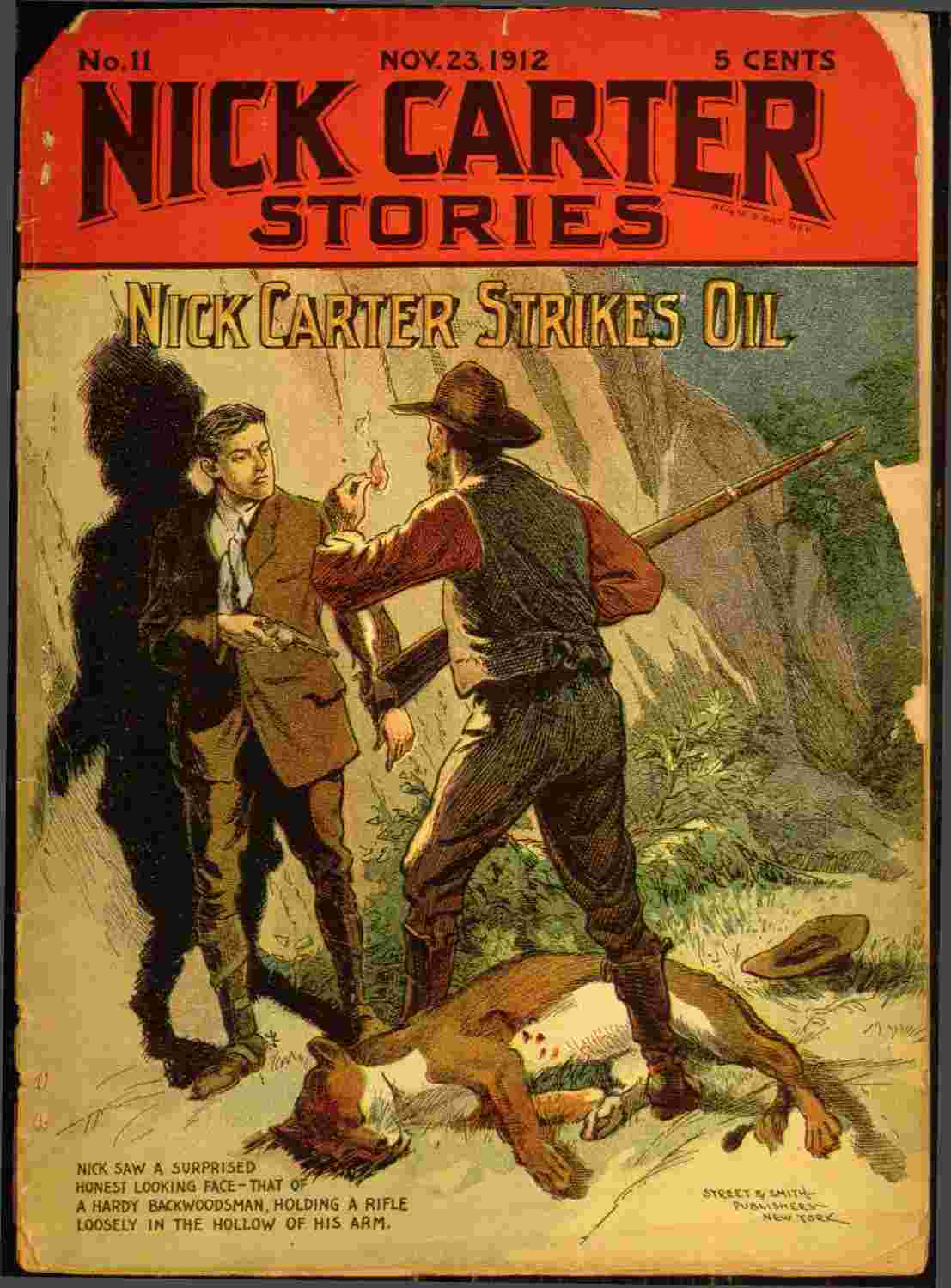
The Project Gutenberg eBook of Nick Carter Stories No. 11, November 23, 1912: Nick Carter Strikes Oil; or, Uncovering More Than a Murder
Title: Nick Carter Stories No. 11, November 23, 1912: Nick Carter Strikes Oil; or, Uncovering More Than a Murder
Author: Nicholas Carter
Alden F. Bradshaw
Release date: January 2, 2022 [eBook #67082]
Most recently updated: October 18, 2024
Language: English
Original publication: United States: Street & Smaith, 1914
Credits: David Edwards, Chuck Greif and the Online Distributed Proofreading Team at https://www.pgdp.net (Northern Illinois University Digital Library)
Issued Weekly. Entered as Second-class Matter at the New York Post Office, by Street & Smith, 79-89 Seventh Ave., New York. Copyright, 1915, by Street & Smith. O. G. Smith and G. C. Smith, Proprietors.
Statement of ownership, management, circulation, etc., of Nick Carter Stories, published weekly, at New York City, required by the Act of August 24, 1912.... Editor, W. E. Blackwell, 32 W. 75th Street, New York City.... Managing editors, business managers, publishers and owners, Street & Smith, 79-89 Seventh Avenue, New York City.... Known bondholders, mortgagees, and other security holders, holding 1 per cent. or more of total amount of bonds, mortgages, or other securities: None.... Signed by George C. Smith, for Street & Smith.... Sworn to and subscribed before me this 30th day of September, 1912, Chas. W. Ostertag, Notary Public No. 31, New York County (my commission expires March 30th, 1913).
TERMS TO NICK CARTER STORIES MAIL SUBSCRIBERS.
(Postage Free.)
Single Copies or Back Numbers, 5c. Each.
| 3 months | 65c. |
| 4 months | 85c. |
| 6 months | $1.25 |
| One year | 2.50 |
| 2 copies one year | 4.00 |
| 1 copy two years | 4.00 |
How to Send Money—By post-office or express money order, registered letter, bank check or draft, at our risk. At your own risk if sent by currency, coin, or postage stamps in ordinary letter.
Receipts—Receipt of your remittance is acknowledged by proper change of number on your label. If not correct you have not been properly credited and should let us know at once.
No. 11. NEW YORK, November 23, 1912. Price Five Cents.
NICK CARTER STRIKES OIL;
Or UNCOVERING MORE THAN A MURDER.
Edited by CHICKERING CARTER.
CHAPTER I.
THE CLERGYMAN.
“It ain’t right! It’s swindling, and you can’t make it anything else!”
These words, uttered in a loud, angry voice, were followed by a fierce oath, and the man to whom they were addressed raised his hand, and there was a look of pain on his pale face.
“I wish you wouldn’t swear,” he said gently. “Be calm, and tell me just what you mean.”
The first speaker looked ashamed of himself, and probably would have answered in a quiet way if another man who was standing near had not put in:
“Don’t pay any attention to him, Mr. Judson. Let him rave. If he’s such a fool that he can’t make money, it’s not your fault, and he has no business to complain to you.”
“But,” said Mr. Judson, “he makes a serious charge against——”
The first speaker did not hear this, for he was angry almost beyond his control, “mad clean through,” as the saying is in that part of the country, Colorado, where the scene took place.
He did not hear, because he broke in violently:
“I’ve been swindled, robbed, do you hear? And you’re just as much to blame as if you’d been the only one in the scheme. You wear the clothes of a preacher, but, by——! you’re a wolf in sheep’s clothing, and you deserve to be shot on the spot. If you want to keep that{3} pious skin of yours whole, you’d better not come around Hank Low’s way.”
“But, Mr. Low, listen to me,” the clergyman begged.
“Not a word, you black-coated devil! When I think of the way my wife and kids have been cheated by a sneak thief of a minister, it puts murder in my heart, it does! I won’t talk to you, for fear I’ll forgit and take the law into my own hands. Geddap, Jenny.”
The man’s old mare responded to the command and a lash of the whip, and jogged away, dragging the rickety old wagon in which sat the angry Hank Low alone.
The clergyman turned, with a sigh, to his companion.
“I’m afraid, Mr. Claymore,” he said, “that all is not as it should be in this matter.”
“Pooh!” returned Claymore easily; “you mustn’t mind the howling of such a wild man. He doesn’t know what he’s talking about. He won’t hurt you.”
“Oh! that isn’t what I fear. I don’t like to hear a man talk like that, because it shows that he believes he has been wronged. There might be some truth in it. If so, I should be the first to make it right.”
“But there isn’t anything wrong. It was all a plain matter of business. Hank Low had a lot of land that he couldn’t do anything with. We asked him his price for it, we had a dicker with him, and he sold. What could be simpler, or fairer, than that?”
Instead of answering, the clergyman looked over the ground where they were standing. It was a level, but rocky, spot between high hills.{4}
No house was in sight, but a half mile farther up the valley was Hank Low’s cabin.
Three miles in the other direction was the small village of Mason Creek, and some miles beyond that the city of Denver.
This spot where they stood had been part of Hank Low’s farm.
He had had a hard struggle trying to make a living out of his land, and had not succeeded very well, and there was a heavy mortgage to be lifted, besides.
One day a couple of men came to Mason Creek and spent a good deal of time tramping about the country.
One of them was William Claymore.
After a few days of tramping about, Claymore offered to buy the most useless part of Hank Low’s farm.
He mentioned the name of Reverend Elijah Judson as a man who was interested with him in some kind of a plan.
Nothing very definite was said about it, but Low understood that the clergyman meant to put up a private school for young ladies, and wanted the land for that purpose.
A deal was made by which Low was able to pay off his mortgage, but nothing more.
He would have been content with that if he had not discovered, when it was too late, that the parties who bought his land had no idea of putting up a school, or anything of that sort.
It was at the time when the fact was just becoming known that oil could be found in great quantities in the far western lands.
Claymore and his companion, by making secret tests of the soil, had come to the conclusion that this worthless end of Hank Low’s farm was the best place in the State for oil wells. So they bought several acres for next to nothing.
It might be supposed that their next step would be to sink wells and build a refinery, or a pipe line. But such things cost money, and neither Claymore nor his partner had any left to speak of.
They had to raise it, and in this task they had the assistance of the Reverend Elijah Judson.
The clergyman had not been in Colorado when Hank Low’s land was bought. In fact, he did not half understand the scheme.
He had not been a success as a preacher, but he had a little money, some two or three thousand dollars, and Claymore had persuaded him that with it he could make his fortune in oil.
There was nothing dishonest in discovering oil and digging for it, for if there had been, the clergyman would not have touched the scheme.
Supposing that it was all right, he had put in his money, and had been made the president of the company.
His name was printed in large type on the letters sent out by Claymore, and these letters were sent to people in the far East, who had been members of Reverend Elijah Judson’s church.
They were also sent to other places where his name was known, and they told all about the wonderful discovery of oil.
Friends of the clergyman were to be allowed to invest in the company, if they wanted a sure thing.
The letters did not state that the money was needed for digging the wells or building a refinery.{5}
Oh, no! Persons who received the letters were given to understand that this was their chance to get rich quickly.
And the Reverend Elijah Judson’s name as president of the oil company was enough to make everybody sure that it was all right. For, of course, the clergyman would not go into any business that was not perfectly straight and sure.
That was quite the case—at least, the clergyman thought it was. He meant well, and he really believed that the company was square, and that there would be great profits in the business.
There were many answers to the letters, and money came in rapidly. Not many persons invested large amounts, but the sum total was considerable.
All this operation of raising money for the work took several months.
At last the clergyman went to Colorado to look over the plant and do his share of the work.
He was surprised to find that there wasn’t any plant.
There was the land that had been bought; on it were a few small mounds of loose dirt to show where borings had been made; and in Denver there was the office of the company. Nothing more.
Claymore explained that it took time to get the machinery for sinking the wells, and Mr. Judson was satisfied.
They went out to the land, and there happened to meet Hank Low, as he was driving to the city with a small load of farm stuff for the market.
By that time, of course, Low had learned just why his land had been bought.
The farmer honestly believed that he had been swindled, because nobody had told him that the land he was selling was very valuable.
“They might have let me in on the deal,” he grumbled. “The land was mine. S’pose it had been gold they found. Wouldn’t it be swindling to make me sell it dirt cheap just because I didn’t know what ’twas worth?”
His neighbors told him he mustn’t expect any better treatment in a business deal.
“But,” he argued, “they sprung the preacher on me, made me believe there was to be a school there. Ain’t that false pretenses? You bet ’tis! An’ ef ever I git my hands on that preacher I’ll make him suffer!”
He hadn’t had his hands on the Reverend Elijah Judson, but he had made him suffer, just the same.
“I hate to be called a swindler,” sighed the clergyman, as he stood there with Claymore.
“Mr. Judson,” responded Claymore, “business is business, and the man who gets left in a trade is always sore. That’s all there is to it, and you mustn’t think anything more about it.”
“Well,” said Mr. Judson, “I’ll try to think it’s all right, but if I should find that any wrong has been done I shall insist on making things right with Low.”
There was a sneering expression on Claymore’s face, but he said nothing, and they returned to the city.
Mr. Judson found new trouble there. He met one of his old church members on the street, and shook hands with him.
“I didn’t know you were in this part of the country, Mr. Folsom,” said the clergyman.
“I suppose not,” snapped Mr. Folsom, in reply, “and I presume you’d have liked it better if I had stayed away.{6}”
“Why, what do you mean?”
“I came out here to look into the oil company I put my money in. That’s what I mean.”
“Well——”
“There isn’t any well! There ought to be several, but there isn’t one, and, what’s more, there won’t be any, and, what’s more yet, you know it.”
“Why, brother Folsom——”
“Don’t ‘brother’ me! You’ve lent your name to a swindle, and you ought to be ashamed of yourself. I can stand my loss, thank fortune! and it will teach me not to trust a minister again; but there are others, widows and orphans, who have put their all into your infernal scheme, and they can’t stand it. You’ve made them beggars, just to fatten yourself.”
The clergyman grew ghastly pale as he listened, and even Claymore, who was still with him, looked troubled.
“This is dreadful!” gasped Mr. Judson. “I’d die if I believed it to be half true!”
“Then you’d better die,” retorted Folsom. “That’s all I’ve got to say. I’ve looked at that wonderful land the company bought, and there isn’t enough oil in it to fill a lamp. Not a dollar that’s been put into it will ever be got out again. But you’ll be fairly well off with the money you’ve got from the widows and orphans—if you don’t get into jail for swindling.”
With this, Mr. Folsom strode away.
“What does it mean?” asked Mr. Judson.
“Sorehead, that’s all!” responded Claymore. “He doesn’t know what he’s talking about——”
“But he seems to, Mr. Claymore, if I find that there has been any dishonest work in this business, I shall expose it all, understand that. I shall die of the shame of it, but I will not commit suicide until I have seen that the really guilty parties are punished.”
“Come, Mr. Judson, don’t talk of suicide. That’s foolish. You’re not used to business, that’s all.”
“It is not all—ah! there’s Mr. Low’s wagon in front of that store. I am going to speak to him.”
Claymore objected, but the minister was stubborn, and they went into the store.
Low was there, and the clergyman asked him to call at the hotel to talk over matters.
“I want to know all the facts,” said Mr. Judson.
“Waal,” answered Low slowly, “I’ve got some business to attend to, but ef ye’re in at half past three I’ll be thar.”
“I shall look for you at that hour.”
It was then about noon, and while they were at dinner Claymore tried to make the clergyman think that the business was all straight, but evidently he did not succeed.
“I shall go to my room and think quietly till Low comes,” said Mr. Judson, when they got up from the table, “and I repeat that if all does not seem to be honest and aboveboard I shall take measures to right the wrongs that have been done.”
“Go ahead, then,” grumbled Claymore. “I shall be at the office if you want any information.”
They parted, and did not meet again.
Half past three came, and, prompt to the minute, Hank Low drove to the hotel entrance and went in.
Mr. Judson’s room was on the fourth floor, the clerk told him, and called a boy to show the visitor up.
“Never mind,” said Low, “I’ve been here before, and I know the way,” and he went up alone.{7}
Within five minutes he came down the stairs again, an angry look upon his face.
He said nothing to anybody, but hastened to his wagon, got in, said “Geddap, Jenny,” and drove away as rapidly as the old nag could take him.
As nearly as anybody could make out, it was just previous to Low’s departure that two or three persons on a street that ran along one side of the hotel were fearfully startled by the sight of a man falling from an upper story window.
He struck headfirst on the sidewalk, and was instantly killed.
Men were at his side before his heart stopped beating, but no word came from the unfortunate man’s lips.
He was unknown to those who saw him die, but they knew from the cut of his clothes that he was a clergyman.
Information was taken to the hotel office at once, and the clerk went out, and he immediately identified the body as that of a guest of the house, Reverend Elijah Judson.
CHAPTER II.
WAITING FOR NICK CARTER.
In the first horror of this discovery nobody thought of murder.
It was taken for granted that the unfortunate clergyman had been leaning from his window and lost his balance.
But it was not long, however, before men began to look at the thing in another way.
The minister’s body was left on the walk under guard of policemen until an undertaker came to take it away.
Up to that time no friend of the dead man had appeared.
The clerk had been so shocked that he could not remember whom he had seen with Mr. Judson.
At last the clerk recalled that Judson had been with Claymore early in the morning, and that the two had dined together in the hotel restaurant at noon.
Accordingly, a messenger was sent to the oil company’s office to inform Claymore of what had happened.
It was while the messenger was gone on this errand that a man went into the hotel and laid his card on the clerk’s desk.
“Send it up to Mr. Judson, please,” he said.
“Mr. Judson!” gasped the clerk, looking first at the man and then at his card.
“Yes,” replied the caller, “Reverend Elijah Judson. He’s stopping here, isn’t he?”
“Yes—that is, he was, Mr. ——” The clerk looked at the card. “Mr. Folsom,” he added, “but he’s—he’s gone.”
“Gone! When?”
“A short time ago—ah! you see, Mr. Folsom, he’s dead!”
“Dead!” cried Folsom; “dead! Mr. Judson dead?”
“Instantly killed, sir.”
Mr. Folsom echoed these words as if he were in a dream.
“What do you mean?” he whispered then; “how did it happen?”
“Nobody knows, sir,” replied the clerk, “except that he pitched headforemost out of his window. He struck the sidewalk; it was just outside there{8}——”
The clerk’s explanation was not heard by Mr. Folsom.
“Heavens above!” he gasped, pressing his hand to his brow; “he took me in earnest, and committed suicide.”
“Suicide!”
It was the clerk who repeated the word, but he had not time to say more when Claymore rushed breathlessly up.
He had caught the last of Folsom’s remark.
“What’s that you say of suicide?” he demanded excitedly.
Folsom looked at him blankly.
“I said,” he answered slowly, “that my old friend had committed suicide, and I fear it was some hasty, angry words of mine that drove him to it.”
Claymore looked sharply at the speaker, and recalled his face.
That conversation on the street was not easy to forget, though Claymore had taken no part in it.
Evidently Folsom did not remember that he had ever seen Claymore before.
He had spoken to the clergyman without noticing that a stranger stood near.
“I think you’re wrong,” said Claymore, still looking straight at Folsom.
“I wish I could think so,” responded Folsom sadly; “but I spoke to Judson very harshly. I thought I had reason to be angry, and I guess I had, but I should not have spoken in that way. I came here just now to beg his pardon. He said at the time that he should die, and I told him he’d better. Heavens, to think that I should have hounded him to his death!”
Mr. Folsom was terribly distressed.
The crowd that had gathered at the clerk’s desk listened breathlessly.
“You may be entirely right,” said Claymore quietly, “but I think not. I heard the conversation you refer to.”
“You heard it?”
“Yes; I was with Mr. Judson at the time.”
“Ah! I didn’t see you. Then you heard his words?”
“I did, and, as I say, you may be right, but I think differently.”
“How can you?” asked Mr. Folsom eagerly; “if there’s a ray of hope for a different explanation, in the name of Heaven speak up, man!”
“Mr. Judson had a bitter enemy,” said Claymore.
“An enemy! Do you know this?”
“I heard a man threaten to kill him this morning.”
For an instant Mr. Folsom was too astonished to speak, and stood with his mouth open, staring at Claymore.
Then he brought his fist down on the clerk’s desk with a bang, and exclaimed:
“Then, I’ll be responsible for tracking that enemy to the ends of the earth, if necessary. I’ll telegraph for Nick Carter to come. He’s in this part of the country, and I can get him here by evening, if not sooner.”
There was a murmur from the crowd.
Everybody, unless it was Claymore, seemed to think that this would be the best possible plan.
After a moment, he asked:
“Is Carter a friend of yours?”
“I’m proud to say he is,” replied Folsom. “We’ve been friends since boyhood, and he will do anything for me, I’m sure. I can’t rest as long as there’s any shadow of doubt that I worried poor Judson to his death.”
“The local police on such a plain case——” began Claymore, but Folsom interrupted:{9}
“I said I’d take the responsibility, and I will. Let the local police do all they can. It won’t do any harm to have Nick Carter also on the spot. I’ll wire him at once.”
He reached for a pad of telegraph blanks, and wrote a dispatch, which he gave to the clerk with a request that it be sent to the office in a hurry.
A bell boy went off with it on the run.
Then Folsom turned again to Claymore.
“Who is this enemy of Judson’s you speak of?” he asked.
A man who had been quietly listening to the conversation touched Claymore on the shoulder.
“Don’t answer that question just yet,” he said.
At the same time he pulled aside the lapel of his coat.
Claymore and Folsom both saw a badge pinned to his vest.
“Come into the office a minute, both of you,” added the stranger.
The two men followed him into the hotel manager’s private room, and the door was closed.
“My name is Kerr,” the stranger said then. “I am a detective, and belong to the regular force here. I shall be very proud to work with Nick Carter on this case, if he comes, but it is my duty to get ahead on it, and clear it up before he arrives, if possible.”
“Of course,” responded Claymore.
Folsom nodded.
“Now,” said Detective Kerr, “you may answer this gentleman’s question. Who is the enemy you refer to?”
“You mean that man I heard threaten Mr. Judson’s life?” asked Claymore cautiously.
“Yes.”
“It was a farmer named Hank Low. He lives out beyond Mason Creek a few miles.”
Kerr made a note of the name.
“What led to the threat?” he asked.
“The men had high words about a business transaction, in which Low thought he’d been badly used. As a matter of fact, Low was treated with perfect fairness.”
“But he was hot about it, eh?”
“I should say so!”
“Where was the threat made?”
“Out there.”
“Near Mason Creek?”
“Yes; on the oil company’s land.”
“Well, do you mean to say that this Hank Low followed Mr. Judson to the city for the purpose of murdering him?”
“No, I don’t mean to say anything of the kind.”
“Then I don’t see how we can suspect Low. Mason Creek is some miles away——”
“Yes, but Low was on his way to the city when we saw him.”
“Oh, that’s different! Now perhaps we are getting down to business. The first question is, did anybody see him in town?”
“I saw his wagon in front of a store,” said Claymore hesitatingly.
“Why do you hesitate?” demanded the detective sharply.
“Well, I just begin to feel that it’s a pretty serious thing to bring a charge of murder against a man. You see,{10} Low was hot, and he shot off his mouth in a temper. I presume he didn’t mean what he said.”
“It isn’t our business to think what he meant,” declared Kerr. “And we’re not bringing any charge against him. If he’s innocent, he can stand a little inquiry. So you’d better tell all you know frankly, and not wait till you’re examined in court.”
“Oh, I’ll be frank enough,” said Claymore. “I know that Mr. Judson asked him to call here at half past three.”
“You ought to have said that before.”
Folsom, who had been listening quietly to the conversation, here suggested that an investigation should be made to find whether this Hank Low had been seen in the hotel.
“I was just going to,” said Kerr.
He opened the door and asked the clerk to step in.
“Do you know anybody named Low?” asked Kerr, when the clerk was with them.
“Yes,” replied the clerk; “there’s a farmer named Hank Low, from Mason Creek——”
“That’s the man.”
The clerk said nothing further, and Kerr asked:
“When did you see him last?”
“This afternoon,” was the reply.
“Here?”
“Yes—great heavens!”
The clerk looked suddenly startled.
“What’s the matter?”
“Why, Hank Low called on Mr. Judson just before he died—or was it afterward?”
“That’s a mighty important point,” said Kerr gravely. “Isn’t there any way by which you can fix the time?”
The clerk thought a moment.
“Yes,” he said; “I can fix it to the minute, but I can’t do it offhand.”
“Why? How can you fix it, then?”
“Just as Low came up to the desk a telegraph boy came with a message for a guest. I had to sign the boy’s book.”
“Yes. Well?”
“I had to enter the time, you know, and I looked up at the clock as I did so.”
“Did you enter the exact minute?”
“I did.”
“What was it?”
“That I can’t remember.”
“The boy’s book will show?”
“Sure.”
“Then,” said Kerr, rising, “we’ll look up that boy, and also try to find the exact minute at which Mr. Judson fell or was thrown from the window.”
The detective cautioned the others to say nothing about their conversation; and went out to talk with the men who had seen Judson fall.
They agreed pretty nearly as to the time of the event.
One said twenty-five minutes of four.
The other thought it was two minutes later.
When their watches were compared, it was found that one’s was two minutes ahead of the other’s.
The testimony of several other persons was taken on this matter, and it was agreed that twenty-five or twenty-six minutes of four was the time when Mr. Judson met his death.
A bell boy was quietly questioned, also.
He remembered seeing Hank Low leave the hotel office.{11}
“’Twas just after he had gone up alone,” the boy said. “I remember, ’cause the clerk was going to send me up with him, and he saved me a trip upstairs by going alone.”
This was important, and Kerr asked a number of other questions as to how it happened that Low went up alone, and so forth.
Next he found a man who remembered seeing Low drive rapidly away.
This man did not know, when he was being questioned, that Low was suspected of murder.
“I says, ‘Hello, Hank,’ says I,” he told the detective, “and he said, ‘Hello,’ and got into his wagon.
“‘How’s things at the farm?’ says I.”
“‘Can’t stop to chin,’ says he, kind of mad, and he whipped up his critter and went away. Never seen Hank in such a hurry.”
All this was important, and Kerr made a note of the names of all witnesses.
“I’ll try to show Nick Carter,” he thought, “that I can work up a case.”
He was just about to leave the hotel, when Folsom approached him with a telegram in his hand.
He gave it to Kerr, who read the one word it contained:
“Coming.”
It was signed “N. C.”
“All right,” said Kerr; “when he gets here I shall probably have the guilty man in the lockup. He doesn’t say when he will arrive.”
“No,” responded Folsom; “but as this was sent from Pueblo, it shows that he is on the way. I’ve looked up the trains, and should say that he’d be here early in the evening.”
“Well, I’m going down to the telegraph office to look up that messenger’s book. If it gives the time I think it does, I shall start for Mason Creek without waiting for Carter.”
“I suppose that’s right,” said Folsom.
Kerr was sure it was.
He went to the telegraph office, but was disappointed to learn that the boy who had the book he needed to see had been sent to a distant part of the city, and could not be back before six o’clock at the earliest.
Then Kerr was in doubt as to what he ought to do.
“It would make me look like thirty cents,” he reflected, “if I should arrest Hank Low and bring him to the city, only to find that the boy’s book showed that he couldn’t have done the thing.
“Suppose, for example, the book shows that the clerk signed it at twenty minutes to four.
“By that time Judson had been dead at least five minutes, and, of course, Low couldn’t be guilty.
“I think I’ll wait for the boy to get back. Carter may be here by that time, and I’d rather take his judgment.”
And Kerr left it that way. He went down to the railroad station at a quarter to six with Folsom, hoping to meet the great detective on the train due to arrive from Pueblo at that hour.
CHAPTER III.
A SUSPECT AND AN ALIBI.
They were not disappointed, for Nick Carter was on the train, and Patsy was with him.
They had recently been engaged in a case that took{12} them to the western part of British America. When that was finished Nick had taken in Colorado on the way home, for the purpose of examining some mining property that belonged to a friend, who had asked him to do so.
It was while he was on this business that he had run across Folsom.
Having finished his examination of the mines, and having no other business pressing at the moment when he received Folsom’s telegram, he had gone at once to a train and started for Denver.
He greeted Folsom warmly when they met on the platform, and then he was introduced to Kerr.
“I’m glad to see you, Mr. Kerr,” said Nick. “I suppose there’s no mystery about this case?”
“Well, I don’t know,” replied Kerr; “I think not, but you may have a different opinion.”
“I thought it was all settled.”
“Settled, Mr. Carter? What do you mean?”
Nick smiled, and glanced at Folsom.
“Usually,” he said, “my friends do not have a brass band to meet me when I begin to work.”
Folsom started, and looked uncomfortable.
It was not until that minute that he remembered Nick Carter’s great objection to working on a case when it was known that he was at work.
“I beg your pardon, Nick,” said Folsom hastily; “I’ve been excited this afternoon, or I would have sent for you secretly, but there’s no brass band about it. Mr. Kerr is the only one who knows that you are here.”
“It’s all right, Folsom; don’t worry,” responded Nick, “but I’ll bet the cigars that more than Mr. Kerr know.”
“You’d win,” said Kerr. “Mr. Folsom spoke of sending for you in the presence of fifty men.”
“That’s so!” exclaimed Folsom, looking very awkward.
Nick laughed.
“Let it go,” he said good-humoredly. “I don’t need to bother with the case if I don’t want to. I presume Mr. Kerr has the hang of it, anyway. So, unless there is real trouble, Patsy and I can take the night train for the East.”
“I hope you won’t, Mr. Carter,” said Kerr earnestly. “I do think that I can put my hand on the murderer, but I’d like very much to get your opinion, if not your assistance.”
“All right. There’ll be time enough for that while we get dinner somewhere. Can you take us to a quiet place?”
“We were going to the hotel where the crime was committed. The Western Union manager is going to send a boy there with a piece of evidence we need, just as soon as the boy gets back from a long errand.”
“Very well,” said Nick; “we’ll go to the hotel, but we won’t go together, if you please. You and Folsom go back together, and if anybody asks you about Nick Carter, give them any kind of a steer you choose, as long as you make them understand that I’m not in town. Then engage a private room for dinner——”
“We have done that already, Mr. Carter.”
“Good! What’s the number?”
“Fourteen, second floor.”
“Patsy and I will join you there in half an hour, unless there’s some hurry.”
“No,” said Kerr, a little doubtfully, “I don’t believe{13} there’s any hurry, for we can’t act till we get the messenger boy’s evidence.”
“Yep,” returned Patsy, who had heard the talk about the forgotten change.
“So long, then.”
Kerr and Folsom left Nick and Patsy inside the station, where they had met.
“You don’t really hope to conceal the fact that you’re in Denver, do you, Nick?” asked Patsy.
The great detective smiled.
“When fifty men heard that I was sent for?” he returned quietly; “not quite.”
“Then why do you make such a fuss about it? Why not go along to the hotel openly?”
“Patsy,” said Nick, as he pretended to consult a pocket time-table, “if the guilty man was one of that fifty, don’t you think it likely that he would shadow Folsom and Kerr and follow them to the station to see if I came?”
“Gee, yes! I hadn’t thought of that.”
“And, if he did so, of course he’s seen me.”
“Sure.”
“And he wouldn’t follow the others out, but would wait to see what became of me.”
“That’s it.”
“Well, then——”
“You needn’t say any more, Nick. I’m on. I’ve spotted every man who has been in sight since we stepped off the train.”
“About a dozen of them, eh?”
“Fully that.”
All through this talk each had been carefully looking around the station, though no one there could have suspected that they were paying attention to anything but themselves.
In fact, Nick had been taking in the situation from the moment he met Kerr and Folsom.
“Let’s go into the waiting room,” he said, as he put away his time-table, “and buy a cigar and a newspaper.”
As they went across the large room they observed very carefully to see if any man was watching their movements.
The crime had happened too late in the afternoon for the regular editions of the evening papers, but extras were now out, and a big pile of them had just been brought to the news stand.
Several men were at the counter buying the papers.
Patsy went to the cigar case, and Nick asked for a paper.
The boy behind the counter was very busy just then, and Nick had to wait his turn, which didn’t trouble him any.
“Mr. Claymore!” the boy called suddenly; “you forgot your change.”
“Oh, did I?” said a man who had bought several papers and was hurrying away.
He came back and reached his hand across the counter.
“Keep a nickel of it for your honesty,” he said.
“Thankee, Mr. Claymore.”
Nick bought his paper next, and Patsy joined him.
They went slowly to a corner of the waiting room and sat down.
“Well?” said Nick, as he unfolded the paper and began to read about the death of Reverend Mr. Judson.
“Well,” repeated Patsy, “there’s nobody hanging around now who was here when we came.{14}”
“I thought so.”
Nick read for a moment, and then remarked:
“That’s an honest newsboy.”
“The man he spoke to was on the platform when we arrived.”
“Yep.”
That was all they said about it.
As a matter of fact, neither of them had the slightest suspicion of Claymore, any more than they had of any of the dozen others who had stayed in sight while Kerr and Folsom were there; but they remembered his face and name, for that was a matter of habit with them.
“Look it over,” said Nick, passing the paper to Patsy.
While the young man read, Nick thought, and at last he said:
“I think we’ll call at the undertaker’s.”
The name of the undertaker who had taken charge of Judson’s body was printed in the paper, and Nick inquired the way to his place from the first policeman they met.
There was a crowd of curious idlers at the door, and a man stood there, who at first was not going to let the detectives in.
“We want to see the body of the clergyman who——” Nick began.
“I know you do!” interrupted the man crossly, “and so does everybody else, but you can’t see?”
“Can’t see, when I have eyes?” retorted Nick, with a queer smile, and he pushed by the man into the building.
The man was astonished, for he had not expected this stranger to defy him, but there was something so commanding in Nick’s quiet way of doing things that he had let both detectives pass before he knew it.
Then he followed them into the office, blustering.
“What do you mean?” he demanded.
“It’s my business to be here,” said Nick coldly. “I am a detective, and my name is Nicholas Carter.”
“Oh!” exclaimed the undertaker, and his eyes bulged. He did not seem able to take them off the famous man, of whom he had heard so much. “Oh!” he added, after a pause.
“If that makes a difference,” said Nick, “you may show us the body.”
“Certainly; anything you want, Mr. Carter. Only too proud.”
He led the way to a back room, and for a minute or two Nick and Patsy stood there studying the still, cold form.
“Can I do anything more for you?” asked the undertaker, as they turned away.
“No, thank you.”
“I suppose you’ll see the clergyman’s friend, won’t you?”
“Do you mean Mr. Folsom?”
“Yes, sir. The hotel people, you see, Mr. Carter, told me to take charge of the body, and I supposed it would be a kind of charity case, as, of course, the hotel people had no interest in the unfortunate man. But if Mr. Folsom was his friend, perhaps he’d like to order a better casket, don’t you see. If——”
“I’ll speak to Mr. Folsom about it.”
“Thank you, sir. Perhaps you’d like to look at some of my caskets and advise Mr. Folsom——”
“I’ll leave that to him.”
“Oh, very well, sir; but if you don’t mind speaking to{15} him about the matter. It would be too bad to bury a clergyman in an ordinary——”
By this time Nick and Patsy were out of hearing.
“Say!” said Patsy, in a tone of disgust, “that fellow had gall.”
Nick was silent.
“The idea of asking you to pick out a casket! Huh!”
When they were about halfway to the hotel, Nick remarked:
“It wasn’t suicide.”
“No,” responded Patsy. “I could see that. The thing that killed him was the breaking of the back of his skull on the sidewalk; but he had a black-and-blue mark over the right eye. That wasn’t made by his fall.”
“Certainly not. It was made by the blow that sent him reeling through the window.”
“That information will make your friend, Folsom, feel better, won’t it?”
“I judge so, as his telegram told me that he feared suicide, and hoped that it was murder.
“But,” added Nick. “I don’t think I shall be in a hurry to ease Folsom’s mind. We’ll wait till we have heard the whole story before letting him know what we think. It may be handy to give out the report that we believe it a case of suicide.”
“I’m on,” said Patsy.
They found Kerr and Folsom waiting for them in room fourteen, and they sat down at once to dinner.
While they were eating, Kerr told the whole story as far as he knew it.
Naturally, he mentioned Claymore’s name as the witness to Hank Low’s threats.
“Who is this Claymore?” asked Nick, as he lighted a cigar at the end of the meal.
“He’s a Denver business man,” replied Kerr. “I have no acquaintance with him. I believe he hasn’t been here more than a year or so.”
“Less than a year, I guess,” said Folsom.
“Why, do you know him?” asked Nick.
“No,” replied Folsom, “except as I have talked with him this afternoon, but I remember now that his name is on the letters sent out by the oil company of which Judson was president. Claymore is the secretary of the concern, I believe.”
“But you hadn’t met him before?”
“No; and I didn’t hear his name till late in the day, and even then I didn’t connect him with the company, though I remember wondering a little how he knew so much about poor Judson. You see, I was terribly excited.”
“No wonder.”
“It worries me a great deal,” continued Folsom, “to think that my angry words might have led Judson to suicide. He meant well, I am sure of that, and he was deceived by the rascals as much as the rest of us.”
“Hum!” murmured Nick; “seems to me that’s setting Claymore out in rather a black light.”
“Yes, it is. I hadn’t given it much thought, for my attention was taken up with the death of Judson, but I have no doubt that Claymore is crooked. A dishonest promoter, you know. One of these fellows who know how to swindle and keep on the right side of the law. Don’t you think so?”
“Maybe.{16}”
Folsom looked as if he wished that Nick would say more, but the detective was silent.
Shortly after this a waiter came to the room to say that a telegraph messenger wished to see Mr. Kerr.
“Send him up at once!” exclaimed Kerr.
The boy came in with his book.
“Boss said you wanted to see it,” said he, laying it on the table, and going out again at once.
Kerr opened the book with great eagerness, and, after looking down the columns of names and time marks until he came to the one he wanted, his eyes glowed with delight, and he passed the book to Nick, with his finger on a certain line where the hotel clerk’s name was written.
“There!” he cried triumphantly; “see that?”
Nick looked, and he saw the clerk’s name in one column, and against it, in another column, the figures, “3:31.”
“You see!” added Kerr, too excited to wait for Nick’s opinion, “Hank Low did it!”
“I see,” responded Nick slowly, “that Hank Low could have done it.”
The reply disappointed Kerr, and he began to argue, but Nick interrupted him.
“Excuse me a moment, gentlemen,” he said.
He rose, and looked at Patsy, who withdrew with Nick to a corner of the room, and the two men whispered together a moment.
Then Patsy went out, and Nick returned to the table.
“Excuse me,” said Nick, again. “I don’t mean to interfere with your handling of the case. Mr. Kerr——”
“Oh, bless you!” exclaimed Kerr; “that’s what we all want. You do just what you think best, Mr. Carter.”
“Thank you. I was going to say that I had forgotten something, and sent my assistant out to look after it. Now, as to this time mark, it is very important. I can see that.”
“Of course,” said Kerr, encouraged by the great detective’s tone. “The testimony of the clerk cannot be doubted. Here is the sure testimony that Hank Low started for Judson’s room four minutes before the man fell from his window. It is known that Low left the hotel and drove away just before word was brought in that the man had fallen out. See?”
“Yes.”
“Then do you think we ought to lose any time before arresting Low?”
“Do you say that he lives some eight miles from here?”
“Yes—about eight.”
“If he’s running away, he’s got a pretty good start.”
“All the more reason why we should get after him at once. I declared, I wish I had run out there and hauled him in before you came.”
“That might have been a good idea, but I don’t believe there’s any use in hurrying now.”
Neither Kerr nor Folsom could understand Nick’s delay.
The fact was, he was waiting for Patsy, and he kept them talking for several minutes, and then Patsy returned.
“Speak out,” said Nick. “I want these gentlemen to hear what you have to report.”
“Well,” said Patsy, “Claymore was in his office all the time from one o’clock to ten minutes of four, when a messenger came to tell him of Judson’s death.{17}”
CHAPTER IV.
NICK’S JOURNEY TO HANK LOW’S.
Kerr and Folsom stared at each other and at Nick. They were no fools, and it was clear enough what Patsy’s errand meant.
“Then,” said Folsom, in a low voice, “you suspected Claymore?”
“Oh, no, not exactly,” Nick replied; “but I thought it would be just as well to make it impossible to suspect him. That was all.”
This remark did not convince either of the men.
“You wouldn’t have gone to this trouble,” said Folsom, “if you hadn’t believed that he had a motive for the crime.”
“As to motive,” replied Nick, “I can only guess, but if Claymore is crooked and Judson was straight, isn’t it possible that Judson threatened an exposure, and that Claymore would try to prevent it?”
Kerr nodded.
“That’s all right,” he said; “but in the face of this evidence,” and he tapped the messenger’s book.
“It looks very bad for Hank Low,” admitted Nick.
“You think that Claymore set Low up to it?” remarked Folsom.
“Do I?” inquired Nick mildly.
“Well,” responded Folsom, “what are we to think?”
“Anything you please. I am willing to take hold of this case, but, as I start under unusual difficulties, I want you to let me go at it in my own way.”
“Certainly, Mr. Carter,” said Kerr; “but I don’t see the difficulties with all this evidence——”
Nick raised his hand.
“You have done first-rate work, Mr. Kerr,” he said. “The evidence is sound, as far as it goes. But it don’t go quite far enough. The difficulties I refer to are the fact that so many men know that I am here, and that the only man who can say that Judson was murdered is dead.”
“I see,” said Kerr.
Folsom turned pale.
“You think, then,” he said hoarsely, “that it was not a case of murder at all?”
“I didn’t say so,” responded Nick; “but this I will say, for, as I am in it now pretty deep, there’s no use in concealing my thoughts from you two—but you mustn’t let it go any farther.”
“Certainly not, Mr. Carter.”
“Well, then, I don’t believe that Hank Low did it.”
Both Kerr and Folsom stared, open-mouthed.
“By thunder!” said Kerr slowly, “if any man but Nick Carter said that——”
He hesitated.
“You’d say he was a fool,” remarked Nick.
Kerr laughed uneasily.
“I am afraid I should,” he admitted.
“That’s all right,” said Nick; “you can think that of me just as well as not, if you want to. Meantime, I’ll go out and get acquainted with Hank Low.”
“To-night?”
“Now.”
“Won’t you want help?”
“Oh, no. If I don’t come back with him as a voluntary prisoner, Mr. Kerr, I’ll help you arrest him in the morning, and give you all the credit.{18}”
“Credit be hanged, Mr. Carter! I’m not a jealous idiot.”
“Glad to hear you say so. You will lie low, then, till you hear from me again?”
“Yes, but if it was any other man——”
“You’d lock him up as a dangerous lunatic. I know. If I’m mistaken, I’ll own up frankly. Now, tell me the way to Mason Creek.”
Kerr told him, and advised him where to get a horse.
“It seems to me,” said Nick, “you’ve described a roundabout way.”
“Yes, the road runs along a crooked valley and around the base of a big hill. If it was daylight, I might tell you of a short cut over the hill, but you wouldn’t be able to keep to the trail in the dark, to say nothing of the fact that the woods on the hill are not safe just now.”
“Not safe?”
“No. There’s a scare about panthers out that way.”
“Ah! I shall have to keep my revolver handy.”
“It will be as well; but, of course, you’ll stick to the road?”
“Yes, though you might tell me where the trail strikes off.”
“It’s about four miles from here. You pass a perfectly bare ledge a hundred yards long at your right, and then come to a stream. Instead of crossing the bridge, you can follow up the stream. In the daytime it’s plain enough, and not a bad ride for a good horse.”
“All right.”
Nick then gave some private instructions to Patsy, and left them.
He went to the stable that Kerr had spoken of and hired a horse.
It was about eight in the evening when he galloped away, and at that hour it was quite dark.
The road took him quickly out of the city, and he was soon in a wild country where it would have been easy to imagine that there wasn’t a town within a hundred miles.
The sky was clear, but the moon had not yet risen.
Nick did not ride hard, for he felt in no hurry, and it was somewhat less than half an hour after he started when he noticed a long, high ledge at his right.
“Probably the place Kerr spoke of,” he thought.
He was glancing up at it, when his horse suddenly leaped violently.
At the same instant there was a flash and a report from the bushes at the other side of the road.
Nick’s hat flew from his head, and he felt a wave of heat cross his brow, which had been singed by a rifle bullet.
His hand caught his revolver, but before it was drawn another shot came, and the horse staggered and fell dead without a struggle.
Nick slipped off quickly, ran a few paces, and fell. Then he lay still and watched.
Not another sound came from the bushes across the road.
“Confound them!” thought Nick, who was not scratched, except for the slight mark on his forehead. “Why don’t they come out to make sure of their business?”
It was clearly a case of intended murder, for, if the unseen villains had been robbers they would have crept forward to go through the pockets of the supposed dead man.{19}
And, of course, it was plain that they knew whom they were firing at, for nobody would have shot at a stranger like that.
“This,” muttered Nick, “is what comes of starting on a case with a brass band at the head of the procession.”
He meant by this that he believed the attempt to kill him was connected with the death of Judson.
“It’s only too easy to see how it happened,” he thought. “Everybody knew I was sent for, and there isn’t a doubt that my arrival was spotted.
“Then it was easy to guess that I would go out to look up Hank Low, and, as this is the only way to his place, they were sure of having a shot at me.”
Nick listened as he lay there, but could hear no sound of steps on the other side of the road.
The rushing of the stream a little beyond would have drowned ordinary noises so that the would-be murderers could have got away without being noticed.
Apparently that was what they had done, for the detective neither heard nor saw them.
He could only guess whether they believed that their shots had done their work.
While he was waiting, the moon rose, and, as the sky was perfectly clear, the landscape became almost as light as day.
Nick at last got up cautiously and went to his horse.
The animal had fallen at the side of the road, and so was out of the way of any one passing.
Nick took off the saddle and bridle and hid them in the bushes near by.
“I’ll pay for the horse,” he thought, “but there’s no sense in giving the saddle to the first thief who comes along.”
He went back to the spot from which the shots had been fired, and lit up the place with his pocket lantern.
If the scoundrels had accidentally dropped anything that could serve as a clew, the detective would have found it, but he could find nothing.
He saw traces of footprints on the grass and leaves, but they were too faint to be measured.
Having satisfied himself on this matter, Nick started on foot to finish his journey.
When he came to the stream, he did not cross the bridge, but turned into the trail that Kerr had told him about.
The moon made the path perfectly plain at the start, and Nick took it not only to save the long walk around the base of the hill, but to save time.
For some reasons, he would have liked to go straight back to Denver, for there was no doubt in his mind that his would-be murderers had gone to the city, and if he was there, he might run across them.
But he believed it to be his first business to have a talk with Hank Low, and so he went on.
The trail followed along the bank of the stream for some distance, and then crossed it on a bridge of fallen trees. After that, it was very steep until it reached the summit of the hill.
Although the trees were rather thick, the moonlight came in on the eastern slope sufficiently to make the way clear.
It was different when Nick began to descend upon the other side. That slope was in shadow, for the moon was not high enough to light it, and more than once he found it difficult to keep on the path.
Once he thought he had lost it, and he was thinking{20} that it would make him feel rather foolish to get lost at night in these woods.
“Better have kept to the road,” he muttered, standing still.
There was a very steep descent just before him, and he could see hardly anything, but he felt that the ground was dipping sharply.
At the left there was a ridge of bare rock, and it seemed that the trail led along the under side of it.
“This must be right,” he argued to himself. “By daylight a horse would get down here easily enough. It’s the right general direction, anyway, and I’ll chance it.”
Putting his hands on the bare rock at his left to steady himself, he went slowly down.
It was not a high ledge, and he had come, as he thought, about to the bottom, when there was a slight noise behind and almost overhead that startled him.
His revolver was in his hand instantly.
There was a blinding flash not ten feet in front of him, and a deafening report.
Swish! went a bullet past his face.
Then there was a bloodcurdling scream in the air above, and the detective fell flat under a heavy body.