
CHAPTER V.
THE DETECTIVE MAKES AN ARREST.
Nick’s breath was knocked out of him, but he was not stunned.
He knew partly what had happened.
It was a wild beast that had borne him to the ground.
Kerr’s remarks about the “panther scare” flashed upon his memory.
Evidently this beast had sprung upon him from the top of the ledge.
He could feel the great limbs quivering, and one of the claws scratched his hand.
All this happened in a second.
In the next second, Nick had exerted all his giant strength, and rolled the beast over.
He got upon his knees and fired his revolver three times in rapid succession at the huge carcass that he could feel but not see in front of him.
Then a rough, surprised voice interrupted him.
“Good Lord! How many of ’em be ye, anyway?”
“Only one, stranger,” replied Nick, getting to his feet.
“Gosh! I thought it mought be a regiment, by the way ye fired. Got a double-quick action repeater, ain’t ye?”
Nick did not reply at once.
The beast was still clawing the ground frantically, and he was not sure that another dose of lead was not necessary.
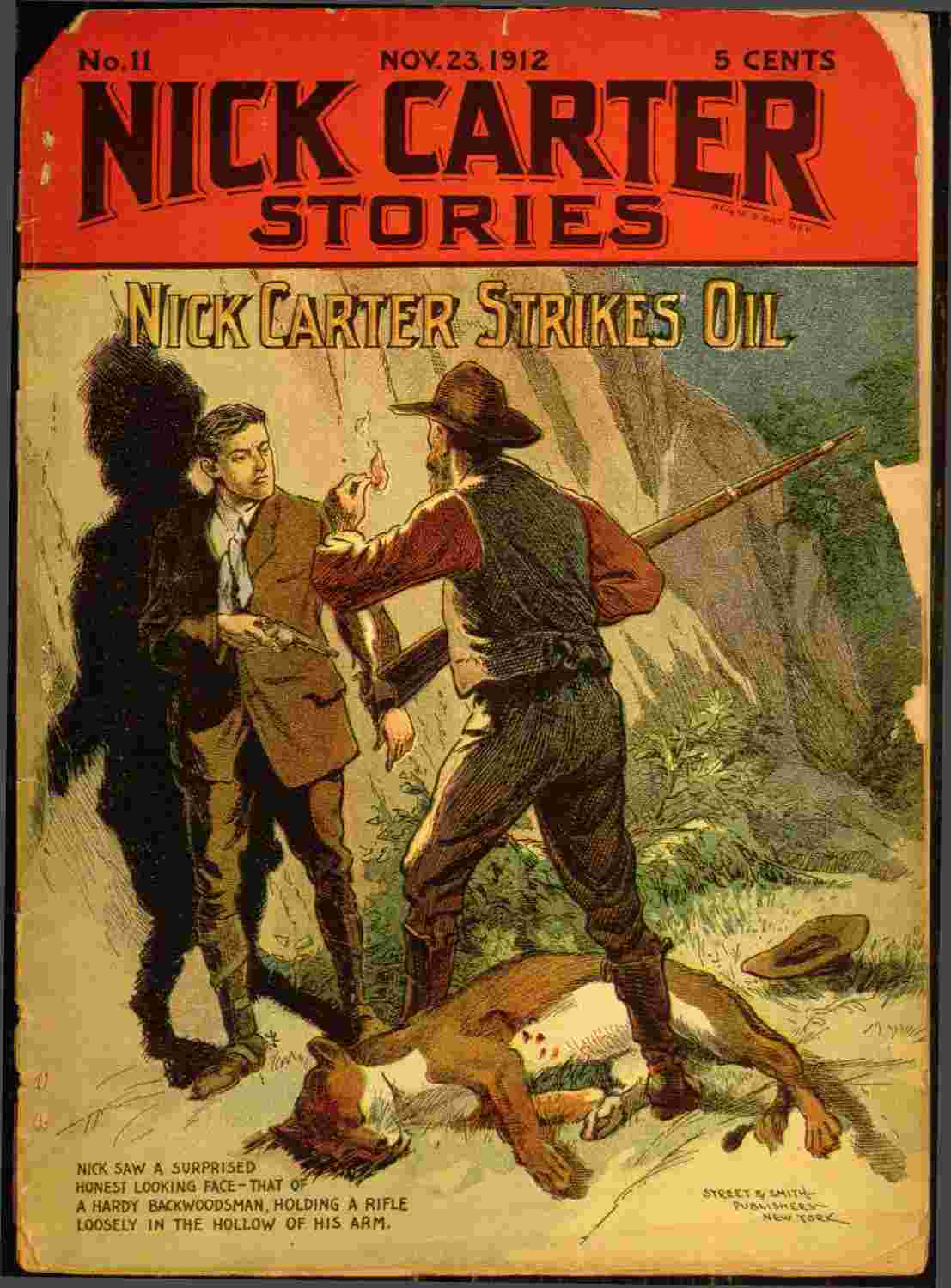
Then a little flame glowed in the darkness near by, for the man who had spoken to him had struck a match.
He held it first over the dying panther, for such it was, and then remarked, in a satisfied tone:
“Done for! Four times dead, I reckon.”
Then he took a step forward and held the match close to Nick’s face.
The men looked at each other in silence for a moment.
Nick saw a surprised, honest-looking face—that of a hardy backwoodsman—and he caught a glimpse of the rifle that the man held loosely in the hollow of his arm.
The backwoodsman saw a well-dressed tenderfoot,{21} whose coat was torn by the panther’s claw, whose face was grimed with dirt and smeared with blood.
“By golly, stranger,” said the backwoodsman, “you’re not jest fit to enter a beauty show—not but what ye may be a slick-lookin’ chap when yer face is washed.”
The detective laughed heartily.
“I reckon, pard,” he said, “that you saved my life.”
“Reckon I did,” returned the other quietly; “but I come dum close to killin’ you to do it.”
“I felt your bullet hiss past my face.”
“So? Should ha’ thought that mought have scared ye to death.”
“Oh, no, I’m used to things like that.”
“You don’t say!”
“But I’m not used to enemies that spring on a man in the dark without making any noise of warning. That’s what the panther did.”
“Yes, he’d ha’ had ye, sure, ef I hadn’t been here to fire.”
“It was good luck.”
“Waal, I dunno about the luck of it. I was here on purpose. Been a-lookin’ fer that critter.”
“Indeed!”
“Yes; the pesky varmint has been worryin’ the life out of us, and to-night I jest made up my mind that I’d get him. I was pretty dum certain he’d be on the trail somewhere, fer there’s enough as comes over it, you know, to give the scent. I thought he’d be watchin’ fer prey, but I didn’t have no idee that he’d git a chance at any. That’s whar I’m s’prised., How come ye here, stranger?”
“I’ll tell you in a minute,” Nick answered; “just explain to me first how you managed to take that shot in time. I heard the beast springing just as you fired.”
“Why,” said the backwoodsman, “I was waitin’ here, hopin’ the scent of me would bring the varmint along, and, of course, I wasn’t makin’ no noise about it.
“Then I heard steps—yourn, you know—and I was wondering about it as you come down the steep part of the trail.
“Ef you look up at the top of the ledge, thar, you’ll see that the risin’ moon makes the top line quite clear.
“Waal, I had my gun up, fer I didn’t know but what you might be an enemy, when, all of a suddent, I saw a black mass on the clear edge of the rock up thar.
“I knowed what it was, and the thing jumped.
“Thar wasn’t no time to think about it, for I knowed the critter had spied you and was springin’ fer ye, and I had to fire then, or not at all. So I blazed while the beast was in the air.
“It was too late to save you from a knockdown, but the critter was dead when he hit you. Them shots of yours was mighty slick ones, comin’ as fast as they did, just as ef you was out practicin’ at a target, but they was good powder and lead throwed away.”
“I can spare the powder and lead,” Nick responded, “and at the time I couldn’t believe that the panther had been hit in the heart. He was making a furious struggle.”
“Yes,” drawled the backwoodsman, “it takes them critters some time to die. But how’d you come here?”
“I was going along the road on horseback when my horse died suddenly.”
“Died!”
“Shot.”
“Gosh!”
“It was meant for me.”
“Huh! Robbers?{22}”
“Perhaps. But they let me alone.”
“Mebbe they knowed you was handy with a gun?”
“I shouldn’t wonder. Anyhow, I had business out this way, so I came along. I took the trail to save time.”
“So! Business out here, you say.”
“Yes. I’m looking for Hank Low’s place. I presume it’s not much farther, is it?”
“Hank Low’s! No, it ain’t much farther—’bout two gunshots.”
There was surprise and suspicion in the man’s tone.
“This trail will bring me there, I suppose?” said Nick.
“’Twill if ye follow it far enough.”
“Then I shall have to go on. I’m much obliged——”
“Hold on, stranger! What’s yer business with Hank Low?”
“I’ll tell that to Low.”
“Then you can tell it to me.”
“Why, are you——”
“Yes, I am. My name’s Hank Low.”
Nick had guessed as much.
He held out his hand in the darkness and grasped that of the man who had saved his life.
Low returned the grasp rather feebly.
“Mr. Low,” said Nick, “I am more obliged to you than ever.”
“What do you want of me?” demanded Low, in a surly tone.
“I want to talk to you about the land you sold some months ago.”
“Do you belong to the company that bought it?”
The question came quickly, and Low’s voice was harsh.
There was no longer the good-natured tone in which he had spoken while talking about the panther.
“No,” replied Nick, “I haven’t anything to do with the company. I heard you were swindled.”
“That was it, stranger,” cried Low; “nothing short of it. People say I was beat in a business deal, but I’m tellin’ ye it wasn’t a squar’ deal.”
“I’d like to know all about it.”
“What’s yer name?”
“Nicholas.”
“Waal, Mr. Nicholas, come down to the house. I’ve got nothin’ to hold back, and ef you’re interested, you can hear the whole story.”
Low talked as they walked along through the woods.
His voice continued to be harsh, as he told of the trick that had been played upon him, but Nick saw that Claymore had kept well within the law.
“It wasn’t fair,” thought the detective; “but it was what would be called a business deal, and Low was beaten. No wonder he feels sore, but he can’t do anything about it.”
Of course, Low mentioned the Reverend Elijah Judson in the course of his story, and his voice became more angry when he did so.
“I can’t understand an out-an’-out villain,” said he; “but it seems a durned sight worse when a preacher takes to swindling, now, don’t it, Mr. Nicholas?”
“I should say so,” replied Nick, “if I was sure that the preacher had known that the scheme was unfair.”
“Know! How could he help it? Ain’t he president of the company?”
“He was.”
“Was? Ef he ain’t now, then thar’s been a mighty sudden change. Will ye come into the house, Mr. Nicholas?{23}”
They had come to cleared land at the bottom of the hill, and Low’s house was plainly seen in the moonlight a few rods away.
None of the windows were lighted.
“No,” said Nick; “your wife and children are asleep by this time, and we might wake them up. We can talk out here just as well, can’t we?”
“Sure.”
They sat down on a log near a shallow brook that crossed the farm.
The moon rays reflected from the water straight into Nick’s eyes, and his attention was curiously attracted.
“Must be handy having running water on your place,” he remarked.
“Huh!” returned Low; “that’s whar you reckon wrong. I thought so when I took this land, and I found out my mistake too late.”
“What’s the matter?”
“Durned ef I know. The cattle won’t drink it, and I don’t like the taste myself. I’ve had to dig a well up on the hill, thar, and run the water to my house and barn through pipes. That cost a good bit, but it was the only way I could get water that would do.”
They were silent for a moment. Then Low said:
“I seen that cuss, Judson, to-day. He was up here with Claymore in the early morning. I met ’em, and we had a jawin’ match. I spoke pretty hot, I reckon, but I can’t help it when I think how I’ve been used. Thar’s my wife and children, you see. I never have been able to give them the nice things I’d like to. Ef they had let me in on the deal I mought ha’ got money enough to dress my children right smart and send them to school in the city.”
“What should you say,” suggested Nick, “if you heard that the company had got left in buying your land?”
“Eh? Got left? What do you mean?”
“Suppose that, after all, the land proves to be as worthless as you thought?”
“By Jove! ’twould serve ’em right.”
“I guess that’s the case.”
“Waal, I’m dum glad to hear it, but it don’t make me feel any better toward those swindlers. I kind o’ thought the preacher chap wanted to squar’ things, but I found I was mistaken.”
“So? How was that?”
“He met me again in the city, and asked me to call on him at the hotel. Reckon he had some new, slick scheme up his sleeve.”
“Did you call on him?”
“Yep.”
“Well?”
“He wouldn’t see me.”
“That’s odd.”
“I thought so at the time. I told him I’d be there at half past three, and he said he’d wait for me. I was there on time, and I went right up to his room.”
“What did he say?”
“Say? He didn’t say nothin’. I didn’t see him. He wouldn’t let me in.”
“Did he know you were there?”
“Sure! I knocked, and heard somebody stirrin’ in the room. I’m sure of that. So, when he didn’t say, ‘Come in,’ I knocked again. ‘It’s Hank Low,’ says I, loud and sharp. ‘Ef you want to see me, speak up quick, fer I ain’t got any time to waste on ye.{24}’
“Thar wa’n’t no answer to that, so I sung out that he might go to the devil, and I waltzed downstairs fast.
“I was kind o’ ’fraid he might call me back, and I didn’t want to hear him, for I was as mad as a hornet, and I was afraid that ef him and me got together thar’d be trouble.”
“Did you leave the hotel at once?”
“Yep. Druv straight home, and didn’t see him then, nor since.”
“Did you notice any excitement around the hotel as you drove away?”
“Excitement? Reckon not. A feller I know spoke to me, but I was too dum mad to answer him decent.”
“But didn’t you notice anything else?”
Low thought a moment.
“Now I think of it,” he said, “I do remember seein’ two or three men runnin’ down the street at the side of the hotel, but I was so dum mad that I didn’t turn my head. The hull town mought ha’ been on fire fer all I cared. I was thinkin’ of how I’d been cheated.”
“I understand.”
If Nick had had any doubt of this man’s innocence it was all gone now, for Law was no actor; just a plain, honest farmer—bull-headed, quick-tempered, and unreasonable, perhaps, but no murderer, and he couldn’t have told his story of the afternoon in that straightforward way, if he had been guilty.
“Mr. Low,” said Nick, after a pause, “Judson is dead.”
“Dead!” repeated the farmer, in a tone that showed the greatest surprise. “How long since, Mr. Nicholas?”
“He died while you were at the door to his room.”
“You don’t mean it!”
“He was murdered.”
“Wha-a-at!”
“Thrown from his window to the sidewalk.”
“Good heavens! Then that was what those men were runnin’ for.”
“Yes—they went to pick him up.”
The farmer sat with his elbows on his knees, staring open-mouthed at Nick.
“That’s awful, ain’t it?” he whispered.
“It is,” said Nick, “and there’s something else that is still more awful.”
He paused, but Low said nothing.
“It is perfectly well known,” Nick added, “that you started up to Judson’s room just before the deed.”
Low became very attentive, but it was plain that the truth was not dawning on him yet.
“And that you came down again in a hurry,” added the detective, “immediately afterward. It is also well known that you threatened Mr. Judson——”
This was enough, and the light burst upon the honest farmer suddenly. In the moonlight his face was ghastly white, and his voice almost choked, as he said:
“Mr. Nicholas, you don’t mean to set thar an’ tell me thar’s folks as say I done it?”
“That is what they say,” returned Nick quietly.
Low groaned, and buried his face in his hands.
“My wife has often told me,” he sobbed, “that that sharp tongue of mine would git me into trouble. I see! It all fits in like the handle into an ax. My God! will anybody believe me?”
“Listen,” said Nick. “There isn’t going to be as much trouble as you think for. I may be able to help you. I am a detective, Mr. Low.{25}”
The farmer uncovered his face and looked frightened now.
“I said my name was Nicholas,” the detective went on, “and that was the truth, but only a part of it. My last name is Carter.”
Low started.
“From New York?” he gasped.
“Yes.”
The farmer shook from head to toes. He laid his trembling hands on Nick’s arm, and began:
“Mr. Carter, I’ve hearn tell of you that you’re keen and hard when it comes to criminals, but you’re straight with innocent men. I swear——”
“You don’t need to,” interrupted Nick; “you are as innocent as I am, and I know it. I believed it when I started out to see you, but I am going to arrest you for murder, nevertheless.”
“Mr. Carter, I don’t understand! What will my poor wife say?”
“You needn’t let her know. I want you to understand, though. Suspicion has been put on you by an enemy of yours. Now, if I lock you up overnight, it will make this enemy believe that I have finished my work. See?”
“You want to blind him?”
“Yes. Then I can hunt for the real murderer in my own way.”
“All right, Mr. Carter.”
Low was perfectly quiet. He did not talk or act like the hot-tempered man who had threatened Mr. Judson.
“You can tell your wife,” said Nick, “that a man wants you to go to the city on business about the land deal. Let her think that some good luck has come your way. I don’t think you’ll have to disappoint her afterward. Then hitch up your horse, and we’ll go back together.”
Low agreed to this without argument. He went into the house and was gone several minutes. Then he went to the barn and hitched up. A little later, he and the detective were jogging over the road toward Denver.
CHAPTER VI.
THE PHOTOGRAPHER’S EVIDENCE.
Kerr was at police headquarters when Nick arrived with his prisoner, and his eyes glowed triumphantly when he saw them come in.
“You got him!” he exclaimed.
“Yes,” said Nick, “he surrendered when I told him how strong the evidence was against him.”
“I wonder he hadn’t run away.”
“Well, you see, he didn’t know that a messenger had come in with a telegram just ahead of him.”
Kerr chuckled.
“This will be a great story for the newspaper fellows,” he said. “They’ve been here all the evening till about half an hour ago. I told them to come back later.”
Nick looked thoughtful.
He wondered if it would be necessary to give the honest farmer the shame of having it printed that he had been arrested for murder?
“I suppose the newspaper boys know that I am on the case,” said Nick.
“Oh, yes—everybody knows it.”
“But they don’t know that I went to Mason Creek?”
“Well, I reckon they’ve guessed it. Newspaper reporters are good at that, you know.”
“Do they know that Low was under suspicion?{26}”
“Sure! They got that from the hotel clerk.”
“Humph!”
Nick was a little disgusted.
When he handled a case in his own way, hotel clerks and others were not allowed to tell what they knew, and he took pains that nobody should know too much, anyway, until he got ready to tell them.
“See here, Kerr,” he said earnestly, “I’d hold the reporters off for a time, if I were in your place.”
Kerr glanced at the clock, and saw it was not far from midnight.
“They’ll be hungry for news pretty soon,” said he.
“And perhaps I can give them a little more, and a better story, if they wait a bit.”
“Why——”
“Low isn’t the only one.”
“Ah!”
“I want to consult with my assistant before telling about this arrest.”
“You have a clew that you haven’t spoken of, then?”
“Maybe. Just lock Low up without putting anything on the blotter for a little while. Give me an hour to see what I can do.”
“All right, Carter, if you say so. But what shall I tell the reporters?”
“Nothing. I’ll be back inside an hour.”
Nick whispered a few words to Low, telling him to keep his courage up and his mouth shut, and went away.
He had asked Kerr to wait an hour, without any idea as to what he should or could do, for Nick felt that he had only got to the beginning of the case.
He was certain of Low’s innocence, though he might not be able to convince a jury of it.
It was necessary, then, to find the proof of Low’s innocence, as well as proof that somebody else was guilty.
Who that somebody else was he could not guess.
He still thought of Claymore, in spite of the alibi that Patsy had found to be sound.
Claymore evidently had not committed the murder, but that he knew more than he had told, Nick was certain.
Could any evidence be gotten in an hour that would save Low from being published in the papers as a suspected murderer?
Low’s horse and wagon were at the door of the station.
Nick got in and drove to the stable where he had hired a horse.
There he explained what had happened to the horse, paid the damage, and returned the saddle and bridle that he had picked up on the way back with his prisoner.
Then he went to the hotel in the hope of finding Patsy.
He made the round of the rooms on the ground floor without finding him.
As he was passing the desk, the clerk spoke to him.
“Excuse me,” said he, “but aren’t you Mr. Carter?”
“I am,” said Nick.
“There’s a young man waiting here to see you. Your assistant told me to point him out to you as soon as you came in.”
“Where is he?”
“That man sitting near the door with a parcel in his hands.”
Nick went up to the young man.
“Are you waiting for Mr. Carter?” he asked.
“Yes,” replied the young man, rising.
“I am he.{27}”
“Oh! well, sir, I understand you are working on the Judson matter. The man who is supposed to have committed suicide.”
“I have been looking into it a little.”
“Well, sir, I’ve got something here to show you. I showed it to your assistant, and he said it would interest you.”
The young man went to undoing his parcel, and three or four idlers drew near.
“Wait,” said Nick.
He led the young man to the desk and asked for a room.
Shortly afterward, they were in a room alone, and Nick took the parcel.
Unfolding the paper with which it was wrapped, he found a photograph.
It was a clean-cut picture of Reverend Mr. Judson’s fall from the hotel window.
Nick looked earnestly at the picture.
“How did you happen to get this?” he asked.
“I am an amateur photographer,” was the reply. “I work in the office at the top of the building just across the street from the hotel. Yesterday I got hold of some new plates that a friend had advised me to use, but I had no time to try them till this afternoon.”
“And you tried them on this scene?” asked Nick quickly.
“Without meaning to, yes. You see, I knew it would be Sunday before I would have time to take any pictures that I cared about, but I wanted to be sure that the plates were all right.
“So, when there was a dull time in the office work, I got out my camera, which I had with me, and went to the window.
“There isn’t much of a view from here, but I thought I’d take a couple of shots at the roofs, just to test the plates.
“I had the camera all ready, when I accidentally touched the button.
“That made me hot, for I had spoiled a plate.
“So I pointed it carefully from the best view I could get from there, and tried again.
“Just as I pushed the button, I heard cries on the street, and, looking down, saw a man lying on the sidewalk, and several others running toward him.
“Of course, I went down to see what was the matter.
“Later I went back, and as soon as possible after supper, I developed my second plate.
“I didn’t bring that with me, for it wouldn’t interest you. But it came out so good that I thought I might as well see what I had caught on the first plate, when the thing went off before I knew.
“That picture in your hand was what I caught.”
He paused, but Nick said nothing, and the young man added:
“I had heard your name mentioned in connection with the matter, and, as people said it was a case of suicide, I thought I ought to show you what I had caught.”
Nick drew a long breath.
“Well!” he said, “for once the brass band has been useful. I wanted to work unknown, but the fact that I am known to be on the case has brought me a piece of evidence that otherwise might never have been discovered.”
Again he looked at the picture.
“This lets Low out of it,” he murmured.{28}
Kerr’s theory was that Low had made a mad rush for the clergyman as soon as he entered the room, pushed him from the window, and then hurried out and down the stairs.
The amateur’s photograph showed not only the unfortunate clergyman falling headforemost toward the sidewalk, but above him the forms of two men at the window.
They were not looking out, but rather in the act of dodging back.
These two were outlined very dimly, but the picture was clear enough to show that there were two of them, and that their arms were half raised, as would be natural if they had just thrown a body away from them.
Unluckily, the faces were not at all distinct, and try as he would, and Nick used his magnifying glass, he could not make them out to his satisfaction.
While he was still studying it, there came a knock at the door, and Patsy hurried in.
“What do you think of the picture, chief?” Patsy asked, with a show of some excitement.
“It’s a good piece of evidence,” responded Nick; “if only this young man had had a little more luck! We could get along without the picture of Judson, if we only had a clean-cut picture of the two murderers.”
“That’s all right,” said Patsy confidently, “I know who they are.”
Nick looked quickly at his assistant.
Then he turned to the photographer.
“Will you leave this with us?” he asked. “I shall see that you are well paid for it.”
“Oh! I don’t care for any pay,” replied the young man. “I shall be glad if it helps you. Good night.”
He left them, and Patsy made his report.
“I laid for Claymore, as you told me,” he said, “and after chasing him around town for a while, I found at last that he had gone to the office of the oil company. He spent the whole evening there.”
“Was his partner with him?”
“No; but I learned his name.”
“What was it?”
“George Donnelson.”
“All right. Go ahead.”
“There was nothing for me to do but hang around. I was pretty sure that any attempt to find out what Claymore was doing would make him suspicious. So I didn’t go into the building even, but stayed outside on the other side of the street.
“It was a dull wait till a little while ago.
“Then something happened.
“A man came hurrying up the street and another man after him. I thought I had seen them both before somewhere, from their motions, but I couldn’t see their faces in the dark. I suppose I wouldn’t have bothered to get a closer look, if they hadn’t stopped right in the entrance to the building where Claymore has his office.
“That interested me, and I crossed over.
“One man was holding the other back.
“’Tain’t safe to wait any longer,’ said the one who got there first.
“‘And it ain’t half so safe to try to see him here,’ the other answered. ‘Don’t be a fool! You see, his windows are still lighted, and he’s busy. When he gets through, he’ll come, as he said he would. Let him alone now and come back.’
“They jawed a little more back and forth, and finally the second man got the first one to go away.{29}
“I didn’t know then what they were talking about, and I don’t know now, but I dropped Claymore for a time and followed those two men.”
“Why?” asked Nick.
“Because I knew them. One was Jack Hamilton, the leader of the gang we had a tussle with in Helena, and the other was his right-hand man, Jack Thompson.”
CHAPTER VII.
DADDY DREW’S DIVE.
Nick looked suddenly at the picture.
“By Jove!” he muttered, “I believe I know them now.”
“I haven’t a doubt of it,” said Patsy, “but you couldn’t swear to it to the satisfaction of a jury.”
“True, and the jurymen could look at the picture for themselves, and see that the likenesses are not there. We’ve got to get more evidence than this, Patsy. Nobody saw them do the deed. This picture almost tells the story, but not quite. But go on. You must have more to tell.”
“A little. I shadowed Hamilton and Thompson to a dive where you and I have been before—Daddy Drew’s.”
“Whew!” whistled Nick. “It means a fight with all the crooks in Denver, if we go there.”
“Well, that’s where they are, and they’re waiting for Claymore.”
“All right. We’ll go there and get them, then we can decide if we’d better arrest them. Is that all?”
“Not quite. Knowing they were there to stay, I ran back to Claymore’s office. He had just put out his lights and was leaving the building.
“He went to police headquarters.”
“Did you go in, too?”
“In a disguise, yes. I saw that Claymore had a private talk with Kerr. Then he went out again.”
“How did he look?”
“Rocky, but he was saying, ‘Very good,’ and ‘Quite right’ to Kerr.”
“That means that Kerr told him,” said Nick.
“Told him what?” asked Patsy.
“What I have done. He shouldn’t have said a word, but I can understand how he should make such a slip, for Claymore was the first to direct suspicion at Hank Low. What became of Claymore?”
“He went home. He lives in a boarding house——”
“We must have him! Come on!”
They left the hotel together hurriedly.
* * * * * * *
In a corner of Daddy Drew’s dive—the worst place in Denver—sat the two men who had escaped from Nick Carter in Helena, when he was on another case.
They had liquor in front of them, but they drank little.
Every time the door opened to admit a newcomer, they looked that way eagerly.
The place was pretty well filled, and all the scum of the city seemed to drift in there, for it was known that once inside the doors a man need not leave until morning.
Daddy let his customers sleep on the floor, if they had nowhere else to go.
At last, closing hour came, and all the doors were locked, and the curtains pulled tightly across the windows.
Jack Thompson muttered an oath.
“He’s going to bilk us,” he muttered.{30}
“Not him,” responded Hamilton. “Wait, I tell you. The night’s young yet. He can’t afford to bilk us, don’t you see?”
“No, I don’t. He might skip——”
“But he’s not suspected! He’s got every reason to stay, for here is where the money is. He’ll get around before the night is over.”
“I hope he brings his wad with him.”
“He will.”
They were silent for a moment, and then Jack muttered:
“I’d have liked it better if he’d paid us for the other job and not asked us to tackle the detective.”
“Pooh! what scares you so?”
“Nick Carter. Ain’t that enough?”
“Nick Carter’s dead.”
“Do you believe it, Nat?”
“I’m going to tell Claymore so.”
Jack shuddered.
“I see you don’t believe it,” he said; “but I hope Claymore comes along and believes it. Then he’ll pay us, and we can skip before the cuss comes to life.”
Nat Hamilton smiled.
“He won’t come to life if he’s dead,” he remarked coolly, “any more than the preacher chap will.”
“Ugh!” grunted Jack, and they were silent again.
Not less than thirty men were in the place.
They were fairly quiet, for they knew that loud noise might bring the police down on the dive, and then their night’s shelter would be closed up.
But they were a tough lot, and every man of them would have joined in to help anybody there if a policeman, or a dozen of them, had come in to make an arrest.
This was so well known that the police usually waited for their men to come out before trying to arrest them.
There hadn’t been a murder in Daddy Drew’s for a long time, and a tough present on this night remarked to another that one was about due.
A few minutes after twelve, there was a light knock at the door.
The bartender who went to it and looked through a slide, came back to Nat.
“Feller out there askin’ for youse,” he said.
Both men got up, but Nat pushed Jack back into his chair.
“I’ll see who ’tis,” he said.
He went to the door and looked through the slide.
Claymore’s face appeared there as if it were a picture in a frame.
“He’s all right,” said Nat to the bartender; “friend o’ mine. Let him in.”
The door was opened, and Nat’s friend came in.
As he went to the back of the room silently with Nat, many curious glances were cast at him.
“Who is he?” asked one of another.
And those who answered came pretty near to guessing the truth.
“Some fellow,” said they, “who gets others to do his work for him.”
Two or three knew Claymore by sight, and they were not surprised.
“Well?” said the newcomer, when he sat down at the table in the corner, and three heads were put close together.
“We done it,” said Nat.
“Sure?{31}”
“He’s dead as a nail.”
There was a short pause. Then, in a low voice:
“You lie, Nat.”
Both the criminals started angrily, but they gritted their teeth and looked at the man, who added:
“He’s just as alive as I am. Less than an hour ago he brought Hank Low in on a charge of murder.”
“Then,” exclaimed Jack; “it’s all right, ain’t it?”
“No, it isn’t all right. Carter believes that Low is innocent, and he has arrested him for a bluff. He knows that you did it.”
Jack turned ghastly pale.
Nat looked as if he didn’t believe it.
“He can’t have any evidence against us,” said he.
“He’ll get it. You know Nick Carter.”
“But how can he get it? Nobody saw us.”
“Somebody must have seen you enter the hotel.”
“No,” said Nat positively; “I swear, Claymore, we got in without being seen.”
“You haven’t told me how you managed that.”
“No, for you sent us down the road on the chance of a pot shot at the detective. I’ll tell you. There’s an office building next to the hotel, you know, with an alley between.”
“Yes.”
“We went in there and found an empty room. It was easy enough to pick the lock and get in. Then we found that a short board would reach from the window to an open window in the hotel. Jack went out and swiped a board from the place where they’re putting up a new building. At twenty-five minutes past three we put the board out, crawled across, and got to the preacher’s room without meeting anybody.”
“And left the board there?”
“Not on your life!” replied Nat. “We took the board in and hid it in a closet until we had tumbled the preacher out of the window. Then we slipped back, returned to the office building by the same way, and so went down to the street.”
“And left the board——”
“Of course! We weren’t going to lug it around in daylight. What harm could it do in an empty room?”
“Oh, no harm, of course,” very sarcastically. “Nobody would find it, and wonder about it; oh, no!”
“What do you mean, Claymore?”
“I mean this: Nick Carter has that infernally sharp Patsy along with him. I believe you know Patsy.”
“Yes, darn him!”
“So I say; but while Nick went out to get Low, Patsy was nosing around town. He probably found that board; he probably saw you two fellows, and knew you; then he put two and two together, and the long and short of it is that Carter is after you.”
“We’ll be hanged sure!” groaned Jack.
“There’s only one way out of it, boys.”
“Well?”
“Carter will come here to a dead certainty. He knows the town, and knows that this is the place where you would most likely hang out. He’ll come here.”
“Then he’ll get a warm time of it,” said Nat.
“If you think so, stay. But you know the Carters. If you want a chance to escape, take it now. There’s a train for San Francisco runs through here in half an hour. You can catch it.”
“Come on,” said Jack, rising.{32}
“Hold on a bit,” said Nat. “Who pays the freight? We haven’t had our money yet.”
“I’ve got it, but I’ll be hanged myself if I pay you in here. Get out on the street. I’ll go with you part way to the station, and settle with you.”
“Don’t wait,” urged Jack.
“That’s good advice. Carter may break in here any minute, or he may sneak in in disguise. That’s his most likely way, and then you’ll be nabbed before you know it.”
Nat was rather pale now.
“I’ll give him a fight for it, if he comes,” he muttered, but he got up, and the three went out.
“Will you settle now?” asked Nat, when the three were out on the street.
“Don’t be in such a hurry,” was the sharp reply. “Your only safety is to get away from this place. Walk along toward the railroad. I’ll be close at your heels until I think it’s safe to stop and settle.”
Nat hesitated.
“Don’t you dare to do us dirt!” he hissed savagely.
“I’ll settle with you both before you get to the station. Get a move on! Carter may be here the next second.”
The crooks started away, looking back frequently to see that Claymore was following.
He kept about half a block behind them.
Nobody but themselves seemed to be on the streets.
There was a drunken man staggering along some distance ahead, but he didn’t count.
He, too, disappeared around a corner before the crooks came to it.
When they were about to pass that corner a quiet voice behind them said:
“This will do. We’ll settle here.”
“All right,” responded Nat.
Both men halted, and, turning about, found themselves looking into the muzzles of two revolvers.
The face back of the hands that held the weapons was not that of their employer, Claymore, but that of their deadly enemy, Nick Carter.
CHAPTER VIII.
HANK LOW’S LUCK.
Claymore was not in his boarding house when Nick and Patsy arrived there.
He had come in and gone out shortly afterward.
Where he had gone, or in what direction, nobody could say.
Possibly to Daddy Drew’s to meet the desperadoes he had hired to commit murder; but Nick didn’t believe it.
“That long work in his office this evening means something else,” said Nick. “He’s got another plot up his sleeve. I’ll go to Daddy Drew’s and get those men.”
Accordingly, he had turned his face into a copy of Claymore’s and had been admitted easily.
Nat had said he would put up a stiff fight if he should meet Carter, and he kept his word.
Probably he reckoned that the detective would wish to take him alive, for he did not surrender when he saw the revolver pointed at his heart.
Instead, he made a quick rush at Nick, trying to knock up both his arms.
The detective was quite ready for that.
It was true that he wished to take the men alive, and he did not fire, for he had hoped they would be scared into quiet surrender.{33}
When the attack came he dropped both weapons to the sidewalk.
Letting drive with his fists, he caught Nat on the chest, and knocked the wind out of him.
But the crook did not fall. He staggered against Jack, who at first was going to give up.
Seeing that the weapons had been dropped, Jack joined in and made a desperate effort for freedom.
He caught his partner and kept him from falling, and then both sailed into the detective.
“Why!” said Nick, with a laugh, “come on, if that’s what you want.”
His arms shot out like flashes of lightning, and every blow landed, but the crooks kept too close for him to give them settlers.
And, after a moment, Jack retreated and drew his revolver.
That was a moment of peril for Nick, as he was busy just then with Nat.
And Nat, seeing the chance, pretended to be knocked down, so as to give Jack a chance to shoot.
Up came the ruffian’s revolver, but before he could aim, around the corner rushed the drunken man whom they had seen.
This man threw his arms about Jack’s neck, and bore him silently to the ground.
“Put the bracelets on him, Patsy,” called Nick.
“They’re on,” replied the “drunken man” calmly.
Nick had leaped upon Nat, and in a second had him ironed.
“This is the way I settle,” he said, as he stood up.
The prisoners cursed furiously, but if that did them any good nobody knew it.
Nick picked up his revolvers, and then he and Patsy marched the prisoners to headquarters.
Kerr was still there, and he was surrounded by eager reporters.
“Here are the murderers,” said Nick. “Low is innocent.”
He produced the amateur’s photograph, and told the story as briefly as possible.
“The chief villain is yet to be caught,” he concluded. “I think we shall find the clew to him in his office.”
There was a great deal of excitement at headquarters, and many questions were asked.
Nick told the reporters to make it plain that Low’s arrest had been a fake.
“When it’s all settled,” he said, “I’ll give you the details, or you can get them from Kerr, who deserves a great deal of credit for the way he picked up evidence. I’ve got work ahead between now and morning.”
Low was released, of course, and he went with Nick, Patsy, and Kerr to Claymore’s office.
Everything seemed to be in order there, but Nick picked the lock of Claymore’s desk, and found a lot of papers there, on which the man had been at work during the long evening.
There were maps of the country around Mason Creek, some printed, some roughly drawn with a pencil.
There was also the deed which Low had given to the oil company when he sold a piece of his land.
Using his magnifying glass, Nick saw that some changes had been made in the deed.
Words and figures had been carefully scratched out and others inked in.{34}
“I had an idea this was what he was up to,” said Nick. “We shall find Claymore out at Low’s farm.”
The four men set out for Mason Creek soon after.
Nick went in Low’s wagon, and Patsy and Kerr in one they hired.
When they came to the beginning of the trail, Nick got down and told the others to drive slowly on.
“I’ll take the short cut,” said he. “You keep on by the road, and if he escapes me he’ll run into your hands.”
As it was late in the spring, light came early, and the day was beginning to break when Nick passed the dead body of the panther.
As he approached nearer Low’s house, he moved cautiously.
Coming to the edge of the cleared land, he saw a man busy with a shovel at a little distance.
It was Claymore.
He was digging a hole for the purpose of setting a boundary post in it.
The post had been taken up from a spot some distance farther down the stream that crossed the farm.
Claymore’s scheme was to change the boundaries of the land bought by the oil company so that they should include twice as much as had been bought.
That was why the deed had been changed, and it explained the maps in Claymore’s desk.
Nick watched the rascal for a few minutes, and then walked toward him.
“Why don’t you put the post up where it will take in Hank Low’s house and barn?” he asked.
Claymore turned at the sound, and caught up a revolver that was lying on the ground beside him.
He fired hastily, and the bullet went wild.
Nick had him covered.
“Try again,” said the detective, “if you think you can do your own murdering.”
As he spoke, he was advancing upon Claymore, who gave one desperate look around, and saw the two wagons coming up the road.
Then he dropped his weapon, sat down on the ground, and put his hands to his face.
“You haven’t as much nerve as I thought you had,” remarked Nick.
He put handcuffs on the prisoner, and waited for the others to come up.
“I can tell you all about it,” said Nick, then. “This man Claymore found that he had bought land where the oil was scarce. He was so anxious to get the land cheap that he didn’t dare to prospect thoroughly. If he had done his work well, he would have seen that the place for oil wells is farther up the stream and nearer Low’s house.
“He found that out after a while, and then schemed to get possession of the rest of the farm without paying for it.
“Seeing that Judson would expose the crooked work of the company, he had him murdered by a couple of desperadoes who drifted into Denver just in time for the job.
“Then he did some forgery work on the deed to make it show that he had bought a good many acres more than he really had, and to back up the deed he had to come out here and change the boundary posts.
“His best chance for doing that was while Low was locked up. That was why he didn’t go to meet his confederates early at Daddy Drew’s.{35}
“His confederates have told me all about the murder of Judson, so that they are sure to be hanged, and one of them, Jack Thompson, is ready to confess and tell just how Claymore hired them to do the deed.
“Between Jack’s confession and what I heard them say, we have got a complete case.
“If I was in Hank Low’s place, I’d give up farming on land where the water is covered with oil, and dig wells.
“I noticed the appearance of the water in the stream when I was talking with Low earlier in the night, and I knew that the place to dig for oil is near his house.”
It was soon proved that Nick was entirely right, for the upper part of Low’s farm was rich in oil.
The farmer acted more than honestly about it.
With the help of Folsom, who was greatly pleased to learn that the clergyman had not committed suicide, Low got the names and addresses of all who had put money into the scheme of which Judson had been president. And in the end nobody who had invested with the clergyman lost anything.
No attempt was made to get back the part of the farm that was sold, for the land wasn’t worth the trouble.
Jack Thompson confessed, but that did not save him from severe punishment. He was put in prison for life, and Claymore and Hamilton were hanged.
“I can’t help wishing,” said Nick, “that Claymore’s partner, Donnelson, had been around. I would have liked to send him up, too, but perhaps I shall come across him later.”
THE END.
“Nick Carter’s Hunt for a Treasure; or, a Fight for Life with a Mysterious Foe,” is the title of the next story that will appear in this weekly. Nick Carter’s hope that he will soon come across Donnelson again is fulfilled, for he meets him in the mysterious case which is described in this story, and in which the ingenuity of Carter is taxed to its utmost. There is a blind man in this story, and he proves to be a puzzle to the great detective for some time. He will puzzle you, too. The story is No. 12, and it will be out November 30th.
WHAT IS A DAY?
Nine persons out of ten—yes, 999 out of every 1,000—if asked how long it takes the earth to turn once on its axis would answer twenty-four hours. And to the question: How many times does it turn on its axis in the course of the year? the answer would be 365¼ times. Both answers are wrong.
It requires but twenty-three hours and fifty-six minutes for the earth to make 366¼ turns during the year. The error springs from a wrong idea of what is meant by a day.
The day is not, as is commonly supposed, the time required by the earth to make one turn on its axis, but the interval between two successive passages of the sun across the meridian—that is to say, the time which elapses after the sun is seen exactly south in its diurnal course through the heavens before it is again seen in that position.
Now, in consequence of the earth’s revolution in its orbit, or path, round the sun, the sun has the appearance of moving very slowly in the heavens in a direction from east to west. At noon to-morrow the sun{36} will be a short distance to the east of the point in the heavens at which it is seen at noon to-day, so that when the earth has made one complete turn it will still have to turn four minutes longer before the sun can again be seen exactly south.
THE MAN AND THE HOUR;
Or, Sheridan Keene’s Clever Artifice.
By ALDEN F. BRADSHAW.
CHAPTER I.
THE DEATH OF JACOB MOORE.
“Chief Inspector Watts, I want you to do me a favor.”
Chief Watts met the request with a rather encouraging smile.
“I have not forgotten, Mr. French, that I am considerably your debtor in that line,” he genially rejoined, with some significance.
“Well, it is not on that account, Chief Watts, that I appeal to you at just this time. I never charge up favors against my friends. But I am confronted just now by a case which, while I am still ignorant of the immediate particulars, I fear will require exceedingly shrewd and delicate handling.”
The expression on the face of the chief inspector changed slightly.
“Is it a criminal case, Mr. French?” he asked quietly.
“It is a case of murder, Chief Watts, or so, at least, it is here stated,” replied Mr. Hamilton French, one of the brightest of Boston’s legal lights and a noted criminal lawyer. “Here is a telegram I received less than ten minutes ago.”
“Read it, please.”
“It reads: ‘Jacob Moore was murdered last night. Come at once.’ It is signed by Moore’s nephew, a man named Richard Thorpe, who has lived with Moore off and on since his boyhood.”
“Who is this Moore? Is he an acquaintance of yours?”
“Oh, yes. I have been Moore’s legal adviser for something like twenty years, and am so well informed of his family affairs that this crime, if Moore has actually been murdered, at once suggests to me possibilities and complications of a decidedly serious nature.”
“And what is the service you desire of me?” asked Chief Watts gravely.
The eminent lawyer, a man close upon sixty years, hurriedly consulted his watch. It was then about nine o’clock, a clear, cold morning in November, with the mercury out of doors well below freezing.
The scene of this interview was the private office of Chief Inspector Watts, in the headquarters building, in Pemberton Square.
“I will tell you why I have called upon you, Chief Watts,” replied the lawyer. “In the light of facts already in my possession, I anticipate serious trouble from this case, if it proves to be of a nature reported.”
“Trouble in getting at the truth?”
“Precisely.”
“I see.”
“Now, I want the help of a detective—a man of brains and energy, one who is capable of noting those obscure bits of evidence which escape the investigations of most{37} men, and who, having discovered them, can analyze them and deduce the most probable conclusion.”
“You want a rather clever man,” laughed Chief Watts, in his agreeable way.
“I want a very clever man,” returned the lawyer pointedly. “As a matter of fact, Chief Watts, you are the man whose aid I would have liked to secure; but I am aware that your duties here make that impossible. Furthermore, this Moore lives out Lynn way, which is beyond the customary circle of your work.”
“So it is, Mr. French.”
“Can’t you loan me just such a man as I have described, however—one to whom I can impart some of the inside facts of this case, and who will quietly investigate it for my special benefit. I apprehend some little bother from the regular force of constables and police, who persistently cling to their own methods and views; and I want the help of a man who will pull in the harness with me, to some extent at least, and whose features are not very generally known.”
“You want him to do this work on the quiet, I take it.”
“Precisely.”
“Have you visited the scene of the murder?”
“No, not since the crime was committed, Chief Watts,” replied the lawyer. “This message was the first intimation I had of it. I at once wired Thorpe that I would come out to the Moore place this morning, and asked him to stay active investigations until I arrived. I then came directly here to make the request stated.”
“Which leads me to infer that you already suspect some person of the crime, assuming one to have been committed,” said Chief Watts, looking up with a curious light in his eyes.
“Well, I will admit——”
“One moment, please. That’s neither here nor there. I do not wish to anticipate the work of any of my men.”
“Have you such a one as I described?” asked the lawyer, with manifest eagerness.
“A better one than you described, Mr. French,” nodded the chief, with an expressive upward glance at the face of the attorney; “for he is a young man who has qualities and abilities to which mere words cannot do justice. Moreover, if it is your wish, I will give him such assistance as may come in my way.”
“It will be appreciated, I assure you.”
“What is involved in this case, more than placing the crime where it belongs?”
“A considerable fortune.”
“The Moore estate?”
“Precisely.”
“When are you going down there?”
“The sooner the better. If you will grant the favor I have asked, I would like to take the next train.”
“Do so, by all means,” said Chief Watts, rising. “Garratt, send Sheridan Keene in here.”
“Is he the officer to whom you referred?” asked the lawyer.
“Yes, he is.”
“I think I have heard the name before.”
“You will hear it many times again, if he decides to continue the work he has begun. He is a young man of extraordinary——”
But the sound of a firm step in the corridor, followed by the opening of the office door, led Chief Watts to suppress his complimentary utterances, and to turn, in{38}stead, to the person who entered—a tall, athletic young man, of about twenty-five years, with an erect and supple figure and noticeably refined and forceful face.
“Detective Keene, this is Mr. Hamilton French, the lawyer,” said the chief gravely. “He is a personal friend—one I would be glad to effectively serve, if it is possible. I wish you to undertake some special detective work at his solicitation.”
A curious smile rose about the lips of Sheridan Keene, and he took the hand which Lawyer French extended.
“After the preface of Chief Watts,” he said, with dry pleasantry, “I hardly need assure you, Mr. French, that I shall do the best I can for you. What is the nature of this work, sir?”
“One moment, gentlemen,” interposed Chief Watts. “You have just about time to hit the half past nine train. The sooner you reach the immediate scene of this tragedy, the better. I would suggest, Mr. French, that you start at once and give Detective Keene any points you may desire during the journey.”
“My idea exactly!” exclaimed the lawyer. “Are you ready to go with me at once, Detective Keene?”
“I am always ready when duty calls,” said Keene, laughing. Yet his response was true to the very letter.
“Good!” cried the lawyer heartily. “Come, then! I have a coupé at the door.”
Keene turned back, with only one swift glance at the expressive eyes of the chief inspector; then hastened through the corridor and overtook the attorney at the outer door.