
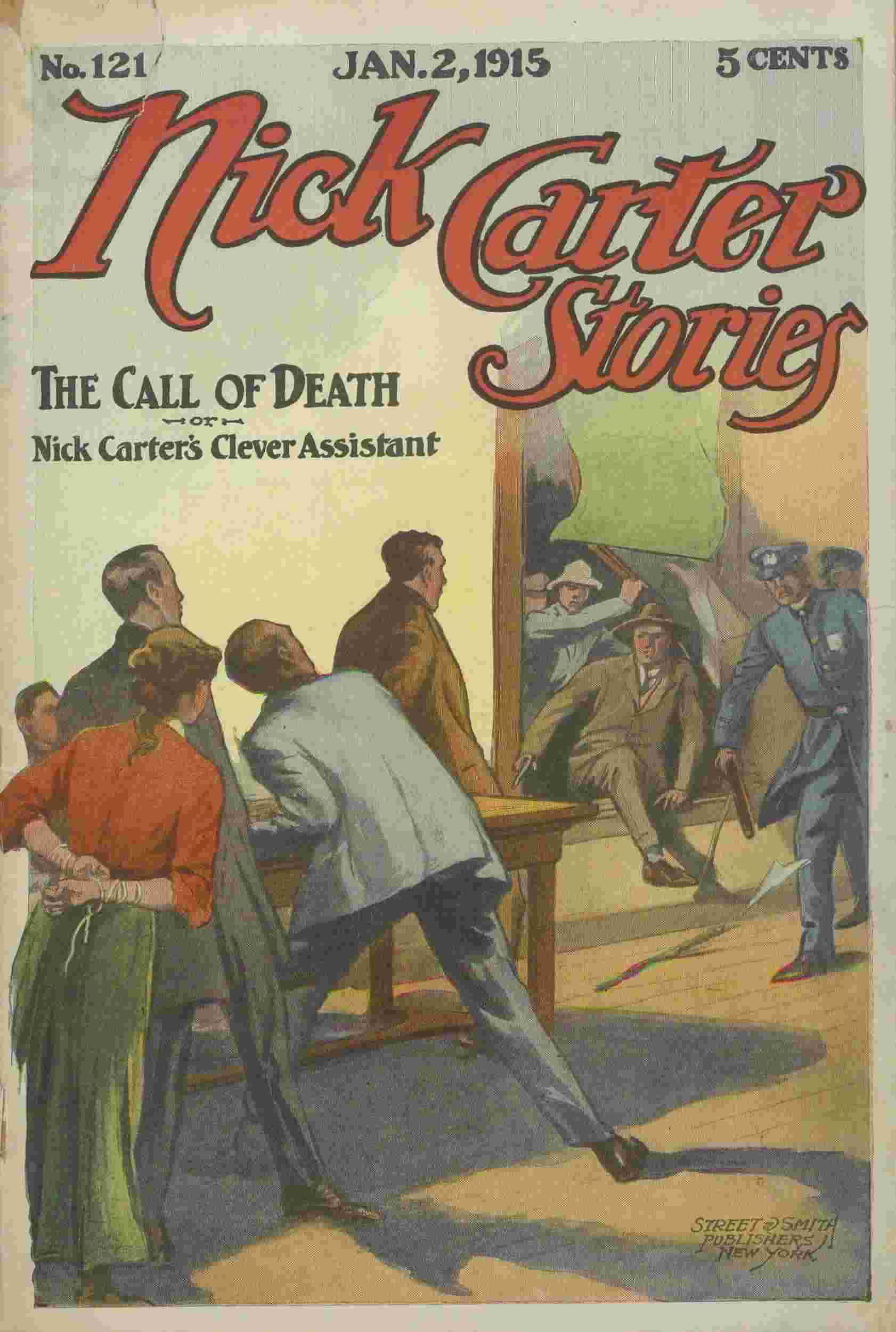
RUBY LIGHT.
By BURKE JENKINS.
(This interesting story was commenced in No. 120 of Nick Carter Stories. Back numbers can always be obtained from your news dealer or the publishers.)
CHAPTER V.
A JOY RIDE.
I had time enough at Boston the next morning to get a good breakfast before the Portland Express left; and this I partook of in the station dining room. I knew within reasonable bounds when the steamers reached their dock at Portland, and figured that I should have ample time for my plan, which was simplicity itself. I would just be on hand when the boat docked.
And I was. Furthermore, I had stationed myself in a most advantageous position for seeing all who quitted the boat. A pile of boxes, not five feet from the passenger gangway, further favored me by allowing partial concealment of myself. I would simply spot my man when he quitted the vessel; the rest would be regulation shadowing.
A fog had delayed the boat about an hour in entering the harbor, as I learned from a longshoreman; but she finally loomed up directly before us, and the fog entirely cleared as the lines were cast and she was warped to the pier.
Herded into the usual impatient mass, the passengers pressed against the ropes until the final sliding of the gangplank.
Then, at a signal from the officer in charge, they swarmed from her. I didn’t miss a face; and I am pretty good at this work. Besides, I counted on seeing a face that was with me constantly now.
But I didn’t.
Little by little the crowd thinned. One or two belated ones trotted shoreward; then no more.
I could have been sure that the man and girl hadn’t passed me; and I found myself in a predicament.
I waited a few more minutes, but without another individual setting foot upon the plank. Plainly any search I might further make must be done aboard the vessel itself.[Pg 41]
But if I did that I would have to quit the gangway, and that, naturally, I was not pleased to do. It was the strategic point.
It was not an overbrilliant plan, or an extremely reliable one, that I finally hit upon; but it was the best I could do under the circumstances.
I caught sight of a shaggy-browed deck hand who had stepped from the freight hold and stood, lounging idly, waiting for the rest of the crew to begin unloading.
I had replenished my cigar supply at Boston; so I approached the man diplomatically.
“My friend,” said I, “I’m almost positive that some people I am very anxious to see took this steamer; but I haven’t been able to find them. Would you mind watching out for them while I step aboard? I certainly don’t want to miss them.”
He accepted the proffered smoke greedily enough; but scowled at me from under his cap visor as he grunted:
“How’n tarnation’ll I be able to know ’em? What d’ they look like?”
“A man with a sort of stoop to his shoulders, and a mighty pretty girl,” I replied. “Anyway, you can’t fail, for if anybody shows up, it must be that——”
I stopped, for he was scratching his pate in thick-headed brain-working.
“Hold on thar!” he finally growled. “Why, dang me, man, they ain’t aboard no longer!”
“Ain’t aboard?” I cried. “Why, I could swear they haven’t yet crossed that gangplank!”
“Right you are there, my lad,” he agreed; “for them there and that same pair o’ individools must be the folks as got into a launch out yonder in the harbor when we were stopped by the fog.”
“Into a launch!” I echoed frenziedly as a sharp memory shot through me. Surely the couple did have a uniform method of boarding and quitting vessels.
“Better see the purser about it,” added the fellow; “there’s his window in there. He knows more about it as I do.”
He pointed aboard the boat where the brass grill of that officer’s office showed up plainly enough. And immediately I strode across the plank and up to the purser, who was figuring at his desk.
He acknowledged my nod genially, and asked what he could do for me.
“If you don’t mind,” said I hurriedly, “will you tell me all you know about that couple that quitted the steamer for a launch back there in the harbor?”
“Quitted the steamer for a launch?” he cried, in the utmost bewilderment, while he looked at me as though he thought I was demented. “Why, nobody did.”
“That deck hand there——” I started to explain as I turned, and indicated where I had come from.
But I got no further; for, at that very moment, I saw the very same deck hand steadying a girl across the freight gangway.
I lost an important minute in my consternation at having been thus so easily outwitted; and I reached the wharf again just in time to see him help her quickly into a taxicab at the pier end. But, before he sprang in himself, he grinned back over his shoulder at me delightedly.
No, I had not exactly recognized that peculiar stoop to the shoulders of the owner of the launch back there at Port Washington, as I had assured myself I would be able to do.[Pg 42]
But, if I ever hoped to retrieve myself, I hadn’t a moment to lose. I, in turn, hot-footed it to the shore end of the pier, and fortune seemed to favor me here a bit; for there stood another taxi, and its “vacant” flag was flying.
“Follow that cab, my man,” I said hurriedly and out of breath from my sprint. “Don’t let ’em lose you, and there’s money in it.”
The little chauffeur grinned delightedly from under his goggles.
“Right-o!” he chortled happily, as he cranked; and next second we jumped into the high speed.
But that first spurt was short-lived, for we came to sharply applied brakes by the time we had but crossed the avenue.
I heard a sharp command as a man dashed from the swing door of a shore-front saloon. Then the door beside me was yanked open, and as quickly closed.
“After ’em now, for all that’s in you!” yelled the man who had flopped beside me, and the car lurched forward again.
I whirled on the intruder in a rage.
“Came near losing ’em, didn’t you?” said he quietly.
“Pawlinson!” I managed to whisper in my amazement.
“I was a trifle dramatic,” he explained easily; “but, from my vantage point of the saloon window yonder, I calculated that maybe two of us might work together better in this case.
“And, besides,” he added meaningly, as the cab swayed us to its mad pace, “I want to talk over some things with you.”
As I think was natural enough, I had the greatest difficulty in recovering from complete bewilderment. But I did manage finally to blurt out:
“And I, too—I’m in the dark about a good many things.”
“Just as I thought, of course,” he replied. Then his tone changed to a sharpness, a grittiness of command that didn’t set well with me for a whit.
“Now, I want to know,” said he, “just who you are and where you stand.”
Though I resented the manner of his query, I couldn’t but realize that he really was entitled to the knowledge.
“My name is Tom Grey,” said I, “and I am one of Chief Garth’s men. Last night he detailed me to——”
“Yes, yes. I know about that,” he broke in impatiently. “I saw you go in and leave his house. But what I want explained is: How did you happen to mix in on this thing at Port Washington?”
“The merest coincidence,” said I, rather lamely.
Then I gave him all I knew about it and the way it had come about that I happened to be swinging my feet from the stringpiece of the dock at that particular moment.
“Well,” he said, with a tinge of sarcasm, “it was a very unfortunate coincidence, as you call it; for I can tell you it wasn’t any cinch to throw off suspicion in landing that job as engineer of the launch. But I had landed it; and if it hadn’t been for you I could have delayed the start until four of my men arrived. They were coming on the next train from New York.”
“And so that’s why you faked that the engine was broken down?” I blurted, somewhat idiotically.
“Rather!” was the reply; and the sarcasm was no longer veiled. “And you can imagine my surprise when I recognized you entering Chief Garth’s place just as I myself was leaving.[Pg 43]”
“Now, you know well enough, Mr. Pawlinson,” said I sheepishly, “that my interference at the launch was natural enough when you grant that I knew nothing of the circumstances, and——”
“Enough of that!” he said. “I’m not harboring any resentment any more, though I still have a bit of a game leg as a souvenir of the incident. But what I do want to know—and what has made me follow you closely from Garth’s to this very moment—is: Just where do you stand in this matter? Are you entirely—now that you understand the thing—are you my man?”
“Why, of course,” I replied, in as convincing a tone as I could command. But somehow it didn’t ring overtrue; for, in spite of myself, I simply couldn’t cotton to this man.
“But now, in turn”—I changed my tone—“I should like to know——”
Here the cab swung a corner violently; then we took to the evener going of a well-macadamized road, which seemed to lead almost indefinitely in a dead straight line.
“We’re dogging ’em close,” said I, pointing to the rear of the cab we were pursuing. “He’s a good man,” I added, indicating our driver.
“Good enough,” replied Pawlinson shortly. “But what do you intend to do next? Just what is the lay, anyway?”
He certainly could make me feel like a fool; and, as a matter of cold fact, I certainly had acted, so far, with every trait of the tyro. Indeed, I had simply counted upon locating the man and wiring the chief of his whereabouts. But now what was I really counting upon doing?
“It’s plain enough we’ve got to dog ’em as close as we can,” said I finally. “I don’t see any better way now, do you?”
“No, not now,” he replied. “But I have heard of better preparedness in my time. But come, come, Grey”—and his tone lightened perceptibly—“we’re in this thing together, and there’s no use of us rasping against each other any more. I really stand in need of a man, and I hope you’ll prove to be he. This case really means a lot to——”
“That’s just it!” I broke in. “If you’ll stop to think, you’ll see that I really don’t know a solitary thing about the affairs except that the man ahead of us yonder is wanted. The offense is all in the dark. Don’t you think yourself that I’d be likely to enter into the thing with more spirit if I were shown a little more light?”
He eyed me narrowly for a moment, as though he were deciding with himself just how far he would go in explanation. Finally he reached his decision with a grunt.
“You know about the robberies of country places along Long Island Sound?” said he shortly.
He really needn’t have said another word to quicken me to the most intense interest.
“I should say I did!” I ejaculated. “Why, it was just from overzeal in one of those cases that the chief gave me the can.”
Pawlinson smiled.
“I told Garth I didn’t want the game flushed quite then,” he explained.
“Then you were back of that, too?” I cried, trying to get through the fog.
“Yes. And the man we are after is Stroth, Carl Stroth.”
“Stroth?” I queried dubiously, for the name carried no memory. “I never heard of him.[Pg 44]”
“I’m prepared to believe that you never did,” agreed Pawlinson; “for the man has proven himself wise enough, and big enough, never to appear personally connected with the jobs.”
“But how could he——”
“Here,” put in Pawlinson. “I’ll state it in a nutshell. About the robberies along the Sound, you know. And you know, too, as do the rest of the police, that the tricks were invariably pulled off by water—that is, the lads worked by boat. But what they don’t know is that this man Carl Stroth is the head, center, and chief of a gang—a thoroughly organized and completely equipped gang of crooks.
“And just to show you how complete is the equipment—well—quickly stated again—there’s a hundred-foot auxiliary schooner, speedy, with a machine gun under a tarpaulin, manned by a crew, a real crew.”
He had a sharp, decisive way of narration.
“Sounds fishy, don’t it? Fishy, but a fact,” he went on. “Now, the way a crib was cracked was this—is cracked, I suppose I had better say, for they haven’t been once checked yet: The schooner lies well off shore—’most any distance, in fact. Then the launch—the very launch, by the way, that you figured in yourself yesterday—is manned by experts at this very game. They land, clean out the place selected, back to the launch, back to the schooner. So it’s really very simple, as you see. And in its simplicity lies its great effectiveness. The schooner carries regular yacht papers, and everything is quite proper. Get it?”
“I understand,” said I slowly; “but I can scarcely believe such a thing possible in this day and generation.”
“Why not?” he snapped. “For the life of me I can’t see why the field for absolute and out-and-out piracy isn’t greater now than ever. Pretty nearly every invention, though it gives pursuit improvement, likewise equips the pursued. The world’s very much the same—— But, heavens and earth, man, this is scarcely the time to get too wordy; and I’ll let it out now that the only reason I had in all this explanation was to watch your face closely while I was telling it.”
“Why, what do you mean by that?” I cried.
“Well,” he explained haltingly, “Carl Stroth’s hand reaches far.”
“How?” I hadn’t yet caught the point.
“You see, as I said before,” he continued, “I wanted to be dead certain as to just what part you were playing.”
“I was playing?” I exclaimed, my temper beginning to rise. “Do you mean to say you thought that I, in any way, was connected with——”
“I mean no offense, my man,” said he imperturbably; “and you must remember that I never so much as set eyes on you till yesterday; and what happened then didn’t predispose me in your favor, naturally. I mean simply that I have had just about dealings enough with this man Stroth to know that he plays a sure game. And it wouldn’t have been the first time for him to plant one of his own men right inside the enemy’s camp.”
Now, on mature thought, there really was nothing that I should have taken umbrage at in this suspicion; and I certainly ought to have had better control of myself.
But I felt myself fairly rise to boiling point. Words bubbled to me at this implication as to my being a turncoat.
Those words never came out, though, for we skidded[Pg 45] briskly around a corner, and were thrown sharply back to the moment and to action.
In the intense concentration of the conversation, both of us had been more engrossed with each other than with our chase; though I did notice, out of the tail of my eye, that the driver of our car had shot back a quick glance over his shoulder at us inside.
Then next second, as I say, we turned a corner—a sharp, right-angle whirl from the straight avenue both cars had been following.
Pawlinson and I both leaned forward in interest, craning our necks for a view through the front glasses of the vehicle.
“What in time does this mean?” cried he, as another vehicle shot by us, coming from the opposite direction.
He started pounding on the glass.
But our driver, for a moment, paid no attention. Instead, he swung the car toward the curb and brought up short before the door of a large house.
We both sprang out to the sidewalk, and as we stood there our little chauffeur hastened to explain.
“Them folks stopped their car and went in that there house,” said he, in a funny, staccato voice. “And the car’s gone back.”
Instinctively Pawlinson and I started to mount the first step of the stoop, though reason might well have prompted another course.
Then the little chauffeur enlightened us further.
“And now I guess that’ll be about all to-day, gentlemen,” he chortled gleefully, as he slid up his goggles to his forehead.
That kind of eye shield certainly is effective on occasion. For, just as the taxi jumped into speed, it left us there on the sidewalk in our first but most convincing recognition.
“Stevens!” we fairly yelled, in unison.
Then we looked at each other.
CHAPTER VI.
A WATER TRAIL.
“A rather close organization, you see,” said Pawlinson finally, and with a placidity that was galling.
“What do you mean?” I queried shortly and a bit irritably. The incident hadn’t improved the temper of either of us.
“I mean that Stroth had everything pretty nicely arranged, didn’t he? For your reception, that is. Even to depositing you way out here, where——”
“Hold on!” I snapped sharply. “You yourself were duped as well as I was, and we’ve got no time for words. What do you make out of this?”
“What do you make out of it yourself? According to your own account, you left Stevens yesterday headed off somewhere in the launch from College Point.”
“But that certainly was he just now,” said I.
“Most positively; and his little scheme has thus landed us not only well out of the way of the whereabouts of Stroth, but I know enough of this town to know that we can’t get another cab inside of fifteen minutes. How do you figure the little devil happened in Portland, anyway?”
Pawlinson again favored me with one of those searching looks which were making me hate him more and more heartily.[Pg 46]
Fact was, I was getting vastly sick of the entire job. But a sudden thought did, momentarily, throw me into ejaculation.
“By Jove, I’ve got it!” I cried. “Berth number nine!”
“Berth number nine! Here, come, man, we’ve no time to waste! We’ve got to get onto some track immediately.”
“And you must have been the one who occupied number three on the sleeper last night,” I continued.
“You deduce well,” said he, with a grin.
“Well, when I got my own reservation, the ticket seller told me that berth nine was taken from Stamford. So that’s it. Stevens, after running the launch somewhere up the Sound toward Connecticut, left it there and boarded the same train, and from there on——”
“And from there on,” grunted Pawlinson, “even I can follow. But look here. Why didn’t you come out with this sooner?”
“I didn’t connect the thing at all,” I replied.
“No; it seems not.”
“What I can’t make out, though,” I went on, unheeding his manner, “is this: Why in thunder all the care taken to effect the boarding of the Portland steamer by launch from Port Washington?”
“Simply enough understood, Grey,” he said, “when you realize that I had every dock and railway station covered. And a mighty good scheme it was—that of handling the thing by water. I might have known——”
He broke off short. A thought had hit him which brooked not an instant’s further delay in speculation. Much as I had come to dislike the man, I could but admire his promptitude and vim.
He tugged me into a brisk run, and we caught a trolley car which he had managed to whistle to a stop on the instant it was crossing the nearest avenue’s corner.
“To the water,” said he, in indefinite explanation, when we were seated. “The water, that’s it! The cue word in this little job, I believe.”
“What do you mean?”
“Not until to-day have I ever known Stroth to use Stevens for a thing but water work. Fact is, where Stevens is there’s a water trick.”
“You mean that you think——”
“I mean that I’d be willing to stake a hefty sum that the schooner is lying this very minute not two hundred yards off Orr’s Island, right here in Casco Bay.”
“The schooner?”
“Stroth’s boat—the one I was telling you about.”
“But, heavens and earth, man,” said I, raising my voice a bit from the whisper we had kept in the car, “open and aboveboard, broad daylight like this?”
“Didn’t I explain that she carries yacht papers, and isn’t even suspected by a soul?”
“But you seem to know all about her, and I can’t see——”
“I agree with you heartily, my boy. You certainly can’t.”
What kept my hands off of him, I don’t understand, unless it was the reverence I had come to have at his very name as handled among us cubs. And whatever retort I might have mustered was broken short by his jumping off the car suddenly.
“This way,” said he, leading a brisk pace that kept my shorter legs almost trotting.
After three blocks of silence, which our speed neces[Pg 47]sitated, he whirled sharply upon me. We stood on the sidewalk before police headquarters.
“What kind of a gun do you carry?” he barked out.
“Automatic,” I replied, tapping my chest nearly under my left arm where I favor carrying a firearm.
“Know how to use it?”
“Yes,” said I.
My answer must have carried conviction.
“Then I’ll keep you in on the game a bit longer,” he decided, talking more to himself than to me. “I wouldn’t have time now to acquaint a new man with the facts sufficiently. Come on in.”
I followed him up the stoop, through the door, and across the hall. I recognized the man at the desk. It was Sergeant Hallins, a man who had once been with Chief Garth.
“Why, hello, Grey!” cried the sergeant heartily, thus proving that the recognition was mutual.
I was distinctly pleased at his genial greeting for two reasons. For one thing, I had a very favorable impression of him from my short, former acquaintance; but, at this moment, it suited me nicely enough thus to prove to Pawlinson that I was not exactly a nonentity.
But Pawlinson, for some reason, did not appear at all to like the fact that we knew each other; though it was apparently not because Hallins failed, in turn, to recognize him.
“Sergeant Hallins,” said he, “you got my wire from New York yesterday at this office?”
For a moment Hallins looked from him to me, and back again, until finally I tumbled to the fact that this was the first time they had met each other.
“Mr. Pawlinson,” said I, by way of introduction. “You gentlemen must pardon me, for, of course, I thought that you knew each other.”
Hallins shot Pawlinson another swift glance, a puzzled one, before he replied:
“You mean the wire about the schooner, Mr. Pawlinson?”
“Naturally; since it was the only one I sent,” drawled the Washington detective in that sarcasm which I now saw was not for me alone. “Did she arrive in Portland Harbor to-day?”
“Yes,” replied Sergeant Hallins. “The schooner Ruby Light arrived here shortly after dawn, and dropped her hook off Orr’s Island, as usual.”
There was a distinct hesitancy, coupled to what was almost bewilderment, in Hallins’ tone.
“And you have kept note of her movements to-day?”
I could see the imperiousness of the tone grated upon Hallins as much as it had upon me; but he replied civilly enough:
“One of my men in the rôle of a bumboatman was on her decks for upward of an hour. It seems that she is fitting out for a rather longer run than usual.”
“Ah!” grunted Pawlinson sharply. “And she sails—when?”
“That he was not exactly able to gather; for the boatswain, a decidedly uncommunicative chap, had to be handled softly.”
“Uh!” broke in the other. “The boatswain was in command?”
“Yes. It seems that he was waiting for Captain Stevens.[Pg 48]”
In spite of myself, I started at the name; for as yet I hadn’t stumbled to what way Hallins could have known more about the vessel than I myself. But it came out next breath.
“You must pardon me, Mr. Pawlinson,” continued Hallins haltingly, but as though he must put in the words, “but are you quite positive that you are on the right trail? Dead positive, that is?”
“Why do you ask?” snapped out Pawlinson viciously.
“Simply because I could be almost as dead positive that everything is right in that quarter. I’ve known that boat for some years now. Even when I was working in New York, I used to spend my vacations in Casco Bay, and she has been owned all that time by Mr. Stroth. Why, I’ve even met the owner myself, and upon one occasion was his guest aboard for an afternoon.”
“When was that?” gritted Pawlinson, in a voice which, for all its harshness, carried some uneasiness.
“About four summers ago. Now, what I’m getting at is,” went on the sergeant hurriedly, “the schooner is still owned by the same gentleman, a known yachtsman and above suspicion.”
“Oh, is he?” Pawlinson came to finality. “Well, now, to come to the point, yes. I do know exactly what I am doing; and, furthermore, I’ve no time to waste starting to do it. You say your man who got aboard to-day couldn’t get even an inkling when the start was to be made?”
“Nothing from those on board. But this my man did gather: The vessel can’t start without gasoline; or, at least, the Ruby Light usually does carry considerable.”
“How is that? Can’t start? What’s to keep her?” Pawlinson’s was intense as he fired the questions.
“Why, it happens that the supply tank at the club float where she usually fills sprang a leak early in the day, and the consignment of reserve barrels of ‘gas’ can’t reach her till eight-fifteen at the earliest.”
“Good!” “Fine!” fairly chortled Pawlinson, rubbing his hands together delightedly. “No, you’re right, Hallins, she’ll not start without gasoline, and plenty of it. She never does. She uses her engine a lot.”
Then his voice whirled from gloating to practicality; then to a bit of uneasiness as he glanced over his shoulder out of a window where the sky was dimming to dusk. “What time is it now?”
Hallins glanced at his watch.
“Five to seven.”
“As late as that?” cried Pawlinson. “I can’t believe it. But here, man, we’ve still time to make it. I want ten of your best men, which, with myself and Grey here, will make twelve. And I want the police launch—she’s fast, isn’t she?”
“The police launch?” cried the sergeant bewilderedly.
“Why, yes, of course! You have such an article, haven’t you? Come, come, man, I’m in no mood for delay!”
“But your later wire!” blurted out Hallins.
“My later wire?” Pawlinson fairly yelled. “What in thunder are you getting at?”
“Here!”
Hallins strode hurriedly over to his desk and caught up a yellow telegraph blank.
“I received that not thirty minutes before you stepped in yourself. I thought, of course, you knew what you were about when you sent it.[Pg 49]”
“I sent it? I?” shrieked Pawlinson, as he tore open the sheet, where we both read:
“Send patrol launch well manned immediately to Trawly’s Rock. My orders from Washington.
“Pawlinson.”
“And you have sent it?” cried Pawlinson.
“I did wonder that the thing wasn’t in cipher,” admitted Hallins, getting scared. “But I didn’t dare disregard the command from Washington. But who did send it?”
“I wonder if that Stevens——” I broke in excitedly.
“Oh, you do wonder, do you, Grey?” Pawlinson snarled. “Well, for once I shouldn’t be surprised if you were right.”
Nothing could quench the biting vitriol of his tongue.
“Checkmated at every turn! And a pretty pair of asses we are!” he was pleased to put himself thus in with me.
“Now look here, Hallins,” he went on, while I inwardly admired the rapidity with which he shifted the greatest chagrin to action. “And look sharp! When did you send the patrol launch?”
“I guess it must have been ab——”
Here the door swung open, and a clean-limbed young fellow strode over to Hallins.
“Launch’s gone, pop,” said he boyishly. “And the men’re tickled to death at the little outing.”
Then the lad sensed the tenseness of us all.
“Why, what’s the matter?”
“Matter enough!” said Pawlinson shortly, “But no time now to explain to you, boy. Now look you, quick? You have just come from the water front?”
“Yep!” answered the lad, not a bit abashed. “I was here when dad gave the order—he’s training me for the game, you know—and I trotted on down to see ’em start, and——”
“You like the water—know boats? Most boys do. Eh, what?”
Young Hallins grinned.
“Hear that, dad?” he cried. “Me like boats, eh?”.
“The boy’s crazy,” explained Hallins, regaining his composure somewhat. “He’s got the fastest thing in the harbor—built it himself, too.” The proud parent showed here.
“She’s good for twenty-five an hour flat,” boasted the youth.
“Where is that boat now?” barked out Pawlinson, and then I caught his drift.
“Down at the float. Old Pete looks out for her for me.”
“What’s she worth?” snapped Pawlinson. “Don’t be afraid to make it high, my boy. Washington’s paying for her. I’ve got to have her.’
“Don’t want to sell her,” came the reply, in as sharp a decision as Pawlinson’s own. “But you can have her to use on that kind of lay for nothing.”
The boy warmed to the snap of adventure.
“But do you know how to run one?” came his next query. “I’ll go myself and run her for you.”
Pawlinson cast an interrogative glance at Hallins.
“No,” declared the father decidedly. “He’s a bit young for his spurs yet, Mr. Pawlinson. But, by all means, take the launch. Anything we can do to right matters, and to——”
“Why, of course! Why didn’t I think of it before?[Pg 50]” interrupted my companion. “You, Grey, are up on motors. Yesterday proved that; and I’m glad now I kept you—even after to-day. Come, lad, lead us to that speed boat of yours; and, take my word for it, you won’t lose by it.”
A five-minutes fast run brought us to the waterside; and there, moored cleverly in a sheltered nook behind some piling, lay a slim, gray craft of which that boy builder might well be proud.
Pawlinson and I clambered into the cramped cockpit, and luck favored us in that I was familiar with the make of engine.
I immediately took hold and started her.
“Good! You know ’em!” chuckled the boy; and I felt the genuine compliment.
“How far to Trawly’s Rock, lad?” cried Pawlinson, taking the wheel.
“About ten miles from here, and right past Peak’s Island,” yelled young Hallins. “That’s the quickest way.”
Then he raised his voice even higher, for the engine was no silent affair:
“But if you’re intending to land at the rock, you’ll have to have a dink.”
“A dinghy?” grumbled Pawlinson petulantly. “What for? Seconds count now, you know.”
“Here, I’ve got you,” replied the boy, whirling on an old fossil who had been silently viewing our departure. “Old Pete’ll lend you his punt. She tows like a breeze. She will cut down your speed; but you just got to have one if you mean to land there.”
Old Pete mumbled something around his pipestem;
“How’s that?” I queried impatiently.
“Oh, that’s all right,” assured young Hallins. “I’ll make it all right with Pete after you’ve gone.”
And, without further parley, he passed me the painter of one of those small scows that have justly won their way into favor among yachtsmen as tenders.
At first mention of this small delay, Pawlinson had gritted out an impatient imprecation; but a glance I later cast at him saw his brow clear at a thought.
A quickly thrown clove hitch of the punt’s painter; then I threw in the propeller. The shaft was chain-driven.
She picked up speed immediately; and, even towing the small boat as we were, I reckoned on about seventeen miles an hour. But, notwithstanding, I was impatient at the check, for I soon saw that the lad had not overestimated when he spoke of twenty-five for the beauty.
“Confound that scow!” I ejaculated as we headed out into the bay.
“Can’t be helped, my boy,” replied Pawlinson almost genially. “It might come in useful, you know.”
I believe now that he must have had his plan cooking even then.
TO BE CONTINUED.
HAZING THE PROFESSOR.
A party of smart young students in a small town in Kentucky, last winter conceived the brilliant idea of hazing their new teacher. It was decided to invite him to accompany them coon-hunting some night, and, after leading him about in the woods until completely bewil[Pg 51]dered, to abandon him, and leave him find his way back to the village or remain in the woods all night. Now, as the pedagogue was a stranger, and weighed nearly two hundred pounds, this scheme seemed too funny for anything, and many a hearty laugh did they have over it. The invitation was given and accepted, and the appointed night came, cold and clear, with several feet of snow on the ground. Everything moved on as per arrangement, the professor seeming guileless and unsuspecting, but from beneath his puffy eyelids now and then gleamed an amused twinkle. The party had plodded through the snow for several hours, and the ringleader was about to give the signal to disperse, when the professor sank to the ground with a groan of agony.
“Oh, oh!” he moaned; “oh, one of my attacks again! Quick, boys, for mercy’s sake, get me to a place of shelter, or I’m a dead man!”
Talk about scared boys! Here they were five miles from the nearest house, and an apparently dying man on their hands. Something must be done, and quickly, too. A litter was hastily improvised, with coats for cushions, and the suffering professor gently laid thereon, and homeward they started, a sorry set of practical jokers, taking turns at carrying their massive preceptor. No sounds were heard but the heavy breathing of the professor and the grunts of the students, who were straining every nerve to keep from jostling the patient. After what seemed to be scores of miles, the weary, bedraggled fellows carefully set down their burden, to snatch a few minutes’ rest before entering the town, which was within a stone’s throw, when, what was their surprise to see the professor rise leisurely from his comfortable couch, and coolly observe:
“Much obliged, boys! much obliged! But one word: The next time I wished to play practical jokes I wouldn’t select an invalid for a subject.”
The boys are not over it yet.
THE PERILS OF COAL MINING.
To perceive fully the dangers of a coal miner’s life, it is necessary to review the extraordinary conditions which threaten it.
If workmen in coal mines had no other reason for complaint than that of toiling in perpetual lamplight and in an overheated and impure atmosphere, they would have no more cause to regret their fate than have many other men who live by the labor of their hands. But although the ordinary conditions of a workingman’s life are often oppressive and injurious, they are in almost every instance less violent and destructive than those to which colliers are exposed in their daily work.
As soon as an opening is made in a bed of coal, chemical and mechanical changes of serious importance are commenced, and they are all more or less opposed to the permanence of the work. The oxygen of the atmosphere, aided by the force of gravity, lessens the barrier between the imprisoned gases and the opened places of the mine. Of these the most abundant and dangerous are carbonic-acid gas or choke damp, and carbureted hydrogen or fire damp.
Carbonic-acid gas accumulates in disused workings, and not unfrequently escapes into the roads and workings. As it has a greater specific gravity than any other gas found[Pg 52] in a coal mine, it drops to the floor of the opening in which it happens to accumulate. For this reason, the upper part of a driving or a wicket may have a comparatively pure atmosphere, while the floor and parts immediately above it are occupied by a gas, which, if breathed, would be destructive to animal life.
When opening old works, or when approaching places partly opened, the miner must be cautious for his life’s sake. He is meeting, without the power to resist, an invisible and insidious enemy—a life-threatening agent, that strikes without warning. If a system of ventilation exist in the mine, there will be a means at hand of driving from its hiding places a considerable accumulation of the deadly gas, if care be taken to watch the approach of the enemy. If there be no sufficiently comprehensive scheme of ventilation, the choke damp must be diluted, or, in other words, the gas must be mixed with the overlying atmospheric air. This is often done when the accumulation is locally inconsiderable, by the wafting of a miner’s jacket backward and forward till the air can be safely breathed.
The other kind of gas just mentioned, is not less dangerous to the workmen. This gas is known as carbureted hydrogen, or fire damp. As it is lighter than atmospheric air, it rises to the roof of the mines in which it is found, and is there mixed with the mine atmosphere, by occasional disturbances or by the process of diffusion. Unmixed with other gas, carbureted hydrogen destroys human life. But when the gas is largely diluted by atmospheric air—say, thirty parts by volume of atmospheric air to one part of the gas—the presence of fire damp is made known to the miner by a pale-blue cap with a brownish tinge over the top of the lamp flame. This gives a warning more and more imperative, until the proportion is only thirteen parts of air to one of fire damp, when the mixed gases become explosive. This quality continues until the proportion is one of fire damp to four or five of atmospheric air, when the explosiveness of the mixture is lost, and ordinary lights of the mine are extinguished.
AN UNEXPECTED MEETING.
“The northern limit of the brown bear’s habitat is as yet undetermined, but I have seen them in the interior of Alaska as far as latitude sixty-seven degrees, and they probably range still farther,” said Uncle John, when the boys had asked him for some points about these beasts. “My first encounter with one of these animals was a startling experience for me, and, I have always thought, equally so for the bear.
“We have been working up against the strong current of the Koowak River all day, and toward nightfall pitched our tent at the base of a high bluff forming the right bank of the stream.
“While supper was being prepared, I climbed the bluff to get a look at the country, and was walking leisurely along, with my gun carelessly held in my left hand. The top of the bluff was densely covered almost to the edge with spruces and alders, and the undergrowth was so thick that it was impossible to see more than a few feet through it. Ahead of me a cluster of rocks offered a temporary place to sit down and enjoy the view, and I made for it.
“Just as I reached the nearest rock, a tremendous shaggy animal rose apparently from under my feet, and[Pg 53] I immediately recognized in him the brown bear, of whose fierceness the natives had been telling me for weeks.
“My first instinct was to shoot, and I probably would have done so had my gun been in my right hand; but at the first motion I made, the bear reared on his haunches and was so formidable looking that I concluded to wait and see what he intended doing. After a moment’s hesitation, he dropped on all fours, and, with wonderful quickness, turned and sprang out of sight in the dense undergrowth.
“When I returned to camp and related my experience, Tah-rok, my native guide, assured me that the bear must have recently concluded a heavy meal, as otherwise he would have most certainly attacked me.”
Some officers from one of the vessels of the Bering Sea fleet went ashore at Herendeen Bay during the summer on a deer hunt, and one of the party saw a bear about one hundred yards distant, eating berries.
Without a thought of the consequences, he raised his gun and fired at the animal. The shot went wide of the mark, but at the report of the gun the bear started for the hunter on the dead run. His charge was met by a shower of bullets from the officer’s repeater. Although badly wounded, the infuriated brute did not hesitate an instant, but rushed straight at his enemy.
When within about ten feet of the hunter, the bear rose on his haunches and prepared to close. Blood was pouring in streams down his body. One bullet had shattered his upper jaw, but he was still so full of fight that the outcome of the struggle would have been extremely doubtful had not another of the party arrived and ended the fight by shooting the brute through the brain.
An examination of the bear’s body showed that it had been struck six times. Three of the shots were in parts of the body ordinarily considered vital, and would doubtless have ultimately caused death, but the vitality of these animals is almost incredible, instances having been cited of their running over one hundred yards after being shot through the heart.
TWO SAD CASES.
A professional beggar was standing with a board in front of him, with the inscription: “I am blind,” when a gentleman threw a dime on the ground.
The blind man instantly picked it up.
The gentleman said:
“Why, I thought you were blind.”
The fellow, after a moment’s hesitation, looked at the board, and then said:
“I’m bless’d if they haven’t made a mistake, and put a wrong board on me this morning. I’m deaf and dumb.”
The above reminds us of another affecting story of a kind-hearted lady who was passing a street beggar who bore on his breast a placard declaring that he was deaf and dumb. The kind lady read the placard, and said to the beggar:
“My good man, how long have you been deaf and dumb?”
“Ever since my birth,” the man ingenuously answered.
“What a heart-touching affliction,” said the good lady, as she placed half a dollar in the poor fellow’s outstretched palm, and passed on.[Pg 54]
THE NEWS OF ALL NATIONS.
More Money for Farmers.
The important farm crops of the United States this year are worth $104,000,000 more than the value of the same crops last year. The total value of the important crops is given as $5,068,742,000 by the government authorities. Adding the value of the other crops, to be announced later, will make a record figure in the nation’s production.
This year’s wheat and corn crops are the most valuable ever grown, the wheat and apple crops are record harvests, and the potato crop is the second largest ever raised. The huge wheat crop and the increased price of that cereal, the large corn and apple crops, and the increased price of oats, barley, and rye more than offset the loss in the value of the cotton crop resulting from the war.
The values of the important crops, based on the average prices paid to producers on November 1, and their values last year, follow:
| 1914. | 1913. | |
| Corn | $1,885,867,000 | $1,730,021,000 |
| Wheat | 858,056,000 | 587,863,000 |
| Oats | 484,390,000 | 425,150,000 |
| Barley | 100,839,000 | 97,469,000 |
| Rye | 34,387,000 | 26,153,000 |
| Buckwheat | 13,297,000 | 10,444,000 |
| Potatoes | 219,396,000 | 230,741,000 |
| Sweet potatoes | 42,751,000 | 44,706,000 |
| Hay | 803,353,000 | 786,062,000 |
| Cotton | 462,483,000 | 880,360,000 |
| Flaxseed | 18,960,000 | 21,192,000 |
| Apples | 144,963,000 | 124,470,000 |
A corn crop of 2,706,000,000 bushels is estimated by the government. This yield compares with 2,447,000,000 bushels a year ago, or an increase of 150,000,000 bushels. The crop has turned out much better than was expected early in the season.
Woman Builder of Death Machines.
A charming, gentle young woman—“Bertha Krupp,” as she is called by the soldiers; the Baroness von Bohlen, as she is known in Germany—is associated with the European war in many fantastic ways.
Bertha Krupp, as the principal owner of the great Krupp works at Essen, is the kaiser’s gun maker. When she was to be married she was so important a personage that the kaiser acted as her godfather. The young nobleman, Baron Gustave von Bohlen und Halbach, was the choice of his majesty. Not only have the Krupp works furnished a vast amount of efficient field artillery to the Germans, but they have supplied the monster siege guns with which the Belgian and French forts have been smashed.
Modest and unassuming, the young mistress of the Krupp works is beloved by all who know her, and especially by the thousands of workmen at Essen, whose admiration she aroused when, shortly after her father’s death, she began supervising the operation of the works and bravely remained close to the big guns while they were being tested. From the income from the manufacture of the guns a fund is set aside by Bertha Krupp to help some of her fifty[Pg 56] thousand pensioners. At large orphan asylum is supported by the Krupp money. Throughout Germany the baroness is noted for the charities that she supports with her immense fortune.
And the soldiers, whenever they hear the noise of the terrible Krupp guns, say: “Bertha is talking again.”
Girl Soldier’s Escape.
A girl soldier’s thrilling escape from death or capture is thus described by a correspondent at Petrograd, Russia:
“The daughter of Colonel Tomilobbskaya, of the Russian army, who, in male uniform, distinguished herself in the fighting at Avgustovo some time ago, has been wounded for the third time. She is in East Prussia with her father’s command. While on a scouting tour, she unexpectedly came upon a patrol of German hussars. She quickly wheeled her horse and dashed away, but was hotly pursued in the direction of a stream which the hussars evidently thought she would not attempt to cross. When near the stream, her horse was struck by bullet, and fell, but the girl disengaged herself, and, plunging into the water, swam across. She was wounded in the arm, but managed to stop the flow of blood and got to the Russian lines.”
A large number of women are serving in the Russian army, several have met death in battle and others have been sent back wounded. In last week’s Blade mention was made of a famous Cossack girl trooper who has been at the front.
Engine Hurls House One Hundred Feet.
A freight train went wild in Chicago, plunged across Sheffield Avenue, picked up a two-story house occupied by two families of sleepers, carried the building bodily almost half a block, then stopped. Two children, one four and the other two years old, were instantly killed. Four other persons who were sleeping in the house were rescued by firemen practically unhurt.
Edward Kranch, and Helen, his sister, were the ones killed. Their father and mother, sleeping in another room on the ground floor, escaped, being thrown wide of the house. The family of Edward Matison, including his wife and two children, were safe on the second floor.
Man Kills Dog With His Fist.
James G. Harvey, of Hazleton, Pa., who at the age of nineteen defeated John L. Sullivan in a calf-lifting contest, showed his strength by killing a dog with a blow of his fist, when the animal had been rounded up to be killed and no revolver was handy.
Giants May Train in West.
Manager John J. McGraw, of the Giants, is considering a plan to take the New York club to California next spring to train. Secretary John B. Foster stated recently that nothing definite had yet been done in the matter, although the club was considering it carefully. When McGraw visited California last year with the world tourists he was impressed with the fine climate in southern California, and was advised to train there by Charles A.[Pg 57] Comiskey, of the White Sox, who has taken his team to the coast for several seasons.
Manager McGraw does not mean to desert Marlin Springs, Texas, entirely, because the Giants have a permanent training camp and baseball park there. If the plan goes through, the Giants will spend three or four weeks on the coast and then go to Marlin for a couple of weeks to put on the finishing touches of the training work.
It is believed that the Giants would be a big attraction on the coast next spring, because there will be thousands of Easterners there to attend the Pacific-Panama Exposition. The Giants have trained at Marlin Springs for several seasons, and, as the place is so well suited for the purpose, it is not likely that the Giants will abandon their camp there. Secretary Foster is already arranging several exhibition games to be played, throughout the South on the Giants’ return trip North.
Hunter Shot by Playful Hound.
Theron Ferguson, twenty years old, of Wilkes-Barre, Pa., was shot by his own dog while hunting on the mountains. He received a full charge in the hip, and his condition is serious. Stopping to rest after a long tramp, Ferguson was examining the shotgun, when his hound playfully jumped upon him. The foot of the dog touched the trigger, and the cartridge exploded.
Disobeyed His Orders, Killed 600 Germans.
At the battle of Vailly the French were obliged to fall back, and were unable to get away with all their guns. They had time to bury most of them, though, and the only one they did not bury was spiked so that the Germans could not make any use of it.
It was with this gun that a gunner of the battery covered himself with glory. The gun crew had been ordered back, but he declared that he would not abandon the gun while any ammunition was left. He methodically emptied shell after shell into the Germans, who were moving up in serried ranks only a half mile away. Closer and closer they came, firing volleys as they advanced, but the gunner stood his ground and still had a dozen shells left when they were not more than three hundred yards away. At this distance he bowled them over like ninepins, but nothing could stop them. He let fly his last shell at only fifty yards, and did such awful execution that he was able to remove the breechblock and make good his escape, notwithstanding that he had received a bullet between his ribs.
Hardened as they were to slaughter, some of those who witnessed the deed turned faint at the ghastly sight of the mangled Germans, more than six hundred of whom were blown to pieces within five hundred yards of the gun.
War Cuts Canal Income.
John Bucklin Bishop, former secretary to the Isthmian Canal commission, who returned recently from Panama on the United Fruit steamship Tenadores, said that the income of the canal for October amounted to $376,000, which, if continued, would mean $4,500,000 a year.
“Governor Goethals has said,” Mr. Bishop asserted, “that the operating expenses of the Panama Canal amount to four million dollars, so that the canal will clear five hundred thousand dollars. The war in Europe has made a big difference in the traffic through the new waterway,[Pg 58] and the increase when peace is proclaimed will be considerable.”
“What about the slides in Culebra Cut?” he was asked.
“Colonel Goethals is not worrying over the slides in the canal,” he said. “The big dredges were ready for just such an emergency, and made short work of the two slides on the other side of Culebra Hill.”
Mr. Bishop said that ships could be passed through the canal in ten hours now, instead of twelve hours, as previously estimated.
Courtney, at 65, Works as Usual.
In fine health and full of vigor in body and mind, Charles E. Courtney, since 1883 the coach of the Cornell oarsmen, recently celebrated his sixty-fifth birthday. He received a number of congratulatory messages, and a group of the oarsmen called upon him that evening, but the old man did not take a holiday. He went to the boathouse at eight o’clock, as usual, and did not return home until six-thirty o’clock in the evening. Courtney seems no older than he was at sixty, and his capacity for work appears to be undiminished.
“Boy Zeppelin” Earns Coin from War Kites.
In a little workshop in Cleveland, Ohio, a twelve-year-old boy spends his spare hours these days turning out big, ferocious-looking “war” kites, which he sells to his playmates. The boy is Stuart Jenney, a seventh-grade pupil.
Young Stuart caught his war spirit almost from the day he read that the European powers had declared hostilities. For several years he has been the most skillful kite maker of his district, and has sold many kites to his playmates, but he has abandoned the conventional types for the fighting kind.
Stuart’s “flyers” soar skyward in flocks after school hours, pirates of the air, their long tails armed with jagged bits of glass designed to cut the cords of rival kites that are not maneuvered cleverly enough to dodge their foes.
For overparticular strategists Stuart designs and makes special warriors, collecting, of course, special prices for these models. He carefully selects the wood, linen, and paper that go into their construction, and will not let a kite leave his “factory” until he has personally tested it.
Kite battles mean more orders, for once a cord is severed while the kite is sailing high, that particular pirate reaches the earth a mass of broken sticks and torn paper, totally beyond repair.
Penn Out of Aquatics.
Pennsylvania does not expect to do anything wonderful in an aquatic way this winter, but Yale, Columbia, and Princeton are figuring on winning the intercollegiate championship. The swimming season will not begin in earnest until after the holidays, but long before that time the coaches will know just about where their teams will finish. Princeton will not be able to get its water-polo team out until late, for nearly all the men on this team played on the football team also.
Yale looks forward to a brilliant season. Two of the last year’s champion intercollegiate squad and three members of the record-breaking relay team are available, besides splendid material in every other event. There is no doubt but what the New Haven swimmers will take a lot of beating. The title bearers in question are the fancy[Pg 59] diver, McAleenan, and the plunger, Smith; the relay record holders, Captain Summers and Marr and Hoadley.
In addition to these star performers, the squad has several likely veterans, including sprinters Schlaet and Mayer and the middle distances, Gould and Moise, and some most promising new recruits. Leaders among the latter are Rosener, of Andover, credited with breaking the fifty-yard standard in practice; Wooley, one of the speediest dash swimmers seen at New Haven this fall, and Ferguson, of Chicago, heralded a real comer at the furlong. Evidently there isn’t a weak spot in the team.
Prospects for water polo are not quite so good, though they may improve. At present, Van Holt, the best backfield player, is suffering from an injury sustained in football, and there is a question of Leish, the great scoring forward, being in the line-up. Should they prove available, Captain Steiner will have the nucleus of a strong sextet, for Kent, Mayer, and Smith are experienced men. Otherwise it may be difficult to find candidates of championship caliber for the vacant positions.
The swimmers of Harvard will be again obliged to use the Brookline baths for practice, since the dormitory pools are too small for the purpose, and the long-promised natatorium at Cambridge still remains a pious wish.
Matthew Mann, the advocate of the elementary crawl, will coach the squad. He says the Crimson has excellent material, but it is hopeless to believe that it can be promptly developed, owing to the difficulty of getting the candidates to take often the inconvenient trip between Cambridge and Brookline.
Among the best watermen trying for positions in the varsity team are Captain Fullerton, able to do around 1:00 for 100 yards and 2:40 for the furlong; Seymour, almost as fast at the two distances, and Gibbs, Wentworth, Jackson, and Darling, good for about 0:27 at 50 yards, and warranted to furnish likely representatives of the sprints and relay races.
Elopers Drowned in River.
Ivan Heer and his sweetheart, Miss Ruth Rechman, both of Cave-In-Rock, Ill., were drowned in the Ohio River a few miles below Evansville, Ind. Heer and Miss Rechman were in a skiff eloping to Caseyville, Ky., where they were to have been married. Their skiff struck a snag and the craft rapidly sank. Occupants of a launch near by tried to save the elopers, but were unsuccessful.
Heer was about twenty-two years old and Miss Rechman was twenty, and a popular young woman of Cave-In-Rock.
Tires of Looking at His Own Gravestone.
Francis M. Collins, eighty-eight-year-old war veteran, has grown tired and lonely sitting at the foot of his own grave in Forest Home Cemetery, at Milwaukee, Wis., admiring the flowers and the monument—especially the monument. Collins has decided that man was not meant to be alone, on the earth or under it, and is planning to get married.
For twelve years Collins has been a daily visitor at the grave. For a long time it was a source of pride for him to look at his name and war record carved in a solitary magnificence on the handsome tombstone. He prepared for his burial by a budget filed with a certificate for five hundred dollars with a local bank.[Pg 60]
The solitary name on one side of the stone began to look forlorn and lonely. The veteran got the habit of romancing on how nice it would be to have another name—her name—on the opposite side. There was no particular woman then. But there is now. Her name is Orrie Viola—something—but Collins will not tell the rest of it.
The other day a stone carver came trudging through the cemetery with his tools. He hunted around in the vicinity of the chapel until he found a plot that looked like a little garden, and beside it was an old man with a patriarchal beard. When the stone carver left, the name “Orrie Viola Collins” smiled back at the afternoon sun, and Collins was smiling up at the newly carved name.
Some New Inventions.
A cotton manufacturer of Westbrook, Maine, has patented a machine for the harvesting of cotton which has just been successfully demonstrated at Fairwold, S. C. The harvester picks the cotton by sucking the lint out of the bolls by compressed air, somewhat on the order, apparently, of the vacuum cleaner.
A mechanic of St. Louis, Mo., has invented a “non-skidder,” which is intended to prevent the possibility of accident to an automobile by making it impossible for the car to slide off the road. The attachment consists of two shoes fastened to the rear of the car, between the wheels. When the car begins to skid, the driver touches a button, and the shoes instantly drop to the surface of the road, stopping the car. The shoes are about eighteen inches long and three inches wide, made of hard metal with a corrugated undersurface.
A device perfected by an inventor of Wakefied, Mass., enables the motorman of a street car to see the entire interior of the car or to have an unobstructed view down the outside. It consists of a series of mirrors arranged at angles in a small tube, through which images of any object are reflected.
For use in small gatherings there has been invented an attachment for phonographs that illustrates songs as they are sung by projecting lantern-slide views on a screen hung in front of the phonograph horn.