
Bears Eating Farmers’ Pigs.
Bears are causing the farmers around Grifton, N. Y., annoyance. Although there has been no drought to drive them from the swamps, the animals, for some unexplainable reason, have come out of the low grounds in numbers, and their inroads upon the farmers’ hogs and other stock have caused the latter to take steps looking to the eradication of the bears.
Mayor F. I. Sutton and J. E. Forrest, of Kingston, are out in quest of bear in the vicinity of Stonington Creek, and hope to bag one or more of the intruders.
Pushing Buttons President’s Job.
Pushing buttons is one of President Wilson’s jobs. Nothing of big national interest is properly “opened” except by the president. The latest request was for him to press a button at the White House officially opening the new Houston, Texas, ship canal. In a like manner the president the other day opened the new union passenger station at Kansas City, Mo.
The cost of clearing a line for one official flash, involving the suspension of service over thousands of miles[Pg 61] of wire, and the attention of scores of men, is borne by any telegraph company over whose line it goes. There is a tacit understanding between the telegraph companies and the White House that the wire service will be free for all events of sufficient importance to merit the president’s attention.
The greatest button-pushing event in the history of the White House was the president’s flash which blew up the Gamboa Dike in the Panama Canal and allowed the water to enter the big ditch for the first time.
The next big event of this kind will be the opening of the Panama-Pacific Exposition, at San Francisco, next year.
Several days before the date of the official opening the telegraph offices at points along the route selected for the flash will be notified that at a certain hour, on a certain day, the president will open the exposition. About thirty minutes before the time set the Washington office will “cut in” a wire from the White House and attach it to one of a certain number of wires assigned for exclusive service between Washington and Chicago. It is the custom to rig two circuits out of Washington, to prevent possible accidents or mistakes that would delay the message.
Chicago is notified that wires, say No. 119 and No. 104, Washington and Chicago, will be used for the flash. During the full half hour prior to the sending of the flash these wires are kept absolutely clear of messages, except the signals of the wire chiefs, who are rigging the circuit. “Repeaters” are placed at frequent intervals along the route. The “repeaters” are simply instruments used to add further energy to the circuit at different points. They do not really repeat the president’s flash. The initial impulse given at Washington carries straight through to the coast.
When the Chicago office learns that Washington is using wires 119 and 104, these wires are promptly hooked up with other wires through to Omaha, Neb., or Ogden, Utah, and the word passes along the line. The Ogden operator finishes the circuit and San Francisco is advised to make ready for the flash.
At precisely the time named the president steps to a button in the White House offices, gives it a push, and the exposition opens.
It is the special nature of the flash that wears on the nerves of the telegraph men. If a presidential message should go wrong, they would account it a big blot upon their records. As soon as the flash has gone through the circuit is dismantled and the telegraph traffic flows on.
Four-room Dwelling Hacked from Rock.
James Homer, of Inez, Ky., is building, or rather making, one of the strangest houses ever heard, told of in this section of the country. He has undertaken to pick and hack a four-room dwelling place out of a solid rock, which is seventy-five feet high and projects out of the mountainside some forty or fifty feet. Homer claims he will have it finished by 1916. He said, in a recent interview:
“Some people may think I am crazy, but I am perfectly sane. This is a vast undertaking, but I consider nothing is impossible to the man that has a will. ‘Where there’s a will there’s a way,’ you know.
“I think this will be an ideal home for my wife and four children, and when I have it finished I am going to[Pg 62] give a house party, one that will be a surprise, indeed, to the people of Rockcastle Creek, for this will be the only house of the kind that I ever heard of, and probably the only one that any of my neighbors have ever seen.”
Gives His Life for Science.
G. R. Mines, a professor of physiology at McGill University, Montreal, Quebec, met death mysteriously in his laboratory at the university. Just what caused his death is not known, but Principal William Peterson believes Professor Mines, in the course of experiments upon himself in his chosen branch of physiology, dealing chiefly with the phenomena of the heart action and respiration, lost his life through the apparatus which was attached to his body getting out of order in some unknown manner.
Wireless an Aid to Science.
Actual difference in time between Washington, D. C., and Paris, France, has been established by the recent series of exchanges of wireless telegraph signals between the big naval wireless station at Arlington and the French government station at Eiffel Tower.
The results of the tests are hailed by scientists as a distinct step forward toward errorless calculation of time and distances. It is approximately 4,000 miles from Washington to Paris and the greatest distance over which previous tests of a like nature has been made was 600 miles.
England Training 1,250,000 Soldiers.
All England is talking of the stirring address which Lord Kitchener, the war secretary, made at the Lord Mayor’s banquet, in which he combined high praise for the army now in the field and appearing for war, with an appeal for further recruits to carry the arms of Britain to success.
Lord Kitchener said:
“The British empire is now fighting for its very existence. I want every citizen to understand this cardinal fact, for only from a clear conception of the vast importance of the issue at stake can there come that great national and moral impulse without which governments and war ministries and even armies and navies can do but little.
“We have numerous advantages of resources, men, and material, and that wonderful spirit of ours which has never understood the meaning of defeat. All these are great assets, but must be used judiciously and effectively.
“I have no complaint whatever to make about the response to my appeals for men. The progress of the military training of those already enlisted is remarkable, but I shall want more men and still more until the enemy is crushed. Armies cannot be called together as if with a magician’s wand. In the process of their formation there may have been discomforts and inconveniences in some cases—even downright suffering. I cannot promise that these conditions will wholly cease, but I can give you every assurance that they have already greatly diminished, and everything that administrative energy can do to bring them to an end assuredly will be done.
“The men who have come forward must remember that they are enduring for their country’s sake just as their comrades are in the shell-torn trenches. The introduction of elaborate destructive machinery with which our enemies had so amply and carefully supplied themselves has been[Pg 63] the subject of much eulogy on the part of military critics, but it must be remembered that in the matter of preparation those who fix beforehand the date of war have a considerable advantage over their neighbors.
“So far as we are concerned, we are clearly open to no similar suspicion.
“Our losses in the trenches have been severe, but such casualties are far from deterring the British nation from seeing the matter through. They will act rather as an incentive to British manhood to prepare themselves to take the places of those who have fallen.”
In paying tribute to the leadership of Sir John French, commander of the British expeditionary force, and his generals, and to the high efficiency and courage of the army, the war minister said:
“I think that it has now been conceded that the British army has proved itself to be not so contemptible an engine of war as some were disposed to consider it.” He concluded:
“Although our thoughts are constantly directed toward the troops at the front and the great tasks they have in hand, it is well to remember that the enemy will have to reckon with the forces of the great Dominion, the vanguard of which we already have welcomed in this country, in the very fine body of men forming the contingents from Canada and Newfoundland, while from Australia, New Zealand, and other parts are coming in quick succession soldiers to fight for the imperial cause. And, besides all these, there are training in this country more than one and a quarter million of men eagerly waiting for a call to bear their part in the great struggle.”
Ridding Country of Cattle Plague.
How did the foot-and-mouth disease start its epidemic in America?
The answers to questions like this are always lost in mystery. But at the great Chicago stockyards, closed for the first time since 1865, the story is told that at Niles, Mich., where the plague first broke out a few weeks ago, there is a tannery which imports hides. It imported a sizable consignment of water buffalo hides, so the story runs, and imported them via Italy. They came packed in Italian straw. They were unpacked and the straw carelessly thrown to one side.
A Polish farmer in the vicinity, with the sound thrift of the Old World, saw this straw, and inquired about its eventual use. He was told he could have it if he would haul it away. He hauled it. He fed it to his little herd of cattle.
But the cattle, instead of waxing fat and prospering, began to grow thin. They developed a fever. They put their heads down and began to lick their hoofs. The local veterinary authorities had their attention directed to the case. The government came in, and the foot-and-mouth disease was officially declared extant in the United States.
The foot-and-mouth disease, which has caused a quarantine on live stock in so many States, is violently contagious among animals. It is characterized by sensitive sores on the tongue, palate, and hoofs of the animals. The sores become red and raw within a very short time, and cause the disease to spread rapidly to other cattle. Government experts have declared that the only way to stamp out the disease is to destroy all animals affected.
In the world-famous Union stockyards of Chicago infected cattle were killed in great droves, regardless of[Pg 64] value, and were buried in quicklime to prevent any possible spread of the disease. Similar methods have been followed by cattle raisers of States where the quarantine is in force. The work of cleaning up and disinfecting the Chicago stockyards progressed rapidly. The only sign of excitement coincident with the shutting down of the yards was a shotgun onslaught on the hundreds of thousands of pigeons ordered killed by the State and government authorities. They were doomed as disease-germ carriers. The work of driving the rats from the yards was started. Poison fumes were sprayed into the holes and crevices in the brick pavements in those pens in which the work of cleaning and disinfecting had been completed.
In all the vast acreage of cattle pens, ordinarily marked by tossing horns and eddies of sheep and swine, there was little life save where men handling the disinfecting machine waged battle against the germ of the costly malady. The twenty-five miles of streets and alleys within the inclosures were wintry in appearance, snow white with the lime spread over them.
The resumption of slaughtering at the Chicago yards will not mean the restoration of business to its normal volume because the business in stockers and feeders will be affected. Two of the greatest cattle-producing States, Illinois and Iowa, are under the government ban because of the presence of the foot-and-mouth contagion. When Delaware was put under quarantine it was the thirteenth State in the list. By special order of the United States department of agriculture, Canada was included in the quarantine area. No evidence of foot-and-mouth disease had been discovered in the Dominion, but it was learned that infected cars had been sent over the border and the order was issued to prevent their return.
The government authorities took steps to prevent the disease from getting a foothold in the ranges and grazing sections of the West. “The government will kill all infected animals,” said Secretary of Agriculture Houston. “It will stop all movement of infected cattle from infected areas, and will do everything to localize the epidemic.”
That the foot-and-mouth disease cannot be transmitted to human beings by eating the flesh of diseased animals, but can be contracted by drinking unboiled milk or butter made from the milk of an infected cow, is the statement made by doctors who have studied the disease.
Fate Calls Upon a Modern Valjean.
This is a story of a few sheets of legal cap paper faded and yellow with age, a modern Jean Valjean, whose quarter of a century of peace and industry may end in a black cloud of misery and death, and a passionate crime in which brother slays brother.
Unlike Victor Hugo’s celebrated character, this modern Valjean has not mounted the rostrum of justice to proclaim his guilt and true self before the wide world, but, to the contrary, the man accused refuses to acknowledge the alleged facts and criminating evidence that the hand of the law spreads before him.
Recently carpenters moving an old desk in the district attorney’s office in Pittsburgh, Pa., accidentally broke open a locker, from which tumbled a number of dusty papers. Among them were the verdict and minutes of a coroner’s inquest and an indictment for murder. The papers recalled the crime of almost a quarter of a century ago.[Pg 65]
In 1892, Joseph Gantt and his brother Frank were ex-convicts. Both had served their time, reformed, gone to work, and were living with their parents in Pittsburgh.
On the day before the murder, just twenty-two years ago, Frank Gantt was picked up by the police on the strength of his former record.
At the dinner table the following night, Joseph accused Frank of returning to his old ways of crime and bringing more disgrace on their aged parents. The charge resulted in an argument. The table was upset as both men jumped to their feet. The lamp was dashed to the floor and the room was in darkness.
When lights were restored, Frank was dead on the floor from a knife wound and Joseph was gone.
The story was told at the coroner’s inquest. Sisters and brothers were brought before the grand jury, and an indictment was returned.
Then Fate smiled on the man who wished to reform, tucked the papers in an out-of-the-way corner of the district attorney’s desk, and left them a score of years until her smile faded.
When Assistant District Attorney John Dunn brought the papers to the office of the county detective department in Pittsburgh, Detective E. E. Clark was interrogating Miss Ethel Reese in regard to another case. The girl is not as old as the musty papers.
“Ever hear of Joe Gantt?” asked Dunn.
“Not that I remember,” replied the detective.
“I have,” spoke up the girl. “He’s my uncle. His name is Clark now, and he lives in Chicago. Why?”
“Oh, nothing,” said Dunn, as he walked out of the office, making notes on his cuff.
Dunn and Detective Edeburn came to Chicago. With the assistance of Captain Halpin, of the detective bureau, and two other Chicago detectives, they began to hunt for “Clark.” They located the man. His arrest followed. Then Miss Reese arrived in Chicago with Detective Clark.
“That’s Uncle Joe,” she said, when she confronted “Clark” in Captain Halpin’s office. “He came back to Pittsburgh to visit us last spring. Why is he arrested?”
“He is wanted for the murder of your Uncle Frank,” replied the captain. The girl fainted.
Meanwhile, the man—whether Clark, Gantt, or Ghent, as the Pittsburgh newspaper twenty-two years ago called him—is silent except to insist that he is Frank J. Clark and not Gantt. He refuses to recognize the girl.
During the last twenty-two years the man says he has lived “clean.” He worked all over the country. He served his country against Spain in ’98. He fought at Santiago as a member of the Fifth Mississippi Volunteers—known as “the Immunes,” because all the men in it were immune to tropical fevers.
Last of all, Gantt married and settled down in a little home at 2128 West Harrison Street. He has been working as a structural ironworker.
His wife is a deaf mute—the man himself is now approaching the sixty-year mark—and the smile of the kindly Fate has faded.
Ocean-to-ocean Auto Travel.
With the exception of such slight improvements as may be made during the winter months, the principal transcontinental routes are now in approximately the shape they will be at the beginning of the heavy travel to the Pacific Coast Exposition early next year.[Pg 66]
Late reports to the American Automobile Association from all quarters indicate that the road improvements on the principal cross-country lines during 1914 have been underestimated. This is particularly the case on the western end of the “Northwest Trail.”
The cities, counties, and towns on the line of the Lincoln Highway in the Far West have also made very great improvements. The “All-Southern Route” as a whole has been greatly improved during 1914, and will not present very serious difficulties to tourists who decide to go leisurely across that way in 1915.
Maps and specific information can be had by addressing A. A. A. headquarters, Riggs Building, Washington, D. C.
Indian Waif-king to Assemble Tribe.
He is king of the remnant of a great race now scattered to the winds—David Seattle, of the Snohomish tribe. Lean as a wolf was the king, and footsore with far travels, when he entered the office of the Seattle Star, asking that paper to help him in locating his widely dispersed tribesfolk.
Until a few moons ago he did not know he was king, this stolid Indian lad, who had been placed in St. Joseph’s School, in Tacoma, when a baby. He did not remember when he came or who brought him there. On the register he is simply “David Seattle.” No hint of royal inheritance appeared to mar his democratic playing and boyish quarreling with school companions. Assertions of kinship would only have served to call down upon him the wrath of his playmates, and who were certain that royalty rode on magnificent chargers and was heralded with blaring trumpets.
Charlie David Seattle, only living son of Chief Seattle I., waits for death. He is very old, and his work is done.
There came to him not long ago in Snohomish an Indian of another tribe. “I met one of your people in Seattle,” he confided. “His name is like yours—David Seattle.”
The old man, strangely excited, came to the city and found David.
“Where,” he asked, “were you born? And who was your father?”
“I do not know,” said the young Indian. “I was put in St. Joseph’s School when a baby.” And he told the old patriarch all he knew, which was little enough, though it served.
“It was I who put you there,” said Charlie David Seattle. “Your father was dead some time before. I took you from your dead mother’s arms. You are the oldest son of the oldest son of Chief Seattle. You are the head of the Snohomish people.”
It was thus plain David Seattle learned he was a king.
Chief David Seattle has been visiting as many of his people as he has been able to locate. Sometimes he bought railroad tickets. At other times he stole rides on freight trains. And often he walked. He went to Oregon, wandering east of the Cascades, journeying to remote corners of the Olympic Peninsula. Finally he reached the northern end of British Columbia. Wherever he heard of Snohomish Indians there he went.
“There are,” he said, “two thousand three hundred of my people left. Of these I have visited two thousand. They were glad to see me.”
That is why he appealed to the white man’s newspaper—to help him find the other three hundred.[Pg 68] [Pg 67]
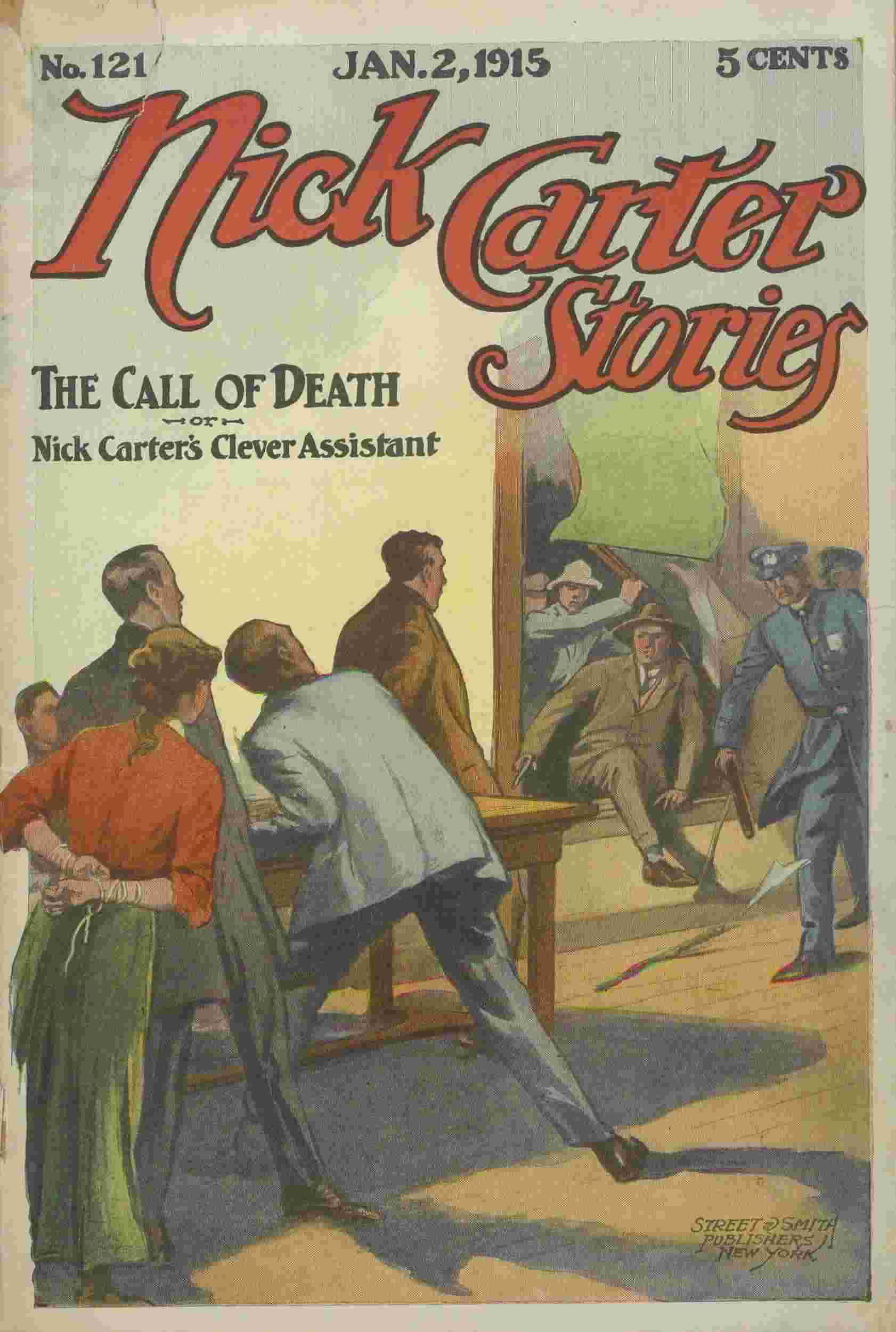
The Nick Carter Stories
ISSUED EVERY SATURDAY BEAUTIFUL COLORED COVERS
When it comes to detective stories worth while, the Nick Carter Stories contain the only ones that should be considered. They are not overdrawn tales of bloodshed. They rather show the working of one of the finest minds ever conceived by a writer. The name of Nick Carter is familiar all over the world, for the stories of his adventures may be read in twenty languages. No other stories have withstood the severe test of time so well as those contained in the Nick Carter Stories. It proves conclusively that they are the best. We give herewith a list of some of the back numbers in print. You can have your news dealer order them, or they will be sent direct by the publishers to any address upon receipt of the price in money or postage stamps.[Pg 69]
692—Doctor Quartz Again.
693—The Famous Case of Doctor Quartz.
694—The Chemical Clue.
695—The Prison Cipher.
696—A Pupil of Doctor Quartz.
697—The Midnight Visitor.
698—The Master Crook’s Match.
699—The Man Who Vanished.
700—The Garnet Gauntlet.
701—The Silver Hair Mystery.
702—The Cloak of Guilt.
703—A Battle for a Million.
704—Written in Red.
707—Rogues of the Air.
709—The Bolt from the Blue.
710—The Stockbridge Affair.
711—A Secret from the Past.
712—Playing the Last Hand.
713—A Slick Article.
714—The Taxicab Riddle.
715—The Knife Thrower.
717—The Master Rogue’s Alibi.
719—The Dead Letter.
720—The Allerton Millions.
728—The Mummy’s Head.
729—The Statue Clue.
730—The Torn Card.
731—Under Desperation’s Spur.
732—The Connecting Link.
733—The Abduction Syndicate.
736—The Toils of a Siren.
737—The Mark of a Circle.
738—A Plot Within a Plot.
739—The Dead Accomplice.
741—The Green Scarab.
743—A Shot in the Dark.
746—The Secret Entrance.
747—The Cavern Mystery.
748—The Disappearing Fortune.
749—A Voice from the Past.
752—The Spider’s Web.
753—The Man With a Crutch.
754—The Rajah’s Regalia.
755—Saved from Death.
756—The Man Inside.
757—Out for Vengeance.
758—The Poisons of Exili.
759—The Antique Vial.
760—The House of Slumber.
761—A Double Identity.
762—“The Mocker’s” Stratagem.
763—The Man that Came Back.
764—The Tracks in the Snow.
765—The Babbington Case.
766—The Masters of Millions.
767—The Blue Stain.
768—The Lost Clew.
770—The Turn of a Card.
771—A Message in the Dust.
772—A Royal Flush.
774—The Great Buddha Beryl.
775—The Vanishing Heiress.
776—The Unfinished Letter.
777—A Difficult Trail.
778—A Six-word Puzzle.
782—A Woman’s Stratagem.
783—The Cliff Castle Affair.
784—A Prisoner of the Tomb.
785—A Resourceful Foe.
786—The Heir of Dr. Quartz.
787—Dr. Quartz, the Second.
789—The Great Hotel Tragedies.
790—Zanoni, the Witch.
791—A Vengeful Sorceress.
794—Doctor Quartz’s Last Play.
795—Zanoni, the Transfigured.
[Pg 70]796—The Lure of Gold.
797—The Man With a Chest.
798—A Shadowed Life.
799—The Secret Agent.
800—A Plot for a Crown.
801—The Red Button.
802—Up Against It.
803—The Gold Certificate.
804—Jack Wise’s Hurry Call.
805—Nick Carter’s Ocean Chase.
806—Nick Carter and the Broken Dagger.
807—Nick Carter’s Advertisement.
808—The Kregoff Necklace.
809—The Footprints on the Rug.
810—The Copper Cylinder.
811—Nick Carter and the Nihilists.
812—Nick Carter and the Convict Gang.
813—Nick Carter and the Guilty Governor.
814—The Triangled Coin.
815—Ninety-nine—and One.
816—Coin Number 77.
817—In the Canadian Wilds.
818—The Niagara Smugglers.
819—The Man Hunt.
NEW SERIES
NICK CARTER STORIES
1—The Man from Nowhere.
2—The Face at the Window.
3—A Fight for a Million.
4—Nick Carter’s Land Office.
5—Nick Carter and the Professor.
6—Nick Carter as a Mill Hand.
7—A Single Clew.
8—The Emerald Snake.
9—The Currie Outfit.
10—Nick Carter and the Kidnapped Heiress.
11—Nick Carter Strikes Oil.
12—Nick Carter’s Hunt for a Treasure.
13—A Mystery of the Highway.
14—The Silent Passenger.
15—Jack Dreen’s Secret.
16—Nick Carter’s Pipe Line Case.
17—Nick Carter and the Gold Thieves.
18—Nick Carter’s Auto Chase.
19—The Corrigan Inheritance.
20—The Keen Eye of Denton.
21—The Spider’s Parlor.
22—Nick Carter’s Quick Guess.
23—Nick Carter and the Murderess.
24—Nick Carter and the Pay Car.
25—The Stolen Antique.
26—The Crook League.
27—An English Cracksman.
28—Nick Carter’s Still Hunt.
29—Nick Carter’s Electric Shock.
30—Nick Carter and the Stolen Duchess.
31—The Purple Spot.
32—The Stolen Groom.
33—The Inverted Cross.
34—Nick Carter and Keno McCall.
35—Nick Carter’s Death Trap.
36—Nick Carter’s Siamese Puzzle.
37—The Man Outside.
38—The Death Chamber.
39—The Wind and the Wire.
40—Nick Carter’s Three Cornered Chase.
41—Dazaar, the Arch-Fiend.
42—The Queen of the Seven.
43—Crossed Wires.
44—A Crimson Clew.
45—The Third Man.
46—The Sign of the Dagger.
47—The Devil Worshipers.
48—The Cross of Daggers.
[Pg 71]49—At Risk of Life.
50—The Deeper Game.
51—The Code Message.
52—The Last of the Seven.
53—Ten-Ichi, the Wonderful.
54—The Secret Order of Associated Crooks.
55—The Golden Hair Clew.
56—Back From the Dead.
57—Through Dark Ways.
58—When Aces Were Trumps.
59—The Gambler’s Last Hand.
60—The Murder at Linden Fells.
61—A Game for Millions.
62—Under Cover.
63—The Last Call.
64—Mercedes Danton’s Double.
65—The Millionaire’s Nemesis.
66—A Princess of the Underworld.
67—The Crook’s Blind.
68—The Fatal Hour.
69—Blood Money.
70—A Queen of Her Kind.
71—Isabel Benton’s Trump Card.
72—A Princess of Hades.
73—A Prince of Plotters.
74—The Crook’s Double.
75—For Life and Honor.
76—A Compact With Dazaar.
77—In the Shadow of Dazaar.
78—The Crime of a Money King.
79—Birds of Prey.
80—The Unknown Dead.
81—The Severed Hand.
82—The Terrible Game of Millions.
83—A Dead Man’s Power.
84—The Secrets of an Old House.
85—The Wolf Within.
86—The Yellow Coupon.
87—In the Toils.
88—The Stolen Radium.
89—A Crime in Paradise.
90—Behind Prison Bars.
91—The Blind Man’s Daughter.
92—On the Brink of Ruin.
93—Letter of Fire.
94—The $100,000 Kiss.
95—Outlaws of the Militia.
96—The Opium-Runners.
97—In Record Time.
98—The Wag-Nuk Clew.
99—The Middle Link.
100—The Crystal Maze.
101—A New Serpent in Eden.
102—The Auburn Sensation.
103—A Dying Chance.
104—The Gargoni Girdle.
105—Twice in Jeopardy.
106—The Ghost Launch.
107—Up in the Air.
108—The Girl Prisoner.
109—The Red Plague.
110—The Arson Trust.
111—The King of the Firebugs.
112—“Lifter’s” of the Lofts.
113—French Jimmie and His Forty Thieves.
114—The Death Plot.
115—The Evil Formula.
116—The Blue Button.
Dated December 5th, 1914.
117—The Deadly Parallel.
Dated December 12th, 1914.
118—The Vivisectionists.
Dated December 19th, 1914.
119—The Stolen Brain.
Dated December 26th, 1914.
120—An Uncanny Revenge.
[Pg 72]
PRICE, FIVE CENTS PER COPY. If you want any back numbers of our weeklies and cannot procure them from your news dealer, they can be obtained direct from this office. Postage stamps taken the same as money.
STREET & SMITH, Publishers, 79-89 Seventh Ave., NEW YORK CITY