
“Yes.”
“Who hid it?”
“Never mind who hid it, Dolan,” Magill objected. “Don’t you get too inquisitive. The party who hid it had no legitimate claim on it. He stole it. Furthermore, he’s dead. There will never be a kick from him. All we need do in order to get it is to force a certain party to squeal.[Pg 22]”
“How much coin is there?” asked Patsy, displaying a steadily increasing interest.
“A quarter million.”
“Come again! Say that just once more.”
“A quarter million.”
“I reckoned I must have misunderstood. Say, you ain’t nutty, are you?” questioned Patsy, with a suspicious growl. “Your dome ain’t cracked, is it?”
“Not a crack in it,” Magill earnestly assured him. “I’m handing you straight goods. There’s a quarter million that may be had for—well, Dolan, for a mere bit of chesty work. You wouldn’t get in on it, mind you, only I cannot get word to pals of mine in time to use them. I want a little help.”
“For what?”
“To take that skirt where she can be properly questioned,” Magill said pointedly.
“Take her where?”
“To a house about three miles from here.”
“What’s the matter with a hack or a buzz wagon?”
“Either would fill the bill,” said Magill. “There is only one difficulty.”
“What’s that?”
“The skirt says she won’t go,” Magill explained suggestively.
“Oh, ho; I see!” said Patsy, with eyes dilating. “You want to force her to go?”
“That calls the turn,” answered Magill. “She has agreed to meet me at the end of this street just before dark to finish the spiel I was having with her. She wouldn’t end it here for fear she’d be seen from the house where she boards.”
“I get you.”
“There are only a few scattered houses at the end of the street, and that’s the direction I, want to take her,” Magill added. “Now, if you’re not a bird head, you can see how easy it can be, done.”
“You mean to kidnap her?” said Patsy quickly.
“That’s the game.”
“And you want me to help?”
“If you’ve got the nerve.”
“I’ve got nerve enough, all right,” declared Patsy. “But what do I get for this job?”
“Enough money to buy a corner lot on Broadway,” Magill forcibly assured him. “That’s all I want of you, too, and it’s all the risk you have to take.”
“When do I get the coin, and how much?”
“Ten thousand bucks, possibly more, within twenty-four hours.”
“After nailing the skirt?”
“Exactly.”
“I’m hooked,” said Patsy, as if abruptly deciding to accept the offer. “Spiel off what you want done and I’ll do it.”
“Shake!” said Magill, extending his hand. “I thought I read your mug correctly. My name is Mike Magill, sometimes called Turk Magill, and you’ll find me all right and always on the level.”
“If that goes, Mr. Magill, I’m your meat for any kind of a job,” said Patsy. “A quarter million, eh? Say, I’m afraid I’ll wake up. Hang it, I’d wade through blood for that. What am I to do?”
“We’ll need a touring car,” said Magill.
“I know a garage where I can swipe one.[Pg 23]”
“Swiping it might make trouble for us. Could you hire it?”
“Sure—if I had the price,” said Patsy.
“Here’s a twenty-dollar note. Will that be enough?”
“More than enough.”
“Take it, then,” said Magill. “It shows you, too, that I mean business.”
“I’m wise to that, all right.”
“Do your part, Dolan, and you’ll get a hundred bucks for every dime in that twenty,” Magill added impressively.
“You leave it to me,” Patsy rejoined. “That skirt is as good as on her way.”
CHAPTER VI.
THE MAN WHO DIED.
It was early evening when Nick Carter arrived home after his interview with Kate Crandall. He found Chick awaiting him. On the office table lay a small plaster cast, not there when Nick departed with Harriet Farley that morning, concerning whose mission and what since had occurred, Chick was, of course, entirely ignorant.
“Well, by Jove, you’ve had a long outing,” he remarked, when Nick entered and removed his coat and hat. “Have you been equally busy?”
“You know me,” replied Nick pointedly.
“None better. What’s doing?”
“A case for the young lady who prevented me from going with Mallory this morning.”
“Who is she?”
“Her name is Harriet Farley. She is the only child of the late Archibald Farley. She is worth four or five millions—and then some.”
“That ought to keep the wolf from the door, at least,” said Chick, smiling. “What’s the case?”
Nick briefly informed him, covering all of the essential points and immediately adding:
“Have you heard from Patsy?”
“Not a word.”
“There must be something doing, then, or he would have found time to telephone a message of some kind. How long have you been here? What’s this?”
Nick had caught sight of the plaster cast on the table. He took it up and examined it.
“One result of my trip with Mallory,” said Chick. “It’s mighty strange, Nick, how circumstances sometimes dovetail together in this big and busy world.”
“What do you mean?”
“You have not forgotten Mallory’s letter about a dead man up in Harlem?”
“Certainly not.”
“We went up there,” Chick said, more earnestly. “The address proved to be a miserable house in one of the outskirts. It appeared to be unoccupied, so we forced an entrance, though very little force was necessary, as far as that goes.”
“You found?”
“A miserably furnished place, Nick, with indications of poverty on all sides. There was evidence that a man and woman have been living there, and so some of the neighbors informed us; but the woman has removed all of her belongings and left only the body of the man. We found the body in a dismal back room on the second floor. He has been dead about two days.[Pg 24]”
“Murdered?”
“Not exactly.”
“What do you mean by not exactly?”
“Violence, but not murder,” said Chick. “The cause of his death was obvious. It resulted from a bullet wound in his left shoulder. It had not been properly treated. Blood poison had ensued and sent him over the dark river.”
“H’m, that’s strange!” Nick remarked. “There must be something back of it. Could you identify him?”
“Easily.”
“Who?”
“The very man, Nick, of whom we were talking with Mallory when Vallon arrived with that letter—Jim Nordeck, the yegg cracksman, the crook suspected of having been one of the gang that robbed that Westchester savings bank.”
“The devil you say!”
“There was nothing to it,” Chick added. “There was no mistaking him.”
“You probably are right,” Nick replied, with a nod. “One of the gang is known to have been wounded during their hurried get-away.”
“The man was Nordeck.”
“Undoubtedly.”
“That occurred a week ago,” Chick went on. “He evidently has been lying ill and in a bad way since then. There was convincing evidence of that. Furthermore, according to the neighbors we questioned, no physician was called and nothing definite is known about the couple. They have occupied the house nearly a month. They probably did not dare to call a physician, lest the wound might lead to an exposure of Nordeck’s identity and his part in the Westchester burglary.”
“That undoubtedly explains it,” Nick agreed. “Nordeck took a chance of recovery without the help of a surgeon. His negligence proved fatal. The writer of the letter must have been his daughter, Nancy Nordeck, whom I saw on a Harlem train a month ago.”
“That’s right, too,” Chick said. “The woman seen by the neighbors answers Nancy Nordeck’s description. She took care of her father till he died. Then she bolted, sending Chief Mallory that letter and a fifty-dollar bank note for funeral expenses.”
“It shows plainly enough that I was right.”
“In attributing the burglary to a gang including Nordeck?”
“Exactly. That bank note was part of the plunder,” said Nick. “Nordeck evidently got his share of it. He must have been dead broke before the burglary, however, or he would not have been living in such quarters as you describe. You searched the house, of course.”
“Every nook and corner.”
“What did you find?”
“Only what I have stated. There was nothing to show where Nancy Nordeck has gone, nor any trace of the stolen money. She bolted with that, all right, or as much of it as Nordeck derived from the job. Mallory took charge of the body and will have it decently buried.”
“If we are to judge from the sentiment expressed in her letter to Mallory, the better part of the girl must have been deeply stirred by the death of her father,” Nick observed. “She wanted him to have a cloth-covered casket with silver grips, you remember, also a prayer said for him.[Pg 25]”
“She is not entirely bad, then, after all.”
“His death may have hit her hard, Chick, and possibly will reform her. Let’s hope so for her own sake. Where did you get this cast?”
“From one of the footprints in the back yard,” said Chick. “I thought it might be needed later, perhaps, and so I sent Danny after some plaster and made a cast of the footprint. It was Nancy Nordeck’s, all right, for no other woman has recently been in the yard. She was——”
“Stop a moment,” Nick interrupted. “By Jove, Chick, you are right. Circumstances do dovetail strangely sometimes.”
“You mean——”
“This is a facsimile of one of the imprints I found under Maybrick’s library window.”
“Are you sure?”
“Positively. Here is the run-down heel, the mark of a patch on the sole, and the size is exactly the same.”
“Great guns! that seems almost incredible,” said Chick, with a puzzled expression. “It cannot be that Nancy Nordeck was one of the women you suspected of having been watching Maybrick.”
“On the contrary, Chick, she certainly was,” Nick insisted.
“But what motive could she have had? A clergyman is about the last man on earth in whom Nancy Nordeck would have any interest. Her whole career has been a vicious one.”
“True.”
“It must be that you are mistaken, then, and that the shoe of some other woman corresponds exactly with hers.”
“Wait a bit!” said Nick. “Let me consider all of the circumstances. I know I am not mistaken. Be quiet while I stir up my gray matter and dig out the solution of this problem.”
Nick was not long in finding it, or in framing up a theory that seemed consistent, at least, with all of the known circumstances. His thoughtful face suddenly lighted. He straightened up and exclaimed, gazing again at Chick:
“By Jove, I think I have it.”
“The answer?”
“Yes.”
“Good!”
“If I am right, however, the outlook is bad—deucedly bad at that.”
“Bad for whom?”
“For the rector, Maybrick—and for Nancy Nordeck herself.”
“Why bad for her?” questioned Chick perplexedly. “I don’t get you. What do you make of it?”
“Listen.” Nick drew forward in his chair. “As sure as you’re a foot high, the veiled woman who visited Maybrick on Tuesday evening was Nancy Nordeck. Her inferior attire, the likeness of this plaster cast to the footprint under the library window, together with all of the other circumstances, convince me that she was the woman.”
“But why, if she went there to visit him, did she look through the library window?”
“To learn whether he was at home and alone. That would have been a perfectly natural step for her to have taken.[Pg 26]”
“True, Nick, as far as that goes,” Chick allowed. “But why on earth did she visit Maybrick? What business can a crook of her class have had with a clergyman?”
“That is suggested, at least, in the letter she sent to Mallory.”
“You mean?”
“The sentiment I detected between the lines,” said Nick. “That girl, Chick, for she’s little more than a girl, was so deeply affected by the death of her father that she resolved to reform. There’s nothing else to it. She went to Maybrick and told him about the burglary, and she offered to turn over the plunder to him that he might restore it to the bank officials.”
“Oh, hold on!” Chick exclaimed incredulously. “You are overlooking no end of contradictory points. How, to begin with, did Nancy Nordeck come in possession of the plunder?”
“That is easily explained,” Nick replied. “We know that Jim Nordeck has been repeatedly buncoed and cheated by his pals, and he may in this case have insisted upon taking charge of the plunder until it could have been equally divided. The gang would have consented to that, of course, for they could not have cracked the vault without his assistance. He was the big squeeze in that part of the work.”
“That’s very true,” Chick allowed.
“If I am right, then, Nordeck took it to the house in which he died, or hid it somewhere else, perhaps, expecting to recover from his wound and soon whack up with his confederates, who, evidently, were not living with him and Nancy in the Harlem house.”
“Surely not, Nick, or they would have been seen by the neighbors.”
“Instead, however, Nordeck died, and the girl experienced a change of heart. I now feel dead sure of that, Chick, and it’s not the first time that death has brought about such a reformation.”
“But why did she not, in that case, take the plunder directly to the bank officials, or turn it over to the police?”
“For two reasons, perhaps,” Nick pointed out. “She may have feared arrest, or knew that she would be watched and would be prevented by other members of the gang.”
“Possibly.”
“The fact that they did not go to the Harlem house and force her to give up the plunder, moreover, convinces me that Nordeck had hidden it somewhere, and, that after his death, Nancy alone knew where it could be found.”
“I see.”
“She did not dare to go and remove it, however, lest she should be seen and waylaid by the gang. She went to Maybrick, therefore, and told him all of the circumstances. It would have been perfectly natural for her to select him, for his charitable work among the criminal classes is widely known, and she would have felt sure that she could rely upon him.”
“That goes without saying,” said Chick.
“This theory is further confirmed by the fact that Maybrick left home the following night with two empty suit cases,” Nick argued.
“In which to bring home the plunder?”
“Exactly.”
“But why did he draw five hundred dollars from the bank?[Pg 27]”
“H’m, let’s see,” Nick said thoughtfully. “It’s obvious that Nancy Nordeck is nearly penniless, aside from the bank funds. She may have refused to take any more of the stolen money, yet may have insisted upon having funds with which to leave the country. She is wanted for several petty crimes, you know.”
“True.”
“Maybrick must have drawn his own money to give her, knowing he would afterward be reimbursed by the bank officials. There is a reward of ten thousand dollars for the recovery of the funds.”
“The girl could have got that,” said Chick.
“If she has had the turn of heart that the circumstances lead me to suspect, she would not accept the reward,” Nick replied. “That is a woman’s way of doing things.”
“I begin to think you are right Nick, after all.”
“I feel pretty sure of it.”
“But how do you account for Maybrick’s absence and his——”
“That’s the worst feature of the case,” Nick put in.
“You mean?”
“That he’s in bad, most likely, as well as Nancy Nordeck.”
“I don’t quite get you.”
“Suppose I am right,” said Nick. “Suppose this theory is correct. It’s a copper-riveted cinch, Chick, in that case, that the gang that committed the burglary has been stealthily watching Nancy Nordeck and——”
“By thunder, I see the point!” cried Chick, more gravely. “You think they have got both her and Maybrick, and also have landed the plunder.”
“It certainly looks so. Furthermore—wait! There’s my telephone bell. We may hear from Patsy.”
Nick turned quickly to his desk and took up the instrument.
“Hello!” he said quietly.
No answer.
He called again a bit louder:
“Hello! hello!”
Still no answer.
Nick’s brow clouded.
Then, suddenly, there fell upon his listening ears a quick, intermittent tapping. He listened even more intently. His countenance lighted, then clouded again, darker than before. He seized a pad of paper and a pencil and began to write, listening all the while.
Three minutes passed and Nick then hung up the receiver and sprang to his feet.
“Bring Danny and the car as quickly as possible,” he cried. “We’ve got to make a record run, if ever we made one. Guns on your hips, Chick. Patsy in the hands of the gang.”
CHAPTER VII.
TAKING LONG CHANCES.
Patsy Garvan and Turk Magill, after arriving at a very lucid understanding concerning Kate Crandall, speedily decided how their felonious design could best be executed. Patsy entered into it, moreover, with a zest that further assured Magill of his sincerity, of which he had scarce a shadow of doubt when they parted to begin operations.
Leaving Magill to keep his appointment with Kate,[Pg 28] Patsy hastened to a public garage that he had seen while shadowing her from her office. Luckily, too, he immediately found the proprietor, to whom he quickly introduced himself and confided the situation.
Patsy found in him a willing assistant, too, who provided him with a touring car, but flatly refused to accept any payment.
“I’ll not even think of it,” he protested, when Patsy tried to force Magill’s twenty-dollar bank note upon him. “Pastor Maybrick is a friend of mine, and he’s one man in a million. Nick Carter is one in ten millions, moreover, and it’s a pleasure to serve both of them. You take the car, Mr. Garvan, and return it when convenient. It’s yours for the asking. I’d like to do more, and I wish you good luck.”
Patsy thanked him heartily and guided the car from the garage within twenty minutes after parting from Magill. He knew that he was playing a hazardous game and taking long chances, that he was going up against as dangerous and desperate a man as ever stood in leather, as well as crooks of like character, and that a slip of the tongue, or even the ghost of a mishap, might at any moment expose his subterfuge and put him in peril of his life.
It was not in Patsy’s nature to shrink from the undertaking on that account, however, and he hardly gave it a thought. He felt that the game was worth the candle, and he was ready to burn the candle at both ends.
Daylight was turning to the dusk of early evening when he left the garage. It was just about the time when Kate Crandall had promised to meet Magill, and Patsy at once headed for the point agreed upon. He discovered them when he entered the long street leading out of the town, moreover, and he slowed down to approach them moderately.
Magill saw him coming. Increasing confidence in him mingled with his feeling of grim satisfaction. He was talking earnestly with the woman, then in a locality where there were only a few scattered dwellings; but he had relieved her of any misgivings by turning back with her toward the town, though, in reality, only to see and make ready for Patsy when he approached. He reached into his pocket and grasped a large silk handkerchief with which he was provided.
Half a minute later brought Patsy within thirty yards of the couple. He then swerved toward them, bringing the car to a stop near the curbing.
“Beg pardon, sir,” said he, leaning out, and, at the same time, deftly unlocking the door of the tonneau. “Will this road take me to Bronxville?”
Kate Crandall paused.
Magill shook his head and stepped back of her as if to point the way for his questioner.
“No, not straight ahead,” he replied, with a significant wink. “You must take the first crossroad.”
“To the left, or right?”
“To the left, and—now, Dolan, get her!”
Magill had clapped the silk handkerchief over Kate’s mouth, and, as quick as a flash, was tying it back of her head.
Patsy, equally quick, leaped from the car and seized her arms, forcing them behind her and crying hurriedly:
“Tie her wrists, Magill, with another handkerchief. I’ve got her. She can’t yip. Her struggles cut no ice. Into the car with her, now, and the trick is turned.[Pg 29]”
In spite of her frantic efforts to escape, it was a comparatively easy task for two strong and determined men to quickly overcome the frightened woman, who was hurriedly forced into the tonneau even while Patsy was speaking. She then sank, half fainting, in one corner, unable to make any outcry and hardly able to move.
Magill banged the door and sat down beside her, crying sternly:
“You’ll not be hurt, woman, if you keep still and do what you’re told. Now, Dolan, away with you. Follow this road for half a mile, then take the left fork. I’ll direct you later. You’re all right from your toes up, pal, and you’ll get the coin I promised you. Let her go lively.”
The last was entirely unnecessary. The speedometer already was showing forty miles, and the last of the scattered dwellings were quickly left behind.
The dusty road swept like a gray ribbon under the swiftly moving car, the skillful driving of which Magill was quick to see and appreciate, while Patsy was inwardly congratulating himself upon having informed the rascal that his vocation was that of a chauffeur.
Under Magill’s repeated assurances that she was in no personal danger, Kate Crandall’s first flash of terror had subsided, and she appeared to yield more calmly to the situation, though a fiery gleam in her black eyes plainly evinced her impotent fury and resentment.
With one eye on the woman, the other on the road ahead, Magill frequently shouted additional instructions to Patsy, who quickly followed them with merely a nod in response.
Patsy had, of course, no idea as to their precise destination. He was thoroughly familiar with the country through which they were speeding, however, knowing by name nearly every important road in Westchester County, and he soon foresaw in what part of it they were likely to bring up. His anticipations soon were verified. Magill suddenly leaned forward and cried, pointing up the woodland road, then only dimly discernible in the increasing darkness:
“Slow down when rounding the bend, Dolan; then take the lane on the left. It will bring you to an old stone house in a clearing. That’s the crib. The going is bad in the lane, but you can make the side yard all right. You’ll see lights in the distance. Head for them.”
“I get you, Mike,” Patsy cried back at him; then, to himself: “I’ll get you for keeps, too, by thunder, barring a slip-up.”
The touring car swept around a long curve in the woodland road. Scattered lights in the distance came into view. Seen through the trees and from the moving car they appeared and vanished again and again like fluttering fireflies seen in the gloom of a summer night.
Patsy knew the distant settlement. He noted the precise location of the grim old house that also came into view, looming up against a background of woods and the star-studded purple of the sky. A feeble ray of light here and there from the lower windows told that it was occupied, but that the outer blinds were closed and the curtains drawn.
“Swing round to the right, Dolan, and you’ll bring up at the side door,” Magill directed. “That’s the stuff. Leave me to do the talking. I’ll put you in right, Dolan, for what you have done.[Pg 30]”
“I’ll do as much for you, Magill,” replied Patsy, with dry significance.
He had rounded a corner of the gloomy stone building and stopped some ten feet from a side door. A whistle from Magill was answered with a cry from within, quickly followed by the heavy tread of men on a bare floor. The door was hurriedly opened and a stream of light from the side hall fell upon the touring car and its occupants.
It also distinctly revealed the three men who had responded to Magill’s signal. One was a short, swarthy fellow in the twenties, a stranger to Patsy, but whose vicious character was plainly reflected in his sinister face.
Another was tall and gaunt, with squinted eyes and cadaverous countenance; while the third was a square-shouldered, powerful man of fifty, with a smoothly shaved, hard-featured face, evincing imperious will and bulldog aggressiveness.
Patsy instantly recognized the last two men, both crooks and cracksmen of national reputation, and he also realized more keenly that he was carrying his life in his hand.
“Blink Morgan and Ginger Gridley,” he said to himself. “I’m in right, by thunder, if I can only stay right and keep things coming my way. If not—gee! I can see my finish.”
These thoughts flashed through Patsy’s mind while Gridley, striding from the house, cried harshly:
“What’s this, Turk? What’s the meaning of this? Why——”
“Oh, you back up, Ginger, till I have time to explain,” Magill interrupted, springing from the car. “Lend a hand, Morgan, and take this skirt inside. She’s the cat who queered our game last night. We’ve got her where we want her, now, all right. Take her in.”
The cadaverous man with squinted eyes, from which he derived his nickname, hastened to obey, Magill having rudely forced the woman to get out of the car while he was speaking, and she then was seized by Morgan and hurried into the house.
Gridley, in the meantime, whom Patsy knew must be the leader of the gang, gazed with frowning eyes from one to the other, and then sternly repeated his question:
“What’s the meaning of this, Magill? Why have you brought her here?”
“Because she wouldn’t yield to persuasion,” Magill curtly declared. “We must force her to tell what we want to know. That could not be done without bringing her here.”
“You still think she knows?”
“She must know. She heard all that infernal squealer said.”
“But who is this fellow?”
“He helped me get her. He’s all right, too,” Magill forcibly asserted. “Get out, Dolan, and shake hands with Tom Gridley, more often called Ginger Gridley. You’ll find him full of ginger, too, if you cross him badly. He’s all right, Tom, and I couldn’t have got the skirt without his help. He hired the car with some money I gave him and——”
“Come inside,” Gridley interrupted, extending his hand to Patsy. “It’s all right, Dolan, if you’re all that Magill says you are.”
“I’m all that, and something more,” Patsy coolly assured him. “You can bank on me as long as I’m used right.[Pg 31]”
“You’ll have no kick coming, Dolan, if you’re handing us straight goods,” replied Gridley. “If not——”
“Nothing doing in the if-not line,” put in Patsy tersely.
“This way, then. Lock the door, Phelan.”
The last was addressed to the fourth man of the gang, while Patsy followed them into the house. He heard the ominous click of the lock when Phelan turned the key. It told him there was no retreat, no backing out of the hazardous undertaking into which he had fearlessly ventured.
Patsy Garvan, however, had no such inclination even for a moment.
CHAPTER VIII.
PATSY’S CLEVER WORK.
Gridley led the way into a large, square room. Like the exterior of the grim stone house, it bore all the earmarks of antiquity. Great beams crossed the faded ceiling. The discolored walls were partly wainscoted. A smoldering log burned in a huge stone fireplace.
The furnishings in the room were old and threadbare. An oil chandelier lighted the scene. It was suspended above a table, on which were several newspapers and a few old books, also a telephone—the only modern fixture in the room.
Kate Crandall was seated on an old sofa, still bound and gagged, and in charge of Blink Morgan, but, apparently, nerved to meet whatever might follow.
“Sit down, Dolan, till I am ready to talk with you,” Gridley commanded, when all hands had entered the room. “Now, Turk, out with the whole business. Where did you pick him up and why?”
“I’ll tell you where and why he——” Patsy began.
“You keep quiet,” Gridley sharply interrupted. “You’ll have your say, Dolan, when the time comes. Sit down and close your trap till you’re asked to open it.”
“Sure thing, if that’s the way you feel about it,” Patsy coolly acquiesced.
He saw plainly that Gridley not only was the leader of the gang, but, also, that he ruled with a rod of iron. He realized, too, that he might not be able to blind Gridley as successfully as he had fooled Magill, and Patsy immediately set about casting an anchor to the windward.
He had caught sight of the telephone on the table. He took a chair near it. He knew that he could not use it in any ordinary way, yet he felt that he might craftily turn it to some advantage.
He also knew, of course, nothing about the discoveries Chick had made and the theory Nick was at that moment elucidating in his business office in Madison Avenue, but he did know, at least, that any communication to their office would speedily reach one of them, if not both.
“There’s nothing for me in holding up this gang before I get wise to their game,” he reasoned, while Magill was hurriedly explaining what had occurred, which then held the entire attention of his three confederates. “I’ll wait till I get next to the whole business, and then decide what to do,” Patsy added to himself. “I can pick it up, all right, when they begin to talk with this woman. Gee whiz! but I don’t fancy that.”
Furtively watching Gridley, while Magill was stating how they had met and what had followed, Patsy detected a steadily deepening frown on Gridley’s hard-set face.[Pg 32] It smacked of incredulity, of increasing misgivings, and Patsy scented trouble.
“That infernal rascal is not going to swallow my story without something to wash it down,” he thought, a bit grimly. “I must sharpen up my wits and be ready for him, if he starts in to put me through the wringer. By Jove, I’ll have something else ready, too. I reckon I can work it undetected.”
Magill still was talking earnestly to his three confederates.
Patsy leaned nearer the table, resting one arm on it, and stealthily placed three of the books in a pile and gradually drew them close to his elbow. He accomplished this just as Magill ended his story, when Gridley replied with a doubtful growl and a side glance at Patsy:
“It strikes me, Turk, that you have taken long chances.”
“Chances?” said Magill, frowning.
“Yes. You really know nothing about him.”
“Only what he told me.”
“That may not be true.”
“But the circumstances and what he has done——”
“All are right as far as they go,” Gridley curtly interrupted. “But they are not enough. We must be dead sure of him. We must find out just who he is and where——”
“Say, are you ginks talking about me?” Patsy cut in, with affected resentment.
“Yes, we’re talking about you,” snapped Gridley. “You’re a stranger to us. We might get in wrong, you know, in blindly relying upon a stranger.”
“Oh, is that so?” Patsy retorted. “And I might throw a shoe, too, by helping a strange gang in such a game as you guys are playing. What do you want—my pedigree?”
“See here, Dolan——”
“Oh, I’m seeing all there is to see,” cried Patsy, frowning. “You’ll find out, mebbe, that I’m a law-and-order spotter, or a central-office sleuth.”
“It would cost you something, all right, if we did.”
“You guys give me a pain. I’ll tell you now. I’ll show you the way,” Patsy forcibly added, seizing the telephone for a moment, but quickly replacing it on the table.
“There is one man who can tell you all about me. He will give it to you straight,” he quickly went on, now shouting with pretended resentment. “Call up 47 Madison! 47 Madison! Here, I’ll write it for you on the edge of this newspaper, so you’ll make no mistake. 47 Madison! Ask who Jack Dolan is, and——”
“Dry up!” snapped Gridley, interrupting, while Magill, Morgan, and Phelan stared from one to the other. “I’ll not telephone to anybody. You keep cool, Dolan, and answer my questions. This is nothing for you to get hot about. Who is the party, anyway?”
“He runs a barroom near Madison Avenue,” said Patsy curtly.
“What’s his name?”
“Jim Donovan. He knows all about me. He’ll tell you who I am and whether you can bank on me.”
“Sure, Ginger, we can bank on him,” Magill now cried impatiently. “He’s all right, or he wouldn’t have lent me a hand to get the skirt.”
“That’s right, too,” Morgan chimed in confidently.
“He’ll go the limit, Ginger, you can bet on that.”
“So he will, perhaps, but there was no harm in making[Pg 33] sure of it,” Gridley now said, less harshly, evidently impressed with these arguments and the attitude Patsy had taken. “He ought not to kick at that.”
“Oh, he’s not kicking. He’s all right, Gridley, from his toes up,” Magill insisted. “He knows what he’s doing.”
The blinded rascal never spoke more truthfully.
Patsy already had turned one of the cleverest tricks of his exceedingly clever career.
All the while during the heated discussion, which had absorbed the entire attention of the four crooks, Patsy had been tapping with his lead pencil on the metal mouthpiece of the telephone.
He had so placed the instrument near the pile of books that they lifted the receiver sufficiently to let its hook rise and make a connection with the number he thrice had shouted—chiefly, of course, for the ears of the exchange operator.
The position of the telephone was not suggestive of the ruse. One would have observed only by chance that the books raised the receiver.
The tapping with a pencil was not noticed by either of the four crooks.
The quick, intermittent taps sped instantly over the wire. They were the taps distinctly heard by Nick Carter in his business office. They conveyed to him what Patsy could not vocally impart—this tapped communication by the ordinary telegraphic code, with which Nick and all his assistants were perfectly familiar:
“Cornered. Stone house. Baldwin Road, Westchester. Half mile east of Granger settlement. Rush. Will hold up gang if——”
Patsy had ended it abruptly.
He saw Gridley’s evil eyes cast toward him. He dropped his pencil and with his elbow, as if by accident, he quickly upset the telephone and prevented the detection of his exceedingly artful ruse.
Turning quickly to catch the falling instrument, however, Patsy met with a mishap that threatened to pervert all of the good work he had done. His hasty movements caused something to drop from his vest pocket. It fell to the floor near his chair. He did not see it, but it instantly caught the eye of Turk Magill—the twenty-dollar bank note said to have been used for automobile hire.
It gave Magill’s confidence a sudden, terrible jolt. His faith in Dolan oozed out of his every pore. He flashed a swift, significant glance at Gridley, then walked carelessly back of Patsy’s chair—only to turn quickly and seize him from behind, confining his arms and crying sharply:
“Sit quiet! If you are all right, Dolan, you have nothing to fear. But——”
“Here’s the but!”
It was a big revolver in the hand of Ginger Gridley. He sprang up when Patsy began to struggle, thrusting the weapon directly under his nose and adding fiercely:
“Sit quiet, as you’re told, or I’ll put you in shape for an undertaker. We’ll soon find out who you are and whether you’re on the level. Bring a piece of rope, Phelan, and tie him to the chair. Be quick about it.”
“Oh, very well,” said Patsy coolly. “But what’s it all about? Have your noodle boxes gone wrong? Why this sudden change of mind, Magill?”
Magill did not reply immediately. He waited until Phelan came with a piece of rope, with which Patsy’s arms were quickly bound to the back of the chair. He[Pg 34] then picked up the bank note, quickly displaying it and crying:
“You have lied to me once, Dolan, and your whole story may be a string of lies, as Gridley suspects. You said you paid for the car with this money. You lied! This is the same bank note I gave you.”
“So ’tis,” said Patsy, with dry terseness. “But don’t let that worry you, Magill. Never worry over picking up a twenty case. You’re dead lucky to get it back.”
Patsy now saw plainly enough what had occasioned this sudden aggressiveness. He saw, too, that the moment was fast approaching when subterfuge would be utterly futile, when even his identity might be discovered, and he at once took the only course left open for him—that of prolonging the conversation and staving off any desperate move of these rascals, until his combination telephone-and-telegraph appeal could be answered.
For though the telephone receiver was muffled by its position on the books, Patsy had faintly heard Nick’s repeated hello and recognized his voice, and he felt reasonably sure, from his succeeding silence, that the tapped message had been received and rightly interpreted.
Magill’s face, like that of every man of the gang, had taken on a frown as black as midnight. He shook the bank note in Patsy’s face, retorting fiercely:
“Lucky to get it back, am I? Well, you’ll be mighty lucky to get out of here with your life, if we find that you have tricked us.”
“Oh, I have not tricked you,” Patsy calmly asserted. “You’re getting all haired up over nothing. I’ll explain to your entire satisfaction, Magill, if you give me time.”
It was for time, indeed, that Patsy then was playing.
“Out with it, then,” snarled Gridley, again taking the ribbons. “What do you mean? How came you with this money?”
“Magill gave it to me.”
“But you said you hired the touring car with it.”
“No, I didn’t,” said Patsy. “He only thought I did. The truth is, Mr. Gridley, I hated to let go of twenty bucks that had come so easy. So I hung on to the long green, instead, and stole the touring car from in front of a house.”
“I ordered you not to steal one,” cried Magill.
“I know it,” said Patsy, with a grin. “But I ain’t much on obeying orders. I reckoned a stolen car would serve as well for the job we had framed up, and since I was going into a thieving game, I thought I might as well swipe a car and be hung for a sheep as a lamb.”
“He’s lying!” Gridley said sternly. “See what else he has in his pockets. Search him from head to foot and—what’s that?”
Magill had quickly obeyed, thrusting his fingers into Patsy’s vest pockets. From one of them he drew out a crumpled scrap of paper, thoughtlessly put there by Patsy after having read it.
“It’s a leaf from a notebook,” he cried. “Here’s writing on it.”
“Writing on it?”
“Thundering guns! Whom are we up against?” Magill added, with a growl. “Listen, Gridley, listen!”
Magill straightened up with lips viciously twitching and read it aloud—the communication from Nick Carter to Patsy:
“‘Kate Crandall knows, but will not speak. Shadow her constantly until otherwise directed. Be governed by cir[Pg 35]cumstances. I’m off for home. Phone me there of any discoveries.’”
“Gee whiz, it’s all off now, for fair,” thought Patsy. “I’m booked for all I’ve invited, unless the chief shows up.”
There certainly were indications of it. Gridley snatched the paper from Magill and read it himself, then uttered a terrible oath.
“This does settle it,” he fiercely muttered. “A detective—that’s what he is!”
“Sure thing,” snarled Magill.
“Search him from head to foot, Phelan. We must find out who he is and where we stand. See if that hair is his own and—ah, it’s not his own, eh? Off with it, Phelan, the whole business.”
Phelan set to work with vicious zest, and in a very few moments he not only had Patsy stripped of his disguise, but also the contents of his pockets spread upon the table—handcuffs, searchlight, two revolvers, a well-filled pocketbook, a handkerchief, keys, and other minor articles.
None of them bore his name and address, however, nor did Nick’s brief, though very significant note, bear his signature.
A cry of increasing rage broke from Magill when the truth thus was forced upon him, but Gridley checked him with a gesture, saying sternly:
“You keep quiet, Turk, and let me handle this fellow.”
“But, blast him——”
“There aren’t any buts,” snapped Gridley. “I’m chief of this gang, and what I say goes. I’ll wring the truth out of him, you can bet on that, and we then shall know where we stand. Tell me at once—who are you?”
The last was fiercely addressed to Patsy, but Patsy was undisturbed by his ferocity. He met his fiery gaze with a frigid stare, replying indifferently:
“Jack Dolan, just as I’ve told you.”
“That’s a lie,” snapped Gridley.
“You’d say that if I told you the truth. So I might as well hand you one name as another.”
“Oh, is that so? You mean, then, that you won’t tell me?”
“I already have told you.”
“Let it go at that, then, for the present,” said Gridley, with ominous severity. “Who gave you this note?”
“The party who wrote it,” said Patsy dryly.
“What’s his name?”
“I dunno, Mr. Gridley, on the dead. It has slipped my mind.”
“Hang him!” cried Magill impatiently. “He’s giving us the laugh. String him up and force him to answer.”
“You keep quiet,” Gridley again commanded; then to Patsy: “Why were you told to shadow this woman? That hasn’t slipped your mind?”
“No; sure thing,” said Patsy, with a glance at Kate Crandall. “I can remember that, all right.”
“Out with it, then. Why were you told to shadow her?”
“To find out where she went,” Patsy dryly admitted.
“By Heaven, if you don’t loosen up and tell me, I’ll find a way to make you!” Gridley thundered. “Who gave you this note? To whom are you to telephone any discoveries you may[Pg 36]——”
He broke off abruptly, hit with a sudden idea, and turned sharply around to his listening confederates.
“What was the number he mentioned?” he cried. “Can you remember it?”
“Sure!” cried Blink Morgan. “Four, seven Madison!”
“Get that telephone book.” Gridley pointed to the table. “Look for the police headquarters. See if that’s their number.”
“Rats!” growled Phelan. “He ain’t a police sleuth. He’s no plain clothsie. I know that push.”
“Try the private agencies, then,” snapped Gridley. “Look up—stop a bit! Begin with Nick Carter. Try him. Look up his number.”
“Holy smoke!” thought Patsy. “Here’s where the cat makes her final jump. She’ll come clean out of the bag this time. But the rascals do not suspect the trick I’ve put over on them. That sure is my only anchor to the windward.”
Morgan and Turk Magill had turned pale when Nick Carter’s name was mentioned, and their fears were completely verified.
For Phelan, suddenly starting up from the telephone book he was hurriedly inspecting, cried excitedly:
“I’ve got it! Here’s the name and number. Four, seven Madison! It’s a telephone in Nick Carter’s business office.”
“Last jump is right,” thought Patsy.
Gridley swung round and gazed at him with murder in his eye.
“So Nick Carter wrote this note, did he?” said he, through his teeth. “You’re to telephone your discoveries to him, eh? What have you discovered? What has he got on us?”
“Nothing on you that I know of,” said Patsy, unruffled. “I was not directed to shadow you fellows.”
“What on this woman, then?”
“I don’t know for sure, and I don’t think he does,” Patsy truthfully answered, not yet informed of Nick’s deductions and suspicions. “That’s dead-straight goods, Gridley, on my word.”
Gridley vented an oath and shaped another course.
“Make sure that he is securely tied, Phelan,” he cried sternly. “We’ll settle his hash a little later. Our first move must be to get the coin—and get it mighty quick, if Carter is dipping into this business.”
“That’s right, too,” Magill declared, glaring at Patsy. “Get the coin and bolt—that’s our only safe course.”
“We’ll take it, too, and take it on the jump,” Gridley forcibly added. “Free that woman, Morgan, and be quick about it. She shall tell us what she knows, or—God help her!”
CHAPTER IX.
THE LAST CALL.
Kate Crandall had not stirred from the sofa during the sensational scenes just enacted. They told her only too plainly that she was in the hands of knaves who would shrink from no desperate deed that would serve their ends, and she had no thought but to escape from them by any means she could command.
Blink Morgan hastened to liberate her, while Gridley seated himself directly in front of her and sternly said:
“You’ve got mighty few minutes, woman, to tell us what we want to know. We have others here who could tell us, but whose traps are tightly closed. We have not killed[Pg 37] them, lest we might kill our golden goose; but understand this: We’ll end them and you, too, unless you give us the information which——”
Kate Crandall checked him with a haughty gesture.
“One moment, Mr. Gridley, if that’s your name,” she said coldly. “I can tell you with very few words all that I know. You will believe me, I think, though this man refused to do so.”
She glanced at Magill, but he made no comments.
“You were seen two nights ago by him and Morgan,” said Gridley, sternly eying her. “They had followed a girl to the home of a clergyman named Maybrick. They saw her look through his library window and then enter his house. They would have listened at his window to her interview with him—but you got there first, and they could not do so without taking risks then thought to be needless. We must know what the girl told him. It’s up to you to tell us. You heard what she said, or you would not have remained to listen.”
“That is true,” Kate coldly admitted. “I heard all that she said to Mr. Maybrick.”
“Tell me,” said Gridley sternly.
“She told him that her father had recently died; that he was a criminal and had forced her to be one, but that she now was determined to reform. She told him that her father was one of a gang that had recently robbed a bank, and that he had had charge of the stolen funds and had buried them, confiding to her their hiding place while on his deathbed.”
“That’s the point,” said Gridley. “That’s the very thing we want to know—where the plunder is hidden.”
“I cannot tell you,” said Kate.
“Not tell me! Why not?”
“Because I do not know. The girl did not inform Mr. Maybrick.”
“What did she say about it?”
“She said she would take him to the spot, and that he could then remove the funds and restore them to the bank. She would not then reveal the hiding place.”
“Did she give him no hint?”
“No, none,” said Kate. “She appointed a place for him to meet her last evening, which he promised to do. That is all I can tell you.”
“Is that true?”
“God hearing me, it is true!” Kate solemnly declared. “I cannot possibly give you the information you expected from me. I do not know——”
“Stop! I believe you,” Gridley cried curtly; then, turning to Blink Morgan, he harshly commanded: “Bring the jade up here, Blink, and the gospel sharp with her. I’ll find a way to force her to speak.”
Morgan seized a lamp and hastened from the room.
Patsy heard him descending the cellar stairs a moment later.
“By thunder, this is the gang that cracked that Westchester savings bank,” he said to himself. “Gee whiz! there’s half a million at stake. If the chief was right, Jim Nordeck must be the man who buried the plunder, and the girl in question must be Nancy Nordeck.”
Patsy did not realize just then, however, how perfectly right Nick Carter had sized up the entire case. This appeared a moment later, when Nancy Nordeck and the missing rector were led into the room, both with their arms securely bound behind them.
The Reverend Austin Maybrick was quite pale, but he[Pg 38] carried himself with dignity, and his fine face wore a look of scorn that told how little he feared the threatening situation. He appeared surprised when he saw Kate Crandall and Patsy, but he did not speak.
Gridley hardly noticed him. He turned at once to the girl who had entered, and then leaned wearily against the nearest wall.
She was a slender, poorly clad girl, who looked ten years older than she really was. Her dark-brown hair was in disorder, her eyes deeply ringed, but her features were regular and she would have been quite attractive, but for a wan and pinched look that told of dejection, suffering, and more of care and misery than often falls upon one of her years.
She also was surprised at seeing Patsy and Kate Crandall, but it appeared only in the sharper glint of her large, expressive eyes, which flashed from one to another, though chiefly at Gridley, with a look of mingled determination and defiance that evinced a fearless spirit in her frail form.
Gridley turned to her with lowering gaze, saying harshly:
“You’re surprised at seeing others here, ain’t you?”
Nancy Nordeck gave him look for look, with her thin gray lips curling contemptuously. She drew herself up a little, replying with a sinister slang that evinced her lack of refinement.
“Not on your life, Gridley. I wouldn’t be surprised at any scurvy trick that you pulled off. What d’ye want, now that you’ve brought him and me from the cellar? I’d sooner stay there than be in the same room with you.”
“Cut out that lobscouse!” commanded Gridley sternly. “I’m going to show you where you stand, and where these persons stand whom you’ve drawn into this mess. I’m going to force you, or them, to tell me where your double-dealing dad hid that plunder.”
“Oh, you are!” Nancy exclaimed derisively. “You’ll get fat trying to force that out of me. You can’t get it out of them, or any one else, for I’ve told no one. I handed you that at first, but it seems you can’t swallow it. I’m the only one who knows where the stuff is planted.”
“That is true, absolutely true,” said Maybrick, with habitual dignity. “I don’t know why you have brought this other woman here, but you——”
“What you don’t know cuts no ice with us,” Gridley sharply interrupted. “You keep quiet, or I’ll find a way to make you. There’s a bunch of sleuths on this case who may make trouble for us at any moment, and I’m in no mood to mince matters. This infernal jade, if she’s the only one who knows, is going to tell me where to find that plunder.”
“Oh, is that so, Gridley?” questioned Nancy, with eyes flashing.
“You’ll find it’s so.”
“And you’ll find it isn’t,” snapped the girl defiantly. “You put that idea out of your block. It might turn you batty.”
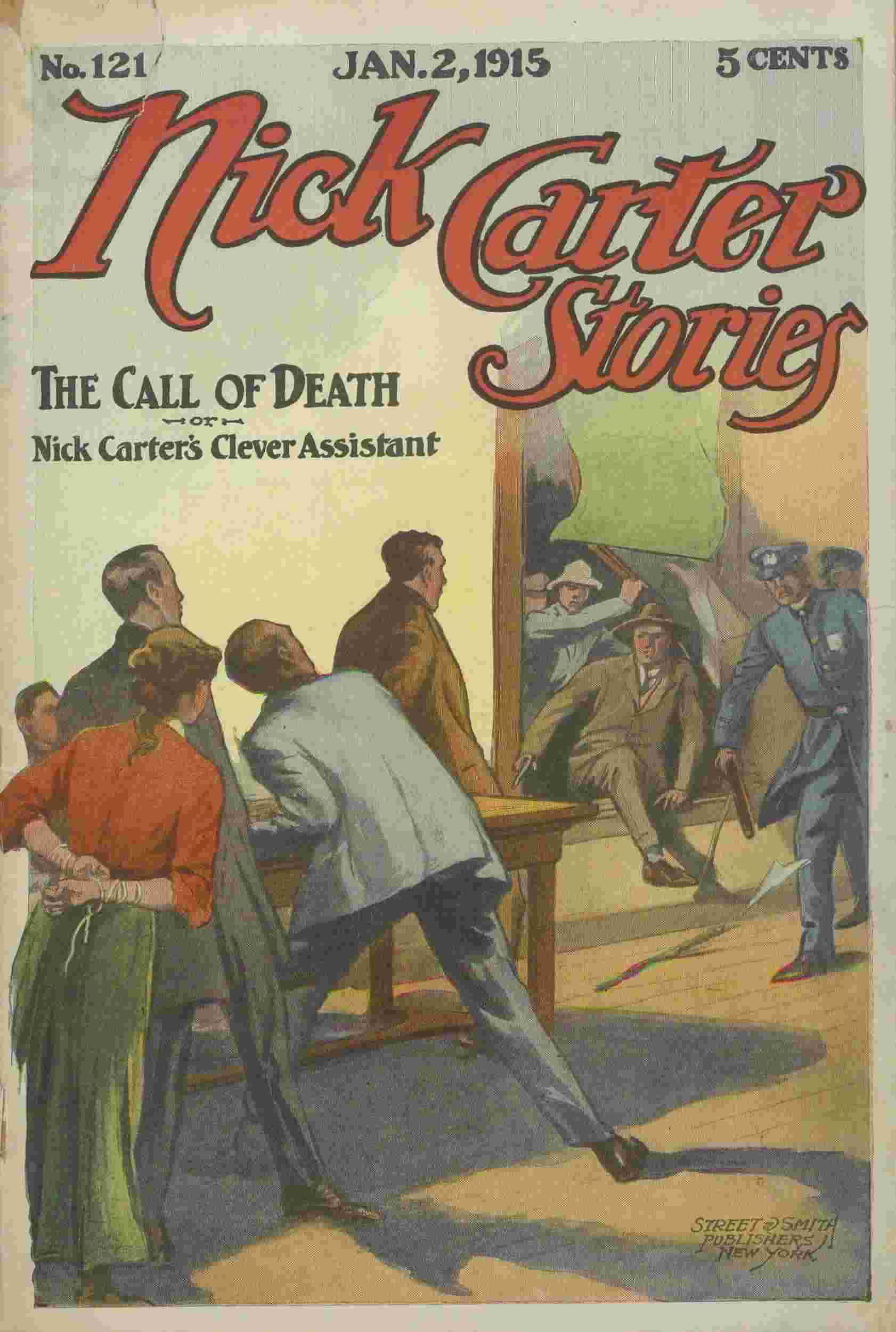
“See here, Gridley,” she added, with a sudden display of deeper feeling. “I’ve been a bad egg most of my life. It come to me natural, and my old man forced me into it. He’s dead now, and I stood by alone and saw the last breath go out of him. I’d never seen the like before. I’d never been where one sees the call of death—the call of death! It told me something I never knew [Pg 39]before—but no matter what! You wouldn’t know, if I told you—and I couldn’t tell you if I tried.”
“See here——”
“You see here!” Nancy forcibly interrupted. “I’m going to have my say, and it won’t take me long. I’m done with the life I’ve led, and done with you fellows. That plunder is going back to the bank. That’s what I’m going to do for a starter on the new road. I knew you guys would watch me. I reckoned I’d better not take this gent to the place where the stuff is hid, not till I was dead sure you weren’t trailing me. So I took him to a fake place first, just to find out, and you and your push were on hand to nail us. You’ve got us, all right; but you’ll not get the coin. I fooled you—and I’ll keep you fooled. You’ll get nothing from me.”
She had told the whole story in those few passionate words, a story that might have filled a volume, and the look on Gridley’s face was one to have appalled a less fearless speaker. He turned quickly to his confederates and fiercely cried:
“We’ll see about that, pals! We’ll find out whether she’ll speak. Pull the boots off of this gospel sharp and shove his feet into the fire. She brought him into this mess. Let’s see whether she’ll pull him out of it. She can do it only by squealing. If not, we’ll burn his feet off, and——”
“Say!” cried Patsy. “Cut that, you fellows.”
“Cut nothing! You dry up, or we’ll cut out the tongue you talk with.”
Nancy Nordeck had turned as white as a sheet.
“Keep quiet, my girl, and be brave,” said Maybrick, observing her. “Reveal nothing—no matter what these scoundrels do. That is your new duty.”
“I’ll stick, sir, if you say it,” said Nancy, but she was trembling from head to foot.
“Oh, you will, eh?” thundered Gridley. “We’ll see whether you will. Grab the gospel sharp, two of you, and——”
But there was no grabbing done of that nature.
Gridley’s furious commands were drowned by the crash of a falling door, the rending of blinds and the breaking of shuttered windows, at which the heads of policemen and leveled revolvers instantly appeared.
Patsy Garvan guessed the truth, and a yell broke from him.
“Hurrah! Zambo! It’s all off! The chief is here!”
Patsy was right. While the words were still on his lips, Nick, Chick, and Danny tore through the hall and rushed into the room, with weapons drawn and blood in their eyes.
Gridley vented an oath and snatched up one of Patsy’s revolvers, still lying on the table.
A bullet from Nick’s weapon broke the rascal’s wrist. He fell to the floor, howling with pain.
Chick had a gun under Magill’s nose, and Morgan and Phelan had thrown up their hands.
There was very little to it after that, in so far as opposition was concerned. Within five minutes the crooks were in irons, their captives liberated, and Nancy Nordeck relieved of her fears and started, indeed, on the better road.
Through her the entire amount of stolen funds were restored to the bank, or, more properly, through her and the Carters. She never was prosecuted for any of her past misdemeanors. Nick Carter made sure of that—and[Pg 40] equally sure that Gridley and his confederates received the most severe penalty of the law.
Nick’s deductions had been entirely correct, after the disclosures Chick had made, and the remarkable message from Patsy had showed them the way. Nick was right, too, in thinking that Kate Crandall, though informed of the facts, had suppressed them only with a feeling of jealous hatred and revenge for Maybrick and Harriet Farley, whose relief and gratitude over the happy turn of affairs scarce need be mentioned.
THE END.
Kate Crandall very soon disappeared from her customary haunts—but Nick Carter had not seen the last of her, as you will find by reading the story in the next issue of this weekly, No. 122, out January 9th. The story is entitled “The Suicide; or, Nick Carter and the Lost Hand.”