
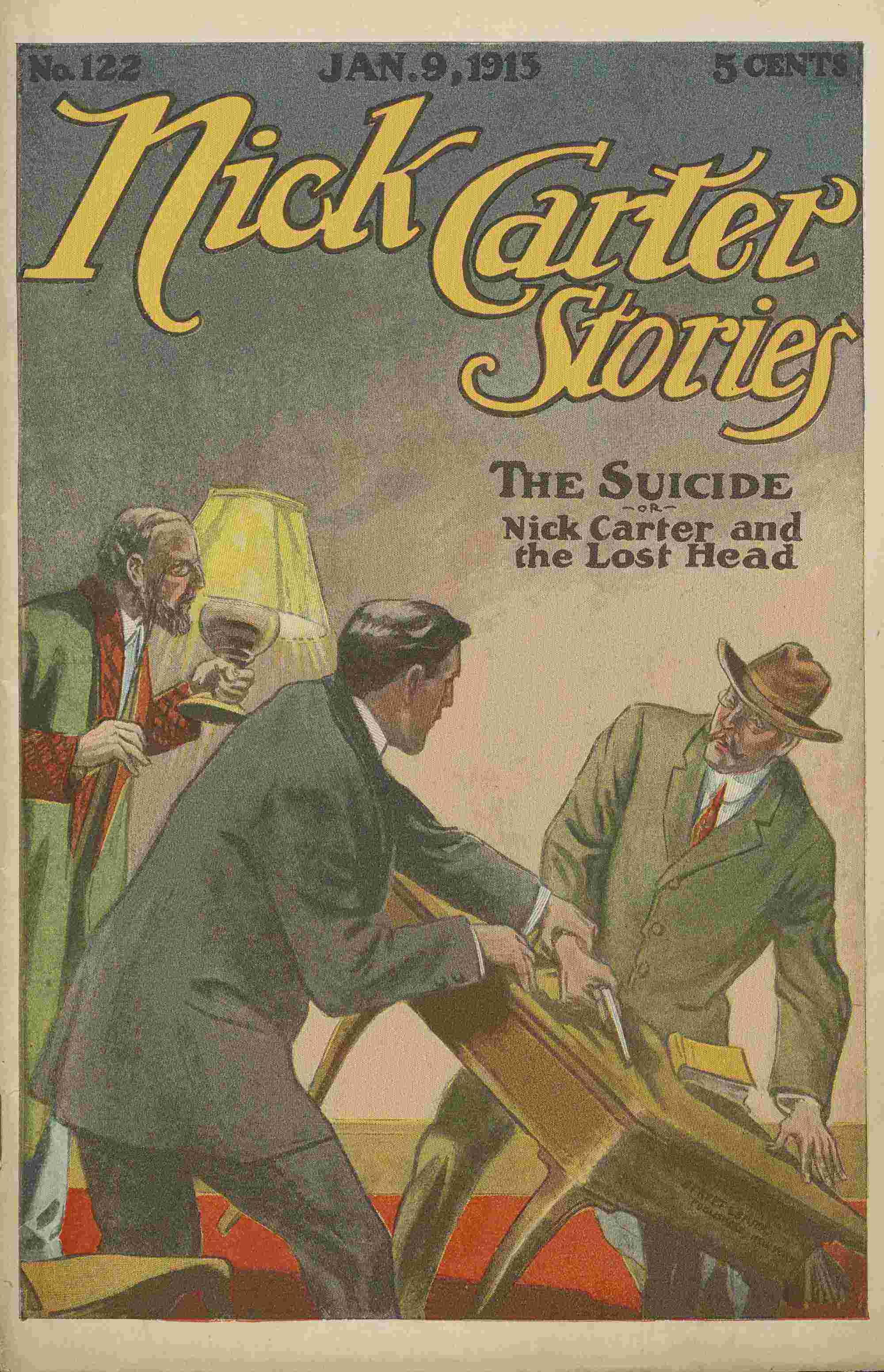
(This interesting story was commenced in No. 120 of Nick Carter Stories. Back numbers can always be obtained from your news dealer or the publishers.)
CHAPTER VII.
A DASH IN THE DARK.
I enjoyed that ride into the darkness that was, by now, fast settling over Casco Bay; at least, I relished the first part of it. And it was in momentary forgetfulness of my dislike of my companion that I said cheerfully:
“Somethin’ like, eh?”
“Uh!” grunted Pawlinson; and I resolved to make no further overtures.
Some more minutes elapsed in this dark dash—straight away we were making it, and we flew no lights. Then Pawlinson swirled us to a tangent.
“You’re not going past Orr’s Island, then?” I cried; but I might have saved my breath for all the attention he paid me.
Perhaps three more minutes it was that we ran thus. Then he whirled on me with a short:
“Off!” I was bewildered, for speed had certainly been the desideratum up to now.
“Off, I said!” he ripped out vexedly. “I’m giving orders here, remember.”
I threw out the switch, and we slumped down to wabbling in the light sea that was running.
Even in the gloom I could see his features working. Then I followed his gaze out over the water toward where Peak’s Island showed darker against the night sky.
And more showed in that direction than that; for two trim masts were swaying slightly against the starred background.
“The schooner!” said I.
“Right—for once.” Pawlinson came out of his silence. “And now maybe you can see why I didn’t run right past the island, eh?”
“But surely speed boats are plentiful enough nowadays,[Pg 40]” I answered. “There couldn’t have been much to arouse suspicion, even if we had shot directly alongside. The lad said it was shortest.”
“It’s easy to see you don’t know Carl Stroth. Look!”
The steady, bright-eyed glare of a powerful searchlight ate into the night. It came from the schooner’s fore crosstrees.
“Get it through your noddle at last?”
“Yes,” said I humbly enough.
For some minutes the searchlight played over the waters; but it was noticeable that it confined its attentions to a small arc; and that arc, fortunately or unfortunately, did not include that portion of the bay where lay our inert, low-lying craft.
But its radiance suddenly found and rested upon something well ahead of us—a something that made both Pawlinson and myself let out an oath.
“The police launch!”
“But it’s headed back to town from Trawly’s Rock!” I cried.
“Well, and why not?” he snapped. “Even a policeman can sometimes fall to the fact that there’s such a thing in this world as a bunk.”
“You think, then,” said I, “that they have found out the wire was bogus?”
“I think that when they got out to that desolate chunk of rock and didn’t find me there, that possibly something like that did enter their heads.”
“But——”
“But Stroth is right this minute chuckling happily; for, by the time that launch gets back to headquarters for new orders, he’ll be hull down, seaward.”
“But he’s waiting for that gasoline.”
“Oh, he is, is he? Take a squint at the schooner again, and see if he’ll have to wait long.”
Much as I hated the fellow, I couldn’t but admire his perception. I followed his pointing, and discerned that a small lighter had been brought alongside the vessel, and, by the light of the lanterns that had been hung to the rigging at the rail, I could see men transferring barrel after barrel to the schooner’s hold.
“The gasoline!” I cried.
“Probably,” came the reply.
“Then Hallins’ man who got aboard to-day was wrong as to the time they could get it?”
“I have known mistakes, such slight ones, to be made before,” snarled Pawlinson.
“But we can beat ’em to it yet,” I said, with enthusiasm.
“How? What are you driving at?”
“There’s a good twenty-five-mile-an-hour gait bottled up in this little tube,” I explained. “And here we are in a triangle. The police launch is headed cityward, but ahead of us, eh?”
“Right enough.”
“Then out there lies the schooner at another corner of the triangle, and to our port side.”
“Right again.” Pawlinson’s sarcasm was, for the moment, absent.
“I take it you are planning force from the first. You asked as to my gun, you know.”
“Yes, yes. Go ahead, man!”
“Then,” I cried, “what’s the matter with us uncorking every bit of ginger there is in this hydro—shoot[Pg 41] past the schooner—overtake the patrol launch—give ’em the news, and——”
“You think we could make it before Stroth’d get wise? He’s got a good engine himself, remember; and, should he tumble, he’d have a head start on the launch.”
“But, being auxiliary,” I interrupted, frantic for action, “he is bound to be as much slower than the police boat than it is to our hydro. Besides, he’s not to up-anchor or cut. It’ll work!” I cried enthusiastically as I fished in my pocket for my jackknife and turned back quickly toward the taffrail.
“Here, what’re you up to?” snapped Pawlinson.
“Why, we’ve got to cast that blamed punt adrift now,” I answered sharply. “We’ve got to be clear of everything.”
Ice came into the voice that met my warmth.
“Start the engine. We’ll keep the punt.”
“But, man——”
“Start the engine.”
There was that in Pawlinson I’ve met in few men; for I had that machine barking the next instant—and I’m not an oversweet-tempered individual myself, as I have intimated.
I threw in the clutch, and we fairly jumped out of the water when she began to “plane.”
There was no shunning the island now on Pawlinson’s part.
Instead, he headed almost directly for it—a course that was calculated to bring us within a furlong of the anchored schooner on our way to intercept the patrol launch, which was pointed, as near as we could judge, directly cityward.
The exact angle was a thing of estimation to a nicety; but, with the speed we were soon attaining, it certainly looked as if it would work.
The wind had fallen flat, as it often does between the day and night breezes, and this helped. So we cut a swath of boiling spume over an unrippled mirror which heaved only to a slight swell.
“Now, man”—Pawlinson let me into his thoughts—“once clear of the schooner’s stern, and we’ve got ’em; no matter which way the cat jumps.”
“Yes,” I agreed enthusiastically. “By that time they wouldn’t have a chance to clear before we’d have the patrol launch veered for her.”
“And now for it!” His tone was calm and collected enough; but I read tenseness in it, nevertheless.
As for myself, I was fairly rigid with the moment, for it was the crucial one. We were about to pass the schooner.
Then came the sickening disgust.
Out from the fore crosstrees blazed the white glare of the searchlight again.
This time we were in for it. The rattling exhaust of our engine had told its story; or, at least, it had told enough to excite sufficient curiosity for a look at us.
The light oscillated once or twice in search; then it steadied, and our eyes blinked in its glare. Everything about us sprang into daylight, and the brass cylinder heads before me fairly glittered.
I imagined I could hear the wielder of the light chuckle at his find; but I didn’t have to imagine the imprecation that Pawlinson hissed venomously. I have seldom heard such fervor; but I seconded it heartily.[Pg 42]
“All up!” I groaned; for it took no clairvoyant to fathom that the alarm had been sounded.
Even above the sound of our engine we heard a sharp command given, and the lines were cast from the lighter alongside. Then came some quick blows on metal.
“Make that out?” queried Pawlinson shortly.
“Cutting the cable,” I muttered. “They know the game. Her engine’s going already. Where’s the police boat?”
“The fools in her smell something up; but, being fools, they’ve stopped to see what it is.”
Sure enough, off there about a quarter mile, the lights of the patrol stood fixed, showing that either her engine had been shut off or was running free from load.
“At any rate,” I growled, “she’s too far off to help, anyway. That schooner’s certainly fast under power. Once started, she’s a good match for the launch, and besides——”
“Stop the engine!”
I whirled in amazement at the deadly animosity that came into Pawlinson’s voice; and the searchlight—which had kept us steadily in its radiance—showed a countenance an equal match to the tone. Then a smile came over his face as he corrected:
“Throw her into the neutral!”
I did so, and our screw stopped.
“Now, haul up that punt’s painter and get into the tub.”
“Get into the punt?” I cried, mystified.
“Into the punt, I said, didn’t I?” shrilled the man with me. I can scarcely call him Pawlinson. I have never seen rage mount much higher as he busied himself setting the steering wheel to a certain spoke. The gear was a good one, and would hold to any setting of rudder.
“But why?” I ventured further; then regretted the words, and forthwith did as he had ordered.
I brought the punt alongside, sprang into it, and stood steadying, awaiting what would come next.
But I snatched a second for a peek over my shoulder.
The schooner was almost upon us by now; for, of course, she was headed for the nearest way out of the bay; and that way happened to be our way.
But I was brought sharply back to Pawlinson.
“And now,” said he, “I think we’ve got something that’ll work.”
As he said this, he, too, clambered from the speed boat into the punt along with me.
Now, mind you, the engine was still running in the neutral.
“Reach over there!” he ordered. “Full speed ahead! You can reach the lever from where you stand. You know best how to do it. You start her, and the rudder’ll do the rest.”
Then it was, on that very instant, that there flashed over me a light of understanding as brilliant as the calcium that still played about us.
“You don’t mean it, man?” I cried; for I remembered now the strong metal stringers of the hydroplane’s structure; the weight of her engine; the impact that it meant at a twenty-five-mile-an-hour clip. The boat lay low in the water; and the hole she’d make in that yacht-planked schooner would be well along, and even below the water line.
“I do mean it!” he yelled. “And now’s the time! About amidships she’ll catch it, I think. We’ll watch it from the punt.[Pg 43]”
I felt myself boil as would any civilized man.
“And I think not!” The words sounded as from some other throat than my own. “Sink that schooner with all the men in her, and——”
“And what?” I could feel his breath hot with wrath as he brought his face pugnaciously close to mine.
“The girl!” I cried.
“What do you know about her?”
“Enough to know that I’ll not——”
I don’t remember the end of that sentence; for he suddenly whirled his broad back upon me, and, fending my interference off thus, reached over into the speed boat’s cockpit and threw back the starting lever.
But the steering wheel was aft, a side steerer attached to the coaming—the port coaming at that, and right to my hand.
I grabbed that wheel, and flung it around desperately, in the second I had before the hydroplane shot from us.
She didn’t veer far from her course of intended destruction; but it was enough, and I had the inner glow of satisfaction for the one instant that was allowed me before I met him as he turned and gripped me in deadly embrace.
In an iron clutch I felt myself borne bodily aloft. I struck the water breathless, and I cannot swim.
CHAPTER VIII.
IN STRANGE QUARTERS.
I have my own theory as to just what becomes of us when we—the real, thinking we, that is—enter that somewhat uncanny realm which men have agreed to let ignorance call unconsciousness. But this is neither the time nor place to air it.
Sufficient to state, now, that from the moment I felt the chill of the waters of the bay, and strangled in its brine, I knew nothing of what we name actuality until I was sensible of an easy, steady sway of body as I was rocked cradlewise.
A distinctly delicious semiconsciousness made me forget a decided stiffness and cramp of muscle, and it was with reluctance that I opened a tentative eye.
I am not ordinarily one of those who jump up immediately upon wakening, anyway.
And slowly it was that the nature of my surroundings came to me.
A faint swish directly beside the bunk whereon I found I was lying proved to come from a hung-up suit of Cape Ann oilskins; and a further exploring peek beyond revealed several rows of bunks like my own.
A ladder of steep incline, topped by a hatch; a semicircle of seat lockers; tar in the air, and a faint reek of bilge—the combination ended all conjecture.
A hearty chuckle from directly alongside my head made me up-on-elbow for a nearer scan of the chuckler.
I have never seen a bundle of more jovial rotundity, or a larger. A perfect giant of a man he was, with good nature popping from him. And a sailor he was to the gnarled crooks of his “fishhook” fingers, which at this moment were ramming home a husky charge of palm-rolled cut plug into a broken-stemmed “ha’penny clay.”
“Ho, ho!” he burbled when he saw that I had caught sight of him. “An’ where away now, m’ bucko?”
I passed a hand over my features, and my question was trite enough:[Pg 44]
“Where am I?”
Again merriment rippled in folds up and down him as he replied:
“On board the Ruby Light, m’ lad, and a better vessel’s keel was never laid!”
“Ruby Light?” I echoed hesitatingly, for a bit of mistiness still held me. “Why, I thought—that is——”
“That is,” he rumbled gleefully, “this here’s about the last place you expected ter come ter life in. An’ mebbe it are jest about the last place you’d ’a’ picked out. He, he! Shouldn’t wonder, m’ lad, shouldn’t wonder!” And he drifted off into a falsetto titter.
But there certainly was no malice in his merriment; it seemed rather to make me a comrade.
“But how in thunder did I get here?” My voice was putting on more heartiness. “And who——”
“Hold on, now Billy-boy! One at a time, and slow,” he chided. “As to the how and the who, why—I m’self was the who; an’ a good long boat hook was the how. Managed ter ketch under the belt as you slid by our quarter during said episode last night. An’, by time, boy, you were heavier’n you look, shore!”
“But what I should like to know is, why——”
“An’ that thar’s just what I’m going ter pass up ter sooperiors. Orders is orders, y’ know, matie; an’ I shore am some strong when it comes to ’em. But I tell you what I can do an’ it ought’r sound like screeching good news; I can tumble a cup o’ b’iling hot coffee into you. Eh, what? A mug along ’ith some salt horse?”
“Sounds good to me!” I strove to echo his strain, as I threw my legs over the side of the bunk. “But how about my clothes?” For the first time I realized that I was wearing nothing but a coarse, sailor’s blue flannel shirt.
“Right t’ hand, an’ bone dry!” he chortled, as he edged his huge bulk through a narrow opening, beyond which I caught the glow of a small “shipmate” range.
Next instant he reappeared with my clothes over his arm.
“Did m’ best, laddie, ter get ’em into some sort o’ shape. Kind o’ draggled they was, as is natural. An’ the shoes are durned stiff, believe me. But they’ll come around——”
“Well, I should say!” said I, delighted to get into my own togs, “and I don’t see how you managed to get ’em as good as you did.”
The old fellow had actually made a pretense of pressing the trousers, though truth compels me to say that he had run the seams decidedly awry.
I was surprised to see how weak I was, for, even though there was scarcely any sea running, I lurched abominably as I put on my trousers.
“Coffee’s in order!” he announced, and once more sought the range.
Two minutes after I had drained that mug and chewed off some chunks of “junk,” and I was still doing business at the old stand.
“And now,” said I, “next?”
“Well,” came the hearty response, “seein’s I’m the doctor, why, I jest says the deck for yourn. Besides, them’s the orders.”
Before I mounted the ladder I stood before the old fellow, and put out my hand.
“My name’s Tom Grey,” said I, “and somehow I’m not much when it comes to thanks; but[Pg 45]——”
“Aw, shucks!” he roared back at me, as he fairly enveloped my hand with his big paw. “Nawthin’ ’tall! Kind o’ fun, ’twas, fishin’ you out thataway! Besides, I warn’t doing nothin’ but obeyin’ orders; an’ as mebbe I’ve before let out, I’m quite some when it comes t’ orders. Yep! Why, any o’ the lads on deck’ll second the motion that old Steve, bos’n o’ this here Ruby Light, jest eats ’em—orders, that is. Now, tumble out and mind your eye, matie. Me fer a cat nap.”
Whereupon he rolled into the bunk I had quitted.
CHAPTER IX.
A PLEASURE TRIP.
It was fully fifteen minutes after I gained the deck before the slightest attention was paid to my appearance, and this period I made full use of in close scrutiny of my surroundings.
Never, even aboard a man-of-war, have I seen such decks. Holystoned they were, every inch of them, and at that very instant four fellows were scouring away for dear life.
And that immaculateness was everywhere apparent. I could see well enough why it was that I had awakened alone in the forecastle with only old Steve to watch over me.
Brass shone to brisk burnishing; mahogany glowed to the chamois; every man jack of ’em was furbishing, except the helmsman.
And the craft was well worth such grooming. Even in the anxiety that, of necessity, was mine at the moment, I glowed over such fitness; everything O. K. to the dot. Bowsprit to taffrail I scanned her, and didn’t find an “out.” Her forestay she carried pretty well inboard, for the ’sprit was short, according to the modern custom.
The masts, clear Oregon pine, raked a trifle, giving a dash that was a bit reminiscent of the old America. It may not make for speed, but I never saw a real sailor that didn’t favor it.
Guessing the direction by the sun, I reckoned our course to be somewhat east of south, and the freshening west wind bellied the creamy canvas into unwrinkled corpulence. Besides her lower standing, she was carrying ballooner and club topsail.
But no foretopsail met my upward search, and it didn’t take long to see why. Between her masts stretched wireless rigging.
Now, all this time of my survey of the schooner, not one of the full score of sailors that were working all about me, as I paced the forward deck, gave me a word. But I judged, from an occasional furtive glance or two I caught, that I was nothing if not interesting.
I suppose, though, as old Steve had intimated, “orders were orders.” But that kind of thing gets on a man’s nerves as only such inactive suspense can, and I was upon the very point of striding aft to stir up something when I spied some gilt emerging from the companionway.
The little captain gave a word to the man at the wheel, then whirled and faced forward.
“Stevens once more!” said I to myself, though I was not oversurprised at the recognition.
His grin when he caught sight of me was all the satisfaction I got before he popped immediately back down[Pg 46] the companionway. But I didn’t have long to wait for further developments, for I don’t believe it was a full minute before a little Jap glided up the steps, and came directly toward me.
“You come follow me,” said the flunky abruptly, as he whirled a most ridiculous rightabout. But naturally I was in no mood to read humor in things, so I followed meekly enough.
The Jap led down the steps, and across a saloon; then he tapped almost reverently at a door that gave off from a passageway beyond.
To a sharp summons to enter, he opened the door, and stood aside for me to pass him, which I did. Then the door closed behind me, and I faced the strangest stateroom I ever saw.
But it was not the room itself, remarkable as it was, that focused the entire attention, for a man in a broad-backed chair, busied at something on the table before him, sat facing me.
The whole breadth of the room was between us, but I could feel every nerve of my ill-controlled features pass under the appraising scrutiny of that pair of half-closed gray eyes that drilled at me as he glanced up from what had been engrossing his attention.
It will be remembered that on the two occasions I had seen this man, Carl Stroth, I had not got a fair and square look at him. Back there on the launch at Port Washington he had stood steadily at the wheel, peering ahead, while I, of necessity, was busied with the engine.
And that other time when, as the accommodating “deck hand,” he had made a fool of me, his disguise had been of the cleverest.
But now I had ample opportunity for a searching survey of the man, for he let a minute pass in silence. And I availed myself of this opportunity to the full; though now, as I attempted to word the impression his face made upon me, I am forced lamely to state that its strongest characteristic lay in its very indefinableness; a sort of haunting fitting of something I decidedly didn’t like across features which seemed more naturally to fit themselves into something I instinctively did like.
Even seated as he was, there came to his shoulders suddenly that forward hunch which I had before noted, and which now I could see was accompanied by a forward craning of the neck in riveting his eyes upon me. Vulturelike it was, and more.
And then, as suddenly, the posture shifted to ease as he said quietly:
“None the worse for the episode, Mr. Grey?”
It was not so much surprise at his knowing my name—which I knew his methods well enough by now to see would be easy—as it was the lightness and even friendliness of the tone; a friendliness which consorted ill with the stare he had favored me with the moment before. But I strove to match it as I replied:
“It was more for adventure than money that I entered the detective service, Mr. Stroth.”
I know now that nothing I could have said would have had more effect upon him, or quicker.
“Ah!” he cried delightedly, as he sprang to his feet, shoved back his chair, and strode toward me. “Good! There we have it—adventure—spice—zest! The only thing worth while, isn’t it?”
It certainly was an unexpected way to open conver[Pg 47]sation, under the circumstances; and, next second, he seemed to realize it, for his tone altered to one of less enthusiasm:
“But first it’s probably best for us to understand each other.”
He nodded for me to be seated, and resumed his own chair.
“Mr. Grey,” said he, “who is, or was, your employer in this case?”
My smile was almost a wince at his shift of tense to the past; then I replied evasively:
“This case?”
“Come, now, man,” he retorted sharply, and I regretted my attempt at fencing; “you look like more sense. And I believe, if you’ll remember our several positions at the present minute, that probably out-and-out frankness will strike you as the best policy. It is natural that I am puzzled about you at some points in reviewing the events of the past two days, and I see no better or quicker method of clearing the air than direct question and answer. So now, what say you? Of course, I can handle my own end in either course you choose to pursue, though personally I prefer candor.”
He was right; the upper hand was his, and it didn’t take me many seconds to reconcile my conscience to my superior’s, by saying:
“Let it be the truth, then, Mr. Stroth. And I certainly hope that something’ll come out that will make things a bit clearer to me. The Lord knows I’m in the dark deep enough myself. I’m ready.”
“First, then,” said he, as he handed me over a humidor of dusky-hued panetelas—though I noticed he didn’t take one himself—“perhaps it would be best for me to state my difficulties, eh?”
“As you will, sir,” I agreed, lighting the welcome cigar, which I really stood in need of.
“Here we have it, then,” he continued. “First I see you on the dock at Port Washington, and it’s the first time I ever saw you in my life, I believe.”
“Exactly,” I broke in, “and I believe I was at that time instrumental—was of some service?”
“Wait! That’s just the point. You were of service, immense service, I admit. I never would have thought that Pawlinson would have the nerve to risk fooling Stevens into hiring him for engineer of my own launch. And it might very well have succeeded but for you, as you say.”
“But then?”
“But next I stumble on you at the Portland wharf. Apparently your rôle had, by that time, decidedly shifted. Stevens, who came from Stamford, where he left the launch, even tells me that both you and Pawlinson traveled in the same sleeping coach with him to Boston.”
“I didn’t know it at the time,” I said, but he paid no attention to the interruption as he concluded:
“And now, last night, came the final mystery, for my searchlight revealed both you and Pawlinson at fisticuff loggerheads in a wabbly punt, with a speed-boat accompaniment. As to your place in this little series of events, I confess myself completely mystified; and so it is that I ask you—who was your employer in this thing, and where do you stand, anyway?”
I saw no way to answer except in the strictest truth, and I couldn’t see, for the life of me, how it could hurt matters at all then, for I certainly was completely in his[Pg 48] power any time he should choose to apply the thumbscrews.
“I am one of Chief Garth’s men,” said I. “You know him?”
“Old Garth, of the United?” he chuckled. “I should say I did. Yes?”
“Now, it was mere coincidence that made me figure back there at Port Washington. I didn’t even know Pawlinson then.”
“I have had enough whirls with coincidence to credit improbability on that score. Well?”
He was attention itself, and, had I resolved upon a lie, I might well have feared the brain behind those eyes. But truth is deliciously easy. So I continued quietly:
“So when I returned to Chief Garth’s house that night I found that Pawlinson had asked him for a man upon a difficult case, and that——”
“Yes, yes. I’ve got you. The same case. Coincidence again, and, as I say, I believe you. You left Portland with what plan?”
“Simply to spot you,” I replied. “You see, I read the steamer’s name on the stern out there in the Sound when you boarded her. I knew her port, for I have sailed on her myself.”
There was a short interval of silence, during which he fitted things together. Then he came out with:
“So Pawlinson followed you to Portland, made his authority known to you, and you worked together after your meeting there?”
“Exactly!”
“But come, finish it! What was the meaning of that disagreement between you alongside the hydroplane?”
“You didn’t catch the motive, then?” I queried.
“Not at all. I was called to the deck only in time to see him lift you clear of the punt, and hurl you overboard. And,” he added, with a smile, “old Steve’s boat hook did the rest.”
“So you haven’t yet tumbled to the reason for quitting the speed boat?”
“No; though I did understand that there wasn’t time for you to connect with the police launch.”
“Well,” said I, “granting a fiend’s viewpoint, the plan was not so bad, for it certainly would have stopped you. That craft was built stancher than most hydroplanes, and carried a terrible way on her. She’d have made a nasty-enough hole——”
“What!” He sprang erect in the sudden mount of fury at the full realization. “Do you mean to tell me that the scoundrel actually meditated——”
“Not only meditated,” I interrupted coolly. “He’d already ordered me into the punt, and set the rudder before I myself could——”
His tone lowered as he broke in on my explanation:
“So that was the reason for the fight?”
“Naturally,” I replied. “Much as my ways lie in dark places, I am not taken with such methods; where women are concerned especially.”
“Then you knew that my daughter was aboard with me?”
“I didn’t know till this minute that the young lady was your daughter,” said I. “But the inference that she was on the vessel was natural enough after I had chased you pretty well over Portland.”
Stroth made no direct reply to this. He seemed rather to be settling some course. Then he shot out abruptly:[Pg 49]
“What did Pawlinson tell you he was after my scalp for? Did he let you that far into his confidence?”
Now, it’s no easy matter to tell a man of Stroth’s type that he’s a thief, and in spite of me I couldn’t word Pawlinson’s revelations into much softer phrase.
He noted my hesitation, but didn’t spare me a whit.
“Come, Grey, out with it exactly! I want it all—and unvarnished!”
“Well,” said I, bracing my voice with a swallow, “those affairs at certain country places along Long Island Sound have long been puzzling us, and——”
I might have spared myself my hesitation, for he didn’t so much as turn a hair.
“Oh, so that was all, eh? Then he said nothing about——” He checked the sentence to another question: “What do you know about Pawlinson, anyway?”
“Precious little,” I answered him, and I let my manner tell as much as it could of my contempt for the fellow. “In fact, I never heard of him till he came into prominence about three years ago at Washington. And that’s about all any one in the service knows. He’s understood to be something of a mystery.”
Stroth grunted.
“I don’t doubt it—I don’t doubt it,” said he, as to himself.
Then came another slight interval of silence, during which I puffed away contentedly at the panetela, for I felt no presentiment of coming trouble. In fact, I was beginning rather to enjoy the situation.
I knew men well enough to read in Stroth that he had not lost sight of the saving part I had played the night before; though, as I sat there looking at him, I confessed to myself he was a puzzle in some way—distinctly a puzzle.
He came out of his momentary abstraction with a shout of enthusiasm that was positively boyish:
“Then it’s to be a little pleasure trip, after all! Good enough, Grey! And I believe you’ll find that——”
Here I was fool enough to enter a wedge of curiosity.
“Then all that dope about this being the schooner that has been working the Sound is absolute bunkum, Mr. Stroth?”
It was as if I had touched a match to bomb.
His brow darkened, and he bit out:
“I believe I’m doing pretty well by you! But, of course, you have your choice—that is—pleasure trip—or otherwise. Understand me? Otherwise.”
I hastened to shift.
“Nothing I like better than a sailing voyage, Mr. Stroth,” and I let him know by my laugh that I realized he had me.
“I didn’t think you were a fool,” he replied, in lighter vein. “So here we have it, then, and it’s the last word I want spoken on the subject. We’re bound for Savannah, Georgia. Simple enough, eh? Till then you’re my guest, we’ll say. And, after we reach port, I’ll have your word that you let three days go before you get the wires hot to headquarters. Now, take the proposition or leave it!”
“I understand at last, Mr. Stroth,” said I slowly, “and my worst enemy can’t say I’m not a man of my word.”
As suddenly as he had left it he whirled back to boyishness.
“Fine—fine!” And he actually slapped me heartily on the shoulder. “By the way, what time is it?”
As if in answer, seven bells rang out.[Pg 50]
“Good enough! There’s plenty of time to show you something before dinner. And if you’re interested in that sort of thing we’ll certainly have an enjoyable trip!”
Well, here, indeed, was a man of moods.
TO BE CONTINUED.
THE MYSTERIOUS RIDER.
By E. K. NOSTWELL.
My shanty was situated in the Bighorn Mountains, Wyoming. With the exception of two companions and some friendly trappers, who lived about five miles distant, I had not seen a white man for nearly a year.
One day I was out hunting with Anderson Picket. We had just sighted an antelope, and were occupied in stalking the animal, when we suddenly heard the neighing of a horse near us. Surprised at such an unusual sound in a neighborhood where very few human beings were to be encountered, we looked up and saw, hardly three hundred paces from us, a rider whose head was uncovered and his long hair floating in the wind that blew across the hills. He was a white-faced, haggard man, mounted on a thin horse.
For a few seconds he remained motionless, and then disappeared as suddenly as he had come.
“A highwayman,” whispered Picket.
“What should a marauder be doing here?” I replied doubtfully, “for a distance of three or four hundred miles no one, with the exception of you, myself, and the trappers upon the creek, can be found. Not a single soul to hold up. Let us see who the fellow is.”
Quickly mounting our horses and dropping our game for the time being, we galloped up the hill, following the stranger, who was slowly riding toward the north.
“That animal hasn’t had much fodder or rest lately,” laughed my companion. “I’ll wager he hasn’t ten pounds of flesh on his bones.”
“I’d like to know who the man is, and what he is doing alone in these solitary hills,” said I inquisitively. “Come, get a gait on the horse; let’s get our game, and follow the fellow.”
After acting upon the suggestion, we returned to our pursuit, and were hardly a hundred paces behind, when I shouted:
“Hello, my man! Where are you bound for?”
The horse turned its head toward us, but the rider did not move, and immediately started off at a breakneck gallop.
Although we were well mounted, and endeavored to follow him, he soon disappeared in a path thickly overgrown with brushwood. We consequently lost scent of the fugitive, and my companion very sensibly observed that we had better not follow him, as he might easily blow out our brains, under shelter of the rocks or hidden behind the brushwood, before we were aware of his presence.
We therefore retraced our steps toward our cabin, which we reached an hour later.
My second companion, who, in consequence of a slight wound, had remained at home, came toward us in great excitement.
“I’m glad you’re back, boys!” he cried.
“Heavens, man! what has happened?” I asked anxiously.[Pg 51]
He was as white as a corpse, and sighed as if relieved when we reached him.
“It was awful, I tell you, awful. In all my life I shall never forget what has happened to me.”
“Come along; stop your quaking, and tell us what’s wrong. Seen any suckers or a ghost?” said I smilingly, while Anderson asked impatiently:
“You’ve had a visit, haven’t you? A highwayman on an old gray nag——”
“How do you know that?” stammered Jim, quickly interrupting him. “Some one was here, but it wasn’t a road man, it was a ghost.”
While he said this, he shivered from head to foot, and looked around anxiously on all sides.
“Don’t be a fool,” I laughed. “Tell us a straight story. What has happened to you?”
“Meanwhile we had reached the cabin, and, as I sprang from the saddle, Jim pointed, with trembling hand, to the ground.”
“Here, look at this; you can see the prints of the ghostly horse’s hoofs,” said he, in a voice full of excitement. “I was cleaning up things in the cabin, when I suddenly heard a noise outside. I thought you fellows had returned, and went out-o’-doors to meet you. Horrified, I sprang back; before me, on a horse, nothing but skin and bones, was a man without a hat, with long black hair. He sat bolt upright in the saddle; he had a thick black beard; his face was ashen gray, and two eyes, wide open, stared at me in a ghastly way as only a specter’s can. I wanted to cry out, but my tongue seemed glued to my mouth—I felt my hair standing on end. Then the ghost turned his horse—started off at a gallop—I could plainly hear the rattling of the rider’s and the horse’s bones.”
Jim shuddered again at the remembrance of the horrifying spectacle.
“That was the same fellow that we followed,” cried Anderson; and I could only agree with him.
We then told Jim of our adventure, and quieted him by reasoning that it could not have been a ghost, but simply a human being, possibly some lunatic.
It was my custom before going to bed, to look after the horses. I left the hut that evening as usual, but hardly had I taken a few steps when suddenly I stopped as though my feet were rooted to the ground.
Directly in front of me, in the bright moonlight, stood the same ghastly rider. His long black hair hung loosely round a ghastly face. The eyes were sunk deep in their sockets. The mouth was wide open, and the glimmer of the white teeth could be seen behind the black beard; in his left hand he held the reins, while the right hung limply by his side. He sat in the saddle as though hewn out of stone, without the slightest motion.
I had the same feeling as Jim. I wanted to cry out, but could not; only a hoarse whisper came from my throat, but instinctively my hand sought the revolver at my side. I slowly raised my six-shooter, and covered the frightful apparition. Then I found my voice.
“Who are you? Answer, or I’ll shoot!” I said.
At the sound of my voice, the horse, which consisted of nothing but skin and bones, jumped to one side, and both horse and rider went off at a breakneck gallop, the bullets which I sent after them taking no effect. I distinctly heard the peculiar rattle of which Jim had spoken,[Pg 52] and which gradually grew dimmer and dimmer, until nothing could be distinguished but the far-off clatter of horse’s hoofs on the rocky ground.
My heart was beating violently as I reëntered the hut.
Not one of us closed an eye that night. I tossed to and fro, in vain speculating what was to be done if the uncanny thing reappeared. When at last morning dawned, I resolved to ride over to the trappers at the creek and get their advice.
Soon after sunrise I started, and, after two hours’ ride, saw the shanty of my friends some little distance off. They came to meet me with their guns in their hands, ready to shoot.
“Lucky for you that our eyes are accustomed to long range, and that the air is clear to-day, else either you or your horse would have a bullet between his bones now,” said the elder of the two trappers, as I reached them, holding out his hand in friendly greeting.
“That’s so,” acquiesced the other, also shaking hands, but with a very solemn air. “Charlie is right. We were ready to shoot, but luckily saw our mistake in time.”
“Since yesterday we have been on the watch. We’ve been fooled long enough, and mean to make an end to this infernal nonsense,” said the first trapper.
“Has a singular-looking rider also paid you a visit?” I cried eagerly.
The friends looked at each other in astonishment.
“Do you know the beggar?” asked Jack quickly.
“I don’t know him, but it is on his account that I’m here.”
And I related our adventure, to which both listened attentively.
“No doubt it’s the same fellow who got the best of us,” said Charlie; shaking his head. “Day before yesterday we saw him for the first time. He took no notice of us, and seemed to be deaf to our shots. About noon he and his miserable old horse stood there, just opposite our shanty. ‘Hello, what do you want?’ I called out. No answer. A minute afterward he was gone. In the evening he drew rein up there on the hill again. As he wouldn’t answer me, I lost patience, and got out my shooter, but before I could raise it, the fellow again disappeared. But I’m not going to be fooled to-day. I’ll send a bullet through him, or his horse.”
I willingly accepted the trappers’ invitation to stay with them during the day. Our conversation turned almost exclusively on the mysterious stranger. In the afternoon I accompanied them to their traps, and while they were setting them I walked up and down with my gun in my hand. We had resolved as soon as the rider should reappear, to shoot his horse, and in that way get this singular creature into our hands.
The day was drawing to a close, and the peaks of the mountains were dyed in the sunlight.
“The fellow has a notion we’re going for him,” said Jack. “I shouldn’t be sorry if he slipped by us now, for I’m anxious to see what sort of——”
He stopped suddenly, and the words seemed as if frozen to his lips as he stood staring at the rocks opposite the hut. There, on the top of the hills, clearly outlined against the red sky, was the ghostly rider. I also stood staring, spellbound, at the apparition. Then a shot rang out, and the horse fell forward.[Pg 53]
“Come on, and don’t let the fellow crawl from under and get out,” cried Charlie, the smoking gun still in his hand, and pulling the revolvers from our belts we all scurried over the frozen creek that ran in front of the shanty, and up the declivity.
Jack was the first to reach the top. With one bound he stood next to the rider, who lay motionless on the quivering horse, of which he was still astride.
“Hold him!” yelled Charlie, with whom I was close on Jack’s heels.
“It’s not necessary,” said Jack, bewildered, “for you’ve shot the beggar dead.”
“Nonsense,” said Charlie angrily. “I know exactly where my bullet hit. I aimed at the horse’s left eye,” he added. “There it is.”
Meanwhile Jack was examining the rider closely.
“What is this?” he cried, astonished. “The fellow is bound fast to the horse—look here—even with a chain.” Horrified, he sprang back. “Look, the man has a mark around his neck. Great Heaven, he’s been hanging—he’s been lashed to the horse, and the poor beast has been carrying around a lifeless burden.”
Filled with astonishment and horror, we saw that Jack’s suspicions admitted of no doubt. The rope had sunk deep into the man’s muscular throat, and the knot was still attached to it.
Charlie then raised the dead man’s head.
“Why, it’s Black Sam!” he exclaimed. “He was a wild fellow, but he got his deserts. His gun was always ready, and he has sent many a good fellow to pass in his checks. Who knows how long it is that he has been astride this horse? Corpses do not decompose up here in the mountains, but dry up; I’ve often noticed that in dead animals.”
Shuddering, he turned away. The dead man, with his withered face and staring eyes, had a truly horrifying appearance.
“What’ll we do with him?” asked Jack, after a short pause.
Charlie considered a moment, then answered, while he unfastened the bands which tied the dead man to the dead horse:
“Lend a hand here, boys! It’s our duty to give him a Christian burial. Let’s push him in the gully.”
In a few moments the dead man was released; Charlie took him by the shoulders, Jack and I by the legs, and so we carried him to the place indicated, and, by our united efforts, soon had a grave dug, in which he was laid. After this had been filled in, we rolled stones and small rocks over it to prevent the wolves from disturbing the dead.
It was night before we had finished our work. A solemn stillness reigned over all; no sound was to be heard, and, with uncovered heads, we uttered a short prayer.
“God be merciful to this poor sinner,” added Charlie.
Then we silently returned to the hut.
We retired that night earlier than usual, and even in my dreams the ghostly rider appeared to me. I awoke several times bathed in perspiration, disturbed by the loud howls piercing the stillness of the night. Wolves were eagerly fighting over the bones of the dead horse.
Next day I returned home, and related to my astonished friends the end of the mysterious rider.[Pg 54]
THE NEWS OF ALL NATIONS.
Want Shorter Course.
The Cornell faculty has directed the committee on student affairs to give serious consideration to the plan to cut down the length of the varsity race at the Hudson regatta from four to three miles, and has directed that committee to take the matter up with the stewards of the Intercollegiate Rowing Association.
The question of shortening this course was taken up seriously at a recent meeting of the faculty, and a considerable number of the professors expressed themselves as in favor of shortening the course. An agitation by Cornell to this end may be expected during the winter.
Calf With Eight Good Legs.
Wrily Simpson, of Big Laurel, Va., owns a calf which has eight well-developed legs, the extra limbs being just behind the forelegs and just in front of the hind legs. The animal gets about splendidly on its extra walkers.
Exhibits of Ten Nations Arrive for the Fair.
Large consignments of foreign and domestic exhibits are arriving daily for the Panama Exposition, which will be opened promptly February 20, 1915. The latest consignments are:
Japanese shipment of 1,671 cases; 1,568 crates and cases from Canada; 126,000 pounds of exhibits from the Philippines; 110,000 pounds of materials from the Argentine.
Heavy shipments from England, Germany, Australia, New Zealand, China, and Italy are already on the grounds.
Two Prolific Apple Trees.
Frank Weber and John Trent, of Troy, Kan., picked from two trees twenty-seven barrels of apples. They were of the York Imperial variety. Trent’s orchard is considered one of the most productive in that section.
Wireless Tit-for-tat Shots.
Europe’s two principal wireless stations, the Eiffel Tower, at Paris, and the Nauen Tower, between Berlin and Hamburg, have been exchanging conversations.
The Nauen operator, discovering that the Eiffel was able to pick up his war messages ticked an indictment of Eiffel’s news as flimsy and unreliable, to which the Eiffel rushed a long, rhyming retort, jeering the Germany army for its failure to reach Paris, and concluding:
“Despite your fine telegraphic victories, the Germans are slowly plunging into an abyss.”
Oldfield Wins Desert Race.
Barney Oldfield, “master driver of the world,” is the title the automobile speed king now is wearing.
Greeted by 15,000 cheering people, Oldfield drove in his car, a winner of the 671-mile Los Angeles-Phoenix road race.
Although led into the fair grounds seventeen minutes by Nikrent, Oldfield won first place and a cash prize of $2,750 by thirty-six minutes elapsed time. Oldfield’s elapsed time was 22 hours 59 minutes, and his average[Pg 56] was 29.1 miles per hour. Nikrent’s time was 23 hours 35 minutes.
The 134 miles from Prescott, the second-night control, was driven in mud, and the drivers and cars were covered with a coat of clay.
Town Sells Jail at Auction.
Noank, Conn., is getting rid of some of its luxuries. The lockup and contents have been sold at auction and brought $83.12.
The jail building, an unpretentious affair as compared with the Tombs in New York, was knocked down to Squadrito Brothers, of Mystic, for $75, and two other bids took the jail stove and utensils for $6.87. A quilt and mattress fetched $1.25.
Schoolhouse Topples Over.
While the school at Sulphur Point, Fla., was being dismissed for recess, the building, which was built on high blocks, suddenly toppled over and went crashing to the ground, killing a cow that happened to be lying alongside of it. Fortunately none of the inmates were injured. A crowd gathered and succeeded in freeing the carcass of the cow by raising the building back into its place. Studies were resumed after the excitement died down, but some repairs have been made to the schoolhouse.
Old Gravestone is Replaced.
A century-old gravestone, made in 1814 to mark the graves of two victims of an Indian massacre near Alton, Ill., was brought to an Alton stonecutter to be repaired.
The stone, which commemorated the deaths of William and Joel Moore, July 10, 1814, had been split by the weather, and the parts will be cemented together. It was a rough sandstone slab, not smoothed, and the early-day pioneer had carved out an inscription in the sandstone with some crude tool. The letters are still legible.
A granite tablet has been placed on the site where the sandstone slab was found, and the slab has been taken as a relic by Irby Williams.
Prophesied His Long Sleep.
“I feel so tired that I believe I could sleep forever,” remarked C. A. Kinkaid to a hotel clerk at Seattle, Wash., as he obtained his key and repaired to his room.
On the following afternoon Kinkaid was found dead. Death was due to asphyxiation, and evidently was accidental. One of the gas burners was partly open, but the window was up about six inches.
Kinkaid, who was a bridge carpenter, was a well-known member of the Eagles. He is survived by a wife, who left the city a few weeks ago to visit relatives in Lafayette, Ohio.
State Map Made from Seeds.
One of the unique agricultural exhibits that will be displayed at the Pan-American Exposition is a grain map of Kansas, made from twenty-eight varieties of field and garden seeds by J. C. Hastings, of Grantville, Kan. The grains and seeds are glued to a canvas, and the coloring[Pg 57] contained in the ordinary map of Kansas is carried out so far as possible with the various grains, so that the reproduction shows a splendid similarity. The size of the map is 48×88, and the grain on it weighs nineteen pounds.
Boy Helps Build Church.
Verne Hall, fifteen-year-old son of Mr. and Mrs. George Hall, of Portland, Ore., is helping to build a church by soliciting bricks and hauling them to the site of the new St. John’s edifice. In answer to his letter to Governor West, he received 500 bricks.
Hole Was Dug by Scientist.
The English newspapers recently made what they declared to be a startling discovery of extensive underground galleries at Totternhoe, in the Chiltern Hills, which the Germans had dug, supposedly for some mysterious military purpose. The residents of the neighborhood even described the Germans and the mysterious way in which their excavations were conducted.
William M. Safford, whom the Observer describes as a distinguished American scholar, now writes to that newspaper declaring that he made the excavations. Mr. Safford says he discovered a cavern, which was nearly closed, and that his excavations in it disclosed carvings on stone dating 1613.
Quits Cattle for Turkeys.
Herding turkeys is a new way of making a living discovered by J. W. Abrams, of Springfield, Colorado. Abrams herds nearly a thousand turkeys through the Colorado alfalfa fields every year, letting the birds feed on grasshoppers. Two especially trained collie dogs assist in the work of herding. The ranchers are glad to have the pests which destroy their crops eaten from the fields, so Abrams and his outfit are welcome wherever they go.
An old cow pony, with a slicker, a shelter tent, and a cooking outfit packed on his back; two beautifully marked collies, and a thousand bronze turkeys, strutting and gobbling, make up the outfit. Abrams always herds within reaching distance of a stream, so his charges can get plenty of water.
When the turkey herder sold his flock last year at Thanksgiving time, the $2,450 he received was almost clear profit. Abrams had 980 birds, averaging ten pounds apiece. He topped the market with his grasshopper-fed turkeys, receiving twenty-five cents a pound on the lot.
The only expense the birds had been to him was for oil to run his incubators, feed during the first six weeks of their lives, when they were too small to herd, rent on the ten-acre place where they were hatched, and the cost of raising a small field of spelt in which they ran to fatten after the fall frosts had killed the grasshoppers. Some turkey hens which he kept through the winter laid the eggs he set in the incubators.
“It isn’t difficult to teach young turkeys to let dogs herd them,” Abrams said. “They are rather timid at first. But Jeff and Mutt, here, have been trained never to frighten the birds. You’ll notice they never bark at them, just growl a little and pretend to snap at their legs when they don’t behave. Turkeys are stupid birds, you know. Every flock has a leader, who walks ahead. The others follow him blindly. I always keep an old gobbler from the year before for a leader. He is used to the dogs, and Jeff and Mutt manage the flock by guiding him.[Pg 58]”
The real work of the two dogs begins at dusk, when they herd the turkeys to the nearest shelter and keep them there until they settle for the night. When their master has cooked and eaten his supper and has rolled up in his blankets for his night’s sleep, it is their duty to guard the flock from wandering skunks, stray coyotes, cats, and other animals who are fond of young turkey. By dawn the old gobbler is stirring, eager for a breakfast of bugs and grasshoppers.
Abrams was a cowboy before he started herding turkeys, about five years ago.
“The range was all fenced in Colorado,” he said, “and it was up to me to find some other job besides running cattle.”
“Big May,” Circus Lady, Dead.
Christiana Sinclair, who traveled with circus side shows as “Big May, the tattooed woman,” is dead at her home at Baltimore, Md. She weighed three hundred pounds.
Eyewitnesses Tell How “Audacious” Sank.
According to witnesses of the sinking of the great British dreadnaught Audacious, off the coast of Ireland, there was only one fatality. Naval men in New York unite in praise of the work of the crew of the steamship Olympic, in effecting the rescue of nearly nine hundred men of the sea fighter’s crew. All those not taken off by the Olympic were rescued by the British cruiser Liverpool.
Whether the Audacious is still at the bottom of the sea or is being repaired by the British admiralty and may again see service is now the only mystery connected with reports of the vessel of the first line of England’s naval defense falling victim to a German mine or torpedo. It is the general opinion that the Audacious struck a mine.
Two men who arrived in New York on the steamship New York, from Liverpool, confirmed the stories of the loss of the warship that had previously reached here, and added numerous details. One statement they made was that the Audacious was blown up by the cruiser Liverpool at nine p. m. on the day it was disabled. This has not been confirmed.
The men who told the story were James Rupert Beames, leader of the orchestra on the White Star liner Olympic, which rescued the crew of the Audacious and made fruitless efforts to tow the battleship to shoal water, and Hugh Griffiths, one of the orchestra musicians.
The story of Beames, who was helped from time to time by Griffiths, substantially was as follows:
“Neither the Liverpool nor the other small warship that had steamed to the work of rescue was capable of saving the superdreadnaught.
“It was decided that the Liverpool could better risk hitting a mine than could the Olympic, and for this reason the Liverpool made a serpentine maneuver ahead of the Olympic as a feeler for mines.
“Hardly had the Liverpool cut across our bow when the order was given to man the starboard lifeboats. Before this a call had been issued for volunteers.
“More answered than the boats could accommodate, and when it came time for action the Olympic’s crew actually fought to get into the boats, so eager were they to do something for their country and for the sailors on the doomed Audacious. When one of the boats hit the water they found in it a little bell boy, eleven years old, who carried messages to and from the purser’s office.[Pg 59]
“Although the starboard lifeboats were manned, Captain Haddock suddenly changed his plan.
“Instead of dropping down on the port side of the pounding warrior, he decided to put about and approach on the starboard side. By so doing he made a lee, which enabled the fourteen lifeboats dropped from the port side to accomplish a task that never could have been done if the original plan had been put into effect.
“The seas were high, and the men in the Olympic’s lifeboats had a hard pull. It took them twenty minutes to get over to the Audacious, which lay about five hundred yards away. We could see the crew at quarters. They were the calmest body of men I ever have seen. The discipline was perfect. Through the binoculars the captain of the Audacious was seen walking up and down the deck calmly, with his hands behind his back. The rescue work proceeded rapidly, and there was but one fatality.
“The Olympic dropped anchor off Lough Swilly at eight p. m. An hour later a tremendous flash lighted up the entire ship. We rushed to the deck and could see, for fully twenty seconds afterward, burning fragments shooting upward from the place where the Audacious had been. Then there came a roar. It sounded, they said, as if some mammoth boiler were letting off steam. It stopped as suddenly as it came. That was the end of the Audacious.
“As a reason for destroying the Audacious it was said that the battleship was hopelessly damaged, and that if not blown up it would become a menace to navigation.”
Seek Brave Man to Ring Haunted Bell.
At midnight Christmas Eve the ringing tones of “Big Sam,” the haunted bell, as it is called at Richmond, Va., will be heard for the first time from the tower of the new armory. Chief W. H. Thompson, of the fire-and-police-signal system, makes this announcement, but he does so with a hesitancy that frequently brings this question:
“Are you sure?”
“As reasonably sure as any one may be about anything in connection with the haunted bell,” said Chief Thompson, still with an air of mystery and as if evading a direct reply. “That bell has been silent almost from the time it was brought to this city twenty-three years ago, and they say it is haunted.”
“So I’ve heard,” ventured the scribe, “but what about it?”
“It has had a baleful influence upon everything connected with it. All who had a hand in bringing it here are dead.”
“Good gracious! What more?”
“It is the biggest bell in the city. It weighs four thousand pounds. It was presented to the Grace Street Presbyterian Church by David Sinton in 1891. We called it ‘Big Sam,’ and the first time he spoke he shook the tower so hard all feared it would come down. The vibrations were so great that it was decided not to ring it again, and, being useless, an effort was made to sell it. The city bought it for the Blues armory in November, 1909, but the acoustics there made it impossible to operate the striker, and finally it was transferred to the new First Regiment Armory and installed in the tower.”
“Well, how about this midnight business on Christmas Eve? I would like to know,” said the scribe, “because it may be that I won’t be here.”
“I was directed to make the necessary connections so that it will strike the hours, both day and night, and auto[Pg 60]matically strike all alarms of fire, military, and special calls. It should be ready to strike the midnight hour Christmas Eve.”
“Will you have the honor of starting the apparatus that strikes the first call?” Chief Thompson was asked.
“No,” he replied quietly. “I told you that every one connected with the haunted bell is dead. I shall sublet the contract of making the connections. Now, possibly you, being a newspaper man and one used to dangers, will——”
“No, sir; I positively will not! Good night!”