
Serenade for Newlyweds.
William Munn was married at Corry, Pa., on a recent evening, and while the wedding supper was in progress a party of serenaders arrived. To make the affair interesting, Munn’s friends set off several sticks of dynamite. The charge shattered every window in the house, and the bride and groom and several of the guests were hurled from the chairs upon which they were sitting. To avoid arrest, the serenaders paid all of the damages.
Strange Animal in His Trap.
Jerome Redmond, known all over the Northwest for his skill in trapping, recently captured a strange animal in Lake Sixteen, Cheboygan County, Michigan. It resembles an otter, only its body is more like a serpent. It has two front legs, and its tail is shaped like that of a fish. Running the full length of its back is a ridge with teeth like a saw’s. Redmond has been offered one hundred dollars for it by the local taxidermist, but refused the offer. The animal measures eight inches from tip to tip.
Bars Whipping from School.
Corporal punishment has been abolished in the public schools at St. Louis, Mo., except for extraordinary cases, as a result of the petition of George E. Dieckman, chairman of the humane society executive committee, who maintained that St. Louis was the only one of the big, progressive cities in which this “brutal and ineffective punishment” was preserved.
The new regulation adopted by the board of education provides that corporal punishment may be administered only in incorrigible cases, with the consent of the parent, and in the presence of the principal. A thin rattan is to be used. Slapping, shaking, and boxing the child’s ears are all absolutely prohibited.
Daylight Bandits Get $25,000 in “Swag.”
The most daring robbery that has been perpetrated in Chicago in many months, in which a jeweler, his clerk, and two other men were seized in broad daylight, bound hand and foot with rope, held prisoners, and menaced with revolvers, while gunmen robbed the safe of $25,000 in jewelry and money, occurred recently.
The scene of the robbery was the North Avenue loan bank and jewelry store, 517 West North Avenue, founded six years ago by Max Klein and Max Spear. An important part of the business is loaning money on jewelry, and all the valuable pieces were in a safe in the rear of the store, which was looted. The four men who were seized, bound, and held prisoners while the men packed the loot in a suit case and got away were Max Spear, partner and manager; George Kacker, clerk; Charles A. White, customer, who entered while the robbers were at work, and[Pg 61] Frank Dallas, a saloon keeper, who came in to get change for a twenty-dollar bill.
All four victims remained bound hand and foot in the little rear office for forty minutes while the money, watches, rings, bracelets, necklaces, and other jewelry were taken from the safe by one of the men, while the other robber kept a gun close to their heads. They saw every detail of the robbery, and finally watched the robbers depart.
Says 150 Hens Equal Six Bales of Cotton.
“One hundred and fifty hens equal six bales of cotton,” is the economical equation demonstrated by George Echols, a farmer, of Brazos County, Texas.
Echols has a flock of 150 hens. He has sold, this year, $200 worth of eggs. Reckoning sales for the next two months, and adding sales of live poultry, making due allowance for eggs and poultry used by his family. Echols figures he will clear $300 on his flock.
Echols has a tenant who pays him $140 for the use of his farm land. The tenant’s crop this season is six bales of cotton, worth but $40 more than his rent. Under normal conditions the cotton would not net more than $360. The cotton required most of the tenant’s time since April and the feed of a team.
Echols says his wife devoted only about one hour a day to the hens. Counting the equipment of team and implements for growing cotton, and contrasting the investment in chickens and poultry houses, Echols declares the gross figures prove 150 hens are equal to six bales of cotton.
Egg-laying Contest Closed.
The third international egg-laying test, held at Storrs, Conn., is concluded, and every poultryman should be interested in the few following facts:
1—Of the five leading pens, three were from New England.
2—The leading pen is owned by Francis F. Lincoln, of Mount Carmel, Conn.
3—The leading pen—White Leghorns—laid 2,088 eggs.
4—Tom Barron’s White Wyandottes finished second, with 2,085 eggs.
5—The average production per hen is 144 eggs.
6—The highest individual record, 265 eggs, was made by a White Wyandotte, owned by Merrythought Farm, Columbia, Conn.
Rabbit-killing Boy Released from Jail.
Oscar Phillipson, of Plainfield, N. J., the nineteen-year-old boy who was recently sentenced to the county jail for 120 days for shooting a rabbit, is at liberty on bail pending an appeal. Former Mayor N. B. Smalley put up the $250 bail.
Ernest Napier, president of the State game commission, and William Hoblitzel, game warden for Union County, conferred with Mr. Angleman, the boy’s lawyer, and an appeal was decided upon. Justice of the Peace Thomas Snape, who sentenced Phillipson, accepted Mr. Smalley’s bond and Mr. Napier paid the $9 costs himself. They then went to Somerville and brought Phillipson home in an automobile.
Young Phillipson has declined a number of offers from men who want to pay his fine. He has declined because he doesn’t want half of the fine to go to the man who informed against him.[Pg 62]
Mr. Napier upheld Justice Snape as well as Game Warden Hoblitzel in the action taken over the violation of the game laws. At the same time he said he was willing to do all in his power to relieve the present situation, which has aroused so much public sentiment.
There is a feeling that the case will not be argued on appeal. Governor Fielder himself suggested an appeal as a means of getting the boy out of jail in the event that the court of pardons, consisting of the governor, the chancellor, and six members of the court of errors and appeals, should not look favorably upon a pardon.
The governor has directed his secretary, L. Edward Herrmann, to make an investigation of the whole case in preparation for the meeting of the court of pardons. Governor Fielder said it seemed to him that some plan might be devised whereby the exaction of the maximum penalty might be avoided where the circumstances seemed to warrant.
Newsboy Becomes Dairyman.
With nickels and pennies made after school hours and on Saturday selling newspapers, Noble McKillip, thirteen years old, of Fort Worth, Texas, has been paying for school books for himself and his eleven-year-old sister, Goodie, and also car fare for both, and in addition clothed himself and put so much in the bank each day. He has now set himself up in the dairy business with his newspaper earnings. He drew his savings out of the bank and paid for the cow, a four-gallon Jersey.
Noble is a student in the Vickery school. Selling papers did not interfere with his studies, and he is progressing rapidly in them and expects to go through the higher branches.
De Oro’s Mark to Stand a Long Time.
Alfredo de Oro, the world’s champion at three-cushion billiards, has experienced the thrills of victory in many hard-fought matches, but it is doubtful if any of his performances afford him greater satisfaction than his world’s record run of 13, made in his match with George Moore, for the three-cushion title, at New York, recently.
Previous to this, the best mark of the veteran Cuban in a title match was ten, but now that he hoisted the mark three points, it may stand for a long time. The present season has been productive of some phenomenal performances at the angle game. Early in the season, Pierre Maupome, the Mexican expert, ran eighteen in a practicing game at St. Louis, and a little later August Kieckhefer, champion of the Interstate Three-cushion League, made a run of seventeen points in a game at Milwaukee.
Quite as remarkable as these two big runs was the performance of Harry Wakefield, one of San Francisco’s leading experts, who in a game against a coast amateur scored fifty points in twenty-two innings. Wakefield started With 5, 5, 2, 5, and then electrified the crowd with a run of fifteen on his next trial, giving him thirty-two points in five innings. He made forty-six points in sixteen innings, and in the seventeenth inning scored three, missing his fiftieth point by a whisker. His opponent played five safety shots in succession, so that it took Wakefield five more innings to count his remaining point. Among those who saw the performance were Joe Carney, former three-cushion national champion, and W. H. Sigourney, the well-known balkline amateur.
With the big Interstate Three-cushion League affording[Pg 63] the sixteen contestants every incentive to practice, some great performances can be looked for.
This prediction also applies to the balkline stars playing in the Champion Billiard Players League and to those who are not. The contestants around the big circuit are getting more billiards this year than any set of players have enjoyed in the history of the game in this country.
Too Heavy for Hikes of War.
Rudolph Berger, who is a well-known operatic baritone singer, and who is six feet five inches tall and tips the beam at 240 pounds, has arrived at New York from Naples after serving three weeks in the Austrian army. He took part in long marches. The Austrians started for Lemberg, but Berger never got there. He was overweight, and after a while his feet refused to carry him. He was allowed to abandon his military career. He says he will become an American citizen.
New Fluid to Take Place of Gasoline.
John Andrus, a Portuguese, came to this country to make his fortune. He has become an inventor. Recently the government paid him thirty thousand dollars for a discovery he made in toughening armor plate. A much more important discovery, however, has been made by Andrus. He is working on a substitute for gasoline that can be manufactured, he says, for one and one-half cents a gallon.
According to some of the biggest men in the automobile business, who have observed tests of the new fuel, it will revolutionize not only the automobile business, but all manufacturing business. The substitute is declared to be superior to gasoline in more respects than cost. It is claimed that it runs automobiles faster and that when it is used the engines are cleaner and cooler.
Andrus has a good business head, and has interested influential men in his plans. No stock is for sale, but the automobile men are talking about the discovery as the most important news in their industry. They say that the new fluid consists mostly of water, a little naphthalene, and two secret ingredients. Andrus mixes these in a still to which heat is applied. The fluid looks like water and smells like camphor balls.
Says His Rifle Fires 200 Shots a Minute.
A one-man gun, invented by a Rochester man, and guaranteed by him to increase a soldier’s fighting efficiency twenty or thirty times, is for sale. Its inventor, Harry W. Sweeting, says he has begun negotiations with Germany for the sale of the invention, which he has protected by American patents. Mr. Sweeting is now in New York on his way to Washington. At the Park Avenue Hotel he admitted that he was trying to sell the gun to Germany, but hinted that there was some probability of negotiations with this government.
The new gun weighs only nine pounds, half a pound more than the present standard rifle. It will fire from 165 to 200 shots a minute, Mr. Sweeting said, ninety shots consecutively without being taken from the shoulder. He says the velocity is 2,700 feet a second.
“By holding the trigger back,” Mr. Sweeting said, “ninety shots are fired. The ejector is on the under side. The sight is only three inches from the eye, giving a quicker and more accurate aim than in the present rifles,[Pg 64] in some of which the sight is thirteen inches from the eye.
“My gun has only one-third as many working parts as the present rifle. There is not a flat spring in the gun, and all the parts are inclosed, which protects them from the weather. It has safety locks which make it impossible to fire after the gun misses fire, and a self-cleaning device. Give me the gun to bring down a man a mile away who is six feet from a tree and I will get him before he gets to the tree. If I should fail, I can shoot him through the tree, if it is not more than eighteen inches in diameter.”
The inventor has been working on the invention for more than a year. His thirty-eight pages of specifications are registered with the Patent Office.
Dollar a Year is His Salary.
At a salary of one dollar a year, Frederick W. M. Burmeister has been appointed custodian of the cut-off channel front and rear-range lights in the Patapsco River, near Baltimore, Md.
Custodian Burmeister has but few duties to perform. In addition to his salary, he has the free use of a home on the lighthouse reservation. He could not be carried on the government pay rolls without a specified salary, and to give official importance and responsibility the salary of one dollar was agreed upon.
It was not stated whether he would be paid monthly, as is the department’s custom, or let it accrue to the end of the year.
Big Eagle Drops Baby.
About two weeks ago a posse of farmers scoured Will County, Illinois, for two huge eagles, which were killing hundreds of chickens and young turkeys. One of the pair was killed. The other disappeared, and the hunters finally abandoned the hunt.
On a recent morning, Delmer Reeves, the two-year-old son of David Reeves, was playing in the back yard of the Reeves home. His mother heard the child scream and rushed to the door in time to see an enormous bird clutch the baby by his dress and lift him from the ground.
The mother screamed, and the eagle dropped the child after the baby had been carried a few feet. The eagle’s talons badly lacerated the child’s flesh. Members of the farmers’ posse have resumed their hunt for the dangerous visitor.
“Wild Man” Was Only Ill.
Women and girls of Port Jefferson, L. I., who had been frightened frequently in the last few months by the appearance in deserted stretches of road near the town of a “wild man,” learned with relief recently that Constable Harry Gover had caught the man. Their fears changed to sympathy when they learned the wild man’s story, and his capture probably will result in his getting assistance.
He said his name was Juan Rodriguez, and that he had come from Monterrey, Mexico, ten years ago. He was sent to a hospital in New York some time ago, and eight months back was discharged as cured. It was spring then, and he walked out into the country looking for work.
His strength has been sapped by his long illness, he said, and at last he found himself too weak to work. Then[Pg 65] he took to the woods, subsisting on what he could beg at first, and then, as his clothes became mere tatters and his appearance began to frighten strangers, on what he could find in the woods.
He said he had never accosted a woman or a girl, though he realized many had seen him and had run, and he said he had frequently spent the night in trees while he listened to farmers beating the woods around him for traces of him after their wives or daughters had seen the wild man.
He was fed, and decent clothes were given to him.
Three Boys Travel Far in Piano Box.
The trucker wheeled the heavy piano box into the Erie freight house, at Fourteenth and Clark Streets, Chicago, and dumped it on the floor.
“That’s some box!” he complained.
“You bet it is!”
The words came from the mouth of a youth whose grinning head stuck out from the top of the box. The trucker fell over his truck and ran yelling into the night. Attracted by the noise, the night watchman, William Schimmel, came into the freight house.
“Hey!” shouted the boy. “Can I get some water?”
Schimmel questioned the head.
“I’m Willard Montague, snake charmer,” it said. “Got two pythons and their baby here. Get me some water for myself and some cocaine for the snakes.”
Mr. Schimmel left the freight house in a great hurry. He described what he had seen and heard to C. D. Ward, general agent; A. C. Brundage, claim agent; Policeman Toussaint, and Detectives Zohora and Jansen. Ward called up James Burke, superintendent of the Chicago terminal division of the Erie, who came down in his auto. The crowd grouped itself around the box, which was marked. “Don’t Stand on End,” and signaled for the young man inside to stick his head through the trap. Montague, grinning, complied.
Burke asked to see the snakes.
“They’re wrapped up in those comforters,” said Montague. “I don’t like to disturb ’em. Besides, I couldn’t get out of here in time.”
Burke insisted. Montague made a dive at the comforters, whistled through his teeth, and drew his hand out sharply.
“One of ’em kinda catch you?” prompted Burke.
“Yeah,” said Monty, sucking his thumb; “the big one sorta got me.”
“How big are they?”
“One’s ’bout eleven feet long. Ugly. Haven’t been fed. Been keeping them asleep with ‘coke.’ Just run out of the dope.”
“Well, let me see their scales,” Burke insisted.
Two electric lights were rigged up and held in the opening so that Burke and others might have a glimpse of the interior of the box.
Monty was stirring up the blankets as though some monstrous reptile were there.
“Come, come!” said Burke. “If you don’t pull that comforter off that boa constrictor I will.”
Then the covering was yanked off and the men on top of the box looked directly into the cherubic face of another grinning boy. Simultaneously another heap of cov[Pg 66]ers back of Montague was thrown off and a third head revealed.
“Those are the pythons, are they?”
“Yes, those are the snakes.”
“Well, now, suppose you come out here and tell us the story.”
One at a time the boys wriggled through the trapdoor and came out, blinking, to face the audience. Each was bathed in perspiration and all were in stocking feet.
A reporter took their names: Willard Fox, 18 years old; Howillard Edward Montague, 22 years old, and Carl Espe, 17 years old. All were from Binghamton, N. Y.
They had been disguised as a piano box for seven days, and were on their way to Alameda, Cal., to the ranch of Montague’s uncle, Doctor William Tappan Lumb. They chose to go as a piano box because it was cheaper than three passenger tickets.
The box was built by a carpenter in Binghamton. It had a false bottom and the sides were padded. The boys put stones in the bottom, and also their suit cases.
“We expected to be on the way about three weeks,” said Monty, who seemed to be the leader of the expedition. “We took along canned goods, bread and cereals, coffee and tobacco.
“We had a phonograph and records, but it is broken. We had also arranged to have light. We had some electric batteries in the false bottom which connected with a bulb, but the bulb broke.
“There was also a stove and alcohol to run it. We have shoes, coats, sweaters, hats, and, in fact, all our possessions.”
They even had a framed certificate on the wall—Montague’s diploma from the “Boan Lake, Mich., College of Manopathy.”
“We didn’t have much sleep, add we got bumped around some,” said Fox, “but, say, wasn’t it a peach of an adventure? My parents live in Wiegel, N. Y., and Monty and Espe haven’t any.”
“The boys have violated a Federal interstate law,” said Mr. Burke, “but I don’t know what action the road will take. We shall probably take steps against the shipper and the man who was to receive them at the other end. The fare was to be paid in Alameda.”
Officer Toussaint questioned the travelers, then turned them over to the South Clark Street police. He could not say definitely what would be done with them.[Pg 67]
300 SONGS 10c
ON MOONLIGHT BAY; I’d Love to Live in Loveland; If You Talk in Your Sleep; Oh Mr. Dream Man; Everybody’s Doin’ It; When I Was 21 and You Were Sweet 16; Is it Very Far to Heaven; After the Honeymoon; I’m Going Back to Dixie; Alexander’s Ragtime Band; Oh You Beautiful Doll; Casey Jones; Grizzly Bear; Red Wing; They Always Pick on Me; Put on Your Old Grey Bonnet; Steamboat Bill; Let Me Call You Sweetheart; Roses Bring Dreams of You; Silver Bell; Billy; Mysterious Rag etc. OVER 300 Latest Song Hits & 10 pieces PIANO MUSIC for 10c. ENTERPRISE CO., TT 3348 LOWE AVE., CHICAGO.
3⅓c a Day
now buys a dazzling Lachnite Gem. Their brilliance is eternal—they stand fire and acid tests and cut glass like diamonds. Cost but one-thirtieth as much. Set in solid gold. The newest designs. Sold on Free Trial. See our new jewelry book.
Write for Big Jewelry Book
Your name and address is enough. No obligations whatever. Write today—now.
HAROLD LACHMAN COMPANY
12 N. Michigan Avenue, Dept. 2341, Chicago, Ill.
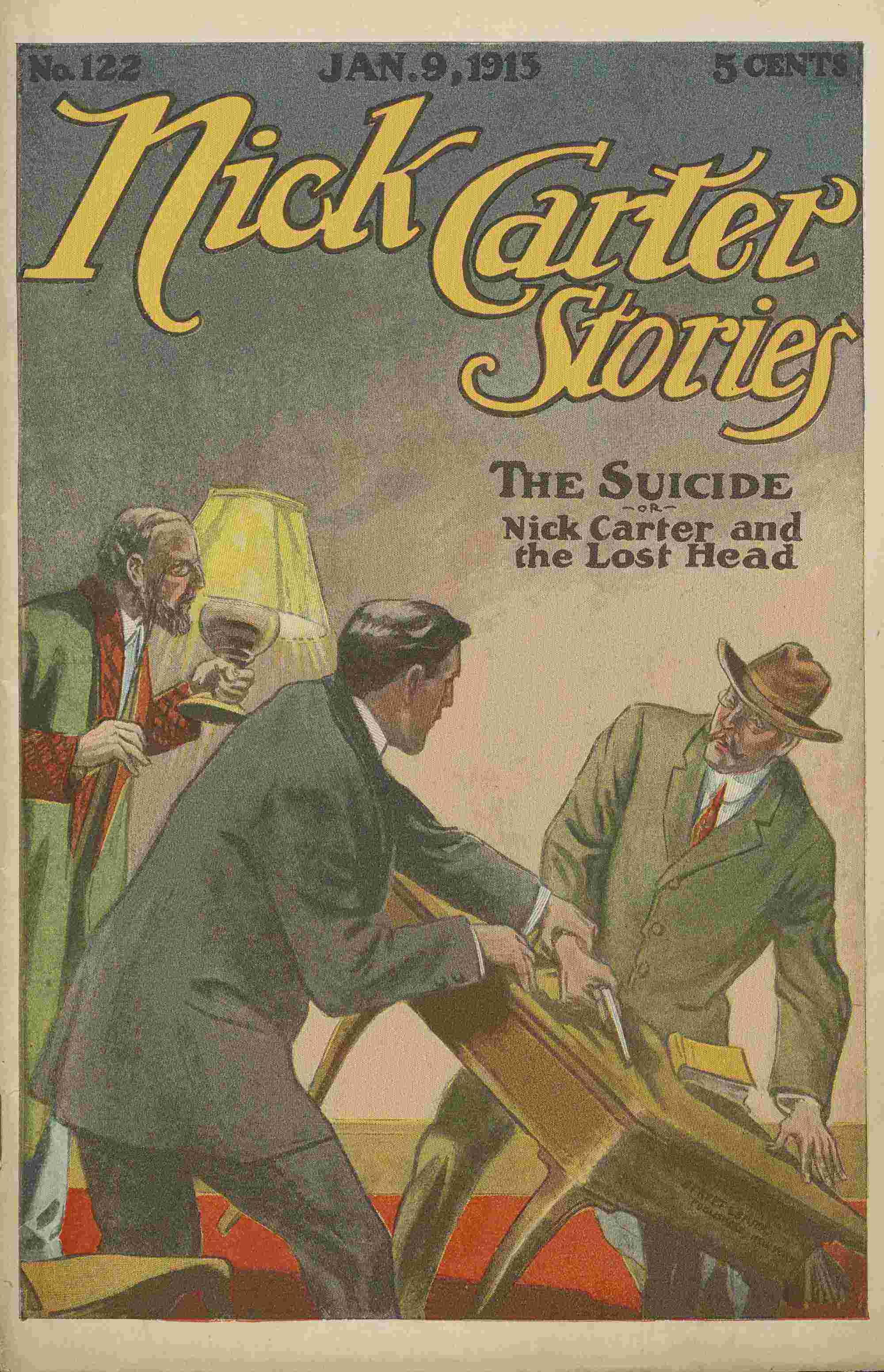
The Nick Carter Stories
ISSUED EVERY SATURDAY BEAUTIFUL COLORED COVERS
When it comes to detective stories worth while, the Nick Carter Stories contain the only ones that should be considered. They are not overdrawn tales of bloodshed. They rather show the working of one of the finest minds ever conceived by a writer. The name of Nick Carter is familiar all over the world, for the stories of his adventures may be read in twenty languages. No other stories have withstood the severe test of time so well as those contained in the Nick Carter Stories. It proves conclusively that they are the best. We give herewith a list of some of the back numbers in print. You can have your news dealer order them, or they will be sent direct by the publishers to any address upon receipt of the price in money or postage stamps.[Pg 71]
692—Doctor Quartz Again.
693—The Famous Case of Doctor Quartz.
694—The Chemical Clue.
695—The Prison Cipher.
696—A Pupil of Doctor Quartz.
697—The Midnight Visitor.
698—The Master Crook’s Match.
699—The Man Who Vanished.
700—The Garnet Gauntlet.
701—The Silver Hair Mystery.
702—The Cloak of Guilt.
703—A Battle for a Million.
704—Written in Red.
707—Rogues of the Air.
709—The Bolt from the Blue.
710—The Stockbridge Affair.
711—A Secret from the Past.
712—Playing the Last Hand.
713—A Slick Article.
714—The Taxicab Riddle.
715—The Knife Thrower.
717—The Master Rogue’s Alibi.
719—The Dead Letter.
720—The Allerton Millions.
728—The Mummy’s Head.
729—The Statue Clue.
730—The Torn Card.
731—Under Desperation’s Spur.
732—The Connecting Link.
733—The Abduction Syndicate.
736—The Toils of a Siren.
737—The Mark of a Circle.
738—A Plot Within a Plot.
739—The Dead Accomplice.
741—The Green Scarab.
743—A Shot in the Dark.
746—The Secret Entrance.
747—The Cavern Mystery.
748—The Disappearing Fortune.
749—A Voice from the Past.
752—The Spider’s Web.
753—The Man With a Crutch.
754—The Rajah’s Regalia.
755—Saved from Death.
756—The Man Inside.
757—Out for Vengeance.
758—The Poisons of Exili.
759—The Antique Vial.
760—The House of Slumber.
761—A Double Identity.
762—“The Mocker’s” Stratagem.
763—The Man that Came Back.
764—The Tracks in the Snow.
765—The Babbington Case.
766—The Masters of Millions.
767—The Blue Stain.
768—The Lost Clew.
770—The Turn of a Card.
771—A Message in the Dust.
772—A Royal Flush.
774—The Great Buddha Beryl.
775—The Vanishing Heiress.
776—The Unfinished Letter.
777—A Difficult Trail.
778—A Six-word Puzzle.
782—A Woman’s Stratagem.
783—The Cliff Castle Affair.
784—A Prisoner of the Tomb.
785—A Resourceful Foe.
786—The Heir of Dr. Quartz.
787—Dr. Quartz, the Second.
789—The Great Hotel Tragedies.
790—Zanoni, the Witch.
791—A Vengeful Sorceress.
794—Doctor Quartz’s Last Play.
795—Zanoni, the Transfigured.
[Pg 72]796—The Lure of Gold.
797—The Man With a Chest.
798—A Shadowed Life.
799—The Secret Agent.
800—A Plot for a Crown.
801—The Red Button.
802—Up Against It.
803—The Gold Certificate.
804—Jack Wise’s Hurry Call.
805—Nick Carter’s Ocean Chase.
806—Nick Carter and the Broken Dagger.
807—Nick Carter’s Advertisement.
808—The Kregoff Necklace.
809—The Footprints on the Rug.
810—The Copper Cylinder.
811—Nick Carter and the Nihilists.
812—Nick Carter and the Convict Gang.
813—Nick Carter and the Guilty Governor.
814—The Triangled Coin.
815—Ninety-nine—and One.
816—Coin Number 77.
817—In the Canadian Wilds.
818—The Niagara Smugglers.
819—The Man Hunt.
NEW SERIES
NICK CARTER STORIES
1—The Man from Nowhere.
2—The Face at the Window.
3—A Fight for a Million.
4—Nick Carter’s Land Office.
5—Nick Carter and the Professor.
6—Nick Carter as a Mill Hand.
7—A Single Clew.
8—The Emerald Snake.
9—The Currie Outfit.
10—Nick Carter and the Kidnapped Heiress.
11—Nick Carter Strikes Oil.
12—Nick Carter’s Hunt for a Treasure.
13—A Mystery of the Highway.
14—The Silent Passenger.
15—Jack Dreen’s Secret.
16—Nick Carter’s Pipe Line Case.
17—Nick Carter and the Gold Thieves.
18—Nick Carter’s Auto Chase.
19—The Corrigan Inheritance.
20—The Keen Eye of Denton.
21—The Spider’s Parlor.
22—Nick Carter’s Quick Guess.
23—Nick Carter and the Murderess.
24—Nick Carter and the Pay Car.
25—The Stolen Antique.
26—The Crook League.
27—An English Cracksman.
28—Nick Carter’s Still Hunt.
29—Nick Carter’s Electric Shock.
30—Nick Carter and the Stolen Duchess.
31—The Purple Spot.
32—The Stolen Groom.
33—The Inverted Cross.
34—Nick Carter and Keno McCall.
35—Nick Carter’s Death Trap.
36—Nick Carter’s Siamese Puzzle.
37—The Man Outside.
38—The Death Chamber.
39—The Wind and the Wire.
40—Nick Carter’s Three Cornered Chase.
41—Dazaar, the Arch-Fiend.
42—The Queen of the Seven.
43—Crossed Wires.
44—A Crimson Clew.
45—The Third Man.
46—The Sign of the Dagger.
47—The Devil Worshipers.
48—The Cross of Daggers.
[Pg 73]49—At Risk of Life.
50—The Deeper Game.
51—The Code Message.
52—The Last of the Seven.
53—Ten-Ichi, the Wonderful.
54—The Secret Order of Associated Crooks.
55—The Golden Hair Clew.
56—Back From the Dead.
57—Through Dark Ways.
58—When Aces Were Trumps.
59—The Gambler’s Last Hand.
60—The Murder at Linden Fells.
61—A Game for Millions.
62—Under Cover.
63—The Last Call.
64—Mercedes Danton’s Double.
65—The Millionaire’s Nemesis.
66—A Princess of the Underworld.
67—The Crook’s Blind.
68—The Fatal Hour.
69—Blood Money.
70—A Queen of Her Kind.
71—Isabel Benton’s Trump Card.
72—A Princess of Hades.
73—A Prince of Plotters.
74—The Crook’s Double.
75—For Life and Honor.
76—A Compact With Dazaar.
77—In the Shadow of Dazaar.
78—The Crime of a Money King.
79—Birds of Prey.
80—The Unknown Dead.
81—The Severed Hand.
82—The Terrible Game of Millions.
83—A Dead Man’s Power.
84—The Secrets of an Old House.
85—The Wolf Within.
86—The Yellow Coupon.
87—In the Toils.
88—The Stolen Radium.
89—A Crime in Paradise.
90—Behind Prison Bars.
91—The Blind Man’s Daughter.
92—On the Brink of Ruin.
93—Letter of Fire.
94—The $100,000 Kiss.
95—Outlaws of the Militia.
96—The Opium-Runners.
97—In Record Time.
98—The Wag-Nuk Clew.
99—The Middle Link.
100—The Crystal Maze.
101—A New Serpent in Eden.
102—The Auburn Sensation.
103—A Dying Chance.
104—The Gargoni Girdle.
105—Twice in Jeopardy.
106—The Ghost Launch.
107—Up in the Air.
108—The Girl Prisoner.
109—The Red Plague.
110—The Arson Trust.
111—The King of the Firebugs.
112—“Lifter’s” of the Lofts.
113—French Jimmie and His Forty Thieves.
114—The Death Plot.
115—The Evil Formula.
116—The Blue Button.
Dated December 5th, 1914.
117—The Deadly Parallel.
Dated December 12th, 1914.
118—The Vivisectionists.
Dated December 19th, 1914.
119—The Stolen Brain.
Dated December 26th, 1914.
120—An Uncanny Revenge.
[Pg 74]
PRICE, FIVE CENTS PER COPY. If you want any back numbers of our weeklies and cannot procure them from your news dealer, they can be obtained direct from this office. Postage stamps taken the same as money.
STREET & SMITH, Publishers, 79-89 Seventh Ave., NEW YORK CITY