
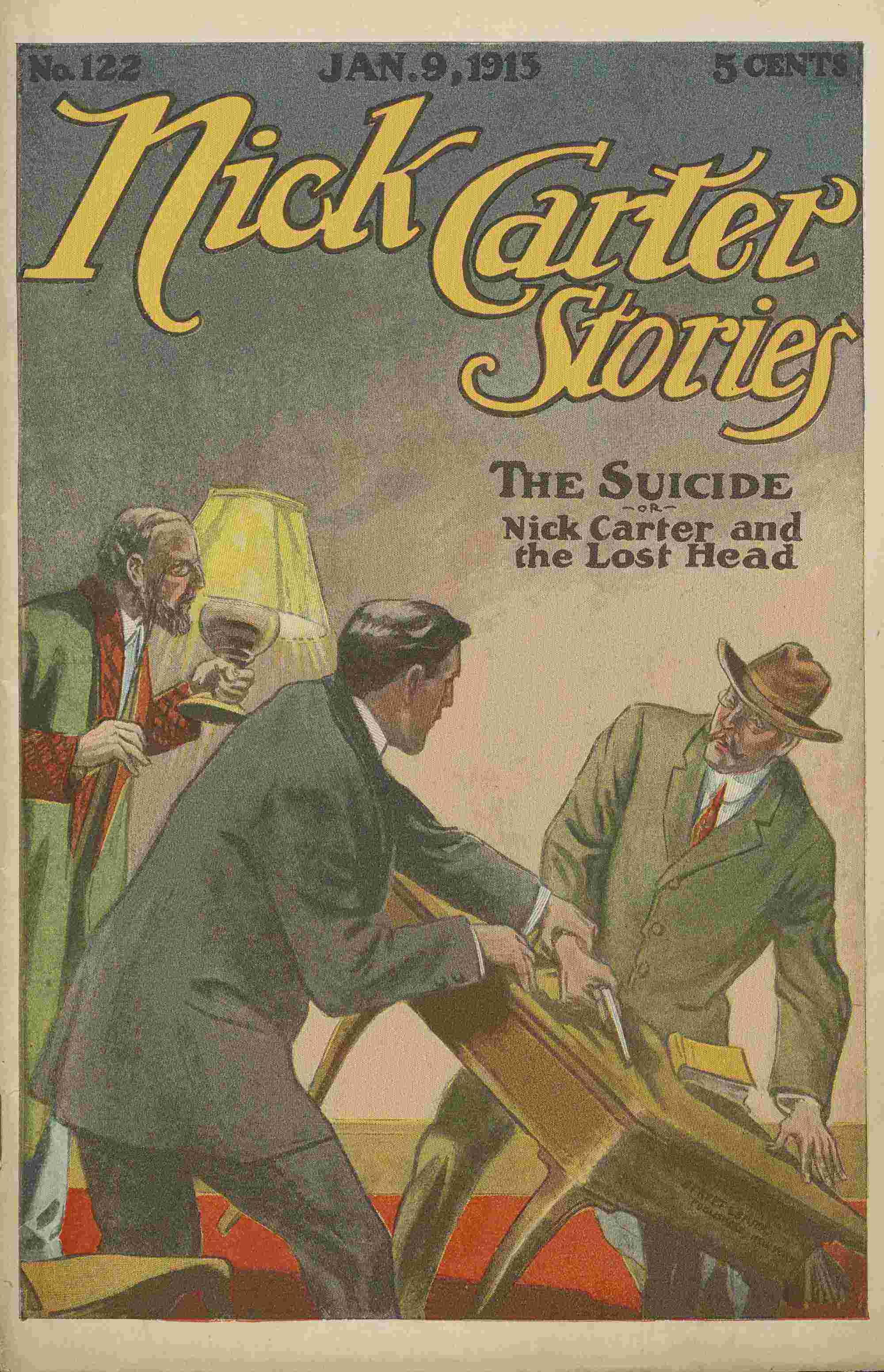
The Project Gutenberg eBook of Nick Carter Stories No. 122, January 9, 1915: The suicide; or, Nick Carter and the lost head
Title: Nick Carter Stories No. 122, January 9, 1915: The suicide; or, Nick Carter and the lost head
Author: Nicholas Carter
Burke Jenkins
E. K. Nostwell
Release date: July 7, 2022 [eBook #68467]
Most recently updated: October 18, 2024
Language: English
Original publication: United States: Street & Smaith, 1914
Credits: David Edwards, Chuck Greif and the Online Distributed Proofreading Team at https://www.pgdp.net (Northern Illinois University Digital Library)
Issued Weekly. Entered as Second-class Matter at the New York Post Office, by Street & Smith, 79-89 Seventh Ave., New York.
Copyright, 1915, by Street & Smith. O. G. Smith and G. C. Smith, Proprietors.
Terms to NICK CARTER STORIES Mail Subscribers.
(Postage Free.)
Single Copies or Back Numbers, 5c. Each.
| 3 months | 65c. |
| 4 months | 85c. |
| 6 months | $1.25 |
| One year | 2.50 |
| 2 copies one year | 4.00 |
| 1 copy two years | 4.00 |
How to Send Money—By post-office or express money order, registered letter, bank check or draft, at our risk. At your own risk if sent by currency, coin, or postage stamps in ordinary letter.
Receipts—Receipt of your remittance is acknowledged by proper change of number on your label. If not correct you have not been properly credited, and should let us know at once.
No. 122. NEW YORK, January 9, 1915. Price Five Cents.
THE SUICIDE;
Or, NICK CARTER AND THE LOST HEAD.
Edited by CHICKERING CARTER.
CHAPTER I.
HOW THE END CAME.
“Slow down, Danny, and look out for that wire,” said Nick Carter to his chauffeur. “It may be a live one.”
“I’m onto it, chief.”
“Onto it, eh? Don’t you run onto it while I’m in the car, not if it’s a live one. You may fancy absorbing the output of an electric-lighting plant, but not for mine, Danny, not for mine! I know what it would do to me. I’ve seen men electrocuted.”
Danny Maloney laughed, for it was obvious that the famous detective was jesting.
“Onto it with my lamps, chief, is what I meant,” he replied.
“Say what you mean, then,” said Nick, with a smile. “Precision is one of the valuable assets of a detective. Luckily, however, you are addressing one who can read between the lines—barring those of the ambiguous letter that brought us out here.”
“Can’t you fathom it? It must be mighty blind, chief, if it fools you.”
“On the contrary, Danny, it is perfectly plain—what there is of it,” said Nick dryly. “A woman, one Mrs. Myra Darling, states that she is in great trouble, that a very devoted friend of mine has advised her to appeal to me, and will I favor her with a call at my earliest convenience.”
“That all?” questioned Danny tersely.
“The whole business,” said Nick. “Of course, the appeal coming from a woman, I cannot turn it down. Noblesse oblige.”
“You don’t know her?”
“Not from a side of leather. I am acquainted with no Darling [Pg 3]woman—suppress that smile, Danny. I know what you are thinking. But all women are not darlings—far from it.”
“This one might be,” said Danny, his smile spreading to a grin.
“That’s neither here nor there,” said Nick, with a laugh. “Not being in the market, Danny, all women look alike to me. Now, the said Mrs. Darling’s trouble may be—ah, but we are near an answer to the momentous question. Yonder is the place, unless I am much mistaken. Stop at the driveway gate. I’ll walk into the grounds. Keep your eye peeled, by the way, while I’m engaged with her ladyship.”
The place referred to was out beyond Washington Heights and overlooking the Hudson. It was an attractive estate, without being at all pretentious, as were others in the immediate locality.
The grounds flanked a broad street in which electric lighting was being introduced, and from which the house stood back some thirty yards, with a well-kept lawn and a few shade trees. In the rear were a stable and garage, beyond which the land sloped down sharply toward the river.
Nick did not wait for an answer from his chauffeur. He sprang from the car while speaking, then walked briskly up the driveway and approached the house, quite a large wooden dwelling of the colonial type. Nick mounted the broad front veranda and rang the bell.
It was answered almost immediately by a tall, graceful woman, clad in black, and about thirty years of age. She was of medium complexion, with brown hair and eyes and a finely poised head. Her features were regular, but her face was a strong one, rather than handsome, evincing will power, intellectuality, and a lofty character. She bowed and smiled a bit gravely, saying immediately:
“You are Mr. Carter, I think.”
“Yes,” said Nick politely.[Pg 4]
“I am Mrs. Darling. Walk in, please, and come into the library. I am very glad you could comply so soon with my request. It is very good of you.”
“I happened to be at liberty this afternoon,” Nick replied, following her into the hall. “I received your letter this morning.”
Mrs. Darling conducted him into a prettily furnished library and invited him to be seated. Taking an opposite chair, she then said gravely:
“I will take as little as possible of your valuable time. I will tell you with few and simple words, Mr. Carter, why I have sent for you.”
“Cover all of the ground, Mrs. Darling,” Nick suggested. “My time just now is at your disposal.”
“Thank you,” she replied, bowing. “I will in that case begin at the beginning. I was married eight years ago to Mr. Cyrus Darling, a New York tobacco dealer, a man whom I have always supposed had considerable means, though he has never informed me definitely. He owned this place, however, and we have always lived well, and he has provided for me generously.”
“Mr. Darling is not living?”
“No. I will explain presently.”
“Continue.”
“I was nearly twenty years younger than he, Mr. Carter, but our married life was a uniformly happy one, though not as gay and festive as he perhaps would have preferred. I am inclined to be domestic, while he was of a volatile nature, having neither a strong or stable character. I frankly admit, Mr. Carter, that he was subservient to my will and wishes.”
“I understand you,” said Nick.
“I have no children, and I keep only two servants, aside from a chauffeur, whom I occasionally employ,” Mrs. Darling continued. “My husband’s habits were good, as the world goes, and I noticed nothing unusual in his conduct until about three months ago.”
“And then?”
“I then thought he appeared strangely reticent, at times very self-absorbed and less frank and affectionate than before. I asked him whether there was anything wrong, but he assured me to the contrary, though he seemed a bit irritated because I questioned him.”
“I follow you.”
“Later, Mr. Carter, he appeared quite despondent, and I feared that his business troubled him. He said that my fears were groundless, and that his business was never better. He went from bad to worse. He said very little at home, and remained in town evenings much more frequently than in years past, which I attributed to his seeming depression and his desire to find relief in the excitement and diversions of the city.”
“Did you occasionally accompany him?” Nick inquired.
“Very seldom. He did not seem inclined to have me do so.”
“Was he addicted to drink?”
“Only moderately. I never saw him intoxicated, nor anything like it.”
“Proceed.”
“About two weeks ago, Mr. Carter, he decided to sell his business, saying that he was sick of it and would try something else. I remonstrated with him, telling him that he was making a mistake, and that it is not easy for a man over fifty to make such changes profitably.”
“That is very true, Mrs. Darling.[Pg 5]”
“It had no effect upon him, however, and he let the business go,” she replied, sadly shaking her head. “During the following week he was at home part of each day, but he spent most of the afternoons and evenings in town. On Tuesday, one week ago yesterday, he appeared unusually nervous and depressed. I missed him soon after lunch, and supposed he had gone into town. I had an appointment with my dentist and was absent from two o’clock until nearly six. When I returned home—well, Mr. Carter, the end had come.”
“You mean?” questioned Nick gravely.
“My husband had committed suicide—or was the victim of foul play.”
“H’m, I see!” Nick drew up in his chair. “Were you in any uncertainty at that time, Mrs. Darling, as to the cause of his death?”
“No, not at that time, Mr. Carter,” she quickly informed him. “I know what you have in mind—that I should have called in the police immediately. I did not then, however, nor at any time until yesterday, have even a thought of anything but suicide. The circumstances suggested nothing else.”
“What were the circumstances, Mrs. Darling?” Nick inquired. “State them briefly.”
“There is very little to tell,” she rejoined. “My husband was last seen alive by one of my servants. She saw him going out of the back door of the house and around the stable, and she supposed he was going down to our boathouse, which was on the river bank and out of view from here, owing to the sharp slope of the land.”
“I see,” said Nick, glancing from the window.
“Soon after, Mr. Carter, the boathouse was seen to be on fire. It contained a motor boat and considerable gasoline, which caused it to burn very rapidly. It was completely destroyed. In the ruins were found the remains of my husband, little more than a charred skeleton, from which the flesh was almost entirely burned.”
Mrs. Darling paused to dry her eyes, maintaining with an effort her outward composure. Appreciating her feelings, Nick waited a few moments and then inquired:
“Are you sure, Mrs. Darling, that his death was not due to an accident?”
“Positively,” she replied. “To begin with, Mr. Carter, he left this letter on the chiffonier in my bedroom. You may read it.”
She took it from the library table while speaking and tendered it to the detective.
Nick read it, the following few lines written with pen and ink.
“My Dear Myra: Forgive me for the step I am going to take. I am driven to it by feelings I cannot describe. I am sick and tired of the whole business—of life itself. I am going to end it. Forgive and forget me.
“Cyrus.”
Nick replaced the letter on the table, saying considerately:
“There seems, indeed, to be no reasonable doubt of Mr. Darling’s intentions. You recognize the writing, I infer.”
“Yes, surely,” she replied. “Furthermore, Mr. Carter, there were found in the ruins numerous articles that positively identify my husband’s remains. They included the buttons on his garments, which were entirely consumed; also his pocketknife, his false teeth, and a plain[Pg 6] gold ring. His revolver also was found near by, and it is supposed that he shot himself after setting fire to the boathouse, presumably to make sure that his terrible design could not miscarry.”
“Who examined the articles and investigated the case?” asked Nick.
“Doctor Lyons, my physician, who is also the coroner.”
“A capable man,” Nick nodded. “I am acquainted with him. What is his opinion?”
“He thinks it a case of suicide. He could find no evidence of anything else, and is very positive in his opinion.”
“Had your husband any money, jewelry, or——”
“He left those in the bedroom, his watch, diamonds, and pocketbook, also his ring of keys,” Mrs. Darling interposed. “Only one key was missing from the ring.”
“Which one?”
“The key to the boathouse.”
Nick did not reply for a few moments. He sat gazing thoughtfully at a figure in the heavy carpet. Superficially viewed, the circumstances stated seemed to admit of only one reasonable theory—that Mr. Cyrus Darling had, indeed, deliberately ended his own life.
“The funeral and burial were last Thursday,” Mrs. Darling added, during the brief silence on Nick’s part. “Doctor Lyons did not think the case called for any investigations beyond those he personally made, nor did I at that time. He——”
“One moment,” said Nick, looking up. “What have you since learned, Mrs. Darling, that occasions your misgivings? Why do you now suspect foul play? That, I think, is the term you used.”
“I have two reasons for apprehending something of the kind,” she replied. “One relates to my husband’s estate. I have learned from his lawyer, who has been assisting me, and in whom I have absolute confidence, that Mr. Darling left no will, that he has recently withdrawn considerable money from the bank, and that his safety-deposit drawer contains only a few securities, worth less than three thousand dollars. From dividends which I know that he has been in the habit of receiving, as well as from our living expenses for several years, I know that he was worth at least a hundred thousand dollars.”
“Is your lawyer investigating the matter?”
“I have requested him to do so.”
“What is his name?” Nick inquired, taking out his notebook.
“Henry Clayton. He has an office in town.”
“I am acquainted with him, also,” said Nick, noting the name. “You mentioned a second reason for your misgivings. What is that?”
“One of my servants.”
“You mean?”
“I referred in my letter, Mr. Carter, to a very devoted friend of yours, who advised me to appeal to you.”
“Yes, I remember,” said Nick, wondering. “A devoted friend of mine—one of your servants?”
“I refer to my table girl, who also serves me as a maid. You have, I am very sure, no more grateful and devoted an admirer. I will call her.”
Nick bowed and waited, still more deeply puzzled as to the girl’s identity.
Mrs. Darling touched a bell on the library table.[Pg 7]
Nick glanced again from one of the windows—and discovered another perplexing fact.
His touring car was standing where he had left it, but his chauffeur was missing. Danny Maloney had disappeared.
The quick, light steps of the approaching maid sounded in the hall. Turning in that direction just as she appeared at the open door, Nick beheld——
Nancy Nordeck.
CHAPTER II.
THE GIRL WHO WAS DOWN.
Suspicions were mingled with Nick Carter’s surprise at seeing Nancy Nordeck. They were perfectly natural, too, under the circumstances, and in view of the disclosures to which he had just listened. The presence of a girl with a criminal record in the home of a man whose death was shrouded in mystery, much more of a mystery than Mrs. Darling even imagined, though already keenly appreciated by the detective, might indeed be significant.
Months had passed since Nick last saw Nancy Nordeck. She had so improved in looks that he hardly recognized her. She bore little likeness to the frail girl with pinched and haggard face, who was so deeply affected by the violent death of her crook father that she had resolved to reform, a moral awakening that Nick had by no means felt sure would be lasting.
His first thought, therefore, was that she might be up to her old tricks and in league with rascals to have killed Cyrus Darling to get possession of his fortune. It was not in Nick’s nature to expose the girl, nevertheless, if her reformation was genuine, for he never put a block in the way of any one who was down and striving to rise.
He felt for a moment that his position might be a delicate one, but though no signs of them appeared in his face, his impressions evidently were suspected by the girl. For she approached him quickly, saying respectfully, yet with characteristic assurance:
“I know what you’re thinking, Mr. Carter, and no one could blame you. But there’s nothing in it, sir. I’ve been as straight as a string from the time you set me right and shook hands with me, wishing me all kinds of good luck, and you couldn’t think if you tried how much I now care for you and your good opinion. I have hid nothing here, sir. Mrs. Darling knows all about me and what I was, and she’s been as good to me as you, sir. I’d bite a finger off before I’d go crooked again in any way.”
“I think you can safely depend upon that, Mr. Carter,” said Mrs. Darling, smiling faintly. “Nancy has confided her entire past to me, and in overlooking it and lending her a helping hand, I now know positively that I made no mistake. She is a good girl and a capable one.”
There was a suspicious moisture in Nancy’s brown eyes, then fixed upon the strong, kindly face of her mistress. She colored deeply, too, when Nick extended his hand and said heartily:
“Come here, Nancy. Let’s shake again. I’m more than glad to hear this and to know you are on the right track. Stick to it, my girl, as I now feel sure you will.[Pg 8]”
“You may be sure that I will, Mr. Carter,” said Nancy, eagerly shaking his hand.
“Now let’s proceed with this matter,” Nick said, more seriously. “Mrs. Darling tells me that you advised her to appeal to me?”
“So I did, Mr. Carter,” Nancy replied.
“She will answer any questions you care to ask her,” Mrs. Darling put in.
“To begin with, then, what do you know about the case?” said Nick. “Was it you who last saw Mr. Darling alive?”
“Yes, sir. I saw him leaving the house and going down back of the stable.”
“Did you notice anything unusual? Did he appear excited, or——”
“No, sir; not in the least,” put in Nancy. “I didn’t reckon anything wrong was coming off. I didn’t get wise at all until the mistress told me that most of the master’s money is missing.”
“Wise to what, Nancy?”
“That he was killed and robbed, mebbe, instead of putting out his own light.”
“Why did you suspect that?”
“Only because of two guys he has been friendly with lately. They have been here to see him, one of them quite a number of times.”
“Two men?”
“Yes, sir.”
“Do you know them?” Nick inquired, turning to Mrs. Darling.
“Hardly more than by name,” she replied. “My husband introduced me to one of them, named Philip Floyd, who has called several times to see him. I have met the other only once.”
“What is his name?” asked Nick, proceeding to write them in his notebook.
“Ralph Sheldon. He called here a few days ago with Mr. Floyd, who introduced me to him. My husband was absent at the time and they remained only a few minutes. That is the only time I ever saw Mr. Sheldon, though my husband had frequently mentioned him.”
“Are they old friends of his?”
“Quite the contrary. I never heard of them until about a month ago.”
“Had they any business relations with your husband?”
“I cannot say.”
“Do you know anything about them?”
“No more than I have told you,” said Mrs. Darling. “My husband referred to them only as friends, and he appeared to think well of them.”
“Do you know where they live?”
“I do not.”
“Both were here, you say, a few days before he died.”
“The day before, Mr. Carter, and both attended his funeral.”
“Did they say why they wanted to see him on the day preceding his death?”
“They did not. I inferred from their remarks, however, that it was only a friendly call.”
“Are they men of his own age?”
“I would say that Mr. Sheldon is nearly as old. He appears to be in the forties. Mr. Floyd, however, is not over thirty.[Pg 9]”
“Are they prepossessing men?”
“Yes, in a way, though I did not quite fancy them,” said Mrs. Darling. “As for Nancy—well, she may speak for herself. It was partly her impression of them that led me to take her advice and appeal to you.”
“On the dead, Mr. Carter, I would not trust either of them as far as I could throw a bull by the tail,” Nancy bluntly declared, in characteristic terms. “You know me, sir. I am not easily fooled. I can read a man dead right nine times out of ten, Mr. Carter, the minute I set my eyes on him.”
“You did not fancy them, then?”
“Not so you’d notice it,” said Nancy. “I wouldn’t say too much against the Sheldon man, Mr. Carter, for I’ve seen him only twice. I saw him at the funeral, and I let him in with Mr. Floyd a few days before. He’s all right, mebbe, though I’d hate to bank much on it.”
“What about Mr. Floyd? Why do you distrust him so seriously?”
“I have more than one reason for that hunch,” said Nancy inelegantly. “For a starter, Mr. Carter, I’ve seen that guy before.”
“Floyd?”
“Yes, sir.”
“When and where, Nancy?”
“Give it up. On the dead, sir, I can’t tell.”
“But you feel sure of it?”
“Surest thing you know,” said Nancy confidently. “I’d stake my bundle on it, Mr. Carter, and you know what that means, knowing what I was. Any man I knew in the past was most likely a crook.”
Nick did not contradict her.
“Besides, he knew me, sir, the first time. I let him in here,” Nancy went on. “I was wise to that, all right, but it wasn’t for me to meddle with the master’s affairs. So I kept my trap closed.”
“Why did you think Floyd recognized you?”
“I saw his lamps light up the instant they lit on me,” Nancy explained, in characteristic terms. “He looked at me like he saw a ghost.”
“Did he say anything to you?”
“No, not a word, Mr. Carter. But no man with eyes like his is on the level. I know what I’m saying. It’s like breaking sticks for me to pick out a crook from a bunch of men. Floyd is one, Mr. Carter, if ever there was one, and that’s why I got the mistress to send for you. I don’t forget what you did in that Maybrick case—and what you did for me, sir, never!”
“I’m quite sure of it, Nancy,” Nick replied. “You can tell me no more about the two men, I infer.”
“No, sir.”
“That is all, then. I will look deeper into this matter, Mrs. Darling, if you wish me to do so, under one condition.”
“Any conditions you see fit to impose, Mr. Carter,” she replied gratefully.
“You must leave the case entirely to me, aside from the instructions you already have given your lawyer and Doctor Lyons. I will see and inform both of them of our arrangements.”
“Very well. I leave it all to you.”
“And say nothing about it to others,” Nick added. “There must be no publicity at present.”
“I am more than anxious to avoid it,” Mrs. Darling assured him.[Pg 10]
Nick arose and took his hat from the table.
“I am going to have a look at the ruins of the boathouse,” he said. “If you will show me the way——”
“I will send Nancy with you.”
“I prefer to go alone,” Nick objected. “I will return in a very few minutes.”
He left the house by the rear door, passing around the stable and down the river bank. All that remained at the boathouse and its contents was a heap of charred, black ruins. The ground near by was covered with footprints of many persons who had visited the tragic scene, but none of them were of material significance.
Nick wanted only to view the surroundings, however, and he saw with a glance that the spot was so shut in by the hill in the rear and the trees on either side, that knaves selecting it for the murder of Darling, if such was his fate, would have incurred only chance observation by persons on the river, against which effective precautions could easily have been taken.
Scarce ten minutes had passed when Nick returned and rejoined Mrs. Darling in the library. He then obtained from her a description of Floyd and Sheldon, the only two persons then seeming to invite suspicion, and he also asked to see a photograph of her husband.
“I know of only one in existence, Mr. Carter,” she replied. “That was taken the year after our marriage. It is still a very good likeness of him. It is in our album. I will get it for you.”
She brought the volume and opened it on the library table—only to search it vainly.
The photograph of Mr. Cyrus Darling had disappeared.
CHAPTER III.
POINTERS TO CRIME.
Nick Carter made no comments upon the disappearance of the photograph, or, at least, none that expressed his thoughts. Mrs. Darling could not say how long it had been gone from the album, nor could she conceive of any reason for its removal.
“He may have led a much more gay and festive life than she suspected,” thought Nick, upon leaving the house after giving her a few additional instructions. “He may also have been a thousand times more sly than she imagined. Another woman now has the photograph, perhaps, the gift of a recreant husband, who thought it easier to give her that than to sit for a new one. It would be worth while to know the woman’s name, in that case—and also to know what has become of Danny Maloney.”
Nick’s mental digression occurred while he emerged from the driveway gate and found that his chauffeur was nowhere to be seen. The touring car stood at the curbing, but there was no sign of Danny.
“H’m, that’s a bit odd,” Nick soliloquized, gazing in each direction. “I thought he might be merely stretching his legs. He must have seen some one, or something, that he thought it worth while to learn more about. He never neglects—ah, that will explain.”
A scrap of paper protruding from under the chauffeur’s seat had caught Nick’s eye as he was about to enter the car. He drew it out and read, scribbled with a lead pencil:
“Don’t wait for me, chief. I’ll report later.”
Nick smiled and sprang into the car. Ten minutes later[Pg 11] he arrived at the residence of Doctor Lyons, whom he found alone in his office.
“Well, well, Nick, this is an unexpected pleasure,” said the physician, after their greeting. “It’s ages since I have seen you. What’s on your mind? I know your call is not entirely a social one, nor do you look as if you needed a prescription.”
“No, I’m as right as a trivet,” said Nick, smiling. “It’s about the suicide of Mr. Cyrus Darling.”
“What about it?”
“This is strictly between us, mind you, and must not go farther.”
“Enough said. Mum’s the word.”
“You view the remains, I am told, and pronounced it a case of suicide?”
“Certainly. There was nothing else to it, absolutely nothing.”
“I’m not so sure of it,” said Nick.
“Coming from any one else, Nick, I should laugh derisively at that,” Doctor Lyons replied, with a look of surprise. “Coming from you, however, it demands serious consideration. What do you mean?”
“I’m not prepared to say,” Nick rejoined. “I have just begun to look into the case at the request of Mrs. Darling. When I learn anything definite, Lyons, I will make it a point to inform you.”
“That’s good enough for me,” said the physician. “But I really think, Nick, that you are on a wild-goose chase. There’s nothing to it. Darling committed suicide, Nick, as sure as you’re alive.”
“It will be wise to report nothing different at present,” said Nick. “You may be right, of course, and I may drop the case within twenty-four hours.”
“I’ll wager you will.”
“I would like to know how you sized up the circumstances, nevertheless,” Nick went on. “Darling left a note which stated his suicidal intention, then went to the boathouse and set it on fire, immediately shooting himself. That is your opinion, I understand, briefly stated?”
“Yes, that is about the size of it,” admitted the physician.
“Were you among the first to view the remains?”
“Yes. I was sent for immediately. I saw all that remained of the unfortunate man. He was almost entirely cremated.”
“You made a careful examination, I suppose.”
“Certainly.”
“Of the skull?”
“I examined his remains thoroughly, Nick.”
“Did you find any fractured bone, or splintered, as if caused by a bullet?” Nick inquired.
“No, I did not.”
“Did you find the bullet that killed him?”
“No. The body was terribly burned, parts of it being entirely consumed. It was impossible to perform a satisfactory autopsy. There is no question of his identity, however, if that is what you have in mind. Darling’s ring was found on his finger. He wore a double set of false teeth, which alone are enough to establish his identity. We found some of the horn buttons on his clothing, moreover, which his wife readily recognized. Really, Nick, there is nothing to it.”
“Why do you think, then, that he set fire to the building before shooting himself?”
“Possibly to make sure of his death in case he only[Pg 12] wounded himself. Or, perhaps, the fire was caused by the flash of the revolver. There was a lot of gasoline in the building. It may have caught from the flash of the weapon. It certainly caused a very intense fire. The house and all it contained were completely consumed.”
“I was told that you still have the revolver and the articles mentioned.”
“That is true.”
“May I take them temporarily? I will guarantee to return them.”
“Certainly,” Doctor Lyons readily consented. “If the matter were a less solemn one, however, I would wager a big round roll, Nick, that you are wasting your energies on a fog bank. There’s nothing in it. Cyrus Darling killed himself, as sure as death and taxes.”
“We’ll let it go at that, then, for the present,” said the detective, with a smile. “I will return these articles in a few days.”
“Whenever convenient, Nick,” replied the physician.
He had taken them from a drawer in his desk while speaking, a parcel wrapped in thick brown paper and securely tied with a string.
Nick thanked him and departed.
Half an hour later he entered the New York office of Clayton & Craige, attorneys, and was received in the private office of the senior partner.
Nick found, however, that Clayton could add but little to the information already imparted by Mrs. Darling.
Clayton stated that he had been Darling’s legal adviser for a number of years, that the latter had left no will, and that his personal estate, as far as could be discovered, consisted of less than five thousand dollars. From several brokers with whom Darling had been in the habit of dealing, nevertheless, Clayton had learned that he had sold bonds and securities within two months amounting to nearly a hundred thousand dollars.
“It certainly looks bad, Mr. Carter, deucedly bad,” he added gravely, after stating these facts. “Though I have not yet mentioned it to Mrs. Darling, I can form only one theory consistent with the circumstances, and that is not entirely consistent.”
“What is your theory?” Nick inquired.
“I think Mr. Darling was murdered.”
“By whom?”
“I have no idea, not the slightest.”
“Do you know of any persons with whom he has had business relations, who might have committed the crime?”
“I do not. I am entirely in the dark.”
“How would you account for the letter stating his suicidal intention? That was found in his wife’s bedroom.”
“It may be a forgery.”
“Put in the bedroom by some one else?”
“Exactly.”
“That would have been possible, perhaps, if a conspiracy existed,” Nick allowed tentatively.
“Conspiracy—that’s just the word,” said the lawyer. “I think that Cyrus Darling was the victim of a dastardly conspiracy, Nick, carried out with infernal cleverness.”
“And that his fortune was the incentive to the crime?”
“Precisely,” said Clayton. “I don’t know how it was framed up, of course, nor who are involved. I do believe that Darling was terribly jockeyed in some way, however, and either persuaded, or forced, to turn all of his bonds and securities into cash. I know positively that he did so,[Pg 13] for all of the brokers with whom he dealt are well acquainted with him and absolutely sure of his identity at the time. He certainly is the man who made the sales and received the money. There is no question about that.”
“Admitting that,” said Nick; “what more do you suspect?”
“I think that Darling was bunkoed out of it by some means and later lured to the boathouse and killed, the rascals covering their tracks by setting fire to the house, and contriving to leave a forged letter, pointing to suicide. Either that is the case, Nick, or else he got in wrong and lost all of his money, and then really committed suicide.”
“You think either theory is tenable?” questioned Nick, smiling a bit oddly.
“I do think so.”
“I am going to look a little deeper into the case.”
“I’m glad to hear that, Carter, on my word,” Clayton quickly declared. “No man would be more likely to ferret out the true solution of the mystery.”
“There is no solution, Clayton, but the true solution,” Nick replied. “I may require some little time. Meanwhile, kindly say and do nothing about the matter, nor reveal anything that would add to Mrs. Darling’s distress. She appears to be a fine woman.”
“She is a fine woman, Nick. That goes without saying, and I know what I’m talking about.”
“Has Darling lived happily with her?”
“Surely,” Clayton replied. “Why not, indeed? She is just the type of woman to steady a man of his temperament. He liked a good time, you know, and was easily influenced. But for her, Nick, he might have gone clean over the traces. She was his balance wheel. She kept him going nicely, instead of off on a tangent. Yes, yes, they have lived happily, all right, or I would have heard of it.”
“No doubt,” Nick allowed.
He took his hat and arose to go.
CHAPTER IV.
THE ANGLE OF REFLECTION.
As Nick Carter had inferred, even before finding the terse, explanatory note of his chauffeur, there was a very good reason for the disappearance of Danny Maloney. There were equally good reasons, too, for the brevity of his note and his delay in reporting at the home office.
Seated alone in the touring car after Nick had entered the Darling residence, Danny fell to watching a gang of men at work in the near distance, then installing the wires for an electric-lighting system, to one of which Nick had jestingly referred when approaching the place.
Scarce five minutes had passed, however, when something of much more importance caught Danny’s eye and instantly claimed his attention. It was the sudden appearance and significant actions of a man who rounded a corner some thirty yards back of the motionless car.
One might wonder, perhaps, how Danny, not having eyes in the back of his head, caught sight of the man the moment he turned the corner. As a matter of fact, however, Danny saw him reflected in the chauffeur’s mirror clamped to the frame of the windshield, in which he could distinctly see objects back of the car.
This led to a somewhat curious situation. The man[Pg 14] saw the car and its solitary occupant, but he did not observe the mirror, and he evidently supposed that Danny, facing straight ahead, could not see him.
Danny easily saw the reflection, however, without turning his head. He saw the stranger stop short the moment he rounded the corner, and saw the car, at which he gazed suspiciously, which in turn was enough to arouse Danny’s suspicions.
“Gee! what’s eating him?” he muttered, watching him intently. “Here’s a reflex, back-action discovery, for fair. He don’t know I can see him; but who the dickens is he, and what’s struck him?”
The man stood gazing intently, first at the car and then at the Darling residence, several times from one to the other. He appeared in doubt, uncertain what to do.
Presently, frowning darkly, he took a pencil and a letter, from his pocket and made a memorandum of the envelope. Then he turned and retraced his steps and vanished around the corner as quickly as he had come.
“Gee whiz! there’s nothing to it,” thought Danny. “That fellow was going to the Darling residence. He was alarmed when he saw this car, and he has taken the number of it. He don’t know who owns it, then, so why did he change his mind? He certainly must be off color, or he would not have feared to enter the house. But why—why be hanged! It’s up to me, by gracious, to find out why.”
Danny abruptly ended his vain speculations. He quickly wrote the brief note that Nick found a little later, then sprang from the car and started after the departing stranger.
Danny discovered him nearly a block away, after rounding the corner—an erect, finely built man, fashionably clad, and having all of the outward indications of a gentleman. He was about thirty years old, with dark eyes and hair and clean-cut features, in many respects a strikingly handsome man.
Danny shadowed him to the city. He saw him enter an automobile garage and consult a reference book, one containing the license numbers of New York cars and the names of their owners. His face, when he departed, wore a darker cloud, a look of increasing apprehensions.
“Gee! he’s found out that the car belongs to Nick Carter,” Danny readily reasoned. “That don’t seem to please him worth a cent, which shows that my suspicions are all to the good. I’ll not lose sight of him, by gracious, until I learn who he is and where he hangs out.”
Danny then shadowed him to a leading hotel, where his quarry spent nearly an hour at lunch in the café, afterward sauntering out and bringing up, ten minutes later, near a large West Side apartment house, then known as the Ashburton Chambers.
This house evidently was his destination, for he gazed up at one of the side windows when crossing a street on the corner of which the lofty building stood.
“He’s got a date with some one,” thought Danny, watching him from the opposite side of the avenue. “Or mebbe he has a suite there and—no, by ginger, I was right. He’s here to see that woman.”
She emerged from a side door of the house just as the man was crossing the street—a finely formed woman in a stylish walking costume, a figure so striking and graceful that Danny at once felt sure that he had seen her before. Her face was partly hidden under a polka-dotted veil, however, precluding immediate recognition.[Pg 15]
They caught sight of one another at the same moment, and the man stopped on the corner, while the woman hastened to join him. Remaining there, apparently heedless of numerous passing pedestrians, they entered into a subdued and earnest conversation, the gravity of which was obvious.
“I’ve got to have a nearer look at her,” thought Danny. “I’m dead sure I’ve seen her before. Mebbe, too, I can get a line on what they are talking about by passing near them.”
Retracing his steps, he quickly crossed the avenue and then slowly approached the couple, sauntering by them. He then saw the woman’s face distinctly—her large, lustrous eyes, glowing darkly through the meshes of her veil; her attractive features and clear, velvety complexion; her finely formed mouth and rounded chin—a strikingly handsome face, of that type and character for which men sometimes lose their heads.
“Great guns!” Danny muttered. “It’s Kate Crandall, that fly beauty who figured in the Maybrick case. She tried to throw down the church rector because he would not marry her. She must have found an easier way to get money and plenty of it, if fine feathers cut any ice.”
Danny paused in the broad main entrance to the house and furtively watched the couple. He had tried in vain to catch a word or two of their conversation. He now saw the man show Kate Crandall the memorandum made on his letter, and he rightly inferred that they were talking about the touring car and its owner.
Presently, parting abruptly, the man hailed a taxicab and rode away, while Kate Crandall quickly approached the front entrance to the house.
Danny as quickly withdrew to the office, where he began an examination of the register.
Kate Crandall entered and approached the counter, speaking to the clerk.
“If Ralph Sheldon comes in, Tom, send him up to my suite, will you?” she said familiarly.
“Certainly,” replied the clerk. “Does that go until evening?”
“It goes until he shows up,” replied Kate, with significant emphasis. “I will be at home all of this evening.”
“I’ll keep him in mind.”
“Thanks.”
Kate turned quickly away and entered the elevator.
Danny decided that he had picked up all that was coming to him, and he started for home. It was nearly six o’clock when he entered the house, and found Nick in his business office with his two chief assistants, Chick Carter and Patsy Garvan.
On the office table lay the several articles Nick had obtained from Doctor Lyons, which he was just beginning to examine, already having told Chick and Patsy about the case as thus far set forth.
It took Danny only a few minutes to report what he had seen and heard, and it was very nearly in line with what Nick had expected.
“Good work, Danny, very good work,” he said approvingly. “It will help some, my lad, even more than you imagine. I have left the car at the curbing. Take charge of it, please.”
“Sure thing, Mr. Carter,” cried Danny, glad to feel that he had been of service.
“So Kate Crandall is at the Ashburton Chambers, eh?[Pg 16]” remarked Nick, with thoughtful frown, “I have wondered what became of her after that Maybrick affair. She is about as attractive a woman as one often meets, but she has an infernally evil streak in her.”
“You think she figures in this affair?” Chick inquired.
“I certainly do,” Nick declared. “Danny undoubtedly is right in thinking that the unknown man was going to the Darling residence. The fact that he has an interest there, and also in Kate Crandall, denotes plainly enough that Cyrus Darling also had an interest in the woman. The stranger, in view of his conduct, forms a connecting link between the other two, so to speak.”
“I see the point,” Chick replied.
“Gee! that point is plain enough,” put in Patsy. “But, holy smoke, it must be a case of suicide. How else can you size it up, chief? Darling had been in the dumps for two or three months, as down in the mouth as a sick horse, according to his wife’s story. Crooks could not have forced him to feign despondency for that length of time. In my opinion, chief, he just about blew in all of his money with some other woman, and blew out his brains when his bundle was gone. That’s how I size it up.”
“Really?” queried Nick dryly.
“That’s what. He certainly shot himself, chief, if what Doctor Lyons told you is true.”
“If what Doctor Lyons told me is true, Patsy, you probably are entirely wrong.”
“Wrong?”
“It’s a hundred to one.”
“Why so, chief?”
“Because in ninety-nine cases out of a hundred a person who commits suicide with a revolver shoots himself in the head,” said Nick. “That is the most natural spot for a suicide to select. He knows that a bullet in the brain will instantly render him insensible and preclude conscious suffering. Even if he does not stop to reason about it, he instinctively selects his head in which to send the fatal bullet. The records corroborate me. How often do you hear of a man shooting himself in the heart or lungs?”
“Very seldom, indeed,” Chick agreed. “I don’t know that I ever heard of a case.”
“But what of that?” questioned Patsy argumentatively. “I don’t see how that cuts any ice. Darling could have shot himself in the head.”
“I admit that he could—but he didn’t,” Nick said dryly.
“Why are you so sure of it, chief?”
“Because the bullet would have made a hole in his skull. Even if sent into his mouth, or through an eye, it would surely have passed through the brain and have fractured, at least, the back of the skull. Doctor Lyons is positive, however, that the skull was intact. I questioned him particularly about that. Admitting that my premises are correct, then, it’s a hundred to one that Cyrus Darling did not shoot himself.”
“Gee! there’s no getting around that argument,” Patsy thoughtfully allowed. “You must be right, chief, after all.”
“I think so.”
“But how came the revolver near him? Some one else must have shot him. In that case, chief, he must have been murdered, as Doctor Lyons and Lawyer Clayton suspect.[Pg 17]”
“On the contrary, Patsy, both of them are wrong,” Nick said confidently. “Cyrus Darling was not shot at all.”
“Not shot at all!” echoed Patsy incredulously.
“That is my opinion.”
“Gee! that beats me. Why was the revolver there, then? Why——”
“Stop a moment,” Nick interrupted. “You have just said, Patsy, that crooks could not have forced Darling to feign despondency for eight consecutive weeks. If so, then, his despondency must either have been voluntarily feigned, or else it must have been genuine.”
“Sure thing, chief. That’s plain enough.”
“One fact, however, indicates that it was not genuine,” Nick proceeded. “I refer to the fact that he recently spent many evenings in town, far more than in the past. His wife thinks he sought diversion to relieve his depression. He did not, however, permit her to accompany him. That’s a very significant point.
“It is wholly inconsistent in a husband seeking such relief. He would have wanted his wife with him to cheer him up and help divert his mind—barring one contingency.”
“Namely, chief?”
“Another attraction.”
“Gee! there may be something in that,” said Patsy, quick to see the point. “You mean another woman.”
“Exactly.”
“Kate Crandall.”
“Quite likely, Patsy, in view of what Danny discovered.”
“Gee whiz! things are shaping up,” said Patsy, laughing. “I begin to think you are right, chief.”
“Let’s see, now, in how far this is confirmed by Darling’s conduct during the past three months,” said Nick. “It was then that his wife first noticed his reticence and lack of customary affection.”
“He must have been bestowing it upon the other.”
“Quite likely,” Nick dryly agreed. “Then came a long period of increasing depression, relieved by frequent evenings in town, ostensibly alone. Later he sold his business, also his bonds and securities. Obviously, he wanted all of his funds in cash. Finally came the suicide, the letter stating his intention, and the burning of the boathouse, which nearly consumed the corpse and precluded absolute identification.”
“By Jove, Nick, you evidently think the whole business was faked,” said Chick abruptly.
“That is precisely what I think.”
“And that Cyrus Darling is not dead?”
“Exactly.”
“But the body——”
“One obtained for a blind,” Nick interrupted. “Really, Chick, this entire combination of circumstances admits of no other conclusion. Darling’s conduct during the past three months, as I have just sized it up: the selection of the boathouse for the supposed suicide, where the arrangements for such a fraud could have been easily and secretly made, as well as a quick and undetected get-away on the river after the trick was turned; the setting fire to the building in order to cremate the corpse and preclude identification except by means of articles placed on it, the garments, ring, and even the false teeth of the supposed victim—all point to one conclusion, Chick; that the job was a frame-up from beginning to end.”
“By Jove, it’s a curious case, Nick, if you are right,” Chick answered.[Pg 18]
“Not so very curious. It’s a case of a lost head.”
“A lost head?”
“Exactly. That of a man who has lost his head. It’s up to us to help him find it and set it back on his shoulders—if not too late.”
“Lost his head for a woman? Is that what you mean?”
“Precisely.”
“But why do you think we may be too late?”
“Because, though a week has passed since the supposed suicide, the cat has not jumped,” said Nick enigmatically.
“I don’t get you.”
“Nor I, chief,” put in Patsy. “What cat has not jumped?”
“The two-legged cat responsible for the whole business,” Nick explained. “We can safely assume, the foregoing being correct, that Darling turned his fortune into cash with a view to leaving the country with the woman; that he aimed to create a belief that he is dead, presumably to prevent investigations, pursuit, and a possible lawsuit, with consequent alimony, and that he intended living abroad under a fictitious name with the woman.”
“That now seems perfectly reasonable,” Chick agreed.
“The question is, then, assuming Kate Crandall to be the woman, why have they not jumped the country?” Nick added. “Why the delay? Why is she established in the Ashburton Chambers? Why the continued interest in the Darling residence, as appears in what Danny saw and heard? That shows plainly enough that she is the woman involved. It is confirmed by her acquaintance with Ralph Sheldon, mentioned by Mrs. Darling as a friend of her husband. His friendship may be of the left-handed kind.”
“Most likely, Nick.”
“All this, then, denotes that something has gone wrong. Why has Darling not fled with the woman? Has he been given the double cross? He may have been bunkoed out of his big bundle of cash and—well, there is no telling what has become of him. It’s up to us to find out.”
“I get you now, Nick,” Chick nodded. “He may, after all, be the man found dead in the boathouse.”
Nick quickly shook his head.
“I don’t think so,” said he. “If there were evidence showing positively that he was shot, rather than the contrary, I might think the rascals killed him. His going there voluntarily, however, his feigning despondency for close upon two months, apparently paving the way to get by with a fake suicide—all convinces me that he was not killed.”
“I see.”
“This is further confirmed by the removal of his photograph, which Mrs. Darling thinks is the only one in existence.”
“What was his object in removing it?”
“To prevent broadcast publication of it in the newspapers, in case the truth was suspected,” said Nick. “Verbal descriptions cut no great ice. A picture, however, has brought many a knave to the ringbolt. He was heading off that means of identification, exposure, and arrest.”
“Gee! that listens good to me, chief,” said Patsy. “Ten to one it hits the nail on the head.”
“I feel reasonably sure of it.”
“But what are your plans?” Chick inquired. “If Darling is up against a gang, as you suspect, and they [Pg 19]discover that his wife has put us on the case, it’s long odds that they will lose no time in bolting.”
“That’s the very point I was coming to,” Nick said, more forcibly. “They must have discovered it. Danny’s report convinces me of that. Kate Crandall knows it, also the unknown man who informed her. He must be identified. We have Danny’s description of him, which will probably be recognized by persons employed in the Ashburton Chambers, if he has been in the habit of visiting Kate Crandall.”
“No doubt.”
“You tackle that part of the work, Chick, and we’ll get after these suspects before they can make a successful get-away.”
“But Kate Crandall said she would be in her apartments all of this evening, chief,” Patsy reminded him. “That don’t look much like bolting.”
“That may have been only a blind,” Nick replied. “She may have feared that she already was being watched, or that the clerk might be questioned later. Be that as it may, we’ll lose no time in seeking tangible proof of my suspicions. While Chick is hunting up the unknown man, Patsy, you see what you can learn about Ralph Sheldon and Philip Floyd.”
“I’ve got you, chief.”
“If the former visits Kate Crandall, as she directed, we may be lucky enough to clinch the case and round up the entire gang this very evening,” Nick added, rising abruptly. “I’ll tackle Kate Crandall personally. I’ll find out in short order what she knows about Cyrus Darling.”
“That’s the stuff, chief,” cried Patsy.
“We’ll be off at once. Danny is still waiting. We can make the Ashburton Chambers in twenty minutes.”
CHAPTER V.
THE WOMAN IN THE CASE.
Nick Carter entered the Ashburton Chambers soon after eight o’clock that evening. He did not send up his card to Kate Crandall. He sauntered in and bought some cigars off a girl clerk in charge of the counter. While lighting one, he inquired carelessly:
“Have you seen Ralph Sheldon here this evening?”
“Yes, sir,” said the girl. “He came in half an hour ago. I saw him talking with the clerk. I guess he went up to his suite.”
“To the woman’s suite,” thought Nick, recalling what Danny had reported. Then, indifferently: “I heard to-day that Mr. Sheldon is living here.”
“Yes, sir. He has a suite with Mr. Floyd on the third floor. They have been here about two months.”
“Philip Floyd?”
“Yes, sir. But I don’t think he is here to-day. He travels a good deal of the time. The clerk can tell you.”
“It’s not material,” said Nick, turning away.
He sauntered out and around to the side door of the house, throwing away his cigar, then entered and took the elevator, saying to the man in charge:
“Miss Crandall’s apartments.”
“Third floor, sir,” directed the man. “Number ninety-eight, to the right.”
“Number ninety-eight?” queried Nick. “I thought Ralph Sheldon had that suite.[Pg 20]”
“No, sir. He and Mr. Floyd have number ninety-four, rear corridor.”
Nick did not reply. He stepped out on the third floor and turned to the right. The dimly lighted corridor was deserted. It ran parallel with one side of the house and led to a stairway and a narrow passage back of some of the rear apartments, evidently a passage and stairway designed for the use of servants and the removal of sweepings and rubbish.
Nick found that Kate Crandall’s suite was the last in the side corridor. He paused at the door and listened, hearing nothing, and he then crouched and peered through the keyhole. He could see a thread of light under an inner door, which precluded hearing voices from within, and he then knocked sharply on one of the panels.
There was no response.
Nick waited a few moments, then knocked again, which had the desired result. The door was opened by the woman he was seeking.
She was not conventionally clad for receiving visitors. Her fine figure was enveloped in a voluminous woolen wrapper. Her feet were thrust into a pair of worsted slippers. She appeared to have been on the verge of getting ready for bed. She drew back with a look of surprise on her darkly handsome face.
“Goodness!” she exclaimed. “I thought one of the hall-boys knocked. What do you want?”
“An interview with you,” Nick tersely informed her. “Don’t pretend, Miss Crandall, that you do not recognize me. A woman never forgets the face of a person she dislikes.”
“I did not so pretend,” Kate retorted. “I knew you immediately, Mr. Carter, but I cannot imagine why you want an interview with me.”
“I will presently inform you,” said Nick. “May I come in?”
“Certainly.”
“You are alone?”
“Of course. I am nearly always alone here. I have a headache and was thinking of going to bed,” Kate glibly asserted.
“That is why, perhaps, you were so long in answering my knock,” Nick remarked, more sharply eying her.
“Precisely,” Kate nodded. “I was near not answering it at all. I am glad I did, however. As for disliking you, Mr. Carter, that is absurd. I bear you no ill will for the part you played in that Maybrick affair. I was not seriously involved in it. I always make it a point not to lay myself liable.”
“To the law, you mean?”
“To the law—certainly,” she bluntly admitted. “What else would I mean? I’ll keep out of the grabnet of the law, Mr. Carter, you can safely bet on that.”
Nick wondered whether it was true, or only a bluff designed to dispel his suspicions. He had followed her into an attractively furnished parlor, where he instantly detected the odor of cigarette smoke. He wondered, too, whether he really had found her alone, or whether some male visitor, possibly Ralph Sheldon, had hurriedly concealed himself in one of the adjoining rooms.
“Have a chair,” Kate added. “Really, Mr. Carter, I am quite pleased to see you, for all you think I dislike you. What do you want to interview me about? You have piqued my curiosity.[Pg 21]”
“You said you were alone here,” Nick remarked, instead of answering her question.
“So I was until you came in.”
“Really?”
“Sure! Why should I deceive you?”
“That’s the question,” said Nick. “I think that you have.”
He had leaned nearer to her while taking a chair, so near that his head almost touched hers, for she then was seated.
“That I have deceived you?” she asked, gazing at him.
“Surely.”
“How so?”
“Some person was smoking a cigarette here within a very few minutes.”
Kate Crandall laughed and tossed her head.
“Dear me, is that why you think so?” she said derisively. “Really, Mr. Carter, you are not near as keen and clever as you think you are.”
“No?”
“Far from it. It was cute in you, of course, to detect cigarette smoke so quickly. But I was the smoker. You’ll find the end of my cigarette in the cuspidor, if you care to look. Here is the box.” Kate took it from the pocket of her woolen robe. “Have one. They seem to steady one’s nerves for a time. It may sharpen you up a bit.”
“My wits don’t need the grindstone,” Nick replied dryly.
“No?” queried Kate, with his own tentative intonation.
“Far from it,” said Nick, imitating her. “You are the one who is not keen and clever. You were not the smoker, Miss Crandall. When a woman has just smoked a cigarette, the scent of it may be easily detected in her hair. I smelled of yours when I sat down.”
“Oh, indeed!”
“Now, having eliminated you, who was your visitor? Why did he hide when I knocked? I know, of course, that he did not depart, or I should have seen him.”
Kate Crandall’s mocking smile had given way to a frown, but it was not of long duration.
“You are very much mistaken, Mr. Carter,” she replied. “He left just before you arrived. If you think any person is concealed in my apartments, you are at liberty to search them.”
“No, indeed; it is not material.”
“I fail to see why you have any interest in me, or my visitor,” Kate quickly added. “Please explain. Why are you here? What have you to say?”
“I want you to do most of the saying,” Nick replied. “Tell me, and give it to me straight, what do you know about Mr. Cyrus Darling?”
Kate Crandall heard him without a change of countenance.
“Well, just now, Mr. Carter, I know nothing about him,” she said pointedly. “He’s dead.”
“What did you know about him when alive, then?” Nick demanded.
“Very little. So little, Mr. Carter, that I’m quite ashamed of myself.”
“Why so?”
“Because, when I discovered the truth, it was not at all to my liking.[Pg 22]”
“What truth?”
“That he was a married man.”
“Do you mean that you did not know it before he died?”
“That’s just what I mean.”
“How long had you known him?”
“Something like three months.”