
Millions for Italy’s Army.
The cabinet council, at Rome, Italy, has sanctioned an extraordinary army appropriation of $80,000,000. When the new war minister, General Zupelli, succeeded General Grandi, he urged an additional appropriation to hasten military preparations, but the head of the treasury department at that time was unwilling to sanction it, as the enormous outlay might impair the national finances. The minister resigned and the cabinet was reorganized.
General Zupelli repeated his request, explaining that the necessity was urgent. The council granted the demand immediately. Since August 1st, the extraordinary expenditure of the army and navy has amounted to about $205,000,000. Due to this, the Italian navy has been kept mobilized since the war broke out, while the army has been fully prepared for action. The country is in a position to place in the field 750,000 men, fully equipped for a winter campaign.
Doomed to Blindness Girl Studies Hard.
Slowly becoming blind, with perhaps a year before her sight is blotted out, Alma Krager, of Burlington, Iowa, a freshman student in the liberal-arts college of the State University, has announced her determination to spend the last days before blindness in pursuit of her studies at Iowa.
The facts of her pitiful situation were disclosed following the visit of a Chicago specialist who made an examination of her eyes and predicted what is next to a fatality itself. Nothing can be done to save her sight, it is said, and total blindness is due within the coming year.
The doctor’s verdict came as a hard blow, but has not changed the girl’s determination to spend her last days of sight in study here. Even now temporary blindness comes, yet she still holds her place well at the head of her classes.[Pg 59]
Last summer Miss Krager received a severe shock when a bolt of lightning struck but a few feet away from her during an electrical storm near her home. This, it appears, has affected the nerves controlling her eyesight, and nothing can be done to ward off the impending blindness.
Here’s Some Football Score.
A remarkable game of football was played at Barnard, Kan., between the local team and a high-school team from Lincoln, Kan., when Barnard finished with 176 points to Lincoln’s 0.
Girl Has Permit for Own Telephone System.
Wentzville, St. Charles County, Mo., will get its first local telephone exchange through the enterprise of Miss Cordelia F. Lusby, who is chief operator at Wentzville in the long-distance telephone service.
With her own means Miss Lusby will put in the poles, string the wires, and provide a central station. About seventy subscribers have been obtained. The total investment will be about $3,000.
“Why shouldn’t a woman establish and manage a local exchange if she chooses?” says Miss Lusby.
“Don’t you think women have intelligence enough for that? It seems to me the telephone business is one for which women are peculiarly fitted.
“Wentzville, with a population of more than 800, never has had a local exchange, and there is a growing sentiment in favor of one. I have been chief long-distance operator here for the last nine years, and therefore feel my experience is sufficient to warrant my starting it.
“The citizens are giving their patronage to me more liberally than I had expected, and the success of the venture seems assured. The exchange will be operated day and night. My sister, Miss Elise L. Lusby, will assist me.”
The public-service commission at Jefferson City has issued a certificate of public convenience, authorizing Miss Lusby to construct and operate the plant.
Twelve Prussians Catch the Bus.
As a heavy London motor omnibus dashed toward a British camp on the second line in northern France recently, a sentry fired, and the guard turned out with loaded rifles and fixed bayonets, for in the vehicle were twelve Prussian soldiers with packs and rifles. As the bus approached, the driver, a typical London busman, cried out:
“Don’t shoot! They’re feeding out of my hand. They’re hungry.”
The Prussians had been on outpost duty. When they saw the omnibus returning from the advanced British trenches, where it had delivered a load of ammunition, they stood in the middle of the road, threw up their hands, and surrendered, saying that they were starving.
Locked in Box Car Twenty-one Days Without Food.
A long freight train rolled into the yards at North Tonawanda, N. Y., and stopped. A brakeman twisted the seal in the ordinary hand-organ fashion and pushed back the door. What he saw caused him to jump back. A man, whose face was pale and colorless, lay sprawled upon the floor. In his hand was an apple core, brown and shriveled. The man was unconscious—almost lifeless.[Pg 60]
Further investigation showed the man to be Robert H. Gardner, forty-seven years old, of Cleveland, Ohio. His condition was explained when it was found that he had been locked in the box car twenty-one days, without a bite to eat save three apples, which he had in his pockets when he entered.
Gardner, who has a wife and children in Cleveland, packed a merry-go-round in the box car in Frostburg, Md. While arranging parts of the machine so they would ride “easy,” the door was pulled shut and locked. The car was of the thick-walled, almost air-tight type, and he could not make himself heard to those passing outside. Physicians give some hope that the man may live.
Some New Inventions.
A patent just issued to a California inventor provides a partition for dividing a bed into two sections separate from each other and secures the bedclothing in such manner as to form two separate compartments in the same bed, producing, the inventor claims, practically the same advantage as twin beds.
A New Jersey inventor has patented a method of treating wood to produce a substitute for cork, in which he seeks to remove all acid from the wood and then impregnate the wood with a solution of glycerin and water, after which it is dried for use.
In a recently patented combination kitchen table and ironing board the board is slid under the table when idle and pulled out and supported by a folding leg when needed.
A Minnesota inventor has patented a self-adjusting pail, with which grain can be automatically weighed and measured.
A camera operated by electricity has been invented for lowering into oil wells to photograph the conditions surrounding broken tools.
Taming Rockefeller Deer.
John D. Rockefeller’s deer, at Tarrytown, N. Y., are becoming as neighborly as their owner at Pocantico Hills. Every morning six or more of them follow the mail man to the post office and to the railroad station, where he goes on Mr. Rockefeller’s business.
The deer roam about the street, unmolested, and often allow people to pet them. Mr. Rockefeller delights in seeing them on his estate.
Spy With Four Sets of Clothing.
A German spy, captured near Paris and shot, had on four sets of clothing—the British uniform, the French soldiers’ garb, his own, and a woman’s dress over all.
McGraw at His Desk.
Manager John J. McGraw, of the Giants, is back at his desk in the New York club’s offices. Mr. McGraw had little to say when interviewed about his plans for next season, but he announced that he had given up the idea of training in California. He now has on his hands the biggest baseball squad that a major-league club has ever carried, and in the next few weeks he expects to let out much of his surplus talent.
Manager McGraw plans to go to the training camp in Marlin, Texas, earlier in February than heretofore, and will have his eye on pitchers and a third baseman. He[Pg 61] would not say anything about any contemplated change in the outfield, but it is quite probable that if some of the youngsters come up to expectations, there is likely to be some changes in the Giants’ line-up for next season.
If the Giant squad gets into condition at Marlin as soon as Manager McGraw expects, it is not unlikely that he may take a team to the coast to play several exhibition games at the Panama-Pacific Exposition.
The management of the big show is anxious to have the Giants visit the coast, and if the club shows its best form early in the season, the Giant manager may decide to take the trip.
Makes Corn-shucking Mark.
Shenandoah, Iowa, has an entry for the best corn husker in the State. Orin Wiggins, of Oswego, Kan., who is husking corn for George E. Gordon, shucked 138 bushels in eleven hours. This was the most corn ever shucked by one man on his farm, says Mr. Gordon, who has lived on a farm four miles west of Shenandoah thirty years. His corn is making forty-five bushels to the acre.
Strange Shower Falls on California Town.
A remarkable fall from the heavens of large quantities of what is described as meteoric floss took place at Healdsburg, Cal. The shower, which began between seven and eight a. m., and reached its maximum about ten o’clock, was seen by all the inhabitants of the town.
According to one of the eyewitnesses, the material appeared high in the heavens, in a clear sky, as a mass of stars, lustrous metallic sheets, and silvery ropes. It reached the earth in various shapes and sizes, ranging from minute particles to sheets twenty feet square. It fell in such quantities that long ropes and masses of it hung from the telephone and telegraph wires.
When the substance reached the warm earth, it began at once to contract into fibrous masses, resembling flossy asbestos, though tests proved that it was not that mineral. Most of it soon disappeared, though samples were saved and sent to Director Campbell, of the Lick Observatory, and to Professor Tito Alippi, director of the observatory at Urbano, Italy.
Says He Can Raise “Titanic.”
In announcing that the international oceanograph expedition will begin a seven-year cruise next May, Captain J. Foster Stackhouse, explorer and geographer, says that the expedition will visit the scene of the Titanic disaster to investigate the possibility of raising the ill-fated liner. He believes that the big ship can be located and raised.
A steel sphere, eight feet in diameter, is the latest device to aid in bringing sunken ships to the surface and in search for treasure lost in the depths of the sea. The sphere is equipped with a number of electrically operated devices to do the work. As it is lowered from its ship by means of a steel-wire cable, it throws beams from an electric searchlight to locate the wreck. If it is not found at once near the point where the vessel was lost, the bell brings its electrically driven propellers into action and moves about as desired, always in touch with the ship above by means of its cable, which carries telephone wires.
When the searchlight has located the wreck, so that the men within the sphere can ascertain its position through[Pg 62] the heavy glass windows, the bell is brought to the surface, and descends, carrying a large pontoon. The term pontoon as used in this sense means a water-tight cylinder placed beneath a submerged vessel and then filled with air to assist in refloating the vessel. These cylinders are equipped with motor-driven pumps for expelling their contents when the time comes for them to exert a lifting force.
As most of the wrecks of recent years are of iron or steel, the bell makes use of the electro magnet in order to fasten a number of pontoons to the sunken vessel. This is done by approaching the hulk and allowing the four large magnets to lie against the side of the wreck. The magnets are then energized and the bell clings firmly to the hulk, holding on with the force of many tons. This allows a great drill, set between the magnets, to operate against the steel plates of the vessel, and a motor operates this drill so that a hole is bored in a very short time. Then, by an ingenious worm drive, the diving bell is shifted just a few inches to one side, after the drill is withdrawn. The pontoon carried down by the bell has been placed on the sea bottom meanwhile, below the spot where the device is operating. From this pontoon extend a number of chains, the loose ends of which are held up by floats. When the drill has bored a hole, one of these chains is gripped by an arm, also magnetized, which extends from the diving bell, and the pontoon hook on the end of the chain is set into the hole in the vessel, where it is automatically locked. The process of boring holes and inserting pontoon hooks is repeated until the pontoon is secured to the wreck by sufficient chains, after which the diving bell ascends for another pontoon, and attaches it in the same manner, continuing until the sunken vessel is encircled by these metal cylinders. The number required will vary according to the size of the vessel, of course.
When this work is accomplished, the tender is instructed by telephone to begin the pumping out of the pontoons, and the motor in each is started by the electrical-power generator in the ship. The men in the bell can observe the operation from a little distance, and send up instructions to pump out certain pontoons more rapidly than others, in order to bring the wreck right side up. As the water is emptied from these cylinders, they become more and more buoyant, until they strain at their chains, tug at the vessel, and finally raise it from the mud and bring it to the surface, where the tender ship can tow it to the nearest port for the recovery of its contents, or, if the vessel is not beyond repair, for overhauling and restoring to seaworthy condition.
In many cases the recovery of the ship alone would be worth the expense, while in others the treasure is immensely valuable. The location of scores of wrecks is no secret, but the methods of raising the sunken vessels has made the knowledge worthless. The Los Angeles man who has perfected this unique diving bell believes that he has solved the problem.
Our Flag Again on the High Seas.
A few days ago the John Ena, a big four-masted bark, sailed majestically through the Narrows into the lower bay at New York City. Recalling as it did the days when the lofty rigging of American ships dominated the sky line along the water front instead of the tall buildings which are now to be seen there, the arrival of the John[Pg 63] Ena was the first striking evidence to shipping men of the return of the United States flag on the high seas.
Since the new registration regulations went into effect, the rehabilitation of the merchant marine has made itself known practically every day in the arrival or departure of some steam vessel which had been changed to American registry, but the presence in the bay of an American-owned and American-manned sailing vessel of the type of the John Ena was the most eloquent reminder of all to those who could remember the old days. The John Ena came from Honolulu, Hawaii, with a cargo of raw sugar.
The records show that between September 1st and November 15th, eighty-four ships came under the United States flag through the new law, which extends American registry to foreign-built vessels. This was more tonnage than had been added to the American merchant marine in the previous twenty-five years. The American merchant marine now consists of 2,444 ships of 1,369,492 gross tons.
Of the eighty-four ships, seventy were British, eight German, five Belgian, and one Norwegian, disproving the contention raised when the legislation was pending that it was merely a scheme to make available and protect with a neutral flag the German ships tied up idle in American ports on account of the war. Practically all of the ships were American owned, flying alien flags merely because their owners built them abroad, where cost of construction and operation was low.
“This is a most satisfactory showing,” said the commissioner of navigation, Eugene T. Chamberlain. “It proves that there was a considerable number of ships owned by Americans, but our laws were such as to prevent an American from hoisting his own flag on his ship if that ship happened to be built abroad. The great maritime powers—Great Britain, Germany, Belgium, and Norway—all had laws that permitted registry of foreign-built ships. They had been doing everything possible to build up their merchant marine, while we had hindered ours.
“I have great hopes now for the future of the American merchant marine. We have added 300,000 tons in three months and there is as much more existing American-owned tonnage that probably will take the flag. I look for a development of the shipping industry generally in the United States for many reasons.”
From Forge to Chair of Senate.
Edward Schoeneck, next lieutenant governor of New York, started life as a blacksmith, became a stenographer to get a legal education, and later became a lawyer. Though still on the sunny side of forty, he has served two years as ward supervisor, four as member of Assembly, and four as mayor of Syracuse.
His father, Henry Schoeneck, came to this country as a young man and opened a blacksmith shop. He quit it to serve as a soldier, and on his return found his business pretty well gone. There was a large family of boys, and as they became old enough each in turn went into the shop.
Edward was initiated at the forge at fourteen, and for ten years worked there, first as a helper of his father, and after his father’s death as the support with his older brothers of the family. While he worked at the forge he continued the study at home of the common branches.
Before he was eighteen he decided to become a lawyer. He first mastered stenography and got employment in a[Pg 64] mercantile house and then awaited his opportunity. He found it in the law office of White, Cheney & Shinaman. Later he went through Syracuse Law School, was admitted to the bar, and immediately began practice.
The year he entered the law school he was elected supervisor of his ward. At the close of his term as supervisor, he was elected to the Assembly. He was then only twenty-eight years old. When Wadsworth became speaker in 1906, Schoeneck was one of the little group that moved up from the back rows into the “seats of the mighty” and became one of the forces in the reorganization of the Assembly under Wadsworth’s general direction. When it was done, he announced that he proposed to stay home the next year and earn some money, but at the speaker’s solicitation he went back. He remained only one year, however.
Then he resumed his law practice with the intention of sticking to it. But in 1909 the Republican party in Syracuse was in a desperate situation. The Democrats were preparing to nominate George W. Driscoll, brother of the then Republican Congressman from this district, for mayor. The Republicans had had the mayoralty for eight years, and there were two independent movements breeding which threatened trouble.
There wasn’t a Republican candidate for the nomination. Driscoll, a popular man and a good spellbinder, was clearly to be the Democratic nominee. Each of the two independent organizations put up a candidate, both Republicans. He consented to become the candidate of the regulars and was elected. Two years later he was reëlected.
Mr. Schoeneck ran for lieutenant governor with Stimson in 1910, having been picked for it by the veteran Francis Hendricks. This year Mr. Hendricks once more proposed that he become a candidate for the office, and it was at his suggestion that the former mayor began his two successful canvasses of the State, first for the nomination and then for the election.
Mr. Schoeneck is a robust, upstanding man, and likes outdoors. He likes to go shooting up at Lake Bonaparte or fishing at Otisco Lake, where he spends most of his summers. He holds the patience record for bass fishing at Otisco, where sometimes they bite and sometimes they don’t. He plays good handball, baseball, croquet, but a “punk” game of tennis. He retains the manual dexterity of his manual-labor days, and could build a house if need be.
How Long Will War Last? Soldier Tells.
How long will the war last? No question is more frequently asked. Many prominent men, military experts, statesmen, and well-informed authorities have given their opinions. No one asked the soldiers, until the other day in a café in a little French town a correspondent happened to put the question to a French infantryman, who had spent many days in the trenches. And the soldier gave this answer:
“When everybody gets tired of slaughtering, there will be peace. It will come whether we are on the road to Berlin or not. It is one thing for to shout ‘On to Berlin!’ It is another thing to go there. When Germany is driven out of France and Belgium, I shouldn’t be surprised to see her ask for peace. I suspect that by that time we shall have suffered heavy enough losses not to be arrogant. The idea of promenading across[Pg 65] Germany is not what appeals to our soldiers. They know what that would cost. Our soldiers are fighting for their homes and their country.”
The soldier said he thought there would be peace by Easter. He was not averse to giving the Germans credit of being good fighters, and for having a splendid military organization. “But we shall beat them,” he said. “We are beating them.”
And so it goes. There are many interesting sidelights like this on the war which are not told in the routine dispatches.
Thirteen Dead, is Football’s Record.
Football claimed thirteen victims in the season which is now practically over. Two of the players killed were on college teams. The others were either members of high-school, preparatory, or “free-lance” elevens. Tackling was responsible for more deaths than anything else. The list of fatalities is as follows:
Floyd McGinnis, only son of James McGinnis, a merchant of Ada, Ohio. Young McGinnis was tackled in a practice game September 21st, and was thrown hard. He rose from the ground, ran a few steps, and then fell dead.
Ray Allen, nineteen years old, of the Stanley High School, Sapulpa, Okla. He was tackled in a game played against the Tahlequah Indians October 3d, and died thirty-five minutes after being thrown.
Albert Wiseman, Sac City, Iowa, High School, suffered concussion of the brain when thrown in a game played October 9th. He died on October 10th.
Charles C. Hays, eighteen years old, a student in Fordham University, N. Y., preparatory school. Hays played in a game against St. Peter’s College eleven October 12th. He tackled the runner, and others fell on top of him. A kick in the stomach caused injuries from which he died October 14th.
Carroll Olson, twenty years old, a player in the Milwaukee, Wis., Amateur Football League. Olson sustained a fractured skull in a scrimmage in a game at Lane Park October 11th, and died the following day.
William S. English, of Troy, N. Y., and member of the senior class of Mount St. Mary’s College, Emmitsburg, Md., was injured in a class game on the campus of the college October 12th, and died an hour after he had been hurt. He was not a member of the regular team.
Michael Kennedy, twenty years old, Pittsburgh, Pa., died October 20th after an injury sustained in a practice game in Lawrence Park, October 17th. Kennedy, when he was hurt, was running with the ball and made a line plunge. In doing so, his head was bent against his body, and paralyzation set in.
Lester Koehler, seventeen years old, and quarter back of a Detroit, Mich., high school, died October 29th, after sustaining injuries in a game a week previous. He received a blow on the head which developed into paralysis.
Dudley Gothrup, McAllen, Texas, eighteen years old, died almost immediately after having been tackled and thrown in a game November 1st.
James Levery, nineteen years old, of Ambridge, Pa., died in a hospital at Pittsburgh, November 2, having been injured in a football game at his home October 31st. He was jumped on in a scrimmage and his back was broken.[Pg 66]
Fred Treece, seventeen years old, and quarter back of New Brighton, Pa., High School football team, died November 15th in a New Brighton hospital. Treece collided head on with a player from the New Wilmington High School in a game November 14th, sustaining a concussion of the brain.
Frank L. Wells, Dorchester, Mass., full back of the English High School, received a scratch on the arm in a game between his school and Salem High School November 7th. He died of blood poisoning in a hospital at Boston November 10th. Wells was an all-around athlete and junior member of the Boston Athletic Association.
T. G. Brown, of Knoxville, Tenn., and member of the Sewanee University eleven, died on the field October 3d after a scrimmage between two teams. Organic heart trouble was held responsible.
The fatalities this year fall one below those of last, when fourteen fell victim to the gridiron game. Only three times in the last fourteen years has the list been smaller, in 1901, 1908, and 1911. It does not compare with the casualty list of 1903, when the total reached forty-four, nor in 1909, when thirty lives were sacrificed. The smallest number was that in 1901, when only seven were killed.
Serious injuries have been on a smaller scale this year than last, although minor sprains and contusions have been as numerous as ever. As has been the case in many other years, the more severe injuries came in the early part of the season, and, as was the case with the fatalities, they were mostly confined to the younger set of players.
Over 71,000 people saw Harvard defeat Yale, 36 to 0, in the biggest game of the year. Harvard holds the undisputed title to the Eastern championship. The Illinois and Nebraska University teams have proved the best in the West.
New World’s Record in Bike Contest.
A new world’s record was set in the recent six-day bicycle race at Madison Square Garden, New York. Alfred Goullet, of Australia, and Alfred Grenda, of Tasmania, who won the race, covered a distance of 2,758 miles and 1 lap. The previous record was 2,751 miles.
Close behind the “Kangaroo team,” as Goullet and Grenda are known, were Iver Lawson and Peter Drobach, the Swedish-Polish team. Jimmy Moran, of Boston, and Reggie McNamara, of Australia, were third. Moran had declared it would be his last race. The veteran made a desperate effort to win, but evidently his age told against him. Francesco Verri, of Italy, and Oscar Egg, of Switzerland, known as the Italian team, and Fred Hill, of Brooklyn, whose title was the American team, tied for fourth place, while George Cameron and Harry Kaiser, of New York, the Bronx team, finished last among the leading six.
One might imagine a six-day race as a terrible, and even cruel, test, of human endurance, but the riders do not complain. Though they obtained very little sleep, they are not racked with the sufferings of exhaustion, as supposed. They eat continually, often over forty times a day, and it is not unusual for them to leave the track at the end of their long ride weighing more than when they began. They become more tired mentally than physically, and strangely, they insist that it is their arms, and not their legs, that become fatigued.[Pg 68][Pg 67]
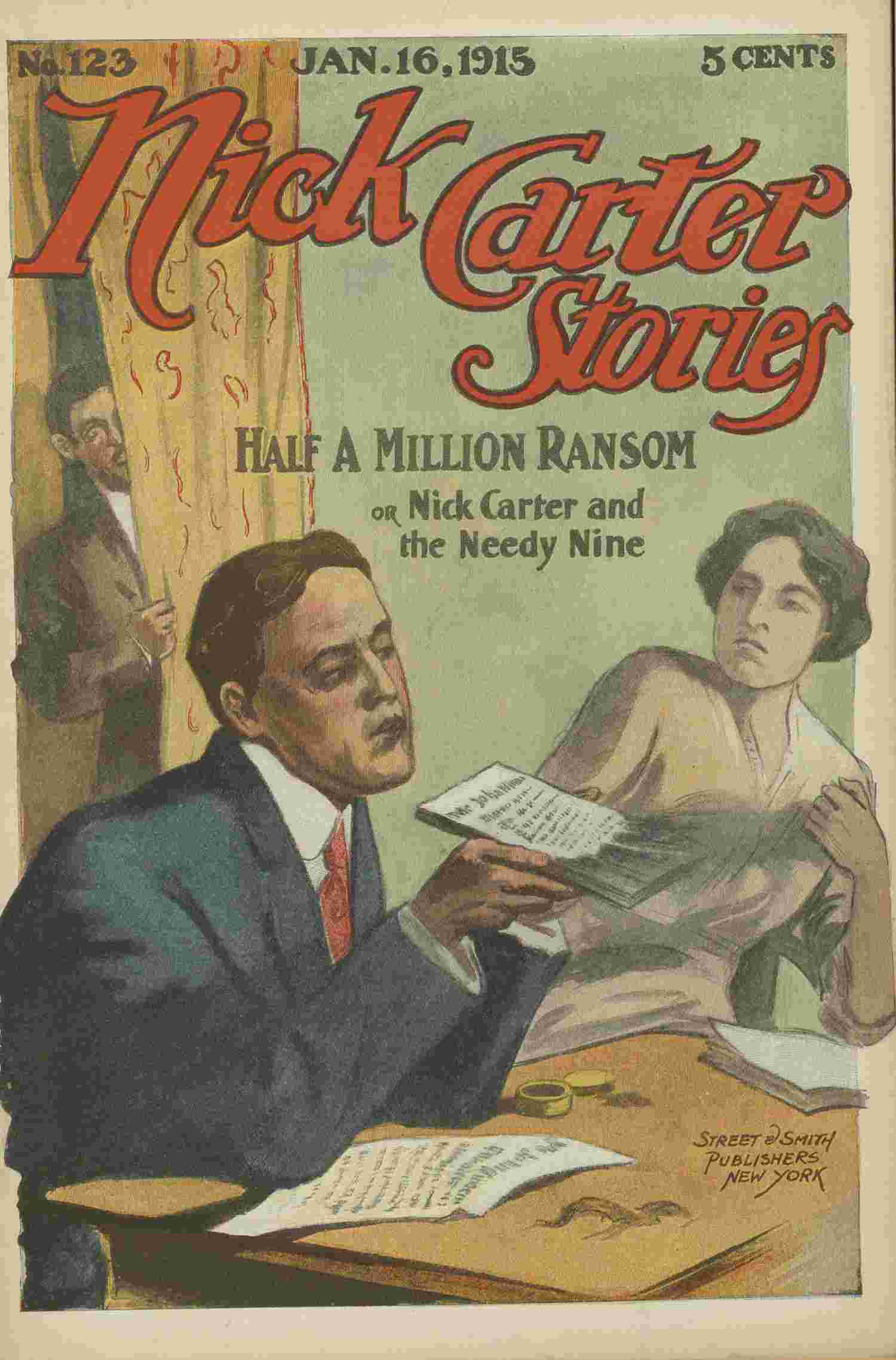
The Nick Carter Stories
ISSUED EVERY SATURDAY BEAUTIFUL COLORED COVERS
When it comes to detective stories worth while, the Nick Carter Stories contain the only ones that should be considered. They are not overdrawn tales of bloodshed. They rather show the working of one of the finest minds ever conceived by a writer. The name of Nick Carter is familiar all over the world, for the stories of his adventures may be read in twenty languages. No other stories have withstood the severe test of time so well as those contained in the Nick Carter Stories. It proves conclusively that they are the best. We give herewith a list of some of the back numbers in print. You can have your news dealer order them, or they will be sent direct by the publishers to any address upon receipt of the price in money or postage stamps.[Pg 69]
692—Doctor Quartz Again.
693—The Famous Case of Doctor Quartz.
694—The Chemical Clue.
695—The Prison Cipher.
696—A Pupil of Doctor Quartz.
697—The Midnight Visitor.
698—The Master Crook’s Match.
699—The Man Who Vanished.
700—The Garnet Gauntlet.
701—The Silver Hair Mystery.
702—The Cloak of Guilt.
703—A Battle for a Million.
704—Written in Red.
707—Rogues of the Air.
709—The Bolt from the Blue.
710—The Stockbridge Affair.
711—A Secret from the Past.
712—Playing the Last Hand.
713—A Slick Article.
714—The Taxicab Riddle.
715—The Knife Thrower.
717—The Master Rogue’s Alibi.
719—The Dead Letter.
720—The Allerton Millions.
728—The Mummy’s Head.
729—The Statue Clue.
730—The Torn Card.
731—Under Desperation’s Spur.
732—The Connecting Link.
733—The Abduction Syndicate.
736—The Toils of a Siren.
737—The Mark of a Circle.
738—A Plot Within a Plot.
739—The Dead Accomplice.
741—The Green Scarab.
743—A Shot in the Dark.
746—The Secret Entrance.
747—The Cavern Mystery.
748—The Disappearing Fortune.
749—A Voice from the Past.
752—The Spider’s Web.
753—The Man With a Crutch.
754—The Rajah’s Regalia.
755—Saved from Death.
756—The Man Inside.
757—Out for Vengeance.
758—The Poisons of Exili.
759—The Antique Vial.
760—The House of Slumber.
761—A Double Identity.
762—“The Mocker’s” Stratagem.
763—The Man that Came Back.
764—The Tracks in the Snow.
765—The Babbington Case.
766—The Masters of Millions.
767—The Blue Stain.
768—The Lost Clew.
770—The Turn of a Card.
771—A Message in the Dust.
772—A Royal Flush.
774—The Great Buddha Beryl.
775—The Vanishing Heiress.
776—The Unfinished Letter.
777—A Difficult Trail.
778—A Six-word Puzzle.
782—A Woman’s Stratagem.
783—The Cliff Castle Affair.
784—A Prisoner of the Tomb.
785—A Resourceful Foe.
786—The Heir of Dr. Quartz.
787—Dr. Quartz, the Second.
789—The Great Hotel Tragedies.
790—Zanoni, the Witch.
791—A Vengeful Sorceress.
794—Doctor Quartz’s Last Play.
795—Zanoni, the Transfigured.
[Pg 70]796—The Lure of Gold.
797—The Man With a Chest.
798—A Shadowed Life.
799—The Secret Agent.
800—A Plot for a Crown.
801—The Red Button.
802—Up Against It.
803—The Gold Certificate.
804—Jack Wise’s Hurry Call.
805—Nick Carter’s Ocean Chase.
806—Nick Carter and the Broken Dagger.
807—Nick Carter’s Advertisement.
808—The Kregoff Necklace.
809—The Footprints on the Rug.
810—The Copper Cylinder.
811—Nick Carter and the Nihilists.
812—Nick Carter and the Convict Gang.
813—Nick Carter and the Guilty Governor.
814—The Triangled Coin.
815—Ninety-nine—and One.
816—Coin Number 77.
817—In the Canadian Wilds.
818—The Niagara Smugglers.
819—The Man Hunt.
NEW SERIES
NICK CARTER STORIES
1—The Man from Nowhere.
2—The Face at the Window.
3—A Fight for a Million.
4—Nick Carter’s Land Office.
5—Nick Carter and the Professor.
6—Nick Carter as a Mill Hand.
7—A Single Clew.
8—The Emerald Snake.
9—The Currie Outfit.
10—Nick Carter and the Kidnapped Heiress.
11—Nick Carter Strikes Oil.
12—Nick Carter’s Hunt for a Treasure.
13—A Mystery of the Highway.
14—The Silent Passenger.
15—Jack Dreen’s Secret.
16—Nick Carter’s Pipe Line Case.
17—Nick Carter and the Gold Thieves.
18—Nick Carter’s Auto Chase.
19—The Corrigan Inheritance.
20—The Keen Eye of Denton.
21—The Spider’s Parlor.
22—Nick Carter’s Quick Guess.
23—Nick Carter and the Murderess.
24—Nick Carter and the Pay Car.
25—The Stolen Antique.
26—The Crook League.
27—An English Cracksman.
28—Nick Carter’s Still Hunt.
29—Nick Carter’s Electric Shock.
30—Nick Carter and the Stolen Duchess.
31—The Purple Spot.
32—The Stolen Groom.
33—The Inverted Cross.
34—Nick Carter and Keno McCall.
35—Nick Carter’s Death Trap.
36—Nick Carter’s Siamese Puzzle.
37—The Man Outside.
38—The Death Chamber.
39—The Wind and the Wire.
40—Nick Carter’s Three Cornered Chase.
41—Dazaar, the Arch-Fiend.
42—The Queen of the Seven.
43—Crossed Wires.
44—A Crimson Clew.
45—The Third Man.
46—The Sign of the Dagger.
47—The Devil Worshipers.
48—The Cross of Daggers.
[Pg 71]49—At Risk of Life.
50—The Deeper Game.
51—The Code Message.
52—The Last of the Seven.
53—Ten-Ichi, the Wonderful.
54—The Secret Order of Associated Crooks.
55—The Golden Hair Clew.
56—Back From the Dead.
57—Through Dark Ways.
58—When Aces Were Trumps.
59—The Gambler’s Last Hand.
60—The Murder at Linden Fells.
61—A Game for Millions.
62—Under Cover.
63—The Last Call.
64—Mercedes Danton’s Double.
65—The Millionaire’s Nemesis.
66—A Princess of the Underworld.
67—The Crook’s Blind.
68—The Fatal Hour.
69—Blood Money.
70—A Queen of Her Kind.
71—Isabel Benton’s Trump Card.
72—A Princess of Hades.
73—A Prince of Plotters.
74—The Crook’s Double.
75—For Life and Honor.
76—A Compact With Dazaar.
77—In the Shadow of Dazaar.
78—The Crime of a Money King.
79—Birds of Prey.
80—The Unknown Dead.
81—The Severed Hand.
82—The Terrible Game of Millions.
83—A Dead Man’s Power.
84—The Secrets of an Old House.
85—The Wolf Within.
86—The Yellow Coupon.
87—In the Toils.
88—The Stolen Radium.
89—A Crime in Paradise.
90—Behind Prison Bars.
91—The Blind Man’s Daughter.
92—On the Brink of Ruin.
93—Letter of Fire.
94—The $100,000 Kiss.
95—Outlaws of the Militia.
96—The Opium-Runners.
97—In Record Time.
98—The Wag-Nuk Clew.
99—The Middle Link.
100—The Crystal Maze.
101—A New Serpent in Eden.
102—The Auburn Sensation.
103—A Dying Chance.
104—The Gargoni Girdle.
105—Twice in Jeopardy.
106—The Ghost Launch.
107—Up in the Air.
108—The Girl Prisoner.
109—The Red Plague.
110—The Arson Trust.
111—The King of the Firebugs.
112—“Lifter’s” of the Lofts.
113—French Jimmie and His Forty Thieves.
114—The Death Plot.
115—The Evil Formula.
116—The Blue Button.
Dated December 5th, 1914.
117—The Deadly Parallel.
Dated December 12th, 1914.
118—The Vivisectionists.
Dated December 19th, 1914.
119—The Stolen Brain.
Dated December 26th, 1914.
120—An Uncanny Revenge.
PRICE, FIVE CENTS PER COPY. If you want any back numbers of our weeklies
and cannot procure them from your news dealer, they can be obtained
direct from this office. Postage stamps taken the same as money.
STREET & SMITH, Publishers, 79-89 Seventh Ave., NEW YORK CITY