
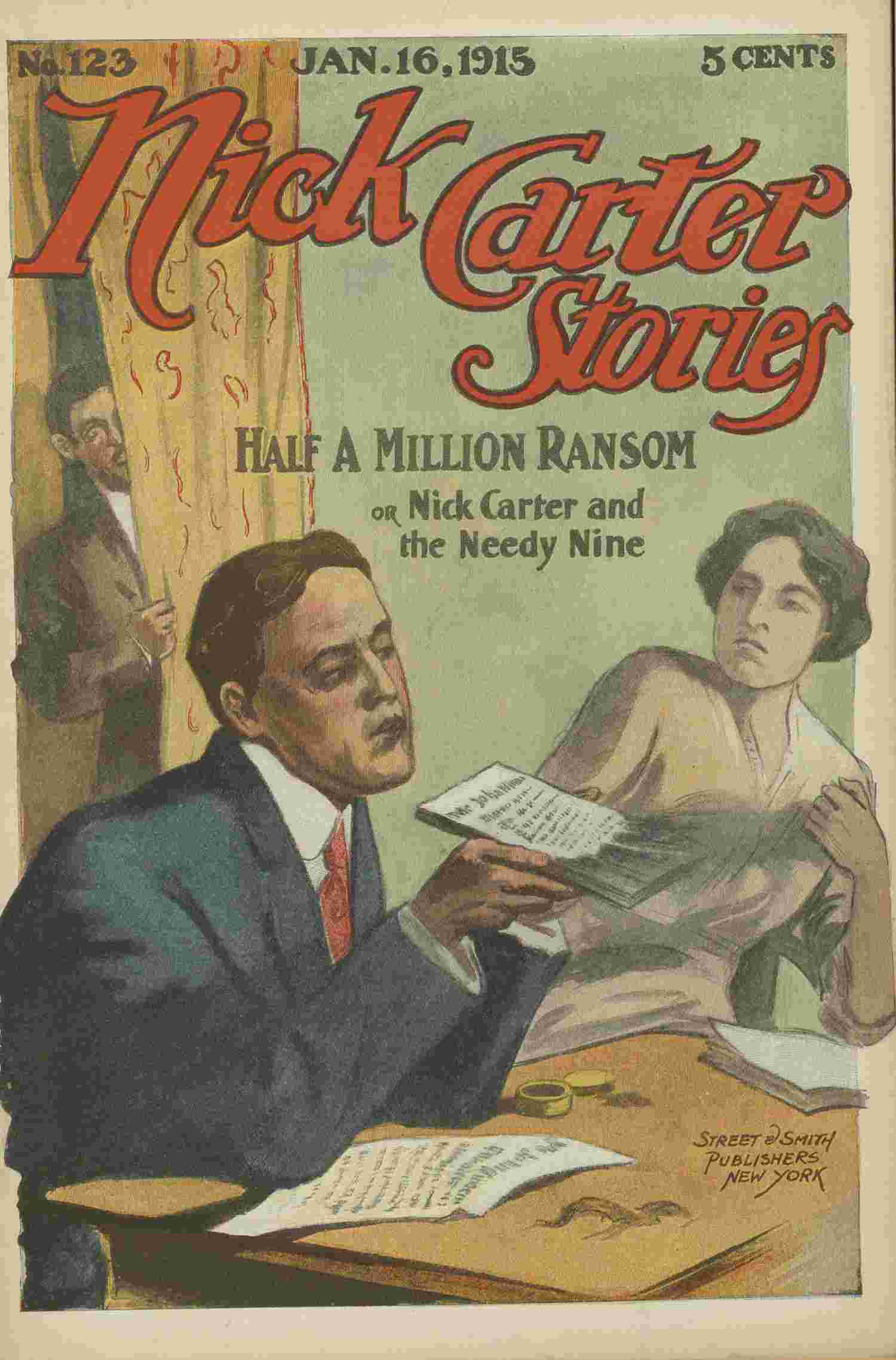
CHAPTER VI.
THE MAN IN A FIGURED VEST.
It was after twelve o’clock when Nick received from Patsy Garvan, the telephone communication informing him what his assistant had learned up to the time he visited the garage, as stated, and this soon was followed by the return of Danny with additional information concerning Patsy’s doings and designs.
“We will wait for his next report, or a communication from David Mack,” Nick said simply.
Chick gazed at him for several moments, but his inquiring look brought no response from the detective.
Nick Carter had, in fact, been unusually absorbed during the long period of waiting. He had been sitting at his desk, gazing vacantly at it, with his brows knit and his mind concentrated upon the case engaging him, weighing all of the circumstances and seeking, as only Nick Carter’s mind could seek, for something under the surface.
Half an hour brought no further report from Patsy, but it brought the expected communication from the banker.
Nick seized the telephone the instant the bell began to ring.
“Hello!” he called.
The answer came quickly:
“This is Mack talking. Is that you, Nick?”
“Yes.”
“I am talking from my private office. I have heard from Redlaw.”
“Tell me. Come on with it.”
“I am directed to go out Westchester way at six o’clock this evening, alone in my runabout, and to follow the New Rochelle road till I am stopped by a man wearing a figured vest and carrying a red silk handkerchief in his hand. That’s all. Not another word was said. What shall I do?”
“Do what he has directed,” said Nick promptly.
“And follow your instructions of this morning?”
“To the letter.”
“I will. Have you any to add?”
“No. I shall wait for your next report.”
“Very good. You shall receive it as soon as possible,” Mack assured him. “I’m game, mind you, for whatever the case requires.”
“You are well chosen, then, for this work,” Nick replied. “Between us, I think we can turn the trick.”
“Me, too! So long.”
“Good-by and good luck.”
Nick hung up the receiver.
“By Jove, that dovetails well with Patsy’s report,” Chick declared, after Nick had told him of Mack’s statements. “The man with a figured vest must be the same Jack Conroy mentioned by Patsy, and the intimate friend of Kate Crandall. Both evidently are in this job, including Duffy’s wife and son, and very likely Duffy himself. What do you think?”
Nick Carter’s reply astonished his chief assistant, even, for it was entirely unexpected.
“I’m hit with a new idea,” said Nick, swinging round in his swivel chair. “Pull up here. I’ll tell you with very few words what I think, Chick, and what you now must do.”
Chick drew up his chair and listened.[Pg 23]
What Nick Carter told him and required of him will appear in what occurred a little later.
At three o’clock that afternoon, alone, and carefully disguised, Nick Carter arrived in the neighborhood of the Duffy residence, where he began a stealthy search for Patsy Garvan. He failed to find him, of course, and soon he noticed that the house appeared to be deserted. There was no sign of life through any of the windows, and the door of the garage was closed.
“The birds must have flown,” Nick reasoned, pausing a short distance from the house. “Patsy must have found them here and they must have made an immediate move of some kind, or he would have telephoned to me again. He is trailing them and found no opportunity to communicate with me. If I am right, by Jove, I may be able to clinch my suspicion concerning the Redlaw letter, if it was written in this house. I’ll secure that evidence, at least, if possible.”
Nick had sauntered around to the front of the house while thus sizing up the situation. The conclusion at which he had arrived was a perfectly natural one, and he mounted the steps and rang the bell, feeling quite sure that the summons would not be answered, and that he then could admit himself with a skeleton key and secretly search the house.
Somewhat to his surprise, however, the summons was immediately answered. He heard quick footsteps in the hall. The door was opened boldly, as boldly as if no occupant of the house had any occasion for caution, or fear of a visitor, and Kate Crandall herself appeared on the threshold.
The disguised face of the detective evinced no surprise. He accepted the situation as he found it. He bowed politely and said, with inquiring intonation:
“I am looking for Miss Clara Randall, who was recently employed in the banking house of Madden, Mellen & Mack. I was told that she might be found here. Was I rightly informed?”
Kate Crandall bowed and smiled. There was not a sign of distrust in her dark eyes. One would have said that she had not the slightest cause for fear, though Nick knew very well how audacious a bluff she was capable of undertaking. She had removed her street costume and was clad in a gray house gown of clinging woolen material that served to accentuate the graceful lines of her fine figure.
“Yes, sir, you were rightly informed,” she replied. “I am Clara Randall.”
“My name is Henderson Black,” said Nick. “I am fortunate in finding you. Can you spare me a few minutes of your time?”
“For what, Mr. Black?” Kate questioned, eying him a bit more sharply.
“I have a business proposition to make you,” Nick suavely explained. “I am in need of an expert stenographer for very important work. Don’t say that you will not consider it, please, before having heard my offer. May I come in and explain? I will detain you only a short time.”
“My time is not worth very much just now, Mr. Black,” Kate said, with a laugh. “I was nearly asleep over a dull novel when you rang. Yes, I will hear what you have to say, though I hardly think I care to take on any very arduous work. Come into the library.”
She drew back for him to enter, then conducted him[Pg 24] to an attractively-furnished room. An open book was lying on the table. Near by was a large armchair with a fancy silk pillow on the back of it, bearing an indentation where her head had been resting. These seemed to confirm her statements.
An open desk stood near one of the walls. The first article on it to catch the detective’s eye was a large pad of plain paper, remarkably like that on which was written the Redlaw letter.
Nick instantly noticed all of these things, however, and his ears were alert to detect a sound from any other part of the house. None could be heard. He apparently had found the woman alone. He remarked casually, nevertheless, while he took a chair near the table:
“Are we likely to be overheard? My business relates to private political matters, Miss Randall, and what I tell you must go no further.”
“There is no one to overhear you,” said Kate, tossing aside the silk pillow and resuming her seat. “Mrs. Duffy, who lives here, has gone out of town with her son, and her husband never comes home before evening.”
“Ah, very good,” said Nick.
“As far as I am concerned,” Kate added; “I will not repeat anything you confide to me. You may speak freely.”
“I intend doing so,” Nick replied, with more sinister intonation. “To begin with, however, I wish to know something about yourself.”
“About me?”
“Yes, and about the—Needy Nine,” Nick pointedly added.
Kate Crandall heard him with hardly a change of countenance. There was no apprehensive start, no unmistakable betrayal of how hard she was hit by his ominous words.
Though he thoroughly despised her, Nick could not but admire the nerve of this woman. He could detect only a quick dilation of her searching black eyes and a sudden deeper paleness in her cheeks. These were the only signs of her secret perturbation, and her voice, when she replied, was as steady as his.
“The Needy Nine?” she said inquiringly.
“Yes, the Needy Nine,” Nick repeated.
“I don’t know what you mean, Mr. Black.”
“You don’t?”
“Surely not. You are talking Greek to me,” Kate declared. “I never heard of any Needy Nine.”
“Nor of a man named Ralph Redlaw?”
“No, never.”
“Well, well, I must be mistaken, then.”
“You certainly are, sir, if you think I know anything about such persons. I am all in the dark as to your meaning.”
“Possibly, Miss Crandall.”
“Randall, sir.”
“I said Crandall—and that is your name,” Nick insisted. “Furthermore, since I am not inclined to mince matters, I will inform you that my name is not Henderson Black. You will readily remember it, I think, if I remove these slight adornments.”
Nick deftly removed his disguise with the last and tossed it upon the table.
Kate Crandall shrank slightly, with brows knitting to a quick frown over her darkly glowing eyes. Her pallid face took on a look of scorn, of bitter hatred, but she replied, without stirring from her chair:
“Oh, it is you, Nick Carter, is it?[Pg 25]”
“I thought you would remember me,” said Nick dryly. “It is some little time since we met.”
“Not nearly as long as I would have wished,” snapped the woman. “I have no love for you, Carter, and well you know it. What’s the meaning of this masquerade, anyway? Are you out again to make trouble for me? Haven’t you done enough before?”
“All the troubles you have had, Miss Crandall, you made for yourself,” Nick retorted. “As for masquerading, why have you been posing under a fictitious name here and while in the employ of Madden, Mellen & Mack?”
“Because you made my own name notorious,” Kate informed him, with bitter asperity. “I could not get employment under my own name. A woman must live decently—though infernal meddlers like you make it next to impossible. What do you want here, anyway?”
“You know what I want,” Nick said, more sternly. “I want to know what you and your confederates have done with John Madden’s little daughter, Amy Madden.”
“Done with her? I don’t get you,” Kate declared. “What do you mean by—done with her?”
“You know what I mean. You abducted her.”
“Abducted nothing!” snapped Kate. “I don’t know what you are talking about. If you are out to frame me up in a job of that kind, Carter, you have bit off more than you can chew. I can prove——”
“Disprove is what you will have to do,” Nick curtly interrupted.
“What do you mean?” scowled Kate. “Come across plainly.”
“I’ll make it plain enough to you,” Nick retorted. “I happened to see the woman who pretended to faint in Central Park yesterday afternoon. I remained with the nurse after we found that the Madden girl had been stolen. I went with her to the Madden residence, and I was there when one of the abductors talked by telephone with John Madden—or thought she did.”
“Thought she did!” echoed Kate involuntarily.
“Exactly,” Nick nodded. “But she did not talk with John Madden. She talked with me—and I recognized her voice. It was your voice, Kate Crandall.”
“Rats! Nonsense! You are talking through your hat,” Kate cried, with inelegant defiance, though her cheeks were ghastly and her thin, cruel lips as gray as ashes.
“Oh, no, I am not,” Nick insisted. “I heard——”
“You heard nothing of the kind,” Kate broke forth angrily. “I was not near Central Park yesterday afternoon. I can prove an alibi. Recognized my voice, indeed! I can refute any such evidence as that, Carter, and you can bet your boots on it. You’re not going to frame me up in this way, take my word for it.”
“Your word, Kate, isn’t worth the breath that utters it,” Nick replied.
“That’s only your opinion,” she snapped back at him.
“I expected you to deny everything in connection with this job, but I am gradually weaving the net around you,” Nick added. “You will also deny, of course, that you know anything about this letter.”
He drew it from his pocket while speaking and spread it open for her to look at—the pencil-printed Redlaw letter.
Kate Crandall gazed at it for a moment with flaming eyes, then tossed her head and burst out laughing—a[Pg 26] bitter, scornful, defiant laugh, so utterly void of mirth that it grated harshly on Nick’s ears.
“What is it?” she demanded. “Something that you have cooked up, Carter, with a view to putting me into the soup. I don’t want to read it. I care nothing about it, know nothing about it, and you may do what you like with it and go to the devil!”
“You never saw it before, did you?”
“No, never.”
“We’ll see about that. Keep your seat, Kate, and keep your hands on your lap, where I can see them,” Nick sternly commanded. “If you move either of them, I’ll put you in irons.”
“Irons! What do you mean by——”
“I mean what I say,” Nick sharply interrupted. “Obey me, or you’ll pay the price.”
“But——”
“There aren’t any buts. I think I can verify my assertion. I came here for that purpose and many others equally important. You keep quiet.”
Nick reached over to the desk while speaking and took from it the pad of paper mentioned.
With an eye on Kate Crandall all the while, he compared the size of the printed sheet with the pad. It corresponded exactly.
From a little tin box brought from his business office, Nick then sprinkled the quantity of dry black dust over the face of the pad, which he then held at a slight angle and blew the dust from the surface.
Most of it was dispersed with a single breath. There remained, in fact, only the particles that occupied the faint indentations, scarcely perceptible before, caused by the pressure of a pencil through the printed sheet that had been removed from the pad—lines and letters which the black dust now brought out quite vividly.
The face of the pad, in fact, now presented quite a legible likeness of the Redlaw letter—so like it that further denial was out of the question.
Nick turned the pad and displayed it to the watching woman.
“What say you now?” he asked sternly. “Out with it! What have you to say?”
“If it’s all the same to you, Carter, I’ll do the saying at this stage of the game.”
The last did not come from Kate Crandall, who looked as if turned to stone by the detective’s utterly irrefutable discovery.
The interruption came, instead, from a man who flung aside a portière masking a doorway, and quickly entered the room—a well-built, dark-featured man, wearing glasses and a short, pointed beard.
He also wore, as Nick was quick to notice—a figured vest.
CHAPTER VII.
THE AMBUSH.
“The man with a figured vest, Jack Conroy, mentioned by Patsy.”
This thought passed like a flash through Nick Carter’s mind when the intruder stepped into the room. Instantly, too, Nick suspected trickery, and his right hand went instinctively toward his hip pocket.
On the instant, however, the intruder covered him with a revolver.[Pg 27]
“Hold on!” he exclaimed. “Don’t you attempt to pull a gun, Carter, or there’ll be nothing left but the clean-up. I’ve got the drop on you.”
“So I now observe,” Nick put in dryly.
“But not because I thought it specially necessary, mind you, beyond preventing you from putting something over on me, as you have threatened my friend here,” Conroy quickly added. “You sit quiet and keep your hands in sight, as you told her, and there’ll be no bloodshed. This business can be settled without using guns—and settled right.”
“Without using guns, eh?” said Nick, sharply eying him.
“That’s what.”
“And is that why you are so ready with one?”
“I told you why, Carter, and it goes. I’m no gunman, but I don’t propose to let you give me the worst of it, nor this young lady. There will be no more trouble unless you reach for a weapon. If you do—well, I’ll take mighty good care that mine barks first.”
“We’ll let it go at that, then,” said Nick, settling back in his chair. “Who are you and how do you figure in this business? Kate Crandall said she was alone here.”
“So I did, Carter, and supposed——”
“You keep quiet, Kate, and let me do the talking with this detective,” Conroy commanded, interrupting her when she pulled herself together and started to explain. “He has made a mistake, a big blunder, and I’m going to set him right—providing he is not too pig-headed to see things right.”
Conroy coolly sat down while speaking. He took a chair at the table, one directly opposite that occupied by the detective, and he then laid his revolver directly in front of him on the table, where it could be easily reached.
“Now, Carter, we’ll discuss this business man fashion,” he said curtly. “I’ll not touch the gun unless you reach for yours.”
“Very well,” said Nick indifferently. “But you have not answered my questions.”
“What questions?”
“Who are you and how do you figure in this business?” Nick repeated. “Why were you concealed in that room?”
“That isn’t a room,” said Conroy, with a jerk of his thumb toward the door through which he had entered. “That door leads into the rear hall and out to the kitchen.”
“Why were you concealed there, then?”
“I wasn’t concealed there. I only happened to be there,” Conroy coolly asserted. “Kate Crandall did not know I was in the house. Nor was I, in fact, until after you had entered.”
“Well?”
“I heard your voices when I came through the rear yard from the side street. Not knowing yours and being a bit jealous of Kate, I entered noiselessly and listened in the rear hall. That’s all there was to it,” added Conroy. “I heard most that you have said, Carter, and you’re dead wrong.”
“You really think so, do you?”
“I know so, Carter.”
“Dead wrong in what respect?” questioned Nick tentatively.
“In suspecting Kate Crandall of[Pg 28]——”
“Stop a moment,” Nick interrupted. “Who are you, anyway?”
The question brought a sharper gleam into the eyes back of the gold-bowed glasses, but it waned almost instantly, for the detective’s tone and scrutiny evinced no definite suspicion.
“My name is Jack Conroy.”
“Jack Conroy, eh?”
“That’s what.”
“Where do you live? How could you enter this house?”
“I board here, have boarded here for weeks,” Conroy promptly asserted. “That’s why I could enter. I have a key to both doors.”
“That’s true, Mr. Carter, on my word,” Kate Crandall put in.
“I already have told you what I think your word is worth,” said Nick, with a quick glance at her.
“But you are wrong, Carter, dead wrong,” Conroy repeated. “I know what I am talking about, and I’m going to prove it to you.”
“That’s up to you, then,” said Nick. “I’m always, open to conviction. I’m willing to listen.”
“That’s as it should be,” Conroy replied. “As I understand it, from what you two have been saying, some girl or child has recently been abducted.”
“Exactly,” said Nick, not without an object in prolonging this conversation.
“Yesterday afternoon?”
“Yes.”
“At what time?”
“About four o’clock.”
“Well, I was with Kate Crandall in a moving-picture house at that hour, so I know she could have had no hand in an abduction,” Conroy forcibly asserted. “I know also that you may not believe that, since I am her intimate friend, and it’s on another point that I’m going to set you right.”
“What point is that?”
“That letter,” said Conroy, pointing to it. “I don’t know what it contains, but I heard what you said about it and saw what you did to the pad. You evidently suspect that the letter was written in this house. So it was, of course, in view of what you have discovered. But Kate Crandall did not write it.”
“How do you know that?” questioned Nick.
“Because I know who did write it.”
“Who?”
“The man who lives here and owns the place—Andy Duffy,” said Conroy emphatically.
“How do you know he wrote it?” Nick asked, with steadfast scrutiny.
“Because I saw him at work on it three or four evenings ago,” said Conroy. “I was reading, and he was seated at his desk. I wondered what he was doing, he was at work so long and kept tearing up sheets of paper.”
“Why didn’t you inquire?”
“It was none of my business. I picked out several pieces of the paper from the wastebasket, nevertheless, after he had quit and gone to bed. I found only some printed letters on them, instead of written, but I could make nothing out of what little I found. I did not suppose, of course, that he was engaged in anything crooked.”
Conroy told this story glibly and with an air of genuine veracity.[Pg 29]
“There, what say you to that, Carter?” Kate Crandall demanded, with her nerve and courage reviving. “You have been barking up the wrong tree. You admit that you were wrong now, I guess.”
Nick did not trouble himself to assert that Conroy’s statements were false. Pretending to be impressed by them, on the contrary, and with no apparent interest in the weapon lying on the table, Nick had been keeping a constant eye on the man, waiting only to catch him with his attention so diverted from the revolver that it could not be instantly seized, if he should venture a sudden aggressive move.
Instead of replying to the woman’s taunting remark, Nick continued his talk with the man.
“You suspected nothing crooked, eh?”
“Certainly not,” said Conroy, shaking his head. “But I now know, of course, that he must have been framing up this abduction.”
“Is that all you know about it?”
“Not by a long chalk!”
“What do you mean? What else do you know?”
“I can tell you who are with Duffy in the job.”
“His confederates?”
“Surest thing you know.”
“Why are you so sure of it?”
“Because I now recall certain circumstances that did not, at the time of their occurrence, impress me as being suspicious,” Conroy explained. “They now have a very different look.”
“What circumstances, Mr. Conroy?” Nick inquired.
“To begin with,” Conroy proceeded, “Duffy has been visited several times during the past month by a fellow named Kennedy. They have held private discussions out in the garage. I knew they were private, all right, for both made it a point to get rid of me whenever I showed up.”
“I see. What more?”
“Three days ago I saw both of them talking privately with Duffy’s wife, Maggie, and I wondered at the expression on her face,” Conroy continued. “I now know they must have been talking about this abduction, and I afterward saw Maggie giving her red-headed boy some very careful instructions. He’s a cute kid, Carter, and he also may have figured in the job.”
“Quite likely,” Nick allowed.
“That’s how I now size it up, Carter, and it’s a hundred to one that Kennedy and Duffy, with Maggie Duffy and possibly the kid, are the ones who stole the missing child. But Kate was not in the job, Carter, I’ll swear to that,” Conroy forcibly insisted. “I know all about her, mind you, and that she has been a little off color in the past; but she certainly had no hand in this job.”
“That’s true, Carter, on the level,” Kate glibly asserted.
Nick ignored her again, but not the man, for an instant. Addressing him, he inquired:
“Is there anything more you can tell me?”
“You bet there is,” Conroy quickly replied. “I think I can put you on the road to recover the child.”
“How so?”
“Because I know that Duffy and his wife agreed to join Kennedy in a certain house to-night, and that’s where the woman has gone with her sorrel-haired youngster.”
“Where is the house?[Pg 30]”
“Out Westchester way,” said Conroy; then, more earnestly: “I know just where it is located. Duffy’s car is in the garage here and I can run it. If you want to go out there to nail this bunch and get the stolen child, I’ll take you out there and help you round them up. I’ll do this just to prove to you, Carter, that Kate had no hand in it.”
“Good for you!” Kate Crandall exclaimed. “That ought to be fair enough for any meddlesome detective.”
“As foul, instead, as the jade herself,” was the thought that passed through Nick Carter’s mind.
That he rightly interpreted this offer; that he knew Conroy designed only to lure him to the house mentioned, in order to place him at a greater disadvantage, if not even to kill him outright, if it could be more safely done—that Nick Carter knew all this and much more appeared in what speedily followed.
“Yes, it’s a fair offer, Conroy,” said he, pretending to be impressed with it. “You know where the house is located, you say?”
“I do,” Conroy nodded. “I can take you straight to it.”
“Does Kennedy live there?”
“He is employed there. He is the only person living there just now. He is employed as a caretaker and chauffeur by the man who owns the place.”
“Do you know the man?”
“Sure I know him.”
“Who is he?”
“He’s the junior partner of a banking house, the one for which Kate worked for a time,” Conroy explained. “His name is David Mack. He’s a widower, and he has not occupied the Westchester house since his wife died. That was only a year ago. He keeps Kennedy there, however, and goes out occasionally. Kennedy probably is taking the risk of hiding the stolen child in the vacant house.”
“By Jove, that might be true,” said Nick. “Have you any idea, Conroy, that Mack himself is in this job?”
“No, no, he isn’t in it,” Conroy quickly protested. “He would have no hand in such business. David Mack is strictly on the square. Kennedy is only his hired man, you know, and is alone out there most of the time.”
“I see.”
“If you will go out there with me, Carter——”
“Stop a moment,” Nick interrupted. “You said you picked some of Duffy’s torn papers from the wastebasket and found printing on them. Have a look at this letter. Were the printed letters that you found like these, or similar?”
Nick leaned forward with the last and tossed the Redlaw letter upon the table.
Conroy instantly picked it up, suspecting nothing.
It was the opportunity for which Nick had been paving the way.
He seized a drooping fold of the tablecloth, then gave it a jerk that instantly whisked the cloth from the table, carrying with it books, papers, magazines, and Jack Conroy’s revolver, scattering all of them over the floor.
Then, with a lightninglike move, Nick’s hand shot across the table and seized the beard of the startled man.
Conroy shrank back with a terrible veil. His beard, his glasses, a neatly fitted wig—all were torn off by the detective’s irresistible hand, revealing the ghastly, horrified, rage-distorted face of—David Mack.[Pg 31]
“Aha! I thought so,” Nick shouted, leaping to his feet and reaching for his revolver. “You are the chief abductor, Mack, after all.”
Nick did not, however, succeed in drawing his weapon nor in making the arrests he had in view. The entire sensational episode transpired in the quarter part of a second.
The yell scarce had left David Mack’s lips, when, through a doorway back of the detective, two men leaped with uplifted bludgeons and fell upon Nick from behind, just as he was springing to his feet.
One of them was a brawny, powerful man with red hair—Andy Duffy himself.
The other was Gleason, his chauffeur, mentioned in Patsy’s hearing by Kate Crandall.
All three men were with the woman in the house when Nick rang the bell, and their immediate suspicions had led to what followed.
Nick heard their steps behind him even while he was speaking, and he sprang to one side to avoid a blow—but the move was an instant tardy.
A blackjack in Duffy’s hand fell squarely on the side of Nick’s head. The terrific blow staggered him. Another from Gleason followed it. The third came from his more brawny assailant. All fell in the hundredth part of a second.
Nick felt his knees buckle under him. The room went whirling around like a top. The beginning and end were more quick than one could imagine.
Vengeful shouts from David Mack, exultant cries from Kate Crandall, the hoarse oaths and imprecations of his merciless assailants—all suddenly sounded faint and far away, and the light through the lace-draped windows turned to inky darkness.
CHAPTER VIII.
UNDER THE SURFACE.
It was not a sudden inspirational suspicion, no inexplicable intuitive conviction, that had caused Nick Carter to snatch a disguise from the face of Jack Conroy, so called, and unmask the treacherous scoundrel chiefly responsible for the abduction of Amy Madden.
Nick Carter had dug out this possibility from under the superficial facts and circumstances before leaving his business office that afternoon. He had asked himself numerous pertinent questions leading up to it.
Why had Kate Crandall, surely one of the abductors, lately left her position with Madden, Mellen & Mack? What reason could she have had for giving up a remunerative situation?
Why did it really happen that, instead of dealing directly with the father of the stolen child, the abductors had selected to negotiate with his junior partner, David Mack? What was the true reason for that? Were there secret relations existing between these two, Kate Crandall and David Mack?
If so, and Nick recalled the downfall of Cyrus Darling, had Mack also lost his head for this handsome, fascinating, yet thoroughly unscrupulous woman? If so, again, might not he and her very intimate friend, Jack Conroy, be one and the same?
Going a step farther, might not David Mack have still other motives for the crime? Consider the size of the ransom demanded. Who so likely to demand half a[Pg 32] million for the restoration of a six-year-old child, as a banker accustomed to handling millions?
This was the process of reasoning, or part of it, that had started Nick in search of Patsy Garvan, to see what more he had learned and to give him additional instructions.
This was the new idea, moreover, that he had imparted to Chick Carter before leaving his office, as already stated, together with instructions to his chief assistant.
Resulting from all this, Chick Carter was doing some lively flying around while Nick was engaged as described.
Chick’s first moves on the criminal chessboard were hurried visits to several banking and brokerage houses, where he finally obtained the information he was seeking—that a man named Jack Conroy dealt extensively with certain stock-market brokers, with whom he carried heavy margin accounts, and whose names the detective finally obtained.
Chick then visited these brokers one after another, and he learned that the said Jack Conroy was carrying margin accounts aggregating more than half a million dollars, so distributed that neither broker had felt any misgivings, though comparatively little was known about the man.
It was after four o’clock when Chick had gathered all of these facts, and he then made a bee line for the offices of Madden, Mellen & Mack. He found Madden and Mellen in the room in which Nick had conferred with them that morning, and Chick at once came down to business.
“Is Mr. Mack absent?” he inquired, after evasively informing Mr. Madden that no definite clews had been discovered, much to the banker’s disappointment.
“Yes, he has gone for the day,” said Mr. Mellen, replying.
“He is to meet that infernal scoundrel, Redlaw, this evening,” Mr. Madden bitterly added. “Nick has told you, of course, about the rascal’s telephone communication to Mack?”
“I know all about that,” Chick replied. “How long has Mr. Mack been gone?”
“Since two o’clock. The assistant cashier is handling his work.”
“Mack is cashier for this firm, then, I take it.”
“Yes.”
“Is he a wealthy man, Mr. Madden?”
“No, not very,” said Madden, while both bankers appeared to wonder at the question.
“Is he worth a million?” asked Chick carelessly.
“Nothing like it.”
“Half a million?”
“No, nor half of that,” said Mr. Mellen. “He has only a small interest in this firm. His wife, who died a year ago, was a terrible spendthrift. I doubt that Mack could raise a hundred thousand dollars, to say nothing of half a million. His place up in Westchester County may be worth twenty thousand.”
“Does he live there?”
“Not since his wife died. He employs a man to care for the place, however, and goes out there occasionally. He lives in a suite in town.”
“I see,” said Chick, with eyes shining. “I suppose Mack acts as your treasurer, as well as cashier, doesn’t he?”
“He has charge of all of our securities, of course, if[Pg 33] that is what you mean,” said Mr. Madden. “But what of all this? What are you driving at, Mr. Carter?”
“I will tell you presently,” Chick replied. “Are your clerks still at work in the outer office?”
“Yes, certainly.”
“How often is your balance sheet made up and your securities examined and checked off?”
“Once a month,” said Mellen, gazing.
“Does Mack attend to all that?”
“Yes, always.”
“Where are the securities kept?”
“In a compartment in our vault,” said Mellen. “Mack has one of the two keys. I carry the other.”
“Call in one of your clerks, Mr. Madden,” said Chick. “Let’s have a look at your last balance sheet, and compare it with the securities now in your vault.”
“Good heavens!” cried Mr. Madden, aghast. “You don’t suspect David Mack of embezzlement, do you?”
“Well, to be perfectly frank, that is precisely what I suspect,” Chick declared, more forcibly.
“But——”
“Let’s lose no time in speculating upon it, however, for time is valuable. We can quickly learn the truth. Have the balance sheet brought in, Mr. Madden, while you, Mr. Mellen, bring the securities from the vault. We can conduct these investigations quietly and without informing your clerks. That must be avoided for the present.”
Chick Carter’s instructions now were hurriedly followed. The result of the examination, moreover, fully confirmed his suspicions.
David Mack was found to be short in his accounts precisely—half a million dollars.
Numerous packages of securities, or supposed to contain them, tied up and sealed and labeled with Mack’s own handwriting, contained only worthless papers and useless old documents.
David Mack was short precisely the amount of the demanded ransom.
“My Lord!” Mr. Madden groaned, when the full truth was learned. “My Lord, who could have believed it? Are disasters never to end? What on earth does this mean, Mr. Carter?”
Chick waved both dismayed bankers to their seats.
“What it means, gentlemen, may be very briefly stated,” he now said gravely. “David Mack has been speculating heavily in an assumed character and under the name of Jack Conroy. He has margin accounts with half a score of brokers, and is involved more than half a million dollars, with absolutely no prospect of recovery in the present declining market.”
“Recovery! Good heavens, I should say not!” cried Mellen, throwing up his hands.
“Mack has been secretly using your securities, gentlemen, to carry these numerous accounts,” Chick continued. “He evidently realized lately that his situation was a hopeless one. To pull himself out of the hole and square himself here, therefore, he has resorted to another crime.”
“You mean——”
“I mean, gentlemen, that David Mack conspired with your stenographer and other confederates to abduct the Madden child—knowing very well that you, Mr. Madden, would pay even half a million dollars for her safe return.”
“Good heavens![Pg 34]”
John Madden sank back in his chair as if completely nonplused.
“That is the story in a nutshell, gentlemen, and that is why David Mack was appointed to conduct negotiations with a fictitious Redlaw. Observe, Mr. Madden, how easy that would make it for him to take your money and restore your missing child.”
Mellen banged the table with both fists, crying angrily:
“By Heaven, that scoundrel shall pay for this. I will have his life. I will——”
“On the contrary, Mr. Mellen, you will be wise and let the law inflict the penalty,” Chick Carter interrupted. “Nick already is at work along these lines. We shall, I think, have Mack and all of his confederates in custody before midnight—and the stolen child safe in her own home.”
“Heaven grant it!” cried Madden fervently.
“If the time should be longer, however, you must be patient,” Chick quickly added. “If Mack should return before we have succeeded in rounding him up, you must have him arrested immediately, and allow him no communication with persons outside. I do not think that will occur, however, if my suspicions are correct. Now, Mr. Madden, give me precise directions for reaching Mack’s house in Westchester.”
“Is there where you expect to find my child?”
“I certainly do.”
“By Heaven, then, I will go with you.”
“And I, also,” cried Mellen. “I want one crack at that miscreant.”
Chick checked them with a gesture.
“On the contrary, gentlemen, you must do absolutely nothing in this matter,” he firmly insisted.
“Nothing?”
“It is out of your line, gentlemen. It is one for men of my vocation to handle. An indiscreet step on your part might ruin all that we have accomplished. Be patient, I repeat, until we have finished our work.”
Both bankers now saw the wisdom of his advice, and they readily yielded to it. Five minutes later, having obtained the directions he required, Chick left their office and hastened home.
Nick Carter had not returned.
No word had been received from Patsy Garvan.
It then was nearly six o’clock.
Chick rang for Danny Maloney and the touring car, then telephoned to police headquarters.
More than an hour later, just as the dusk of evening was deepening to darkness, Chick alighted from the car with two plain-clothes men in a rural road amid the wooded hills of Westchester County, and cautiously approached a fine old wooden residence half hidden among trees in the near distance.
The three detectives still were outside of the private grounds, when, emerging from some shrubbery flanking one side of the extensive estate, a quick, athletic figure hurried toward them.
“Great Scott!” Chick quietly exclaimed. “Is it you, Patsy?”
“You bet, Chick, and I’m mighty glad you have showed up,” said Patsy expressively.
“Something doing, eh?”
“Surest thing you know.[Pg 35]”
“Where is Nick?”
“Well, I have a hunch, now, that he is in that house,” said Patsy, pointing.
“David Mack’s house.”
“That is?”
“Surely. He is the man we want, the chief crook of the bunch.”
Patsy looked puzzled. He did not then know what Nick Carter had dug from under the surface.
“Gee! that beats me,” he muttered. Then, more hurriedly: “I followed Duffy’s wife and boy out here, and have been watching ever since and waiting for darkness. Less than half an hour ago a big touring car came out, containing a veiled woman and three men. They now are in the house. One of them is Jack Conroy, I reckon, for he answers the description and wears a figured vest.”
“Jack Conroy and David Mack are one and the same.”
“The devil you say!”
“Devil is right, I guess,” chuckled Chick. “What more? Why do you think Nick is in the house?”
“Because they stopped the car at the side door, that one under the porte-cochère, and the three men lugged in a big burden wrapped in the robes. It looked like the figure of a man, but I couldn’t be sure of it. If——”
“There will be no ifs, Patsy, in about five minutes,” Chick interrupted. “The darkness now will cover our approach. Come on, all hands! We’ll find out why the milk is in the coconut—even if we have to break a nut or two.”
CHAPTER IX.
THE DROP SHOT.
Chick Carter led the way across one side of the wooded estate, closely followed by Patsy and the two headquarters’ detectives.
They moved noiselessly over the damp greensward, like shadows only a little darker than the darkness, and picked their way toward two lighted windows back of the porte-cochère. Though the curtains had been lowered, a thread of bright light under one of them told that a view of the room could easily be obtained.
Chick and Patsy crept near enough to peer in, and the scene that met their gaze was about what they expected.
The room was the library.
Seated in it was the entire gang of crooks—Mack, Duffy, Gleason, and Kennedy, with Duffy’s wife and son, and Kate Crandall. All were divested of their outdoor garments. All wore expressions of grim exultation—the occasion for which was plainly manifest. They were gazing darkly at the only other occupant of the room.
Nick Carter sat bound securely to a large armchair in one corner. His face was pale and a bit drawn, but the light in his stern eyes told the nature of his thoughts.
Chick did not wait to hear what was being said. He saw a revolver on the table near Mack’s hand. He drew Patsy back a little, then whispered:
“There is a conservatory back of the house, with an inner door leading into the library.”
“I noticed it,” murmured Patsy.
“I can get into the conservatory with Jenks and Gilman. The three of us can then force the inner door in a jiffy.[Pg 36]”
“Sure! Like breaking sticks.”
“You remain here.”
“Why here?”
“You saw the gun on the table?”
“You bet!”
“Mack is the only one who will venture anything desperate,” Chick whispered. “He thinks Nick is the only one who is wise to this business. Vengeance, when he finds himself cornered, may impel him to snatch up the weapon and kill the chief.”
“Gee! I get you.”
“Have your revolver ready,” Chick added. “If Mack makes any such move as that, give him a drop shot on the instant.”
“Drop shot is right,” muttered Patsy, scowling. “I’ll drop him so he’ll never rise again.”
“That’s all. We shall down that door within five minutes.”
“Go ahead. I’ll do my part.”
Chick glided away in the darkness, followed by the two detectives.
Patsy crept to the window again, revolver in hand, where he crouched to gaze and listen.
David Mack was speaking.
“There now is nothing to it, Carter,” he was snarling bitterly, no longer in disguise. “You have put me in a position that leaves me no alternative. I must wipe you out of existence.”
Nick Carter sat gazing sternly from one to another.
“You put yourself in the position you are in, Mack,” he coldly answered. “If you think you can remedy it by killing me—well, that’s up to you.”
“It’s what he deserves,” snapped Kate Crandall. “He’s an infernal meddler. It will be the joy of my life to know that he is off the earth. You know what he has done for me, Dave.”
“Yes, I know, Kate, all right.”
“Give him all that’s coming to him, then.”
“It’s the only chance for any of us,” growled Duffy, scowling. “We must play the game to a finish, or throw up our hands.”
“You’ll throw up your hands, all right,” thought Patsy, with eyes and ears alert.
“As for Kate Crandall——” Mack began.
“Oh, you are not the first man, Mack, who has been brought to the bad by this unscrupulous woman,” Nick interrupted. “She will give you the worst of it, sooner or later, as she has done for others.”
“Not worse than you’ll get,” cut in Kate, with vicious asperity. “Thank Heaven, I’ve got you where I want you, at last.”
“Don’t bank too heavily on that,” Nick coolly advised.
“What do you mean by that, Carter?” Mack quickly demanded.
“Just what I say.”
“Do you imply——”
“Only that my death, on which you seem inclined to bank, is not going to save you,” Nick sternly interrupted. “I know all about the game you have been playing. You overleaped your mount, Mack, when you had yourself appointed to negotiate with a fictitious Redlaw. I know well enough that you are short in your accounts, and that[Pg 37] you have taken this criminal course to raise money with which to square yourself.”
“You know too much,” scowled the recreant banker.
“It is known also to my assistants,” Nick pointedly added. “Your putting me away will not save you. You are booked for Sing Sing, one and all of you, as surely as——”
“You lie!” screamed Kate Crandall. “That’s only a bluff, Dave, to avert the fate that threatens him. He’s lying when he says——”
But her own vicious words were given the lie at that moment.
Like a bolt from an azure sky, came the sudden, violent crash of three men against the door leading into the conservatory, and with it the smash of woodwork and the rending of lock and hinges.
The door fell in upon the floor with a violence that seemed to shake the house, and over it Chick, Jenks, and Gilman came plunging, revolvers in hand.
Mingled with all this were the shrieks of Kate Crandall, screams from Maggie Duffy, the hoarse shouts of dismay from the cornered men—and a single ringing report from a revolver outside of the splintering window.
For David Mack, as Chick had anticipated, obeyed the first impulse of his recreant heart, that of vengeance. He leaped to his feet the instant the crash came, and snatched his revolver from the table, turning like a flash to fire at the helpless detective.
Patsy’s revolver barked on the instant, however, and the bullet went true.
It was a drop shot, indeed.
For David Mack threw up his hands and without so much as a groan pitched headlong to the floor, shot through the brain. He died where he lay thirty seconds later.
In the meantime Chick and the two detectives from headquarters had covered the others, and, in spite of curses and imprecations, they were speedily put in irons.
The case, already so apparent to the reader, practically ended then and there, in so far as any difficult work for the detectives was concerned.
Amy Madden was found confined in a room on the second floor, and long before midnight, as Chick had predicted, she was restored to the arms of her overjoyed father. Her story confirmed Nick’s theory of the abduction, which already has been stated.
The crooks were easily convicted in court a week later, and all were sentenced to the State’s prison for several years. Kate Crandall pined in her confinement and died before her sentence expired.
Nick Carter and his assistants were handsomely rewarded by the grateful banker, even more handsomely than Nick was really willing to accept. He allowed, nevertheless, discussing it with Mr. John Madden, that it was better than having had to pay—Half a Million Ransom.
THE END.