
“According your instructions, have sent black steel box labeled number four on third shelf to left of door in laboratory.”
The detective went up to his room and put on a serviceable business suit in place of his evening clothes, with a warm cap that he could pull well down over his eyes. He kicked off his light patent-leather pumps and substituted a pair of heavy waterproof shoes.
Finally he covered himself up in a long overcoat, in the pockets of which he dropped two automatic pistols, fully charged.
Before leaving his room he compared the wax matches he had got from the baroness in the restaurant with the burned match he had picked up in Mrs. van Dietrich’s room. They were the same kind exactly.
“I see you’re there, all right, Mike,” he remarked cheerily, as the head porter walked up to him in the lobby. “Wait a moment, while I go in to see Mr. Mallory and Mr. Savage.”
He found both partners in their office, and bringing out the burned wax match, he said, in a businesslike, brief manner:
“I should like you, please, to examine the baggage of Mrs. van Dietrich and find out whether there are in it any wax matches like this. Also ask her maid, Mary Cook, if she or Mrs. van D. ever used such matches.”
“Very well,” answered Savage, picking up the burned match. “We will do it, of course. But I don’t see the point.”
“That makes no difference,” retorted Nick. “The point is important. Did you find out anything at the railroad station this afternoon—whether anybody from the hotel went away?”
“Nobody has gone all day, except two people who live in the village, and whom the station agent knows quite well. You see, this is only a branch, which the railroad company ran up here for the benefit of our hotel, so it is not used much except by patrons of our house.”
“I see,” nodded Nick Carter. “Well, you may not see either Mike or me until two or three o’clock in the morning. Good night!”
“I hope you will find out something,” called out Mallory, as he went out.
“With ordinary luck, I hope to do so,” were Nick Carter’s parting words.
CHAPTER V.
AN EXPERIMENT IN CHEMISTRY.
“Florine!” said the Baroness Latour, as she entered her rooms after dining with Nick Carter. “I am going to do a little chemistry work in the bathroom. Of course, I am not at home to anybody. Some of those people about the hotel are disposed to be friendly, but I can’t be bothered with them to-night.[Pg 17]”
“Very well,” returned Florine. “Shall I help you change?”
“Yes.”
They retired to the baroness’ bedroom, and in ten minutes the baroness came forth in a neat gingham gown. Over this she wore an apron of the same material, but of darker pattern, that covered her completely.
Florine knew just what to do for the experiments her employer was about to make.
From two large trunks which stood in her own room she took a small electric stove, crucibles, retorts, and similar articles. Also a glass table, which folded when packed away, but could be set up quite firmly in a few minutes. It was the kind of table that is often used by experimenting chemists.
“That will do,” the baroness told her then. “You can stay out here, in my sitting room. Remember that no one is to be allowed to come in until I tell you.”
She shut herself in the bathroom, the ground-glass window of which was open a little at the top, and placed a crucible, containing some colorless liquid, on the electric stove.
She had connected the stove by wires to one of the electric fixtures, after removing the bulb, and thus got all the power she required.
Soon there came a slight hissing from the crucible.
She darted over to it, and having put on a pair of asbestos gloves, lifted the crucible to the glass table.
Next, she adjusted an oxygen mask with a glass front, and, taking off the asbestos gloves, replaced them with others of rubber. She knew well the necessity of taking every precaution when experimenting with dangerous elements.
Taking a small bottle from a cabinet, which had been one of the articles brought in by Florine, she poured half of the liquid in it into the crucible.
A violent agitation of the contents of the crucible caused her to leap back hastily. It was evidently caused by mixing the two substances too abruptly.
Soon the disturbance in the crucible subsided. Then the baroness poured the remainder of the stuff into the crucible, leaving the bottle—it was really only a vial—absolutely empty.
There was no further bubbling, but the mixture in the crucible, which had been a dull blue, grew lighter and lighter in color, until it was a very pale green, which in turn resolved itself into a sickly yellow.
As the last tinge of green disappeared, the baroness took another vial from the cabinet. This vial was filled with a liquid that looked like water.
She emptied it all into the crucible.
The liquid immediately took on a rich amber hue. As it did so, she hastily reached for a glass cover, with a small, funnellike hole in the top.
Over this hole she fitted a rubber tube, forcing the other end of the tube tightly into a long, narrow bottle.
Hardly had she secured the tube and lifted the bottle, when a heavy vapor arose inside the crucible, easily visible through the glass top.
The light vapor went swiftly through the tube, and the long glass bottle could be seen filling.
In five minutes the amber fluid had entirely disappeared from the crucible, while the long bottle was full of vapor.
“This is well,” muttered the baroness, as she watched[Pg 18] the experiment with intent eyes. “Everything is working out all right. Now for the next stage.”
Skillfully, she withdrew the tube from the bottle, and in its place tightly inserted a stopper made of india rubber. The mixture she had prepared with such care would have eaten through a cork in a few minutes.
Having progressed thus far, the baroness carefully placed the glass-tubelike bottle in a steel case, padded inside, which had been specially made for it.
Screwing on the cap firmly, she laid the case on the glass table, and stood thoughtfully regarding it for several seconds.
“I’ll have to try its strength,” she decided, half aloud. “This is the dangerous part of the experiment.”
She brought forward a large bottle, on which was a bulb and spraying contrivance carefully fitted to it.
The ever-useful Florine had seen that the bottle was ready with the other paraphernalia her employer would want. Florine knew nearly as much about it all as the baroness herself.
The baroness carefully sprayed the air of the bathroom, after closing the window at the top. She wanted no outside atmosphere to interfere with the test she was about to make.
Now, for the first time, she removed the strange-looking mask she had worn throughout her operations. It protected her lungs entirely from the dangerous gases. There was always the possibility that they might escape, in spite of all her care with the vessels she used.
As she took off the mask, leaving her mouth exposed, her eyes dropped heavily and her head swam.
She stumbled slightly as she made her way to the ground-glass window and pulled down the upper sash.
The current of air revived her at once.
She stood there for a few moments inhaling the pure sea atmosphere luxuriously.
“This shows it is a success,” she murmured. “I was so careful that hardly a whiff of the gas could escape. Yet, even after spraying the room as I did, it almost overcame me. It is better than the other stuff I used, I am sure. I’ll put this to the proof to-night, if I get a chance—and I think I shall.”
Opening the window wider, she stood there, ruminating, a curious smile on her beautiful young face.
“Nicholas Carter! As if it would be possible for me not to know him because he chooses to call himself Colonel Pearson and assumes an indolent manner that is not his own at all! And I have been playing golf and dining with him! Well, it is all in the game! He says himself he does not know how our next game is to come out. We shall see.”
She went out of the bathroom and told Florine to put everything away.
This order was obeyed so thoroughly and swiftly, that in about five minutes nothing was to be seen in the bathroom to suggest the experiment just carried on.
The open window had allowed the last breath of the noxious vapor to escape, and none of the paraphernalia was in sight.
The glass experimenting table had been folded up and put away, and the electric stove, crucible, and retorts had gone with it, each being packed away into its own particular recess in the trunks.[Pg 19]
Only the steel case—tubelike, as was the glass bottle of deadly vapor inside—was placed in a black leather bag, which snapped shut with a patent spring lock.
This bag the baroness put into another trunk with her own hands. She would not trust even Florine to do anything with the bottle in its steel case.
For two hours she sat in the darkness, peering out to sea, where the lights of the yacht could be seen blinking uncertainly.
She did not talk to her maid, although Florine was in the room, and, although quite quiet, was wide awake.
It seemed as if there must be something more than the ordinary relations of mistress and maid between them, for Florine made no complaint of the long vigil. Neither did the baroness take any notice of her, as she might have done if there had been no mutual understanding.
“Lock the door after me when I go out, Florine,” were the words with which the Baroness Latour at last broke the silence. “And be ready to let me in quickly when I return.”
“Very well.”
Florine made this response in a low, colorless voice.
There was no surprise at the baroness going secretly from her rooms at midnight, nor at her giving these orders about the door.
It seemed as if she knew what her employer had in hand, and was in thorough accord with the proceedings.
The baroness had taken off the gingham gown she had worn in the makeshift laboratory, and had replaced it with a house dress of costly material, but which was made up rather plainly.
Over this gown she slipped a voluminous black cloak. Then she went over to the trunk in which she had placed the black bag, and drew the bag forth.
“The door is locked, Florine?” she asked, without turning her head.
“Yes, my lady!” answered the maid, with a touch of mockery as she used this form of address that is so uncommon in America. “I have just looked, to make sure.”
“Stand by it, in case of accidents,” ordered the baroness.
Without speaking, Florine took her station at the door which led to the outer corridor, although she knew such a precaution was unnecessary.
The baroness took from the bag the steel case into which she had packed the glass cylinder containing the powerful vapor she had produced in the bathroom.
Unscrewing the cap of the case, she drew out the glass cylinder, and, holding it carefully in her left hand, reached again into the bag with her right.
This time she brought out a diminutive rubber bulb, attached to a syringe with a thin, hollow, threaded screw on the bottom.
Carefully she sent the screw through the center of the rubber cork in the glass cylinder. When this had been accomplished, she concealed the cylinder in the wide sleeve of her cloak.
“Open the door, Florine! And close it as soon as I am outside.”
“Ready?” asked Florine, as she glided, soft-footed as a cat, to the door, and stood there with her hand upon the key.
“Yes.”
All this was said in the same low, but distinct tones in which the baroness and her maid had communicated[Pg 20] with each other ever since the former had come in after dining with Nick Carter.
The door opened silently. The baroness slipped through to the corridor. The door closed after her.
CHAPTER VI.
WITH THE AID OF HER MEN.
The lights had been lowered throughout the hotel. In the corridors a small electric light burned at wide intervals, with an occasional red glow to show where the fire exits were situated.
The baroness was glad there was so little illumination. She saw a light through the transom over the door of number forty-four, which was Nick Carter’s room. But it was not strong, and she decided that it might have been burning in the bathroom, casting only a reflection into the bedchamber.
“Strange that he should sleep with a light anywhere about him,” she muttered. “He isn’t the kind of man to do that, I should think. I don’t care, so long as he is asleep, however.”
She listened intently outside this door for at least a minute. So keen was her hearing that she believed she would hear his breathing unless he slept more quietly than most men.
Not a sound reached her, and she crept noiselessly along the corridor until she got to the bedroom door of a titled Englishman, who had been the center of attention, especially among the women, ever since he had been at the hotel.
His name was Lord Vinton, and he was understood to be possessed of enormous wealth.
A curious smile passed over the countenance of the baroness. She listened outside Lord Vinton’s door, as she had at Nick Carter’s.
“No mistake about it in this case,” she murmured, below her breath. “His lordship snores like a balky motor car. That makes it all the easier for me.”
In a few seconds she did all she had come to do.
It did not look anything serious, if there had been any one there to observe her movements.
She seemed only to be passing her hands about the door and then hiding them in her cloak, ere she moved away.
But this is what she did: She slipped the glass tube, with the rubber stopper, from her cloak sleeve, inserted the mouth of the syringe into the keyhole, and pressed gently upon the rubber bulb.
The result was to inject into the bedroom of Lord Vinton a small quantity of one of the strongest and most effective narcotics known to science.
The almost invisible vapor went through the keyhole and instantly spread to all parts of the apartment. Every nook and crack of the room was filled with the stuff, and it was absolutely unbreathable by any human being.
So strong was it that only an unforeseen accident could prevent its taking action. Once under its influence, and the sturdiest man would fall into a deathlike stupor, which might last for several hours.
The baroness had made the vapor as strong as it was possible to do without rendering it too dangerous.
She had no intention of killing any of her victims. Her object merely was to make them unconscious, and then get possession of them.[Pg 21]
Incidentally, she took care to freight herself with all their portable wealth, such as jewelry and precious stones.
Even this last she did not do herself in the case of Lord Vinton.
As will have been divined, this mysterious young and beautiful woman who chose to be known at the Hotel Amsterdam as the Baroness Latour had plenty of men at her orders.
All she did was to prepare the way for them, and then let them do the rough work.
She satisfied herself by listening at the keyhole—in which the key had been left—that the spray had operated properly, and that Lord Vinton was most assuredly in a state of coma. Then she glided swiftly back to her own rooms, was let in without a moment’s delay by the watchful Florine, and sank into a chair to regain her breath.
“You may go to bed, Florine.”
Florine, the docile, said “Good night!” and departed to her own apartment, adjoining that of her employer.
The baroness, still wearing her black cloak, threw open the window of the sitting room, and, her room in darkness, looked across the bay at the white yacht, which she could just make out in the gloom.
“They ought to be here soon,” she murmured, as she placed the glass cylinder in its steel case. “I won’t send another signal. It might be caught by somebody else. Besides, it is not necessary.”
She was right. It was not necessary to signal her men on the yacht, gently rocking some two miles from shore.
On the other hand, it was nearly an hour before her ear caught the subdued thumping of muffled oars.
“They have to row slowly,” she said to herself. “That’s so. Even with oars muffled, they might be heard if they came too fast.”
A soft whistle came from below as the laboring of the oars in their padded rowlocks ceased.
Looking out of the window, she could just discern a dark patch on the water immediately beneath.
She did not reply to the whistle. Instead, she drew from under her cloak a coil of thin, tough wire. On one end of it was a leaden weight, like a large fishing-line sinker.
Dropping the leaden sinker over the sill, she paid out the wire until the weight dropped into the sea. She knew just how far this was by a scrap of red ribbon she had the night before tied on the wire at a certain spot, when she had measured the distance from her window to the water.
Three sharp tugs at the wire told her that the other end had been found by the men in the boat. She began to pull the wire back, and soon she had the end of a thick, strong silken rope which had been attached to the end of the wire with a well-made sailor’s knot.
The baroness untied the silken rope and made it fast with a similar knot to the handle of her room door. This door was locked and bolted, and she had satisfied herself that the handle was a solid one.
The way in which she knotted the silken line to it, indicated that she was an expert in handling ropes. She did it as easily and swiftly as any experienced seaman.
Going back to the window, she jerked the cord three times, while looking down.
Soon the silken cord became taut under a heavy weight. It strained and gave a little where it crossed the edge of the window sill.
“All right?” she whispered.[Pg 22]
“All right!” was the answering grunt, in a man’s voice.
It was only a few seconds later when the figure of a man appeared above the window ledge. It climbed through the window and stood by her side, seemingly waiting for orders.
“You did that very well, Kennedy!” she whispered. “Is my uncle there?”
“No. He said it was not necessary for him to come.”
“Too lazy, I suppose. Who else is in the boat?”
“Four of the crew.”
“Very well! Signal down for one of the men to come up, and we’ll go on with what we have to do.”
“All right, mademoiselle.”
Kennedy, first mate of the yacht Idaline lying out there in the bay, shook the rope up which he had climbed. As there came an answering shake, he called down softly:
“Groton!”
“Aye, aye!”
“Come up here—quick!”
The lithe young foremast man who answered to the name of Groton came up, hand over hand, so swiftly, that he was on the window sill while the mate was still looking down.
“That’s right!” remarked the baroness quietly. “Now, you two wait here, while I go back to the room and get things ready. No noise, of course!”
“Shall I lock the door while you are out?” whispered Kennedy.
“Yes. Somebody might happen to be about and try the door, if they saw me in the corridor. I’ll give the usual signal.”
She reached into her black bag to make sure certain things were there. Then she went out and slipped along the corridor on the thick carpet, while Kennedy softly secured her sitting-room door inside.
“I wish Carter would put out that light of his,” she murmured, as she passed his room. “I don’t trust him, and I’d rather think he was asleep.”
She stood again outside Lord Vinton’s door, and as she came near the keyhole, she could distinguish the pungent odor of the narcotic she had sprayed into the bedroom.
It has practically all blown out of the window by this time,” she thought. “If I didn’t know it so well, I don’t suppose I should smell it.”
From the black bag she took out what looked like a pair of long slim scissors, with spreading claws, which could be opened and closed at will.
It was an implement for turning a key in a lock from the opposite side of the door. To police and criminals it is known as an “outsider.”
Gripping the end of the key through the keyhole with the powerful nippers, she turned the key almost as easily as if she had been inside the door.
“So much for that,” she murmured. “But there is the bolt! Well, I guess I can negotiate that.”
She had provided for the inmate of the room obeying the familiar injunction found in all hotel bedrooms nowadays: “Guests will please lock and bolt their doors before retiring for the night.”
The implement she took out of her bag now was not much like the “outsider,” but it proved equally effective.
Thin as paper, it was strong and highly tempered, and, after a few moments of careful manipulation, she had the bolt back and the door a little way open.
The room was in darkness. She felt for and turned the[Pg 23] button of the electric light, but she left the light on only long enough to show her where the gas jet was. She lighted the gas, turned it low, and then put out the incandescent.
Going to the bed, she gazed for a few moments at the face of the man who lay unconscious in it.
One hand lay outside the counterpane. She lifted the hand boldly, and pressing her fingers upon the wrist, felt for the pulse. It was faint, but steady.
“He will be all right after a while,” she muttered. “That mixture of mine does its work scientifically. It knocks them cold for the time being, and afterward they are as well as ever. That old German chemist certainly knows his business, and this formula was worth all I paid for it.”
She hurried back to her room, gave the signal, and was admitted by the mate.
“Come to this room—you and Groton—and dress this man in the bed. Put everything on him that he should wear, including necktie and collar, watch fob and so on. Make him look as if he had dressed himself.”
Kennedy grinned and shook his head doubtfully.
“That won’t be so easy,” he protested. “Dressing a man who can’t help himself will be a tough proposition.”
“Never mind! Do as well as you can. I’ll show you the room. Then I’ll come back here. When you have him ready, send Groton to tell me. You stay in the room till I come. We have to get him away.”
The first mate nodded, and, accompanied by Groton, followed the baroness to the room of Lord Vinton. There the baroness left the two men to get his lordship dressed, and returned to her sitting room.
Florine slept through it all.
“He’s all fixed,” announced Kennedy, ten minutes later, when the baroness had been called back to Lord Vinton’s room by Groton. “We’ve put him into these light-colored togs and this funny soft hat. We couldn’t find any others handy, except his evening clothes, and I didn’t think you wanted him in them.”
“That wouldn’t have made any particular difference,” she returned. “Leave him on the bed for a minute and come over here.”
She went to the two trunks and handsome traveling bags at the other side of the room, and brought forth a quantity of jewelry which would hardly have been expected in the baggage of a wealthy nobleman traveling only for pleasure.
Rings, with diamonds, bracelets, brooches, and other gewgaws for women to wear, were wrapped in tissue paper or embedded in silk-lined cases, while scarfpins, cigarette cases, jeweled watch charms, and kindred articles of masculine use were plentiful.
“Lord Vinton may turn out not to be a lord, after all,” muttered the baroness. “Even if he is, he does not mind turning a few honest dollars by importing jewelry on the side. I hope the dollars he expects to make will be honest, by the way. But it would be interesting to know how much duty he paid on all this.”
When she had piled up everything on the floor she cared to take, she coolly dropped the loot into two of Kennedy’s capacious outside pockets.
He wore a nautical pea-jacket, and his pocket room was extensive.
“Now, boys!” she whispered. “Work quickly. I will go ahead and see if the corridor is clear, and have my door[Pg 24] half open. Stand at the door, Kennedy, and watch me. When you see me get to my room, I’ll hold up my hand.”
“I get you!”
“That will mean ‘All right!’ You and Groton pick up your man then and bring him along, just as you did Mrs. van Dietrich. Now! Careful!”
She skimmed lightly along the corridor, and directly afterward the two sailors followed, carrying between them the unconscious form of Lord Vinton.
Giving a signal to the two men still in the boat, Kennedy superintended the tying of the silken rope under Vinton’s arms, and the three of them lifted him over the window sill and let him dangle.
“Ready below?” questioned Kennedy softly.
“Ready! Let him come!”
Down went his lordship, who was laid in the bottom of the boat, while Kennedy turned to the baroness.
“Anything more, mademoiselle?”
“Not at present.”
“Any message for Captain Latell?”
“Tell him to keep a sharp lookout at all times, and to watch for signals from me. Have his telephone ready.”
“It is always ready, mademoiselle. He has it in his own window, and some one is always near.”
“Good! That’s all.”
Kennedy and Groton slid down the rope to the boat. The baroness untied it from the handle of her door and threw the rope after them.
The wire was again coiled, and, with the leaden weight, was in her black leather bag, which fastened with a strong patent lock.
Before finally leaving Lord Vinton’s room, after her victim had been brought to her own apartment, she had gone back to shoot the bolt and lock into place again. Also, she had used her steel implements to close the door, in about the same way as she had opened it, but by a reverse process.
Now, when a soft splash, as the oars dipped, told her the boat was on its way back to the yacht, she closed the window, looked about her with a satisfied sigh, and then went calmly to her bedroom.
Ten minutes later, this mysterious and beautiful girl, who could carry out such an audacious enterprise as that just finished without showing any particular emotion, lay down, without removing her attire, and, almost at once, seemed to be sound asleep.
When Florine went in to brush her employer’s hair the next morning, the maid thought she never had seen the baroness look fresher or seem in better spirits.
CHAPTER VII.
NICK LIES IN WAIT.
It may be explained at once that Nick Carter was not in his bedroom in the Hotel Amsterdam when the baroness saw the light through the transom. The detective did not want anybody to speculate on his whereabouts that night, and he argued that if a light was seen in the room of Colonel Pearson, it would be assumed that the colonel was inside.
He had determined to find out what the mysterious abductors had done with Harvey L. Drago, who had vanished into thin air, in broad daylight.
After playing a sane and deliberate game of golf, it[Pg 25] was not to be credited that Mr. Drago had made away with himself. Nick brushed that aside as soon as it came to his mind.
The wealthy young American had been kidnaped by somebody, no doubt, and the object of that somebody could hardly be anything else than to exact a large ransom.
It had occurred to Nick Carter, when told that Mrs. van Dietrich had melted away from her bedroom in the night, that perhaps an aëroplane had been employed. But all the conditions were against that.
Neither could an automobile have been used without its being seen.
After turning everything over in his mind, including the possibility of Drago having been hidden in the woods, he could not make that theory apply to his own satisfaction in the case of Mrs. van Dietrich.
The dear lady was rather large, and she would surely be hysterical when she came to herself.
No, it would be too risky to keep that eminent leader of society among a lot of trees and expect to keep her quiet.
He thought of the wireless telephone he had seen used by the baroness from the window of her room, and though he had not been convinced that she had any deeper purpose than to amuse herself—as a wealthy young woman of lively fancy might conceivably do in this manner—he remembered the yacht at anchor out in the bay, and wondered whether or not the baroness was signaling to that vessel.
He had never noticed anybody coming from the yacht to the hotel. But that did not carry any significance. There were many handsome homes along the coast in this vicinity, and the yacht might be owned by any one of the dozen or so of millionaires who were accustomed to spend part of their summer in Delaware.
That he was suspicious of the baroness was natural to a man of his quick, deductive mind. The discovery of the burned match in Mrs. van Dietrich’s room would have been sufficient to make him so, after he had satisfied himself that the baroness used the same kind of thick wax matches.
Another touch of evidence in connection with the matches was that he had found a scrap of gilt and colored paper on the floor of Mrs. van Dietrich’s bedroom—part of a label which he found had come from the original box containing them.
In the restaurant he had caught a glimpse of nearly the whole label in the baroness’ chatelaine bag when she had taken out her cigarette box. The paper had been pulled out accidentally, and pushed back again.
Nick decided that, as the design was unusual, as well as artistic, the baroness was keeping it as a curiosity.
The label was not all there. The part missing would have fitted in with the scrap Nick had in his pocket.
Going further in his speculations, Nick recalled that, although Mrs. van Dietrich had disappeared in the night, when it would be comparatively easy to get her out of the hotel unobserved and take her to any desired place at a distance, Harvey L. Drago had been spirited away in broad daylight.
The only theory Nick could apply to Drago’s disappearance was that he was somewhere near the hotel, and would not be taken away to his final destination till nightfall.
Acting on this hypothesis, the detective, with the head[Pg 26] porter, were out now, at night, looking for the abductors of Mr. Drago, in the expectation that when they got a clew to the one case, they would find it leading them to the other.
They had for two or three hours been moving about in the dense woods that surrounded the Hotel Amsterdam, and hid the sea beach from the highroad, when Nick Carter took a seat on a rock overlooking the water, with the porter by his side, and remarked that it was time to rest a while.
“I’m not tired,” protested the porter, Mike Corrigan. “I wouldn’t mind betting you are not, either, colonel. You are stopping here because you think it a good place to look around.”
The head porter grinned as he said this, and in the faint light that came from the cloud-veiled moon Nick returned the grin. He was pleased to note that Mike Corrigan was of an observant kind.
“You’re not far off, Mike. I see there is a place here where a boat has landed, and it is just possible another one may come. See those furrows in the sand above tide line on the beach, and do you notice that those soft shells have been ground by something, and left, all broken, where they have been pressed into the sand?”
“That’s right,” agreed Mike. “I see it, just where the moon strikes. But I’ll confess I wouldn’t have noticed them if you hadn’t spoke—not in this poor light. Think that was done by a boat?”
“I am sure of it,” was Nick’s quick reply. “It was the keel of a boat that ground these shells, and the round bottom made the wide mark on either side. It isn’t hard to see where a boat has been before the signs are washed away.”
“I don’t see any other place where a boat could be run up on the shore, either,” observed Mike.
“That’s why I am expecting we shall see another boat—or perhaps the same one—come up here, if we stay for a while. But get back into the woods. We can watch there without being seen.”
“The moon is in its last quarter,” remarked Corrigan. “So there isn’t much light. If it wasn’t for the stars, I don’t think we could make out anything at all.”
“We’ll get to the other side of this point,” went on Nick. “We can see all over the bay from there, and still not be too conspicuous.”
“‘Conspicuous’ is good!” muttered Mike. “I wonder what in thunder it means.”
Nick Carter led the way to the spot he had selected. It was a thick mass of shrubbery only a few yards above high tide. Here he told Corrigan to sit down.
The porter obeyed—so heavily that he broke several twigs, which crackled with much more noise than Nick cared for. He gave Mike a sharp touch with the toe of his shoe.
The detective had seen some signs which had escaped his companion, and he did not want any noise. Nick subsided.
Nick took out a pair of powerful night glasses and trained them on the light-studded yacht far out in the bay.
It was something about this yacht which had attracted his attention in the first place, and which had caused him to shut off the porter so peremptorily when he had begun to protest against being gently kicked.
Nick Carter lay flat upon the ground, examining the[Pg 27] shadowy form of the yacht, and trying to satisfy himself as to the meaning of certain movements he observed.
It was a full hour before he moved to any noticeable degree, although he had shifted his position now and then, as he sought to relieve his cramped limbs.
But his night glasses had been always fixed on the yacht, and his eyes had become accustomed to the gloom so much that he could tell fairly well what the general state of affairs was on her deck.
Corrigan was about to whisper a question as a sigh of satisfaction escaped his companion. But Nick shook him off impatiently and told him to keep quite quiet.
The detective had seen a bustle on the deck of the yacht which he believed signified that a boat was being lowered. But if it was, they were dropping it on the other side, and he could not make out enough of their movements to be sure what was going on.
“If it isn’t a boat, then I don’t know what they’re after,” he murmured, under his breath. “Hello! What’s that?”
Far out, some little distance from the yacht, his glasses had enabled him to distinguish a phosphorescent flash, repeated again and again on the dark surface of the bay.
Nick Carter had seen phosphorescent gleams of this kind too many times not to be able to interpret the meaning of any particular kind or number.
A single one, or even many, might have been caused by the jumping of fish. That would flash up the bright glow so often seen in mid-ocean at night.
But regular gleams, such as Nick saw now, and which developed into shining patches one by one, could have been caused only by the regular dipping of oars. The space between the patches represented the width of a rowboat.
“They are rowing two pairs,” he murmured. “And the boat is rather heavy, too. What are they after?”
As they came nearer, he could see that there were five black patches in the boat, and it did not take him long to resolve these patches into men, two were rowing and one was steering. The other two sat still.
“This looks like a fight, if we want to save Drago,” muttered Nick, rather louder than his musings had been so far.
“What?” asked Corrigan.
The porter’s view had been obscured by the shrubbery. Moreover, he had no night glass to help his vision.
His curiosity would not be denied any longer, however, and he squeezed his way around.
Nick Carter placed the night glass in his hand.
“There you are, Corrigan! Take a squint through these!”
The porter obeyed, and after some moments of adjusting the glasses, he got the boatload of men into focus, and uttered a low grunt of wonder.
“Five of ’em, eh? Well, colonel, that will be two each for us, and whichever of us gets through first, let him have the odd one.”
Nick smiled at this businesslike proposition—which also had an agreeable sporting flavor—and nodded in acquiescence.
“All right, Mike! That goes! But—one thing, mind!—I take the first man! You can have the second. Then I’ll tackle the third, and the fourth is yours. By that time we’ll know who gets the fifth.”
“Fine!” chuckled the porter. “You’ve been in scraps like this before, I can see.[Pg 28]”
The boat was gliding straight toward the point where Nick Carter and his companion were hiding in the shrubbery. Then, suddenly, when it had come within fifty yards of the shore, it swerved abruptly, and shot toward that part of the Hotel Amsterdam where the windows of the baroness overlooked the bay.
As the boat got nearer to the hotel, Nick’s night glass, plus his keen eyes, enabled him to make out a feminine figure at one of the darkened windows.
CHAPTER VIII.
NICK DEALS WITH ODDS.
Throughout the performance of Kennedy and Groton climbing the rope to the window of the baroness, the detective lay there, with his night glass turned upon them, and when he saw the form of a man coming down on the rope, he knew he was on the right track.
“Shall we go back to the hotel and break in her door?” asked Corrigan.
“No. We couldn’t get there, for one thing. Everything would be over before we could interfere. Besides, that would not help much. I want to prove that the kidnaping has been done from the hotel. But, also, I want to catch them in the act.”
“That’s what you’re doing, isn’t it?”
“I am, in a way,” answered the detective. “But it would be only my word against theirs, and you may be sure that people who can carry out a scheme like this successfully are not bad as liars.”
“They’re going back to the yacht now,” remarked Corrigan.
“I see they are leaving the hotel. Whether they are going directly to the yacht remains to be seen. I am inclined to think they are not.”
“Why?”
“Mr. Drago is undoubtedly somewhere in this wood, and it is time they took him away. They would be sure to do these two jobs under one, I think. It is the methodical manner in which the leading spirit of the enterprise has everything done.”
“The boss of this thing must be the husband of that young baroness, I should think,” said Corrigan. “Or perhaps her brother.”
“Why don’t you think she may be doing it herself?” asked the detective, smiling.
“A pretty girl like that wouldn’t do it. She couldn’t,” was the porter’s positive reply. “But she might be drawn into it by some of her menfolks. Things like that happen sometimes. You see it in the newspapers, anyhow.”
It was not long before it was shown that Nick Carter had been correct in his belief that the boat would put in to get Drago from his hiding place in the wood, wherever it might be.
The boat stopped in the middle of the bay, and Carter, from his place behind the bush, could see one of the men who appeared to be in command—in fact, it was Kennedy, the first mate of the yacht—looking around him with a night glass.
He scanned the shore as far as he could see it, and also looked steadily at the hotel.
Nick Carter smiled as he thought he saw the glass trained in the direction of his own window in the hotel, room number forty-four. He could not be sure, in the darkness, but he believed he was right.[Pg 29]
“My charming dinner companion must have told him whereabouts my room is situated,” he said to himself. “Even if he cannot be sure which is my window, I am conceited enough to think he is trying to assure himself that I am not watching him from one of them. Much good it will do him!”
As they came on, the oarsmen stopped rowing. Then, as the boat’s head shifted a little, they headed straight for the beach where Nick Carter and the porter were watching.
The muffled oars made no sound as they came up on the beach, and the easy way in which the bow grounded on the soft sand proved that the craft was under the command of a finished mariner.
No sooner was the boat pulled so well up on the shore that it did not need securing in any other way, than the five men all tumbled out and pulled her a little farther. This done, they stood silently in a group while their commander looked about him.
Now, if he had chosen, Nick Carter could have captured the whole party at the point of the pistol, shooting them down if they resisted.
But his natural love of “playing the game” forbade anything of that kind. He contented himself with keeping them covered—with Corrigan’s pistol, as well as his own—and watching in silence.
Had Nick known who the Baroness Latour really was, he would have brought half a dozen men with him, instead of one. And with good reason. He would have been aware that the caliber of the five men in the boat was of a kind not easily put down, and that any one of them would have gone to his death cheerfully for his beautiful leader.
There were several minutes of inactivity, during which the five men stood watching the silent, insensible figure in the boat, while seemingly on the watch for somebody else to come.
“I ought, perhaps, to jump in here and rescue that man in the boat at any cost,” thought Nick. “But it wouldn’t do. I should have only half my work done, even if Mike and I can knock out these five—as I believe we can. I’ve made up my mind to take Drago back to the hotel, and I’m going to do it.”
It was five minutes afterward when a soft whistle arose from the woods behind him. Kennedy replied with a similar signal.
“Get ready, Corrigan!” whispered Nick Carter.
“I am ready,” was the prompt response.
There was the sound of branches moving with a swish, and three men came out of the wood together.
One, whose stiff gait indicated that his hands were tied behind him, so that he was afraid to step freely, was between the other two, each of whom held him by an elbow.
As they came clear of the shadows, Nick saw that, not only were the hands of the man in the middle bound, but a handkerchief was fastened tightly over his mouth.
“Drago!” muttered the detective. “It’s just what I expected. They’ve got some one else from the hotel, and stopped on their way to pick up this one from the wood.”
As the newcomers came up to the other five men, Nick heard somebody say softly:
“That you, Mr. Kennedy?”
“Yes,” came the reply.
“Kennedy!” muttered Nick. “Well, it is a common name.[Pg 30] This may not be the Kennedy I know. But, taking it with everything else I’ve found out, it looks as if it might be.”
There was a low conversation, of which the detective did not catch much—not enough to know what it was all about, indeed—until he heard the man who had first spoken respond to a remark that did not reach his ears:
“No, sir. We haven’t heard a sound or seen anybody since we came into the woods.”
Nick tried to decide what this meant, and to whom they were referring. He did not suppose it was himself, or that the baroness had noticed him leaving the hotel after taking dinner with her. But then, Nick Carter did not know just what means the beautiful young woman had at her disposal for finding out things that might interest her.
“Well, get him aboard,” ordered Kennedy. “We’ll hustle them both over to the yacht, and then get a little sleep. This thing doesn’t have to keep us all up on a double watch, if we don’t waste time.”
The men walked along the beach with their captive, and the detective might have got his hands on them without much trouble by taking them by surprise, when Mike Corrigan “spilled the beans” by an unforeseen and peculiar accident.
In his eagerness to hear what was said, he had leaned forward in the shrubbery as far as he dared. Unfortunately, he had nothing firm to give him a hand hold, so he was standing in a teetering attitude, when anything might have knocked him over.
There was more trouble, too. A small twig, impossible for him to see in the gloom, was immediately under his face, and as he bent lower, it suddenly popped into his nose, tickling that organ beyond the point of bearableness.
There could be only one result, and it came quickly.
Mike Corrigan was a determined man, and he fought nobly against the irritation by holding his nose above the bridge and rubbing it all over. He had heard somewhere that this treatment would stop the most insistent sneeze.
It did not work in this instance, however. The sneeze would not be denied. There were several choking gasps—not to say snorts. Then, bursting all bonds, a terrific blast turned itself loose, and Nick Carter knew it was all off.
Even at ordinary times the husky head porter was noted for the resounding force of his sneeze. But, coming as it did, after this frantic struggle to hold it back, Corrigan achieved an effect in advanced sternutation which awoke the echoes both on sea and land, and made the very trees quiver.
The group of men paused in consternation just as they were about to enter the boat, and, hearing Nick Carter jump to his feet at the same moment, they realized that strangers—probably enemies—were close behind them.
“See who it is, men!” ordered Kennedy.
The sailors seemed all to be armed, for several revolver barrels shone in what little light there was as they came breaking their way through the shrubbery.
“There is no use trying to hide our presence now,” was all Nick said to the porter, as he prepared for battle. “This means fight.”
“That suits me,” responded Mike. “I supposed it was what we came out for to-night.”
The philosophy of the porter made Nick forget a little of his chagrin at the way his plans had been upset. He felt that, though the odds were so much against them, he had a man by his side who would help him to leave a[Pg 31] mark on their adversaries, no matter how the fracas came out, and that was the main thing under the circumstances.
Nick pushed the shrubbery apart, and, with Mike close on his heels and his automatic pistol gripped in his steady fingers, he stepped out to the open sandy beach.
Keeping the oncoming sailors at bay by raising his left hand authoritatively—although the leveled automatic in his right may have had something to do with it—he looked straight into the face of the first mate of the yacht, as a fugitive gleam of moonlight fell across it.
“So!” ejaculated Nick Carter. “It is you, Kennedy?”
“That’s what I’m called,” was the defiant response.
“I heard your name spoken just now, but I did not know that it was you,” went on Nick. “It is some time since we met. I might have known that only the brilliant and complex mind of Mademoiselle Valeria could have devised and carried out this strange series of kidnapings at the Hotel Amsterdam. Then, of course, that yacht out there is the Idaline.”
“You can guess anything you like,” returned Kennedy gruffly. “No matter who is behind this affair, you can bet it is going through without your interference, Mr. Nicholas Carter. I have my orders regarding you, and I am going to carry them out.”
“From the Baroness Latour, of course,” said Nick Carter, dropping the name from his lips with mocking emphasis. “Do you mind telling me what your orders are about me?”
“I’m instructed to capture you if I catch you prowling around. So you’d better surrender and save trouble. We are a crowd, and there is only you two. You can’t do anything.”
“Oh, we can’t do anything, eh? You are too many for us? Well, you have the odds, I’ll admit. But I think I can play a card that will stop you from taking the pot right away.”
“You can play any card you like, and it won’t make any difference,” was Kennedy’s contemptuous rejoinder.
“We shall see,” said Nick. “Now, I realize that it would be impossible for us to shoot down the whole seven of you, so we won’t try to do it.”
“You have that much sense, anyhow,” rejoined Kennedy.
“Let me finish,” continued Carter. “Out of the seven of you, I have my eye on two men. You don’t know which two, but I do. Remember, two men, Kennedy!”
“Well, what of it?”
“Just this: As surely as one of you—any one of the whole seven—makes a move toward us, so surely I will shoot those two! And I generally get what I aim at. You know that, Kennedy. While I am shooting down two of your number, this man at my side will also shoot down two. By that time, unless we have gone under, the odds between us will be more nearly equal. You will be only three to two, and I am not afraid of those odds.”
CHAPTER IX.
ONE AGAINST SEVEN.
No sooner had Nick Carter announced his intention than he saw it impressed the men in front of him.
The dread of the sharpshooter is proverbial. When a man knows he may possibly be the next target for a man who shoots straight, and that the marksman will go[Pg 32] after one man, and one only, it takes much of the fire of battle out of him, unless he is of phenomenal courage.
In this critical situation, the detective had hit upon a shrewd course.
It was much better than making a rush, blazing away indiscriminately. Now each of the seven men facing him wondered if he might be the one to be shot first.
That ugly-looking automatic pistol, with a number of cartridges ready to be sent flying at the enemy, was calculated to disturb the equanimity of any ordinary person.
There was a nervous shifting of feet among the sailors, and the detective’s jaw set firmly as he saw that his bluff was likely to be effective. It was hardly a bluff, either, for he and Mike Corrigan would both shoot on the instant if there were any move by the enemy. Moreover, each had picked out two men.
If Kennedy had not been unusually quick-witted, and if the sailors had not had a respect and love for the owner of the yacht, Mademoiselle Valeria—known in the Hotel Amsterdam as the Baroness Latour—which amounted to worship, it is likely that Nick Carter would have had things all his own way.
But Kennedy knew his men, and he was aware of the fact that a reminder of the young woman by whom they had been employed in many shady transactions in the past, and who had always paid them well, would make them forget pretty nearly everything else.
Quick action was imperative.
He saw that they were wavering, and that unless something was done quickly to bring them up, they might actually yield themselves to these two men who were holding them down with as much confidence as if they had been a dozen.
“Remember mademoiselle!”
Kennedy yelled this slogan with the suddenness of a rifle shot.
The effect was remarkable. On the instant, the whole seven leaped toward the detective and Mike Corrigan.
As they did so, the two automatic pistols barked once—twice—almost together.
The two men aimed at by Nick Carter both dropped.
If Mike Corrigan’s aim had been as good as the detective’s, they might have won. But the porter’s hand was shaky, and both of his bullets missed. He managed to shoot them at a rock some distance away, where they flattened and fell into the sand.
“Fire, men!” shouted Kennedy.
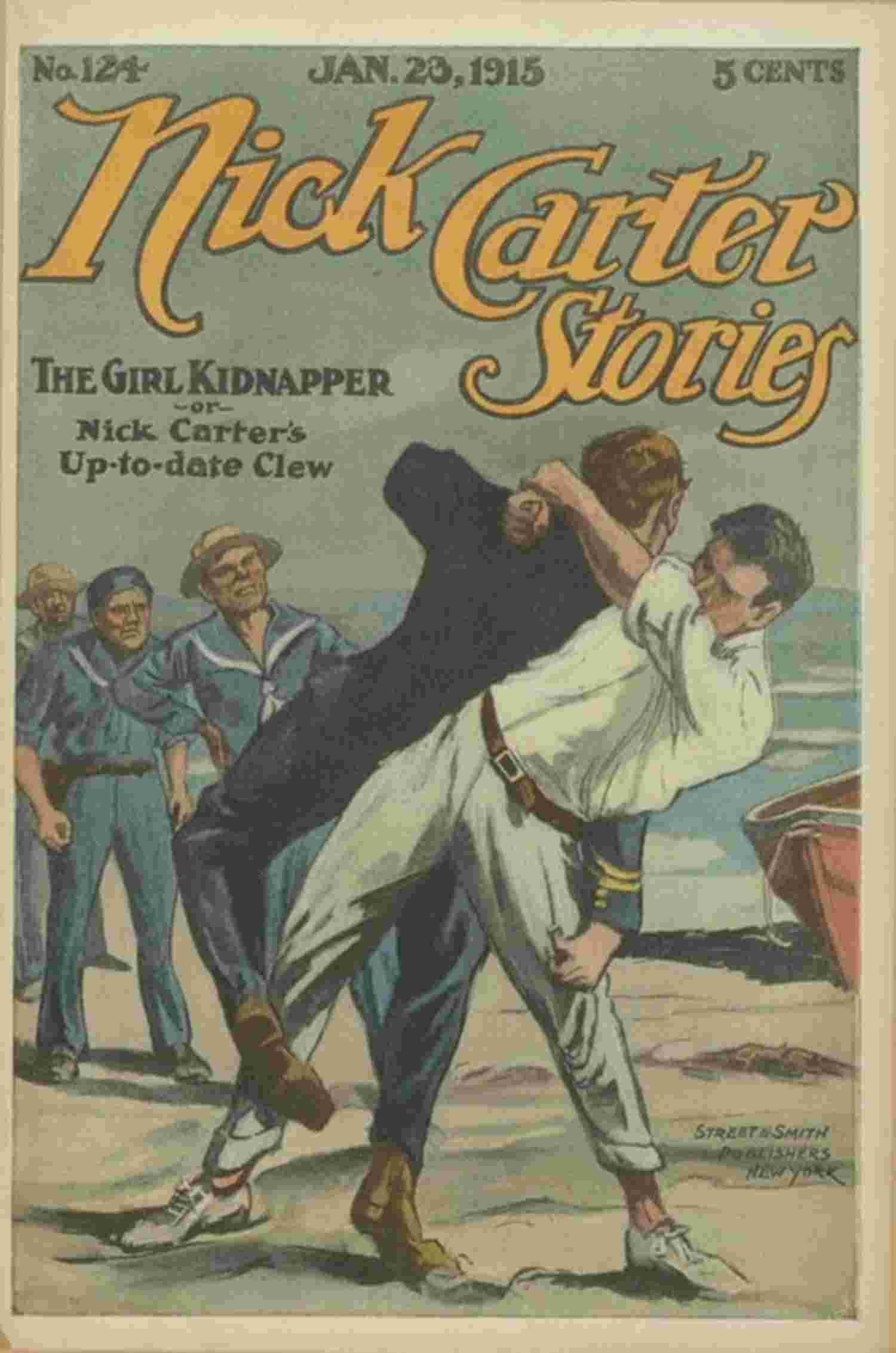
But Carter was not waiting for a bullet from the other side. For the third time he pulled his trigger. Then, taking his gun by the barrel, he used the heavy stock for a club and sprang at Kennedy, just as a shot came from the enemy and Mike Corrigan sank to the ground with a groan of agony.
The sailors might have fired again, only that they were afraid of attracting attention by the reports. Besides, seeing that Nick Carter had flung himself upon the first mate, they were for a moment uncertain what to do.
The detective and Kennedy came together with a crash. Outlaws as they were, the sailors of the piratical yacht out there in the bay were inclined to let the duel between the two giants go on till one or the other had gained a victory.
The seamen enjoyed a good fight, whether they were in it personally or not.
This was a good thing for the detective now. He was[Pg 33] perfectly aware that, if he won, they might get a chance to close in and overpower him. But, even with that, he would make a dash for freedom, to come back with reënforcements later.
Letting his pistol fall to the sand, Nick went for his tall foe with his bare fists. Kennedy, being on the defensive, parried the detective’s straight lunge, and got a knee lock on his adversary.
Nick, carried into close quarters as his opponent met his rush, started a long, slow, heartbreaking twist which was almost as grueling on himself as on Kennedy.
The latter was in good condition physically—hard as nails and full of aggressiveness. If he had been weaker than Nick Carter, the detective could not have made such progress with his mode of attack. Carter’s supple form bent to every turn, and though Kennedy tried to crush him by main strength, his adversary could laugh at all his efforts.
Then Nick took a new line—or, rather, an amplification of his first method of attack.
Slowly he threw his powerful leg outward and twined it around that of the panting first mate.
Kennedy fought hard to keep out of this lock. But he could not help himself. The hold the detective had on him was almost breaking his back, and he knew that if he relaxed for the slightest fraction of a moment, the awful pressure of Nick Carter’s steellike arms would crumple him up like a dried leaf in a hurricane.
The crucial moment came.
Kennedy was compelled to give way slightly, in the hope of relieving the pain in his breaking back. That was what Nick had been waiting for. Seizing the opening like lightning, his leg flew around to the position he had been seeking.
Now he knew he had his man under control.
Twisting with the suppleness and power of a boa constrictor, he ducked and heaved. As he did so, a gasp of involuntary admiration went up from the sailors.
There was no alternative for the first mate now but to yield or break in two.
The next instant he was sent flying over the detective’s head in a neat and scientific cross-buttock, landing upside down on the sand, where, with a groan, he lay without motion and “all in.”
Although Nick Carter was well breathed by his exertions, and gasped hard as he sought to recover himself, there was plenty of fight left in him.
The sailors came at him in a body.
With the fall of their leader, they seemed to emerge suddenly from the spell that had held them still. It seemed to Nick as if there were twenty flying fists in front of his face.
He recovered himself immediately, and, stirred to better efforts by the odds against him, he let drive scientifically and with deliberation, notwithstanding that he sent in his blows so swiftly.
One—two! One—two!
The detective’s hard fists drove right and left into the faces of the men before him.
Usually they landed on the jaw, although now and then, for a change, the target was an eye or nose.
“Come on!” roared Nick Carter, warming up comfortably with all this excitement. “How many are there of you?”
One—two! One—two![Pg 34]
In the quiet of the night, with no other sounds to be heard, the blows thudded as if some one were kicking a dog.
One of the sailors went down, but the two left came on, fighting desperately.
The detective was ready for them.
A finished boxer, he was economical of his exertions. When he struck, he always landed, and when he parried, he moved only just so much as was required to ward off a blow.
There were no fancy twists or ballet master’s gyrations about Nick Carter when using his fists in real battle.
A rain of heavy blows descended upon him. He retired just enough to get arm room, and came back steadily.
Had he had his assistants by his side, the detective could have held off these powerful seafaring men to the end.
But all he had was Mike Corrigan, and poor Mike had been put out of commission by a bullet.
So it came that even the iron physique of the great detective weakened under the strain of the last half hour.
On the other hand, the sailors were fresh. Moreover, furious at the fall of their superior officer, the first mate, they determined to avenge him at all hazards.
The two men made a rush at Nick Carter side by side, and though he sent forth a hailstorm of blows, which seemed to fairly smother them, they contrived, by shameless “covering up,” to keep on their feet, until, by sheer weight, they forced the detective to his knees.
Still fighting, he was sent forward on his face.
He had been beaten, seven against one, almost into unconsciousness!
Almost—but not quite.
He lay still, on the ground, face downward, but keeping a sharp eye on what might be going on around him.