
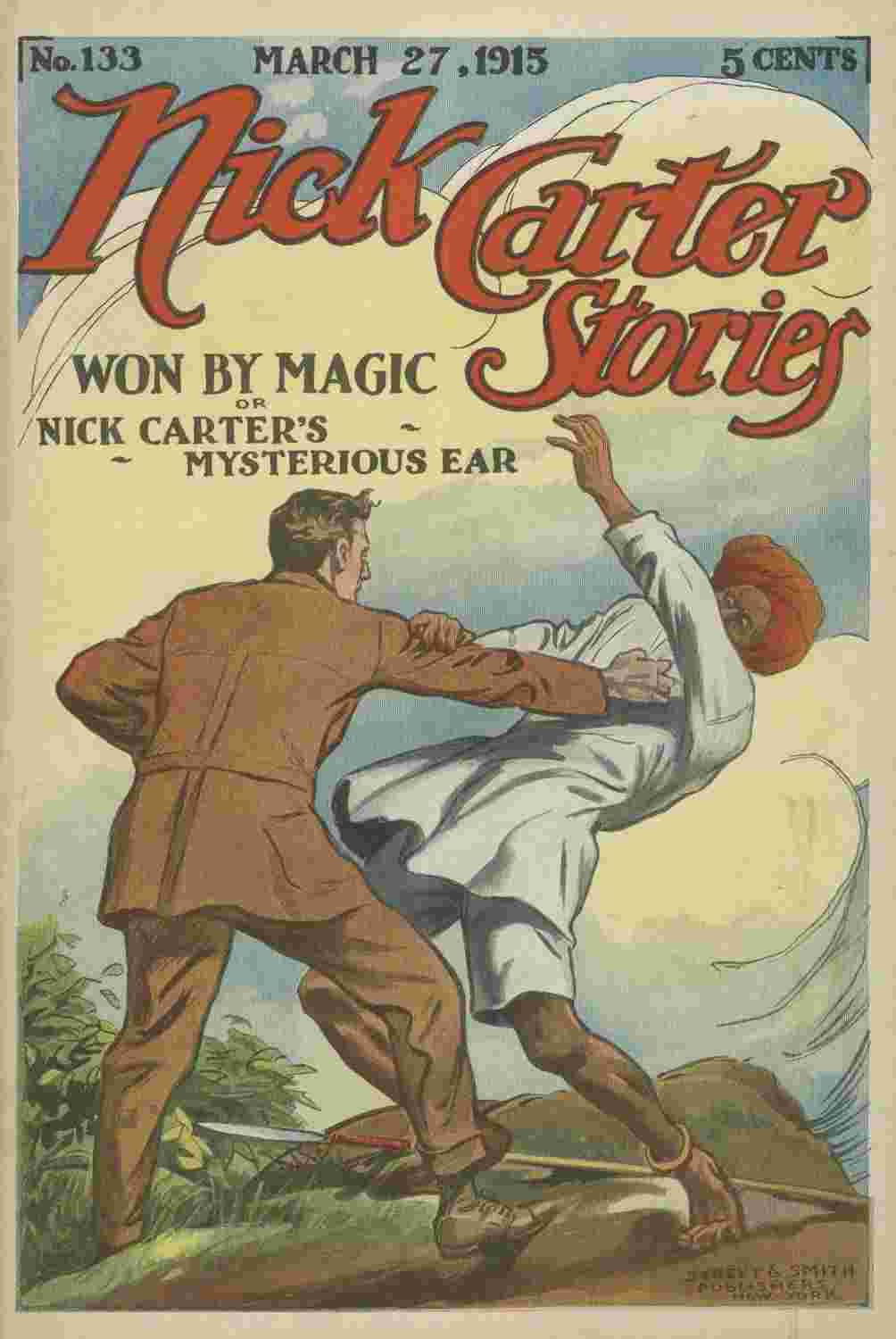
This was true. In some ingenious way, the dusky warriors had contrived to get Leslie separated from the others, and were forcing him to their rear.
“Come on, boys!” called out Nick Carter.
That was all he said, but both Chick and Patsy knew, from the tone, that it meant business.
Disdaining cover, the detective jumped into the middle of the path and rushed into the crowd of dark-browed Hindus who were shooting hatred from their black eyes as fast as they were sending arrows on their vain mission of death.
“Club your rifles and knock them down,” was Nick Carter’s order.
He swung his heavy revolver—he had no rifle—and brought down the foremost man like an ox struck by a sledge hammer. Then he darted forward until he was by the side of Leslie Arnold.
Two powerful natives were holding the young man by the arms, but in his right hand he still gripped the repeating rifle which he was no longer able to use.
With one blow of the revolver, Nick sent the man on Leslie’s left to the ground, and shooting out his left fist almost simultaneously, he caught the other fellow and laid him flat by the side of his comrade.
“Get to work with your gun, Leslie!” shouted Nick Carter. “Here come more of them!”
Indeed, it seemed as if there were no end to the evil-looking rascals now.
They came from below, as well as above. There was murder in every one of their fierce, scowling faces.
“It’s no use!” exclaimed Leslie Arnold. “They have us now. We can only try to fight our way down the hill, and get clear if we can.”
“You bet we can!” yelled Patsy Garvan, who had been fighting so hard that he was bathed in perspiration. “We can wipe out the whole works, if we stick to it. Come on, Chick! Watch me lay out that crooked-eyed citizen in front—the one who is swinging the spear.”
Chick had emptied the magazine of his rifle, but the weapon made a splendid club, and he circled it viciously in the air, so that it cleared the way all around him.
But, fight as they would, it was apparent that the small party could not hope to prevail against all these savage Hindus. There seemed to be fifty, at least.
It was now, when the situation looked hopeless, that an inspiration came to Nick Carter.
He saw that his party could not win with ordinary weapons. But he might use something else. It was worth trying, at all events.
With a loud shout of “Look! All of you!” he raised his hand and held before these men from the Land of the Golden Scarab, something upon which the sun shone redly and seemed to endow with life as he waved it about.
For a space while one might count three there was silence. Then, as Nick stepped forward, holding the object, whatever it was, in his hand, and pushing it into the face of the first man in the rank, an awful shriek arose, and the whole crowd turned and fled.
“Holy Gumbert!” cried Patsy. “What’s the answer?”
“Chase them!” ordered Nick. “After them!”
“What’s struck them?” asked Chick.
“Never mind!” returned Nick. “We’ve got those fellows on the run! Keep them there!”
That the whole gathering of Bolongus had been seized with unreasoning panic was perfectly plain.
They kept on running, throwing down their spears and bows and arrows, and still Nick Carter and his party kept after them.
It was well into the night before Nick gave up the chase and called his men together.
“It wasn’t necessary to go after them so far, I guess,” he said. “But I wanted to make sure that they were fairly on their way. We are not quite into their country. But I think we may go there at some future time, if we can get a force together large enough to make sure that we shall be able to get back. For the present, we must be satisfied with having rescued Leslie Arnold.”
“That’s enough for me,” interposed Jefferson Arnold, as he put an arm over his son’s shoulder.
“But what about William Pike?” objected Leslie. “I don’t like the idea of his getting away with all that money.”
“We’ll nail him some time, my boy,” was Jefferson’s cool response. “He can’t stay over there in that wild country always, you know. It is a good place to get to when a man is running away from the law, I have no doubt. But a white man wants to get back to his own kind of people sooner or later.”
“Nevertheless, I’d like to get my hands on William Pike,” replied Leslie. “I’d choke that money out of him before he could spend much of it, I’ll stake anything on that.”
“We are pretty sure to get Pike some day,” put in Nick Carter.
“If you say so, Carter, I’m sure of it,” said Jefferson Arnold. “But, say, what is that thing you have in your hand, that scared them all and sent them flying back just when they seemed to be on top.”
“Here it is,” answered Nick, opening his hand. “It seems to have the most marvelous power I ever heard of in a small, ordinary-looking thing like this.”
“I don’t think it is very ordinary looking,” remarked Chick. “But it certainly has the ‘punch.’ It is the ear of some idol, isn’t it?”
“Yes. It is the thing that fell from the hand of that snake charmer. I never supposed it would serve us such a good turn as it has now.”
“When the priests and wise men of Bolongu find that the ear of the great Mashonu is in the hands of a white man, it will most likely mean the death of all those.”
It was Jai Singh speaking, and he swept his arm in all-embracing fashion to include all the men who were racing away in a cloud of dust a mile or more away.
“The ear of the idol Mashonu, eh?” observed Nick Carter musingly. “I have heard of that idol. I did not know I held such a precious relic. Well, I’ll take care of it. Now, everybody! Right about face! Our cue is to get back to the lower country before we have any more trouble.”
“Thank Heaven I am taking my boy back with me!” said Jefferson Arnold, in a voice that trembled with gratitude.
.
“The Secret of Shangpore; or, Nick Carter Among the Spearmen,” will tell you more about the adventures of the famous detective and his assistants in India. This story will be found in the next issue of Nick Carter Stories, No. 134, out April 3d.
ON A DARK STAGE.
By ROLAND ASHFORD PHILLIPS.
(This interesting story was commenced in No. 127 of Nick Carter Stories. Back numbers can always be obtained from your news dealer or the publishers.)
CHAPTER XXXI.
CURTAIN UP!
Klein did not join the throng in the ballroom, but went out upon the broad porch, paced it from end to end, studied the windows, and ran a critical eye along the green hedge that bordered the pebbled road. During a lull of the orchestra, the dull roar of the surf came to his ears. Remembering something, Klein walked out along the narrow footbridge to the summerhouse on the cliff edge.
There he bent down and examined a bundle that was hidden beneath a large rock, assured himself that everything was complete, then retraced his steps. Midway on the bridge he stopped.
Far below, the surf, its edges sparkling, rolled against the base of the cliff. Overhead, the white moon poured down its stream of silver.
Reaching the porch again, Klein met Mr. Lydecker and another man. One glance into the latter’s face started a flood of memories.
Mr. Lydecker greeted Klein, then turned to his companion.
“Permit me. Mr. Klein, Mr. Jarge.”
Their hands barely touched. “I believe I have had the honor of meeting Mr. Klein before,” Jarge said quietly, his black eyes searching Klein’s face.
“Yes,” answered Klein, just as quietly; “I believe we have met. It was on the Fall River boat, about a month ago, was it not?”
“Bless my soul!” exclaimed Mr. Lydecker. “Is that really so? What a coincidence, to be sure! I happened to meet Mr. Jarge on the Fall River boat, and it couldn’t have been more than a month ago.”
“It was the same night,” Klein said. “I remember seeing you on board, Mr. Lydecker.”
Klein instantly recalled the night in the smoking room, when he had watched Mr. Jarge following Mr. Klein and his daughter.
“Since that night,” Mr. Lydecker was saying, “I have always had a warm place in my heart for Mr. Jarge. He was the ship detective, you know, and bless my soul if he didn’t return my daughter’s jewels before we even knew they had been stolen. Quite remarkable, don’t you think so, Mr. Klein?”
“Very remarkable,” answered Klein dryly.
Jarge, to all appearances, did not relish the conversation, and with a mumbled excuse he sauntered away.
“Yes, sir,” Mr. Lydecker repeated, once they were alone, “Mr. Jarge won my instant admiration. I don’t mind telling you, Mr. Klein, that I have engaged this man to mingle with my guests to-night. The robbery of last week has naturally made me nervous, and I concluded I would take measures to prevent another incident like that.”
“You say that this Mr. Jarge was a detective on the Fall River boat?” Klein asked. “How did you find that out?”
“Why, he told me himself,” replied Mr. Lydecker. “Besides, he returned all my daughter’s jewelry, which she was foolish enough to leave in her stateroom when we went to dinner.”
“And I suppose Mr. Jarge caught the thief, and you prosecuted him?”
“Why, no; not exactly. You see, Mr. Jarge asked me to keep the matter quiet. We did so.”
“How does it happen that Mr. Jarge is in Hudson?” asked Klein.
“He has left the boat, and started in business for himself. He is very successful, too, I believe. I had almost to force him to take my case to-night.”
“Is that so?” Klein smiled to himself. “But did it ever occur to you, Mr. Lydecker, that this Jarge might have had a good reason for gaining your friendship in the manner he did?”
“Why—why, what do you mean?” sputtered the older man.
“Do you really know anything about him, other than what he had told you himself?”
“I can’t say I do,” Mr. Lydecker admitted reluctantly. “But I do not see any reason for doubting——”
“If you had taken the trouble to inquire at the Fall River offices in this city, you would have learned that they do not, and never have, employed private detectives on any of their boats.”
“Nonsense, Mr. Klein!” broke in the other, “I cannot believe that Mr. Jarge would deliberately lie to me. Besides, he has done me a great favor, and I appreciate it.”
“You are allowing your daughter to wear some of her most valuable pieces of jewelry to-night, are you not, Mr. Lydecker?” Klein questioned, apparently changing the subject.
“Why, yes, I have allowed her to do so. You see, it is her birthday.”
“And the majority of the women present are doing the same, I believe?”
Mr. Lydecker admitted that such was the truth. “But,” he asked, “what has that to do with Mr. Jarge?”
“It might not have a thing in the world to do with him,” responded Klein; “and again, it might.”
They were interrupted at that moment, and the conversation was dropped.
CHAPTER XXXII.
A NEW TWIST TO THE PLOT.
Klein went indoors, and mingled with the guests. He saw that Tod was playing his part like a veteran. After one of the dances the two managed to exchange a few words.
“There’s some surprise in certain quarters,” Tod ventured, smiling.
“Well, it won’t do any harm, now,” Klein answered. “I knew you would be recognized, and for that reason I wanted you to keep under cover until the right time.”
“Where have you been?”
“Talking with a friend of yours,” Klein observed.
“Friend of mine?”
“Yes; Mr. Jarge.”
“Is that man here?” exclaimed Tod.
“Very much so. Mr. Lydecker has engaged him as a private detective especially for this dance to-night.”
“Good Lord!” The colt reporter whistled softly. “What do you make of it, Klein?”
“I intend making a lot of it, a little later on,” responded Klein. “At least, I hope so. At present there is just one little gap to bridge. However, don’t you forget your part in the drama.”
“There isn’t a chance in the world of my going up in the air now,” Tod replied, in a confident voice. “So, whenever you’re ready to ring down the curtain, go ahead; I’ll be in the picture.”
With this they parted, Tod hurrying back to the dance that was just starting, while Klein, avoiding Miss Lydecker, who seemed puzzled because he refused to join in the festivities, went out of the door, and stood for a time in the friendly shadows of the wide porch.
A sudden bustle among the dancers, following a waltz, told him that they were about going in for supper.
“My cue at last,” he murmured to himself, thrilling a bit at the thought of the scene that was to come. “All the guests will be in the dining room now.”
Swiftly he crossed the porch, gained the footbridge that led to Eagle’s Nest, traveled its length, found the bundle he had previously examined, took it, and went into the summerhouse. He remained there for all of five minutes, and when he emerged he was wearing a long raincoat. He came back over the bridge, gained the shadow of the house, and was on the point of entering, when he stopped short. Hurrying around the corner, and coming to a halt within a few yards of where Klein had paused, came the detective, Jarge.
At the same moment a window, just above his head, opened and something flashed in the moonlight. Jarge’s hand went out. It was all done before Klein could fully realize the meaning. Then swiftly it dawned upon him. He had expected it, but not at this moment.
Now, instantly alive to the situation, despite the fact that the scenes were being juggled, Klein stepped forward. Until that time Jarge had not seen him. At the first sound, however, the detective whirled.
“Well?” he snapped, taken off guard, his voice far from a natural one.
“I’ll trouble you for that necklace you just caught,” Klein announced quietly.
“I—I don’t know what you mean.” Jarge was plainly upset, and was sparring for time.
“Don’t hedge. I saw it. A necklace was dropped to you from that window. Give it to me!”
“I don’t know——” began the other.
Klein advanced another step, gripped Jarge’s wrist with one hand, and allowed the other to drop into the detective’s pocket. Quick as a flash Jarge turned, but not in time to prevent the discovery. Klein’s fingers brought forth the necklace from the pocket.
“You——” gasped the enraged detective.
“Don’t waste your good breath,” Klein interrupted, placing the necklace in his own pocket. “If I’m not greatly mistaken, you’ll need all of it later on. By the way, do you happen to have Miss Lydecker’s brooch with you to-night? I mean the one you got away with last week. Rather a neat plan, Jarge. Posing as a detective is quite a help, isn’t it? And winning the respect of Mr. Lydecker by first stealing his daughter’s jewels, then returning them, is another clever move on your part. You’re an artist!”
Gradually Jarge was recovering from his first shock. And as Klein finished with his accusations he shrugged his shoulders and laughed.
“Very good, Mr. Klein,” he announced curtly. “Your deductions are well conceived. You’re almost as clever an artist as myself.” He laughed again. “But whatever you’ve discovered—and I admit it isn’t a thousand miles from the truth—you’ll keep to yourself. If I have been clever in one way I have been in others. You see, Mr. Klein, I work out all my plans according to system, and they seldom fail me.”
“I’m afraid this will fail,” Klein answered.
“Not at all. Momentarily interrupted—that is all. You had better run along and forget what you have just seen.”
“You appear to be extremely confident that I——”
“It is a confidence inspired by careful scheming and mature deliberation,” broke in the detective, his voice once more assuming that quiet drawl, which since the first had interested Klein. “And of course you will not think of mentioning to-night’s incident, Mr. Klein, realizing the circumstances that surround you.”
“I know of but one circumstance that could seal my lips,” replied Klein, “and that would be an extreme one. As there are slight prospects of such a miracle taking place, I’m afraid, Mr. Jarge, you will be compelled to accompany me into the house. I’m sure Mr. Lydecker will be interested in learning the identity of the——”
“Don’t you think the police of New York City would be as interested in finding you, Mr. Klein?” interrupted Jarge.
Klein’s lips hardened. This, then, was the weapon with which the detective hoped to club him into silence.
“I am quite willing to return to New York—after to-night,” he replied.
“It would be rather unpleasant, would it not? A man accused of assault to kill is not granted many favors. I do not like to see you deliberately put your head into a noose, Mr. Klein. Especially as I have twice saved you from capture.”
“What’s that?” Klein’s heart started throbbing just a trifle faster than normal. “You saved me?”
“Yes. I was the unknown who aided you to escape that night in Mrs. Wold’s boarding house. And several nights later, on board the Providence, I saved you from a certain zealous newspaper reporter, who had taken passage with the intention of apprehending you.”
Klein could have shouted aloud at this unexpected confession. He was glad of the heavy shadows, for his face must have mirrored his thoughts. Only a wooden man could have remained stolid under similar circumstances.
That Jarge was the unknown who had pushed him through the door that night in Mrs. Wold’s boarding house, with a whispered “Run for it!” in his ear, thereby saving him from the police, came as the proverbial bolt from the blue. Yet, instead of cowering Klein, as the other had naturally expected it would, the confession served to bridge the few remaining gaps in the otherwise perfect wall of the Delmar case.
“So in view of this, Mr. Klein,” the detective spoke up after an interval of silence, apparently satisfied that his case had been won, “I presume you have no objections to returning the necklace. Also, that you are not as anxious to report what has taken place within the past fifteen minutes.”
“On the contrary,” Klein broke in sharply, “I have no intention of returning the necklace, other than to its owner. And as for repeating what I have just witnessed, I think such a statement would sound better from your own lips. Come along, Mr. Jarge!”
The detective objected strenuously to such an arrangement, until Klein produced a revolver. The polished barrel was sufficient inducement, and he walked meekly ahead of Klein.
CHAPTER XXXIII.
THE CLIMAX.
Klein and his unwilling prisoner entered the large room, to find it cleared of all women. The men were grouped at one end of the room, and were talking in whispers. In a chair sat Tanner, his face colorless, his collar torn, his shirt rumpled. At his side stood Tod, flushed and triumphant. In front of both was Mr. Lydecker.
The moment Klein entered upon this scene, preceded by Jarge, an exclamation fell from Mr. Lydecker’s lips. Tanner, looking up, started visibly, and a silent signal seemed to flash between him and Jarge. Klein alone noticed it, but said nothing.
“Bless my soul!” exclaimed Mr. Lydecker, unaware for the second that Jarge was a prisoner. “I’m glad you’re here, Mr. Jarge. We have discovered a painful——”
“Mr. Jarge is not talking at present,” Klein interrupted. “At my request he is here to return the necklace which his confederate, Tanner, dropped to him from the window.”
“D-dropped to him?” stammered Mr. Lydecker.
“Exactly. I am glad that we managed to catch both men at the same time.” He beamed upon the excited reporter.
“I nabbed my man just as he opened the window,” Tod said. “I guess he dropped the necklace at the same time.”
Klein motioned Jarge to be seated. The detective obeyed sullenly. Then Klein brought the necklace from his pocket and handed it to Mr. Lydecker.
“Will you kindly return this to its rightful owner?” he said.
Mr. Lydecker accepted the necklace with trembling fingers. “This—this is all a mystery to me,” he gulped. “I cannot understand. I—I——” He stopped, and looked helplessly at Klein.
“Perhaps Mr. Jarge, with the proper persuasion, will return your daughter’s brooch, which he took last Saturday night,” Klein said.
“You’ll have to prove that,” snarled Jarge, his black eyes blazing. “This whole affair is—is a mistake.”
“A very serious mistake on your part,” Klein answered. Then, facing Tanner squarely, he said: “What have you to say?”
“Nothing,” replied Tanner.
“Following your instructions, Klein,” broke in Tod, “I had the police called here.”
Hardly had the words left the reporter’s lips when the chief of police himself, accompanied by two detectives, entered the room.
“What is the trouble, Mr. Lydecker?” the chief asked sharply. “Another robbery?”
Mr. Lydecker nodded. “I—I guess Mr. Klein will explain the whole painful matter to you. I am all upset.”
The chief turned to Klein, who, in a very few words, explained how he had come upon Jarge under the window just as the necklace was being dropped.
“This is the man who dropped it?” asked the chief, nodding toward Tanner.
“Yes,” said Tod eagerly.
“And it was caught outside the window by this man?” the chief went on, nodding toward Jarge.
Klein answered in the affirmative. Then he added: “Do you happen to know of a Mr. Jarge, who is at the head of a private detective association?”
“Never heard of either one of them,” was the blunt answer.
“If there was such an organization in the city you would undoubtedly be aware of it?”
“Certainly I would.”
Klein smiled. “Mr. Lydecker has been imposed upon by a pair of clever crooks; one of them an actor, whom you have probably seen in the Hudson Stock Company; the other passing himself off as a detective. Last week they got away with Miss Lydecker’s brooch, and to-night they probably figured upon a greater haul.”
“How do you happen to know so much concerning them?” demanded the chief, plainly impressed, yet at the same time perplexed.
“I have been interested in the case for the past month,” Klein answered frankly.
“Are you a detective?”
“I am an actor, who for a certain reason found it necessary to play the rôle of a detective,” announced Klein.
“And that reason?” insisted the chief.
“The best reason in the world—for self-defense!”
“It is rather unusual for a man in your position to assume such a task without——”
“Will you allow me five minutes for a full explanation?” Klein asked. The chief agreed.
“A month ago,” began Klein, “a friend of mine, Charles Delmar, was found unconscious on the roof of his boarding house, in New York City.”
“I recall the case,” broke in the chief, nodding.
“Previous to his assault, I was with him. I had stopped in on my way to the Albany Hotel, where I expected to get a theatrical engagement. I found my friend desperately in need of money—he had been ill and out of work for six months. In sympathy for him I forced him to take my clothes—his own were in rags—and apply for the position. I remained in his room until midnight, and as he did not return, was compelled to leave, wearing his clothes. On my way through the hall I was seen by the landlady, who, before I could explain, imagined I was a thief, and called the police. Before their arrival, however, I was aided in escaping by an unknown person, whom I learned to-night, from his own lips, to be Mr. Jarge. The next day I was astounded to hear of my friend’s death, and still more surprised to learn that he was discovered on the roof of the house, clad in a suit of gray clothes.”
“What was so surprising about that?”
“The simple fact that when I last saw him he was wearing my clothes, and they were of a peculiar shade of brown,” Klein said.
The chief frowned, but nodded for Klein to proceed.
“An hour or two previous to my discovery I met a friend who declared he had seen a man entering the Albany Hotel wearing my suit. He was so positive of it that I came to the conclusion that this man was after the stock engagement sought by Delmar, and that he had assaulted my friend and changed clothes with him for the identical reason I had in changing clothes with Delmar. Realizing my own position in the matter, and the strong circumstantial evidence against me, I determined to take this clew, slight as it was, but the only one, apparently, and run it to earth. To clear myself of suspicion I had to apprehend the real criminal.
“Mr. Tod”—indicating the reporter—“is a representative of the New York News, and has been commissioned by his paper to find me. I outwitted him in New York, but he managed to trace me aboard the Fall River boat, and was on the point of having me arrested when this same obliging gentleman, Mr. Jarge, interfered and prevented it.
“I continued on to Fall River, after parting from Jarge at Newport, and from there traveled to Hudson, where the stock company in question is located. Here, as a supernumerary, I started my quest. I soon learned that the manager had signed three men that night in New York—Metcalfe, Tanner, and Dodge. So this was a more difficult problem for me to solve. I had to discover which of the three men was the right one, and at the same time keep my intentions secret. By substituting a photograph of my friend, Delmar, for another picture used in one of the scenes, I eliminated Dodge, and narrowed the suspicion down to Metcalfe and Tanner, both of whom had shown much concern over the photograph, and later demanded its removal from the frame.
“One night, in my dressing room, Tanner dropped a newspaper clipping, which I found and read, and which I thoughtlessly wrapped about a stick of grease paint, and placed in my make-up box, little thinking it would prove to be of any consequence. Last Saturday night, at a dance given in this house, Miss Lydecker’s brooch was stolen. At first the case appeared to be a most puzzling one, since none of the men had left the room, and all of them readily submitted to a search. After I arrived home that same night I recollected that just before the brooch was missed, Tanner had opened a window. I saw instantly that in this way the brooch had been dropped to a confederate below. I also remembered that earlier in the evening Miss Lydecker had seen a man skulking along in the shadow of the hedge. I made a search, but found nothing. This man Jarge evidently had been Tanner’s confederate.”
“Why did you not inform me of this?” broke from Mr. Lydecker, who was greatly agitated over the explanation.
“Because I was not positive,” Klein replied, “and I did not care to make accusations until I had the proofs.”
“Please continue, Mr. Klein,” said the chief of police.
“Three days ago,” Klein resumed, “while on a trip to Fall River, I was fortunate enough to save Mr. Tod from the hands of several enraged strikers. While this meeting was a surprise to me, and to him as well, the fact that he was wearing my brown suit—the suit taken from Delmar on the roof of his boarding house—was a still greater one. From Mr. Tod, who then refused to believe me guilty of the Delmar assault, owing to my action in protecting him, I learned he had been in Boston, and while there had chanced to overhear a conversation between two strangers which convinced him that Jarge was not a detective, but a clever crook posing as one, and known to those of the underworld as ‘Doc.’”
The attentive chief of police exclaimed sharply: “Doc? Why, that man is wanted in half a dozen parts of the country!”
“Then you’ll have the honor of arresting him,” Klein replied. “Meanwhile,” he went on, picking up the thread of his story, “Tod informed me that he had purchased my suit in a pawnshop opposite the station in Fall River. In searching the pockets we found a piece of folded newspaper. I saved it. A part of the paper is torn, and the clipping Tanner dropped from his pocket that night in my dressing room just fits that torn part!”
Tanner, who had remained silent while the evidence was piling up against him, suddenly leaped to his feet.
“It—it’s a lie!” he burst out. “A lie! You can’t——”
Tod jerked him back to his chair. “Sit down!” he commanded, glorying in his position. “When we want you to talk we’ll let you know.”
“Mr. Tod recognized Tanner as one of Mrs. Wold’s roomers,” Klein continued, “and that same night I sent her a telegram. In answering it she mentioned the fact that Tanner had occupied a room adjoining Delmar’s, and on the morning of the assault had disappeared. She said, also, that a slim, black-eyed stranger was a frequent visitor to this room. From then on my case was as good as finished. I enlisted the services of Mr. Tod, and together we have managed to bring the little drama to a satisfactory conclusion.”
Tanner, white-lipped, trembling with suppressed agitation, was on his feet again, despite Tod’s effort to prevent him.
“There isn’t a shred of truth in that yarn!” he cried hoarsely. “I—I didn’t take the necklace—nobody saw me! I don’t know a thing about this Delmar case! Never heard of it! I tell you it’s all—all a lie!”
Klein, awaiting the favorable opportunity to spring his final and greatest surprise, suddenly stripped the raincoat from his shoulders, and faced the stammering, protesting Tanner.
A dead silence followed—few realized the situation—broken sharply by a scream from Tanner, as, wild-eyed, his nerves shattered by the strain he had labored under, and the story he had been compelled to listen to, beheld the telltale brown suit on its rightful owner.
One staring, agonized look, as though on the accusing face of his victim, and Tanner’s spirit was broken. He was no weakling, but before this unexpected and daring stroke of Klein’s the actor collapsed.
Another outburst followed the first, and, as if desirous of fleeing from further torment, Tanner whirled, knocked the astounded reporter aside, and sprang through the window.
CHAPTER XXXIV.
UNTANGLING THE WEB.
“Watch Jarge!” cried Klein to one of the detectives, as he sprang through the window, followed by the chief of police.
Tanner fell upon the porch, scrambled madly to his feet, gazed bewilderedly about him, then dashed away over the narrow footbridge that led to Eagle’s Nest. Klein and the chief were a few paces behind.
At the summerhouse Tanner hesitated, vainly searching for an avenue of escape, seeming to realize, for the first time, that he was trapped. Suddenly, with a despairing cry, followed by a mocking, hysterical laugh, the actor-crook deliberately hurled himself against the frail railing, and as Klein darted forward with a cry of horror on his lips, Tanner disappeared over the edge of the cliff.
“Good Lord!” exclaimed the chief, reaching Klein’s side. “The man must have been mad!”
The two men peered over the cliff’s edge. The white surf dashed at the rock base, thundering its eternal song, and the curling foam glistened in the moonlight like lace. That was all.
The men retraced their steps. As they reached the porch the chief said:
“There’s a strong undertow along here, but I’ll have my men look for the body.”
When the news was given to those inside the house, Jarge’s cloak of indifference dropped. Tanner’s death broke his nerve. He huddled back in his chair, as if fear had come to him for the first time.
“I—I guess there’s little use—in playing the game—to win, now,” he murmured, his voice all but a whisper. “Let me congratulate you, Mr. Klein. You’ve whipped me at my own game. Tanner and I overheard you that night in Delmar’s room. We were both pretty well down and out. We decided to get the engagement in Hudson, and——” He stopped, and was silent for a moment. “Well, you see how it has all turned out. Tanner hit Delmar, but he didn’t intend to kill him. All he wanted was the suit; his own was in rags. I saved you—later in the evening—because I thought if you were caught your story would set the police on a new trail. As long as you were suspected, and kept out of sight, suspicion would not be turned our way. I did the same trick on the boat. I stole Miss Lydecker’s jewels and returned them to Mr. Lydecker, passing myself off as a ship detective. I did this so that I might win his friendship. Tanner and I had long planned to rob this house.”
“Bless my soul!” was all that Mr. Lydecker could say.
“And what about this suit?” questioned Klein.
“I pawned it in Fall River.”
“And it was you, a week ago, whom Miss Lydecker saw?”
“Yes.” Jarge put a hand into his waistcoat pocket, and brought out the brooch. “I haven’t much use for this, now,” he said. “I have carried it about with me because I didn’t care to trust it to any one else, and I believed detection was next to impossible.”
The chief of police took it, and handed it to Mr. Lydecker.
“I guess that is all,” Jarge said, his hands falling limply into his lap. “And I’m glad it is over.”
Metcalfe, the juvenile man, who had been a silent witness to the whole affair, suddenly stepped forward.
“Perhaps you’ve wondered why I was so upset the night you put Delmar’s photograph in that ‘prop’ frame. Well, I suppose it was foolish of me at the time. But it happened that on the very day Delmar was assaulted, and probably just before you came, Klein, I visited Delmar in his room, and we had an unpleasant argument. Delmar was for throwing me out. We talked rather loud in the hall, and I noticed that a number of the roomers were taking some interest. Then, when I read the next morning that Delmar had been found unconscious, I—I instantly recalled our words, and fancied suspicion would fall upon me. That explains my actions.”
“I was puzzled at first,” Klein told him, “when both you and Tanner acted so suspiciously. And it was not until I had the case well unearthed that I realized you could have had no vital concern in the matter. Now, of course, your explanation clears everything.”
Mr. Lydecker offered the use of his automobile to the chief, and it was readily accepted. The two detectives, with Jarge between them, left the room. As the chief followed he turned to Klein.
“You’ll be the important witness in this case, Mr. Klein. I suppose Mr. Lydecker will vouch for your appearance?”
“Willingly, sir,” answered Lydecker.
“Just a minute,” broke in Tod. “Will you take me to the city? I’ve got to send my story in to the News.”
“Plenty of room,” the chief answered, smiling at the colt reporter’s eagerness.
“Can you imagine Reed’s surprise when he gets this?” Tod whispered aside to Klein. “Great Scott! This is one of the scoops you read about! See you later.” And he hurried out to the waiting automobile.
* * * * * * *
After the publication of Irving Tod’s sensational scoop, Mr. Reed, the editor of the News, came to the conclusion that, after all, a son-in-law like Tod was not the worst thing that could be wished upon him. As for Claire Reed, she admitted, in time, that the possession of a devoted husband was more to be desired than a life sacrificed to the stage.
Hobart Klein is still a member of the Hudson Stock Company, but his name goes on the billing as “Owner and Stage Director.” As actor-manager he has been called upon to assume many rôles, but his most successful one, from a personal viewpoint, has been that of a husband; and he is upheld by a very able critic, Mrs. Helen Lydecker Klein.
THE END.
HIS EXACT SIZE.
There is a kind of selfish smartness which makes a man think well of himself, but which renders him a laughingstock, nevertheless. One rainy day, when a shoe shop was full of customers, a man entered hurriedly, and speaking to an assistant, who was fitting a lady, said:
“Can you show me some of those you advertise? I am in great haste.”
Excusing himself to the lady, the assistant proceeded to wait upon the newcomer. Pair after pair of boots were tried on, and finally a perfect fit was secured.
“Now, what make are these boots?” inquired the man. “They fit me like a glove. Just write down the make, with the exact width and length.”
The salesman did as required, and the man drew on his old shoes and started for the door.
“Don’t you want the boots, sir?” inquired the surprised assistant.
“Oh, no,” responded the man. “I just wanted to get my size. I have a friend in the wholesale business who can get them for me at a good deal less than your price,” and he went off, followed by the unspoken opinion of the salesman and the laughter of several customers who had witnessed the affair.
A HINT TO TEACHERS.
Two teachers of languages were discussing matters and things relating to their profession.
“Do your pupils pay up regularly at the end of each quarter?” asked one of them.
“No, they do not,” was the reply. “I often have to wait for weeks and weeks before I get my pay, and sometimes I don’t get it at all. You can’t well dun the parents for the money.”
“Why don’t you do as I do? I always get my money regularly.”
“How do you manage it?”
“It’s very simple. For instance, I am teaching a boy French, and on the first day of the quarter his folks don’t send the money for the lessons. In that event I give him the following sentences to translate and write out at home: ‘I have no money. The quarter is up. Hast thou got any money? I need money very much. Why hast thou not brought the money this morning? Did thy father not give thee any money?’ That fetches them.”
WHERE’S THE JOKE?
Daniel Webster liked to make remarks of a character intended to puzzle simple minds. Stopping to dinner one day at a country inn on his way to Marshfield, he was asked by the hostess if he usually had a good appetite.
“Madam,” answered Webster, “I sometimes eat more than I do at other times; but never less.”
The inhabitants of the village where this profound Hibernicism was uttered, have probably been at work ever since trying to comprehend its exact purport.
THE NEWS OF ALL NATIONS.
Eat More Corn Bread.
The suggestion that the American people get better acquainted with corn as a breadstuff, made in Mr. Boyce’s talks recently, has brought many commendatory letters. Mr. Boyce called attention to the fact that corn is a universal crop in the United States. Demand from Europe has made wheat prices high, but Europe has not yet learned to eat our corn.
“Your advice should be heeded by everybody, in the cities and in the smaller places and country,” says one letter, from an Iowa town. “Corn has been selling at from seventy-two to seventy-seven cents a bushel. Bulk cornmeal of good quality can be bought for three to five cents a pound. As you say, there is no better food in the wintertime. People have been eating too much wheat.”
Another says: “We should eat more corn, instead of so much wheat, and also more graham flour and oatmeal. They all furnish the best kind of nutriment.”
Eating of potatoes, rye bread, rice, oatmeal, and similar foods is also advocated. More attention should be paid to vegetables as a partial substitute for bread.
Corn is as healthful as it is economical. Those who make a practice of eating corn bread rarely suffer from indigestion, constipation, or kindred complaints.
Eighty-three, But He’s a Speeder.
Though Alfred S. Hensley, of Stanhope, N. J., is eighty-three years of age, he would not be “dared” by some of his cronies, who wagered that he would not ride a motor cycle. Hensley was telling them how some years ago he was a “speed maniac” with a motor cycle. They laughed, and the old man jumped on the seat of a motor cycle and was off down the Stanhope-Newton Road like a shot. He went about half a mile and then turned back, covering the last quarter of a mile in sixteen seconds, and as he set the machine against the curb, he pocketed a wager with the remark:
“Well, I guess I’m still one of the young uns.”
All Five Shots Hit Villain of a Play.
Lewis Benton, who has lived near Shingletown, Cal., fifty miles from a railroad or town, all his life, came to Sacramento the other day to settle up a timber claim at the United States land office.
Benton, who had read a great deal about the white-slave traffic and had heard something about moving pictures, looked up a newspaper reporter who had spent the summer with him, and together they attended a picture show.
Real trouble was reeled off at the theater. The films showed a stirring play, in which a deep-eyed villain with a silk hat and a cane did his worst for three reels. During the most thrilling portion of the play, when the villain tried to hurl one of his fair victims from the sixth story of a building, Benton could contain himself no longer.
He whipped out his forty-four-caliber revolver and began shooting at the screen. After the police had seized and hustled Benton away, the screen was examined, and it was found each of the five shots hit the curtain within the space of a silver dollar. When the pictures were run again, it was found that the villain was struck between the eyes by every bullet.
The newspaper man had a hard time explaining Benton’s action to Police Judge Waldo Thompson. The judge finally consented to let Benton return to Shingletown minus his “shooting iron.” The revolver was sent to him by parcel post.
Finds Money in a Chimney.
When he moved into a recently purchased house, Floyd Wilkins, of Georgetown, Del., was overjoyed to find a sum of money hidden behind a loose brick in the chimney. The money is supposed to have been placed there by the former owner of the house, who died several years ago. Wilkins has not disclosed the amount.
Pathetic Romance of Aged “Lonesome Bill.”
While hunting for coon in the mountains north of Big Laurel, Va., the hunters came upon the cabin of old “Lonesome Bill,” and seeing no light in the house, investigated and found the old man dead. Whether the aged hermit froze to death or died from illness no one knows, but it is thought that he had been in poor health for some time, and it is likely he succumbed to old age.
His exact age is not known, as all his family have long been dead or moved away, but it is supposed that he was near one hundred years old, probably older. The old man was seldom seen away from his mountain home, and how he lived is still a mystery. It is said that at the age of eighteen or twenty he came to the mountains from the eastern part of the State, with his father, mother, and three sisters. They were all nice people, and Bill was well educated, having graduated from some Eastern university. He fell in love with one of the mountain girls near where his father had bought a large farm, and was about to marry her when his father, Mark Alexander, interfered.
There was some trouble between father and son, but the son finally succeeded in securing his father’s consent to the marriage, but before the day came for the wedding the girl was taken sick and died after a few days’ illness.
From the day of her death, Bill Alexander was a changed man. He went into the forest, high upon the mountainside, and built himself a rude cabin, where he lived until he died. At first he would see no visitors, and came near killing several persons, including his father.
Not many months later his father died and two sisters married, leaving his younger sister and mother alone. He received them in his cabin, and they remained with him for two days, when they sold out the farm, with the exception of his house and one acre, and left the country. The two sisters who married had already gone away with their husbands.
So Bill Alexander, the dashing young college man of eighty years ago, came to be simply “Lonesome Bill” to the mountain people, and he was left to brood over his lost love alone. All traces of his people having been lost, he was buried by the side of the cabin he called home. The cabin contained nothing of importance, further than an old tintype of a young and pretty girl dressed after the fashion of the mountaineers a century ago.
Suit Over Nail in the Bread.
A nail and a tooth of a woman’s comb or a piece of a toothpick found in loaves of bread that had not been touched by a human hand in the preparation or baking or delivery are the causes of a suit for damages brought by C. A. J. Qeek-Berner against the Ward Bread Company before Judge Aspinall and a jury in the Kings County Court, New York.
Mr. Qeek-Berner claims he found the nail and the other foreign substances with his teeth, and in so doing inflicted damage to said teeth and mental anguish to himself to the value of $50,000. The plaintiff testified he found a wire nail an inch and one-half long in one loaf of bread, and in trying to masticate it, he ruined five teeth. Later, in another loaf, he found a tooth from a woman’s comb. Counsel for the defendant insisted that it was but a common toothpick.
Thirty-mile Race to Save $25,000.
With a package containing $25,000 in cash perilously near falling out of the open door of an empty express car, a Union Pacific fast-mail train speeded westward, from Omaha, Neb., pursued by a special train carrying the messenger who had missed his car.
The race continued for nearly thirty miles before the mail was overtaken. The package of money was found just a few inches inside the open doorway.
The money package was delivered just before the train started. It was placed just within the open door, and while the messenger was registering, the train of exclusive express cars pulled out of the station. The chase immediately was begun.
Flood Kills Caged Beasts.
Flood and storm conditions approaching those which swept southern and central Arizona with disastrous results a month ago were repeated several days ago. Two cities—Globe and Miami—were isolated. In the Salt River Valley damage amounting to more than $100,000 has been done. In Phoenix the streets were rivers, and animals valued at $30,000 were drowned in a menagerie.
Ranchers in the lowlands were caught unprepared and scores were rescued from trees and housetops by boats after their homes had been swept away. Many productive areas between here and Bisbee are still covered by the flood, which in places reached the highest stage recorded in twenty years.
$25,000 to Girl Who Kept Nice and Quiet.
Just how golden constant and well-regulated silence can be made was evidenced when Miss Bertha Gretsch of New York, learned that Jacob Hyman had bequeathed her half of a $50,000 estate because she didn’t laugh and talk when he took her fishing.
Hyman, who was seventy-three years old when he died lived with Miss Gretsch’s parents for many years, and since her early childhood she was his constant companion. Being of a silent and contemplative nature, the aged man enjoined her to always sit still and not be giddy when she was about with him, particularly when he went angling. She was, however, permitted to utter monosyllables in monotone when he made an unusually good catch.
Regarding a loud laugh as one of the disturbers of philosophic calm, Mr. Hyman was opposed sternly to visible and risible mirth. And because Miss Gretsch could fish without giggling or otherwise impeding the sound of absolute silence, she is now an heiress. She is twenty-two years old and is a graduate of Erasmus Hall High School. Mr. Hyman was noted during the latter years of his life for his benefactions to Jewish institutions. He was in business for some time at 5 Beekman Street.
Another Man Restores Stealings.
W. H. Chapin, convicted of larceny by bailee in Portland, Ore., for appropriating to his use $3,500 belonging to Mrs. Marion Annie Grace, was given a full pardon by Governor Oswald West, who executed the instrument upon receiving a bond signed by Chapin’s friends guaranteeing that he would make restitution.
Mrs. Grace and her husband, an aged couple, alleged that they had placed their savings in Chapin’s hands for investment, and that he had converted the money to his own use.
Governor West notified Chapin that if he would guarantee full restitution, a pardon would be forthcoming.
“It seems more important,” wrote the governor, “that these old people should be provided for than that Chapin should go to the penitentiary.”
Government Plan to Aid Unemployed.
The Federal department of labor has completed the preliminary work in connection with the Federal employment bureau, and necessary blanks are being sent employers throughout the country and to post offices for distribution to persons seeking employment.
It is the purpose of Secretary Wilson and his department to act as a clearing house for those who seek employment and those who have employment to offer. Both union and nonunion workers and proprietors of open or closed shops throughout the country are interested in these operations of the department.
It is Secretary Wilson’s intention, it is further stated, to try to induce municipalities which contemplate building projects and public improvements to begin their work as soon as possible. Mr. Wilson believes the greater part of this work should be done in times of industrial depression and less should be done during periods of great industrial activity.
Finally, the secretary of labor believes it will be necessary ultimately for the Federal government to actually put the unemployed on the land. He favors a plan much like the one provided for Ireland by the Gladstone bill. The government bought the land, cut it up into small farms, built houses and other improvements, placed a family on each farm, and received payment in amounts little larger than taxes.
War Costs Germans Trade in Chemicals.
The German exports of chemical products, in the manufacture of which that country undoubtedly led the world, have been virtually entirely cut off since the outbreak of hostilities. Last year they attained the enormous figure of about $250,000,000.
German experts in this trade, however, express no fear as to the future. They are of opinion that the competition which has started in other countries will, after the cessation of the war, only tend to sharpen the edge of the inventiveness of German chemists, who will, they say, be able to make further chemical discoveries which will place them in a position at least equal to that which they have hitherto held.
Quitting Booze and Smokes.
Under the conditions that he neither smokes nor uses intoxicants until he is thirty years of age, Charles Gordon Emery II., of Watertown, N. Y., is left the sum of $50,000 in trust by the will of his grandfather. Charles G. Emery, the tobacco millionaire, filed for probate here to-day. The estate amounts to between four and five million dollars.
Bear Curfew in Jersey.
Women and children of Vernon, N. J., are staying indoors nowadays from fear of bears. Two or three have stolen sheep and beehives lately, carrying their loot into the woods and swamps on the outskirts of the town. Hunters are organizing to put a stop to the bear raids.
Thanks Good Samaritan of ’61.
A resolution was adopted by the legislature of Vermont commending Mrs. Bettie van Metre, of Berryville, Va., for her care of Lieutenant Bedell, of Westfield, Vt., after he was injured during the Civil War.
Lieutenant Bedell’s leg was broken by a shell in a battle at Opequon, Va., and he was left behind by his regiment. He was picked up unconscious and carried to the house, where he was left in an attic room for three days without proper care, until Mrs. van Metre, then a girl of twenty years, heard of his condition, and insisted on acting as nurse. She watched over him, regardless of criticisms, until he was able to be moved back to his Vermont home. She then accompanied him on a troop train, and afterward returned to Virginia.
Indians’ Football Dates.
The athletic officials at the Carlisle Indian School have announced the 1915 football schedule, which contains one game less than last season.
Cornell, University of Pennsylvania, Notre Dame, and Syracuse have been dropped, and Harvard, Bucknell, and Fordham take their places.
It has not yet been decided as to who will coach Carlisle on the gridiron during the coming season, although there are a number of applicants, among whom are former Indian football stars, as well as graduates of leading universities.
The schedule follows:
September 18, Albright College vs. Carlisle Indians, at Carlisle; September 25, Lebanon Valley vs. Carlisle Indians, at Carlisle; October 2, Lehigh University vs. Carlisle Indians, at South Bethlehem; October 9, Harvard University vs. Carlisle Indians, at Cambridge, Mass.; October 16, University of Pittsburgh vs. Carlisle Indians, at Pittsburgh; October 23, Bucknell vs. Carlisle Indians, at Carlisle; October 30, West Virginia Wesleyan vs. Carlisle Indians, at Wheeling, W. Va.; November 6, Holy Cross College vs. Carlisle Indians, at Worcester, Mass.; November 13, Dickinson College vs. Carlisle Indians, at Carlisle; November 20, Fordham University vs. Carlisle, at New York City; November 25, Brown University vs. Carlisle Indians, at Providence.
Has a Five-footed Pig.
R. S. Givens, living between Georgetown and Laurel, Del., has a hog which has five perfectly formed feet. The freak is attracting much attention from the residents in the western part of the country, and hundreds have been to see it within the past few weeks.
Worked Fourteen Years, Never Asked Pay.
Here is a man who worked for about fourteen years as a clerk without compensation. He is Edward A. Noonan, of New York, who went into the employ of John Fox & Co., manufacturers of iron pipes, on August 23, 1900, but he never received anything for his work except a promise of twenty-five dollars a week.
The remarkable fortitude of Noonan in waiting fourteen years for a pay day that never came around, figures in the accounting of the estate of John Fox, late representative and president of the National Democratic Club, which was filed in the surrogates’ court yesterday. Mr. Fox was senior member of the firm that employed Noonan, and the latter has made a belated claim for $19,500 back salary.
Even while the affairs of the estate were being straightened out in the office of former Surrogate Charles H. Beckett, attorney for the executors, Noonan did some clerical work in connection with the estate. But he never mentioned anything about his claim. The estate also advertised for claims, but Noonan paid no attention.
Not until the accounting was to be filed did he assert his desire to be paid his salary. However, there will be no pay day for the unpaid clerk in the near future, as the estate is not inclined to recognize the claim, and it will be made the subject of a jury trial in the surrogates’ court under the new law.
The accounting shows that John Fox, son of the former politician, received only $1,121 as his first year’s income from the estate, while Eleanor B. Fox, granddaughter, received $1,000, and Mrs. Catherine O’Brien, a niece, a similar amount.
1,827,000 Persons Get Aid in France.
Official statistics give the number of applications for government aid as 2,116,000, of which 261,600 were refused. At present daily allowances are paid to 1,857,000 persons, the average a family being two francs 10 centimes—forty-two cents. The daily outlay is 3,900,000 francs—$780,000.
Much Despised Weed Has Medicinal Value.
Thymol is an important antiseptic. For years it has been manufactured almost exclusively in Germany, from a plant cultivated in India. At the beginning of the European war the price of this medicinal chemical rose from two dollars to seventeen dollars a pound.
“Yet during all these years,” says Professor E. Kremers, of the University of Wisconsin, “while we have been importing about ten thousand pounds of thymol annually, a weed growing on the sandy areas along the lower course of the Wisconsin River has probably been producing enough thymol to have supplied the entire United States in the present crisis.”
Although attention has been directed again and again to this medicinal agent, this weed has been allowed to go to waste. Because of its thymol, it is not even touched by grazing cattle or sheep. Yet after the thymol has been removed, the exhausted plant is eaten by animals, and may thus be converted into a useful agricultural product.
Now that the supply from Europe is cut off, requests for seed and plants have been received at the Wisconsin pharmaceutical experiment station.
Once Rich, Now Beggar.
Unshaven and shabbily clad, “Colonel” William Wayne Beldin, who says he was at one time independently wealthy, was found guilty of mendicancy by Magistrate Deuel, in the Tombs police court, New York, and sentenced to the workhouse for ten days.
Beldin, who retains traces of his former gentility, says he was at one time vice president of the Chicago & Northwestern Railroad. Unfortunate speculation in Wall Street, he says, dissipated his fortune, and for a time he was supported through allowances paid to him by relatives and former friends.
Five years ago these funds ceased to be forthcoming, and he obtained a position as a waiter in a small restaurant. Finally he lost even this humble position.
According to Patrolman Gavan, of the Old Slip Precinct, Beldin was begging Saturday night from passers-by opposite the Stock Exchange. After he was placed under arrest, he told the police he had relatives in the South who would be glad to care for him if he could find them.
One Day of Rest Upheld.
The constitutionality of the law securing to employees in factories and mercantile establishments twenty-four consecutive hours of rest every week, as applied in New York State, was upheld by a unanimous decision of the court of appeals in that State.
The decision was given in an appeal from judgments of the city court of Buffalo convicting the Klinck Packing Company, of that city, of violating the law. The statute is known as “the one day of rest in seven” law. The employers will carry the case to the United States Supreme Court.