
CHAPTER XI.
WHAT THEY ALL SAY.
“The crew are all forward,” explained Nick, in low tones, as the two kept well in the shadow of the cabin, where they could look along the deck. “It won’t be difficult if we are careful. I know the layout of this yacht very well. It belongs to Judge Millings, and it has been leased to these people for two months.”
“I didn’t know that,” admitted Chick.
“You could have found it out if you had made inquiries, as I did,” answered Nick quietly. “We can get to the cabins of these two men and open them very easily, without disturbing anybody else. We’ll have to gag and bind them. But we can tackle each one separately, so it won’t be hard to do.”
“That sounds all right. Are we to begin the job now?”
“Yes. There is nothing to wait for. We’ll get Solado first, because his stateroom is nearest to the companion-way.”
Nick led the way to a corridor on the other side of the boat from the one that communicated with the cabin he had occupied, and which he had locked when he came out, in case there should be any one prying about.
“Here’s the door, Chick. I’ll open it.”
Softly and skillfully, Nick Carter introduced his wire and turned the lock.
He stepped inside, closely followed by Chick, both walking on their tiptoes, and without the least noise.
It was quite dark. But the detective knew where the bed was, and he moved over to it without hesitation. Then he uttered a low exclamation of surprise.
The bed was empty!
“Hurry, Chick! Let’s get out of this! There’s something going to happen. They’ve found out that I have got away!”
“Where’s the other cabin?”
“Farther along! Let me see!”
Nick rushed forward. He was not astonished when he found that the other cabin was not only unoccupied, but that the door was unlocked and partly open.
“Let’s get out, Chick! I guess the whole yacht is on the qui vive! The rascals have laid a trap for us.”
“Do you think they know I am aboard?”
“I hope not! That will give us an advantage if we can surprise them by being two, instead of one. Come on!”
Nick led the way to the short flight of steps leading to the big door that gave upon the deck.
As he had expected, the door was fastened. The only bolt was inside. But there was a lock that could be operated either without or within.
“The lock is nothing, Chick! We can burst that!” whispered Nick. “Now! Together!”
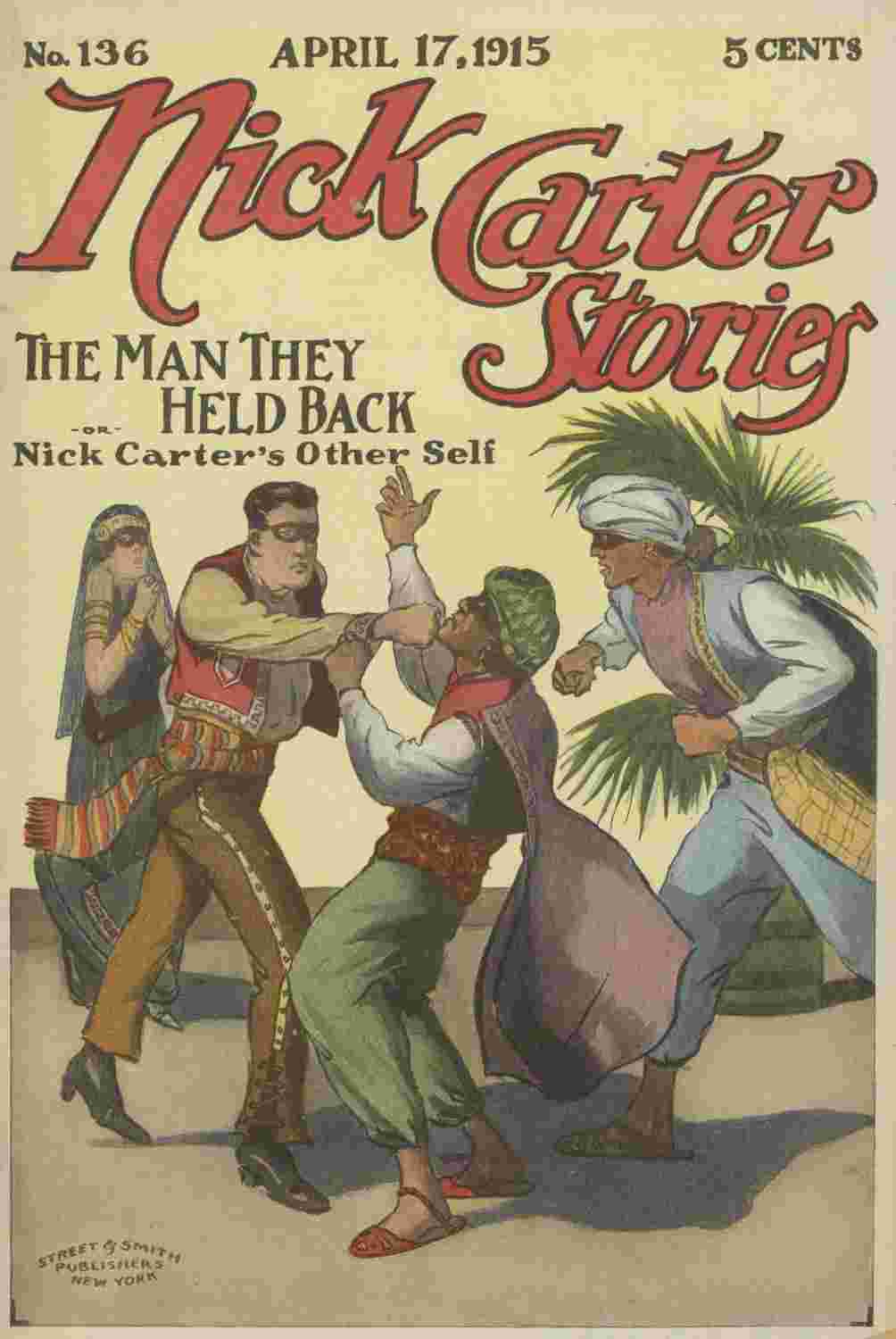
The two hurled all their weight against the door. The lock broke away, and Nick Carter found himself in the arms of Prince Miguel, the bigger of the two ruffians.
There was a desperate struggle for a few minutes, and then Jean, the valet who had been attending Nick when he came aboard—showing him his dry clothing and explaining to him that his bath was ready—tried to help his master.
It happened that Nick was held in such a way that his left arm was free. He sent a swing at the valet that knocked him spinning down the deck, where he lay without movement.
The sailors at the other end of the yacht had not been told of what was to take place.
As Nick had said, the yacht was hired for two months from the multimillionaire, Judge Millings, and all the crew went with the vessel. It was not likely the sailors belonging to the yacht would take a hand in anything that looked too bad.
“Don’t you suppose they knew Marcos was a prisoner?” Chick had asked.
“Not likely. Marcos was allowed to go about the yacht as he chose. We have proof of that in the fact that he attacked Miguel when he was sitting on the deck, smoking. They relied on there being no boats handy, and on the watchfulness of that scoundrelly valet, Jean, who was really his guard, I should judge.”
Now that there was a quiet, but strenuous battle on, the crew were in blissful ignorance. Miguel and Solado had thought they were quite capable of holding Nick Carter until they should be ready to take him to some place ashore.
They were finding their mistake, for, as Nick sent the valet flying to the deck, senseless, Chick flew at Solado just when that worthy was going to help Miguel.
“You may be a big man in your own country,” observed Chick, as he twisted Don Solado’s arms behind him until he gasped with pain. “But in America we have better men than you in jail.”
He forced Solado to his back on the deck, and then slipped a pair of handcuffs on his wrists.
This had been swift work with Chick. But Nick Carter had been equally as speedy.
Miguel had been taken very much aback when he saw Jean going to the deck, and the detective had taken instant advantage of this fact to jam him against the taffrail and put on him the light, but powerful, nickel-plated handcuffs referred to in a previous chapter.
“Now, are you going to come quietly, or shall we have to wake up the crew and tell them you are a couple of rascals the police are after?” asked Nick Carter sternly.
“You shall pay for this!” hissed Solado.
“We shan’t pay as much as you will,” was the detective’s rejoinder.
“Keep quiet, Solado!” warned Miguel.
“Are you going to let them do what they want?” growled Solado.
“Yes.”
There was something in the way this word “Yes” was uttered that put Nick Carter on his guard.
He made no comment, however. Instead, he directed Chick to open the gangway where the ladder led down to the water, and then to go down by the rope to the skiff and bring it around.
“I will take care of the prisoners while you do it,” added Nick.
“Prisoners?” echoed Miguel indignantly. “Do you know who we are?”
“I know you have tried to kidnap the Prince of Joyalita, and that I got him away from you.”
“Well, what have you to do with the affairs of Joyalita?”
“Nothing. But I have something to do with sustaining the laws of the United States,” was Nick Carter’s swift rejoinder. “You can’t kidnap people here without being compelled to suffer for it.”
“But how is it any business of yours? You are not a policeman.”
“I am a detective,” answered Nick briefly, as he looked over the rail to see that Chick was bringing the boat around. “That is a policeman, I believe.”
“A detective, eh?” put in Don Solado sneeringly. “I don’t believe it. What is your name?”
“My name is Nicholas Carter.”
The two scoundrels stiffened as they heard that dreaded name. It was evident that they never had suspected that they were dealing with a man who had once brought two criminals from the very borders of Joyalita back to New York to answer to a charge of piracy they had committed near Sandy Hook.
Don Solado struggled to regain his composure.
“Even if you are Nicholas Carter, that gives you no right to treat us in this way,” he barked. “Who gave you authority to put handcuffs on us?”
“I took that on myself,” replied Nick. “Here’s the boat at the foot of the ladder. Come on! I’ll explain to the crew in the morning where you are.”
“I’ll not go!” roared Solado. “This is an outrage. It is not as if either of us had committed a crime. You can’t prove that we kidnaped any one.”
“Can’t I?” cried Nick Carter. “I believe I can. Anyhow, there is something else you will be called on to explain, that may get you into an American jail, in spite of the titles you wear in your own country.”
“What is that? What are you talking about now?”
“I am talking about a very valuable jeweled watch that you took from Prince Marcos without his knowledge, and that you lost at the ball at the Hotel Supremacy.”
The two rascals glanced at each other in the dim light of the dawn that now showed itself, and the detective saw that they were trembling.
“What do you know about such a watch?” demanded Miguel.
“I know that you had it, and lost it. I also know that Don Solado went to see Mrs. van Raikes, the hostess at that ball, and confessed to her that the watch was lost.”
“Well, where is the crime, even if what you say is true?” blustered Don Solado.
“It consists in the fact that you stole it from Prince Marcos——”
“What rubbish!” interrupted Miguel. “Is it likely I would condescend to such a contemptible crime as picking a pocket?”
“I don’t know anything about that,” returned Nick. “But I do know you took the watch. Moreover, I know where it is now. It will be brought up in evidence against you if necessary.”
“Where is the watch?” asked Solado.
“In the possession of Prince Marcos.”
“Are you sure of that?”
“Quite.”
“Then there is nothing in that to warrant your making us prisoners,” retorted Solado triumphantly.
“We’ll see about that later,” answered Nick. “The charge of abduction will do for the present. Ready, Chick?”
“All ready!” replied Chick, from below.
“Come on, gentlemen!” said Nick, leading his two prisoners to the gangway.
They looked around, as if to seek some avenue of escape. Then, giving it up, they went down the ladder and seated themselves in the stern of the skiff, as Chick directed.
“Throw your gun on them, Chick!” called out Nick Carter. “I want to speak to one of the gentlemen of the crew before I go. Shoot, if either of those men gets too obstreperous.”
In the absence of the captain and first mate, the second mate had been left in charge of the yacht.
The second mate had been in his stateroom, and so little noise had been made by Nick Carter and Chick in making the two temporary owners prisoner that he had not been disturbed till the door was broken open.
Even then he had not got up at once.
He was an honest, heavy-headed sort of man, who was a good-enough sailor, but afflicted with an abnormal love of sleep when once he got to his bed.
The fact that he could keep on deck forty-eight hours at a stretch if required—as he had done on one occasion when fighting a tearing gale in an old-fashioned windjammer in the China trade—did not interfere with his ability to sleep almost as long when there was no demand upon him.
“These gentlemen are going with me, Mr. Jarvis,” said Nick politely. “I am Nicholas Carter. You know me, I think, for I recognize you.”
“Of course I know you, Mr. Carter. You sailed with me to the South once for more than a week. I don’t forget any one I’ve once known. What is all this about? I’ll have to tell the captain, you know.”
“Say they went away with me,” answered Nick. “I’ll see the captain when he comes to New York next week. I know where he always puts up in town. Good night, Mr. Jarvis.”
“Good night, Mr. Carter! Good luck!” returned the worthy second mate.
He watched the skiff row away, with Chick at the oars, and then, with a yawn, returned to his bunk.
“It’s a funny thing, those two gentlemen going away like this,” he muttered.
A moment later he noticed the valet lying along the deck, and in a scandalized tone he ordered one of his men to “wake up that souse there.”
They found Jean was not much hurt. When he had been doused with water outwardly, and warmed up within with a serving of grog, he was as good as new, according to the seafaring men who fixed him up.
“I’ll go ashore later,” decided Jean.
Then he went to bed, regardless, in his still-dazed condition, of what had become of his employer.
“Are you going to take these fellows to the Tombs, chief?” asked Chick, as they transferred to the launch and went rushing down the river toward the city, with Nick Carter at the wheel. “Or is it a police station we want?”
“Police headquarters,” was Nick’s reply. “I think a little third degree will help matters materially.”
“You shall pay for this, Mr. Nicholas Carter!” hissed Don Solado.
“That’s what they all say,” returned the detective, with a shrug.
THE END.
“The Seal of Gijon; or, Nick Carter’s Ice-house Fight,” will be found in the next issue of the Nick Carter Stories, No. 137, out April 24th. The further adventures of the great detective with the potentates of Joyalita are given in the forthcoming number.
Dared for Los Angeles.
By ROLAND ASHFORD PHILLIPS.
(This interesting story was commenced in No. 134 of Nick Carter Stories. Back numbers can always be obtained from your news dealer or the publishers.)
CHAPTER XII.
THE UNEXPECTED.
Elliot Nash was puzzled, the morning following, when Hooker came to the shack and said that Sigsbee wished him to call at his office. Nothing was said concerning the previous night’s adventure, and while Nash was eager for an understanding, he determined to wait until after the interview with the Los Angeles politician.
He reached San Fernando at noon, and the local train set him down at the Fifth Street Station, Los Angeles, shortly after one o’clock. After the few months’ absence, the city appealed strongly to the engineer, and he spent all of an hour walking slowly in Broadway, Main, and Spring Streets, looking into the store windows, enjoying the scene of the hurrying throngs of shoppers, and amused or amazed now and then at the volley of questions fired at him by the curious, excited tourists.
The big restaurants were filled, and always in front of them stood a group of thrifty strangers, studying the bill of fare posted in the windows, and trying to decide what to order, and just what it would cost, before venturing inside.
Nash was more than interested in the types around him, who made the Los Angeles streets as lively and colorful as those of some foreign city. Here came a bevy of chattering, laughing girls, probably residents, all in white, with glowing complexions; jostling elbows with them, a Japanese family would wend their way, dressed in fashionable clothes, and carrying themselves with an air of importance—the City of Angels has many Japanese millionaires. Here and there a Spanish landowner, one of the real settlers of southern California, who still frown upon the “gringos,” as they style the Americans, swarthy of face, erect of figure, strutted past like a soldier on parade. Quaint Mexican women, bareheaded, barefooted, garbed in loose gowns of brilliant coloring, stepped in and out, following their lords and masters—thin-faced, evil-eyed, cigarette-smoking “greasers” in grimy linen suits and wearing huge, silver-trimmed, and costly sombreros—in most cases, more hat than man.
Shy, unsociable Chinese; stolid-faced men, dainty women, and big-eyed, beautiful children, all in gorgeous, flowing garments, pattered noiselessly through the crowd, apparently unconscious of the staring and remarks made by the gaping farmer from Iowa, who, with his wife and family, had spent his savings for a few glorious months in this California paradise.
Nash strolled aimlessly down Spring Street, and went into the Big Alexandria Hotel, and on through the crowded lobby to the grill. Here he ordered lunch, and enjoyed every morsel. It was nearly half an hour past the appointed time when he presented himself to the stenographer who guarded the inner offices of Mr. J. Sigsbee, in the big Equitable Bank Building. Sigsbee, while serving the city on the aqueduct construction, was interested in a large law firm.
When Nash found himself in the presence of Sigsbee, and discovered him to be none other than the man he had been refused an introduction to the previous night at Camp Forty-seven, he knew that, instead of clearing the problem was becoming more intricate.
His first impression of Jim Sigsbee was far from an agreeable one, although he was taken aback at the pleasant manner with which the politician greeted him. He imagined that the first thing Sigsbee would do would be to mention something of last night’s meeting. But in this he was disappointed.
“I am very glad to meet you, Mr. Nash,” he said frankly, extending his hand and smiling. “Please sit down.”
Sigsbee cleared away the papers from his desk, and gave orders to the girl in the outer office that he was not to be disturbed.
“Mr. Nash,” he began, swinging around in his chair, “I am a blunt man, and when I approach a subject I strike for the heart at the first blow. I have asked you here to talk over certain matters that have come to my notice. As one of the aqueduct board, these affairs interest me strongly. I have been elected to this board by the honest votes of the Los Angeles citizens, and I intend to do my duty toward them. You have found certain irregularities on foot in Camp Forty-seven. I want to compliment you, Mr. Nash. Men of your caliber are the men we desire on the great undertaking. I am not going to deny these irregularities, but I intend putting a stop to them immediately. Mr. Hooker, the foreman, is, in a measure, responsible. I have relieved him of the foremanship. The position is open to you. Will you accept?”
Nash did not attempt to mask his surprise.
“You wish me to take Mr. Hooker’s place?” he asked.
“Exactly. Hooker has proven himself to be unreliable. Camp Forty-seven is a most important station. It must be commanded by an upright, fearless man. I think you measure up to that standard, Mr. Nash.”
“This is a big proposition, and a sudden one,” Nash said. “But—well, if you will allow me to run the camp according to my ideas, I’ll accept.”
Sigsbee smiled and nodded vigorously. “Good! That’s the spirit I like to see. Since the beginning, I have interested myself in this particular camp, because I have been awarded a small steel contract. I want you to assume full charge and accept all the responsibility. Can I depend upon you?”
“You can, Mr. Sigsbee,” Nash answered. “You may hold me directly responsible for all matters of which I have charge. I believe that is one of the specifications in all the contract work, isn’t it?”
“Yes. Each foreman is supreme. To him is given all the praise, and likewise all the blame.”
“When will you want me to begin?”
“Right away—to-morrow.”
“That is agreeable to me.”
“Very well.” Sigsbee turned back his chair. “I will notify the aqueduct board at its next meeting—that is Monday. Your orders will come through me.”
“I shall obey them to the letter.”
“I’m sure of that,” said the politician, rising. “And let our motto be ‘All for Los Angeles.’” He accompanied the engineer to the outer office. “Will you step down and have a drink before going?”
Nash asked to be excused, to the other’s surprise. “Don’t indulge, eh? Not even one?”
“I’ve a lot of work ahead of me,” said Nash. “It’ll need a clear head. Thank you just the same.”
“You’ll smoke, won’t you?”
Sigsbee held out a cigar. Nash accepted it, and thanked him. He enjoyed a good cigar. Once down on the busy street, he lighted the weed, and walked slowly down to Fifth, and along this thoroughfare to the station. He was so busy with his own thoughts that he paid scant attention to what went on around him. So much had happened within the past twenty-four hours that it was small wonder he appeared preoccupied.
A hundred unanswered questions pounded at his brain; no sooner did he try to reason out one than a dozen rushed in. So, with a shrug of his shoulders, he resolved to give it all up and allow the problems to wag for a while.
“I’ve enough to do in minding my own affairs,” he told himself. “The other things will solve themselves.”
He reached the station just in time to catch a train back to San Fernando. He swung up on the last car, and made his way into the smoker. With a sigh of relief, he sank into the nearest seat.
“Well, there’s one thing certain,” he said, addressing the endless orange groves that stretched on either side of the track. “And that is, Camp Forty-seven is going to be heard from, and in the right way, for work accomplished and the cost of it.”
CHAPTER XIII.
ON THE HIGH TRAIL.
The installation of the new foreman at Camp Forty-seven provoked no little discussion, not alone in the camp concerned, but all along the busy line of aqueduct construction. It was the abruptness of the affair which probably affected the majority of the workers, and a dozen different stories were in circulation as to the real cause of the change.
Doubtlessly the men arrived at as satisfactory a conclusion as did Nash himself. While he had no great respect for the Los Angeles politician—Sigsbee—still Nash admired him for the apparent determination he had expressed in their interview that day—a determination to rid Camp Forty-seven of graft.
Whether this was Sigsbee’s object or not, or his main reason, for changing foremen, Nash speedily took matters into his own hands and put his ideas into execution. He studied out a system, held weekly consultations with his subforemen, and saw to it that they followed the lines he had drawn. There was considerable grumbling at first, principally because each man had been in the habit of doing what he pleased.
“That’s why you don’t accomplish more,” Nash told them. “You don’t pull together. Teamwork is the thing that counts.”
Gradually he gained his ends, and as gradually the work on the aqueduct allotted to his camp showed improvement. Never before had Nash worked so earnestly and with so much confidence. He felt as if on his shoulders alone rested the success or the failure of this wonderful waterway. He instilled the same fervor, the same enthusiasm, into the work of those under him, and soon the complaining wore away, and every man of them entered into the struggle with that supreme, indomitable spirit that recognizes no such word as failure.
One blistering hot afternoon, when he was riding slowly over the high trail that led from the main road to the camp, Nash heard the wild gallop of hoofs behind him. Before he could turn, a frightened horse dashed past, careening madly down the path, threatening each second to topple into the ravine below.
Nash drew rein. “That horse was saddled,” he said aloud. “I wonder if there’s been an accident?”
He struck his pony sharply, and descended the trail. Half a mile on he stopped, uttered an exclamation, leaped from his saddle, and knelt beside the quiet form of a woman. She was lying in a matted clump of scrub oak, where the horse had probably thrown her.
Carefully he drew an arm away from her face. There was a cut above her closed eyes, and the crimson had run down over her cheek, staining the lace on her collar. She seemed so quiet, so very white, that for the instant Nash believed she was dead. It was only when he took his handkerchief and wiped her forehead that she sighed and allowed her eyes to flutter open.
“Just in time,” he said encouragingly. “Not hurt much, I hope?”
She seemed conscious suddenly of where she was, and of what had happened. She sat up and passed a limp hand across her eyes.
“I—I guess not,” she faltered unsteadily. “My horse threw me. I—I remember falling, and then——”
“Your forehead’s cut,” Nash said; “not very deep, though. You’ve this brush here to thank for your escape. If you had fallen to these rocks, there would have been real damage.”
He helped her up. She was a trifle dizzy at first, but it soon wore away. She allowed him to bind his handkerchief about her head.
“There!” he said, finishing with the improvised bandage. “That will keep the dust out. Do you live near here?”
She nodded. “Over at the Elkhorn Ranch.”
“I should advise you to get back as quickly as you can,” he told her. “Have the wound washed and dressed. I don’t think there’s a drop of water this side of the camp.”
“Oh,” she said, turning quickly to face him, “you’re from the construction camp, then?”
“Yes, from Forty-seven, about two miles down the trail. I was just going back when your horse dashed past me.”
Her eyes were shining now, and a quick color had rushed to her cheeks. Nash told himself that it had been a long time since he had seen a prettier girl. He reasoned quickly, by the hue of her skin, that she was a stranger to this part of southern California.
“You haven’t been here long, have you?” he said.
She shook her head. “No. This is my first day at the ranch. I’m visiting friends there.” She hesitated a moment, and looked frankly into his bronzed face. “How did you guess?”
He laughed. “Why, this sun will leave its mark on you. It’s the champion long-distance artist. You’ll soon change that New York white for California copper.”
She stared at him bewilderedly. “How did you know I was from New York?” she asked.
“Well,” he admitted. “I haven’t been away from there long myself. I thought you were from the East by your accent.”
“You’re a regular fortune teller,” she replied, smiling; and he laughed.
“Now, you take my pony and ride along to the ranch,” he said. “It’s only a short walk for me—by cutting across the hill yonder. You can return the mount to-morrow, or any time convenient. Meanwhile, I’ll keep an eye out for your horse.”
She demurred at first, but Nash insisted; so it ended by the girl being helped into the saddle.
“I’m so interested in this—this aqueduct,” she said, after he had finished looking over the saddle straps.
“Then you must come over to the camp—any day—and I’ll show you around,” he said. “I am always glad to interest myself in others who are interested in what I’m doing.”
“Are you—the—boss?” she asked.
“I’m the foreman,” he answered. “Naturally I take a great deal of pride in the work of construction.”
For the instant, as he looked at her, he fancied he detected a new light—a cold, different light—come into her eyes; and he could have sworn her hands were trembling as they rested on the pony’s neck.
“Then—then you are Mr. Nash?” she said presently.
He nodded. “That’s an excellent guess.”
Her fingers found and gripped the reins, and, as if composing herself, she straightened in the saddle.
“I—I will return your pony promptly, Mr. Nash,” she said, in a voice that seemed to issue from strange lips. “And thank you very much for what you have done.”
With a puzzled frown, Nash watched her as she galloped up the trail and disappeared from view behind a shoulder of rock, riding her mount with the ease of an experienced horsewoman.
“She’s no beginner when it comes to the saddle,” Nash muttered. “Elkhorn Ranch, eh?” he said, a moment later. “Odd I never heard of it before.”
Then he turned on his heel and wended his way down the rough slope, deserting the trail for the cut-off in the direction of the camp.
CHAPTER XIV.
THE NIGHT ALARM.
Before he was halfway to his cabin he came upon the runaway horse, peacefully cropping the grass in a little hollow between the high hills. It was but the work of a moment to catch it, and, after satisfying himself that the animal was free from injuries, Nash adjusted the saddle and sprang into it.
Arrived at the camp, he turned the horse into the stable where the others were kept, but concluded then to take the saddle up to the cabin, where it would be safer.
Finishing with supper and lighting the lamp in the big room of the cabin, which he used as an office, Nash noticed a piece of paper in the middle of the floor. He picked it up and unfolded it. Then he frowned and looked around the room, as if expecting to find the owner watching him. Traced upon the paper was a small but excellent map of the entire Los Angeles Aqueduct route, showing the intake at Owens Lake. The different elevations, the telephone stations were marked in red ink, while the numerous tunnels, beginning with the long one at Elizabeth and ending with the Reever Bore above San Fernando, were denoted by heavy crosses.
Nash studied the map for a long time. “Now, where in the world did this come from?” he muttered. “It’s an exceedingly clever drawing.” Suddenly he lifted his head and whistled. “By Jove, that’s it! It fell from the saddle pocket.”
He examined the saddle, which he had dragged to one corner. Sure enough, there was a pocket under one of the flaps. He drew out several other drawings; one of them proved to be an enlarged map of Camp Forty-seven. Under it was written, in pencil, and partly erased:
“I think his name is Elliot Nash. Let me know positively.”
The signature was obliterated.
Nash returned the papers to the pocket. Then he went back to his chair before the long table, where some blue prints were unrolled.
“I wonder if those maps belong to the girl, or to the person owning the saddle?” he asked himself. “They’re not the kind used by any of the engineering corps. They’re prepared especially on the finest kind of paper. And some one has written my name upon one of them.” He took in a deep breath, and reached for his pencil. “Well,” he mused, “I’ll ask the girl—when we’re better acquainted.”
He was still poring over his figures at ten o’clock, when one the subforemen came hurriedly in with the information that a big water main had burst and threatened to flood out a part of the freshly laid conduit.
“Never heard of such a thing in this weather,” Nash said, catching up hat and coat.
“Came all of a sudden,” the other announced. “The watchman telephoned in. I’ve been trying to get you for the past fifteen minutes, but your wire must be out of order.”
In ten minutes, Nash, accompanied by the man who had brought the news, was upon the scene. The sight was enough to make his blood boil. Several hundred feet of concrete, laid that day, was washed out. He managed to get the water shut off, and then hurried to inspect the pipe. The bright moonlight proved his first suspicions correct.
“Bring that torch here!” he called to one of the men.
The torch was brought. Nash knelt down and examined the broken length of cast-iron pipe.
“Just as I thought!” he muttered. “It’s been smashed—probably with a sledge.” He turned to the subforeman. “Where’s the regular watchman on this job?”
The man was called and questioned. No additional light was shed upon the case; the watchman had seen no one in the vicinity of the pipe, and the sound of escaping water and falling concrete was his first intimation of anything wrong. Nash felt that the man was telling the truth.
These water mains had been laid long before the actual construction work on the aqueduct had been started; this undertaking, together with the stringing of telephone and electric-light wires—all preliminary to the main project—had cost the city of Los Angeles more than two millions of dollars. Water, to the different construction camps, was a valuable asset, since the great part of the work lay through arid mountains and vast stretches of the Mohave Desert.
While Nash was puzzling over the situation, a shout interrupted, and one of the men came running up with a sledge hammer he had discovered a couple of hundred feet up the slope.
“That’s the answer!” exclaimed Nash. “Find the owner of this, and we’ll have the man who smashed our pipe.”
Before leaving the scene, he spoke again to the subforeman:
“You’d better double your watchmen from now on. We can’t afford to take any risks. There’s five hundred dollars’ worth of a conduit ruined to-night. Tell your men to hold any suspicious strangers they may run across. If necessary, shoot first, and ask questions afterward.”
CHAPTER XV.
OUT OF THE SHADOW.
Nash slept little the remainder of the night, for the smashing of the water main and the total destruction of the newly built conduit worried him. Things had been running so smoothly for the past few months that this interruption came as a shock. He did not like to suspect any of his own men of the outrage, yet it seemed impossible that an outsider could elude the watchmen and perpetrate such an act.
Early the following morning he called together all his subforemen, warning them not to allow a stranger within the camp limits unless he showed the proper credentials.
“Without water,” he told them, “our construction work cannot go on. We must guard it as we would our lives. Use as many watchmen at night as you think best—better too many than not enough. Now, let’s see if we can’t nip this thing in the bud. I’m willing to pay a substantial reward for the capture of these culprits.”
The men responded eagerly, and Nash felt confident that they would do all in their power to prevent another such outrage.
Late that same afternoon, while at work in his office, Nash was interrupted by a knock on the door.
“Come in!” he shouted.
The door was opened, and the girl of the previous day’s adventure stood before him. She was dressed in a khaki riding habit, brown boots, and a wide-brimmed sombrero.
“Oh!” Nash said, smiling. “Pardon my shouting, won’t you? I thought it was one of the men. Come right in and sit down.”
She thanked him, drawing off her riding gloves, and sinking into the chair he had hurriedly placed for her. “You see, I’ve kept my promise. Your pony is outside. He’s a little beauty—sure-footed as a deer. And mine——”
“I found yours halfway to camp,” he answered. “It’s in the barn. I’ll give orders to have it brought around. Your saddle is here.” He pointed to the corner. “I thought it would be safer. Is it your own saddle?” he asked.
“Yes.”
He went over to the telephone. So those little maps really belonged to her, he said to himself. What use could she have for such technical drawings? And what was the meaning of his name and the note on one of the drawings?
“Hello!” The barn boss was on the wire. “Send over the horse I brought in last night, will you?” said Nash. “No, only the bridle. The saddle is here. Right away, please.”
He hung up the receiver and turned to his visitor.
“I believe you’re getting tanned,” he said, searching her face critically, thoughtfully.
She laughed. “Really? And in one day? Well, I have to begin some time, don’t I? And if I stay at the ranch for six months I suppose I’ll be as dark as an Indian.”
“Oh, then you’re going to be a permanent visitor?”
She nodded. “Shall I be a welcome one?” she ventured.
“At Camp Forty-seven, yes,” Nash answered.
“Oh, I’m carried away with this wonderful country!” she exclaimed, her eyes sparkling. “How much I’ve missed by living all these years in the East! And this aqueduct building is so interesting. You don’t realize how I enjoy watching the work. I should have been a man, I guess. I’d really love to get down with the laborers and mix cement.”
“Well,” Nash returned, in mock seriousness, “perhaps I can give you a job. It would be a novelty for our camp, at least.”
They laughed. Presently the girl’s horse was brought around to the door.
“Maybe you’d like to take a little inspection trip with me?” he suggested. “I generally make the rounds about this hour.”
She gladly assented.
Nash had the saddle adjusted.
“Do you know,” he said abruptly, just before helping her into the saddle, “you haven’t told me your name?”
“Miss Breen,” she told him. “I really should have introduced myself yesterday. I was too upset, I guess.”
They jogged along the main street of the camp, and then struck sharply up the winding trail, reaching the summit of the hill after a ten-minute climb. From this point of vantage a five-mile view of the conduit construction was visible.
“There!” he said, drawing rein and sweeping his hand up and down the valley. A little, amazed cry escaped her lips.
“Oh, it’s wonderful, isn’t it?”
“It is more than that, Miss Breen,” he replied. “I don’t know where there is a greater undertaking on the face of the earth than this one. Why, every time I ride here and look over that lengthening line of conduit, I feel like shouting to the very heavens. And to think that my city is doing it all!”
She turned curiously, moved by his tone. “You—you’re a Los Angeles man?”
“To the core!” he answered. “Do you blame me for being proud? How many cities would dare even to dream of such a marvelous waterway? Oh, out here in the West, Miss Breen, men are doing the impossible!” In a calmer voice, he added: “This will be the longest aqueduct in the world—two hundred and fifty miles. Think of it! It will carry ten times as much water as all the aqueducts of Rome combined.”
The girl did not answer, but her gaze was riveted upon the winding, glistening length of concrete far below.
“We’re bringing the snow waters of the great Sierra Nevada Mountains across the Mohave Desert,” he continued, “across the deep cañons, through many tunnels, and finally beneath the Sierra Madre range. And a city of three hundred thousand people voted a bond issue of twenty-five millions to accomplish this feat of daring.”
“It must be a great satisfaction to a man to know that his brain and his hands are helping this dream of a city to become a reality,” Miss Breen remarked, after a pause.
“Yes,” said Nash. “We forget it is work. Wasn’t it Kipling who said the highest pleasure that could come to a man was in the realization of a task well done?”
“‘Each for the joy of the working,’” the girl quoted softly. “I think that’s the verse.”
For a little time they were silent, wrapped in their own thoughts. The girl was idly fingering her pony’s mane; Nash was watching the white plumes of steam that arose from the big dredges, far in the distance. Then he swept his eyes to an opposite part of the valley.
“Over there,” he said quietly, but with a touch of pride, “I’m starting a ‘coyote.’”
The girl looked to where his finger pointed. She could barely make out a black hole a few yards below the summit of a hill.
“What’s that?” she asked.
“A coyote is the name we use for that little tunnel. You can barely make out the mouth of it from here. We’ve got to level off the top of that hill. To accomplish it, we send in a drift; then, at the end of it, we hollow out a big chamber. This is filled with dynamite—a half a hundred boxes probably. Wires are laid from it across the valley and to the top of another hill. At the proper time, an electric battery is attached to the wires, a button is pressed—and bang! The top of the hill goes up in the air.”
“Oh!” she exclaimed, gripping her hands. “It must be a wonderful sight. May I watch it?”
“It won’t be ready for another week yet,” he answered. “But when we touch off the battery you’ll see the prettiest exhibition of fireworks this side of Manhattan Beach.”
In a little while they rode down the slope once more and along the busy line of operations. He explained everything to her, in the simplest terms; she appeared deeply interested, and asked a hundred questions, some of which puzzled Nash, not because of their difficulty, but rather because they were so unexpected. It seemed strange to him that a girl like Miss Breen, apparently in this part of the country for health and recreation, should manifest such a keen desire for technical knowledge.
She betrayed immediate interest in the humanlike electric shovels, and at the grinding, growling, dust-hidden cement mixers, and at the spiderlike derricks that picked up tons of steel with the ease of a man lifting a sheet of paper.
Finally he took her to where the first siphon was being erected.
“You see,” he explained patiently, “when we come to a valley, or to any depression, we’re compelled to use these immense steel mains. Through them the water is shot down one side and up the other. This one building is ten feet in diameter. In New York, if you remember, there is a siphon bored through solid granite, running beneath the Hudson River, and bringing water from the Catskill Aqueduct. With the exception of a small length of pressure pipe in use at Niagara Falls, our siphons are the largest and longest in the world.”
“I should think the force of the water would soon burst even the best of steel,” she announced suddenly.
“It would,” Nash replied, smiling at her remark. “Water will break steel like an eggshell, unless, of course, the steel is of a certain thickness and tensile strength.”
Miss Breen went over and looked at a huge section of steel pipe which was almost ready to be riveted in place.
“It doesn’t look very strong,” she said.
Nash laughed. “The aqueduct engineer spent many months figuring out the right thickness. Specifications to the thousandth of an inch are given.”
“And do you order the steel?” she asked.
He nodded. “That is one of the easy jobs,” he said. “’Most anybody can follow printed specifications.”
It was growing darker steadily. They had been so interested that the time had been forgotten; turning from their observations, they saw that the men had deserted the conduit work, and that all the big machines had stopped.
“How quiet it is!” Miss Breen said, as they walked back to where the ponies were hitched.
“I’ll ride with you as far as the high trail,” Nash volunteered, drawing out his watch, and surprised that the hands marked six o’clock. “Are you afraid to go on to the ranch alone?”
“Of course not. I haven’t been afraid since I left the East. Somehow, one forgets there is such a word out here.”
As he swung into his saddle, his coat flew up a little, and disclosed a weapon in his hip pocket.
“A revolver!” she exclaimed. “Why, what are you afraid of, Mr. Nash?”
“It isn’t that I’m afraid,” Nash told her gravely; “but in an argument, the man with a gun generally wins out.”
“I suppose, being a Californian, you’re a good shot?” Miss Breen said. “I suppose it comes natural, doesn’t it?”
Nash shook his head and smiled into her anxious face. “What makes you think that? All Easterners think the same. They want to believe that every man between here and the Colorado line carries a six-shooter or two. Nothing could be more absurd. The real gunman is found in the big cities. Why, I’ll wager there are more men in New York City to-day carrying guns than in the whole State of California.”
“Well,” she returned, “I always imagined because one was in the West that——” She stopped suddenly. “Look there! A snake!”
Nash jerked the gun from his pocket, aimed it swiftly, and tightened his finger upon the trigger. The hammer fell in obedience to the pressure on the trigger, but only a hollow click resulted.
“Jove!” he exclaimed, realizing the truth instantly. “I used this revolver last night, and forgot to load it again.”
“An unloaded gun isn’t of much use, is it?” Miss Breen said, laughing with him, and watching the snake crawl safely away.
“On the contrary,” Nash responded, “it is.”
She frowned. “But how? Why, the other man could——”
“Could, but wouldn’t,” Nash interrupted. “It’s the gun he’s afraid of, not the bullet. And being gun-shy is about the commonest of human traits. As a general rule, you’ll find it is the Eastern man who is most likely to pack around a gun. He considers it a necessary part of his Western equipment—the same as fringed gloves, chaps, knotted bandannas, and jingling spurs.”
She did not answer him immediately, and they rode on in the silence. The twilight still lasted; an awesome hush brooded over the purpling hills. The hard outlines of the slim pines and the gaunt ridges of rock softened in the tender light. The air, sweet with the fragrance of wild flowers, tempered by the banks of snow on the higher ranges, swept to the faces of the riders.
“What is that?” Miss Breen asked abruptly, pointing below, to where a black line wound along the foot of the cliff.
“That is part of our water main,” Nash responded, following the direction of her finger. “It is piped from camp to camp. A half mile on down the line is where——”
He stopped so unexpectedly that the girl bent forward in her saddle and peered into his face. Nash had caught sight of a dark form slipping along the pipe line. The outrage of the previous night was instantly recalled to his mind.
He dropped from his saddle. “You’d better remain right where you are, Miss Breen.”
Luckily they had stopped well within the shadow of a cliff. The man below them came on cautiously, unable to distinguish the two who waited on the trail.
Miss Breen had slipped from her saddle and had joined Nash. Both were crouching behind a jagged point of rock.
Nash’s eager, searching eyes had discovered something that fairly made his pulses race. The advancing man was carrying a long-handled hammer over his shoulder.
“What—what is it?” the girl stammered, awed by the silence.
“You’d better not stay here,” Nash told her again.
“What are you going to do?”
“I’m going to capture this man,” he declared. “He may be armed. You had better get back of——”
The man was so near now that Nash could distinguish the wide-brimmed sombrero and the glistening silver ornaments on the band. At the moment his eyes gathered in these details, he was surprised by a quick, choking cry that fell from Miss Breen’s lips.
The advancing man must have heard, for he stopped, rigid as a statue. His face, protected by the big hat, was shrouded in shadow.
Although mystified at the girl’s action, Nash knew no time was to be wasted. He jerked out his gun, and stepped from the shadow.
“Hands up, you!” he exclaimed grimly.
The man reeled back. Nash spoke again sharply. The arms shot skyward, the heavy hammer crashing to the rocks behind him.
“Keep them there,” cautioned Nash. “Now, walk forward! Careful! No tricks, or I’ll——” He moved his revolver suggestively.
The man came forward slowly, step by step. Then, just as his features were beginning to grow distinct, Miss Breen lifted a shrill, frightened voice:
“Run, run! His gun isn’t loaded!”
In a flash, hardly before Nash could realize what had been said, the man dropped his arms, vaulted the line of pipe, and was instantly swallowed by the shadows.
TO BE CONTINUED.
BREATHING THROUGH THE NOSE.
It is all important, in order to preserve the system from shock and the danger of contamination by foreign substances, that before the air enters the lungs it should be made as nearly as possible of the same temperature as the blood, and should be deprived of all particles of dust, which might be a hindrance to the bodily functions.
The entire course of the tortuous nasal canal is lined with mucous membrane, and this membrane is of a highly vascular structure. That is to say, the whole tissue is flushed with blood by a perfect network of vessels, over which the air we breathe passes, and from which it borrows the requisite heat. The mucus which is secreted by the membranes is also advantageous in rendering the atmosphere suitably moist.
In the light of these considerations, the difference between air breathed in through the nose and that taken in by the mouth becomes at once apparent. In the first case it is gently drawn in through the winding canals, and is tempered and purified on the way, while the air which reaches the lungs by way of the mouth comes upon them all at once, and is identical in nature with the surrounding atmosphere, whether that be warm or cold, dry or moist, full of dust or free from it.
Of no less importance than the benefits accruing to the whole system from properly breathing through the nose are those which result to the nasal membranes themselves. In the process of imparting heat and moisture to the air as it passes over them, the tissues are prevented from accumulating an oversupply of mucus, and any excess by blood pressure in the parts is relieved by the contact of the cold air which is constantly breathed in. One investigator has even gone so far as to assert that many forms of colds may be greatly benefited by a correct breathing exercise taken every few hours.
However that may be, it is certain that the disadvantages of mouth breathing are too numerous and glaring to be lightly passed over.
THE NEWS OF ALL NATIONS.
Never Rode on Railroad Train.
Joseph McGinnis, aged eighty, is dead, in Findlay, Ohio. It is said that he had only been in three towns during his lifetime, and that he had never ridden on a railway train.
Ban on One Carnival Sport.
Coney Island and other amusement places of New York State will have to struggle along this summer with “red-hots” and scenic railways and other athletic diversions without the aid of that soothing exercise of hitting with a baseball the head of an “Ethiopian” as it protrudes from a hole in the canvas sheet and win a cigar. This is the depressing news which comes from Albany, N. Y., where a fussy legislature is interfering with the cheap and simple pleasures of the poor.
The bill, if passed, prohibits, on pain of fines ranging from $100 to $500, the earning of an honest though hazardous living by exposing the skull to the aim of snipers at Coney. Many persons who have no more profitable use for their heads will join the army of the unemployed, and the millions which throng Coney each week will have to content their violent natures by throwing baseballs at wooden heads instead of at the “African brother.”
Big Steer Hurled from Train.
A Northwestern east-bound fast fruit and stock train, while running at a terrific speed, lost a big steer between Logan and Woodbine, Iowa, when the side door of the car became unfastened.
The steer, after performing a series of acrobatic stunts, picked himself up minus one horn, and walked to the F. C. Hodges yard on the Plumer farm. Railroad men say that the accident is without a parallel. The snow drifts along the track may account for the steer escaping fatal injury.
Beware of Food “Jag.”
“Many popular artificial foods, which people imagine to be good food in concentrated form, contain more alcohol than sherry wine, and will cause intoxication if enough is taken,” said Doctor Franklin W. White, of Boston, Mass., in speaking on “Food in Health and Disease” at the Harvard Medical School.
Comparing the relative value of foods, according to the “glass-of-milk” and “bread-and-butter” standards, Doctor White asserted that a glass of milk was equal in food value to twenty glasses of soup or broth, and that a small slice of bread and butter equaled a large plate of beans or a dozen oysters. He emphasized the nutritive value of olive oil, a spoonful of which, he said, equaled in value a glass of milk.
“A lot of money is spent for flavor instead of for real food value,” Doctor White said.
Fed Hens Auto Grease.
As hen food and an egg producer, automobile grease is now more popular in Brielle, N. J., than corn. Ralph T. Pearce, an engineer, made the discovery.
Recently one of his hens discovered a quantity of grease that had been spilled near the yard. In his capacity as bookkeeper to the bird, Pearce found that her productivity increased suddenly and remained at the new high level. Investigation gave him an idea. Now all his hens have a grease course in their menu.
The engineer says that not only do his birds lay better, but their new diet costs less than recognized varieties of hen food.
Heiress Scorns High Life.
Miss Lillian G. Carter, of Atlanta, Ga., who inherited $2,000,000 from her father, Josiah Carter, still declares that she will devote her life to settlement work. She does not care to be a social butterfly, she says.
Close Call for Aged Woman.
When Mrs. Marcus W. Church, seventy-one years old, of Wheeling, W. Va., was overcome by a paralytic stroke, a maid sent at once for Mrs. Church’s son, Frank Church, who, on reaching home, thought his mother was dead. He called an undertaker, who arrived two hours later.
When the undertaker began preparations to embalm her, Mrs. Church sat up, rubbed her eyes, and asked: “What’s the matter here?” A few minutes later she was able to be about the house, and in the evening she partook of her dinner as usual.
“Ferocious” Bear is Captured.
The bear that has been bothering people around Poland, Ohio, has been caught. Like an ordinary criminal, the animal was run down by a posse.
A crowd of men and boys tracked the animal to a hiding place in a thicket, and then “rushed” the place in a body. They found bruin in the spot, but he didn’t want to fight. On the contrary, he seemed glad to see the crowd, and wanted to play. It was then found that he wore a muzzle, and was hungry.
The bear hunters were at a loss to know what to do with their catch until a gypsy appeared and claimed bruin as his own property.
Regains Voice Calling Cat.
Mrs. Grace Lambert, of Pinewood Avenue, Toledo, Ohio, was able, the other day, to use her voice for the first time since March 4, 1914, when she lost her speech following a long attack of bronchial pneumonia. Mrs. Lambert’s voice suddenly returned when she called “Pete,” the family cat, to breakfast.
When Ballet Skirts Grew Short.
In the earlier days of the ballet the dancers were dressed in the elaborate and fulsome costume of the period—the women in hooped petticoats falling to the ankle, with their powdered hair piled up a foot or more upon their heads, the men in long-skirted coats, set out from their hips with padding.
So long as this costume was worn, the dance was necessarily confined almost entirely to the dignified and gliding movements of the minuet. It permitted none of the airy and intricate steps which are peculiar to the technic of the ballet proper.
Noverre, the eighteenth-century maître de ballet, who is chiefly responsible for giving the ballet its present form, wrote as follows: “I wish to reduce by three-quarters the ridiculous paniers of our danseuses. They are opposed equally to the freedom, the quickness, and the prompt and animated action of the dance.”
Mlle. de Camargo, the famous dancer, started the innovation in dress. She was the first to execute the entre chat, a light and brilliant step, during the performance of which the dancer rapidly crosses the feet while in midair. In her dances, therefore, she took the precaution of wearing the caleçon, from which the tight-fitting fleshing of the ballet dancer was subsequently evolved.
Two National Forest Blazes.
There is the possibility of a dangerous spring and summer fire season in the national forests in the West, as presaged by reports that two forest fires occurred in January. Moreover, the snowfall in much of the Rocky Mountain region and in the foothills has been much below normal.
January fires are almost unheard of in the national forests, and the snow reports are regarded as especially significant, as they indicate that, unless the deficiency is made up, the forests will be dry earlier in the spring than usual, with a consequent increase of the fire menace.
The fires occurred in the Pike forest, in Colorado, and the Black Hills forest, in South Dakota, the latter believed to have been of incendiary origin, according to the district forester at Denver. About seventy-five acres were burned over, all told. They were the only national forest fires reported for January.
The district forester at Ogden, Utah, in charge of the national forests in Nevada, Utah, and southern Idaho, reported that the snow in this region also is far below normal.
Two Beds for Eighteen.
A dapper young man breezed into the Teneyck Hotel, at Albany, N. Y., and said to “Doc” Benedict, its assistant manager:
“I want to engage two double rooms with bath.”
“For how many persons?” asked Benedict.
“Well,” explained the young man, “twelve men are to occupy one room, and six women the other. I want a double bed in each room.”
“This hotel won’t rent one room for twelve men or even for six women,” said Benedict.
“If I were to tell you,” pleaded the young man, “that I am the advance agent for a lilliputian show, and that none of the twelve men or six women weighs more than thirty-five pounds, would you rent the rooms?”
“Oh, that’s different,” said Benedict, and he switched the register around for the advance agent to sign.
Thief Returns Santa Claus Picture.
“Golly,” the famous pickaninny Christmas painting by Angus Peter McDonall, has come back to the Santa Claus Association, in New York.
No one knows who stole it last December, and no one knows who left it on the twelfth floor of 347 Fifth Avenue. Yet it was returned by a friend of “The Meanest Thief” who stole it. With the painting he left a letter explaining that conscience and inability to pawn the work of art had influenced him to bring it back.
A man with three days’ stubble on his face and poorly dressed placed a letter and package in the hands of one of the officials at the headquarters of the association. He disappeared down the elevator before any one could learn his identity. The letter read: