
CHAPTER X.
THE AMBUSH IN THE PASS.
“We are about fifteen miles on the Carita side of the border line,” remarked Nick Carter, as he sat in his big car outside Mala’s hotel in Paron, waiting for Phillips to bring out the few things he had left in the house. “We shall be able to get to Penza easily before noon.”
“If we don’t have a breakdown,” observed Patsy.
“We shan’t break down,” returned Nick. “I looked the car over too closely the last time we had to stop for tire trouble and stripped gears. She’s as sound as a bell now.”
“Of course she is,” put in Chick. “What makes you talk about breaking down, Patsy? You know we couldn’t afford it now.”
“Oh, I don’t know,” rejoined Patsy; “if we did break down, we’d have to commandeer another car in this country, and perhaps have a scrap before we got what we wanted. I’m getting stiff for lack of exercise.”
There was no answer to this. Nick Carter and Chick both smiled at the truculence of Patsy Garvan. They knew he meant what he said, but they did not desire his wishes to be fulfilled, nevertheless.
Phillips came out with a traveling bag and big coat belonging to Marcos, stowed them in the back of the car, and got in himself.
“Didn’t see anything of the watch, I suppose, Phillips?” asked Nick, in a low tone.
“No, sir,” replied Phillips, shaking his head. “The Seal of Gijon is in Penza, I have no doubt. We will get it when we are there.”
“You are right, Phillips,” said Nick Carter sternly. “We will get it. What had Mala to say for himself?”
“I didn’t see him, sir. No one seems to be in the hotel at all. Or, if there are people about, they are keeping out of sight.”
Nick nodded, and started the car. Then he stopped and put on the heavy coat Phillips had just brought out. He had a soft cap—an extra one that was in his baggage—which he pulled over his eyes. The other had been lost. He drew on a pair of gloves, and once more touched the electric starter.
“She’s running smoothly,” remarked the irrepressible Patsy, as the car glided down the slight incline of the main street of Paron. “After all the racket she’s had, up in the mountains and along the road before that, we could not blame her if she did jolt a little.”
“She’s got to go smoothly,” said Chick. “Because we have to be in Penza before noon, if we hobble into the city on rims, instead of rubber.”
Nick Carter took no part in this chat. He was listening to the steady purring of the engine, and it was music to his ears that he did not care to disturb.
They had to go rather carefully down this narrow street, for it was very crooked, and some of the nearly naked children of the place had the same inclination to get in front of the car that automobilists meet with everywhere.
After about a quarter of a mile of this sort of work, they turned into the wider highroad, that gave them an opportunity to go faster. They were fairly on their way toward Penza now.
It was at this instant that Phillips leaned forward to speak to the detective, in his passionless tones.
“You need not trouble about traffic regulations, sir,” he said. “There are no speed limits in Carita, nor in Joyalita, either.”
“That’s good to know,” smiled Nick.
He let out the engine, and the car responded instantly. They were soon flying along at fifty miles an hour, which became sixty when they struck a down grade.
The detective felt the keen enjoyment which comes to the enthusiastic motorist when he has a big, flexible engine under his control, and a long, wide roadway before him.
They roared down a slope, thrashed their way up a tough incline on “high,” and sped along a plateau as smooth almost as a ballroom floor, with the sun warming their shoulders and the sweet breath of full-blown trees and tropical vegetation in their nostrils.
Phillips again leaned forward as they came near the end of the plateau and touched Carter on the shoulder to call his attention. He had to raise his voice to the utmost to make the detective hear him.
“Seven miles more, sir!” he shouted. “Then we shall be clear of Carita. You see that tall white post ahead of us?”
“Yes.”
“That marks the boundary line. When we are past that we are in Joyalita. We shall get to Penza in time, with something to spare.”
“That’s what I’m aiming for,” answered Nick Carter, as he glanced at the boundary post.
“Two miles beyond that post and the shanty by the side of it, where the customs officer is keeping watch, we go through a pass. That is the real frontier, although the boundary post was put there many years ago, before it was quite settled where the line is, and is generally recognized.”
This was a long speech for Phillips, especially at the top of his voice, and he dropped back in his seat, exhausted.
The car began to glide down a long grade, and Nick was hoping the customs officer would not bother him. He wanted to get up good speed passing the house, so that he could take the hill facing him with plenty of power on.
Just as he got to the house, however, a boy of about twelve years of age ran out and stood almost in front of the car, waving for him to stop.
Nick was inclined to flash past. He was in no mood to parley with a customs officer, especially when represented only by a small boy.
But another thought came to him, and he slowed down.
The boy ran to the car and jumped upon the running board, so that his face was level with the detective’s.
“What is it, my boy?” asked Nick, in Spanish.
“There is danger, your highness,” replied the lad, in the same tongue.
“You know me, eh?”
“Ah, yes, your highness,” was the quick response, while the dark eyes flashed with a friendly light. “You are Prince Marcos. My father has said all along that you would be back in time to save your country. We used to live in Joyalita. We love Marcos.”
“What is the danger you speak of?”
“Troops in the pass, your highness.”
“Troops in the pass, eh? How many? Where did they come from?”
“I saw them from my bedroom window,” explained the boy. “Father has a long telescope, and I looked through it at the pass about two hours ago. About twenty soldiers were galloping up from Penza. I saw them get off their horses among the rocks, and some of them lighted cigarettes, as if they were going to wait.”
“Gee!” ejaculated Patsy. “We may have a scrap, after all.”
“Twenty soldiers, on horseback!” commented Chick. “Well, I’m not surprised. Are you, chief?”
“Not much,” returned Nick. “Of course, that fellow Jason has reported that I am on my way. I know Solado is in Penza, and probably Miguel has got there, too. It would be awkward for them to have Prince Marcos turn up to-day. They would do anything to prevent it, and as they have the soldiers at their command, it is the most likely thing in the world for them to try to stop me.”
“I didn’t think the soldiers were against Marcos,” remarked Patsy.
“Some of them are, evidently,” was Nick Carter’s rejoinder. “Of course, these fellows in the pass have been picked.”
“Oh, yes,” assented Patsy. “There are always some dirty hounds in every army. What are we going to do? Shoot them, I suppose?”
“We are going to break through somehow,” replied Nick sternly. “I don’t see any of them from here.”
“They’re hiding,” explained the boy. “Two of them were watching the road when I looked through the telescope a little while ago. The others were among the trees and rocks.”
“I don’t think we’d better try to push through,” advised Phillips. “The boy says there are twenty. There may be thirty. We are only four.”
“Ah! What’s the matter with you?” growled Patsy, in extreme disgust. “You won’t be asked to fight. Prince Marcos and the doctor and I can clean them out ourselves.”
“I will fight if you go on,” returned Phillips simply.
The valet meant what he said. He was a noncombatant from preference. But, like many men of his quiet, unobtrusive nature, he would fight like a wild cat when cornered.
“We’ll go on,” said Nick Carter, in a matter-of-fact tone. “Thank you, my boy!”
He took a gold coin from his pocket and gave it to the lad, who literally fell off the running board in astonishment and delight.
“Thank you, your highness! I hope you will get to Penza all right!” cried the boy after them as the car started and began to roll away at a good speed to make the next hill.
“You’d better keep your heads low,” suggested Nick. “Phillips, I am sorry we have got you into this.”
“Never mind, your highness! The saints will preserve us!” was the valet’s fervent response.
“Full speed ahead, chief!” called out Patsy. “Gee! This is where we begin to live!”
Chick said nothing. But he took his automatic revolver from his pocket and examined it affectionately.
As the car took the hill it was shadowed for some distance by large trees, which not only shut off their view of the pass, but prevented the soldiers seeing the car until it was comparatively near.
Nick Carter’s pistol was ready to his hand in the right pocket of his overcoat, and his two assistants had their weapons in their fingers.
What Phillips was doing was his own business, but there was a determined expression in his usually stolid face which promised well when the clash should come.
There was a dip toward the pass, too, so that the car was out of sight until it reached the brow of the last hill—always supposing it had not been sighted from the rise on which the boy’s home stood.
“We’ll coast down this one,” observed Nick. “If we can crash right through those fellows without having to stop and fight them, it will save time!”
“Bully!” roared Patsy. “Tear into them!”
Nick Carter switched off his power with a touch of the magneto key. Then, with his gears taken off, so that they were in neutral, he let the car surge down the long slope by its own momentum.
There was no noise from the big machine save for the faint rasp of the wide nonskid tires on the road.
Faster and faster it shot along, until, as they reached a speed of more than a mile a minute, the immense body began to sway from side to side in a way that made Phillips’ teeth chatter, as he clung to the side.
Chick and Patsy were too much interested in the prospect of a fight to care how fast they were going.
The automobile was halfway down the hill before the sentries sighted it. They had been listening for the sound of the engine. By shutting it off, Nick Carter had fooled them completely.
Suddenly a hoarse shout broke from the lips of one of the two soldiers. He wheeled around and darted down the slope toward the pass, bellowing: “The car! Here it is! Prince Marcos is here!”
He called over his shoulder to his comrade to shoot, and kept on his own way to warn the others hiding in the narrow pass.
The second sentry did his best to carry out his comrade’s advice, and brought his carbine to his shoulder.
But he could not take steady aim at a car that was moving toward him at the rate of nearly seventy miles an hour. He might as well have leveled his gun at a flash of lightning.
The soldier did his best, however. He pointed his gun in a general way at Nick Carter’s head and pulled the trigger.
There was a crack, hardly heard through the shouts and the rushing of the car, and the bullet went six feet too high, at least.
Then Phillips came to the front. He brought out a revolver, and, as the car came level with the soldier who had just fired, the valet sent a bullet into his chest.
There was a shriek, followed by a gurgling groan, from the trooper, and down he went in a huddled heap. The car surged past, and those in it hardly had time to see what became of the man.
“Bully for you, Phillips!” shouted Patsy. “You plugged him good! Wow! You’re all right, old socks!”
The trouble was not over yet, however.
When the first sentry rushed back to the pass, his cries aroused the whole troop, who were dozing among the bowlders at the other end.
Lieutenant Trenzini had wrapped himself in his cavalry cloak, and, with a cigarette between his lips, had found a nice shady spot, with green grass growing thickly on the ground. It was an ideal place for a rest, and the good lieutenant was making the most of it.
He was the first to hear the warning cry of the sentry. With a bound, he was on his feet.
The clattering of the accouterments told that his men had followed his example and were ready for orders. He rushed across the high ground and hailed the excited sentinel.
“What’s that?” demanded the lieutenant. “Do you say the car is coming? Are you sure? Did you see Prince Marcos?”
“Yes, sir,” returned the man, after gasping a moment to recover his breath. “I saw the prince. He is driving. It is almost here now. It came before we expected it. The trees, and the motor shut off, and——”
Crack!
From the other side of the pass came to their ears the sound of the sentry’s carbine, followed by the spiteful roar of Phillips’ revolver.
“Quick, men!” bellowed Lieutenant Trenzini. “Line the road, and, as the car comes through, be ready to shoot. Aim low and shoot to kill!” he added savagely. “They’ve killed one of our men, but we’ll make them pay for that. We shall be backed up at Penza. Don’t forget that. Prince Miguel——”
There was a scampering of heavily booted men as his soldiers rushed to obey their officer’s orders, and he did not proceed any farther. He knew his men were all with him.
As Nick Carter had easily conjectured, they were all “picked” men.
Four or five of them had already reached the road away from the bowlders, and were taking up their positions to command the car with their carbines, when, from the other end of the pass, arose a frenzied howl of alarm.
“Look! Look!” shouted the soldier who had gone a little farther along the pass than his comrades. “It’s a charge! What are we to do!”
The soldier was so terrified that he turned to see which way to run. But the other troopers were behind him, and he could not escape.
They were standing only about a hundred feet from the end of the pass.
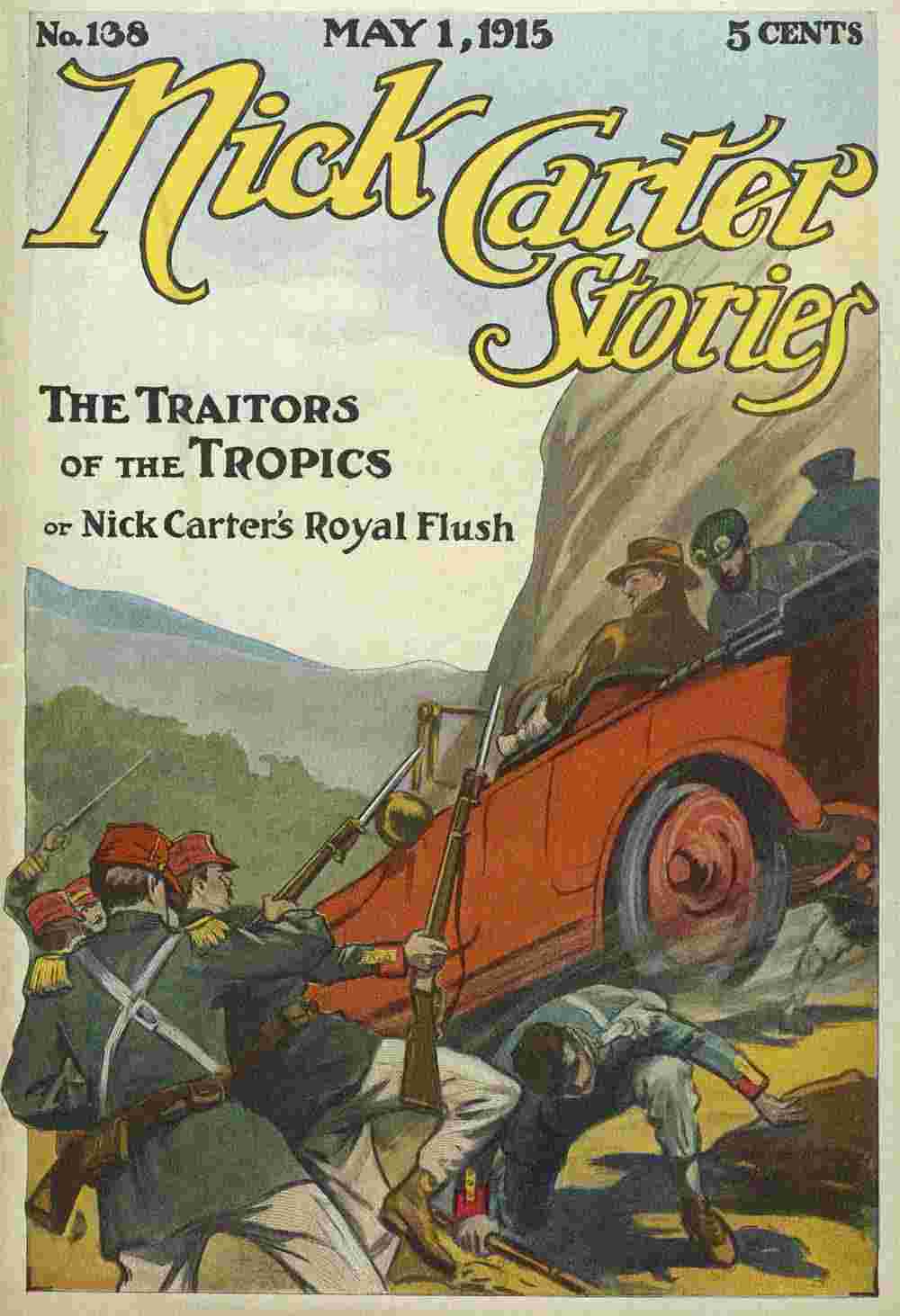
A moment later the car came out of the pass like a torpedo. It cleared the hundred feet at a single leap. Nick Carter had no time to steer clear of the soldiers crowding into the roadway.
The fact that he knew they would have sent a shattering volley into the car if they had had time, consoled him somewhat for the desperate action he was compelled to take.
Like a great juggernaut, the automobile plunged through the ranks of the startled troopers—a very fiend of devastation!
From the road arose a chorus of heavy groans and maddened shrieks, and the swaying of the front wheels told Nick Carter and his companions that they were making an awful pathway over living bodies.
If was all over as soon as it had begun. The car cleared the pass and flashed along the road, still on its way to Penza.
How many men had been killed or horribly mutilated could not be told.
The detective kept his car going. This was war, and mercy was not to be considered.
Lieutenant Trenzini let loose a torrent of frenzied oaths. He was insane with impotent rage, and he shook his fist after the flying car like the maniac he had become.
Then he turned to his men, half of whom were groaning and writhing on the ground, while the remainder seemed to have lost their senses, courage and all.
“Fire! Fire!” he bellowed. “Curse you! Why don’t you fire?”
The habit of obedience is irresistible with the trained soldier. As the order came, those of the troop who were uninjured raised their carbines and pointed them at the fast-disappearing car.
They rapped out a scattering volley. It was wholly ineffective.
The bullets whistled and sung around the car, sending up flicks of dust from the road, or whining over the heads of the occupants. One bullet even struck a mud-guard, making a slight dent on the very edge.
Without aim, and in a condition of panic, how could men be expected to shoot straight?
With all this, the speed of the car was its main safeguard. In a few seconds it was entirely out of range, and directly afterward vanished around a bend in the road.
“Glory!” shouted Patsy Garvan. “That’s one for us. Is there any other place where they can lay for us like that, Phillips?”
“No. That is the only part of the road where there would be a chance of ambush,” replied Phillips quietly. “If there is any more attempt to stop us, it must be made out in the open.”
“I don’t think they will dare that,” observed Nick Carter.
He was right. No one interfered with them again, and it was just ten minutes before noon when he marched into the council hall, in the full uniform of Prince Marcos, and placed his veto on the treaty that would have sold Joyalita into the hands of Carita and put Prince Miguel on the throne that belonged to his cousin.
He had already had the Seal of Gijon taken from the rascal who meant to use it to further his own schemes.
When the car rattled up to the palace, there were plenty of people who thought they recognized Marcos, and the cheers with which he was received proved his popularity. At the same time it struck a death knell to the black heart of Miguel.
Phillips was delighted. He led Nick to the prince’s chamber and quickly dressed him in his uniform of state.
When the work of dressing was complete, Phillips stood back, and, with a low bow, murmured:
“Your highness, Prince Marcos! Who can deny it?”
Miguel, Don Solado, Jason, and Lieutenant Trenzini are all in prison now. They were charged with high treason, and although Marcos might have passed over their crimes, in his easy-going way, his minister would not allow it. Even a monarch cannot do as he pleases in affairs of state.
It was not till a month after Nick Carter, in the person of Marcos, had saved Joyalita that the proceedings against the traitors were begun, however.
Through the astute Phillips, it was announced officially that Prince Marcos had been overcome by the journey to Penza and the excitement of the council, and must not see any one for several weeks.
Nick Carter, Chick, and Patsy were all smuggled away. They wanted to reach New York as soon as they could get there.
They found Marcos almost entirely recovered from his wound.
Nick Carter wasted no time in sending him down to Joyalita to take his rightful place.
When Marcos went he was accompanied not only by his mother, but also by Claudia Solado and hers. This was because a wedding was to take place soon at Penza. Marcos made Claudia his princess.
“She’s some girl, is Claudia!” remarked Patsy Garvan, as he listened to a letter his chief had just received from Penza, two months after their adventures down in Joyalita. “If I were not a married man, I believe I would have tried to steal her from Marcos. What do you say, Chick?”
“She’s worth any man’s stealing, I should say,” laughed Chick.
“She is worthy of Prince Marcos, who saved his country,” added Nick Carter. “And that’s praise enough for any young woman.”
“Oh, come off!” rejoined Patsy. “What are you giving us, chief? Marcos is all right, of course. But the man who really saved Joyalita was a gentleman by the name of Nicholas Carter, and you know it.”
“My two assistants gave me good help or it never could have been done,” was Nick Carter’s modest response.
THE END.
“The Pressing Peril; or, Nick Carter and the Star Looters,” will be the title of the long complete story which you will find in the next issue, No. 139, of the Nick Carter Stories, out May 8th. In this narrative will be found some of the most interesting adventures of the famous detective. There will be the usual serial and other items of interest.