
CHAPTER VII.
THE TRAIL TO THE CAVE.
The sun was well up, and the whole rugged landscape began to seethe under its direct, unshadowed rays, when Chick, after an hour’s run, suddenly stopped the car.
They had been making good time, even though it was mostly uphill.
All three occupants developed caution now, as they felt instinctively that they were entering a zone of danger.
Chick had been thinking steadily—while he guided the big car with the instinctive skill of a good driver—and he had come to the conclusion that his chief had been inveigled into the depths of this desolate country, to keep him away till it would be too late for Marcos to save his beloved Joyalita.
Once Chick had talked over his shoulder to Phillips for several minutes. The result of that conversation had enabled him to lay out a plan which might or might not be successful, but which, at all events, would be something definite to work on.
“Gaspara!” had been Phillips’ reply to his question as to whether there were any notorious bad men in these mountains.
Further questioning had brought out that Gaspara was the leader of a gang of brigands, consisting of eight or nine rascals who had come together when they all worked on the construction of the Panama Canal, and who had decided that they could make more money, as well as enjoy the freedom they liked by infesting the automobile highways up and down the Caribbean coast.
“They have their headquarters somewhere in the mountains,” explained Phillips. “But they go a long way when they hear of any party of tourists that they think they can pick up, or some wagons with valuable freight.”
“I know the kind of men,” was Chick’s response. “Have they horses?”
“Sometimes. They use mules and automobiles, too. All stolen. When they want a horse or motor car, they just go somewhere and pick it up.”
“Free and easy, eh?” put in Patsy. “They’re the real ‘I-should-worry’ citizens. The only thing against it, I should think, is that they’ll be shot or hanged at last.”
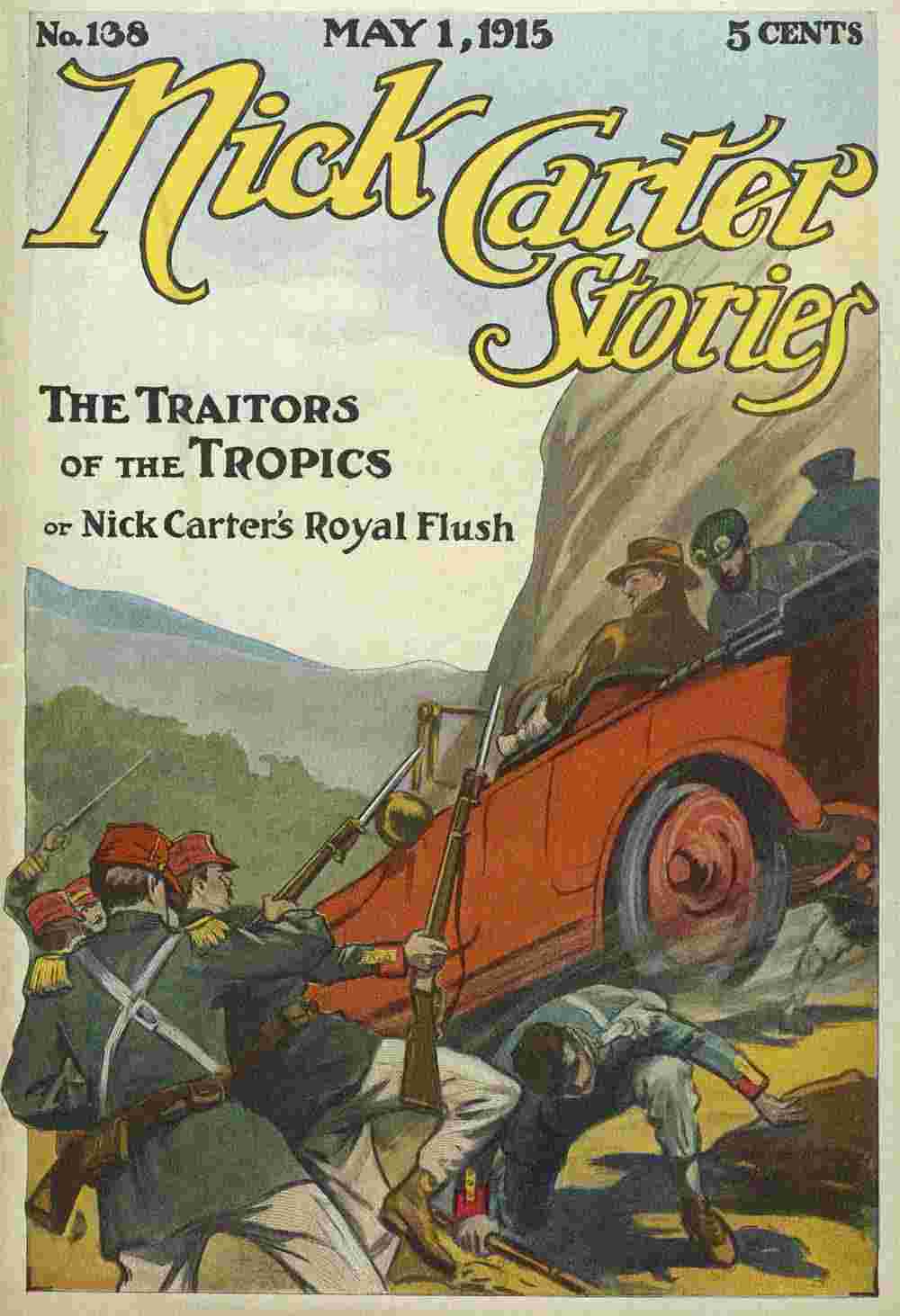
When Chick stopped he was on a narrow plateau at the top of a long hill up which he had been climbing for fifteen minutes. Just ahead of him was a curve and then another hill.
He ran the car under the shelter of the overhanging rocks, and moved to the edge of the flat surface to see what was beyond.
He had to walk about a hundred feet. Then he drew back instinctively. He was on the edge of a sheer descent of about five hundred feet. The road broke off as sharply as if it had been cut down with a gigantic cheese knife.
“Bad place to drive a car, Chick!” observed Patsy, who had come along behind him. “I’d keep well in against the wall, if I were you.”
“That’s what I have done, Patsy,” was the short reply. “See that your gun is all right.”
“Of course it’s all right,” answered Patsy. “But, why the reminder?”
“Look!”
Chick had dropped to one knee behind one of the huge bowlders that were thickly strewn about, and Patsy, taking the hint, dropped also, as he followed the direction of his comrade’s pointing finger.
“I can’t see anything but a steep hill and something black at the top,” declared Patsy.
Chick drew from a pocket the powerful field glass belonging to the motor car, and which he had taken out of its case when he left the machine.
Through the glass he took a long survey of the hill and what Patsy had called “something black.”
“I thought I wasn’t mistaken,” observed Chick, taking the glass from his eyes. “I didn’t need the glass. That black something is the opening of a cave. Outside it you can see, with the glass, there is a fire burning. The smoke stretches across the sky for miles, I should think. You see, the wind is blowing away from us, or the smoke would blow right over our heads.”
“We shall have to curve right around this deep valley to get there,” muttered Patsy. “But I reckon that’s where we’re likely to find the chief. Let’s ask Phillips if he knows what’s in that cave.”
Phillips was asked, but he could not say positively. He knew that Gaspara and his gang often took up their habitation in caves in the mountains. But they were a migratory lot, and seldom could be found in one place longer than a few weeks at a time—often only a few days.
“The trouble is they may see the automobile when we get near,” mused Chick. “Still, I think we can go almost to the bottom of their hill without showing ourselves.”
They all got into the car, and Chick saw that he would be sheltered from the view of people at the mouth of the cave until he would be near enough to leave the car and pursue the rest of the way on foot.
He had made up his mind that he would find Nick Carter there. Every sign pointed to the likelihood of Gaspara having taken up his quarters on that hill, and knowing that he was willing to undertake any job if paid enough for it, there seemed no reasonable doubt that he had consented to help out the plotters of Joyalita by holding prisoner the supposed Prince Marcos.
“Here’s where we shall have to get out,” said Chick, as he pulled the machine to the side of the road. “The hill begins just around that bend and winds up over our heads.”
There was an overhanging shelf of rock which made a safe place for the car. On either side of it, the hill ran down straight from above, breaking off precipitously some ten yards at the other side of the roadway.
The drop here was only about fifty feet, but that would be quite enough to jolt anybody who might happen to fall over, as Patsy sagely remarked.
“What’s the game now?” he asked, looking at Chick.
“To get up that hill under cover as well as we can, and rush the cave,” returned Chick coolly.
“Do you think they are all in there?” asked Patsy, just as calmly.
“No. I have seen six of them go out and move up the hill at the back of the cave. Suppose that there are nine in the gang, we shall have to meet only three. If the number is eight, it will be two. We can depend on the chief to help when we get the ropes off him. I suppose they have him bound.”
“That’s so,” assented Patsy. “I guess there ain’t much doubt that we shall find him there.”
“None at all,” rejoined Chick. “Haven’t you been watching the trail?”
“Yes. I’ve seen that patch on the hind tire marked in the mud once in a while. But there has been so much bare stone to go over, where no tracks show, that I have got mixed up.”
“I haven’t,” declared Chick quietly. “I saw the patch a few yards back, and there is another in the road right ahead of us. We shall have so easy a time picking up that trail that it would be a disgrace if we lost it.”
They followed the trail to the foot of the winding hill. Then they halted, and Chick told Phillips to remain where he was while they went up to find out what might be in the cave.
“Wouldn’t it be better for Phillips to get to the car and have it all ready to make a jump when we get there?” suggested Patsy.
“You’re right,” agreed Chick. “Do that, Phillips.”
“Very good, Doctor Fordham,” was the reply.
“Doctor Fordham?” exclaimed Patsy, mystified for a moment. “Oh, yes. I’d forgotten your name, doctor,” he added, with a grin.
“Don’t forget it when there happen to be strangers around, Patsy,” warned Chick, as he began to ascend the hill—bent over, to make himself as inconspicuous as possible.
They had gone about halfway up the hill, to where there was a sharp turn, when a shower of rocks came whirling down, bouncing from one side to the other, and compelling Chick and Patsy to skip about nimbly to avoid them.
“What the blazes?” blurted out Patsy.
“Keep quiet!” came from Chick.
More rocks, none of them very big, but so plentiful that it was impossible to dodge them all. Then, hatless and with hair flying, there shot around the corner—Nick Carter!
“Run, boys!” he called out, rather breathlessly. “They’re coming.”
“How many?” inquired Patsy, as he ran to the side of his chief and kept step with him going down the hill.
“Three!”
“Gee! That’s easy!”
Patsy stopped short and leveled his revolver at the jutting rock around which he expected to see a man coming.
He was not disappointed. One of Gaspara’s gang stumbled into view. He had hardly done so when there came two cracks from Patsy’s revolver, and the man pitched on his face and rolled over.
“Thought I’d get him,” observed Patsy contentedly. “Are there any more, chief?”
“Two followed me,” answered Nick Carter. “But keep on. You have the motor car, I suppose, Chick?”
“Yes.”
“All right! Then we can get away. Have you seen that fellow Jason?”
“No. But we’ve found tracks of him,” answered Patsy.
The three were running at top speed, talking jerkily as they moved along.
“Where’s those other two men?” asked Patsy, glancing over his shoulder.
No other man had come into view since the fall of the one shot by Patsy. They had evidently feared a dangerous ambush.
Even if they were bandits, they had some respect for their lives.
“They are holding back,” observed Chick. “But there are more than three, aren’t there, chief?”
“Yes. Six more. But they went out an hour ago. I have been watching a chance to make a rush ever since. The moment seemed to come at last, and I made a bolt for it.”
“Bully!” broke out Patsy, in uncontrollable admiration.
“Did they shoot at you?” asked Chick.
“I didn’t give them a chance,” was Nick’s reply. “I knocked two of them down, with right and left-handers, and the third was stooping over the fire, with his back to me.”
“I’d have given a year’s pay to see it,” declared Patsy enthusiastically. “There’s the car!”
Indeed, the motor car was ready to start, under the sheltering rock. The ever-watchful Phillips stood at the side, with both doors open, ready to close them with a snap as soon as the three detectives were in their places.
Phillips never allowed himself to betray surprise. So he took the coming of Nick Carter quite as a matter of course, and never even raised his respectable, well-trained eyebrows as Nick jumped in and took the wheel.
The next moment Phillips was sitting by the side of Patsy, while Chick was at Nick’s right hand, and the car began to surge along the narrow pathway, with the throttle well open.