
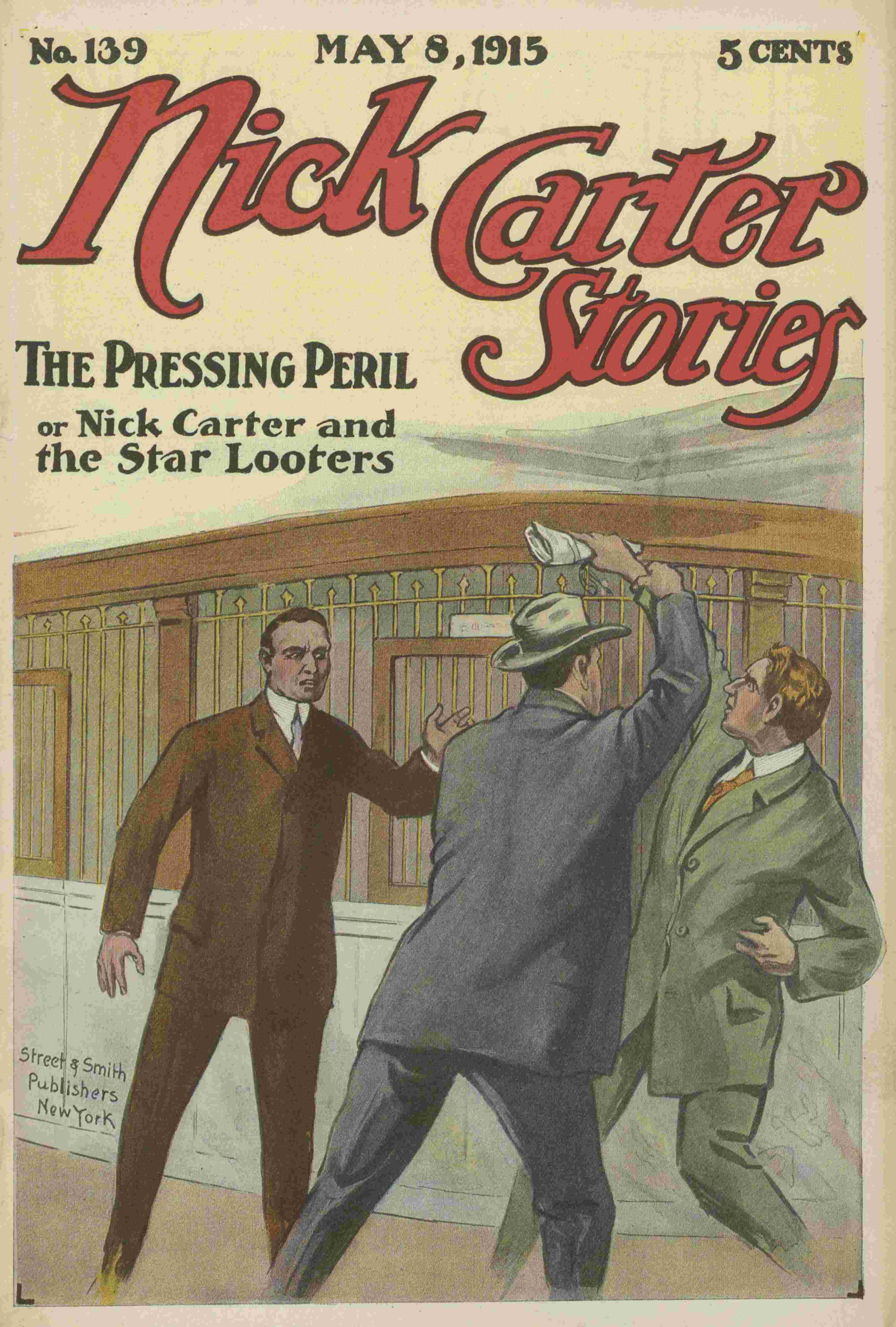
Dared for Los Angeles.
By ROLAND ASHFORD PHILLIPS.
(This interesting story was commenced in No. 134 of Nick Carter Stories. Back numbers can always be obtained from your news dealer or the publishers.)
CHAPTER XXIII.
THE CONFESSION.
It was a long time before either Miss Trask or Nash spoke again. The girl was sitting, wet-eyed and silent, in the chair, the book open upon her lap. Nash had walked to the window, and stood gazing out upon the road, which, under the magic of the moonlight, wound along the slope like a wide, silver ribbon.
The notes of a song came faintly through the still night air; in a neighboring cabin some of the men were making merry. The words were silly and meaningless, the tune of a dance-hall variety. Yet both the girl and Nash waited until the song was finished.
Then resolutely Nash turned.
“How long have you been here, Miss Trask?”
“In California? Only a few months. I—I came from New York immediately after my brother was buried. I had given him this book only at Christmas. Out of all his effects—I kept it. I was living at a little hotel near Central Park, and used to go over and pass away the hours reading. I suppose I dropped it—and that man who spoke to you must have picked it up.”
“What led you to take up—this work?” Nash asked.
“I—don’t know. Maybe it was because—because I had hopes of finding my brother’s murderer.”
“You knew him?”
She shook her head. “No. Oh, I hadn’t any set plan. I just imagined, somehow, that on this great engineering project I might come face to face with the man who——”
“And if you had?” Nash interrupted.
A quick, hard light flamed to her eyes, only to die away as suddenly as it had come. “I don’t know,” she faltered. “I am only a woman, and——”
“Did it ever occur to you, Miss Trask,” Nash ventured to ask, “that your brother might have been as much to blame as—the other man?”
“But—but he was my brother,” she replied.
“Of course.” Nash smiled faintly. “A year ago, Miss Trask, I worked on the New York Aqueduct.”
“You?” She raised her eyes quickly. “Then maybe you knew——”
“Your brother?” Nash nodded. “Yes, I knew him.”
“And you knew about—about his death? You have heard how a man shot him, and——”
“I did not know of his death,” Nash answered gravely. “That is, I was not positive.”
She was facing him now. “How strangely you talk, Mr. Nash!”
“Possibly it is because I am placed in a strange position,” Nash replied.
She started to speak, then stopped. The chugging of a motor interrupted, and instinctively both man and woman understood. Nash stepped swiftly to the window. The flashing lights of a big car were dancing down the road.
“It—it’s the officers!” the girl exclaimed. She had followed the engineer, and was peering over his shoulder.
“I’m afraid so,” Nash responded.
“They’ve come to-night—instead of in the morning. They must have suspected you would try to escape.”
Nash dropped the curtain and went back to the table.
“It’s too—too late for you to get away now,” she stammered, breathing hard. “What—what are you going to do?”
“That isn’t the question which troubles me,” Nash said quietly. “How are you to explain your presence here?”
“I won’t need to,” she retorted.
“Oh, but you will have to. You are employed by these people. Do you want them to suspect you of double-dealing? Remember, Miss Trask, it is the law you are fighting now.”
“I shall tell them the truth.”
“You must tell them that you came here—to arrest me. I am your prisoner. You must tell them that.”
“I won’t!” she exclaimed.
“You must do this, Miss Trask. You must protect yourself.”
“I will tell them it is all a mistake—that you are innocent,” she said. “I will tell them that you are not the man they want.”
“What good will it do?” Nash asked. “What good, Miss Trask? You have no proofs.”
“Oh, but I cannot tell them what you wish me to!” she protested, over and over again. “I cannot!”
“Listen to me, Miss Trask,” Nash answered, speaking swiftly now, for the pounding of the motor on the up grade was becoming more and more distinct. “It is the right way—the only way. It will protect your reputation. Think of what it all means. You have informed them of my supposedly crooked dealings, and now they discover you in my cabin—apparently aiding me to escape. Can’t you understand what a serious matter it will be?”
“But I refuse to tell them that I——”
The machine had stopped outside of the door. In another moment the detectives would be inside the cabin. There was but one method open to Nash; it was a brutal one, but to clear the girl’s name, he resolved to take it.
“Miss Trask,” he said, “you must not help me. You must do as I have said. A moment ago you told me that there was but one object which led you to accept this work. Well, you have succeeded. I am the man you wanted to find.”
She stared at him dully, unable to grasp his meaning. Footsteps came heavily across the board porch.
“I—I don’t understand!” she gasped. “I don’t——”
Nash clenched his hands. “Miss Trask—I am the man who shot your brother. Now you must do as I say.”
The color drained from her face and she sank back against the wall, as if Nash’s declaration had been a stinging lash. Her lips moved, but no sound issued from them. Then, reverberating in the silence, came a loud knock upon the door. It was not answered. A second one came, louder and more determined.
“Come in!” Nash said.
The door was thrown open, and two men stepped inside. They were both strangers to Nash.
While one of the men stood near the door, as if to prevent any escape, the other moved warily toward Nash.
“Are you Elliot Nash?” he demanded.
“I am,” the engineer responded.
“Then I’m sorry to say I’ve a warrant here for your arrest.” As he spoke he drew back his coat, and Nash found himself looking upon a detective’s badge.
Nash only smiled, and looked across at the girl, who all this time had been standing weakly against the wall.
“I’m afraid you’re too late, gentlemen,” he announced. “I have already surrendered to Miss Breen.”
Both men looked toward the girl. Then the spokesman laughed, and nodded, apparently acquainted with her.
“Well, congratulations, Miss Breen,” he said. “You have got your nerve, haven’t you? Wanted all the honors in this deal, eh? Leave it to a woman every time,” he added, in an undertone.
Nash flashed a curious glance at the girl. He wondered how she would accept the situation, and he had not long to wait. She drew herself erect, and a trace of color stole into her cheeks.
“You may take Mr. Nash to the city with you,” she said, her voice never more calm. “I—I will appear against him in the morning. Good night, gentlemen.”
She walked across the floor, drawing on her heavy riding gloves. Then she stepped out into the night.
Presently the sharp thudding of her pony’s hoofs sounded clearly upon the hard road. Minute by minute they died away, and when they had been swallowed by the night’s silence, Nash, for the first time in months, felt a great, crushing sense of loneliness.
The girl had gone—out of his life—forever. And, somehow, he had begun to have a deeper feeling than that of mere friendship toward her. He had even begun to dream those glorious, rose-colored dreams which come to all men, soon or late.
And what an end they had come to! His air castles were toppling about his shoulders.
To-morrow she would appear against him before the engineering board in Los Angeles. He would face her—not as a man wrongly accused of betraying his city, but as a self-confessed murderer of her brother—a creature to be despised and shunned.
She, whom once he thought would champion his cause, and fight for the opportunity to undo what she at first fancied was her duty, would now be only too glad to see him condemned.
And so this was to be the end of everything, he soliloquized bitterly. All his efforts and endeavors were to go for naught. He would be made an example of before the whole State of California.
“What a penalty!” he murmured to himself.
“We want to get that midnight train from San Fernando,” the detective said sharply.
“I am ready,” Nash responded quietly.
CHAPTER XXIV.
BEFORE THE BOARD.
At ten o’clock the following morning Nash was ushered into the big directors’ room, where the governing board of aqueduct engineers was to pass judgment.
The two detectives had brought him into San Fernando by automobile, and they had been just in time to catch the last train to Los Angeles. Despite the cloud which hung over his head, Nash had been treated with the utmost consideration.
Very little sleep came to him in the few remaining hours of the night. He was well aware of the serious situation, and tried to fix upon some definite method of procedure. The examining board would expect him to defend himself. He resolved to tell the whole truth, from the very day he discovered the letter in the book of verse to the present. As for proofs, one way or another, he could offer nothing better than his word.
It was a beautiful, balmy morning when he walked down Spring Street in the custody of the two detectives, a morning such as only Los Angeles can boast of—tempered by ocean breezes, and with the air heavy with the perfume of orange blossoms. Nash drank deep of the sunshine; how marvelous it seemed; doubly so now, when his liberty might be but a question of——
Before they reached the new city hall on South Broadway a half dozen newspaper men were trailing them; a camera or two appeared. Somehow, the news of Nash’s arrest and the expected upheaval in Camp Forty-seven had reached the ears of the vigilant press.
The chimes on the city-hall tower were striking eleven when Nash finally took the seat set aside for him in the big directors’ room. The majority of the engineers were gathered about the long table, waiting.
Nash was surprised to see at the far end the familiar face of Jim Sigsbee. The politician had evidently decided to forego his proposed trip to San Francisco and remain on the scene.
The preliminaries were brief and to the point.
“Our private detective in this affair, Miss Breen, has not shown up,” the spokesman of the board announced gravely, “but we can proceed. The prisoner is probably aware of the nature of the crime for which he has been arrested.”
Nash admitted that he understood.
The president of the board continued: “What have you to say in your defense, Mr. Nash?”
Nash got to his feet and calmly faced the assembly.
“Upon my arrival in this city, gentlemen, I happened upon a letter directed to a Mr. Hooker, at that time the foreman of Camp Forty-seven. The man to whom the note was issued did not care for the position. As no names were mentioned, I took the letter, gave it to Mr. Hooker, and was engaged.”
“This letter,” interrupted the president, “was written by whom?”
“By Mr. Sigsbee.”
Finding himself the center of all eyes, Sigsbee nodded.
“I remember giving a letter to a man who claimed to be an Eastern engineer,” he explained. “He pleaded so hard for a position that I offered him a chance on Camp Forty-seven.”
Nash was asked to continue.
“I began in the camp as a sort of clerk,” he said. “After a week, because I proved my value, I was made a subforeman, and given charge of the conduit construction. One day, when Mr. Hooker was—ill, I helped the city inspector check over the pay roll. Having kept a memorandum of my own, I found it differed from the foreman’s statement to the extent of being just about half of the amount that——”
Sigsbee was instantly upon his feet.
“That’s a lie, gentlemen!” he cried. “You all know me better than that. Why, it was at my instigation that this engineer was charged with——”
Nash ignored the politician’s interruption and continued his remarks directly to the president. “When I threatened to inform the authorities of the truth, Mr. Hooker asked me to call upon Mr. Sigsbee. I did so. Mr. Sigsbee, instead of discharging me, as I had expected, admitted things were not as they should be, placed the blame on his foreman’s shoulders, and offered me the position, with the understanding that I should be directly responsible, and that Camp Forty-seven was to be forever above suspicion.”
The engineers were paying close attention, and appeared to be convinced of Nash’s statements. Sigsbee was still on his feet, and when Nash had finished he spoke again.
“Gentlemen,” he began smilingly, “you have all known me, most of you, for the past ten years. You all know how faithfully I have worked that this great waterway might be made an actuality. The insinuations just now cast upon myself and upon the affairs of Camp Forty-seven are absurd. I was attracted to Mr. Nash by his apparent knowledge of engineering matters, his earnestness, and the fact that he was a native of this city. Mr. Hooker was ill, and had long before asked for a vacation. I considered it my opportunity, and made the change. There were no hard feelings at all, I can assure you. I would like to ask Mr. Nash, if I may, what proofs he is prepared to offer to substantiate his claims.”
Nash realized his helplessness. Sigsbee must have known, too, otherwise he would never have asked the question.
“I have no proofs, gentlemen,” he declared, “other than my word.”
Sigsbee smiled, and sat down. The president nodded for the engineer to resume.
“I accepted the position as foreman of Camp Forty-seven, and since then have worked faithfully in the discharge of my duties. The specifications given me by Mr. Sigsbee have been followed to the letter. I had no suspicions as to the trick being played upon me until Miss Breen arrested me last night.”
“What trick was played upon you?” asked the president.
“Changing the specifications,” Nash answered. “False ones were given me. I followed them. When I attempted to prove my innocence to Miss Breen I found they had been taken and the rightful ones substituted.”
“Did those specifications come from the board, Mr. Sigsbee?” the president inquired.
“Certainly, sir,” Sigsbee nodded. “If I am not mistaken, they are now in Mr. Nash’s cabin, on file. Are they not, Mr. Nash?”
“They were placed there some time yesterday afternoon, by Mr. Hooker,” Nash responded.
Sigsbee looked around at the circle of anxious faces and shook his head. “Did you ever hear of a more absurd statement, gentlemen?” he asked solicitously. “Why, the thing is farcical!”
By their expressions, the men about the table seemed to agree with Sigsbee. The president spoke again, after the interval:
“I suppose, Mr. Nash, you have proofs to substantiate these claims against Mr. Sigsbee?”
“As the false specifications are gone, I am unable to give you any,” Nash responded. “Mr. Sigsbee and his confederate, Mr. Hooker, have planned a shrewd game, and have left few loopholes. As the matter stands at the present I am helpless.”
Sigsbee was upon his feet instantly, his cheeks flaming. “I won’t stand for such insinuations!” he roared. “I won’t stand for a man of Mr. Nash’s reputation to——”
The president of the board put up his hand. “Just a moment, Mr. Sigsbee,” he cautioned. “I think we can straighten out this matter with the aid of these new witnesses.”
The door had opened. Every eye in the room instantly turned. Miss Breen and Hooker advanced into the room and were seated.
Miss Breen and Hooker! Nash felt the hot blood mount to his temples. So she had gone over to the other side! He knew she must do so, yet, deep in his heart, he hoped——
Miss Trask, or Miss Breen, as she was known to all the men in the room, save one, did not look in Nash’s direction. She appeared unusually pale and concerned.
“We have been waiting for you, Miss Breen,” the president announced. “Our evidence appears to be somewhat confused. Will you kindly state your knowledge of the affair to the board?”
Miss Trask arose, facing the president. Her voice was low and evenly pitched, and never once did she falter.
“I became acquainted with Mr. Nash through an accident, and in his company, later, I was taken around the camp. One day he allowed me to inspect the steel sections on the Soledad Siphon. Unknown to him, I measured the steel, and later on compared the measurements with the specifications. It was then I learned the truth; that the steel he had been using was a quarter of an inch too thin. I then reported the facts.”
Nash listened eagerly. Miss Trask’s declaration explained her actions and questions that day when he had willingly guided her about the camp.
“Have you any answer to make, Mr. Nash?” the president asked.
“None whatever,” Nash answered quietly. “Miss Breen has told you the whole truth. I have not denied that my steel was a quarter of an inch too thin.”
For the smallest part of a minute Miss Trask allowed her eyes to rest upon him. Nash’s heart responded. Was it possible that he could read within those depths a message of——
Hooker was called upon. The president handed him a copy of the true specifications.
“These are similar to the ones you delivered to Mr. Nash?”
Hooker nodded. “Yes, sir.”
“Mr. Nash claims you changed the copies yesterday afternoon,” the president declared. “That you took the false ones and substituted these.”
“Such an idea never entered my head,” replied Hooker.
“Where were you yesterday afternoon?”
“I was in Camp Forty-seven for about an hour.”
“To see whom?”
“Mr. Nash. He was out. I waited around a short time and finally left in Mr. Sigsbee’s machine.”
Sigsbee was plainly nervous. His fingers were drumming upon his chair arm, and he shifted about uncomfortably.
“Where did you go from Camp Forty-seven?” the president asked.
“Up the usual road.”
“But you only arrived in Los Angeles this morning, I understand.”
“Yes, sir. About two miles below the camp my gasoline tank sprang a leak, and I was forced to spend the night at the Elkhorn Ranch.”
“That is where Miss Breen is staying, is it not?”
“Yes, sir. She came in with me this morning.”
Sigsbee was ready to interrupt once more. He seemed particularly anxious to have Hooker silent.
“Gentlemen of the board,” he began impressively, “it seems to me that all the necessary arguments have been heard. Miss Breen has testified, and also Mr. Hooker. Both parties are known to you, and you must be forced to admit that the claims suggested by Mr. Nash are not alone preposterous, but impossible as well.”
The president nodded, and many of the others did the same.
“Then I move that we hold Mr. Nash guilty of the charges brought against him, and turn him over for trial before the proper authorities,” Sigsbee resumed.
The president of the board hesitated a moment. “There are a number of points which do not seem quite clear to me as they stand, but which will probably come to light during the trial. However, to me, at least, Mr. Nash appears to be prompt with his answers, and, to all appearances, telling a straightforward story. Of course, his word, against——”
Sigsbee interrupted. “One moment, if I may. It seems that Mr. Nash is unable to give us any proofs as to the existence of these so-called frauds, and perhaps, if we are to weigh his words with any consideration at all, we might ask him why he left a responsible position in New York and came here to Los Angeles, willing to accept a minor one.”
Nash’s fingers clenched themselves. He had been fearing that question, not so much because of himself as because of Miss Trask.
“When we are to consider a man’s word, and weigh it conscientiously,” Sigsbee went on to say, “we ought to convince ourselves that his past is one to warrant it.”
“Perhaps you will tell us why you left the New York Aqueduct so abruptly, Mr. Nash?”
“That has nothing to do with the charge you are bringing against me,” Nash answered hotly.
“Oh, hasn’t it?” Sigsbee sneered. “Well, perhaps the gentlemen of this board will think differently. Perhaps you do not relish the idea of telling them that you are a murderer! That you left New York to escape paying the penalty.”
CHAPTER XXV.
THE UNEXPECTED.
The effect of Sigsbee’s declaration upon the rest of the listeners was dynamic. Every eye swung around and rested upon Nash’s white face.
“What have you to say, Mr. Nash?” the president questioned, first to find his voice.
“I have nothing to say,” replied Nash.
“But I have!” a clear, commanding voice arose.
Nash lifted his eyes. Miss Trask, who had so abruptly interrupted, was upon her feet. She looked at the president, who appeared to be as much surprised as the others.
“May I explain?” she asked.
The president nodded. Sigsbee brought himself erect in his chair, a frown chiseled between his brows.
“Why, surely, Miss Breen,” he said anxiously, “this affair cannot interest you.”
“On the contrary, Mr. Sigsbee, it is of vital interest to me,” she answered swiftly. “The man whom you have accused Mr. Nash of murdering was my brother!”
Sigsbee could only sit and gasp; the others about the long table leaned forward in their chairs. So abrupt and startling was the announcement that in the hush which followed one might have heard the dropping of a pin.
“Your brother?” It was the president who first regained his voice.
“Yes,” said Miss Trask.
“And this man”—indicating Nash—“this man killed him?”
“That is what Mr. Sigsbee would have us believe,” the girl answered quietly.
“But we have it from his own lips,” broke in Hooker, who, up to the present, had remained dumb. “Nash told me himself that——”
“I know,” Miss Trask nodded. “I, too, have heard it from his own lips. He told me last night—just before the detectives arrived from Los Angeles.”
“And he knew, at the time, that you intended arresting him?” asked the president.
“Yes.”
“Then why——”
“Why am I defending him??” Miss Trask interrupted. “Because there has been a mistake—a horrible mistake. Mr. Nash is as innocent of the crime as any one in the room.”
Nash caught at his breath, staring dumbly, wonderingly, into her face. What motive, he asked himself, had prompted Miss Trask to change so abruptly?
“Until this morning—an hour ago,” Miss Trask continued, “I believed his confession. Then I received a wire from New York saying that one of the aqueduct engineers, dying, has confessed to the murder. I did not understand at first, but after a time it became clear to me. Mr. Nash had a quarrel with my brother; a gun was fired somehow. The shot cut across my brother’s cheek. I distinctly remember, because he was brought home, and remained there for a week. Two weeks later he was engaged in another fight—and this one proved fatal. Mr. Nash believed all the time—as I did at first—that he was responsible; that it was in his quarrel my brother had met his death. My brother was quick-tempered, and he provoked the fight. I want Mr. Nash to be freed of all blame.”
Nash listened as a man in a dream, and finally, when Miss Trask had finished, and had smiled upon him, he spoke:
“The fight took place in a café,” he said, bringing back the vivid picture. “It was a harmless one at first. We began sparring; he dropped to the floor. Then he jerked out a gun—I was unarmed. But suddenly a shot rang out behind me, your brother cried out, and when I looked down his face was bathed in crimson. Somebody grabbed me, forced me out of the room. They told me my opponent was dying, and that I must run for it. Explanations were useless.” Nash stopped, and looked around at the circle of interested faces.
“That—that is all,” he said, “except that I packed my things that night and took the first train for California.”
With the exception of Sigsbee and Hooker, the others in the room were visibly impressed. Sigsbee, instantly aware that the issue at hand was being forgotten, got to his feet.
“A very remarkable little romance,” he sneered. “Very remarkable, indeed! But I’m afraid we are wandering from the subject. While Miss Breen has apparently proven that Mr. Nash did not murder her brother, the fact remains that he was a trouble-maker, and——”
“Just a moment, Mr. Sigsbee,” interrupted Miss Trask. “Whatever Mr. Nash did in the past is of no concern at the present time. May I have permission to speak at length?” She looked over at the president, who, understanding, nodded.
“Since I became engaged upon this case, gentlemen,” she continued, “I have had the opportunity of learning a few unexpected truths. Convinced, as I was at first, of Mr. Nash’s disloyalty, I was amazed at his manner toward me and the men under him, and his enthusiasm for his work. It was only after a severe struggle with myself, and after I had found what I concluded was the final proof of his unfaithfulness, that I took up the matter with the board of engineers.”
“Do we understand that you retract the evidence you have only just offered?” demanded the president.
“Certainly not, Mr. President,” she answered. “Every word I have said in the matter of the siphons is true. Even Mr. Nash agrees with me.”
Nash nodded. “I have denied nothing,” he said. “Miss Breen’s statements are perfectly correct.”
In a puzzled way he waited for her to continue.
“Several days ago Mr. Nash saved my life,” the girl resumed. “It was then, half crazed by what I had gone through, that I confessed everything to him. I told him who I was, and what I had done.”
“That was before his arrest?” leaped to Sigsbee’s lips.
“Yes, before his arrest.”
Sigsbee shrugged. “It’s a wonder, carried away by your feelings for this man, that you didn’t urge him to escape,” he said.
“That is exactly what I did do, Mr. Sigsbee.”
The politician stared. “You—you tried to——”
“I told him the truth, and urged him to get away before he was arrested. Not only then did I plead with him, but I went into camp an hour before his arrest and begged him to leave.”
“What prevented him from doing so?” asked the president.
Miss Breen smiled. “His innocence, gentlemen. Why, do you think, being guilty of this crime, he would have remained in camp? It was because he was innocent that he remained.”
“Do you mean to say, Miss Breen,” the president asked, “that you believe Mr. Nash was ignorant of the offense for which——”
“I do!”
“But you have already testified——“ began Sigsbee.
“I testified to the facts exactly as they were, exactly as I found them; exactly, gentlemen, as Mr. Nash admits they were. He does not deny that his steel was different from the specifications. What he does deny is that he was given those specifications there on the table.”
“If he was given other specifications, which he claims to have followed,” Sigsbee declared, “why does he not show them? What we want at this inquiry is proofs, not words.”
Miss Breen allowed her eyes to rest upon the insolent, flushed face of the speaker. “‘Why doesn’t he show the proofs?’ you ask,” she replied calmly. “Because you took particular pains to put them out of his reach, Mr. Sigsbee.”
“Look here!” Sigsbee exclaimed, forgetting, or indifferent to the fact, that he was addressing a woman. “I won’t stand for any such insinuations!”
“You’ll stand for some things you don’t expect,” the girl answered swiftly, not in the least ruffled by the man’s declaration. “You laid your plans very carefully, Mr. Sigsbee; you imagined them to be perfect. Most criminals do. It is the unexpected that steps in and clogs the smoothest running gear.”
“I—I demand——“ spluttered the politician.
“Very well,” announced the girl, apparently enjoying the situation, which to all others in the room, Nash included, was more than mystifying. “I’ll satisfy you.”
She looked around at the circle of interested engineers. Nash found her eyes, and held them. Something mirrored in their depths sent his pulses racing.
“Last night, after leaving Mr. Nash in charge of the detectives,” she resumed, “I rode back to the ranch. Arrived there, I found Mr. Hooker, who, as he has previously explained, was preparing to stop overnight. When I discovered him he was flat on his back under the machine, coat off, sleeves rolled up, his hands covered with grease and dirt. At his suggestion, I volunteered to hold the lantern, and later he asked me to carry his coat into the house. I did so. As I picked up the garment from the ground, some papers dropped out. I was on the point of returning them when——”
Hooker, with a loud cry, suddenly leaped to his feet, flung aside the chair in which he had been sitting, and which blocked his way, and bolted for the door.
“Don’t let him get away!” Miss Breen cried.
Instantly several of the men sprang into action, and two of them caught Hooker as he was about to disappear. They brought him back to the table, and forced him into a chair, where he sat huddled, white-lipped and trembling.
“I’m sorry Mr. Hooker spoiled my climax,” Miss Breen said, smiling. “Evidently he has just searched his pockets, and discovered the false specifications which he took from Mr. Nash’s cabin yesterday afternoon are missing. However,” she added, opening a little hand bag which she carried, “they are not lost. Here, gentlemen, are Mr. Nash’s proofs.”
A bomb, thrown through the window, would not have caused greater confusion. The false specifications were hurriedly examined by all the men. Nash’s writing and figures on the margins were instantly identified.
Sigsbee, stunned by the unexpected twist in his carefully laid plot, sat as one stricken dumb.
“What have you to say, Mr. Hooker?” asked the president, after the excitement had subsided.
Hooker seemed to realize his hopeless position. His actions had proven his guilt. “Camp Forty-seven was rotten with graft,” he said reluctantly, dully. “Sigsbee and I had to throw the blame on some one’s shoulders—so we picked Nash. That’s all.”
The president of the board walked over to Nash. “I guess there’s a great big apology coming to you, Mr. Nash.” He gripped the engineer’s hand. “I feel we can depend upon you, and I hope you will continue to represent us in Camp Forty-seven.”
“I shall do my best,” Nash answered. “My motto has been, and always will be, ‘All for Los Angeles.’”
“That must be our motto as well,” responded the president. “And with this in view, we must be careful not to allow the faintest whisper of this meeting to reach the ears of the public. Los Angeles has always been free from graft and political deals. It must be kept so. The public must have the utmost confidence in the men who are constructing its wonderful aqueduct. I believe all the members present understand the delicate situation. And as for these two gentlemen”—he looked across to Sigsbee and Hooker—“we must see that they are sent away. We will withdraw all charges against them. To air this matter in court would be a detriment to our clean record of the past. And while these men deserve punishment, severe punishment, we must consider, above all else, the welfare of our city. Therefore, I move that these men be placed in the custody of a detective and taken East.”
The suggestion of the president was unanimously upheld by the board of engineers.
Following the verdict, Nash slipped away and found Miss Trask.
“If it hadn’t been for you,” he murmured, pressing her hand, “I might——”
“If it hadn’t been for you,” she interrupted, “that night at the coyote I might have——”
The remembrance of that night, and the one particular incident, rushed to Nash’s mind.
“And why—why did you lie to me about the time?” he asked. “Why did you wish to remain with me when you knew that the explosion was to——”
She looked away, and the color trembled in her cheeks.
“C-can’t you guess?” she faltered.
Nash had arrived at a solution a long time previous to this moment, but it seemed too good to be true. Now he knew it was true.
“Let’s go over to the Alexandria for lunch,” he suggested. “I can talk better there.”
And, once in that big, cosmopolitan hotel, and in a secluded corner of the grillroom, Elliot Nash amazed the stolid-faced waiter by his order. And what he said later to the girl who shared the feast was meant only for her ears.
THE END.
AN IMPORTANT EXCEPTION.
An old man who entered the meteorological office, the other day, said:
“This ’ere’s where you give out weather predictions, ain’t it?”
The clerk nodded.
“Well,” continued the old man, “I thought as how I could come up and give you some tips.”
“Yes,” said the clerk politely.
“Yes; I’ve thought it out a little, an’ I find that ye ain’t al’ays right.”
“No; we sometimes make mistakes.”
“Course ye do. We all does, some time. Now, I was thinkin’ as how a line that used to be on the auction handbills down in our county might do first-rate on your weather predictions an’ save ye a lot of explainin’.”
“What was the line?”
“Wind an’ weather permittin’.”
He went off without waiting to say good-by.
Saving the Building and Loan Money.
By E. E. YOUMANS.
“Paul, I want you to go down to the Building and Loan with this money to-night,” said Mrs. Brown, as she came into the room where her son was seated, reading a book. “I’d go myself, but I expect Mrs. Carson here to see me, and must be on hand when she comes. I guess you can attend to it all right enough, don’t you think so?”
“Sure,” said the youth, laying aside his book; “I’ll start at once.”
He secured his hat, and prepared to leave.
“Look out you don’t lose the money,” cautioned his mother. “There are some fifty dollars in the roll.”
“No fear,” answered Paul; and a moment later he was on his way down the road.
The place where the Building and Loan Association met was at a small village, some two miles from Mrs. Brown’s farm, and it was necessary for Paul to pass through a lonely woods on the way.
This he did not mind, however, for he was used to the road, and had often gone through the woods at night. It was just turning dusk when he left the house, but before he reached the forest, darkness had fallen in full.
The moon did not rise till late, and he could not see far ahead when he passed in under the trees. But he pressed on, the money tucked safely away in the inside of his vest, and had just reached the end of the woods, when the sudden glimmer of a light in the edge of the trees attracted his attention.
“Why, that’s near the old cave,” muttered the boy, stopping and looking toward the gleam. “Wonder what it means?”
He was about passing on, when the impulse to go forward and investigate seized upon him, and he turned toward the cave.
“It won’t take but a minute,” he told himself. “I’ll just sneak up near enough to see who’s prowling around. It may be some of the boys, though it’s been a long time since any of us have been down this way.”
He climbed over the fence, and stole toward the light. It was still shining, but before he got halfway to it, it suddenly went out.
He kept on, however, and soon reached the vicinity of the cave. This was situated in a small and rocky ravine, and had been formed by several large bowlders rolling down from the sides of the gorge, and lodging in such a manner as to leave a considerable cavity underneath.
Paul and his friends had for a long time used this place as a sort of rendezvous in some of their sports. But they had lost interest in it, and had not been there for some time.
In a few minutes he was near enough to the cave to hear the sound of strange voices.
“That’s none of the fellows,” he muttered, beginning to feel a little uneasy. “But who can it be?”
He paused for a moment in uncertainty. Then his curiosity urged him on again, and he soon gained a position behind one of the bowlders that formed a side of the cave.
Here he crouched down, and listened. In a little while the party within began talking again.
“There’s no doubt about it. He’ll have all the money with him, and, if we’re smart, we’ll make a clean haul of three or four thousand dollars.”
“All the same, it’s blamed risky,” said another voice.
“Well, what of it? I reckon we’re smart enough to make our escape. We’ll just stay here till twelve or one o’clock, then we’ll make tracks for Bolton’s house. Take my word for it, bub, he’ll never put that money in the bank to-morrow.”
Paul almost betrayed his proximity by the start he gave as these words reached his ears. Mr. Bolton was the treasurer of the Building and Loan Association into which he was going to pay the fifty dollars that night, and these two men were concocting a scheme to rob him at his home.
The youth soon decided what to do. He must hurry away at once, and tell the treasurer what he had discovered.
“It’s the greatest piece of rascality I ever heard of,” thought Paul, as he cautiously rose to his feet and turned away.
But he was not destined to escape. He stepped upon a small stone which slid out from under his foot with a sharp noise, and nearly threw him down.
“What’s that?” cried one of the men, and the next second both were heard starting from the cave.
Paul did not wait. Knowing he was sure to be caught, he broke into a run.
The next moment the men saw him, and started in pursuit with a shout of rage.
“Stop, you young eavesdropper,” cried the foremost ruffian; “stop, I say, or I’ll shoot you.”
Paul paid no attention. He dashed back toward the road, expecting to have a bullet sent after him each moment, but for some reason it did not come.
Straining every muscle, he soon came near the fence, and at the same moment he heard the pursuers close behind him. He had no time to climb the fence, and gathered himself for a spring.
When he reached it, he placed his hand on the top rail, and made a tremendous leap. He would have cleared it all right, but the rail gave way under him, and he fell headlong into the grass on the roadside.
He sprang up, but it was too late. A heavy hand was laid on his collar, and he was jerked violently around.
“Now I’ve got you,” said a rough voice. “I’ve a good mind to break your head.”
“Let me go!” panted Paul.
“I’ll let you go, confound you,” roared his captor, shaking him savagely. “Who are you?”
“None of your business,” said Paul fearlessly. “If you don’t let me go, it’ll be worse for you.”
“Careful with that tongue of yours. Just come along back here.”
With a quick move the youth struck the man a stinging blow in the face. The ruffian uttered a howl, and put up his hand. Paul broke loose, and dashed away.
“Stop him, Dick,” cried the fellow he had hit. “Shoot him down; don’t let him escape.”
Paul was running for all he was worth. Dick promptly gave chase. He was a good runner, and, despite the boy’s desperate exertion, rapidly overhauled him.
When he got near enough he struck at the boy with his fist, and once more Paul sprawled into the road. He was partially stunned, and, before he could recover, both men were upon him.
“Let me smash him,” cried the one savagely. “He nearly broke my nose. Just let me get at him.”
“Oh, what’s the use!” said the other. “We’ve no time to fool with him. Give me your handkerchief.”
The man did so, and in a few minutes Paul’s hands were secured behind him, he was lifted between them, and carried back to the cave.
Here he was laid down, and Dick began searching him.
“We may as well take whatever you’ve got of value,” he said. “We deserve something for that blasted run you gave us.”
Paul’s heart sank. His mother’s hard-earned fifty dollars would be stolen.
The man soon found the book and the bills, and chuckled as he saw the money. Then, by the light of the lantern which he had relighted, he examined the book, and uttered a low whistle.
“Well, I’ll be hanged, Joe,” he cried, “if here isn’t one o’ the Buildin’ and Loan books; fifty dollars along with it, too, by the great thunder! Well, youngster, we’d only get this money anyhow, so we’ll take it now. Wish we could get all that’ll be paid in to-night as easy as we get this.”
He put the bills into his pocket, after which Paul was thrown into the cave. A large stone lying near was rolled against the entrance, and Paul’s capture was complete.
Hour after hour passed till the boy knew it must be after midnight. Then the men prepared to leave.
“I reckon you’ll be comfortable there for some time, bub,” said one, as they moved away. “You can thank your lucky stars that we didn’t kill you.”
The next moment they were gone. Paul tugged at the bandage confining his wrists.
“I must get away and warn Mr. Bolton,” he reflected excitedly. “They may kill him.”
But the handkerchief was well tied, and he could not weaken it.
“What shall I do?” he cried desperately. “I must get away.”
Then an idea flashed into his mind. He rolled over, with his back against the rock, and, despite the pain, began rubbing the handkerchief against it.
His hands were soon bruised and bleeding, but he kept on, until finally the linen was worn through, and dropped off.
He groped his way to the entrance, and tried to move the rock. He could not budge it. He sank back again with a groan of dismay.
“Too bad,” was his despairing cry. “I can’t get out, after all. The men must be almost there now. If——”
He thrust his hand into his pocket, and uttered a low cry. They had not robbed him of his jackknife, and he soon had it out, digging away the dirt for life.
How the boy worked! In half an hour he had dug a large cavity under one side of the stone, and a hard push sent it over so that he managed to squeeze through on the other side, and crawl from the cave.
Then off he started across fields for the house of Gilbert, the town marshal. He had to cross a brook, but he did not lose time. He waded through, and, with the water dripping from his garments, reached the marshal’s house ten minutes later.
As soon as possible that individual was aroused, and Paul told his story.
“Hurry,” he concluded. “You may be too late.”
In less than five minutes they were hurrying toward the treasurer’s home. The marshal had two revolvers, one of which he handed to Paul.
“Don’t be afraid to use it,” he said, and a few minutes after they came in sight of Mr. Bolton’s house.
They looked cautiously around as they approached, but all was silent. Evidently the thieves had not arrived yet.
When they reached the house, the marshal rang the bell long and hard. A moment later an upper window was raised, and Mr. Bolton called out:
“Who’s there?”
“It’s I, Gus,” said the marshal, stepping back and looking up. “Come down, quick as you can, and open the door.”
Mr. Bolton knew the officer, and lost no time in admitting him.
“What is up?” he asked, when they were all inside.
The officer explained:
“They’ll be here soon,” he concluded. “We must be ready for ’em.”
Hasty preparations were made. Believing that the thieves were acquainted with Mr. Bolton’s house, the officer concluded they would force an entrance into the room where the treasurer kept his safe, and to this apartment they all repaired.
A large, high-backed sofa was drawn up under the gas jet, the gas was lighted and turned down low, and the three watchers crouched down behind the safe.
“We’ll wait till they get in the room,” said the officer; “then I’ll give you a nudge, Paul, and you must turn on the gas in full. Bolton and I will cover ’em with our revolvers, and if they don’t surrender, we’ll let ’em have it.”
Paul was much excited. But he tried to remember what the marshal had told him, and held himself in readiness to turn on the gas when the signal was given.
Suddenly a slight noise was heard near the window.
“Hist!” said the officer. “There they are!”
Two or three peculiar scratches were heard, then the sash was carefully raised. In a moment the men climbed through the window and stood out on the floor.
The marshal nudged Paul. A broad glare of light flooded the room, and at the same moment Marshal Gilbert cried sternly:
“Surrender, or we’ll shoot you down!”
Startled into confusion by the sudden illumination of the room and the ominous command, the two robbers became panic-stricken, and made a dash for the window.
But the officer and Bolton were too quick for them. Their revolvers cracked simultaneously, and both men went down, badly wounded. After this their capture was easy, and they were soon disarmed and secured.
They were taken to jail, where their wounds were dressed, and when they finally recovered were sent to prison.
Paul, of course, recovered his money, but the members of the Building and Loan Association were so grateful for the valuable service he had rendered them that they clubbed together and paid up his mother’s book for several months to come.
THE PLUMAGE HUNTER.
Not very long ago the writer accompanied a gold-mining expedition into the tropical forests of Guiana, and stumbled across an English traveler who was collecting birds for a London and Parisian firm of merchants. He was settled in a village of Acawois Indians, far from any of the haunts of the white man. Every male Indian of the village was in his service, and at the conclusion of each week they received pay, according to results, in cheap knives, powder, hatchets, cooking utensils, et cetera; pay day being usually celebrated by a feast, in which all the men got fearfully intoxicated on a filthy compound called paiwarri.
We started out every morning immediately after breakfast. The Indians were armed with bows and arrows and blowpipes. The collector divided them into sections, and sent them off into the bush, himself accompanying one group, but without doing any shooting. I fastened on to a man and a boy, and kept close in their wake all day. With the skill of a denizen of the woods, my man did not walk a step without rousing a feathered creature of some sort. Sometimes a large bird—a toucan or a macaw—would flap clumsily out of a bush, and the twang of the bowstring would announce its death. Small birds fluttered across our path constantly, and these were promptly brought down with the pipe. Now and then a flight of a score or two would suddenly settle all over in the branches about our heads, and on these occasions the Indian managed to kill a dozen or so before they appeared to realize their danger. It was kill, kill, kill, without a moment’s pause. As the birds fell, the boy secured the bodies and dropped them into a long wicker basket, which was strapped across his forehead and hung down his back.
On our return to the village the men were coming in and emptying their baskets onto a long table in the middle of the Englishman’s hut. Many of the birds were of the most brilliant plumage; but there were hundreds of birds, not boasting any brightness of color, that were of no use. The slaughter, in fact, is much greater in regard to the birds that are not wanted than those which reach the English market. The collector, stripped to the shirt, and with his sleeves rolled up, set to work at once, going through the game. He handled every bird, dropping those pretty enough for a bonnet or valuable enough for a collection into one heap, and the useless ones into another. Not more than one bird in ten was retained; the rest had been slaughtered uselessly. When I reproached my friend with this wanton waste of feathered life, he replied that he could not attempt to kill the birds himself, and it was impossible to get Indians to discriminate between valuable and worthless specimens.
JOKES FROM JERROLD.
Douglas Jerrold, once the keenest of wits, a remarkable combination of Thackeray and Hood, is now almost forgotten. It is a pity. His jests were singularly ripe and racy. He had no mercy on the sentimentalists.
“I love nature,” said one of these dawdles to him one day. “I often take a book, retire into some unfrequented field, lie down, gaze on the heavens, then study. If there are any animals in the field, so much the better. The cow approaches, and looks down upon me; and I—I look up to her.”
“Exactly,” said Jerrold, “you look up to her with a filial smile!”
A delightful way of telling him he was a calf.
Another sentimentalist got a beautiful settler in this way: Walking in the country, Jerrold and a small party of friends stopped to notice the antics of a small donkey in a field. A gushing poet in the party said:
“Dear little thing; how I should like to buy it and give it to my mother!”
“Do,” said Jerrold—“do, and tie this sweet motto round its neck: ‘When this you see, remember me.’”
He had little mercy for pretentious prigs, who always abound in “literary circles.” A young author had written on the same subject as Lamartine, and bragged of it.
“Ah,” said he, “Lamartine and I row in the same boat.”
“Yes,” said Jerrold, “but not with the same skulls.”
Another of these gentry, praising one of his own plays, said to Jerrold:
“Do you remember the baroness in that play?”
“Oh, yes,” said Jerrold. “I never read anything of yours without being struck with its barrenness!”
At the same time he always had a friendly hand for a man who was too hard hit. A newspaper called the Chronicle, once attacked a young friend of his, savagely assailing his work. Jerrold took up the cudgels and wrote in his defense. He began by telling how, in some countries, the too luxuriant growth of the vine is prevented by sending asses in to crop the rising shoots. Then he gravely added:
“Even so young authors require pruning; and how thankful we all ought to be that the Chronicle keeps an ass!”
Walking one day in the Haymarket, then a rather disreputable promenade, some one met him, and thus accosted him:
“What, Jerrold, you here? Looking about for characters, I suppose.”
“Yes,” said Jerrold quietly; “I am told a good many are lost about here.”
THE NEWS OF ALL NATIONS.
Michigan on Gridiron.
Six of the eight games which will make up the University of Michigan’s 1915 football schedule were announced recently by the board in control of the athletics. The midweek games have not yet been decided upon.
The schedule follows:
October 9, Mount Union; October 16, Case; October 23, Michigan Agricultural College; October 30, Syracuse; November 6, Cornell; November 13, Pennsylvania at Philadelphia.
With the exception of the Pennsylvania game on Franklin Field, Michigan will fight all her battles on the home gridiron next fall.
Hen and High-bred Chickens.
A hen of high-flying propensities advertised her character when a barred Plymouth Rock, the property of Mr. Gushee, of Hastings, N. Y., announced from a cedar tree on the Longue Vue estate, that she had a remarkable secret to impart.
Those who answered the frenzied squawks for aid found with her a brood of thirteen chicks. M. C. Cronin, who superintends the poultry stock at Longue Vue, removed the flock from the tree crotch, which was twenty feet from the ground, and installed the family in a comfortable house. The hen had been missing for days, but no one thought to look for her at such a height. Now they are trying to decide whether the birds are cedar birds or plain chickens.
Destroying Odor of Smoke.
A new invention is a lamp which consumes smoke. It resembles an ordinary alcohol lamp in appearance. At the tip of its burner is a piece of platinum. When the platinum is made to glow by the alcohol flame arising from the burner it gives off formaldehyde in great quantities. This overcomes the smoke or any other impurity in the atmosphere. When the lamp is lighted in a room where smoking is in progress it prevents the accumulation of stale smoke. It can also be used as a disinfector.
Ex-slave Ill at 102.
Mrs. Minerva Gillies, whose father, Richard Washington, was George Washington’s slave, was taken to the Harlem Hospital, in New York recently, suffering from ailments that come with old age. She is 102 years old, and lived with her daughter at 58 West 133d Street.
Richard Washington was a stableboy at Mount Vernon. After the death of George Washington, he was sold and went to Petersburg, Va. There Minerva was born. She remained in slavery until the end of the Civil War, when she came North.
From Gate to President.
At a meeting of the directors of Yale & Towne, of Stamford, Conn., the largest hardware manufacturing concern in the country, if not in the world, Walter C. Allen, who twenty-three years ago applied for a job at the gate of the works, was elected president in the place of Henry R. Towne, who retires after forty-six years in that position.
Mr. Towne was made chairman of the board of directors.
Death Takes Four of Family.
For the first time in the history of Loganville, Ga., according to the older inhabitants, four deaths occurred in one family within four days. Edgar Rickets, who lives about four miles west of the place, experienced this affliction recently.
On a Monday he attended the funeral of his mother. That night his baby died, and the next day his wife and little boy, about two years old, also died, all being victims of pneumonia fever. The three bodies were buried Wednesday in a local cemetery. This is the first time that a triple funeral has ever occurred from one family in this section.
Dog Rescues an Old Soldier.
Wanderer, a smart collie, is being showered with attention as a hero in Woodside, Md., for saving from death Charles McCallion, an aged veteran of the Civil War. “Wan,” as the dog is commonly known, is owned by Edson B. Olds, treasurer of the Union Trust Company.
Mr. Olds’ attention was attracted to the continuous barking and peculiar antics of the dog on Sunday morning. Wan would dash up to the house and bark for a few minutes, then run to a field near by and bark again.
When Mr. Olds followed Wan on one of the trips, he found McCallion lying in the middle of the field, unconscious from the cold. A physician was summoned, and the aged veteran was taken to the Soldiers’ Hospital. He will recover.
Ding Dong! Go Bells for Wong Chungs.
Mr. Wong Chung, late of China, whose head is said to be worth $10,000 to certain bloodthirsty officials of his native land, and Mrs. Chung Fong, more recently of the Celestial republic, who has traveled 10,000 miles to wed the political refugee with the precious cranium, were married in New York recently at the First Chinese Presbyterian Church by the Reverend Huie Kin.
The flavor of romance which one might expect from the above was absent at the ceremony. Mr. Chung is tall and thin, with the face of a student. He was attired in the official gala dress of the new republic, which consists of gray trousers, Prince Albert, high collar, and ascot tie. His bride, who is a slim, elderly lady, with gold-rimmed spectacles, wore a native Chinese costume of white silk, with a loose tunic effect and a short white veil. She bought this just before she set out in search of the prospective husband, whom she had not seen in ten years.
Many of the elite of the Chinese colony, which is not to be confused with Chinatown, witnessed the ceremony. Miss Fun Hin Liu, a Wellesley graduate, was the bridesmaid, and Mr. Lo Lam, a student from Columbia, was best man. After the ceremony, which was the simple Presbyterian ritual, delivered in English by the pastor of the church, Professor Ou, of the Canton Chinese College, made singing noises while the newly married pair had their pictures taken.
Mrs. Fong met her husband ten years ago while he was serving as dean of the Canton Christian College. Since then the two have kept up a correspondence, which grew so ardent on his side that it finally lured Mrs. Fong across the Pacific and to Chicago, where her husband-to-be met her and brought her to New York.
Starved, Fight for Food.
Owing to the extended shutdown of the mines in Venetia, a small mining town in Washington County, Pa., 480 persons, including many women and children, are slowly starving to death. This message was received in a letter sent to a local newspaper. Barks and herbs are the only food that the starving people can obtain, and the pangs of hunger have so affected many that they fight one another for the bark and herbs that can be found in the fields and woods.