
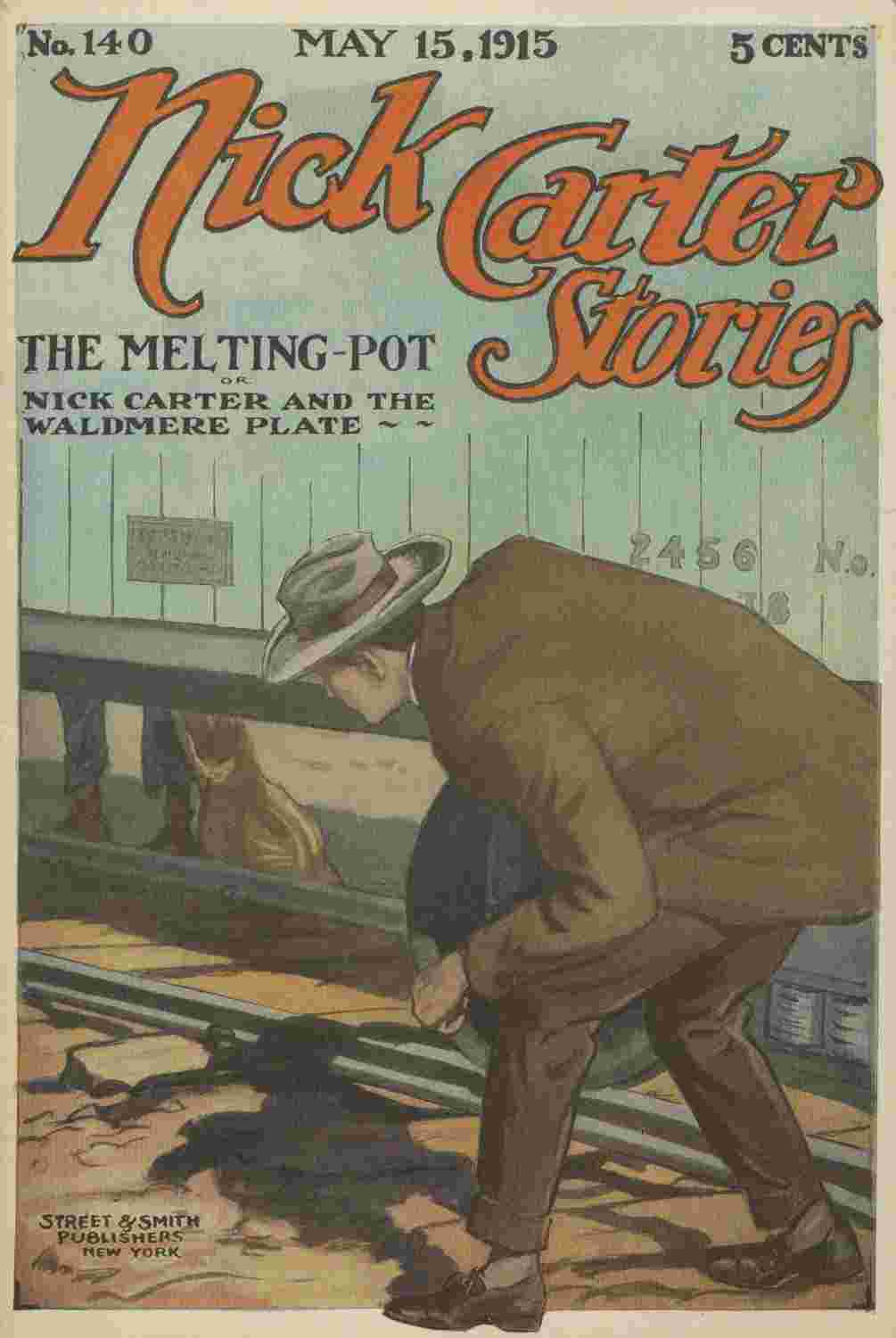
Where’s the Commandant?
By C. C. WADDELL.
CHAPTER I.
THE GLINT IN THE DARKNESS.
Colonel Vedant and his adjutant, Captain Ormsby Grail, hurried down to the Dolliver Foundry, one of the large industrial plants along Brantford’s bustling seven miles of water front, in response to an urgent message from Otto Schilder, manager of the plant. It was ten o’clock at night, but as the Dolliver people were turning out some castings for a wireless telegraph mast of new design, to be erected at Fort Denton, and required frequent consultations with the commandant, there seemed nothing especially strange in the request.
On the arrival of the officers, however, they learned, to their surprise, that there was no desire for the colonel’s presence, and the manager flatly disclaimed having sent for him. The old soldier stared incredulously, his somewhat florid face taking on a deeper flush behind his gray military mustache.
“Pardon me, Mr. Schilder”—he made little effort to conceal his irritation—“but do I understand you to say that it would have been impossible for any such message to be sent me from the foundry this evening?”
The manager removed his cigar, and rose from his desk to face the other.
“Positively so, colonel.” He spoke emphatically, and with a slight German accent. “There has been nobody in the office since six o’clock except myself and Miss Griffin”—with a wave of the hand toward his stenographer—“and we have been wholly engrossed in making up some arrears in correspondence.”
“You hear, Grail?” The colonel turned toward his adjutant. “Are you responsible for this blunder? Got the name twisted, or something of that sort, eh?”
“Hardly, sir.” The younger officer appeared no less perplexed than his superior, but his tone was one of firm conviction. “The note was written on a letterhead of the Dolliver Foundry, and was ostensibly from Mr. Schilder; I am familiar with his signature. As to the contents, I could not well have been mistaken. You remember, I read the message over to you twice. The contents make small difference, anyhow, since Mr. Schilder denies having sent us a communication of any sort.”
“Small difference,” admitted the colonel, “except as offering a possible clew to the perpetrator of this hoax, for it cannot well be anything else, unless, indeed——” He paused abruptly, the umbrage he had shown giving way to something like concern. “Come, captain!” He addressed his companion a trifle peremptorily, at the same time backing toward the door. “We are detaining Mr. Schilder. Permit us to apologize for the interruption, sir, and let us——”
At this point, a remarkable thing happened. The electric lights went out, cutting short the colonel’s apology, and shrouding not only the office, but the foundry yard outside in darkness.
For a moment Grail was absolutely blinded; then, as his vision cleared and the square of the open doorway became faintly visible, he saw cut across it a tiny flash of fire like the glow of a lightning bug in flight. No other sight or sound punctuated the interval, and almost immediately the lights came on again.
“Ah!” Schilder blinked before the sudden radiance. “The dynamo must have slipped a belt, or——” He halted, with a little gasp. “Why,” he exclaimed, “what has become of the colonel?”
It was certainly astonishing. Not one of the three other occupants of the room had stirred. Grail and the manager stood in exactly the same position as before, and the stenographer still sat at her table with her fingers resting on the keys of her typewriter, but the colonel was gone.
With a common impulse, the two men stepped swiftly to the door, and glanced out across the yard. There had not been sufficient time for any one to cross it and reach the gate, yet the colonel was nowhere to be seen, and his erect, soldierly figure could not possibly have gone unrecognized in that wide-open space, and under the glare of the half dozen or more arc lamps now brightly burning. Nor could there be any question of his having strayed from the direct path in the darkness and being now hidden from their view by a pile of rubbish or material, for the inclosure was remarkably free from obstruction. Indeed, the last of what had been a towering scrap heap was being cleaned up, and, with the aid of an electric crane, loaded on cars by the force of men then at work.
“Well, what do you know about that!” Schilder muttered. Then, closely followed by Grail, he hurried across the yard to interrogate the old watchman at the gate. But the latter was firm in his protestation that no one had passed him. Even with the yard lights all out, he could still, he declared, have seen anybody leaving the place by the illumination from the street lamp on the corner.
“Then,” said Grail, “he must have gone out some other way.”
The manager waved his hand significantly toward the high board fence which completely surrounded the yard, and which was topped with sharp spikes to keep out pilferers. There was but one exit—the gate at which they had already made inquiry; the big doors leading into the foundry building were barred and padlocked.
“Perhaps he is still in the office,” ventured Grail. “He might have had a seizure of some kind in the darkness, you know, and fallen behind a piece of furniture.”
But even as he voiced the suggestion he realized its utter absurdity. Schilder’s office contained nothing except the desk which could have concealed the body of a man, and the desk was pushed back close against the wall. Nevertheless, they made an inspection of the place, but entirely without result. Then, when the manager called in every man working in the yard, and questioned him, to no purpose, the searchers seemed to have come to the end of their tether.
“But it is preposterous, you know!” exclaimed Grail, attempting to throw off his misgivings. “There is, of course, some absolutely simple explanation, and the colonel is, no doubt, out at the post by this time, swearing about me for not putting in an appearance. May I use your telephone, Mr. Schilder?”
Inquiry at the fort elicited that Colonel Vedant had not returned, and no information regarding him could be gained from his quarters, the club, or any of his customary haunts. When Grail had gone through the entire list, and called up the post again, only to receive the same negative answer, he made no effort to conceal his growing anxiety. A suspicion of foul play strengthened in his mind. “If not that,” he asked, “why should the colonel, of his own accord, disappear in this absurdly mysterious manner? Colonel Vedant is not the sort of man to be waylaid or carried off without making at least a show of resistance, and I certainly heard no outcry or sound of a struggle. Did you?”
Schilder shook his head. “No, no; there’s nothing in that,” he said impatiently. “How, please tell me, could such a scheme have been planned in advance, and put into effect, when we allow no strangers hanging around here under any pretext? But, overlooking all that,” he argued, “and even granting that the old gentleman might have been knocked out by the sudden, silent blow of a blackjack or sandbag, how was he so quickly spirited away? The lights were out hardly more than long enough for one to draw a deep breath—surely not a sufficient time to get farther than ten or twelve steps from the door. Is it possible that with all those yard lights going again, the colonel could have been dragged or carried the length of the inclosure, and none of the men at work out there have noticed it?”
Grail made no immediate answer. He stepped to the door, and, leaning over, narrowly inspected the cinder-covered ground about the threshold. But no marks or footprints indicating a struggle rewarded his searching gaze; the surface was absolutely undisturbed. Then, all at once, he espied, a foot or two away, a small object. He glanced back over his shoulder, and, seeing that Schilder had turned to address a word of direction to the stenographer, reached out and quickly transferred it to his pocket.
It was a half-smoked cigarette—a cigarette of dull-gray paper, with a peculiar long pasteboard mouthpiece.
CHAPTER II.
THE CLEW THAT FAILED.
“There’s no need to keep you any longer, Miss Griffin,” Schilder said to the stenographer, as Grail came back toward him. “And—er—Miss Griffin, I guess it would be just as well if you didn’t mention this occurrence to any one on the outside. We want no unnecessary notoriety, eh, captain?”
The adjutant agreed with him. “If you don’t mind, though, Mr. Schilder,” he said, “and if Miss Griffin will oblige me, I’d like to have her take down a note for me to Major Appleby. This matter ought to be reported to him at once, and I don’t like to use the telephone. It will be very brief, Miss Griffin,” he continued, turning to the girl. “You can take it direct on the machine. Only I will ask you to give me a carbon copy; we have to be very particular in the army in regard to all communications, you know.”
Then, when she had slipped in her sheets of paper, and sat ready at her typewriter, he swung around so as to face Schilder, and crisply dictated:
“Please come at once, on receipt of this, to the office of the Dolliver Foundry, as I desire to confer with you on a matter of the greatest importance.”
His eyes never for a moment left Schilder’s face while the message was being transcribed, but if he had expected to see anything there, he was doomed to disappointment. The countenance of the manager remained as expressionless as a mask.
“What do you think of that?” Grail finally asked him.
“Well”—the other man was lighting a cigar—“it certainly seems urgent enough.”
“Yes,” said Grail dryly; “except for the address and signature, it is, word for word, the same as the note received by Colonel Vedant.
“Ah, thank you, Miss Griffin,” he added, as he took the two sheets of paper which she handed him, and, signing the original, slipped it into an envelope. “I’m going to ask you, too, if you don’t mind, to stop at the A. D. T. office on your way to the car, and have them rush this right out to the fort.”
After this, nothing more was said until the girl had donned her hat and jacket and taken her departure. Grail thoughtfully folded up and put into his pocket the carbon copy, which he had been studying meanwhile under the light at the desk.
“I observe, Mr. Schilder,” he said, “that the capital D on your typewriter blurs badly, and that the m is slightly chipped on one side. It will be interesting to compare this copy with the note received by the colonel, to see if both show the same defects.”
The manager, however, merely shrugged his shoulders. “You still cling to the idea that the note must have come from here, eh? Well, you’re on the wrong scent, captain—entirely on the wrong scent. A sheet of our letter paper would be no very difficult thing to get hold of, and when you come to look into the matter I think you’ll find that the original note was written at post headquarters.”
“At post headquarters! What do you mean by that?” demanded Grail.
“My dear captain,” Schilder answered, “hasn’t it struck you yet that the most likely person in the world to write that note to Colonel Vedant was—Colonel Vedant himself? Between ourselves, now—you are better acquainted with conditions than I—isn’t there something which might have induced the old fellow to drop quietly out of sight?”
“Ah!” Grail spoke slowly. “So that is your solution, is it?”
“A more plausible one, at any rate, than to imagine he was kidnaped, or something of that sort,” Schilder contended. “It wouldn’t have been much of a trick for him to have slipped off his coat so as to look like one of the workmen, and then to have dodged through the gate when old Dennis wasn’t looking. Men have done such things before, captain.”
“Not men like Colonel Vedant,” Grail insisted warmly. “He is the type that fights rather than runs away. Besides, in this case there is absolutely no ground for such a suspicion. His record is unassailable, and he is due for honorable retirement in a few months. He has no financial troubles. His health, for all his fifty odd years, is perfect, and no one who knows him could doubt his sanity for a moment. What possible reason could there be for such a man to chuck the game?”
“Perhaps a woman?” suggested Schilder.
“Rot! The only woman the colonel is interested in is his daughter, and he would never do anything to cause her the slightest distress or uneasiness. Why, man, on her account alone, if for no other reason, the theory you offer is simply ridiculous.”
There was some further discussion along the same line, but of little consequence. Shortly after, Major Appleby, with a couple of officers from the fort, arrived in a motor car.
“Bless my soul!” exclaimed the major, a short and rather apoplectic-looking warrior, when the situation had duly been made clear to him. “We must lose no time in getting to the bottom of this.”
“Mr. Schilder,” remarked Grail quietly, “is firmly convinced that the colonel took himself off voluntarily.”
“Nonsense!” protested Major Appleby, and his companions promptly echoed the opinion. “Vedant is the last man in the world to have done a thing of that sort.”
“All right,” conceded the manager; “you gentlemen are probably more competent to judge on that point than I. Just the same, I surely am curious to see what other explanation you can get to fit the facts.”
“Ah!” The major cocked his head importantly on one side. “That will no doubt come out in the investigation. The chief thing now is to learn just what the exact facts are.”
The inquiry he set on foot, however, elicited nothing new, and in the end the newcomers had to confess themselves as completely baffled as Grail and Schilder. Still, it did not escape the shrewd eyes of the foundry manager, as the fruitless investigation proceeded, that certain more or less vague suspicions were forming in the minds of Appleby and his associates; and he gathered, too, not so much from anything that was said or done as by a sort of coolness in the atmosphere, that these were in some way hostile to the adjutant.
A sly smile flickered across his lips under the cover of his beard, and, with an air of impatience, he broke in on the aimless conjectures of the three officers.
“Come, come, gentlemen,” he said; “all this amounts to nothing. And, since you seem determined to make it a case of foul play, I guess I had better start to do something on my own hook.”
“You!” The major glared at him haughtily. “What have you got to do with it?”
Schilder laughed. “The Dolliver Foundry can hardly afford, my dear sir, to have a mystery of this sort taking place on its premises without at least a show of effort on my part to clear it up. Delay, moreover, merely makes the matter look worse for us; so, although I dislike needless notoriety as much as any of the rest of you, I——” Instead of completing the sentence, he reached out for the telephone on his desk.
“What are you going to do?” demanded Appleby sharply.
“Call up the chief of police, and place the matter in his hands.”
“The chief of police!” The major gave a violent start, and glanced uneasily at his companions. Only Grail seemed unperturbed, and the side glance he cast at Schilder was distinctly skeptical. It was almost as though he said: “I dare you to make good your bluff.”
The major lost no time, however, in entering a remonstrance.
“Oh, I beg of you, Mr. Schilder,” he urged, “let us not do anything rash! There are—er—certain matters which I am loath to mention here, but which, provided the officers at the fort have sufficient time to sift them out, will, I am sure, bring a speedy solution. You bear me out in this, do you not, gentlemen?” he appealed to his two companions.
They assented, and it was noticeable that in doing so both carefully avoided looking in the direction of the adjutant.
Schilder, a mocking twinkle in his eye, turned toward Grail.
“And you, captain?” he asked. “Can you give me the same assurance?”
The young officer met his gaze steadily. “Why not?” he said. “To my mind, the investigation simply resolves itself into a matter of determining the authorship of the note received by the colonel, and surely we at the fort are as competent to handle that as some blundering policeman.”
Major Appleby gave a grunt of recollection, and his manner toward Grail relaxed.
“Ah, yes,” he said, with evident relief. “I had forgotten for the moment the existence of that clew. The note is at headquarters, I presume, captain?”
Grail nodded. “I left it on my desk, when the colonel and I came away.”
“Then, come,” urged the major, moving toward the door; “let us lose no time in taking a look at it. We can trust you, I suppose, Mr. Schilder, to take no action until you hear from us?”
“Anything in reason, major,” the manager agreed. “And I certainly hope for all our sakes that you meet with quick success.”
After he had returned from seeing the party off in their automobile, however, and had closed his desk for the night, he lingered a moment in the office before taking his departure.
“I wonder,” he muttered thoughtfully, “if that man Grail is stringing me, or am I stringing him?”
Meanwhile, as the motor car swiftly left the factory chimneys and slumlike streets of the river front behind, and climbed the hilly streets back toward the fort, Major Appleby turned toward the adjutant, who sat beside him in the tonneau.
“What do you make of it all, captain?” he asked, in a conciliatory tone. “You were on the ground, and ought to be able to form a better judgment than any of the rest of us.”
“It’s gumshoe work,” Grail answered; “a trick of some of those foreign spies who have been hanging around ever since Colonel Vedant started on his present series of experiments. They thought, no doubt, that, with a hurry call of this sort, they might catch him with some of the papers on his person.”
“Then, you believe that Schilder is——”
Grail shook his head. “Too obvious,” he objected. “Whatever else Schilder may be, he is not a fool.”
“But whom else can we suspect, under the circumstances?” queried Appleby. “Have you any theory at all, captain, that will account for the mystery?”
The adjutant hesitated a moment. “I think I will wait to answer those questions, major, until after we have examined the colonel’s note.”
“Ah, true!” assented the other. “That must naturally be our starting point. And here we are!”
The automobile turned in from the tree-shaded street, and sped down the roadway past officers’ row. It halted in front of headquarters, and the four passengers piled hurriedly out. Grail, abstractedly acknowledging the salute of the soldier on guard, pressed forward in the lead, and, unlocking the door, swung it open. There was no need to switch on the lights, as the room was already sufficiently illuminated by a night bulb which hung in front of the safe.
The adjutant, closely followed by the others, advanced to the desk, then paused, with a little gasp of bewilderment.
“Why,” he exclaimed, “the note is gone! I am positive I left it here.”
He turned to the colonel’s “striker,” who lounged sleepily in the adjoining room, to inquire if any one had been there in his absence.
“Not a soul, sir,” was the answer.
“Then, have you yourself been in here, or touched any of the papers on the desk?”
“Haven’t stirred from my seat, sir, since you and the colonel went.”
That seemed to settle pretty well the question of outside interference, for, with the guard outside and this man seated where he could command the whole interior of the place, no person could have entered undetected. Yet the note was indubitably gone. The drawers of the desk were ransacked, the files gone over, even the floor thoroughly searched, without revealing the slightest trace of it. With all the doors and windows closed, there was no chance of it having been carried away by some frolicsome breeze.
Major Appleby regarded Grail with a portentous frown. “Captain,” he said stiffly, “this is very, very strange.”
CHAPTER III.
UNDER SUSPICION.
There was little sleep at Fort Denton that night. Two o’clock found the lights still burning brightly in Major Appleby’s quarters, where most of the officers of the post were assembled. Conspicuous by his absence from this gathering, however, was the adjutant, Captain Grail. He had been there at an earlier hour to join in the deliberations, but after once more making a report of the circumstances connected with Colonel Vedant’s disappearance, he somewhat stiffly withdrew. He sensed in the conference that same feeling of doubt and hostility toward him which had manifested itself in Appleby and his companions on first hearing the story, and his self-respect would not permit him to remain.
After his departure, a rather uneasy silence settled down on the council. A few pointless remarks were made, but for the most part the group devoted themselves to their cigars, and studied the pattern of the carpet.
Finally, however, Captain Dobbs, the surgeon—a bald, blunt-spoken old fellow—brought things to an issue.
“What’s the use of mincing matters?” he boomed, glancing defiantly around the circle. “Every man here believes that Grail’s at the bottom of this thing. Then why not get down to cases, instead of sitting around here like a pack of dummies?”
A little gasp, partly of relief, partly of surprise at such plain speaking, ran around the room, and everybody glanced involuntarily toward Major Appleby where he sat at the head of the table.
“H’m!” The major cleared his throat, and moved a bit uncomfortably under the scrutiny. “Without—er—going quite so far as our friend Dobbs,” he finally ventured cautiously, “I take it that no one here will deny there is some reason in what he says. We must be prudent, though, gentlemen. Remember, the honor of the army is involved.”
“Prudent! Ha!” The doctor gave a scornful cackle. “Why, the whole post has been like a whispering gallery all afternoon. I doubt if there’s a man on the reservation, from cook boy to colonel, who hasn’t been cocking his head to one side, and asking, under his breath, what there was in this business about Grail. The only person who didn’t seem to be wise to it was Grail himself. Now, let’s cut out all this innuendo and gossip, and look the facts squarely in the face. If the report that’s been going around is true, it’s unquestionably got a bearing on the affair we’re investigating; if not, the sooner we put a stopper on it and turn our searchlights in another direction, the better for all concerned. In either event, I guess the honor of the army will take care of itself.”
There was a murmur of approval as the surgeon finished speaking, followed by calls from various parts of the room for Hemingway; and eventually, in response to these demands, a flushed young lieutenant rose rather reluctantly to his feet.
“Mr. Hemingway,” the major said, “you seem to be the person best qualified to make a statement in this matter. Will you, therefore, repeat for the benefit of us all, the communication which you made in confidence to Mrs. Appleby and myself this afternoon?”
“In confidence—to Mrs. Appleby!” the doctor snorted, scarcely taking the trouble to lower his voice. “No wonder it was all over the post in less than half an hour.”
In the general eagerness to hear Hemingway, however, his growling passed unnoticed, and the young lieutenant, shifting unhappily from one foot to the other, commenced his story.
“In the first place,” he said, glancing appealingly around the circle of officers, “and as I told Major Appleby, I don’t want any one to think that I’ve been up to any sneaking or underhand business. But when a thing came right up and slapped me in the face I couldn’t help taking notice of it, especially after the colonel told all of us that he wanted us to be on our guard during the course of these experiments.”
“Cut out the excuses,” protested one of his auditors. “It’s the facts we want to get at.”
“Well, then,” cried Hemingway defiantly, “I say that Captain Grail has been having dealings with Sasaku, the Jap waiter at the mess, which are open to very grave suspicion. I am in charge of the mess this month, as you all know, and I had noticed that Grail seemed to have considerable to say to the Jap when he dropped in for his meals; but I never attached any importance to the matter until to-day at noon, when I saw him hand Sasaku a long envelope, which the latter immediately slipped under his jacket. Then, I will admit, I began to get a little worked up, for there was a certain furtiveness about the transaction which I didn’t altogether like; so, as soon as Grail left, I promptly nailed Sasaku, and demanded to know what it was the captain had given him.”
“And he lied, of course!” commented a former mess manager, out of the depths of his experience. “Probably told you that you must have been mistaken.”
“No,” returned Hemingway; “he simply informed me coolly that it was none of my business, and gave me notice that he was quitting his job.”
“Why didn’t you grab the impudent beggar, and search him?” another officer broke in.
“Well”—the lieutenant flushed again—“I didn’t want to make any blunder, don’t you know, so I decided to report the matter first to Major Appleby before taking any definite action; and by the time I got back to the mess again the Jap had cleared out, bag and baggage.”
“Cleared out! Where?”
“That’s the question.” Hemingway shook his head. “I’ve had Corporal Stone and half a dozen men out ransacking the town for him since four o’clock, and not a trace can be found. We think he must have sneaked aboard a train somehow, and got away, unless——” He paused.
“Unless,” Major Appleby pointedly finished, “his departure may have some connection with the far more serious matter of the colonel’s disappearance.”
“Has any one put this business about the Jap up to Grail?” the surgeon inquired, with a frown.
“Not directly,” Appleby admitted; “that is, unless the colonel may have mentioned it to him. He was really the only one who had an opportunity, for Grail left the post shortly after the occurrence, and did not return until nine o’clock, and from that time until they set out for the foundry the two were closeted together in the office. Vedant, however, was rather inclined to pooh-pooh the whole matter, and he may very easily have failed to speak.”
“Can any one doubt, though, that Grail knew what was in the wind?” demanded young Hemingway hotly. “Why, the very way he left us here to-night showed it. I say, too,” he insisted, “that a man who’d been caught selling secrets to a Japanese spy, and saw court-martial looming up ahead of him, couldn’t well think of a smoother plan to sidetrack inquiry and shift attention from himself than to have the colonel abducted.”
“But that would indicate that this fellow Schilder was in on the deal, too,” objected one of the officers who had not yet spoken. “And what interest could he——”
“Schilder? Pshaw! He was only a convenient tool,” interrupted Hemingway. “Believe me, he’s as much in the dark as anybody else.”
“How could the game have been worked without his connivance, though?” inquired the other.
“Humph! Trust a pack of slick Japanese to handle that all right.” Hemingway gave a toss of the head. “Knowing the colonel’s movements in advance, what would have been easier than for them to secret themselves about the foundry yard; then, at the psychological moment, cut off the lights and rush the colonel out and away. With their agility and cunning, a trick like that would be simply pie to them.”
“How do you explain this business about the note from Schilder, though?” broke in another questioner. “You think, of course, that Grail or the Jap forged the note that was received; but, if so, why doesn’t Grail show it up now, instead of making things look worse for himself with the assertion that it has disappeared?”
“Ah, that was the smoothest part of the whole deal,” declared the youthful investigator. “He knew that he was bound to be suspected, didn’t he? And he knew, too, that documentary evidence of that sort, subjected to such close examination as would naturally be given it, might lead to his detection. So what does he do but get it out of the way, and at the same time fog the issue with another touch of apparent mystery.”
His emphatic arguments began to carry weight with the rest. It was at least a solution that he offered, and, groping about in the dark as they were, they were ready to accept almost any theory that bore the color of plausibility.
“I think,” said Dobbs, the surgeon, voicing a general sentiment, “it’s about time for us to put this matter up to Grail straight, and see what he has to say for himself.”
The major summoned his striker. “My compliments to Adjutant Grail, and ask him if he can make it convenient to come here at once to answer a few questions.”
In less than five minutes the messenger was back with the astonishing reply:
“The adjutant’s compliments, sir, and he wishes to know if you care to put your request in the form of an order. If not, sir, he does not care to discuss anything with the officers to-night.”
The major grew red with indignation at the injury to his dignity, and the surgeon growled darkly that the answer bore out his suspicions. But Appleby was not a man of snapshot action, and he said, with an assumption of chilly dignity:
“Very well; say to the adjutant, with my compliments, that I shall issue no orders to-night.” Then, turning to the officers, with a portentous shrug, he added: “We will await the developments of to-morrow.”
CHAPTER IV.
MYSTERIOUS ASHES.
After sending his curt message to Major Appleby, Grail sat in the office at headquarters, whither he had betaken himself from the meeting, smoking fiercely, and glowering at a spot on the wall. He had set himself in defiance of the whole post, and he could not but feel that he was in the right. At any rate, he scorned to defend himself against the aspersions of a blunderer like Appleby, or an officious young ass like Hemingway; for, as it happened, he knew of the story set afloat by the mess manager, Colonel Vedant having detailed it to him jestingly during their hurried trip to the foundry. Grail had been prevented then from offering any explanation, owing to their arrival at Schilder’s office.
Rather than make such an explanation now, he vowed he would be drawn and quartered, for he bitterly resented the attitude taken by his brother officers, their readiness—nay, almost eagerness—to believe the very worst of him.
Grail loved his profession. More than once he had refused flattering offers to leave it for a career in civil life. But now, in his hot indignation, he declared that not another week should find him wearing the uniform and associating with such double-faced, intriguing cads.
On the impulse of the moment, he stepped over to his desk, and, snatching up a pen, started to write out his resignation. But as he blotted the sheet before affixing his signature he paused, with an exclamation of annoyance, to find that the lines he had written were streaked with fine gray dust, which had fallen on the paper. A sort of gritty powder, it seemed to be, like the dust which rises from the handling of filed papers or documents. Without giving the matter second thought, Grail was about to tear up the blurred resignation and start to draft another one, when his attention was suddenly caught by a flake of the powder slightly larger than the others.
It was a tiny shred of paper, but what especially aroused his interest was that it showed the trace of a lithographed letter “V” of the peculiar style and shading used as a heading by the Dolliver Foundry.
Quickly he caught up the blotter he had been using, and shook it over a sheet of carbon paper, for there had flashed into his mind a prompt suspicion as to the nature of that dust. That it had fallen from the blotter there could be no question, and he recalled distinctly that he had left the mysteriously missing note lying on that blotter when he and the colonel took their hasty departure.
A moment or two gave him all the confirmation of his suspicion that he required, for under his vigorous shaking there sifted down on the dark surface several fragments, from a sixteenth to a thirty-second of an inch in diameter, on which he could plainly decipher indications of typewriting.
Snatching up a reading glass belonging to the colonel, he bent over these to satisfy himself he had made no mistake; then straightened up, with a muttered expletive and a little, puzzled frown between the eyes.
The glass brought out on one of the specks what appeared unquestionably the upper half of an “m”—and, what was more, the letter was slightly chipped on one side.
Grail leaned over to subject the fragment to a second examination, and make sure that he had not been misled; then drew from his pocket the carbon copy of the note he had dictated to Schilder’s stenographer, and compared the two impressions. They were alike, defect and all, as two pennies struck from the same die. One was forced to the conclusion that they had been made by the same machine.
Dropping his chin into his hand, the adjutant sat staring almost incredulously at the telltale speck in front of him. This knocked into smithereens the entire theory he had evolved as to the disappearance of Colonel Vedant, for, despite the pains he had taken to secure a copy of the note from Schilder’s typewriter, he had never really believed that the original summons had come from there.
Now, however, he was driven to a fresh line of speculation. Recalling the foundry manager’s freely expressed insinuations, he arose half impatiently, and tested the two typewriting machines used at headquarters. There were, as he expected, no point of similarity shown with the copy of the note he had caused to be transcribed by Miss Griffin. The “m” on both machines was clear-cut and flawless; there was no indication of blurring on the “D.”
Returning to the desk, he resumed his perplexed contemplation of the fragments on the sheet of carbon paper. It seemed certain that Schilder must have sent the decoy message, relying on its speedy disintegration to cover up his tracks. And right there another consideration arose to muddle him: How had this disintegration been accomplished? Hitherto he had been so intent on establishing the identity of these specks of typewriting with the missing message that he had not stopped to question the agency which could so quickly and thoroughly destroy a stout sheet of linen paper.
“Some powerful chemical, doubtless,” he reflected, recollecting that the note had been a trifle damp when he drew it from the envelope; and with this suggestion, he scraped together a little pinch of the dust to taste and smell of it. The tests confirmed his opinion. There was a faint, pungent odor to the particles, which, although familiar, he could not exactly place; and one of them, applied to his tongue, produced a slight burning sensation. The paper undoubtedly had been treated with some solution, which, in drying, reduced it to shreds.
He carefully transferred what remained of it to an envelope, in order to have his conclusions verified and the exact nature of the solvent determined by expert analysis; but he really needed no such corroboration. He was fully satisfied that the demolition of the message must have been effected in the way he assumed.
With so much settled, though, he seemed in no way relieved. Indeed, the frown of perplexity on his forehead grew deeper, and, seated there before his desk, he fell into a brown study.
Why, he thought, should Schilder have gone to so much trouble to get rid of this note, when he could so easily have supported his denial of writing it by the simple expedient of using another machine? As he himself had said to Grail, it would be quite a job, without other clews, to trace, among all the hundreds of machines in a city like Brantford, the particular one on which a specific communication was written.
“No,” the adjutant said aloud, fishing from his pocket the half-smoked cigarette he had found at the threshold of the foundry office, and, surveying it with a decisive nod, “I can’t be so far off the track. This new complication simply means that the trail is a bit more involved than I thought. However”—he shrugged his shoulders with returning resentment—“that is something for the bunch of wiseacres down the row to work out. I’m done with the whole business.” And once more he drew a sheet of paper toward him to indite his resignation.
With his pen dipped in the ink, he hesitated. There came a natural reluctance to quit in this way under fire. The fresh developments he had unearthed, too, served as a challenge to his ingenuity. He had a well-defined theory to account for the disappearance of the colonel, and, after his first anxiety at Schilder’s office, had not entertained any serious alarm as to the outcome. It was, he believed, merely a bold attempt on the part of some of the foreign spies who had been hanging around the post of late to obtain information in regard to the experiments in progress there. They must have become aware of the colonel’s habit of carrying home with him at night the reports made to him, in order that he might digest them at his leisure. Since the coup had failed, however, Colonel Vedant having no papers with him that evening, and being the last person in the world to divulge under duress or otherwise any official secrets, Grail felt satisfied that the captive would be released just as soon as those responsible for the outrage were safe beyond the reach of retribution.
He had not really credited Schilder with any hand in the affair. On that one point, at least, he was agreed with Lieutenant Hemingway, regarding the German merely as a rather thick-headed dupe who had unwittingly allowed his establishment to be used as a theater for the enterprise.
Now, however, with the seeming assurance that this decoy message must have come from the typewriter at the foundry, he began to wonder if he had not been taking too much for granted. One was certainly justified in believing that either the manager or his stenographer must have had knowledge of the writing of the note.
“Suppose,” Grail speculated, “the assumption I’ve been going on is a mistake? By Jove, I’m not infallible, and I’ve got no proof to support me—that is, nothing you could call real proof. Suppose, then, that there’s more to this job than I’ve been willing to concede, and that the old colonel is actually in danger? Have I got the right, merely from personal pique, to stand from under and leave the old boy to the mercy of a set of bunglers like Appleby and his crew?”
While he hesitated, his glance happened to fall on the pen he still held between his fingers, which he had picked up from the desk at random. It was a gold one, belonging to the colonel—a gift from his daughter, Meredith, as was shown by the tiny plate affixed to the handle, with the inscription: “Merry Christmas. M. L. V.”
Before the adjutant’s mind rose suddenly the vision of the fair-haired, lovely girl, so devotedly attached to her father. He knew what this affair would mean to her, how deeply she would be affected, whether there were any actual menace in the situation or not. He laid down his pen, and, picking up the form of resignation he had drafted, tore it across, and dropped it into the wastebasket.
“I’ve got to stick it out,” he muttered. “I’ve got to stick it out and clear this thing up—for her sake!”
His mind made up, he threw himself whole-heartedly into his task. A glance at his watch showed him it was after three o’clock, but no thought of sleep suggested itself to him. Instead, he caught up his hat and coat, and started out to take another look over the scene of the disappearance.
But there was nothing new to be gained, he found. The foundry yard, silent and deserted now, the last vestige of the scrap heaps cleared away, and only the idle crane, with its long, sweeping arm at rest, to serve as a reminder of the evening’s earlier activity, offered nothing more in the way of a clew; nor could old Dennis, at the gate, although garrulous enough, add any fresh information to what he had already told.
Leaving him after a brief colloquy, Grail thoughtfully strolled down to the railroad tracks skirting the banks of the river, and patrolled them slowly the length of the foundry inclosure and back, climbing up on each of the scrap-loaded freight cars standing on the siding to investigate, but only to drop down again every time, with a shake of the head. The night was beginning to give way now to the first faint gray of the summer dawn. More and more distinctly the different features of the water front revealed themselves—the chimneys of the big smelter, Brantford’s largest industry; the railroad machine shops beyond; and, overhead, dark and shadowy against the sky, the dim perspective of the great bridge stretching across the stream.
The horizon flushed into pink and crimson; the gilded cross of a steeple off in the distance flashed with the first beams of the rising sun; somewhere up the river a factory whistle blew. Morning had come.
Only the wide river was invisible now, blanketed in the thick mist which still hung over its swift, muddy current. Grail stood a moment staring out at the impenetrable veil; then, obliged to step nimbly from the tracks for the passage of an express train, turned, and made his way back past the gate of the foundry.
As he reached old Dennis, he halted suddenly, and wheeled to glance sharply once more out over the mist-enveloped stream.
“What is that noise?” he inquired.
The old gateman cupped his wrinkled fingers behind his ear, and bent his head to listen.
“Is it th’ choog, choog, choog ye mane?” he returned. “Sure, that must be a autymobile over in th’ bottoms.”
“No.” Grail shook his head. “That’s the exhaust of a motor boat, if I ever heard one.”
“A motor boat!” scoffed Dennis. “Wid all thim sand bars out there? Sure, there’s a loonytick runnin’ it, thin. W’y, sorr, nobody don’t niver sail motor boats on this river. Th’ boss just had wan iv th’ things shipped in yistedah, he was tellin’ me, but ’tis not on no river he’ll be thryin’ it. He’s goin’ to have it tuk out to Lake Manawa.”
A quick flash shot into the adjutant’s eye at this information, but his tone betrayed only a polite interest.
“So Mr. Schilders is going to have a boat out at the lake this summer, eh?”
“As I tell ye, sorr. An’ sure it may be out there already f’r all that I know. He was dickerin’ wid a felly yisteday afthernoon to haul it out f’r him.”
Grail merely nodded, and turned the conversation to another channel. The chug-chug which had caught his attention had faded away by this time, and there seemed nothing to keep him there, but still he lingered on, chatting with the old watchman.
It might have been observed, though, that he directed an occasional keen glance toward the mists, thinning fast now in the rays of the rising sun, and that when at last the vapors were entirely dissipated, and the river visible from shore to shore, a little frown of disappointment gathered between his eyes. On all the broad expanse of the tawny stream there was no craft of any kind to be discerned. He bade old Dennis good morning, and betook himself back to the post.
TO BE CONTINUED.
TIPS TO YOUNG PITCHERS.
HOW TO CURVE A BALL.
To be able to curve a ball is the ambition of every young player. If he happens to be the pitcher of his team, his desire is all the stronger. He wants to fool the other fellows when they come to the bat. He cannot be blamed for that. But while curve pitching is undoubtedly a great accomplishment, it must be remembered that in the old days of baseball many brilliant battles were won with the straight-arm delivery. It is not absolutely necessary, therefore, to curve a ball in order to win success. The writer vividly recalls the famous games in the early seventies in the neighborhood of New York. He was a boy then, and walked miles to see the contests. A curved ball was unknown then, so far as the pitching was concerned. And the pitchers were very effective, too. They studied the weakness of the batsmen, just as the pitchers do now. And that is the study all young pitchers must pursue. Begin your work by pitching a straight ball. You cannot gain control in a better way. As you are young in pitching experience, so also are your opponents young in their knowledge of batting. If you watch them closely you will perceive very quickly that nearly every one of them swings his bat at about the same height every time. For instance, you will notice that the first batter will swing his bat just in front of his waistband. In order to fool him, pitch the ball a little higher or a little lower than that point. The next batter may snap his bat high. Give him a high ball, but a few inches lower than he is likely to strike. The rule is by no means infallible, but it is a good one. It takes a boy a long time to overcome the inclination to swing in the same way every time he strikes. There is another important point to remember: Do not give the batsmen a chance to hit the ball with the end of their bats, if you can avoid it. This is simple enough if the batter stands close to the plate. You can keep the ball well in on him without much trouble. But when he stands back in the box, you must use discretion. Try to coax him with a ball or two just inside the plate. If he refuses to “bite,” then, of course, you’ll have to put it over. As you improve in your work, you can begin to practice curves.
Curve pitching cannot be taught by book or other directions. It must be learned by actual practice and experience. The principles of making a ball curve, however, may be explained. Let the young aspirant grasp the ball firmly in his hand, giving the pressure with his forefinger and middle finger. The other two fingers should be drawn in toward the palm. Next let him snap the ball first out of one side of the hand and next out of the other side. He will soon learn the effect these movements have on the ball. Then he must practice faithfully to so control it as to make the curves useful. Strange as it may seem, it is much more difficult for the beginner to throw or pitch a straight ball than one that describes an arc in its course. This is so because of the natural tendency of the player to throw the ball out of the side of his hand. To pitch a straight ball, it is necessary that the two fingers which grasp the ball should be straight up and down, with their backs in front of the player as he throws. Beyond these few hints it is almost impossible to give any intelligible instructions. It will depend almost entirely on the young player’s ability, inclination, and perseverance, how much of a success he will make at curve pitching. He cannot have too much practice, but he should take care not to overexert himself. It is not necessary to exert all his force. He can practice curves without putting his greatest speed into the ball.
DRUNKEN MONKEYS.
Did you ever hear that monkeys were an intemperate race of creatures? It is true. They actually get tipsy when they get the chance; but the punishment of their crime is something terrible even for a tipsy monkey. They are not merely taken to prison for safety and locked up for a few hours. There are no monkey policemen to do them that service, and we have not heard that there are any monkey magistrates to give them a severe lecture in the morning, fine them a few dollars, and tell them not to do it any more. No, it seems there are none of these beautiful provisions for Jacko’s safety and comfort provided in his native land, and so he falls into the hands of his enemies, and lifelong imprisonment, or even banishment to colder climates, is the punishment.
Like men, monkeys are easily outwitted when under the influence of liquor. They have human vices, and love stimulants. In Darfour and Sena, Africa, the natives make a fermented beer, of which the monkeys are passionately fond. Aware of this, the natives go to the parts of the forest frequented by the monkeys, and set on the ground calabashes full of the enticing liquor. As soon as the monkey sees and tastes it, he utters loud cries of joy that soon attract his comrades. Then an orgy begins, and in a short time they all show degrees of intoxication. Then the negroes appear. Some of the drinkers are too far gone to distrust them, but apparently take them for larger species of their own genus. The negroes take some up, and these begin to weep and cover them with maudlin kisses. When the negro takes one by the hand to lead him off, the nearest monkey will cling to the one who thus finds a support, and endeavor to go on also.
Another will clutch at him, and so on, until the negro leads a staggering line of ten or a dozen tipsy monkeys. When finally brought to the village, they are securely caged and gradually sobered down; but for two or three days a gradually diminishing supply of liquor is given them, so as to reconcile them by degrees to their state of captivity.
AN ANTIQUE MEAL.
“I have eaten apples that ripened more than eighteen hundred years ago; bread made from wheat grown before the children of Israel passed through the Red Sea; spread it with butter that was made when Elizabeth was Queen of England, and washed down the repast with wine that was old when Columbus was playing barefoot with the boys of Genoa,” said a gentleman at the club the other day.
The remarkable “spread” was given by an antiquary named Gorbel, in the city of Brussels. The apples were from a jar taken from the ruins of Pompeii, that buried city to whose people we owe our knowledge of canning fruit.
The wheat was taken from a chamber in one of the smaller pyramids, the butter from a stone shelf in an old well in Scotland, where it had lain in an earthenware crock in icy water, and the wine came from an old vault in the city of Corinth.
There were six guests at the table, and each had a mouthful of bread and a teaspoonful of the wine, but was permitted to help himself liberally to the butter, there being several pounds of it. The apple jar held about two-thirds of a gallon, and the fruit was as sweet, and the flavor as fine, as though it had been packed yesterday.
THE KEENEST EYESIGHT.
Like every other sense, that of sight improves by use under healthy conditions, and therefore the people who have the greatest exercise of their vision in the open air, under light of the sun, have the best eyesight. Generally speaking, savage tribes possess the keenest eyesight, acquired through hunting.
Natives of the Solomon Islands are very quick at perceiving distant objects, such as ships at sea, and will pick out birds concealed in dense foliage some sixty or seventy feet high. Shepherds and sailors are blessed with good sight; the Eskimo will detect a white fox in the snow a great distance away, while the Arabs of the deserts of Arabia have such extreme powers of vision that on the vast plains of the desert they will pick out objects invisible to the ordinary eye at ranges from one to ten miles distant.
Among civilized peoples, the Norwegians have better eyesight than most, if not all, others, as they more generally fulfill the necessary conditions. The reason why defective eyes are so much on the increase in this and many European countries lies in too much study of books in early life, and in badly lighted rooms.
THE NEWS OF ALL NATIONS.
Big Indiana Gas Well.
A gas well which gives more than 12,000,000 feet volume has been drilled in half a mile from Linton, Ind., on the Gillett farm. It is the largest gusher in the central States.
Missouri River’s Jokes with Farmers.
Suppose that, years ago when you were a young man, you came to Missouri and bought a farm on the banks of the Missouri River, and spent the next fifteen or twenty years in clearing the land and bringing it into a high state of cultivation. And then suppose that, just when you had begun to derive some benefit from your years of toil, the river should suddenly reach out and swallow up about half your farm.
Then suppose that the river, after keeping your farm for several years, should grow seemingly repentant and replace your farm, you would no doubt feel that all the land within the bounds mentioned in your deeds was your own as much as it ever was.
But that would all depend on the precise manner in which the river replaced your land. That is where the accretion law of Missouri comes in, and it is a fearful and mysterious thing. If the river, in putting your land back, began piling it up against your bank and continued doing so, the land to the water’s edge would be yours, even if it went beyond your original boundaries. But if the river, as it often does, should first throw up a bar out in the channel and then gradually fill up the space between that and your land until finally the current changed and left the island thus formed joined to your land, you would have no claim to any land thus formed. It would belong to the county, and could be surveyed and sold to the highest bidder, and the money it brought would go to the school fund.
The Missouri River is a malicious stream, and if it ever comes to judgment, will have a lot to answer for. Instead of pursuing its course in an orderly manner and sticking to one established course, it is forever changing, eating away the bank on one side and throwing up new banks on the other side, cutting out old sand bars here and building new ones there, so that the main channel is never the same for very long at a time.
In Holt County, near Fortescue, there has been a great deal of excitement lately, caused by the disputes over the possession of some of the land thus formed, commonly known as “bar land.” Several men had fenced land which was claimed under deed by John C. Hinkle, a Civil War veteran, who has lived on this land for the last fifty years. About fifteen years ago the river took five hundred acres of Mr. Hinkle’s land and afterward put it back as a bar. Mr. Hinkle claimed the land on the ground that the bar had made to his land, and the other men claimed it on the ground that it had been put back as an island, which finally joined Mr. Hinkle’s land, and was therefore as much theirs as any one’s. The court upheld the squatters’ claim that the land did not belong to Hinkle, and this decision was the signal for squatters to rush in and seize bar land all along the river front. In the last thirty days perhaps a dozen men have settled on these bars.
The fact of possession seems to be given considerable weight in this matter, and the land has generally been seized in the night. A squatter will pick out a piece of land that most suits his fancy, get some help, slip in at night, put a fence around it, and build a shack on it. Of course, it is not much of a house or much of a fence, but it is enough to establish proof of possession.
Sometimes two different men will have designs on the same piece of land, or perhaps the man whose deed calls for this land will offer objections to its being seized, and these conditions have given rise to several exciting encounters. Several houses have been torn down, many fences cut to pieces and in at least one instance men have been escorted from the land of their choice at the point of a Winchester, with instruction to “beat it” and not to come back. While no blood has been shed so far, it is freely predicted that it is only a matter of time until somebody is carried out “feet first.”
The county has ordered the land surveyed, with the intention of selling it to the highest bidder, but the law says that the ones in possession have a right to buy it at the highest bid, so that even if the county sells the land, the ones actually on the ground have a big advantage. This fact will probably cause others to try to seize land before the survey is made.
The land is not so very valuable except in a dry year, as it is liable to overflow any time the river rises a few feet.
Cowboy Sheriff.
Many who have visited the Pawnee Bill and Buffalo Bill Wild-West Shows wonder what has become of all the likely looking cowboys whose daring feats ahorse and with the lasso excited wonder and admiration.
Some are with other shows, some perform for moving pictures, but most of them have quit the business and settled down. Among those who quit when Pawnee Bill and Buffalo Bill closed is Tom Tait, who has located in Gillette, Wyo., county seat of Campbell County, where he has been elected sheriff. All his life has been spent on the cattle ranges of Wyoming, Montana, and the Dakotas, with the exception of the time he was on the road with the show. As a tamer of wild horses he has few equals, and as a “cow hand” none at all.
All Six Died with Boots On.
The Grim Reaper has surely played relentless and strange havoc with the Law family, of Muscatine, Iowa. Brad E. Law, a popular grocer, died recently while sitting in a chair at his home. He died “with his boots on,” so to speak, and so did his two brothers, his father, and his father’s two brothers. One of the grocer’s brothers, an engineer, was struck by a piece of a flying wheel, which broke and severed his head, and the other brother died while at the dinner table. His father died while plowing in the field, and one of his father’s brothers died in the pulpit, while preaching a sermon. His father’s other brother died while driving to town on his farm wagon.
They all met death while they were not expecting it. Neither of them was sick before his death, and sickness was not the cause of any of the deaths.
Tourists Welcome in Canada.
Numerous items have appeared lately in the press, advising residents of the United States to obtain passports when visiting or passing through Canada. Officials of the Canadian Pacific Railway made inquiries of the government at Ottawa whether passports are now required. The government announces that its officials are in no way interfering with bona-fide tourist traffic, and that persons desirous of visiting points of interest in Canada or of passing through Canada en route to other places will be accorded the same courteous treatment as was customary before the outbreak of war, and that passports are not required.
Why Belgium Thanks United States.
More than $21,500,000 has been received and the greater part of it spent for Belgian relief, according to a statement issued in New York by the commission for relief in Belgium.
One hundred and ten thousand tons of foodstuffs, cargo for twenty ships, are now on the way to American seaports from interior points, the statement adds.
Nearly sixty cargoes of foodstuffs, valued at more than $20,000,000, had been sent to Rotterdam up to the middle of March by the commission.
New Way to Hunt the Coyote.
Hunting coyotes on motor cycles is a popular sport in Sherman County, Kan. A party of ten young men went coyote hunting in this manner from there, and in one day succeeded in capturing three of the prairie pests.
New Attachment for Razor.
A Canadian inventor had secured a patent on which appears to be a simple attachment for converting an ordinary razor into one of the safety type.
The device consists simply of a piece of springy sheet metal folded so that it may be slipped over the razor blade. By holding the razor so that the side of the attachment comes in contact with the face, the right angle for the blade is attained.
Girl’s Foot Worth $14,000.
Fourteen thousand dollars was the price set on the right foot of a seven-year-old girl of Kenosha, Wis. A jury in the circuit court awarded that sum to Minnie Extra, daughter of a Kenosha laborer. A car on the Chicago & Milwaukee Electric Railway had mangled her foot so that amputation at the ankle was necessary.
Dog Politician Aids Master.
Joseph B. Steele, Independent candidate for the mayoralty nomination at the primaries in Granite City, Mo., has no “houn’ dawg” to aid him, but a devoted political worker in “Queen,” a bright little terrier. He picked up the dog on the streets recently and give it a home.
In way of repayment, the dog trotted about the town carrying in its mouth a card bearing Steele’s picture and an announcement of his candidacy. According to Steele, the dog is so intelligent that on meeting a doubtful voter it rises on its hind legs to call the sign more emphatically to his attention. The dog campaigner attracted much interest in Granite City.
Steele obtained the idea of enlisting Queen from the dog’s fondness for retrieving sticks and carrying objects about in its mouth. After a short training in carrying the card, the animal showed a remarkable enthusiasm for politics.
This Boat Travels on Land.
The visitor to the lumber districts of Canada may occasionally see what is to him a very remarkable sight—a primitive-looking steamboat high and dry on a road, crawling along quite comfortably, apparently just as much at home as in its natural element.
These boats are known as “alligators,” and are used for towing the rafts of logs down the rivers and lakes to the mills. Sometimes it is desired to transfer one of these craft to a new sphere of operations, which can only be reached overland, and the boat is then hauled out of the water, placed upon rollers, and travels to its destination by means of its own power.
“Dead” Fifty-two Years. Still Alive.
After being mourned as dead for fifty-two years, John Wesley Franse, a Civil War veteran, has been found living in a small town near San Francisco, according to a letter received by relatives in St. Louis, Mo. Franse was found by his sister, Mrs. William H. Marvin, of Kirkwood, a St. Louis suburb.
Franse served in the Confederate army under General Sterling Price. The entire regiment to which he belonged was captured and placed in the Union prison at Alton, Ill. Believing that he had died there, members of the Franse family for more than fifty years visited the Alton cemetery each Decoration Day and placed flowers on one of the unmarked Confederate graves.
At a social in Los Angeles recently Mrs. Marvin mentioned that her maiden name was Franse. Another guest said he knew an old man near by that name, and the search followed which resulted in the finding of the long-lost veteran.
Found in a Pound of Raisins.
One pound of raisins purchased from a store in Derry Church, Pa., by a special agent of the dairy and food commission was analyzed by State Chemist Charles la Wall. He found: Prunes, rice, beans, and fuzzy dirt; human and animal hairs, straight and curly; fibers of cotton and wool dyed green, yellow, brown, pink, and gray; straw and a little bit of bran, sand, cornstarch, broken wheat, and yeast spores; pine wood and fragments of unidentified other timber; tobacco leaf, cigarette paper, and cigarette tobacco. Also, the wings and legs of a few unfortunate insects. Otherwise the raisins were all right. The groceryman was arrested.