
McManus Sisters in Doubt.
That adequate reparation for the murder of John B. McManus, the former Chicagoan, killed on his ranch outside of Mexico City, would not be exacted by the United States government is the belief expressed by his two sisters living in Chicago. They have taken the matter up with a number of Chicago Congressmen.
“I doubt if a proper indemnity will ever be paid Mrs. McManus,” said Miss Elizabeth McManus, when seen with her sister, Mrs. Mary Dorgan. “And it seems as if the matter of bringing the murderers to justice would also be allowed to lapse, as in other cases. Outrages were committed against the sisters of the Sacred Heart in Mexico City, and I find the state department did nothing further than to complain to the Mexican government.”
A letter from Counselor Lansing informed Miss McManus the Brazilian minister had placed the “full facts” before the new minister of Mexican foreign affairs.
This Potato King is a “Jap.”
Reading a story of the visit of George Shima, the potato king of Lodi, Cal., to Los Angeles, in a paper of that city, merchants of Lodi recall that not many years ago the Japanese capitalist could not obtain credit in the stores of this city, not because he was not honest, but as a newcomer he had not established credit.
Those business men who refused to trust him did not anticipate that in a few years Shima would control 37,000 acres in California and have 6,000 acres in his own holdings, and have established a large credit in California banks.
Last July Shima owned about a quarter of the 4,000,000 sacks of potatoes in California, and to-day he owns half of the 500,000 sacks unsold in the State.
Ready for the Golden Shore.
William Reid, a negro, who has lived in Red Bank, N. J., since he was mustered out of the Union army in 1865, celebrated his seventy-fifth birthday and vouchsafed the information that he had made preparations for a pleasant funeral.
He told his friends he dug his own grave in Whiteridge Cemetery, South Eatontown, four years ago, and that a slab now covers the space which he some day expects to fill.
During his spare moments he has constructed his own coffin, and this is stored with Reid’s favorite undertaker. Reid told his friends that while he was ready for the golden shore, he didn’t care how long the storage charges continued.
Unique Fire Tower in Forest.
Harry Childers, of La Pine, Ore., has been appointed fire guard by the forest service for the Rosland ranger station. The lookout at this station is one of the most unique in the State, being a 250-foot tower built on a big yellow pine. The trunk of the tree is divided about twenty feet from the ground and forms two parallel supports for the tower up to a height of nearly 200 feet. The lookout’s station in the top of the tower sways from two to ten feet in the wind.
Forty-one Years Postmaster.
John K. Gaither, for forty-one years postmaster at La Center, Wash., a few miles northeast of Ridgefield, will retire from the service as soon as Patrick M. Kane, recently appointed, can file his bond and get his commission.
Mr. Gaither, who is seventy-six years old, came west from Indiana in the year of 1873, and the following year was appointed postmaster. When he took over the La Center post office, there were only four patrons who subscribed for newspapers. Mr. Gaither is hale and hearty and active in several societies.
Jailer’s Order Kicked Back.
For permitting a prisoner to leave the jail before completing the reading of three chapters in the Bible, Jack Sheehan, warden of the city prison, in Johnston, Pa., was sentenced by Mayor Joseph Cauffel to read the same three chapters of the book of Corinthians. Sheehan did it.
J. R. Edwards had appeared before the mayor on a charge of having imbibed too freely. He was sentenced to read the three chapters aloud, and Warden Sheehan was delegated to listen to see that the sentence was fully complied with. Sheehan could not stand the prisoner’s reading and told him to go, it is alleged. Sheehan was then sentenced to do the reading.
Kentucky Woman, 112.
“Aunt Crissie” Stallard, who is probably the most noted woman in Kentucky, has just celebrated her one-hundred-and-twelfth birthday, and is still hale and hearty. “Aunt Crissie” was born in West Virginia and came to Kentucky at the age of twenty, and married James Stallard that same year. Her husband died twenty years later.
This aged woman has outlived all of her children except one who has been helpless for years. She is still living on her farm, near Hilliard, where she lived in 1823. She does all her own work—milking, gardening, getting her own firewood, just as she did back in the old days.
Her neighboring friends have offered to supply her with plenty of coal, but thus far she has repeatedly refused their offers. Aunt Crissie has a farm of 240 acres of land, with mineral and timber on it. Companies have offered large sums of money for the farm, but her reply is always the same: “I will never sell so long as I can provide for myself.”
Through High School at Ten.
Whitesburg, Ky., can perhaps boast of the youngest high-school graduate in the State. Miss Grace Newman, ten years old, daughter of Attorney J. H. Newman, of that place, is the heroine. Having entered the high-school examination at Whitesburg, and averaging among the best, she received her diploma and a good compliment. She is exceedingly small for one of her age.
Traded a Colt for 160 Acres.
Charles Watson, of Fort Scott, Kan., swapped a two-year-old colt for 160 acres of land in 1856, and the man rode the colt away because he feared Watson would go back on the deal. To-day the land is worth at least $16,000, and “Uncle Charlie,” as Watson is familiarly called, is rich. He is a veteran of the Civil War.
Thousand Killed in Mines.
More than 1,000 lives were lost in and about the mines of Pennsylvania in 1914, according to statistics made public by the state department of mines. Six hundred men and boys were killed in the anthracite mines—a reduction of twenty-four, compared with 1913—and 413 lost their lives in the bituminous regions—a decrease of 198, compared with the previous year.
The total production of coal in the State was 237,251,835 tons. The anthracite output amounted to 91,367,305 tons, a decrease of 259,659 compared with 1913, and the bituminous production was 145,884,530 tons, a decrease of 27,081,129 tons compared with the previous year. The number of persons employed in and about the mines last year was 376,831.
Some Quaint Tricks of the Numeral Nine.
There are some curious facts and fancies connected with numbers. The number nine is, perhaps, the first as regards such experiments, although number seven is more prominent in literature and history. When you once use it you can’t get rid of it. It will turn up again, no matter what you do to put it “down and out.”
All through the multiplication table the product of nine comes to nine. No matter what you multiply with or how many times you repeat or change the figures, the result is always the same.
For instance, twice nine equals eighteen; add eight and one, and you have nine. Three times nine equals twenty-seven; two and seven make nine again. Go on until you try eleven times nine equals ninety-nine. This seems to bring an exception. But add the digits—nine and nine make eighteen; and again, one and eight make nine. Go on to an indeterminable extent and the thing continues. Take any number at random. For example, 450 times nine equals 4,050, and the digits, added, make nine once more. Take 6,000 times 9, equals, 54,000, and again you have five and four.
Take any rows of figures, reverse the order, and subtract the lesser from the greater—the difference will certainly be always nine or a multiple of nine. For example, 5,071 minus 1,705 equals 3,366. Add these digits and you have eighteen, and one and eight make the familiar nine.
You have the same result no matter how you raise the numbers by squares and cubes.
One more way is given by which number nine shows its strange powers. Write down any number you please, add its digits, and then subtract the sum of said digits from the original number. No matter what numbers you start with, the sum of the digits in the answer will be nine.
Try these experiments, and you will be delighted with the exact manner in which they prove the statement. Some quaint puzzles have been made based on these fixed principles.
Launch New United States Ship in June.
The new superdreadnaught Arizona will be launched early in June. As soon as it takes the water, preparations will begin for the laying of the keel of the still greater superdreadnaught California. The launching of the Arizona is expected to prove one of the greatest naval celebrations in the history of New York.
Ninety-pound Voter, Still in Knee Pants.
John Smith, of Recluse, Miss., still in knee pants and weighing a little less than ninety pounds, is the smallest voter in the South. John attained his majority a few days ago and hastened to the depot for a ticket to Gulfport, the county seat, to get out his registration papers and be qualified as a full-sized man voter.
When he asked for the ticket, the agent handed him a child’s half-fare one. John was set back at this, but remarked that the agent didn’t know anything anyway. He would show them something when he came back from Gulfport.
When the conductor passed him in the train and shouted “Ticket, sonny!” John wanted to fight, but again he managed to control himself.
When he entered the court clerk’s office in Gulfport, he was asked:
“Want an errand boy’s job, kiddo?”
“No, dog-gone it,” yelled John, “I want to register.”
“The deuce you do,” shouted the clerk. But John submitted birth-registration papers and took oath as to his age. He was registered and now had the right to vote. His chest swelled.
Just at that time the candidate for next term of court clerk entered and said, “Hello, kid.” “Now, that’s where you lost a vote,” answered John indignantly. The candidate apologized when he learned the facts.
John, with his ninety pounds, knee pants, and registration papers, went back to Recluse. He now struts about the town discussing the tariff, the effect of the Mexican situation on the chances of the Democratic party, and everything his father talks about. And he doesn’t stand for any “kidding” about it, either.
Man Shows a Prophetic Egg.
J. P. Edwards was in Piggott, Ark., recently, showing a curious egg one of his hens laid the day before, and the exhibit surely aroused the most profound wonderment. The egg is an ordinary one in shape and size, but on the surface of the snow-white shell there appear to be faint maps of the eastern and western hemispheres. North and South America are intact, except a part of the extreme southern point, the Gulf of Mexico and Panama Canal being plainly shown.
On the eastern hemisphere everything looks as though having been torn by cyclonic winds and in danger of being scattered to the “four corners of the earth,” wherever they are.
Some say this freak egg is simply one result of the European war, earthquakes, land monopoly, et cetera. Those who are of prophetic vision see “signs” in this egg which prognosticate the future face of the world.
Girl Plumber-Butcher Quits Her Laundry.
“Cattle are more interesting than clothes,” says Miss Allie Pitts, of Eureka Springs, Ark., who has forsaken the butcher business to run a laundry. Miss Pitts is twenty-seven years old. She was accustomed to killing her own cattle and hogs when she was in the meat business. This summer she plans to quit the laundry, buy a cattle ranch, and ship her own stock to market.
Before she became a butcher Miss Pitts was a plumber. At an age when most girls are giggling over beaus and party dresses, this mountain girl was repairing broken water pipes and defective drains.
“I guess it’s because I’m just naturally odd,” she says bashfully when asked how she came to choose such odd professions. “I went to keeping books in a meat shop, and one day when the butcher was taken sick I offered to take his place. Then I bought a shop of my own in Granby, Mo. With the help of a man I employed I did all my own butchering, cutting up the beef, and rendering the lard. I knocked the animals in the head as they came down the runway. Oh, yes, I hated it at first, but I soon got used to it. Some way I hated worst to kill the hogs.
“Cattle are interesting,” she continued musingly; “much more interesting than clothes. I’m going back into the cattle business.”
The restrictions of corsets, high heels, and frills are unknown to this wholesome mountain girl. She dresses very plainly in a short, dark skirt, mannish waist and tie, and knockabout hat. She has mild blue eyes, curling dark hair, and talks with a little lisp.
Edison Will Make Benzol.
Another step for the manufacture of benzol in this country has been taken. Thomas A. Edison has opened a factory in Johnstown, Pa., for the manufacture of benzol from coal gas, a process never before developed in this country.
Carbolic acid and aniline dyes are made from benzol, which heretofore has come chiefly from Germany. Since the war there has been a great shortage of this product, and chemists and manufacturers have given much attention to producing it in this country. Recently Secretary of the Interior Lane announced that Doctor Rittman, one of the department’s chemists, had discovered a method of producing benzol from petroleum, and this week he announced that he had made arrangements with a manufacturing firm to use the Rittman method.
Rancher Battles with Trapped White Wolf.
John S. Sherrod, the rancher near Glenwood Springs, Col., who caught a huge white wolf in his traps near Fruita, was in Glenwood Springs and admitted having experienced a very thrilling time in connection with the wolf, and the near loss of his life in the Grand River.
The wolf was caught on the south side of the Grand River, and Sherrod had to cross in a boat. When landing on the north bank, the wolf sprang at the trapper, who grappled with the beast in order to save his life. The strain on the chain attached to the trap was too much with the two pulling on it, and it gave way, allowing the wolf and his captor to drop into the river, which is quite swift at this point.
Sherrod was almost drowned in his efforts to keep the wolf’s head under water, but he finally succeeded in besting the animal, which he pulled out on the bank and killed with a club.
The wolf’s pelt is worth one hundred dollars, and Sherrod seems to think he earned every cent of it.
Some Facts You May Not Know.
Among the rare specimens not open to public inspection in the Harvard Zoölogical Museum is what is asserted to be the largest frog in the world. It weighs about six pounds, is twenty-seven inches long from tip to toe, and of a slaty-black color. Its web feet are equal in size to those of a large swan. Only three of its kind have ever reached the United States.
The smallest cows in the world are found in the Samoan Islands. The average weight does not exceed 150 pounds, while the bulls weigh about 200 pounds. They are about the size of merino sheep.
The Siamese have a superstitious dislike of odd numbers, and they studiously strive to have in their own houses an even number of windows, doors, rooms, and cupboards.
There is a tribe of Indians in Mexico whose language is limited to about 300 words and who cannot count more than ten.
Next to the United States, Germany has the greatest number of telegraph offices and the largest line mileage.
Sugar exists in the sap of about 190 plants and trees.
The Chinese pupil reciting his lesson turns his back on the tutor.
Warships taking refuge in a neutral port are liable to be disarmed after twenty-four hours.
In some parts of Siberia milk is sold frozen around a piece of wood, which serves as a handle to carry it.
Herons, which average only four pounds in weight, often have been known to eat more than three pounds of fish at a meal.
In 1850 only one woman worked for wages to every ten men; now the ratio is one woman to four men.
His Second Fall Cures Him.
And he was wondrous wise;
He jumped into a bramble bush
And scratched out both his eyes;
And when he saw his eyes were out
With all his might and main,
He jumped into the bramble bush
And scratched them in again.
W. J. Parker, a Corunna, Mich., lawyer, unwittingly took the part of the wise man in the Mother Goose story, with results as satisfactory as the tale sets forth. He recently slipped on an icy sidewalk and sustained a sprain of his ankle that compelled him to hobble about on crutches.
On a recent evening when he started down cellar to fix the furnace fire, he slipped and fell downstairs, and when he picked himself up, found his ankle was all right again and that he could walk without crutches and without pain.
Surgeons who examined the ankle say the first fall caused an obscure dislocation and that the second one reduced it. Parker has discarded the crutches permanently.
Has Lived Seventy-two Years on Same Farm Land.
Luman Owen, resident of Oak Grove, Wis., who has lived on the same farm seventy-two years, says he is the oldest living white person in Wisconsin who was born in the Badger State.
“My father came to Oak Grove, Dodge County, with his family and took up land from the government in the fall of 1842, which is seventy-two years this last fall,” said Mr. Owen. “I have lived on that same land continuously ever since, and am the last survivor of the family of nine persons. However, this was not their first place of settlement in Wisconsin. They came to Waukesha in the fall of 1836, from Ogdensburg, N. Y., and were on a boat from the time they left Ogdensburg, until they landed in Milwaukee, seven weeks and four days. They could have walked the distance in less time than that.
“My father took up land from the government in Waukesha, then called Prairieville, and there, in the spring of 1837, I was born. In 1842 our family moved to Dodge County, and again took up land from the government, the patents for which are signed by President James K. Polk. There was no homestead law in those days. Land had to be bought from the government at one dollar and twenty-five cents per acre.
“When we came here, this part of the country was wilderness, inhabited by wild animals and Indians, but it settled up fast, and as soon as people began to raise more than they wanted for their own use, the next thing was to get to market. We were sixty-five miles from Milwaukee, where all surplus farm products had to be hauled, and most invariably by an ox team, which was a long, tedious journey. If a man took in a load of produce to market and was fortunate enough to get a load of merchandise or immigrants or something of the kind to bring back, he would come out about even financially. But if he failed to get the load back, he would come home owing hotel bills along the road.”
Man Who Dumped Brewery is Dead.
Reverend Abraham de Kack, one-time prosperous brewer, who emptied the contents of his brewing plant into Grand River and later became a Methodist minister, is dead in Ionia, Mich., of pneumonia.
De Kack, more generally known as “De Quack,” and familiarly to his immediate circle of acquaintances as “Quackie,” which appellation is by no means lacking in the respect that it would seemingly fail to convey, was once a brewer in Holland, and later a celery grower, and finally a preacher of the gospel.
It was many years ago that De Kack brewed beer—it was considered good beer, too—but when he saw the harm that alcohol does, even in small amounts, he at once went to his little brewery, discharged the help, opened up the spigots of the beer vats, and, at the loss of a small fortune to himself, drained all the beer into the sewers. Then he became a minister.
It was a habit of De Kack’s to pay his hired help daily as far as possible, for he took seriously the biblical saying: “Owe no man.” Martin Dows, of Grand Rapids, one of De Kack’s employees, received his pay every night for twenty-nine years.
Old Nag Dies After Race.
After serving his master, Peter l’Heureux, of Marlboro, Mass., for the most of his twenty-six years of life, Mr. l’Heureux’s faithful family horse, either out of shame because he was beaten or because he felt bad about putting his owner out of pocket, turned around and died after he had just lost the second straight out of three heats in a race against the equine owned by Joseph Chaput on the Lakeside Avenue Straightaway.
For some time there had been arguments between the two men relative to the merits of their horses as “steppers.” It was decided to settle the matter. Bets were placed and all concerned repaired to the scene of contest. There were friends of both parties, probably 500 in all, assembled to see some free racing.
The distance was to be a quarter mile, best two heats out of three, and, after the stationing of officials, the race was on. L’Heureux’s horse was beaten by a good ten yards in the first heat and was a bad second in the next sprint. The animal was just turned round by the driver and headed in the direction of home when it suddenly pitched out of the shafts—dead.
“Boy” Prisoner Proves to be Married Woman.
After fraternizing with men prisoners in the jail and sharing a cell with Robert Stewart for several months, “Frank A. Dawson,” alias “Frank Morris,” of Oklahoma, arrested in Sutton, W. Va., on a charge of burglary, was found to be a woman.
Dawson, who appeared to be a youth of sixteen years, sent a note to Jailer Hyer, when her case was to have been called in court, and informed him that she was in disguise.
Dawson’s story was confirmed by a matron, and she further asserted that she is Mrs. Frank C. Dawson, of Clarksburg, and that she has a mother, brother, and a young child residing in that city.
Mrs. Dawson is a very pretty young woman. She and Stewart have occupied the same cell at night and she has daily associated with the other prisoners in the corridors. Stewart asserts that he was not aware of her sex.
According to the police, Dawson and Stewart are responsible for a number of daring burglaries in this vicinity, in which they are said to have made away with several thousand dollars’ worth of jewelry and valuables.
Boy Risks Life for Thirty-five Cents.
While Lee Mills, nineteen years old, was returning to his home in Webb City, Mo., from a “movie” show, at a late hour, two rough-bearded men stepped from behind the corner of a building, each holding an automatic revolver, and commanded “Hands up!” Instead of complying, young Mills, who was carrying an umbrella, used the latter as a “spear” and attacked the two holdup men. They opened fire upon him, but Mills, undaunted, continued to use his stout umbrella until he had put both men to flight. They fired many shots at him, but only one took effect, striking him in the right arm and passing through the fleshy part, without breaking any bones.
When young Mills was taken to a hospital for treatment, the doctor, thinking his patient must have a considerable sum of money with him to have put up so fierce a fight against such odds, asked him if he wanted his valuables taken care of.
“Oh, no,” replied Mills, “it isn’t necessary, as I only have thirty-five cents,” which statement proved true.
TOBACCO HABIT Conquered easily in 3 days! Improve health prolong your life. Relieve stomach or kidney trouble, hoarseness, headaches, irritability, nervous worry, heart weakness. Avoid blindness! FREE Gain lasting vigor, calm nerves, better memory, clear eyes, superior mental strength. Banish spells of melancholy; avoid collapse. If you chew, dip snuff or smoke pipe, cigarettes, cigars, get my interesting free book. Just what you have been looking for. Proved worth weight in gold to others; why not you? Overcome nicotine habit, start anew and be genuinely happy. Book mailed free. EDW. J. WOODS. 230 L., Station E.New York, N.Y.
$ OLD COINS WANTED. $4.25 EACH paid for U. S. Flying Eagle Cents dated 1856. All U. S. Large Cents, 1/2 Cents, 2c Pieces, 3c Pieces, Gold Dollars and Hundreds of other U. S. and foreign coins command a CASH premium. Send TEN cents at once for New Illustrated Coin Value Book, 4x7, showing GUARANTEED prices. Get Posted, it may mean your fortune. Clarke & Co., Coin Dealers, Box 67, Le Roy, N.Y.
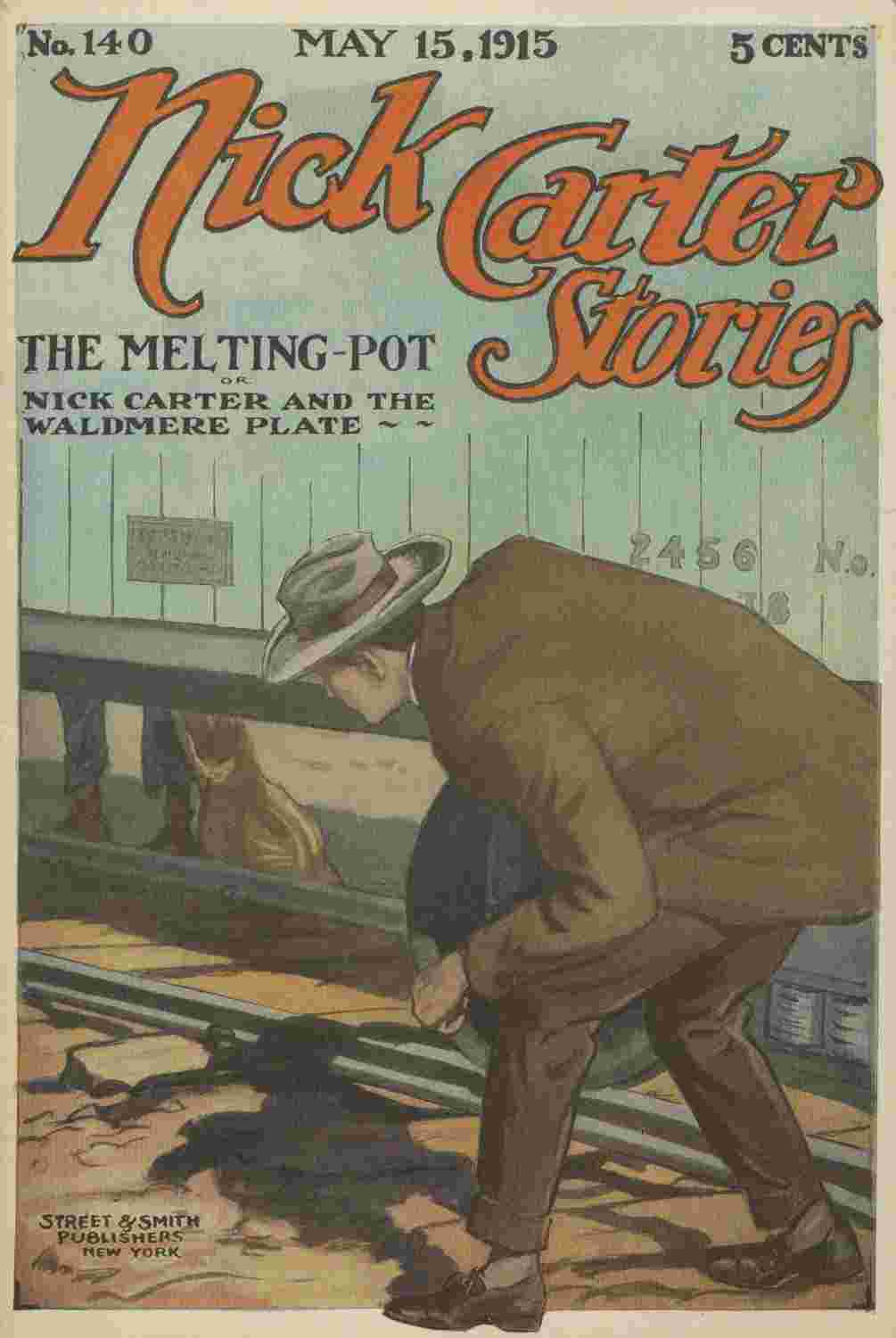
The Nick Carter Stories
ISSUED EVERY SATURDAY BEAUTIFUL COLORED COVERS
When it comes to detective stories worth while, the Nick Carter Stories contain the only ones that should be considered. They are not overdrawn tales of bloodshed. They rather show the working of one of the finest minds ever conceived by a writer. The name of Nick Carter is familiar all over the world, for the stories of his adventures may be read in twenty languages. No other stories have withstood the severe test of time so well as those contained in the Nick Carter Stories. It proves conclusively that they are the best. We give herewith a list of some of the back numbers in print. You can have your news dealer order them, or they will be sent direct by the publishers to any address upon receipt of the price in money or postage stamps.
704—Written in Red.
707—Rogues of the Air.
709—The Bolt from the Blue.
710—The Stockbridge Affair.
711—A Secret from the Past.
712—Playing the Last Hand.
713—A Slick Article.
714—The Taxicab Riddle.
717—The Master Rogue’s Alibi.
719—The Dead Letter.
720—The Allerton Millions.
728—The Mummy’s Head.
729—The Statue Clue.
730—The Torn Card.
731—Under Desperation’s Spur.
732—The Connecting Link.
733—The Abduction Syndicate.
736—The Toils of a Siren.
738—A Plot Within a Plot.
739—The Dead Accomplice.
741—The Green Scarab.
746—The Secret Entrance.
747—The Cavern Mystery.
748—The Disappearing Fortune.
749—A Voice from the Past.
752—The Spider’s Web.
753—The Man With a Crutch.
754—The Rajah’s Regalia.
755—Saved from Death.
756—The Man Inside.
757—Out for Vengeance.
758—The Poisons of Exili.
759—The Antique Vial.
760—The House of Slumber.
761—A Double Identity.
762—“The Mocker’s” Stratagem.
763—The Man that Came Back.
764—The Tracks in the Snow.
765—The Babbington Case.
766—The Masters of Millions.
767—The Blue Stain.
768—The Lost Clew.
770—The Turn of a Card.
771—A Message in the Dust.
772—A Royal Flush.
774—The Great Buddha Beryl.
775—The Vanishing Heiress.
776—The Unfinished Letter.
777—A Difficult Trail.
782—A Woman’s Stratagem.
783—The Cliff Castle Affair.
784—A Prisoner of the Tomb.
785—A Resourceful Foe.
789—The Great Hotel Tragedies.
795—Zanoni, the Transfigured.
796—The Lure of Gold.
797—The Man With a Chest.
798—A Shadowed Life.
799—The Secret Agent.
800—A Plot for a Crown.
801—The Red Button.
802—Up Against It.
803—The Gold Certificate.
804—Jack Wise’s Hurry Call.
805—Nick Carter’s Ocean Chase.
806—Nick Carter and the Broken Dagger.
807—Nick Carter’s Advertisement.
808—The Kregoff Necklace.
810—The Copper Cylinder.
811—Nick Carter and the Nihilists.
812—Nick Carter and the Convict Gang.
813—Nick Carter and the Guilty Governor.
814—The Triangled Coin.
815—Ninety-nine—and One.
816—Coin Number 77.
NEW SERIES
NICK CARTER STORIES
1—The Man from Nowhere.
2—The Face at the Window.
3—A Fight for a Million.
4—Nick Carter’s Land Office.
5—Nick Carter and the Professor.
6—Nick Carter as a Mill Hand.
7—A Single Clew.
8—The Emerald Snake.
9—The Currie Outfit.
10—Nick Carter and the Kidnapped Heiress.
11—Nick Carter Strikes Oil.
12—Nick Carter’s Hunt for a Treasure.
13—A Mystery of the Highway.
14—The Silent Passenger.
15—Jack Dreen’s Secret.
16—Nick Carter’s Pipe Line Case.
17—Nick Carter and the Gold Thieves.
18—Nick Carter’s Auto Chase.
19—The Corrigan Inheritance.
20—The Keen Eye of Denton.
21—The Spider’s Parlor.
22—Nick Carter’s Quick Guess.
23—Nick Carter and the Murderess.
24—Nick Carter and the Pay Car.
25—The Stolen Antique.
26—The Crook League.
27—An English Cracksman.
28—Nick Carter’s Still Hunt.
29—Nick Carter’s Electric Shock.
30—Nick Carter and the Stolen Duchess.
31—The Purple Spot.
32—The Stolen Groom.
33—The Inverted Cross.
34—Nick Carter and Kono McCall.
35—Nick Carter’s Death Trap.
36—Nick Carter’s Siamese Puzzle.
37—The Man Outside.
38—The Death Chamber.
39—The Wind and the Wire.
40—Nick Carter’s Three Cornered Chase.
41—Dazaar, the Arch-Fiend.
42—The Queen of the Seven.
43—Crossed Wires.
44—A Crimson Clew.
45—The Third Man.
46—The Sign of the Dagger.
47—The Devil Worshipers.
48—The Cross of Daggers.
49—At Risk of Life.
50—The Deeper Game.
51—The Code Message.
52—The Last of the Seven.
53—Ten-Ichi, the Wonderful.
54—The Secret Order of Associated Crooks.
55—The Golden Hair Clew.
56—Back From the Dead.
57—Through Dark Ways.
58—When Aces Were Trumps.
59—The Gambler’s Last Hand.
60—The Murder at Linden Fells.
61—A Game for Millions.
62—Under Cover.
63—The Last Call.
64—Mercedes Danton’s Double.
65—The Millionaire’s Nemesis.
66—A Princess of the Underworld.
67—The Crook’s Blind.
68—The Fatal Hour.
69—Blood Money.
70—A Queen of Her Kind.
71—Isabel Benton’s Trump Card.
72—A Princess of Hades.
73—A Prince of Plotters.
74—The Crook’s Double.
75—For Life and Honor.
76—A Compact With Dazaar.
77—In the Shadow of Dazaar.
78—The Crime of a Money King.
79—Birds of Prey.
80—The Unknown Dead.
81—The Severed Hand.
82—The Terrible Game of Millions.
83—A Dead Man’s Power.
84—The Secrets of an Old House.
85—The Wolf Within.
86—The Yellow Coupon.
87—In the Toils.
88—The Stolen Radium.
89—A Crime in Paradise.
90—Behind Prison Bars.
91—The Blind Man’s Daughter.
92—On the Brink of Ruin.
93—Letter of Fire.
94—The $100,000 Kiss.
95—Outlaws of the Militia.
96—The Opium-Runners.
97—In Record Time.
98—The Wag-Nuk Clew.
99—The Middle Link.
100—The Crystal Maze.
101—A New Serpent in Eden.
102—The Auburn Sensation.
103—A Dying Chance.
104—The Gargoni Girdle.
105—Twice in Jeopardy.
106—The Ghost Launch.
107—Up in the Air.
108—The Girl Prisoner.
109—The Red Plague.
110—The Arson Trust.
111—The King of the Firebugs.
112—“Lifter’s” of the Lofts.
113—French Jimmie and His Forty Thieves.
114—The Death Plot.
115—The Evil Formula.
116—The Blue Button.
117—The Deadly Parallel.
118—The Vivisectionists.
119—The Stolen Brain.
120—An Uncanny Revenge.
121—The Call of Death.
122—The Suicide.
123—Half a Million Ransom.
124—The Girl Kidnapper.
125—The Pirate Yacht.
126—The Crime of the White Hand.
127—Found in the Jungle.
128—Six Men in a Loop.
129—The Jewels of Wat Chang.
130—The Crime in the Tower.
131—The Fatal Message.
132—Broken Bars.
Dated March 27th, 1915.
133—Won by Magic.
Dated April 3d, 1915.
134—The Secret of Shangore.
Dated April 10th, 1915.
135—Straight to the Goal.
Dated April 17th, 1915.
136—The Man They Held Back.
PRICE, FIVE CENTS PER COPY. If you want any back numbers of our weeklies and cannot procure them from your news dealer, they can be obtained direct from this office. Postage stamps taken the same as money.
STREET & SMITH, Publishers, 79-89 Seventh Ave., NEW YORK CITY