
“It might have been Chick Carter,” said Floyd, with knit brows. “You are sure it wasn’t Nick himself?”
“I’m dead sure of that,” nodded Nan. “I saw him over the baluster rail at two this morning, and also Patsy Garvan, as you call him. ’Twasn’t either of them who called this morning, and I don’t reckon he was a detective.”
“Possibly not.”
“I walked by the door three or four times, but I couldn’t hear what he was saying to the mistress. They sat too far from the door.”
“Gee! the chief was right,” thought Patsy. “He’s never wrong, by Jove, as far as that goes.”
“Oh, I know the Carters are on the case,” Floyd said moodily. “I got wise to that this afternoon.”
“How was that, Stu?” inquired Hogan, removing his pipe.
“I saw the gink Gammon is serving going down Madison Avenue in a taxi,” said Floyd. “Gammon thinks I ain’t wise to him, but I am. From what Gammon has told me, I reckoned the English gink was going to pump Carter, or pull off some kind of a bluff. So I hurried down and had a look through Carter’s front door.”
“Gee! that’s news to me,” thought Patsy, with increasing interest.
“I saw Carter himself on a couch in one of the rooms,” Floyd went on. “I piped him through a mirror in the hall. I’m not sure that he didn’t pipe me, as well.”
“Was the English gazabo there?” questioned Hogan.
“No,” said Floyd bluntly. “The taxi driver must have blundered and went too far south. All of a sudden I saw him coming up the avenue and I knew he was going to stop at the dick’s house.”
“Thunder!” Lucy Devoll exclaimed. “What did you do?”
“Bolted,” said Floyd grimly. “I made a quick get-away, you can bet on that. The gink went in there, and that’s all I waited to see. Gammon had an appointment with him at eight. He ought to show up pretty soon. Then we’ll know how the cat is going to jump.”
“Do you think the dicks have got any line on me?” questioned Hogan apprehensively.
“How can they have any line on you?” Floyd returned, with a growl. “You was in disguise and you had a rented limousine with a phony number. There’s no way that they can have picked up a line on you.”
“Begad, I hope not.”
“You stand well as a taxi driver,” Floyd added. “You’re as safe from suspicion as a preacher. That’s why I had the infernal live stock brought here.”
“You’re right, mebbe.”
“I know I’m right,” Floyd asserted confidently.
“I can see where you’ll get the surprise of your life a little later,” said Patsy Garvan to himself.
“But when do we get the coin? That’s what I want to know,” vouchsafed the Devoll girl, most expressively. “I’ve gone into this blindly, as Nan has, on your word, Floyd, and——”
“Oh, I’ve got that all fixed,” Floyd interrupted. “That’s what Gammon is after to-night.”
“Well, I hope he gets it.”
“He knows I won’t turn down the man until I’m dead sure of the coin. I’m not taking that kind of a chance. The rest of the job cut no great ice and was easily done, but putting out a man’s light—that’s a different matter.”
“I should say so,” frowned Lucy.
“If the coin is ready for us——”
“Easy!”
“That must be Gammon.”
Patsy heard the ringing of the doorbell—three times.
The corpulent woman, Hogan’s wife, hastened out to open the front door.
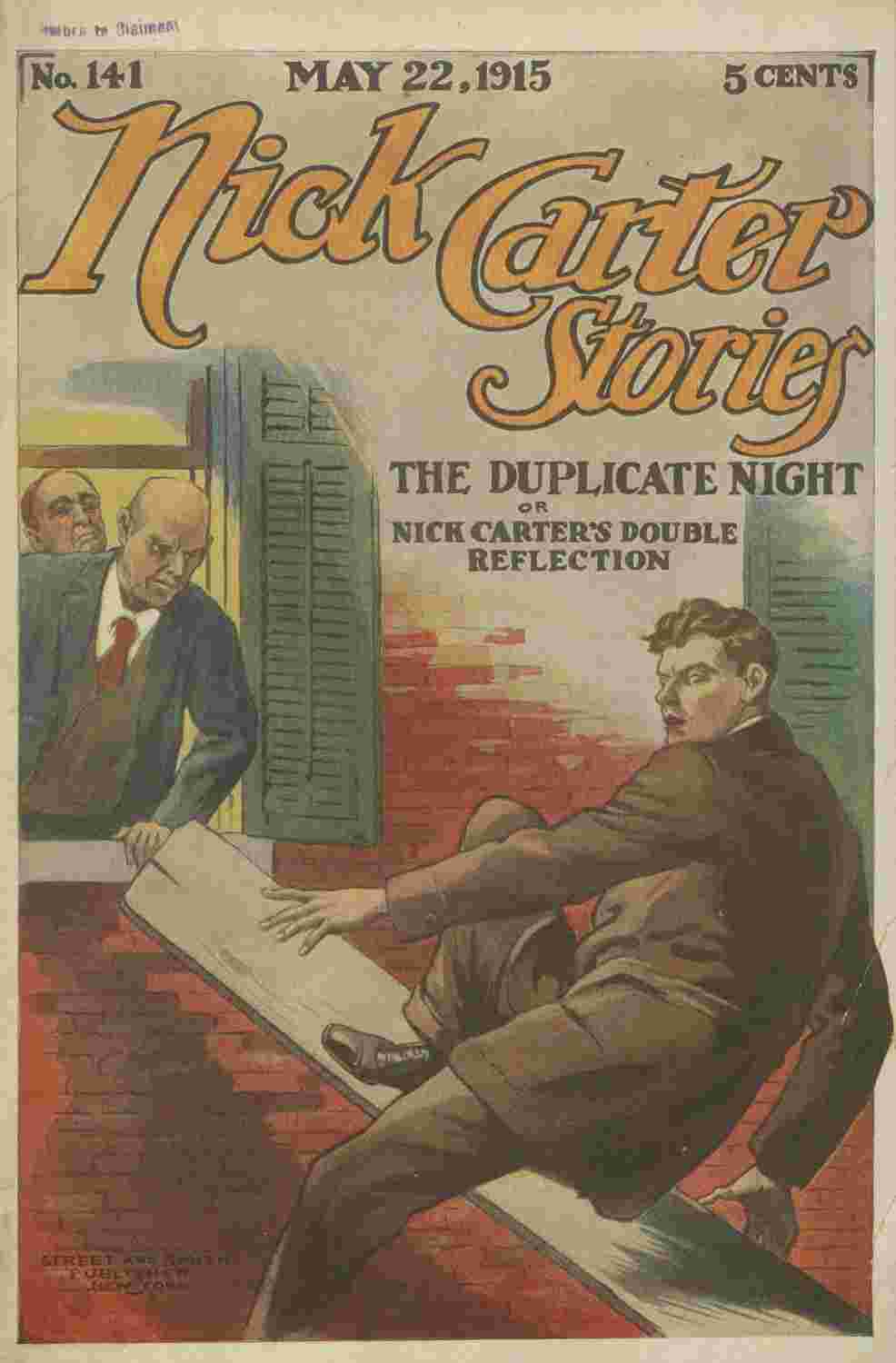
Patsy clung to his board, watching constantly, listening intently, but he began to feel the strain of his awkward and perilous position. He scarce dared to stir, lest the board should slip from one end, or the other, and his distress was each moment becoming more painful.
“I’ll hang on, by thunder, till I learn the whole business,” he muttered, gritting his teeth. “I’ll land this bunch, too, or know the reason why.”
Less than a minute had passed when Mrs. Hogan returned to the kitchen. She was closely followed by Baldy Gammon, and Patsy Garvan saw the English crook for the first time.
He knew nothing about him, of course, nor about the first interview Nick had had with Sir Edward Chadwick, and much that he had heard was almost Greek to the determined young detective. Hence, his resolution to get all that could be obtained.
Stuart Floyd sprang up with an inquiring stare when Gammon entered, but the latter said quickly, with a sharp glance at the several other occupants of the room:
“Gimme a word with you alone, Floyd. It’s as ’ow I ’ave somethink to tell you.”
“What about?”
“You know. Come into the front room,” Gammon insisted.
Stuart Floyd followed him without replying.
Hogan frowned darkly, and Lucy Devoll stole to the kitchen door to listen.
Patsy rightly reasoned that Floyd and Gammon were the two responsible for the active work of abducting Waldmere, and that the others were merely in their employ. He wondered, too, of course, to what Englishman they had referred.
“Gee! I wish they had done their talking there,” he said to himself during the lull in the kitchen. “This may leave me dead lame as to the exact truth—as lame as I’ll be after lying so long on this board. It’s like being on a rack.”
Patsy had not long to wait, however, before Gammon returned to the kitchen. Scarce ten minutes had passed, and the English crook then was followed by a man with silvery-gray hair and a flowing beard.
Patsy instantly recognized him, nevertheless.
“Great guns!” he exclaimed mentally. “What’s on, now? Floyd is going out in disguise. Gee! had I better try to follow him?”
Floyd already had on his street garments, and brief consideration convinced Patsy that he could not possibly get down from his perilous perch in time to overtake him.
For Floyd lingered only to say a few words quietly to Hogan, and he then turned sharp on his heel and departed.
Gammon remained, however, and took the chair the other had vacated.
Floyd had gone, of course, to keep the appointment as Mr. Pimlico.
Lucy Devoll, frowning, began to question Gammon about it, and so sharp and insistent were her inquiries that he finally proceeded to tell them of the exact situation.
Patsy listened exultantly—but it was of brief duration.
The talk in the kitchen led up to Nan Levine’s mission there, of which Baldy Gammon was ignorant. The moment he learned of the morning caller at the Ringold residence, however, he seemed to be inspired with suspicions that had entirely escaped Stuart Floyd, or been utterly ignored.
“’Ang it, girl, you may ’ave been followed ’ere!” he exclaimed, starting to his feet. “’Ow do you know you wasn’t? What’s out back ’ere? Let’s ’ave a look?”
“Oh, there’s nothing there,” growled Hogan, laying down his pipe.
“’Ow do you know? Let’s make sure of it, all the same. I’ll see for my blooming self.”
This sudden turn of affairs fell, of course, with alarming possibilities on the mind of Patsy Garvan, particularly when he saw the scowling ruffian striding toward the window on the sill of which the plank was resting.
“Gee! this is a case of sneak—if sneaking is possible,” he muttered, in rising excitement. “It’s a quick get-away for mine.”
Patsy had begun to wriggle back on the board with his first thought. His muscles were stiff and cramped, however, and he could not move quickly, nor steadily.
Twice he felt the board slip treacherously on the stone sill of the window.
Then the curtain was raised high from within.
Baldy Gammon appeared at the window.
A blaze of light poured out upon Patsy, and he recoiled involuntarily.
That one slight move threw the board from the sill.
Patsy heard a roar from Gammon—but heard no more for several moments.
He fell through space as if out of an airship, turning while he fell, and in another instant he had crashed completely through the bulkhead door mentioned, and landed, stunned and bleeding, on the floor of the shop cellar.
CHAPTER IX.
THE LAST TRAIL.
There was a very good reason for Chick Carter’s disappearance from the suite in which Nick had left him. The designs of the latter in leaving, after hearing with the dictograph the interview between Chadwick and Gammon, must be perfectly obvious. It was a simple thing for Nick to hasten home and return in a disguise such as Gammon had described.
Nick also had in mind, of course, to arrest the genuine Mr. Pimlico the moment he put in an appearance.
The instinctive caution of Stuart Floyd, however, when venturing out of haunts in which he felt comparatively safe, prevented this second design of Nick Carter, or briefly postponed and transferred it to another quarter, and also occasioned the sudden disappearance of Chick.
For Floyd did not take the elevator after entering the Oriental Hotel, nor did he enter the house through the front door. He came in through a side door, then stole up the stairs to the third floor, seeking the corridor and door to which Gammon had directed him.
He came so quietly that Chick Carter did not hear him until the rascal was nearly to the door of the Englishman’s suite—and at the same moment Floyd caught sight of a slender wire glistening on the threshold.
There was no need to tell Stuart Floyd what it was, nor did he stop to learn whither it ran.
He turned like a flash and darted toward the main stairway of the hotel, down which he fled at top speed, tearing off his disguise while he sped down the stair and thrusting it into his pocket.
Chick Carter had caught sight of him, however, and instantly guessed the truth.
“He’s wise, by thunder, and knows we’re on his trail,” flashed through Chick’s mind. “But in getting him, I must get the others, also. I’ll take the other course.”
Chick did not stop to inform Nick what had occurred. He rushed to the side stairway at the end of the corridor, and flew down each flight at record speed, bent upon picking up Floyd when he emerged from the front of the house.
Though he came near being too late, his tremendous efforts proved successful. He caught sight of Floyd running across the avenue on which the house fronted, and then darting into a cross street leading toward the East Side.
“I’ll get you now, by Jove,” Chick muttered, with eyes alert. “If you give me the slip this night, you shall have a medal.”
Floyd, seeming to feel reasonably safe when well away from the hotel, slowed down in order not to attract attention. Several times he looked back, however, but could discover no one following him.
Chick was steadily gaining on him, nevertheless, and before a block had been covered he met a policeman.
“Here, Grady, one moment,” he said sharply.
The officer recognized him instantly, for Chick had removed his disguise.
“Oh, it’s you, Mr. Carter,” said he, touching his helmet.
“Yes,” said Chick quickly. “I’m on the track of a crook, Stuart Floyd.”
“The deuce you say!”
“I may need you and others to pull a gang. Follow me at a short distance and pick up help as you come along. Don’t lose sight of me.”
“Not on your life,” said Grady, with eyes beginning to glow.
“Join me at once, if you see me wave my arm.”
“I’ve got you, sir.”
There had been only a momentary stop, and Chick had not for an instant lost sight of his man.
Floyd was fifty yards ahead of the detective, and on the opposite side of the street. He no longer was hurrying greatly. He seemed to feel that he had got safely away.
Chick crept on after him, steadily gaining.
Grady had a constant eye on Chick and cautiously followed him. Presently he picked up another policeman, and a moment later a plain-clothes man from the precinct station.
All followed Chick, hugging the buildings they were passing.
Five minutes later, Chick saw Floyd stop suddenly in front of an old wooden house. It was that in which Hogan dwelt with his wife.
Floyd, when about to enter, heard a terrible crash in the rear yard, and then a window thrown open and a roar from Baldy Gammon.
Instead of entering the house, Floyd rushed through the alley and into the little back yard.
Hogan and Gammon came tearing down a back stairway and joined him.
“What’s wrong? What the devil’s wrong?” Floyd demanded, yanking a search lamp from his pocket.
“A spy! A spy at that window,” cried Hogan, pointing. “He’s fell through this door and gone into the cellar.”
Chick Carter, waving his arm, had to wait only thirty seconds for his three assistants to join him. He knew that he had rounded up his game.
“One of you watch this front door,” he directed, in whispers. “The others follow me. Guns ready!”
Chick did not wait for an answer. He plunged through the alley, the policemen after him, and arrived in the yard, a veritable rat trap, just as Floyd switched on the electric light.
“Hands up!” Chick cried. “We’ve got you covered, Floyd. You, too, Gammon! You’ll be dead ones if you show fight.”
The policemen were not idle while Chick spoke. Both bored in upon the three cornered crooks, and Floyd and Gammon found themselves with revolvers at their heads.
Hogan uttered a groan, and threw up his hands.
Patsy Garvan came crawling out of the cellar at the same moment, only a bit bruised by his fall. He also had a gun in his hand—and that settled it.
The arrest of the entire gang was easily made, and thirty minutes saw all except Sir Edward Chadwick locked in the precinct station. Word then was sent to Nick, who then turned his man over to the police, and the case was practically ended.
For Lord Archie Waldmere was found confined in an ice box in the Hogan cellar, not much the worse for his distressful experience, he having been lured away and overcome precisely as Nick had deduced from the surrounding circumstances.
It would be vain to attempt describing his gratitude to the Carters, as well as that of his wife, or the amazement with which he learned of the treachery of his uncle and the altered sentiments of his dying father. It opened the way for him to a new life in England, or to a renewal of the old, and he took it later with the willing consent of Lady Waldmere.
But neither ever forgot the Carters, or failed to visit them when in the States.
Stuart Floyd went back to prison and died there six months later.
Others engaged in the conspiracy were punished in accord with the law, and are behind prison bars to this day.
THE END.
“The Edge of a Crime; or, Nick Carter’s Trail of Mercy,” will be the title of the long, complete story which will be found in the next issue, No. 142, of the Nick Carter Stories, out May 29th. You will also find the usual interesting serial, short stories, and useful bits of information.
Where’s the Commandant?
By C. C. WADDELL.
(This interesting story was commenced in No. 140 of Nick Carter STORIES. Back numbers can always be obtained from your news dealer or the publishers.)
CHAPTER V.
THE SEVERED ROPES.
It was eight a. m. by the time Grail reached the fort, for he had stopped on the way to submit to a chemist an envelope containing the remnants of the decoy message. The chemist agreed with him thoroughly that its disintegration must have been accomplished by means of chemicals. He thought a mixture of certain acids, drying into the fiber of the paper, would cause it rapidly to disintegrate and crumble to dust, although he declined to commit himself definitely on the point until he had made a complete analysis.
His theory, however, was all that Grail really cared for, since it showed him that he was on the right track, and that the destruction of the note was due to no accident or mischance, but was part of a deliberate and premeditated plan—an incident to be duly reckoned with in any investigation of the colonel’s disappearance.
Too thoroughly did he recognize his own limitations even to consider the task of handling the business in person. But how was he to secure the aid he required at the fort? If the army post has ramparts of privacy against the world, there is little going on inside which does not become generally known, and Grail had no sooner set foot on the reservation than he sensed the same feeling of hostility and suspicion which had manifested itself in the manner of the officers who met him at the foundry the night before.
The challenge of the sentinel on post, the side glances of the enlisted men, even the stiff salute of his own orderly, gave him to understand that he was ostracized—under the ban as much in barracks as along officers’ row. There was no open disrespect shown, but the very air was full of a silent disapproval. He evidently had not a friend in the place—no one upon whom he could call for help.
Outwardly calm, but inwardly raging at the injustice, he turned in at headquarters—he would have starved rather than go over to the mess for breakfast—and, in order to conceal his perturbation, buried himself in the morning papers.
Staring fixedly at the headlines in the Brantford Bee, although unconscious of a word, he was roused from his abstraction by a slight cough, and glanced up, to find standing in front of him Sergeant Cato, the relief telegraph operator, and a decidedly superior type of noncom. Indeed, Cato had ambitions toward winning shoulder straps for himself, and had been materially aided by Grail in his preparation for the necessary examination.
There was no recognition of this now, however, in the stiff, distant salute which he gave his superior.
“The list of messages sent out during the night, sir,” he said.
Evidently, thought Grail, he was only to be addressed in the strict line of official duty. Even this man whom he had befriended reflected in his manner the general uncompromising spirit.
Perfunctorily the adjutant took the slip handed him, and glanced at it. Then he gave a quick start.
“To Miss Vedant, at Chicago!” he exclaimed, forgetting his determination to be as stiffly military himself as any one accosting him. “And sent by Major Appleby at two o’clock! Do you mean to say, Cato, that——”
The sergeant gave a slight sigh of relief, and noticeably unbent.
“Yes, sir,” he returned. “It was to inform her of her father’s disappearance. I thought myself it was a mistake to frighten her, when the thing’ll probably be cleared up before she can get here; but the message was handed me for transmission, and what could I do?”
“So you expect the affair to be cleared up before Miss Vedant arrives, eh?” Grail asked. “What makes you say that, sergeant?”
Cato flushed a trifle. “Well, sir, if I may make so bold, it’s because I am banking on you.”
“Me?”
“Yes, sir.” He shifted his feet uneasily. “Excuse me, captain, if I go too far; but it is a cinch, to my mind, that you’ll never rest easy under this talk that’s going around.”
“You mean that there is a rumor that I am in some way responsible for Colonel Vedant’s disappearance?”
Cato nodded. “That was what made me so sure the thing would be straightened out,” he explained. “I knew you’d move heaven and earth before you’d let a charge like that stand against you.”
Grail was silent a moment. “Is the fact of the colonel’s disappearance pretty generally known among the men, sergeant?” he asked finally.
The other gave a significant shrug of the shoulders. “It’s the only thing they’re talking about over in the barracks, sir.”
“And do many of them believe this gossip connecting my name with it?”
Cato’s reluctance to answer was more eloquent than words. “You know what a bunch like that is, sir,” he said apologetically. “Let somebody tell ’em St. Peter is a crook, and they’ll be proving it to you in five minutes. That’s what made me a bit standoffish when I came in just now, captain. I knew you couldn’t help but be wise to the way the post is feeling, and I didn’t want to seem to be handing you out any sympathy.”
An incredulous look flashed into the adjutant’s face, and he bent quickly forward. “Am I to understand, then, sergeant, that you do not entertain the same unfavorable opinion of me as the others?”
“Me, sir!” Cato’s tone was one of surprise. “What kind of a soft-brained pup do you think I am, sir? You sell out to Japanese spies, and make away with the old man? Why, Captain Grail, if you told me yourself that you’d done it, I wouldn’t believe you—no, not if you swore to it! It’s because I’m certain of your innocence, captain, that I’ve been so positive the colonel would be found. Foolish as the charge is, you’ve got to disprove it for your own sake; and, with that sort of a proposition facing you, I knew you would manage to do it somehow. I only wish,” he added, “that I could be of some help to you.”
The adjutant turned sharply about at the suggestion. Quick-witted, discreet, diplomatic, and, above all, devoted to his cause, here was the very helper for whom he had been seeking.
“Help me!” He sprang to his feet. “You can, sergeant. You can help me enormously. Are you willing to put in a day or two of scout work for me, following up what may seem to be a series of absurd and irrelevant investigations, but asking no questions until you are through, or until I see fit to enlighten you as to my purpose?”
“Try me!” said Cato, drawing himself up.
Grail studied for a moment the eager face of the young noncom in front of him; then nodded his satisfaction.
“Good!” He drew from his pocket the stump of the cigarette he had found outside Schilder’s office door, and showed it to the other. “You will notice,” he said, “that this is an imported cigarette, not likely to be found in the average tobacco shop. What I want you to do, therefore, is to go, unostentatiously, through the saloons and small stationery stands down on the river front, in the neighborhood of the Dolliver Foundry, and find out for me, if possible, just where cigarettes of this kind are kept in stock, and, if possible, learn the names of the customers who have asked for them.”
The sergeant signified his comprehension. “And what else, sir?” he asked, handing back the cigarette after a careful examination.
“I fancy,” Grail said, “that you will find your work pretty well cut out for you along that one line. Still, you may have luck; and, in that case, I would like to have you find out about a motor boat which arrived yesterday, consigned to Otto Schilder.”
“You will want me to use a disguise of some kind in making my inquiries, I suppose, sir?”
“Provided the disguise doesn’t make you too conspicuous—yes,” the adjutant assented. “That was a point, however, that I intended leaving largely to your own judgment. As a suggestion, though, it might be well, if you could manage it, to play the part of a foreigner seeking a job at the foundry—say, a Russian or a Pole.”
“I think I can manage it,” Cato returned. “Why, captain, taking off that Russky dialect is my strong specialty. I used to work at a rolling mill at Portsmouth, Ohio, where there was a whole bunch of them.” And, to illustrate his powers, he dropped into an imitation which left no doubt in Grail’s mind as to his ability to make good.
Accordingly, after a little further discussion, the sergeant started off on his mission, while Grail, feeling as though a load had been removed from his shoulders, hurried out to give orders for the inflation of the dirigible balloon which formed a part of the equipment of the post. He was the most enthusiastic aviator among the officers, and was regularly permitted to take out the dirigible without going through the form of making official application.
No one asked him the purpose or object he had in view. Silently, and with eyes averted, the men obeyed his orders; and the officers all kept distinctly aloof, although usually when there was a flight to be undertaken a crowd was very quick to gather.
“Never mind,” Grail said to himself. “By to-morrow, if all goes well, the tide will have turned, and they’ll be only too anxious to hear what I have to say.”
The preparations completed, he climbed into the light framework under the big, swaying bag, and was just about to give the order “Let go!” when, casting a final glance about, he chanced to observe that two of the cords which held up the car were badly frayed. Had a flight been attempted with them in that condition there could hardly have failed to be a serious accident.
Stopping his engine, Grail sprang to the ground, and faced the little squad of men who had been helping him make ready.
“This machine was in perfect condition when it was brought out of the hangar,” he remarked to them grimly, as he pointed to the almost severed ropes. “Consequently one of you must be responsible for this damage.”
Then, as they hesitated, glancing uncertainly at one another, he took a quick step forward, and caught up a sharp fragment of broken glass which one of them—a new recruit by the name of Simmons—had attempted to drop behind him.
“Ah!” he cried triumphantly. “I thought I would be able to smoke out the culprit. Now we will have the corporal of the guard.”
He held the offender in a close grip until the corporal he summoned arrived; then turned him over, with an injunction that he be held in close confinement, and permitted to speak to no one, or send out any word, until his own return.
Presently the weakened cords were replaced with new ones, under his instructions, and everything was again in readiness for the flight.
It may seem strange that Grail did not immediately follow up so serious an affair; but, as a matter of fact, he was so perturbed and puzzled by the dastardly attempt on his life that he wanted a little time for reflection. Was it merely the crazy freak of a simple-minded “rookie,” or did the incident hold a deeper and more sinister significance? Could it be a further development of the plot which had already resulted in the colonel’s disappearance, and was Simmons merely a tool in the hands of the secret conspirators?
Revolving these questions and many others in his mind, he gave the word to cut loose, and a moment later he was hovering high up in the air above the grassy parade ground. He turned the nose of his craft due east, and, with his propeller whirring, flew away toward the river’s long, crescentlike curve around the town.
The dirigible from Fort Denton was not an unusual sight aloft, and consequently attracted but little attention from the people of the city; but out at the post Grail’s flight was watched with curious interest. Officers and men alike, although pretending indifference, laid aside their duties to follow, with eager gaze, the evolutions of the airship. They gained but little for their pains, however. Out over the line of smoky chimneys marking the water front they saw him go; then sail in a straight line across the river, where he turned to the south, and, having executed a couple of wide circles over the wildernesslike bottoms below the town, headed back for home. But as to his purpose they gathered not the slightest intimation.
At that distance they could not discern that as he swept above the weed-grown, bush-covered lowlands so frequently subject to overflow, he leaned over in the car, and studied with the eye of the skilled topographer every feature of the country beneath him.
Upon a tumble-down shack in a clump of stunted willows his gaze lingered longest, and as he estimated its distance from the river, as well as from the few other habitations which dotted the waste acres, his eye showed a glint of satisfaction. Unwilling, however, to reveal by his movements the nature of the survey he was making to any possible watcher, he did not hang long over the spot, or descend for a closer view, but contented himself with two rounds, at high altitude, as already described, and beat back westward toward the fort.
With the wind against him, his return trip consumed more time than the outgoing one, and it was well after noon when he finally effected a skillful descent to the parade ground. He had been absent from the post altogether a little over two hours.
“Has Sergeant Cato returned yet?” was the first question he asked as he sprang from the car; but, receiving a sullen negative for answer, bent his steps, as soon as he had seen the dirigible safely put away, toward the guardhouse.
There he found himself confronted by Lieutenant Hemingway, who happened to be acting as officer of the day. The younger man’s eyes fell, and he showed his embarrassment by blushing painfully; but Grail was cool and steady as a statue.
“I wish to speak to Private Simmons, placed under arrest by my orders,” he said brusquely.
“Simmons?” Hemingway spoke rather superciliously. “Oh, yes—the man brought in from the balloon squad. Why, he isn’t here. I heard that there was only a slight disorderly charge against him, and I let him go to his quarters.”
“You heard!” repeated Grail icily. “Didn’t you know the nature of the accusation against him?”
The other manifested a shade of anxiety. “Why—er—no,” he stammered. “I was not here, you see, when the fellow was brought in, and just as I returned both the corporal and sergeant were called out by a fight over at barracks.”
“And you did not consult the book before taking this step?”
“No,” Hemingway was obliged to confess. To tell the truth, he had deemed it rather smart to set at liberty one whom he supposed to be merely a victim of the adjutant’s ill humor; but now doubts began to assail him.
Hastily he caught up the record of offenders for the day, and noted the charge entered opposite the name of Simmons; then fell back, with a little gasp.
“Attempted murder!” he exclaimed. “Here, corporal! Sergeant! Somebody! Hustle over to barracks, and bring back that man Simmons we had here a while ago.”
But, as might have been expected, the bird had flown; and, although a squad was instantly ordered out to search the city for him, and the police were put upon the case, both Hemingway and Grail knew that with so much of a start the chances of catching him were very slim indeed.
The culpable lieutenant, court-martial staring him in the face, started to stammer some wild excuses; but Grail merely turned on his heel, and marched off to his quarters. He had scored heavily over one of his enemies, but he gathered little gratification from the fact. He would have preferred a chance to question Simmons.
CHAPTER VI.
THE HAPPIEST GIRL.
Under the circumstances, there seemed to be nothing for Grail to do but await with what patience he could muster the return of Sergeant Cato; and as the afternoon slipped away with no report from the latter, he threw himself on a couch in the office at headquarters and presently drifted off into a dose. Worn out by his exertions, the strain he had been under, and his loss of sleep the night before, he was soon wrapped in a profound slumber; and, as nothing happened to disturb him, five o’clock still found him sleeping heavily.
Meanwhile, the train from Chicago, bearing the distressed daughter of the commandant, had arrived, and Major Appleby, who had gone down to meet her, could only return a gloomy shake of the head to the unspoken question of her wide, trouble-filled eyes.
“Don’t ask me anything now, my dear,” he said, in a low tone. “We are trying to keep the matter quiet for the present, and you can’t tell who might overhear us in this crowd. As soon as we get outside, though, you shall learn all there is to know. Mrs. Schilder is waiting for us in her car, and wants to take you to her home.”
“Mrs. Schilder?” The girl’s lips parted in a little gasp of surprise, for she had only a very slight acquaintance with the wife of the foundry manager.
“Yes,” the major explained. “Mrs. Appleby and I would have been delighted to have you with us, but it seemed preferable that you should not be at the fort, where you would be kept constantly upset by all sorts of unfounded rumors. So, as Mrs. Schilder pointed out that you would probably be more comfortable in her home than anywhere else, we accepted her invitation on your behalf.”
Miss Vedant hesitated a moment, then gave a slight shrug, as though to signify that it was a matter of indifference to her. Troubled and shaken as she was, she was in no mood to protest against any arrangement they might have made, and, anyway, it was too late now to draw back without seeming ungracious, for the major, by this time, was conducting her out through the tall, pillared entrance of the station, and she saw, a few steps away across the plaza, Mrs. Schilder waiting for them in the automobile.
Mrs. Schilder, modishly gowned, and undeniably beautiful, in a dark, foreign style, greeted the girl with just the proper touch of sympathetic restraint to put Meredith at her ease.
“I don’t want you to think me unduly urgent in this matter, my dear,” she said, “but I could not help feeling that if I were in your place I should want to be among friends who understood the situation. You must not regard yourself as a guest with us, either; you are to consider yourself at home, and do in all things just as you choose. At any rate,” she added, with a reassuring pressure of the hand, “give me the happiness of having you with me until your father is restored, which must certainly be within a few hours.”
Meredith glanced up eagerly. “You believe that?” she exclaimed, then turned as if for corroboration to Major Appleby, who sat with them in the tonneau.
The major cleared his throat. “We are at least very close on the trail of the Japanese spies who are undoubtedly responsible for the outrage,” he assented guardedly, “For a time we were at sea, thinking they had fled the city, but through a hint astutely obtained by Mrs. Schilder”—he bowed pompously toward that lady—“from her butler, who is also a Japanese, we are now confident that they are still in Brantford, and, therefore, with the efforts we are making, must be run to earth in very short time.”
“Japanese spies?” Meredith repeated. “So that is what is back of the affair? Remember, I know nothing except what was contained in your telegram. Please tell me all the circumstances,” she pleaded.
The major started to comply, with a labored, heavy account, but Mrs. Schilder tactfully interposed, and, taking the recital into her own hands, told in a few words the story of the occurrences at the foundry the night before.
“But why are Japanese spies suspected?” The girl’s brows wrinkled into a little frown. “I see nothing in all this to indicate such a theory. Did Captain Grail see any Japanese around?”
“He did not say so,” stiffly responded the major. “To tell you the truth, my dear, Captain Grail, beyond giving a bare account of the incident, declined to commit himself in any way, or even to confer with the other officers of the post over measures looking toward your father’s recovery.”
The girl stared at him almost incredulously. “Yet he must know more of what happened than anybody else,” she cried. A wave of hot indignation swept over her face at the thought that an officer so closely associated with her father could from any cause show indifference at such a crisis.
Involuntarily she drew back, with a hand on Mrs. Schilder’s arm. “Would you mind taking me out to the fort before we go to your house? I must see Captain Grail myself, and question him—now, at once. I cannot understand what he means by such an attitude.”
The major endeavored to dissuade her. “I doubt if it would do you any good,” he urged. Then, hesitating, he excused himself to Mrs. Schilder, and leaned over to whisper: “If you must know, my dear, Grail is not popular at the fort just now. We have, in short, excellent reasons to believe that he himself is implicated in the colonel’s disappearance.”
Involuntarily she drew back, with a little cry of unbelief. “Impossible!” she declared. “You cannot realize what you are saying, major!”
“I not only realize, but reiterate it,” he said solemnly. “More than that, I have stated the case mildly to you, for we have evidence to prove that his was the crafty brain which hatched up this whole so-called mystery. Now, I am sure, you will see the futility of attempting to gain any information from him.”
“No.” She shook her head. “If what you say is true, then I think there is more reason than ever that I should see Captain Grail.”
With an air of determination, she leaned once more toward Mrs. Schilder, who had discreetly turned her eyes away during the colloquy, and was gazing out over the side of the car. “I am afraid the major must consider me very self-willed,” she said, “but I am going to ask you again if I may not be driven to the post?”
Her hostess immediately bent forward to give the desired order to the chauffeur, and, despite Appleby’s fuming, the car was whirled around and headed for the new destination. Back down Carney Street they sped, past the courthouse and city hall, and finally reached the fort.
Inquiry having developed that Grail was in his office at headquarters, the major, with an air of stern virtue, prepared to conduct Meredith to him; but again Mrs. Schilder suavely interposed.
“Perhaps Miss Vedant would prefer to see the adjutant alone,” she said, laying a detaining hand on Appleby’s arm.
Meredith gave her a quick glance of gratitude, and assuring them both that she needed no one with her during the interview, hurried on through the door.
A moment later Grail was awakened by the announcement, “A lady to see you, sir,” and he rose up, blinking and confused, to find her standing before him.
“You?” he cried in amazement, for he had never dreamed that Appleby and the crowd would permit her to come near such a pariah as himself. “You, Meredith!”
Ormsby Grail had dreamed dreams centering about this fair-haired, slender daughter of his colonel. He had seen her blossom from the child he had once taken on his knee into a charming woman, and learned to love her. But he had refrained from whispering any word of his love to her. She was too young, he told himself; she could not possibly know her own mind. Even when it was decided that she should go to Chicago for a year to cultivate her remarkable voice, he still had not ventured to speak. He would wait a little longer, he decided. She seemed to him no more than a child.
So, although he wrote to her frequently, in a friendly, brotherly sort of fashion, and never let a week go by without some remembrance from him, he sedulously concealed from her the real state of his feelings—or thought he did—and never dared visit her in Chicago.
Half extending his arms, he took a hasty step toward her, then halted abruptly, the recollection sweeping over him of what she must have heard.
“You wished to see me?” he asked, in a controlled voice.
“Yes.” Her glance met his steadily, although she was somewhat nervously twisting her hands in their brown suede gloves. “I want to ask you about father.”
“Haven’t the others told you?” he inquired. Then, as she nodded, he added, with a touch of defiance: “I suppose you have heard, too, what they are saying about me?”
“I have heard.”
“And do you believe it?”
“If I believed part of it,” she said, “I would be the happiest girl in the world!”
CHAPTER VII.
NEW DEVELOPMENTS.
Grail stared at the girl in bewilderment as she repeated: “Yes, the happiest girl in the world. For if I thought you were responsible for his disappearance, as they say, I should know that no harm could possibly have befallen him. It is because I am certain of your innocence that I am apprehensive; and it is because I know you must be moving heaven and earth in the effort to find him that I have come to ask you what you have discovered. What faith can I put in Major Appleby’s promises”—she gave a deprecating gesture—“when I see how he is bungling things? But, surely, you can tell me whether or not there is any real ground for hope?”
A great flash of joy and wonder lighted Grail’s face. “Meredith,” he cried huskily, “I never expected to feel so proud in all my life! You don’t know what your trust and confidence mean to me!”
Then, afraid that if he said more, he might say too much, he placed a chair for her and drew up one for himself.
“More than that,” he went on, “I am going to prove to you that your faith is not misplaced. Take my word for it, your father shall be restored to you within a very short time; before to-morrow morning, unless I am very much mistaken.”
Never yet, in their long acquaintance, had Grail failed to make good a promise to her, and his assurance now brought a sigh of genuine relief to her lips and a smile to her pale, anxious face.
“Ah!” she exclaimed. “You mean that the running down of these Japanese spies must result in disclosing father’s whereabouts?”
“Japanese spies!” His lips curled contemptuously. “They exist only in the imagination of Appleby and Hemingway.”
“Precisely what I thought, too, when the major told me,” she said. “I know, of course, that all the foreign nations keep secret agents hanging around our forts and army posts, just as we do around theirs; but that any of these men would go to such lengths struck me, on the face of it, as ridiculous.”
“There you are wrong,” Grail returned. “Ordinarily, I grant, you would be right; but the colonel’s present series of experiments being concerned with a new and surprising development in the use of the wireless in warfare, has stirred these fellows up to a pitch where they have been ready to dare almost anything. Besides, the chap who, I am convinced, engineered this deal——” He caught himself just as he was on the verge of revealing to her the point which had caused him most concern in the affair.
Dexterously he extricated himself from the situation by knocking a book from the desk with his elbow and stooping over to regain it.
“As I was about to say,” he resumed, “the chap who engineered this deal was not a Japanese, but of a nation which furnishes spies of an even more bold and subtle character.”
He drew from his pocket the half-smoked cigarette which formed his principal clew.
“Are you sufficiently versed in such things to tell me of what make this is?” he asked.
“Russian,” she replied, without a moment’s hesitation. “The little countess we used to know in Washington, you remember, smoked cigarettes exactly like that.”
“Exactly,” he said, “and the man for whom we have got to look in this case is a Russian.”
A thoughtful look came into Meredith’s eyes. “Dad was in Russia once, on secret-service business himself,” she said; “and although they would never tell me about it, mother confessed to me on one occasion that for a long time she had been fearful of an attempt at revenge upon him, for something that happened while he was on the mission. You don’t suppose, do you, that this could in any way be an outcome of that old affair?”
“Absurd!” he answered. “Why, it was almost twenty years ago that your father was over there. If there was anything coming to him on that score, I fancy he would have been called to account long before this.”
Then, he deftly turned the subject to a discussion of the facts from which he had built up the hypothesis he was following.
“I had been on the lookout for a Russian spy, you see,” he explained, “for I had been tipped off by Sasaku, one of the dining-room boys, who is rather attached to me, that a fellow he had once seen chased out of Tokyo was here in Brantford, showing considerable interest in doings at the fort. Accordingly, I framed it up with Sasaku to get in with the chap, on the plea of being a ‘gumshoe man’ himself, desirous of working to mutual advantage, and gave him yesterday a bundle of fake papers to fool the other with, and get him to divulge his name and his business.
“That,” he added disdainfully, “is the sole basis for the ‘Japanese spy’ story you have heard. And, by the way”—he glanced with a frown at his watch—“I ought to have heard from Sasaku before this. He promised to send me a communication at the very first opportunity.”
“But where does the cigarette come in?” Meredith asked, a trifle impatiently.
“The cigarette? Oh, that was the connecting link. It is really the corner stone to my entire theory; for although I very quickly decided that the gumshoe artists were at the bottom of the job, I was, at first, rather inclined to suspect Otto Schilder as the moving spirit. It seemed pretty crude work for one of the kaiser’s men, I will admit; but there was no one else handy to lay it to, and as a German he was, of course, open to question. The discovery of the cigarette outside the office door, however, cleared things up amazingly. I recollected a glint of light I had seen flash across the doorway when the current was cut off, and, by putting two and two together, it didn’t take me long to figure out just about what had happened. The telltale spark I saw traversed the aperture of the doorway from top to bottom; consequently, the cigarette must have fallen or been dropped from above. Had the smoker been on the roof, then? And was it possible that the colonel, seized and muffled as he stood on the threshold, had been hauled up there by a rope? An electric crane, though, with its long arm sweeping silently over the yard, and lifting scrap iron across the fence to be loaded on cars outside, gave me a more plausible idea.”
“But if you knew so much,” Meredith interrupted, “why did you not at once denounce these men?”
“With what proof?” asked Grail. “Remember, some little time had elapsed before I got this theory, and to identify the guilty men in that large force of laborers would then have been practically impossible. Besides, all the evidence I had to present was this cigarette butt; and, although it was perfectly plain to me that it had been tossed away by one of the men in the basket of the crane just before grabbing the colonel, I might have had difficulty in getting others to see it in the same light. No, no! To have shown my hand at that stage would have been simply to tip all the fat into the fire.”
“But what of father?” exclaimed Miss Verdant sharply. “Is no effort being made to find him, or learn what has become of him?”
“Assuredly,” Grail hastened to appease her. “That is, of course, the object to which everything else must be subservient. Trust me, Meredith. Take my word for it that your father is safe and sound, and will be with you by this time to-morrow night.”
“Is that ‘orders’?” she asked, in playful allusion to an old joke between them, although her lip quivered as she tried to smile.
“That’s ‘orders,’” assented Ormsby firmly, “and I want you to be enough of a soldier’s daughter to obey them. You are all broken up by this thing, and worn out by your trip, as well. What you’ve got to do now is to take some rest, and quit worrying. Come! I’ll take you over to Major Appleby’s house. I suppose you are stopping there?”
“No,” she explained. “I am to be with Mrs. Schilder, I believe.”
Grail looked up sharply, and seemed on the point of saying something, but reconsidered the impulse.
“You don’t need to tell me to trust you, captain.” She extended her hand. “Indeed, if it were not for my reliance on you, I don’t know what I should do.”
The adjutant, choking back words that rose tumultuously to his lips, escorted her to the door; then paused, with an involuntary exclamation, to stare at the group of officers gathered about Mrs. Schilder’s car, excitedly discussing an evening paper which one of them had just brought in.
Its flaring black headlines were plainly discernible to Grail, and in a flash he read that his little Japanese friend and ally, Sasaku, had been murdered in the city.
TO BE CONTINUED.
“I CROW.”
Many a “star” might well envy the most insignificant member of her troupe the supreme sense of importance and satisfaction with which he performs his little duty, be it only that of blowing out the candle through the hole in the scenery when the hero aims his deadly rifle at the flame and the cap explodes.
Think of the pleasure his performance accorded this small boy, for instance:
First Boy—“You ought to come to the concert our music teacher is goin’ to give.”
Second Boy—“You goin’ to be in?”
“Yes. I am one of the primmer donnas. We are goin’ to give a cantata.”
“Wot’s that?”
“Oh, it’s all about sunshine and storms and picnics and all sorts of country things. It’s great.”
“Do you sing all that?”
“N-o. I’m only in the first scene: ‘Early mornin’ on the farm.’”
“What do you do?”
“I crow.”
THE WRONG PASSENGER.
One may, perhaps, presume so far upon old acquaintanceship as to indulge occasionally in a mild, practical joke, but to attempt familiarity with strangers is “another kind of game.”
A city street arab was wont to play rather roughly with a good-natured bulldog, owned by a shopkeeper of the neighborhood. One day the boy was walking with a friend when he saw the dog approaching.
“Hi! there’s Towse!” he cried. “Now see me scare him!”
He stepped in front of the dog, with arms extended, and partially blocked the passage. The animal looked surprised, stopped, and evidently considered within himself what it would be best to do.
“I never knew him to act like that,” said the joker. “He always lies down on his back and rolls. I’ll stir him up a little.”
With that he sprang at the dog and caught him by the ears.
Towse was evidently amazed, but he proved equal to the occasion. Fastening his teeth in the boy’s trousers, in startling nearness to an expanse of bare knee, he held on like a vise.
Just at that moment the boy caught sight of an unfamiliar spot of white on the animal’s head, and dropped his hold to take at once to his heels, leaving a goodly portion of woolen cloth in the creature’s mouth.
“Run, Patsy, run!” he shouted to his chum. “He’s gone and turned hisself into another dog!”
HOW LONG IS FIVE MINUTES?
In a murder trial before a court in the West, the prisoner was able to account for the whole of his time, except five minutes, on the evening when the crime was committed. His counsel argued that it was impossible for him to have killed the man, under the circumstances, in so brief a period, and on that plea largely based his defense, the other testimony being strongly against his client. When the prosecuting attorney replied, he said:
“How long a time really is five minutes? Let us see. Will his honor command absolute silence in the courtroom for that space?”
The judge graciously complied. There was a clock on the wall. Every eye in the courtroom was fixed upon it, as the pendulum ticked off the seconds. There was breathless silence. The keen-witted counsel waited until the tired audience gave a sigh of relief at the close of the period, and then asked quietly:
“Could he not have struck one fatal blow in all that time?”
The prisoner was found guilty, and, as it was proved afterward, justly.
DON’T SNUB THE BOYS.
Don’t snub a boy because he wears shabby clothes. When Edison, the great inventor, first entered Boston, he wore a pair of yellow linen breeches in the depth of winter.
Don’t snub a boy because his home is plain and unpretending. Abraham Lincoln’s early home was a log cabin.
Don’t snub a boy because he chooses a humble trade. The author of “Pilgrim’s Progress” was a tinker.
Don’t snub a boy because of physical disability. Milton was blind, and Cato was deaf.
Don’t snub a boy because he seems dull or stupid. Hogarth, the celebrated painter and engraver, was slow at learning, and did not develop as soon as some boys.
Don’t snub a boy because he stutters. Demosthenes, the greatest orator of Greece, overcame a harsh and stammering voice.
Don’t snub any one; not alone because some day he may outstrip you in the race of life, but because it is neither kind nor Christian.
KEEPING THEM DOWN.
Rich Youth—“I should not object to the work of earning my own living if I had to, but what I should hate would be the officiousness and petty tyranny of superiors. I should hate to have to bow to the whims of some wealthy man not a bit better than myself.”
Poor Youth—“That’s easily avoided. Be a typewriter, as I am. Employers never put on airs over me. I know how to take the starch out of em.”
“Eh? What do you do?”
“Ask em to spell a hard word now and then.”
THE NEWS OF ALL NATIONS.
Blames Cat for Loss of Ship.
Captain Roland F. Quillen, of Bethel, Va., whose three-masted schooner William J. Quillen was sunk off Cape Hatteras after a collision with the Norwegian steamship Laly, never again will take a cat to sea. He attributes the accident, which nearly cost his life and the lives of his crew, to a gray cat which he had aboard.
“I’ve shipped for twenty-five years and always have taken along dogs,” Captain Quillen said. “Just before I started from Baltimore for Mayport, Fla., somebody stole my dog. So I got a cat—a gray cat. Cats are bad luck, I guess. This was my first accident. The cat was lost.”
Turn Funeral Coach into a “Tango Car.”
The dead business is dead in Atlantic City, N. J. This is the conclusion of the management of the Atlantic City & Shore Fast Line after six months’ experiment in specializing in the dying business.
A half year back they went to considerable expense to have a finely equipped trolley, twice the size of the ordinary cars, constructed to carry funeral parties to the cemetery on the mainland. At the expiration of the six months they found the car a dead loss.
Work was started at once to make it a paying proposition. It is being dismantled and will be transformed into a “tango car.” The conveyance will have the central seats removed, a fine maple floor will be put down and waxed. Then it will be put in special service to carry gay parties to the country clubs on the mainland. They can tango their way over and back again; in fact, never stop tangoing from the time the car starts out from its station.
“There’s more than one way of making ends meet,” declare the officials.
Woman Buys a Large Dairy.
Mrs. Elsie Rothery, a Memphis woman, has bought and assumed active management of a large dairy farm near Natchez, Miss. She purchased the 300-acre farm on which the Natchez Creamery is located, together with a number of fine milk cows and the dairy equipment.
She intends to conduct a modern dairy on an extensive scale.
Noted Woman Detective, Mrs. M. E. Holland, Dies.
Mrs. M. E. Holland, who was called “America’s greatest woman detective,” died recently at her home in Chicago. She was forty-eight years old and had been ill for two weeks. She was recovering from an operation when pneumonia set in.
Mrs. Holland was editor of The Detective, official organ of the police authorities and sheriffs of the country. She was internationally known as a finger-print expert and had figured in some of the most important cases in the country. A number of years ago she was hired by the government to install in the secret-service bureau the finger-print system of identification.
She was a native of Galena, Ill., but had lived in Chicago many years. She had the largest private rogues’ gallery in the world, and, with her former husband, was joint partner in a large police-equipment house. She owned personally a special make of handcuff and the patent right of the Oregon boot, an affair which superseded the ball-and-chain device, and was the patentee of a folding stretcher that has been adopted universally in police circles. Mrs. Holland was the only woman in the country holding honorary memberships in the associations of police chiefs and detective-bureau chiefs throughout the United States, and was a familiar figure at their conventions.
Mrs. Holland was divorced from her first husband and was married to Arthur McCarthy, a police sergeant, in January, 1914. She continued to work with her former husband, however, in publishing The Detective. Later she was divorced from McCarthy.
“Snooker” is New Pool Game.
There’s a new game in New York called snooker. It is English pool, and is played on a table six feet wide and twelve feet long. The pockets at each corner and on the sides are smaller than those of the regulation pool table, and in proportion the balls are smaller.
Fifteen red balls are racked together at one end of the table. In back of the pyramid is a black ball that counts seven for you every time you succeed in putting it in the pocket. Directly in front of the apex of the pyramid is a pink ball that is valued at six points. In the center of the table is a blue, worth five, while at the opposite end of the table are a yellow, green, and brown ball, worth two, three, and four points.
The game is played by shooting alternately at any of the other colored balls. When the fifteen red balls are pocketed, the remaining extra-point balls are played off in rotation. The penalties of the game are just about as numerous as the creditors on the trail of the man who is hard up. Snooker has resulted in putting the nose of one Mr. Kelly much out of joint.
Old Ma Wolf a Jealous Mother.
“All my sheep, gather in a heap, for I spy the woolly, woolly wolf,” shouted an urchin standing in front of the wolf dens in the New York Zoölogical Park recently, when some of his playmates gathered in the park to watch the animals. The wolves he spied are Cherokee, Seneca, and Iroquois, latest arrivals in the prairie-wolf pack, and they are just as limber and wild as the Indians used to be on the plains of North Dakota, from which Minnehaha, the mother wolf, came to the park a few years ago.
Since the trio arrived, interest has centered about them more than any other attraction in the park. Their mother is insanely jealous of them and especially solicitous for their welfare.
Only by patient watching and waiting was it possible for Alexander Ferguson and Peter Romanoff, the keepers, to steal into the cage and snatch the puppies away from Minnehaha. The howl she set up was chorused by all the other wolves in the park, and this brought hundreds of persons running in the direction of the wolf dens.
Minnehaha was forgotten when the crowd discovered Miss Marcella Burke, secretary to Raymond L. Ditmars, curator of the New York Zoölogical Society, with Iroquois, Cherokee, and Seneca in her arms. The little ones did not like the idea of being taken out of the cage, but Miss Burke, who has handled a variety of animals in the course of her work—more perhaps than any other young woman, excepting those engaged in the circus business—petted the puppies and soon made them feel at home.
The children gathered around Miss Burke, and besought her to give them the little wolves. One chap said that he had a dog like Seneca, and another was certain that Cherokee was a spaniel and not a wolf at all, while still another exclaimed that Iroquois was neither a dog nor a wolf, but a cat. During the argument, Minnehaha never let up her high-pitched staccato cry, manifesting clearly that the puppies were neither dog nor cat, but hers at all hazards.
It was not until her offspring were returned to the cage that she ceased howling for them. Her coddling of the little ones kept the crowd amused for some time, and Minnehaha tenderly picked each one up by the slack of the neck and tucked them away in the cave. She snarled at the spectators and stood guard at the cave hole, ready to resent another intrusion.