
“Dear Old Pal: I am waiting with the car where you directed. Bring the gink out quickly, or a gun may move me on. Land him in the car, pal, and I’ll do the rest. I’ve got the stuff to quiet him until we can slip him the steel. I’ll pick you up as directed. Have the cat land him and there’ll be nothing to it.
Toby.”
Nick Carter frowned while he read this communication, so suggestive of sanguinary designs. Had it been written by the driver of the limousine in which Waldmere was seen to depart with an unknown woman? Was it she referred to as the cat? Had the note been sent in to the wearer of the toreador costume? Had he slipped it into the pocket and inadvertently left it there when returning the costume?
Naturally, of course, these questions at once arose in Nick’s mind, and they seemed to compel affirmative answers. He gave the note to Patsy to read, then turned to Perrot and inquired:
“When was this costume returned?”
“A messenger brought it about an hour ago,” said Perrot. “My girl Marie found the paper in the pocket and brought it to me. It was not there when the costume went out. We are sure of that, Monsieur Carter.”
“Who had the costume last night?”
“It was let to a man who gave the name of John Talbot, address Lexington Avenue. He paid in advance and sent for ze costume yesterday afternoon. I have sent my clerk to ze address, but no such a man is known there.”
“That does not surprise me,” said Nick. “Talbot was a stranger to you?”
“Yes, Monsieur Carter, a total stranger.”
“Do you recall him? Can you describe him?”
“Only that he is a man of good build, quite dark, and with a beard.”
“The beard cuts no ice,” said Nick, taking the note from Patsy. “If engaged in such deviltry as this suggests, he would have called here in disguise. I will keep this note, Mr. Perrot, and look into the matter.”
Perrot signified his consent with a bow, a smile, and numerous gestures.
“Pardieu!” he exclaimed. “As you will, Monsieur Carter. I wondered if I ought to give it to ze police.”
“You have done better,” Nick assured him. “Now, Mr. Perrot, about the costume hired by Mrs. Archie Waldmere.”
“Ha, I remember!” said Perrot. “Madame is one fine lady. It was ze lace costume of Night.”
“That’s the one,” bowed Nick. “Do you remember when she engaged it?”
“One week to-day, Monsieur Carter. Wait—I will be sure. I will show you ze entry.”
Perrot hastened to find it in the book, and the date confirmed his statement.
“Was the costume seen, or let to any other person, during the week?” Nick inquired.
“It was, monsieur,” Perrot said quickly. “It was let two days later to a young woman who—wait! I will show you. Ha, it is here! To Miss Belle Blair, Boston Road, Fordham. She paid in advance and returned it ze next day. It was in ze pairfect order. One would not think she had worn it.”
“Nor had she,” Nick said dryly.
“Hey! What is that? You think——”
“I think, Perrot, that you must say nothing of any of this to others,” Nick pointedly interrupted. “There is a crime involved, and I rely upon your discretion.”
“Pardieu! You may safely do so.”
“The Night costume was hired only in order to make one so nearly resembling it as to defy ordinary inspection,” Nick added. “But the name of the woman is not Belle Blair, nor does she reside in Fordham. She is a crook, as well as the said Talbot.”
“That’s dead open and shut, chief,” remarked Patsy. “They worked along the same lines.”
“Exactly,” Nick nodded; then, to Perrot: “Have the costumes let to Mr. and Mrs. Waldmere been returned?”
“Not yet, Monsieur Carter, and there is no haste. I know them. That is enough.”
“And I think you can add nothing to the information you have given me,” said Nick, smiling. “I am obliged to you for it. Here is my card. If anything turns up later, perchance, telephone to me.”
Perrot promised to do so, and the detective departed.
“Gee! this certainly looks bad, chief, don’t it?” questioned Patsy, as they walked down the avenue.
“Superficially, Patsy, it certainly does,” Nick allowed.
“Was some one out to get Waldmere? Has he been turned down in cold blood?”
“I am not ready to say. I wish to dig a little deeper.”
One o’clock that afternoon brought additional evidence. It came through Monsieur Perrot, who was admitted to the detective’s residence in a state of suppressed excitement.
He brought in a paper wrapper—the cape of the Spanish cavalier costume worn by Archie Waldmere the previous night.
It was gashed in two places with a knife, as if the wearer had been stabbed, and the cloth was saturated with blood.
Perrot stated that it had been found by an East River boatman. It was caught on a spike in the river wall at which one of the crosstown streets end, directly over the swirling waters of the East River.
The boatman had given the cape to a policeman, who found Perrot’s name on it and began an investigation. When told that Nick already was at work on the case, the officer at once sent the costumer to the detective to exhibit the garment and state the circumstances mentioned.
Nick examined the cape carefully after Perrot had departed, and subjected the stains to a test.
“Human blood, Patsy,” he remarked. “There is no question about it.”
“Gee! the case looks worse and worse,” Patsy replied gravely. “It appears like dollars to fried holes that Waldmere was knifed to death. The collar is torn, as if he put up a struggle.”
“So I see,” Nick nodded, still inspecting the garment.
“And the two gashes are on the left side, as if thrusts were aimed at his heart. Gee whiz! it looks to me, chief, as if he was brutally killed and then chucked into the East River.”
“Go up to the street Bolton mentioned,” said Nick, referring to the policeman. “See whether there is any sign of blood on the river wall, or the near street. Question the people living close by and find out whether a motor car was heard to stop there during the night.”
“I’ve got you, chief,” said Patsy, hastening to make ready.
“Report as soon as possible.”
“Trust me for that.”
It was three o’clock when Patsy returned, and his report was still further convincing.
He had found marks of blood on the river wall and in the near street.
Two near residents, moreover, had heard a motor car stop there just before midnight, but had supposed only that some person was returning home.
Nick heard this report without any comments. It was not much different from what he was expecting.
Chick Carter had returned from Brooklyn, in the meantime, and was discussing his call on Mrs. Ringold when Patsy entered. He now resumed it with Nick, saying quite earnestly:
“They employ only four servants. One is a chauffeur, but he is married and has a home of his own.”
“He’s out of it, then,” said Nick. “Who are the others?”
“A housekeeper of nearly sixty, who has been there several years.”
“It’s safe to drop her, also.”
“That leaves only the cook, in whom Mrs. Ringold has absolute confidence, and a girl who serves as a maid, named Annette Levine. She has been there less than a year.”
“Did you see her?” Nick inquired.
“Rather!” said Chick expressively. “She was so much in evidence that I could not help suspecting her.”
“You mean?”
“Merely that she passed through the hall five times while I was talking with Mrs. Ringold in the library,” Chick explained. “I had cautioned Mrs. Ringold to speak low, so I know that the girl could not have overheard us. But I noticed that she glanced furtively into the room each time she passed the open door.”
“Gee! that girl needs looking after,” said Patsy, who had been listening.
“Describe her, Chick.”
“Oh, she’s a slender, thin-featured girl of about twenty, possibly a little older. She has gray, catty eyes and a foxy countenance. I agree with Patsy that she needs looking after.”
Nick turned abruptly to his junior assistant.
“Go over there, Patsy, and watch the house until you are sure Annette Levine is in bed for the night,” he directed.
“I told Mrs. Ringold to give the girl the evening, if she asked for it,” put in Chick.
“So much the better. You will know what to do, Patsy, in that case.”
“You bet I’ll know, chief,” cried Patsy, hurriedly departing.
“In the meantime, Chick, you had better see the policemen who were on duty in the street back of the Carrington place last night,” said Nick. “One of them may have noticed that particular limousine, or its driver. Find out who they were and what they can tell you.”
CHAPTER V.
THE DOUBLE REFLECTION.
Nick Carter was alone in his library at five o’clock that afternoon. Both Chick and Patsy still were absent and at work on the mystifying case.
As he frequently did when wishing to concentrate his mind upon a difficult problem, Nick had stretched himself on the library couch, relaxing physically, as an aid to his mental operations.
The dusk of the January afternoon had deepened into darkness. Joseph, the detective’s butler, had switched on the lights in the hall, the business office, and library, and he then was in the rear of the house, directing preparations for dinner.
Nick was lying with his eyes closed, deep in thought, undisturbed by the faint sounds from the avenue outside, scarce breaking the stillness then in the hall and library.
Nick was thinking of the missing man, the titled Engglishman, of Lord Archie Waldmere, and of the two previous cases in which he had served him so successfully, and in both of which the now notorious crook and escaped convict, Stuart Floyd, had figured conspicuously.
Nick was reviewing these sensational cases, as well as that then engaging him. He was wondering whether, as Chick had suggested, revenge was the motive in the present strange affair and whether Stuart Floyd might, after all, be back of the whole business.
The couch on which Nick was lying was so placed that a person reclining on it faced a mirror on one of the walls, that opposite the open door leading into the hall.
In the hall and nearly opposite this door was a large coat-and-hat stand, backed with a plate mirror. It stood at such an angle that a person lying on the couch and looking into the library mirror, which hung at an angle from the wall, could see the mirror in the hatstand, and reflected in that a portion of the hall and the front door leading to the street.
In the front door was an oval plate-glass window, with filmy lace curtains draped daintily to each side. It was plainly visible from the library by means of the double reflection under the conditions described.
The French clock on the library mantel struck the half after five.
Nick Carter heard it. It recalled to his mind the single stroke of the clock in the hall of the Carrington mansion, the half after ten the night before, a fateful moment.
Sensitive in the superlative degree, particularly to outside influences, and still thinking of the knave by whom Waldmere twice had been victimized, Nick suddenly opened his eyes.
He started slightly. He thought for an instant that he beheld a ghost, an apparition, or some mental fantasy called up by the nature of his thoughts.
For his eyes were turned toward the mirror on the wall, and in double reflection he saw the brightly lighted front hall, the massive front door, the oval window; and he beheld between the parted lace draperies the face of a man peering into the hall—the face of Stuart Floyd.
It would have caused most men to leap up from the couch, but Nick Carter never lost command of himself. He knew on the instant that this was no mental fantasy, no optical illusion.
There was no mistaking that clean-cut, hard-featured face, with its gleaming, malignant eyes and drawn, sinister lips. Its expression was like that of a dog about to bite.
“Floyd himself, as sure as fate,” flashed through Nick’s mind. “He’s gazing in here with some object in view. Can he see me, I wonder, as plainly as I can see him? He will take to his heels, in that case, if I stir to undertake catching him. But how can I otherwise get him, or contrive——”
Nick’s train of thought ended abruptly.
The face at the window suddenly vanished. Nick now leaped up and rushed through the hall, hurriedly opening the front door and descending the steps to the sidewalk. He gazed quickly in all directions. There were pedestrians to be seen in all directions—but no sign of Stuart Floyd.
An approaching taxicab was swerving toward the curbing. The glare of its lamps dazzled Nick’s eyes and prevented his seeing distinctly. He turned sharp on his heel and entered the house, going into his library, which then was unoccupied.
“By Jove, that was strange,” he said to himself, taking the swivel chair at his desk. “That certainly was Stuart Floyd. But why was he gazing into my house? Has he vengeful designs upon me? Is he out to plant a bomb, or to turn some other cowardly trick? If he——”
The doorbell rang, ending Nick’s train of thought, and he heard his butler going through the hall to answer the summons. He sprang up and intercepted him, saying quickly:
“Go back, Joseph, to the kitchen. I will answer the bell. There may be something doing.”
Joseph looked surprised but Nick did not say what more he had in mind. It was not in his nature to let another face possible peril, instead of meeting it himself. He saw Joseph retreating, and he then strode to the door and opened it.
The taxicab mentioned had stopped in front of the house. Its passenger had alighted and was standing on the steps.
“I’m looking for Mr. Nick Carter,” said he. “My driver says this is where he resides.”
“That is correct,” said Nick.
“Is he at home? I have a letter of introduction to him from——”
“Come in, sir,” Nick interposed. “Walk into my library and take a chair. What can I do for you?”
“Ah!” exclaimed the stranger. “You are Mr. Carter, then?”
“Yes. Be seated.”
Nick had sized up his visitor while speaking. He was a tall man of powerful build and somewhat over fifty. He was smooth shaved, with strong features, quite an aggressive expression, and searching gray eyes. His mouth was broad, his lips thin, his chin square, and determined.
It was a face that did not impress Nick favorably. It evinced characteristics that were not pleasing to the keen insight of the detective. The stranger was well dressed, however, in a plaid suit and voluminous frieze overcoat, both of pronounced English cut and pattern.
“I am glad I find you at home, Mr. Carter,” he said, in sonorous tones, taking a chair near that of the detective and producing a letter from his breast pocket. “Here is the introduction I mentioned. You are acquainted with Captain Phil Grady, of Scotland Yard, who is also a personal friend of mine. He is the writer and he advised me to see you.”
Nick felt some of his misgivings beginning to melt away. He glanced through the letter, introducing one Sir Edward Chadwick, of London, and he then smiled and shook hands with the Englishman.
“I know Grady very well, Mr. Chadwick,” he replied. “I am pleased to know you, also. How is my old friend, and when did you last see him?”
“Quite recently, Mr. Carter, and I left him well,” rejoined Chadwick, with a smile softening the stern line of his thin lips. “I arrived in Boston this morning and came to New York by rail. I am here on important business and need your advice, and possibly your aid. I am stopping at the New Oriental.”
“I will be glad to be of any service to you,” said Nick. “What is the nature of your business?”
“I wish to find a young man who, I have reason to believe, is somewhere in the United States.”
“Ah, I see.”
“I am a stranger here, and appreciate, of course, the difficulties of my undertaking,” Chadwick continued, with a suavity that Nick did not quite fancy. “I am his uncle, however, and accepted the mission at the earnest solicitation of his father, my elder brother, who now is on his deathbed, if not already dead.”
“I understand,” bowed the detective. “What is your nephew’s name and when did you last hear from him?”
“Nearly three years ago.”
“Where was he at that time?”
“He then was in London,” said Chadwick, spreading his large hands on his knees. “He defied his father and was disinherited and cast out by his entire family, myself included. He became infatuated with a chorus girl in an American opera company, and married her in spite of his father’s bitter opposition, the Honorable Earl of Eggleston. He fled with her from England, and——”
“One moment,” Nick interposed. “The young man is Lord Archie Waldmere, I think, a son of the Earl of Eggleston by his second wife, now deceased.”
Sir Edward Chadwick stared with manifest amazement.
“Goodness!” he exclaimed. “Is it possible, Mr. Carter, that you know him?”
“I am quite well acquainted with him.”
“And you know where he may be found?”
“Well, not at just this moment,” Nick said, a bit dryly. “He has been living in New York, however, for the past two years.”
“Well, well, that is most surprising. This is great and glorious news,” cried Chadwick, vigorously rubbing his hands. “Captain Grady was right. He said that I would get next to the right man, Mr. Carter, if I called upon you. Really, I am overjoyed.”
Nick somehow felt that the speaker’s joy was not so deep as he asserted. His voice had a twang that grated on the detective’s ears. His narrow eyes gleamed and glittered in a way, moreover, that Nick did not fancy. With no show of these distrustful feelings, however, he said agreeably:
“It certainly appears that you have come to the right man, Mr. Chadwick. So the Earl of Eggleston is on his deathbed, is he?”
“Alas, yes!”
“Is that why he is seeking his son?”
“Exactly,” bowed Sir Edward. “His only other son, who would have been the heir to his title and his estate, died seven months ago. The earl has no direct male successor except Lord Waldmere. He desires a reconciliation, therefore, and is anxious to forgive the recreant son and reinstate him as heir to his title and property. That is as it should be, Mr. Carter, and I have done all in my power to bring it about.”
“No doubt,” said Nick, gazing steadily at his visitor. “This will be good news for Waldmere, providing he can be found.”
“Found?” echoed the Englishman inquiringly. “What do you mean by found? I thought you knew where he was living.”
“So I do,” said Nick. “Where he now is living, or whether he is living, at present, are open questions.”
“What do you mean?” questioned Chadwick, with a gasp. “I don’t understand you.”
“I will make it plain with a very few words,” Nick replied.
He swung round a little in his chair while speaking, and he then proceeded to tell his visitor of the disappearance of Waldmere, and of the circumstances and apprehensions concerning him.
The Englishman listened, with occasional interruptions and questions, and with almost constant wringing of his hands.
“Well, well, this is terrible, terrible,” he declared, after Nick had concluded. “This news will kill his father, if not already dead. You say you are at work on the case, Mr. Carter. Have you no clew, no encouragement to give me?”
Nick already had decided that he would not disclose any of his suspicions. He shook his head and replied gravely:
“I can say nothing favorable at present. I don’t know what my further investigations may bring to light.”
“But will you confer with me?” Sir Edward questioned. “Will you let me aid you? Will you keep me informed——”
“Yes, certainly,” Nick interposed. “I will inform you promptly when I have discovered anything definite. I will at once telephone to you, Mr. Chadwick, if you intend remaining at the Oriental.”
“That is my intention, of course, now that I have learned so much from you, and depend upon you so completely.”
“You shall hear from me, then, sooner or later,” Nick earnestly assured him. “Frankly, I am all at sea at present.”
“Well, well, I am sorry, sorry enough to hear that,” declared Sir Edward, unconscious of the sharper gleam in his narrow eyes, but which was instantly noticed by the detective.
“If you would like to meet Mrs. Waldmere, however,” said Nick, “I will call on her with you and——”
“No, no, I do not wish to meet her, Mr. Carter, at present,” protested the Englishman, with a half-subdued growl. “She was the apple of discord. I suppose we will have to put up with her. I will meet her after Lord Waldmere has been found and—but that is enough for the present, enough for the present,” he abruptly broke off, rising to go. “Let me hear from you, Mr. Carter. Telephone to me, or call to see me. I shall be on nettles until you find Lord Waldmere safe and sound.”
“Unless I am much mistaken and less discerning than you think me, you soon will be on nettles for an entirely different reason,” Nick said to himself, while he arose and accompanied Sir Edward Chadwick to the door.
CHAPTER VI.
PLAYING THE SPY.
It was six o’clock when Sir Edward Chadwick left Nick Carter’s residence and departed in the waiting taxicab. Half an hour later Chick Carter came in and entered the library.
He found Nick seated at his desk. Lying on it were several articles that figured as evidence in the case, also a pad of cable blanks and a thick blue book as large as an unabridged dictionary.
On a chair near by was the gashed and bloody cape worn by Waldmere the previous night, the gory aspect and circumstances in connection with which seemed to tell beyond reasonable doubt his tragic fate.
“Ah, it’s you, Chick,” Nick remarked, looking up when his assistant entered. “Anything new?”
“No, nothing,” said Chick, removing his overcoat and hat and drawing up a chair. “I have tried in vain to trace the murder car, the limousine in which Waldmere was brutally done to a frazzle. There seems to be nothing in it, as far as I see, except murder most foul and——”
“Oh, but there is,” Nick interrupted, turning in his swivel chair.
“Something else to it?”
“Exactly.”
“What do you mean?” Chick questioned, gazing. “Have you discovered new evidence?”
“I have had a visitor and—and seen a devil,” Nick dryly asserted.
“Seen a devil!”
“A knave who has all the makings of one. None other than Stuart Floyd.”
“Great Scott!” Chick exclaimed. “You don’t mean, Nick, that he was your visitor?”
“Not exactly,” said Nick. “He only looked in, Chick, probably with some evil design, though I cannot say for what.”
“And your visitor?”
“He was Sir Edward Chadwick, of London, England, who said he arrived in Boston this morning. I am glad he called. He forms, unless I am much mistaken, the strongest link in the chain I am welding together.”
“Well, well, you surprise me,” said Chick. “Who the deuce is Sir Edward Chadwick, and what did he want?”
“I think he wanted to learn what I suspect and am doing in this case,” Nick replied. “He met with no success, however, but departed quite convinced that I am all in the dark. I made sure of that, for I had talked with him only a few minutes when I began to distrust him.”
Nick then stated in detail what had passed between him and the Englishman, and then proceeded to inform Chick what he since had been doing.
“I have been looking him up,” said he, with a glance at the English blue book mentioned. “Sir Edward Chadwick is the only brother of the Earl of Eggleston, Lord Waldmere having taken the name of his mother after his marriage and estrangement from his father, she having been his second wife and now dead for many years.”
“I remember his saying so.”
“Chadwick is married and has one son, now about thirty years old. I have cabled to Captain Grady for particulars as to the character and standing of both. I ought to receive an answer by to-morrow morning.”
“Most likely. They are very prompt.”
“Chadwick stated that he arrived in Boston this morning,” Nick went on. “I have telephoned to Boston, also, and learned that no liner arrived there this morning, none since last Saturday, four days ago.”
“By Jove, that smacks of a lie and certainly warrants suspicion.”
“I think Chadwick has been here longer, and has been framing up this job. Thinking himself entirely free from suspicion, and that the steps he has taken and his pretended anxiety to find Waldmere will shield him from distrust, he feels confident that no one will think of looking up his movements with a view to confirming any of his statements.”
“I see,” Chick nodded. “But what do you suspect?”
“Well, if there was no direct male heir to the estate and title of the Earl of Eggleston, both would fall legally, and possibly by will, to Sir Edward Chadwick,” Nick said pointedly.
“You suspect him of treachery, then, and of playing a deep game.”
“That hits the nail on the head.”
“You think he has conspired with others to murder Waldmere, and remove the only barrier to his inheriting the estate and title of his brother?”
“That also rings a bull’s-eye,” Nick nodded.
“But wouldn’t he incur such serious suspicion at home, Nick, that he might——”
“Not in the way he has undertaken the job,” Nick interposed. “He ostensibly is acting as agent for the Earl of Eggleston, and apparently is engaged in a genuine search for Waldmere. He has appealed to Scotland Yard and got a letter of introduction to me. I feel quite sure, however, that both steps were taken only to give color to his pretentions. If I am right, Chick, he is getting in his secret work with the help of knaves hired for the purpose, while he keeps well in the background and pretends to be playing an honorable part.”
“But the killing of Waldmere may enable him to——”
“I’m not sure that there has been any killing,” Nick again interrupted.
“No murder?”
“Not yet.”
“Great guns!” Chick exclaimed. “That’s encouraging, at least, but why do you think so?”
“I have been looking over some of this evidence again,” said Nick, glancing at the articles on his desk. “I think I detect the work of a crook who is as crafty and designing as Chadwick himself, assuming that I have sized him up correctly.”
“You mean Floyd?”
“Yes.”
“Why do you think he figures in the case?”
“Because of his presence at my door to-night and the fact that, even while he fled, the taxicab containing Chadwick was approaching my house,” said Nick. “There was something more than a coincidence, Chick, in that both were here at the same time. It is very significant of relations between them.”
“By Jove, that does seem reasonable,” said Chick. “I agree with you.”
“Just what relations exist between them, however, and how the two came together, are open questions,” Nick added. “Floyd is a keen and clever rascal. He would not engage in such a job as this, if my suspicions are correct, without clearly seeing his way to getting all that would be coming to him. He would not undertake such a job, moreover, for any small sum.”
“That’s true.”
“Bear in mind, now, that Chadwick is a long way from home. It’s a hundred to one that he has not at immediate command any such sum as Floyd would require, nor could he easily obtain it from England without laying himself liable to subsequent suspicion.”
“That’s right, too.”
“What’s the logical deduction, then?”
“Simply this—that Floyd might go so far as to get away with Waldmere and plant all of the evidence indicating that he has been murdered, but he would go no further than that,” Nick pointedly reasoned. “He would not complete the job, nor put himself in a way to the electric chair, until he had received the price agreed upon for the murder. He would hold Waldmere a prisoner until he got his money.”
“I see the point,” Chick nodded. “That would, indeed, be very like him.”
“Here, now, is something in support of that theory,” said Nick, turning to his desk. “Here is the note that lured Mollie Waldmere to the west-front chamber that she might not see the duplicate Night and prevent her from enticing Waldmere from the house.
“Here are the two admission cards craftily obtained from the Ringolds, on which were written the names of the costumes worn by the two crooks. Here, too, is the note found in the pocket of the Mexican costume, apparently sent to the wearer by a confederate and indicating that Waldmere was to be taken away in a limousine and murdered.”
“I see,” said Chick, bending over the desk to examine them.
“Do you see anything specially significant in connection with them?”
“I can’t say that I do.”
“Well, I can,” said Nick. “The writing on all of these articles is the same, or so nearly alike that I am sure that the same man wrote all of them.”
“By Jove, I think so, too, now that you point it out,” said Chick. “They must have been written by the wearer of the Mexican costume, who hired it from Perrot under the name of Talbot.”
“Certainly, since it was he who wrote the note given by him to Mollie Waldmere.”
“Unquestionably.”
“Plainly, then, the chauffeur’s note was not sent in to him at all,” Nick continued. “He wrote it himself. He did so only to put it in the pocket of his costume, knowing it would be found later and that murder would then be suspected, a suspicion seemingly confirmed by the finding of the gashed and bloodstained cape worn by Waldmere.”
“You now think, then, that the whole business is only a blind?”
“The murder part of it.”
“And that Waldmere is alive?”
“I do.”
“And confined somewhere pending a settlement for the job?”
“That is precisely what I suspect.”
“By Jove, I am inclined to think you are right,” Chick now said earnestly. “But what’s to be done, Nick, in that case?”
“I already have decided,” said Nick. “I was waiting only for you to return.”
“What’s your scheme?”
“Chadwick is a stranger in New York. He cannot go about alone, nor will he venture into the underworld, where, if I am right, Waldmere is in custody. An interview with him may be necessary, however, possibly several of them, and it’s long odds that they will be held in Chadwick’s quarters in the Oriental, since he thinks he has blinded me and feels safe from suspicion.”
“Quite likely, Nick, but what’s your scheme?” Chick repeated.
“We’ll plant a dictograph in Chadwick’s apartments.”
“Ah, I see.”
“That is, providing we can get an adjoining, or an opposite room,” Nick added. “We then can watch his apartments and overhear anything said there. There is no time like the present, moreover, for he left here only an hour ago, presumably to return to the hotel, and he very likely will be at dinner when we arrive there.”
“We could, in that case, turn the trick in a very few minutes.”
“We’ll attempt it,” said Nick, taking the instrument and a coil of fine, pliable wire from a drawer in his desk. “We’ll go up there in disguise. Have a gun on your hip, also, for there’s no telling what may come off.”
“I’ll wear two, Nick, to make a dead-sure thing of it,” Chick said dryly.
It was seven o’clock when the two detectives arrived at the New Oriental, where they lost no time in getting in their work.
Nick confided in the chief clerk, from whom he learned that Chadwick had arrived that afternoon, that he was traveling alone, and had just gone in to dinner, also that he had a small suite on the third floor.
One directly opposite to it happened to be unoccupied, and no less than ten minutes after their arrival at the hotel both detectives were established in the vacant suite.
“Now, Chick, we’ll work lively,” Nick remarked, throwing off his coat and hat. “You keep an eye on the corridor. I’ll do the painting.”
“I’ve got you,” Chick nodded. “Lie low, if you hear me whistle.”
Nick stole out with the dictograph and wire, as well as the tools he required. He opened the opposite door with a picklock and entered the suite, which consisted of only a sitting room, bedroom, and bath. The Englishman had left the lights on, and his outside garments and luggage were in the bedroom.
A table stood in the middle of the sitting room. Near one of the walls, that adjoining the hall, was a desk supplied with writing materials. It was prevented from standing flush against the wall by a projection of the baseboard, and Nick quickly attached the dictograph to the back of the desk, well out of sight.
He then ran the fine wire downward to the floor, tucking it between the carpet and the baseboard, and conducting it to the door. Then he ran it over the threshold, close to the jamb on the hinge side, and then under the hall carpet and into the opposite room.
No warning whistle from Chick had delayed him, and the entire work had occupied less than fifteen minutes.
“We now will wait developments,” said Nick, when all was ready. “Out with the lights and set this door ajar. If this man has no visitor to-night, Chick, I shall be much mistaken.”
Chick adjusted the door, leaving a crack, through which they could see that of the opposite suite, and both then sat down to wait in the darkness.
The steps of others could occasionally be heard in the corridor, but half an hour had passed when the Englishman returned to his apartments.
Both detectives saw him enter his lighted rooms, consulting his watch when he closed the door.
“That may be significant,” Nick whispered. “He expects some one, perhaps, at an appointed time.”
Nick was right, and eight o’clock brought the expected visitor.
He knocked once, then twice, on the Englishman’s door. The detectives could see him quite plainly in the lighted corridor, a stocky, smooth-shaved man in a plaid overcoat and wearing a fur cap.
Nick could see his face only in profile while he waited, but he felt sure he had previously seen him, though he could not then say where.
When Sir Edward Chadwick admitted him, however, and the stocky man entered and removed his cap, revealing in the bright light of the room a strikingly bald head, as round as a bullet and glistening like a billiard ball, Nick identified him on the instant.
“Great Scott!” he whispered to Chick, as the Englishman closed the door. “That’s Baldy Gammon. That does settle it.”
CHAPTER VII.
MR. PIMLICO.
Nick Carter, though he never had seen the man, now knew where he had seen the face. He had trained himself never to forget the face of a crook, even though seen only as he had seen that of Baldy Gammon.
It was included in his rogues’ gallery, two excellent photographs, front and profile, on a Bertillon signaletic card sent to him from Scotland Yard about two years before.
The card contained also a description and the criminal record of one Jasper Gammon, nicknamed Baldy Gammon because of his bald head. There could be no mistaking this fellow, who had a notorious record as a confidence man, sneak thief, and all-around swindler.
“Baldy Gammon?” muttered Chick, not placing him. “Who the deuce is he?”
Nick quietly informed him, at the same time taking up the dictograph receiver and holding it to his ear. Every word uttered in the opposite suite could be distinctly heard, every sound that was made, in fact, and Nick whispered the interview to Chick while the scene in the suite across the hall was in progress. Minds as keen and perceptive as those of the two detectives could easily supply most of the following invisible details:
Sir Edward Chadwick closed the door and waved Baldy Gammon to a chair, taking one opposite his visitor.
“Well, you are on time,” he said approvingly, though his voice still had the hard twang that had grated on Nick’s ears and suggested the flinty nature of the speaker.
“Yes, Sir Edud,” replied Gammon, with a pronounced vernacular. “I allas makes it a point to be on time—allas, Sir Edud.”
“Well, skip all else and light upon the issue,” said Chadwick. “What’s the verdict?”
Baldy Gammon drew forward in his chair and announced, with manifest satisfaction, together with a leer in his coal-black eyes.
“We’ve got ’im, Sir Edud, got ’im foul and dead to rights. In other words, Sir Edud, we’ve got ’im just where we wants ’im.”
“I already know that, Mr. Gammon,” returned Chadwick bluntly.
“You does?”
Baldy Gammon looked surprised, and Sir Edward Chadwick proceeded to explain.
“I have called on Nick Carter and learned how the game was played and the stumblingblock removed,” he said pointedly. “I thought it wise to cover my tracks by seeing this American detective without delay. He does not suspect me, nor will he, now, and though he is at work on the case, he frankly admitted that he is all in the dark.”
“The which is a werry good place for ’im to be, Sir Edud,” Gammon dryly vouchsafed. “Don’t ’e know, then, as ’ow you ’ave been ’ere for nearly a week?”
“He knows nothing about me, Mr. Gammon, except what I saw fit to tell him.”
“Well, it’s safe to say, Sir Edud, as ’ow you’d tell ’im nothink worth knowin,” said Gammon, with a grin.
“Come to the point,” frowned Chadwick. “I did not employ you to comment upon my sagacity.”
“Werry true, Sir Edud; werry true, indeed.”
“Come to the point. Is it all over?”
Baldy Gammon shook his almost hairless head and appeared a little disturbed.
“Well, not quite, Sir Edud, not quite,” he reluctantly admitted.
“What do you mean, Gammon?” Sir Edward harshly demanded. “What do you mean by not quite? Hasn’t he been disposed of, put out of the way, out of existence?”
“Not yet, Sir Edud.”
“Why not? Hang it, why the delay? I inferred from what Carter told me that it was all over, that the infernal——”
“Now, ’old your ’osses, Sir Edud, ’old your ’osses,” Gammon interrupted, with as much suavity he could command. “It’s as ’ow it cawn’t be ’elped. I’ll tell you just ’ow it is, Sir Edud.”
“Do so, then, and lose no time about it,” Chadwick commanded, frowning more darkly. “I had hoped you brought me better news.”
“It’s precisely what I suspected,” Nick Carter murmured. “I’ll wager my reputation on it.”
“Looks so,” Chick tersely agreed.
Baldy Gammon, having broken the ice, came forth with his explanation.
“It’s like this, Sir Edud,” he began. “When I came over ’ere for this ’ere work, knowing as ’ow you soon would follow me, I ’ad in mind the werry man for a job o’ this kind. It don’t matter what ’is name be, nor would ’e like me to inform you.”
“I’m not at all anxious to know it.”
“I’ve knowed ’im for some time, Sir Edud, and I knowed ’e would ’ave the right ’elp and a ’ead to frame up the job in the right way. ’Ow well he did it, Sir Edud, goes without saying. We’ve got the man. We’ve got ’im where we wants ’im.”
“You know where I want him,” snarled Chadwick harshly. “You know what depends upon his death, and——”
“’Ear me out, Sir Edud,” interrupted Gammon pacifically. “It’s as ’ow we can turn ’im down at any moment.”
“Why in thunder hasn’t it been done, then? Why this needless delay? Delays are always dangerous.”
“It’s like this, Sir Edud,” Gammon proceeded. “This covey I speak of, ’im as run the whole blooming job, and who can be banked on to do ’is part when the time comes—this ’ere covey don’t feel dead sure of getting what’s coming to ’im.”
“The money you agreed upon? Is that what you mean?”
“That’s what I means, Sir Edud, and——”
“But couldn’t you convince him that the money would be forthcoming?” snapped Chadwick impatiently. “You should have made it plain that he will finally get it.”
“I tried to, so I did, Sir Edud, but it’s as ’ow the covey don’t feel that way,” Gammon replied, a bit dubiously. “You see, Sir Edud, ’e wants to be dead sure of ’is afore taking the risk of a chair what isn’t over-inviting. I could not tell ’im just who you are and all the facts, the which would be werry convincing. You ordered me not to do that, Sir Edud, and I allas act on the square. So the covey is ’olding off till sure——”
“Wait!” Sir Edward exclaimed harshly. “Where is this man? I must see him. I must talk with him myself. I can convince him that the money will be forthcoming. Send the man here to see me.”
Baldy Gammon stared thoughtfully at the carpet for a moment.
“I ain’t a bit sure as ’ow ’e’d come, Sir Edud, unless ’e comes in disguise,” he then replied.
“I don’t care how he comes, so be it he comes quickly,” snapped the other.
“That could be inside of an hour, Sir Edud.”
“I will wait here for him.”
“’E has a silvery-gray wig and a flowing beard, the which I’ve seen ’im wear at times,” observed Gammon. “I’m thinking as ’ow ’e would come in them.”
“Let him wear them, then.”
“And I will ’ave him use the same signal knock as I used.”
“Once, then twice.”
“Yes, Sir Edud.”
“Very good. I will remember.”
“To make dead sure,” added Gammon, “I will ’ave ’im mention ’is name as Mr. Pimlico. That’s no common name, Sir Edud, and you’ll be sure it’s ’im.”
“I understand you, Gammon,” Sir Edward said, with a growl. “Send the man here to-night. Tell him I insist upon seeing him.”
Baldy Gammon arose with a bow and gesture of assent, then hurriedly departed.
Nick Carter whispered a few words to Chick, then stole noiselessly out of the suite in which they had been listening.
It was half past eight when Baldy Gammon departed, leaving Sir Edward Chadwick to await the arrival of the said Mr. Pimlico.
Chick Carter made no move to prevent the departure of this London crook, nor to follow him. He remained seated in the darkness of the opposite suite, with the door still ajar and his gaze fixed upon that directly across the corridor.
Nine o’clock came and with it came Mr. Pimlico.
There could be no mistaking the man Baldy Gammon had described, with his silvery-gray hair and flowing beard, giving him the appearance of a man of seventy.
Chick heard him coming and saw Chadwick open the door in response to the signal knock. He surveyed the man a bit sharply, saying tersely:
“Well, sir?”
“My name is Pimlico,” said the other.
“Ah! Come in.”
The door closed behind the couple and Chick Carter seized the dictograph receiver.
Sir Edward Chadwick took a chair near the table, his visitor one directly opposite, saying, while he sat down:
“Gammon brought me word that you wish to see me.”
“I do,” Sir Edward said curtly.
“What need is there?” Mr. Pimlico demanded.
“Much need.”
“He said he told you just how matters stand.”
“So he did.”
“I am taking chances by coming here, sir, even in disguise.”
“There would have been no need of your coming, Mr. Pimlico, or whatever your name may be, if you had done what you had agreed to do,” Sir Edward said, quite sternly.
“I have taken all of the steps agreed upon except one—the last step,” Pimlico said, with ominous significance, but with unruffled calmness. “I am in a position to take that final step at any moment. But you have not forgotten, of course, there is another side of the bargain.”
“You mean——”
“The payment of the amount agreed upon,” Pimlico put in firmly.
“That will be paid when your work is completed, when I have positive proof that it is done.”
“What assurance have I of that?”
“My word of honor,” said Sir Edward, with a steadily deepening frown. “That ought to be sufficient under such circumstances.”
“Could there be more desperate circumstances?” Pimlico calmly inquired. “Bear in mind that you are a stranger to me, that I have taken the word of another for what I already have done, and to the effect that you are a responsible person and will make good. That is hardly enough, however, in view of the nature of the work and the risks involved. Before the final step is taken, ending the whole business, I must see the color of your money.”
Sir Edward shifted uneasily in his chair and eyed his visitor more darkly. Pimlico’s voice had a firmness that did not please him. He feared that he might find it impossible to move him, to prevail upon him to take that final step so essential to his knavish treachery. He feared that his designs might miscarry at this last moment. It was these fears that impelled him to go further than he otherwise would have gone—to the extent of confiding in his hireling.
He drew himself up, as if he suddenly came to that determination, saying with much less asperity:
“You mean, then, that you insist upon being paid in advance, Mr. Pimlico.”
“That is what I mean,” bowed Pimlico, deliberately stroking his gray beard.
“But I cannot comply with that demand.”
“Cannot, sir, or will not?” Pimlico pointedly questioned.
“Cannot,” Sir Edward said earnestly. “I would pay you on the spot, my friend, if it were possible for me to do so.”
“That’s the point. How do I know that it ever will be possible?”
“I can convince you of that.”
“In what way?”
“First tell me—if convinced of my integrity and ability to pay you later, will you complete the work you thus far have done so ably?”
“I will consider it, at least, and very possibly do it,” said Pimlico, after a moment.
Sir Edward drew nearer the table and rested his arms on it. Gazing intently across it at his hearer, he said, with augmented feeling, but with voice somewhat lowered:
“I will tell you just where I stand and why I have done this, something I directed Gammon not to confide to you.”
“Nor did he,” said Pimlico simply.
“Gammon is a man of his word. I happen to know that, my friend, or I would not have employed him for work of this kind. So am I a man of my word,” Sir Edward forcibly added. “I am a man of high standing in England, a man of character and ambition, in the way of which is the one barrier I now want removed. An earldom and a vast fortune await me when that is out of my way.”
“This man Waldmere?”
“Yes.”
“What is he to you?”
“I am his uncle. His father, the Earl of Eggleston, is my only brother. He is dying, if not already dead, and his title and vast estate will soon be mine, providing Waldmere is dead and out of the way. Can you doubt, then, that I will pay you the price agreed upon with Gammon?” Sir Edward forcibly questioned. “Why, man, I will pay even more liberally. I will double the amount, and it shall be paid when——”
“One moment,” Pimlico interrupted. “Has Gammon told you where Waldmere is confined?”
“No, he has not.”
“Or who I really am and where I hang out?”
“No, neither.”
“Have you any idea?”
“Not the slightest. I have left it all to Gammon. Nor do I care about that, Mr. Pimlico,” Sir Edward added. “If you will do what I require, if you will put this man away, if you will complete your work at once and contrive that positive proof of Waldmere’s death shall be found, I will do all that I have agreed to do and something more than that, as soon as——”
He stopped short.
A pencil with which Pimlico had been toying had slipped from his fingers and fallen to the floor.
Sir Edward Chadwick leaned over to pick it up and replace it on the table. When he straightened up and again gazed at his visitor—he underwent a change as if death had suddenly claimed him.
There had been an equally quick change in the other.
Mr. Pimlico had disappeared. His gray wig and flowing beard were lying on the floor. His right hand held a revolver, his left a pair of handcuffs, and the stern face that now met the gaze of the horrified Englishman was that of—Nick Carter.
It wore an expression far different from that seen by the designing Englishman in the library of the detective’s residence a short time before. He thought he then had played his cards well. He had succeeded only in sealing his own fate.
How he had been duped, by what means it had been accomplished, or how much more the detective knew than he had blindly told him—into none of these did Sir Edward Chadwick pause to inquire. With a half-smothered oath, with his great white teeth meeting with an audible snap, he started to rise and reached for a weapon.
Nick Carter was much too quick for him, however. His hands shot like a flash across the table. They closed with a viselike grip on those of the titled crook. There was a swirl of glittering steel around his brawny wrists, a quick snap of the double locks, and Sir Edward Chadwick was secured in manacles almost before he knew it.
“Take them off! Hang you, take them off!” he fiercely snarled, tugging vainly at them. “What’s the meaning of this? What——”
“Silence!” Nick sternly commanded, forcing the frantic man back in his chair. “You know very well what it means. You are under arrest, Sir Edward Chadwick, a would-be murderer by your own blind confession. You will answer to the law for conspiracy with intent to kill. Now, having got the mastery, I will take steps to secure the hirelings.”
The Englishman broke forth again with bitter oaths and imprecations, though his face had gone ghastly and his lips were as gray as ashes.
“Take them off! Take them off!” he repeated, striving vainly to break the steel bracelets. “You can do nothing. You cannot prove it. My word is as good as yours. There were no witnesses, no——”
“You are very much mistaken,” Nick again interrupted sternly. “I have all the corroboration the law will require. There is a dictograph behind this desk, and my chief assistant in the opposite suite has heard every word you have said. I will call him, that you may see for yourself and end your vain struggles.”
A cry failed to prove effective, however, and Nick stepped into the hall and threw open the door of the opposite suite.
It no longer was occupied.
Chick Carter had disappeared.
Nick wondered and waited—but waited vainly.
Chick did not return.
Nor did an hour bring any sign of—the genuine Mr. Pimlico.
CHAPTER VIII.
TAKING LONG CHANCES.
It was a misty, humid, disagreeable night, with the unseasonable January warm spell hanging on, making winter garments almost unbearable, though ordinary discretion precluded removing them.
Patsy Garvan found it damp and uncomfortable while watching the Ringold residence from a concealment in the adjoining grounds. He was glad when the early dusk of the afternoon deepened into darkness, enabling him to steal out and move around without incurring detection, thus relieving the monotony of his persistent vigil.
It was eight o’clock when his patience was finally rewarded. He had seen the Ringolds at dinner, had watched them through the lace-draped windows of the house, and had seen Nan Levine serving at the table, then clearing it, and supping with another servant in the kitchen. Nothing in her looks or actions, however, denoted that she was in haste, or had any intention of going out that evening.
Patsy was agreeably disappointed, therefore, when he saw her leaving the house. She emerged from the side door, with a dark cloak enveloping her slender figure, while her head and face were covered with a veil. She tripped out to the street, where she paused to glance sharply around for a moment, and then she hurried away.
“Gee whiz! she is breaking cover, all right,” thought Patsy, at once elated. “She’s off on a definite mission, too, and that looks more like business. There’s no mistaking her, for all she’s so bundled up and closely veiled. That points to something doing, for fair. It’s ten to one, now, that Chick sized her up correctly.”
Stealing out, Patsy followed the girl with no great difficulty. He knew that his disguise would preclude recognition, even if she had seen him the previous night, as Nick had apprehended. It soon became obvious to Patsy, however, that she did not feel that she had incurred suspicion, or had any thought of being followed.
Patsy shadowed her over to New York, where she took the Third Avenue elevated. Leaving it a little later, she finally brought up at an inferior wooden house in a low street on the East Side. She darted up the inclosed steps and rang the bell three times, and she was admitted so quickly that Patsy was unable to see who answered the summons.
“She’s under cover again, all right, but this looks still more like business,” he said to himself. “But how am I to get next? That’s the question.”
Patsy had paused on the opposite side of the street and was sizing up the house and its surroundings. The ground floor was used for a small store. Over the door was a sign bearing the single word—Hogan.
“It looks like a measly little grocery store,” muttered Patsy. “But why is it closed so early? Other shops around here are open. Hogan must have other business on for to-night, something doing in which that girl figures. Gee, I must contrive in some way to turn the trick.”
The front room of the dwelling over the store was in darkness, but Patsy could see that the roller shades were drawn down, with no sign of any person near them in the act of peering out. He could also see on the rear wall of an adjoining building the faint reflection of light from the side window of a rear room of the house.
“That’s where the girl has gone,” he rightly reasoned. “But who is with her and how am I to get up there? Those windows are a good ten feet from the ground. I’ll have a look at the back of the crib. There may be a porch.”
Moving more cautiously, Patsy found a narrow passageway between the house and the building mentioned, through which he stealthily picked his way into a small back yard, so small it was hardly worthy the name.
For the rear wall of a large garage fronting on the next street was within six feet of the back of the house. The yard was as dark as a pocket, moreover, but Patsy could feel the outlines of a bulkhead door, evidently opening into a cellar under the store.
There was no sign of a porch, or means of getting up to the second-floor windows. Patsy could see, nevertheless, that the curtain of one of them was up about an inch above the lower sash.
While looking up he also saw that the garage was quite a new one and that it was built of cement blocks, a building of only one story, and having a flat roof.
“If I can get up there, by gracious, I might get a look into that room, at least,” he said to himself. “A look might help. I’ll make a bid for it, even if I have to seek aid from whomever runs the shebang.”
Feeling around a rear corner of the garage, bent upon finding a way to the front, Patsy discovered that the alternate corner blocks of cement were set inward about half an inch, a quite common and slightly ornamental construction, as courses of bricks at uniform distances are sometimes laid.
Naturally, of course, each receding block left a slight projection, the upper edge of that on which it was set, and Patsy was not long in finding that he could fix his toes on these projections, and, by grasping those above that he could mount to the garage roof almost as easily as if provided with a ladder.
“Gee! this was softer than I could have hoped,” he said to himself when seated on the edge of the low roof. “The house is near, but not quite near enough. By Jove, if I had only a piece of—holy smoke! I’m a smelt if I haven’t got it. Things sure are coming my way.”
It was a piece of board that had caught his eye, a strip about six feet long and as many inches wide, and which evidently had been overlooked by the builders when cleaning up the roof of the garage.
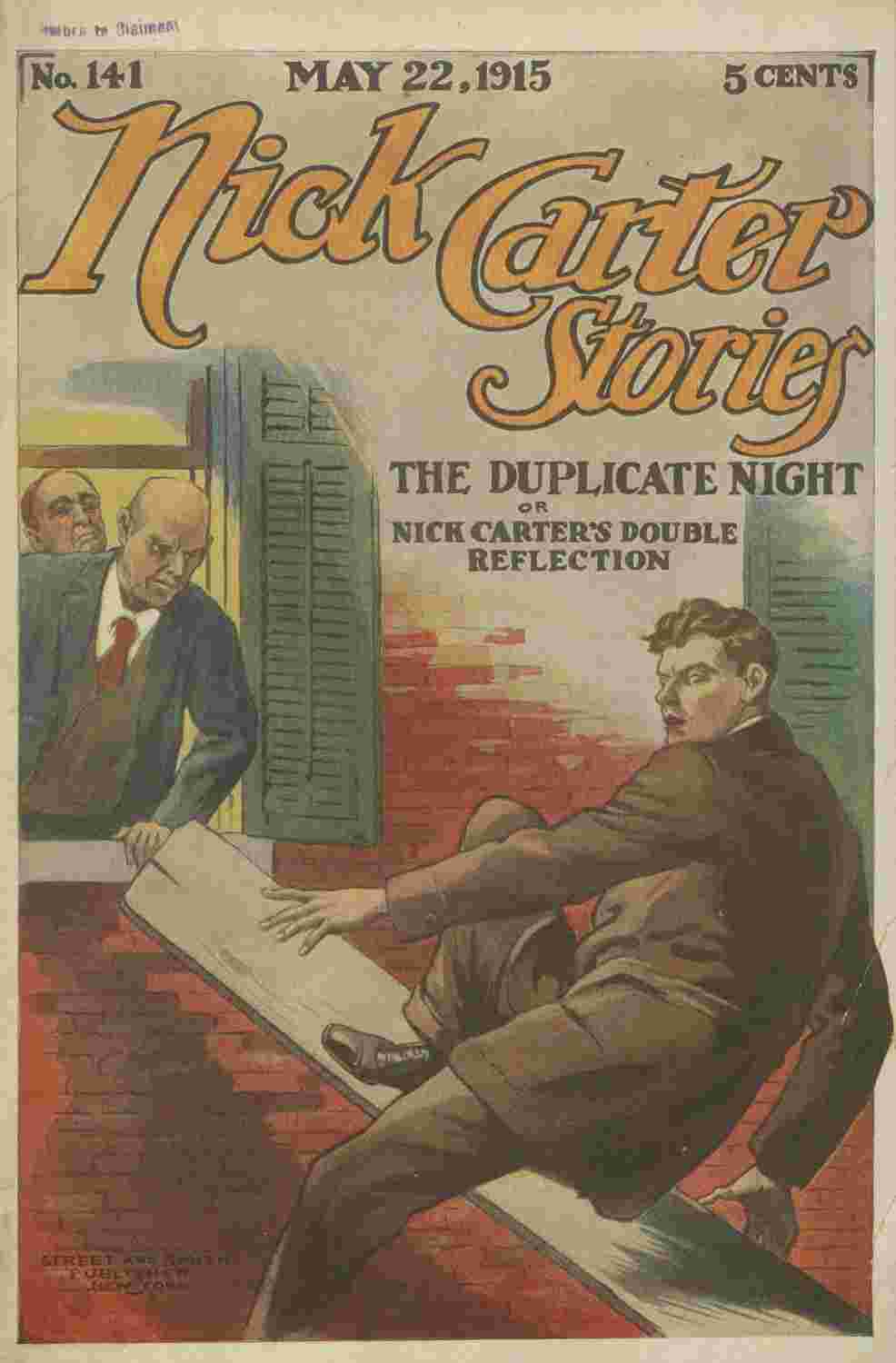
Patsy seized it with much the same avidity as a terrier seizes a rat. Creeping along the roof with it he quickly reached a point directly opposite the lighted window of the dwelling—that already specially noticed.
A narrow beam of light was shed out below the roller shade, lending a faint glow to the misty night air. Through the narrow space between the curtain and sash, however, Patsy could see only that there were several persons in the back room, which evidently was a kitchen, and he was too far from the closed window to hear their voices.
“Gee whittaker! I’ve got to get still nearer,” he said to himself, ruefully gazing into the black abyss below. “I might as well be on top of the Flatiron Building. I must take a chance with this plank, by gracious, if I lose a leg.”
Crouching on his hands and knees, proceeding all the while with the utmost quietude and caution, Patsy found that the strip of board was long enough to reach from the outside stone sill of the window to the edge of the garage roof, with about a three-inch rest on each end.
“It will support me, all right,” he muttered, gazing at it after having gingerly placed it in position. “Gee! but it’s a ticklish crawl. Can I wriggle out on it without displacing one end, or the other? If not, it will be a quick trip to the ground for mine.”
Patsy viewed it doubtfully for several moments. It was a stunt from which the boldest would have shrunk. Then he looked at the lighted window again and listened vainly—and his face then took on an expression that spoke louder than words.
“It’s got to be done,” he murmured decidedly. “There’s nothing else to it. I must find out who is in that room, and what is going on there. I might as well be a bump on a log, as sitting here.”
Starting up, Patsy removed his overcoat and hat, placing them near by on the roof.
He then crouched close to the edge, grasping each side of the plank as far out as he could reach.
He found that it rested firmly on each end, and he then worked his hands still farther out, gradually letting himself down until he lay flat upon it, with his feet on the garage roof and his head within eight inches of the house window, his eyes directly in line with the lower edge of the slightly raised curtain.
The beam of light from within fell full on his face. It looked unusually pale, but never more set and determined.
Patsy had reasoned that it might be more difficult to return than to get out there on his narrow support. But he had resolved to cross that bridge when he came to it.
It was enough for him, just then, that he had accomplished his immediate object. He now could see plainly into the room and also hear the voices of its occupants.
He took them in visually with a single swift glance—five persons.
One was a brawny Irishman in his shirt sleeves. He was seated near the stove and smoking a clay pipe.
Another was a corpulent, red-faced woman, whose garments denoted that she was the mistress of the house, as the other appeared to be its master.
“Hogan and his wife,” thought Patsy. “I’ve seen him driving a taxi, too, and his wife most likely runs the little store.”
Patsy afterward learned that he was right.
A third person was Annette Levine, divested of her outside garments.
A fourth was a dark, finely formed woman in the twenties, whom Patsy instantly recognized as a familiar character in the Tenderloin, one Lucy Devoll, a girl formerly intimate with the Vantoon sisters, then in prison for their complicity in two of the crimes committed by Stuart Floyd.
The fifth person was none other than the notorious crook himself—Stuart Floyd.
He looked white and pinched, and there was an abnormal glitter in his eyes that told of feverish anxiety and physical consumption, of the horrible price paid for traveling the downward path.
“Eureka!” thought Patsy, when he discovered these worthies. “I’m in right, if I can only stick here. If worse comes, I can wriggle around and drop into the yard. It’s not more than ten feet.”
Patsy lost nothing that was said in the room while these few thoughts passed through his mind.
Stuart Floyd was talking, addressing the girl who had entered only a few minutes before.
“What type of man is he, Nan, the one who called this morning?” he asked.
“A decent-looking, muscular man, smooth shaved,” said Nan Levine, as she was called. “He’s about medium complexion.”