
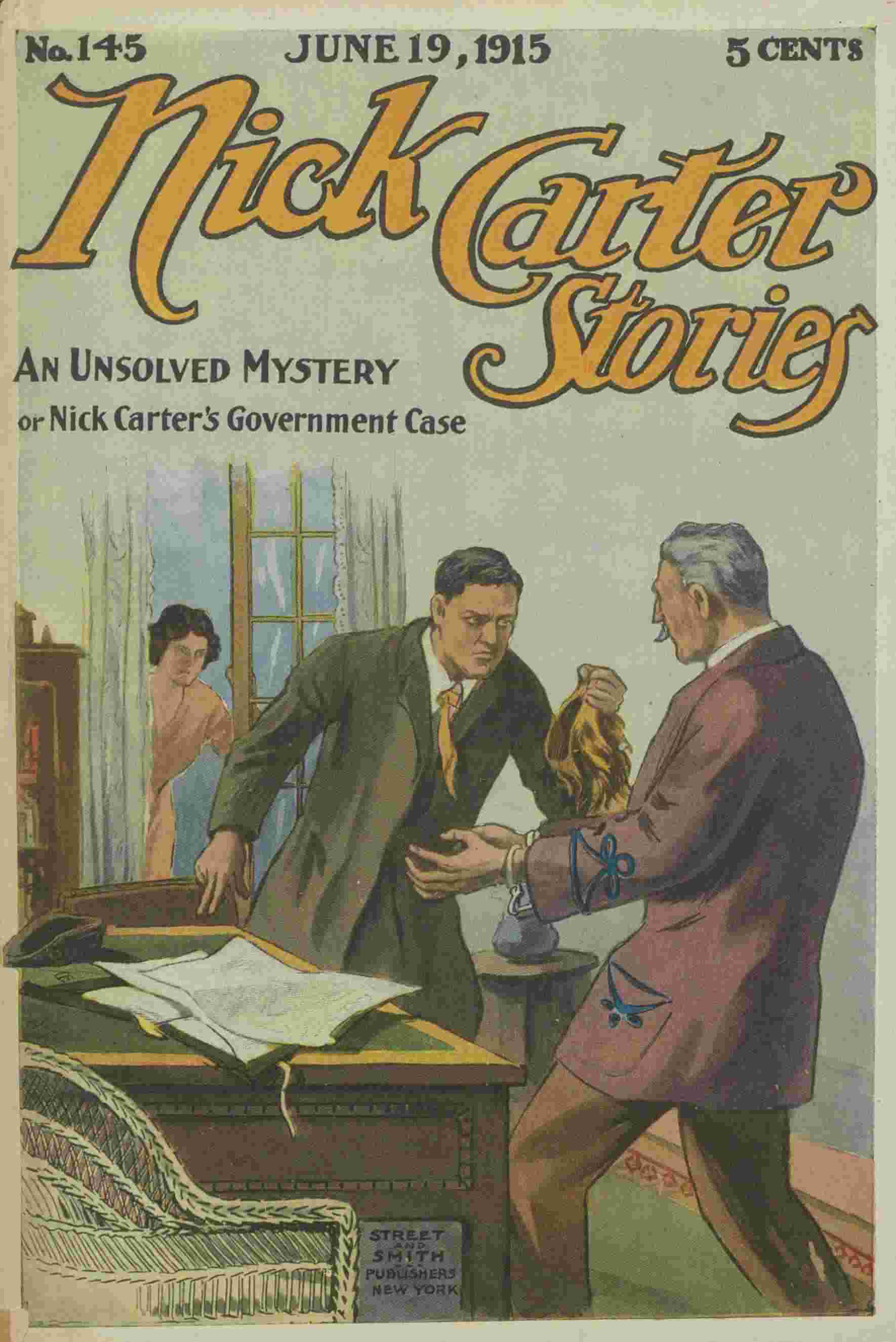
CHAPTER X.
A DESPERATE MOVE.
It was nearly noon.
Less than three hours had passed since Nick Carter and his two assistants set to work on that eventful morning.
There was a change in the scene in Captain Casper Dillon’s library.
Nick Carter was seated in one of the large chairs near the wall, tied to it and with his arms secured behind him. His strong, clean-cut face, nevertheless, wore an expression of absolute indifference. He sat listening without concern to the discussion that was in progress.
There was another prominent figure in it at that time. He was seated near the library table, on which still lay the plans Nick had brought there, and the safety of which was all that then gave him any uneasiness. This figure was that of the Baron Esterveldt, who had followed Irma Valaska there in a touring car, then directed his chauffeur to return home.
The woman, one of Europe’s cleverest spies, then was seated near him.
Captain Dillon had been liberated, of course, and was in nervous exultation over the less threatening turn of affairs.
There then were three other persons in the room—Andy Margate, Tom Carney, and Larry Trent.
They had arrived upon the scene ten minutes before. The forces that had been in operation had come together, had united for the first time, and explanations formed a part of the discussion, conducted almost entirely by the Baron Esterveldt and Margate.
“Never mind how I came to know of your designs,” Margate was saying to the other just as a French clock on the mantel struck twelve. “That’s neither here nor there. All that we need come to is a settlement of the matter as it stands.”
“What do you consider a settlement?” Esterveldt demanded, with sonorous voice.
“That can be told with few words,” returned Margate coldly.{39}
“Brevity is desirable under the circumstances,” said Esterveldt, with a sneer.
It was ignored by Margate.
“There is just this much to it,” he went on icily: “I have in my possession certain articles for which you people have conspired. They are intact, just as we found them when Captain Dillon reluctantly parted with them.”
Dillon scowled darkly, but did not interrupt.
“We will return them to you for a price,” Margate continued. “What that sum shall be, and when the deal can be completed, are the only two questions to be settled.”
“Ah, indeed?” queried Esterveldt, frowning. “What about this detective and his assistant, the one you say is in your hands?”
“You may dispose of them as you please, Baron Esterveldt,” Margate said coldly. “I can imagine that your subsequent safety will permit of only one course.”
“There is some truth in that.”
“What you do with them is immaterial to me,” added Margate. “Carter is too dangerous a man for me to leave alive, if I were the one seriously threatened. That, however, will be up to you.”
“We can take care of him,” snapped Irma Valaska, with a fiery glance at the unruffled detective. “We’ll be sure to close his mouth.”
“Possibly.”
Nick dropped in the single doubtful word indifferently.
“A settlement, then, should be easily arrived at,” said Margate, resuming. “As a matter of fact, so far as I and my two friends here are concerned, there is nothing else to it. There is nothing——”
“Oh, yes, there is! There is much more to it!”
The interruption, one that turned the scene into a tumult, was shouted from outside.
It was followed by the crash of the French window, through which came Chick Carter and Patsy Garvan, weapons drawn and with four policemen at their heels.
Others were battering down the back door.
Others were stationed at the front.
A shout of satisfaction from Nick Carter was drowned by a roar of dismay from the Baron Esterveldt, a shriek of mingled fear and fury from Irma Valaska, and oaths and imprecations from knaves instantly involved in a vain but terrific struggle.
Only one man succeeded in making a move for liberty—Andy Margate.
He sprang through the parlor door, as quick as a cat and defiant of the bullet that whizzed by his head. Two bounds took him across the room. He did not seek the front door of the house, knowing it must be guarded.
Without an instant’s hesitation, a devil indeed when cornered, he leaped straight through a side window, carrying away panes and sashes, and alighted in the side yard.
Two policemen in the front yard tried to stop him.
Margate dodged them, cleared the front fence cleanly, and in an instant was in the runabout Irma Valaska had left at the curbing. He uttered a defiant yell and was away in a moment.
Patsy Garvan rushed out of the house in time to fire twice, only to miss the crouching rascal, and in another moment the speeding car had turned the nearest corner.
At one o’clock that afternoon, Nick Carter, in company with Chick and Patsy, knocked on the door of a suite in the Willard and waited for the occupant to{40} open it. There was an odd smile on the face of the famous detective, an odd smile on that of each of his companions. The light in their eyes was one that never shone on land or sea.
They had not long to wait, scarce a moment. Well enough the man in the suite knew that only one person would be likely to knock on his door, that only Nick Carter and his assistants knew that he was there.
Harold Garland, as anxious and distressed as if his life was at stake, ran to the door and opened it.
“Ah!” said Nick, smiling. “I thought you might be at lunch.”
He had an overcoat on his arm when he entered with his assistants, and he placed it on a table in the parlor.
“Lunch!” Garland echoed the word derisively. “Heaven above! will I ever eat again, Carter?”
“Well, I hope so,” said Nick, laughing.
“Do you laugh at me?” Garland stood and stared. “Tell me——”
“Oh, I haven’t much to tell you, Captain Garland. I came near losing those plans you brought me from the war office this morning.”
“Losing them!” Garland spoke with a gasp. “God above! that would be heaping Pelion upon Ossa. If you had lost them, also——”
“Oh, but I didn’t,” said Nick.
“Where are they, then, and——”
“Have a look.”
Nick picked up his overcoat and revealed on the table—two portfolios stuffed with government plans.
Garland stared for an instant, then uttered a shriek that might have been heard a mile away—a shriek imbued with joy and relief that words could not describe. He tore open both, viewed their contents for a moment, and then he threw his arms around the detective, sobbing like a child and crying wildly:
“Oh, Carter, Carter, Carter, how am I to repay you? They are all here, all here! Both portfolios—every plan! Oh, my God, I think I’m going daffy!”
“Let it be with delight, then,” said Nick, kindly forcing him to a chair. “We have called the turn on the foreign spies, at least, and put them where they belong. They have learned nothing from these plans, moreover, and you can bank safely on that, Garland, to the day of judgment. Calm yourself and listen. I will tell you what we have done and where you now stand.”
Nick then told him what had transpired that morning; of the finding of the stolen portfolio by Chick and Patsy; of the subsequent arrest of the Baron Esterveldt and his confederates, and the imprisonment of the entire gang, with the exception of Andy Margate.
“But we shall get him later,” Nick added, after thrilling Garland with the entirely favorable outcome of the case. “The others will get all that is coming to them, and are as good as booked for long terms in a Federal prison. As for Andy Margate, he is a clever and elusive crook. I have wormed out of Trent that he got an inkling of this job before leaving Europe, and that he came over here to take advantage of it. He did not know just what it was, but he kept an eye on Madame Valaska and discovered her friendliness with you. He saw you only by chance when you were met by her at the Union Station, Trent and Carney being with him, and they saw her slip the portfolio to Dillon, then in disguise, just before the touring car started. Dillon passed by the car to receive{41} it, and Margate at once suspected its value. They waylaid him later, and—well, that’s the whole story. But he will not escape. We’ll get him later, Garland, take my word for it. We’ll get Andy Margate a little later.”
Nick Carter’s prediction proved to be correct.
THE END.
How Nick Carter’s prediction was fulfilled will be told in “Paying the Price; or, Nick Carter’s Perilous Venture,” the long, complete story which you will find in the next issue, No. 146, of the Nick Carter Stories, out June 26th. The further adventures of the celebrated detective and his two famous assistants in their efforts to run down Andy Margate is related in a most graphic manner. Then, too, there is the usual installment of the serial now running, together with several other interesting bits of information.
Where’s the Commandant?
By C. C. WADDELL.
(This interesting story was commenced in No. 140 of Nick Carter Stories. Back numbers can always be obtained from your news dealer or the publishers.)
CHAPTER XXII.
AN OFFER.
Stupefied at such a refined and gratuitous exhibition of malevolence, Grail seemed suddenly to awake at the words, straining at the cords about his limbs, striving desperately to slip the gag, if only to utter a single word. But his efforts were absolutely in vain. Head, trunk, hands, feet were held immovable as in a vise; not a sound could he force past his mute lips.
Instead, Rezonoff bent down close beside him, and in such an excellent imitation of Grail’s tones that one could scarcely doubt it came from him, flung after the gray-haired commandant a peal of derisive and insulting laughter. Then, the interlude over, he gave directions to relax the bonds on the prisoners, and remove them once more inside the hut.
“I am obliged to leave now to accompany your friend the colonel,” he approached Grail to say, “and must defer the definite settlement of your case until to-morrow. Before I go, though, I wish to leave one thought with you to ponder over. I have, of course, no ground for animosity against you and your companion, other than that you have seen fit to poke your nose into my affairs; under certain conditions I am willing to overlook.
“In short, my dear captain”—he lighted a cigarette—“as you are doubtless aware, I am interested in the wireless experiments which have been conducted out at the fort, and for detailed information in regard to them, am prepared to offer you your liberty.”
Grail made him no answer.
“Ah!” The other laughed. “I know what you are thinking. You do not believe that I will carry out my end of the bargain. But consider: Even with all the precautions I may take, every death increases my risk and danger; for, despite the proverb, dead men do tell tales. Then, too, I would have no fear of your talking; the transaction with me would be all-sufficient to seal your lips forever. No,{42} my offer is bona fide, captain; you may rely on it. Indeed, I will do even more. With your acceptance, I will guarantee to exonerate you fully from all the suspicion now directed against you at the fort. And I can do it, too.”
Grail broke his silence. “And the alternative,” he demanded, “if I refuse?”
“The alternative?” The Russian lifted his cigarette to his lips and blew a cloud of smoke toward the ceiling. “Deplorable for you, my dear captain, but inevitable.”
“I shall kill you, Rezonoff,” said Grail, in a low tone. “I shall kill you if ever I have the opportunity.”
“I suppose,” the other returned, “that means a refusal of my offer, eh, captain? Well, I shall not take it as final now. You shall have twenty-four hours to think it over.”
Then, with a glance at his watch, he turned on his heel, and strode from the hut; and a few minutes later the prisoners heard the chug-chug of his automobile as it sped away.
Grail and Sergeant Cato glanced furtively at one another, the same thought mirrored in the eyes of each. They had a respite of twenty-four hours to go on, it seemed, and in twenty-four hours much can be accomplished.
CHAPTER XXIII.
VAIN EFFORTS.
Of the five confederates who had been at the hut with Rezonoff, two—Vance and Minowsky—accompanied him in the automobile, while Pepernik, under his orders, returned to the rooming house to serve as a “stalking horse” against the police, and lead them off the trail.
This left Matschka and Simmons to guard the prisoners, each man taking a relief of three hours, with Matschka accepting the first turn at sentry duty.
It was a period of quiet in the hut, broken only by the mutterings and tossings of Simmons as he slept somewhat restlessly, rolled up in a blanket over in the corner.
Matschka, silently alert, sat on a box smoking innumerable cigarettes, but never letting his glance drift from the captives, who shifted about uneasily in the effort to relieve the chafing of the cords at their wrists and ankles, the while they feverishly revolved methods of escape.
One conclusion was very speedily reached by both of them: That it would not be wise to make the attempt under the eye of their present sentinel. He steadfastly declined to be drawn into conversation by them, or to have his attention diverted in any way, and his discernment was almost uncanny. Let one or the other of them feel even the slightest slackening of his bonds, and immediately Matschka was there to tighten up the knots.
They soon decided, therefore, to defer active measures until Simmons took the watch, and in the meantime devote all their energies to devising an effective plan of escape.
Eagerly each sought to recall all the tales of the old Indian fighters which are handed down in the service, with their details of almost miraculous deliverance from similar situations, but none of the expedients used seemed adaptable to their present plight.
Many prisoners, bound hand and foot, have managed even under the watchful eyes of a guard to extricate themselves from their fetters and get away; but it has always been due, Grail gloomily reflected, to some slip-up or oversight on the part of their captors—a pocketknife{43} overlooked in the search of the prisoner’s person, a carelessly tied knot, or a convenient sharp stone against which to fray the ropes. With them, however, no such fortuitous circumstance existed so far as Grail could see; and he was satisfied from Cato’s expression that his companion was equally baffled by their plight.
They were simply tied up hard and fast, and in such thorough and scientific fashion that to slip or unloose their fastenings with any one watching them was practically an impossibility. Nevertheless, Grail did not despair. There must be some way out of the dilemma, he believed, and industriously he set himself to find it.
So the time passed away, with both Cato and him vainly cudgeling their brains, until at last four o’clock arrived, and with it Matschka roused up Simmons and himself rolled over into the blanket.
The deserter yawned, stretched himself, and walked over to the door, to gaze out into the gray morning mists which enveloped the bottoms.
“B-r-r!” he muttered, shivering from the chill dampness as he returned to take his seat on the box. “That air is as cold and clammy as the touch of a dead man’s hand.”
Cato, seeing evidence of a desire to talk in this, promptly encouraged it.
“Feeling seedy, anyhow, aren’t you?” he said. “You didn’t seem to be sleeping very well.”
“Sleep?” Simmons laughed harshly. “I haven’t been seeing anything but the staring eyes of that yellow-faced Jap all night long.” He shivered again.
“Never killed a man, did you, sarge?” he resumed, after a pause. “Well, don’t! Believe me, it’s a nasty business—kind of turns you sick, when they crumple up and flop down all limp, like that Jap did on the stairs. And that straw hat of his!” he exclaimed. “It sounded to me like a load of brick, bumping from step to step, clean to the bottom. I couldn’t understand why everybody in the house didn’t come running out to see what was the matter.
“What else could I do, though?” he burst out in a sort of petulant defense. “As I told the boss, I had to get him, or he’d have got the whole shooting match of us. It was just the same way with Captain Grail there. I hadn’t nothing against him in the world, but I knew where he was going when he ordered out the dirigible, and it was up to me to stop him any way I could. Take it from me, though,” he added, “the Jap had us nearer right than even Captain Grail. He had the whole thing figured down to detailed plans and specifications.”
“How did he come to let you get him, then?” inquired Cato, noticing out of the corner of his eye that Grail was slowly working one foot free.
“Ah, that was where I worked it fine!” Simmons boastfully wagged his head. “Them little brown fellows is smooth, sarge, but for once I was just a shade smoother. You see, when I started on my get-away, I headed straight for Matschka’s room to make my change; and as I bolted into the house and up the stairs, who should I see but this Sasaku just coming out. I knew he’d recognize me from the way he dived back into his room; but I pretended not to notice anything, and went on up to Matschka’s joint. That was a sort of general hang-out for the crowd, you understand, and all of us had a key to the door.{44}”
“Yes,” interposed the sergeant encouragingly, as he sedulously kept his glance away from Grail; “what then?”
“Let’s see, where was I? Oh, sure, I remember now; I was in Matschka’s, and the Jap was in his own room, across the hall. Well, I didn’t lose any time skinning out of my uniform, but all the same I had my door ajar, and I kept listening, and pretty soon, just as I expected, I heard him come sneaking over to get an eyeful. I acted like I hadn’t a suspicion in the world, but I was saying to myself: ‘If that guy ever gets out and telephones to Grail that he’s seen me here, I’ll be doing a stretch at Leavenworth sure, and all the while I was opening the knife in my pocket. Then, when I heard his steps turn away from the door, and head for the stairs, I turned like a flash and was after him. The door was open a crack, as I told you, and I had on rubber soles, so he never heard me. I caught him just at the top step, and let him have it between the shoulder blades, and he went down without even a squeak. Then I grabbed a letter that he had in his hand, and blew.”
“A letter?” repeated Cato. “To whom?”
“To Captain Grail. And, believe me, it was some letter, too. The chief was inclined to be peevish when I got over here, and told him what I’d done. But you bet he didn’t have another word to say after he’d taken a squint at that letter. The Jap had the whole game doped out, with all our names and everything else; and he——”
“Hello, there!” he exclaimed sharply, happening unfortunately to turn just as Grail was slipping his foot free from its tether. “Oh, no; I guess you won’t!” And, diving forward, he speedily retied the confining knots more securely than ever. An hour and a half’s patient effort had gone for naught.
CHAPTER XXIV.
NEW TACTICS.
From that time on, Simmons redoubled his vigilance; and at seven o’clock the taciturn and lynx-eyed Matschka returned to the job.
Grail had hoped that possibly their opportunity would come at breakfast, but in this he was destined to be disappointed. Only one of them was permitted to eat at a time, a single arm being freed sufficiently to allow them to feed themselves, and the big Russian standing warily at hand to check the first suspicious movement.
Moreover, since it was not deemed wise to draw attention by starting a fire in the shack, the repast consisted solely of cold bread and meat, and no table implements which might have proved of some service were handed out.
The day wore on in a succession of frustrated hopes. Ten o’clock brought Simmons on as sentinel again, but, warned by his previous experience, he was, if no less loquacious, decidedly more watchful. The end of his shift at one o’clock found the prisoners as far as ever from a solution of their problem, and the time at their disposal half gone.
Practically their sole hope lay now in what scheme they could frame up to circumvent Simmons when he again came on from four to seven; and Grail by this time had about come to the conclusion that Simmons was almost as difficult to circumvent as Matschka.
Perhaps, however, came the thought, he could be won or brought over to their aid. The deserter had dropped{45} one or two remarks which rather indicated that he was not altogether satisfied with the bargain he had made, and was chafing under the autocratic rule of his Muscovite employer.
Recalling these symptoms of discontent, and reflecting, too, that Simmons would no doubt sell out his present associates as readily as he had the former ones, the adjutant set himself to pondering the arguments and promises which he considered would prove most persuasive.
By a stroke of luck, he had an opportunity to use them sooner than he had expected.
About two o’clock, Minowsky appeared with a message from their leader directing Matschka to return to Brentford, and surrender himself to the police.
“All you’ve got to do, he says,” explained the emissary, “is to stick to it that you don’t know Simmons, and that, if he used your room, it was entirely without your knowledge or consent. They haven’t got any real evidence against you, and the worst you can get, the chief says, in a couple of days behind the bars. Anyhow, you’ve got to do it, he says, to throw off the detectives. While they’re busy trying to get something out of you, they won’t be poking around in the other directions, and maybe stumbling onto something that would hurt.”
The big Russian, trained to military obedience, did not hesitate, or even question the order. With an indifferent grunt, he arose, and at once prepared to accompany the other back to town.
Left thus alone in charge of Simmons, Grail lost no time in commencing his overtures; and Cato, promptly scenting what was in the wind, ably seconded his efforts.
For a time, Simmons paid little heed to them. He was busy poring over a newspaper which Minowsky had brought, and from his unhappy expression it was evident that he was far from pleased with what he read.
Finally, he cast the sheet from him, and sat nursing his knees in moody silence.
“By golly, it begins to look to me like I was picked for the goat,” he muttered resentfully. “What I done ain’t a patch to what the rest of the crowd is up to, and it was all for their benefit, too. Yet, do they try to protect me in any way? Are they trying to hand the cops any false steer, as the chief promised they would? Naw, they ain’t. Instead, this stiff of a Pepernik, when they question him, comes out and gives me the worst kind of a black eye; says he’s seen me hanging around the rooming house often, and that he caught me once in his own room, being only kept from handing me over to the police by my claiming that the door was open, and I come in by mistake.
“Does that look like they was protecting me?” he demanded. “If they wanted to do what was right, would I be sitting here shivering for fear the detectives might pop in on me at any minute? No; I’d be a thousand miles away, with a good disguise on me, and plenty of money in my pocket.
“Why, how do I know”—he sprang to his feet and began excitedly pacing the floor—“but what the whole crowd is making a duck right now, and leaving me to hold the bag? Maybe this calling off Matschka is just a stall to give him a chance to blow with the rest. All the chief really wanted was to get the colonel. As he himself said, he didn’t have nothing against you two.”
Needless to say, Grail and Cato both sympathized with his complaints, and played upon his apprehensions, until{46} finally when he seemed sufficiently worked up, the adjutant made a flat-footed proposition.
“Turn State’s evidence on the crowd, while you have a chance, Simmons,” he urged. “Don’t let them give you the worst of it. Right now you have everything in your own hands, and by telling the truth and giving up this gang to justice, you yourself will get off scot-free, or with only a few years’ imprisonment at the most. To-morrow it may be too late.”
With these and many other persuasions they sought to convince him; but Simmons, although manifestly impressed, still hesitated.
“I don’t dare,” he whimpered. “That captain told me what would happen to me if I ever turned on him. There’s Russian spies all over this country, he says, and every one of them would make it his special business to hunt me down and get me. They never forget, he says, and they never give up; and, believe me, what he says they do when they finally land you is enough to make your blood run cold.”
Grail almost found it in his heart to pity the poor wretch thus tossed between contrary fears; but the important thing with him, of course, was to gain his freedom, and he labored all the more assiduously to allay the dread inspired by Rezonoff’s threats, and at the same time urge the advantages of coming over to the side of the law.
It was a purely commercial argument, however, which finally won the day.
“Simmons,” he said abruptly, “if you will release Cato and myself immediately, I will give you a thousand dollars the moment we get back to the fort.”
For a minute longer the man wavered. Then the prospect of a thousand-dollar spree in Brentford’s gilded resorts overcoming even his terror of Russian vengeance, he bent over the prisoners, and began fumbling at the knots.
CHAPTER XXV.
UNEXPECTED VENGEANCE.
While he worked, Grail hurriedly plied him with questions. “Have you any idea,” he asked, “where Rezonoff was planning to take the colonel when they left here last night?”
Simmons shook his head. “I don’t know for sure,” he said. “They didn’t take me into their confidence any more than they had to. But I have a suspicion from something I heard dropped that they were planning somehow to ring the colonel’s daughter into the game.”
“The colonel’s daughter!” Grail gulped the words out, his face grown gray and tense.
“Yes. Just before they started off, I heard him say to Vance that it would be quite a family reunion to have father and daughter under——”
The sentence was destined never to be finished. Just then a pistol shot rang out from the back of the hut, and Simmons, with a shrill cry, sprang to his feet, clutching at his left hand, from which the little finger had been shot away.
A second later he was out of the hut and dashing for the cover of the horse weeds at a speed which only terror could have lent to his feet.
Grail and Cato, owing to their cramped limbs and the necessity of jerking off the last of their trammeling cords,{47} made slower progress; and by the time they reached the door their late companion had disappeared, the only sign of him being the rustling and swaying of the thicket as he passed through. Just entering the weeds, however, and in close pursuit, they could discern the forms of half a dozen lithe, brown-skinned little men.
Grail drew a long breath as comprehension came to him. He had not dreamed before but that the pistol shot had been aimed at Simmons by one of the returning Russians.
“Ah!” he exclaimed. “The danger that he did not count is the one to overtake him—the vengeance of the Japs for the murder of their countryman. As he himself said, they are deep—deep and crafty—those little people; and no doubt they have been seeking him ever since they learned that he was the murderer of Sasaku. Also, unquestionably, they would shadow the men with whom he was associated; and thus, through Minowsky’s coming here this afternoon, they learned of his hiding place.
“But come,” he urged, laying a hand on Cato’s arm. “Let us hurry after them. We still may be in time to prevent bloodshed. They will certainly desist if we tell them that Simmons has decided to give himself up to the authorities.”
Indeed, considering that they had been trussed up for over fifteen hours, it was really remarkable how quickly they made their way to the shore. Through the tall weeds they plunged breathlessly, never thinking of the danger they ran in possibly being mistaken for the fugitive.
As a matter of fact, though, they were led astray from the actual chase by a chance pig, which, stirred up from its comfortable wallow at their approach, drew them considerably to the north under the delusion that they were following the footsteps of Simmons, or one of his pursuers.
So, when they finally came out on the river bank, it was to see Simmons emerge from the bushes fully four hundred yards below them, and, in frenzied flight, dash down to the water’s edge.
There he hesitated a second, glancing back over his shoulder; but evidently seeing the avengers hard upon his heels, threw aside his coat, and splashed into the shallows with the manifest intention of trying to escape by swimming.
A dozen steps he took, the water rising above his waist; then, just as he was about to throw himself forward and strike out, he stopped suddenly with a peculiar gesture, seemed to struggle unavailingly, and, half turning toward shore, threw up his arms with a wild scream for help.
“Great heavens!” exclaimed Grail. “He’s struck quicksand!” And immediately he and Cato started to run down the shore. But before they had covered half the distance they saw that they would be too late. With fearful rapidity the victim was being drawn down. Already the water was up to his chin.
A little knot of the pursuers stood on the bank, but they stirred neither hand nor foot to tender aid. In absolutely stolid silence they watched the tragedy being enacted before them. Grail tried to call to them, to explain; but they either failed to hear or declined to heed him.
So the end came. There was one last awful, gurgling cry; then silence. By the time that Cato and Grail came panting to the spot, the Japanese had disappeared, departed as quickly and silently as though they had evaporated{48} into air. Only a few bubbles floating on the surface of the muddy river remained to give a sign of what had happened.
CHAPTER XXVI.
THE DAMPENED LETTER.
Shocked and shaken by the terrible fate which had overtaken Simmons, Grail and his companion could only stand staring silently at the flowing waters; but very shortly they aroused themselves from their stunned apathy.
Primarily it behooved them to make good their escape; for the Russians might return at any moment, and, finding them gone from the hut, set afoot a search, which, so long as they remained so near at hand, could not fail to result in their recapture.
With the possibility of such an encounter, they decided not to risk going back through the bottoms, but since the skiff that they had used the night before was close at hand, to take it, and row across the river.
Quickly they launched it, therefore, and Grail, who took the oars, forgot, under the desire for speed, how stiff and sore his arms were.
As he thought of what might have happened to Colonel Vedant while he lay a prisoner—nay, more, of what might have happened to Meredith, recalling Simmons’ interrupted disclosure—he set his teeth in grim determination, and pulled away so furiously that Cato was constrained to protest.
“Here, captain,” he urged, “you’ll wind yourself before we are halfway across. Take it easier.”
But Grail only shook his head, and dug at the water harder than ever. Nevertheless, the swift, eddying current of the river is a thing to test the mettle of any rower, and, despite all that Grail could do, the landing that they finally effected was far downstream.
A passing trolley car, however, afforded them quick means of returning to the city, and, boarding it, they rode until Grail sighted the signboard of a public telephone station, and leaped off to call up with fast-beating heart the home of Mrs. Schilder.
The voice of the French maid answered, and as she repeated his name it seemed to him that there was a distinct flutter of surprise in her tone.
However, he was too absorbed to pay any heed to that. “Is Miss Vedant there?” he inquired breathlessly.
“Mees Vedant? No.” Grail’s heart seemed to stop beating in the pause. “She and madame ’ave just gone out in ze automobile.”
He drew a long breath, and the icy hand which seemed to have been clutching at his throat relaxed. His fears and misgivings, then, in regard to Meredith had all been in vain; she was safe.
What he would have thought if he had known that Marie lied when she said that Meredith was not in, and that immediately on leaving the phone Marie hastened wide-eyed to her mistress, is another question.
Also, he might have indulged in some reflection, if he had known that immediately on receiving the maid’s news, Mrs. Schilder herself hurried to the instrument and called up a number not listed in the book, but recorded at the office as belonging to Dabney.
Ignorant of all this, he went out almost buoyantly to rejoin Cato, and catch the next car headed for town. They had to wait a little for it to come along; so, with one{49} thing and another, it was three-quarters of an hour before they arrived at the fort.
The evening had settled down early with a lowering sky, from which fell every now and then a spatter of raindrops, and the thunder was growling sullenly away in the distance; so, although it was still hardly sunset, darkness had practically fallen, and the sentinel at first failed to recognize them as, muddy and bedraggled, they approached the entrance.
At the sound of Grail’s voice, however, he stared in incredulous surprise, and seemed about to say something; then recovered himself and gave the salute.
“There was a note came for you, sir,” he stammered, “just about five minutes ago; but I didn’t know if—didn’t know when you were coming back, so I told the boy to take it over to the guardhouse.”
“Thank you,” replied the adjutant, and, stopping on his way to his quarters, possessed himself of the missive.
It was slightly damp to the touch, he noticed, but he thought nothing of that on account of the rainy evening. Tearing it open, and holding it up to the light when he reached his rooms, he pursed his lips as he read:
“Dear Grail: I am dictating this to you at Schilder’s office, where I have just received some astounding information which completely exonerates you from the unjust suspicions some of us have entertained toward you, and also points the way toward the speedy recovery of Colonel Vedant.
“Should you return to the post before eight o’clock, will you not accept our apologies, and come at once to Mr. Schilder’s residence to join the officers in a conference we are holding there, to decide on how best to use the intelligence at hand to Vedant’s advantage? Faithfully yours,
Appleby.”
Grail studied the letter. There seemed no reason to doubt the genuineness of the bold signature; it was Appleby’s in every line and flourish. Neither could he question that the thing had been typed at Schilder’s office. The chipped “m” and blurred “D” spoke for themselves.
Then he smelled and tasted of the paper on which it was written, but an incipient head cold, as a result of his night spent out on the bottoms, had somewhat blunted those senses, and he could not be sure of the results. The letter seemed, on the face of it, to be straight.
Still, to make certain, he called in his “striker,” and asked if he knew where Major Appleby could be found.
“I understand, sir,” said the man, “that he and all the other officers at liberty have gone out to Mr. Schilder’s.”
Grail turned to Cato. “That seems to settle it,” he announced. “As soon as we can get brushed up a bit, we’ll call a taxi and be off.”
TO BE CONTINUED.
EXCEEDINGLY CAUTIOUS.
A gentleman once told a strange story, one that, like so many other true stories, was difficult to believe.
His auditors showed by their manners that they doubted, and so he appealed to another gentleman who had been present at the time to confirm the truth of his statement.
To his amazement, this man replied stiffly, and said:{50}
“I regret that I do not remember the circumstances to which you allude.”
The next day both these persons met, and the first gentleman said:
“But can’t you really remember those extraordinary circumstances?”
“Oh, yes,” replied the second.
“Then why the dickens did you say you didn’t, when I asked you about them before?” inquired Mr. One indignantly.
“Ah,” replied Mr. Two, “I saw that the company, all of them took you for a liar, and I wasn’t going to be taken for another!”
LOST AMONG THE ALLIGATORS.
Many years ago I was journeying by steamboat up one of the many bayous or creeks in the southern part of the State of Louisiana.
In the course of the morning the steamboat drew up at a wooding station to take in a supply of fuel, and, led by curiosity, I went ashore with a lad about my own age.
Growing tired of watching the negroes carrying the split wood on board, we yielded to the temptation to venture a little way into the forest.
A squirrel crossed our path. We gave chase, and the frisky little animal led us on till we found ourselves out of hearing of the hissing of the steam and the voices of the negroes at the woodpile.
Suddenly a bell rang; this we knew to be the signal for the steamer’s departure, and were horrified to note how faint and far-off the sound appeared. However, shouting at the top of our voices, we turned back.
Through brambles and briers, thorns and thickets, climbing over fallen logs and splashing through marshy places, we scrambled and leaped.
Then we distinctly heard the coughing of the steam and the dash of the paddle wheels. The boat had started! The sound grew more indistinct, and our hearts sank as we heard them rapidly die away in the distance.
We thought it would be an easy thing to find the river; yet our efforts were utterly in vain.
After a time, no river appearing, we realized the fact that we were lost!
An hour or two passed, and we became sensible of the pangs of hunger. We searched our pockets, and discovered that one biscuit was our entire stock of provisions. This we divided and gloomily ate.
An incident now occurred which showed that our position had its positive dangers. A fallen tree lay before us.
Upon mounting the log, I espied, coiled in many folds, with its rattle erect in the center, a huge rattlesnake.
Just as I was about to leap down, my eye caught its villainous glance. Fortunately I knew enough of serpent lore to recognize this formidable enemy, and, with a shout and gesture, prevented my companion climbing the log.
Nor were we a moment too soon. The creature had evidently observed us, for, as we fled, we heard his warning rattle, and momentarily expected him to spring over the log, in pursuit.
As the sun drew westward, we busied ourselves with picking out a tree suitable for camping purposes.{51}
I helped my companion to mount one, which was thick and bushy, in the branches of which he soon lay down.
I stayed below to watch for a last chance. It seemed a useless thing to do; yet, though hoarse with shouting, I once more lifted up my voice.
Was it a fancy that there was a reply? We could not be mistaken, for both of us heard a faint, far-off response.
We waited with intense anxiety the approach of the stranger.
At length a gun barrel emerged from a great bank of rushes, followed by a rough, hunter-looking man.
“Who are you?” he asked.
“We came ashore from the Abeille at the wooding station, and have lost our way.”
“Whew!” he whistled, and rested on his gun; then scanned us both narrowly, for by this time my companion had slidden down from his post among the branches.
“Guess you had better come with me,” he said; and, shouldering his rifle, he turned and pushed his way through the reeds.
Soon we saw through the branches the glitter of water, and came out upon the bank of a river, smaller than that up which we had passed in the steamboat in the morning.
Here, concealed in the rushes, was a canoe, which he quickly launched, swinging the head round to where we were standing.
Without speaking, he motioned us to get into the frail craft, then followed himself, laying down his gun and taking up a paddle. With a few strokes he drove the canoe out into mid-channel.
Very soon the night fell, and the fireflies darted among the bushes on the shore. We now heard the barking of dogs, deep-toned and long-continued.
Ten minutes more and the canoe was laid alongside a shelving bank, some five or six feet high. Our boatman, quickly leaping ashore, fastened the chain of the canoe to a stump near the water’s edge, and bade us disembark.
We followed our protector as best we could in spite of the growing darkness, till, after traveling a few hundred yards, as far as one might judge in such a blind journey, we halted before a dimly visible log house.
The man unfastened the door, whereupon two huge deerhounds leaped out, frisking and barking, and, in their canine fashion, expressing the height of joy upon the return of their master.
Upon perceiving us, they showed signs, lively and unpleasant, of doubt and animosity, till they were roared down by the deep voice of our conductor.
A match was struck and a pine knot kindled. Heaping some dry wood upon the hearth, the hunter speedily had a blazing fire, whose ruddy glow showed up distinctly the rough interior of the house.
One of the first acts of our protector was to unroll a bundle from the corner and spread upon the floor a buffalo robe, upon which he bade me sit.
From the blazing fire he lit a rude lamp, which he hung upon the roof. Then he produced his iron pot, and sharpening his knife, with the pot in one hand and the knife in the other, went out into the darkness.
He soon returned with water from the river in the pot, and in his hand a piece of deer meat.{52}
The pot was set upon the fire; the meat, cut into pieces and powdered with salt, put into it, and a handful of meal added, making a savory compound, which to us hungry boys seemed a delicious supper.
The serving of the meal was primitive. There was but one plate in the establishment; this the owner relinquished to his visitors, after having heaped it with smoking food, himself feeding leisurely from the pot.
We learned that our entertainer was an Englishman, who, in consequence of liberal views on poaching matters, had thought it more prudent to put the broad Atlantic between himself and his native village.
Here, deep in the backwoods, he lived a Robinson Crusoe kind of life, miles away from human habitation, supporting himself with his gun.
During the course of the evening we had been conscious of a growing babel of sounds, which arose on all sides in the great, dark, outside world, and which deepened in intensity as the night wore on.
Every now and then a hoarse bellow as of some mammoth bull that, slumbering, had been awakened by intolerable agony, came from the alligators that abounded in the surrounding swamp.
We had noticed that the door of the hut was a crazy concern, loosely hasped, and with an unfastened padlock on the outside. Inside, its only protection was a wooden bar, which shot so smoothly in its grooves as to suggest that a strong-snouted animal could easily nose the door off its hinges.
Upon communicating our fears to our host, we produced upon his grim visage the nearest approach to a smile that we had yet observed.
He seemed entirely at his ease.
He had strange tales, such as that one day he came home and found an old alligator asleep on his hearth; how that rattlesnakes had frequently crept in through the interstices of the logs; and how that almost every evening after dusk, at certain times of the year, wolves prowled around.
Then our protector informed us that we must be stirring with the dawn. He would take us in his canoe a distance of ten miles, whence, by crossing a narrow tongue of land, we might reach a steamboat landing.
With lively interest we watched his preparations for the night. He tried the wooden bar placed across the doorway. The logs were put together on the hearth. He then bade us wrap ourselves as well as we could in our buffalo robe; put out the lamp, and then lay full length on the floor, near the hearth, and was soon fast asleep.
Wearied as I was, I could not sleep. The external noises grew louder and louder. The alligators waddled up and down the acclivity upon which the house stood.
At one time no fewer than four of these ugly reptiles were prowling around our little sanctuary.
Meantime, our host had fallen into the profoundest of slumbers, the audible proofs of which had in them some obscure consolation, for I could not but reason that a man who could sleep under such circumstances, and sleep so soundly, could not but be assured that there was no real ground for alarm.
So the event proved. Confused thoughts of rattlesnakes, alligators, wolves, steamboats that devoured, and rattlesnakes that coughed and paddled, clouded my brain until I fell off into an uneasy slumber, gradually deepening into utter unconsciousness.{53}
When we awoke our host was standing in the open doorway, drying himself with a strip of canvas, after his matutinal wash in the river.
He had put a can of water over the fire, and, bruising some coffee berries between two stones, he made us a not unacceptable beverage. Biscuits, coffee—without either sugar or milk—and the considerate relics in the iron pot from his last night’s supper, made our breakfast.
We were soon on board the canoe, and were rapidly drifting downstream. The distance was quickly accomplished, and connection with civilization rapidly made; but I shall never forget that night spent among the alligators.
A NEW MOSQUITO TRAP.
He had the appearance of having traveled a good deal and was very talkative.
I incidentally touched upon the subject of mosquitoes.
“Mosquitoes!” he said; “why, my dear sir, up the Kongo I’ve seen them as big as bumblebees. One night, I remember particularly, they were out on the warpath, seeking whom they might devour, and were so outrageously lost to all sense of respect for me, that I was compelled to take refuge under the mosquito bar or curtain, although it was only just after dinner time and I wasn’t a bit sleepy. There were two candles burning on the table, so that I could see pretty clearly through the thin muslin bar, and by and by I noticed one of the indefatigable gray cusses, in prospecting around, had discovered a hole about the size of a shilling in the bar. He hummed joyously and then sailed away and triumphantly broke the news to all his friends and relatives, and in five minutes the whole community had clustered round the hole. They marched in silently and formed up in battalions, awaiting the signal to fall to. I had been imitating the sailor’s parrot by thinking a good deal, and superior intellect prevailed; for, as the last of the procession entered, I slipped out from underneath, took a cork from the brandy bottle, stopped up the hole, and slept outside. The way those penned-up insects raved and swore when they saw themselves circumvented was simply bloodcurdling. Fact, sir. What! going so soon? Well, I hope to meet you again some day. Good-by.”
THE CAP FITTED ALL.
“You told me that you were going to a spiritualistic séance last week,” said young Hepburn to his chum, McCabe. “Did you go?”
“Oh, yes,” replied the other; “I went.”
“Well,” said his friend inquiringly, “anything out of the way happen?”
“Well, rather,” said McCue. “We had spirit rapping and table moving and other things, besides, and the whole affair went off splendidly until the medium went into a trance, and then announced that he was the spirit of a man who had had his umbrella stolen, and that the thief was in the room.”
“And what happened then?” queried Hepburn.
“Well,” replied his chum, “the whole party made a dash for the door, and I was afraid that if I stayed behind I might be taken for the thief, so I retreated with the rest.{54}”
THE NEWS OF ALL NATIONS.{55}
Forks Save Keeper Clawed by Lion.
Attendants armed with pitchforks saved the life of Carl Wilson, an animal tamer, when Prince, a Nubian lion owned by the Levitt & Meyerholz circus, leaped at him as he was putting the beast through its paces at Jersey City.
Wilson was rehearsing four lions when Prince became enraged. As the trainer advanced to the corner of the cage where it crouched, the beast sprang, Wilson fell backward, and the lion clawed his face and tore his arm.
The lion was growling over the prostrate trainer, when attendants, standing outside of the bars, prodded the animal with long-handled forks. Prince turned on them, giving Wilson opportunity to crawl to a door on the opposite side of the cage. He was taken to the Jersey City Hospital.
Prince has a reputation as a bad lion. Six other trainers have met with more or less serious injuries at his teeth and claws.
Scottish Officers Make Ammunition.
One hundred members of the Glasgow Officers’ Training Corps have begun a self-imposed task of making shells, in response to the appeal from Earl Kitchener for unlimited amounts of ammunition.
These volunteers belong to the best families of Glasgow, and most of them will go to the shell factory in their own automobiles. They have undertaken to work six-hour shifts after a preliminary course of training.
Hamilton’s Oath Sold.
The original oath taken by Alexander Hamilton on his admission to practice as attorney and counselor in the supreme court and as solicitor and counselor in the court of chancery in New York, a one-page folio, dated Albany, July 12, 1783, brought the top price at the opening session of the sale at the Anderson Galleries of Part V. of the library of the late Adrian H. Joline, of New York. George D. Smith paid $125 for the document.
The same buyer gave $100 for the original manuscript petition of Colonel John Brown to “Horatio Gates, in the Army of the United States of America, commanding at Albany,” requiring General Arnold’s arrest on thirteen charges. Mr. Smith also gave sixty dollars for a four-page letter written by Washington Irving.
Auto Puts Engine Out by a Blow.
A great, overgrown Erie express train near the Garfield, N. J., railroad crossing struck a poor, little, aluminum-bodied automobile with all its might—and the Erie locomotive was put out of business and had to be hauled back to the repair shops.
That was all there was to this New Jersey incident, except for the fact that two men who were seated in the automobile don’t know just how they escaped injury.
Antonio Parapeto, of Monroe Street, Garfield, N. J., and John Russo, 430 Midland Avenue, also of Garfield, climbed into the touring car “to take a little spin.{56}” While approaching the Erie Railroad crossing at Garfield, the autoists failed to see No. 9 Erie Express, bound for Chicago, until they were only thirty feet from the tracks. Both men jumped.
The automobile went ahead and was smashed to splinters.
The locomotive came to a halt very soon. The metal work of the automobile had cut a steam pipe near the locomotive’s pilot and rendered it helpless. Traffic on the line was tied up for an hour.
Parisians Lionize Pau.
An incident in Paris illustrates the popular regard for General Pau, who has been spending some time in that city since returning from his political mission to Petrograd and the Balkan capitals. Persons who saw the general enter the Red Cross branch in the Place Madeleine, waited in the street to see him come out. A crowd soon collected. A young girl borrowed a hat and quickly collected enough money in the crowd to buy for the general a huge bouquet of red, white, and blue flowers.
General Pau appeared to be deeply moved on receiving the flowers, and kissed the girl. The crowd cheered him, and as he drove off in his motor car he responded by shouting: “Vive la France!”
Husband Rued His Bargain.
Belmar, N. J., women want to know the name of the wife who obtained from her husband funds for a new Easter bonnet and two dollars, besides, as a church contribution.
Women of one of the borough’s church societies each undertook to earn a dollar. They were to tell how they made it. Some baked cakes and one earned her share by deciphering a tombstone. The prize went to the woman who bargained with her husband for a dollar to trim her own Easter hat.
The husband gave her a dollar not to wear the hat and bought her a new hat besides.
Girl Arrests Hat Critics.
Miss Hannah Goldstein, of 1841 Prospect Place, East New York, chased two young men whom she accused of criticizing her hat into a candy store near her home, and there, after her screams had brought a crowd, exercised the right of any citizen to make arrests.
She took both into custody with the support of the onlookers, and escorted them to the Brownsville station, where they were booked on a charge of disorderly conduct.
The prisoners said they were Louis Markowitz, of 1589 Prospect Place, and Murray Zepkin, of 1858 Prospect Place.
Boy in Storage Three Days.
While the police of New York searched three days for James Kelly, the fourteen-year-old foster son of Mrs. Thomas Riley, of 158 Kent Street, Williamsburg, the youngster was locked in the subbasement of the building in which he lived. A workman for a storage ware{57}house, which occupies the lower floors, found him unconscious.
A general alarm was sent out for the boy, and it was only by accident that the subbasement was opened, as goods had been placed there to remain several months.
At the Williamsburg Hospital, where the boy was revived, he said he went to the cellar to look for something, and found the door closed when he attempted to leave. He screamed and beat upon the walls until he became unconscious, he said. The vault was so far below the ground that his signals were unheard.
England Aids Belgians
The English National Committee for the Relief of Belgium, organized as an auxiliary of the American Relief Fund, has made an excellent start. Although its appeal was issued a few days ago, $400,000 has already been subscribed.
Many Anglo-Americans have contributed, among them Countess Strafford, who sent $500. The success which the appeal has met is regarded in London as a wonderful tribute to the American organization.
Land French Boy’s Valor.
Jacques Goujon, seventeen years old, has been mentioned in military orders, and a military medal has been given him. The youth killed two German sentinels, blew up, with the aid of bombs, two quick-firers of the enemy, was captured, but succeeded in escaping, carrying with him at the same time a machine gun of the Germans to the French lines. Later, during a German counter-attack, Goujon’s right arm was blown off by a shell.
The military authorities at Lyons, Goujon’s home city, had refused to accept him for military duty on account of his age. He went to Paris, where he was accepted because of his robust constitution.
Weds Invalid Rescuer.
Frank A. Seabert, seventy-seven, former superintendent of the Delaware, Lackawanna & Western Railroad, has fulfilled what he declared was a debt of honor, when he married Miss Jeannette A. Thomas, forty-seven, the woman who saved his life recently. The ceremony occurred in the Pasadena Hospital, Pasadena, Cal.
Recently Miss Thomas threw herself upon a discharged employee of Seabert’s in the Seabert mansion at Sierra Madre, who had attempted to kill her employer. She was shot in the spine, and physicians say she is paralyzed for life. For five years Miss Thomas had been Mr. Seabert’s private secretary. The first Mrs. Seabert died four years ago.
Hen Hatches Turtle Brood.
Thomas Warren, a fox hunter, of Winsted, Conn., who recently found a nest of turtles’ eggs in a field, placed them under a setting hen as an experiment. Seven of the eggs hatched. The hen’s unusual offspring still nest among the feathers.
Gave Three Sons to France
Three of the four sons of Charles Legrand, who entered the army, have been killed in action.
M. Legrand, who was formerly president of the chamber of commerce and was active in the project for{58} exchanges of commercial students between Harvard University and the French Commercial University, has been notified that the third of his sons had been killed.
Use Name of Spy to Spy on Germans.
Anton Kuepferle, the American citizen of German birth who is held for trial in London on a charge of supplying Germany with information concerning the movements of English troops and ships, is said to have been the means of affording English detectives much inside information concerning the workings of the German spy system, with headquarters in Holland.
Kuepferle’s arrest was kept a secret for nearly two months. Meantime it is reported that Scotland Yard men were using the prisoner’s name as a means of communicating with German officials in Holland. In Kuepferle’s baggage, sheets of paper used for invisible ink were found. Imitating Kuepferle’s handwriting, the detectives were said to have written letters to German spy chiefs, between the lines of which they traced in invisible ink all sorts of questions asking further instructions. A rapid-fire correspondence is reported to have continued for many weeks.
The prisoner is charged with having visited many English and Irish ports to investigate shipping and report to Germany the movements of transports. Dublin, Liverpool, and Belfast are said to be centers where he was active. His capture took place the day following the declaration of the German submarine blockade, February 18th.
New Record Made by Wireless Phone.
A new distance record for wireless telephony was established when P. N. Place, superintendent of the Scranton division of the Lackawanna Railroad, spoke from Scranton, Pa., to Frank Cizek, superintendent of the Syracuse division, who was in Binghamton, N. Y. The messages traversed sixty-three miles through a mountainous country.
The achievement was made more notable by the fact that the messages exchanged were not brief greetings, but business communications, regarding the movement of trains. The Lackawanna trains between Scranton and Binghamton moved for several hours according to orders sent and received by the wireless telephone.
Every word transmitted by the wireless was heard distinctly, according to L. B. Foley, superintendent of telephone, telegraph, and wireless of the Lackawanna, who was in charge of the experiment. Mr. Foley was jubilant over the achievement. Experiments with wireless telegraph and telephone have been conducted by the Lackawanna under his direction for more than a year.
The more recently recorded demonstration previous to this was on February 9th last, when wireless-telephone conversations were carried on between the station at Binghamton and a moving train at Lounsberry, N. Y., twenty-six miles away. The immediate object of the Lackawanna’s experimenters now is to increase the distance between a fixed station and a moving train to fifty miles, and that between two fixed stations to 150 miles, the distance between Hoboken and Scranton.
“I firmly believe,” Mr. Foley said, “that we shall be talking from our station in Hoboken to our station in Scranton within the next three or four weeks.”
The Lackawanna has constructed wireless stations at{59} Hoboken, Scranton, Binghamton, and Buffalo, and the ultimate object of its experiments is to have all points of the entire line between Hoboken and Buffalo in constant communication by wireless telephone. Simultaneously with the experiments in talking between fixed stations, progress is being made in the development of wireless telephony between a fixed station and a moving train. The experiments are being conducted by the Lackawanna’s own men working independently of other agents. They use the Marconi receiver and a transmitter devised and constructed by themselves.
The Lackawanna began with experiments in wireless telegraphy from a moving train to a fixed station, and this was developed until the wireless-equipped train was always in communication with one of the fixed stations along the line, but with the advance of wireless telephony the development of this branch of communication was appreciated, and the efforts of the Lackawanna were bent to its perfection.
The value of wireless telephony has been proved on the occasion of every blizzard that has destroyed or impaired communication by wire along the railroad lines west of New York. In several instances the Lackawanna has succeeded in getting its trains in operation many hours ahead of other railroads because of the efficiency of its wireless.
Owes Life to Albert.
A wounded soldier in the Nantes Hospital tells how King Albert saved the life of a French officer. During a furious bayonet charge, a lieutenant ventured too far into the German lines, and was brought down by a rifle shot. He was grievously wounded, and evidently was thought by the Germans to be dead. The scene of the conflict shifted, and though the officer was very weak from loss of blood, he dragged himself out of the range of fire and then fainted.
On regaining consciousness, he saw two Belgian officers beside him, one with a lantern and the other dressing his wounds. They carried him to a motor car in the road. Arriving at the field hospital, near the general headquarters of the Belgian army, he got a better view of the two officers. One of them he recognized, saluted, and started to speak, but the king hushed him.
“All right, my brave hero,” he said; “save your strength; the world can’t afford to lose men like you.”
Woman, 100, Leads in Dance; Blesses Sturdy Ancestors.
Doubtless, as she says, Mrs. Emily Mayhew Osborne’s sturdy health heritage from New England ancestry has something to do with her century’s lease on life. “I have lived to enjoy vigorous old age because of the clean, moral life of my forefathers,” she said.
Nevertheless, when the orchestra tuned up for the one-hundredth-birthday celebration at 660 East 164th Street, New York recently, Mrs. Osborne led her fifteen descendants in a tango step. Four grandchildren and nine great-grandchildren joined in the applause which greeted this skillful attempt to reconcile Puritan ancestry with modern liberalism.
One hundred years rest lightly on the shoulders of this direct descendant of Thomas Mayhew, the first governor of Martha’s Vineyard, who received a royal grant of Nantucket Island in 1641. She is hale and hearty,{60} takes a long walk every day, and sews several hours at a stretch.
“Yes, I use glasses,” commented Mrs. Osborne, anticipating the next question, “but understand, now, that I don’t have to use them. They rest my eyes—that’s all.”
When she came to New York City from Columbia County, a woman of one and twenty, Manhattan Island above Fourteenth Street was mostly pasturage. “Yes, Broadway was nothing but a pathway for cattle, and Fourteenth Street was a little lane!” she exclaimed, in a flash of reminiscence.
After the death of her first husband, John Wilson Higgins, Mrs. Osborne married Samuel Osborne, who died many years ago. Of the eight children she has borne, two are living, Miss Emily Higgins and Mrs. Victor Smith.
Beginning in the afternoon, Mrs. Osborne’s birthday party lasted into the evening, with friends and neighbors dropping in to leave flowers and extend congratulations.
Respirator Appeal Swamps British.
One day’s appeal through the London press has given the English army all the respirators needed, and the press bureau issued the following notice:
“Thanks to the magnificent response already made to the appeal in the press for respirators for the troops, the war office is in a position to announce that no further gifts of respirators need be made.”
“It looks,” says The Daily News, “as though every woman in England who could find time for it made respirators. No doubt reports from soldiers who had suffered from fumes had a tremendous effect in prompting the instant answer to the appeal of the army, but the response was of such an extraordinary nature as to set up a record.”
Great Waste in Potatoes.
Doctor Carl L. Alsberg, chief of the bureau of chemistry in the department of agriculture, said, in a talk to the New York Society of Chemical Industry at Rumford Hall, 50 East Forty-first Street, New York, that millions of dollars’ worth of potatoes and grain were destroyed by excessive moisture in this country every year, when they could be utilized for making alcohol and other purposes.
The United States, he said, had relied on Germany for a supply of potato dextrin used as an adhesive, when it could easily be obtained here by simple processes from the potatoes which are annually allowed to rot in the Pacific coast States.