
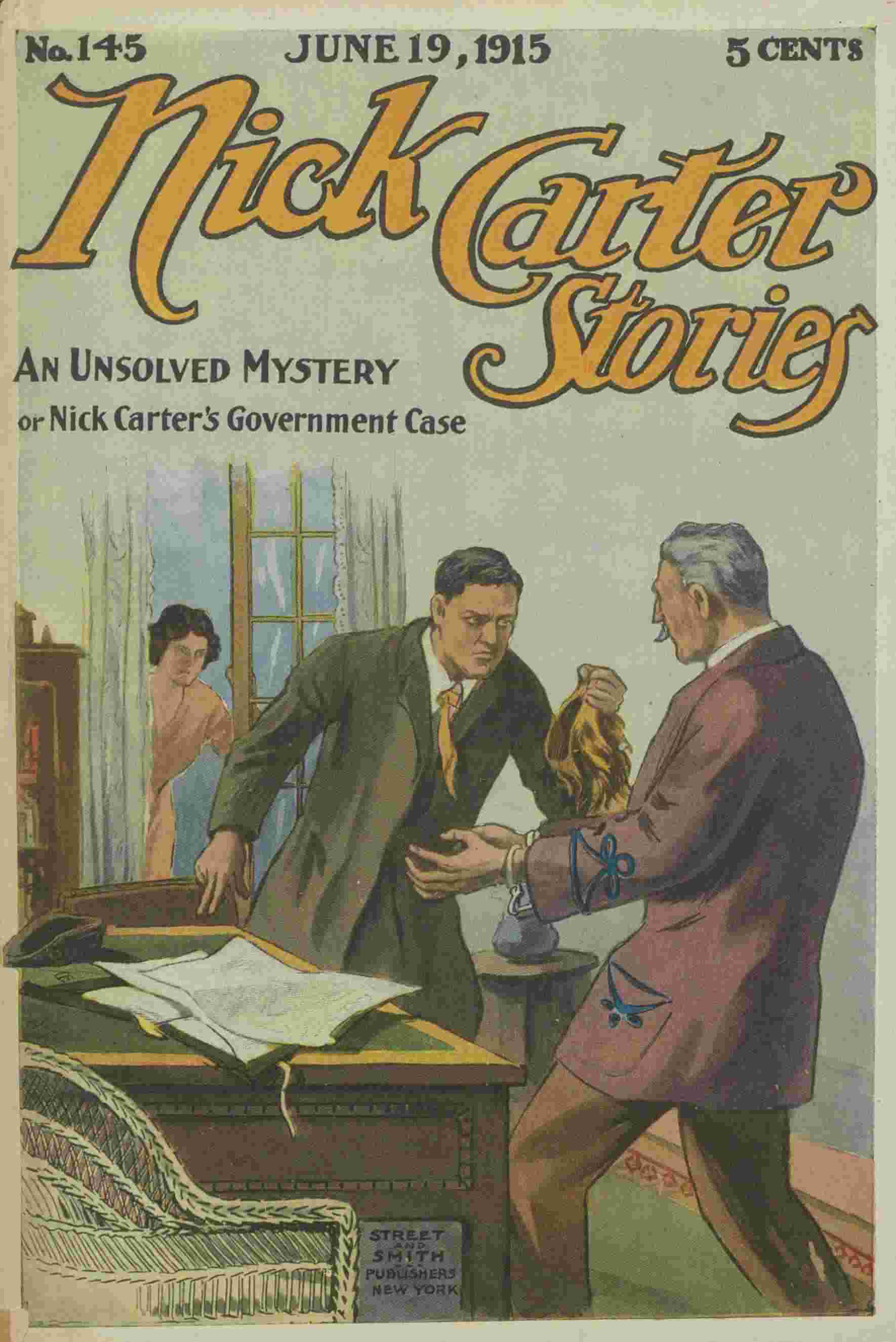
CHAPTER VI.
NICK SHOWS HIS HAND.
It was after eleven o’clock when Nick Carter, in immaculate evening dress, sauntered alone into the fashionable restaurant. He had found certain persons whom he had been seeking, more of them than he had been expecting to find. He had discovered them in a box at the opera, and had followed them in a taxicab after the curtain had fallen upon Leonora’s tragic death.
The scene over which Nick cast a seemingly indifferent eye was a brilliant one. The glare of light, the throng of well-dressed men, of beautiful women in gorgeous attire and radiant with jewels, the clink of fragile glasses, the rippling laughter of pretty girls, the murmur of cultivated voices, all mingled with the fascinating strains of orchestral music—Nick Carter took it all in with a few swift glances while the head waiter approached to conduct him to a seat.
“There is a vacant table near that at which Senator Barclay and his friends are seated,” Nick quietly remarked, deftly slipping a generous tip into the waiter’s hand.
The crisp bank note was felt and properly appreciated.
“Certainly, sir. This way, sir.”
“Forget that I suggested it,” Nick added.
“My mind is a blank, sir.”
“A waiter who knows his business,” thought Nick.
He followed him to a small table near one of the lace-draped windows.
At a large one in an alcove scarce ten feet away seven persons were seated. They included Senator Barclay and his daughter Estella, a handsome brunette in the twenties, who with her father appeared to be entertaining the others.
A well-built, distinguished-looking man, attractive aside from a habitual sinister squint, was seated next to Miss{21} Barclay. He was close upon fifty and his hair was streaked with gray. There was a bruise on his brow, partly hidden by a treatment of paint and powder. He was the victim of the recent assault by unknown thugs—Captain Casper Dillon.
Next to him sat a massive, powerful man, with a large head and a profuse growth of tawny hair and beard, giving him a leonine aspect. Obviously, he was a foreigner, as was a corpulent, showily dressed woman seated opposite.
Another was the government engineer, Garland, looking drawn and white, in spite of his efforts to appear congenial; while next to him was seated a slender, graceful woman of almost dazzling beauty and brilliancy, her sinuous figure ravishingly clad and her abundance of auburn hair fairly ablaze with costly gems.
“H’m, just so,” thought Nick, furtively gazing. “Verona Warren, eh? Wonderful eyes, an irresistible smile, a mouth like a rosebud, and a matchless complexion—but not all her own. She is a skillful woman who, at thirty-five, can strip off enough years to appear like a debutante. Lost his head to Madame Irma Valaska, eh? I thought I might be right—and now I know it.”
Ten minutes passed.
None of the group in the alcove had an eye for the solitary man seated near one of the windows, apparently absorbed in his wine and lunch. Only one among them would have recognized him. Not Garland, however, for Garland had seen him only in disguise that afternoon.
Nick could occasionally catch a few words uttered more vivaciously than others, but none were of special significance. He saw Stella Barclay frowning at times upon Garland, however, and finally heard her inquire:
“What on earth, Harry, has come over you? You’re as dumb as an oyster, and dreadfully white.”
“Pardon!” Garland exclaimed, brightening quickly. “I did not realize it, Miss Barclay.”
“I have noticed it all evening. You are not ill, are you?”
“No, indeed.”
“Miss Barclay is right,” said Captain Dillon, with a squint from one to the other. “I have noticed it. One would think, Garland, that you have lost your best friend.”
“My best friend is here,” smiled Garland, glancing at the woman beside him. “I have not lost her, I hope”.
She laid her hand on his and bent nearer to him.
The others laughed and Captain Dillon gazed, turning slightly from his companions, for the first time on face of the detective. He started perceptibly and lost color for a moment.
Nick pretended to see him at the same moment. He bowed and smiled, touching his lips with one finger at the same time, and glancing significantly at the chair opposite his own.
Captain Dillon nodded slightly, and a few moments later he excused himself, remarking to his companions:
“There is an old friend of mine. I want just a word with him.”
They glanced at Nick, but none knew him by sight, and the incident was entirely conventional.
Captain Dillon took the opposite chair and extended his hand, which Nick pressed cordially while remarking:
“I thought I remembered you, Captain Dillon, and I made haste to put you on your guard when I saw that{22} you recognized me. I am here incognito. I don’t wish to be known. Pray don’t expose me to your friends.”
“Certainly not!” Dillon quietly exclaimed, squinting at Nick over the table. “I’m very glad you warned me, or I certainly would have done so.”
“I foresaw it, captain,” smiled Nick. “You have not changed much in the several years since we met. You hold your own like an old war horse. I am pleased to meet you again.”
“That feeling is reciprocated, Mr. Carter, I assure you,” Captain Dillon said quietly. “How long have you been in Washington?”
“Not long,” said Nick. “I am here on important business. I cannot tell when I may leave. That depends.”
“Upon the business mentioned, of course,” said Dillon, with an expression between a smirk and a smile.
“Exactly,” bowed the detective.
“Government business, I suppose.”
“Yes.”
“Secret business, or——”
“Well, in a way,” said Nick, when the other paused with an inquiring squint. “It relates to the theft of some important documents.”
“I see,” Captain Dillon nodded, with steadfast scrutiny. “Diplomatic correspondence, perhaps, or——”
“No, not exactly,” smiled Nick. “They are, in fact, of a very different character. I am not at liberty to inform you precisely, however, as you may infer.”
“Yes, certainly,” Dillon readily allowed. “But did you expect to find them here, or——”
“Well, no, not quite that,” Nick again replied agreeably, as if oblivious to the other’s insinuating manner. “That would be too much to have expected. I am inclined to distrust a certain person who now is at supper, here, however, and I’m keeping an eye on him.”
“Ah, I see.”
“But do not imagine, Captain Dillon, because I am seated so near your table, that he is in your party,” Nick added, in jesting fashion.
Captain Dillon laughed softly and shrugged his shoulders.
“I should hope not,” he replied, with a deprecatory gesture. “All of my party are above suspicion. You know Senator Barclay by sight, of course, and the dark-haired girl is his daughter. That tall, fine-looking chap is Captain Garland, a government engineer in the war department. I really must rejoin them now. Here is my card. If you remain long in town and find it convenient, call and see me. I would be delighted.”
“I will try to do so,” said Nick, a bit dryly. “I am at the Willard. Drop in and inquire for Mr. Arthur Greenleaf.”
Captain Dillon laughed and promised to do so, then bowed and rejoined his friends.
“A rat, if there ever was one,” thought Nick. “No need to tell him more definitely what business brought me here. He will infer that I suspect Garland of having stolen the plans, however, and that will throw him off his guard. He will feel dead sure, too, that I do not suspect him, or I would not have confided in him. No sane man could reason otherwise.”
Nick left the restaurant before Senator Barclay and his party, but he did not go far. He waited outside in disguise, one easily and quickly adjusted, until the suspects emerged. He saw the hairy foreigner, in company{23} with the corpulent woman and the said Verona Warren, part from the others and ride away in a limousine.
Senator Barclay and his daughter left in another, after shaking hands with Garland and Captain Dillon, who then hailed a taxicab and rode away together.
Nick had one waiting near by, to which he hastened and gave the driver his instructions.
“To the Grayling, Vermont Avenue. Drop me there as quickly as possible.”
Ten minutes served to turn the trick.
Nick waited in the doorway of an opposite dwelling. His watch said one o’clock when Garland put in an appearance. He came on foot, walking slowly, staggering at times as if drunk. Nick had noticed, however, that the young man drank nothing in the restaurant. He crossed over and intercepted him at his door.
“You return late, Garland,” said he. “I have been waiting for you.”
Garland stared at him with feverish eyes, as white as a sheet, with that terrible expression of anguish and anxiety on his drawn features that Nick had noticed in the afternoon.
“Beg pardon!” he muttered, pulling himself together. “I don’t think I know you.”
“Yes, you do,” said Nick. “We met this afternoon in Welden’s office. I am Nick Carter.”
“Oh, good heavens!” Garland seized the detective’s arm. “Welden said I would not have known you. Tell me—do you bring me good news? You have been waiting for me. You must, then, have learned something.”
“Invite me in,” Nick replied. “There will be time enough for me to tell you.”
“Pardon! Certainly,” Garland said, fishing out his keys. “I’m so frightfully upset that I scarce know what I’m doing. I started for home in a taxi, but couldn’t remain in it. I was so infernally nervous. I wanted to walk—walk—walk. I shall go stark mad, Carter, unless those plans are recovered. Come up to my room.”
Nick followed him to a handsomely furnished double room on the second floor.
Garland switched on the lights, throwing off his hat and inverness, and then placing cigars and cigarettes on the table.
“Help yourself, Mr. Carter, but don’t keep me in suspense,” he pleaded. “What have you learned?”
Nick did not hurry. He settled back in an armchair, lighting a cigar, and inquired:
“Where have you been?”
“To the opera.” Garland swung round from the roller shades he had lowered. “God above! isn’t it ghastly! Think of it! To the opera—with a heart of lead and blood like ice in one’s veins. But I had to go, have to keep up appearances, or the truth might leak out. On the dead, Carter, I think I am booked for the bug house. Do tell me what you have——”
“Patience,” Nick interrupted. “Sit down and be calm. When I talk with a man I want him to have a level head on his shoulders. That’s right; light a cigarette. It will steady you—temporarily. Where did you go after the opera?”
“To supper with a party of friends.”
“Including whom?”
“Senator Barclay and his daughter, the Baron Esterveldt and his wife, with Miss Warren, whom I mentioned to you this afternoon. Captain Casper Dillon, an ex-army{24} officer, joined us in our box and accompanied us to supper. He is a friend of the Esterveldts.”
“Captain Dillon,” Nick observed, blowing a wreath of smoke toward the ceiling. “Ex-army officer, did you say?”
“Yes.”
“Are you well acquainted with him?”
“Quite well. I meet him frequently at the home of the Esterveldts, when I go there to see Miss Warren. She is their niece, you know, and Captain Dillon is an intimate friend of the family.”
“Miss Warren is their niece?”
“Yes.”
“How did that happen? Hers is an English name.”
“Her father was an English naval officer.”
“Ah!”
“He married a sister of the Baron Esterveldt. Both have been dead for several years, and Verona since has lived with the Esterveldts.”
“H’m, I see.”
“They have an extensive estate in Bohemia and a residence in Berlin. They have been in Washington nearly a year, however, for Verona is very fond of America and of Miss Barclay. They met abroad more than a year ago and became very friendly. The Baron Esterveldt entertained the Barclays at that time, and Senator Barclay is now doing all in his power to return the compliment.”
“Naturally,” said Nick oddly.
“It was through him that I met Miss Warren and—well, I fell over head and ears in love with her.” Garland enthused for a moment. “She’s a wonderful girl, Carter, a marvel of beauty, wit, and brilliancy. You ought to meet her. To see her is to worship her. She’s the most fascinating girl——”
“Where do the Esterveldts reside?” Nick interposed.
“They rent a fine place near the Dupont Circle, that of the late General Dexter.”
Nick mentally noted the location, then said a bit bluntly, throwing his half-smoked cigar into a cuspidor:
“That, I infer, is all you know about these people?”
Garland stared at him.
“Know about them?” said he. “What more need one know? Why do you speak like that? Why have you delayed to question me about them? Tell me, Carter, I implore you, what have you learned about——”
Nick checked him with a gesture.
“I have learned enough, Garland, to convince me that I am justified in what I am about to say,” he replied impressively. “It is going to hurt you. It is going to stab you in a tender spot, but it will be for your own good, and I have no alternative but to say it. Your honor is at stake, Garland, and the integrity of a United States senator is in jeopardy.”
Garland lurched forward in his chair.
“Good God!” he gasped hoarsely. “What do you mean, Carter? What do you mean?”
“Did you see Captain Dillon talk with a man at another table this evening?”
“Yes, of course.”
“Did you see the man?”
“Certainly.”
“Could you identify him if you were to see him again?”
“Yes, yes, surely! But why——”
“Have a look.”
Nick removed his disguise and thrust it into his pocket.{25}
Garland swayed unsteadily, staring with wide, dilated eyes and twitching lips. He did not speak for a moment. He seemed to be trying to grasp the situation, to take in the full significance of what Nick had said, and evidently had done. He made a desperate effort to steady himself, clenching his hands till the nails ate into the palms.
Then, suddenly, he hurled his cigarette into the fireplace and spoke with a sort of fierce composure, as a man might who had clutched his heart with his hand and held it with an iron grip.
“I have heard that you are a man of many faces,” said he. “I now can believe it. I know, too, that you are one man in a million, that you are above dramatic claptraps and needless subterfuge. I’m nerved for whatever you may say to me. Come across with it.”
“Good for you,” said Nick approvingly. “You’re a big man, Garland, big in more ways than one, and a splendid future awaits you. You are so big, in fact, like other men I have known, that you are blind to the servile treachery and dirty trickery of which some are capable, both being so foreign to you. That is one reason why big men are sometimes easily made the dupes of the others.”
“Dupes?”
“I heard you say to-night, Garland, that you hoped you had not lost your best friend.”
“Best—best friend! You don’t mean—you don’t mean——”
Garland choked and loosened the collar on his throbbing neck.
“I mean the woman you know as Verona Warren,” said Nick. “I am going to take her away from you—for your own good.”
“You mean——”
“I mean that her name is not Verona Warren,” Nick went on impressively. “I saw her in St. Petersburg three years ago, while engaged on a case for this government. She did not see me, or know of my presence there, but I learned all about her. She then was a spy in the Russian secret service, one of their cleverest, bar none. Her name is Irma Valaska. She is the widow of a Russian soldier who was killed in Korea. Two years ago she failed in a mission intrusted to her, and she fled from Russia. She then entered the secret service of one of the Balkan states. I don’t know just what European power she now is serving, but I do know——”
Nick leaned forward and spoke with redoubled earnestness.
“I do know that she is here as a spy for some foreign power, or powers; that her secret mission is to get information concerning our coast-line fortifications and defense. I know that she, with them to whom she pretends to be related, this Baron Esterveldt and his wife, have made you and Senator Barclay their dupes, and that the theft of your portfolio and the government plans was the work of this woman, as base, treacherous, and——”
“Stop! I cannot believe——”
“You stop!” Nick forcibly interrupted. “Do I need to say, Garland, that I would not tell you this if I were not absolutely sure of it? I am absolutely sure. Listen to me. I will tell you something more.”
Garland obeyed and listened, not once interrupting. He looked like a man turned to stone.{26}
Nick told him from beginning to end what he had learned since talking with Chief Welden, also much that he had done and suspected.
It brought home the truth to his hearer. It opened his eyes to the treachery of which he had been the victim. It turned to dead ashes the love that had made it possible. He covered his ghastly face with his hands, sobbing convulsively for several moments, and then he met the blow man fashion.
“My God, it is terrible, terrible!” he said hoarsely, gazing again at Nick. “You have forced me to believe, to realize, but—oh, this woman!”
“She has deceived abler men than you, Garland,” said Nick kindly. “You must tear her out of your heart.”
“Must—I have!” said Garland, with sudden vehemence. “There is no alternative.”
“As a matter of fact, Garland, this conspiracy dates back more than a year,” Nick said confidently. “It began with the Baron Esterveldt’s hospitality to the Barclays when they were abroad. It was framed up at that time and the way paved for what since has occurred. Captain Dillon had a hand in it as long ago as that, for I since have learned that he then was in Europe.”
“You must be right, Carter,” Garland said, more calmly. “I now see it plainly. My honor is at stake, as you said, and the integrity of Senator Barclay. What’s to be done?”
“You can do nothing,” Nick replied. “The recovery of those plans before any advantage can be derived from them is my work.”
“But is it possible?”
“I must make it possible. You, Garland, must do what I direct.”
“I will. But what?”
“I want you where I can reach you quickly, if necessary,” said Nick. “I also think it wise for you to disappear temporarily. I may be able to turn that to some advantage. I am stopping at the Willard. Leave here to-morrow morning and register there in this disguise under the name of John Black. Get a room on the third floor, if possible, on which I am located.”
“I will do so,” said Garland, taking the disguise.
“I am registered as Arthur Greenleaf,” Nick added. “Two of my assistants are in same suite. Don’t seek me, however, nor make any inquiries. Merely lie low and wait till I come to you. Do you understand?”
“Perfectly,” said Garland. “I will follow your instructions to the letter.”
“Very good,” Nick replied. “Where is the dummy portfolio and the papers it contained?”
“Here, in my safe.”
“Just as you found it when you arrived home last Friday evening?”
“Yes.”
“Let me have it,” said Nick. “I think I can make use of it.”
Garland hastened to get it.
Nick examined it for a moment, then arose and extended his hand.
“That’s all for to-night, Garland,” said he. “Keep a stiff upper lip. There will be something doing to-morrow.{27}”
CHAPTER VII.
INTO A TRAP.
“Andy Margate is the man we must get. He is the rascal who now has the government plans. Andy Margate is the man we must get—and lose no time in getting him.”
These forcible declarations came from Nick Carter soon after eight o’clock on the morning following his impressive interview with Harold Garland. They were addressed to Chick and Patsy, then in their suite in the Willard immediately after breakfast.
“But how to get him is the question,” Chick replied. “Patsy and I have searched every inch of advertising space in every newspaper, but we could find absolutely nothing that seems to relate to the stolen plans.”
“Which denotes very plainly to me, Chick, that Margate has not yet begun negotiations to dispose of them, neither with the original thieves, nor with any government official,” said Nick.
“That’s reasonable, of course.”
“Naturally, too, Garland is the man with whom he would most likely have communicated,” Nick added. “He has not done so, which further convinces me that I am right. Margate and his confederates are waiting for some move or publication by the government, and to see where they can get in their work to the best advantage.”
“It does look so, Nick, I’ll admit,” Chick allowed.
“We must get them, therefore, before they can accomplish anything more serious.”
“But how?”
“I have opened the way,” said Nick. “Carney will be liberated this morning. If my theory is correct, he will hasten to rejoin Margate and the other scamp who assaulted Dillon.”
“Gee! that looks like a copper-riveted cinch,” said Patsy. “Carney can be shadowed and the others located.”
“That is precisely what I want you to do, Patsy,” Nick replied. “Go to the courthouse in disguise and pick him up when he leaves. Keep an eye on him till you have found the others, and then report to me as quickly as possible.”
“Trust me for that, chief,” said Patsy, hastening to make ready.
“In the meantime, Chick, you begin an espionage on the Esterveldt place,” Nick directed. “I suspect that Margate knows of Dillon’s intimacy with them, and if he knows the occasion of it, he may attempt to covertly communicate with them. The Baron Esterveldt undoubtedly is the big finger in the service of the foreign power guilty of this conspiracy. He is the one who is providing the money, a fact that Margate may have discovered.”
“I agree with you,” said Chick. “That would be the natural quarter for the rascal to turn. I’ll have an eye on the place within half an hour.”
“Very good.”
“What are your own plans?”
“I’m going after Captain Casper Dillon,” said Nick, with ominous intonation. “I have opened the way to that, also. I propose to clinch my suspicions without further delay. I want that miscreant traitor at the outset, and I’m going to get him.”
“That’s the stuff, chief,” cried Patsy. “He ought to be nailed right off the reel.”
“He’ll be nailed, Patsy, all right,” Nick grimly answered.{28}
There was the usual gathering of spectators in the municipal court that morning. Some persons have a morbid interest in watching the wheels of justice revolve, in viewing culprits vainly squirming to slip through the meshes of the legal net, and to witness their condemnation to righteous punishment.
Among them that morning was a sinister-looking fellow in a baggy brown suit and woolen shirt, who would really have looked more in place in the prisoner’s dock than in one of the chairs allotted to spectators.
He had no interest in the proceedings, nevertheless, until the case of Thomas Carney was called and that worthy put in an appearance—a stocky, dark man of thirty, wearing a scowl evincing his resentment of his long detention in custody.
Much to his surprise, no doubt, as well as that of his lawyer, the court was favorably impressed with the argument of his attorney, and decided there were no grounds for longer holding the prisoner, and Mr. Thomas Carney was forthwith discharged.
Patsy Garvan, the spectator in baggy brown, then had disappeared from the courtroom. He was watching from across the street the door from which Carney would emerge, and he had not long to wait.
Carney came out with his lawyer, with whom he shook hands before they parted. He then hurried through Sixth Street, bringing up in a few minutes near Center Market, where he was met by a seedy fellow who emerged from the market, and who evidently said a few words to him while passing.
Patsy was not near enough to hear him, however, though he detected the fact and came to a quick conclusion.
“That fellow was waiting for him and gave him instructions from some one,” he said to himself. “It has started him in a new direction. It’s money to marbles that he was directed where to meet Margate.”
Patsy was right to that extent.
Carney appeared, however, to have no thought that he might be followed, which made it perfectly easy for Patsy to shadow him.
Pausing only once in a barroom, where he gulped a stiff drink of whisky, Carney shaped a course that took him into one of the lowest parts of the city, where he brought up at an inferior wooden house adjoining a narrow court making in next to the bare back wall of a brewery.
Sauntering by the court, into which Carney had quickly disappeared, Patsy saw that a diverging alley led to the back of the house, beyond which was a motley collection of old buildings, at none of the windows of which he could discover any person.
“I’ll take a chance in the alley,” he said to himself, noting that the narrow court was deserted. “The rascal evidently has entered the back door of the house. I must find out for what, or who’s there, at least. It may be where the rascal lives.”
Turning back, having come to that decision, Patsy stole into the court, crouching below the side windows of the house, the curtains of which were lowered. Then hugging the board fence of a small rear yard, he crept to the entrance of the alley, into which he cautiously peered.
Despite his caution, however, this move was a fatal one. His head no sooner protruded beyond the corner of the fence, than an uplifted bludgeon fell as quick as{29} a flash, catching him squarely on the skull and sending him to the ground as if felled with an ax.
Three men, including Carney, quickly leaped upon him, one instantly winding a thick scarf around his head; and before Patsy had even begun to recover from the stunning blow, he was caught up bodily and carried through the back door of the house, which one of the ruffians hurriedly closed and locked.
A dash of cold water brought Patsy to himself, so completely to himself, in fact, that he realized what had occurred before he betrayed that he was reviving; and instantly resolved to hide that fact until he could learn, or stealthily draw his revolver and hold up his captors.
The last ambitious move was nipped in the bud by a sharp command from one of them—a wiry, muscular fellow in the twenties, whose right hand had struck Patsy to the ground.
“Cut out that water, Tom,” he cried, addressing Carney, who had dashed the water upon Patsy after they had dropped him on the kitchen floor. “This isn’t a bathhouse. Turn him over first and be sure we are right. See whether he carries a gun and bracelets. Those would clinch it.”
“I know I’m right,” said another, with a voice so cold and keen that it fairly cut into Patsy’s ears. “You’ll find both gun and bracelets. Put the irons on him, hands behind him, and make sure they are tightly locked. There will be time enough to revive him.”
“That’s no pipe dream, Andy,” said the other, while he hastened to assist Carney.
They had turned Patsy face downward while speaking, both crouching over him, and he knew that any attempt to resist them would result only in additional rough usage and do no earthly good. The mention of Margate’s name, however, had told him into whose hands he had fallen, and their remarks indicated plainly enough that he had walked into a trap.
“I thought you had killed him, Larry, mebbe,” growled Carney. “I wanted to make sure you hadn’t. I’m not running my neck into a rope.”
“Rope be hanged!” snapped the other, subsequently learned to be one Laurence Trent, and by far the worst crook of the two. “Ah, I thought so. Here they are, Andy.”
Patsy felt his two revolvers jerked from his pockets, and then the chill of the handcuffs around his wrists, locked with a pressure that nearly stopped the circulation. He still pretended to be unconscious, nevertheless, bent upon learning more and biding his time for a counter-move.
“I knew you would find them,” said Margate. “I’ve known from the first, Larry, that I must be right.”
“These prove it, Andy.”
“As for your running your neck into a rope, Carney, you’re no good at running,” said Margate, coldly addressing the other. “Otherwise, you would have worked your legs fast enough to keep out of limbo. You’ve come near making a mess of a good thing.”
“I’m sorry, Andy, on my word,” replied Carney. “But I slipped in starting, and that put me behind. I hope I have not queered it.”
“I never let a job of mine be queered,” Margate said, with sinister assurance. “I can see my way clear, all right, but we must get in our work more quickly than if these infernal sleuths had not turned up.{30}”
“Who d’ye think is on the case?” growled Trent, who had been making Patsy doubly secure with a cord around his elbows.
“I dunno,” said Carney, turning to him. “Who?”
“Nick Carter.”
“The devil he is!” Carney gasped, staring.
“Leastwise, Andy saw him in Hardy’s office yesterday afternoon, and he reckoned——”
“Never mind what I reckoned, Larry, just now,” Margate interrupted. “Sit this whelp against the wall and chuck some more water on him. We must find out just what Carter knows, or suspects, and what he has done. He knew me, all right, or this blooming idiot would not be here. We’ll find out what more he can tell us.”
“You’ll get fat and juicy on that,” thought Patsy, intensely disgusted with the unfortunate turn of affairs. “There’ll be nothing in denying my identity, for that cold-blooded guy is right. But if he gets anything more out of me, he’ll do it with a corkscrew.”
Another splash of cold water broke Patsy’s train of thought, indulged in while the two lesser rascals sat him against one of the kitchen walls. He did not want it repeated. He opened his eyes, therefore, and said curtly, gazing from one to the other:
“Cut that! I’m not on a water diet. What do you ginks take me for?”
“Great guns! He’s a long ways from dead,” growled Carney.
Larry Trent laughed loudly.
But Margate waved both of them aside, taking a chair directly opposite the detective and coldly eyeing him.
“We know for what we have taken you,” he said icily. “We know who you are, too.”
“Well, you’ve got nothing on me, Mr. Margate, as far as that goes,” Patsy coolly retorted.
“Ah, you admit that you know me, then!”
“That’s what. You are pretty well known and widely mugged in two countries.”
“I see,” Margate drawled, with a sneer. “I was right. Carter did recognize me. He has told you about me.”
“I didn’t need much telling,” Patsy said dryly, in no mood to hide his feelings.
“Nor did I,” retorted Margate. “I suspected the trick he might attempt to turn, and you found us ready for you.”
“Yes, I’m wise to that, now, without being told.”
“And you’re going put me wise to something.”
“Am I?”
“Exactly.”
“Well, I guess I could put you wise to some few things you don’t know,” Patsy dryly allowed.
“That’s just what I want,” said Margate, with a threatening nod. “What case is Carter on in Washington?”
“Give it up,” said Patsy. “You’ll have to ask him.”
“Does that mean that you’ll not inform me?”
“Take it any old way you like.”
“I’ll find a way to make you.”
“You bet we will,” snarled Trent, seizing a poker and starting to thrust it into the stove. “A red-hot iron will open your mouth. That’s what you’ll get, too, unless——”
“Keep quiet, Larry,” interrupted Margate, thrusting him aside. “There’ll be time enough for that. I’ll get the truth from him while you are gone.”
“Gone where?{31}”
“We must not let Carter head off our game, now that we’re dead sure that he is on to Carney and the trick we served Dillon,” Margate forcibly explained. “He may be wise to even more than that, and we must warn Dillon and Esterveldt of their danger. We must put them on their guard against Carter, at least, until we can land them and get the blunt for the picture book. Better a small loaf than no loaf at all, now that Carter is butting into this game.”
“But he——”
“There’s nothing else to it, Larry, and we must lose no time,” Margate said, interrupting. “Come out here, both of you, and take my instructions. We shall be left on the rocks, stranded like three old hulks, if Carter gets in his work ahead of us. Come into the entry and take my instructions.”
There was a mingling of quiet energy and threatening determination in this man that told plainly enough that he would brook no opposition, nor did either of his confederates offer any. They followed him into the dim basement entry, where for several minutes the three knaves held a whispered discussion.
Patsy saw plainly that Margate was much the most capable and dangerous of the three. No less keen a knave would have suspected Nick’s ruse and laid such a trap for him, or an assistant. Patsy writhed inwardly under the turn of affairs, but was forced to admit that he was powerless for the moment, at least.
Listening intently, he could hear only the faint, earnest whispers of the men in the entry. These were presently followed by the hurried steps of Trent and Carney, when both ran up the stairs and quickly left the house.
Margate returned to the kitchen and resumed his seat. He drew a revolver and shifted it to the side pocket of his fashionable sack coat. He eyed Patsy in silence for several moments, with his thin lips curled with a sneer, and he then said deliberately, with ominous quietude:
“Now, young man, I’ll see whether you’ll become communicative. We’ll talk this over without interruptions.”
“That’s good enough for me,” Patsy coolly asserted. “I’m right here to do my share of the talking—if the subject suits me.”
CHAPTER VIII.
CAPTAIN DILLON’S VISITOR.
It was about half past ten when Patsy Garvan heard Carney and Larry Trent hurry out of the house in which he found himself effectively trapped.
Less than half an hour later a rather roughly clad man with bearded face and rounded shoulders, a face and figure denoting that he was well along in years, passed the Carnegie Library and crossed Vernon Square, and a few minutes later fell to sizing up an apartment house in a neighboring street.
It was one of those attractive places of the kind with which Washington abounded, a double rise of flats entered from a neatly trimmed front yard, with well-shaded grounds on either side of the ivy-grown brick edifice.
The ground-floor flat on one side was occupied by a solitary and exclusive tenant, the ex-army officer, Captain Casper Dillon. He kept no servants and had very few visitors. He was lounging in his library, clad in a smoking jacket and absorbed in the morning newspapers, when his bell rang.{32}
He glanced through the partly open French window, which overlooked the side grounds and a walk leading around to the rear door. He could not see who was in the front vestibule.
He arose, pausing for a moment, and then took a revolver from the table drawer and slipped it into his hip pocket.
Striding through the hall, he opened the front door and gazed a bit sharply at his caller—the bearded man with rounded shoulders.
“Well, sir?” he said shortly.
“I’m sent here to see Captain Dillon, sir,” said the visitor, with subdued and husky voice. “Is he at home this morning?”
“He is seldom at home to strangers,” Captain Dillon replied, with sharper scrutiny. “What is your business?”
“I’m sent to tell only him, sir, no one else,” was the reply. “Here is my card, sir—Michael Rohan, sir. If he is at home, would you say this much to him: It’s about what happened a few nights back. That’s all I can say, sir.”
Captain Dillon’s brows knit closer, but his searching scrutiny had proved ineffective. His visitor’s respectful air, his manifest humility, his evident aim to follow instructions that had been given him—these so plainly denoted that he was acting for others and had no aggressive intentions, that Captain Dillon was completely deceived.
“You may come in, my man,” he said curtly, stepping back to admit him and then closing the door. “Come into the library. I will hear what you have to say.”
Rohan followed him, removing his cap and gingerly taking a chair to which the ex-army officer pointed, one near a cloth-topped library table in the middle of the room. He laid his cap on it, and appeared to feel out of his element amid such superior surroundings.
Captain Dillon noticed it, and his frown relaxed. He sat down at the opposite side of the table, gazing across it and saying:
“Your name is Rohan, is it?”
“Yes, sir. Michael Rohan, sir,” said he huskily.
“Who sent you here?”
“I’m to see Captain Dillon, sir; no one else. If——”
“I am Captain Dillon.”
“Oh, is that so, sir?” Rohan asked, gazing. “I ought to have known it, mebbe. Who else is here, sir?”
“Nobody,” Captain Dillon said curtly. “I live alone in this flat. Come to the point, my man. What do you want of me?”
“I’m not after wanting anything, sir,” replied Rohan, drawing nearer the table. “It’s them that sent me.”
“Who are they? Why did they send you?”
“I’m not to mention any names, sir. I’m sent here only to tell you what they want—and to find out what you are willing to give up for it.”
Captain Dillon turned wary. He was not a man to be easily led into a trap. He frowned again, saying a bit sternly:
“You must be more explicit, Mr. Rohan. I’m not good at guessing riddles. I don’t know at what you’re driving.”
“You don’t, eh?” Rohan’s eyes took on a curious leer.
“I certainly do not,” Dillon insisted.
“You was beat up a few nights back, wasn’t you?”
“Yes, by two cowardly thugs.”
“Three, sir, was the number,” said Rohan. “But that don’t matter. You lost something, didn’t you?{33}”
“A small quantity of blood—nothing more.”
Rohan spread his arms on the table and lurched a little nearer.
“Tell that to the marines, sir,” said he, with a sinister nod. “You know what I mean, sir, and I know you know it. You’d better meet me halfway, too, Captain Dillon, or I might as well take myself out the way I came in. You’ve nothing to fear from me, sir, and I don’t fear you. I wasn’t one of the three, and I can prove it—but I came from them. If there is nothing doing, sir, I’ll go back and tell them so.”
Michael Rohan appeared about to do so, in fact, but Dillon checked him with a gesture.
“Stop a moment,” said he. “What do your rascally friends want?”
“Money,” said Rohan shortly.
“For what?”
“For what you lost that night.”
“How much money?”
“All that you’ll give. That’s what I’m to find out.”
“But I don’t know you, Rohan, from a side of leather,” Captain Dillon said, with a growl. “What evidence have I that you were sent by those three scoundrels? I’m not buying a cat in a bag, nor dealing with any known agent. You may, for all I know, be a detective in disguise.”
Rohan shrugged his rounded shoulders and grinned derisively.
“There’s nothing in that, sir,” said he. “I can give you proof enough.”
Captain Dillon’s squinted eyes took on a gleam of eagerness.
“What proof?” he demanded.
“You’re alone here, you say?” Rohan glanced around again toward the hall and bedrooms.
“Yes, on my word,” Dillon earnestly declared.
“Got a gun on you? Stand up, sir, and lift your jacket.”
“I have one,” Dillon admitted.
“Lock it in a drawer,” said Rohan. “Mind you, sir, I’m not to be held up, and I’m not to hold any one up. I only want a square deal.”
Dillon placed the revolver in a drawer, turning the key and tossing it upon the table. That he anticipated what the proof was to be, despite his pretended ignorance, was betrayed by the eager light in his narrow eyes.
“Now, Mr. Rohan, come to the point,” said he, settling back in his chair. “Where are your credentials? What proof have you?”
“Proof enough, sir,” said Rohan. “The thing you lost.”
“Have you brought it here?”
“I have, sir.”
“Let me see it.”
Rohan arose and thrust his hands up under the back of his coat. The hump between his shoulders disappeared. He drew out a black leather portfolio and placed it on the table.
“There ’tis, sir,” said he; then added quickly: “But don’t get gay. I’m to take it back when I go, and I’m going to do it. I’ve got a gun, sir, and——”
“Enough of that,” Dillon interrupted, eyes glowing. “You’ll need no gun, Rohan, if that portfolio contains what I hope. I will pay any price for them that you rascals can reasonably ask. But I must see them—must be convinced.{34}”
Rohan snapped the two buckles that secured the folded flap of the portfolio.
He thrust in his hand and drew out, not blank papers, which the dummy portfolio had contained—but a quantity of genuine government plans.
“Have a look, sir,” he said indifferently. “It’s up to you.”
An irrepressible cry of exultation broke from Dillon. He lurched forward to the table, quivering with eagerness and excitement, and with both hands outstretched to seize the plans and examine them.
Rohan’s hands fell at the same moment. As quick as a flash, in the hundredth part of a second, he snapped handcuffs on the wrists of the recreant army officer. Then he arose, sweeping off his disguise and saying sternly:
“Let the plans lie there, Captain Dillon.”
“Oh, my God!” Dillon fell back with a terrible cry. “Nick Carter!”
“Yes. Let them lie. I had Mr. Garland get them for me from his department this morning. They are not the plans you stole and lost, but they have served my purpose. You are under arrest, Captain Dillon, as a traitor to your country and a conspirator with foreign spies.”
Captain Dillon had collapsed as if his last ounce of strength had left him—his last drop of blood, in fact, for he looked like a corpse in the great armchair into which he had fallen. He did not speak, could not have spoken; but an interruption, a most unexpected one, came from another.
The stern words scarce had left the lips of the detective, when, through the partly open French window, entering with the swift stealthy and sinuous movements of a leopard, Irma Valaska darted into the room.
Her face was ghastly, her lips gray and drawn, her eyes ablaze as if all that was devilish in her nature was concentrated in their fiery depths.
Nick Carter did not see her until, hearing her fierce, sibilant voice, he swung round and found himself gazing into the deadly muzzle of a leveled revolver.
“You’re wrong! He’s not under arrest!” Irma Valaska cried, with terrible intensity. “Throw up your hands, Nick Carter. Up with them—or there’ll be a corpse where you are standing.”
Nick did not pause for an instant. No sane man looking into her drawn, determined face, would have ignored the murderous light in the woman’s eyes.
Nick fell back a step and threw up his hands.
Irma Valaska came nearer to him. Plainly enough, she feared him no more than a wild cat fears a rabbit.
“Don’t drop them!” she cried, between her teeth. “I’ll fire if you lower them an inch. You devil of a Carter! You would foil my designs, eh? Oh, I know you—I know you! I know all. You move foot or finger, and I will kill you.”
“You look quite capable of it,” said Nick calmly.
“I am!” she cried. “I would rather than not. But there will be time for that—time for that! Move quickly, Casper, while I keep him covered. Get your revolver. Cover him while I get his weapons and keys. I’ll have those things off your wrists. The baron is coming. He will aid us. We shall fool this devil Carter, and spit in his face. Be quick, Casper, be quick!”
There was no need whatever for so vehement a bid{35}ding. Dillon had seized upon life anew the instant he saw her and the complete change in the situation. He caught up the key from his table and opened the drawer in which he had placed his revolver. He had it in his hand and was on his feet, white and vengeful, before Irma Valaska had ceased speaking.
In view of the several irons he had in the fire, and the value he placed on a whole skin, Nick Carter did not think it worth while to invite so ready a bullet by attempting any absurdly desperate move.
Smiling indifferently, he permitted Irma Valaska to hold the ribbons for a time.
CHAPTER IX.
CHICK CARTER’S QUEST.
There were reasons, of course, for the swift sequence of sensational episodes of that morning, as there are reasons why the maelstrom so fiercely swirls on certain tides. There is always turbulence and violence when strong tides meet.
It was after nine o’clock when Chick Carter approached the rented home of the Baron Esterveldt and his wife, as well as the beautiful snake who was posing as their orphan relative.
It was, as Garland had said to Nick, a most attractive place. A stately stone residence well in from the street, with an environment of beautiful grounds, shaded with fine old trees and adorned with ornamental shrubbery. Rounded and perfectly kept driveways led to a stable and a commodious garage, beyond which a stone wall divided the estate from a rear street.
Chick turned his steps in that direction after sauntering by the front of the house, taking the opposite side of the fashionable street. He could see no one at any of the windows, many of which were partly open for ventilation at that hour of the morning.
Upon entering the back street, however, where the wall and considerable intervening shrubbery served to conceal him, he obtained a good view of the back of the house, and he then discovered the two persons he was chiefly seeking.
The sunshine lay warm and bright on a broad rear veranda. In one of several large willow chairs was seated the massive, bearded man whom Nick had seen in the restaurant the previous night, and afterward described to his assistants. He was reading a morning newspaper.
Walking to and fro as if for exercise, Irma Valaska also was plainly seen, with her hands clasped behind her and her graceful, sinuous figure clad in a close-fitting blue street costume. Madame Valaska always made it a point to be prepared for the street at a moment’s notice. It was the precaution of conscious peril.
“By Jove, there they are,” thought Chick, when his gaze fell upon them. “That big fellow must be the Baron Esterveldt. There’s no question as to the identity of the woman. If anything comes off here this morning, it’s a safe gamble that one or both of them will figure in it. Having got my eye on them, therefore, I’ll find a concealment from which I can safely watch them.”
Chick did not find it difficult to do so. Cautiously scaling the wall near one corner of the rear grounds, he found a shelter back of a thick hedge dividing the estate from that adjoining it, a point enabling him to easily see the house and the entire rear grounds.{36}
“Now, by Jove, I’m ready for whatever turns up,” he said to himself. “If Nick is right, and it’s long odds that he is not far from the truth, there ought to be something doing this morning.”
Nearly two hours passed, however, before his vigil was rewarded.
The Baron Esterveldt had, in the meantime, finished reading his newspaper. He lingered briefly to talk with his companion, then arose ponderously and entered the house.
Chick was too far away to hear anything that passed between them, but their earnestness during the brief conversation convinced him that they were anxious and apprehensive.
Left alone on the veranda, Irma Valaska took the chair the man had vacated and began to read the newspaper he had left for her.
Something like a quarter hour passed and then the ball began rolling in earnest.
Glancing toward the back street, Chick discovered a man moving cautiously near the wall, pausing at intervals to gaze over it in the direction of the house, and acting in a way much too suspicious to be disregarded.
This man was, as may be inferred, Larry Trent.
Chick changed his position slightly in order to watch him.
Presently Trent arrived at a point nearly back of the garage, and he then discovered the woman seated on the veranda. He at once leaped over the wall and darted behind the garage, from which nearer point he gazed out at her.
“The game is opening, all right,” thought Chick, who was some fifty yards from the garage, that being on the opposite side of the grounds. “But who the deuce is the fellow? He appears to know the woman by sight, at least, yet fears for some reason to approach her. By Jove, he may be one of the crooks who assaulted Dillon and got away with the portfolio. He may have seen Irma Valaska in the touring car that evening, and in other respects a stranger to her.”
This was confirmed almost within a moment, and it gave Chick a further hint at what may be in the wind.
Larry Trent stepped out from a rear corner of the garage and whistled to the woman.
Irma Valaska looked up quickly and saw him. She dropped her paper, gazing curiously at him, and Trent beckoned for her to join him.
The woman hesitated only for a moment. She seemed to anticipate why she was wanted. She threw aside the newspaper, then hurried down the veranda stairs and out over the driveway.
Chick Carter then saw plainly that they met like strangers.
For about five minutes they stood talking with intense earnestness, Trent doing most of it and frequently pointing and gesticulating emphatically, and all the while Irma Valaska listened with a steadily deepening frown.
Suddenly they parted, and the woman ran back to the house.
Trent darted to the wall and hurried through the back street.
Chick Carter came to a quick decision—that he would follow the man.
What little he had seen convinced him that Trent was{37} back of, or at least directing, whatever business was to be done that morning.
Chick crept from his concealment, therefore, and within half a minute was on the track of the man.
If he had waited about three minutes, he would have seen Irma Valaska rush out to the garage again, from which she quickly sped away alone in an electric runabout.
She had been warned in accord with the instructions of Andy Margate, and she was away at top speed to confer with Captain Casper Dillon.
Upon stopping in front of this house, however, she became habitually crafty and discreet. Instead of ringing the doorbell, she stole in over the side path leading to the rear door and by the partly open French window, at which she arrived just in time to hear the conclusion of Nick Carter’s interview with Dillon, with the result already depicted.
Hardly a minute later, Tom Carney approached the house, bent upon warning Dillon, as Trent already had warned Irma Valaska. Carney saw the runabout in front of the house. He became discreet, also, and crept into the yard and nearly to the French window.
Turning a near corner three minutes later, still in pursuit of Larry Trent, Chick Carter saw the two men meet in front of the house. He drew back and watched them. He saw the runabout, but he had no reason to suppose that it had brought Irma Valaska to the house, nor did he then know that it was where Captain Dillon lived, or that Nick might be there.
Trent and Carney talked in earnest whispers for several moments, then both hurried away.
Chick’s suspicions were redoubled, and he now proceeded to shadow both.
The two men proceeded posthaste to the dwelling in which they had left Andy Margate and Patsy Garvan.
Chick paused in the narrow street after they had disappeared into the court, and began to size up the inferior house and its surroundings. He wondered why they had come there. He decided to get a look at the rear of the house, but he did not steal into the court, as Patsy had done. Instead, he entered an adjoining yard, that of an express stable, and he scarce had passed back of the fence dividing it from the dwelling, when he heard the voices of the men just leaving the house.
Quickly peering through a crack in the board fence, moreover, he saw Andy Margate and recognized him.
Margate was speaking in his characteristic cold and confident fashion while the three men passed out of the rear yard and through the alley.
“There’ll be time enough, if the woman has held him up and Dillon got the bracelets on him,” he was saying, every word of which was plainly heard by the listening detective. “We can make a deal with them and get a good bit of coin, and then we’ll bolt for other parts. I have fixed that whelp in the kitchen so that he can’t escape and queer our game. He’ll stay till we return, and——”
Chick Carter could hear no more, nor needed to hear more. He knew well enough, now, at whose house the runabout had stopped, whom it had brought there, and what probably had occurred.
Chick knew, too, knowing what Patsy’s mission had been that morning, to what whelp Andy Margate had referred.
Chick waited only until the three men had vanished down the street, and he then clambered over the fence{38} and into the yard back of the house. He did not stand upon ceremony after having assured himself with a few swift glances that the house was deserted—barring its one captive occupant. He beat out a pane of one of the kitchen windows with his revolver, then entered the room and—found Patsy Garvan, gagged and bound, hand and foot, on the floor of a small closet.
Though their meeting was an exultant one, and Patsy’s surprise all that may be imagined, they spent but little time in congratulations. A very few words, moreover, told each what had been learned by the other, as well as how the situation then stood.
“Gee! there’s nothing to it,” said Patsy finally. “We can reach Dillon’s house nearly as quickly as those three fellows. We can nail the entire gang.”
“Stop a bit,” Chick objected. “If they are going to attempt making a deal with Dillon and the woman, there will be time enough for us.”
“Time for what?” questioned Patsy.
“Time to search this house,” said Chick. “It evidently is where the crooks have been quartered. We may find what we want.”