
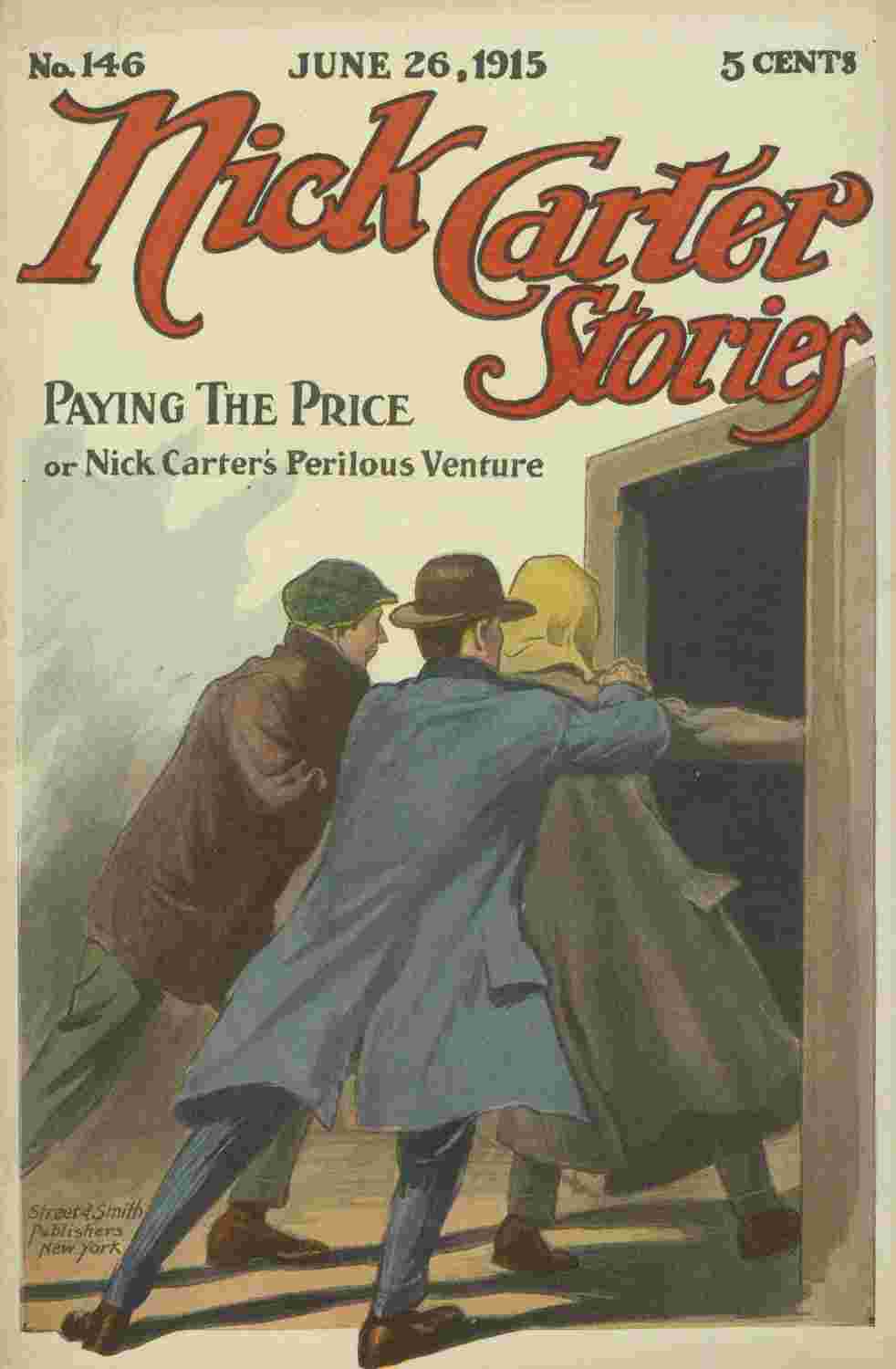
The Project Gutenberg eBook of Nick Carter Stories No. 146, June 26, 1915: Paying the Price; or, Nick Carter's Perilous Venture
Title: Nick Carter Stories No. 146, June 26, 1915: Paying the Price; or, Nick Carter's Perilous Venture
Author: Nicholas Carter
C. C. Waddell
Contributor: R. S. Warren Bell
Release date: March 13, 2022 [eBook #67618]
Most recently updated: October 18, 2024
Language: English
Original publication: United States: Street & Smaith, 1914
Credits: David Edwards, Chuck Greif and the Online Distributed Proofreading Team at https://www.pgdp.net (Northern Illinois University Digital Library)
Issued Weekly. Entered as Second-class Matter at the New York Post Office, by Street & Smith, 79-89 Seventh Ave., New York. Copyright, 1915, by Street & Smith. O. G. Smith and G. C. Smith, Proprietors.
TERMS TO NICK CARTER STORIES MAIL SUBSCRIBERS.
(Postage Free.)
Single Copies or Back Numbers, 5c. Each.
| 3 months | 65c. |
| 4 months | 85c. |
| 6 months | $1.25 |
| One year | 2.50 |
| 2 copies one year | 4.00 |
| 1 copy two years | 4.00 |
How to Send Money—By post-office or express money order, registered letter, bank check or draft, at our risk. At your own risk if sent by currency, coin, or postage stamps in ordinary letter.
Receipts—Receipt of your remittance is acknowledged by proper change of number on your label. If not correct you have not been properly credited and should let us know at once.
No. 146. NEW YORK, June 26, 1915. Price Five Cents.
PAYING THE PRICE;
Or, NICK CARTER’S PERILOUS VENTURE.
Edited by CHICKERING CARTER.
{2}
CHAPTER I.
THE RECTORY MURDER.
Nick Carter paused only a moment before replying. He took that one moment to consider the other strange matter that had brought him to Washington, and whether compliance with the request just made by the chief of police would seriously interfere with it. He decided that it would not, and he then said quite gravely:
“Why, yes, I will go with Detective Fallon, since you both press me so earnestly. It is barely possible, chief, as you say, that I may detect something that would escape his notice. Who is the victim of the crime, if such it proves to be?”
“There is no question about that, Nick,” said the chief. “The murdered man is the Reverend Father Cleary, of the St. Lawrence Church. He was found dead on the floor of his library in the rectory, which adjoins the church, about half an hour ago.”
“A Roman Catholic priest, eh?”
“Yes.”
“What do you know about it?”
“Very little. I was notified by telephone. I directed that nothing should be touched, nor anything said about the crime before I began an investigation. I sent two policemen to take charge in the rectory until I could get word to Detective Fallon. He is the best man on my force for such a job.”
“But I am not in your class, Nick; far from it,” put in Fallon, who was an erect, dark man of forty, with a rather grave and resolute type of face. “You are in a class of your own, Carter, as far as that goes.”
“Cut it!” said the chief tersely. “Chucking violets is a waste of time. Fallon will tell you all that is known, Nick, while you are on the road. My car and chauffeur are outside. Take it, Fallon, and let me hear from {3}you. You have carte blanche, Nick. Dig into the matter in your own peculiar way.”
“I will see what I make of it,” Nick replied, turning to accompany Fallon from the police headquarters.
It then was about half past eight on the first day of November, and the famous New York detective was in Washington on other business, the nature of which will presently appear. He knew it could wait, however, and he was not averse to complying with the urgent request of the local police chief, who, in as serious a case as had been reported to him, was more than eager to secure the aid and advice of the celebrated detective.
Nick took a seat with Fallon in the tonneau of the touring car, the latter having hurriedly given the chauffeur his instructions.
“We can run out there in ten minutes, Nick,” he added, when the detective banged the door and sat down.
“The St. Lawrence Church, eh?” queried Nick, gazing at him. “I don’t recall having seen it.”
“It is a new one,” said Fallon. “It was built only a year ago. It is pretty well out and not in a wealthy and fashionable section of the city. Father Cleary is a comparatively young priest, not over forty, and is known for the good work he has done in the slums. He will be sadly missed in the low districts.”
“Were you acquainted with him?” Nick inquired.
“Yes, slightly.”
“How long has he been in Washington?”
“About three years,” said Fallon. “You were here about a month ago, by the way, on that government case against several foreign spies. I heard of it after you left. I was sorry not to have seen you.”
“I was here only a couple of days with two of my assistants,” Nick replied. “We were fortunate in speedily rounding up the miscreants, barring one.”
“You refer to Andy Margate, I suppose.”
“Yes. The net still is spread for him, however, and the{4} others now are doing time. Margate was not one of the spies. With the help of two local crooks, he turned a trick on the foreigners that proved to be much to my advantage.”
“You refer to Larry Trent and Tom Carney?”
“Yes.”
“Both are bad eggs,” said Fallon. “I have known them from ’way back. Trent is the worse of the two, for he is better educated and came from decent people.”
“So I have heard.”
“He has a sister, Lottie Trent, who is an honest and industrious girl. She’s employed as a stenographer in an office in the war department. I knew her parents, also, who have been dead for several years. By the way, Nick, there was mighty little published about the true inwardness of that foreign-spy case. They went up without a legal fight, even.”
“There was no fight coming to them,” said Nick dryly. “They had no defense. I clinched the case against them, including Captain Casper Dillon.”
“But the bottom facts were nearly all suppressed.”
“Yes, all of the bottom facts,” Nick allowed, smiling significantly.
“It is hinted, nevertheless, that Senator Barclay and a young government engineer in the war department, one Harold Garland, were somewhat involved in the matter,” said Fallon. “Is that true?”
“Really, Fallon, I cannot say,” said Nick, still smiling.
Detective Fallon laughed lightly, knowing well enough that Nick could have informed him concerning every part of the case, if so inclined. He took no exceptions to his reticence, however, and inquired, after a moment:
“Is there any clew to Margate’s whereabouts?”
“Not that I know of,” Nick admitted. “The police throughout the country are on the watch for him. He is a very keen, crafty, and elusive fellow, however, and is better known in Europe, where he has done most of his knavish work. But we shall get him, Fallon, sooner or later. If——”
“Here we are,” Fallon interrupted. “There is the church.”
The touring car had turned a corner, bringing the sacred edifice into view. It occupied the corner beyond and stood somewhat back from the street, both front and side. In the rear, fronting on the side street, was the dwelling occupied by Father Cleary, whose only servant was an elderly housekeeper, one Honora Kane, who had been a widow many years.
The church, the rectory, and the surrounding grounds extended back to the next street, from which they were divided by a stone wall, the rear grounds being adorned with several old shade trees, the wide-spreading branches of which mingled with those in the side grounds of the adjoining estate.
Nick took in all these features of the scene while approaching the rectory, on the sidewalk in front of which a policeman was pacing to and fro. He touched his helmet when Fallon sprang from the car, but evidently he did not know the face of the more famous detective.
“What has been done, Bagley?” asked Fallon, pausing briefly.
“Nothing, sir, except to keep it quiet,” said the policeman. “We have been waiting for you. Grady is inside.”
“We’ll go in,” said Fallon.{5}
“One moment,” Nick interposed, detaining him. “The murder has not leaked out, Bagley, I take it?”
“No, sir.”
“I see that there are no inquisitive people hanging around here. Have you seen any one, by the way, who appeared to have an interest in the place?”
“No, sir; I have not.”
“That’s all, Bagley; thank you.”
“I see the point, Nick,” Fallon remarked, as they entered the grounds fronting the rectory.
“Holy smoke!” Bagley muttered, starting after them. “That must be Nick Carter. Great guns! there’ll be nothing to the case, if he is on it.”
The two detectives were admitted to the hall by a pale young woman in a calico wrapper and a long gingham apron. Her tear-filled eyes, together with the low moans and sobs of a corpulent woman in an adjoining room, evinced the grief and distress of both.
“Let me take the ribbons, Fallon,” Nick said quietly. “We may go over the traces if we drive too fast.”
Fallon readily acquiesced, and Nick paused and questioned the woman who had admitted them.
He learned that her name was Margaret Dawson; that she was the nearest neighbor to the rectory, and that she had hurried to assist Mrs. Kane, the housekeeper, upon learning her cries when she discovered the terrible crime.
“Nora was nearly out of her bed, sir, and didn’t know what to do,” she explained. “So I telephoned to the police station, sir, and was told to let things alone till the officers came. That was not long, sir, and nothing has been touched, not even Father Cleary’s body. An officer is in the library, sir, where it’s lying.”
“Mrs. Kane is the only servant?” questioned Nick, glancing at the sobbing woman in the adjoining room.
“Yes, sir. She is quite deaf, sir, and heard no disturbance during the night. She went to bed before nine o’clock last evening, leaving Father Cleary alone in the library.”
“She has told you this?”
“Yes, sir. The library door was closed when she came down this morning to get breakfast, but she did not think of anything wrong on that account. When the meal was nearly ready, however, she went up to call Father Cleary and found his room had not been used. Then she came down to the library, sir, and discovered what had been done.”
Seeing the housekeeper gazing anxiously at him, Nick entered the room and briefly questioned her. She could tell him only that Father Cleary had had no visitors early in the evening, and that he expected none, as far as she knew, and that he had not lately appeared at all troubled, or in any way apprehensive.
That was about all that the elderly housekeeper could tell him, and Nick turned to the waiting detective.
“She is too deaf to have heard any disturbance in the library, Fallon, after having gone to her bedroom,” he said quietly, with a gesture directing the two women to remain in the front room.
“Yes, surely,” Fallon agreed.
“Come. We will go into the library.”
Nick led the way through the dim, simply furnished hall. He passed a passageway leading to a side door. Beyond it was the library, in the east side of the house, with a dining room nearly opposite across the hall, and a kitchen and porch in the rear.{6}
The door of the library was then open. A policeman who had heard them enter had stepped into the hall and was waiting for them.
“One moment, Fallon,” said Nick. “What has been done in this room, Grady, since the crime was discovered.”
“Nothing, sir,” said the policeman, gazing curiously at him. “Both women say they have not entered the room, though the housekeeper opened this door. I have disturbed nothing. Things are just as I found them.”
“Very good.”
Nick paused on the threshold of the open door and studied with searching scrutiny the tragic scene that met his gaze.
CHAPTER II.
CONFLICTING EVIDENCE.
The library was a square room of moderate size, comfortably, though simply furnished. An open desk stood against one of the walls, with a rise of shelves on each side, partly filled with books. In the middle of the room was a square, cloth-topped table, on which were several books and newspapers, also an oil lamp with a green porcelain shade.
A large leather-covered armchair stood near the table, between it and a swivel chair in front of the desk. A smaller chair near a window, the roller shade of which was partly drawn down, was overturned on the floor.
To the right of the window hung a portière consisting of two heavy tapestry curtains, suspended from a black walnut rod. They were drawn nearly together, but between them could be seen a double door with small, leaded glass windows. It opened upon a side veranda overlooking the tree-shaded grounds east of and to the rear of the dwelling.
Nick noticed that one of the curtains was awry, and, glancing up, he saw that it had been torn from one of the pins that fastened it to the transverse rod above the door.
On the floor between this door and the table lay the body of the murdered priest. He was a man of middle size, wearing the conventional black garments of his calling. He was lying on his back, with his arms extended, his head nearly touching a leg of the table, and with his smooth-shaved face upturned in plain view of the detectives, a face on which the pallor and peace of death long since had fallen.
Father Cleary had been stabbed twice in the breast, nearly in a line with his heart, and his garments and the rug on which he was lying were saturated with blood, then dark and congealed.
Nick Carter saw at a glance that the priest had been dead for several hours.
“The scene is suggestive, Fallon; very suggestive,” he said, after a few moments. “We will proceed deliberately, however, since nothing can be done for this man. It’s a case of murder, pure and simple, if that can be. Let Grady wait in the hall. I will study the evidence in detail.”
Fallon nodded and glanced significantly at the policeman.
Nick crossed the room and raised the window curtain. In the brighter light that entered, the scene was even more vividly tragic and gruesome.
“No weapon is here,” said he, with searching gaze while he crouched to examine the corpse. “The assassin took{7} care not to leave it. It evidently was a dagger, or a knife with a broad blade. Note the two gashes in the garments. Either thrust would have been fatal. This man has been dead since last evening, probably as early as nine o’clock.”
Nick had lifted one stiffened arm while speaking and dropped it to the floor.
“Surely,” Fallon said simply.
“Here are stains of ink on his middle finger. He evidently was writing when——”
Nick did not finish the remark. He arose and turned to the open desk, then approached it. A sheet of paper was lying on it, also a pen that evidently had been abruptly dropped.
“Ah, here is proof of it,” said Nick.
He bent forward and read from the sheet of paper merely the following lines:
“To the Right Reverend Bishop Cassidy, Washington, D. C.
“My Dear Bishop: I feel compelled to ask your consideration of a matter of which I have just become informed. Though the sacred secrecy of the confessional forbids——”
That was all, written with a firm and flowing hand, and Nick straightened up and turned to his companion.
“Yes, this settles it, Fallon,” said he. “Father Cleary was writing when his assassin entered. Observe that he quickly dropped his pen, instead of placing it in this tray with the others.”
“Yes, obviously,” Fallon agreed.
“Plainly, then, he was startled, or even alarmed by some unexpected noise. That would not have been the case, Fallon, if his bell had rung, either that of the front or the side door.”
“But he may not have been alone at that time,” suggested Fallon. “The person by whom he was killed may have been here.”
“That is not probable,” Nick quickly objected. “This letter which he began to write denotes that he was alone, also that some person had just left him, or only a short time before, and by whom serious information of some kind had been imparted to him, so serious that he felt compelled to write about it to Bishop Cassidy.”
“It must in that case have been something relating to the church.”
“Not necessarily. I do not, in fact, think that it was.”
“Why so?”
“Notice the next line: ‘Though the sacred secrecy of the confessional forbids,’” Nick pointed out. “There he stopped and dropped his pen. Forbids what? We know that it forbids his revealing what is imparted in confession. That seems to have been the source of the information about which he intended to write, judging from the beginning of the letter. It may not, of course, have been part of a penitent’s confession. It may have been something indirectly related with it, or referring to a confession.”
“I see,” Fallon nodded. “There seems to be no way to definitely determine.”
“Not at present,” Nick replied, folding the sheet of paper and putting it in his pocket. “Let’s go a step farther.”
Nick turned and took up the lamp on the table, shaking it gently and peering into the chimney.
“Empty,” said he tersely. “The wick is turned up and charred. The lamp burned until the oil was exhausted.{8} The assassin did not extinguish the light. He left in a hurry, no doubt.”
“He remained long enough to close the door leading into the hall,” said Fallon. “The housekeeper found it closed this morning.”
“Father Cleary may have closed it when he received his first visitor.”
“You think there were two?”
“I do,” said Nick.
“Here together?”
“No. One came after the other had departed.”
“But why did he close the hall door after letting them out?” questioned Fallon, a bit doubtfully. “Mrs. Kane’s statements imply that she usually found it open in the morning.”
“I don’t think that he let them out, not both of them at least,” said Nick. “Here is another door.”
“Ah, I see.”
Nick pointed to the portière hanging across it.
“He may have let the first visitor out this way, instead of by the front or side door,” said he. “This door leading into the hall, in that case, still would have been closed.”
“I see the point.”
“He may have admitted his second visitor through this curtained door, or perhaps have left it open a little for ventilation after letting out the other,” Nick continued to reason. “It may have been violently forced from outside, on the other hand, alarming him while he was writing.”
“I follow you,” nodded Fallon.
“Notice that one side of the curtain is awry and torn from one of the pins supporting it. The location of the body, too, between the window and this table, shows that Father Cleary probably was approaching the window when he was assaulted and stabbed. There is no evidence of a struggle. His assailant evidently flung aside those curtains so violently that one was partly torn from its fastening, and he then sprang at the priest and stabbed him before he could defend himself.”
“That certainly seems, Nick, to be a reasonable reconstruction of the murder itself,” said Fallon, noting the points mentioned.
“Let’s see what more we can find in support of it,” said Nick.
He now approached the portière and examined it. On the edge of one of the curtains, where a hand evidently had grasped it, was a plainly discernible red stain, obviously a bloodstain.
Nick called Fallon’s attention to it, then gazed at it with a puzzled expression on his earnest face.
“The miscreant’s hand was soiled with blood after the stabbing,” said Fallon. “He tore the curtain from the pin when leaving, instead of when he entered, as you were led to infer. What are you thinking about?” he added, noting Nick’s look of perplexity.
Nick parted the curtains before replying. He then found that the door was set in a narrow casement, just wide enough to permit the two sections of the door to open inward.
Nick opened both and found on the woodwork of the right-hand section, or that to the right of a person standing on the veranda and looking into the room, four stains of blood, evidently from parts of the fingers of a man’s hand that had grasped that section of the door. Though they were too smeared to be of value as finger prints, in{9} so far as revealing the tissues of the skin was concerned, they showed plainly the size and shape of the fingers, which could only have been those of a man.
“By Jove, I don’t quite fathom this,” Nick remarked, after a moment.
“Fathom what, Nick?” questioned Fallon.
“These bloodstains.”
“Why do they mystify you? I see nothing strange in them. The murderer evidently drew the portière and closed this door with a bloodstained hand.”
“I am not so sure of it.”
“How can you reason otherwise?”
“You overlook something,” said Nick. “It may be a very important point.”
“What is that? Explain.”
“Notice that it was the man’s right hand that grasped this section of the window,” said Nick. “The relative size and position of the finger marks show that, also that he must have been facing toward the room, not coming out of it.”
“By gracious, that’s so!” said Fallon, gazing.
“That part of the portière which is stained and torn from the pin, moreover, is on the same side of the window.”
“True.”
“To have grasped them with his right hand, therefore, the man must have been backing out of the room, if leaving it.”
“True again.”
“There is one alternative,” said Nick.
“Namely?”
“That instead of backing out of the room—he was entering it.”
“But that is hardly tenable, Carter.”
“Why?”
“Because his hand was stained with blood. He must have been leaving the room after the murder,” Fallon argued.
“Unless——”
“Unless what?”
“Unless his hand was soiled with blood before he entered and killed the priest.”
“But——”
“Stop a moment,” Nick interrupted. “I now am convinced that this murder was committed in just the manner that I have described. Father Cleary heard some one back of the portière, or forcing the window, and he sprang up to see who was here. The intruder flung aside the portière and stabbed him.”
“Well?”
“Notice this point,” said Nick. “The murderer evidently did not remain to accomplish anything more. He did not go to the desk to see what the priest had been writing, or he would, if my previous reasoning is correct, have taken away the letter Father Cleary had begun.”
“Surely,” Fallon quickly allowed.
“We can safely assume, then, that the assassin got out as quickly as possible,” Nick proceeded. “Surely, then, he would not have backed out. He would have hurried straight out, drawing the portière and closing the double door.”
“Undoubtedly.”
“The side of the curtain which is stained, also the same section of the door, would have been to his left, there{10}fore, and naturally would have been grasped with his left hand.”
“Certainly.”
“That gives rise to a very pertinent question,” said Nick. “Why was his left hand stained with blood?”
“You mean?”
“Most men wield a knife with the right hand,” Nick went on. “That is the hand that should have been covered with blood from the knife used, not the left, which naturally would have been raised to seize his victim by the throat or shoulder to prevent resistance.”
“By Jove, there’s no getting around that, Nick, as far as it goes,” Fallon thoughtfully admitted, more deeply impressed and now more mystified. “But these prints on the door show plainly enough that it was the right hand that was soiled.”
“They also show that he must have been facing the room,” said Nick. “In other words, Fallon, that he was backing out of it, which you admit is improbable—or that he was entering it with blood on his hand, which you also think is untenable.”
Fallon shook his head and frowned.
“Hang it, Nick, you’re mixing me all up,” he declared. “I won’t know in another minute whether I’m afoot or horseback. You tell me what you think. Never mind what I think. Your head is worth two of mine—yes, half a dozen.”
“No, I think not,” said Nick, smiling faintly. “Plainly, nevertheless, these bloodstains present inconsistencies not easily explained at this moment.”
“They do so, for fair.”
“We will look a little farther. You saw that I found this door unlocked?”
“Yes, I noticed that.”
“It was secured only by the latch, which can be lifted from either side. It is safe to assume, since the lock is not damaged, that the assassin found the door unlocked. Either that, or, as I have said, it was opened a little for ventilation.”
“The latter seems quite probable,” said Fallon. “It was unseasonably warm last evening.”
Nick stepped out on the veranda, instead of replying, Fallon following.
It extended from the side door, where two low steps led down to a gravel walk running out to the street. The veranda was about twelve feet in length, with a vine-covered trellis at the rear end of it, and with the outer side protected with a scroll railing.
Near the trellis stood a large willow armchair, in which Father Cleary had been accustomed to sit and read at times on warm, pleasant days.
Nick glanced in that direction and made another strange discovery.
CHAPTER III.
THE MYSTERIOUS BANDAGE.
The first thing to catch Nick Carter’s eye after stepping out on the veranda was a strip of white cotton cloth, also a piece of common white string, both lying on the veranda floor near the willow chair mentioned.
The strip of cloth was somewhat soiled and wrinkled, also creased and curled in a way, and Nick picked it up and examined it.
He found that it was about two feet in length and five{11} inches wide, also that it had been carefully folded lengthwise. On one soiled end of it were stains of blood.
“By Jove, here’s another bit of curious evidence,” said he, after a careful examination.
“It looks like a bandage,” said Fallon.
“That’s just what it is.”
“But why curious?”
“Note the wrinkles and creases and the way it curls,” said Nick. “Plainly enough, Fallon, it has been bound around a man’s hand, or it would not have retained these several turns and creases.”
“I see.”
“Hold out your hands, both of them. We can find out by readjusting these quirks and turns on which hand it was worn.”
“Certainly. That’s a simple problem.”
Nick proceeded to fit the bandage, so to speak, to Fallon’s hands. It would not fit the right hand, though turned in either direction, without altering the original turns and wrinkles. It could be perfectly bound around the left hand, however, and the result of Nick’s experiment was convincing.
“This is as plain as twice two,” said he. “It was worn by some man on his left hand.”
“Surely,” Fallon agreed. “He probably had a sore hand, or a cut.”
“You are wrong,” said Nick. “That’s the curious part of it.”
“Wrong?” questioned Fallon, puzzled. “Why so?”
Nick still had the bandage twined around his companion’s left hand.
“Notice these bloodstains,” he replied. “They are not on the inside of the bandage, which would come next to a cut, or sore. They are on the outside of it.”
“By Jove, that is a bit strange,” Fallon now declared.
“The blood did not soak from a wound, moreover, for the layer of cloth beneath this outside one is perfectly clean, as you see.”
“True.”
“So, as you now can see, is the inside of the bandage, which came next to the hand,” Nick continued, removing it and displaying the inner side. “There is not a sign of blood, pus, salve, or liniment, as if it had been bound around a wounded hand. It is perfectly clean, in fact.”
“Humph!” Fallon ejaculated, gazing at it with increasing perplexity. “There is no question as to your being right. It speaks for itself. But what in thunder do you make of it?”
“The hand was not injured,” said Nick.
“It may have been lame, or sprained.”
“The bandage would not have been removed in that case, Fallon,” Nick replied. “If sufficiently lame to require a bandage, it would not have been removed when the man arrived here. No man about to attempt a desperate job with a lame hand would first weaken the hand by removing a bandage with which it had been protected, or strengthened.”
“That’s true, also,” Fallon nodded. “You think it was worn by the assassin?”
“I do.”
“When he entered?”
“No. Before he entered,” said Nick. “In order to have free use of his hand, he evidently tore off the bandage and string and threw them aside before he entered. Here are stains of blood on the string, also, proving that those{12} on the bandage were on the outside of it, as I have already demonstrated.”
“You’re right, Nick,” agreed Fallon. “There is no denying it.”
“Take it from me, too, the man’s hand was not injured.”
“But why that bandage, then?”
“For some other reason,” Nick said dryly. “What that reason was, Fallon, remains to be learned. It would be a waste of time for us to try to guess it.”
“I agree with you.”
“The blood on the outside of the bandage evidently came from the man’s right hand, moreover, which I already have pointed out was stained, not after, but before he entered this door. This mysterious bandage confirms my previous deductions.”
“By Jove, it’s a perplexing mess,” said Fallon, brows knitted. “I cannot fathom why the scoundrel’s right hand was soiled with blood before he entered this house. Why it afterward may have been is simple enough.”
“Let’s go a step farther,” said Nick, thrusting the string and bandage into his pocket.
He then began a careful examination of the veranda floor, but he could find no tracks, nor evidence of any description.
Leaving the veranda, Nick then inspected the walk leading out to the street, also the neatly trimmed lawn adjoining it. The gravel walk retained no footprints, but Nick had taken only a few steps when, abruptly halting, he pointed to the greensward.
The grass was slightly bent and bruised. Faint though it was, the track of a small shoe was discernible, showing its size and the direction in which it was turned.
“I see,” Fallon nodded, crouching with Nick to examine it. “Some one recently stepped here, not longer ago than last evening.”
“That some one was a child, a girl, or a woman with a small foot,” Nick replied. “It most likely was the last, a young woman.”
“Why so?”
“Notice the prints of the heel, which sank a little into the sod. It was small and quite high. The deduction is a simple one. Only young women wear shoes with French heels. They are seldom found on girls, or on elderly women.”
“By Jove, you overlook nothing, Nick.”
“Not this, surely, for it stares me in the face,” Nick replied. “Here’s another. Notice that the first points nearly toward the street. This points toward the rear grounds. Plainly, then, the woman was going toward the street when she first stepped from the gravel walk, and she then turned in the opposite direction.”
“That’s plain, too,” Fallon agreed. “But what do you make of it?”
Nick glanced back at the veranda for a moment.
“The woman came from the side door, or from that opening on the veranda,” said he. “She walked as far as here, as if about to go to the street, then she turned toward the rear grounds. Take it from me, Fallon, she was Father Cleary’s first visitor last evening. He let her out, probably through the door opening upon the veranda, and she started for the street. After hearing him close the door, however, and knowing he was not watching her, she turned in the other direction.”
“By Jove, I think you are right.{13}”
“Come. We’ll try to follow the tracks.”
Nick traced them with no great difficulty. The trail led him for a short distance diagonally across the grounds toward the back street. Then it diverged abruptly in the direction of the low wall dividing the church property from an adjoining estate.
Gazing over the wall, Nick discovered other tracks in the next yard, where the grass was not as closely trimmed and was considerably trampled down. It was in the side yard of a wooden dwelling somewhat back from the street and about thirty feet from the wall.
Leaping over the low wall, Nick examined the sod and grass. He found numerous intermingled tracks and indentations, including that of a slender heel and others much broader and deeper. Passing his hand over the grass and glancing at the palm, he found it slightly stained with blood.
“Here we have it, Fallon,” he said, rising and displaying his hand. “Here is the key to the mystery, or to a part of it.”
“Good heavens!” Fallon exclaimed, gazing at it and then at the trampled grass. “There was a fight here.”
“A very one-sided fight, Fallon, unless I am much mistaken,” Nick replied.
“You mean?”
“It’s as plain as twice two, Fallon, as far as it goes,” said Nick, confidently. “Father Cleary had a woman visitor last evening. She confided something to him, or revealed it in a confession, about which he then sat down to write to Bishop Cassidy.”
“As the unfinished letter indicates.”
“Exactly. After leaving him and pretending to start for the street, the woman came this way and got over the wall into this yard. Here are her heel prints in the sod. Why she came here and where she intended going is an open question.”
“Plainly.”
“Be that as it may, she went no farther voluntarily,” Nick continued. “She was intercepted by two men, at least; possibly three. I can find at least two different heel tracks in the sod. The depth of them, also the trampled condition of the grass, show plainly that there was a brief struggle. The woman was overcome, though not without bloodshed, as also appears on the grass.”
“Considerable blood, too, Nick, judging from your hand.”
“Enough to tell this part of the story,” Nick replied. “Probably, too, here is where Father Cleary’s assailant got the blood on his right hand, as well as on the outside of the bandage, before entering the rectory.”
“Yes, surely.”
“He tore off the bandage and cast it aside before undertaking the more desperate game,” Nick added. “My opinion is, at present, that the scoundrel knew that the woman had revealed something to the priest, whom he then killed to prevent further exposure, while confederates who were with him got away with the woman. That is my theory. Whether it is correct, or not, remains to be discovered, as well as the identity of the knaves and the whereabouts or fate of the woman.”
“I agree with you,” said Fallon gravely. “That seems to be the most reasonable theory, if not the only one. What’s next to be done. Can we trace these tracks any farther?”
“Not beyond the street, I fear, though I will try to do so,” said Nick. “I will also question the people living{14} in this house. They may have heard some disturbance last evening. In the meantime, Fallon, you return to the rectory and notify the coroner and a physician.”
“The coroner is a physician, Doctor Hadley.”
“He will be sufficient, then, for the present,” said Nick. “You had better talk with the chief, also, and tell him what I make of the case. I saw a telephone on a stand in the hall.”
“I saw it, too.”
“Go ahead, then. I will rejoin you there a little later.”
Fallon readily acquiesced, turning and quickly retracing his steps to the rectory.
Nick glanced again at the trampled grass, then traced the several faint tracks as far as the sidewalk, where, as he had expected, the trail ended abruptly.
He then rang at the door of the house, in the side yard of which he had made his latest discoveries. The summons brought a middle-aged woman to the door, who stated in reply to his questions that no disturbance had been heard the previous evening, and that she knew nothing of what had transpired outside of the house.
Nick saw plainly that she was telling the truth, and he did not long detain her. Returning to the sidewalk, he noted that there were no dwellings opposite, only several vacant lots, none of which was inclosed with a fence.
“The rascals may have gone in that direction,” he said to himself, after vainly searching the street for tracks of a carriage or a motor car. “They must, if they got away with the woman, have had a conveyance of some kind. They may have crossed those lots, however, to the next street.”
Bent upon confirming this, if possible, Nick walked in that direction. He had only just entered the nearest of the several lots, however, when he saw some pieces of white paper scattered over the dry ground. They appeared to be fragments of a torn letter, and were so fresh and clean that they must have been recently dropped.
Nick picked up a few of the fragments and examined them. They were written on only one side, in a dainty, feminine hand; but the few words on each piece, none of which was more than an inch square, gave him only a vague idea as to the character of the entire letter.
That was so suggestive, however, that Nick carefully searched the ground for the remaining fragments, which had been somewhat scattered by the wind, or designedly done by the person who had destroyed the letter. He succeeded in finding enough of the fragments to feel reasonably sure that they would nearly complete the torn sheet, and he inclosed them in his notebook.
Nick then crossed the vacant lots to the next street, noting that the locality was one in which such a crime as he now suspected could have been committed without much danger of detection; but he could discover no further clew to the movements of the woman and her assailants, and then retraced his steps to the rectory.
The coroner had arrived during his absence and was viewing the remains of the murdered priest. Nick did not remain to talk with him, however, but beckoned for Fallon to join him on the veranda.
“I must be going, now, for I have an appointment this morning,” he explained. “You can tell Doctor Hadley, also the chief, what I make of the case. Here is Father Cleary’s unfinished letter, which you had better hand to{15} the coroner. I will try to see you later and give you further assistance.”
Detective Fallon thanked him, and Nick then departed.
CHAPTER IV.
A CONNECTING LINK.
Nick Carter had spent much less time at the St. Lawrence rectory than one might infer from the nature and extent of his investigations. He had covered the ground rapidly, despite the numerous deductions and explanations with which he had assisted Detective Fallon, from whom he parted shortly before ten o’clock.
Something like twenty minutes later, Nick alighted from a taxicab at a handsome stone residence in Massachusetts Avenue. It was that of Senator Ambrose Barclay, one of the leading statesmen then in the higher house, and the man directly responsible for Nick Carter’s arrival in Washington late the previous night.
A butler admitted the detective and at once ushered him into a richly furnished library, where Nick was almost immediately joined by both Senator Barclay and his daughter Estella, a beautiful brunette in the twenties. The great service already done them by the detective was fresh in their minds, only a month having elapsed, and their greeting was extremely cordial.
“I got your wire saying you would see me this morning,” Senator Barclay then said, while Stella quietly closed the door. “I’m very glad you could make it convenient to comply with my request. I have not forgotten how deeply I am indebted to you, Carter, for having saved my reputation in that foreign-spy affair. I will not say my honor, of course, for I was in no degree culpable, though malicious persons, or an uninformed public, might have thought differently.”
“I was very well aware of it, Senator Barclay, and I made sure that your name did not appear in the matter,” Nick replied. “But let the dead bury the dead. What’s the trouble, now, that you again need my aid?”
“I am in a quandary, possibly in an equally bad mess,” said the statesman. “It concerns, to begin with, the same young man who was robbed of the government coast-defense plans by those infernal foreigners, aided by that traitor, Dillon, all of whom woolly-eyed me into friendly relations with them for more than a year. I cringe with chagrin when I think of it.”
“But how is Harold Garland involved in your present trouble?” questioned Nick, keeping him to the point.
“Involved in it!” blurted Senator Barclay. “Damn it—excuse me, Stella; I forgot you were here. How is Garland involved in my present trouble? Hang it, Carter, he is something more than involved in it. He is the trouble.”
Nick laughed, while Stella Barclay blushed profusely.
“Suppose you explain, senator, without any expletives,” Nick suggested.
“Yes, dad, dear, do,” pleaded Stella. “Tell Mr. Carter the whole business. Don’t mind me, I shall survive it.”
“It can be told in a nutshell, Carter,” said Senator Barclay familiarly. “Since you opened his eyes to the devilish treachery of that jade, Madame Irma Valaska, Garland has transferred his affection to my daughter. He always was fond of her, mind you, and he now declares that he loves her. I am glad that he does, and she him.{16} I am fond of Garland myself, as far as that goes, for he’s a clean-cut, manly, and wonderfully capable fellow. I know of no man whom I would rather have for a son-in-law.”
“Permit me to extend my best wishes,” said Nick, with a sort of droll pleasantry, glancing at the crimson face of the smiling girl. “I think, like your father, that Harold Garland is a remarkably fine fellow.”
“I think so, too, Mr. Carter,” Stella said simply.
“But what is the trouble?” Nick inquired, turning again to her father. “What is wrong with Garland?”
“That is what I want you to learn,” Senator Barclay said gravely. “Garland is not himself. He is frightfully worried about something.”
“You don’t know about what?”
“No; I only suspect. Although he firmly denies it, Nick, he is in serious trouble of some kind. It is something that came up about a week ago, when Stella and I first noticed his changed manner and appearance.”
“Changed in what way?” Nick inquired.
“He has become indescribably moody and depressed. I have watched him covertly at times and seen him wearing an expression of utterly indescribable anxiety. He has lost twenty pounds in a week and looks as pale as a corpse. Something must be done, Carter, and you are the man who must do it.”
“We are dreadfully anxious,” put in Stella, with an appealing glance at the detective. “Do, Mr. Carter, see what you can learn about him, or from him.”
“You have questioned him, of course,” said Nick.
“Yes, vainly.”
“Does he say nothing at all in explanation of these changes?”
“He attributes them to our imagination and insists that there is nothing wrong,” said Senator Barclay. “I know better, however, and that he is all wrong. I called him down quite severely night before last, Mr. Carter, and he then made the remark which afterward led me to send for you.”
“What was that?”
“I charged him with being in serious trouble of some kind and insisted that he must confide in me,” Senator Barclay explained. “My persistency irritated him a little. He seemed to lose his head for a moment, and he asserted quite resentfully that I must cease interrogating him. He then added impulsively that I would be quite lucky if I kept out of the trouble myself.”
“H’m, is that so?” said Nick. “Did you ask him to explain?”
“Yes, certainly. He declared that he meant nothing definite, however, that he had spoken impulsively and only in a cursory way. I am sure, nevertheless, that the remark had much more serious significance, and that he implied that I might become involved in the very trouble with which he was burdened.”
“That is a natural inference,” Nick agreed.
“And you know, too, what it might signify,” Senator Barclay responded gravely. “There is only one bad mess, Mr. Carter, in which I could be involved with Garland. That is something relating to the theft of those government plans, and the fact that my name was kept out of that unfortunate affair.”
“That is what I have in mind,” bowed Nick.
“You also know, of course, that the miscreant who stole them from Dillon after he had received them from{17} Irma Valaska, is still at large. I refer to Andy Margate. He is capable of any kind of knavery. If he——”
“I know all about Andy Margate and of what he is capable,” Nick interposed. “It may be, of course, that he still is in Washington. He may be attempting to blackmail Garland.”
“That is precisely what I fear.”
“I inferred so. Have you said as much to Garland?”
“I have. He declares that he has not seen Margate, however, and that he knows nothing about him. If he is lying, if my suspicions are correct—well, you know, Carter, what that would mean for me. My reputation would again be in jeopardy. My honor, my seat in the senate, my political career—all would be frightfully threatened.”
“I agree with you,” said Nick seriously. “I will look into the matter, Senator Barclay, and sift it to the bottom.”
“That is precisely what I want.”
“There is, I infer, nothing more definite that you can tell me.”
“No, nothing.”
“When did you last see Garland?”
“Night before last.”
“Does he know that you have sent for me?”
“He does not. He might resent it.”
“Possibly,” Nick allowed. “Is he still living at the Grayling?”
“Yes.”
“Does he occupy the same office in the war department?”
“He does.”
“Very good. I will leave immediately, then, and try to see him during the day,” said Nick, rising to go. “I will either call here again this evening, or telephone to you and let you know what I have learned. I think, as you do, that the matter may be serious.”
“You will go right at it?” Barclay anxiously questioned.
“Like a bull at a gate,” Nick assured him. “You will hear from me this evening.”
Nick did not, nevertheless, immediately start in search of Harold Garland. He returned to the Willard, where he was registered under an assumed name, and went up to his apartments. He was thinking of the shocking murder brought to his notice that morning, of the dead priest, of the unknown woman, or girl, who by that time perhaps had suffered a like terrible fate.
Hoping to give Detective Fallon further assistance, and suspecting that the torn letter he had found might have a bearing upon the double crime, Nick set to work matching the edges of the numerous fragments of the letter, placing them together, and pasting them on a sheet of blank paper.
It took him half an hour to complete the work. He found that several fragments from the bottom of the letter were missing, presumably having been blown away from the vacant lot where he had found the others, or dropped elsewhere by the recipient of the letter. It was decidedly suggestive, in view of the double crime and the surrounding circumstances. It was written with a pen, evidently by a woman, and read as follows:
“Dear Harry: You must meet me this evening, Tuesday, at the time and place I mentioned. Do not disappoint me. There is no question as to the conditions of{18} which I informed you, and immediate steps to meet the situation are absolutely imperative. Meet me this evening, therefore, without fail. I will not take ‘no’ for an answer. Unless you comply, I shall do what I have threatened. I will take steps to compel you to rectify the terrible——”
The remainder of the letter was missing several fragments from the bottom of the torn sheet. They evidently had contained, however, only a few concluding words and the signature of the writer.
Nick read it, then reread it, with brows knitting, and a more serious expression on his thoughtful face.
“Tuesday evening,” he muttered. “That must have been last evening. The scraps of paper would have blown away, or have become soiled, if dropped on the ground a week ago. The appointment was for last evening, surely, and the significance of the letter—by Jove, it might be!”
Nick’s train of thought abruptly digressed.
“He frequently is called Harry. He was not at the Barclay residence last evening, not since night before last. Can this be what is troubling him? Is he in some way involved with another woman? Was Harold Garland the recipient of this letter? Have I blundered egregiously in my estimate of his character? Is he a wolf under the surface? Now aiming to wed Stella Barclay, has he found it necessary to rid himself of a woman and kill a priest, in order to preclude an exposure of previous vices? I don’t believe it, by Jove, but I’ll mighty soon find out.”
Nick arose abruptly, folding the pasted letter and putting it into his pocket. He then selected a simple disguise from among several in his suit case, one of which he felt sure was adequate to serve his purpose. He adjusted it carefully at his mirror, and then left the hotel and headed straight for Harold Garland’s office in the War Department Building.
CHAPTER V.
IN THE TOILS.
It was noon when Nick Carter entered the vast building on Pennsylvania Avenue, in which the state, war, and navy departments of the nation are located.
Nick proceeded at once to the west wing and the office he was seeking, which he entered without the ceremony of knocking. He found a young woman at work with a typewriter.
“Is Mr. Garland inside?” Nick inquired, glancing at the closed door of a private office.
“No, sir,” said the stenographer, turning from her table. “But he is likely to come in at any moment.”
“Where has he gone?”
“To an office on the next floor, sir. A young lady is mysteriously missing, one with whom he is acquainted, and he wanted to inquire about her.”
“Is she employed in the office to which he has gone?”
“Yes, sir.”
“How long has she been missing?”
“She was at work yesterday, sir, and left at the usual hour. She has not been seen since, according to Mr. Barstow, in whose office she is employed. She was on some very important work and should have been here this morning, which led to an immediate investigation. She lately has been acting strangely, which also has caused some misgivings.”
“How strangely?” questioned Nick.{19}
“Well, as if she was worried or in trouble of some kind, as near as I could learn from one of Mr. Barstow’s clerks, who came here a short time ago to inform Mr. Garland.”
“You said that Garland is acquainted with her?”
“I think so.”
“Are you?”
“I know her only by sight and name.”
“What is her name?”
“Charlotte Trent,” said the girl. “She is more commonly called Lottie Trent.”
Nick Carter evinced no surprise upon hearing the name of the missing girl. It told him, nevertheless, in view of all of the circumstances, that the case was rapidly becoming more serious and complicated. He knew, recalling what Fallon had said that morning, that this same Lottie Trent must be the sister of Larry Trent, the crook confederate of Andy Margate in the recent theft of the government plans, a fact that at once increased the detective’s misgivings.
Nick did not then stop to consider the matter, however, nor to further question the stenographer. He saw that she could tell him nothing more definite. Without evincing any special interest in what he had heard, he now said to her:
“I wish to see Mr. Garland on very important business. Ask him to wait for me if he comes in presently. I will return in a few minutes.”
“I will, sir,” replied the girl. “I think you then will find him here.”
Nick thanked her and withdrew to the corridor, where he found an attendant who directed him to Barstow’s office on the floor above. While he was approaching the stairway to walk up, Nick saw Garland leaving the elevator, just returning to his own office.
He looked gaunt and white, a shadow of his former self, as Senator Barclay had stated. His refined, clean-cut face, which was as strong in many respects as that of the detective, wore an expression of overwhelming anxiety. His eyes had an abnormal glitter, as if the fever of prolonged mental distress was consuming him.
Nick watched him for a moment, then went up to Barstow’s office. There, after partly confiding in the government official, whom he pledged to subsequent secrecy, Nick obtained a specimen of Lottie Trent’s handwriting. He also learned that Garland had been sent for only because he recently had been seen talking with the girl in the corridors, which had given rise to a hope that he might know what now occasioned her absence. He had asserted, nevertheless, that he knew nothing about her.
Nick returned to the corridor and compared the girl’s writing with that in the torn letter found near the scene of the murder. A mere glance at both, for Nick was a keen chirographist, convinced him that Lottie Trent was the writer. He replaced the letter in his pocket and returned to Garland’s office.
“He came in soon after you went out,” remarked the stenographer, looking up and smiling. “You will find him in his private office.”
Nick entered it without knocking.
Garland was seated at a large roll-top desk. He swung round in his swivel chair and sharply eyed the detective.
“Oh, you’re the gentleman who called while I was out,” he said, a bit brusquely. “Sit down. What can I do for{20} you? My clerk said you spoke of having important business.”
“It is very important,” Nick replied, drawing up a chair.
“Concerning what? I don’t recall having met you.”
“My name is Parsons,” said Nick, turning the lapel of his vest and displaying the edge of his detective badge. “I am in the bureau of secret investigation.”
“A detective?”
“Yes, in other words.”
“But why have you called on me? What’s your business?” Garland demanded, with sharper scrutiny.
“This may give you a hint at it,” said Nick, unfolding the pasted letter and handing it to him.
Garland took it and viewed it curiously for a moment. He then read it without speaking, but with brows knitting closer over his feverish eyes. Looking up with a perplexity not easily to have been distrusted, he asked, a bit curtly:
“Why is it pasted together in this way? It gives me no hint at your business. What’s the meaning of it?”
“You don’t know?” questioned Nick, though already convinced of it.
“Certainly not. It’s Greek to me.”
“Have you never seen it before?”
“No, never.”
“Do you recognize the writing?”
“I do not. I haven’t the slightest idea who wrote it. Why is the signature missing?”
“Because I could not find the fragment containing it where I found the others,” said Nick. “I happen to know, however, who wrote the letter.”
“Who?”
“A girl named Lottie Trent.”
“Lottie Trent—oh, by thunder!” Garland’s frown vanished as quick as a flash. “By Jove this may help to clear up a mystery, Mr. Parsons. Lottie Trent is missing and cannot be found. I have just talked with her employer. He——”
“So have I,” Nick interrupted. “He told me that you have frequently been seen talking with the girl. Talking with her so earnestly that——”
“Stop!” Garland’s teeth met with a quick snap. “And that led you to suspect that this letter was sent to me. I see, now, why you covertly approached the matter. You aimed to evoke some sign of self-betrayal on my part. Understand one thing, Mr. Parsons, right here and now,” he added with threatening vehemence. “I know nothing about this letter nor about Lottie Trent.”
“You did not see her, then, last evening,” said Nick, unruffled.
“No, sir; I did not.”
“Nor attempt to meet her?”
“Certainly not,” snapped Garland. “Why would I attempt to meet her? I would not have known where to find her. The girl is nothing to me.”
“I also happen to know, Mr. Garland, where she was about half past eight last evening,” Nick replied. “Unless I am very much mistaken, she was forcibly abducted by two or three men. That was accomplished just before the murder of the priest.”
“Murder? Priest?” gasped Garland, staring. “What are you talking about? What do you mean?”
“I think, too, that it must have been before you, Mr. Garland, arrived in the grounds back of the St. Lawrence{21} Church and rectory. Otherwise, you might have prevented the abduction of Lottie Trent and the murder of Father Cleary. If you had arrived earlier——”
“Stop a moment!”
Garland lurched forward in his chair. He now was more than pale. The last vestige of color had vanished from his cheeks, leaving him ghastly and drawn, with lips as gray as ashes.
“See here!” he cried, half in his throat. “At what are you driving? What do you mean by the murder of a priest and the abduction of this girl? Have you come here, Mr. Parsons, bent upon leading me into a net? Are you one of those infernal, double-dealing detectives who seeks to stab a suspect from behind, instead of attacking him openly? Why do you say I was in the grounds of the St. Lawrence Church last evening? Why——”
“Only because you were there,” Nick interrupted. “I can read it in your eyes, in your colorless face. This patched letter alone would convince me that you were there. What was the occasion? Why did you go there? A denial will not avail you anything. Shape the opposite course, Mr. Garland, and confide in me. It would be to your advantage, as it already has been. I am not half a stranger to you—as you can see.”
Nick whipped off his disguise with the last, but the immediate effect upon his hearer was not what he expected. For a half-smothered cry of alarm broke from Garland, instead of the cordial greeting the detective anticipated, and the young man leaped up and darted to the door, at which he listened intently for several seconds, as pale and trembling as if a sheriff with a death warrant awaited him in the outer office.
Nick was compelled to admit to himself that he was somewhat puzzled. He waited without speaking, nevertheless, until Garland turned back and resumed his seat.
“I overlooked for a moment that you came in disguise,” he said nervously, while he seized and warmly pressed both hands of the detective. “Heavens, what a call-down I gave you. But it goes without saying, Nick, and very well you know it, that I fairly worship you and am overjoyed at seeing you.”
Nick smiled oddly and shook his head.
“That remains to be seen, Garland,” he replied.
“What do you mean?”
“I might believe it under different circumstances.”
“Different circumstances? How different?”
“You were not glad when you first recognized me. You were seriously alarmed. You were glad only when you remembered that I entered this office in disguise. You feared at first that some one had seen and recognized me. Your looks and conduct admit of no other interpretation. Come, come, what’s the meaning of it? What’s the answer?”
Garland hesitated, settling back in his chair, looking white and worried again, as if burdened with fears he could not overcome.
“Really, Nick, there is no answer——”
“Stop a bit,” Nick interrupted. “Don’t hand me anything of that kind. I can read deeper than most men. You cannot get by me, Garland, with any flimsy denials. You are living in abject fear of some one. You fear that you are being secretly watched, and that this office is also under stealthy espionage. You fear that I was seen and recognized when I entered.
“There can be only one reason for such a fear as{22} that. Crooks are putting something over on you, Garland, and you have been warned against appealing to me for aid. You feel that you are absolutely in their power, too, or you would have ignored their warning and their threats. No other deductions are tenable. They would not have feet to stand on.”