
Drives Horse 62,868 Miles.
Adam Puerkle, carrier on R. F. D. Route 2, out of Stuttgart, Ark., has a horse that he began driving on the route March 9, 1903, and since that date he has had this horse in constant use, a portion of the time making daily trips and the rest of the time making three trips a week.
He has made a total mileage of 62,868 in the mail service with this horse, and is still using him three trips per week, with a fair prospect of several years’ more service. This horse is fifteen years old.
Cow Chews Tobacco and Dies.
When William Rogers, a farmer west of Bethany, Mo., returned home from town late the other night, in the rush of putting away his team and doing sundry chores he forgot some chewing tobacco which he had purchased, and left the package containing over two pounds on the wagon seat.
Rogers thought of his tobacco in the night, but decided that it would be safe till morning.
When he appeared in the barnyard next morning, he was surprised to see one of his best milch cows standing by the wagon, diligently chewing. An investigation showed that she had devoured nearly all of the tobacco. The cow showed symptoms of illness immediately, and a veterinarian was summoned, but the animal died the next day.
His Heart Sewn Up, Patient Recovers.
A remarkable operation, involving the sewing up of a wound in a man’s heart, was performed successfully recently at the Beth Israel Hospital, Monroe and Jefferson Streets, New York City. The injured man, Israel Ziff, of 238 East 105th Street, is well on the way to recovery, and probably will be out of the hospital in a few days.
Ziff operates a pushcart in Monroe Street, near the hospital, selling slices of coconut to passers-by. He is in the habit of slicing the coconut himself with a knife, more than a foot long, whose wide blade tapers down to a sharp point.
Several months ago Ziff cut himself badly while cutting up his wares, and his wife and children begged him to give up his occupation and find some other method of earning a living. He tried to do it, but he could find nothing else. His pushcart was well known in the neighborhood, and his business was good; so he was compelled to keep at it.
Business was brisk one night, and the coconuts were going fast. Ziff had to cut up new ones from time to time, and every few minutes found him bending over with his knife at work. Presently the thing he had always feared happened; his knife slipped and cut through the left breast, a deep wound.
Ziff knew he was badly hurt. So he straightened up, laid down his knife, and started for the Beth Israel Hospital, about a block and a half away. How he got there continues to be a mystery to the surgeons, but he did get there. He walked into the office in Jefferson Street,{61} near Cherry Street, looking as if nothing much matter.
Doctor George Levy, who received him, saw that his injuries were serious, and notified Doctor Alfred A. Schwartz, the house surgeon. Doctor Schwartz’s examination disclosed a wound at least an inch and a half long at the outer surface and going far down in.
Doctor Schwartz called up Doctor Charles Goodman, of 969 Madison Avenue, the attending surgeon, and told him that he was badly needed at once. Doctor Simon D. Ehrlich, the hospital’s anæsthetist, also was notified, and Ziff was carried to the operating room. Here Doctor Schwartz packed the wound with gauze and stopped the flow of blood, and everything was made ready to start work when Doctor Goodman arrived.
The operating surgeon arrived in record time, and then began some quick work. The flow of blood had to be stopped in the first place, and the patient anæsthetized for the operation. But if the chest where cut open to check the hemorrhage, the lungs would have collapsed from the air pressure on the outside, so air had to be pumped in until the inflation was sufficient to resist the pressure from without.
This process was combined with the application of the anæsthetic by the method known as intertracheal anæsthesia. By means of an apparatus operated by electricity, ether was mixed in a jar with air in the proportion considered advisable, and the resultant mixture forced through a tube far down into the patient’s throat. By this means anæsthesia was produced and the air within the lungs was raised to double the normal pressure.
With the patient anæsthetized and the lungs secured against danger of collapse, Doctor Goodman cut away three ribs and a piece of the breastbone. He found the chest full of blood, and this had to be drawn off before anything more could be done. When the blood was cleared away, Doctor Goodman found that the knife had made a big cut in the pericardium and that the point had gone flown nearly three-eighths of an inch into the heart.
The most ticklish part of the operation followed—sewing up the heart while it was palpitating. One stitch was sufficient to close the wound in the heart itself, three more did the work with the pericardium. Doctor Goodman sewed the skin together over the wound, and Ziff was put away to recover. He came out of the operation as rapidly as could have been expected, and except that the protection of the ribs over the heart will be missing, he is likely to be in no way the worse for his experience.
Had the point of the knife gone a millimeter or so farther in, Ziff never would have lived to get to the hospital, as the consequent hemorrhage would have been almost instantly fatal. The hospital authorities at first supposed from the nature and depth of the wound that he had been stabbed in a fight, and it was not until a day or two ago that Ziff recovered sufficiently to tell them how he had been injured.
“The Lady of the Lighthouse.”
Beautiful Mrs. Helen S. Woodruff, of New York, who lived in darkness for two years, is now working hard for the cause of the blind. In her own time of trial she patiently learned to “see through her fingers” and wrote the story, “The Lady of the Lighthouse,” which has made her famous.
When her sight was restored by a marvelous opera{62}tion, she was so grateful that she has devoted all her time and energy for the benefit of the New York Association of the Blind, which has established the original “Lighthouse” in New York.
Mrs. Woodruff is the first society woman who has acted for the “movies,” and she only consented to do this in the dramatization of her story because it would aid the cause of the blind. The photo play which illustrates her talks on the blind is to be shown all over the country, for charity.
Humorous Exploits of Old-time Editor.
For a short time immediately preceding the Civil War, Henry Faxon, who, according to William Lightfoot Vischer, was the “father of American newspaper humor,” was a special writer on the Louisville Journal. Afterward he went from Louisville to Columbia, Tenn., and was the editor there, for perhaps a year or so, of a weekly newspaper; but he really belonged to Buffalo, N. Y.
Henry Faxon, familiarly called Hank, was a man of innumerable accomplishments. He could speak many tongues. He was an excellent electrician, a brilliant musician, had a rich singing voice, and frequently delighted his company with songs that he sang to his own accompaniment on the piano. He was a fine draftsman and cartoonist, and often made pictures with his pencil that were full of fun.
In newspaper work he wrote with a humor that has never been excelled, and in a broad, exaggerated style, which was not widely appreciated in his day. Indeed, he was the originator of that class of newspaper humor, and a brilliant poet withal.
It was Faxon who caused Blondin to achieve the first great performance in rope walking that gave that artist a world-wide fame in—and on—his particular line. Faxon induced Blondin to walk across Niagara River at the falls the first time the rope walker attempted that seemingly perilous feat, which he performed so many times afterward.
Faxon was the editor of a little newspaper at Buffalo at the time under consideration—the summer of 1859. A circus had stranded in Buffalo, and with it was this Frenchman, Emile Gravelot Blondin, who came to this country in 1855. He was part owner of the broken circus. Faxon took a fancy to Blondin, or, at any rate, sympathized with him in his distress, and, after serious discussion of the proposed thrilling feat, Faxon agreed to supply the paraphernalia, at the cost of several hundred dollars, and Blondin declared he was ready to perform it, which he did for the first time on June 30, 1859, later doing that same act with a man strapped on his back, and again with a wheelbarrow, stove, and cooking utensils, with which he cooked a meal when halfway over the rope.
The thing was widely advertised; great excursions went to see it. Blondin’s fame and fortune were made.
Faxon was happiest when doing something to relieve the distress of another, and he was moreover greatly given to practical joking. These two characteristics in him produced a hoax that became famous at the time.
A little south of Buffalo is a beautiful sheet of water called Silver Lake, and it had some mysteries about it. In its center was a deep place that soundings could not measure. Its waters were cold as ice, and there were no fish or other living creatures in it. On its banks a man{63} had built a fine hotel, hoping to make it an attractive resort, but guests were few and tribulation plenty. Bankruptcy threatened, and the landlord told his troubles to Faxon, who had run down there for a few days’ rest.
Faxon fixed up a plan to fill the hotel. Faxon went back to Buffalo and secured the services of another genius—a mechanical genius—a young German, whose only wealth was his ingenuity and a little tinsmithery. Faxon told him what he wanted. The German jumped at the idea.
He constructed a great tin or zinc monster like a sea serpent. It had an immense and fearful red mouth, from which darted a forked tongue, and its huge jaws worked like an alligator’s.
This thing was so anchored near the deepest place in the lake and was so arranged with pulleys and tiller ropes, or something of that nature, that being worked from a secret subcellar in the hotel, it could be made to dart its head and hideous length up out of the lake and lash the water with its tail until it would send big ripples to the shores.
Its movements were so rapid and eccentric that the artificiality of the thing could not be detected, and it had no regular hours for appearance, but was a sort of a go-as-you-please serpent.
Faxon wrote blazing columns in his newspapers about it. The newspapers, all over the country had many lengths of that snake in them, in word paintings and other picture. The hotel became crowded, and the landlord put up sheds and tents on his premises and filled them with guests, and he coined money, so to speak.
The monstrous serpent was a wonder and a mystery for a great many more than seven days, but at last, in a specially strenuous flop one day, the apparatus broke and that old tin serpent turned its white belly up to the sun, and the Silver Lake snake business exploded.
Meantime, the landlord had become as rich as a king and could have afforded to give the hotel away, but he used it for many years as a country seat, and looked complacently at his fortune as a monument to the wit of Hank Faxon and the credulity of mankind.
How to Live Long, Told by Eleven Men.
What is the secret of long life? Probably there is no question that has so many answers, nor such a variety of answers. But it’s still the big question. The other day eleven recipes for long lives were given at a dinner at Amarillo, Texas, held in honor of the Reverend James Cunningham, celebrating his ninetieth birthday. The guests were veterans of the Confederacy, whose ages ranged from seventy-five to eighty-one, and each told briefly of the manner of living that had enabled him to reach old age and retain good health and vigor.
In substance, the recipes provide for hard work, fresh air, outdoor living, the avoidance of trouble and worry, good humor, plenty of sleep, temperance, and the avoidance of tobacco.
“For fifty years my habits have been regular,” said Doctor Cunningham. “Before that time I was careless. Then I went outdoors and engaged in farm work. The change was marvelous, and I have exceeded the record for longevity that has appeared in other generations of the family.”
Captain W. W. Kidd has been a carpenter thirty-five years, and naturally has spent much of his time {64}out-of-doors. Regular habits and care of his health enabled him to pass the eighty mark. “My father lived to be ninety-eight,” he said, “and one of my grandmothers to be ninety-six. While long life runs in the family, I am sure that fresh air and plenty of exercise will make a man live a long time.”
J. L. Caldwell said that for fifty years he had not lived in a plastered house, and that he attributes to that fact much responsibility for his excellent health and long life. “Before I abandoned the plastered house,” he said, “I was in poor health, and after it I had no physical complaints worth mentioning. I have had exercise sufficient to keep up circulation.”
“I have always avoided worry and courted good humor,” said J. G. Hudson.
“I attribute my long life to my service in the army as a soldier,” said A. B. Kinnebrew. “Before entering the army I was sickly and weak. The camp life and marches and excitement recuperated me, and thereafter I enjoyed good health by being careful of my habits and eating.”
“I have lived temperately, eaten coarse victuals, and slept well, and these things have much to do with a man’s health,” said J. H. Rockwell. “There is something, too, in ancestry. My father lacked but four months reaching the century mark; another ancestor lived to the age of one hundred and seven. I have traced my ancestry back three hundred years, and find that a majority of them have lived beyond the age of eighty.”
“At the age of fourteen, when I left home,” said W. J. Patton, “I made a vow to myself never to use intoxicants or gamble. I have worked out-of-doors most of the time since the war, and much of the time have slept in the open. I have always taken plenty of exercise.”
J. M. White said he had never used tobacco and had always been temperate, and he believed those two facts were largely responsible for his reaching a ripe old age.
Richard Wren’s health was poor before he entered the army, but the change made him robust and strong, and he has enjoyed good health to this day.
D. L. Britain said hard work and regular and temperate habits had caused him to grow into a stout and happy old age.
“I have never had any trouble with my neighbors, and that means a lot in the matter of health,” said Doctor W. A. Lockett.
“Early to bed and early to rise has been my motto,” said J. H. Sowder. “Added to that I have been temperate, regular in my habits, and avoided things that might injure my health.”
Brothers as Like as Two Peas.
Leslie and Hallie Woodcock are brothers, who have the entire marine corps at League Island, near Philadelphia. They are as remarkable “twins” as ever made any one gasp, and, after eight months, their officers and fellow marines of Company 17 cannot tell them apart.
Leslie and Hallie are seventeen years and twenty years old and enlisted from their home in South Carolina. At enlistment they were promised that they would never be placed in separate companies. Not long ago a disgusted captain was for assigning them to different companies. They smiled and told him of their enlistment agreement.
In reading the list of those detailed for various police duties in the mornings, the company officers merely mention the name of Woodcock. They realize that one blond{65} young twin will report for duty. Further investigation is useless.
“I’ve done a pile of stuff for you, old boy,” said Hallie to his brother. “Remember the time——”
“I know you stole my girl about a month ago,” replied Leslie. “Thought I was solid. But she never knew the difference.”
“Maybe we haven’t got some girls up in town buffaloed,” grinned Hallie. “When we get paid we toss a coin to see who is to spend his money first. The one that wins goes uptown and sees the crowd. Our salaries aren’t fat and they don’t last forever, but when the first one of us begins to run low, the other one steps into his shoes, and then our citizen friends think that there is only one of us and that one is there with considerable dough.”
Each of the boys holds in his voice the smooth drawl of the South. One can’t tell the difference between the tones. There is something uncanny in the similarity of the two smiles. Their lips go back in exactly the same fashion and four eyes twinkle alike. They smile often, too, for to them the resemblance is life’s one grand joke. Each weighs 149 pounds; wears an eight shoe, a 14-3/4 collar, and the same size hat.
One or two of the men have discovered that one of the twins has a small piece chipped from one of his front teeth.
“That would be a hot one,” observed an old sergeant: “Who goes there—Woodcock? Halt and uncover tooth.”
Farmer Finds Hornets’ Nest.
C. E. Demurr, a farmer living near the Kansas-Oklahoma line, found a hornets’ nest on the Chickaskia River, and believing it empty, took it home for an ornament in his room.
Demurr thought nothing more of it until the next day, when he heard a buzzing sound. The hornets, which had been awakened from their stupor by the fire, left the nest and made things lively about the Demurr home for the next few hours. All efforts to dislodge the “bald heads” were unavailing until the room doors were closed and the fire permitted to burn out. The hornets became benumbed with the cold and were easily killed.
A Smart Youngster.
Two women whose husbands are members of the faculty of Oberlin College went to call on the new professor’s wife. They were shown into a room where the small daughter of the house was playing. While awaiting the appearance of their hostess, one of the ladies remarked to her friend, at the same time nodding toward the little girl. “Not very p-r-e-t-t-y, is she?” spelling the word so that the child should not understand.
Instantly, before there was time for the friend to reply, came the answer from the little girl: “No, not very p-r-e-t-t-y, but awfully s-m-a-r-t.”
The Original Rattlesnake Flag.
Pennsylvania’s State museum, at Harrisburg, has just received one of the most precious of the historic relics housed there. It is the original rattlesnake flag of the Revolutionary War, the oldest banner representing what is now the United States.{66}
The flag was donated by the heirs of Samuel Craig, of Westmoreland County, who died six years ago. One of the forbears of the Craigs carried it in the early days of the Revolution.
Edmund S. Craig, of New Alexandria, and P. M. Hill, of Greensburg, two of the donors, took the flag to the museum. Jesse E. B. Cunningham, ex-deputy attorney general and a former Westmoreland County man, accompanied the pair and presented the relic to Thomas Lynch Montgomery, State librarian and curator of the museum. The flag is red, with the coiled rattlesnake and the “Don’t Tread on Me” warning in the center.
The Weekly 101, Most Unique Paper.
Robert R. Fitzgerald, of Lawrenceburg, Ind., is the editor of the most unique newspaper in the world—The Weekly 101. It is printed in lead pencil throughout, though the editions run from eight to twenty pages of standard newspaper size. The advertisements, illustrations, comic section—everything about the paper is hand-lettered by the editor, who prefers to hide himself behind the pseudonym of “Mooney Mingles.”
Fitzgerald is twenty years old, and started his paper more than a year ago. Two editions are turned out weekly, and, thus far, more than 170 editions have been printed. The regular editions are penciled on white print paper, but the baseball extra is generally done on paper of a better quality and known as the “green sheet.” In this supplement the baseball events of the week are briefly and ably reported.
A special edition was recently turned out to become a part of the Indiana exhibit at the Panama-Pacific Exposition. Another special number was sent to President Wilson, who congratulated the editor upon the patience and ingenuity necessary to produce such a newspaper.
The Weekly 101 is prepared during the editor’s spare hours, and these are limited, because Fitzgerald works ten hours a day in a local factory to support his mother and a family of five.
The ambitious young man is anxious to own a real newspaper plant, because, as he complains, the press he now uses frequently breaks down through an attack of writer’s cramp.
Those who have received sample pages of the pencil editor’s work say that the young man seems to be competent to take his place among the live editors of to-day. Lawrenceburg is already proud of his remarkable and unique weekly, but the thriving little city will probably be doubly proud when the young editor launches forth into the regular channels of newspaper work.
The following paragraph is from one of the sample sheets submitted by our correspondent:
“The 101 Weekly newspaper will be just one year old next week. Mooney Mingles, the little editor, has planned to put out a big special edition on that day. During this whole year Mooney has not, like hundreds—yes, like thousands—of other boys, wasted his time, but during all of his spare moments has published just 160 of these copies, all printed by hand. The young editor has sent copies of this penciled newspaper to the exposition at San Francisco, Cal., to Chicago, New York, Indianapolis, Kansas City, Detroit, London, England, and many other large cities, and figures that it has been seen by 10,000,000 people.{68}{67}”
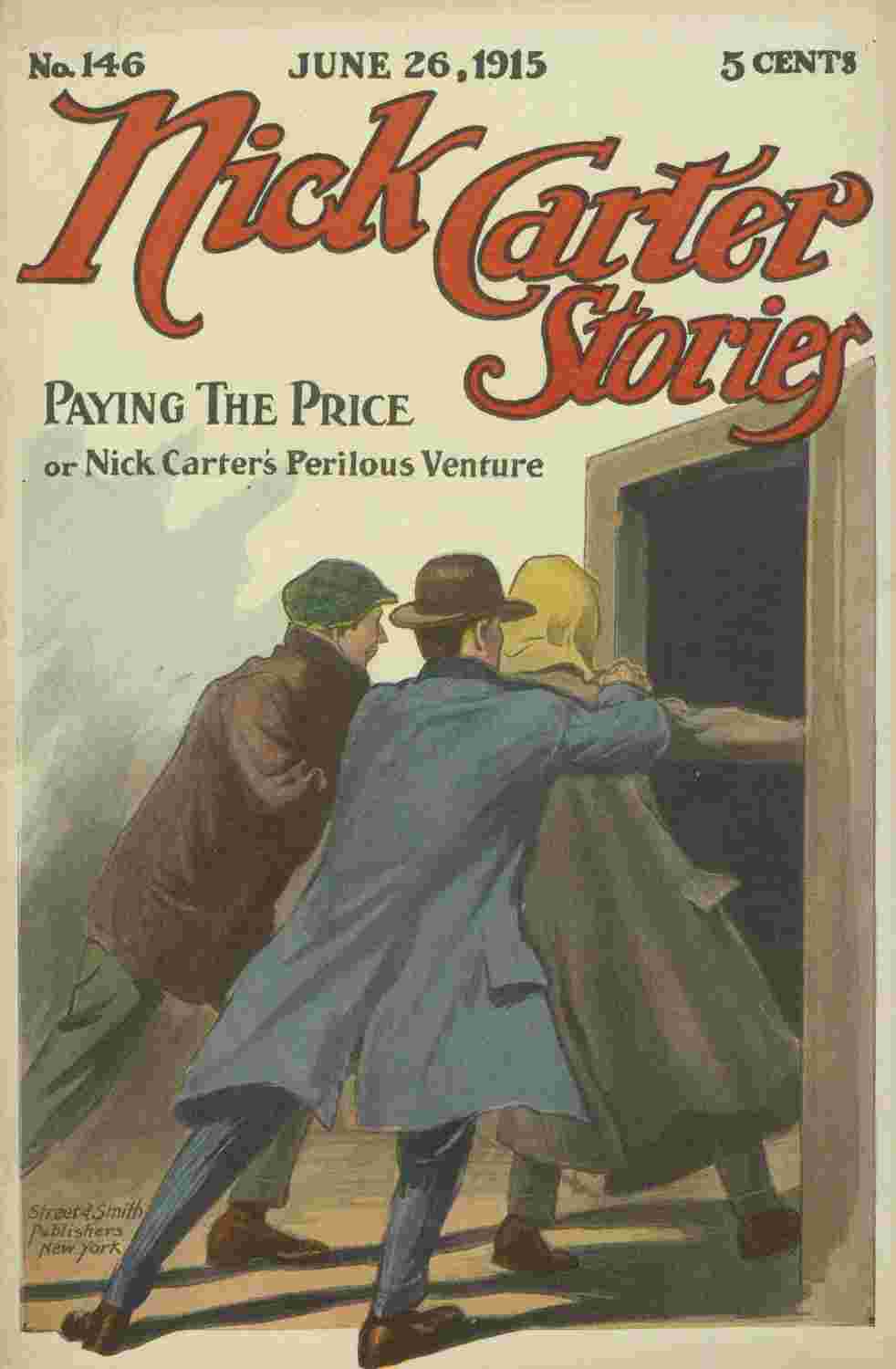
The Nick Carter Stories
ISSUED EVERY SATURDAY BEAUTIFUL COLORED COVERS
When it comes to detective stories worth while, the Nick Carter Stories contain the only ones that should be considered. They are not overdrawn tales of bloodshed. They rather show the working of one of the finest minds ever conceived by a writer. The name of Nick Carter is familiar all over the world, for the stories of his adventures may be read in twenty languages. No other stories have withstood the severe test of time so well as those contained in the Nick Carter Stories. It proves conclusively that they are the best. We give herewith a list of some of the back numbers in print. You can have your news dealer order them, or they will be sent direct by the publishers to any address upon receipt of the price in money or postage stamps.{69}
704—Written in Red.
707—Rogues of the Air.
709—The Bolt from the Blue.
710—The Stockbridge Affair.
711—A Secret from the Past.
712—Playing the Last Hand.
713—A Slick Article.
714—The Taxicab Riddle.
717—The Master Rogue’s Alibi.
719—The Dead Letter.
720—The Allerton Millions.
728—The Mummy’s Head.
729—The Statue Clue.
730—The Torn Card.
731—Under Desperation’s Spur.
732—The Connecting Link.
733—The Abduction Syndicate.
736—The Toils of a Siren.
738—A Plot Within a Plot.
739—The Dead Accomplice.
741—The Green Scarab.
746—The Secret Entrance.
747—The Cavern Mystery.
748—The Disappearing Fortune.
749—A Voice from the Past.
752—The Spider’s Web.
753—The Man With a Crutch.
754—The Rajah’s Regalia.
755—Saved from Death.
756—The Man Inside.
757—Out for Vengeance.
758—The Poisons of Exili.
759—The Antique Vial.
760—The House of Slumber.
761—A Double Identity.
762—“The Mocker’s” Stratagem.
763—The Man that Came Back.
764—The Tracks in the Snow.
765—The Babbington Case.
766—The Masters of Millions.
767—The Blue Stain.
768—The Lost Clew.
770—The Turn of a Card.
771—A Message in the Dust.
772—A Royal Flush.
774—The Great Buddha Beryl.
775—The Vanishing Heiress.
776—The Unfinished Letter.
777—A Difficult Trail.
782—A Woman’s Stratagem.
783—The Cliff Castle Affair.
784—A Prisoner of the Tomb.
785—A Resourceful Foe.
789—The Great Hotel Tragedies.
795—Zanoni, the Transfigured.
796—The Lure of Gold.
797—The Man With a Chest.
798—A Shadowed Life.
799—The Secret Agent.
800—A Plot for a Crown.
801—The Red Button.
802—Up Against It.
803—The Gold Certificate.
804—Jack Wise’s Hurry Call.
805—Nick Carter’s Ocean Chase.
807—Nick Carter’s Advertisement.
808—The Kregoff Necklace.
811—Nick Carter and the Nihilists.
812—Nick Carter and the Convict Gang.
813—Nick Carter and the Guilty Governor.
814—The Triangled Coin.
815—Ninety-nine—and One.
816—Coin Number 77.
{70}
NEW SERIES
NICK CARTER STORIES
1—The Man from Nowhere.
2—The Face at the Window.
3—A Fight for a Million.
4—Nick Carter’s Land Office.
5—Nick Carter and the Professor.
6—Nick Carter as a Mill Hand.
7—A Single Clew.
8—The Emerald Snake.
9—The Currie Outfit.
10—Nick Carter and the Kidnaped Heiress.
11—Nick Carter Strikes Oil.
12—Nick Carter’s Hunt for a Treasure.
13—A Mystery of the Highway.
14—The Silent Passenger.
15—Jack Dreen’s Secret.
16—Nick Carter’s Pipe Line Case.
17—Nick Carter and the Gold Thieves.
18—Nick Carter’s Auto Chase.
19—The Corrigan Inheritance.
20—The Keen Eye of Denton.
21—The Spider’s Parlor.
22—Nick Carter’s Quick Guess.
23—Nick Carter and the Murderess.
24—Nick Carter and the Pay Car.
25—The Stolen Antique.
26—The Crook League.
27—An English Cracksman.
28—Nick Carter’s Still Hunt.
29—Nick Carter’s Electric Shock.
30—Nick Carter and the Stolen Duchess.
31—The Purple Spot.
32—The Stolen Groom.
33—The Inverted Cross.
34—Nick Carter and Keno McCall.
35—Nick Carter’s Death Trap.
36—Nick Carter’s Siamese Puzzle.
37—The Man Outside.
38—The Death Chamber.
39—The Wind and the Wire.
40—Nick Carter’s Three Cornered Chase.
41—Dazaar, the Arch-Fiend.
42—The Queen of the Seven.
43—Crossed Wires.
44—A Crimson Clew.
45—The Third Man.
46—The Sign of the Dagger.
47—The Devil Worshipers.
48—The Cross of Daggers.
49—At Risk of Life.
50—The Deeper Game.
51—The Code Message.
52—The Last of the Seven.
53—Ten-Ichi, the Wonderful.
54—The Secret Order of Associated Crooks.
55—The Golden Hair Clew.
56—Back From the Dead.
57—Through Dark Ways.
58—When Aces Were Trumps.
59—The Gambler’s Last Hand.
60—The Murder at Linden Fells.
61—A Game for Millions.
62—Under Cover.
63—The Last Call.
64—Mercedes Danton’s Double.
65—The Millionaire’s Nemesis.
66—A Princess of the Underworld.
67—The Crook’s Blind.
68—The Fatal Hour.
69—Blood Money.
70—A Queen of Her Kind.
71—Isabel Benton’s Trump Card.
72—A Princess of Hades.
{71}73—A Prince of Plotters.
74—The Crook’s Double.
75—For Life and Honor.
76—A Compact With Dazaar.
77—In the Shadow of Dazaar.
78—The Crime of a Money King.
79—Birds of Prey.
80—The Unknown Dead.
81—The Severed Hand.
82—The Terrible Game of Millions.
83—A Dead Man’s Power.
84—The Secrets of an Old House.
85—The Wolf Within.
86—The Yellow Coupon.
87—In the Toils.
88—The Stolen Radium.
89—A Crime in Paradise.
90—Behind Prison Bars.
91—The Blind Man’s Daughter.
92—On the Brink of Ruin.
93—Letter of Fire.
94—The $100,000 Kiss.
95—Outlaws of the Militia.
96—The Opium-Runners.
97—In Record Time.
98—The Wag-Nuk Clew.
99—The Middle Link.
100—The Crystal Maze.
101—A New Serpent in Eden.
102—The Auburn Sensation.
103—A Dying Chance.
104—The Gargoni Girdle.
105—Twice in Jeopardy.
106—The Ghost Launch.
107—Up in the Air.
108—The Girl Prisoner.
109—The Red Plague.
110—The Arson Trust.
111—The King of the Firebugs.
112—“Lifter’s” of the Lofts.
113—French Jimmie and His Forty Thieves.
114—The Death Plot.
115—The Evil Formula.
116—The Blue Button.
117—The Deadly Parallel.
118—The Vivisectionists.
119—The Stolen Brain.
120—An Uncanny Revenge.
121—The Call of Death.
122—The Suicide.
123—Half a Million Ransom.
124—The Girl Kidnaper.
125—The Pirate Yacht.
126—The Crime of the White Hand.
127—Found in the Jungle.
128—Six Men in a Loop.
129—The Jewels of Wat Chang.
130—The Crime in the Tower.
131—The Fatal Message.
132—Broken Bars.
133—Won by Magic.
134—The Secret of Shangore.
135—Straight to the Goal.
136—The Man They Held Back.
137—The Seal of Gijon.
138—The Traitors of the Tropics.
139—The Pressing Peril.
140—The Melting-Pot.
Dated May 22d, 1915.
141—The Duplicate Night.
Dated May 29th, 1915.
142—The Edge of a Crime.
Dated June 5th, 1915.
143—The Sultan’s Pearls.
Dated June 12th, 1915.
144—The Clew of the White Collar.
PRICE, FIVE CENTS PER COPY. If you want any back numbers of our weeklies and cannot procure them from your news dealer, they can be obtained direct from this office. Postage stamps taken the same as money.
STREET & SMITH, Publishers, 79-89 Seventh Ave., NEW YORK CITY