
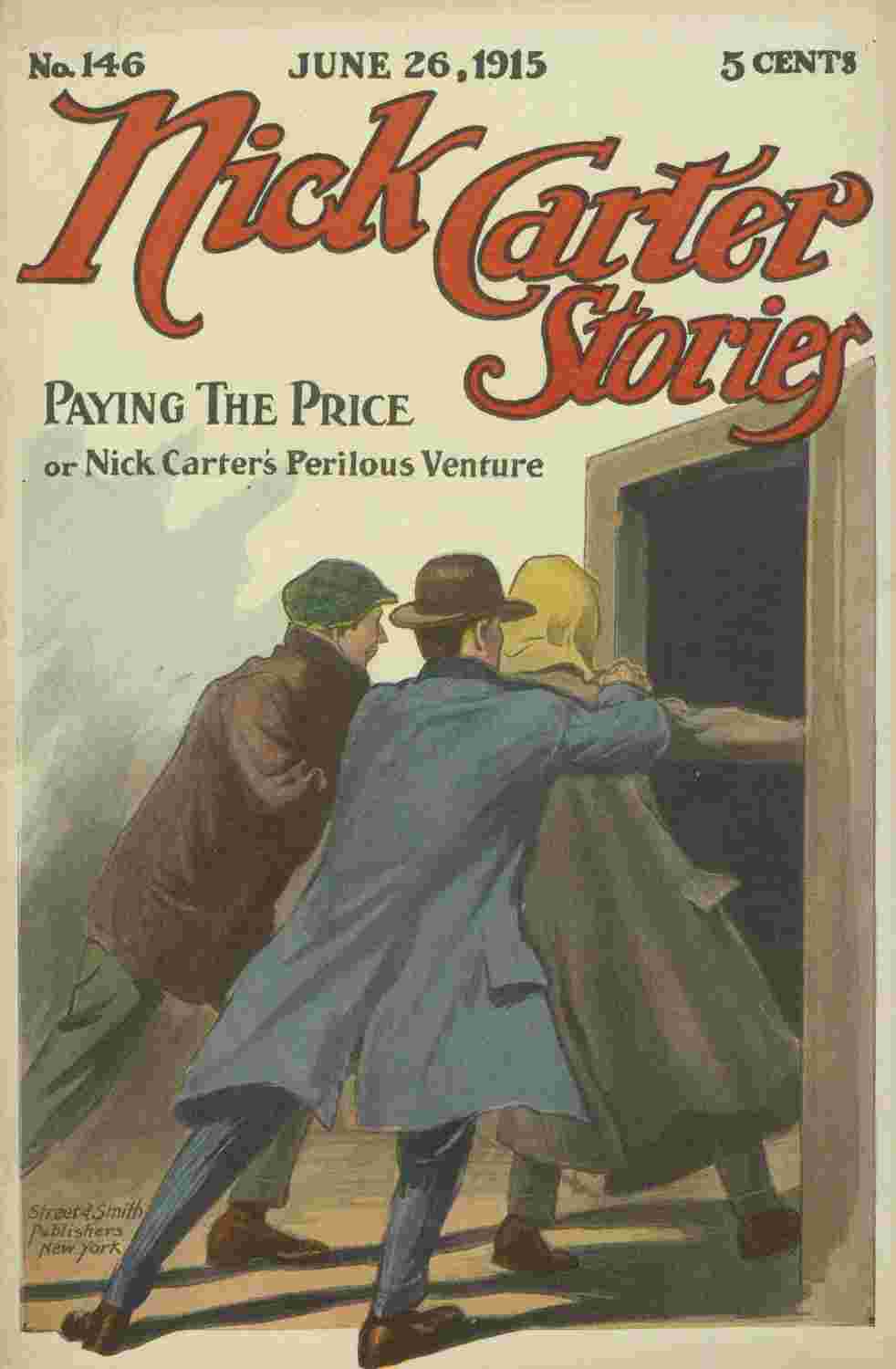
“Good heavens!” Garland huskily exclaimed, nervous and trembling. “You don’t know what you are saying, Nick, nor——”
“Oh, yes, I do,” Nick again interrupted. “Nor have I finished, Garland, by any means. You listen to me for half a minute.”
“But——”
“There aren’t any buts,” Nick insisted impressively. “You hold your horses and hear what I have to say. Father Cleary, of the St. Lawrence Church, was murdered last evening. He was stabbed to death in the rectory. Lottie Trent, after having seen him and confided something to him, was abducted by the knaves who afterward killed him. Both crimes were committed to prevent further exposure of what the girl had told him. You, Garland, know what it was!”
“On my word, Carter, I——”
“Wait!” Nick cut in again. “I have adequate proof of all this. I am on the case and I’m going to sift it to the bottom. You, Garland, were near the scene of these two crimes. This torn letter written by Lottie Trent convinces me of that. I now can guess, too, with what object it was left there, and with what designs you were lured there. This girl is a sister of Larry Trent, now in prison for complicity with Andy Margate in the recent theft of your government plans. Now, Garland, you tell me the truth. I’ll stand for nothing else, nor can anything else save you. I once have pulled you out of the fire. I can, if necessary, do it again. There is no middle course for you. I must arrest you, or know the whole truth. Out with it. What is Andy Margate putting over on you?”
There was no resisting Nick Carter under such conditions, and Garland now seemed to realize it. A look of relief had appeared on his pale face, that relief with which one burdened with a terrible secret sees the way open to confiding in another.
“You are right, Nick,” he admitted, with sudden determination. “I am in just such a position as you suspect. I did fear that you had been seen coming here. Now that you are here, however, and can leave in disguise, as you entered, I will take a chance and tell you the whole business. I have, in fact, been tempted to send for you in spite of threats and warnings. Heavens, how I have longed for your aid and advice.”
“You now may have both,” said Nick. “Get right at it, then, and tell me the whole truth. You look like a nervous wreck.”
“I am,” Garland admitted. “I have suffered the tortures of hell for more than a week.”
“Omit nothing. Tell me the whole business.”
“It can be briefly told,” Garland began. “I was called up by telephone nine days ago by an unknown man. He stated that I was about to receive a package by mail, and that the sender of it insisted upon having a personal interview with me. I was warned against confiding in any one, and threatened with direful consequences if I did so. I was told that an automobile would arrive at the first corner east of the Grayling, where I am living, at precisely nine o’clock that evening, and I must be there{23} to immediately enter it, when I would be taken to the sender of the mailed package. I was repeatedly warned, mind you——”
“I understand,” Nick interposed. “Never mind the warnings. Let’s get at the facts. What followed?”
“I waited with indescribable misgivings, Nick, for the package said to have been sent to me,” Garland continued. “It came an hour later. I opened it and found—a photograph of the portfolio that contained the government plans of which I was robbed by Irma Valaska and Captain Casper Dillon, whose infamous designs you so successfully foiled.”
“H’m, is that so?” said Nick, with brows drooping. “A photograph of the portfolio, eh?”
“Yes.”
“Is there any doubt about it?”
“Not the slightest. It shows the flap of the portfolio, turned back so as to show my name and address, which I had written on the inner side of it. The writing is plainly discernible and it corresponds precisely with that in the portfolio now in my possession.”
“Where is the photograph?”
“Here in my safe, also the portfolio. I will get them. You may see for yourself.”
“Wait one moment,” Nick interposed. “I will examine them a little later. Go on with your story. What did you do after receiving the photograph?”
“What could I do?” questioned Garland nervously. “My misgivings were redoubled, and since have been confirmed. I did not dare to deviate from the directions given me. I confided in no one. I locked the photograph in my safe and determined to learn what was back of such an ominous beginning.”
“Very good,” Nick nodded. “With what result?”
“I followed the instructions given me,” Garland proceeded. “I was on the corner mentioned at precisely nine o’clock that evening. A limousine approached. I saw plainly that the chauffeur was prepared to speed on, if in any way threatened.”
“You entered it?”
“Yes. It hardly stopped for me to do so. A masked man was seated in it. He at once assured me that I was in no personal danger, and he then insisted upon blindfolding me. I consented reluctantly and he drew a black cap over my head. I then could see nothing, absolutely nothing, and I have no idea where I was taken.”
“Where did you bring up?” Nick inquired.
“In a house or building into which I was led, still blindfolded,” said Garland. “I do not know where it is located. I haven’t the slightest idea. I heard the closing of a heavy door after entering, and I presently felt the downward movement of an elevator. I found myself in a lighted room a moment later, and the cap was removed from my head.”
“And then?”
“Two masked men stood beside me. A third was seated at a table. In one corner stood a large photographic camera. The man at the table was not masked. It was, as you probably infer, Andy Margate.”
“Yes, no doubt,” Nick said dryly. “Well, what followed? What did Margate want of you?”
“That may be told in a nutshell.”
“Briefly stated, then?”
“Margate has photograph copies of all of the {24}government plans stolen from me a month ago. They were taken during the short time he had the plans in his possession.”
“Ah, I see!” said Nick. “That is, indeed, a serious matter. What does Margate intend doing with them?”
“He threatens to sell them to foreign powers,” replied Garland, shuddering. “Think what that would mean! Thank God, however, he offered me one alternative.”
“Ah!” Nick again exclaimed a bit dryly. “What is the alternative?”
“The privilege of buying them myself.”
“Humph! Have you consented to do so?”
“What else could I do?” Garland demanded. “My position is worse than it was a month ago. If photograph copies of the government plans are possessed by this scoundrel, they are even more dangerous than the originals, which could be entirely changed if known to be hopelessly lost. In view of uncertainty concerning photograph copies, however, construction work in accord with the plans might be adhered to with disastrous consequences. You know what might follow if——”
“If war were declared, and our foes had photographic plans of our coast defenses—yes, I know all about that,” Nick interrupted. “But that’s in the dim and distant future. Let’s stick to the game that now is being played. Did you consent to buy the photographs?”
“Yes.”
“For what price?”
“One hundred thousand dollars was demanded,” Garland said, with a groan. “I protested that it was more than I could possibly raise. Margate had learned, however, that I had a fortune of about sixty thousand dollars. He agreed to compromise at eighty thousand, and I was allowed ten days in which to raise the needed twenty. The infernal knave will not only leave me penniless, but also plunge me deep in debt.”
“Have you raised the money?”
“All but five thousand, for which I think I can make arrangements to-morrow.”
“To-morrow,” Nick echoed. “That is your last day of grace, is it not?”
“Yes. I am to see Margate again to-morrow night.”
“Where?”
“Under the same conditions as before.”
“And he expects you to hand him the money?”
“He does. He insisted, in fact, that he would allow me only this one meeting; that he would, if the price is not paid to-morrow, at once take steps to sell the photographs abroad. He warned me that I would be constantly watched, and threatened to instantly end all negotiations with me if I confided in any one, or appealed for aid to the police. He mentioned you in particular, and threatened——”
“Never mind what he threatened,” Nick interrupted, with an ominous frown. “He shall have good cause to threaten me.”
“But consider my position, Nick,” Garland cried hopelessly. “I am placed——”
“I see just where you are placed,” Nick cut in again. “You have made the whole knavish business sufficiently plain. But I, Garland, now propose to take a hand in it.”
“You mean——”
“I mean that the price shall be paid—but Andy Margate is the man who shall pay it,” Nick forcibly de{25}clared. “I’ll bring that rat up with a round turn, Garland, or I’ll chuck my vocation.”
“But how——”
“Don’t ask me how,” Nick interrupted. “Let me see your portfolio and the photograph you received by mail.”
Garland hastened to get them from his safe.
Nick examined them carefully, inspecting the photograph with a powerful convex lens, particularly the address mentioned. He saw plainly that the photograph was a genuine one, that the writing could not otherwise have been so perfectly imitated, and he then returned them to his waiting companion.
“Lock them up again,” he directed. “Now, Garland, answer me a few questions. Why have you recently been talking with Lottie Trent?”
“For only one reason, Nick. She has repeatedly stopped me in the corridors, or on the stairs, to beg me to use my influence to have her brother pardoned and liberated from prison. I have told her it would be useless, but she still persisted. She is a good girl, mind you, honest and industrious, with none of her brother’s characteristics.”
“There was no other occasion for your interviews with her?”
“Absolutely none.”
“Did you go to the St. Lawrence Church last evening, or somewhere in that locality?”
“I did,” Garland admitted.
“For what?”
“I was called up by telephone at the Grayling about nine o’clock. I recognized the voice of the same man who had talked with me about the photograph sent by mail. He said that he must see me, and directed me to meet him back of the St. Lawrence Church. I went there and waited until midnight, but he did not join me. I inferred that I had arrived too late.”
“Have you since heard from him?”
“Yes, this morning. He telephoned that he was prevented from meeting me, and that I must keep the appointment made for to-morrow night.”
“That will be kept, all right,” Nick said a bit dryly. “Can you get a New York wire with this telephone?” he added, glancing at the instrument on Garland’s desk.
“Yes, of course.”
“Do so. I want my business office. I will have Chick and Patsy join me here to-morrow,” said Nick, referring to his two most reliable assistants. “We’ll show Andy Margate what wood shingles are made of, take my word for it.”
Garland hastened to obey, and Nick soon was in communication with Chick Carter, to whom he gave such instructions as served his purpose, the nature of which will presently appear.
“Now, Garland, you must leave this matter to me and follow my instructions to the letter,” said he, after talking with Chick. “There must be no change from your recent conduct and appearance. I do not want our meeting suspected, in case you are being watched, and you must govern yourself accordingly.”
“I will do so,” Garland assured him. “Heaven knows, in fact, I see no way out of this scrape.”
“I’ll find the way,” Nick replied. “Let me have the key to your apartments in the Grayling.”
“Certainly,” Garland consented, with a look of surprise. “But what do you intend——”
“Never mind what I intend doing,” Nick interrupted,{26} carefully replacing his disguise. “At what time do you usually arrive at your apartments?”
“After business hours?”
“Yes.”
“About five o’clock.”
“Very good,” said Nick, rising to go. “You will not need the key, Garland. I will be there to admit you.”
CHAPTER VI.
HOW NICK SIZED UP THE CASE.
Ten o’clock the following morning found three persons seated in Harold Garland’s apartments in the Grayling—Nick Carter and his two assistants, Chick Carter and Patsy Garvan.
The murder of Father Cleary then was on every tongue. Newspapers throughout the country were describing the shocking crime under glaring headlines. It had leaked out, too, though Nick had not revealed it, that Lottie Trent had been abducted by the assassins and was in some way concerned in the crime.
The thousand tongues of rumor were never more busy. Conjectures of every description were in the air. Linked with the name of the missing girl, in circles where he was well known and his recent changed appearance had been noticed, was that of Harold Garland, and many already were whispering suspicions that he knew more than he was willing to tell.
These insinuations were given additional impulse by the fact that several newspapers were describing a man who had been noticed near the scene of the double crime, and whose actions, as reported by several observers, were of a kind to warrant suspicion. His identity had not yet been discovered by the newspapers, however, and thus matters stood at ten o’clock that morning on the second day following the murder.
“By Jove, it’s a bad mess, an awfully bad mess,” Chick Carter gravely remarked, after Nick had described the case in detail to both of his assistants.
Both had arrived in disguise at the Grayling that morning, in accord with instructions Nick had telephoned, and they had been given apartments on the same floor with those of Garland.
“Bad enough, Chick, but not nearly as bad as it might be,” Nick replied. “I have stated only the superficial facts, not what I have detected under the surface.”
“The case has redeeming features, then?”
“Decidedly.”
“How so?”
“I suspect, to begin with, that Margate’s scheme at the outset was only a colossal bluff. I don’t believe he had, nor has, photograph copies of the government plans.”
“Great Scott!” exclaimed Patsy, gazing. “He must have a nerve, chief, in that case.”
“The proof of a pudding is its eating,” Nick replied. “Whether it’s a big bluff, or not, the rascal was in a fair way to get by with it. He has brought Garland to the point of planking down the money demanded.”
“You think it a case of blackmail, then,” said Chick.
“I do.”
“But the photograph of the portfolio—he certainly must have taken that,” Chick argued.
“Very true,” Nick admitted. “It is a small photograph, however, and may have been taken with an ordinary kodak. Margate may have had a camera of that kind. He is a{27} keen, far-sighted fellow. He may have apprehended that his designs at that time might miscarry, and that he later could work out the scheme I now suspect. Having that in view, he may have taken a photograph of the portfolio. A photograph of a big government plan with such a camera, however, would be of no earthly use.”
“That’s very true,” Chick admitted.
“Bear in mind, now, that Margate had the plans considerably less than twenty-four hours after stealing them from Dillon,” Nick continued. “It’s not reasonable to suppose that he would immediately have thought of having them photographed, nor be supplied with the necessary paraphernalia.”
“True again, Nick, as far as that goes.”
“We can safely assume, too, that he would not have dared to employ a photographer to make the negatives. The nature of the plans would have forbidden that. It’s a hundred to one, too, as I have said, that he was not provided with a camera large enough to have been of any use in making photographs of the plans, though he might have taken that of the portfolio.”
“Gee! that’s right, too, chief,” put in Patsy, who had been listening attentively. “It was not in the crib where we recovered the plans, or we should have seen it. Chick and I searched the shack from cellar to attic. Besides, they must have been photographed by daylight, and Margate had the plans only one morning, when you come right down to it. We nailed the whole gang, you remember, soon after noon.”
“Those are the very points, Patsy, on which I base my suspicions,” Nick replied. “In so serious a matter as this, however, we must not bank on suspicions only. Aside from getting the photographs, if Margate really has them, we must put that thoroughbred rascal where he belongs.”
“Didn’t Garland see the photographs during his interview with Margate?” Chick questioned.
“He saw a batch of photographs and blue prints on a table, but was so unnerved by the threatening situation that he did not examine them, taking it for granted that they were what Margate stated.”
“The more fool he,” Chick said dryly.
“I suspect that the rascal would not have let him examine them, in case my suspicions are correct,” said Nick. “I suspect, too, that the big camera Garland saw in the room was brought there only to give color to Margate’s assertions.”
“By gracious, chief, if we could find out where he got it——”
“That’s the very point, Patsy,” Nick interrupted. “He may have bought it in some store, or hired it from some photographer. You must start out this morning and follow up that thread.”
“I’ve got you.”
“You may be able to learn from whom the camera was obtained and where it was delivered. Garland has stated that it was too large for one to have carried away by hand. It may have been sent by express, or taken away in an automobile by the rascal himself. Follow up the thread, if possible, wherever it leads.”
“Trust me for that, chief,” said Patsy expressively.
“In the meantime, Chick, you must see Lottie Trent’s brother, in prison, and find out from him whether the girl is acquainted with Margate, and, if possible, where he has been living since he slipped through our fingers a month ago. If you tell Larry Trent what has befallen{28} his sister and of what Margate is guilty, I think he will state all he knows about the rascal.”
“Very likely,” Chick agreed. “You have no doubt, I infer, that Margate is the man who killed the priest.”
“Not the slightest,” said Nick confidently.
“But for what reason?”
“Because, unless I am much mistaken, Lottie Trent has been friendly with Margate for some little time, not knowing his true name and character, nor anything about his relations with her convict brother,” Nick explained. “I think she in some way discovered, however, that Margate was plotting with confederates against Garland, and that she went to Father Cleary and confided in him.”
“Confided what?”
“One fact on which hinges the whole business and which further confirms my suspicions.”
“Namely?”
“The fact that Margate is out only to blackmail Garland, and that he has not a single photograph of the government plans.”
“But why didn’t she inform Garland himself, in that case, instead of confiding in the priest?”
“She may have had no opportunity,” Nick pointed out. “She may have made the discovery that very evening. She may have been threatened by Margate and others engaged in the scheme.”
“I see,” Chick nodded.
“She could frame up a plausible reason to visit the priest, perhaps, and take a chance that she could save Garland by doing so,” Nick went on. “This is consistent with her recent appeals to him, and she would have been eager to do him such a service. She went out to expose the whole business to Father Cleary, I think, and was probably seen and followed by Margate and his confederates. They afterward killed the priest and got away with the girl, that nothing should prevent their getting the money expected from Garland.”
“But how do you account for the letter written by the girl?”
“She was lured into writing it.”
“When?”
“That very evening, Chick, after Margate learned that she was wise to his game,” Nick continued to explain. “She probably did not know that he had discovered the fact and suspected that she might expose him.”
“I see.”
“He paved the way to further incriminate Garland, therefore, bent upon making a sure thing of bleeding him out of this money. He wrapped his hand with a bandage, pretending that he had sprained it, and got the girl to write the letter, she supposing it was for him.”
“That’s quite obvious, of course.”
“Lottie Trent probably consented, not thinking of Garland’s given name, in which the letter was addressed, nor of the covert significance of the letter. Margate did not ask her to sign it, of course, which explains why a few fragments of the bottom of the sheet could not be found where I found the others.”
“I see the point,” Chick said thoughtfully. “You may be right.”
“It is further confirmed by another bit of evidence.”
“What is that?”
“The bandage I found on the rectory veranda,” said Nick. “It bore no evidence of having been bound around{29} a wound, or sprain. Plainly enough, nevertheless, it had been wrapped around the left hand of a man.”
“And you deduce from that?”
“Something quite suggestive,” said Nick, smiling. “I happen to know that Andy Margate is left-handed.”
“By Jove, that is doubly significant,” Chick declared. “Did you recall that when making your investigations?”
“No. Not until I talked with Senator Barclay and learned about Garland.”
“You suspect, then, that the girl was heard confiding in the priest.”
“Exactly.”
“And that she was abducted after leaving the rectory, and the priest afterward killed.”
“Precisely.”
“And that Garland was afterward lured to that locality, and this torn letter dropped in the opposite lots in order to so incriminate him, apparently, that he would be helplessly in the power of these rascals.”
“That is my theory, Chick, and I’ll bank on its being very close to the truth,” Nick nodded.
“Gee! my money goes with yours, chief,” said Patsy. “I wish I could place a real bet on it, instead of only a mental wager.”
“I think you would win,” Nick said a bit dryly.
Chick straightened up in his chair.
“Have you confided all of these points to Garland?” he asked abruptly.
“You bet I haven’t,” said Nick. “I’m taking no chance that a feeling of relief will betray, in case of his being watched, the scheme that I now have in view.”
“I thought you had something up your sleeve,” smiled Chick. “What is your scheme?”
Nick took a cigar from his pocket and lit it before replying.
“I’ll tell you,” he then said seriously. “Garland joined me here late yesterday afternoon. I had come here in disguise, providing that the house might be watched, which I have not taken the trouble to confirm, knowing it might be impossible.”
“Quite likely.”
“I talked with Garland about half an hour, merely to give my instructions. I then sent him out, wearing my garments and disguise, and he last night occupied my apartments in the Willard. He is to remain quartered there until I have cleaned up this affair. I remained here in his place, as well as in the garments belonging to him. You have observed, no doubt, that I’m wearing a new set of scenery, and that my suit case stands there in the corner.”
“Yes, I noticed both,” laughed Chick. “But what is your scheme?”
“A very simple one, though open to many possibilities,” Nick replied. “Garland has a final appointment to-night with Andy Margate. He is to be met as before, and taken to the present quarters of that archscoundrel, where he undoubtedly is established with his confederates in this job. He is expected to hand over eighty thousand dollars in return for the alleged photographs—but he will do nothing of the kind.”
“You intend——”
“Garland is about my height and build,” Nick cut in. “His cast of features resembles mine. It will require but very little artistic work with grease paints and powders{30} to turn me into a likeness of him that will pass muster under ordinary conditions.”
“And you——”
“I mean that Garland will not keep the appointment,” said Nick, with ominous intonation. “He is to come here this evening in disguise, but only to serve me as a model. He then will return to the Willard. I shall go in his place—to meet Andy Margate.”
CHAPTER VII.
NICK CARTER’S VENTURE.
Nick Carter’s project was a daring one, even though ventured against crooks of ordinary caliber. Against as lawless, determined, and desperate a knave as Andy Margate, who, if Nick’s deductions and suspicions were correct, had not shrunk for an instant from killing a priest and abducting a girl to prevent the perversion of his knavish designs—against a man of that type, such a project was doubly bold and hazardous.
Nick Carter realized from the outset that he would carry his life in his hand. He realized, too, that it would be utterly vain to attempt to pursue the man and the motor car described by Garland.
That they would guard against anything of that kind not only was obvious to Nick, but he further reasoned that any attempt to do so would surely be detected, and result only in perverting his own more promising designs. He preferred to take his own chance, therefore, and to rely upon the other work about to be done by Chick Carter and Patsy.
Shortly before eight o’clock that evening, a tall man clad in black, wearing gold-bowed spectacles and a pointed beard, issued from the Grayling as if he were a resident in the house, and sauntered away through Vermont Avenue.
This man was Harold Garland, wearing the garments and disguise of the detective, the same worn by Nick when he visited the office of the government engineer the previous day.
Nearly an hour later, or close upon nine o’clock, the light in Garland’s apartments suddenly vanished. Half a minute later, wearing a soft felt hat, a long frieze overcoat, and a suit of plaid woolen, precisely the same garments worn by Garland when he visited Margate, Nick Carter emerged from the apartment house and strode toward the first corner east.
A man who was turning it just as Nick was approaching it gazed at him sharply, then smiled and bowed.
“Good evening, Garland,” he said familiarly.
“Ah, good evening,” Nick returned genially.
“I thought I recognized you. A misty night, this.”
“Yes, quite so,” said the detective.
They then had passed one another, scarce two feet between them, and in the bright glare from a near arc light, and Nick halted on the corner.
“By Jove, that’s quite encouraging,” he said to himself. “That man evidently is well acquainted with Garland. He felt sure that he recognized me. He saw me plainly, too, in the bright glare from this arc light. I also got by with the voice. Having done so under these conditions, I ought to succeed in fooling Margate. Yes, indeed, it was encouraging.”
Nick was justified in congratulating himself, in fact, for he had, with consummate skill and artistic applications{31} of paint and powder, transformed himself into an almost perfect likeness of the man he was aiming to impersonate.
It was, as the passing stranger’s remark implied, a fit night for such an undertaking. A mist hung like a gray pall on the quiet night air. It obscured all but the brightest stars. A half-filled moon shone through it only faintly, surrounded with a great circle, like a halo around the head of a saint.
It was, in fact, a damp, chilly, and disagreeable November night.
Nick gazed up and down the avenue and through the side street. The latter was less brightly lighted. Lamps of motor cars could be seen in each direction on the avenue. They came and went, many of them passing him, but none showing any sign of stopping to pick him up.
Suddenly a clock on a neighboring church began to boom the hour—nine o’clock.
Nick counted the slow strokes of the bell, falling with sonorous reverberations on the night air. They brought to his mind the church and rectory visited the previous morning.
Nick thought of the white, upturned face of the murdered priest, found dead on his library floor. He thought of the missing girl and wondered what her fate had been.
His features hardened under these contemplations. His eyes took on a more threatening gleam and glitter. He was in a fit mood to face danger in behalf of justice, and bring to righteous punishment the miscreants guilty of these crimes.
A sudden glare of light shot across the avenue a block away. A limousine came quickly around the corner and approached the Grayling, but it did not stop. Its lamps, seen through the gray mist, were like the glowing eyes of an uncouth monster.
“By Jove, there comes my man,” flashed through Nick’s mind. “He came by the Grayling in order to see whether Garland’s rooms are lighted. I’ll turn up my collar to offset the bright light from that electric.”
Nick did so, and then began to think he was mistaken.
The rapidly moving limousine was swerving toward the opposite side of the avenue. Suddenly it made a quick turn, however, and sped directly toward the curbing on which the detective was standing.
The door flew open and a man thrust out his head.
“Get in!” he cried sharply. “Be quick!”
Nick sprang into the car and sank upon the seat. The door banged behind him.
“Let her go, Jimmy!” shouted his companion.
The car had not stopped, in fact, and it now sped on rapidly through the side street.
Nick’s companion sprang up and gazed intently from the back window until more than a hundred yards had been covered. Any pursuing car or motor cycle would have been plainly visible to him. There was none, however, and the limousine turned again and sped toward Florida Avenue.
The man sat down and leaned from the open window on his side of the car, that on which Nick sat being closed.
“You’re well away, Jimmy,” he called to the driver. “There’s nothing doing. Let her go lively.”
Nick had been quick to see that this man was not masked, as when Garland had accompanied him. No sooner had he a good look at his dark, thin-featured face, more{32}over, than Nick instantly recognized him. He had arrested him in New York more than a year before.
“Bartholomew Lombard, better known as Batty Lombard,” he said to himself. “The rat I took in for lifting a diamond in Tiffany’s. I’m certainly in right for the present, at least. I wonder what other jailbird is driving the machine”
Nick could see only the back of his head and broad shoulders, his woolen cap and thick overcoat, with the collar turned up to his ears.
“What are you afraid of?” Nick asked, when the man turned and settled down beside him.
Lombard glanced sharply at him.
“Can’t you guess?” he questioned, with a growl.
“I suppose you think I’ve put the police wise and that you may be followed,” said Nick.
“That calls the turn,” Lombard nodded. “I’m guarded against that, all right.”
“Well, that’s not my style,” Nick replied, cleverly imitating Garland’s voice all the while. “I always do what I have agreed to do.”
“Is that so?” questioned Lombard, with a groan. “Well, you sure have got a little something on most men, then.”
“Are you the same man who met me before?”
“Don’t I look it?”
“How can I tell? He wore a mask.”
Lombard chuckled oddly, with a mischievous gleam in his narrow eyes. He drew from his pocket a black bag, replying a bit dryly:
“I’m the same gazabo and here’s the same bandage that you wore. If it’s all the same to you, Mr. Garland, I will slip it over your block as before.”
“It’s not all the same, by any means, but I suppose I must stand for it,” Nick protested.
“Stand for it is right,” said Lombard, rising. “I have to guard against your putting anything over on us. Safety first, you know. If you had the use of your lamps, you might serve us some scurvy trick sooner or later.”
“As scurvy a trick, perhaps, as you rascals are serving me,” Nick retorted.
“That’s not half bad,” Lombard returned. “We’re letting you down easy. Some ginks would bleed you to a standstill. You’re playing dead lucky, Mr. Garland.”
“That’s not my opinion.”
“The which has not been asked for.”
“Are we going to the same place as before?”
“That’s what.”
“Why——”
“Cut it, now,” Lombard interrupted. “There’ll be time enough for a spiel after you get there. Sit back and keep quiet.”
The rascal had drawn the black bag over Nick’s head while speaking, and Nick was forced to comply with the last. He settled back in the cushioned corner and relapsed into silence.
Though enough air entered from the bottom for him to breathe freely, the thick black bag completely blinded him. It was like being enveloped in Stygian darkness, and Nick bent his mind upon trying to determine the course the limousine was taking.
That also proved entirely futile. He soon decided that many turns were being purposely made, and that they were not going direct to their destination.{33}
For nearly half an hour, as well as he could judge, the car sped on and not a word came from his companion.
Nick then felt through the open window a more damp and chilly air, as if it came from the Potomac.
The varied noises of the city had been left far behind. Only the occasional distant clang of a trolley-car gong reached his listening ears. The road had become more rough. He knew that he was passing through one of the less thickly settled outskirts.
The car at length turned sharply, and Nick sensed that it was entering an inclosed area of some kind. Suddenly it stopped and he heard the driver spring to the ground. Lombard opened the door and seized the detective’s wrist.
“Steady, now, and keep your trap closed,” he said, with a growl. “Step out of the car. I’ll guide you.”
Nick obeyed without replying.
He felt his way from the car, and then the hand of the driver gripped his other arm. He felt the crunch of gravel under his feet, then the stone step of a doorway.
The tread of all three then fell upon bare planking, and Nick could sense that they had entered a building and were in a corridor of considerable size, which he determined from the sound of their footsteps on the floor.
Nick had taken only a few steps, however, when he felt the two men thrust him through another doorway. Their hands left his arms. He heard the crash of a closed door behind him—and then found himself alone and in sudden silence.
“What’s the meaning of this?” he asked himself, recalling what Garland had told him of his own experiences. “This isn’t quite in line with what he stated. Have these rascals——”
Nick held his breath for an instant.
The floor on which he stood was descending.
“An elevator!” flashed through his mind. “Garland mentioned an elevator, and that he was taken down to the room in which he met Margate. This must be the same place.”
The descending floor stopped in a few seconds, so gently that Nick rightly inferred that electricity was the motive power. He reached out in each direction and could touch only—four bare walls.
“By Jove, I’ll find out what kind of a box I’m in,” he said to himself abruptly. “I’ll not wait for these rats to show me.”
Nick removed the black bag and still found himself in inky darkness. He could discover in no direction the faintest ray of light. He waited a few seconds, thinking he might be released from these stuffy quarters, but not a sound broke the tomblike silence.
Deciding not to use his searchlight, lest it might betray him if he was being covertly watched, Nick fished out a match from his pocket and lit it.
The flame revealed four bare walls of wood, a ceiling and floor of like planking, the whole forming a boxlike structure about five feet square. As well as he then could judge from the brief flickering light from the match, there was no way to open it from the inside.
“Box is right, by Jove,” he said to himself, with increasing suspicions. “I may be in more of a box than I bargained for right off the reel. Can it be that these rascals already suspect——”
A quick, metallic snap cut short Nick’s train of thought.{34}
A panel in one of the walls flew open, slipping quickly to one side. It revealed a window about a foot square and nearly six feet from the floor.
Through it came a flood of electric light from a corridor, only a small part of which could be seen by the detective.
Nick’s attention was instantly claimed, moreover, by something more portentous—the head and face of a man gazing through the bright opening.
They were the head and face of—Andy Margate.
CHAPTER VIII.
CAUGHT IN A BOX.
Nick Carter gazed for a moment without speaking. The face of the knave peering in at him wore an expression the detective did not fancy.
Mingled malice, merciless hatred, and vicious exultation were pictured in every feature of Margate’s white, hardset face. His eyes had a gleam as cold and murderous as that reflected from a blade of steel. His thin, cruel lips were drawn like those of a dog about to bite.
“So you’re here again, eh?” he questioned, breaking the momentary silence.
Nick eyed him sharply, suspecting the truth, yet still maintaining the part he had undertaken to play.
“Yes, as I agreed,” he replied curtly. “Let me out. Why are you keeping me here?”
“Aren’t you comfortable?”
“No. It’s close and stuffy.”
“It’s not half as close and stuffy a box as you might land in,” Margate said, with a malicious grin. “Haven’t you thought of that?”
“I’m not thinking along those lines,” Nick replied. “Come, come, Mr. Margate, let me out.”
“Not yet,” leered the rascal. “I want to talk with you. Have you brought the money agreed upon?”
“We’ll discuss that in the room where I previously talked with you,” said Nick. “I refuse to discuss it, or anything else, as long as you keep me in this place.”
“Is that so?” sneered Margate. “Listen, then! When you leave it—you’ll leave it for a worse place.”
“What do you mean by that?”
“Can’t you guess? Hold on! Keep your hands in front of you!”
Nick was stealthily reaching toward his hip pocket.
Margate’s sneering voice had taken on a fierce and threatening ring. His right hand leaped into view at the lighted window, and a revolver was aimed point-blank at the detective’s breast.
“Don’t try to pull a gun, Carter, or you’ll be a dead one on the instant,” he now threatened sternly.
“Ah!” Nick exclaimed, casting subterfuge to the winds. “You know me, then.”
“You bet I know you,” sneered Margate, with vicious asperity. “I have mighty good cause to know you. I’ve been wise to you from the first—and I now have you where I want you. You’re going to pay the price for what you put over on me a month ago.”
“I see,” Nick said coolly, despite the ominous outlook. “You’re a very clever fellow, Margate, after all.”
“Clever enough to get the best of you.”
“So it appears,” Nick agreed, bent upon learning just what the rascal knew of his movements and doings. “I{35} did not suppose you were half as keen. You make me curious.”
“I’ll do more than that to you, Carter,” scowled the other. “Curious about what?”
“How you discovered my identity. I thought my tracks were perfectly covered.”
“You did, eh?”
“Otherwise, Margate, I would not be in this box,” said Nick. “You can bet on that.”
“It looks like a safe bet,” Margate allowed, with a leer. “You’re not half as crafty, Carter, as you think. Do you suppose for a moment that I would not make sure that Garland did not send for you?”
“He did not send for me,” Nick replied carelessly, bent upon leading him on.
“I know he didn’t—but Senator Barclay did.”
“Ah!”
“I’ll soon have both where I want them—as I’ve got you!” Margate exultantly added.
“Admitting that, which now seems quite probable, I don’t see how you discovered that Senator Barclay sent for me,” said Nick, pretending he was merely puzzled and had no covert design.
“You don’t, eh?” leered Margate, evidently pleased to discuss his own cunning. “I’ll tell you how.”
“Well, I’m listening.”
“I sent a man to watch your New York residence.”
“Ah!”
“I knew that if any detective was employed, you would be the one.”
“I see.”
“And you were seen when you left home alone with a suit case and took the train for Washington,” Margate went on sneeringly. “You were shadowed when you arrived at the Willard. You were watched throughout yesterday. You were seen with Fallon, the infernal dick, dipping into a mess you had better kept out of. You were seen going in disguise to Garland’s office, and afterward to his rooms in the Grayling, where he joined you about five o’clock. You were seen leaving and returning to the Willard, where you remained until to-night, when you went to his rooms again and fixed yourself up to turn this trick on me.”
Nick Carter’s face evinced no sign of the satisfaction he now felt.
It was obvious to him that Margate had blundered and been deceived, in spite of his precautions. He evidently had, or one of his confederates, been watching Garland in the disguise of the detective, and that none of them suspected the ruse Nick had adopted.
It was perfectly plain, therefore, that the presence of Chick and Patsy in Washington was not suspected, and no steps having been taken by the rascals to guard against what they might accomplish, Nick now felt reasonably sure that one or both of them would make good along the lines he had laid out. His own situation did not look nearly as dark as it had before evoking these disclosures, and Nick was content to meet it as he found it.
The situation took a more threatening turn, however, sooner than he really expected.
Seeing Nick apparently nonplussed by what he had heard, Margate laughed exultantly and quickly added:
“But you’ll turn no trick on me, Carter, take my word for it. The boot is on the other leg. I still have Garland where I want him, as well as you. The newspapers tell{36} me all that you have disclosed. I’ll get Garland later—and finish you at once.”
“Don’t hurry, Margate,” Nick put in coolly. “I’m in no rush.”
“But I am!” snapped the scowling miscreant. “I’m itching to get even with you, to pay you for what you have done to me, to see you dead at my feet. It won’t be long, Carter, not long. You shall pay the price. Take it from me—you shall pay the price!”
The threatening face vanished like a flash with the last.
The panel flew back into place with a sharp, ominous click.
Nick Carter found himself again in inky darkness.
He stepped quickly to the opposite wall and listened at the closed panel.
He now could hear Margate’s voice in the adjoining corridor, followed by others replying. They told him only too plainly what fate the miscreants had in view for him.
“The sooner it’s done, Batty, the better,” Margate was forcibly saying. “We’ll wait only for Nell to show up. I want her here when we put out his light. That’s the only sure way to prevent her from peaching, or any one else. Put them in the same boat with you. Then they’ll never squeal.”
“That’s right, too, Andy,” declared a voice which Nick recognized as that of the burly chauffeur.
“Sure it’s right, Baldwin,” Margate returned.
“But where is she, Andy?” Lombard demanded. “You must have seen her this evening. She hasn’t had charge of the girl since afternoon. When will she show up?”
“By Jove, they have Lottie Trent here, also,” thought Nick. “There would be something doing, all right, if I could break out of this thing.”
Listening while indulging in these thoughts, Nick heard Margate reply:
“I left her in Brady’s just before coming out here, before seeing you and Baldwin start out on this job. She had had no supper, so waited to get it. She may show up at any moment.”
“But Carter has guns, Andy, and will put up a fight. If——”
“Hang his guns!” Margate cut in harshly. “He’ll get no chance to use them. We’ll not need a gun.”
“How can you fix him?”
“Dead easy. We’ll attach the hose to the gas meter and run it to the trap. It will reach from the meter to the elevator shaft. We’ll bore a hole for it through the plank ceiling. Carter then can’t stop the flow of gas. We’ll suffocate him like a rat in a copper boiler.”
“That’s the stuff,” growled Baldwin approvingly. “Dead easy is right.”
“Come out to the office,” Margate added. “We’ll wait there till Nell comes in.”
“But the girl——”
“We’ll silence her later. She can’t get out. I’ve made sure of that. Come out to the office.”
Nick heard their heavy tread through the corridor and up a short flight of stairs, which convinced him that he was in the basement of some building.
“By Jove, I’ve got to make a bid for liberty, at least,” he said to himself.
Whipping out his electric searchlight, he at once began a hurried inspection of the four walls and the section{37} where the panel was located. He saw plainly that the trap had been constructed on a small elevator, and so made that it could be opened only from the outside. He quickly found, moreover, that the planking was of sufficient strength to preclude escape, nor could he start the panel in either direction.
“By gracious, it don’t look very promising,” Nick muttered, grim and frowning. “But there’ll be some gun play, all right, if the rascals try to bore a hole through this ceiling. I’ll foil them yet, barring——”
Nick then was given the surprise of his life.
A sharp click broke his train of thought. The door of the trap flew open and a girl stood directly in front of him in the lighted corridor.
She was deathly pale and frightfully excited, but her eyes were aglow with fierce determination. Her hair and garments were in disorder. Her lace collar was stained with blood. She was trembling from head to foot with frantic eagerness.
“I heard them—I know!” she wildly whispered. “I’m Lottie Trent. I was imprisoned in that room opposite. I picked the lock with a hairpin. I had seen them open this door and knew you could not——”
Her torrent of words was cut short by the sudden sharp crack of a revolver.
A bullet splintered the woodwork above her head.
“They’ve heard me!” she gasped.
Nick already had seized her and drawn her into the trap, beyond reach of bullet from that end of the corridor where Margate and his two confederates were plunging down a low flight of stairs.
“Wait here!” Nick commanded, forcing the girl to one corner and snatching out both of his revolvers. “I’ll give these rats a taste of their own medicine.”
CHAPTER IX.
BETWEEN TWO FIRES.
Chick Carter and Patsy Garvan, though this case was one in which nearly all of the work had devolved upon Nick Carter himself, were not idle while their chief was engaged as described.
Following the instructions given him, Patsy spent most of the day in running down the place where Margate had obtained a large photographic camera, as Nick had been led to suspect.
Patsy finally found that such a camera had been bought ten days before from a pawnbroker in one of the lower sections of the city, and that the purchaser was a man of Margate’s description.
The pawnbroker stated that he had not left his address, however, but had paid for the camera and sent an expressman to get it, but whose name the pawnbroker did not know.
Patsy then began a vigorous hunt for the expressman, but his efforts were not rewarded until nearly nine in the evening, when he found the man he was seeking.
This man then informed him that he had taken the camera to a building out Georgetown way, which had been vacated a short time before by a manufacturing concern that had failed in business, and which had recently been rented by parties who contemplated moving into it for a similar business, but who were not yet under way.
Patsy needed to hear no more than that. He learned precisely where the building was located, thanked the{38} expressman for his information, and then headed for the trolley-car line running out there.
“It’s after nine, and the chief must have left the Grayling,” he shrewdly reasoned. “If there is anything doing, it will be in that same building. I’ll hike out there at once, in case I am needed.”
It was half past nine when Patsy boarded a trolley car, and he then was given a surprise.
In one corner of it sat—Chick Carter.
He was not alone.
His companion was a flashily clad blonde of about thirty, with yellow hair and rouged cheeks, and whose rather bleared eyes and maudlin expression plainly denoted that she had been looking on the wine when it is red in the cup.
“Gee whiz!” thought Patsy, immensely tickled for more reasons than one. “Where did he get next to that? She’s a bird with wilted plumage. He looks all right, but she certainly has her load. There must be something doing, or he wouldn’t be heading out this way with her. But where did he gather her in? That’s what puzzles me.”
Their eyes met a moment later, but no observable sign passed between the two. A momentary twinkle in Chick’s eyes, however, gave Patsy the only needed cue.
Nick Carter’s anticipations were speedily verified when Chick, visiting Larry Trent in his prison cell that afternoon, told the convict what had befallen his sister, and of the other crimes of which Margate was guilty.
Resenting the wrong done the girl, Trent informed Chick that his sister had known Margate only under the name of Matt Gaffney; that the latter had lodged in the same house with her, and that they had been quite friendly, also that Margate could be found almost every evening in a red disguise in a saloon and restaurant run by one Phil Brady, in a red-light section of the city.
Chick thus obtained enough information as he thought would serve his purpose, and eight o’clock that evening found him watching Brady’s establishment from the opposite side of the street.
Half an hour brought no results, however, and Chick then sauntered into the saloon and bought a drink, carelessly asking the bartender:
“Seen Gaffney this evening?”
“Not yet,” was the reply. “But he’ll soon show up. There’s a skirt waiting for him in the last booth.”
Chick took a look at her with the aid of the bar mirror.
“She’s a new one to me,” he said indifferently.
“She ain’t new around here,” grinned the bartender. “That’s Nell Breen.”
Chick turned away without another question and repaired to his former vantage point across the street.
Ten minutes later he saw Margate enter the saloon and talk a few moments with the woman, buying a drink for both.
Margate then came out, hastening to a limousine that had stopped at a near corner. He talked earnestly with the driver and one passenger for a short time and then hurried away.
The limousine departed in the opposite direction.
Chick made one of his characteristic clever moves. He scribbled a few words on a blank card with a lead pencil, then hurried to the booth in which Nell Breen was sipping a Martini and waiting for pork chops.{39}
“Here, Nell, read that,” he whispered impressively, slipping her the card. “Andy sent me in with it.”
The woman looked up suspiciously, then read the card: