
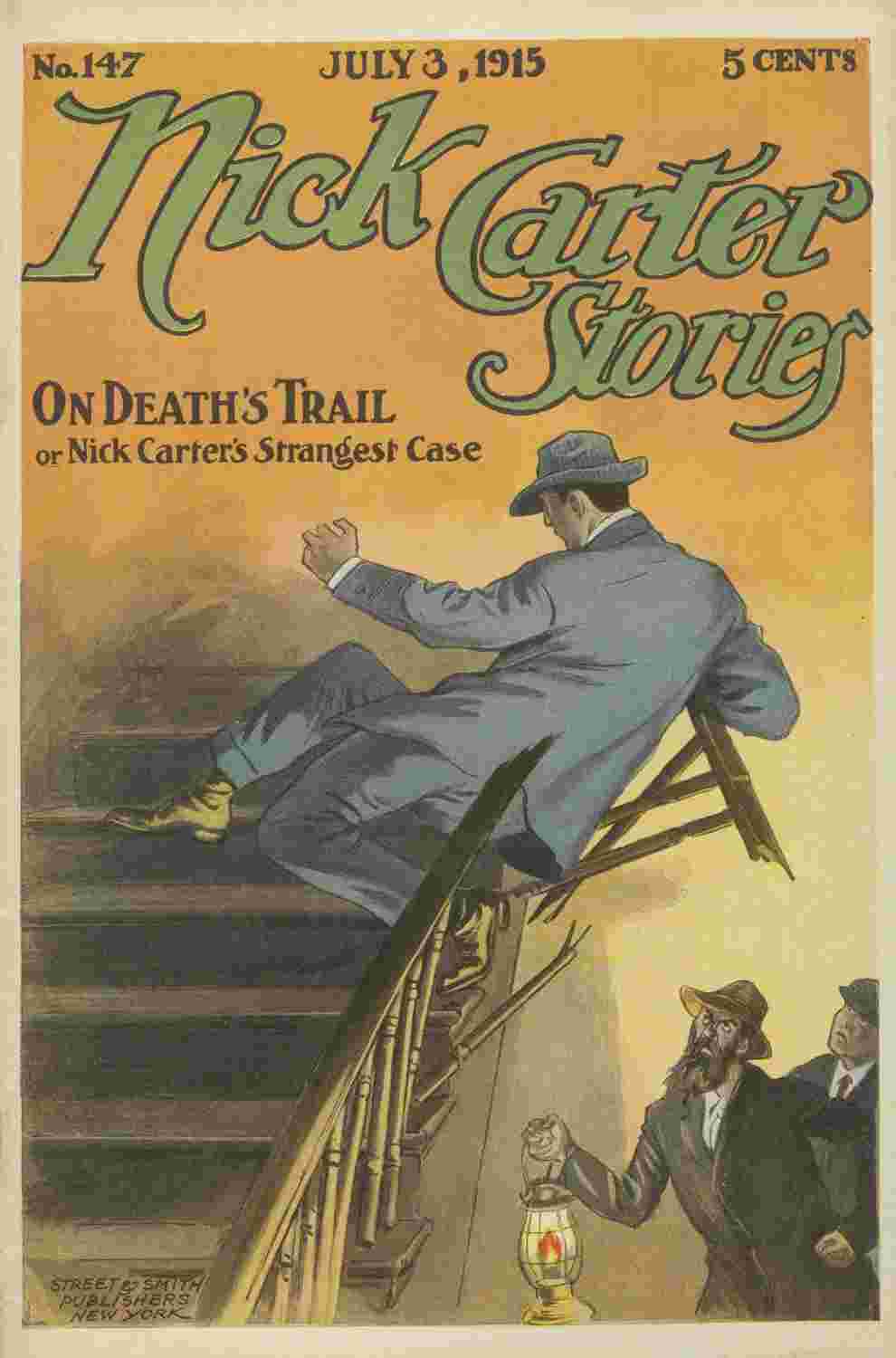
The Project Gutenberg eBook of Nick Carter Stories No. 147, July 3, 1915: On Death's Trail; or, Nick Carter's Strangest Case
Title: Nick Carter Stories No. 147, July 3, 1915: On Death's Trail; or, Nick Carter's Strangest Case
Author: Nicholas Carter
Ralph Boston
Contributor: Charles Heber Clark
Release date: March 13, 2022 [eBook #67617]
Most recently updated: October 18, 2024
Language: English
Original publication: United States: Street & Smaith, 1914
Credits: David Edwards, Chuck Greif and the Online Distributed Proofreading Team at https://www.pgdp.net (Northern Illinois University Digital Library)
Issued Weekly. Entered as Second-class Matter at the New York Post Office, by Street & Smith, 79-89 Seventh Ave., New York. Copyright, 1915, by Street & Smith. O. G. Smith and G. C. Smith, Proprietors.
TERMS TO NICK CARTER STORIES MAIL SUBSCRIBERS.
(Postage Free.)
Single Copies or Back Numbers, 5c. Each.
| 3 months | 65c. |
| 4 months | 85c. |
| 6 months | $1.25 |
| One year | 2.50 |
| 2 copies one year | 4.00 |
| 1 copy two years | 4.00 |
How to Send Money—By post-office or express money order, registered letter, bank check or draft, at our risk. At your own risk if sent by currency, coin, or postage stamps in ordinary letter.
Receipts—Receipt of your remittance is acknowledged by proper change of number on your label. If not correct you have not been properly credited and should let us know at once.
No. 147. NEW YORK, July 3, 1915. Price Five Cents.
ON DEATH’S TRAIL;
Or, NICK CARTER’S STRANGEST CASE.
Edited by CHICKERING CARTER.
CHAPTER I.
AN OPEN QUESTION.
The solitary ray of light that found its way into the dismal room seemed to shrink from entering.
Silence reigned supreme within.
Outside, even the stillness of the night was hardly broken.
It was a ray of moonlight, as feeble through the misty air as “the glowworm’s ineffectual fire.”
It found its way in, nevertheless, under one broken slat of a closed blind, and then it seemed to hesitate, losing life and shrinking from going farther.
Was there a lost life within?
The ray of light came farther and fell upon only one object in the room. All else was gloom and silence.
It stood near the partly open window and the closed blinds. It was as motionless as a block of stone, as white as a figure of marble, as cold as a form of clay.
Its covering of white hid it entirely from view, had there been eyes to see. It hung in flimsy folds on either side of the narrow, unpillowed bed. Now and then a breath of the night air stirred it, but only as if in mockery, and an observer would have shrunk and shuddered—lest its motion had been imparted by what it covered.
It was the only sign of life amid the gloom and silence.
Suddenly the stillness was broken, but only faintly. It was as if a bell tolled too soon the funeral knell. In some quarter remote from the dismal room, a clock struck the hour—three slow, mellow strokes of the bell.
Three o’clock in the morning.
Five hours afterward, when the November sun had risen into the heavens and dispelled the night mists that had hung over the slow-winding Potomac and the nation’s Capitol, a telephone communication sped from {3}the office of the Washington chief of police to a suite in the Willard, in which three persons then were completing their toilets for breakfast.
One was the celebrated New York detective, Nick Carter, and his two companions were his two chief assistants, Chickering Carter and Patsy Garvan.
“I’ll answer it, chief,” said Patsy, who happened to be the nearest to the room telephone.
“Go ahead,” Nick nodded. “Who can want me at this hour? Harold Garland, perhaps, or Senator Barclay, though I can’t imagine for what.”
“It’s Captain Hadley, the chief of police,” said Patsy. “He wants to talk with you.”
Nick took the receiver and called:
“Hello! What’s wanted, Hadley?”
“That you, Nick?”
“Yes.”
“How soon can you leave to meet me?”
“Immediately, Hadley, if necessary.”
“Do so, then. Meet me as soon as possible, at Herman Fink’s undertaking rooms. You know the place. It’s where that crook, Andy Margate, who committed suicide when you cornered him last night, was laid out to remain until this morning.”
“I know, Hadley, of course,” Nick replied. “But what about him?”
“His body is missing.”
“Missing!” Nick echoed, amazed.
“Yes. It was stolen in the night. Fink just telephoned me that he cannot find——”
“Enough said, Hadley,” Nick interrupted. “We’ll see what we can find. I will join you there as soon as possible. I will leave at once.”
“Great guns!” Chick exclaimed, after Nick had told him what had occurred. “Margate’s body stolen! What’s the meaning of that? Are we up against another job in which that miscreant figures?”
“Gee! he’ll not cut much of a figure in any kind of a{4} job,” said Patsy. “He was dead as a doornail when he was lugged into Fink’s back room. I can swear to that, chief, for I saw him stripped, and saw Doctor Nolan view the body. He’s the district coroner and ought to know his business. Say, chief, you don’t think that that rat has put anything over on us, do you?”
The last came from Patsy when he noticed the serious expression that had settled on Nick’s face.
“I hardly think so, though the bare possibility of it occurred to me,” Nick replied, hastening to finish his toilet.
“Holy smoke! it don’t seem possible.”
“Margate was a crafty dog,” Nick added. “He knew more than a wooden Indian. No, I don’t think, of course, that he can have fooled us.”
“Gee! that would be the last straw. I can’t believe it.”
“The theft of his body, nevertheless, unless it can be traced and proved to have been disposed of in some way is a serious matter.”
“Why so, Nick?”
“Because Margate was a dangerous crook. The disappearance of his remains is a thousand times more serious, in view of all of the possibilities involved, than would be that of an ordinary person. If Margate is still alive, incredible though it seems, he again becomes a dangerous menace to society.”
“Very true,” Chick admitted. “But, great guns, it seems utterly incredible. The undertaker, or surely the physician, would have detected it. Besides, we saw him keel over, toes up, when he swallowed poison, and——”
“Stop a moment,” Nick interrupted. “We don’t positively know that it was poison. I’m not dead sure of it, now, in view of what has occurred.”
“You suspect that it was only a drug?”
“That is possible.”
“Something that instantly caused a condition resembling death, but from which he revived later?”
“Such tricks have been turned.”
“But——”
“There is nothing in speculation,” Nick again interposed. “We’ll defer breakfast until we have looked into the matter. There may be evidence that will definitely settle it.”
“Let’s hope so.”
“You had better both go with me,” Nick added. “If the body has, indeed, been stolen, we must find a way to trace it and make absolutely sure that there was no monkey business in the death of Andy Margate. I shall not rest easy while any doubts exist concerning the fate of that designing rascal.”
It then was eight o’clock, precisely ten hours since Nick Carter and his assistants had rounded up Margate and his three confederates for the murder of Father Cleary, a Roman Catholic priest, and the abduction of Lottie Trent, the girl employed in the war department who had confided to the priest the details of a plot to blackmail Harold Garland, an engineer in the same department, as well as the father of his fiancée, Senator Barclay, both of whom had previously been seriously involved in the theft of secret fortification plans by Margate and a gang of foreign spies, all of whom had been run down by the three detectives.
Cornered by Nick and his assistants the previous night, one of the crooks had been fatally wounded, two of them arrested, and their ringleader, Margate, had committed{5} suicide by swallowing poison from a vial seized from his pocket.
There had appeared to be no reasonable doubt of it. The district medical examiner who viewed the body pronounced the man dead, and ordered the removal of the corpse to the rooms of an undertaker until morning, it then being too late to have it placed in the city morgue, pending the necessary legal steps in such cases.
Thus it occurred that the corpse of Andy Margate, or the supposed corpse, if Nick Carter’s present misgivings were warranted, rested that night in the back room of Herman Fink’s undertaking establishment, to which Nick and his assistants repaired as quickly as possible after the astounding telephone communication from Captain Hadley that morning.
The chief had just arrived when Nick entered with Chick and Patsy. They found him in the front office, talking with Herman Fink and Doctor Nolan, the coroner who had viewed the body the previous night, and who was solely responsible for the temporary disposal of it in charge of the undertaker.
The ruddy face of Herman Fink, who was a short, corpulent little German, evinced not only his consternation over what had occurred, but also the fact that he was utterly incapable of having connived in any way at the theft of the notorious crook’s remains.
“Ah, here is Carter, now,” Captain Hadley exclaimed, when the three detectives entered. “Here’s a fine mess, Nick, for fair. I have known live crooks to slip through the fingers of the police, but never a dead one. This is the first case on record.”
“We have no precedent, then, to serve us as a guide,” Nick replied, smiling a bit grimly. “Is there any question, then, as to the theft of the body?”
Herman Fink threw up his pudgy hands and exclaimed, before Chief Hadley could reply:
“Mein Gott! Vot a question? Not der slightest, Mr. Carter, not der slightest. How can there be any question, Der pody is gone, stolen from my pack room, lugged out through der vindow. Come in and see for yourself. Der plinds——”
“One moment,” Nick interposed, detaining him. “I will presently make an investigation. I understand, Doctor Nolan, that you were present when Margate’s body was brought here last night.”
The physician bowed, looking inexpressibly annoyed over what had occurred and evidently feeling that he was in a measure responsible for it.
“I was here, Mr. Carter,” he replied. “I remained until after Fink and his assistant had stripped the body and laid it out. It was nearly one o’clock, mind you, which was the only reason why I deferred sending it to the morgue until this morning. A thought of its being stolen did not enter my mind. I would not have believed it possible.”
“In view of what has occurred, can you believe it possible that the man was not dead?” Nick asked, a bit dryly.
“Not dead!” Doctor Nolan echoed, with a look of derision. “No, no, certainly not. That is absurd, Mr. Carter. I know that he was dead.”
“You feel absolutely sure of it, eh?”
“I certainly do, sir.”
“Did you make any tests to verify your opinion?”
“I did not,” Doctor Nolan declared, a bit brusquely.{6} “No test was necessary. I can tell when a man is dead, Mr. Carter, without resorting to tests.”
“Mein gracious!” Fink exclaimed, starting with a sort of ludicrous commiseration at the detective. “Vat an idea! Not tead—vy, vy, Mr. Carter, dot is der vorst I ever heard. I know der man vas tead.”
Nick did not resent these positive assertions of both the physician and the undertaker. He knew much better than they, however, to what consummate trickery knaves of Margate’s caliber sometimes resort, and he was better informed than either of the ways and means that make it possible.
“I infer, Mr. Fink, that the body was not embalmed, or you would have said so,” Nick replied.
“No, sir, it was not,” Fink allowed.
“At what time did you leave it laid out in your back room?”
“It vas half past von when I vent up to ped.”
“Do you reside over your business establishment?”
“I do, Mr. Carter, mit my family and my assistant, Hans Grost. He came down at half past seven this morning and found der pody vas stolen. He——”
“Who now has the vial, Chief Hadley, from which Margate took the supposed poison?” Nick cut in, turning to the police chief.
“Doctor Nolan has it, I believe.”
“I have,” bowed the physician. “It is in a safe in my office.”
“Does it still contain any of the liquid?”
“A very little, Mr. Carter.”
“Do you know of what it consists? Have you examined it?”
“Not yet. I anticipated no such occasion as this.”
“Hang on to it, doctor,” Nick directed. “A careful chemical analysis may become necessary. Now, Mr. Fink, lead the way to your back room. I’ll see what I make of this extraordinary robbery.”
CHAPTER II.
A CURIOUS CLEW.
Nick Carter lost no time in seeking evidence that would prove conclusively that Margate’s body had really been stolen. He followed Fink through an interior room in which numerous coffins and caskets were displayed in casements of the walls, and adjoining which was the back room in which the body had lain.
It was about twelve feet square. Two windows overlooked a small back yard, from which a narrow alley led out to a side street. The yard was some six feet lower than the avenue on which the building fronted, and below the back room was a basement used for a workroom and storage purposes. A door led from the basement into the yard.
The bare bier stood nearly in the middle of the room.
The blinds of one of the windows was open, the others closed.
A sheet with which the body had been covered was missing.
The garments removed from the corpse the previous night hung on hooks in one of the walls.
Nick quickly took in these features of the scene, and he speedily learned from Fink that both blinds had been closed the night before, that one window was open a few inches, that a door leading to the basement stairs{7} was both locked and bolted, as was true of the lower one leading into the yard. Neither of them appeared to have been opened by the crooks.
“Are these all of the garments removed from the body?” Nick inquired, glancing at them.
“Yes, sir, every piece,” Fink declared.
“The remains were covered, you say?”
“Yes, sir; with a sheet, but that is gone,” said the undertaker.
“It certainly looks like a genuine case of body snatching,” Chick remarked. “Assuming that your misgivings are warranted, Nick, and that Margate tricked us with a drug and afterward revived, he surely would have put on his clothing before departing. He would not have left here unclad, or wrapped only in the missing sheet.”
“Drug be hanged!” Doctor Nolan said derisively. “That’s nonsense. That theory hasn’t feet to stand on.”
“It does seem highly improbable,” added Chief Hadley, gravely shaking his head. “I see no reasonable grounds for such a suspicion. It appears dead open and shut that the corpse was stolen.”
“We must, then, find positive evidence of it,” Nick replied. “The crooks must have left their tracks. It won’t do to remain in any uncertainty concerning the death of Margate. This matter must be positively settled.”
“Settled!” Doctor Nolan scornfully blurted. “It already is settled. There’s no question about it.”
Nick Carter did not reply. He saw nothing to be gained by an argument in support of his seemingly absurd suspicions.
Taking a powerful lens from his pocket, Nick fell to inspecting the floor, the sill of the open window, and the outside of the faded green blinds.
On the floor near the bier were particles of dry dirt, as if tracked in on soiled shoes. The dust on the stone outside of the window had recently been disturbed, while that on the slats of the blinds plainly showed the marks of fingers, evidently thrust between them in order to pull open the blinds.
Glancing down into the unpaved yard, Nick then discovered two quite deep holes in the damp ground, some three feet from the wall and directly opposite the window. He called Chick’s attention to them, remarking quietly:
“There was a short ladder set up against this window.”
“I see. Surely.”
“The indications are, indeed, that Margate was really dead and that his body was stolen. Either that, Chick, or he had confederates who removed and afterward revived him.”
“But how could they have learned that he was brought here?” Chick questioned doubtfully. “It was nearly midnight when we rounded him up, and he was brought directly here from the building in which we cornered him. Who could have learned about it, and how, between half past one and daylight, to say nothing of having framed up and pulled off such a job?”
“That remains to be learned,” Nick replied. “Nor will that alone be sufficient. His body must be traced and found. Go down with me to the yard. We’ll have a look in the alley.”
Fink led the way and unlocked the doors.
“All of you except Chick remain in the basement,” Nick directed, when the others followed him down the stairs. “If there are any footprints to be found outside,{8} or evidence of any kind, I don’t want them obliterated. They may prove to be of value.”
“Ah!” Doctor Nolan exclaimed. “I take it, Mr. Carter, that you are coming to my way of thinking.”
“There is evidence in support of your belief,” Nick frankly admitted, disregarding the tinge of sarcasm with which the physician had spoken.
“I thought you would find it.”
“I may find something more, perhaps, before I end my work in this case.”
Nick’s voice took on a more subtle ring when he replied, stepping out into the yard with his chief assistant.
There in the damp earth they found numerous hardly discernible footprints, most of them near the two holes Nick had observed from the window, or leading toward a gate opening into the alley. All of them were so intermingled and partly effaced, however, that they were of little value. After carefully inspecting them, nevertheless, Nick said quietly:
“Three men have been here. I think that was the number, judging from these faint imprints. One of them held a short ladder while the others entered that window. They brought out the body, whether dead or alive, and got away with it.”
“You still suspect trickery on Margate’s part?” questioned Chick.
“I do,” said Nick. “I believe there is something more than a coincidence in the theft of this man’s body so soon after his supposed suicide. We must go deeper, however, before I can form a more definite opinion. Let’s have a look in the alley.”
Nick found the gate unbolted and called Chick’s attention to it.
“They did not delay to fasten it,” he remarked. “Ah, here is something of more significance! The body was taken away in a box.”
“By Jove, that’s as true as death and taxes,” Chick agreed, after following Nick through the gate. “It also indicates, at least, that the persons who stole the body supposed Margate to be dead.”
“It does appear so.”
The earth in the alley was more damp than in the yard, and was of a grayish clay that readily retained an imprint.
That which at once had caught Nick’s eye was that of a long box, such as caskets are inclosed in for burial. It had been placed on the ground, into which it had sunk just enough to leave a perfectly definite impression of its outlines, presumably when a heavy body was placed in it.
Through the alley leading to the side street, moreover, were numerous footprints; but these were so intermingled and partly obliterated, like those in the yard, as to be of no great value.
Crouching upon the ground, however, Nick made a discovery that would have escaped the observation of most men. It was hardly perceptible, but the keen eyes of the famous detective seldom missed anything out of the ordinary.
“By Jove, here’s a remarkable clew,” said he, suddenly looking up. “I remember none like it.”
“What do you mean?”
“Look closer.”
Nick pointed to the rectangular surface contained within the plainly discernible outlines of the box.{9}
“By gracious! there are some more faint marks on the damp clay,” said Chick, bending nearer.
“Exactly,” Nick nodded.
“What do you make of them?”
“That side of the box that came next to the ground was marked with the ordinary ink and brush such as shippers use. There probably was an address marked on the box.”
“And transferred to the clay?”
“Precisely. The damp clay moistened the ink and has retained parts of some of the more heavily marked letters, chiefly the capital letters.”
“I see.”
“They are faint and much blurred, however, as well as reversed in position; but—yes, I am right. Here are two at the end of an address marked on the box.”
“They look like two small letters, a ‘g’ and an ‘e,’” said Chick, twisting so as to view them better.
“That’s correct,” said Nick, using his lens. “They are the final letters of the word college. Here is the loop of one ‘l’, also the larger curve of the capital ‘C.’”
“By Jove, that’s very significant,” said Chick. “This may have been the crime of medical students who wanted a body for dissection.”
“I begin to think so.”
“Can you determine any of the other letters?”
“Only three capitals,” said Nick, still scrutinizing the blurred marks with his lens. “There appears to be two quite long words preceding the word ‘college’.”
“That immediately preceding it begins with ‘M.’ It may be medical.” Chick quickly suggested.
“I am quite sure of that.”
“What are the others?”
“There seems to be two words preceding that, or one very long one,” said Nick. “They are so blurred that I cannot read them. The first capital in the address, however, is a ‘D.’”
“It evidently is the name of a medical college.”
“I think so.”
“The location is not legible?”
“No. Only a capital ‘S,’ evidently that of the word ‘street.’ No numerals are discernible.”
“The box must originally have contained something that was shipped to a local medical college,” said Chick. “With the initial to aid us, and the fact that it is in one of the city streets, not an avenue, the directory should enable us to identify it.”
“We will see after going a step farther,” replied Nick, rising and replacing his lens in his pocket. “I wish to inspect this side street.”
He led the way while speaking, and paused on the curbing of the sidewalk. The street was a narrow, unpaved one, flanked on both sides with inferior stores with dwelling apartments above, a street that was only dimly lighted after the early hours of the evening.
The ground was somewhat muddy from recent rain, and near the curbing were plainly discernible the tracks of a wagon and the footprints of the horses attached to it.
“A team stopped here last night,” said Nick, pointing. “There was a fourth man in the gang.”
“Why do you think so?”
“Because here are four tracks of tires close to the curbing. There would be only two, those of the front and rear wheels, if there had been only one stop made.”
“That’s true.{10}”
“I am sure there were three men who took the body from the back room,” Nick added. “No less could have accomplished it without being heard. They would not have dared to leave their team standing here all the while. The fourth man drove away and returned to get his confederates and their burden. That’s why we find four tracks here, instead of only two.”
“Surely,” Chick agreed. “There’s no getting around it.”
“The wagon had rubber tires, moreover, and—yes, by Jove, one of them was patched, or mended. Here are the marks left in two places by a seam, or where some new rubber was vulcanized to the old. This will help some, I think.”
“We can bank on that, Nick, all right.”
“Say nothing about this to others,” Nick directed. “We will follow up these clews and see to what they lead, Chick, before making any disclosures.”
“That’s good judgment.”
“Come. We’ll return to the shop.”
As they retraced their steps through the alley, Nick obliterated the evidence found there, treading out the imprint of the box with his boots.
“Well, what have you learned?” Chief Hadley asked, when the two detectives entered and rejoined the group in the basement. “You have been gone long enough to have discovered something.”
“Enough to further confirm Doctor Nolan’s opinion,” Nick replied, a bit dryly. “The body was taken away by four men who came in a wagon.”
“Ah!” Doctor Nolan exclaimed. “I was reasonably sure of it.”
“There is no other evidence worthy of mention,” Nick added. “It may be well, chief, to have an officer inquire at the dwellings in the side street. The crooks possibly were heard, or even seen, without the truth being suspected.”
“I will attend to it,” Hadley nodded, while they returned to the office of the undertaker.
“There is nothing more to be learned here,” said Nick. “I will look deeper into the case, however, and will report to you later.”
“Do so, Nick, by all means.”
“Regarding that vial, Doctor Nolan. I want you to let Chick take it for a few hours,” Nick added, turning to the physician. “I want an analysis of its contents, or the nature of it to be positively determined. I will be responsible for its safe return.”
“That’s good enough for me, Carter,” Doctor Nolan readily assented.
“Chick will call at your office for it later in the day.”
“Very well.”
Nick did not defer his departure to further discuss the matter. He left Chief Hadley and the coroner to proceed as they saw fit, and Herman Fink in quite abject consternation over the gruesome calamity that had befallen him.
“We now will hunt up a directory,” Nick remarked, walking up the street with Chick and Patsy. “I decided not to consult the one in Fink’s office.”
“It would have led Hadley to suspect that we are wise to something,” smiled Chick.
“Surely.”
“What have you picked up?” questioned Patsy, surprised.{11}
Chick informed him, ending just as they arrived at a corner drug store, into which Nick led the way.
A city directory supplied him with the information he was seeking.
“Here we have it,” said he, while Chick and Patsy eagerly read the address to which he pointed. “The Dabney Private Medical College.”
“By Jove, there is no question about it,” Chick declared.
“Private—that was the word that bothered me,” Nick added. “The first two words looked like a single exceedingly long one. This certainly does settle it. Come on. We’ll not wait for breakfast. We’ll find out what’s doing in this Dabney Private Medical College. There shall be nothing too private for us to butt into, Chick, take my word for that.”
CHAPTER III.
THE EMPTY BOX.
Gifted with more than ordinary intuition, as well as a remarkably keen perception resulting from years of trained experience, Nick Carter already felt sure that the case engaging him had features that did not yet appear on the surface, and that it might prove to be one of the strangest cases on record.
It still was comparatively early, only nine o’clock, when Nick arrived with Chick and Patsy in the neighborhood of the Dabney Private Medical College.
From a policeman whom he met and whose beat was in that locality, Nick learned that the institution was a small one, having usually only about twenty students, and that it was conducted solely by one Doctor David Dabney, a physician of good reputation, recognized ability, and a man of considerable means.
The last was manifest in the locality and appearance of the place presently viewed from a near distance by the detectives. It occupied a corner estate of considerable size, containing an attractive stone residence and a near building of brick, to which an annex evidently had been added, and beyond which were a stable and garage, the driveway to which was entered from a side street. All were of a superior type, while the well-kept grounds were adorned with numerous shade trees, the branches of some of which mingled with those in the rear of a fine estate forming on a fashionable avenue.
The latter struck Nick as being somewhat familiar, but seeing only the rear of the handsome wooden residence, which was almost hidden by the intervening trees, and not having approached by the way of the avenue, he did not then recall when he had previously seen it, or who dwelt there.
In view of what the policeman had told him, and which the appearance of the Dabney place seemed to confirm, Nick quickly decided how he would proceed.
“If the physician is all that the officer stated, he would not countenance the theft of a corpse, even that of a crook, and the job must have been secretly done by some of his students, assuming that we are in right,” said Nick, after sizing up the place.
“That now seems reasonable,” Chick agreed.
“Gee, we ought to be able to cinch it!” said Patsy. “The wagon and box must be here, as well as the body, even though that may have been concealed. We ought to be able to find them.”
“We’ll find them, Patsy, if they are there,” Nick re{12}plied. “I’ll enter and have a talk with Dabney. You two saunter around to the side street from which the driveway leads to the stable and garage. Keep your eyes open and hold up any one who attempts to leave while I am getting in my work. I think I can drive the game from cover.”
“Go ahead,” Chick nodded. “We’ll follow in a few moments.”
Nick moved on, and presently entered a walk leading to the physician’s residence. A man came out of a side door at the same moment and started to cross the grounds toward the brick building mentioned. Upon seeing Nick, however, he turned and approached him.
He was a tall, spare man of about sixty, with smooth-shaved and rather angular features, a prominent nose, deep-set eyes, and a high brow. He was clad in a black suit with a long frock coat, which accentuated the height of his somewhat attenuated figure. He bowed when the detective drew nearer, saying, with an agreeable voice:
“Good morning, sir.”
Nick returned the greeting, then added:
“I am looking for Doctor Dabney.”
“You need look no farther,” smiled the physician. “I am Doctor Dabney. What can I do for you? Will you walk into the house?”
“I think not,” Nick replied, knowing that what he sought would not be found in the house. “My name is Ryder. I have a nephew who wishes to become a physician, and I am thinking of sending him here for tuition, if agreeable to you.”
Doctor Dabney brightened perceptibly.
“It will be decidedly agreeable, Mr. Ryder,” he said, extending his hand to shake that of the detective. “I am always glad to add to the list of my students. How old is your nephew?”
“He has just turned twenty.”
“A very good age at which to begin a course of medical study. Do you reside in Washington?”
Nick replied that he did not, and he then proceeded to make a few consistent inquiries as to terms and accommodations for students, and he wound up with remarking:
“If you can spare the time, Doctor Dabney, or will have some one conduct me, I would like to inspect your college building and its various departments. I infer that you have no objection.”
“Quite the contrary,” Doctor Dabney said quickly. “I will be more than pleased to show you around. I am to give a lecture in the dissecting room in half an hour, but I shall have ample time to accompany you.”
“The dissecting room—that is one place I would specially like to visit,” said Nick, with manifest interest.
“We can conveniently begin with that, for it is in the annex,” said Doctor Dabney, pointing toward the rear of the brick building. “Come with me. Some of my students are beginning to arrive, you see. They are the ones whose homes are in or near the city. I at present have only twenty students who are quartered in the college, though we have accommodations for twice that number.”
Nick had already observed that several young men were entering from the side street, while others were gathered near a door leading into the annex. He was quick to detect, moreover, that a group of three in front of the garage and stable were betraying a much more serious interest in him while he approached with the physician. They were talking earnestly and viewing him with a{13} furtive, apprehensive scrutiny which, with their noticeable paleness, at once convinced him that they were the culprits he was seeking.
Nick evinced no special interest in them, however, but remarked to the physician, following up the topic under discussion:
“I suppose you find it difficult at times to obtain subjects for dissection?”
Doctor Dabney heard him without a change of countenance.
“Well, yes, at times,” he admitted. “They can be obtained only through the proper authorities and by paying a fixed price. That is to say, of course, unless one resorts to felonious methods to get them,” he added, smiling significantly. “But I would not sanction anything of that kind.”
“I suppose not.”
“No, not for a moment,” Doctor Dabney declared.
Nick believed him. He saw plainly enough that the physician was not only a man of character, but also that he had too much at stake to have connived at such a crime as had been committed the previous night.
They had been following a driveway passing the garage and stable. In the latter a hostler was washing a covered wagon, and Nick glanced in and noted that the wheels had rubber tires.
A few more steps brought them to the annex of the brick building. A door leading into a broad corridor with a cement floor was wide open.
Instead of immediately entering, however, Doctor Dabney turned to another door some twelve feet to the right, remarking, while he opened it:
“Speaking of subjects for dissection, Mr. Ryder, I will begin with showing you where they are kept until wanted. The door in the rear leads directly into the dissecting room, where I give many of my lectures.”
Nick peered into the cold basement room which the physician disclosed. It was lighted with only a single narrow window, high in one of the walls. The door in the rear wall was closed.
On a low stone shelf at one side a covered figure was lying, gruesome in its suggestiveness, but the size of which at once convinced Nick that it could not be the body of Andy Margate.
Near the opposite wall, nevertheless, and equally convincing to the detective, stood a long, narrow box, somewhat faded and defaced, which Nick saw at a glance was about the size of the imprint found in the alley back of Fink’s undertaking rooms.
“It’s not a very agreeable sight, Mr. Ryder, but I thought you might wish to omit nothing in connection with my establishment,” said Doctor Dabney, in apologetic tones.
“Quite right,” Nick replied. “Do you mind if I step in?”
“Certainly not,” said the physician, with a look of surprise.
“Such things do not affect me seriously,” Nick added. “The room appears well adapted to what is required of it. May I ask, Doctor Dabney, what this box contains?”
Nick touched it with his foot.
“Nothing whatever. It is empty.”
“Are you sure of it?”
“Sure of it—certainly,” exclaimed the physician. “It was put here only temporarily. It contained the casement in which a skeleton was recently shipped to me from{14} New York. The skeleton has been removed and is now in the dissecting room.”
Nick turned and regarded him more sharply.
“Would you be surprised, Doctor Dabney, if I were to tell you that the box now contains a corpse?” he inquired.
“Surprised would hardly express it,” Doctor Dabney replied, with a shrug. “I would not call you a liar, of course, but I would say that you never were more mistaken in your life.”
“Nevertheless, doctor, you’re the one who would be mistaken,” said Nick pointedly.
“Nonsense! You don’t mean——”
“I mean just what I say, Doctor Dabney. This box now contains a corpse.”
“Absurd! How could——”
“Wait a moment,” Nick again interrupted. “Let’s see whether I am right. It is a matter that can be easily and quickly settled. See for yourself, Doctor Dabney.”
Nick had previously noticed that the screws had been removed from the cover of the box, though it still remained in position. He bent over while speaking and seized one side of it, then tipped it over on the floor.
No cry of amazement came from the physician.
The detective was the one who drew back with surprise.
Quite naturally, of course, Doctor Dabney now began to suspect some ulterior motive for the detective’s conduct. He straightened up with a frown, saying a bit brusquely:
“This is no place for a jest, Mr. Ryder, as you should know without being told. If you are not what you pretend, and have any reason for thinking that this box contained a body, I beg to inform you——”
“One moment, doctor, if you please,” Nick interposed. “I will presently explain to your entire satisfaction.”
Nick turned over the box while he was speaking. He found on the lower side a blurred black address printed with a shipper’s marking brush. The wood still was damp and soiled with grayish clay, moreover, which alone would have convinced him that he had made no mistake.
Nick did not immediately explain to the physician, however, who stood watching him with a darker frown on his thin face. He saw that about a dozen of the students had gathered in the driveway near by, all of them men in the twenties, and among them the three whom he had seen talking so earnestly near the stable.
Nick stepped out and approached the group, apparently with no aggressive intentions, until, turning abruptly to one of the three, he said sternly:
“Well, what have you done with it?”
The man addressed was about twenty-five, and quite a powerful fellow, set up like an athlete, with dark features and somewhat sinister eyes.
“Done with what?” he demanded. “You appear to be addressing me.”
“That’s right,” Nick nodded. “I am addressing you and your two companions, and your faces alone warrant what I am saying. What have you done with it?”
“I don’t know what you mean,” snapped the other. “If you think——”
“Stop one moment,” Nick sternly interrupted. “I know, young man, which is much more than to merely think. You three men, with a fourth to aid you, stole a corpse last night from the back room of Herman Fink, the under{15}taker. You used the rubber-tired wagon in yonder stable. You stopped in the side street, entered through an alley, and, with a short ladder, you took the body through the undertaker’s back window. You put it in that box, which you already had placed in the alley, and afterward brought it here.”
“I guess not,” cried the same man defiantly. “You’re talking through your hat, Mr.——”
“Carter is my name—Nick Carter,” the detective again cut in. “You may have heard of me. Whether you have, or not, is immaterial. I can prove all that I have said, and only the truth, if you chose to make a clean breast of the whole business, will save you fellows from—ah, here is additional evidence, if that were needed. It appears that your confederate, the fourth man, was about to bolt.”
Nick had caught sight of Chick and Patsy approaching from the side street, each grasping the arm of a tall, pale young man, who appeared to be on the verge of fainting.
CHAPTER IV.
MARKED IN DUST.
The mention of Nick Carter’s name, following close upon his positive accusations, produced an immediate change in the attitude of the three recreant medical students. Defiance vanished like a flash from the face of the one who had been talking, and whom Nick now suspected of being the leader in the crime of the previous night.
Another was trembling visibly, while the third impulsively blurted, as if impelled by the detective’s advice:
“There’s nothing to it, Oakley, but to confess the whole business. Neither bluff nor bluster will cut any ice against Nick Carter. Good heavens! what possessed me to do such a thing?”
“That’s not the question,” said Oakley, a bit sullenly. “You now have confessed the whole business, barring the outcome. Only the devil himself can explain that. The question is—what became of the body?”
Nick Carter heard the last with no great surprise. It was in line with his earlier suspicions. He saw, too, with what consternation Doctor Dabney and the other students began to realize what had been done the night before, and he checked with a gesture the censure that was rising to the lips of the astounded physician.
“You hold your horses, Doctor Dabney, and let me handle the ribbons,” he said impressively. “The reputation of your college is at stake, and I am much better able to save it than you, providing the remorse of these young men is genuine and they follow my advice. The good name of your institution should not be ruined by the foolishness of a few of your students, if it can possibly be prevented. I think they now will see it in the same light and do all in their power to rectify their folly. What do you say, Mr. Oakley?”
Oakley threw up his hands and met the detective better than halfway.
“I say that you’re all wool and a yard wide, Mr. Carter,” he cried, with genuine feeling. “I’ll speak for the others and tell you the whole story. Not only that, sir, but we’ll do all we can to repair the wrong.”
“Spoken like a man,” Nick replied. “I learned long ago that a manly man can be brought out flat-footed{16} with proper handling. What is the whole story, Mr. Oakley?”
“It can be told with a breath, Mr. Carter, and I’ll hand it to you straight,” said Oakley. “We were out late last night, I and these three companions, and we drank a bit more than we should have done. When wine goes in, wisdom and discretion go out, sir, and that was the beginning of it.”
“Continue, Mr. Oakley,” said Nick.
“Well, sir, we came to Fink’s place along about one o’clock, and we saw that a corpse had been taken in there. We learned from a chap who had overheard the facts, that it was the corpse of a notorious criminal, and that it was to remain in Fink’s place till this morning, instead of being sent to the morgue.”
“That was correct.”
“Well, sir, in the heat of wine, I suggested to my companions that we ought to have that criminal’s brain for examination, in the interests of medical science and the possible benefit to society. It was a mad suggestion, but not too mad for my companions. We were just right to do what, if in our sober senses, we would not have done for the world.”
“In brief, Mr. Oakley, you went there and stole the body,” said Nick.
“That’s just what we did, sir, and precisely as you have stated,” Oakley admitted. “We came here and quietly got out the wagon, also a short ladder with which to reach the undertaker’s back window, which we had located before going away. We brought the body here about four o’clock this morning. We did not dare to leave it in the box, however, which we had taken from the room you have just inspected. We replaced the box in the room, but hid the body in the basement under the dissecting room.”
“It then was about four o’clock?”
“Yes, sir.”
“Continue.”
“We already had begun to realize, of course, the gravity of the crime we had committed,” Oakley proceeded. “We went to my apartments in the street below, but not to go to bed, for we were much too nervous to sleep. We held a long discussion of the matter and the situation in which we had placed ourselves, and we finally determined to replace the corpse in the wagon and to return it to Fink’s place, making a frank confession of our guilt and relying upon his mercy. But we found, upon returning to the basement, that we could not do so.”
“Could not, Mr. Oakley?”
“No, sir,” cried Oakley, with augmented feeling. “It was impossible for us to do so. Imagine our surprise, our consternation, our utterly inexpressible dismay.”
“You mean——”
“I mean, sir, that the body was gone.”
“That’s true, Mr. Carter,” groaned another of the culprits. “Every word of it is true as gospel. The corpse had vanished as if the earth had swallowed it. We searched in vain. Good heavens, what a mess! I thought, sir, I was going daffy.”
Nick Carter was less surprised than the other hearers. He had begun to suspect what had really occurred and how it was possible. He paused to briefly consider the matter from every standpoint, aiming to act for the best, while Doctor David Dabney relieved his pent-up feelings in terms that would read even worse than they{17} sounded, and while the half score of students who had gathered near by stared in mute amazement over the bewildering affair.
Nick presently took the ribbons again, however, saying with an impressiveness that never failed to prove effective:
“There is nothing in harsh words, Doctor Dabney, at this stage of the game. We must meet the situation in the best way and attempt to remedy it without too much publicity. I am not going to arrest these young men at present, nor later if it can be avoided.”
“Good for you, sir,” cried Oakley gratefully.
“I shall bind them on their honor to remain here, as usual, and these other students, as well as yourself, to say nothing about this matter,” Nick added. “Upon your silence and theirs may depend the effect of all this upon your institution. I happen to know all about the criminal whose body seems to have disappeared so mysteriously, and the recovery of which is of much more importance to me, as well as to the community, than the immediate censure and punishment of these four students. You must do what I have directed, therefore, while I shall take immediate steps to trace the missing body.”
Nick’s consideration and advice had the effect he anticipated. Doctor Dabney subdued his anger and eagerly seized the opportunity to avoid publicity. The relief of the four culprits was beyond description, and one and all who were present pledged themselves to strictly follow the detective’s instructions.
Thus the matter was adjusted temporarily, at least, and Nick then turned to Oakley and said:
“Conduct me to the basement, now, and show me where you left the body. In the meantime, Doctor Dabney, that there may appear to be nothing unusual going on here, have all of your other students attend the lecture you had planned to deliver. There is, in fact, no occasion to postpone it. I will undertake with my two assistants to do all that the case now requires. Lead the way, Oakley, that no time may be lost.”
The last was said with a significant glance at Chick and Patsy, and the three detectives followed Oakley toward the basement door, while Doctor Dabney and the gathering students trooped toward the entrance to the annex in accord with Nick Carter’s instructions.
“I happen to have a key that will open this door, Mr. Carter, or we must have found some other hiding place for the body,” Oakley explained, while unlocking the basement door. “How it was discovered and removed by others—well, sir, that beats me to a frazzle. I was literally knocked stiff when I found it missing.”
“Had you detected any sign of life, Oakley, while handling it?” Nick inquired. “I infer, of course, that you had not.”
“Not the slightest, Mr. Carter,” said Oakley, with a look of surprise. “You surely do not suspect——”
“Never mind what I suspect,” Nick interrupted, while descending to the basement. “Show me just where you placed the body.”
Oakley led the way to a corner back of some coal bins and pointed to the floor.
“We left it there, sir,” he said simply.
“With a covering over it?”
“Yes, sir; the sheet brought from Fink’s place.”
“Nothing else?”
“No, sir.{18}”
“Did you lock the door after going out with your companions?”
“That was not necessary,” Oakley explained. “It has an automatic spring lock, like many of the doors in this building, which can be opened from within, though a key is required by one entering from outside. They were equipped with locks of that kind because students frequently are the last to leave the building, and it obviated providing keys for all.”
“I see,” Nick remarked. “One can leave this basement without a key, then?”
“Yes, sir; easily.”
Nick took out his electric searchlight and began a close inspection of the cement floor. It was covered with a thin, almost imperceptible layer of dust, mingled with which were particles of coal dust, quite plainly visible with the aid of a powerful lens.
“You have given it to me straight, Oakley, all right,” Nick remarked, after a moment, looking up. “My lens shows where the dust has been disturbed, and I can determine part of the outline of the body. There appears to have been considerable moving about, however, either by——”
“Surely not by the body!” Oakley exclaimed, staring.
“Don’t be so sure of that,” Nick said dryly. “Things aren’t always what they seem. We may find that—ah, I find it even sooner than I expected. Here is one—yes, a second and third. This tells the story.”
“What is it?” cried Oakley impulsively.
“Have a look, Chick,” said Nick. “Use my lens.”
Chick hastened to comply, viewing one of several faint bits of evidence on the dusty floor.
“What is it?” Oakley repeated, quivering with excitement.
Chick looked up and replied:
“It’s a faint print in the dust—the print of a naked foot.”
CHAPTER V.
WHERE THE TRAIL LED.
“Subdue your surprise. This is no more than I was expecting to find,” said Nick Carter, glancing at Oakley’s amazed face. “I have picked up a trail which I felt sure I must seek, sooner or later, and to find where it leads now is of paramount importance.”
“Gee! that’s right, chief, for fair,” said Patsy. “This man hunt now opens in earnest.”
“I shall need you no longer, Oakley,” Nick added. “You had better join the other students at the lecture. I will do what I can to pull you fellows out of this scrape, but much will depend upon what already has been published, and upon my success in finding the missing man. No, no, don’t demur over going, nor stop to thank me. Time now is of double value. Go at once.”
Oakley appeared anxious to remain to follow farther the detective’s investigations, but the expression in Nick’s eyes warned him against objecting, and he turned with a nod and a mere word of thanks and hurried from the basement.
“By Jove, this is a most extraordinary case,” Chick then said, a bit grimly. “Have you now any doubt, Nick, that Margate still is alive?”
“Not the slightest,” Nick replied. “I have felt from the first that that was the case.{19}”
“But how could he have accomplished——”
“Oh, the circumstances admit of only one explanation,” Nick interposed. “Margate had, when we cornered him, some kind of a drug or compound which, when swallowed, instantly produced a physical condition so closely resembling death that it deceived not only us, but also Doctor Nolan and the undertaker.”
“It did, indeed.”
“The condition, which was probably a form of catalepsy, evidently lasts a definite number of hours, depending in a measure upon the health and strength of the subject, and concerning which Margate must have been perfectly informed.”
“Surely.”
“He took the one chance that, if supposed to be dead, he would throw off the effects of the drug and revive at such a time and in such surroundings as would permit of immediate flight.”
“The drug evidently ceased to be effective between four o’clock and daylight.”
“Undoubtedly,” said Nick. “That would have served him admirably if he had remained in Fink’s back room. He could have arisen and quietly dressed himself, his garments having been left in the room, and he could easily have made his escape.”
“Sure, chief,” put in Patsy. “Like turning over in bed.”
“The job done by the students, however, put him in bad,” Nick added. “He must have revived in this basement, in a building in which he probably could not obtain a rag of clothing, aside from the sheet with which he was covered. Immediate flight, however, was imperative. He luckily had the advantage of darkness, and he probably fled at once, wrapped only in the sheet. His first move, of course, was to find garments by some hook or crook and in some near quarter, and I think we can learn where he got them.”
“He did not break into Dabney’s house, nor the rooms of any of the students, or the fact would have been reported,” said Chick.
“He would have been less likely to do that, Chick, than to have sought some near residence occupied by fewer persons and presenting less danger of detection and arrest.”
“That’s true.”
“I will try with Patsy to follow up the trail,” said Nick, turning to the door. “You go to Doctor Nolan’s office in the meantime and get the vial still containing some of the drug, or compound, used by Margate. Take it to Professor George Arden, whose address you will find in the directory. He is one of the leading chemists in the country, and he probably will be able to tell us of what the stuff consists.”
“Most likely,” Chick agreed. “Where will I see you later?”
“At the Willard. We will return about noon for lunch.”
“Very good. I’ll be there,” Chick nodded, turning to go.
They had emerged from the basement while speaking, and Nick and Patsy now began seeking the trail of the missing man. Neither in the driveway, nor on the surrounding lawns, could they discover any sign of a bare footprint, however, and Nick paused after a few moments and said:
“We must use our heads and determine what direc{20}tion he naturally would have taken. He would not have ventured to the lighted streets. He would have known he might be seen and arrested.”
“That would have been very probable, chief, for fair,” said Patsy.
“He may have crossed the rear grounds, therefore, and perhaps saw that house which fronts on the avenue. The roof could have been seen above the trees, even in the darkness.”
“That’s right, too.”
“We’ll go that way, Patsy, and see what we can learn. Keep your eyes open for footprints.”
“Bet you!” said Patsy sententiously.
It took them only a few minutes to cross the Dabney grounds, when they brought up at a low wall flanking the rear of the estate Nick had noticed when he first arrived in that locality. It now struck him even more familiarly, though he never had seen the rear grounds, nor that side of the imposing wooden residence.
“Come on,” he said, leaping over the wall. “The direct course, if Margate had his head and really came this way, would have been around the garage and across the side lawn.”
“Sure, chief, if he was heading for the house,” said Patsy.
“A dwelling is where he most likely would have sought clothing,” Nick replied. “A knave as desperate as he and as sorely in need of garments would not have shrunk from breaking in and——”
“Gee! half a minute, chief,” Patsy now cried, interrupting. “Yes, I’m right. Here’s the print of a bare foot.”
Patsy had discovered it in some loose earth near the garage and hastened to inspect it. There was no mistaking it, for it was distinctly outlined in the damp soil, and it showed plainly in which direction the man was going.
“He was heading for the house, chief, just as you have suspected,” Patsy added, turning to look for another.
“I was sure he would seek some dwelling,” Nick replied. “Which one was the only question. It naturally would be the one most safely and quickly approached, and that was why I came this way. We’ll inquire whether anything has been stolen, or—hello! some one is calling my name. By Jove, it’s Senator Barclay. That explains it. I thought I recognized this place, though I have called here only twice.”
“Gee! he’s some excited, chief,” said Patsy. “I guess you have hit the nail on the head, all right.”
Senator Barclay, who had emerged from a side door of the house, had been hurrying toward them while they were speaking. He was hatless and wore a loose velvet smoking jacket, and he looked pale and excited, indeed, in the morning sunlight.
“I saw you from the library window, Nick,” he cried, upon drawing nearer. “What brought you here? I’ve been trying vainly to get you by telephone. I was told that you left the Willard before breakfast.”
“So I did,” Nick replied, shaking hands with him. “I was called out on a rather curious case. But what do you want of me, Senator Barclay, and why are you so disturbed?” he added tentatively.
“I have cause to be disturbed, most serious cause,” Senator Barclay answered, with an effort to govern his feelings. “I will tell you of that a little later. My house has been robbed—a most amazing robbery.”
“Why amazing, senator?{21}”
“Judge for yourself. Every piece of my clothing, removed when I went to bed last night, was carried away by the thief. Shoes, stockings, underwear, shirt, and outside garments—not a piece was left behind by the rascal. Why he took such articles is more than I can fathom. Why he——”
“One moment,” Nick interposed, with a furtive glance at Patsy. “Did he take anything else of value?”
“I should say he did,” Senator Barclay cried impetuously. “My pocketbook containing several hundred dollars, my diamond pin worth nearly a thousand, my watch and chain—all of them went with the garments.”
“H’m, I see.”
“Not content with them, moreover, the rascal robbed the sleeping room of my daughter Estella, and got away with considerable money and a quantity of costly jewelry, which unfortunately had not been put in the library safe.”
“Your loss will aggregate, then——”
“Ten thousand dollars, at least, as far as the plunder goes. But that is nothing, absolutely nothing, Nick, compared with the loss of one other article,” Senator Barclay said, with a groan.
“One other article?” Nick echoed, gazing at his white face. “What is that?”
“I cannot tell you—not here,” was the reply. “I must talk with you privately. Come to the house. Stella is nearly prostrated, but she does not dream of my distress and anxiety. I have hidden the truth from her, even, and can confide only in you, Nick. For you are the one man on whom I can depend, who may be able to successfully meet the situation. Come to the house. I then will inform you.”
“Very well,” Nick consented. “I understand, now, why you were so anxious to reach me.”
“I was more than anxious, more than anxious,” Senator Barclay repeated, while Nick and Patsy accompanied him toward the house. “There is another mysterious feature in connection with this robbery, Nick; one that seems utterly inexplicable.”
“What is that?” Nick inquired.
“The thief, or thieves, as the case may be, left a soiled sheet in the butler’s pantry, which they entered by breaking the window and unlocking it. The pantry is so shut in that the noise was not heard. The robbery was not discovered until Estella awoke early this morning and found that her room had been entered. Why the burglars had a soiled sheet, which looks as if it had been through a war, puzzled me even more than——”
“It does not puzzle me, Senator Barclay,” Nick interposed.
“No?”
The statesman gazed at Nick with a look of amazement.
“Not at all,” Nick added. “There was only one burglar, senator, and I happen to know why he had a soiled sheet.”
“Good heavens! is it possible?” Senator Barclay replied, with countenance beginning to brighten. “There are hundreds of brilliant and discerning men in the circle of my acquaintance, Carter, but you certainly have something on all of them. What do you mean? How do you know there was only one burglar, and why he left a soiled sheet in my house? By gracious, I begin to feel that you may yet avert the calamity that threatens me.”
“Let’s wait until we are seated in our library, senator,” Nick replied, smiling. “I then will answer your{22} questions and learn what you require of me. It goes without saying, of course, that I will do all in my power to avert any calamity that threatens you.”