
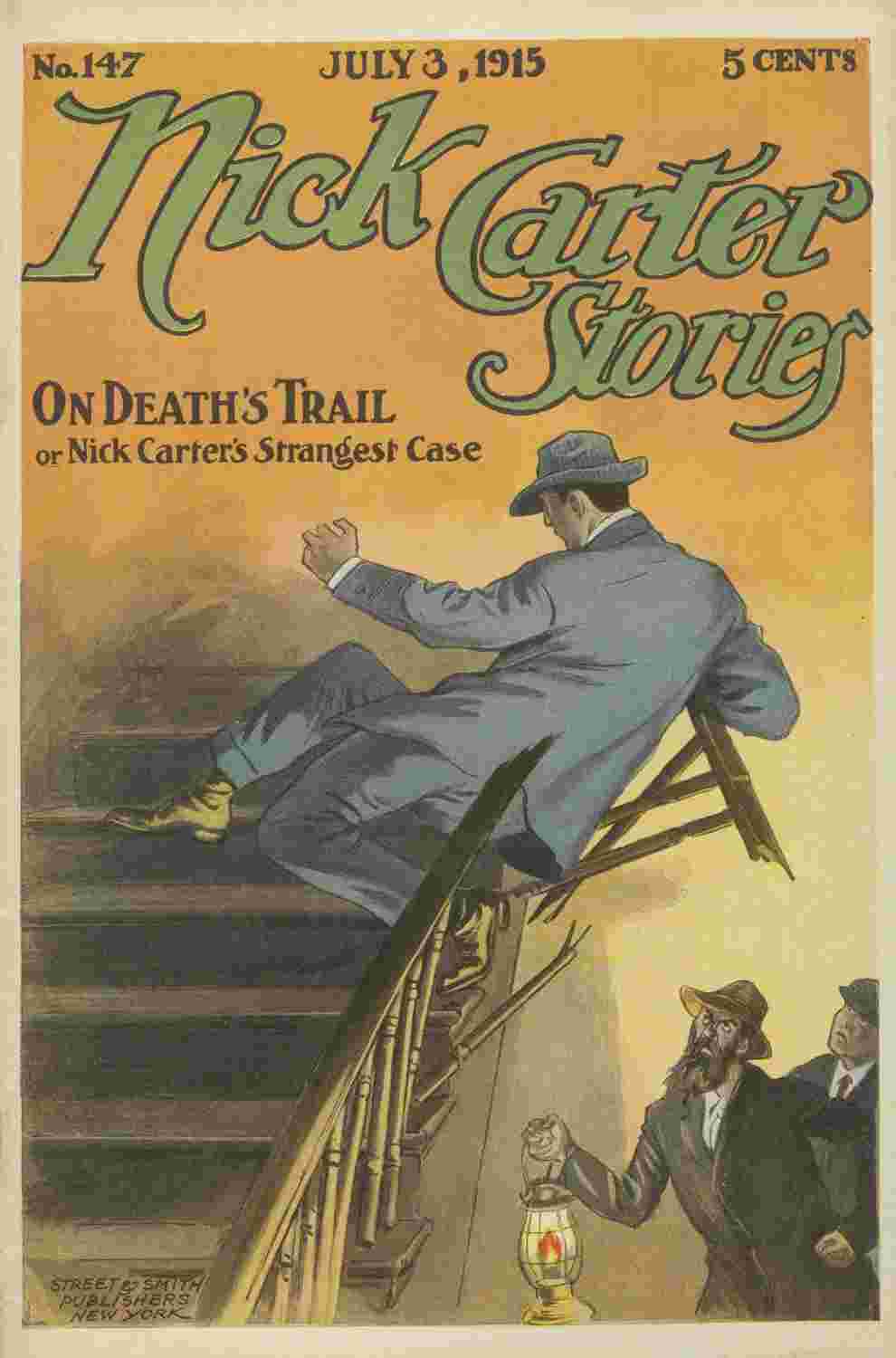
Sheridan of the U. S. Mail.
By RALPH BOSTON.
CHAPTER I.
THE BOSS DEFIED.
The man in the gray uniform of Uncle Sam’s postal service laughed lightly. “Don’t talk like a boob,” he said. “I’m not defying any organization, and I have no desire to make an enemy of Mr. Samuel J. Coggswell or anybody else. If he’s petty and narrow-minded enough to get sore on me just because I refuse to give up five dollars for a picnic ticket for which I have no earthly use, well, I can’t help it.”
The smile upon his good-humored face suddenly gave place to a sterner expression. “And let me tell you,” he went on, “I don’t like your method of selling tickets. The way you go about it looks to me very much like blackmail. I never had the pleasure of meeting your friend, Mr. Coggswell, but if he instructed you to hold up strangers on the street, and hand them that line of talk, I haven’t any use for him; and you can tell him I said so.”
The stout, red-faced, flashily dressed young man who had accosted the letter carrier on the street corner just as the latter was about to enter Branch Post Office X Y, scowled at this utterance.
“Oh, I’ll tell him, all right,” he retorted. “You can bet he’s goin’ to hear about your freshness. What’s your name, anyway?”
“Owen Sheridan,” was the prompt reply.
The other produced a pencil and memorandum book from his vest pocket and ostentatiously made a note of the name.
“Very well, Mr. Sheridan,” he sneered, “we’ll see how you’ll feel when you’re on Boss Coggswell’s black list. Guess he’ll make you lose that cocky air before long.”
He turned on his heel and sauntered off up the street. Carrier Sheridan, who had just returned from his delivery route, entered the post office and went upstairs to the “swing room”—the place in which the carriers lounge between tours—and joined a dozen of his gray-coated comrades who were indulging in a few minutes of idle chatter.
“I had a funny experience just now,” he said; “a chap buttonholed me on the corner and tried to sell me a ticket to the Samuel J. Coggswell Association’s annual chowder and outing. When I refused to come across with five dollars, and told him I had no desire to go to the outing, he got sore and began to threaten me with the wrath of Mr. Coggswell. He said it meant my finish in the postal service if I wouldn’t give up. Can you beat that for cast-iron nerve?”
Instead of the loud laugh which he expected, some of the carriers smiled sheepishly, and others looked grave.
“You don’t mean to say that you refused to take the ticket, son?” exclaimed “Pop” Andrews, a grizzled carrier, whose coat sleeve bore two gold stars, signifying that he had seen forty years’ service in the department.
“I certainly did refuse,” replied young Sheridan indignantly. “Do you suppose for a minute that I’d let any man blackmail me into giving up money for something I don’t want?{42}”
Pop Andrews shook his head deprecatingly. “That was foolish of you, very foolish. If you want to get along in this business, you can’t afford to antagonize ‘Boss’ Coggswell. You haven’t been in New York long, so perhaps you don’t know who and what he is?”
“Oh, yes, I do,” replied Sheridan, with a smile. “I’ve heard of him, of course. He’s a politician, and the leader of this assembly district; but I don’t see what reason I’ve got to be afraid of him as long as I do my duty. This is a civil-service job, and——”
Several of the men interrupted him with bitter laughter. Pop Andrews undertook to explain the reason for their mirth.
“Civil service is all right as far as it goes, son,” he said gravely, “but the trouble is, it don’t go very far—not nearly as far as the pull of Samuel J. Coggswell.
“You see,” he went on, “the boss has got so much influence at Washington that he can get pretty near anything he wants. If he wishes to boost a postal employee’s salary, or land him a soft berth, he can do it with a few strokes of his pen, or a few words on the long-distance wire. But if he wishes to keep a man down, he only has to put in a knock at headquarters, and the poor fellow’s goose is cooked. You can slave, and study, and take all the civil-service exams you want, but you’ll never get promotion while you’re on Samuel J. Coggswell’s black list.”
“You don’t mean it?” exclaimed Sheridan in astonishment. “Then that fellow spoke the truth? I thought he was only trying to bluff me into buying a ticket for the outing.”
“He gave it to you straight,” replied the veteran postman. “You shouldn’t have refused to buy the ticket. I guess you’re the only employee in this branch that hasn’t got one.”
“Is that right, boys?” demanded the astonished carrier, turning incredulously to his comrades. “You don’t mean to say that you are all going to the outing?”
The other carriers laughed. “I reckon there’s mighty few of us that’ll be there,” said one. “I gave my ticket to a feller that keeps a delicatessen shop on my route, this morning. It wasn’t any use to me.”
“Then why on earth did you buy it?” demanded Sheridan indignantly.
“For the reason that Pop has just given you—because I want to stand in right with Coggswell,” was the candid reply. “That’s why we all buy ’em each year. It’s Coggswell’s little graft. He knows that we haven’t any use for the tickets, but it’s his pleasant little way of collecting five dollars a year from each of us. Considerin’ the pull he’s got at headquarters, we think it’s a mighty good investment.”
“I think it’s a dirty piece of blackmail,” declared Sheridan, his eyes flashing. “Before I’d submit to it, I’d——”
“Don’t be rash, son,” broke in Pop Andrews. “That kind of talk sounds good behind the footlights at a theater, but, take it from me, it won’t carry you very far in the service. You’re young and ambitious, you want to get ’way up in the department; take my advice, and win the friendship of the man whose pull can put you there. You might begin by joining his organization. That’s what a good many of the fellows in this branch are doing. They’re wise enough to see the advantage of being a member of the Samuel J. Coggswell Association.{43}”
“But I’m on the other side of the fence,” protested Sheridan. “My politics——”
“I don’t care what your politics are,” interrupted the grizzled carrier, with a sly wink. “When Election Day comes you can vote whatever way you want. We all do that. Coggswell has no way of telling in which column you put the cross. But in between elections, belong to the organization and whoop it up for Coggswell all you can. In that way you’re sure to bring yourself to the boss’ attention.”
“I guess I’ve brought myself to his attention already,” said Sheridan, with a whimsical smile. “You see, Pop, in addition to refusing to buy a ticket, I sent him a message, telling him just what I think of him and his blackmailing methods.”
“Phew!” exclaimed several of the carriers, looking at their comrade commiseratingly. Owen Sheridan was very popular with the employees of Branch X Y, and they would have been sorry to see him come to grief.
“What sort of a man was this fellow you were up against?” inquired Pop Andrews gravely.
“A chap about my own age, I should judge; rather stout, with a red, beefy face, and dressed to kill,” replied Owen. “He had a diamond in his necktie so big that it almost blinded me, and he was smoking a big black cigar that I guess only a politician could afford to buy.”
“That was Jake Hines,” declared one of the men. “He’s Coggswell’s right-hand man.”
“Jake’s not a bad sort, if he’s handled right,” said Pop Andrews. “If I were you, Owen, I’d go and see him this evening. You’ll find him at the clubhouse. He hangs round there nearly every night.”
“Go and see him? What for?” demanded Sheridan in astonishment.
“To have a talk with him and straighten things out, of course. You don’t want to lose any time rectifying the blunder you’ve made. Tell Jake that you’ve been thinking things over, and you’ve decided that you’d like one of those tickets, after all. If you can afford it, it would be a good scheme to take two, to help smooth things over, you know.”
Owen Sheridan laughed heartily at this suggestion. “Say, if I could get the job of postmaster general to-morrow merely by buying one of those tickets, I wouldn’t buy one!” he declared resolutely.
CHAPTER II.
SUMMONED BY THE BOSS.
Owen Sheridan’s comrades had not been guilty of exaggeration in warning the young man of the danger he ran in antagonizing Boss Coggswell. Great reforms have been effected in the United States postal service since the time when Sheridan entered the department, and politicians of Samuel J. Coggswell’s ilk are no longer able to terrorize and corrupt the employees by means of a “pull” at Washington.
A certain famous post-office investigation resulted in the indictment of many big and little postal officials, and the laying bare of a startling system of fraud, corruption, and official misconduct; and made it, happily, a thing of the past; but before that big house-cleaning occurred, the power of the political boss was a thing to be feared by every carrier and clerk in the department.{44}
Owen was not greatly disturbed by the warnings. Young, optimistic, self-confident, he could scarcely bring himself to believe that the big career he had mapped out for himself in the department could be checked or affected merely by his refusal to buy a ticket to a political picnic.
The idea appeared preposterous. He would succeed, he told himself confidently, in spite of the antagonism of Samuel J. Coggswell and his lieutenant, Jake Hines. He was painstaking, a hustler, and keen of mind; these qualities, he felt sure, were bound to win his promotion in time—even without any politician’s pull.
“No, I’m not worrying much about Mr. Coggswell,” he said to himself, with a smile, as he stood at his “case” in the post office, sorting the mail for his delivery route, the morning after his encounter with Jake Hines. “But what is worrying me a lot more,” he went on, with a frown, “is this confounded—— By Jove! Here’s another one of ’em now!”
The cause of his emotion was an envelope which had just turned up in the pile of mail he was sorting. For several minutes his long, nimble fingers had been going through the heap of letters with such speed and dexterity that it seemed impossible that he could be separating and arranging them in rotation, according to the house numbers on his delivery route. He seemed scarcely to glance at the addresses on the envelopes; it appeared to be a purely mechanical operation.
Although there was nothing about this particular white envelope to make it conspicuous, Owen recognized it as soon as it turned up. With a look of deep disgust on his face he withdrew it from the pile.
“This is the fifth he has sent her in the past week,” he muttered. “I wonder who the fellow is, and what he is to her. I wish I knew.
“But, of course, I wouldn’t do anything like that,” he added hastily, ashamed of the unspoken thought. “It is mighty tough, though, to have to deliver your rival’s letters to the girl you love. To suspect that there is a rival is bad enough; but to have to be the bearer of his confounded letters is certainly rubbing it in.”
Uncle Sam’s men in gray are supposed to be mere automatons when it comes to delivering mail. One of the rules of the department is to the effect that carriers must not indulge in any unnecessary conversation while covering their routes; and, of course, they are not supposed to ask any questions or betray any curiosity concerning the letters they carry.
Owen Sheridan was well up on the rules and regulations, but he vowed, as he stepped out of the office to cover his route, that he was going to find out the significance of that letter before another hour had passed.
For thirty minutes he went briskly from house to house, stuffing mail into letter boxes, ringing each bell, blowing his whistle in every vestibule he visited; then, having finished his row of flat houses and private dwellings on the side street, he swung into the avenue and stopped outside a store, on the window of which was the sign, in gilt lettering: “Walter K. Sammis, Real Estate and Insurance.”
For a second he stood on the sidewalk as though afraid to go in. Then he drew a long breath and entered, a half dozen letters in his hand, among them the envelope which was causing him so much concern.
A young woman who sat at a typewriter behind the{45} barrier which divided the office in two, looked up from her machine, and greeted him with a cordial smile.
“Good morning,” she said. “You’re a little late to-day, aren’t you? I’ve been waiting impatiently for you—I mean the mail, for the past ten minutes.”
She was a very pretty girl. Her hair was dark, her eyes were brown and very large and bright, her cheeks bewitchingly pink. The young carrier thrilled as he looked at her.
“Yes, the mail is kind of late this morning, Miss Worthington,” he said awkwardly. “I’ve got an unusually big delivery to-day.” He held out the bunch of letters in his hand. “Here are five for the boss and one for you.”
He watched her face anxiously as she extended her hand for the mail. His own grew dark as he saw her eyes light up at the sight of the handwriting on the envelope addressed to her.
“You—you seem to be getting an awful lot of mail from Chicago lately,” he remarked gloomily.
She nodded and smiled brightly. “Yes, I am very fortunate. This is the fifth this week.”
“And all from the same fellow!” he exclaimed, with a bitter laugh.
“Why, how do you know that?” she demanded, looking at him quizzically from under her long lashes.
“Oh, don’t you suppose I can recognize the handwriting?” was his sullen reply.
“Really?” She laughed. “I didn’t think you letter carriers were so smart. Considering the thousands of letters you must handle in the course of a week, I should think it would be impossible for you to remember the handwriting of each——”
“I’d like to know who he is!” Owen broke in impulsively.
“Why, really, Mr. Sheridan!” she exclaimed. “I think you are rather impertinent. Unless I am greatly mistaken, the contents of the letters you handle do not concern you at all. Your duty is to deliver mail, and it ends there.”
Her tone was one of great indignation, but there was a merry twinkle in her eye. He was so dejected, however, that he did not notice the twinkle.
“The contents of that particular letter do concern me very much, Miss Worthington,” he returned doggedly. “As a letter carrier, I admit I have no right to ask you any questions; but as a man—well, I’ve got to know what that fellow is to you. I’ve got to know what chance I stand against him. I’ve been suffering the whole week—ever since the first of those confounded letters made its appearance, and I can’t stand it any longer.”
Then, before he realized what he was doing, Owen Sheridan was blurting out a proposal of marriage. The words came impulsively from his lips. When he entered the real-estate office five minutes previously, he hadn’t the slightest intention of taking such a decisive step.
He was in love with the girl, to be sure, and for several weeks past had been telling himself that some day he would ask her to be his wife. But he had also told himself that the day was far off. He was not in a position to think of marrying as yet. He had been in the postal service for less than a year, and consequently was receiving only six hundred dollars per year.
To marry on six hundred a year—less than twelve{46} dollars per week—looked much too difficult. And out of this modest wage, too, he had to buy his uniforms—complete outfits for both summer and winter wear. He would have to work for at least five years more before he attained the rank of fifth-grade carrier and a salary of eleven hundred dollars, on which he could support a wife.
For this reason he had hesitated to speak out before; but now jealousy, aroused by those letters from Chicago, forced the words from his lips.
The blood rushed to Dallas Worthington’s cheeks as she listened to him. “You—you want me to marry you?” she gasped. “You can’t mean it. Why, you scarcely know me at all!”
“Scarcely know you?” he protested. “Haven’t I been seeing you every day for the past six months?”
“Yes; but only when you’ve come in here to bring the mail. You can’t learn enough about a girl to make up your mind that——”
“Well, it isn’t my fault that I haven’t seen you after office hours,” he protested. “I’ve asked you often enough to let me take you out or call at your boarding house, but you’ve always turned me down.
“But, anyway,” he went on earnestly, “I know you well enough to feel sure that you’re the only girl for me. Why, I’m so crazy about you, that on deliveries when there hasn’t been any mail for this address, I’ve delivered the wrong letters here on purpose, just so as to have an excuse for dropping in and seeing you.”
The girl laughed. “Oh! So that’s why this office is always getting other people’s mail. I’ve often wondered how you could be so careless.”
“Isn’t there any chance for me, Miss Worthington?” the young carrier asked pleadingly, as he glanced at the clock on the wall of the real-estate office, and suddenly realized that if he dallied there much longer there would be complaints all along his route; for the bag suspended from his shoulder was still half full of undelivered mail, and people in New York City are very particular about getting their letters on time.
“I don’t ask you to marry me now,” he went on hastily. “I couldn’t do it even if you were willing, for I’m not making enough money. The United States government pays its postal employees poorly at the start. I guess there isn’t another branch of the Federal civil service where a fellow has to do so much for so little pay.”
“Why don’t you get out and go into something else?” she asked. “I’ve often wondered why a bright fellow like you should be satisfied with such a small job.”
“I want to be a post-office inspector,” he answered. “That’s the goal which tempted me into entering the service. Those fellows earn good money, and I’ve always had a liking for detective work. You can rest assured that I don’t intend to remain a carrier very long. To be promoted to the secret-service branch of the department is my ambition, and I feel confident that I’ll be able to realize it.”
“I feel sure you will,” the girl said softly, with a quick glance at his earnest face. “And—and I’ll wait for you, Owen—until you’re in a position to get married.”
“You will?” he exclaimed joyously. “I didn’t expect such luck. Then, those letters from Chicago——”
“Were from my brother,” she answered, with a laugh. “He’s two years younger than I, and he’s always getting{47} into scrapes. He’s in another one now, and he needs money; that’s why he’s been writing so frequently the past week.”
CHAPTER III.
THE WIGGLING EAR.
Owen finished his deliveries and returned to the post office with a much lighter heart than when he had started out.
“She’s promised to wait for me, and I’m the happiest man in the world,” he said to himself with a smile. “And she won’t have to wait so very long, either. I’m going after that post-office inspector job hammer and tongs—and nothing can stop me from getting it.”
“Are you Carrier Owen Sheridan?” inquired a voice, suddenly breaking in upon his happy meditations.
“Yes,” answered Owen to the young man who addressed him.
“Well, you’re to come around to the club at nine-thirty this evening,” went on the latter, in a peremptory manner.
“The club! What club?” demanded Owen, staring hard at the speaker, whom he had never seen before.
“The district organization, of course,” replied the young man impatiently. “You didn’t suppose I meant the Elks or the Knights of Pythias, did you? You’re to come around to the headquarters of the Samuel J. Coggswell Association at nine-thirty sharp. The boss wants to see you.”
Having delivered this laconic message, the young man hurried away, and Owen stood on the threshold of the post-office entrance looking after him in great astonishment.
“Boss Coggswell wants to see me!” he muttered to himself. “I wonder what on earth for.”
Then a ray of enlightenment came to him, and he grinned broadly. “I guess Jake Hines has reported to him what I said about those tickets, and his majesty has sent for me to demand an explanation and an apology.”
A frown displaced the grin upon his countenance. “I’d like to see myself going,” he muttered. “If Coggswell wants any explanation, he’ll have to come to me; and, at that, I guess he won’t get a lot of satisfaction.”
But, after a half hour’s reflection, he changed his mind and decided that it might be just as well for him to heed the summons, insultingly peremptory as its delivery had been.
“If I don’t go he may think I’m afraid to face him,” he told himself; “and, besides, I’m mighty anxious to hear what he has to say.”
So, at nine-thirty that evening, Owen, being through with his day’s work, proceeded to the headquarters of the Samuel J. Coggswell Association, a four-story brownstone structure on a quiet residence street.
The quarters of the district organization were luxurious for a political club. Handsome oil paintings in big gilt frames lined the walls of the reception hall into which the letter carrier stepped.
One painting, which hung on the wall opposite the entrance, so that a visitor’s eye was bound to strike it as soon as he stepped through the door, was the full-length portrait of a dark, rather stout gentleman, who stood with his arms folded and his chin sunk upon{48} his chest—a pose made famous by the late Napoleon Bonaparte, and since copied by many others.
A brass plate attached to the massive gilt frame of this portrait in oils bore the legend: “Honorable Samuel J. Coggswell.” By this token Owen knew that he was gazing upon the likeness of the man whom he had come to see. He had never before met or seen Boss Coggswell, and had no idea what he looked like; so, while he waited to be announced, he studied the picture with great interest.
He was greatly astonished at what he saw. From what he had heard and read of political bosses in general, he had formed the impression that they were all rough, thick-necked, illiterate men of a rough type.
He had imagined that Coggswell would be like this; but the face which looked at him from the painting was one of refinement; the forehead was broad and high, the features were regular, the mouth was curved in a kind, almost benevolent, smile. Unless the artist had unduly flattered him, Boss Coggswell looked very much like a gentleman, and a very pleasant sort of gentleman at that.
The young man who had gone to announce Owen’s arrival to the boss soon returned and beckoned to the letter carrier to follow him. He led the way through a billiard room, and among the men playing at the tables Owen recognized Jake Hines, the man who had tried in vain to intimidate him into buying a ticket to the club outing.
Although the carrier was not now wearing his gray uniform, the recognition was mutual. Owen could tell that by the scowl which came to Hines’ face at the sight of him, and, as he passed the table at which the politician was playing, he heard him mutter something under his breath which sounded like “fresh young Aleck.”
Up a flight of stairs which led to a door marked “Director’s Office—Private.” Owen’s guide conducted him.
In response to a knock on this door, a deep, pleasant voice cried, “Come in!” and Owen found himself in a luxuriously furnished room, facing a rotund, smiling, middle-aged man who sat at a mahogany roll-top desk.
One glance at Boss Coggswell convinced the letter carrier that the oil painting downstairs was an excellent portrait. The district leader certainly appeared to be a very pleasant man. It seemed hard to believe that he could be the kind of fellow who would persecute a humble post-office employee for refusing to give up five dollars for a ticket to a club outing.
“Sit down, young man,” said Mr. Coggswell, motioning to a chair beside his desk. “You are Carrier Sheridan, I believe, and you have route number forty-eight?”
“Yes,” answered Owen, inwardly wondering why the political leader should have taken the trouble to familiarize himself with the number of his delivery route.
“I am informed,” went on Mr. Coggswell, with a gentle smile, “that you refused to buy a ticket to the annual chowder and outing of our association.”
“Yes,” replied Owen, meeting his questioner’s gaze boldly. To himself he thought: “He certainly isn’t losing any time in getting down to business.”
“And I am informed, also,” Boss Coggswell went on, still with the same gentle smile, “that you expressed an opinion that my method of selling tickets was closely akin to blackmail?{49}”
“I didn’t say exactly that,” returned Owen. “I don’t know what your method of selling tickets may be; but I did say that if you instructed or sanctioned your followers to hold up government employees and threaten them with all sorts of dire disaster if they refused to buy those tickets, you were a blackmailer, and I had no use for you.”
He looked Coggswell squarely in the eye. “And, moreover, I am still of the same opinion,” he added quietly.
For a few seconds the two men sat eyeing each other; then the political boss suddenly leaned forward in his chair and placed his plump hand upon Owen’s shoulder.
“Young man,” he said, “I like you for that. You make a hit with me. A fellow who is not afraid to speak out always has my admiration. I despise a man who will submit to injustice and tyranny for fear of losing his job, or the hope of getting a better one.”
To say that Owen was astonished by this unlooked-for treatment would be to put it mildly. He looked at the speaker incredulously. The suspicion entered his head that, perhaps, Coggswell was merely playing with him as a cat plays with a mouse—handing him these verbal bouquets first of all in order to give the more force to the abuse and threats which were about to follow.
“Yes,” the boss went on, “as soon as I heard that there was a young man at Branch X Y who had the courage to defy me, I made up my mind to send for him. I wanted to see what you looked like. I wished to find out whether you would have backbone enough to stand by what you had said to Jake Hines, or whether you would cringe and back water as soon as I put it up to you.”
Owen, not knowing what answer to make to these amazing words, smiled lightly and remained silent.
After a slight pause Boss Coggswell went on:
“I am pretty good at sizing up men, Mr. Sheridan, and I like your style. I should be pleased to have you join my organization. We need young men of your caliber in this district.”
“Thank you,” replied Owen, “but I don’t care to go into politics. And, besides, I am of the opposite party.”
“I like you for saying that, too,” declared the district leader warmly. “It is refreshing to meet a young man who is so loyal to his party that he won’t desert it even to advance himself. I am sorry that we can’t have you in our organization, Mr. Sheridan, but I am going to help you, nevertheless; I have taken a great fancy to you, and I am going to see that you get ahead.
“Tell me a little about yourself,” he went on. “How long have you been in the postal service?”
“Nine months,” answered Owen.
“And what is your ambition? Surely, a bright young chap like you doesn’t intend to remain a carrier all his life?”
“Not if I can help it,” replied Owen, with a smile. “I am looking for the job of post-office inspector. That’s what caused me to enter the service.”
“Ah!” murmured Coggswell; “a post-office inspector, eh? You know a good thing when you see it, don’t you? Got any pull?”
“No, I haven’t. But I’m studying hard, and I think I shall soon be able to take the examinations, and——”
A loud laugh from Boss Coggswell interrupted him.{50} “The examinations? Pshaw! They won’t get you very far unless you’ve got a pretty strong pull, besides.”
He looked keenly at the young man, and lowered his voice a trifle as he went on:
“Now, as I presume you are aware, I have considerable influence at Washington. I think I shall use that influence to get you what you want, Mr. Sheridan.”
Owen stared at him incredulously. “Are you joking with me?” he demanded.
“Not at all. I am perfectly serious. As I said before, you have made a big hit with me, and I want to help you. To get you the post you are looking for will not be difficult. You may have to wait a little while, for there are no vacancies at present, but I give you my word that as soon as one occurs you shall be made an inspector.”
He rose from his chair and held out his hand to Owen to indicate that the interview was at an end.
“Well, good-by. I am very glad to have met you,” he said heartily. “Stick to your job as carrier for the present, and rest assured that it won’t be very long before you will be in the department’s secret service.”
Feeling as if he were in a dream, Owen rose and walked toward the door; but just as he was about to turn the handle, Coggswell’s voice halted him.
“Oh, by the way,” said the politician, in a careless tone, “there is one little point that I had almost forgotten. I think you cover route number forty-eight, do you not?”
“Yes, that is my regular route.”
Coggswell drew nearer to Owen and lowered his voice almost to a whisper. “Well, Sheridan, suppose there was somebody residing on your route whose mail I happened to be interested in? Suppose I had good reasons for wishing to examine this man’s letters, without his knowledge, of course. Suppose I asked you not to deliver anything to him until after it had first passed through my hands, or the hands of a trusted agent? What would you say to that, Sheridan?”
“I would tell you to go to blazes!” replied Owen promptly. “I am not a crook, Mr. Coggswell.”
So here was the nigger in the woodpile, at last. This was the meaning of all the soft words that had gone before, and the glittering promise which the politician had made to him.
“You are quite sure that you wouldn’t do me a little favor like that?” the boss went on, looking searchingly into the young man’s face.
“Quite,” answered Owen shortly.
“Not even if your promotion to the job of post-office inspector depended upon it? One good turn deserves another, you know.”
“I would rather remain a carrier all my life than stoop to such dirty work,” declared the carrier hotly.
“Better think it over, Sheridan. Don’t be rash. It would be a pity for a bright young fellow like you to have his career ruined for a little thing like this. You understand, of course, that there wouldn’t be the slightest danger of this man finding out that his mail had been tampered with? He would receive every letter in perfect shape. You wouldn’t be running any possible risk of discovery.”
“That doesn’t make any difference,” retorted Owen. “Whether it’s safe to do so or not, nobody is going to tamper with any mail that’s in my charge.{51}”
“You really mean that? You’re not making any grandstand play, eh?”
“I never meant anything more in my life, Mr. Coggswell.”
For several seconds the two men stood staring fixedly into each other’s eyes. Then, suddenly, Boss Coggswell once more placed his hand upon the carrier’s shoulder.
“It was only a joke, my boy. Or, rather, I should say, it was a little test. I wanted to determine your strength of character, and I must say that you have met the test remarkably well. I know now, for sure, that you are honest, and not to be tempted. Good-by.”
With a paternal pat on the shoulder the politician dismissed his visitor.
Owen was very thoughtful as he walked out of the clubhouse. He was not by any means convinced that the sinister proposition which had been made to him was nothing more than a harmless ruse to test his character.
In spite of the politician’s reassuring words, he felt sure that Coggswell had been very much in earnest about wanting him to hand over the mail of somebody on his route—that was the real reason he had been summoned to the clubhouse.
Owen recalled something which he had once heard somebody say regarding Samuel J. Coggswell—a very queer remark which had been made in his presence one day by a man who knew the boss well: “When you are talking with Sammy,” this man had said, “watch his ears carefully. If they begin to wiggle, look out for a crooked deal. Most men can’t move their ears without moving the rest of their heads besides, but Boss Coggswell can wiggle either ear at will. And, whenever he’s up to to some low trick, those ears of his always begin to move. He can keep the rest of his face as straight as a poker player; he can smile on you as sweetly as if he loved you like a brother, when all the time he hates you like poison; he can keep his voice as smooth as velvet; but he can’t make his ears behave when there’s anything crooked going on inside his head.”
Owen recalled these words now, as he stepped out of the clubhouse. And he recalled, too, that all the while Samuel J. Coggswell had been talking to him about that scheme to tamper with the United States mail, his ears had been moving up and down as if on springs. Therefore, Owen felt sure that there was mischief brewing.
TO BE CONTINUED.
UNEXPECTED.
He had been trying to impress upon the children in the school, in the capacity of a temperance lecturer, that though it was right and proper to relieve suffering and poverty, it was much better to find out the cause of it all—drink, of course—and remove that; and so with everything.
“Now,” he said, “suppose your father some morning came downstairs, and, on going to the cellar, found it flooded; what would he do first? Would he begin bailing the water out?”
“No, of course not.{52}”
“Now, what would be the first thing he’d do?”
After a short silence, a shrill, piping voice cried out:
“Why, he’d carry on awful!”
SUMMERTIME IN THE COUNTRY.
By MAX ADELER.
We have moved into the country to stay for a few weeks with some of our relations. They gave us such very warm and repeated invitations that we concluded to make some sacrifice to go, to oblige them, and I had no idea how much they appreciated our company until the end of the first week, when they handed me a bill for fifty dollars for board for three of us.
Life in the country is very charming in summertime. We sleep in the spare room in the garret, where the temperature gets up to one hundred and four degrees. The roof has not been repaired since Columbus landed, and consequently it is full of apertures. For any one who wants to study astronomy while lying in bed, our garret offers phenomenal advantages; but whenever it rains at night there is nothing to be done but to make a raft out of the clothes horse and some bed slats, and float the family until daylight. It is sometimes an exciting apartment. A few nights ago, while hitting at a mosquito with a shuck pillow, I knocked a wasps’ nest off of one of the rafters, and in the morning we had knobs as big as hickory nuts all over our faces and legs.
It is a good thing to live out here in the country, because the early-morning air is so healthful. We get our morning air very early. The family is routed out at four o’clock, so that the men may go to the harvest field, and if we lie abed, there will be nothing to eat until dinnertime. To be sure, that would not make any very great difference, if we could live without food, for country diet is not as attractive as I hoped it would be.
We always have salt ham and fried potatoes for breakfast; then we have boiled ham and potatoes for dinner, and cold potatoes and sliced ham for supper. On Sundays we have two kinds of ham and stewed potatoes, and potato pudding for dessert. When I asked for milk for the children, they said they were using all the milk to fatten the calves.
They apologized for not having butter because the hucksters who supplied it hadn’t come. I threw out a hint about raspberries, but they said the man at the store was expecting them every day from the city, and I would have to wait. They get their potatoes from the city, too, and the ham was cured in Cincinnati.
The only vegetable that grows here is cabbage, but we are not allowed to eat it, because they trade it off at the store for potatoes, and they swap their chickens to the huckster for butter—that is, their young chickens. We had for dinner one day a hen that cackled during the War of 1812. She ate like a piece of india-rubber boot.
One of the finest things about living in the country is that you can wander off to some shady spot and lie in luxurious ease upon the grass, dreaming away the hours. And while you are dreaming away the hours, straddle bugs will probably crawl up your pantaloons and bite you, and caterpillars will insert themselves between your shirt collar and neck. When you get home you find that you have caught a frightful cold from lying on the damp grass, and while you are sneezing, you learn that one of{53} the children has fallen out of the haymow and run a pitchfork through his calf, and that the other one has been pitched over the fence by the Durham bull.
Then, we like to sit out in the cool of the evening and enjoy the calm, quiet solitude of the place. There is a canal at the end of the lawn, and when we get enough of the quiet solitude, the Mary Jane, of Pencader, will come along, and we will be entertained by the captain, who swears violently at the boy because he does not stimulate the mules to sufficient activity. As he wakes the echoes with his abnormal profanity, we suddenly put the children to bed to protect them from demoralization; and then, when the hind mule has kicked at the boy three or four times, the boat passes upstream, and silence once more returns.
We sit there until bedtime, beating off the mosquitoes with one hand and scratching the bites with the other. And as soon as we get into our garret with a candle the atmosphere is filled with bugs, which dance around the room and beat against the walls until we go to sleep.
It is a good thing to live in the country, because the children have such a chance to obtain vigorous health. They begin the summer in the country with prickly heat. Before that is cured they get cholera morbus from eating green apples.
Afterward they catch mumps from the children on the next farm, and at intermediate periods they get bitten by the dog, they come near drowning in the creek, they are sunstruck, they rub against poison vine in the woods and swell up, they are tangled in the mower and lose fingers in the feed cutter, they are run over by the ox cart and ground up in the threshing machine.
Then they cry all night in our garret, and eat so much at meals that the owner of the house looks sour at them and growls out something about raising the price of board; and they wear out clothes enough to run an orphan asylum for a couple of years.
One of the best things about the country is that it gives you a chance to go a-fishing. We fish in the creek. After digging for a couple of hours in search of worms, we go to the water and throw in. I get a bite and pull up, and the line winds tightly around the limb of a tree. Then I shin up the tree and undo it, and throw in again. After several more ineffectual bites, I pull up an eel, and find that he has swallowed the hook.
Everybody knows how it is with an eel. You might as well try to hold a streak of lightning. When he has covered your boots with slime, he bites the line off and wriggles back into the water. When you have put on a new hook, you get a bite, and jerk out a muddy snag, and then you catch one small minnow and find that you have been sitting in a puddle of water, waiting for him to nibble.
As your bait is exhausted, you conclude to go home, where you can put some ointment on your blistered hands and face, and pick the ticks out of your skin and have sewed up the rents made in your trousers by the blackberry bushes, and get ready for the mosquitoes in the evening.
There are some very peculiar charms about rural life, and the farmer is the noblest man on earth. But as for me, I believe I prefer existence in an alley in the city to even temporary residence among the agricultural population.{54}
THE NEWS OF ALL NATIONS.
Failed to Get Guinea Eggs.
Last autumn Clinton B. Struble, of Penn Yan, N. Y., bought one hundred guinea fowls of a dealer in North Carolina, with the intention of raising guineas on his Esperanza estate for the Rochester market. The flock has had the best of care and has been fed with every variety of supposedly egg-producing concoctions known to Yates County poultrymen. Notwithstanding this treatment, which has been kept up for over six months, not one egg was received.
Recently Mr. Struble took a poultry expert home with him in the hope that he might find out what the trouble has been. The expert found the flock in a splendidly healthy condition, but all male birds.
“Dead Man” High, Not Dry.
“There is a dead man on the roof of City Hall,” was the telephone message to Mayor Mitchel’s office, in New York City, the other afternoon. Like alarms followed from tenants of skyscrapers around City Hall Park. Peter Chieffo, the janitor, was sent aloft to investigate.
The janitor found a man stretched out asleep on the sunny side of the clock tower. There was an aroma of rum about him and a spirit of rebellion in his heart. He protested volubly at being awakened.
“’Snice’n’ warm up here,” he said; “lemme ’lone.”
Chieffo helped him down, first by the ladder which leads from the attic to the skylight on the roof, then down two flights of spiral stairs, and lastly down the three remaining marble flights to City Hall Park. How he got up there with the bundle he was carrying is a question which puzzles the members of the board of estimate. The visitor was unable to explain or even to give his name.
Sudden Finish of a “Bad Man’s” Reign.
In the early spring of 1877 the then wild-and-woolly little mining city of Joplin, Mo., began to hear rumors of a great find of shallow lead on the banks of Creek, just across the State line in Kansas. Short is a little stream that rises in the western part of Jasper County, Missouri, and, after meandering around a few miles, empties into Spring River, in the eastern part of Cherokee County, Kansas.
The new discovery of lead was on this stream some nine miles from Joplin. At that time zinc mining was still in its infancy. In fact, there were thousands of tons of high-grade zinc ore, which, under the name of “black jack,” had been thrown out from the lead with which it mingled and lay in the old dumps of the region. But the new strike was of lead only, and shallow lead was the one thing sought after by the miners of those days.
Then there followed a “stampede” worthy to be classed with those we have read about as occurring in the gold fields. One year from that day there was on that ground a thriving little city that claimed a population of 5,000 people.
There flocked in every blackleg and professional “bad{56} man” from a wide section of country. Gambling of all grades flourished unchecked in the broad light of day. Half the buildings were saloons, and a large share of the other half were brothels. The crooked little trail along which the buildings of the place were scattered was very appropriately dubbed “Red-hot Street” by the miners, and it played fully up to its name for many weeks.
Naturally, such surroundings and conditions bred crime. There was quarreling, fighting, and bloodshed. One or two men dropped out of sight, but their disappearance caused hardly a ripple of inquiry. They were mostly of that sort who “die with their boots on,” and no one mourned their loss. Gradually the evil elements grew bolder, and under the lead of the bolder spirits among them, took advantage of the general disorder to rob and plunder at every opportunity.
At the head of these plunderers was one of those characters of whom we read in stories of wild Western life, and whose likeness we may still see exploited upon the screen of the moving pictures. He was a typical “bad man” of the Western mining country. A tall, finely formed fellow, with a handsome, dare-devil face. He wore his hair well down onto his shoulders, sported high-heeled, red-topped boots, “toted” a pair of big revolvers, and when under the influence of liquor, which was practically all the time, he was a dangerous man. The respectable element feared him and the coterie which followed his lead. But there was no organized authority to appeal to for protection, and nothing was done, while the gang went on their way unchecked and grew in insolence and outrage day by day.
This wild leader of a wild band called himself “Tiger Bill” and boasted loudly of the men he had killed in other places and as to the valiant things he proposed to do on Short Creek. But the men of the place were mostly too busy to pay any attention to the vaporings of Tiger Bill, and as time went on he waxed more truculent and boastful than ever.
But he was destined to meet disaster at the moment when his prestige was greatest, and from a source the very last that either the desperado himself or any one else would have thought capable of resistance to his will. Among the dozen or so plank sheds along Red-hot Street, that had up the name of “Restaurant,” was a rough box of a place presided over by a little German.
He was a meek-looking, pink-and-white little man, with weak eyes sheltered behind a pair of large spectacles. He was an industrious fellow, who attended strictly to his business, and whose only name, so far as we knew, was Gus.
One morning Tiger Bill rose in an unusually ferocious frame of mind. The luck had been against him at cards the night before, and his morning potations had not sufficed to soothe his ruffled spirits. Walking along Red-hot Street, he spied little Gus hard at work in his shed. The sight seemed to fire Bill’s soul with a desire to exploit his fame in the place. He felt assured that the inoffensive little German was a tenderfoot ready to his hand,{57} on whom he could demonstrate his valor and satisfy his desire for blood and fame in perfect safety to himself.
“It’s a long time,” he remarked to the henchman at his side; “it’s a long time since I had a man for breakfast. Watch me get the little Dutchman.”
So saying, he strode into the place, with his revolver held ostentatiously in his right hand. Walking up to the rough board counter, he said:
“Here, you little, sore-eyed cuss, give me half a dozen raw oysters. Do it pretty quick, too, if you know what is good for yourself.”
Gus hastened to fill the order. Not a sign did he show of fear, but some remarked later that he served the oysters with his left hand.
“Here,” shouted Bill. “What do you mean sticking such oysters as them under my nose?”
And at the word he dashed the contents of the dish full in the face of the German. As he did so, he threw up his hand holding the revolver. Beyond question he meant to kill Gus.
But Tiger Bill never fired that shot. Quicker than even his trained and murderous hand, quick as a flash, indeed, the little German’s hand came up, and it held a big, old-fashioned Colt revolver, and in an instant the desperado was as dead as he could reasonably expect to be, with a bullet hole drilled neatly through his head.
A great crowd instantly rushed in. Bill lay dead upon the floor, his right hand still holding the revolver; behind the counter stood Gus, quietly wiping off the mess of oysters from his face and the counter.
“Good Lord, Gus, what have you done?” shouted one.
“Mine Gott,” replied Gus. “Vat must I do? He vas schlapped me mit der oysters of der face already, und he vas his gun have ready to shoot. Next time maybe he takes a tenderfoot, maybe! Eh?”
There was nothing further to be said. Gus had stated the question perfectly. So they picked up what was left of Tiger Bill, and, clad as he was, and “with his boots on,” they thrust him into a hole in the woods. Then the decent element, always in a large majority, rallied, and elected men to serve as a committee to control the town until such time as a regular government could be established.
One of the first duties that committee discharged was to send forth notice that if any of the Tiger Bill crowd or their sympathizers were caught in Short Creek that night there would be one of the largest and liveliest hangings in history. That notice was enough; without Tiger Bill, the courage of the bunch was wholly a minus quantity, and they stayed not upon the order of their going, but went.
Silent Workers of the “Black Cabinet.”
“Headwork and legwork are more important than green goggles and false whiskers” for the modern sleuth, according to William J. Flynn, chief of the United States Secret Service, better known as Uncle Sam’s “Black Cabinet.”
As a rule, disguises are not used by those in the service. If the matter in hand, for instance, requires the collection of information from workmen, a man is chosen who looks the part without a disguise. He simply wears such clothes as workmen wear and affects the manners and speech of the men with whom he mingles. On the{58} other hand, if the work requires contact with people in a better-dressed walk of life, or with foreigners or negroes, an operative of the same class is chosen.
The United States Secret Service is under the direct supervision of the secretary of the treasury. The only thing that can land a man in its employ is passing the preliminary examination, submitting to a personal interview with Chief Flynn, and showing one’s nerve and ability during a month of testing out in the real business of detective work for Uncle Sam. If a man makes good after this preliminary test, he goes on the roll permanently.
The men are gathered from greatly different sources. There are college graduates, mostly sons of criminal lawyers; musicians, stenographers, linguists, bank clerks, identification experts, telegraph operators, commissioned and noncommissioned officers of the army or navy, newspaper men, a couple of sheriffs, one or two wardens, and an ex-mayor.
Some of the best work of secret-service operatives in recent years has been accomplished by men formerly in the claims department of a railroad or life-insurance companies.
The secret-service headquarters in Washington occupies a very unpretentious suite of offices on the first floor of the treasury department. Here are the private offices of Chief Flynn, whose salary is $4,000 a year, and the assistant chief, William Moran, regarded as the greatest expert in the detection of counterfeits and counterfeiters.
There is a clerical division employing not more than a dozen persons; an identification bureau, where are kept on file the records of all known counterfeiters and other undesirable citizens, and a large storeroom, where confiscated counterfeiting outfits seized in raids are allowed to accumulate pending their destruction according to law. There is a saying in the service that “once a counterfeiter always a counterfeiter.”
The secret service was created primarily to catch counterfeiters and protect the person of the president. In 1861 there was carried in one of the appropriation acts $10,000 for suppressing the counterfeiting of coin. Annually thereafter provision was made for the same purpose, and embracing the counterfeiting of paper currency.
The United States is divided into secret-service districts, each district having headquarters conveniently located in charge of a skilled operative, who has under his direction from time to time as many assistants as the criminal activities in his locality demand.
Perhaps the most picturesque work of the secret service is performed by its “flying squadron”—the free-lance field workers, who may be sent to any place at any time. Most of these men are not much above thirty years of age; the average age of all secret-service men is under thirty-five. They are alert, energetic, resourceful, and capable of assuming almost any part of a sleuth demanded.
A new recruit in the service starts in as an assistant operative at three dollars a day—if he proves worthy, he is promoted to the rank of operative at five dollars a day. As an operative his pay may increase to seven dollars a day, but before he can obtain the top-notch salary, he must have made good and have acquired a considerable fund of practical experience valuable to the service.
One of the most mysterious phases of the secret-service work concerns the maintenance of communication between the central office in Washington and its field opera{59}tives. A message, even in cipher is never dispatched openly to his chief, but to some private individual, previously agreed upon, who in turn places the message in the hands of Chief Flynn.
Secret-service men are at work all the time. When there is no particular case on hand, they are getting a line on the habits, haunts, and byways of certain people who seem to be living without apparent effort. The shadowed party does not suspect it, and he may never know.
Some years ago there was a notorious counterfeiter named Emanuel Ninger, who for seventeen years kept the secret-service men of the whole country chasing him. When they finally landed him, they had enough evidence against him to convict him on a dozen counts.
Ninger was a manufacturer of hand-painted paper money. Being a skillful artist, he was able to paint on white paper an all-but-perfect reproduction of a ten or twenty-dollar bill. But the wet finger of a bartender coming in contact with one of Ninger’s hand-painted bills caused the color to “run.” Ninger had passed this particular bill himself, and through it he was traced, arrested, and convicted.
At the time of his arrest the Washington bureau had on hand a large collection of “Ninger notes,” but Ninger, until apprehended, had been unknown to the secret service, and the notes were credited to “Jim the Penman.”
An Indiana preacher, William K. Wade, turned counterfeiter, but confined himself to twenty-five-cent pieces. The secret-service men were never able to discover the location of his factory nor find his apparatus, but the evidence against him was conclusive, and he was convicted. He served his term in the penitentiary.
During the fiscal year ended June 30th last, there were 368 arrests by the secret service, with seizure of $44,412 of counterfeit and altered notes, $22,319 of counterfeit coins, 154 plates, four dies, and 162 molds.
This Goose Lays Big Eggs.
George Motter, of Nova, Ohio, reports that he has a remarkable goose. This goose doesn’t lay golden eggs, but it does lay eggs which are five inches long, two and seven-eighths inches in diameter, and which weigh three-quarters of a pound each. And Mr. Motter’s goose continues to lay in spite of the fact that she has passed her thirteenth birthday.
“Rings in Noses and Bells on Their Toes.”
Fashions of men and women frequently jump from one extreme to another, but, according to a general all-around prophet, America is soon to witness a series of transformations that will make plain, old-fashioned people simply gasp with amazement. Society maids are to wear rings in their noses and bells on their toes; the fair sex will become entirely bald, and perhaps have cute little landscape scenes done in oil here and there on their shining pates; men may adopt skirts, wear bracelets and earrings, and possibly carry fans instead of canes, the walking sticks being permissible to women alone.
This old world is fast approaching its great upheaval stage, this wonderful prognostigator tells us. The great war of nations shows it—the Scriptures show it, he declares. We have been in preparation for this upheaval for nearly eighty years. He gets this from Peter’s saying{60} that an hour of God’s time is a thousand years. An hour of our time would be eighty-three and one-third years of the Lord’s. This is our eleventh hour of dispensation. It began in 1829 or thereabouts. He also figures it out that the European war will end one year, one month, one day, and one hour from the date of its inception—that—that—oh, well, that lots of things are about to happen, including the customary rise in beef prices.
James Henry Tate is fifty years old, is a pleasant little man, with a great deal of personality and knowledge of events, past, present, and—possibly—the future. Born in America of wealthy parents, educated in the East, and possessing the “gift of tongues” and the power of healing, he went to Denver five years ago after a revelation that Denver is to be the central city of the great upheaval, religious and otherwise.
“Present-day fashions are bearing out the Scriptures. In a very few years women will be wearing bells on their shoes,” he predicts. “Skirts will become tighter, and women will become old at early ages. Then women will wear rings in their noses and will become bald, totally bald. For the Scriptures read in the third chapter of Isaiah, 16th, 17th, and 18th verses:
“‘Moreover, the Lord said because the daughters of Zion are haughty and walk with stretched-forth necks and wanton eyes, walking and mincing as they go and making a tinkling with their feet, therefore the Lord will smite with a scab the crown of the heads of the daughters of Zion.’
“I was called by the spirit when I was but seven years old. I have received many calls since. I have the power of healing by the laying on of hands. I carry a bottle of olive oil with me with which I anoint any one who wishes to be healed, after the devils are cast out of the body. I have a good constitution and have never had a doctor.
“My father is eighty-five years old, has served as a State senator in Wisconsin, and he is rugged and strong. I eat no pork or fish that do not have scales. I bar catfish, for catfish are scavengers and unclean. I eat coarse bread and drink pure water.
“Latter-day churches are ignorant in their evils, and that is what is causing so much backsliding. I have telegraphed President Wilson and Secretary of State Bryan many times, and they have always followed my advice, especially in the maintaining of strict neutrality. I have received personal notes from our president, thanking me for my advice and prayers.”
Interesting New Inventions.
J. B. Deidrich, of Streator, Ill., has invented a bread slicer which he believes will be especially valuable for restaurants and boarding houses. The knife is not much different from the ordinary bread knife, but it is suspended from a frame which causes it to come down in the same place each time it is swung for a cut. There is also a gauge which insures every slice being of the same thickness. With its use there is no danger of bread more than an eighth of an inch thick getting by the censor.
Two Wisconsin inventors have patented a kerosene lamp that is automatically extinguished if upset or even lifted from a support.
A screen has been patented that is raised and low{61}ered with a window so as not to interfere with the light when the window is shut.
The latest aëroplane invention is the use of a recording phonograph by which the operator may make notes of his observations.
A conveyer belt has been recently made for an Ohio stone quarry which cost $6,000, weighs 12,000 pounds, is 839 feet long, and 26 inches in width—one of the largest ever made, if not the record breaker itself.
For carrying baskets that lack handles of their own, a folding wire handle has been invented.
A cane that can be taken apart and converted into a stool is a French invention.
Odd Texas Chicken Prodigy.
A four-legged chicken is the latest poultry prodigy to appear in Sulphur Springs, Texas. Mrs. Neal Stribbling found this odd chicken in a brood of twelve Rhode Island Reds. The baby chicken has two legs on its back, directly above its two lower legs. It seems to be able to get about quite as easily as the others of the hatch.
While sitting down it looks as if it were lying on its back, especially when it stretches its upper legs, but generally they lie flat. When walking the upper legs keep in motion, as if they helped the little chick to get over the ground. It is now five days old, seems healthy, and there is every indication that it will live.
Mrs. Stribbling thinks that possibly, later on, the chicken will be able to flop over and use its upper legs for walking. Should this prove true, she will try to sell it to a circus.
Egg in Contribution Plate.
When Reverend J. George Betzle, pastor of the First Baptist Church, in Fremont, Neb., entered the church on a mission, he was surprised to see a hen flutter out from under the pulpit. In his chase after the startled biddy Mr. Betzle found an egg in the collection plate. The hen entered the church through an open window and evidently wanted to contribute her mite to the cause by laying an egg.
Stayed in One Room Thirty-seven Years.
After spending thirty-seven years in solitary confinement in a dungeonlike room that knew no ray of sunshine, Monroe Eoff, sixty-eight years old, Confederate veteran, died in Union, Ark. Thirty-seven years ago he became blind, and immediately shut himself in his room, from which he never left alive. His wife and daughter were the only persons permitted to enter the room.
Gopher-trail Swindle Mulcts the Country.
Following the discovery that Teodoro Rosas, a Mexican youth, of Phoenix, Ariz., had been conducting a gopher farm and mulcting the county out of fifty to one hundred dollars a month, the supervisors abolished the bounty of five cents which they had long paid on each gopher tail.
Farmers regard gophers as pests, and at their request the bounty was made. Bounty claimants were required only to present the tails of rodents, it being presumed that the animals the tails had belonged to were killed. Young Rosas presented several hundred tails a month.
One of the supervisors chanced to pass by the Rosas farm and saw that it was honeycombed with gophers’ bur{62}rows. He saw a number of gophers without tails, and questioned Fosas, who admitted that he had never killed a gopher, but, after removing their tails, turned them loose for breeding purposes.