
CHAPTER VI.
A THREATENING SITUATION.
Nick Carter did not visit the butler’s pantry to examine the broken window, nor did he care to inspect the soiled sheet left there by Andy Margate, who had provided for him with unexpected outside help one of the strangest cases in the career of the celebrated detective.
Nick already had formed a correct theory in regard to the burglary. He now wanted to learn only what gave Senator Barclay so much more anxiety and distress than his pecuniary loss.
Nick accompanied him into the library, therefore, leaving Patsy to wait in the reception room, and he began with informing the statesman of the circumstances which, beyond any reasonable doubt, explained the crime committed in his residence early that morning.
“Good heavens!” Senator Barclay exclaimed, after hearing Nick’s statements. “Are we never to be rid of this man Margate? I never heard of such a case. If he——”
“Never mind him, Senator Barclay,” Nick interposed. “I will put him away for keeps sooner or later.”
“Well, well, I hope so.”
“Tell me without delay, for time may be valuable, how you are threatened with something more serious than the loss of your money and jewels.”
“It is infinitely more serious, Carter, for it not only involves a matter of international importance, but also the reputation, welfare, and social standing of a very prominent and very beautiful woman,” said Senator Barclay, in tones tremulous again with profound feeling.
“How so?” Nick inquired. “Was something else stolen?”
“Yes. In the pocket of the coat stolen by Margate was a document confided to me temporarily by the woman in question.”
“Ah, I see.”
“With it in the pocket, moreover, was a letter written to me by the woman when she sent me the document for inspection,” Senator Barclay continued. “I received it only early last evening. I was to have returned it this morning. It was most important that I should have done so. The gravity of the situation, Carter, can hardly be imagined.”
“Because of the nature of the document?” Nick questioned.
“That is one reason,” was the reply. “The document relates to a secret compact between several European powers and in a measure has a bearing upon their relations with this country.”
“I see,” Nick nodded.
“It bears the signatures of no less than five foreign ambassadors now in Washington, all of whom are pledged to secrecy in regard to the matter. None would believe for a moment that this compact is even suspected by any American statesman or diplomat, and much less that the existence of the document mentioned is positively known.”
“I follow you.”
“The discovery of the fact might precipitate complications of a very grave and threatening nature,” Senator Barclay added. “I can safely assert, however, that I{23} am the only American who, with one exception, knows anything about the document—aside from the knave into whose hands it has fallen.”
“Let me know the exact facts,” said Nick. “Who is the one exception who knows about the document?”
“The woman I have mentioned.”
“How did you learn about it?”
“The woman informed me.”
“How did she become informed?”
Senator Barclay hesitated for a moment, gazing intently at the earnest face of the famous detective.
“I am going to confide in you, Nick, as I would in no other man on earth,” he said impressively. “The woman whose name I will presently mention is the wife of one of the European ambassadors whose signatures are on the document. He is without exception the most influential and illustrious diplomat now in this country.”
“You must refer, then, to Sir Edward Deland.”
“Yes.”
“I have met him,” said Nick. “He was married here only a year ago. His wife, who is many years younger than he, was a wealthy American girl.”
“From which,” said Senator Barclay; “has evolved the terrible situation in which we now are placed.”
“You and Lady Deland?”
“Yes.”
“Explain,” said Nick. “I don’t quite get you.”
Senator Barclay proceeded to do so. Drawing forward in his chair, he said, even more gravely:
“Something like ten days ago, Nick, for no other reason than that I had apprehended something of the kind, I began to suspect the frame-up of the secret compact mentioned, and that a document to that effect already existed. Naturally, of course, I knew that Sir Edward Deland would be one of the chief figures in it.”
“Quite likely, of course,” bowed Nick.
“I had occasion three days ago to visit the Deland residence in company with my daughter, who long has been an intimate friend of Lady Deland. I found an opportunity to hint to the latter that she perhaps knew something of the matter I had on my mind, and that it would become a true-blue American girl to confidentially inform me of anything that might possibly be a menace to our country.”
“I see,” Nick remarked, suppressing an inclination to criticize. “What did she say to that?”
“Somewhat to my surprise, though I have always been very friendly with Lady Deland and her parents, a fact which perhaps led me to make such a suggestion to her—somewhat to my surprise, I repeat, she immediately admitted that such a compact had been made, that she had overheard her husband discussing it with other diplomats, and that the document bearing upon the matter then was in the library safe.”
“What followed?”
“Lady Deland hastened to add that the compact, of the nature of which she was partly informed, was in no sense a menace to this country,” Senator Barclay continued. “I told her I could not believe that, and that she really must be mistaken. We discussed the matter very earnestly for some time, and she then declared, with much feeling, that the very best service she could do me and her country would be to let me read the document, in order to convince me of my error and so avert the troubles that might otherwise result from it.{24}”
“That was hardly loyal to her husband,” said Nick.
“Lady Deland did not so regard it,” replied Senator Barclay. “She argued that she could not serve him better than to dispel my suspicions and set him right in my opinion. Bear in mind that she has known me from childhood, with absolute confidence in me. She would have no greater faith in her own father.”
“I can appreciate that, senator, as far as it goes.”
“I do not feel that it was quite right to sanction her suggestion,” Senator Barclay allowed. “I knew, in fact, that it was quite wrong. I reasoned, on the other hand, however, that it would be of vast relief and advantage to me to positively verify her assertions. The temptation was one I really could not resist.”
“You allowed her to show you the document?” said Nick inquiringly.
“Not at that time,” Senator Barclay replied. “It then was impossible for her to have done so secretly. Sir Edward Deland was at home, talking with my daughter and another lady in the conservatory.”
“And you alone with Lady Deland, of course, during your discussion.”
“Yes, on the side veranda.”
“What did you decide to do?”
“Lady Deland decided for me. She said that Sir Edward was going to New York yesterday morning for two or three days, also that she knew the combination of the safe and in what compartment the document had been placed.”
“H’m, I see.”
“She said she would send it to me yesterday evening, which she did, with an understanding that I would surely return it to her this morning. That now is impossible, utterly impossible,” Senator Barclay added, with increasing agitation. “Unless I soon can do so, however—good heavens, Carter, think of the position in which we are placed. Unless the document can be recovered and returned to the safe before Sir Edward Deland arrives home——”
“There is no need to picture the situation,” Nick interposed. “If is about as bad as it could be, senator, for you and Lady Deland.”
“Bad doesn’t express it,” groaned the statesman. “It is horrible—horrible!”
“I will do all in my power to pull you out of the affair,” Nick assured him. “Tell me, now, whether the document is of the nature you had feared. Is this secret compact in any way a menace to this country?”
“No, thank God, it is not,” Senator Barclay said fervently. “I am relieved to that extent, at least.”
“All that really is involved in the lost document, then, is the exposure that threatens you and Lady Deland.”
“Is that not enough?”
“Quite enough, Senator Barclay, and then some,” Nick admitted. “You said, I think, that she sent you a letter with the document.”
“Yes.”
“By mail?”
“No, indeed. Both were brought here by her butler, Hawley, who was entirety ignorant of what the package contained.”
“What did she say in the letter?”
“Only a few lines, directing me to take the utmost care of the document, and reminding me of the terrible consequences in event of its loss.{25}”
“That would be quite enough for any knavish person into whose hands it might fall,” Nick said, with grim dryness. “I know of no person who would be more quick to take advantage of it than Andy Margate. Did Lady Deland sign her full name to the letter?”
“She did.”
“Have you communicated with her this morning?”
“Not yet,” groaned Senator Barclay, nervously wringing his hands. “I have been trying to get hold of you. How can I tell her? How can I inform her, Carter, that——”
“You’re not going to inform her, Senator Barclay. You must keep perfectly quiet and leave this matter to me. It now is eleven o’clock. I will see Lady Deland as quickly as possible. Write me a letter of introduction, senator, and I’ll be off at once.”
“But what do you intend——”
“Don’t ask me what I intend doing,” Nick interrupted. “I don’t know myself, at present, save that I must see Lady Deland without needless delay.”
Senator Barclay hastened to write the desired note, saying while he gave it to the detective:
“Do you really mean, Nick, that I must do nothing more in this matter?”
“Absolutely nothing until you have heard from me,” Nick said impressively. “I now know positively that Andy Margate lives, and I’m out to get him. In getting him, Senator Barclay, I shall probably get the letter and document that are of such vast importance to you. Whether it can be done in time to avert the peril that threatens you and Lady Deland remains to be seen. It certainly cannot be accomplished by prolonging this discussion. I must hasten to see Lady Deland.”
CHAPTER VII.
SUSPICIONS VERIFIED.
Chick Carter, following the instructions Nick had given him, readily obtained from Doctor Nolan the vial from which Andy Margate had swallowed most of the supposed poison with which he was thought to have committed suicide when cornered by the detectives, yet which evidently had resulted in the extraordinary case brought to Nick’s notice early the following morning, and the true inwardness of which he had been so quick to suspect.
To prove it, however, despite the surrounding circumstances, and to locate and corner Margate again, to say nothing of doing so in time to save the reputations of Senator Barclay and the impulsive American girl who had put herself in a position that threatened to ruin the remaining years of her life—all this was an entirely different proposition.
The discernment of Nick Carter, nevertheless, as well as the wisdom of the course he had shaped, appeared in part in the visit of Chick Carter to the laboratory of the eminent Washington chemist, and in what immediately followed his departure.
It was nearly noon when Chick introduced himself to Professor Arden and stated his mission. He met with a cordial reception, and the chemist soon began an examination of the small quantity of fluid still remaining in the vial.
Chick waited in an adjoining room for more than an hour. Most of this time was passed in reading a magazine found on the table. Ending an article in which he{26} had become interested, Chick replaced the book on the table and glanced incidentially through one of the screened windows overlooking the grounds without and an adjoining side street.
A man who was passing at that moment caught the detective’s eye, and his sinister appearance and somewhat stealthy movements quickly aroused Chick’s suspicions.
He was a slender, cheaply clad fellow in the twenties, wearing a baggy brown suit and a woolen cap, the latter pulled suggestively low over his brow. He peered from under it while passing a boxwood hedge flanking one side of the grounds, and once he paused nearly back of a clump of shrubbery to gaze intently toward the laboratory windows, though the wire screen prevented any view of the interior.
“By Jove, he is sizing up this place,” thought Chick, after intently watching the fellow. “What’s his motive? If it corresponds with his looks, by gracious, it’s sinister enough. What motive can he have in which I do not figure, since he appears to have turned up since I arrived here? If I’m right, and I’d stake a trifle on it, that fellow is a rat that needs watching.”
The man had moved on, crossing the side street and turning an opposite corner. He scarce had turned it, however, when Chick, still watching, saw his bullet-shaped head thrust cautiously around the corner building. It was obvious, too, that his ratty eyes were directed toward the taxicab in front of the chemist’s residence, that in which Chick had come there and for whom the chauffeur was waiting.
Presently the head vanished—but not the detective’s suspicions.
When Professor Arden rejoined Chick a few moments later, he returned the nearly empty vial, saying, with a smile:
“I have retained enough of the fluid to make a thorough analysis, or tests that may possibly reveal its precise nature and properties. I was inclined to doubt, Mr. Carter, the existence of any substance or compound that would have upon the human organism just such effects as you have described in the case of Margate.”
“Nevertheless, professor, Nick feels very sure he is right,” said Chick.
“I now think he may be,” replied the chemist. “I have been experimenting with a guinea pig, using a minute quantity of the fluid, and the effect upon the animal is very similar. He fell almost instantly into a rigid state and appeared to be dead.”
“That was precisely the case with Margate.”
“While I was applying other tests to a drop of the fluid, however, which required most of the time I have been absent, the animal began to revive.”
“So soon probably because of the small quantity of fluid used,” Chick suggested.
“I think so,” Professor Arden agreed. “I am more inclined, now, to credit your suspicions concerning Margate. I cannot definitely determine the ingredients of the fluid at this time, however, and I may not be able to do so at all. I will try later, nevertheless, and will advise you by letter.”
“I will give you Nick’s home address,” said Chick, producing a card. “It’s mighty strange and powerful stuff, all right, whatever it is.”
“You may have heard, no doubt, of the poisons of{27} Exili,” Professor Arden replied. “He was a notorious criminal of the seventeenth century, who knew the art of making the most subtle and deadly poisons, as well as compounds which are said to have had very similar effects upon persons as those you have described. Some of the formulas of Exili are said to have been handed down through generations to the present day, moreover, the secret and sinister possessions of a very few persons. It is not impossible that was the source of this fluid used by Margate.”
“I am well informed concerning Exili and his poisons,” said Chick, smiling a bit grimly. “We had a very extraordinary and sensational case about three years ago, in which one of the Exili poisons figured. There was no doubt about it in that case. You may be right as to this stuff.”
“You shall hear from me later about it,” said Professor Arden, while he accepted his fee and accompanied the detective to the door.
Chick thanked him again and departed. The man in a baggy brown suit had not reappeared, but Chick still had him in mind. He walked briskly out to the taxicab, then paused briefly and said to the chauffeur:
“Has any man spoken to you while waiting?”
“No, sir.”
“Follow my instructions,” Chick directed, apprehending that he might be covertly watched. “Drive straight down this avenue and turn the first corner to the left. After having turned it to a point out of view from here, stop at once and drop me. Then drive on quickly and go about your business. Understand?”
“Sure. That don’t take a very long head.”
Chick sprang into the taxicab, and without looking back he was whirled speedily around the corner, a block from the chemist’s residence. He then sprang out—and the chauffeur uttered an exclamation of surprise.
He did not recognize his passenger.
Chick had put on a disguise and knocked his soft felt hat into an entirely different shape.
“Drive on,” he commanded, giving the chauffeur a bank note. “Move lively and forget the quick change.”
“Bet you!” grinned the driver, speeding away.
Chick returned to the corner and peered cautiously around it.
The man in baggy brown was just descending the steps of Professor Arden’s residence.
“Aha! That does settle it,” thought Chick. “He wanted to know who had called on the chemist, and he went to inquire, probably offering some plausible reason. He evidently found out, too, judging from the celerity with which he is departing. You shall also find, young man, that there are longer heads than yours.”
The seedy young man then was hastening down the avenue in Chick’s direction, but on the opposite side of the broad thoroughfare.
Chick stepped into the side entrance of a near store and watched him from one of the front windows.
The suspect stopped short on the opposite corner and gazed sharply in the direction the taxicab had taken. It then had disappeared. The street was deserted, with the exception of a solitary nurse girl wheeling a baby in a carriage. The man pushed the cap from over his brow and hurried on.
Chick left the store a moment later and followed him.{28}
His quarry turned the next corner east and soon brought up at a trolley line running out of the city. At a stand near by he bought two newspapers, and then waited on the corner for a car.
Chick noticed in which direction he was looking for it to approach, which told him in which direction the man intended going. He then crossed the avenue, mingling with other pedestrians, and waited on the next corner beyond his quarry. Five minutes later he saw the man board an open car, taking one of the front seats, and Chick presently seated himself on a rear one.
The suspect then was absorbed in one of his newspapers. More than half an hour had passed, when, looking up, he quickly folded it and thrust it into his pocket.
The car then had left the outskirts of the city far behind. It was passing through a rural country, quite thickly wooded in sections, and Chick could see in the near distance a road diverging at a slight angle to the right from that of the trolley line.
“He’s going to drop off at that road,” he said to himself, “It’s favorable for me, all right, in that the woods and shrubbery will afford me some shelter.”
Chick had rightly interpreted the man’s movements, for the latter presently signaled the conductor and alighted from the car at the juncture of two roads, at once walking briskly up that to the right.
Chick rode on about thirty yards, then sprang from the moving car and stepped quickly toward the scrubby trees and shrubbery filling the apex of the angle formed by the two roads. Flanking the opposite side of that which the car was following, scattered dwellings could be seen in the distance, but the road to the right appeared to be unsettled.
Somewhat to Chick’s surprise, after stealing in among the low trees to a point enabling him to see the latter road, he discovered his quarry seated on a rock at one side and gazing up the deserted way.
“He has an appointment with some one,” Chick reasoned, noting the man’s expectant expression. “He is going to wait, and it’s up to me to do the same, also to crawl near enough to overhear what may be said. That ought to be easily accomplished, if I can avoid snapping a twig.”
The suspect had unfolded his second newspaper and was beginning to read it.
Chick dropped upon his hands and knees and crept within thirty feet of the man, then settled himself in a thicket that effectively concealed him, though through the twigs and foliage he could plainly see the waiting man.
He could see, too, that he was much amused by what he was reading, and Chick was not slow in suspecting the nature of it.
Twenty minutes passed, also several motor cars, at each of which the suspect gazed sharply when he heard it approaching. He sprang up at length, hearing and seeing another, and Chick felt a thrill of satisfaction, when an inferior, two-seated runabout containing a man and a woman came to a stop near his quarry.
“All three cannot ride away in that trap,” he said to himself. “I can keep an eye on one of them, at least.”
Even before a word came from one of them, moreover, confirming his immediate suspicions, Chick had sized up the couple in the car.
The woman was somewhat showily clad, about thirty{29} years old, and quite attractive, barring her rouged cheeks and indications of dissipation in her sharp gray eyes.
Her companion was a bearded man in an ill-fitting black suit with a frock coat, and with a gray slouch hat on his head. The instant Chick saw him and his garments, he was sure of the man’s identity, despite his facial disguise.
“Margate himself!” flashed up in his mind. “Andy Margate, as sure as I’m a foot high.”
This was confirmed almost immediately by the intercourse that began as soon as the woman, who was driving the runabout, brought it to a stop at one side of the road.
“Ah!” she exclaimed. “You’re here ahead of us, Tony.”
“Sure I’m here,” said the man in baggy brown. “I’ve been waiting twenty minutes.”
“Well, what have you learned, Selig?” Margate demanded, with manifest interest. “You keep quiet, Nance, and let me do the talking.”
“Tony Selig,” thought Chick; then, he rightly inferred: “By their resemblance, too, this woman should be his sister. Nance Selig, eh?”
The man in the road drew nearer the car, replying, with a laugh:
“Oh, I have not been idle, Andy, you can bet on that. You’re in right in one way, but wrong in another.”
“Wrong, eh?” queried Margate, with a snarl. “Tell me the worst first. Wrong in what way?”
“Nick Carter suspects you have fooled him.”
“The deuce he does!”
“But he only suspects, mind you,” Tony Selig quickly added. “He isn’t sure of it.”
“How do you know? How did you learn that?”
“After watching the Deland woman’s house until nearly noon, as you directed, and seeing no one show up, I started out here to report. As I was passing the residence of Professor Arden, the chemist, I saw a taxicab waiting in front of it. I suspected right off the reel that a detective on your case might be there. You know for what, Andy, and I was right.”
“How did you make sure of it?”
“I watched until a man came out and hurried away in the taxi,” Selig explained, with a sly grin. “I reckoned from your description that he was Chick Carter. I made sure of it by ringing Arden to his door and asking him if Mr. Carter had been there. He was a fall guy, Andy, all right. He said that Mr. Carter had just left there.”
“Humph!” Margate ejaculated, scowling. “That did settle it. I feared that the Carters were on to the case.”
“But they only suspect,” Tony Selig repeated. “They are sure of nothing, Andy, nor any of the guns, except that the stiff was stolen. There is no clew to the thieves, nor any doubt of its having been a genuine stiff, as you can see from this newspaper story. Have a look. Here’s the latest edition.”
Margate seized the newspaper and eagerly read the story mentioned. It told only of the theft of the supposed corpse from Fink’s back room, of the ignorance of the police and detectives concerning the identity of the perpetrators of the outrage, and of the deep mystery enshrouding the entire gruesome case.
Margate read it aloud for the benefit of Nancy Selig, and Chick heard every word of it, as well as all of what passed between the three crooks.
“Nick was right, by Jove, in saying nothing about{30} our discoveries in the alley,” he said to himself. “This rascal now will think, indeed, that we are all in the dark.”
This already was apparent in the look of relief that had arisen to Margate’s bearded face. He banged the newspaper with his fist, uttering an oath, and exultantly adding:
“You’re right, Selig, dead right. The infernal dicks know nothing definite. They believe I was dead, they surely believe it, and know only that my body was stolen. They have no idea who stole it, however, not even a shadow of suspicion, or the reporters would have got wise to it.”
“Surest thing you know, Andy,” Selig nodded.
“It’s a safe gamble, too, that the cursed students who queered my game will keep their traps closed,” Margate forcibly argued. “They’ll not dare to confess. Even though mystified by its disappearance, they’ll think themselves well rid of the body. It’s a cinch that the Carters have not tracked them, nor more than suspect the truth, and we still have time to bleed the woman out of a big wad of money.”
“That’s true, Andy, if we waste no time,” put in Nance Selig suggestively.
“Right you are, Nance,” declared Margate, with eyes glowing.
“Get a move on, then.”
“We’ll get the coin. We’ll drive her to the wall. Home with you, Tony, and wait till I return. I’ll be gone only long enough to put Nance in right. She can turn the trick before evening. In the meantime, Tony, we’ll make ready to receive her ladyship—and her boodle. Home with you, Tony, and wait till I show up.”
The runabout, guided, by the woman, was moving rapidly away before the last was said, shouted over his shoulder by the daring and designing criminal.
Chick Carter had more than one reason for lying low and letting the rascal go.
CHAPTER VIII.
CHICK CARTER’S MISHAP.
Knowing nothing about the discoveries made by Nick Carter since parting from him at the medical college, ignorant as to the identity of the woman mentioned by Margate, but knowing at least that the rascal was engaged in another felonious scheme, said to reach its culmination that very evening, and that he might accomplish even more by following Tony Selig than by attempting to arrest the three crooks then and there, which might have been difficult when undertaken; single-handed—these were Chick Carter’s reasons, for letting Margate and the woman depart, and for resuming his pursuit of Tony Selig.
The latter immediately started up the road in the direction from which Margate had come, and his actions plainly denoted that he had no thought of being followed.
Chick found it comparatively easy, therefore, to shadow him without being detected. He followed him for nearly a mile through the woodland road, passing only a solitary house on the way, despite that the road appeared to be one that was frequently traveled by motorists.
Twenty minutes brought Tony Selig to his destination. It proved to be an old wooden house back from the road, with a stable and outbuildings in the rear, all in a clearing dotted with numerous hencoops and countless hens{31} and chickens, which denoted from what the occupants of the inferior place derived their living, perhaps in connection with other and more profitable ventures.
Chick stole to a point in the surrounding woods from which he could view the place. He saw two men and a large, rawboned woman emerge from the back door, toward which Tony had turned his steps, and all four then sat down on a platform outside and began an earnest discussion of the news Tony Selig evidently had brought them.
Chick rightly inferred that they were all of one family, but he was too far away to hear what passed between them during the next hour. He continues to watch them until four o’clock, however, when Margate returned alone in the runabout. All sprang up to greet him, to which he put a speedy end by saying, so forcibly that Chick heard him distinctly:
“Cut that out for something more important. I’ve set the ball rolling, and Nance knows just what to do. It’s up to us to do the rest. Get the lanterns, Zeke, you and Angus, and we’ll head for the Poplars. It will be dark in an hour, or a trifle more. The game might show up even earlier. We must be ready for her. I’ll get the documents, but we’ll leave the other plunder here. Be ready when I come out.”
Margate hurried into the house with the last, not waiting for an answer.
The two men addressed by name, evidently the father and brother of Tony Selig, hastened to the stable, from which they quickly emerged with three oil lanterns. They then returned to the house, from which the woman had in the meantime brought their coats and hats.
“By Jove, this does look like something doing,” thought Chick, stealing into a thicket some fifty yards back of the house. “The Poplars, eh? I wonder where that is, or they, if it refers only to trees. I’ll come pretty near finding out, by gracious, also to what documents that rascal refers. I wonder which way they’ll head.”
Chick had not long to wait, and it was not without misgivings that he saw the four men shape a course through the woods that took them within twenty feet of his concealment.
They passed without seeing him, however, and he then proceeded to cautiously keep them in view.
A tramp of half a mile through the woods brought into view another section of the road, also a large, old wooden house some fifty yards from the highway, with a stable and a long, open shed adjoining it, the whole shut in somewhat by a park of huge, old silver-leaf poplars, from which the house evidently derived its name.
Chick saw at a glance, nevertheless, that, the house was unoccupied. The curtains or blinds of most of the windows were closely drawn. The stable doors were closed and padlocked, while the ground in the driveway and shed was running to rank grass.
The character of the place also was apparent, and it afterward appeared that it had been closed by the authorities nearly a year before, and since had been unoccupied.
“An old road house,” thought Chick, sizing it up. “It has been vacant for some time. But why have these rascals come here? Why is he taking a chance of breaking into the house? By Jove, I think I have it.”
Margate, leading the way, was skillfully forcing open the back door of the deserted old road house.{32}
“They want the expected interview in a house with which they are not identified, yet in which it can be safely held,” Chick rightly reasoned. “This isolated old place just serves them, and they feel sure of not being traced from it. I reckon that won’t be necessary, by Jove, if I can get in my work without a hitch.”
Margate had led the way into the house, followed by his three confederates.
Chick could see that they had left the door ajar, however, and it was obvious that not one of them feared having been watched, for not a curtain stirred at any of the windows, denoting the precaution of stealthily looking out.
“I’ll wait a few minutes and then take a chance,” Chick muttered. “I can slip in there unheard. I’ll wager I can thwart any knavery they have up their sleeves. It’s only twenty yards from the end of the open shed to that side of the house. It would be child’s play to reach the back door from that place.”
The sun had set and the dusk of the November afternoon was beginning to gather.
Chick looked around for another dwelling, or signs of persons traveling the road, but none met his searching gaze. He felt that he must tackle the task single-handed, and that a step taken at that time might be of later advantage.
Not a sound came from within the house, nor a sign of the men who had entered it.
Starting abruptly when the dusk, began to deepen, Chick crept back of the long shed, quickly picking his way to that end of it nearest the house. He then waited and listened briefly, and he could hear the intermittent blows of a hammer.
“That does settle it,” he said to himself. “They evidently are busy, so here’s my chance.”
Darting quickly to the back steps, Chick crouched and listened again, still hearing the hammer, and he then pushed the door open a few inches. The dim hall was deserted. It ran straight through the house to the front door.
Chick now could hear the four men in one of the side rooms. He stepped noiselessly into the hall, leaving the door as he had found it, and he then sought concealment on a bare back stairway leading to the second floor.
“I may find it of advantage to steal up there,” he said to himself. “I must overhear just what comes off in this crib, and also learn how many I am finally up against.”
The hammer ceased at that moment, and he heard Margate say gruffly, addressing the elder Selig:
“That’s good enough, Zeke. Good enough.”
“It strikes me so, Andy.”
“Sure. Not a ray of light can get through the blankets, to say nothing of the curtains and blinds. We’ll be safe enough from detection.”
“They have been tacking blankets over the windows,” thought Chick.
“Light the lanterns, Angus,” Margate now commanded. “It’s getting infernally dark here, but not as dark as I found it last night, nor anything like as cold. That was a close call, if ever a man had one.”
“Close call is right, Andy,” Tony Selig vouchsafed.
“But the meds did me a good turn, at that,” Margate added. “They forced me into seeking other garments than my own, and put me in a way to pull off this job. We’ll clean up handsomely from the whole business, you{33} can bank on that, and there’ll be no clew left to show who turned the trick, after I have bolted with Nance for South America.”
“You’ll be bolted in other quarters, you rascal, unless I am much mistaken,” thought Chick, still on the stairway. “By Jove, I don’t quite fathom this business.”
The conversation that followed shed a ray of light upon it, but only a ray, as far as the listening detective was concerned.
“You feel sure the woman will pay, do you?” Zeke Selig inquired.
“Pay—you bet she’ll pay,” said Margate confidently. “Her letter to Barclay shows that. What else can she do? She’s got to have the document before her husband shows up, or—well, she knows what the finish would be.”
“When will he show up?”
“The letter don’t say. It says only that she must have the document to-day. I would nail Barclay, too, only he’s likely to call on Nick Carter for aid after informing the woman of his loss. I’ll take a chance that we can bleed her before Carter gets to work there. Just now, you know, he must have his hands full looking after my body.”
“But what in thunder is the document?” asked Tony, after lighting the lanterns.
“I cannot just make it out,” replied Margate. “It’s a foreign agreement of some kind and is signed by a bunch of diplomats.
“H’m, I see,” thought Chick, listening intently. “Senator Barclay evidently is in wrong with some woman.”
“I know enough, however, to be sure we could nail no one else for anything,” Margate added. “The woman is the only one in our clutches, since the trick must be turned immediately. She’ll come across with the coin, all right, and may show up here with Nance at any moment. I’ll fix the front door so we can let her in. By the way, one of you lock and bolt the back door.”
Both Zeke and Angus Selig started to do so, striding out of the room at Margate’s heels, and all three appeared almost immediately in the hall, then lighted by the rays from the lanterns.
Chick heard them coming and knew that he must be seen if he remained on the stairway, about half of which he had ascended. He drew back quickly from the plain wooden rail on the outer side, intending to steal quietly up to the second floor.
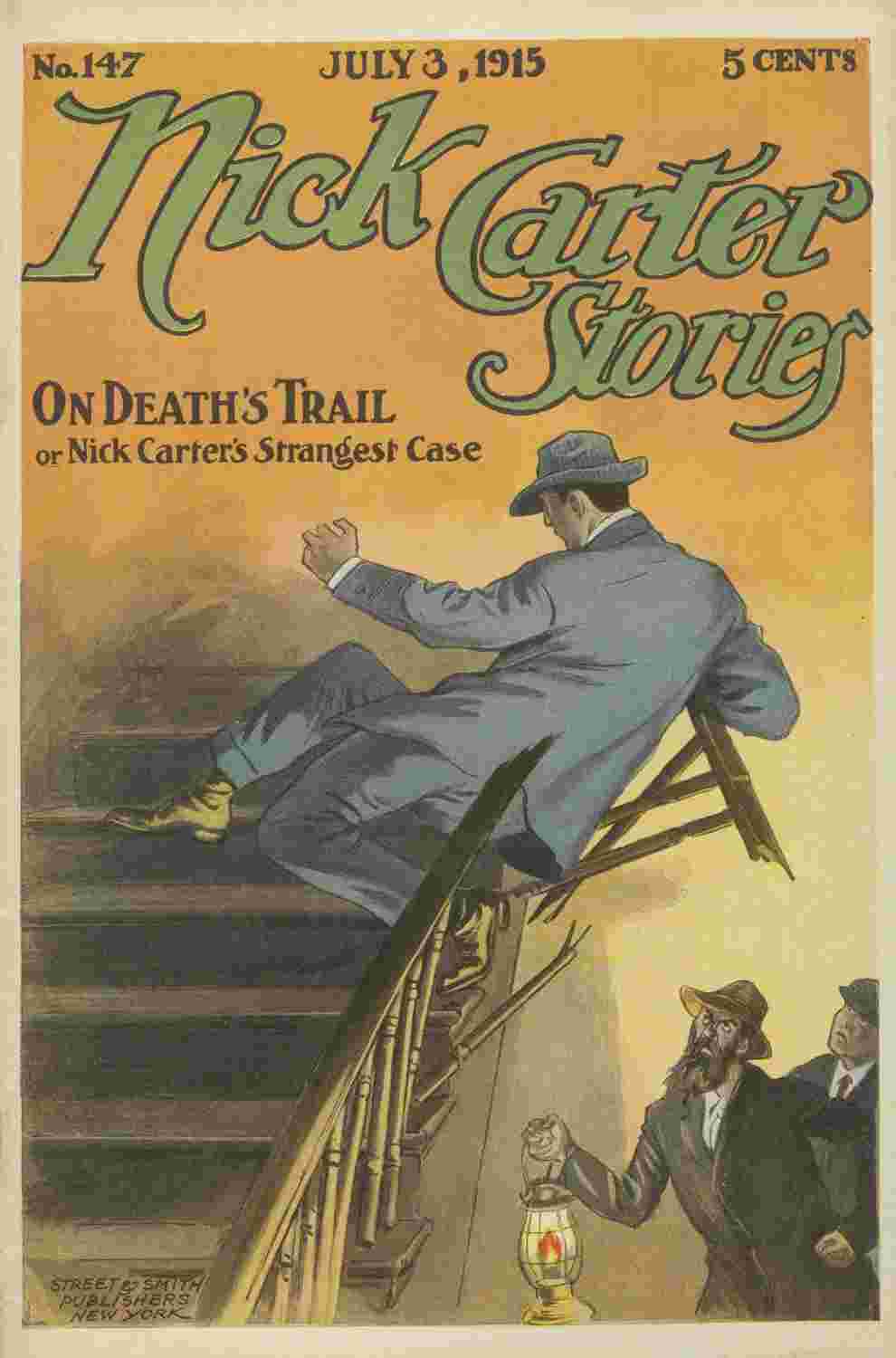
When he trod on the next bare stair, however, the projecting edge of the footboard, weakened with age and dampness in the closed house, broke under his weight.
Chick lost his footing and his balance.
He fell heavily against the rail, seizing it to prevent falling backward down the stairs.
The startling noise brought a roar from Margate:
“What’s that?”
The question was instantly answered—but not verbally.
The stairway rail snapped and broke under the detective’s weight.
Instead of falling backward down the stairway, Chick pitched headlong over the side of it, straight down six feet to the hall floor, on which he landed with a crash that seemed to shake the house.
The three men saw him as plainly as they had heard him, and another roar came from Andy Margate.{34}
“A spy! One of the Carters, boys, or I’m a liar. Get him! Lend me a hand.”
Chick heard them, though severely shaken and stunned, and he tried to rise.
Margate leaped upon him like a wolf on a lamb, however, forcing him back upon the floor and dealing him a blow on the head, at the same time shouting:
“Out with a gun! Shoot him, Zeke, if he stirs. Bring a rope, Tony, and be quick about it. Cut one of the window cords.”
CHAPTER IX.
THE WOMAN INVOLVED.
It was close upon noon when Nick Carter, after his interview with Senator Barclay, rejoined Patsy Garvan and hastened from the statesman’s residence. None could have appreciated more keenly the gravity of the situation, the delicate nature of what had been confided to him, and the quick and clever work that must be done to avert the impending calamity, if indeed it were possible.
Nick thought he already saw his way clearly, however, and he began with informing Patsy of as many of the circumstances as the case required.
“We’ve got a look in, Patsy, at least,” he added, pausing on a corner to hail a taxicab. “If Margate sizes up the letter and document as I think he will, he may undertake to blackmail Lady Deland before I can be seen by Senator Barclay and put on the case. He will reason, of course, that I cannot have yet discovered that he is alive, much less have tracked him to the medical college and to the Barclay residence.”
“Gee whiz!” exclaimed Patsy. “You’re the only man on earth, chief, who could have accomplished all that in so short a time. Margate will not believe it possible.”
“I am banking on that, Patsy, and that he will attempt to take advantage of my supposed ignorance. He will know, too, that any move to blackmail Lady Deland must be made immediately, both on my account and the fact that the document must be restored to her before to-morrow, when it will become useless as a lever to blackmail her.”
“I see both points, chief,” nodded Patsy.
“I have a countermove framed up in my mind,” Nick added.
“What’s that, chief?”
“I will inform you a little later. You go to the Willard as quickly as possible, now, and bring our make-up box to the Deland residence, wearing a disguise. I have one in my pocket that will enable me to go there without being recognized, assuming that the house is being watched, which I hardly think is probable. We’ll take no chances, however. Rejoin me there as soon as possible.”
“You can bank on that, chief,” declared Patsy, as he turned and hurried away.
Ten minutes later, and precisely ten minutes after Tony Selig ceased watching the Deland residence, Nick alighted in the disguise of an elderly man from his taxicab and rang the doorbell of the imposing stone mansion. The summons was answered by the butler, Hawley, to whom Nick said tentatively:
“Is Sir Edward Deland at home?”
“No, sir,” Hawley politely informed him. “He is in New York to-day. He is expected here to-morrow.”
“Lady Deland, then?{35}”
“She is at home, sir. I will take in your card, sir, if——”
“Take this note to her, instead, and say that I would like to see her immediately,” Nick directed, interrupting.
“Walk in, sir.”
Nick had waited only a few moments in the reception hall, when the butler returned and conducted him to the library, where he found Lady Deland awaiting him—a stately, beautiful woman still in the twenties, whose pale cheeks and apprehensive eyes denoted with what misgivings she had read Senator Barclay’s note introducing the famous detective.
“Close the door when you go out,” she directed, with a glance at the butler.
“Yes, your ladyship.”
Hawley bowed himself from the room.
“I am pleased to meet you, Mr. Carter, and long have known you by name,” said Lady Deland, then shaking hands with the detective. “Tell me—what is the meaning of this visit? Has anything happened to Sir Edward Deland, or to——”
She hesitated, turning deathly white when Nick, removing his disguise, said gravely:
“You have anticipated what has happened, Lady Deland.”
“You know?” she gasped.
“Senator Barclay was forced to confide in me.”
“Oh, my God!”
The woman reeled as if about to faint, and Nick helped her to a chair, saying quickly:
“Do not be alarmed. Nothing confided to me, Lady Deland, ever goes farther. I know all of the circumstances and appreciate your position. I hope to accomplish all that is necessary to set you right. I really expect to do so, in fact, so try to be calm and give me your assistance. Both are imperative to what I have in view.”
Nick’s encouraging words were not without effect upon her. Lady Deland drew up in her chair, composing herself with an effort and replying gratefully:
“Thank you, thank you, Mr. Carter; but, oh, this is terrible. How could I have done such a thing? Tell me the worst. Let me know the worst.”
Nick then informed her as briefly as possible of the strange combination of circumstances resulting in the loss of the fateful document and her letter relating to it, adding, with convincing earnestness:
“Senator Barclay is in no sense to blame for the misfortune. He thought the safest place for the document during the single night he was to retain it was in the pocket of the coat in his own room.”
“Oh, I do not blame him, Mr. Carter,” said Lady Deland, who now had nerved herself to meet the trying situation. “Senator Barclay is a very dear friend, and a man in whom I have absolute confidence. Otherwise I never could have taken such a step, which I truly felt would be the best for all concerned.”
“I appreciate that, I assure you.”
“But what can be done? How can——”
“That is what I now wish to discuss with you, Lady Deland, and to point out what I require of you,” Nick interposed. “I think that we may yet thwart Andy Margate and recover the document in time to save you from exposure.”
“But that dreadful man! He must know——”
“Never mind what he knows about it,” Nick again interrupted. “If I can land him and recover the docu{36}ment, I will make very sure that neither he nor any of his confederates will afterward reveal anything. I will put them where they can accomplish nothing. Besides, Lady Deland, revelations on their part would fall flat when opposed with denials from persons of your character and that of Senator Barclay.”
“But what can be done, Mr. Carter?” she anxiously inquired.
Nick then proceeded to tell her of his suspicions, of the only way by which advantage of the document would probably be taken, and that it must be attempted that very day in order to be effective.
“I understand,” she bowed, after hearing him.
“There is only one way by which it could be done, Lady Deland, and only one method that really appears feasible,” Nick continued. “One is by the use of the telephone, which presents too many difficulties and contingencies for me to think that method will be adopted.”
“And the other?”
“The other is with a personal interview with you, possibly by Margate himself, though much more probably by one of his confederates,” Nick continued to explain. “Though a daring and desperate man, I doubt that Margate will venture here in person.”
“But what am I to do?”
“These rascals will have only one object in view, that of forcing you to pay them a large sum of money, or perhaps turn over your jewels to them. Just how they will attempt it remains to be seen, and I wish to be in a position to direct what occurs here. That must be accomplished without incurring the suspicions of the person whom Margate may send.”
“But how can you do that, Mr. Carter?” Lady Deland doubtfully inquired. “It will be necessary for me to see the person.”
“Very true,” Nick admitted, glancing around the room. “I think, however, that we can arrange it. Where does that door lead?” he added, pointing to one across which a portière was partly drawn.
“To Sir Edward’s private study,” said Lady Deland.
“Is there another door leading out of the room?”
“Yes, sir.”
“Where?”
“Into the side hall.”
“Capital!” said Nick, with manifest satisfaction. “From where you sit, Lady Deland, by glancing into the mirror over the fireplace, I think you can see into the study.”
“Yes, sir, I can.”
“You can do so, I observe by merely turning your eyes in the direction of the mirror.”
“I can, Mr. Carter.”
“If you were to do so merely casually, a person seated here would have no idea that you were in communication with a person in the study,” said Nick. “By turning my chair in this direction, I can see the mirror, but not the study door, nor any reflection of it.”
“Oh, I now see what you mean,” Lady Deland exclaimed. “You wish to signal me from the study, by means of the mirror, while I am talking with the person you suspect will come here.”
“Exactly,” Nick replied. “I will stand so that you can see a reflection of me, and I will signify with a nod, or with a negative shake of my head, what course you must shape.”
“I understand you perfectly.{37}”
“It will be necessary for you to yield to whatever design may be attempted.”
“Have you any idea of what it will consist?”
“I think you will be required to go somewhere, both to get and deliver a price for the document, and also in order to receive the letter.”
“I will go,” said Lady Deland quickly. “I shall not fear. I would dare anything, Mr. Carter, to recover it.”
“Something more will be necessary,” Nick replied. “I wish to go with you with one of my assistants, who will presently arrive here.”
“But will that be allowed?”
“We must fool whoever comes here into allowing it,” smiled Nick.
“Will that be possible?”
“I think so, in view of the fact that much is at stake, and that there is no time for other arrangements. You must insist upon going in your touring car, and taking your chauffeur and your maid.”
“Well?”
“You can state that they know nothing about the business engaging you, and that the crooks will incur no danger from your having these uninformed companions. They will have guarded against danger, all right, as a matter of fact. I know such rascals root and branch.”
“But I don’t understand,” Lady Deland said doubtfully. “What can my maid and chauffeur accomplish?”
“Leave that to me,” Nick replied, smiling again. “I shall be your chauffeur, Lady Deland, and your maid will be Patsy Garvan, my assistant, who can make up very cleverly as a girl in the twenties.”
“Oh, I now see at what you are driving,” cried Lady Deland, with countenance lighting.
“You must provide him with the necessary garments, however,” Nick added. “We have all else that will be required.”
“I will do so, Mr. Carter.”
“I also wish to take your butler’s place for a time, that I may determine whether any visitor warrants suspicion, and also take steps consistent with our design.”
“You may do so,” Lady Deland said readily. “I will give you all the assistance in my power.”
“We will make all of the necessary arrangements after my assistant arrives,” Nick rejoined. “I shall want a coat, cap, and gloves belonging to your chauffeur. We will put them in an adjoining room, where I can easily and quickly get them. I will wear a different disguise in the two characters I shall assume, and—ah, there is the doorbell. That should be Patsy. In half an hour, Lady Deland, we shall have completed our arrangements.”
CHAPTER X.
IN THE NICK OF TIME.
It was after two o’clock that afternoon when Nancy Selig, following instructions received from Andy Margate, rang the bell at the Deland residence and prepared, with all the nerve and effrontery of one of her class, to carry out the coercive design of her knavish confederate.
A butler answered the bell—but not the usual butler.
“I would like an interview with Lady Deland,” said Nancy, bowing and smiling with affected gentility.
“I will take in your card, madame,” Nick replied, with blank countenance. “Or if you will state what your business is, I will inform her of your request.{38}”
“She does not know me by name,” Nancy coolly announced. “I am soliciting contributions to a very worthy cause, and I was sent here by a friend of Lady Deland. Will you kindly tell her so, and say,” she added, quite pointedly, “that she may hear something greatly to her advantage.”
Nick Carter needed to hear no more than that. He bowed and vanished.
Two minutes later he returned, saying a bit stiffly:
“Lady Deland will see you.”
“I thought she would,” remarked Nancy, with covert dryness.
Nick conducted her to the library and ushered her into the room.
Lady Deland arose to receive her and pointed to a chair.
Nancy Selig took it without the ghost of a suspicion.
Nick withdrew and closed the door, then stepped noiselessly through the side hall and into the diplomat’s study.
The first words that fell upon his ears from the library told him that Nancy Selig had lost no time in approaching the business engaging her.
“You can safely admit it to me, since you say there is no one to hear us,” she was adding to what already had passed between them. “There is nothing in mincing matters. The question is—do you want to recover it?”
“Assuming that you really know what you have stated, and that I have lost such an article as you suggest, I naturally would be anxious to recover it,” Lady Deland replied.
“There’s just one way you can do it,” said Nancy.
“How is that?”
“By paying for it.”
“Pay whom? Are you the person who has it?”
“No. A man has it who——”
“Send him here, then,” Lady Deland interrupted. “I will talk with him.”
“Don’t be a fool,” Nancy said curtly. “And don’t pretend that the paper is of no great value to you. We know better than that, we who have it. You listen to me for half a minute and I’ll tell you just where you stand and what you must do.”
Lady Deland’s eyes drifted toward the mirror for an instant and she received from the listening detective a signal of assent.
“Well, I will hear you,” she replied, gazing at the crafty, determined face of her visitor.
What Nancy Selig had to say may easily be imagined, and she wound up her threatening remarks with the announcement that Lady Deland must pay ten thousand dollars for the return of the document and her letter to Senator Barclay, or that both would be sent to her husband the moment he returned to Washington.
Lady Deland played her part consistently, now and then receiving a signal from Nick, and evincing apprehensions that soon convinced Nancy Selig of her own ultimate success.
“All you need do is go with me and pay down the money,” she announced, at length. “When you return home, you’ll have the two papers.”
“But I haven’t so much money in the house,” Lady Deland protested.
“Draw it from the bank,” said Nance curtly. “There still is time.{39}”
“Where am I to go with you?”
“To a house a few miles from the city.”
Lady Deland demurred over that, pretending that she feared to do so, and she wound up with insisting that she would go only in her own touring car, in company with her maid and chauffeur.
Nancy Selig objected strongly to that, and for several minutes the argument between the two women continued, but the outlook for success finally overcame Nancy’s objections.
“Well, I agree to that, then,” she said, with a threatening frown. “But you’re not to leave me, or have any talk with them that I cannot hear. I’ll ride with you and go into the bank with you. I’ll not stand for any monkey business, you can bet on that.”
“There will be no monkey business, whatever that is,” said Lady Deland coldly.
“Call your maid here, then, and give her your directions,” snapped Nancy. “Send for the chauffeur, too, so we can make a quick get-away.”
Lady Deland touched a bell on the library table.
Nick entered from the hall half a minute later.
“Send my maid, Hawley,” said Lady Deland; Nance constantly watching her.
“Yes, your ladyship,” bowed Nick.
Another half minute brought Patsy Garvan into the room, so cleverly made up as a girl as to have deceived the most discerning observer.
“Put on your outside garments, Lucy, and bring mine to the front hall,” said Lady Deland.
“Yes, madame,” said Patsy demurely.
“Also tell Hawley to send James to the front door with the touring car,” added Lady Deland. “I want both of you to go with me for a few hours.”
“Yes, madame.”
Patsy bowed and withdrew.
Nick already was on his way to the garage.
Lady Deland opened her desk in the library and removed a bank book.
“Now, woman, I am ready,” she said coldly.
She was not more ready than Nancy Selig, who now felt sure that she was not being tricked.
Five minutes later the touring car, driven by Nick, with Patsy on the seat beside him and with Lady Deland and Nance in the tonneau, sped away from the house and turned toward the business section of the city.
Nick had been quietly informed as to the bank and its location, at which they arrived twenty minutes later, and into which Nancy accompanied Lady Deland, leaving the supposed chauffeur and maid in the car.
“Gee! this looks like soft walking, chief, now,” remarked Patsy, while they waited.
“Quite so,” Nick replied. “I think we shall land the goods and arrest the gang. That woman hasn’t even the ghost of a suspicion.”
Nick was right.
With crafty foresight, bent upon not arriving at the road house until just after dark, Nancy Selig directed the supposed chauffeur over a roundabout course that thus served her purpose.
It was between five and six when the light from the touring car swerved quickly from the woodland road, and the car itself ran noiselessly in toward the shed and stable back of the road house.{40}
“Come!” Nance said quietly, quickly alighting and addressing Lady Deland. “You two servants stay here.”
Nick Carter bowed, standing at the door he had alighted to open.
Lady Deland started to get out of the car.
Then came a crash from within the house, the thud of a fallen body, and then the fierce and furious shouts of Andy Margate, every word of which reached the detective’s ears.
Nick turned like a flash and seized Nancy Selig by the throat.
“Handcuffs, Patsy,” he muttered. “Be quick. Chick is here before us.”
Patsy was out and at work before the last was said, and in thirty seconds Nancy Selig was lying on the ground, manacled hand and foot.
Lady Deland was nearly fainting, but neither detective noticed her.
Both rushed to the back door, still ajar and showing a beam of light.
Nick was the first to reach and open it, dashing into the hall, revolver in hand. He saw Chick on the floor, the four men above him, and the hand of Andy Margate raised with a revolver to beat out the fallen detective’s brains.
Nick fired on the instant, and the bullet went true.
Margate pitched forward in a heap, with an ounce of lead in his brain, and instant consternation and dismay fell upon his three confederates.
“Hands up, you fellows, or there’ll be another corpse here,” Nick cried sternly, with the rascals effectively covered. “Look after Chick, Patsy. I can attend to these rats.”
The “rats” did not dare to show fight. They yielded with curses and imprecations, and within ten more minutes the case was practically ended. All were secured, followed later by Zeke Selig’s wife, and the entire family went to prison for a term of years for their work of that night.
Andy Margate did not revive from the dose Nick Carter had given him, as he had from that taken from his own hand. This time, indeed, he was as dead as a doornail.
The document, as well as the property stolen from Senator Barclay, were easily found and restored to proper hands, and the circumstances were never even dreamed of by Sir Edward Deland, much to the relief and gratitude of the beautiful girl whom Nick had served so cleverly.
He went even farther than that, moreover, interceding with a local judge for the medical students, with the result that their transgression was never made public, and the Dabney Medical College escaped without a smirch on its reputation.
So the strange case ended to the satisfaction of all—save the knaves responsible for it.
THE END.
“The Mark of Cain; or, Nick Carter’s Air-line Case,” will be the title of the long, complete story which you will find in the next issue, No. 148, of the Nick Carter Stories, out July 10th. You will also find several other articles of interest, together with the usual installment of the serial now running.{41}