
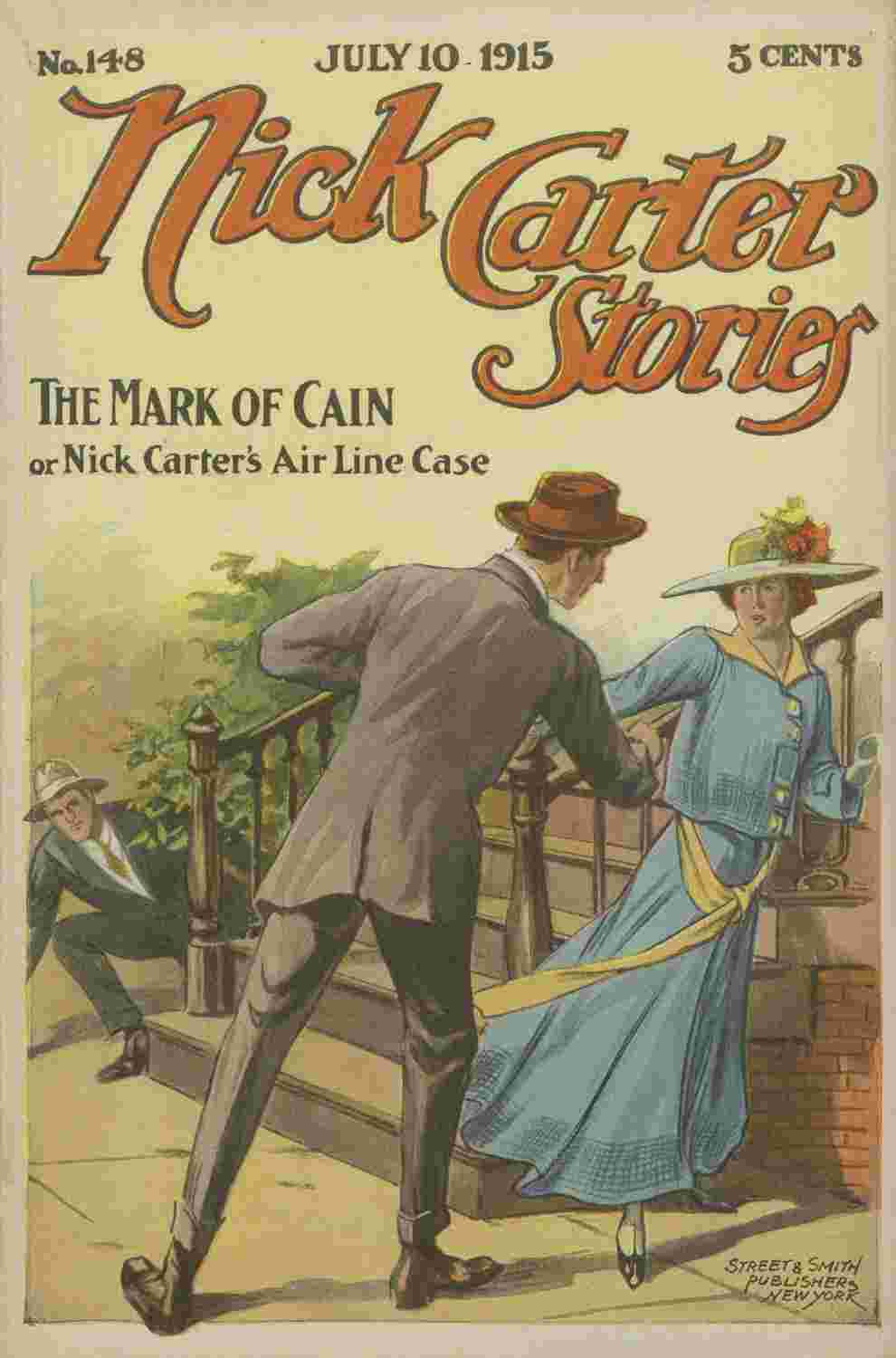
Sheridan of the U. S. Mail.
By RALPH BOSTON.
(This interesting story was commenced in No. 148 of Nick Carter Stories. Back numbers can always be obtained from your news dealer or the publishers.)
CHAPTER IV.
A WARNING.
The more Owen thought over his interview with Boss Coggswell, the more convinced he became that the sole reason the politician had sent for him had been to try to bribe him to hold out the mail of a certain person on his route.
That Coggswell had summoned him to the club in order to express his admiration of Owen’s independence in refusing to buy the ticket to the outing seemed absurd. It had sounded almost plausible when the boss had said it in his smooth, convincing voice, but when he came to think over it afterward, Owen could see how preposterous the thing was. Imagine any political leader going into raptures over a young man who had called him a blackmailer. Imagine him being anxious to help a young man to promotion, just because he liked his way of talking.
“No,” said the carrier to himself, “that offer of a postal inspector’s job was made to tempt me to do Coggswell’s crooked work, and now that I’ve refused, I’ll wager that he won’t move a finger to help me. But I don’t care about that,” he added confidently; “I’ll get there, all right, without his help.”
Something happened the following morning which greatly strengthened the suspicions of the carrier, and{42} made him certain that Boss Coggswell had sinister designs upon the mail of some person on his route.
When he reported for work, Owen was informed by Henderson, the superintendent of Branch X Y, that, beginning that morning, he was to cover a new territory. Instead of route forty-eight, he would henceforth, and until further notice, cover route sixteen.
Now, in post-office work it is a great advantage, naturally, to have the carriers familiar with the territory which they have to cover. It stands to reason that a postman cannot make as quick deliveries over strange ground as on a route in which he knows the names in the house letter boxes almost by heart. For this reason the men are not changed around any more than can be avoided.
Therefore, Owen knew, as soon as Henderson told him that his route was to be changed, that this must be due to Coggswell’s influence. The politician wanted to get him out of the way, and have him replaced by a man who would not refuse to do his bidding.
Owen inquired who was to succeed him on route forty-eight, and learned that it was a carrier named Greene, a man whom Owen liked less than any other employee of Branch X Y.
Greene, who was a pale-faced, shifty-eyed fellow, was a member of the Samuel J. Coggswell Association, Owen learned, and on friendly terms with Jake Hines. The fact that he had been selected for route forty-eight certainly looked significant.
To be taken away from his old territory was a great blow to Owen; for, be it remembered, the real-estate office of Walter K. Sammis was located in that section, and his transfer meant that he no longer would be able to exchange a few words each morning with Dallas Worthington.
And, besides this, the new route was a much less pleasant one. Carrier Greene, who had covered it for two years, had certain reasons of his own for being satisfied with it, but Owen found the new territory very disagreeable.
It comprised the very poorest and most squalid section of the district. The inhabitants were mostly foreigners, and the handwriting on letters they received was hard to decipher. They were in the habit of changing their addresses frequently, too, and this entailed extra clerical work; for each carrier has to enter all such removals in his “log book.” Then, again, many of the tenants of the tenements were too shiftless or ignorant to post their names in the vestibules, and this made deliveries very difficult, and consumed a lot of time.
Nevertheless, Owen did not make any protest. He accepted the situation philosophically, and started out to cover his new route as cheerfully as if he really relished the change. But inwardly he registered a vow that he was going to find out the identity of the person whose mail Boss Coggswell wanted to get hold of, and check that politician’s sinister plans.
First he went to the three carriers responsible for route forty-eight—for every route is covered by three men—and warned them of what he purposed to do.
The two other carriers who took turns at covering that territory were named Gordon and Smithers. They had both had route forty-eight for several years. The fact that they were not now taken off gave Owen{43} reason to suppose that they must be satisfactory to Boss Coggswell, and willing to do his dirty work. For he reasoned that, in order to carry out his crooked scheme, the politician must have the coöperation of all three carriers who covered that route. Otherwise the particular letters which Coggswell wanted to get hold of might go through when Greene was not on duty.
Owen was on friendly terms with both Gordon and Smithers—in fact, the latter and he roomed in the same boarding house. The former was a good-natured, pleasant sort of fellow, but of a weak character. He was always heavily in debt, and he was a hard drinker. More than once he had been caught under the influence of liquor while on duty, and these lapses would have resulted in his dismissal from the department if it had not been for the intercession of Samuel J. Coggswell, who was a friend of his wife’s father.
Smithers, like Greene, was a member of the Samuel J. Coggswell Association, and a crony of Jake Hines. He was a tall, sharp-featured young man, of about Owen’s age, taciturn and very shrewd.
Owen felt sure that these men were all in the plot to tamper with the mails. As he didn’t want to see them disgraced and sent to prison, he decided to give them due warning. Of course, they indignantly denied that any such proposition had been made to them by Boss Coggswell, or that they knew anything about a scheme to hold up anybody’s mail on route forty-eight.
Smithers told Owen that he must be raving mad to suspect anything like that; Gordon laughed and declared that it was the best joke he had heard in many a day; Greene growled that Owen was sore at having been transferred, and was trying to besmirch his character in order to get square.
“Very well,” retorted Owen grimly; “I’ve given you fellows notice; now, if you go ahead and get caught, you’ve got only yourselves to blame. I know that there is such a crooked scheme afoot, and I’m going to find out the name of the victim and put him on his guard.”
CHAPTER V.
A STRONG LEAD.
Owen began by watching Carrier Greene as he stood at his case sorting out the mail preparatory to starting out on the first delivery. He thought he might be able to see him withdraw and pocket the desired letters, and thereby get an important clew; but Greene made no such compromising move.
Owen maintained the same close watch when Gordon and Smithers were at the sorting cases, but these vigils were not productive of results. Either the letters which Coggswell wanted had not yet shown up, or the three carriers were too cautious to abstract them in the post office, preferring to wait until they had them in the bags and were out on the street, where they could get at them without being observed.
It was a headline on the front page of a morning newspaper which at length set Owen on the right track. This headline read: “Judge Lawrence to Fight Coggswell.—Former Supreme-court Judge Preparing to Wrest District Leadership from Boss at Coming Primaries. Coggswell Said to be Seriously Alarmed by Plan to Dethrone Him.”
Now, part of postal route forty-eight was a row of{44} brownstone private residences, and in one of these lived the Honorable Sugden Lawrence, former supreme-court judge, and now a lawyer of considerable prominence.
Owen decided that this was the man whose mail Boss Coggswell wished to intercept. In the first place, if, as the newspaper stated, Judge Lawrence was threatening to wrest the district leadership from its present incumbent, was it not exceedingly likely that the latter would be anxious to “get something on” his prospective opponent—some scandal which could be used to crush the enemy? With such an object in view, secret access to a man’s private correspondence would be a valuable factor. Many a family skeleton has been revealed by this means, many a public career has been ruined by means of a purloined letter.
In the second place—and this was, in his opinion, the strongest argument in favor of his theory—Owen happened to know that Henderson, the superintendent of Branch X Y, had a brother who was a clerk in Judge Lawrence’s office.
Owen had wondered until now why Boss Coggswell, in his desire to tamper with somebody’s mail, had not gone direct to Henderson, and had the thing done right in the post office, before the mail was handed to the carriers.
Surely, this would have been easier, and much more safe, than to deal with three subordinates. Several little incidents which had come under his observation gave Owen reason to believe that the superintendent of Branch X Y was not an overscrupulous official. He was a man who, in the administration of his office, “played politics” to an outrageous extent. Under ordinary circumstances, no doubt, he would not have hesitated to do Boss Coggswell this favor.
Why, then, had not the politician gone to Henderson instead of dealing with the carriers? Owen believed that he understood why, now. Coggswell was afraid that the superintendent would not stand for any monkeying with the mail of his brother’s employer. He might have warned the judge and caused trouble.
Convinced that his theory was correct, Owen went that evening to the residence of ex-Judge Lawrence. The latter, a keen, aggressive man, a few years past middle age, received the letter carrier in his library, and listened with great attention to what he had to say.
When Owen was through, Judge Lawrence nodded his head vigorously. “I think you have guessed right,” he said. “In fact, I haven’t a bit of doubt that it is my mail which that rascal Coggswell is after. There is a certain incident,” he went on, “concerning which I am now in correspondence with a certain person. While there is really nothing about this incident—nothing which could bring discredit on me if the real facts were known, the matter could be misrepresented in a manner which would greatly injure my reputation. I happen to know that Coggswell has a slight inkling of this matter already, and has been trying for some time past to get more information on the subject, so that he can spring it on me and smash me at the primaries. That is why I feel pretty sure that it is my mail he is scheming to get hold of.”
He banged his fist vigorously upon the library table. “Tampering with Uncle Sam’s mail is a pretty serious offense,” he declared grimly; “and so friend Coggswell{45} will learn, if he is engaged in such a contemptible piece of business.”
He arose and held out his hand to Owen. “I am very grateful to you for having come to me and put me on my guard, Mr. Sheridan,” he said. “I am going to take steps immediately to ascertain if our suspicions are correct. And if they are, you and I are going to put Samuel J. Coggswell in prison stripes.”
CHAPTER VI.
JACK HINES IN LOVE.
“Say, Miss Peaches-and-cream, is the main squeeze in?” At this unconventional salutation Dallas Worthington looked up from her typewriter, and stared curiously at the person who had given utterance to it.
She saw that the visitor was a stout, red-faced young man, who wore a suit of exceedingly loud pattern, a soft felt hat of the very latest and most rakish design, and a red necktie, in which glittered a diamond of huge proportions.
“If by ‘the main squeeze’ you mean Mr. Sammis,” she said, with dignity, “he is in his private office. Do you wish to see him?”
“That’s what I came for—originally,” answered the young man, staring at her ardently, “but now that I’ve seen you, I’ve almost changed my mind. I hate to tear myself away from this spot. Say, kid, you make a big hit with me. I didn’t know there was anything so pretty in this vicinity. If I’d suspected it I’d have dropped in here long ago.”
“What name shall I take in to Mr. Sammis?” inquired the girl coldly.
“Gee, but you’re in a hurry to get rid of me!” said the visitor reproachfully. “Well, if you insist, you might tell the boss that Mr. Hines is here—Mr. Jake Hines.”
As the girl arose and stepped into the private office at the rear of the store, Mr. Hines gazed after her trim, graceful figure admiringly.
“Peach!” he said to himself. “I’m mighty glad I called. Even if I don’t sell any tickets here, my time won’t be wasted. If I ain’t taking this queen to Coney Island before another week has passed, I’m a dead one.”
Dallas reappeared and told him that Mr. Sammis would see him immediately. With another ardent glance at her, Mr. Hines stepped into the private office.
“Well, sir, what can I do for you?” inquired the real-estate broker, an elderly man with gray mutton-chop whiskers and a rather severe demeanor.
“I’ve come to see how many tickets you’ll take for the annual chowder and outing of the Samuel J. Coggswell Association,” replied Hines.
“Chowder!” repeated Mr. Sammis testily; “I don’t eat chowder, and I don’t attend outings; consequently I don’t want any tickets.”
“Oh, yes, you do,” retorted Hines, his tone almost bullying. “You don’t have to go, yourself, if you don’t want to. You can buy the tickets and give ’em away to your friends. Boss Coggswell expects you to take at least five, Mr. Sammis. That’s the number all the other real-estate men in the district are takin’.”
“I don’t care what others are doing, and I don’t care what Mr. Coggswell expects,” snapped Sammis. “I must ask you to get out of here at once, young man. This is my busy day.{46}”
“Oh, very well,” growled Hines, rising. “It don’t make no difference to me whether you take any tickets or not, my friend; but take it from me, it’s going to make a whole lot of difference to you. No man that’s interested in property in this district can afford to antagonize Boss Coggswell. You’ll be mighty sorry. There’s lots of ways we can make it unpleasant for you if you get gay with us.”
He swaggered out of the private office, and, as he caught sight of Dallas Worthington at her typewriter, the scowl disappeared from his beefy face.
“Say, bright eyes, how would you like to run down to the Island with me this evening?” he inquired, stepping up to her desk.
“I wouldn’t like it at all,” she answered, without looking up from her work.
“Stung!” he exclaimed ruefully. “May I ask why not?”
“Oh, for several reasons.”
“Give me one.”
“Well, for one thing,” she answered, glancing at him scornfully, “I’d be afraid, Mr. Hines, that on the way you might try to intimidate me into buying a ticket for the Coggswell Association’s outing.”
“Gee!” he said to himself, “she must have overheard what I said to her boss inside.”
Aloud he said earnestly: “You needn’t be afraid of that. I’d make you a present of all the tickets you want, honeybud. Tell me another reason why I can’t make a date with you.”
“Because I don’t make engagements with strangers,” said Dallas haughtily. “Please close the door as you go out.”
“It ain’t my fault that I’m a stranger,” said Mr. Hines plaintively, taking no notice of the hint. “I’m doin’ my best to get acquainted. Say, give it to me straight, little one—am I on a busy wire? Is there any other feller ahead of me?”
“There is!” declared Dallas, with great emphasis. “And even if there weren’t——”
“Then I’m sorry for him,” the young man interrupted.
“Sorry! Why?” she asked, in astonishment.
“Because I’m goin’ to take his girl away from him. I don’t know who the feller is; but whoever he is, he ain’t good enough for you. I never took much stock before in all this talk about fallin’ in love at first sight, but, honest, kid, you’ve hit me straight between the eyes. The minute I came in here and saw you sittin’ at that typewriter, I——”
“Will you please close that door on the outside?” interrupted Dallas, pointing impatiently toward the street door. “I’ve got a lot of work to do, and if you don’t get out of here immediately, I shall have to call Mr. Sammis.”
“Oh, very well,” said Mr. Hines, somewhat crestfallen. “I guess that’s a hint for me to be goin’. So long, girlie. I’ll drop in again some other time when you ain’t quite so busy.
“Gee!” he said to himself as he reached the sidewalk, “I certainly am hard hit. I do believe that I’ve actually fallen in love with that peach—and I don’t even know her name.”
A short distance up the avenue he encountered Carrier Greene.{47}
“Hello, Jake,” said the postman; “didn’t I see you in Sammis’ real-estate office a few minutes ago, talking to Sheridan’s girl?”
“Whose girl?” demanded the politician quickly. “What Sheridan do you mean?”
“Owen Sheridan—the carrier that used to have this route,” answered Greene. “Don’t you know that he’s keeping company with that typewriter girl? It’s a fact. She almost cried, the other morning, when I came in and told her that Sheridan didn’t have this route any more. I understand that they’re going to be married soon.”
“I don’t believe it,” growled Hines. “A queen like that goin’ to marry a twelve-dollar-a-week carrier? It ain’t possible.”
Two evenings later, Mr. Hines, happening to be down at Coney Island with a party of friends, met Dallas Worthington on Surf Avenue, walking arm in arm with Owen Sheridan. The manner in which the girl was looking up into her escort’s face caused Hines to utter an exclamation of jealous rage. For the young politician’s infatuation for Dallas had proved to be more than a passing fancy. Strange as it may appear, he had seriously fallen in love with the girl, and the lapse of two days found him even more hard hit than at first.
Consequently, that meeting at Coney Island was a great blow to him. Until then he had refused to believe what Carrier Greene had told him, and, being an egotistical young man, he felt confident that, although the girl appeared to have somewhat of a prejudice against him at the start, she could not continue to hold out for long against the charm of his personality.
He returned home from Coney Island with the dislike which he had already formed for Carrier Owen Sheridan increased tenfold.
The next day he received a summons from Boss Coggswell to come to the clubhouse immediately. When he got there he found that politician in a state of considerable agitation.
“Have you heard the news?” exclaimed the district leader, pacing nervously up and down the floor of his private office.
“No, boss; what is it?”
“Carrier Greene has been arrested—and Tom Hovey, too.”
“Tom Hovey! The fellow you sent to get those letters from Greene? What are they arrested for?” inquired Hines anxiously.
“Tampering with the mails, of course. I understand they’ve got them dead to rights, too. Greene was seen handing the letters to Hovey, and Hovey was caught in the act of opening the envelope over a steam kettle. Lawrence has got a strong case against us.”
“Against us?” repeated Jake Hines, with a crafty smile. “Don’t say that, boss. They haven’t got anything on you—and you can rest assured that you’ll not be implicated. Neither Greene nor Hovey will squeal, no matter what happens. I’m willing to stake my bottom dollar on those fellows standing pat. They’ll go to jail for life rather than give you away. There’s only one man we’ve got to fear, so far as you’re concerned.”
“Who’s that?” inquired Boss Coggswell nervously.
“That letter carrier, Owen Sheridan. He’s behind these{48} arrests, of course. It was him that put Judge Lawrence wise to the whole business.”
Coggswell nodded gloomily. “Yes, and he can implicate me by testifying that I sent for him the other day, and tried to bribe him to hand over that mail. His evidence——”
“Will put you in stripes, boss, I’m afraid,” broke in Jake Hines grimly. “But he’s the only man we’ve got to be afraid of.”
Coggswell agitatedly paced the full length of the room several times before he spoke again. Hines observed that the boss’ ears were wiggling furiously—that peculiar physical indication of the sinister thoughts that were brewing within the crooked brain.
At length Coggswell halted. “You’re right, Jake,” he said, very quietly; “Sheridan is dangerous. He must be got out of the way.”
Jake nodded his head vigorously. “I agree with you, boss,” he said fervently. “He must be got out of the way.”
CHAPTER VII.
THE FRAME-UP.
Jake Hines couldn’t forget what he had seen down at Coney Island the previous evening; the look of affection which had been in the eyes of Dallas Worthington as she gazed up into the face of Owen Sheridan; the trusting, intimate manner in which she hung on her escort’s arm. Consequently Coggswell’s declaration that the young carrier must be got rid of appealed to him tremendously.
He wondered just what the boss meant by those words. He was in hopes that the latter was about to propose some dark scheme for kidnaping Sheridan. To have the young man shanghaied and cast away on some desert island was a plan which, in his present jealous frame of mind, would have suited Jake to a T.
He made no suggestion, however. He waited for Coggswell to speak. He knew from the way those telltale ears were wiggling that the boss’ fertile brain was busy hatching a plan to bring about the desired result.
After a prolonged silence, Coggswell said suddenly: “There must be no foul play, Jake—understand that.”
“Eh?” exclaimed Hines, in incredulous astonishment. “No foul play?”
“No rough work, I mean,” the boss explained. “No violence. You know very well that I don’t like that sort of thing, Jake.”
A look of disappointment flitted across Jake’s beefy countenance. “What, then, boss?” he inquired.
“Sheridan must be silenced by legitimate means,” declared the district leader. “We don’t want to go against the law, Jake. We don’t want to forget that we are decent, law-abiding citizens. I could not think of countenancing foul play in dealing with this man.”
Hines scratched his head in perplexity, and stared blankly at Coggswell. He was relieved to see that, although there was a virtuous expression upon the latter’s face, those ears were still wiggling at a furious rate.
“What do you mean by legitimate means, boss?” he asked.
“Let me explain, Jake.” Coggswell sat down in his{49} desk chair and motioned his disciple to a chair at his right hand. His agitation had now completely disappeared. Once more he was the calm, dignified, benevolent-appearing original of the portrait in oils which hung in the reception hall downstairs.
“Now, as you have correctly pointed out, Jake,” he went on, “the only danger of my becoming implicated in this regrettable post-office affair is through the testimony of this carrier, Owen Sheridan. Greene and Hovey have been caught red-handed, it is true; but I agree with you that they are not the kind of fellows who can be made to squeal. They will deny emphatically that they were obeying my orders when they tampered with Judge Lawrence’s mail. Hovey will insist that he had reasons of his own for wanting to see the contents of those letters.”
Hines nodded. “Yes, I’m quite sure that both those fellows can be relied on, boss. Pretty tough, though, ain’t it, that they’ll have to go to prison?”
Coggswell smiled confidently. “They won’t go to prison. They’re quite safe. They’ll be admitted to bail, of course, and I’ll see that there’s somebody to go on their bond, no matter what the amount—somebody who won’t mind when the bail is forfeited after those fellows have skipped beyond the jurisdiction of the courts.”
Hines nodded again. “Yes, that ought to be easy. And, now, how about Sheridan? How are you going to prevent him from dragging you into this mess?”
Coggswell smiled. “Let me answer that by asking you a question, Jake. Suppose you were on a jury, trying a criminal case: would you believe the testimony of a jailbird? Suppose the chief witness for the prosecution was a young man who had just been tried, convicted, and sentenced for being a thief: would you, as a juryman, take any stock in what he had to say?”
“I would not,” declared Hines virtuously.
Boss Coggswell laughed grimly. “Very well, then; that’s the answer to your question.”
Hines looked bewildered. “But I don’t quite get you, boss. Sheridan ain’t a jailbird.”
“Not yet, you mean, Jake,” corrected Coggswell, in his quiet, smooth voice.
The eyes of the younger man suddenly lighted up. His was not a quick-moving brain, but he fully grasped the idea now. It appealed to him greatly, too. A prison was even better than a desert island, as a means of putting the kibosh on a rival in love.
“I get you, boss!” he exclaimed enthusiastically. “We’ll have to get busy and dope out a scheme for——”
“I’ve got one already, Jake,” broke in the district leader smilingly. “One that can’t fail to work successfully. All that you’ll have to do is to carry it out.”
For the next thirty minutes Jake Hines listened attentively while his chief explained in detail the plan which he had evolved. It was a plan which met with the former’s warm approval and admiration, and when the interview was at an end, he went out with great enthusiasm to put it into execution immediately.
CHAPTER VIII.
A DOUBTFUL JOKE.
Later that day, three well-dressed middle-aged men entered a branch post office, downtown, and stepped up to the registry window. Handling a small, square pack{50}age through the grille, one of them said to the clerk: “I wish to send this by registered mail. It’s a birthday present to a friend of mine. Is it sure to get there this afternoon?”
“Oh, yes,” the clerk assured him, taking the package and making out a receipt; “it’ll be uptown in an hour, and go out on the three-o’clock delivery.”
Into the registered-mail sack went the little, square package, and soon it was on its way to the general post office.
Here the sack was opened, its contents rapidly sorted, and the little, square package placed, along with several other packages, in a smaller sack which was sent speeding uptown to Branch X Y.
When Carrier Sheridan went to get his mail for the three-o’clock delivery, the little, square package was waiting there for him.
He glanced at the address curiously. Registered mail was a rarity on his new route, which, as has been stated, comprised the poorest and most squalid portion of the district. The package was addressed to a Mr. Michael Harrington, who kept a saloon. Owen put it in his pouch and started out on his delivery tour.
Fifteen minutes later he pushed aside the swinging doors of Harrington’s saloon, at the bar of which was a group of about ten men.
“Howdy,” said Mr. Harrington genially, from behind the bar. “What’s the good word? Have a little drink of something, young feller? It’s my birthday to-day, and I’m standin’ treat.”
“No, thanks,” said Owen, with a smile; “I’m on the water wagon. But I wish you many happy returns, just the same. Maybe I’ve brought you a birthday present.” He produced the small, square package, and his receipt slip. “Sign here, please.”
“I guess it is a birthday present, all right,” said the saloon keeper, holding out his hand for the registered package. “It looks as if it might be the gold watch which my friend Bill Warren telephoned me he was sending. Yes, that’s what it is, all right. See, here’s Bill’s name written on the back.”
He weighed the package in his hand. “Pretty light, though, to contain a watch, ain’t it?” he remarked.
“I should say so,” said Owen.
Mr. Harrington hastily tore open the wrapper and revealed a thin pasteboard box. Opening this, he found a flat, leather-covered watchcase.
“It’s the watch, all right,” he said, turning with a grin to the group in the front of the bar. “Good old Bill. He’s the most generous feller I know. Ain’t it decent of him to have remembered my birthday like this?”
He pressed the button which released the catch of the watchcase, and uttered an exclamation of astonishment and disgust as the lid flew open.
“Empty!” he growled. “Now, what do you know about that?”
The group at the bar laughed uproariously. “The joke’s on you, Mike!” cried one. “It’ll cost you another round of drinks for being the goat.”
The saloon keeper scowled. “I ain’t so sure that it is a joke,” he growled, with a suspicious glance toward the letter carrier, who was just going out of the door. “I know my friend Bill Warren ain’t the kind of man to{51} play a low-down trick like that on me. He wrote me that he was sendin’ me a gold watch for a birthday present, and I believe he meant it.”
He leaned over the bar and called to Owen: “Hey, you! One minute, there, young fellow!”
“Want me?” inquired the carrier, stepping back into the barroom.
“Yes. Are you quite sure that this here registered package ain’t been tampered with?”
“I’m quite sure that it hasn’t while it’s been in my hands, and I think you’ll find that the post office isn’t to blame,” replied Owen. “The government is mighty careful in the handling of its registered mail.
“But, of course, if you’re suspicious,” he added, “you can come around and see the superintendent and ask for an investigation. Before I did that, though, if I were you, I’d get into communication with the sender and ask if the case really contained a watch when he mailed it.”
“That’s a good idea,” said Harrington. “I’ll get Bill on the phone right now.”
Although he didn’t consider that it was really any concern of his, Owen waited while the saloon keeper telephoned, anxious to hear what the outcome would be.
A few minutes later Harrington turned from the phone, a grave look upon his face. “Just as I thought,” he said; “it ain’t a joke at all. Bill Warren says he’s willin’ to swear that he sent that watch—says he can produce two witnesses who saw him put the watch in the package, seal it up, and hand it in at the post-office registry window.”
He hurriedly donned his hat and coat. “That watch has been stole—stole from the U-nited States mails. That’s a serious offense. I’m goin’ right around to the post office to make a complaint. All these gentlemen here are witnesses that the watch wasn’t in the package when I opened it.”
The following day Carrier Owen Sheridan was placed under arrest by two United States post-office inspectors.
“We want you, Sheridan,” they said, accosting him in the doorway of Branch X Y, as he came back from his noon-delivery tour.
“Want me? What for?” he demanded, in great astonishment.
“For robbing the mails. No use throwing any bluff; we’ve got you dead to rights.”
“I suppose this has to do with that watch which was missing from the registered package yesterday,” said Owen calmly. “But why suspect me in particular? The package passed through many hands while in the post office.”
“Yes, but only one pair of hands opened it and stole its contents,” was the grim retort, “and those hands were yours, Mr. Sheridan. Otherwise, how could the pawn ticket have got into your trunk?”
“The pawn ticket?” repeated Owen blankly.
“Yes. We have just come from your boarding house. We went there to look your room over; and we found—this.”
The inspector took from his pocket a pawn ticket for a gold watch, and held it before the astonished mail carrier’s eyes.
“The watch this ticket calls for has already been iden{52}tified as the watch which was stolen from the package, and we found this in your trunk. It looks very much as if you’re going to exchange that gray uniform for a suit of stripes, Carrier Sheridan.”
TO BE CONTINUED.
WILLIE’S MISTAKE.
Willie Jones had been warned several times for breaches of school discipline, and was at length reported to the head master, who gave him a final warning.
One night, not long after, Willie was again caught in mischief, and he felt that this time he was “in for it.”
A flogging by the master was no joke, and Willie determined to make what preparation he could that the wind might be tempered to the shorn lamb.
On rising the next morning, he put on first his undershirt, then a layer of stiff brown paper, upon these a sweater, and over all a clean white shirt, borrowed from his chum, whose clothing was two sizes larger than his own.
Lastly he put on his coat and vest.
It was a very hot day in June, and at morning intermission Willie whispered to a friend:
“I’m nearly stifled. I hope he’ll give it to me now.”
But the master said nothing, and Willie went on stewing until dinner time.
He felt half inclined to dispense at least with the sweater before afternoon school, but fear of the master’s cane deterred him.
All through the afternoon he suffered untold misery, mopping his face until his handkerchief would mop no more.
But at length, just before dismissal, came a messenger.
“The master would like to see Jones in his study.”
On entering the study, the boy saw the supple, snakelike cane lying on the table.
“Well, Jones,” said the master, “I can go on warning you no longer. You have brought this upon yourself. But as it is your first visit here for such a purpose. I shall make your punishment somewhat milder. Hold out your hand; four on each!”
HARD ON THE WARDEN.
A phrenologist who has been touring the country and giving lectures in the art, tells the following “good one” on himself: He was in the habit of inviting people of different avocations to come upon the stage, and he would dilate upon and expound the peculiarities of their cranial construction. He had come to that portion of his lecture where he dealt with the criminal form of the cranium, and addressed the audience:
“If there is any person present who at any time has been the inmate of a prison he will oblige me by coming upon the platform.”
A heavily built man responded to this invitation.
“You admit that you have been in prison, sir?”
“I have, sir,” was the unblushing answer.
“Would you kindly tell us how many years you have spent behind prison bars?”
“About twenty years,” unhesitatingly replied the subject.
“Dear, dear,” exclaimed the professor. “Will you sit down, please?{53}”
The subject sat down in a chair in the center of the stage. The professor ran his fingers rapidly through the hair of the subject and assumed a thoughtful expression.
“This is a most excellent specimen. The indications of a depraved character are very plainly marked. The organs of benevolence and esteem are entirely absent; that of destructiveness is developed to an abnormal degree. I could have told instantly, without the confession of this man that his life had been erratic and criminal. What was the crime for which you were imprisoned?”
“I never committed any crime,” growled the man in the chair.
“But you said that you had been an inmate of a prison for twenty years?”
“I’m the warden of the prison.”
NO MORE DUNNING.
The landlady of a certain medical student, who ineffectually dunned her delinquent tenant for some time, resolved at last upon resorting to extreme measures.
She entered his room one morning, and said, in a very decided tone:
“You must either pay me my rent, or be off this very day.”
“I prefer to be off,” said the student, who, on his side, was prepared for the encounter.
“Well, then, sir, pack up directly.”
“I assure you, madame, I will go with the utmost speed, if you will assist me.”
“With the greatest of pleasure.”
The student thereupon went to a wardrobe, opened a drawer, and took out a skeleton, which he handed to the woman.
“What is that?” asked the landlady, recoiling a little.
“That! Oh, that is the skeleton of my first landlord. He was inconsiderate enough to claim the rent for three quarters that I owed him, and then—— Be careful not to break it; it is number one of my collection.”
The landlady was growing visibly pale. The student opened a second drawer, and took out another skeleton.
“This—this is my landlady in South Street; a very worthy woman, but who also demanded the rent of two quarters. Will you place it upon the other? It is number two.”
The landlady opened her eyes widely.
“This,” continued the student, “this is number three. They are all here. A very honest man, and whom I did not pay, either. Let us pass on to number four.”
But the landlady was no longer there. She had fled.
AN OLD LADY’S DILEMMA.
A friend of mine, who owned a pneumatic-tired bicycle, was explaining the different parts to his grandmother, who was paying him a visit.
He finished up the account by saying:
“And that little tube is where the air is blown in.”
The old lady, who had never seen such a thing before, was very much puzzled.
“Wonderful!” she said, after a moment’s pause of contemplation. “Wonderful! but do tell me, Sam, my lad, how on earth can you get your head in between the spokes to blow the air in?{54}”
THE NEWS OF ALL NATIONS.
Like Bull in the China Shop.
Oakville, Iowa, is a peaceful, prosperous, orderly town, but occasionally some strange thing happens, and one did the other evening. About eight o’clock, while the clerks in C. R. Walker’s department store were busy about their evening work, they heard a noise in the rear of the storeroom, and, upon investigation, found that a cow which had been driven into town by some farmer had found an open door and had come into the store and proceeded to make herself at home. The clerks got busy at once, and when they attempted to drive bossy out, she became frightened, started to run, and fell sprawling on the floor, knocked over boxes, hardware, canned goods, dry goods, et cetera. By twisting her tail until it resembled a great auger, the intruder finally consented to pass out.
A Criminal Catcher.
For more than twenty years Joseph L. Le Fors, of Sheridan, Wyo., has acted as detective for the Live-stock Association of Wyoming, and during that time has chased criminals all over the West and into Mexico.
Le Fors started as a cowboy in the Southwest. His brother was shot dead on the street of one of the early-day border towns. Joe heard of the deed, quit his job, came in, and quietly attended to the matter of his brother’s burial. Then he got an officer’s commission and went after the murderer, who was known as a “bad man.” When the cowboy, in a spring wagon and without much knowledge of the roads in that vicinity, drove out of town on his mission, most of those who saw him guessed that he would not come back. But he returned, and after no great length of time. In the bottom of the wagon was the corpse of the murderer. Le Fors has never talked to any extent of that fight, except to say that he gave the man a chance and he lost.
Among the detective’s most notable feats was the capture of Tom Horn, said to have killed seventeen men. Horn’s quickness with a gun was marvelous, but when the test came, Le Fors proved too fast for him.
It is said that Le Fors had done more than any other man to make stock raising on the open ranges more than a mere venture.
Along Came Ruth, and Crash! See the Snakes!
When Miss Ruth Spencer, of Michigan City, Mich., accidentally tipped over a box containing Doctor John A. Dexter’s collection of thirty snakes in his biology laboratory at Olivet College, Olivet, Mich., she created something of a panic.
Professor Dexter had been offering one dollar apiece for all varieties of snakes caught in Eaton County not already in his collection. The result was that he had rattlesnakes, blue racers, water snakes, garter snakes, and others reposing in a large box in his laboratory. The box stood on a high table.
Miss Spencer came in to the classroom looking for the professor, and, seeing the box, became curious to know its contents. She tried standing on tiptoe, lost her balance, and tumbled the snakes nearly on top of herself{56} and all over the floor. With a scream she ran out of the room.
Meanwhile Professor Shedd was conducting a physics class in a room below, when suddenly a five-foot blue racer, which had crawled through the ventilator, dropped with a thud on his demonstration table. The class was automatically dismissed at once.
When Doctor Dexter arrived at his room, he recaptured most of the reptiles. But one blue racer, three garter snakes, and a small, black water snake are still at large in the science building.
Two Mountain Roads the Work of Convicts.
The Colorado Springs and Cañon City Highway and the Ute Pass section of the Pike’s Peak ocean-to-ocean road, recently completed by Colorado’s system of convict labor, are two of the most perfect mountain roads in the United States.
For twenty miles south of Colorado Springs the road winds around the foothills and mountains, practically the entire roadbed having been cut out of the hillside, and in many places blasted out of solid rock. For the remaining twenty-five miles the way is over foothills and through undulating country. Besides being a marvel in engineering, the road is one of the most scenic and picturesque in the West, passing as it does through Red Rock Cañon, Dead Man’s Cañon, and many other mountain beauty spots.
The road averaged eighteen feet in width, and is perfectly crowned and drained. Although it offers a succession of climbs, so skillfully was the engineering work done that heavy grades have been eliminated, and the motorist is confronted with only one grade as high as three per cent.
The Ute Pass Road follows the ancient trail of the Indians across the Rocky Mountains. In the last few years that part of it between Colorado Springs and Cascade has been entirely reconstructed by convicts.
Under the Colorado system the convict is allowed ten days off his sentence for each month of labor on the roads. This is in addition to the usual reduction for good behavior.
Thomas J. Tynan, warden of the State Penitentiary, under whose supervision the work of the last three years has been done, estimates that in the next ten years five thousand miles of the best roads will be constructed at a cost of less than five hundred thousand dollars.
He says one thousand men have been used in roadwork in the last three years at a cost to the State of twenty-five cents a day for each man. The men go about their work unguarded, and less than one per cent have violated their pledges and made successful escapes.
Wilson Gets Curious Bottle.
Fingal W. Anderson, who lives at Aitkin, Minn., has cunningly contrived a present which he has given President Wilson, and which the latter prizes highly.
Anderson has been ill and has whiled away weary hours in contriving his gift. It is a bottle into which he has{57} inserted a shield of the United States. Upon one side of it is a picture of the White House, and upon the other a picture of the president. In presenting the gift, Anderson said, in a letter:
“This is original, whittled after my own thoughts, during my illness from tuberculosis of the bone. This piece of furniture represents seventeen days of work with my jackknife and drill made by myself from wires and nails. In its construction there are 338 different parts, made from white pine and basswood.
“I am a young man, twenty-eight years old, born in Stockholm, Sweden, and am proud to be of the same race from which was descended John A. Johnson and John Lind.
“As sent to you, it is complete and set up in full. Please accept it with my compliments.”
Death of Aged Woman Who Won War Record.
The death of Mrs. Virginia Taylor Gwynn, a wartime Virginia belle, widow of Captain Henry Gwynn, is announced at her home in Pikesville, Md., at the age of seventy-five.
Mrs. Gwynn often accompanied the Confederate army and led the troops into several engagements herself. She knew the country, and led detachments of the troops out of tight corners. For these acts she was mentioned several times in dispatches.
She volunteered to carry mail and dispatches from one division of the army to another, and to do this had to pass and repass through the Union lines several times. This attracted the attention of General Lee, and he publicly complimented both her great bravery and her beauty.
Captain Gwynn, her husband, was one of the few who succeeded in getting over the stone wall defended by the Union forces during the third day of the Battle of Gettysburg, when Pickett made his desperate charge.
His Jet-black Hair Turns Red in Night.
The sensation of the past week has been the extraordinary experience of Mack Stewart, a grocery merchant of Dublin, Texas.
Stewart is thirty-six years of age, and was the possessor of a head of jet-black hair, with the exception of a slight tinge of gray about the temples. To-day he is what might be termed a red-headed man. In a single night the pigment of black was supplanted by red, and glossy-black locks changed to a pronounced auburn.
Stewart, who was formerly a railroad conductor, attributes the remarkable occurrence to a most vivid dream he had recently. He says he dreamed that he was back at work on the H. & T. C. Railway. He was standing on the top of a box car, when, as the train crossed Chambers Creek, his head was struck by the top of the bridge, and he fell back, with the blood gushing over his face.
He awoke with a start and experienced a terrible pain in his head. The train, the creek, the bridge, and all the surroundings were as distinct as if he actually had been gazing upon them, and the pain was as severe as if he had really received a crushing blow.
Fifty or sixty physicians who have been in Dublin during the past week attending the Erath County and Frisco Central Medical Associations examined Stewar{58}t’s hair, and there was not one who did not express his astonishment.
Instances of hair turning white in a single night on account of extreme fear, mental anguish, or nervous strain, have been known to occur, but cases of black hair turning to red are almost unheard of. They all expressed the opinion that it would eventually turn to white.
Mormons Increase Numbers.
There is no race suicide among the Mormons. The births during the year were more than four times as many as the deaths. The annual report gives these figures:
Net increase in the membership of the church, 129,493 for the period of 1901 to 1914; birth rate, 39.5 per 1,000; death rate of 8.3 per 1,000; marriage rate, 17 per 1,000.
The report shows the church collected $1,887,920 from tithes in 1914, of which $730,960 was expended on church buildings, $330,984 to maintain the church schools, $64,508 to maintain the Mormon temples, $227,900 for missionary work, $99,293 to maintain church offices, $136,727 to complete and maintain the L. D. S. Hospital in Salt Lake City, and $116,238 to the poor.
Largest Sale of Oil in Tank.
What is stated to be the largest sale of oil in tankage ever made was carried out when White & Sinclair sold seventy-two 55,000-barrel tanks of oil in the Cushing field, in Oklahoma, to the Prairie Oil & Gas Company. The tanks contained approximately four million barrels of oil. The price paid is said to be, including tankage, $2,400,000.
Shot at Black Cat; Never Touched It.
Daniel Taylor’s notion of the proper manner for a black cat to conduct itself is to walk ever and anon in a straight line. If it turns in either direction, he is firmly convinced that it should be shot at sunrise, nightfall, or whenever the turn is made, and to show that he lives up to his convictions, he took a shot at a cat shortly before the milkman appeared on his rounds, missed it, and, about twelve hours later, paid twenty-five dollars for the error in the city court. If he had hit the cat, he says, it would have cost him nothing.
When Taylor was a year and a half old, he was taking a turn about the nursery, when a large cat, blue-black, walked in front of him. It stopped, he stumbled, and it took five neighbors to regain his teething ring, which he lost control of on the downward trip. From that day until one afternoon, at fourteen minutes after three, he has believed that a cat passing in front of him means hard luck. Now, however, he knows it.
“What have you to say?” asked the court, when Taylor was arraigned, charged with missing the cat.
“If I repeated what I have in my mind,” replied Taylor, “I would be sent to Siberia. I missed that pestiferous cat, and I am sorry for it. I am a good citizen, but a poor marksman, and if I were not, I would be elsewhere now. If I ever lay hands on that blamed cat, your excellency, I’ll manipulate her nine lives with éclat and finish. I’ll count them over one by one, and——”
“You talk too much,” said the court.
“Perhaps,” answered Mr. Taylor; “but I have the advantage of knowing what I am talking about. I know that when a black cat passes in front of me, it means{59} hard luck, and, unless I kill it, misfortune will befall me. I know——”
“I fine you twenty-five dollars,” said the court.
“I need say no more,” remarked Taylor, counting the money out. “This proves everything.”
Mr. Taylor lives in Pittsburgh, Pa.
Tramp’s Meal Brings $10,000 to Donor.
Mrs. James Maner, living near Gilmore, Ga., on the Marietta car line, is planning a trip to Miami, Fla., to inspect a legacy valued at $10,000, left her by a tramp.
This does not lend itself readily to the fancy, but this time fancy will have to brace up and take it like a man. Truth may be more of a stranger than fiction, and all that, but the legacy is there, and traveling expenses for Mrs. Maner to go down and view it—fifty dollars in the hand, with a lot of legal assurance.
“Eight years ago,” she said recently, “a man came limping into our front yard. He looked like a tramp, and then again he didn’t look like a tramp—I mean, his clothing was ragged and worn, and he was limping from an injury to his foot, and yet he didn’t have the manners of a tramp, if you could call them manners.
“The man was penniless, he said, and in trouble. I felt sorry for him. I took him in and gave him some dinner, and then ten cents to pay his way to Atlanta on the trolley line. He seemed very appreciative, and insisted on taking my name and address down in a little book.”
It seems that the tramp did not lose the little book. And after eight years back came the bread from off the waters, only it was multiplied to a fold entirely out of step with scriptural precedent.
Mrs. Maner paid no attention to the first information that the legacy had been left her. It required an urgent appeal from a Miami lawyer and the proffer of traveling expenses to make her realize that an estate consisting of several houses and some land had really come her way at the expense of a dime, a good dinner—and a bit of the milk of human kindness.