
Her nobby knack at knitting nets them neckties by the score;
Some natty soldier knockers would prefer some knickerbockers
To the knotty, knitted neckties Netty knits for necks galore.
For the enlightenment of our readers who may not have heard about sister Susie, the following chorus is here presented:
Such skill at sewing shirts our shy young sister Susie shows!
Some soldiers send epistles, say they’d rather sleep on thistles,
Than the saucy, soft, short shirts for soldiers sister Susie sews.
Little Maria Finds Friendly Protector.
Maria Greutzen, eight years old, fair-haired and shy, with a thick woolen shawl folded about her shoulders, started on a western journey from Ellis Island, New{60} York, holding tight to the hand of her sister Hedwig. They had come all the way from Antwerp, in war-stricken Belgium, alone on their way to their aunt in Chicago with stout hearts, and tickets tied up in bright calico handkerchiefs. Maria had a stout paper envelope pinned on her little underwaist, with a little extra money for emergency.
It was all so bewildering. Little Hedwig winked back a tear now and then on the trip across the ferry, but then tears come easily when one has only five birthdays and is at the other end of the world from home. They must reach the “beeg train” at Grand Central Station without getting lost, and the kind man guided them and cheered them on.
That is what the men of the Immigrant Guide and Transfer are doing every day, lending a hand to children and grown-ups alike, for grown-ups are sometimes like children in the great, puzzling city. The Immigrant Guide and Transfer was organized some time ago with the approval and direction of Frederic C. Howe, commissioner of Ellis Island.
This worthy and useful organization is at present struggling under a great handicap. The decrease in immigration due to the war leaves it without income to meet the expenses of upkeep. Commissioner Howe is anxious, indeed, not to open the way for any such imposition and exploitation of immigrants as was practiced before the Immigrant Guide service was organized. Money was stolen from the newcomers, tickets were mixed up, exorbitant prices for subway tickets and other fares were extracted, leaving the travelers in a state of helpless panic.
Steps are being taken in this city to render any financial aid Guide and Transfer officials may need.
Spirits Sent Him to Dead.
Jim Thomas, fifty, negro, was arrested after a white man had seen him in the cemetery, in Gurdon, Ark., with a wheelbarrow, spade, and other tools. Examination showed that the negro had dug to the top of the box where James Buckley, a wealthy farmer, was buried three years ago.
The negro explained his actions by saying that spirits told him to communicate with Buckley.
Strange Discovery in Old-time Cliff Abode.
A freak quadruped of unknown species is the latest discovery in the fields of anthropological research in southern Utah. Dean Byron Cummings, head of the department of archæology in the University of Utah, who annually leads expeditions into the deserts of southern Utah and northern Arizona, recently dug up the remains of the mysterious animal of ancient times in an old-time cliff dweller’s home.
The head and backbone of the animal was all that could be found, although the veteran research worker sought diligently to find other bones that might establish a clew to its identity. The cranium is similar to that of an ancient Indian, with sloping forehead and average brain capacity. On its skull was found a hank of wool resembling that of the modern sheep, and the part of the backbone that was intact, showing six vertebræ, was similar in most respects to that of the modern coyote.{61}
Salt Lake scientists and students of other States have examined the strange find, but are at a loss to explain its identity. It is thought by some to be a freak offshoot of the sheep species, while others identify it with the human species.
Dean Cummings had difficulty removing the body from the cliff dwelling, his Indian guides and other native Indians objecting on grounds that the body might have contained one of their sacred good spirits. The find is now in the University of Utah museum.
“Bill the Bum” in Downy Bed.
The story of Mrs. Cook’s adventure in the home of Mrs. Hodkinson, a neighbor, was much like the experience of Goldilocks and the Three Bears. Both women are residents of San Francisco, Cal.
The Hodkinson family has been in New York for some time, and Mrs. Cook promised to look out for the house. She went there the other day to see that all was well.
She didn’t know that “Bill the Bum,” who says his address is Everywhere, was there in the role of Goldilocks. Bill had made himself at home there for three days. He had crawled through a basement window and had sampled things as he went along till he got to the top floor, where there was a nice cozy bedroom and a soft bed.
He had found bread and wine and was filled to contentment. Just like Goldilocks in the home of the Three Bears he had a fine time. Then he got sleepy and dozed off.
Mrs. Cook found him stretched out on a bed upstairs, snoring like a trooper. She tiptoed downstairs and called a policeman. The officer made so much noise climbing the stairs that Bill the Bum was awakened and took a header through an open window. He was captured after a chase, taken to the city prison, and charged with burglary. Among the things taken and not recovered are two cherry pies, three bottles of wine, and half a box of fine cigars.
Girls in Men’s Togs Foil Prison Guards.
Until three girls were arrested in Bridgeport, Conn., all of them wearing articles of men’s clothing, it was not known that they had escaped from the New York State Reformatory for Women at Bedford Hills, Westchester County. They employed Harry Thaw’s method of escaping, walking out the gate when the milkman opened it.
They told a remarkable story of hardships while being sought by police and guards in automobiles. They slept in woods and ravines during the days, and traveled and foraged at night.
The girls are: Ida Oakley, formerly of Danbury; Mildred Doyle, of Manhattan, and Alice Kilcoyne, of Brooklyn. They said they were about to be placed on a bread-and-water diet at Bedford Hills, and decided to escape. They had covered several miles in the prison garb of gray-and-white uniforms before their escape was discovered. They kept far back from the roads, and at noon hid in a ravine. At night they made a raid on a farmer’s chicken coop, and, over an open fire, they broiled three chickens.
Early the next morning they made a raid on the clothesline of a housewife, and obtained enough clothed for Ida Oakley to discard her prison garb. Then, while the{62} others hid in the woods, she went into the village and begged food and clothes, telling a story about a husband with tuberculosis and several hungry children.
In that manner they obtained plenty of food, but clothes were scarce, particularly women’s garments. They obtained sufficient clothes for several men, but not enough for two women. Therefore they had to wear men’s clothes. Mildred Doyle and Alice Kilcoyne, unable to get a skirt, wore men’s trousers until they were in the outskirts of Bridgeport, when they met two young men in the road and explained their predicament. The men purchased skirts for them, but they had to continue wearing men’s coats.
Their appearance in Bridgeport, where they tried to find work, caused comment, and they were arrested. Under questioning, they soon broke down and told of their escape from the Bedford Reformatory.
No Sentence in Eagle Case.
Although Edward Peffer got a verdict against State Game Wardens Charles and A. H. Baum for larceny of the eagle that he shot in Lewiston County, Pa., no sentence has been imposed on the wardens, and it is not likely that there ever will be. The judge of the court does not consider the verdict in keeping with the law as laid down by the State. The stuffed eagle is still in the State museum.
Mexicans Maltreat Booster of Heroes.
Americans are not properly protected in Mexico, thinks Jo Conners, of Phoenix, Ariz. Conners believes that when a peaceful American in a foreign country is deprived of his wooden leg, the act should be construed as a declaration of war. Through the American State department he has applied for the return of a wooden leg, a steel foot, and four hundred dollars in gold, which were taken from him while he was a prisoner of the Carranza forces in Guaymas.
By profession Conners is a chronicler of heroes. He was employed by General Francisco Villa to prepare and publish a volume to be entitled “Heroes of Mexico.” Villa furnished him with an automobile and agreed to pay him one hundred dollars a week in gold.
Conners found everybody in northern Mexico for Villa. Also he found that every one was a hero. By the time he arrived at Guaymas he had collected photographs and brief biographies of no less than 280 Mexican patriots who had risked their lives and fortunes that Villa might triumph and Mexico might become the greatest nation on the face of the earth.
Amid the Villa “vivas” of the populace Conners retired one night in a Guaymas hotel. He was awakened by a soldier who told him that the city was in the hands of the Carranza forces and that he was a prisoner. The 280 biographies and photographs, also four weeks’ salary, were confiscated. Conners was placed in jail and his typewriter was thrown in after him, with a scornful suggestion that he get busy and write something more about “thees Meester Villa.”
In a railroad accident several years ago Conners lost his left leg and part of his right foot. He had purchased the best wooden leg that money could buy and used a steel extension to fill out the right shoe. When the jailer entered his cell the next morning, Conners’ artificial leg and foot were lying on the floor.{63}
Now, this jailer had also lost his left leg, and wore a rude peg in its place. With a cry of delight he pounced upon Conners’ expensive artificial limb. His delight became ecstasy when he tried it on and found that it was a perfect fit. Saying something about a trade, he departed. For some reasons he also took the steel extension. The peg, which was the limb of a mesquite tree, was left lying on the floor.
A few minutes later the jailer returned. “I give you what you Americanos call some boot,” he remarked pleasantly. Whereupon he set before Mr. Conners a plate of luscious tomatoes.
That afternoon the American consul got Conners out of jail. Another jailer unlocked the door for him. Conners wanted to start out immediately in search of his wooden leg and steel foot, but the consul persuaded him that discretion was the better part of valor, and induced him to board a tramp steamer for San Francisco. After he reached San Francisco, Conners remembered that he also lost an automobile in Guaymas. That, however, troubles him little. The auto was Villa’s, but the leg, the foot, and the $400 were Conners’ very own, and he expects Uncle Sam to demand their return without any beating around the bush by Mexico’s warring heroes.
Meteor Falls in Michigan.
A meteor which fell near Standish, Mich., narrowly missed the residence of Charles Selman. The visitor whizzed down in the midst of a brilliant meteoric display, and buried itself so deep in Mr. Selman’s yard that it hasn’t been found. The hole in the ground is four feet across.
“Slippery John” Again at Liberty.
If the police of Charlestown, W. Va., succeed in their efforts to locate John Truslow, known to them as “Slippery John” and many other things, including aliases, it is probable that they will suspend a large anvil from his neck and nail his clothing to a cell wall. He has escaped, drat him! for the eighth time in two months, and, with right hands raised, the police are remarking that, so help them, never again!
John Truslow, according to the police, has been tried and found guilty of every crime of which a mentality such as John Truslow’s is capable. This has limited John’s activities greatly, but recently, while awaiting trial on a charge of stealing a straw hat, he burst from the jail, nearly sweeping it away, and ran to the bird store of John Fisher in the dead of a Saturday night.
There the police, attracted by eight electric bulbs that John illuminated, found him whispering to a gold fish and acting in a frightfully suspicious manner. They crept upon him stealthily, as the department requires them to do. Just as they reached him, a parrot, awakened its sleep, said: “Officer, there’s your man!” There could be no mistake, they had corroboration.
When the reserves, with Slippery John sliding along among them, reached the jail, they saw the warden come screaming from the building. They asked him wherefore the noise and whence his course, to which he replied that Slippery John, the demon skidder, had flown the jail. Then he saw the prisoner, and wept, kissed him on the forehead, and slammed him back in his cell.
All went well until the other night, at the well-known and justly revered witching hour of midnight. Peter{64} Austin, member of a very aristocrooked family, rose up feebly from his part of John’s cell and declared he was ill, requiring water. The warden, who sometimes drinks the stuff himself, was merciful, and let Peter patter out.
The cell door—gods, what an error!—was left open, and when Peter returned—tableaux! Slippery John gone again!
The warden is inconsolable. He has issued an order that hereafter all prisoners that gasp for water must remain in their cells and drink from the nozzle of the hose.
Vaudeville Stunts in Mountain Settlements.
Little mountain settlements in the region of Julian, Cal., have their vaudeville circuits, and they are as important to the people and afford them as much pleasure as Keith’s or the Orpheum afford pleasure seekers of the large cities.
The players are generally Mexicans. They travel by wagon or burro, coming up from lower California, swinging across the mining region, and turning south again into the peninsula.
A handbill pinned to the door of the post office or store is the only program. It announces, in Spanish, that a company of artists, unsurpassed for excellence, will be honored to entertain the people at greatly reduced prices—fifteen cents for children and twenty-five cents for adults, whereas in large cities, like Ensenada, the company wouldn’t attempt to do the same thing for less than a dollar admission.
Sometimes the performance is acrobatic; sometimes it is a concert, with accordion and guitar, to be followed with a dance; again it may be an old-fashioned Punch and Judy show, or a roaring comedy, the actors speaking their lines in Spanish, which, by the way, makes no difference to the border folks, all of whom understand that tongue.
In addition to the handbill, a crier goes through the vicinity, announcing from house to house the merits of the performers, and urging everybody not to miss this last and only chance to see and hear so rare a collection of stars, who, meanwhile, are preparing their evening meal beside the road and making their beds under a tree.
The play is staged wherever shelter can be found—in schoolhouse or some large barn, or, more likely, in the dance hall, for nearly every settlement has such a place. The settings are easily procured. A plank across the tops of two barrels may serve either as a terrible abyss or a shaded silvan walk.
The following morning the all-star troupe rolls out of its separate and individual blankets, cooks breakfast in the open, jumps astride burros, or tumbles into a wagon and makes for the next-night stand.
Roughrider’s Story of German “Wild West.”
Herman Kepple, a circus rider, whose home was formerly in Afton, Okla., at one time with Buffalo Bill’s Wild West circus, and for several years a member of a German “Wild West” aggregation, has just returned on account of the circus having been broken up by the war in Europe. Kepple says that he was more than sorry that he had to return, for his monthly salary with the German show was equal to a small fortune. The big circus was composed of close to 2,000 persons, and rifle shooting, riding, and other “dare-devil” stunts, such as made the stolid Germans gasp, was Kepple’s specialty.{65}
As soon as war was declared, the Cossacks with the show were placed in prison, the English and Japanese actors were taken into custody, and most of the German members had to join the colors.
Still the management tried to keep the show going, using neutral actors and Germans who did not have to join the army, but the attendance grew less and less. Then, as a last resort, they began the production of a spectacular scene known as “Europe in Flames.” This showed—with the crash of big guns and the clash of steel—the progress of the war, and the supposed ending, all leaning in favor of the Germans.
Kepple was supposed to be a royal hussar for a while, then an English soldier and prisoner of war; at times he played dead, and was carried off the field. The beginning of the spectacle pictured the cause of the war, and ended with a general drawing of swords and presenting of arms, with the kaiser, of course, being the last one to draw his weapon. This last was always received with many cheers.
Another Oklahoma cowboy, A. W. Beasley, and Arma Reuter, from Texas, were with the same outfit. Kepple says that Reuter returned to Texas, but does not know what became of Beasley.
Always the Germans won in this mimic war. Even so, the populace soon tired of it, for the real war was carrying off thousands of the nation’s sons. The owners decided to disband. Kepple and Reuter concluded to join the German army, but when they found that they would have to renounce their own country, they backed out.
Negro Finds Rope with Cow Attached.
A negro, Arthur Chairs—his name was part of the set—brought into the Memphis city court on a charge of larceny, carried with him a minstrel joke that Dan Rice used to knock ’em off the seats with years ago. It was so old that it became new when viewed in the serious light in which the negro placed it.
Nobody ever thought that there was any foundation for the old, exculpatory joke that a thief picked up a rope that had a horse at the other end of it, until Arthur Chairs demonstrated beyond doubt that the joke had a foundation in serious fact.
The negro was charged with the larceny of a cow from the rural districts around Oakville. Henry Grant, a negro, appeared as prosecutor. Henry lost the cow.
“Your honor,” said the detective who apprehended the prisoner and his bovine charge, “Henry Grant, here, the prosecutor, lost a cow, and we found Arthur Chairs trying to sell it.”
“What was the cow worth?” asked Justice Biggs, who was wielding the gavel at the session.
“About fifty dollars,” said Grant.
“Must have been a Jersey,” said the judge.
“It was, judge,” said the detective, “and a young heifer, at that.”
“Arthur.”
“Yessah, jedge.”
“Ever been up here before on a charge of this kind?” asked the judge.
“Nossah, jedge, I sho nevah wah heah befo’ in mah life.”
“What do you do for a living?”
“I wucks, jedge, wucks all de time.{66}”
“What sort of work do you engage in?” asked the judge.
“I does mos’ any kinds of wuck I kin find ter do dese days.”
“Now, then, Arthur, the preliminaries are settled. Tell us about this cow.”
“I don’t know much ’bout dat cow, jedge, I sho don’t.”
“Your associations with this bovine were of a pleasant nature, if not of much duration, were they not?” smiled the judge.
“Yassah, jedge, yassah.”
“Just to come right down to plain words, you stole that cow, did you not?” asked the judge sharply.
“Nossah, jedge, I can’t say dat I done stole dat cow at all.”
“Does your high regard for the truth prevent you making a statement to that effect?”
“Yassah, jedge, yassah. I sho gwine ter tell yo’ de trufe ’bout it.”
“I feel justified in expecting that,” laughed the judge.
“Yassah, jedge, yassah.”
“If you did not steal the cow, tell us how you became the possessor of it.”
“Tells yo’, jedge. I’s passin’ ’long de road, an’ dis cow standin’ dah, seemin’ lak she lost. I stops and ’gins ter see if I kin identify huh. Den she ’pears ter know me, an’ I rubs her about de neck, an’ she lay huh haid ovah on me jes’ lak she wants me ter take care ob huh. Den I drap de rope aroun’ huh horns an’ walked away.”
“She followed you?”
“Yassah, jedge, yassah; she sho did.”
“Didn’t have to pull on the rope?”
“Nossah, jedge, not er bit.”
“Hold him for the State,” ordered the judge, and the cow’s guardian pro tem. was escorted below.
Disabled Coal Miner Dies.
After five years’ struggle against great physical and financial odds, Fred Ellwanger, sole survivor of the Marianna mine disaster in 1908, died at his home in Charleroi, Pa.
Ellwanger came to this country from Germany in 1908, and secured work in the Marianna mine just the day before the explosion that cost about two hundred lives. On that day Ellwanger was at work at the bottom of the shaft. He told friends afterward that he was afraid to work in the mine on account of the large amount of gas he noticed in the reaches.
When the explosion came, he was knocked senseless, but fell with his head near a pool of water; this kept his head moist and saved him from death.
He was the only man saved from the explosion. He was rushed to a hospital, where the physicians said he could not live. Forty-two pieces of coal and stone were taken from his body.
For weeks he lingered between life and death, and finally was pronounced on the road to recovery. He never fully recovered.
Unable to work, he published a book telling his story of the disaster. The coal company promptly attempted to suppress the book, and it is still under the company’s ban.{68}{67}
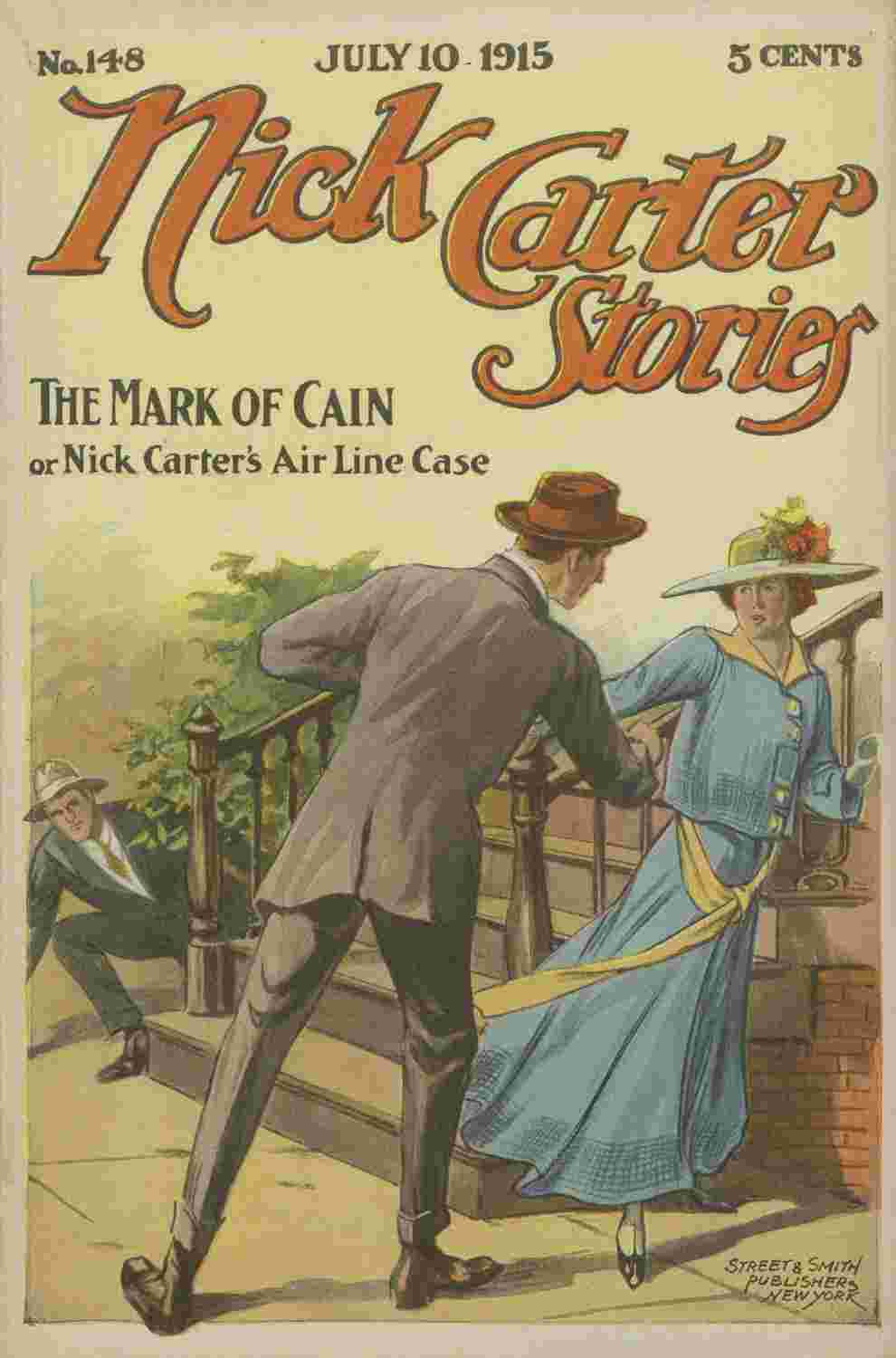
The Nick Carter Stories
ISSUED EVERY SATURDAY BEAUTIFUL COLORED COVERS
When it comes to detective stories worth while, the Nick Carter Stories contain the only ones that should be considered. They are not overdrawn tales of bloodshed. They rather show the working of one of the finest minds ever conceived by a writer. The name of Nick Carter is familiar all over the world, for the stories of his adventures may be read in twenty languages. No other stories have withstood the severe test of time so well as those contained in the Nick Carter Stories. It proves conclusively that they are the best. We give herewith a list of some of the back numbers in print. You can have your news dealer order them, or they will be sent direct by the publishers to any address upon receipt of the price in money or postage stamps.{69}
704—Written in Red.
707—Rogues of the Air.
709—The Bolt from the Blue.
710—The Stockbridge Affair.
711—A Secret from the Past.
712—Playing the Last Hand.
713—A Slick Article.
714—The Taxicab Riddle.
717—The Master Rogue’s Alibi.
719—The Dead Letter.
720—The Allerton Millions.
728—The Mummy’s Head.
729—The Statue Clue.
730—The Torn Card.
731—Under Desperation’s Spur.
732—The Connecting Link.
733—The Abduction Syndicate.
736—The Toils of a Siren.
738—A Plot Within a Plot.
739—The Dead Accomplice.
741—The Green Scarab.
746—The Secret Entrance.
747—The Cavern Mystery.
748—The Disappearing Fortune.
749—A Voice from the Past.
752—The Spider’s Web.
753—The Man with a Crutch.
754—The Rajah’s Regalia.
755—Saved from Death.
756—The Man Inside.
757—Out for Vengeance.
758—The Poisons of Exili.
759—The Antique Vial.
760—The House of Slumber.
761—A Double Identity.
762—“The Mocker’s” Stratagem.
763—The Man that Came Back.
764—The Tracks in the Snow.
765—The Babbington Case.
766—The Masters of Millions.
767—The Blue Stain.
768—The Lost Clew.
770—The Turn of a Card.
771—A Message in the Dust.
772—A Royal Flush.
774—The Great Buddha Beryl.
775—The Vanishing Heiress.
776—The Unfinished Letter.
777—A Difficult Trail.
782—A Woman’s Stratagem.
783—The Cliff Castle Affair.
784—A Prisoner of the Tomb.
785—A Resourceful Foe.
789—The Great Hotel Tragedies.
795—Zanoni, the Transfigured.
796—The Lure of Gold.
797—The Man with a Chest.
798—A Shadowed Life.
799—The Secret Agent.
800—A Plot for a Crown.
801—The Red Button.
802—Up Against It.
803—The Gold Certificate.
804—Jack Wise’s Hurry Call.
805—Nick Carter’s Ocean Chase.
807—Nick Carter’s Advertisement.
808—The Kregoff Necklace.
811—Nick Carter and the Nihilists.
812—Nick Carter and the Convict Gang.
813—Nick Carter and the Guilty Governor.
814—The Triangled Coin.
815—Ninety-nine—and One.
816—Coin Number 77.
{70}
NEW SERIES
NICK CARTER STORIES
1—The Man from Nowhere.
2—The Face at the Window.
3—A Fight for a Million.
4—Nick Carter’s Land Office.
5—Nick Carter and the Professor.
6—Nick Carter as a Mill Hand.
7—A Single Clew.
8—The Emerald Snake.
9—The Currie Outfit.
10—Nick Carter and the Kidnapped Heiress.
11—Nick Carter Strikes Oil.
12—Nick Carter’s Hunt for a Treasure.
13—A Mystery of the Highway.
14—The Silent Passenger.
15—Jack Dreen’s Secret.
16—Nick Carter’s Pipe Line Case.
17—Nick Carter and the Gold Thieves.
18—Nick Carter’s Auto Chase.
19—The Corrigan Inheritance.
20—The Keen Eye of Denton.
21—The Spider’s Parlor.
22—Nick Carter’s Quick Guess.
23—Nick Carter and the Murderess.
24—Nick Carter and the Pay Car.
25—The Stolen Antique.
26—The Crook League.
27—An English Cracksman.
28—Nick Carter’s Still Hunt.
29—Nick Carter’s Electric Shock.
30—Nick Carter and the Stolen Duchess.
31—The Purple Spot.
32—The Stolen Groom.
33—The Inverted Cross.
34—Nick Carter and Keno McCall.
35—Nick Carter’s Death Trap.
36—Nick Carter’s Siamese Puzzle.
37—The Man Outside.
38—The Death Chamber.
39—The Wind and the Wire.
40—Nick Carter’s Three Cornered Chase.
41—Dazaar, the Arch-Fiend.
42—The Queen of the Seven.
43—Crossed Wires.
44—A Crimson Clew.
45—The Third Man.
46—The Sign of the Dagger.
47—The Devil Worshipers.
48—The Cross of Daggers.
49—At Risk of Life.
50—The Deeper Game.
51—The Code Message.
52—The Last of the Seven.
53—Ten-Ichi, the Wonderful.
54—The Secret Order of Associated Crooks.
55—The Golden Hair Clew.
56—Back From the Dead.
57—Through Dark Ways.
58—When Aces Were Trumps.
59—The Gambler’s Last Hand.
60—The Murder at Linden Fells.
61—A Game for Millions.
62—Under Cover.
63—The Last Call.
64—Mercedes Danton’s Double.
65—The Millionaire’s Nemesis.
66—A Princess of the Underworld.
67—The Crook’s Blind.
68—The Fatal Hour.
69—Blood Money.
70—A Queen of Her Kind.
71—Isabel Benton’s Trump Card.
72—A Princess of Hades.
{71}73—A Prince of Plotters.
74—The Crook’s Double.
75—For Life and Honor.
76—A Compact With Dazaar.
77—In the Shadow of Dazaar.
78—The Crime of a Money King.
79—Birds of Prey.
80—The Unknown Dead.
81—The Severed Hand.
82—The Terrible Game of Millions.
83—A Dead Man’s Power.
84—The Secrets of an Old House.
85—The Wolf Within.
86—The Yellow Coupon.
87—In the Toils.
88—The Stolen Radium.
89—A Crime in Paradise.
90—Behind Prison Bars.
91—The Blind Man’s Daughter.
92—On the Brink of Ruin.
93—Letter of Fire.
94—The $100,000 Kiss.
95—Outlaws of the Militia.
96—The Opium-Runners.
97—In Record Time.
98—The Wag-Nuk Clew.
99—The Middle Link.
100—The Crystal Maze.
101—A New Serpent in Eden.
102—The Auburn Sensation.
103—A Dying Chance.
104—The Gargoni Girdle.
105—Twice in Jeopardy.
106—The Ghost Launch.
107—Up in the Air.
108—The Girl Prisoner.
109—The Red Plague.
110—The Arson Trust.
111—The King of the Firebugs.
112—“Lifter’s” of the Lofts.
113—French Jimmie and His Forty Thieves.
114—The Death Plot.
115—The Evil Formula.
116—The Blue Button.
117—The Deadly Parallel.
118—The Vivisectionists.
119—The Stolen Brain.
120—An Uncanny Revenge.
121—The Call of Death.
122—The Suicide.
123—Half a Million Ransom.
124—The Girl Kidnapper.
125—The Pirate Yacht.
126—The Crime of the White Hand.
127—Found in the Jungle.
128—Six Men in a Loop.
129—The Jewels of Wat Chang.
130—The Crime in the Tower.
131—The Fatal Message.
132—Broken Bars.
133—Won by Magic.
134—The Secret of Shangore.
135—Straight to the Goal.
136—The Man They Held Back.
137—The Seal of Gijon.
138—The Traitors of the Tropics.
139—The Pressing Peril.
140—The Melting-Pot.
Dated May 22d, 1915.
141—The Duplicate Night.
Dated May 29th, 1915.
142—The Edge of a Crime.
Dated June 5th, 1915.
143—The Sultan’s Pearls.
Dated June 12th, 1915.
144—The Clew of the White Collar.
{72}
PRICE, FIVE CENTS PER COPY. If you want any back numbers of our weeklies and cannot procure them from your news dealer, they can be obtained direct from this office. Postage stamps taken the same as money.
STREET & SMITH, Publishers, 79-89 Seventh Ave., NEW YORK CITY