
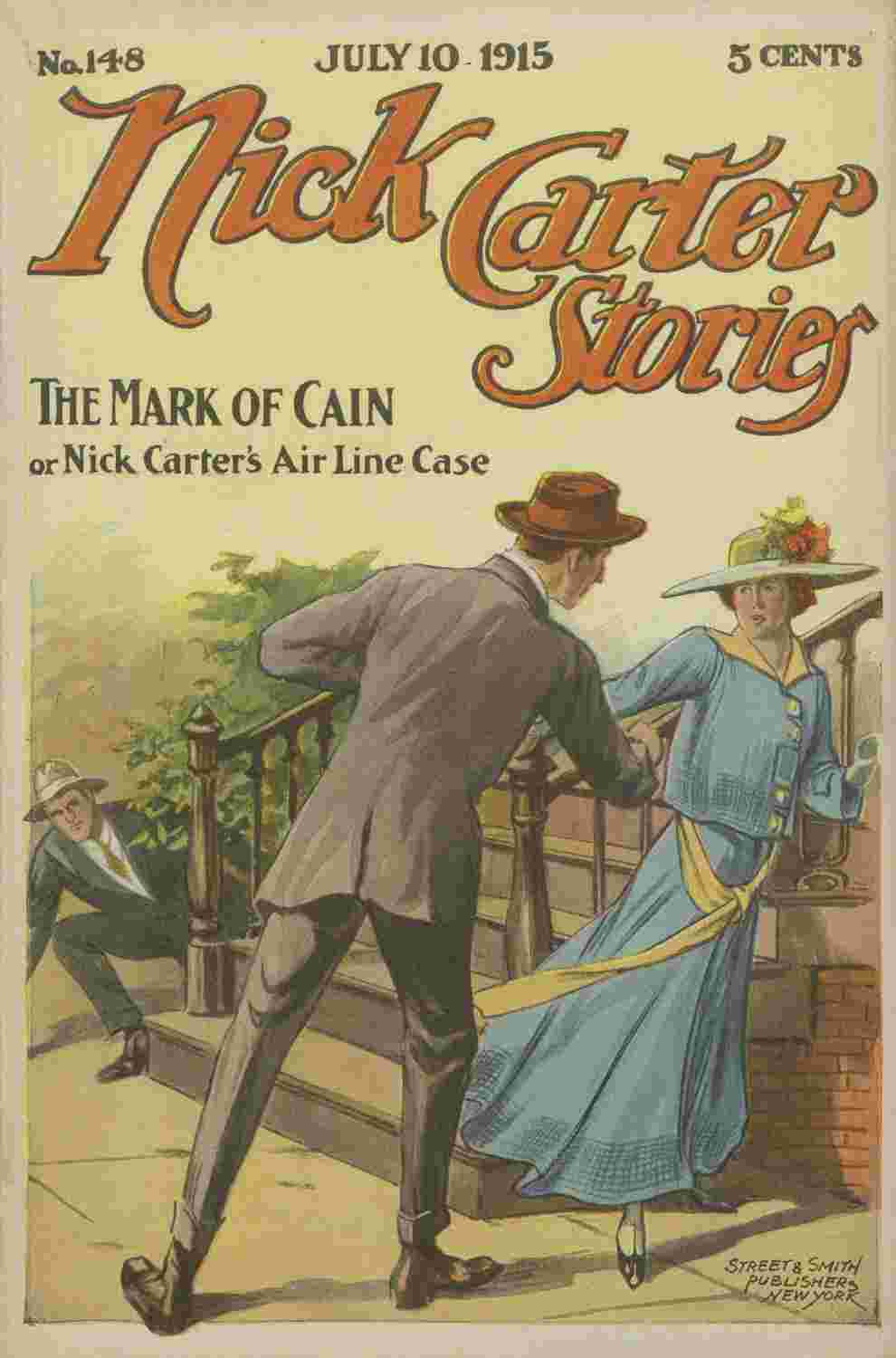
Goulard was hurrying up from one of the basement rooms in company with a clean-cut, florid man of nearly fifty. Both appeared disturbed. Goulard was talking excitedly and flourishing several foreign invoices, the character of which Patsy readily detected.
“Gee, I’m playing lucky,” he said to himself. “There is something doing already.”
He followed the two men to the second floor, on which{22} the extensive offices were located, including the private offices of the firm and assistant managers. All were in the rear of the vast building, but adjoined the extensive salesroom, which enabled Patsy to follow the two men without attracting attention.
He saw them enter the nearest of the several private offices, which were divided by a corridor from the large general office, and a moment later Goulard’s hard, aggressive voice could be plainly heard through the partly open door.
“There is no question about it, none whatever,” he declared. “Lombard is right, Mr. Mantell. Two of the Persian shawls are missing. I have checked off every article found in the packing cases, and Tenney, the receiving clerk, is positive that none was mislaid. The invoice is correct in every particular, save that two of the Persian shawls are missing. There goes another two hundred dollars to the dogs. By Heaven, I’ll close the store, or sell my interest in it, if this kind of thing continues.”
“Another theft,” thought Patsy, pausing at the entrance to the corridor. “The chief was right, by Jove, in that the robberies will continue in spite of us. That must be the senior partner’s private office.”
The last was confirmed by the reply to Goulard’s heated declarations.
“Don’t lose your head, Gaston. You suffer no more than I over these depredations. We are equal partners in the business. Bear in mind that we now have Nick Carter on the case, and he——”
“Carter be hanged!” Goulard interrupted bluntly. “Why hasn’t he showed up this morning? If he——”
“Give him time,” put in another voice, which Patsy recognized to be that of Frank Mantell. “You know, Goulard, what he stated last evening.”
“Stated!” snapped Goulard. “He didn’t state anything. He said only that he would look into the matter. Why isn’t he doing it? Close that door, Lombard. We may be heard in the salesroom.”
Patsy heard the door closed, and the voices of the men within no longer reached his ears. It was obvious to him, however, that they were discussing a robbery committed that morning, evidently from a package of imported merchandise that had been opened in the receiving room.
Bent only upon watching Goulard, as Nick had directed, Patsy waited briefly within view of the office door, toward which he presently sauntered, noting that the corridor ran toward the rear of the building and to a narrow, diverging corridor and stairway leading down to a court making in from the side street.
“I’ll wait and see where he goes after leaving Mantell’s office,” he said to himself, not venturing to play the eavesdropper at the closed door. “He probably will return to the salesroom, or some other part of the store. Ah, this must be his private office.”
It was the last in the corridor, and a plate on the door bore Goulard’s name. The door was partly open, and Patsy glanced in, pausing for a moment. He saw a handsomely equipped office with a large roll-top desk, then open and covered with accumulated letters, bills, and invoices.
Turning into the diverging back corridor, which afforded him a corner for concealment, Patsy then observed that another door led from Goulard’s office into the rear corridor, a fact which did not then impress him seriously.{23}
He scarce had turned the corner, however, when he heard the steps of the two men in the other corridor. They were coming in his direction, and discretion at first impelled him to dart toward the back stairway, as he could not plausibly explain his presence in this rear corridor, which was but little used and only by persons employed in the store.
Lingering for a moment, nevertheless, Patsy heard the men suddenly stop at the door of Goulard’s office. They remained in whispered conversation for several minutes, inaudible to Patsy, though he then heard one of them walk quickly away through the main corridor, while the other entered Goulard’s private office.
Patsy heard the door closed and the steps of the man within, and he still lingered and listened.
“Is it Goulard himself?” he questioned mentally. “Who else would be in his office? I must find a concealment from which I can watch the other door.”
Patsy found it under the rise of stairs to the third floor, a dusty corner from which he could see a portion of both corridors.
He had been waiting about ten minutes, when, much to his surprise, another man emerged from Goulard’s office and appeared in the back corridor.
He was a bowed, round-shouldered man in a gray suit, and entirely unlike the fashionable garments worn by the junior member of the firm. He appeared to be about sixty, a man with grizzled hair, a full beard, and wearing steel-bowed spectacles. He paused for a moment, glancing sharply toward the stairs, and then he closed the rear door from which he had come and hastened toward the stairway.
“That beats me,” thought Patsy. “I’m sure there was no one in that office when I looked into it, and who but Goulard would have entered it? Who the dickens is this fellow, then, and why——”
Patsy did not continue his train of thought. He decided that the matter needed immediate investigation. He darted to the rear door of the office again and listened.
Not a sound came from within.
Stepping around to the other door, bent upon knocking and learning positively whether Goulard was within, Patsy now found on the door a written card:
“Will return at two o’clock.”
“Great Scott!” thought Patsy, startled. “That wasn’t here when I passed this door. Can it be——”
He did not end the thought. He turned abruptly, darting through the rear corridor and down the back stairway, now in hot pursuit of the bearded man in gray.
CHAPTER VI.
THE CODE TELEGRAM.
Chick Carter was on the lookout for Bart Bailey at seven o’clock the following morning, after trailing him to Philadelphia. He had felt sure that his quarry would not be stirring before that hour, but he soon found that he had allowed himself but little leeway. For Bailey appeared in the hotel office ten minutes later and hurried in to breakfast.
Chick saw plainly that the rascal did not suspect an espionage, but his haste denoted that he had important business in view. Chick determined not to lose sight of him, therefore, and he deferred for that reason and in{24} order to gather additional evidence, a telephone talk with Nick, precisely as the latter had inferred.
Chick shadowed Bailey from the hotel about eight o’clock, and the store mentioned by the clerk the previous night. It proved to be a small establishment, occupying only the ground floor and basement of a corner building, with an office in the rear, and to which the crook immediately hastened.
“I’ll not follow him,” thought Chick, sizing up the store from outside. “I may get a line on him from the rear.”
Hastening in that direction, Chick saw that the back windows of an automobile agency overlooked a paved area back of Meyers’ store, and he entered and introduced himself to the manager, confiding the situation to him and requesting the privilege of using the rear windows.
“Why, certainly, Mr. Carter,” he readily consented, after Chick had concluded. “Go as far as you like. I wouldn’t bank much myself, as a matter of fact, on Rudolph Meyers’ integrity. I know he used to run a pawnshop in one of the lower precincts of the city. He opened this store about eight months ago.”
“Soon after the New York robberies began,” Chick nodded.
“I see the point. I have often wondered why he could sell goods cheaper than his competitors. I inferred that his rent might be lower, and he keeps only one clerk, a man named Finley.”
“Many of his goods cost him less—at present,” Chick said significantly.
“I judge so, now,” smiled the other. “They unpack most of them in the area back of the store. A big case came in there this morning by express. It now is out there. I suppose they will open it, now that Finley has showed up. Yes, by Jove, they’re just coming out of the rear door.”
Chick directed the manager to remain in his office, and he then stole to a point from which he could easily see and hear the two men without being detected.
They had emerged from a back door of the store, and had opened another leading down a flight of stone steps to the basement. Barton Bailey already was working upon a large packing case, while Rudolph Meyers, a short, swarthy man of about fifty, stood looking on with a sinister grin.
“Another vindfall, eh?” he remarked, after a moment. “Another vindfall. If it proves to be as good as the last——”
“Much better, Meyers, and then some,” Bart Bailey interrupted, turning from his work. “I happen to know just what is in this one. I was with Murdock when the goods were packed.”
“You left him all right, eh?”
“As right as a trivet, Rudolph.”
“Not one is yet wise, eh?”
“Not yet, old man, nor likely to be,” declared Bart confidently. “The headquarters dicks have been bounced and others are to be tried. You know whom I mean. They’re the worst ever, too, but I reckon they’ll find this nut too hard a one for their ugly jaws. If they——”
“Wait!” cut in Meyers sharply. “Here vas a poy with a message. Vait von minute.”
Chick pricked up his ears and crept nearer the window. Through the open back door of the store he could see a telegraph messenger entering from Broad Street. He saw Meyers hurry in to meet him, saw him glance at the{25} address on the yellow envelope, and then turn and beckon to Bailey, who dropped his tools and hurried into the store.
“By Jove, I wonder what that signifies,” thought Chick, with instinctive misgivings. “A wire to Bailey, eh? Can any one have got wise to my doings?”
Bart Bailey, to whom the telegram evidently was addressed, hastened to sign for it, and then broke the seal. He read the message, and then both men hurried into the rear office.
Chick then could see them through one of the office windows, which had been opened to admit the morning air.
Bart Bailey took a small leather book from his pocket and sat down at a desk, spreading the telegram on it and seizing a large pad of blank paper and a pencil. He then began to refer to various pages in the book, pausing to write briefly at intervals on the pad.
“A code message,” thought Chick, intently watching the couple. “He has the key to it in that book, and is making a transcription on the pad. By Jove, this looks like something doing.”
Chick’s suspicions were almost immediately confirmed. Both men appeared much disturbed. Leaving Barton still at work at the desk, Meyers hurried to the front part of the store, where, through some lace draperies that were displayed in one of the windows, he began to peer cautiously into Broad Street, evidently searching the wide thoroughfare in each direction.
“By gracious, I must be right,” Chick muttered. “Bart Bailey has been tipped by some one, as sure as death and taxes. The other rat is looking to see whether the store is being watched. You’re looking in the wrong direction, old man. By Jove, I would give a trifle for a copy of that transcription.”
Bart Bailey evidently completed it a few moments later. He sprang up in some excitement, tore the written sheet from the pad, then hurried out to the front of the store to read it to his companion. Both remained there, earnestly discussing it and gazing cautiously toward the street.
“Here’s my chance, by Jove, if I ever had one,” thought Chick, after watching them for a moment. “I’ll take it, too, let come what may.”
Stepping quickly to one of the other windows, Chick quietly raised it, then sprang out noiselessly and crossed the area between the two buildings. The desk in the rear office was within reach through the open window.
Chick leaned over the sill and listened for a moment. He could hear the subdued voices of the two men in the front of the store, but could not distinguish what they were saying.
Taking the pad from the desk, Chick drew back and tore off the upper blank sheet and slipped it into his pocket. He then replaced the pad and returned it to its former position, quietly closing the window. The two men in the front of the store still were cautiously watching the street.
“Neither of them heard me,” thought Chick, with some satisfaction. “Nor will a single blank sheet be missed from that pad. I’ll wager I can learn something from it.”
One might wonder how he could accomplish it, but Chick Carter was wise to all the tricks of his profession. He thanked the manager of the agency for the accommoda{26}tions afforded him, cautioned him to say nothing in regard to his visit, and he then learned the location of the nearest drug store.
Hastening to it, Chick bought from a clerk some fine black powder adapted to his purpose. He then requested the privilege of using the prescription room for a few moments, stating with what object, and the favor was readily granted.
Chick then spread the blank sheet of paper on a table and covered it with a thin layer of the fine black dust, which he then blew gently from its surface.
Particles of it remained, however, in the indentations caused by the pressure of the pencil through the sheet on which Bart Bailey had been writing, and it brought out quite legibly nearly every word of the transcription hurriedly made by the crook.
Chick read it carefully, quick to readily interpret the condensed phrases transcribed from the code book, and he found that it fully confirmed his suspicions.
It told him that Bart Bailey had been warned that a detective was following him; that he must watch out for him and lure him to New York, if possible, and to some place designated only as a cobweb. The communication bore no signature whatever.
Chick Carter smiled a bit grimly, now knocking the particles of dust from the sheet and returning it to his pocket. The circumstances, nevertheless, puzzled him somewhat.
“Who the dickens could have learned of my doings and warned this rascal?” he said to himself. “Not Helen Bailey, surely, nor the boarding-house landlady. Neither of them would have done so. I’ll be hanged if I now can fathom it, but I reckon I see my way to doing so. Lure me to New York, eh? I can guess what that means, all right. Well, I’ll give the rats a chance.”
Most men would have shrunk from the risks involved, but not Chick Carter. He now hastened to find a second-hand clothing store, where he clad himself in a somewhat seedy suit and a woolen cap, directing that his own discarded garments should be sent to his New York address.
Ten minutes later, wearing an entirely different facial disguise and having a rather sinister appearance, Chick returned to Broad Street and entered Meyers’ store.
He then found both suspects engaged in hurriedly putting into various shelves and drawers the goods taken from the packing case, which had been opened during his brief absence.
Both at once ceased working when he entered, and Chick saw that he was instantly suspected. He saw, too, that Bailey shot a swift, significant glance at Meyers, plainly directing him not to interfere.
“Is the boss around?” Chick inquired, as he approached them.
Bart Bailey nodded, hooking his thumbs through the armholes of his vest, while he replied inquiringly:
“I am the boss, my man. What do you want?”
“I’m looking for a job, sir,” said Chick, respectfully touching his cap with his forefinger. “I thought, mebbe——”
“That I would give you employment?” Bart put in, with searching scrutiny. “What led you to think so?”
“Nothing, sir, save that most stores need help,” Chick explained, quite humbly. “I have been trying for a job{27} in others, sir, but luck seems against me. I’m broke and in hard sledding, you see, and——”
“Do you live in the city?” Bart cut in again.
“No, sir. I’m here from Chicago only a couple of days.”
“Why did you leave there?”
“My boss failed, and that threw me out of a job. I couldn’t get another in Chicago, so I worked my way here on a freight train.”
“What sort of work can you do?”
“Any old kind, sir, that’ll earn me a dollar,” Chick asserted, somewhat suggestively. “I wouldn’t be particular. You can bet on that.”
“You’d do most anything, eh?”
“That’s what I would, sir. When a man’s up against it good and hard, he don’t stick over trifles. I’d do anything the boss told me.”
“Suppose it was something off color?”
“That would be up to him, sir. I’d do it, all right, and shut my eyes to what it was about.”
“And your mouth, too, perhaps?”
“I would, sir, and keep it shut,” said Chick, with a sinister nod. “You can bank your pile on that, sir.”
Bart Bailey laughed and glanced again at the listening merchant.
“Murdock might use the fellow,” he remarked significantly.
“Vell, yes, he might,” Meyers allowed tentatively, evidently taking a cue the other had given him.
Bart turned to Chick again, saying:
“We’ve got no use for you here, my man, but I think I could find a job for you in New York.”
“That would suit me all right, sir,” Chick declared, with manifest eagerness. “I’d go to New York, sir, or to perdition, if need be. Give me a letter to the party, sir, and I’ll find a way to get there.”
“I’d do better than that, my man, if you mean what you say,” replied Bailey, glancing at his watch.
“You’ll find I mean it, sir,” Chick insisted.
“I’m going to New York in just half an hour,” Bart added. “I’ll not promise you the job, mind you, but I think I can fix you with a friend who wants a man for general work. I’ll take the chance, at all events, and will pay your fare, which can be returned to me out of your first week’s pay. How does that suit you?”
“I couldn’t be hit more to my liking, sir,” said Chick, with manifest gratitude. “I’m more obliged than I could tell if I——”
“Never mind thanking me,” Bart interrupted. “There’ll be time enough for that after you get what’s coming to you. What’s your name?”
“James Donovan, sir.”
“Where are you stopping? Have you got any luggage?”
“Only what’s on my back.”
“Well, that’s easily carried,” Bart laughed, with a covert gleam in his shifty eyes. “Sit down there, Donovan, for about ten minutes. We then shall have time to hit a fast express.”
Chick obeyed him with alacrity, taking a chair to which the rascal pointed.
There was nothing remarkable in the celerity with which these arrangements were completed. Chick knew that the two crooks did not dream of his having learned of the code telegram and its significance, and that they not only would suspect his identity, but also would see in his{28} application for work only a scheme to watch them and the Philadelphia store.
That he would walk with open eyes into such a net as the telegram indirectly suggested would seem utterly improbable, and Bart Bailey had immediately seized the supposed opportunity which the situation presented, feeling sure that he could trap Chick before he could learn that his identity and designs were suspected.
Half an hour later, therefore, found both seated in the smoking car of an express train bound for New York, whither Chick had really expected to have taken the crook in irons, instead of traveling as his supposed dupe.
This appeared to Chick, nevertheless, the surest and speediest way to discover the identity and doings of Bailey’s confederates, as well as to round up the entire gang, which might possibly be perverted by the immediate arrest of Bailey and Rudolph Meyers.
It was early afternoon when they arrived in New York, each having played his part consistently, resulting in no material change in the situation, save a change of base.
“We’ll take a taxi,” said Bailey, as they emerged from the station. “I’ve got the price.”
“That beats working one’s passage on a freight train,” Chick replied. “Whatever you say, Mr. Finley, goes.”
“This way, then.”
Chick followed him to a taxicab, to the driver of which the crook quietly gave his instructions.
The taxicab stopped in front of an unpretentious store in one of the crosstown streets. The single front window denoted that wooden toys and novelties of like description were sold within. A sign over the door apparently told the whole story:
“ACME NOVELTY COMPANY.”
Chick glanced at the sign and window when he followed Bart Bailey from the taxicab. Beyond the low brick building in which this store was located, the two upper floors of which were evidently used for a dwelling, towered the rear wall of a vast mercantile edifice, which Chick immediately recognized.
“Mantell & Goulard’s department store,” he said to himself. “By Jove, this should signify something.”
“This way, Donovan.” Bart Bailey spoke with a growl. “Get a move on.”
Chick did not hesitate. He followed the ruffian without replying, and entered the quarters of the Acme Novelty Company.
CHAPTER VII.
INTO A NET.
Chick Carter sized up the interior of the store with a glance. He saw that it was not used for a retail business. Several empty cases stood on the floor, while a nondescript array of toys and novelties of cheap variety filled the shelves and single counter, all more or less dusty and in some disorder.
The only visible occupant of the place was a burly, powerful man of middle age, with reddish hair and features, and with his shirt sleeves rolled above the elbows of his brawny arms. He was clad in overalls and appeared to be engaged in drawing nails from a cover of one of the empty cases.
“Hello! Back again, Finley?” he exclaimed, in guttural tones, when the two men entered, at the same time bestowing an indifferent glance upon Chick.{29}
“Yes, Nolan, but only for the day,” Bart Bailey replied. “Is Murdock around?”
“He’s in the basement.”
“Good enough! I hoped I would find him here. Shake hands with Mr. Donovan. He’s looking for a job, and I have an idea that Mr. Murdock can use him.”
“I reckon that we can use him, all right,” Nolan vouchsafed, with covert significance. “We want to get the right kind of a man.”
“I think I can fill the bill,” said Chick, while he shook the other’s tendered hand.
“Wait here, Donovan,” put in Bailey. “I’ll find out what Murdock thinks about it.”
“Go ahead, sir,” Chick nodded.
Bart turned to the rear of the store and vanished down a narrow stairway.
“What kind of work is to be required of me?” Chick inquired, turning again to Nolan.
“Odd jobs,” was the indefinite reply. “Mostly packing the stuff we send away. We don’t do any retail business.”
“Does Mr. Murdock run the business?”
“When he’s here,” nodded Nolan. “He’s the big finger.”
“Where does he buy all of these things?” Chick inquired, glancing at the counter and shelves.
“Don’t buy them,” said Nolan tersely. “We make most of them. We’ve got a workroom in the basement.”
“I might——”
What Chick would have said was cut short by a shout from below, a command from Bart Bailey.
“Bring Donovan down here, Nolan,” he cried. “Murdock wants to talk with him.”
“All right,” Nolan shouted; then, to Chick: “I’ll turn the key in the door. Some one might steal in and swipe something.”
He strode to the street door and locked it while speaking, and Chick quick to note the significance of all this, seized the opportunity presented. He shifted a revolver to the side pocket of his coat, then followed Nolan down the narrow back stairway.
It led to a basement room of moderate size, with a cement floor and lighted with several incandescent lamps. In none of the four foundation walls that met Chick’s gaze was there any sign of a window. In one corner, however, a stairway led up to another part of the building.
Near one of the walls stood a long, wooden bench, covered with tools and partly finished articles such as Chick had seen in the store. Aside from this bench, two common wooden chairs and a bare table, the room contained no furnishings worthy of mention.
A workman with his sleeves rolled up, a muscular chap in the twenties, was leaning on the bench with a mallet in his hand.
Bart Bailey was seated on a corner of the table.
Near by, occupying one of the chairs, was a bearded, round-shouldered man in gray—the man whom Patsy Garvan had followed from the department store only a short time before.
Nolan stepped aside to let Chick pass, and the latter quickly noticed that he did not return to the store. It was too significant a fact to be ignored, and Chick was never more alert than at that moment.
“This way, Donovan,” Bailey said, a bit curtly. “Here is Mr. Murdock. I have told him about you. He wants to ask you a few questions.{30}”
“All right, sir,” said Chick. “Glad to know you, sir.”
“Very good. Sit down, Mr. Donovan.”
Murdock pointed to the only vacant chair. It was directly in front of him, and scarce three feet away. He sat with his imposing figure bowed slightly forward, with his hands spread on his knees. He had spoken agreeably, but his voice had a hard ring and his eyes a shifty gleam that further put Chick on his guard.
He sat down, as directed, replying respectfully:
“Thank you, sir. I’ll answer any questions you ask.”
“Very good,” said Murdock. “Finley tells me you are out of work and came from Chicago.”
“I did, sir.”
“What were you doing there?”
“I worked in a hardware store.”
“Are you handy with tools?”
“Quite so,” Chick nodded, wondering how the situation would turn. “I have worked as a carpenter at times, though I never learned the trade.”
“You don’t look like a man accustomed to hard work,” said Murdock, smiling through his heavy beard.
“I’ve done my share, sir, for all that.”
“Let’s see your palms. They will tell the story.”
Chick hesitated for only the hundredth part of a second. He now knew what was coming, that the rascal suspected he was gripping a weapon in his side pocket, of which he aimed to make him let go. Chick reasoned on the instant, too, that he was up against desperate odds, that his best move would be to yield to the rascals temporarily, biding his own time to discover their entire game and to turn the tables on them. All this really was no more than he had expected and designed, when he boldly entered the place in spite of the risks involved.
Chick hesitated only for an instant, therefore, and then extended both hands and displayed his palms, as directed.
As quick as a flash, bending forward from the table on which he was seated, Bart Bailey clapped the muzzle of a revolver to the detective’s head.
“Don’t move!” he commanded, with sudden sharp ferocity. “Keep them there, or you’ll be a dead one. We want your hands where we can see them.”
Chick dropped them on his knees and drew up in his chair. Without so much as a glance at Bailey, and apparently not the least disturbed by his weapon, he gazed at Murdock and asked coolly:
“What’s the meaning of this? What’s it all about?”
Murdock’s eyes took on a more venomous gleam and glitter, his voice a more threatening ring.
“You know what’s it all about,” he said sternly. “If you stir foot or finger, you’ll get all that Finley has threatened. You are playing a tricky game and a dangerous one, for it cuts no ice with us. We know you, Carter, and are out to get you—as you’re out to get us!”
Chick coolly removed his disguise and tossed it upon the table.
“That being the case, Mr. Murdock, I’ll sail under true colors,” he said curtly.
“You may as well,” Murdock rejoined, with a sneer. “But don’t get gay, Carter, or you’ll pay the price. Keep your hands on your knees.”
“Don’t be alarmed,” Chick retorted. “I’m not inviting a bullet by opposing you. Do what you like.”
“We intend doing so,” snapped Murdock. “The mistake{31} you made, Carter, was in undertaking to oppose us. You now find yourself neatly trapped.”
“Oh, not as neatly as you imagine,” said Chick. “You have had nothing on me.”
“Nothing on you, eh?”
“Only what I have voluntarily handed you.”
“Rats!” cried Bart Bailey, with a snarl and scowl. “Tell that to the marines. I’ve made a monkey of you, Carter, and you know it.”
“It’s not in you, Bailey, to make a monkey of me,” Chick replied, with a scornful glance at him. “It’s you who were monkeyed last night, when I picked you up in Lexington Avenue and trailed you to Philadelphia, with you none the wiser.”
“That’s insignificant,” said Murdock, checking Bailey with a gesture. “We know all about that. We know just how it was done.”
“Certainly you do,” Chick coolly allowed. “I was aware of that several hours ago.”
“Aware of what?”
“That you knew a detective had trailed this rascal to Philadelphia.”
“You knew it several hours ago?” demanded Murdock suspiciously.
“Yes.”
“I guess not.”
“Punk!” snarled Bailey derisively. “That’s rot! How could he know it?”
“You have another guess, Murdock,” added Chick, not averse to mocking and mystifying the rascals, in spite of the risk it involved. “I assume, too, that you are the man who sent him the information.”
“How sent him?” Murdock sharply demanded, evidently rendered apprehensive by Chick’s repeated assertions.
“It was sent in a code telegram.”
Murdock’s heavy brows knit like frowning battlements over his threatening eyes. He drew forward in his chair, searching Chick’s face more intently.
“How did you learn of that?” he cried, while Bart Bailey looked as if he had been hit with a club.
“I have methods of my own, Murdock, for getting such information,” Chick replied. “For obvious reasons, however, I do not reveal them to crooks.”
“But how could you interpret a code message even if you saw the telegram?”
“Easily.”
“Impossible, unless——” Murdock turned sharply to Bart Bailey. “Has that code book been out of your hands?”
“Not on your life,” cried Bart emphatically. “This is all a bluff. He’s got you on a string. He don’t know half of what he asserts.”
“Don’t I?” questioned Chick, glancing at him again. “I know that you were directed to look out for me, Bailey, and to lure me to New York, if possible, and to a place designated in your code book as the cobweb. This, of course, is the place.”
Murdock uttered an oath, evidently staggered and more alarmed by what he had learned.
“Bolton,” he cried harshly, turning to the man with a mallet, “search this infernal meddler. I’ll find out whether he’s an infernal mind reader, or has a copy of our code in his possession.”
Bolton hastened to obey.
Chick laughed indifferently, and Murdock fiercely added,{32} with both hands clenched in front of the taunting detective.
“If you knew all that, Carter, why have you walked into this trap?”
“Does that surprise you?”
“It appears reckless, not to say absurd.”
“I did it, then, in order to get a line on the identity of you scamps, and to learn just how you are playing your knavish game,” Chick bluntly admitted.
“Oh, is that so?”
“Exactly so.”
“Well, then, you shall learn,” snapped Murdock fiercely. “It will cost you your life, but you shall learn. I’ll make it a point to satisfy your foolhardy curiosity. You shall learn—but at the cost of your life.”
“Suppose we make a beginning, then,” said Chick, a bit sharply. “Let’s both sail under—true colors.”
He reached up quickly while speaking and seized Murdock’s grizzled beard, giving it a violent jerk. It came away in his hand, as Chick had suspected, revealing the hard-featured, smooth-shaved face of—Gaston Goulard.
CHAPTER VIII.
CAUGHT IN A CORNER.
Patsy Garvan was hit with an idea, of course, when he started in hot pursuit of the man in gray. He suddenly suspected, having seen him come from the back door of Goulard’s private office, under the circumstances already described, that this grizzly bearded fellow was none other than Gaston Goulard himself.
Patsy realized, moreover, that the investigations he had made after the suspect’s hurried departure, might prevent his overtaking him, and that was the thought uppermost in Patsy’s mind when he plunged down the rear stairway in pursuit of him.
He brought up in a paved court back of the vast building. It made in from a side street, and was used chiefly for the receiving and shipping of merchandise from the store. It adjoined the broad doors of the two great basement rooms devoted to these branches of the vast business.
Several wagons and teamsters then were in the court, but there was no sign of the man Patsy was seeking.
“He surely came this way,” he hurriedly reasoned. “He must have gone to the side street, too, for the other end of the court brings up against a wing of the building. I’ll take that chance.”
Patsy took it vainly, however, darting in that direction. He could not discover his quarry in the side street, in spite of his hurried, far-searching scrutiny. It then became a question as to which direction the man had taken.
“He would have gone through the store, of course, if heading for Sixth Avenue,” Patsy continued to reason. “That would have been the nearest way, and he appeared to be in a hurry. It’s odds, then, that he went the other way, and it’s that way for mine.”
Patsy started off again and walked for nearly a block, gazing sharply in every store, including that of the Acme Novelty Company, but he finally was forced to admit to himself that he had lost his man.
“Gee whiz! it’s tough luck,” he muttered, pausing and then turning back. “I’ll eat my hat, crown and brim, if that wasn’t Goulard himself. Why the dickens didn’t I hook onto that idea on the jump? I then could have{33} trailed him without sweating a hair. There’s nothing for me, now, but to return and tell the chief, when he shows up in the store.”
Slowly retracing his steps, however, Patsy lingered for several moments here and there, still hoping to discover his quarry.
A taxicab was approaching from Sixth Avenue. It stopped suddenly at a store on the same side as Patsy, and some thirty feet from where he then was standing.
A man sprang out, quickly followed by another—and Patsy then felt a thrill shoot up his spine.
“Holy smoke! that’s Chick in disguise, as sure as I’m knee-high to a grasshopper,” he said to himself, while he watched both men hurry into the store.
“I know that disguise as well as I know his own face,” Patsy went on mentally. “He was on Bart Bailey’s track, and it now is a hundred to one that he has some job on the rascal. The other must be Bailey himself. Great guns! I’m getting wiser every minute. Now it’s a thousand to one that Goulard went into that store, or why has Bailey gone in there? Gee! the boot may be on the other leg. This may be a job to get the best of Chick. That may be Goulard’s hurried mission from the department store.”
Patsy had reasoned it out correctly, in spite of his meager information of the actual circumstances.
Bart Bailey had, as a matter of fact, sent Goulard a message in response to the code telegram, and had informed him of his designs.
Patsy was not slow in acting upon his suspicion, nevertheless though he took care not to interfere with whatever Chick might have up his sleeve. He sauntered by the store, glancing up at the sign and through the window. He passed just in time to see Nolan turn back after locking the door, and then vanish with Chick down the rear stairway.
“That don’t look good to me,” thought Patsy, brows knitting. “Why did he lock that door? Chick evidently knew it and stood for it. He must know what he’s doing, therefore, but he may slip a cog in some way. I’ll not butt in, but I’ll be hanged if I don’t do a bit of nosing around on my own hook.”
Patsy sauntered by the store again, and now saw plainly that it was unoccupied. He then moved on and crossed the street to survey the two upper floors.
“Some one lives up there,” he muttered. “It may be the gink I saw in the store, or some one else employed there. I’ll not risk asking any questions. Gee! I might get next in that way.”
Patsy was hit with another idea. He had discovered an open alley leading to the rear of the building. He also had discovered a stonemason at work in the alley, engaged in pointing up portions of the brick wall of the next building. He was at work with a bucket of mortar and a trowel.
Patsy made a short detour and presently paused at the entrance to the alley.
“Hist!” he called quietly.
The mason turned quickly, a ruddy young Irishman, and Patsy signed for him to come out and follow him. They met a few rods away a moment later, out of view from the windows above the suspected store.
“What d’ye want?” questioned the Irishman curiously.
“Slip into the saloon here and I’ll tell you,” said Patsy. “I’ll also buy you a drink, or whatever you fancy.{34}”
“Faith, and I can stand that, all right,” grinned the Irishman.
Patsy led the way to a rear room of the saloon, where he gave a waiter an order, and he then proceeded to explain his project to his companion, revealing his identity and his relations with Nick Carter.
“I wish to size up that building next to the one on which you are working, Grady,” he said, having learned the other’s name. “I must do so without being suspected. I can get by, all right, if you’ll lend me your duck blouse, overalls, and hat, and remain here under cover while I get in my work.”
Grady grinned.
“In other words, Mr. Garvan, you want to take my place,” said he.
“Exactly. I’ll slip you a five-dollar note for it, Grady, and——”
“You kape the five bucks in your pocket, Mr. Garvan,” Grady warmly interrupted. “Faith, who wouldn’t do that much for Nick Carter! If you get into these togs as quick as I come out of them, you can be at work with me trowel in the shake of a lamb’s tail. I’ll hide here with my trap closed, be it long or short that you’re gone. That goes, too, by these five fingers across.”
“You’re all right, Grady, from your toes up,” replied Patsy gratefully. “Take it from me, all the same, you’ll get yours for this.”
Patsy sauntered out of the saloon in about five minutes. Only a close observer would have detected his subterfuge. One who had seen Grady at work would merely have supposed that another mason had taken his place.
Patsy devoted very little time, of course, to pointing up the brick wall. He began, instead, while pretending to be at work, a furtive inspection of the walls adjoining the basement to which he had seen Chick and Nolan descend. He could find, however, no window lighting the underground room.
“Gee! that’s mighty strange,” he said to himself. “Have they been stoned up for some reason? I’ll be hanged if I don’t think this crib figures in some way in the department-store robberies. I reckon I’ll go a step farther.”
Patsy already had found that a rear door and stairway led up to the dwelling over the store of the Acme Novelty Company. He could observe no one at any of the windows, however, and he felt quite sure that he could stealthily enter the place.
“If seen by any one, I can say I came in to ask for some water for my mortar,” he said to himself. “I’ll take the chance.”
Mounting the two low steps outside, Patsy found that the door was locked, also that the key had been removed.
“That simplifies it,” he muttered. “I can pick this lock like breaking sticks.”
He accomplished it with a picklock in half a minute. Quietly opening the door a few inches, he gazed into a narrow hall and at a bare stairway leading upward. A door in the right wall some ten feet away also met his gaze. He paused briefly and listened.
Not a sound came from within. The hall was as silent as if the building was deserted.
Patsy stepped in and closed the door, leaving it unlocked, lest he might have occasion to retreat hurriedly.
The closing of the door left the hall and stairway in{35} darkness—barring a single thread of artificial light that now caught his eye.
It was a vertical thread in the side wall, some two feet from where he was standing.
“Electric light,” thought Patsy, listening again. “The store is not lighted. Nor does the store run back as far as this. The door leading into the store from this hall is farther in. There must be a lighted room back here, all the same, or this chink—by gracious, it’s a panel door.”
Thrusting his nails into the crevice through which the light had shone, Patsy had felt a section of the wall slip noiselessly to one side, revealing a secret panel so skillfully constructed as to defy ordinary inspection.
It revealed, moreover, something of far greater significance.
A flight of steps led down to a brightly lighted basement in the extreme rear of the building. It was walled in like a tomb, however, with no sign of a window.
On the cement floor stood a large horizontal engine of peculiar construction, so peculiar that Patsy could not imagine for what it was used, or why it was there.
Near by on a rack was a metal cylinder about two feet long and ten inches in diameter. Each end had a movable metal cover. Around both ends, moreover, was a flange of thick felt.
On a narrow table near the farther wall, one of them spread open evidently for inspection, and so placed that its folds hung nearly to the floor, lay two costly Persian shawls.
The instant Patsy’s gaze fell upon them, the truth began to dawn upon him.
“Great guns!” he exclaimed mentally. “The two shawls mentioned by Goulard. He did not bring them here, however. There is a connection between this cellar and the department store. That’s a dead open-and-shut cinch, and it’s operated in some way with this engine. By gracious, I’ll have a closer look, if it takes a leg!”
Patsy had seen, of course, that this subterranean chamber then was deserted. Placing the panel exactly as he had found it, Patsy crept down the steps and gazed around.
“I have it,” he muttered. “This interior wall has been built across the original basement so as to form this chamber, and at the same time prevent detection by persons in the other part of the basement, who would naturally suppose it extended back no farther than this inner wall. It must be to the other part of the basement that Chick descended. He still must be there, too, unless——”
That there was no alternative, that his suspicions from the outset had been correct, that he had trapped himself also, and was up against a sudden, desperate situation—all flashed over Patsy on the instant, when his train of thought was broken by sounds that sent a momentary chill down his spine.
The quick opening of a door, the heavy tread of men’s feet, mingled with a harsh, commanding voice, which he instantly recognized to be that of Gaston Goulard—these were the sounds that suddenly fell upon Patsy’s ears.
“Open that panel door, Bolton, and give us more light,” Goulard was crying. “Lug him up here, Nelson, and be quick about it. Lend him a hand, Bart. We’ll hide the infernal dick in the engine room till we can dispose of him. Work lively. I must phone to Lombard and make sure that all is well before I return.”
“Great Scott!” thought Patsy, before half of the fore{36}going was said. “I’m in wrong, all right, against odds which—hang it! here’s my best chance.”
Patsy had caught sight of the Persian shawl hanging over the side of the table. As quick as a flash, dropping to the floor, he rolled under the table and back of the folds of the shawl, which for a moment, at least, served to shelter him like a curtain.
He scarce had accomplished this and checked the slight disturbance of the hanging shawl, when the panel flew open, and Nolan and Bart Bailey roughly rolled Chick Carter, then bound hand and foot, down the flight of steps to the engine-room floor.
“Lie there, blast you, until we’re ready to hand you something more,” Bailey cried, with a snarl. “Meddle with our business, will you? We’ll send you to the devil for it.”
“Leave him there,” snapped Goulard sharply. “Leave him there and close the door. Wait here, you three, while I phone to Lombard. There’s no telling what these Carters may have done, or will do. I’ll find out in a couple of minutes.”
Patsy heard his strident voice even after the panel door was closed. He also heard him rush through the hall, evidently to a telephone in the rear part of the store.
Patsy did not wait to hear more. He whipped out his knife and rolled from under the table, giving Chick, who was only a bit bruised by his fall down the steps, the surprise of his life.
“Eureka! You here, Patsy?” said he quietly.
“Bet you!” muttered Patsy, quickly cutting Chick’s bands. “I’m a Charley on the spot, for fair.”
“Is there a way out?”
“Only up these steps.”
“Thunder!”
“Tight box, old top, eh?” declared Patsy, undaunted. “But we have been in just as tight before.”
“Yes, and then some,” Chick nodded, springing up. “Have you got two guns?”
“Sure!”
“Let me have one. The rats have taken mine.”
“No sooner said than done,” grinned Patsy, handing Chick one of his revolvers and retaining the other. “What next? Shall we make a break at once and nail them in their own trenches, or——”
“Wait!” Chick interrupted. “Find the switch key that cuts off these lights. The rascals will fight back, but they could not get a line on us in the dark. We can get them at that advantage.”
“I’m wise,” said Patsy, vainly searching for the electric switch key.
“Be quick,” whispered Chick, crouching at the foot of the steps. “If—ah, there’s something doing. Something is wrong.”
A roar from Gaston Goulard had reached his ears, a fierce oath, followed by:
“There’s the deuce to pay! I can’t get Lombard on the phone. He has been arrested. There’s a chance, by thunder, that guns will show up here at any moment. Gag that infernal dick in the engine room, then put out the light. Fix——”
“Perdition! We’re already fixed!”
Bart Bailey had thrown open the panel door and suddenly discovered the two detectives.
“Hands up!” Chick shouted, starting up the steps. “Up with them, or{37}——”
“Hands up be hanged!”
Bart Bailey leaped aside, seeking the shelter of the wall, then whipped out a revolver and fired through the doorway.
The bullet whizzed a foot over Chick’s head.
“Out with the lights, Patsy!” he shouted. “Smash the bulbs!”
Patsy’s revolver swung upward like a flash.
There was a crash of breaking glass—and the subterranean chamber was in darkness.
CHAPTER IX.
BY THE AIR LINE.
Nick Carter arrived early that afternoon in the big department store of Mantell & Goulard, and several circumstances determined, as he had predicted to Patsy that morning, the course he afterward shaped.
One was the fact that, for the reasons already presented, he had received no communication from Chick and knew nothing about his movements.
Another was the fact that he could find no sign of Patsy Garvan in any part of the great store.
A third was the fact that Gaston Goulard was absent from his office, and that his whereabouts was unknown, as Nick learned upon talking with Frank Mantell and his father, which he then had decided to do, and both of whom he found in the private office of the senior partner.
Nick then learned, too, of the theft that had been committed in the receiving room that morning, about which Goulard had expressed himself so forcibly after apparently vainly investigating it.
Nick smiled a bit grimly after gathering these several points, and now suspicions began to arise in his mind.
“Have there been previous thefts from the receiving room, Mr. Mantell?” he inquired, addressing the elder.
“Yes, many of them; very many,” was the reply.
“Who has charge in that room?”
“A man named George Tenney.”
“Reliable?”
“I feel absolutely sure of it. He has been in my employ for a long time.”
“He evidently is being duped in some way, then,” said Nick. “He looks after the opening of all packages that are received, I suppose, and sees that their contents are sent up to the salesrooms.”
“Yes, of course, with the occasional help of Goulard, or Mr. Lombard.”
“They were both in the receiving room this morning, I think you have stated.”
“They were, Mr. Carter,” bowed Mantell. “They went down to investigate the theft.”
“Was either of them there before the theft was discovered?”
“Yes. Mr. Lombard went down to check off an invoice of the package from which the two shawls are missing.”
“I see,” Nick remarked. “I think I will go down there, Frank, and look around a bit. Show me the way as far as the stairs, then leave me, and pay no attention to my doings. I may have something to report a little later.”
Frank Mantell arose to obey, and Nick accompanied him down to the ground floor.
As they were turning toward the stairway leading down{38} to the basement receiving room, Frank touched the detective’s arm and said quietly:
“There goes Lombard, now. I think he is going down to the receiving room.”
Lombard was heading for the stairs with a wrapped bundle about a foot long and nearly as large in diameter, but he did not see Mantell and his companion.
Nick watched him for a moment, then said quietly:
“Leave me, Mantell. I can find the way by following him.”
Nick had more than one object in doing so.
He arrived at the head of the stairs just as Lombard turned to the left in the great basement room.
Nick darted down after him, and again fortune favored him. He reached the entrance to the room, which was always partly filled with unopened packages of divers descriptions, just in time to see Lombard glide stealthily back of a high pile of cases about two feet from one of the walls.
Nick saw an empty case about ten feet to the right of the door. He crouched behind it and waited.
Less than two minutes had passed when Lombard returned—without the bundle.
He quickly reached the stairway and hurried up to the business part of the store.
Nick Carter’s eyes had a sharper gleam when he crept from his concealment. He at once gave his attention to the narrow passage in which Lombard must have left the bundle.
One side was formed by the high pile of cases.
On the other was a sheathed wall.
Nick examined the cases in rapid succession, and he soon found that none of them could be opened. Obviously, none could be a hiding place for the bundle.
Nick then began a careful inspection of the wall, sounding it foot by foot by tapping it with his knuckles. He suspected, of course, that there might be a secret panel with an open space behind it.
Presently he found a spot that sounded more hollow than other sections.
“By Jove, I think I’m right,” he muttered. “But there seems to be no crack or crevice. The panel, if there is one, is most cleverly concealed.”
Persistently searching the wall, however, Nick finally discovered the head of a nail some six feet above the floor. It did not appear to be as dusty as the rest of the wall. He reached up and pressed it with his thumb.
This instantly brought a faint click from behind the sheathing.
A section of it about two feet square, so neatly fitted that the cracks were invisible, separated from the rest and swung outward under the impulse of a hidden spring.
It brought to light the foundation wall of the building, also a circular metal plate about fourteen inches in diameter, with a handle by which it could be swung downward parallel with the face of the wall.
Nick forced it down and discovered the opening of a tube through the wall, and in the tube a cylinder such as Patsy had seen in the subterranean chamber.
Nick instantly hit upon the truth, of course, and the mystery as to how the merchandise had been taken from the store ended then and there.
“A pneumatic tube,” he said to himself, noting the tight-fitting flange of felt around the end of the cylinder. “Similar to those of a cash system. The tube evidently runs{39} underground to another building, where there must be an engine and air pump for removing the air from the tube. That done, and this plate lowered, the cylinder would fly through the tube in an instant.”
Nick carefully noted the probable direction of the tube, then turned a knob in the metal end of the cylinder, from which he took, as he expected—the bundle seen under Lombard’s arm only ten minutes before.
Nick closed the tube and panel, then took the bundle up to Mr. Mantell’s private office, where he found both father and son.
“By gracious, Nick, there has been another theft,” Frank Mantell cried, when the detective entered. “A pair of costly lace curtains is missing from that department.”
Nick did not care for any particulars. He sat down in one of the large leather chairs and placed the bundle on the floor behind it.
“That’s too bad, Mantell,” he remarked. “I would like to question one of your managers. Send for Mr. Lombard, since we happened to notice him a few minutes ago.”
Frank Mantell looked surprised, but hastened to obey.
Lombard entered in about five minutes, apparently apprehending nothing.
Nick had removed his disguise and thrust it into his pocket.
“Sit down, Mr. Lombard,” said he, without waiting to be introduced. “I am told there has just been another mysterious theft in this store.”
“Yes, so I have heard,” was the quick reply. “I was just going to look into the matter.”
“Don’t you think it would be more profitable to look into that pneumatic tube that leads out of the receiving room?” Nick inquired.
Lombard turned as white as his shirt front.
“I don’t know what you mean,” he faltered. “What—what tube?”
“That in which I found this bundle a few minutes ago,” said Nick, taking it from behind his chair and tearing it open. “Here are the stolen lace curtains. I refer to the tube, Mr. Lombard, in which you placed them.”
Lombard started to rise, but his knees gave way under him and he nearly fainted in his chair, while Mantell and his father stared in speechless amazement.
Nick leaned forward, and, before Lombard fairly knew it, snapped a pair of handcuffs on the culprit’s wrists.
“Now,” said he, more sternly, “tell me where that tube leads, Mr. Lombard, and be quick about it. The jig is up for you and your confederates.”
Lombard pulled himself together and glared at Nick with a scowl.
“You’ll learn nothing from me,” he growled bitterly. “Find out for yourself, if you want to know.”
“That’s precisely what I will do,” declared Nick, starting up. “Look after this man, Mantell, till I return. I have a hunch that I shall not return alone.”
Nick did not wait for a reply, but seized his hat and hurried from the office. He had noted the probable direction of the underground tube, and he hastened through the corridor and down the same back stairway over which Patsy had pursued Gaston Goulard.
“Humph!” he ejaculated, upon arriving in the court. “It runs under these pavements and into the basement of this next building. I’ll find out who occupies it.{40}”
Nick hurried out to the side street and gazed up at the sign: “Acme Novelty Company.”
“Novelty, indeed,” thought Nick, trying the door and finding it locked. “No one at home, eh? I’ll slip around and try the back door.”
He had arrived nearly at the entrance to the alley, when he caught sight of a policeman on the opposite side of the street. He whistled and beckoned him over.
“Come with me, Doyle, and have your gun within easy reach,” he said quietly.
“Something up, Mr. Carter?” questioned Doyle, at once recognizing the detective.
“Yes,” Nick nodded. “I don’t know yet, however, how big game we may find.”
“Sure, I don’t care how big, sir.”
“Follow me through the alley, then, and——”
Nick stopped for an instant only.
There had reached his ear a sound, though a bit muffled, which he instantly recognized—the sharp, spiteful crack of a revolver.
“Come on, Doyle,” he snapped quickly. “That smacks of big game, all right. I reckon we’re in the nick of time.”
Nick was running at top speed through the alley while speaking, with the burly policeman close on his heels.
Ten seconds brought them to the back door of the building—which Patsy Garvan had left unlocked.
Nick then heard the shouts of men within, and the furious voice of Gaston Goulard.
“We’ve got them, Doyle,” he said quietly, pausing for an instant. “Are you ready?”
“I’ll go ahead, if you say the word.”
“Not much!”
Nick turned the knob and threw open the door, shedding the bright daylight into the dim hall in which Goulard, Bart Bailey, Nolan, and Bolton were attempting with fierce threats to subdue Chick and Patsy, who had smashed the lamps in the subterranean chamber only a moment before.
Nick broke in upon them with his revolver ready, shouting sternly:
“Cut it, you fellows! Hands up, and——”
His voice was drowned by the crack of a revolver in the hand of the only man who ventured any resistance—that of Bart Bailey.
The rascal had crouched quickly back of Goulard, and had escaped Nick’s immediate notice.
The bullet tore a hole in the detective’s sleeve and inflicted a slight wound in Doyle’s left shoulder.
Goulard sprang aside instinctively.
Bart Bailey was raising his weapon to fire again.
Nick’s barked on the instant, and the bullet went true.
Bailey pitched forward on his face in the narrow entry, dead before he hit the floor.
There were curses and imprecations, but no further resistance, and the three remaining crooks were speedily handcuffed and started for the Tombs, the initiatory step in the retributive path. Meyers was arrested in Philadelphia half an hour later, and the round-up was complete.
The details of the crime, as they afterward appeared, were very nearly in line with which Nick Carter had been led to suspect. It was learned later that Goulard long had been hopelessly under water financially, having vast secret commitments in the stock market, and he confessed to having taken this method to rob his partner and repair his wasted fortune. He had gone far enough to nearly{41} wreck the business, as a matter of fact, and the firm went out of existence a little later.
Commenting upon him and the case to his assistants shortly before the trial of the culprits, while seated with Chick and Patsy in his library, Nick Carter made several predictions which later proved for the most part to be correct.
“That rascal,” he observed, speaking of Gaston Goulard, “carries the mark of Cain. He has begun with being a traitor to his own partner. He probably will do time for the crime, and then he will continue the downward path. It’s odds that he will commit murder sooner or later. For, unless I am much mistaken, the mark is on him. The others will be convicted and sent to prison. As for Bart Bailey—well, let the dead bury the dead. His death has, at least, opened the way for Frank Mantell to win over the girl he loves, and they are well worthy of one another.”
“That’s right, chief,” declared Patsy.
“I would wager,” Nick added, “that they’ll be married within the year.”
THE END.
“A Network of Crime; or, Nick Carter’s Tangled Skein,” will be the title of the long, complete story which you will find in the next issue, No. 149, of the Nick Carter Stories. Then, too, there will be the usual installment of the interesting serial which is now running. There will also be several other interesting articles.