
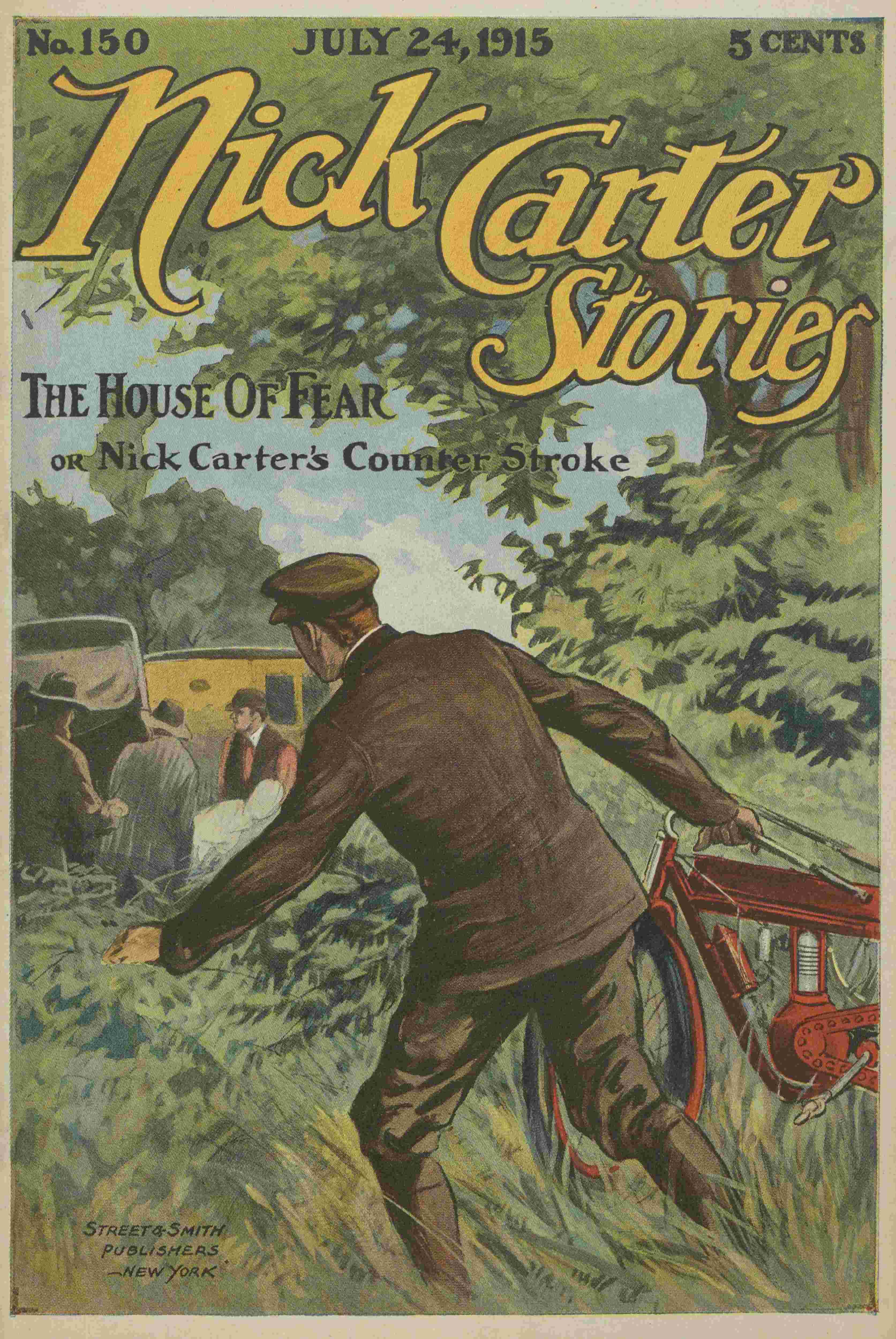
The Project Gutenberg eBook of Nick Carter Stories No. 150, July 24, 1915: The House of Fear; or, Nick Carter's Counterstroke.
Title: Nick Carter Stories No. 150, July 24, 1915: The House of Fear; or, Nick Carter's Counterstroke.
Author: Nicholas Carter
Ralph Boston
Release date: May 18, 2022 [eBook #68116]
Most recently updated: October 18, 2024
Language: English
Original publication: United States: Street & Smaith, 1914
Credits: David Edwards, Chuck Greif and the Online Distributed Proofreading Team at https://www.pgdp.net (Northern Illinois University Digital Library)
Issued Weekly. Entered as Second-class Matter at the New York Post Office, by Street & Smith, 79-89 Seventh Ave., New York.
Copyright, 1915, by Street & Smith. O. G. Smith and G. C. Smith, Proprietors.
Terms to NICK CARTER STORIES Mail Subscribers.
(Postage Free.)
Single Copies or Back Numbers, 5c. Each.
| 3 months | 65c. |
| 4 months | 85c. |
| 6 months | $1.25 |
| One year | 2.50 |
| 2 copies one year | 4.00 |
| 1 copy two years | 4.00 |
How to Send Money—By post-office or express money order, registered letter, bank check or draft, at our risk. At your own risk if sent by currency, coin, or postage stamps in ordinary letter.
Receipts—Receipt of your remittance is acknowledged by proper change of number on your label. If not correct you have not been properly credited, and should let us know at once.
No. 150. July 24, 1915. Price Five Cents.
THE HOUSE OF FEAR;
Or, NICK CARTER’S COUNTERSTROKE.
Edited by CHICKERING CARTER.
CHAPTER I.
THE DEAD ALIVE.
"I say, shir! Can you let me have a match?"
"I think so."
The last speaker was Nick Carter, the famous detective.
The first was an erect, well-built, fashionably clad man, apparently in the forties and somewhat the worse for liquor. His crush hat had a rakish cant. His Inverness hung awry over his shoulders. His cravat had a disorderly twist, and his brown, Vandyke beard had lost its carefully combed appearance.
Nick Carter sized him up as a society man who had been on the bat, and who was returning home on foot to walk off the effects of it. His appearance and the hour seemed to warrant this conclusion, for it was two o’clock in the morning.
Nick was rather roughly clad. His strong, clean-cut face was so artistically treated with grease paint as to effectively disguise him and give him a decidedly sinister aspect. He had spent most of the night in searching for a crook, on whom he very much wanted to lay his hands, but his efforts had been futile, and he was returning to his residence in Madison Avenue.
He had turned a corner of Fifth Avenue only a few moments before, when he saw the stranger approaching, walking a bit unsteadily, and then the only person to be seen in the fashionable street.
Nick saw him fishing out a cigar and vainly searching in his pockets for a match, and he was not surprised when the man stopped him with the above request, straightening up with a manifest effort and trying to speak distinctly.
"Much obliged, sir," said he, when Nick reached into his pocket after [Pg 3]his match box. "Will you smoke, I’ve got anozzer."
"No, none for me, thank you," said Nick. "I——”
"Don’t thank me. Do what I tell you, instead, and do it quick. Hands up!"
The stranger had undergone a lightninglike change. He no longer appeared intoxicated. His every nerve and muscle seemed to have become as tense as a bowstring. His eyes were clear, aglow like balls of fire, and his voice had turned as hard as nails.
His right hand, with which he had pretended to reach into his pocket for another cigar, whipped out an automatic revolver, into the deadly muzzle of which the detective suddenly found himself gazing.
Nick Carter had been up against like situations before, and it did not disturb him.
"What are you really going to do with that toy?" he asked coolly, sharply scrutinizing the holdup man to fix his face in his mind.
"Hands up, or you’ll never repeat that question," said the other, hissing the threatening words between his teeth. "Up with them, or you’ll be a dead one."
His eyes had a gleam and glitter that no sane man would have ignored. They spelled murder in capital letters, and Nick obeyed and raised his hands as high as his shoulders.
"Now, back down those steps," commanded his assailant. "Keep going till I tell you to stop. Back under the steps. Hands up, mind you, or you’ll be found dead there in the morning."
The steps referred to were those of a handsome brownstone residence occupied by a wealthy Wall Street banker and broker, Mr. Gideon Buckley. They led up from the sidewalk to the vestibule of the front door, while under them was a door leading into the basement hall of the house. This was accessible by descending two low steps and turning into the area under the main rise of steps, the entrance to which area was protected with an iron-grille door, then wide open.[Pg 4]
Nick obeyed his assailant—he had no sane alternative.
He backed down the two low steps and into the gloomy area under the main flight, and the holdup man quickly closed the grille door and the spring lock clicked audibly, confining the detective under the rise of front steps.
The holdup man laughed—but not for an instant did his deadly weapon deviate from a direct line from the detective’s breast. He still kept him constantly covered through the grille door, through which he gazed at him with gleaming eyes, as one might have viewed a lion in a steel cage.
The miscreant’s laugh was utterly void of anything like mirth. It was as cold, exultant, and merciless as ever had fallen on the detective’s ears. In a way, moreover, it struck him as being familiar, but he did not recall when and where he had heard it. He was not, however, left long in doubt of the outlaw’s identity.
For the rascal’s vicious laugh ended with a sharp, hissing whisper.
"You keep your voice down, now, or there’ll be something drop," he threatened. "Speak above a whisper and I’ll plug you on the instant."
"I’ll take your word for it," Nick said quietly. "But you are not going to get fat from this job. If you lift all I have in my jeans, you’ll not carry away much."
"Oh, I’m not after your coin," the holdup man retorted, with bitter asperity. "I’ve not run you in here to lift anything. I’ve got you where I want you, at last, and you’re going to hear my little verse. I’ll finish you later."
"Why finish me?" Nick coolly inquired. "What have I done that you want to finish me?"
"You’ve done me, blast you," was the reply, with suppressed ferocity. "You twice have crossed my path and turned me down. You have sent me from bad to worse and made me what I am. I know you, Carter, hang you, in spite of your disguise. I have been watching for you, lying in wait for you, and I’ve got you where I want you."
"Which seems to please you mightily," Nick said dryly, trying vainly to recall the rascal’s identity. "When did I——”
"Oh, I’ll tell you when," interrupted the other, with unabated bitterness. "You’ll know when, Carter, when you see my face. I’ll reveal it to you. I want you to see it, that I may laugh at you, mock you, and tell you face to face how deeply I hate you. Sooner or later, too, I’ll hand you yours and send you to the devil.
"But not to-night—no, not to-night!" he went on, when Nick viewed him in silence. "I want you to anticipate it, to live in fear of it, to be racked mind and nerves until my bullet finds you. I’ll send it into you sooner or later, Carter, as sure as my name is—Gaston Goulard."
He removed his Vandyke beard while speaking, thrusting it into his pocket, and Nick Carter was given an almost incredible surprise.
"Gaston Goulard!" he exclaimed involuntarily. "The dead alive!"
Nick recognized him now. There was no mistaking his hard-featured, white face, its sinister scowl, its expressive cruelty. To have seen a ghost, however, would not have been more amazing.
For Nick last had seen this man less than a month before, when cornered with the notorious Badger gang of crooks in an old lime loft leased by one of their num[Pg 5]ber, to which the detective’s assistants had traced Nick and the criminals—Nick last had seen him plunge bodily through one of the windows and disappear into the swirling waters of the East River.
Though a sharp watch had been kept by Patsy Garvan, moreover, who also had seen the rascal sink from view, Goulard did not reappear on the surface, and there had seemed to be no reasonable doubt that the knave had drowned.
Naturally, therefore, Nick was more than surprised upon seeing his sinister, malevolent face again; nor was it strange that, supposing him dead, he had not penetrated his exceedingly clever disguise, or recognized his evil voice.
It fell again upon the detective’s ears, echoing his last impulsive remark.
"The dead alive—yes!" Goulard hissed triumphantly. "I fooled you, balked you, eluded you, Carter, and I finally will send you to the devil, where you supposed you had sent me. But the devil serves his own at times, and that was one of them. He gave me a new lease of life—that I might finally take yours. But not to-night, Carter, not to-night!"
"That’s very considerate, Goulard, I’m sure," Nick coldly retorted. "Watch out that I don’t put the boot on the other leg and place you where you belong."
"Bah!" Goulard ejaculated, under his breath. "You have no chance of that, not even a look in. You know not where to find me, yet for the past month I have been under your very eyes. I can put my finger on you, too, any hour of the day, Carter—and I shall always have a bullet in reserve for you."
Nick Carter ignored the miscreant’s repeated threats, though he knew him to be capable of executing even the worst of them. Watching vainly, too, for a chance to turn the tables on the scamp, for Goulard was not to be caught napping, Nick coldly inquired:
"How did you accomplish it, Goulard? How did you escape from the East River?"
"I told you the devil serves his own at times," Goulard proceeded to explain, though Nick had hardly expected him to do so. "I rose to the surface, but not in view of your lynx eyes, Carter, nor those of your assistants."
"I already know that," said Nick.
"The swirl of the stream sucked me down—down—down!" Goulard went on fiercely. "I thought I would never rise. I thought of you, too, and even with death staring me in the face I regretted only that I had not lingered to kill you. I was carried down near the river wall. I was beaten on rocks and battered against bowlders. It was awful! I thought I would never rise—but I did! I came to the surface under a boatman’s float thirty yards from the lime shed."
"Ah, I see," said Nick, unruffled by the other’s bitterness. "That’s how the devil served you, is it? You remained under the float till dark, I take it."
"Until after dark," corrected Goulard. "I clung to its timbers, cursing you all the while, and I then contrived to climb the river wall and steal away unseen. But you see me now, Carter, and soon shall feel the sting of my revenge. I wanted you to know it—that I am alive and out for vengeance. That alone impelled me to hold you up to-night."
"Cease your threats," Nick commanded. "They have[Pg 6] no weight with me. Having held me up and locked me in this place, Goulard, what do you intend doing?"
"I will leave you here," Goulard replied, with an uglier scowl on his white face. "I’ll not take the risk of a shot at this time. It’s too long a chance. I will leave you here with my threats ringing in your ears. You shall have time to think of them, to anticipate the end, to dread the day when I will make good. You shall live in a house of fear from this hour, Carter, in constant fear."
"The future will determine that, Goulard, and whether you were really lucky in not meeting your fate in the East River," Nick coolly answered. "If you have no more to say and do, you cannot depart too quickly. Get out, you rat, the sooner the better."
Goulard laughed again and pushed his revolver farther through the grille door.
"I’d love to, Carter!" he cried, under his breath. "I’d love to press the trigger and perforate your cursed skin with a bullet. But the risk is too great. I might be heard, intercepted in my flight, and perhaps railroaded to the chair. There will be a safer time and place. I will wait for it, watch for it, and there then will be no hesitation. I will kill you, Carter, for what you have done to me. As sure as God hears me—I will kill you."
"God may intervene and——”
"Remember!"
The fierce, malevolent face, pressed for a last moment to the grille door, vanished instantly, and the vengeful knave was gone.
Nick Carter heard his swiftly receding steps on the pavements. It was the only sound that broke the night silence in that locality. It died away so quickly, too, that it had seemed hardly perceptible.
Nick seized the grille door and tried to open it—tried vainly.
It withstood his utmost efforts.
CHAPTER II.
PARTNERS IN CRIME.
Nick Carter was not disturbed in the least degree by the threats of Gaston Goulard. He had been threatened too frequently by crooks to pay any attention to their sinister predictions.
They had no weight with the detective, therefore, those of this whilom merchant who had wrecked the big department store in which he had been a partner, and who then had gone deeper into the criminal mire, mingling with crooks and gangsters, resulting in a murder for which he now was wanted by the police, whom he had eluded less than a month before in the manner described.
Aside from his surprise at beholding Goulard alive, the entire incident would have had no great weight with Nick Carter, in fact, except for one reason—the extraordinary episodes that immediately followed.
These alone, with their far-reaching results and because they exhibited from the first the remarkable discernment and versatility of the celebrated detective, made this night a noteworthy one in the record of his professional work.
Finding that immediate escape from under the stone steps was impossible, and that he could not at once pursue Goulard, Nick proceeded more deliberately to seek means to liberate himself. He knew that he could not[Pg 7] have been overheard by any person in the house, having spoken only in whispers, while hardly a sound had been made that would have been audible ten feet away.
"The rascal must have been watching me, as he said, and contrived to intercept me in front of this house, probably having learned that this grille door was open, also that it could be quickly and securely locked. Securely locked, by Jove, is right!"
Nick had taken out his electric searchlight and was inspecting the grille door. He found that it had a strong Yale lock, to pick which was out of the question. It looked, in fact, as if it would be utterly impossible to open the door without a key.
"By gracious, I don’t half like this," thought Nick, pausing to consider the situation. "There is no getting out unaided by the way I entered. I can bang on this other door, of course, and raise some one in the house, who could come down and liberate me. That would necessitate a truthful explanation, however, and the story might leak out.
"It would be embarrassing, at least, to read in all of the newspapers that the famous New York detective was caught and cornered in such a hole as this by a midnight marauder. The sensational journals would feature it with red letters, for fair, and make the most of it. I don’t think I could stand for that.
"Instead of raising any one, therefore, I’ll try to quietly open this other door, which evidently leads into a basement hall. If I can enter unheard, I then can steal up to the main hall and out through the front door. None will then be the wiser, as far as I am concerned, and Goulard will not be fool enough to expose me. He will foresee, of course, that I shall keep my mouth closed. Let the crafty rascal alone to feel sure of that."
Having decided that to be the easiest way out of his dilemma, Nick turned his attention to the door leading to the basement hall. He found it had only an ordinary lock, and that the key had been removed.
"Well, well, this will be soft walking," he said to himself. "I can open it with a picklock in two shakes of a lamb’s tail. In a minute more, that done, I can slip out of the house unheard."
Fishing out a ring of keys on which he had the practical little implement mentioned, Nick quietly inserted it into the lock, and a moment later he noiselessly shot the bolt and opened the door.
Then began the series of sensational episodes that made his work of that night so noteworthy.
Nick stepped into the basement hall, then quietly closed the door, locking it with a key found hanging on a nail near the casing, and which he discovered by means of his searchlight.
He then paused and listened vainly for any sound from the floors above. Obviously, no one in the house had yet been disturbed.
"The way is open, all right, so here goes," he said to himself, after a moment.
A flash from his searchlight revealed the stairway leading to the main hall.
Nick tiptoed toward it and began the ascent.
The top of the stairway ended near the middle of the main hall, and under the rise of stairs leading up to the next floor.
Nick arrived at the top stair, holding his breath, tread[Pg 8]ing as if on eggs, and feeling his way by means of the wall on one side and the baluster rail on the other.
Despite his exceeding care, however, the top stair creaked slightly under his weight.
The noise, though hardly perceptible under ordinary conditions, fell audibly on the surrounding stillness.
It was instantly followed by another, hardly more perceptible, but sufficient to make the detective doubly alert.
The sound came from a room across the hall, the door of which was open.
Nick waited, lest the stair might creak again if he stirred. Bending nearer the baluster rail, nevertheless, he could see through the open door of the opposite room.
It was the library of the handsomely furnished house.
With the exception of one part of the room, all was invisible, shrouded in inky darkness.
The exception was a circle of light shed upon an open desk—faintly revealing a figure crouching in front of it.
It appeared to be that of a man engaged in robbing the desk, or quietly forcing the interior drawers in search of something.
Nick waited and watched.
"By Jove, here’s a curious coincidence," he said to himself. "Have I stolen in here just in time to catch a crook? Apparently, however, I’m in his class. He may, on the other hand, be some one who lives in the house and who has some motive for stealthily searching that desk. No, by gracious, that’s not probable. He certainly is a crook."
The figure crouching at the desk had turned slightly and gazed toward the hall, as if under the impulse of sudden uneasiness, or that subtle sense which at times impresses one of the presence of another.
Nick then saw that the lower part of the man’s face was covered with a black cloth—convincing him that he was a thief from outside, rather than a resident of the house.
He turned, after listening for a moment, and resumed his knavish work.
Nick Carter’s first impulse was to arrest the thief then and there—but he did not do so.
Another and better move, in view of the greater possibilities it presented, quickly occurred to him.
"By Jove, this may be the opportunity of a lifetime," he said to himself. "It’s odds that the rascal is not alone, that he has one confederate, at least, who may be watching outside, probably in the rear of the house. I can fool this scamp and gather in both of them, I think, or even round up a bigger gang with which they may be identified. That surely would discount taking in only this fellow. I’m blessed if I don’t try it."
Nick had recalled his sinister make-up, also that he had several changes of disguise in his pocket. He deftly adjusted one over his already hangdog type of countenance, then glided quickly under the rise of stairs mentioned, crouching low against the baseboard in one corner.
The top of the basement stairs creaked again when he left them, precisely as he had anticipated.
The effect, moreover, was exactly what he was expecting.
The figure at the library desk started up as if electrified by the faint sound.
The circle of light from the flash lamp vanished in[Pg 9]stantly, leaving the room and hall in impenetrable gloom.
"He heard it," thought Nick, holding his breath. "He’s waiting and listening. He fears that some one is here, but he is not sure."
The waiting detective was right. He presently could hear the stealthy, catlike tread of the crook approaching the near door. It ceased after a moment, and Nick knew that the rascal then had reached the threshold and again was listening intently.
Nearly a minute passed, one minute of absolute silence and inky darkness.
Then a swift beam of light shot through the hall—but not under the stairs.
It was gone as quickly as it came, only to be repeated a moment later, leaping swiftly the entire length of the broad hall.
The crook saw no one, and he then stepped noiselessly toward the main stairway, where he paused once more to listen.
It was the move the detective had expected, and for which he was waiting. Rising noiselessly, Nick quickly glided nearer, then suddenly clasped the motionless black figure in his arms.
A thrill of amazement went through him from head to foot.
The form he had clasped, confining both arms and preventing the use of a weapon—was that of a woman.
Amazement, however, did not cause Nick Carter to lose his head. He held fast to the supple, writhing figure of the unknown female, who wriggled vainly to free herself and reach for her revolver, while the detective quickly whispered, in tones well calculated to dispel her fears:
"Whist! Keep quiet! I wa’n’t wise to your being a skirt. What’s your game here?"
Nick’s quietude also was assuring. The woman ceased struggling, but turned sufficiently to gaze at his face, as well as it could be seen in the faint light that came through the pebbled-glass panes of the front door.
Nick now could see the sharp glint of her eyes and the outline of her brow and cheeks above the bandage of black cloth that covered her mouth and chin.
"What’s your own game?" she questioned quickly, under her breath. "What sent you here?"
"I’m on the lift and——”
"You’re not a dick?"
"Dick be hanged! I saw the iron door under the front steps was open, so I picked the lock of the other to see what I could nail," Nick explained. "I piped you in yonder at the desk when I crept up the stairs. But I did not dream you was a skirt."
"Let me go, will you?"
"Sure—if you’ll keep your yap closed."
"Trust me for that."
"I’m not here to be nailed by a bull," Nick added.
"You can gamble that I’m not," muttered the woman. "Say, step in there with me. We ought to know each other better."
"That hits me all right—but walk on your toes."
Nick had released her, when requested, but the woman clung to him for a second, as if fain to express her relief with a momentary display of affection. Together they stole into the library, and she noiselessly closed the door.[Pg 10]
"You’re not a dick, then," she remarked, in whispers. "Say, that’s some load off my mind. I thought sure I was a goner."
"Dick nothing!" Nick muttered derisively. "Have a peek. Do I look like a dick?"
He fished out his searchlight while speaking, throwing the beam upon himself. He then removed the disguise he had put on a few moments before, and displayed the sinister, make-up face beneath it.
It was a ruse that would have deceived the most suspicious of mortals. None would have supposed for a moment that he was there in double disguise—this man who now was pretending to be no less a crook than the woman herself.
She laughed softly and clasped his arm with both hands.
"Say, you’re all right, pal," she whispered. "Flash it on me. I’ll go as far as you have gone, since you sure seem on the level. Have a look at my mug."
She drew down the black cloth from her face, on which Nick flashed the beam of light, giving him still another surprise.
"Great guns!" he mentally exclaimed. "Sadie Badger, the queen of the old Badger gang."
Nick knew both her and the gang, all of whom had figured in the recent murder case against Gaston Goulard, and all of whom had been sentenced to prison, with the exception of Goulard himself, who was supposed to have been drowned, and this one woman against whom sufficient evidence to connect her with the murder, or show complicity after the crime, could not be found. She had been liberated, therefore, after the trial and conviction of the rest of the notorious gang, and she had not since been seen in her customary haunts.
Nick Carter’s surprise was the greater for that reason, when he now beheld her in the very act of robbing the house outside of which he had so unexpectedly encountered Goulard. That they were not confederates in this robbery was obvious to him, however, for he at once reasoned that Goulard would not have put the woman in danger of arrest, if he had known that she was in the house.
Nick now saw, too, that Sadie Badger was clad in a tight-fitting black jersey, under a loose dark coat, and that she wore knickerbocker trousers, black stockings, and rubber-soled shoes, all combining to give her the appearance of a youth under twenty, who might have walked the streets at almost any hour of the day or night without a challenge from the police.
Nick was quick to appreciate all that this signified, and to take advantage of the situation he had in part framed up, though his sinister face reflected none of his true sentiments and designs.
"You’re all right, kid, if looks count for anything," he said quietly. "We meet by chance, a dead queer chance, but there might be something in it for both. What’s your name?"
"What’s yours?" questioned Sadie circumspectly.
"Bosey Magee," Nick promptly informed her.
"Bosey?"
"That’s short for Ambrose," whispered Nick. "That’s my moniker. I hang out in Boston most of the time, but I blew in here last night and went broke in the stuss joints."
"I get you, pal."[Pg 11]
"I held up a bloke an hour back and lifted a small wad. It was not enough, when I saw that the front-basement door of this crib was easy to get at. You can find out all about me from Jack Gleason, who runs the Orient House in Richmond Street, where I hail from," Nick added. "He’ll tell you Bosey Magee wouldn’t crab a game or squeal on a pal. That’s me, kid."
"And it listens good to me, all right," said Sadie, in approving whispers. "I’ll meet you on even ground. My name is Sadie Badger, and I’m out for the coin as you see me, or in any old way I can get it."
"That’s the right sort, Sadie, and you’re in my class. But you’re not cracking this crib alone, are you?" questioned Nick.
"That’s what, Bosey."
"Where are your pals?"
"I’m leary of pals just now," said Sadie. "I was in with a good bunch and in right, but an infernal dick got them a month back and sent them up the river."
"Tough luck," said Nick.
"I ducked the same dose by the skin of my teeth," added Sadie. "I have got no pals I would bank on now, unless——”
"Unless what?"
"I say, Bosey!" The woman’s low whispers took on a more sibilant eagerness. "Since you’re here after plunder, and fate has chucked us together, let’s run in double harness on this job. What d’ye say? Are you game? Will you be my partner in crime?"
Nick Carter did not hesitate for the hundredth part of a second. He saw more to be gained than by arresting Sadie Badger then and there. He grasped her extended hand, replying quickly:
"Will a duck swim? I’d be a fool, Sadie, if I wouldn’t take a chance with you. Partners in crime—that’s what?"
CHAPTER III.
THE HOUSE OF FEAR.
"But what’s your game? What’s the big idea, Nick? What more do you expect to gain than you would have derived from arresting Sadie Badger and sending her up for a prison sentence?"
Nick Carter was at breakfast with his two chief assistants, Chick Carter and Patsy Garvan, on the morning following his encounter with Gaston Goulard and the whilom queen of the notorious Badger gang. He had related his experiences of the previous night, and informed them of his extraordinary compact with Sadie Badger.
"Much!" he tersely replied. "My bargain with her, Chick, was entirely warrantable. In dealing with crooks, one must fight them with their own weapons, craft, deception, and treachery, when necessary."
"I admit that, Nick, of course."
"What good to have arrested her alone, if more can be accomplished?" Nick added. "It would have amounted to comparatively little. I would merely have put one dangerous female crook out of the running. I felt my way carefully, mind you, and I very soon found that she could not steal much from the Buckley residence."
"That of Gideon Buckley, the banker, you say?"
"Yes. She had entered through a rear basement window. She is expert in that game. She had learned from one of his clerks, whom she has artfully insnared with her wiles, that the banker took home a quantity of bonds[Pg 12] and securities yesterday afternoon, and that he has no safe in his residence. She reasoned that he would put them in his library desk for the night, and she went there to get them."
"But failed to find them?"
"Failed completely," said Nick. "Buckley may have taken them to his bedroom, or concealed them in some other part of the house. We could not find them, at all events, and we got away with only a quantity of solid silver from the dining-room table and sideboard. I would have protected his bonds and securities, all right, providing that we had stolen them, but I had other fish to fry in connection with doing so."
Patsy Garvan fell to laughing, and not for the first time during Nick’s recital.
"Gee! this certainly beats me, chief," he declared. "You in criminal partnership with Sadie Badger! That sure is going some. What came off after you left the house?"
"We got out by the way she had entered," Nick replied. "I then went with her to the door of a house in Lexington Avenue, where, she told me, she had occupied the ground-floor flat for nearly a month."
"Alone?"
"She said so, Patsy, and I take it for what I think it was worth," said Nick. "I declined an invitation to enter, but I promised to call within a day or two and plan another job with her. I will have learned more about her and her recent doings by that time."
"But what’s your game, Nick?" Chick repeated. "What do you expect to gain by it?"
"For one thing, Chick, I expect to get Gaston Goulard—before he can contrive to get me," Nick replied, more seriously. "That rat meant what he said last night. I could read it in his evil eyes and detect it in his voice. He would have shot me in cold blood through that grille door, if fear of detection and capture had not restrained him."
"He certainly is capable of it, Nick, as far as that goes," Chick readily allowed. "We want him badly enough for the murder of Batty Lang, but I don’t see just how your bargain with Sadie Badger will enable you to get him."
"It will help," Nick said confidently. "Crooks flock together as naturally as blackbirds. Both Goulard and Sadie Badger, despite that she said last night that she now has no pal on whom she would bank, are in touch with the worst elements of the New York underworld. Through her and the subterfuge I have adopted, I intend to locate some of them, at least, and discover the whereabouts of Gaston Goulard."
"Ah, I see."
"It is not easy for either of us to worm our way into the confidence of a crook, particularly if he is an old-timer," Nick added. "We and our tricks are too well known. They fight shy of us. This was too good an opportunity to lose, therefore, and I resolved to take advantage of it."
"That’s the stuff, chief," said Patsy. "It’s bound to cut ice of some thickness."
"I think so, Patsy, and that it will enable me to finally run down Goulard," said Nick, rising to go to his business office. "I will call on Sadie Badger either to-night or to-morrow, disguised as I was last night, and find out just how the land lies. I can take her in at will, you know, as far as that goes."[Pg 13]
"Like breaking sticks," said Patsy. "You’re in right, chief, to pull off a big stunt of some kind. My money goes on that."
Nick Carter dropped the matter temporarily. Only emergency cases ever interfered with the regular routine of his business, and it was not in his nature to figure blindly on what could be accomplished through the relations he had established with Sadie Badger.
Later in the morning, nevertheless, Nick sent Patsy Garvan to learn what he could on the quiet concerning the woman during her residence in the flat she then occupied.
Nick lunched with a friend in the Waldorf that day. He departed alone about half past one, and had just turned the corner of Fifth Avenue when an approaching limousine swerved to the curbing and its occupant called him by name.
"Get in Nick, please, and go with me," he added, opening the door when the detective approached. "Don’t say you’re too busy. You’re the one man I most wanted to see."
Nick stepped into the costly car before the last was said.
"Home, Greeley. Let her go lively."
These directions were to his chauffeur, and the speaker was Frank Mantell, son of the senior partner of the late firm of Mantell & Goulard, whose big department store had been wrecked months before by the robberies of Goulard himself.
Nick at once recalled his encounter with him the previous night, and he instinctively felt that the matter on Mantell’s mind, for he obviously was carrying a heavy burden, might indirectly relate to it. It was for that reason that he immediately complied with the young man’s request.
"What’s the trouble, Frank?" he inquired, as the limousine sped up the avenue. "You look a bit white and drawn."
"Drawn through a knothole, Nick, is about how I feel," Mantell replied, placing his hand on that of the detective.
"Are you ill?"
"No. Only worried."
"About what?"
"My wife."
"Your wife?" Nick echoed inquiringly. "You don’t mean——”
"No, no; there’s nothing wrong on her part, Nick," put in Mantell quickly. "She is all that a man could wish. But we’re living in a house of fear, Nick, a house of fear. The dread that hangs over us is something appalling. I have had in mind to appeal to you for more than a week, but I know you to be so busy that——”
"One moment," Nick interposed, noting the exceeding nervousness with which his companion was speaking. "What is the cause of your terrible fear? What is it that you dread? Is your wife threatened in any way, or——”
"That’s it!" Mantell cut in quickly. "That hits the nail on the head. She is threatened in a way that is breaking her down mentally and bodily; both of us, in fact. Our lives are becoming a ceaseless shudder, a nightmare from which——”
"Stop right there, Frank," Nick commanded, with some austerity. "I’ll listen to no more talk of that kind. Come[Pg 14] to the point at once and state the bare facts, or I’ll order your chauffeur to drop me on the next corner."
"You’re right, Nick," Mantell quickly admitted. "I think I have hypnotized myself with horrible dread. I cannot govern my own mind, or——”
"There you go again," Nick interrupted. "Now, Mantell, unless——”
"Wait! I’ll tell you."
"Do so, then."
"It began three weeks ago, Nick, with a placard pinned on the side door of our residence," Mantell said, more calmly. "It was a rudely scrawled threat on a scrap of brown paper. It bore no signature and contained only these words: Your money or your wife!"
"Wife, eh?" queried Nick. "Are you sure you did not misread it? Was not the word life, instead of wife?"
"No, indeed, as since has appeared," Mantell said quickly. "Naturally, of course, that first threatening placard did not alarm us. I thought it might be a joke, a very bad one, of course, or the work of some foolish or malicious persons bent only upon annoying us. Two days later, however, a second was tacked on the trunk of a tree directly opposite the windows of my wife’s sleeping room."
"A similar treat?"
"Yes. It read: ‘You’ve got my money. I’m going to get your wife.’"
"H’m, I see!" Nick remarked. "Was it on paper like the other?"
"Yes. It was a piece of ordinary manila paper, such as one might obtain in a grocery store."
"Inscribed with a lead pencil?"
"Yes. The letters were rudely printed, however, not written."
"That was done to avoid exposing his handwriting."
"I inferred so," said Mantell. "That second placard made us somewhat apprehensive. I feared that my wife was to be persecuted by some unknown scoundrel whose enmity one of us has incurred, or who is himself a lunatic. I know of no one whose money I have got, however, or who is justified in any antipathy for me, or my wife. Helen began to grow nervous and——”
"One moment," Nick interrupted. "I can appreciate your apprehensions and the nervousness and fear of your wife. What steps did you take in the matter?"
"None at that time, Nick, except to caution Helen to be on her guard, and not to venture out alone after dark," Mantell replied. "I hoped the matter would end there, with no repetition of the outrage."
"Well, what followed?"
"Nothing more for about three days," Mantell continued. "Helen ventured, just after dusk that evening, to go to our rear gate with a friend who was leaving for home, that being the nearest way. They parted at the gate, and Helen started to return to the house. As she was passing the garage, a man darted from behind it and pursued her. She uttered a scream and ran at the top of her speed toward the house."
"Did he overtake her?"
"No. Luckily, Nick, I entered the driveway gate with my touring car at that moment, and in the glare of the lamps I saw the couple. The man immediately turned and fled. He disappeared in the darkness of the back street, but I heard him shout that he would get her later, in spite of me. Helen had fainted dead away[Pg 15] on the side veranda, and I ran to her assistance, of course, making no attempt to pursue the miscreant."
"He appears to really mean business," Nick observed. "Did your wife recognize him?"
"No. She had only a glimpse at his face. She is sure that he wore a beard, however, and was a dark man, of medium build. She was too frightened to note anything more."
"The beard may have been a disguise."
"Quite likely."
"What steps did you then take to protect her?"
"I employed two private watchmen to stealthily keep an eye on my estate, hoping to discover and arrest the miscreant. On the very next day, Nick, a threatening letter came in the mail, addressed to my wife. It was on cheap, plain paper, and printed with a lead pencil, as were the placards mentioned."
"Obviously, then, from the same person," said Nick. "What did the letter contain?"
"I have it in my pocket."
"Ah. Let me see it."
Mantell hastened to comply, and Nick read the following, rudely printed on a single sheet of paper: