
Michigan Farmer is Rival of Burbank.
Hen Stratton, the Luther Burbank of Benzie County, Mich., is conducting a series of interesting experiments with his chewing-gum tree.
Last fall lightning struck three trees in Hen’s woods, and when he looked over the damage he had an idea. One of his young maples was split in two, the big spruce next to it was splintered, and the slippery elm, a few feet away, was hewed from top to bottom. Hen pulled the three trees together, bound them tight for twenty feet, and let them grow that way.
He thinks the sap of the sugar maple will flow through the spruce gum and turn out the finest kind of maple-flavored gum. He added the slippery elm to make it softer chewing.
"Safety-first" Candle.
Candles can easily be fitted with attachments to put out the light at a set time. Mark a candle of the size used and time how long a certain length of it will burn. Then suspend a small metal dome or cap, to which a string is attached directly over the flame, and run the opposite end of the string over nails or through screw eyes, so that it can be tied around the candle such a distance from the flame end that the part between the flame and the string will be consumed in the time desired for the light to burn. When this point is reached, the string slips off the candle and the cap drops on the flame.
Mule Stops Runaway Auto.
It took a Missouri mule to stop a runaway automobile belonging to Professor W. G. Wesley, of Collinsville, Tenn., which started up mysteriously and ran two blocks to where a mule was hitched to a hind wheel of a country wagon. Seeing the car making for it, the mule turned and kicked the car squarely in the hood, which resulted in damaging the engine so badly that it stopped.
The mule belonged to Jim Sparks, and came from Kansas City.
"The Campbells Are Coming."
For the first time in history, Scottish bagpipe factories are working night and day, according to word from Glasgow.
It is not only the Scottish regiments that march to the battlefields behind the pipes. English, Irish, and even the Indian regiments have caught the "pipe craze," until now it is estimated that ten thousand pipes are playing "Johnny Cope" every morning in Britain, at sea, or in France,[Pg 57] and the demand for the instrument exceeds the supply. The instruments cost from thirty-five dollars to forty-five dollars.
Woman Dwarf 106 Years Old.
The one-hundred-and-sixth birthday anniversary of Mrs. Jeannette Schwartz, a dwarf three feet high, weighing only twenty pounds, was recently celebrated in the Brooklyn Hebrew Home for the Aged.
Mrs. Schwartz received her guests in bed, where she has been since coming to the home a year ago. Her advanced age and diminutive size have made her the wonder of the home.
She replied with intelligence in German to the many questions put to her, but her memory could not recall anything that happened beyond ten years ago.
Bees Sting Horse to Death.
While grazing in a pasture, a valuable horse belonging to J. W. Sweeney, of Lancaster, Ky., was attacked by a swarm of bees and so badly stung that he died.
Chase Kills Dog and Rabbit.
Two greyhounds chased a jack rabbit until it toppled over dead, but the dogs were so exhausted they did not pick it up. A few moments later the dogs also died from overexertion. Ivan Marshall, of Lebanon, Kan., owner of the dogs, buried the three bodies in the same grave.
Fifty Years a Postman.
Louis Manz, of Milwaukee, Wis., who quit the post-office department a few days ago, was the oldest mail carrier in point of service in the United States, having served fifty years. Mr. Manz, who is eighty years old, may become the center of a movement for pensions for superannuated mail carriers.
Upon the occasion of his retirement, a banquet was given in his honor by his friends. It was attended by many of those to whom he had carried mail.
Tooter Would Lead Five Bands.
To be the leader of five brass bands is the strenuous and unusual task of Charles Brown, a Junction City, Kan., bandmaster. Evidently he believes with the poet, that music has its power to soothe the savage breast.
Pink Kitten is a Beauty.
A kitten owned by Miss Mary Swartz, of Point Pleasant, Pa., is one of the oddest freaks of nature ever seen in that section. The kitten is a bright pink in color, and it is a beauty.
Moon is Powerless to Influence Crops.
"Scientists are now convinced that the moon has no more influence on crops than it has upon the temperature, or the amount of rain, or the winds, or any other weather element," say experts of the Federal Department of Agriculture.
"The growth of plants depends upon the amount of food in the soil and the air that is available for them, and upon temperature, light, and moisture. The moon obviously does not affect the character of the soil in any way; neither does it affect the composition of the atmosphere. The only remaining way in which it could influence plant growth, therefore, is by its light.[Pg 58]
"Recent experiments, however, show that full daylight is about six hundred thousand times brighter than full moonlight; yet, when a plant gets one-one-hundredth part of normal daylight, it thrives little better than in absolute darkness. If one-one-hundredth part of normal daylight is thus too little to stimulate a plant, it seems quite certain that a six-hundred-thousandth part cannot have any effect at all. It is, therefore, a mere waste of time to think about the moon in connection with the planting of crops.
"The moon has nothing more to do with this than it has to do with the building of fences, the time for killing hogs or any other of the innumerable things over which it was supposed to exert a strong influence."
Cat Mothers Young Rabbit.
A young rabbit found by Arthur Keen, who lives east of Gentry, Mo., a few days ago, was taken home and placed in a nest of young kittens of nearly the same size and age as the rabbit. The mother cat quietly adopted the little stranger, seeming to think as much of it as she did of her own offspring. The little rabbit seems perfectly satisfied with its new mother, and is as lively and playful as the kittens.
Magnet Picks Up Nails.
This device has been invented to take the place of the hardware man’s scoop. It is only necessary to thrust the hand magnet into a mass of nails and touch a button, which turns on the electric current. The nails cling to the magnet and may be lifted to the scales or wherever desired. After a little practice in manipulating the magnet, the operator can gauge closely as to the number of pounds of nails he desires to lift. As can be seen, this is easier than trying to pick up a handful or scoopful of eightpenny nails.
Work for Thirty-five Thousand in Kansas.
A call for thirty-five thousand harvest hands has been sent out by the Kansas free-employment bureau. Last year forty-two thousand harvesters found work in Kansas. The acreage is slightly less than a year ago, but the prospects for an enormous crop are unusually good.
Find New Name for "Nuts."
"The strenuous life of business men," says an eminent physician, "is causing New Yorkitis. For one insane man in our asylums there are ten outside. New Yorkitis," he says, "is a mild form of insanity. It is caused by irregular working hours, nonhygienic surroundings, and too much rush. Unregulated work isn’t the only thing that’s the matter with New Yorkers," says the doctor.
"They eat too much. As for exercise, they take practically none. Up to forty, we have decreased the death rate. But what is happening after forty? The death rate is increasing by leaps and bounds. Organic diseases, those affecting the kidneys and the heart, the blood vessels and the nerves, are enormously on the increase."
New Typewriter Appliance.
The day of the unhandy hand method of pulling or pushing back the typewriter carriage and spacing the paper on the roll at the end of each line is to be ended for some people, for A. W. Wing, a court reporter, of Chicago, Ill., has just secured a patent for a machine[Pg 59] which accomplishes both movements with a slight movement of the foot.
Wing believes his apparatus will add almost as much again efficiency to a typewriter as at present, as the machine will save both time and strength. He has several models working.
Resolved to Die in Deserted City.
Living only in the memory of a distant past, isolated from the rest of the world, yet living in a city of a thousand homes, sitting idly hour by hour at the front of a small saloon where twenty years ago prosperity and excitement were on every hand, Sam Bolger, former Topeka bartender, later an adventurer, gambler, and Colorado saloon owner, is residing in the deserted mining town of Gillette, Col.
The life of Sam Bolger reads like a romance, tinged with all the vicissitudes of life, livened by the carefree days when gold was more plentiful in Cripple Creek than to-day, shadowed by more sorrows than falls to the lot of the average man.
Several Topeka pioneers may remember him in the days of yore when he served drinks over the bar of a saloon on lower Kansas Avenue, before the amendment was put into effect which placed Kansas in the fore rank of dry States.
A newspaper man and party visited Gillette. They found the town deserted, except by one man, Sam Bolger. He occupied a dilapidated saloon, but had no customers.
An inquisitive nomad put the following question to the old relic:
"Where are the rest of the voters?"
The faded old man did not answer at first, but then he replied: "They are everywhere but here."
He then relapsed into silence, but another Kansan—or, rather, he was a Kansas Cityan—spied a table and a few suspicious-looking bottles within the place. He called the ancient gentleman and together they entered the poorly kept saloon. (Film here deleted by censor.) When the old man came out, some ten minutes later, he was in a more talkative mood.
"I hear that you fellows are from Kansas," he said, "but you don’t know Kansas as I knew it. The men who were young then are now in their dotage. When I lived in Topeka, it was a wide-open town, and it was my business to furnish beer and whiskies to its progressive citizens."
The man—he said his name was Sam Bolger—again fell into a moody silence. Then he resumed his talk.
"I was a fool for ever leaving Topeka. It was in 1880, not long after the prohibition amendment went into effect. I had lost my job. I had no money. So I just naturally drifted West, and for the next ten years I roamed around California, New Mexico, Arizona, and old Mexico. But it was in eighteen-ninety that I came to Cripple Creek. The first real strike had been made. With thousands of others I fell a victim to my ambition to be rich. Out of all those who went to Cripple Creek in those years, only a few remain to-day who have wealth.
"I just naturally had no luck. I sweated my life away in the mines. I gambled and drank away my wages in Cripple Creek. There never was a city yet that could equal it. Money flowed like water. I believe it was the wickedest spot on the map.
"I was in the great Cripple Creek fire of eighteen-ninety-[Pg 60]six. By that time I was part owner of a small saloon. The fire destroyed my place, and I was broke again.
"Then I heard rumors of Gillette. The town became a city in a night. The rush of men here at that time was heavy. Being one of the first on the ground, I started a saloon in a shack and a boarding house in a tent. Then I leased the upstairs of a building and owned the first dance hall here. For several months Gillette was fast becoming the center of the Cripple Creek region. Then the gold gave out. It was shallow. People left here in a single night. Many did not take even the precaution of shutting their doors. Gillette started like a whirlwind, and in a like manner it became deserted.
"Only a few of us remained, firm in the belief that the country was plentiful in gold. My saloon business was ruined, yet I kept it up, and still have it to-day. Gradually my friends left Gillette, but I remained, and have lived in solitary grandeur since nineteen hundred and eight, when the last of my family moved away.
"Why don’t I leave, you ask? Why should I? I have nothing especially to live for. I have formed an attachment to Gillette. I will die here. I am emperor of the place. My word is law, having no one to dispute it."
The visitors soon after this resumed their journey to Cripple Creek, seven miles away. An air of depression filled each and every one of them. They began to realize what Carthage looked like after the carnage of the Romans. As they turned off the main "drag" into a side street and thence to the main road, the newspaper man looked back. Sam Bolger, a pathetic figure to say the least, was still sitting where he had been left.
The Strange Rites of the "Voodoo Queen."
While voodooism—into the realm of which hideous and grotesque cult one cannot go far without encountering the snake dancer, medicine faker, charm vender, witchcraft queen, and the like—is becoming a matter of "ancient history" in the South, still, one is bound to stumble onto signs of it occasionally, and if one only follows the right trail, he may come upon a scene that will readily convince him that the old-time practices of some superstitious blacks are not dead or soundly slumbering.
The annual outbreaks—and then some—of aged Marie Lavoe, known in Louisiana as the "Voodoo Queen," who was born in the Kongo and was brought to that State in the slavery days, only go to prove that her followers—and these are not all confined to the blacks—are just as eager to take part in her mysterious séances and wilder orgies as they were when she, as a young girl and stately specimen of the African queen, first introduced her startling exhibitions of conjuring and sorcery.
Even now, with the annual return of St. John’s Day, this voodoo queen is said to fall from her throne of Christian grace and to plunge again into all the strange practices that in past years won for her a following that has never been outnumbered by any of her rivals, male or female, throughout the South, the only section of the country where such practices are known, although in the large cities of the North charm sellers and voodoo doctors can always be found, if the right negro can be secured to act as guide through the "black belt."
If one would witness some wild dances and still wilder orgies, then one should hie away to Lake St. John, on St. John’s Day, and quietly trail the small bands of happy, smiling black folks to the charming oval clearing where[Pg 61] the "festivities" are to take place. Here the spectator will see a terpsichorean divertisement that might well be called "the dance of wild abandon," inasmuch as the dancers appear to have abandoned about all of their covering that the law will allow.
One has but to watch the contortions to discern the origin of many of the movements of fashionable dances as adopted by the society circles of "white folks" to-day. As to the music, one hears the same syncopated measures that lure our white brothers and sisters into the gilded tango palaces of the metropolis.
The scene is startling, if not inspiring. On a mat of "latanier"—scrub palm—sits the voodoo queen. In front of her is a charcoal brazier, a bowl containing milk, a small cage in which are white mice, and in a round basket rests the coiled, live snake that next to the sorceress is the most important property item of the weird scenes that are about to be enacted. While the aged queen is supposed to be a sorceress, judging from her equipment, she is a "caplata" to her worshipers and supporters.
Soon is heard the syncopated strum of the banjos, then the low minor chant of those seated about the charmed circle. One by one the male dancers divest themselves of their superfluous clothing, females the while making the same preparations. The queen liberates the half-starved snake and holds a tiny, frightened mouse before its glistening eyes. The snake darts forth its head and swallows the mouse with a single gulp. This is repeated until the snake has been fed three mice. As the snake bolts each morsel of living food, the queen throws some red-flash powder on the brazier, and for a moment the whole circle is lost in a sweetly perfumed cloud of vapor, which gradually rises and floats away.
When the dancing begins, the faces of the participants all wear a serious look, very much like that seen on faces of a bunch of college athletes about to engage in a hundred or four-hundred-yard sprint. The wild frenzy of the thing is to come later. It will be noticed that the dancers’ near-nude bodies are decorated with neck circlets of animal teeth—a custom probably adopted from the North American Indians—gayly colored chicken feathers, rabbits’ feet, curious medallions gathered from all parts of the world, but of small intrinsic value, perhaps, although some of the huge ear and nose rings worn by both sexes undoubtedly have been handed down the family line by native Africans.
Gradually the dancers work themselves into the real spirit of the grotesque celebration. They circle about their queen in pairs and singly, and their body contortions soon begin to equal those of the Indians of the Far West when engaged in a similar pastime. The music becomes wilder, the shouts of the nonparticipants become louder, and the dancers begin to puff and blow and grunt strange sounds and exclamations, much like so many blacks playing at craps. Their queen, the while, is not idle. She continues to cast the varicolored flash powders into the fire, and many times the dancers are lost in the misty clouds that the brazier throws off. The dance continues until the participants are completely exhausted and fall with fixed eyes and frothing mouths to the ground, where they gradually recover and then make way for a new "set."
Following the custom established when the thrifty Marie first established her reptilian fandango, each dancer must pay to her three pieces of silver of different denominations.[Pg 62] In the early days of her reign this meant a three-cent piece, a dime, and a quarter, but if her patron hasn’t a three-cent piece, which is now generally the case, he must pay a dime, a quarter, and a half—eighty-five cents in the total. In return for this presentation, the patron may receive a prettily mounted rabbit’s foot, guaranteed to have been killed in a graveyard at midnight, a conjure bag warranted to keep off bad spirits, or his pick from a variety of other "charms" that the chooser firmly believes will carry him safely through to the time when St. John’s Day shall have again rolled around.
Peace at Last in "Bloody Breathitt."
"Dock" Smith, one of the alleged assassins of Ed Callahan, recently pleaded guilty before the court in Winchester, Ky., and was sentenced to a life term in the penitentiary, and it is believed that the passing of sentence on Smith will be the finis to the long-continued feudal warfare which caused the press of the nation to confer the title of "Bloody Breathitt" on the county which produced Jim Hargis and Ed Callahan.
With the deaths of Hargis and Callahan, and the conviction of several of those alleged to have been responsible for the plot which ended Callahan’s life, the old feudal spirit was practically wiped out in Jackson and Breathitt Counties, and that section is to-day regarded as having the brightest prospects of any section of the State.
Wealthy Eastern syndicates have invaded Breathitt and adjoining counties and invested heavily in the coal and timber lands of the section, while at the time James B. Marcum was assassinated and for several years subsequent to that tragedy, financial concerns of New York, Philadelphia, and other Eastern cities declined to invest any capital in this troubled district.
Twelve years ago, in Breathitt County, was fired a shot that meant little at the time to those responsible for it, but which in reality meant more for the future of eastern Kentucky than any event of the past half century, for it sounded the death knell of the famous and deadly Hargis-Cockrill feud. It was the shot that killed James B. Marcum as he stood in the front door of the bullet-riddled courthouse at Jackson, and while Marcum was only one of the many who opposed the leaders of the old Hargis-Callahan factions and had gone the same route, by the assassin’s bullet, his death aroused the people of the State to action, and from that moment the law camped on the trail of those believed to be guilty of procuring Marcum’s death.
Marcum walked into the trap laid for him while those later charged with having laid it were interested spectators, they occupying easy-chairs in the doorway of the Hargis store just across the street. Among those who witnessed the assassination were Jim Hargis and Ed Callahan, county judge and high sheriff, respectively, of Breathitt County; while the other actors in the drama were Curtis Jett, nephew of Hargis, and Tom White, henchman of the Hargis-Callahan clan. These two, according to a subsequent confession by Jett, carried out a plot arranged by Hargis and Callahan to kill Marcum, and as the latter started to enter the door of the courthouse, a shot rang out and he fell mortally wounded.
The assassination of Marcum, following so closely upon the deaths of others in a similar manner, including Jim Cockrill, eldest of the Cockrill brothers, and Doctor B. D. Cox, legal guardian of the infant Cockrill heirs, created[Pg 63] a clamor for justice in Breathitt County, heretofore unknown in this section. So strong was the pressure brought to bear that before nightfall the governor of the State had ordered a company of militia to Jackson, and martial law was declared the following morning.
This resulted in the calling of a special grand jury, and two weeks later indictments were returned against Jett and White, charging them with the murder of Marcum. They were later convicted and sentenced to a life term in the penitentiary, and both are now paying the penalty behind the prison walls at Frankfort. The case was tried in Cynthiana, having been sent to Harrison County on a change of venue from Breathitt County. Subsequently both men were tried and found guilty of the assassination of Jim Cockrill and given the same sentence as in the Marcum murder.
Through the confession later obtained by the Commonwealth from Mose Feltner and others of the alleged Hargis-Callahan faction, indictments were returned against Jim and Alex Hargis, Ed Callahan, and B. Fult French, charging them with conspiracy to bring about the death of Marcum, Cockrill, and Doctor Cox.
For seven years the four alleged conspirators faced legal death in criminal proceedings as a result of the indictments against them, and while they were subsequently acquitted by juries in Lexington, Beattyville, and Sandy Hook, to which places the cases were sent on a change of venue from Breathitt County, Alex Hargis is the only one of the quartet now living.
Jim Hargis was slain by his own son, Beach Hargis, in the Hargis store in Jackson, and Callahan was slain in his store at Crockettsville, twenty miles from Jackson, three years ago.
B. Fult French was the last one of the alleged conspirators to die, and while he was always considered by many as the real leader of the plots which resulted in many of the anti-Hargis faction passing to the great beyond, he died a peaceful death, last winter, at his home in Winchester. It was to this place that French removed from Hazard after the extermination of the French-Eversole feud in Perry County.
The first of the many legal battles resulting from the death of James B. Marcum was waged here in Winchester the year following his death, his widow, Arbellah Marcum, choosing this city in which to file her claims for one hundred thousand dollars damages because French, one of the alleged conspirators, was a resident of this city. It was an easy matter to get services on the other three alleged conspirators in Clark county, as they had to pass through Winchester three or four times a week going to and from Lexington and Jackson.
The trial lasted five weeks and was, perhaps, the most sensational civil proceeding ever fought in Kentucky. Mrs. Marcum was awarded a judgment against Jim Hargis and Ed Callahan for eight thousand dollars damages, but the judgment was the smallest part of the expense to the defendants, as it cost them thousands of dollars to bring hundreds of witnesses from various parts of the mountains and keep them in Winchester for weeks.
Even with the conclusion of the Marcum suit the legal troubles of the Hargises, Callahan, and French had just begun, and for a period of seven years they were before the courts, either to defend themselves or some of their alleged henchmen, and while neither of the four alleged leaders were ever convicted, their large fortunes and once[Pg 64] powerful influence had waned when their legal battles were over.
At the time Jim Hargis was first accused of procuring assassins to kill Marcum, he was the Tenth District Committeeman of the State General Committee of his party, and continued to hold that office until public sentiment forced him out, but when he was killed by his own son, he had lost the political prestige of the leaders who for years stood by him, and he died virtually an obscure resident of Jackson, rarely heard of outside the confines of Breathitt County.
Following the death of Hargis, it was generally believed the old feud had died with its leader, but to those who were opposed to the Hargis faction, Callahan loomed up as the leader of the faction, and every few weeks the old feudal spirit would begin to boil, and this continued until Callahan became the victim of an assassin.
Parting Shot Opens Gusher.
An oil well which it is believed will be in the five-thousand-barrel class and will cause the opening of an extension of the famous Cushing field, near Muskogee, Okla., was started to flowing by a twenty-seven quart shot of nitroglycerin made as a parting slap by the owners, who thought the well was worthless.
This well was sunk in the sand in the edge of the Oilton oil pool. It showed no signs of being productive, and there were no productive wells around it. The owners were about to abandon it, but decided to try one more shot of nitroglycerin. Then the oil spouted all over the lease.
Aged Ship, Success, is Safe in Oakland.
On April 14, 1912, an old, storm-beaten, odd-looking, three-masted sailing ship—the oldest vessel afloat—set out from Lancaster, England, and dropping away from Glasson dock, veteran of all piers, seized the wind in her teeth and sped away on a voyage across the western ocean. At different times in her career the old barkentine Success, for such is her name, had been a full-rigged merchantman, a convict transport ship, and a despised prison hulk, but just what she is to-day can be ascertained by all who care to go down to the harbor at Oakland, Cal., and devote an hour or so to an inspection of the age-old craft which has just arrived here.
High of stern—almost a galleon in lines—bluffy, "apple-bowed," with an out-of-date figurehead sprawling beneath a skyward bowsprit, she sailed, alone of her kind, an anachronism, a curiosity, a craft as out of place among modern hulls, her foremast hands declared, "as an alligator ashore."
And that was why she sailed uninsured, for Lloyd’s—that gamest of all maritime-insurance companies, in whose rooms a gamble will be taken even upon a ship whose skipper "cracks on sail into the Day of Judgment"—had refused her as a risk.
She had been denied British clearance, too, and her only papers were a board-of-health certificate, countersigned by the American consul in her port of departure.
Before her company was filled, a score of captains had thrown up their sea-calloused hands in holy horror when offered the master’s billet aboard her, and two crews had deserted before her forefoot could bruise the ocean swells. And even now the old craft is short-manned.
The date first set for the sailing of the Success from the port on the River Lune saw the Titanic clear South[Pg 65]ampton upon her memorable and tragic maiden voyage. The old barkentine, however, was delayed by an inability to fill her crew.
"If I hadn’t known the sort of stuff that the old girl was built of, I’d have been as skeptical of her chances as the rest," Captain D. H. Smith, her owner, admits. "As vessels go nowadays, she isn’t any giant. She is only one hundred and thirty-five feet over all, with a beam of twenty-nine feet, and registered at five hundred and eighty-nine tons. And then consider her age and history.
"She was built of teak throughout—what they used to call ‘black ship’—and that’s why I have such faith in her, even though she was battered up some in her early youth by the Indian Ocean pirates, and after she fell from caste was moored for so many years as a prison hulk.
"But she made the thousands of miles between Australia and England under her own sail, and then I determined to bring her to the United States."
The Success, all sail set to catch the last of the easterly winds she had counted on to carry her across the north Atlantic in forty-six days, left Lancaster with fair weather. She was provisioned for fifty days and carried eighteen thousand gallons of water.
Cordage humming, she stood bravely on the out course, and when she was ten hours beyond sight of land, her wireless operator, Gallagher, sat at a little petrol outfit which had been installed aboard her, sending the last good-bys of the little ship’s company of nineteen over the evening sea.
Crook Haven, the great Irish station, was taking his messages, the Success, with her call of "I. D. B.," having been given right of way over all other craft. Time and time again other ships tried to cut in, but Crook Haven "turned them out" until Gallagher finished.
Then Gallagher, with his earpieces still on, heard the message which he had shut out come spluttering out of the night. It had been relayed from the Carpathia. She was picking up the Titanic survivors.
Upon the old barkentine the news of the disaster fell like a thunderclap, and the fear of death took each of them by the throat.
"What chance have we," they asked, "with nothing but a century-old bottom between us and losin’ the numbers of our mess?"
And it was not cowardice, either. There was not a man for’ard on the Success but who would cheerfully take every chance that comes in a sailor’s twenty-four-hour day.
There came a time when the Success was sixty days from port and apparently far out of her course. Consequently every time their puny wireless would sputter into the night in a vain attempt to give their location to the ships which were looking for her, the crew, spirit broken and diseased, would jump to the conclusion that their captain was sending the "S. O. S." call for aid, and a strong hand was needed to drive them to the back-breaking task when both watches were required on deck constantly to tack her, and to wear her when the proximity of a great iceberg would not permit them to tack.
When they were twelve days out, four hundred miles due east of Boston, trouble broke out among the crew. Five of the Liverpool bullies grew unruly and demanded that the Success be headed for Halifax, which lay a bit over four hundred miles west and about one hundred and[Pg 66] fifty miles north of their then position. That same night, while asleep in their bunks, they were made prisoners and were kept locked up until Boston was reached.
The famous old hulk finally dropped anchor off of East Boston flats, thus closing one of the most remarkable voyages in recent years. The five malcontents, and one other who had made trouble for the captain, were sent back to their native countries for punishment. From Boston she went to New York, Baltimore, Washington, and Philadelphia prior to her sailing for San Francisco.
She will remain in Oakland for a brief period only while she is being fitted out for her voyage to British Columbia, whence she will sail direct to Melbourne, her home port. She will never return from the latter port, as she will then have completed a tour of the world.
Oklahoma Will Honor First White Settlers.
Citizens of Salina, Okla., are making an effort to raise funds with which to erect a monument in Salina marking the site of the first white settlement in what is now Oklahoma.
An organization known as the Choteau Monument Association has been formed in Salina, and its object is to assemble funds or to coöperate with others in raising funds with which to erect the monument.
The Daughters of the American Revolution and the Oklahoma Historical Association may be appealed to for financial aid, and the suggestion has been made that St. Louis, Mo., where the Choteau family has lived since the founding of that city, be asked to aid in marking the spot.
Professor Joseph B. Thoburn, of the University of Oklahoma, State ethnologist, gives the following account of the establishment of the trading post at Salina:
"It is not generally known in Oklahoma that Salina is the site of the first white settlement in Oklahoma—at least of the first of which anything is known. It was nearly one hundred and twenty years ago, or, to be exact, in 1796, that a trading post was established here by the Choteaus of St. Louis. The Choteau brothers were mere lads when they were brought to St. Louis at the time of the first settlement in 1764. They had grown up in the Indian trade, and for many years they had a practical monopoly of that of the Osage tribe, the members of which were several times as numerous as they are now.
"In 1795 Manuel Lisa, a creole Spaniard, secured from the Spanish governor general of the province of Louisiana, at New Orleans, an exclusive concession or monopoly of trading with the Indians of the valley of the Missouri and those of all of its tributaries.
"As the Osage Indians spent most of their time in the valley of the Osage River, and as the Osage never was a tributary of the Missouri, it followed that the Choteaus would lose the lucrative business which they had built up among the Osages. Moreover, there was nothing to prevent the Choteaus from trading with the Osages at any place outside of the watershed of the Missouri.
"Accordingly, the members of the enterprising firm busied themselves in inducing a large number of Osages to move over and settle in the valleys of the Neosho—or Grand—and Verdigris Rivers, in southern Kansas and northern Oklahoma. The establishment of the trading post in the valley of the Grand River, in Mayes County, on the present site of the town of Salina, followed shortly afterward."[Pg 68][Pg 67]
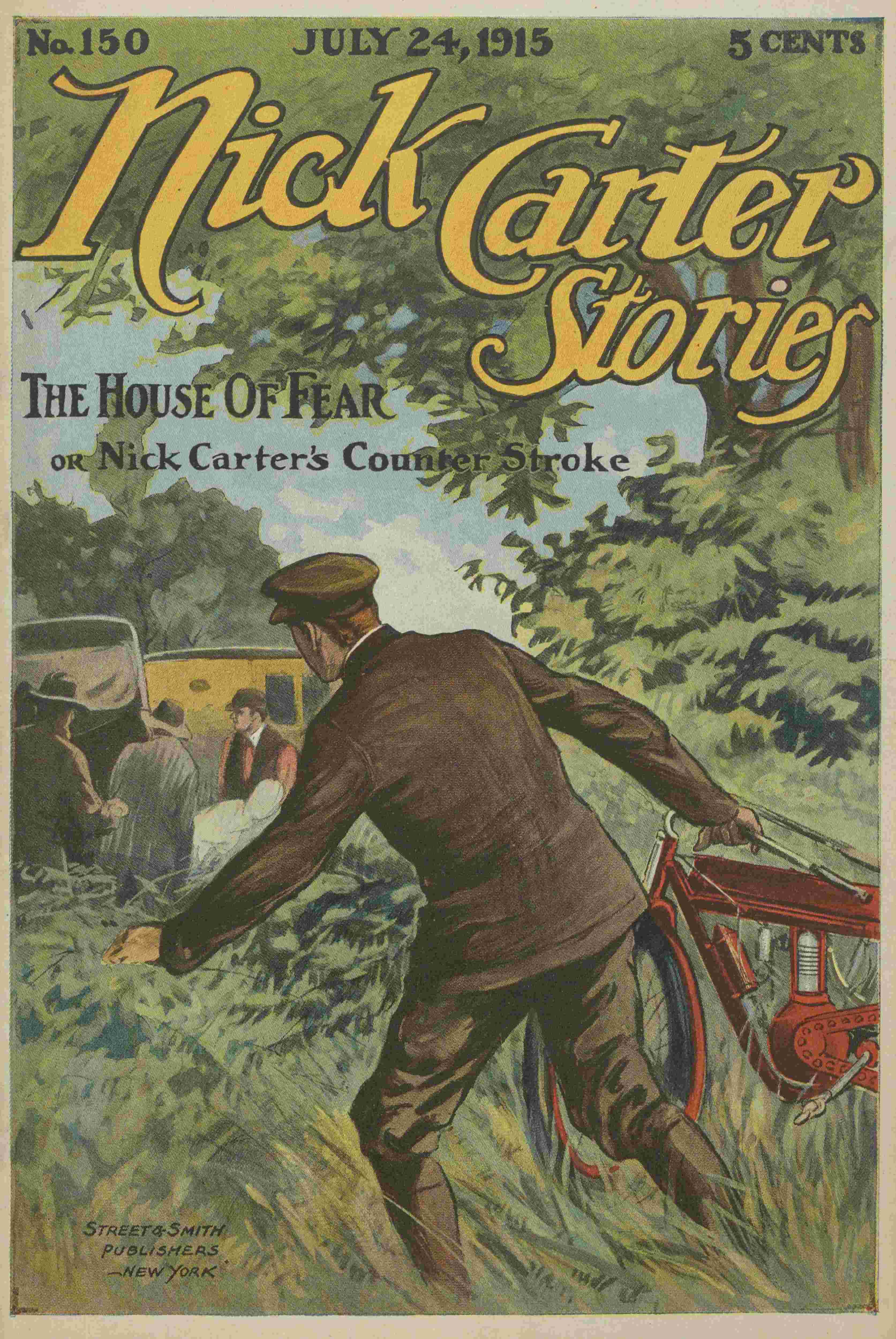
The Nick Carter Stories
ISSUED EVERY SATURDAY BEAUTIFUL COLORED COVERS
When it comes to detective stories worth while, the Nick Carter Stories contain the only ones that should be considered. They are not overdrawn tales of bloodshed. They rather show the working of one of the finest minds ever conceived by a writer. The name of Nick Carter is familiar all over the world, for the stories of his adventures may be read in twenty languages. No other stories have withstood the severe test of time so well as those contained in the Nick Carter Stories. It proves conclusively that they are the best. We give herewith a list of some of the back numbers in print. You can have your news dealer order them, or they will be sent direct by the publishers to any address upon receipt of the price in money or postage stamps.[Pg 69]
714—The Taxicab Riddle.
717—The Maser Rogue’s Alibi.
719—The Dead Letter.
720—The Allerton Millions.
728—The Mummy’s Head.
729—The Statue Clue.
730—The Torn Card.
731—Under Desperation’s Spur.
732—The Connecting Link.
733—The Abduction Syndicate.
736—The Toils of a Siren.
738—A Plot Within a Plot.
739—The Dead Accomplice.
741—The Green Scarab.
746—The Secret Entrance.
747—The Cavern Mystery.
748—The Disappearing Fortune.
749—A Voice from the Past.
752—The Spider’s Web.
753—The Man With a Crutch.
754—The Rajah’s Regalia.
755—Saved from Death.
756—The Man Inside.
757—Out for Vengeance.
758—The Poisons of Exili.
759—The Antique Vial.
760—The House of Slumber.
761—A Double Identity.
762—“The Mocker’s" Stratagem.
763—The Man that Came Back.
764—The Tracks in the Snow.
765—The Babbington Case.
766—The Masters of Millions.
767—The Blue Stain.
768—The Lost Clew.
770—The Turn of a Card.
771—A Message in the Dust.
772—A Royal Flush.
774—The Great Buddha Beryl.
775—The Vanishing Heiress.
776—The Unfinished Letter.
777—A Difficult Trail.
782—A Woman’s Stratagem.
783—The Cliff Castle Affair.
784—A Prisoner of the Tomb.
785—A Resourceful Foe.
789—The Great Hotel Tragedies.
795—Zanoni, the Transfigured.
796—The Lure of Gold.
797—The Man With a Chest.
798—A Shadowed Life.
799—The Secret Agent.
800—A Plot for a Crown.
801—The Red Button.
802—Up Against It.
803—The Gold Certificate.
804—Jack Wise’s Hurry Call.
805—Nick Carter’s Ocean Chase.
807—Nick Carter’s Advertisement.
808—The Kregoff Necklace.
811—Nick Carter and the Nihilists.
812—Nick Carter and the Convict Gang.
813—Nick Carter and the Guilty Governor.
814—The Triangled Coin.
815—Ninety-nine—and One.
816—Coin Number 77.
NEW SERIES
NICK CARTER STORIES
1—The Man from Nowhere.
2—The Face at the Window.
3—A Fight for a Million.
4—Nick Carter’s Land Office.
[Pg 70]5—Nick Carter and the Professor.
6—Nick Carter as a Mill Hand.
7—A Single Clew.
8—The Emerald Snake.
9—The Currie Outfit.
10—Nick Carter and the Kidnapped Heiress.
11—Nick Carter Strikes Oil.
12—Nick Carter’s Hunt for a Treasure.
13—A Mystery of the Highway.
14—The Silent Passenger.
15—Jack Dreen’s Secret.
16—Nick Carter’s Pipe Line Case.
17—Nick Carter and the Gold Thieves.
18—Nick Carter’s Auto Chase.
19—The Corrigan Inheritance.
20—The Keen Eye of Denton.
21—The Spider’s Parlor.
22—Nick Carter’s Quick Guess.
23—Nick Carter and the Murderess.
24—Nick Carter and the Pay Car.
25—The Stolen Antique.
26—The Crook League.
27—An English Cracksman.
28—Nick Carter’s Still Hunt.
29—Nick Carter’s Electric Shock.
30—Nick Carter and the Stolen Duchess.
31—The Purple Spot.
32—The Stolen Groom.
33—The Inverted Cross.
34—Nick Carter and Keno McCall.
35—Nick Carter’s Death Trap.
36—Nick Carter’s Siamese Puzzle.
37—The Man Outside.
38—The Death Chamber.
39—The Wind and the Wire.
40—Nick Carter’s Three Cornered Chase.
41—Dazaar, the Arch-Fiend.
42—The Queen of the Seven.
43—Crossed Wires.
44—A Crimson Clew.
45—The Third Man.
46—The Sign of the Dagger.
47—The Devil Worshipers.
48—The Cross of Daggers.
49—At Risk of Life.
50—The Deeper Game.
51—The Code Message.
52—The Last of the Seven.
53—Ten-Ichi, the Wonderful.
54—The Secret Order of Associated Crooks.
55—The Golden Hair Clew.
56—Back From the Dead.
57—Through Dark Ways.
58—When Aces Were Trumps.
59—The Gambler’s Last Hand.
60—The Murder at Linden Fells.
61—A Game for Millions.
62—Under Cover.
63—The Last Call.
64—Mercedes Danton’s Double.
65—The Millionaire’s Nemesis.
66—A Princess of the Underworld.
67—The Crook’s Blind.
68—The Fatal Hour.
69—Blood Money.
70—A Queen of Her Kind.
71—Isabel Benton’s Trump Card.
72—A Princess of Hades.
73—A Prince of Plotters.
74—The Crook’s Double.
75—For Life and Honor.
76—A Compact With Dazaar.
77—In the Shadow of Dazaar.
78—The Crime of a Money King.
79—Birds of Prey.
80—The Unknown Dead.
[Pg 71]81—The Severed Hand.
82—The Terrible Game of Millions.
83—A Dead Man’s Power.
84—The Secrets of an Old House.
85—The Wolf Within.
86—The Yellow Coupon.
87—In the Toils.
88—The Stolen Radium.
89—A Crime in Paradise.
90—Behind Prison Bars.
91—The Blind Man’s Daughter.
92—On the Brink of Ruin.
93—Letter of Fire.
94—The $100,000 Kiss.
95—Outlaws of the Militia.
96—The Opium-Runners.
97—In Record Time.
98—The Wag-Nuk Clew.
99—The Middle Link.
100—The Crystal Maze.
101—A New Serpent in Eden.
102—The Auburn Sensation.
103—A Dying Chance.
104—The Gargoni Girdle.
105—Twice in Jeopardy.
106—The Ghost Launch.
107—Up in the Air.
108—The Girl Prisoner.
109—The Red Plague.
110—The Arson Trust.
111—The King of the Firebugs.
112—“Lifter’s" of the Lofts.
113—French Jimmie and His Forty Thieves.
114—The Death Plot.
115—The Evil Formula.
116—The Blue Button.
117—The Deadly Parallel.
118—The Vivisectionists.
119—The Stolen Brain.
120—An Uncanny Revenge.
121—The Call of Death.
122—The Suicide.
123—Half a Million Ransom.
124—The Girl Kidnapper.
125—The Pirate Yacht.
126—The Crime of the White Hand.
127—Found in the Jungle.
128—Six Men in a Loop.
129—The Jewels of Wat Chang.
130—The Crime in the Tower.
131—The Fatal Message.
132—Broken Bars.
133—Won by Magic.
134—The Secret of Shangore.
135—Straight to the Goal.
136—The Man They Hold Back.
137—The Seal of Gijon.
138—The Traitors of the Tropics.
139—The Pressing Peril.
140—The Melting-Pot.
141—The Duplicate Night.
142—The Edge of a Crime.
143—The Sultan’s Pearls.
144—The Clew of the White Collar.
Dated June 19th, 1915.
145—An Unsolved Mystery.
Dated June 26th, 1915.
146—Paying the Price.
Dated July 3d, 1915.
147—On Death’s Trail.
Dated July 10th, 1915.
The Mark of Cain.
PRICE, FIVE CENTS PER COPY. If you want any back numbers of our weeklies and cannot procure them from your news dealer, they can be obtained direct from this office. Postage stamps taken the same as money.
STREET & SMITH, Publishers, 79-89 Seventh Ave., NEW YORK CITY