
“Dear Baron Y—— : Who was it that promised to pay up on the 1st of January? You, my dear baron, you are the man. Who was it that promised, then, to settle on the 1st of March? You, my dear baron. Who was it that didn’t settle on the 1st of March? You, my dear baron. Who is it, then, who has broken his word twice, and is an unmitigated scoundrel? Your obedient servant,
Moses Rosenthal.”
BEING CHEERFUL AT MEALS.
A man read in the paper that the family table should always be the scene of laughter and merriment, and that no meal should be passed in the moody silence that so often characterizes such occasions. The idea struck him so favorably that when his family had gathered round the table that evening, he said:
“Now, this sort of thing of keeping so silent at meals has got to stop. You hear me, you girls? You begin to tell stories, and keep up an agreeable sort of talk; and you, boys, laugh and be jolly, or I’ll take and dust your jackets till you can’t stand. Now, begin!”
The glare that he sent around the table made the family resemble a funeral party.[Pg 54]
THE NEWS OF ALL NATIONS.[Pg 55]
Washer with Heater.
A new device that lessens the drudgery of wash day is the combination washer and stove. It is made entirely of metal. The advantage of having the fire under the wash water is that it enables the cleansing to be done better and more quickly; it is not necessary to carry water from the stove to the place where the washing is done. A few minutes’ pumping on the handle is said to drive the dirt from the clothes, linens, or other fabrics in the washer.
$686,700,000 Paid in Life Insurance.
Distribution of life-insurance companies and organizations in the United States and Canada during 1914 amounted to $686,700,000. This is the largest annual amount on record, exceeding by $40,150,000 the amount paid in 1913.
Claims paid in the United States and Canada, $433,050,000.
Payments for premium savings and surrender values, and to annuitants, and in foreign countries, $253,650,000. Grand total, $686,700,000.
While the amount paid by the companies was more, the amount of ordinary and industrial policies written and revived in the United States during 1914 fell off slightly last year. Until the outbreak of war in Europe, the writing of life insurance exceeded the normal rate of increase.
The largest claim paid last year was on the policy of George W. Vanderbilt, whose residence was in Washington. The company that issued it reinsured $750,000 of the face amount. Mr. Vanderbilt carried the policy on the twenty-payment life plan for seventeen years. During that period he paid premiums to the amount of $595,000.
A Fearful Aspect, at Least.
“George,” she screamed; “my neck!”
“What’s the matter?”
“There’s a pillacatter——”
“A what?”
“A tap-e-killer——”
“What in the world do you mean?”
“Oh, dear!” she moaned, as she clutched him frantically; “a kitterpaller! You know, George! A patterkiller on my neck!”
“Oh!” said George, with evident relief, and he proceeded to brush the future butterfly away.
Who Was First Under Wire?
In the northern part of Lansing, Mich., a resident had trouble keeping thoughtless pedestrians and bike riders from cutting across a corner of her lawn. A path was worn smooth across this particular corner. Signs did no good, and personal requests were unheeded. So the resident, not having any males in the family to talk sternly to trespassers, stretched several strands of wire between trees and directly across the path.
The wire was not put up until late in the afternoon. The next day the owner of the path-worn lawn went out to take a look. The new wires were badly bent, as though they[Pg 56] had seen hard usage. Evidently they had, for near one tree was found a well-smashed dinner pail, with broken dishes about and near it a set of “store teeth.” Part of a bicycle lamp lay on another side of the path, with the rim of a derby. Evidently bikes, as well as ships, sometimes have a hard time passing in the night.
End All Debts in One Week.
It is a custom of the Chinese to pay all their debts on New Year’s Day and start the year with a clean slate. The people of Hume, Mo., believe that to be a good plan and conducive to a more neighborly feeling, so the present week has been set aside here as “pay-up” week. During this time everybody is expected to pay all debts, return everything they have borrowed, and, in general, square up every account that is outstanding against them.
At the same time it is hoped that the “paying up” will extend somewhat beyond the commercial side and result in the settlement of all personal differences and general reconciliation of those who have been at outs.
Ohio on the Pension Roll.
Ohio ranks first in the number of her sons on the pension roll, with 74,250, with Pennsylvania a close second and New York third.
She Missed the Seat.
Mrs. J. V. Percal, of Cleveland, Ohio, found the film play featuring her favorite movie hero had just started when she entered a downtown theater Sunday.
And the theater was a bit darker than usual.
She made her way to a seat, removed her hat, and started to pin it to the back of the seat in front of her, all this with her eyes fixed on the opening scene of “The Avenging Hand.”
A man sitting in front of her jumped like a scared cat and yelled, “Wow!”
“When I jabbed the hatpin through my hat, I must have missed the back of the seat,” explained Mrs. Percal.
“What did the man say?”
“Oh, mercy! Please excuse me.”
Expert Rider Postmistress.
Miss Marion Carterett, of Elko, Nev., champion woman “bronchobuster” of Nevada, who won her spurs in open competition with cowgirls from all over the West in the kicking contests at Elko last year, has been appointed postmistress at Deeth. Miss Carterett’s appointment was confirmed last month, and she has assumed charge of the office.
Death Rate in Large Cities.
The death rate after the age of forty is increasing annually in Chicago and other large cities in spite of sanitary modes of living and greater protection against communicable diseases. The expectation of life after forty years is less than it was thirty years ago.
In a warning sounded by the public-health service, it is explained this alarming condition is due largely to the increased prevalence of the diseases of degeneration. The[Pg 57] muscles, arteries, and other organs of those who, as a result of sedentary occupation or indolence, take too little exercise degenerate. The advice of the public-health experts is to take exercise.
Baby Chokes on Prune Seed.
A prune seed, which lodged in his throat, caused the death of Frederick Pellegrini, three-year-old son of John Pellegrini, of Denver, Col. The lad choked to death while a physician was en route to the house from the County Hospital.
She Had Right, Says Court.
The proper way to end an engagement to wed was much discussed in the court of Judge Frederickson, in Los Angeles, Cal. Mrs. Grace Gore contended that she was within her rights when she swallowed the diamond ring presented by Luther Buntin, but that the pugilistic retort of Buntin was too much. The court agreed, and fined Buntin thirty dollars.
The story of the courtship was a “thriller.” The two met at a dance. Each thought the other single. Buntin, a street-car conductor, took the pretty young woman for frequent street-car rides. One night he gave her the ring.
A few nights later Isadore Gore, in the rôle of irate husband, pounced on him and sent him to the hospital for two weeks.
When Buntin emerged from bandages and plaster, he sought Mrs. Gore and demanded the ring. She refused, swallowed it, and he admits his reply to a merry laugh was a series of stinging slaps.
Double Chicken is Hatched.
A chicken hatched in Big Piney, Mo., at the home of Mrs. Maud Vaughn, had four legs, four wings, and two tails. It had but one head, but the body was like that of what might be called a double chicken. It could not walk. Its head was between its two bodies.
Students of Baby Culture.
Not only may Los Angeles, Cal., girls learn to cook and sew in the public schools, but they may become students of baby culture with real live, gurgling, wriggling babies to practice on.
A course in the care and nursing of infants has been added as a permanent feature of the curriculum of the Polytechnic night school, and the first class, numbering thirty-five pupils, includes a dozen young mothers and prospective brides as well as younger girls.
Bird is Killed by Golf Ball.
While “teeing off” at golf, S. C. Pettit, of Topeka, Kan., brought down a sparrow with the flying ball. The bird was dead when it reached the ground. It is said by golfers that such an incident has occurred only once before. A professional golfer on a large course in New England once killed a bird with a golf ball.
Bird Rings Burglar Alarm.
A mischievous bird known as a flicker, belonging to the woodpecker family, has taken a fancy to sounding a burglar alarm over the First National Bank at Wrightsville, Pa. The first time or two the bird indulged in this prank it[Pg 58] caused a stir in the neighborhood. It is thought that in the first place an insect on the surface of the gong was pecked by the bird, and in this way the bird became acquainted with the musical qualities of the bell. The beating of the bird’s bill on the bell produces a sound exactly like that produced by the electric tapper of the gong.
Mouse Scares Girl to Death.
Miss Edna Engel, of Kenosha, Wis., the seventeen-year-old daughter of Caspar Engel, was scared to death by a mouse. The mouse ran out from under a piece of furniture as she entered her room. The girl fell unconscious and died without regaining consciousness.
An Expectant Fruit Grower.
Enos Martin is showing visitors to his farm near Benzonia, Mich., what he thinks will be the greatest horticultural curiosity in the country.
Last June, when the big wind cut through Benzie County, it hit Enos’ peach orchard. After the storm, Enos discovered a stem of a weed driven entirely through the body of one of his best peach trees.
This spring Enos found the weed stem was putting out leaves. He has discovered that it is a milkweed, and he thinks it will unite with the peach, and that next August he can serve peaches and cream from the same tree.
Keen-eared Night Captain.
But for the acute hearing of Night Captain Bert Weare, of Minneapolis, Minn., John Kent might not be occupying a cell in the city jail. He is charged with petty larceny.
Kent was arrested in company with A. W. Hinkley on complaint of E. G. White. White said he met the men in the morning, and that while he dozed in a chair in a saloon, his watch was stolen. He accused Kent.
Kent was searched at police headquarters but the watch was not found. The police were about to turn the men loose, when Captain Weare said he heard a watch ticking. The ticking was traced to Kent’s left sock. White and Hinkley were held as witnesses.
Farmers Strong with Autos.
An interesting fact connected with the figures compiled by the assessors in Atchison County, Kan., is that two-thirds of the automobiles in the county are owned by farmers. The aggregate value of the machines in the county is $174,111, or $311 apiece.
Four-legged, Four-winged Chicken.
A chicken with four perfect legs and an extra pair of wings, one of the most remarkable ever hatched in the State, is drawing scores of people to the poultry farm of A. J. and P. J. Fayette, near Stoneham, Mass. The chick has been named “Daisy.”
Wonderful in His Work with Penknife.
E. G. van Zandt, of North Euclid Avenue, St. Louis, Mo., exponent of the penknife in art, has just completed his latest work, a complete model of a fourteen-room residence, which is a remarkable demonstration of what can be accomplished with an ordinary penknife.
In October, Van Zandt, who is sixty-two years old and a retired mechanical engineer, was confined to his home with bronchitis. Work with his pocketknife has been his[Pg 59] hobby since boyhood, and when he found that he was to be shut in for the winter, he made a workshop of his sick room.
His workshop requires little space. It is composed of a biscuit board, which he uses as his bench; a sharp pocketknife, and a pot of glue. Cigar boxes are his material.
The model of the home is four inches tall, four inches wide, and six and one-half inches long, and weighs, exclusive of the base, exactly three ounces. It required one hundred and fifteen days’ labor, and seven cigar boxes were used in its construction.
The model also includes a garage and shelter shed used in the rear and a private playground. The “estate” is surrounded by a fence, made to represent cobblestones embedded in cement.
The model is complete in every detail, even to doorknobs and hinges. There are eight thousand separate pieces of wood used in its construction. There are thirty-two windows and nine doors in the house. In the windows each sash is separate and each is fitted with glass. The upper sashes have shades. The doors are paneled.
There is an outside breakfast room with a tile floor. Tile also is shown in the vestibule at the front entrance, and the front door is fitted with decorative hinges and a fancy lock. In the rear are doors leading to the cellar, and there is a coal chute to the furnace room. The garage, which adjoins the playground in the rear, also is complete, and there is a shelter shed adjoining it. A brick ash pit is near the garage.
A gravel road leads from the garage outside the grounds, and the garage may only be entered through an ornamental iron gate. The fence surrounding the grounds is a work of art. There is a base of white wood, representing a cut-stone base, with cement and cobblestones above. It is surmounted with a cut-stone coping, and at short intervals there are decorative cut-stone posts with fancy caps.
One of the most intricate pieces of work on the entire model are the ornamental iron gates. There are seven of these, and each required more than a day’s labor. Each picket is a separate piece of wood, and there are ornamental hinges and locks.
Van Zandt says the most difficult work on the whole model was the fitting of the small gratings in the basement windows. The pieces composing the gratings are so small that it was almost impossible to get them glued into position. The glue set before the pieces could be put in place.
Van Zandt solved this problem by specially prepared glue to be used in this work so that it would not set so quickly. It required more than a day’s time for each of the four gratings.
The first part of the house completed, he says, was one of the small windows which project from the roof above the second story, and the last thing completed was the knob on one of the gates.
Van Zandt is emphatic in his statement that the only tool used in the entire work was his penknife. Even the rounded pillars in the porches, he says, were made with the knife and were smoothed with a piece of sandpaper.
In 1913 he completed a model of the Centenary Church, Sixteenth and Pine Streets, on which he worked at odd times for twenty-one years. He says this model was made from observation, without the aid of a picture or[Pg 60] drawing of any kind. He says he visited the church so many times while the work was in progress that people in the neighborhood commented on his presence.
Van Zandt also has a model of a beer wagon, which is similar to those he made for a brewery exhibit at the World’s Fair in Chicago. A complete model of the brewery was shown at the fair, and Van Zandt says he undertook the work of making the wagon after numerous other men had attempted their manufacture and failed.
His work on the brewery exhibit required an entire winter. He made eighteen brewery wagons, thirty-four freight cars, and six trolley cars and trailers.
Funeral Held After Thirty-two Years.
Satisfied that the skeleton found on a sand bar in Red River, near Fulton, was that of their father, drowned thirty-two years ago, Ben and James Wilson brought it to their home in Texarkana, Ark., and had it interred in the family lot, after funeral ceremonies.
The body was found about three hundred yards below the point where Wilson perished in 1883. It had remained in the sand bar until shifting sands, during the recent overflow, left it partly exposed.
Collar Buttoning Made Easy.
A clever little thing in the way of a collar button is the invention of Charles Formage, of New Rochelle, N. Y. The button is an ordinary stud of solid metal, but has a tiny screw hole in its center. Into this a tapering peg is screwed. This goes through the buttonhole of a collar without any difficulty or breaking of nails or swearing on the part of the owner. When the collar is on, the peg is unscrewed and the button remains.
Gets Big Award for Injuries.
For the loss of two fingers and a thumb, Michael Wizloski, an employee of the Eastern Steel Company, in Pottsville, Pa., was awarded $10,043.93 by a jury. This is one of the largest verdicts ever given for an injury not attended by fatal results.
The jury, in its verdict, censured the company for negligence in not properly protecting the machinery which caused Wizloski’s injury.
The Cossack a True Son of Mars.
Apprenticed to Mars at birth, as were the Spartans before them, the Cossacks, survivals from a young, non-industrial world, are the most picturesque fighters on Europe’s battlefields. A frontier’s folk like the people of our early West, a mixture of many adventurous elements, and constituting within their own country a class more distinctive than that of the American cowboy, they have finally been subdued to the needs of the great imperial government of Petrograd, taken over just as they were into its machinery, and preserved as a soldier caste. A wild, conquering, freebooting folk, the Cossacks have been brought within the fold of Russian civilization as soldiers, descendants of warriors and progenitors of generations of soldiers to meet the future needs of the Slav empire.
These Cossacks, in the leisure of national peace, conquered the vast empire of Siberia for Russia, and in each Russian war for the last hundred years have formed the czar’s irresistible first-line strength.
The Cossacks are a people of the limitless steppes, a[Pg 61] people of close corporation, situated in Russia as a race apart, a soldier caste, their state a military organization, their connection with the great empire maintained through the imperial war department, the administration of their internal affairs practically in their own hands, and their privileges as a caste almost as pronounced as were those of the Spartan soldier-citizen, or more comparable to the solider caste of the older Indian organization. The Cossacks came of the original Slav stock, but they were those Slavs who never bowed their heads beneath a yoke, foreign or domestic; who lived a free life on the borders of their race’s civilization, wandering, fighting, buccaneer Slav tribes, who penetrated deeply into Tartar and Georgian lands, who lived by the hunt and by plunder, and who maintained themselves on the borders of Asia and Europe free of all serfdom.
These sturdy Russian wanderers assimilated many adventurous elements, took up among them many Tartars and Slavs, and so to-day the Cossack type is a more or less distinct one. The total Cossack population of Russia is more than 3,000,000. Some years ago they owned nearly 146,500,000 acres of land, of which 105,000,000 acres was arable and 9,400,000 forest land. This land is held by the Cossacks in community partition as a state reward for their military service. It will be seen that the Cossack holdings amount to about fifty acres for each man, woman, and child of the people. There is an admiring, half-envious Russian catchword about being as “free and as rich as a Cossack.”
The Cossacks are the roughriders of Europe. As the cowboys of the American plains and gauchos of the pampas, the Cossacks are as intensely interesting, wild, free, plain folk who live in the saddle in the open places, and whose rough democracy is the expression of the same naïve, rudimentary culture as that of their new-world brothers in spirit. None of their members are allowed to starve, and none of them has succeeded in winning overmastering position through the laying up of great wealth.
The Cossack is favored by the state, and is a main prop of the state’s authority. To be born a Cossack is to be born a soldier. Every Cossack bears the obligation of twenty years’ military service. He enters into this service at the age of eighteen, spends three years in a preliminary Cossack division, next passes twelve years in active service, and spends his last five military years in the Cossack reserve. It is the picked men from his ranks who constitute the imperial guard, a body of the finest type of fighters, whom the czar can trust when he can trust no one else around him. These Cossack soldiers have been the greatest terror with which Russia has been able to threaten Europe. They have been the empire’s most efficient internal police, and they have marched eastward to the Pacific and southward to the zones of British influence, conquering for the czar a vast domain.
Colt with Six Feet.
A colt with six feet was born on the farm of George E. Gano, near Frankfort, Kan. One extra foot grew from the knee and the other from the ankle of the other front foot. In other respects the animal is normal.
Town of Active Old “Boys.”
Lewistown, Pa., has many aged citizens that are still in active life. Among their number are John Gantz, still laboring at ninety years of age; Obdiah Umberger, hearty[Pg 62] at ninety; Reverend Andrew Spanogle, driving an auto at ninety-two years; Thomas Kennedy, laying brick at four-score years; William N. Hoffman, getting around like a boy at seventy-nine years and just as jolly.
Shah is a Gem Plutocrat.
Should the Shah of Persia be deprived of his income, he would still be one of the richest persons in the world. He would only have to sell his ornaments, gems, and precious stones to become possessed of about $35,000,000.
Safe Use of Alcohol.
To promote the industrial and technical utilization of alcohol, the Russian ministry of finance has offered prizes totaling about $136,000 for the best inventions in this respect.
“Song of the Winds” Reveals His Past.
Music wafted back to the empty halls of the lost memory of Charles Fitzhugh McReigh, a Boston composer, the love of a devoted wife, a deserted home, and anxious friends the other night. Memoryless McReigh has been wandering about the country for months.
McReigh mysteriously disappeared from his home over six months ago. He returned the night of his disappearance from a musical gathering with his wife and a party of friends, shortly after midnight. The following morning he failed to come down to breakfast.
For several weeks the family had no word of his whereabouts. After a while Mrs. McReigh heard that a man answering to her husband’s description had come under the observation of the police of several New England cities.
Detectives were appealed to, and, in the course of a month, traced the missing man to Norwalk, Conn., and discovered that while he appeared to be in perfect health, his mind was blank as to his whole previous existence. Nothing could be done to arouse him to his past personality.
The wife and family physician were summoned, but McReigh could not be made to recollect himself. Specialists were consulted at the time, and it was their judgment that he would never recover his mental balance. They suggested only one chance. If an idea, something that had been an absorbing part of his life, could be brought suddenly to his mind, the reaction might accomplish that for which they hoped.
McReigh went to Worcester, Mass., some weeks ago and registered at the largest hotel. Each night he would sit in the mezzanine balcony, intently watching the piano player, who was a fair young woman with beautiful blond hair. He sat there continuously and silently, always with a set look of wonderment as the music was unfolded under the deft touch of the little player.
The night McReigh recovered his reason was witnessed by several others who were sitting by him, listening to the music. The little pianist was playing, as usual, mostly soft, low music, that was soothing and restful, until she came to the last selection, “The Song of the Winds.” As she came to the final measure, with the crash of falling trees and overturned homes, McReigh arose from his chair and staggered toward the piano, and in an instant the little player and McReigh were locked in arms’ tight embrace.
There were just two words spoken—“Tom” and “Frances.” Then the woman collapsed and McReigh had[Pg 63] to be carried away, his face an ashy color. Both were cared for by the house doctor.
It afterward developed that the little pianist was Mrs. McReigh. Acting on the advice of specialists, she had followed her memoryless husband from city to city. Being people of wealth, she was able to go at any length to accomplish her purpose.
McReigh was supplied with funds through the management of the different hotels at which he registered, without his knowledge, and the wife consented to pose as a musician in need of employment in order that she could be able to play in the presence of her husband. “The Song of the Winds” was McReigh’s best-known and favorite composition. McReigh was under the watchful eye of his wife from the time of his discovery in Norwalk.
McReigh’s memory was perfectly normal the following day, and man and wife returned to their home in Boston with plans for a second honeymoon through the West to celebrate the glad occasion.
Habit Saved His Life.
Habit saved George Lee, of Los Angeles, Cal., forty-five years old, recently, when he plotted against his life. He placed the muzzle of a revolver in his mouth, put his mind in order for the end, and was pulling the trigger, when he heard some one call, “Right!”
It was a word used more frequently than any other in his work in a downtown grocery. There Lee was accustomed to carry packages across a long room. Several persons were similarly occupied, and when they would meet, going in opposite directions, the one with a load on his shoulder would always cry, “Right!” The right hand of the other would go up in signal that he would observe the rules of the meeting, for the contents of the boxes were fragile, and any interference might cause a loss that would be deducted from their wages.
While his finger was drawing at the trigger, from outside came the clear call, “Right!” voiced by the conversation of passers-by.
From habit, Lee’s right hand started to lift in signal, the finger released the trigger, and the shell exploded, but the minor twitch that had come when he heard the word of warning switched the aim, so the bullet left a harmless wound in his cheek. Other persons heard the shot, hastened to the room, and rushed Lee off to the receiving hospital, where his wound was dressed, and his spirits revived by the promise that a job would be given him.
Has Relic of One Bald-headed Indian.
Bart J. Marrs, of Hailey, Idaho, has in his possession a valued keepsake in the shape of the scalp lock from the head of a forgotten Sioux chieftain.
Most relics of the long ago are valued from their intimate relationship to the forbears of their present-day owner. Particularly is this true when the relic symbolizes some event of momentous importance to the original possessor.
The trouble with many souvenirs of the misty past is that they may have been made but a few days ago in Chicago or in Connecticut and placed on the market, judiciously, of course, at so much per. With Judge Marrs’ memento, however, is a family tradition which not only proves its authenticity but lends it an added interest.
Redskins who have seen the scalp of Oogley Moogley[Pg 64] in the judge’s home are perfectly satisfied that it is extremely bad medicine to attempt the rough stuff with members of the Marrs clan.
Old Oogley Moogley was at one time taken back East to hold converse with the Great White Father in behalf of his fellow tribesmen. At least, so runs the tradition.
While honoring the honorific city of Boston with his august copper-colored presence, he was made much of by the supercultured, hyphenated ladies of the hub of the universe. One lady, whose talents and inclinations lay in the direction of poesy and letters, was greatly impressed with the æsthetic suggestion conveyed by the name of “Oogley Moogley.”
That gentleman’s dignified bearing and his majestic manner of declaiming “Ugh!” on the slightest provocation were equally impressive and awe-inspiring.
The lady resolved to come to the Golden West, look up the antecedents of the famous chieftain, and trace his personal handle back to its philological root. This for the sweet sake of poesy.
It was only after an hour’s converse with the oldest inhabitant, several futile calls on the Indian agent and the Catholic father of the post, that she learned from an educated Indian that “Oogley Moogley” was simply the warrior’s distorted pronunciation of the epithet “Ugly Mug,” bestowed upon him by the whites. Her dudgeon was up, likewise her dander, and she lost no time in leaving the post and traversing the waste places that lay on the road to Boston.
But Oogley came to an ignominious end. Several Sioux uprisings had taken place in his neighborhood within short periods. On one of his nocturnal prowls, peaceful or not it was never learnt, Oogley ran up against the member of the Marrs family who put the Indian sign on him.
Advancing stealthily to the Marrs cabin, he put his head through a white man’s window for the last time. It may have been that he was desirous only of obtaining a slice of New England pie, a strip of bacon, or begging the loan of a bit of chewing tobacco. The owner of the cabin didn’t ask. He simply put his own construction on the act, drew his trusty bowie knife out of his boot, and grabbed Oogley’s scalp lock in one hand; and one fell blow spelled “finis” for the affair. At the same time, future generations of the Marrs family were enriched by the acquisition of a relic that is a relic.
And Judge Marrs, in answer to the query made famous a few years ago by extensive advertising of a remedy for hairless-headed gentlemen, “Did you ever see a bald-headed Indian?” truthfully replies:
“No, but my granddaddy did.”
Ingenious Anglers Work Great Scheme.
Because of an unpardonable oversight, Carl Selzer and Louis Gunther, anglers, of Grand Rapids, Mich., are lamenting the loss of a half dozen trained minnows which not only proved their contention that fish are susceptible to learning, but brought about an unparalleled catch of pickerel.
Selzer, who is an active secretary of the Y. M. C. A., and Gunther, a German professor, have fished the waters of the Michigan northlands for years. On a trip last fall, while strikes were lagging, they entered on a discussion as to the intellectual capabilities of a fish, and both[Pg 65] agreed that it would be as possible to educate them along certain lines as it would be to teach a dumb animal tricks. Each one had lost many a good fish because of its ability to eject a hook from its mouth after “falling for” the lure of a brilliant bait, and this point alone suggested the learning of the trick from some other fish of wider experience.
During the winter the discussion was revived, and Gunther and Selzer decided to work out their theory, if possible. They visited the State fish hatchery and procured a dozen minnows and placed them in a tank kept in the barn at the rear of Gunther’s home. Into the tank they lowered a square cage made of small-meshed wire. From the start the minnows discovered that the meshes would admit the passage of their bodies, and they flitted through the cage freely in securing the bits of food which the two experimentalists artfully placed within.
After a few days a plan for frightening the minnows was introduced. Gunther dropped a large stone in one end of the tank. With the splash the minnows darted into the cage. When all was quiet again, they would venture forth, and, with another splash, caused by the dropping of the stone, they would flit back through the meshes. Soon they grew to realize that the wire cage was a haven of protection, and no matter what the method used by the two men to frighten them, they would always respond with a dash through the wires.
Several weeks ago Gunther and Selzer planned a weekend trip. They placed their trained minnows in a water container, packed up their appliances, and boxed the cage. Arriving at a northern lake in good season, they immediately rowed to a favorite pickerel “ground.” Gunther held the cage just under the water, and Selzer placed the minnows within. Then it was lowered easily about ten feet and suspended. Both men then baited their hooks with other live minnows and dropped them to the depth of the cage and about five feet away. Inside of a half hour they had made a record catch. Their idea had worked as they planned that it should.
The minnows swam from the cage, investigating after their curious fashion, and attracted a number of voracious pickerel, but as soon as they caught sight of the big fish, for which they held a congenital fear, they darted back into the cage, realizing, by reason of past experiences, that it was their stronghold.
The pickerel, flashing up, struck their pointed snouts against the wires, and, like Tantalus, were repulsed. Then, their greed thoroughly aroused, they swam about for a few moments, gloating on the possibilities, until satisfied that a feast was impossible. As they turned to fin away, their eyes caught the minnows adorning the hooks lowered by the two fishermen. In an instant, acting on the belief that the minnows were a part of the school which had eluded them, they struck and were caught.
For nearly an hour Selzer and Gunther continued to pull in the big pikes, and when they decided the afternoon’s sport was over, they had gathered a larger mess than they had ever caught before. That night they placed their trained minnows in a perforated can and hung it over the side of the wharf. Gunther, who attended to this duty, accidentally failed to lock the can. During the night, in some manner, the lid was raised, and the next morning it was discovered that the minnows had disappeared.
Both men firmly believe that some pickerel, piqued because of a failure in the afternoon to secure one of the[Pg 66] minnows, followed the boat and negotiated the raising of the lid, and had successfully satisfied an aching appetite.
The incident cut the trip short, but the theory was proved, and Selzer and Gunther are now busy training another dozen minnows for future excursions.
Cow Puzzles Kentucky.
What is the State of Kentucky going to do with Alex Steve and his cow Fanny?
Steve is up against it. He was planning to make Fanny help him earn a living. He intended to start an ice-cream business, with her aid, up in Cannonsburg, Pa., where his daughter and four grandchildren live. And now the law says he must either sell Fanny or stay right where he is with the cow—that is, in a box car.
Steve was a miner in Dobra, W. Va., and one day, not long ago, he had one of his feet crushed in an accident and had to give up mining. So Steve decided to go to Cannonsburg to his daughter. He loaded his household goods into a box car, built Fanny a stall in one end, and set up his bed in the other end of the car. Besides Fanny, he had seven chickens in a box as traveling companions. He paid seventy-five dollars and sixty cents for transportation. That was nearly two weeks ago.
The C. & O. Railroad landed Steve and his outfit in Covington, Ky., and tried to turn over the car to the Pennsylvania line for the rest of the journey. The Pennsylvania Railroad officials refused to accept it, because Fanny was barred from entering the State of Pennsylvania by the foot-and-mouth-disease quarantine. No cow, no matter how healthy, can be taken in until the quarantine is lifted.
Steve and his outfit can’t go on and can’t go back to Dobra. They can’t stay in Covington, because Steve has only thirteen cents to his name. The car contains a little feed for Fanny and a little cracked corn for the chickens. Steve has been living chiefly on the milk Fanny gave him and the schmierkäse he made from it, and occasionally some eggs from the chickens. Outside of that, he hasn’t had much else to eat for several days.
Steve doesn’t want to sell Fanny, for, if he does, the ice-cream business will be impossible, but if he must, he wants one hundred dollars for her. He says he paid seventy-five dollars for her six months ago and she now represents his only means of livelihood. He claims the railroad only wants to give him thirty dollars for Fanny. In the meantime he is still stranded with his cow and chickens in his freight-car home in the railroad yards in Covington, Ky.
Two Thousand Air Pilots Engaged in Western War Zone.
It is estimated that the total number of aëroplane pilots engaged in active service with the Germans and the Allies in France and Belgium is nearly two thousand. Fully five thousand pilots in uniform and new aviators are still far from the front. These include Italian aviators.
Comparatively few German aëroplanes are seen on the French front, probably for the reason that German pilots seldom accept battle with the French aëroplane, which they are sent in chase, but they promptly speed back to the German lines when pursued in their turn. Over the German lines they are protected by many types of efficient antiaircraft guns. These include an automatic gun, which shoots shells vertically more than ten thousand feet at the rate of thirty per minute.
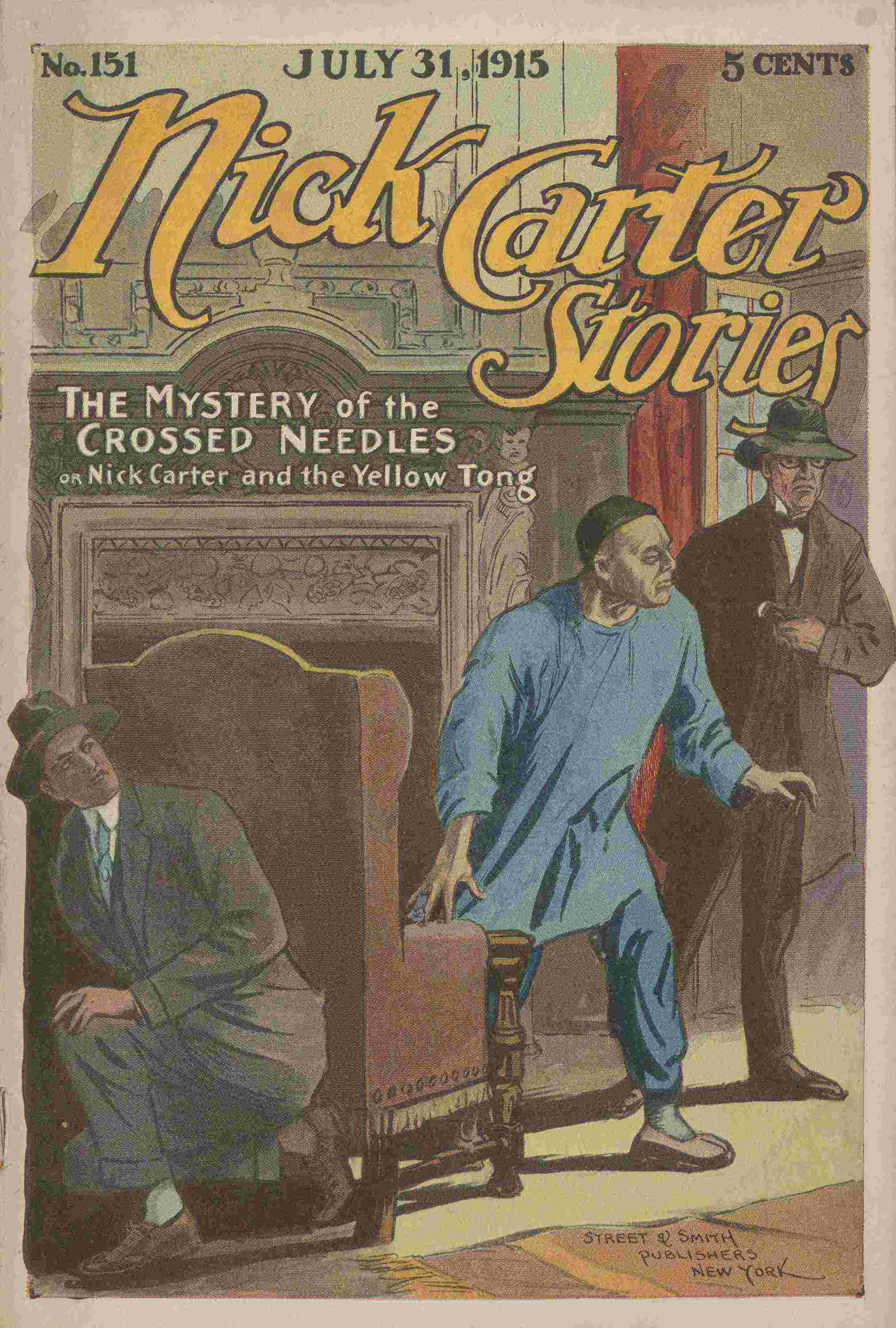
The Nick Carter Stories
ISSUED EVERY SATURDAY BEAUTIFUL COLORED COVERS
When it comes to detective stories worth while, the Nick Carter Stories contain the only ones that should be considered. They are not overdrawn tales of bloodshed. They rather show the working of one of the finest minds ever conceived by a writer. The name of Nick Carter is familiar all over the world, for the stories of his adventures may be read in twenty languages. No other stories have withstood the severe test of time so well as those contained in the Nick Carter Stories. It proves conclusively that they are the best. We give herewith a list of some of the back numbers in print. You can have your news dealer order them, or they will be sent direct by the publishers to any address upon receipt of the price in money or postage stamps.
714—The Taxicab Riddle.
717—The Master Rogue’s Alibi.
719—The Dead Letter.
720—The Allerton Millions.
728—The Mummy’s Head.
729—The Statue Clue.
730—The Torn Card.
731—Under Desperation’s Spur.
732—The Connecting Link.
733—The Abduction Syndicate.
736—The Toils of a Siren.
738—A Plot Within a Plot.
739—The Dead Accomplice.
741—The Green Scarab.
746—The Secret Entrance.
747—The Cavern Mystery.
748—The Disappearing Fortune.
749—A Voice from the Past.
752—The Spider’s Web.
753—The Man With a Crutch.
754—The Rajah’s Regalia.
755—Saved from Death.
756—The Man Inside.
757—Out for Vengeance.
758—The Poisons of Exili.
759—The Antique Vial.
760—The House of Slumber.
761—A Double Identity.
762—“The Mocker’s” Stratagem.
763—The Man that Came Back.
764—The Tracks in the Snow.
765—The Babbington Case.
766—The Masters of Millions.
767—The Blue Stain.
768—The Lost Clew.
770—The Turn of a Card.
771—A Message in the Dust.
772—A Royal Flush.
774—The Great Buddha Beryl.
775—The Vanishing Heiress.
776—The Unfinished Letter.
777—A Difficult Trail.
782—A Woman’s Stratagem.
783—The Cliff Castle Affair.
784—A Prisoner of the Tomb.
785—A Resourceful Foe.
789—The Great Hotel Tragedies.
795—Zanoni, the Transfigured.
796—The Lure of Gold.
797—The Man With a Chest.
798—A Shadowed Life.
799—The Secret Agent.
800—A Plot for a Crown.
801—The Red Button.
802—Up Against It.
803—The Gold Certificate.
804—Jack Wise’s Hurry Call.
805—Nick Carter’s Ocean Chase.
807—Nick Carter’s Advertisement.
808—The Kregoff Necklace.
811—Nick Carter and the Nihilists.
812—Nick Carter and the Convict Gang.
813—Nick Carter and the Guilty Governor.
814—The Triangled Coin.
815—Ninety-nine—and One.
816—Coin Number 77.
NEW SERIES
NICK CARTER STORIES
1—The Man from Nowhere.
2—The Face at the Window.
3—A Fight for a Million.
4—Nick Carter’s Land Office.
[Pg 70]5—Nick Carter and the Professor.
6—Nick Carter as a Mill Hand.
7—A Single Clew.
8—The Emerald Snake.
9—The Currie Outfit.
10—Nick Carter and the Kidnapped Heiress.
11—Nick Carter Strikes Oil.
12—Nick Carter’s Hunt for a Treasure.
13—A Mystery of the Highway.
14—The Silent Passenger.
15—Jack Dreen’s Secret.
16—Nick Carter’s Pipe Line Case.
17—Nick Carter and the Gold Thieves.
18—Nick Carter’s Auto Chase.
19—The Corrigan Inheritance.
20—The Keen Eye of Denton.
21—The Spider’s Parlor.
22—Nick Carter’s Quick Guess.
23—Nick Carter and the Murderess.
24—Nick Carter and the Pay Car.
25—The Stolen Antique.
26—The Crook League.
27—An English Cracksman.
28—Nick Carter’s Still Hunt.
29—Nick Carter’s Electric Shock.
30—Nick Carter and the Stolen Duchess.
31—The Purple Spot.
32—The Stolen Groom.
33—The Inverted Cross.
34—Nick Carter and Keno McCall.
35—Nick Carter’s Death Trap.
36—Nick Carter’s Siamese Puzzle.
37—The Man Outside.
38—The Death Chamber.
39—The Wind and the Wire.
40—Nick Carter’s Three Cornered Chase.
41—Dazaar, the Arch-Fiend.
42—The Queen of the Seven.
43—Crossed Wires.
44—A Crimson Clew.
45—The Third Man.
46—The Sign of the Dagger.
47—The Devil Worshipers.
48—The Cross of Daggers.
49—At Risk of Life.
50—The Deeper Game.
51—The Code Message.
52—The Last of the Seven.
53—Ten-Ichi, the Wonderful.
54—The Secret Order of Associated Crooks.
55—The Golden Hair Clew.
56—Back From the Dead.
57—Through Dark Ways.
58—When Aces Were Trumps.
59—The Gambler’s Last Hand.
60—The Murder at Linden Fells.
61—A Game for Millions.
62—Under Cover.
63—The Last Call.
64—Mercedes Danton’s Double.
65—The Millionaire’s Nemesis.
66—A Princess of the Underworld.
67—The Crook’s Blind.
68—The Fatal Hour.
69—Blood Money.
70—A Queen of Her Kind.
71—Isabel Benton’s Trump Card.
72—A Princess of Hades.
73—A Prince of Plotters.
74—The Crook’s Double.
75—For Life and Honor.
76—A Compact With Dazaar.
77—In the Shadow of Dazaar.
78—The Crime of a Money King.
79—Birds of Prey.
80—The Unknown Dead.
[Pg 71]81—The Severed Hand.
82—The Terrible Game of Millions.
83—A Dead Man’s Power.
84—The Secrets of an Old House.
85—The Wolf Within.
86—The Yellow Coupon.
87—In the Toils.
88—The Stolen Radium.
89—A Crime in Paradise.
90—Behind Prison Bars.
91—The Blind Man’s Daughter.
92—On the Brink of Ruin.
93—Letter of Fire.
94—The $100,000 Kiss.
95—Outlaws of the Militia.
96—The Opium-Runners.
97—In Record Time.
98—The Wag-Nuk Clew.
99—The Middle Link.
100—The Crystal Maze.
101—A New Serpent in Eden.
102—The Auburn Sensation.
103—A Dying Chance.
104—The Gargoni Girdle.
105—Twice in Jeopardy.
106—The Ghost Launch.
107—Up in the Air.
108—The Girl Prisoner.
109—The Red Plague.
110—The Arson Trust.
111—The King of the Firebugs.
112—“Lifter’s” of the Lofts.
113—French Jimmie and His Forty Thieves.
114—The Death Plot.
115—The Evil Formula.
116—The Blue Button.
117—The Deadly Parallel.
118—The Vivisectionists.
119—The Stolen Brain.
120—An Uncanny Revenge.
121—The Call of Death.
122—The Suicide.
123—Half a Million Ransom.
124—The Girl Kidnapper.
125—The Pirate Yacht.
126—The Crime of the White Hand.
127—Found in the Jungle.
128—Six Men in a Loop.
129—The Jewels of Wat Chang.
130—The Crime in the Tower.
131—The Fatal Message.
132—Broken Bars.
133—Won by Magic.
134—The Secret of Shangore.
135—Straight to the Goal.
136—The Man They Held Back.
137—The Seal of Gijon.
138—The Traitors of the Tropics.
139—The Pressing Peril.
140—The Melting-Pot.
141—The Duplicate Night.
142—The Edge of a Crime.
143—The Sultan’s Pearls.
144—The Clew of the White Collar.
Dated June 19th, 1915.
145—An Unsolved Mystery.
Dated June 26th, 1915.
146—Paying the Price.
Dated July 3d, 1915.
147—On Death’s Trail.
Dated July 10th, 1915.
148—The Mark of Cain.
PRICE, FIVE CENTS PER COPY. If you want any back numbers of our weeklies and cannot procure them from your news
dealer, they can be obtained direct from this office. Postage stamps taken the same as money.
STREET & SMITH, Publishers, 79-89 Seventh Ave., NEW YORK CITY