
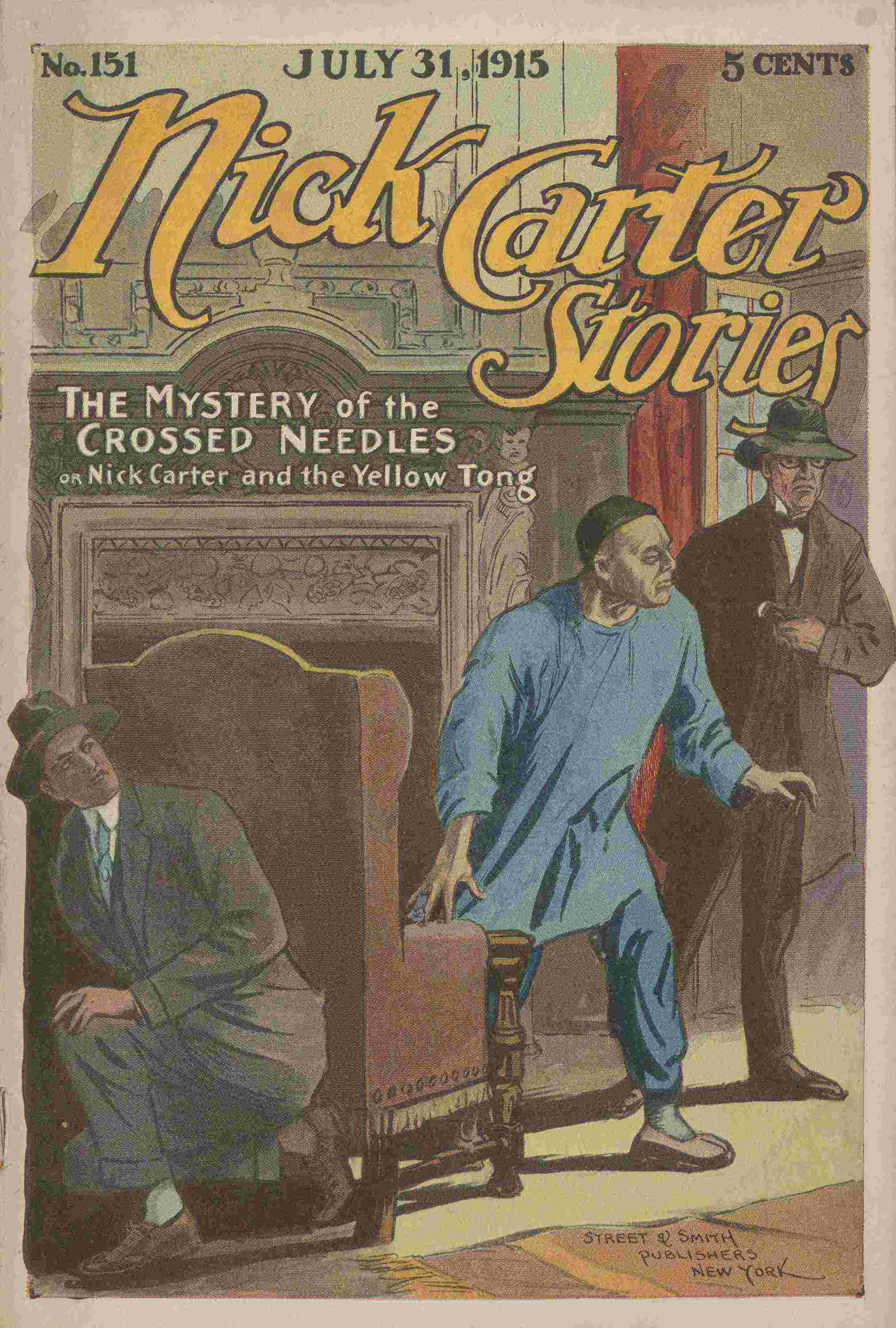
CHAPTER VI.
PATSY’S STILL-HUNT.
“I believe I’ve found him,” was the assertion with which Patsy Garvan greeted Nick Carter, as he opened the door of his own library. “I’ve heard of a chink with a sore mudhook and a listener branded from the top edge down to the flap where you’d hang an earring, if you wore such a thing.”
Patsy jumped from behind Nick’s desk as the detective and Chick entered the room, and it was obvious that the enthusiastic second assistant had been about to write a report for his chief when he was interrupted.
He had thrown his hat on a chair, taken off his coat, rolled up his shirt sleeves, and thrust the fingers of his left hand through his hair, as a preparation for literary labor. Writing was one of the occupations that he seldom took up by choice.
“Where is he, Patsy?” asked Nick, as he took the chair the young fellow had vacated. “Can you produce him?”
“Sure I can,” replied Patsy. “That is, after we’ve laid out three or four other chinks who’ll maybe stick in the way.”
“In Chinatown?” asked Chick.
“Naw!” was Patsy’s scornful reply. “That isn’t any place to look for a chink who’s traveling on the ragged edge of the law. That’s where you’d naturally look for him, and he wouldn’t be a chink if he didn’t have cunning enough to be somewhere else. Gee! They’re a wise bunch, and don’t you forget it. Why, I——”
“Where did you find him?” interrupted Nick. “Get down to business.”
“Well, I’ll tell you,” returned Patsy, in a half-apologetic tone. “When I went out of the house to-night, to look for this chink, I didn’t know where to go. It wasn’t likely he’d be down near Mott or Doyers or Pell Street. Those are Chinatown, of course, and there are more chinks to the square yard around there than you’d find in square miles anywhere else in New York.”
“That’s so,” commented Chick.
“Of course, it’s so. Everybody knows that. Also, there was a possibility that this crooked-eyed geezer might be there. But I didn’t think so. The question was, where should I look? I know a lot of chink laundries in Greater New York, and some more over in Jersey City. But it would take me a week to look into them all, and I wouldn’t be sure of landing my man, at that.”
“Great Scott! Why don’t you tell your yarn right[Pg 22] off the bat, Patsy?” begged Chick. “Where is this Chinaman?”
“I’m coming to that, Chick. Don’t be in such a hustle. When I’d walked around for a while, thinking it over, I found myself back in front of our house.”
“Yes?”
“I was on the other side of the avenue, in the shadow, when I saw two men come out of this house.”
“You did?” shouted Chick. “Did you know them? Who were they? Why didn’t you say so at first?”
“Of course, I knew them,” replied Patsy, to Chick’s first query. “They were the chief and you.”
Chick snorted in disgust, while Nick Carter laughed, for he had suspected what Patsy would say.
“What did you do then?” asked Nick.
“I followed your taxi in another one that I picked up on Thirty-fourth Street, and I told him to keep yours in sight. It took me to Andrew Anderton’s house.
“When I saw you and Chick go in, I paid off my taxi driver and told him to beat it. Then I took up my post on the other side of the avenue and watched. You see, you’d told me that it was the Yellow Tong that had laid out Mr. Anderton, and I know the ways of chinks.”
“Go on.”
“You hadn’t been in there more than a minute before a chink came strolling past the house, and he met another one at the corner. Then two more came, and two more after that. They did not all stay in a bunch, but I saw them all speak to each other.”
“What about the man with the scar that the chief wants?” put in Chick.
“I’m coming to that. The chinks were all watching the Anderton house in a casual kind of way, but all at once I found two of them were missing. What was funny about that was that they did not walk away. I saw the whole six in front of the house at one moment, and the next, when I went to count them, there were only four.”
“What had become of the other two?”
“I don’t know. But that wasn’t all of it. While I was wondering where they had gone, I’m a chink myself if two more didn’t vanish the same way.”
“But they must have gone somewhere,” interposed Nick Carter impatiently. “They weren’t swallowed up by the sidewalk.”
“That’s what they seemed to be,” insisted Patsy. “However, I wasn’t going to stand anything like that without trying to call the bluff. So I walked down the avenue for a block, under the trees, against the park fence, and then crossed over. I came moseying along past Anderton’s, and there was my two Mr. Chinks.”
“What were they doing?”
“Just coming slowly along, chattering to each other. I don’t know much chink lingo, but I’m on to some of their words, and I heard one of them say he’d had another fight. The other one asked him what about. Then came something I couldn’t make out, but I caught the chink word for smoothing iron.”
“Yes?”
“Just then they came into the light of an arc lamp, and I got a flash at the ear of the one who said he’d been in a fight. I saw the white scar. At once I piped off his right hand, and I saw that he had a finger tied up in a white rag. That was enough. I kept right on[Pg 23] past them, as if I wasn’t interested. But I knew they were suspicious.”
“What did they do?”
“They waited till I’d got to the corner, where I turned around. I know that part of the avenue pretty well, and I made for a vacant lot with boards built up around it. There’s one loose board that I’d noticed when I was past there last week, and it had struck me then that it would be handy if a fellow happened to want to hide.”
“That’s right, Patsy!” commended Nick. “A good detective is always careful to take note of everything. The most unimportant things—or things that seem unimportant—may mean a great deal at some other time.”
“Exactly the way I’d figured it,” said Patsy, his freckled face flushing with pleasure at his chief’s words. “And it just hit the spot to-night. I slipped through the hole—just wide enough for me to squeeze through—and pulled the board back into place.”
“It’s a good job you’re slim, Patsy,” smiled Nick.
“Yes. That’s been a help to me many times. Anyhow, as I was going to say, I hadn’t more than got behind the boards, when the chinks came to the corner and peeked around. There’s a big arc light there, you know, so that I could see them quite plainly. They waited a minute, and then they walked past the place where I was, and hustled around into Madison Avenue. I was out of the hole and at the corner just as they boarded a street car.”
“Did you get on the same car?” asked Chick.
Patsy shook his head emphatically.
“Not me, Chick. I was too wise for that. But luck was with me, for another car came along, close behind the other. There had been a blockade downtown, and there was a string of five or six cars in a row.”
“Well?” put in Nick.
“There was nothing to it after that,” replied Patsy, grinning. “The chinks got off at Hundred and Twenty-fifth and walked east. I was a block behind them. They turned the corner when they got to Third Avenue, and then another corner. I landed them at last. They went into a chink laundry that was all dark. One of them knocked at the door. It was opened right away. I guess there was a peephole. But after a while the door swung back and the two went in.”
“And that was all?”
“Not quite. I hung around for a while, and, sure enough, four other Chinamen came and got in. I couldn’t see whether they were the same four I’d been watching on Fifth Avenue, and who got away from me, but it’s a gold watch to a rusty nail that they were.”
“You know just where this laundry is, of course?” asked Nick.
“Gee! Yes. I can lead you right to it. But there’s a little more I haven’t told you yet. I thought, if I hung around for a while, I might find out something else. So I crossed the street, a little way below the laundry. Then I came back and got into a doorway right opposite. I hadn’t been there more than two minutes, when a taxicab came up and a tall man got out. I got only a glimpse of him. He had a long black coat and soft hat, and he wore spectacles with big black rims.”
Nick Carter betrayed the first excitement that had marked him since Patsy began to tell his story.[Pg 24]
“Was he a Chinaman or a Japanese, Patsy?” he asked eagerly.
“Search me. I couldn’t see in the dark.”
“Where did he go?”
“Into the laundry. The door opened as soon as the taxi stopped. There wasn’t any waiting for him. It was all done up in a flash. He’d gone in and the taxi was on its way in less time than you could take off your hat. I did not stay any longer. I thought I’d seen enough. I jumped an elevated train and came home. The name on the sign over the laundry was ‘Sun Jin.’”
“That will do,” said Nick Carter shortly. “We’ll all go to bed. In the morning we’ll go after the man with the scar on his ear and the rag on his finger.”
CHAPTER VII.
CHICK FINDS HIS MAN.
If Chick had a fault, it was an excess of enthusiasm in his work that sometimes led him into indiscretion. That is what Nick Carter told him sometimes, although the admonition never had any particular effect. Chick would go ahead on his own responsibility whenever he believed he could get results.
It was because of this disposition to do things on his own judgment that he did not go to bed when told to do so by his chief. He went to his bedroom obediently enough. But he did not stay there.
“The chief believes I’m tired,” he muttered, as he sat on the edge of his bed, waiting till the house should quiet down. “That’s why he fires me off to bed. Well, I feel just right for work, and I’m going to do it.”
He chuckled to himself, as he thought of how quickly Patsy would be in his room, to go with him, if he knew what Chick contemplated.
“But I don’t want Patsy,” he decided. “I can handle this myself. That chink with the scar probably killed Mr. Anderton, and if I could get him, I’d probably have the whole case cleared up. If I don’t get him, I’m going to interview that professor. What was he going into that laundry for? A man like him, who is supposed to be a Japanese, and who is supposed to be a professor, wouldn’t be mixing up with chinks of that kind if he was square. Well, he’s got to talk to me.”
Chick felt sure that the attack on him had been made by order of Professor Tolo, and he believed that he would be found to be mixed up in some way with the Yellow Tong.
“I don’t believe he is what he pretends to be,” went on Chick, as he got up from the bed and put a revolver in his pocket. “Anyhow, I’ll be ready for him if he tries any more monkey work with me.”
He went to the door, opened it a little, and listened. Everything was quiet. No doubt Nick Carter had gone to bed, and Patsy, of course, was in his own room. It would be safe to go out.
Chick knew the house so well that he could have gone down the stairs in darkness and let himself out without a sound. But there was a light in the hall, which was always kept burning all night, and it enabled Chick to get out that much easier.
“Well, I did that without disturbing anybody,” he murmured. “Now for a taxi and the laundry uptown. If I can only find Mike Donovan at his usual stand in Thirty-[Pg 25]fourth Street, I shall have somebody to help me if I should need him. Mike is a good man.”
He referred to a certain taxicab chauffeur whom he and Nick Carter both employed frequently. This chauffeur, Mike Donovan, was an ex-lightweight champion, and he enjoyed nothing so much as a good scrap, notwithstanding that he was no longer a professional pugilist. He was the same man who had taken Nick Carter to Mr. Anderton’s house earlier in the evening.
“Is that you, Mike?” asked Chick, stopping at a taxicab that was one of a row drawn up in front of a big hotel and looking in at the window. “Donovan, are you in there?”
“Faith an’ Oi am,” was the good-humored response, as Mike Donovan’s face came to the window. “Howly saints! If it ain’t Chick! Phwat do yez want, me bye? Is it annythin’ Oi can be afther doin’ fer yez?”
“Drive me in your cab to Hundred and Twenty-fifth Street and Third Avenue,” replied Chick. “Then I’ll tell you where to go.”
“Jump in,” was Mike Donovan’s response, as he got out of the cab and showed himself a rather small, but compact, middle-aged man, with red hair and a laughing, Irish face. “Oi wuz jest takin’ a rest, so I wuz, an’ hopin’ thot Oi moight git home in the marnin’ wi’out anny more thravelin’. But it’s yese’f thot’s welcome, Chick. An’ I wish there wuz to be a foight as well as a ride in the cab for both of us.”
“There may be that, Mike,” replied Chick dryly, as he took his seat inside, and Mike set the cab moving.
Mike did not reply, because he was busy with his wheels and levers. But it rejoiced his heart to know that there was likely to be a spice of adventure for him. Indeed, he had surmised there would be as soon as Chick hailed him. What would he be going uptown for in a hurry at two o’clock in the morning unless there were a ruction on the horizon? His earlier trip with Nick Carter told him there was some adventure promised, but he said nothing about that.
It seemed to Chick hardly any time before he was out of the taxicab, within a block of the laundry of Sun Jin, which was so enshrouded in darkness that only the gleam of a distant street arc light enabled him to make it out at all.
“Stay here, Mike,” he directed, in a low tone. “When I want you, I’ll give you a signal of some kind.”
“All roight, Chick! Faith, yez’ll foind me wid me cab,” returned Mike Donovan, as Chick slipped away.
Chick did not answer, for, at that moment, two men came out of the laundry and hurried in the other direction, finally disappearing around a corner.
“Come along, Mike! Follow those fellows. They’ve probably got a car, or something, around there,” said Chick, as he ran back and jumped into the taxi. “Don’t lose sight of that tall man, in the big slouch hat and long coat. You saw him, didn’t you?”
“Oi did thot,” replied Mike, as he threw on the power. “He looked loike a praste or a preacher of some koind. He wuz a quare koind o’ mon to be comin’ out av a laundry, so he wuz.”
At the corner of the street Chick saw that he had guessed aright as to there being a vehicle in waiting. A taxi was two blocks ahead, going fast.
“Sure, it’s wan o’ thim nighthawks,” proclaimed Mike Donovan. “Oi know ’em whin Oi see thim. Thot cab[Pg 26] don’t belong to no company. It’s just a private wan, d’yez moind? But av he t’inks he can git away from me—well, he’s got anither guess comin’.”
It need not be told in detail how Mike kept on the track of the other cab. Suffice it that when it turned into Fifth Avenue and kept on downtown, Chick was in time to see the two men go into the house next door to Anderton’s, and that he recognized one of them as Professor Tolo, while the other wore the blue blouse and wide trousers of a Chinese laundryman.
“You can go now, Mike,” he whispered to Donovan. “If you stayed around, they might see you and be suspicious. Besides, I can handle this case myself now.”
“An’ don’t I git no chance for a scrap?” demanded Mike, much disappointed. “Sure, I’d loike to let droive just wance at wan av thim there chinks. Yez tould me Oi w’u’d.”
“I know I did, Mike,” returned Chick soothingly. “But we can’t always have things the way we want them. Better luck next time.”
He paid the sum the taximeter showed, and gave Mike a generous tip in addition. Then he waved his hand in farewell and stepped into the deep doorway of the Anderton house, waiting there until Mike Donovan’s taxicab had been swallowed up in the gloom.
It did not take Chick as long to get Ruggins to the front door as he had feared it would. The fact was that the butler had been so disturbed by all that had taken place that night and morning in the usually peaceful home that he could not sleep. So, when the night bell, which rang in Ruggins’ bedroom at the back of the hall, sounded, he heard it immediately.
“’Ello!” he grunted. “’Ere’s more of it. I’m blowed if I ever was in a game like this ’ere before. What is it now?”
He slipped into some of his clothing, and, with his suspenders hanging down, cautiously opened the front door a little way and peeped out. He recognized Chick at once.
“W’y, Mr. Carter! Is there anything else wrong?”
“Not that I know of,” replied Chick, as he pushed his way in and closed the door. “But I want to go up to Mr. Anderton’s study again. Don’t say a word to anybody.”
“Do you mean you’re going to find out who murdered Mr. Anderton?”
“I’m trying to do so. You can go to bed again. I will stay up in that room for the rest of the night. Mr. Anderton has some valuable things there, and if a man could get in to kill him, there is nothing to prevent his coming back if he wants to. Don’t ask any more questions, please, Ruggins. Mr. Carter told you to let me go where I pleased in the house, didn’t he?”
“Yes. But I didn’t know you were coming back at this time in the morning,” protested Ruggins, in a doubtful tone. “Still——”
“Still,” interrupted Chick. “I want to do it, because I believe it may help me to find out something. That’s all.”
Leaving Ruggins to return to bed—or to sit up, if it suited him, Chick went up to the study and shut himself in. Then, without turning on the light anywhere, he stole cautiously to one of the windows and cautiously peered between the thick curtains.
Instantly he dropped the curtains into place again and set his mind busily to work to decide on a hiding place in the room.[Pg 27]
There was a large leather chair near the open fireplace, so heavy that it was not easily moved, and which obviously was meant for use as a lounging nest in which one could luxuriate in laziness at the fire. Behind this chair Chick squeezed himself just as the window opened, with a creak, behind the curtains.
He was not surprised when the man who came into the room proved to be Professor Tolo. The intruder carried a large pocket flash lamp, and his first action was to throw the light all about the room.
Chick squeezed into a still smaller space behind the great chair, ready to hide himself entirely when the light should come his way. Then one of the incandescent lights was switched on, and he saw there was a Chinaman in native dress with the professor.
“Stand at the door, Sun Jin,” whispered the professor, in English, to his companion.
Without a word, the Chinaman stepped over to the door, saw that there was a key in the door, and turned it in the lock. Chick was glad he had not followed his first impulse, to lock the door when he came in. If he had, it would have told the rascals there was somebody else in the room.
Without paying any particular attention to Sun Jin, the professor began to pull from the bookcase the same volumes he had moved in the presence of Nick Carter. Placing them on a chair, he took out several more books. Then Chick heard a clicking sound.
“Wonder whether I ought to plug him right now,” thought Chick, fingering the automatic revolver in his coat pocket. “I could wing him, so that he would be helpless, without killing him. Then I could lay out the chink, and——”
“Curse him! It isn’t here!” broke out Professor Tolo, in unmistakable English.
He had opened a recess at the back of the bookcase, behind the place where the removed volumes had stood, and found that nothing was there.
“That’s worth knowing,” thought Chick. “The thing they murdered Mr. Anderton for has got away from them, after all. Now, what will they do? There is one satisfaction I have, and it was worth my coming here to find out—this Tolo is mixed up with the Yellow Tong. I wish——”
Professor Tolo had been hastily replacing the books, and now he turned to the Chinaman standing at the door, to say, in a surly tone:
“Look out and see if everything is clear.”
The Chinaman came from the door, and, as if to make sure there was no one in the room besides himself and the mysterious professor, walked all around it, gazing in every direction.
It was well for Chick that he was in deep shadow, or he must have been discovered, for the Chinaman looked all about him, even to placing his hand on the back of the big leather chair. Chick drew back, and was able only just to hide himself.
The Chinaman moved on toward the window, without seeing Chick. On the other hand, Chick had had a clear view of the fellow’s face, and as he placed his hand on the automatic pistol in his pocket, he murmured excitedly:
“That’s the man. He’s the chink with the scar on his ear, and his finger is still tied up in the white bandage.[Pg 28]”
The next moment, unable to restrain himself, Chick had leaped from his hiding place and hurled himself upon the Chinaman!
CHAPTER VIII.
CHICK MAKES DISCOVERIES.
It was not a wise thing for Chick to do, of course. But that same excessive enthusiasm which had induced him to come here, on his own responsibility, instead of going to bed, as he had been told to do by his chief, made him indiscreet now.
That he had the man whom Nick Carter had told Patsy to find, he was sure. But whether the Chinaman had killed Andrew Anderton or not was a question he could not answer positively.
“I don’t doubt it,” he thought. “Anyhow, what is he doing up in this room at this time in the morning? I’ll lay him out on general principles.”
It is pretty certain that Chick would have carried out this purpose if he had had only the Chinaman to deal with. But there was an interruption. He had the fellow by the throat and was cheerfully throttling him, when a heavy weight came down on the back of his head. He knew no more.
When Chick came to himself again, there were thin, white threads of light stealing into the room between the slightly parted window curtains. Daylight had come.
“Fool!” was Chick’s first articulate utterance.
The epithet was not applied to the man who had knocked him down, or the Chinaman with whom he had been struggling when the blow came, either. He was calling himself a fool.
“The chief is always telling me not to fly off the handle,” he continued, in a mumbling whisper. “And I’m always doing it. What chance had I when that tall old fraud was right behind me? As soon as I tackled the chink, of course, Mr. Professor let me have it with a sandbag.”
Chick was sitting up on the floor by this time, and as he felt his head without finding any cut or bruise, he knew that he had been sandbagged—for the second time within a few hours.
“That’s what I was hit with,” he decided judicially. “It is the favorite tool of the Yellow Tong. We knew that before, because two or three people have been laid out that way when some of the tong men were supposed to have done it. Even that poor Brand Jamieson, who got the crossed needles, too, was slammed with a sandbag first of all.”
Chick’s head cleared in the course of a few minutes, and he was able to review the situation in some sort of orderly fashion.
“After all,” he reflected, “it isn’t so bad. The chief wanted to find that fellow with the scarred ear and burned finger. Now I know where he hails from, because Patsy gave us a tip. Patsy knew the name over that laundry was Sun Jin, and that’s what I heard the Jap call the chink I had on the floor. It all fits together like an easy jigsaw puzzle.”
The blow on his head had made Chick feel a little sick, but he was able to get to his feet. When he had opened the study door, the fresher air of the hallways revived him.
He looked at his watch and found that it was five o’clock. There was no sign or sound of activity in the[Pg 29] house. He made his way down the stairs and out to the avenue, without seeing anybody.
“That butler, Ruggins, was just about all in, I reckon,” he thought. “He didn’t care who was in the house, or what was going on, so long as he was not bothered. Well, I guess I’ll get home, report to the chief, and then turn in myself. I know he won’t let me do anything more till I’ve had some sleep. I hope he won’t call me down too hard for what I’ve done. I’ve found out something, anyhow.”
Chick intended to take a Madison Avenue car, as the easiest way to get downtown. So he turned off the avenue to a cross street, to wait for a car at the corner.
But he didn’t have to take a car. To his intense satisfaction a taxi came crawling up behind him, at the leisurely pace which suggested that it had no fare inside. This was confirmed by a husky voice singing out, “Taxi?”
It was the chauffeur of the taxicab. He pulled the machine over to the curb, as he waved one hand to his possible patron, while the other controlled the steering wheel.
“Yes. All right!” responded Chick.
The chauffeur was enveloped in a great, hairy coat, and a cap of the same kind of fur was pulled well down over his face. The weather was not cold in the daytime, for it was early fall, but at night one can get pretty chilly driving a cab for hours at a stretch, and no doubt the heavy coat was comfortable between five and six in the morning.
“Take me down to Thirty-fourth Street and Madison,” directed Chick. “Then I’ll show you the house I want.”
It was one of Nick Carter’s precautions—which he also advised his assistants to observe—not to mention his address to strangers. It was better, he held, to get near the house, and then point it out to anybody to whom it was necessary to show it.
“All right,” grunted the chauffeur. “Can you open the door yourself? You don’t want me to get down, do you?”
“Of course not. I’m able to get into a cab without help,” replied Chick, with a smile.
“It opens a little hard,” said the cabman.
The taxi was in front of the vacant lot, with the high board fence around it, to which reference has been made in a former chapter. It was a lonesome spot, especially at that hour in the day.
Chick found that the door of the taxicab did indeed open hard. He could not turn the handle at first, and when he did accomplish this, it was with considerable difficulty that he got the door to open.
“Sticks like thunder!” he ejaculated, as he tugged at the handle. “What the deuce do you have your door so——”
That was all he had a chance to say. When the door did at last yield to his violent pull, four hands seized him by the head and shoulders, and he was dragged inside with a jerk. Then the door slammed shut, and he felt the cab whirling and rocking away, as three men held him firmly on the floor.
He was able to see that there were thick shades drawn down on both sides of the cab, so that no one could see in from the street.
If Chick had any idea of calling for help, that was soon put beyond his power. A large cloth, which he be[Pg 30]lieved was of silk, from its feel, was bound tightly over his mouth and knotted at the back of his head.
A peculiar odor—that of opium—filled his nostrils. It would have told him, if he had needed the information, that he was in the hands of Chinamen. But he could see for himself, by the light that came to the interior from the front window—through which he had a view of the fur-clad chauffeur, calmly driving—that there were two Chinamen in ordinary laundrymen’s garb, holding him, while a third man, with large, tortoise-shell-framed spectacles covering part of his yellow face and a slouch hat pulled so far down that it almost met the immense collar of his overcoat, sat half behind him.
Chick tried to turn. He wanted to look straight at the man with the spectacles. But the Chinamen gave him a quick wrench, to hold him away, and one of them threatened him with a club that looked like a child’s black stocking packed halfway up its length with sand.
There was nothing to be done just then but to submit, and Chick was philosophical enough to make the best of a bad job. So he did not struggle. He simply knelt on the floor of the cab, where he had been originally put by his captors, and wondered how long it would be before he could force his way to freedom.
He had too much faith in himself to believe that these rascals could hold him very long. Besides, Patsy had traced this Professor Tolo to the laundry of Sun Jin, and he and Nick Carter surely would be paying a visit to that place very soon.
“This is the professor, behind those spectacles,” Chick told himself, “and one of these chinks is the fellow with the scarred ear. I don’t know the other one. Surely they can’t think they can get me without having to pay for it.”
Then he thought of the crossed needles that would have killed him if they had been driven a little farther into his sleeve, and he did not feel so sure that the rascals would not go to extremes rather than be caught themselves as the murderers of Andrew Anderton.
“But it isn’t only that,” went on Chick mentally. “They are after some records made by Anderton. They seem to be of vital importance to the tong. Well, we shall see.”
It was just as Chick came to this conclusion that the taxicab stopped suddenly. At the same moment a large coat or cloak was thrown over his head, and he felt his senses leaving him under the influence of a strong narcotic, whose pungent odor gave him a sensation of horrible nausea.
He remained conscious long enough to realize that he was lifted out of the cab and carried a few yards. Then he heard a door bang, and that was all!
CHAPTER IX.
THROUGH DEVIOUS WAYS.
“See why Chick hasn’t come down, Patsy,” directed Nick Carter, as he and Patsy Garvan faced each other at breakfast the next morning. “He must have been very tired last night to sleep like this now.”
Patsy left the room, but soon returned, with a queer look of dismay on his face.
“He isn’t there,” was his report. “His bed hasn’t been slept in, either.”
“Are you sure of that?” asked Nick sharply.[Pg 31]
“Positive. I met Mrs. Peters on the stairs, and she told me none of the bedrooms have been touched by the maids yet. They never are at this time in the morning. Why, chief, it’s only eight o’clock.”
But Patsy was speaking to emptiness by this time. Nick Carter had run up the stairs two at a time, and examined Chick’s bedchamber for himself. He came down in another minute or two, a heavy frown on his brow.
“Let’s have breakfast, Patsy.”
“What about Chick?”
“Let’s have breakfast,” was all Nick Carter replied.
“Gee!” muttered Patsy. “I don’t know whether I can eat anything. This thing has put a kink in my appetite that——”
Just then Mrs. Peters, the housekeeper, entered with a dish of ham and eggs, which she placed before Nick Carter. As she lifted the silver dish cover, she asked quietly:
“Didn’t you know Mr. Chick was out, Mr. Carter?”
“No. Do you know what time he went out?”
“I heard the front door close about two o’clock, I think it was,” she answered. “I wondered who it was. But there is nothing unusual in you or somebody to go out at any hour of the night.”
“Sure as you live,” interjected Patsy.
“But I knew you intended all to stay home last night, and that was why I couldn’t make it out. So I thought I’d serve the ham and eggs myself, and ask you.”
Mrs. Peters, the worthy housekeeper, had been with Nick Carter for many years, and took a motherly interest in him which excused her curiosity. The detective smiled kindly, as he replied:
“I’m glad you’ve told me this much, Mrs. Peters. I confess I don’t know what has become of Chick. But I soon will. He has good reason for being away, no doubt.”
He nodded a dismissal, and Mrs. Peters disappeared. Patsy did not ask any more questions for the present. He busied himself with breakfast. At the end of the meal Nick Carter asked him if he could take him direct to the Sun Jin laundry.
“I can do that, chief,” replied Patsy. “But we’ll find the chinks there pretty suspicious. How are we going to get in?”
“We’ll see when we get there,” replied Nick Carter quietly.
“I don’t say you can’t get into the laundry,” went on Patsy. “We’ll find one or two chinks in there, ironing and washing, as they always are. But you know that what you see in the shop of a chink laundry doesn’t tell you what is going on behind or upstairs.”
Nick Carter only nodded and smiled. He did not depend on Patsy, or anybody else, to make him understand the ways of Chinamen in New York.
“Call up Danny Maloney, and tell him to bring the small car—the new one. I don’t think there are many persons in New York know I have that one. I have never had it out yet.”
In ten minutes’ time, Nick Carter and Patsy were sliding smoothly uptown in the new car which the detective had bought for daylight use—mainly because his other motor cars—and particularly the big sixty-horsepower machine—were too familiar to the gaze of certain New Yorkers who feared him.[Pg 32]
Leaving the car at a little distance, Nick and Patsy walked along the side street on which Sun Jin’s laundry was situated, and stepped inside. The detective produced a shirt and collar which he said he wanted laundered, and accepted the check from the moon-faced man at the ironing board without any comment.
During the transaction, another Chinaman continued to iron at a board at the back of the hot little room without turning his face toward the customers. He seemed to be completely absorbed in his work, and to feel no interest in anything else. Certainly, he showed no curiosity.
This did not deceive Nick Carter, however. He knew that the very calmness of these Chinamen was suspicious. There might be a dozen more of them in the place behind, or upstairs, and each one might be staring down through peepholes at the strangers.
Only one thing Nick was sure of, and that was that the man with the scarred ear was not in the front shop. Neither of the men working had any such mark, and their hands were clear of bandages or injuries.
Without comment or inquiry, Nick accepted his check. The Chinaman said laconically, “Thursday!” and went on with his ironing without looking at his visitors as they left the shop and closed the door behind them. Patsy glanced through the window as they passed. The two Chinamen were still ironing with characteristic patient industry.
Turning a corner, Nick met a policeman, and the quick look of recognition from the officer made him ask a quiet question, without stopping, as they passed:
“Is there another entrance into Sun Jin’s laundry besides the front one?”
“Through the saloon on the corner,” replied the officer briefly, as he walked on.
“That cop knows his biz,” remarked Patsy, in a low tone. “Anybody seeing him would think he’d never seen you before.”
“He’s an old friend of mine,” returned Nick coolly. “I have a great many on the force.”
Neither Nick Carter nor Patsy wore any disguise, but both were dressed in such inconspicuous raiment that they looked like thousands of other New Yorkers. At a glance, one would have said they were ordinary business men—insurance agents, perhaps.
So, when they slipped into the saloon the policeman had specified and strolled into the room at the back of the bar, the waiter served them with the beer Nick ordered, and went back to the free-lunch counter in front without giving them any further attention.
“Now, Patsy! Hurry! Get across the yard at the back, and slip up the wooden stairs you see through the window. If the door is fastened, open it. You know how to do that.”
“Sure!”
Patsy Garvan found the door locked, as Nick had anticipated. But, with a piece of strong steel wire, that was part of the equipment of his pocketknife, he operated the lock as easily as if he had a key.
Nick Carter sat at the table, with his glass of beer before him, having only sipped it, and through the window watched the door at the top of the crazy wooden staircase outside. He seemed perfectly cool, but his brain was working rapidly and his nerves were on a strain.[Pg 33] He was listening for any sound that might suggest trouble for Patsy.
At the first note of alarm he would be on the stairs himself. But, no such note came. At the end of five minutes Patsy appeared again on the staircase, and immediately afterward he was once more sitting at the table, facing his chief.
“Well, Patsy?”
“Gee! There’s nothing in that joint but two empty rooms. They’re right over the laundry, and I found a crooked staircase leading down to a door on the ground floor.”
“Yes?”
“I sneaked down, and there was a little hole that had been cut in the door with something. I peeked through, and, gee! there were the two chinks, still ironing.”
“What was over the two empty rooms?”
“Nothing but the roof. You noticed that the whole shanty is one of those crazy frame buildings that chink laundries so often get into. Well, I saw there was a trap-door to the roof, but there was no ladder or anything to get up to it, so I didn’t try to see what was on the roof. It wasn’t likely there was anything.”
“The rooms were quite empty?”
“Yes, except for dust,” replied Patsy. “The dust was some help,” he continued, with a grin. “For I saw the marks of a lot of feet, and they were all flat, like the prints of chink felt shoes—except that there was one mark, which I found at different parts of the room, partly hidden by the chink shoes, and which showed that a fellow with American shoes had been there. They were large.”
“I see,” nodded Nick, rather eagerly. “The person who owned them was a big man?”
“I should think so, from the shoe prints.”
“Wasn’t there any furniture in the room, nor any scraps of rubbish that might give us a clew?”
Nick Carter put this question rather sharply. He couldn’t believe that his quick-witted assistant had come away without finding something that might be useful.
“There was this,” replied Patsy, handing a scrap of paper to his chief. “I don’t know that it means anything. It was on the crooked staircase. Being white, it caught my eye, and I picked it up. I was going to throw it down again, and I would have done so if I hadn’t remembered that you always say it is better to keep and examine everything when you are on a case, no matter if it doesn’t seem of any account.”
Long before Patsy had finished his disquisition, Nick Carter had taken from him the scrap of white letter paper his assistant had held out, and he was now gazing at it with a thoughtful eye.
The scrap of paper had been torn from an envelope—that was shown by the fact that part of the gummed flap still adhered—and on the fragment was a name, or part of one. It was “Bentha.”
“Bentha?” murmured Nick. “It is easy to see that part of the name has been torn off. Of course, the name is ‘Bentham.’ Now, what brought this bit of paper to those stairs?”
He lighted a cigar and smoked for several moments in deep reflection. Then he drew from his pocket the powerful magnifying glass he generally carried, and gazed steadily at the bit of white envelope. Patsy noted that his attention was not concentrated on the name,[Pg 34] but that he looked at the back of the envelope as closely as at the front.
“Do you want that beer, Patsy?” he asked, at last, as he replaced the glass in his pocket, and carefully deposited the scrap of envelope between the leaves of his notebook. “If you don’t, empty it into a cuspidor.”
Patsy did not want the beer, and he disposed of it as he was told. The detective emptied his own glass into another cuspidor. Then he got up and sauntered out to the street. Patsy was close behind him.
When they got to the waiting motor car, Nick directed Danny Maloney to drive to a cross street near Andrew Anderton’s house.
The detective did not speak during the ride. But when they got to their destination, he told Maloney to wait, and walked swiftly around to Fifth Avenue, and up the steps of the Anderton mansion.
As Nick and Patsy went in, they found themselves among half a dozen other men who were also going in.
“The coroner’s inquest,” whispered Carter to his assistant. “This is lucky. It prevents our being particularly noticed.”
CHAPTER X.
NICK CONFIRMS A THEORY.
The jury, who had been entering with Nick Carter and Patsy, were ushered into the bedroom where the remains of Andrew Anderton lay. Thence they were conducted to the study, and shown just how the deceased had been found lying on the floor.
After that, the coroner addressed the jury at some length, telling them all he knew about the case—which was not much—and asking them to find a verdict that would give the police something to work on.
The jury—several of whom had had experience in this sort of thing and knew what was required of them—promptly brought in a verdict that “the deceased had come to his death at the hands of some person or persons unknown.”
Doctor Farrell, the coroner, thanked the jury and told them they could go. Their foreman wrote the verdict, for record, and directly afterward there was no one left in the room but the coroner, Nick Carter, and Patsy Garvan.
“It’s the Yellow Tong, Mr. Carter,” remarked Doctor Farrell gravely. “Doctor Miles showed me the crossed needles that were found in the body, and said that the tong had been trying to get hold of certain papers prepared by Mr. Anderton, to be submitted to the government at Washington. The doctor also told me that you were interested in the case.”
“I am,” affirmed Nick.
“Glad to hear it, Mr. Carter,” responded Farrell heartily. “That means that poor Anderton will be avenged. Mind, I don’t mean to cast any reflections on the ability of the police department. But it can’t be denied that headquarters will be glad of your help.”
“I often work in coöperation with police headquarters,” was Nick’s quiet reply. “Where are the crossed needles that were found in Mr. Anderton’s chest?”
“Doctor Miles has them. He will produce them when required by the police. Do you want to examine them?”
“It is hardly necessary. I know as much about them as I require. They are charged with deadly poison, and a mere scratch is enough to cause death. What makes[Pg 35] them the more dangerous is that they leave no marks. Even after death there is nothing to show that the poison has been used, unless there is an autopsy. I want to look about this room for a little while, however. You have finished with it, haven’t you?”
“Yes, I am glad to say. I had to come here to hold this inquest. But my investigation is only preliminary—just to comply with the form of law. The real work on the case begins where I leave off,” replied the coroner briskly. “Well, I must be going. I’ve a heap of work to do. Good morning!”
Doctor Farrell clattered down the stairs and out to the avenue, where his automobile was waiting. Nick Carter was glad to get rid of him. He sat down at the big table and took a white envelope out of the top drawer.
A moment’s comparison of the envelope with the scrap that Patsy had found on the stairs at Sun Jin’s laundry was sufficient to convince the detective that they were of the same kind. Then he looked into the wastebasket, which had never been emptied since the death of Anderton.
A low cry of satisfaction came from Nick Carter’s lips as he found some scraps of an envelope among the other torn paper.
With patience and care, the detective pieced the fragments together, until he had a sort of framework of an envelope. From the middle of it had been torn part of a name and address, which he was convinced had been that of Matthew Bentham.
“Yes,” he murmured, looking at the pieced envelope through the strong glass. “Here is the ‘M’ which he failed to tear off, and below is the whole word, ‘Brooklyn,’ with the initials ‘N. Y.’ I see. He wanted the address of Bentham, but he did not trouble to take the name of the borough. He knew it was in Brooklyn, anyhow.”
“Have you got something, chief?” asked Patsy, who had been watching in silence. “Did that bit of paper I got help at all?”
Nick Carter laughed a hearty, but silent, laugh.
“It has helped me to know where Professor Tolo has gone, or will go, I think,” he answered. “I’m going to see if I can find him. You stay here, however. I have a feeling that the mystery of Andrew Anderton’s death may be solved in or near his own home.”
“I don’t see, exactly,” replied Patsy. “But if you think Tolo had something to do with it, why don’t you nab him, and prove it on him afterward. That’s the way the police do, generally.”
“It’s a good way, too, in some cases, Patsy. But I want to get more than one man now. Besides, I don’t believe Professor Tolo actually committed this murder.”
“But he was behind it.”
“Very likely. But what I want is the rascal who killed Mr. Anderton. If once I were to show my hand by having this Japanese professor arrested, the Chinaman, or whoever it was that drove the crossed needles into his heart would take fright.”
“Either that or they would try to get you,” declared Patsy doggedly.
Nick Carter shrugged his shoulders. He believed the Yellow Tong was on his track now. That was why he wanted to strike at several of the members at once, instead of merely picking off one man—even so important a one as this Japanese professor seemed to be.[Pg 36]
“Never mind about talking. Stay in this room till I come back. But—here is something else. I wish you would sit by that window, behind the lace curtains, and partly behind the dark ones that are drawn over the window at night.”
“I see,” threw in Patsy. “There are two sets of curtains, one inside the other. You want me to keep out of sight of anybody outside. But who is there to see me? At the back is a big, vacant lot, and we are too high for any one in the yard to look in.”
“Quite so, Patsy. I am aware that nobody in this yard could see you at the window, even if there were no curtains. But it is the next yard I want you to watch. The yard on your right as you stand at the window.”
“Oho!” exclaimed Patsy, with a low whistle. “I’m on. That’s where the chinks went when I missed them last night. They didn’t come in here, but they sneaked into the next house.”
“Probably.”
“Yes, and I bet they slipped down into the basement. There is a gate in the iron railings. I see just what they did. They went through that gate and were out of sight in the kitchen while I was watching this house. Gee! This is going to be dead easy!”
“I don’t know about that. But I hope we are getting a net around the rascals. I don’t think I shall be away more than an hour. I’m going to see Mr. Bentham, over in Brooklyn. If I don’t find anything there, I’ll come back as fast as Danny Maloney can bring me. If there is anything to keep me, I’ll telephone you right in this room from Mr. Bentham’s house. Get all that?”
“Every word. So long!”
Patsy moved over to the window and ensconced himself behind the curtain, in accordance with his instructions, and Nick Carter drove away to Brooklyn.
CHAPTER XI.
THE LETTER.
Although this was the first time Nick Carter had ever visited Professor Matthew Bentham in his home, he had met him several times, at meetings of scientific societies and at public dinners.
The detective was a student, and whenever he could take time away from his main calling, that of investigator into strange crimes and seemingly unsolvable mysteries, he was pretty sure to be actively interested in the progress of the world from a scientific standpoint.
So, when he was ushered into the library of Matthew Bentham, in a quiet avenue in the shadow of Prospect Park, Brooklyn, the two met as old and valued friends.
Matthew Bentham had been sitting at his large table, an open letter in one hand and a crumpled newspaper in the other, as Nick entered. That he was deeply shocked was evident at the first glance. His hand shook as he gave it to the detective, and it was in a shaky voice that he requested his old friend to take a chair.
“I see you have read the awful news of Andrew Anderton’s death at the moment you got his letter, professor,” remarked Nick. “I thought it might happen in that way.”
“Why, how did you know?” asked Bentham, in surprise. “It seems to me sometimes as if you know things that you could get only by some supernatural intuition. How did you know I have a letter from Anderton?[Pg 37]”
Matthew Bentham was a tall, well-built man, whose ruddy face indicated that he was fond of outdoor life, in spite of his being a close student. The truth was that he learned many things about nature at first hand. He had traveled in many lands, besides knowing a great deal about his own, and his knowledge was extensive and peculiar. He had been lucky enough to conserve health and wisdom all in one operation.
“My explanation of how I know about the letter is very simple,” replied the detective. “I had that letter mailed myself. It was written only a few minutes before his death last night.”
“To think that Anderton should die of heart failure,” exclaimed Bentham. “Why, I can hardly believe it. Think of the altitudes to which he climbed in the Himalayas, Carter. No man with a weak heart could stand such a cold and rare atmosphere as you get up there. Well, I’m glad I have probably the last words he ever wrote.”
“Yes, there is no doubt of that, I think. The fact was, I had that letter mailed for certain reasons.”
Matthew Bentham looked puzzled. Then he shook his head, as if he did not care to pursue the subject.
“Those reasons are sufficiently weighty,” went on Nick, “for me to desire to know what he wrote. I realize that my request is distinctly out of the ordinary. But I think you know me well enough to be sure that I must have a very strong motive.”
The professor was silent for a few moments. The detective knew he was turning the request over in his mind, and that it had not struck him at all favorably. Then he seemed to decide the other way, for he broke out impulsively:
“Well, it is rather irregular, but I don’t know why you shouldn’t see the letter. Of course, I have your promise that you will not let it go any further.”
“Of course,” replied Nick. “I think it is hardly necessary for me to say that, but I do promise.”
Professor Bentham handed the letter to Nick Carter, who read as follows: