
“Gee! I can see it, all right. But it’s mighty tough on me. I’ve been shut out of this whole circus. When this is over, I’m a goat if I don’t go out and hit a policeman. I’ve got to get action somehow.”
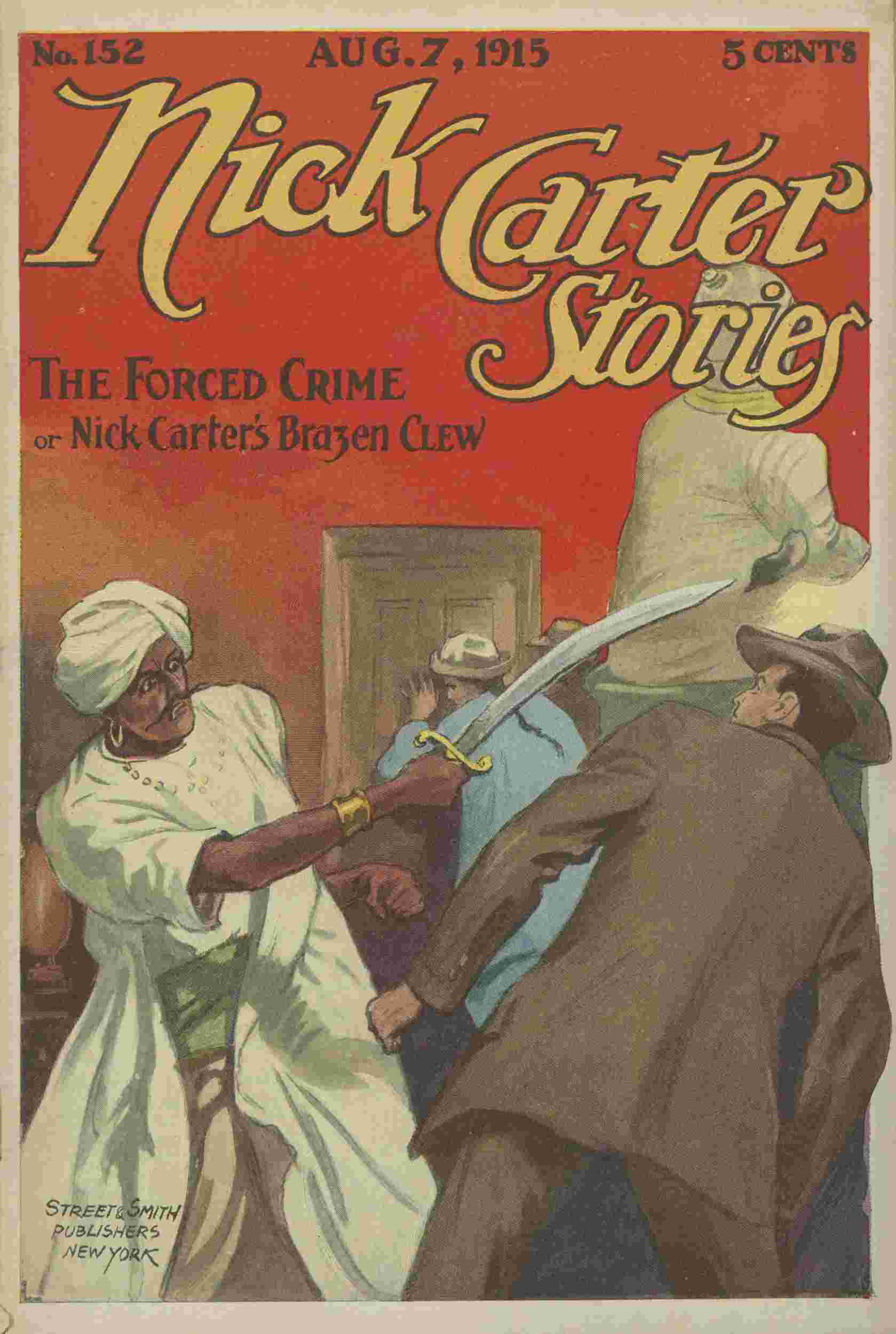
Nick Carter saw that he had Ched Ramar giving way now, and he determined to make an end of the struggle without further waste of time. The fight had been conducted very quietly. It had not even disturbed the two maids, asleep upstairs, and there was no reason to suppose the fracas had been heard on the street.
“You think you have me, I suppose?” hissed Ched Ramar, as he fought with all the energy he had left.
Nick Carter did not answer. He knew that the cunning Indian was trying to make him talk, and thus divert his attention. Instead, he gave his enemy a sudden and harder twist that took him an inch farther back.
There was an inarticulate ejaculation of rage from the Indian, and his black eyes glowed fiercely through his glasses. He stopped for a second the onward rush of his assailant. Then, as he was obliged to give way, he jerked up his arms and tried to bring the edge of the scimitar across Nick Carter’s face.
The attempt failed, but it brought the battle to an abrupt end.
As Nick Carter leaped aside to avoid the scimitar, he kicked the feet of Ched Ramar from under him. Back[Pg 41] went the Indian, crashing against the gigantic image of Buddha behind him.
For a moment the enormous idol rocked on its pedestal. Then, as it lost its balance, down it came, pedestal and all, toward the two fighters!
One corner of the pedestal struck Nick Carter on the shoulder and laid him out flat on his back.
He was not hurt, and he jumped to his feet on the instant. As he did so, he shook his head—partly in satisfaction, but still more in horror.
The body of Ched Ramar lay under the great idol, and the brazen knees were pressed into its victim’s head, crushing it out of all semblance to what it had been!
Ched Ramar had paid the penalty of his rascality through the very agent he had employed to make an innocent girl a participant in his crime.
“Look out, Chick!” shouted Nick Carter, as he saw Keshub breaking away from his assistant’s hold. “He’s going to get out, if you don’t hurry.”
But Patsy Garvan was on the alert. He was only too glad to get into the fight in any way, and he tripped Keshub, just as he leaped through the doorway, in a very skillful and workmanlike manner.
“Oh, I guess not!” observed Patsy. “I saw you getting up after Chick had laid you out, and I was looking for you to make a break like this. Come back here!”
The cloth from Meirum’s turban was bound about Keshub, and he was laid on the floor by the side of the knocked-out Meirum. Then, with considerable exertion, the image of Buddha was rolled completely away from the body of Ched Ramar, so that Nick could look it over with his flash light.
“He died on the instant,” decided Nick. “Cover it with one of those curtains, while I go downstairs and telephone the police station.”
In due course, the remains of Ched Ramar were viewed by the coroner, and a verdict of “accidental death” was rendered.
Very little got into the papers about it. This was arranged by Nick Carter. He did not want too much publicity while any of the Yellow Tong were still likely to be active. It might interfere with work he had yet to do.
Keshub and Meirum, as well as Swagara, were not prosecuted. Nick made up his mind that he could better afford to let them escape than to draw general attention to the rascality they had been carrying on.
So he put them aboard a tramp steamer bound for Japan, and India, and which would not touch anywhere until it got to Yokohama. Swagara was to be put off there.
The next port would be Bombay. Both Keshub and Meirum said they would never leave Indian soil again if once they could get back to it, and there is no reason to suppose they were telling anything but the truth.
Matthew Bentham never knew the part his daughter had played in taking and returning the precious papers. Nick Carter decided that no good end would be served by letting him find it out.
Even Clarice herself was quite unaware of what she had done. The subtle influence of hypnotism had permeated her whole being at the time, and when she came to herself, it was entirely without recollection of what she had passed through when in the power of another and stronger will. Hypnotism is a wonderful science.
“Is this all of the Yellow Tong, chief?” asked Chick, smiling.[Pg 42]
“There will be no end to this investigation until I have my hands on Sang Tu,” replied Nick Carter sternly.
“I thought so,” was Chick’s reply.
THE END.
“The Doom of Sang Tu; or, Nick Carter’s Golden Foe,” will be the title of the long, complete story which you will find in the next issue, No. 153, of the Nick Carter Stories, out August 14th. In this story you will read of the great detective’s ultimate triumph over the shrewd leader of the Yellow Tong. Then, too, you will also find an installment of a new serial, together with several other articles of interest.
Sheridan of the U. S. Mail.
By RALPH BOSTON.
(This interesting story was commenced in No. 148 of Nick Carter Stories. Back numbers can always be obtained from your news dealer or the publishers.)
CHAPTER XXII.
A QUESTION OF COLOR.
After Owen had seen Jake Hines safely locked up in a local police station, he went back to Dallas to fulfill this mission which had brought him to Chicago. “I want you to explain to me about that letter you got from the mail box,” he said. “You got the wrong letter by a mistake, of course? Instead of the one which you had mailed to your brother, you got the pink envelope which the Reverend Doctor Moore dropped into the box?”
“Yes,” answered Dallas, “when the letter carrier opened the box and took out the mail, and I caught sight of that square, pink envelope lying on top of the heap, I jumped to the conclusion that it was mine, and I grabbed it and hurried away, fearing that he might change his mind about giving it to me. You see, Owen, I was very much excited. The letter which I had received from my scapegrace brother that day was very startling. It informed me that he was in great trouble, and was about to do something desperate—the letter didn’t state what—and that the only thing which could prevent him from taking this step was my coming to Chicago immediately. It warned me, too, that I mustn’t let a soul in New York know where I was going.”
“That was Hines’ work, of course,” said Owen. “He couldn’t come to you in New York, so he contrived that scheme to bring you out to him.”
“Yes; but I didn’t suspect anything like that. I was very much worried. From the tone of Chester’s letter I feared that he contemplated suicide, and I was awfully scared. But I didn’t very well see how I could get out to him, because”—she hesitated, and blushed painfully—“because I—I didn’t have the fare, Owen. I had been sending more than I could spare to Chester recently, to help him to get out of a scrape, and I was very hard up. So I had to write him that I was very sorry, but I really couldn’t come to Chicago.”
“And then?” said Owen eagerly.
“Then, after I had mailed that letter, I suddenly thought of the engagement ring which you had given to me, dear. I hated to pawn it, of course, but I was so scared[Pg 43] about Chester, and I—I thought you wouldn’t mind, under the circumstances.”
“So that’s how you raised the fare to Chicago!” said Owen, with a smile of great relief.
“Yes; and when I found that I could go, naturally I wanted to get back that letter; for I feared the effect it might have upon my brother.”
“So you waited at the box until Pop Andrews came to collect the mail, and you prevailed upon him to violate the rules and let you have it, and he handed you the wrong letter,” said Owen. “So far, so good. And now, Dallas, when you found that you had the Reverend Doctor Moore’s pink envelope, with the hundred-dollar bill inside, what did you do with it?”
“When I got to my room at the boarding house, I started to tear the letter up without opening it, still thinking, of course, that it was the one which I had sent Chester. When I caught sight of the money inside, and realized the mistake I had made, I was in a quandary. The hundred-dollar bill and the letter which the envelope contained were each in four pieces. I was afraid to go to the post office and explain how it had happened, because I knew that if I did so it would get Carrier Andrews into trouble for violating the rules. So I decided to cut some sticking plaster into small strips, and paste the pieces together. I made quite a neat job of it; then I addressed a fresh envelope, inclosed the patched-up letter and hundred-dollar bill, and dropped it into a mail box.”
Owen drew a deep breath of relief. “And I suppose the envelope which you addressed was a white one?”
“Yes. I didn’t have any pink ones at the boarding house.”
“And that explains, of course, why they thought at Branch X Y that the letter was missing from the mail. Naturally they didn’t think to go through the white envelopes. No doubt by this time the Reverend Doctor Moore’s friend in Pennsylvania is in receipt of his hundred-dollar bill. Your explanation, Dallas, clears the mystery! What a gink I am not to have thought of that solution before!”
But suddenly a puzzled look came to Inspector Sheridan’s face. “There’s one point that isn’t cleared up yet: If you got the wrong pink envelope, Dallas, what became of the right one? The letter which you sent to your brother ought to have been in the mail still.”
“And so it was,” answered Dallas, with a smile. “When I reached here I found that Chester was already in receipt of it.”
“But how could that be? They searched all through the mail at Branch X Y, and failed to find any square, pink envelope.”
“The letter which Chester received was in a square, white envelope,” said Dallas. “I noticed that as soon as he showed it to me. And,” she went on, with a puzzled frown, “that’s something which I can’t understand at all. I know that it sometimes happens that in a box of colored stationery a white envelope will get mixed with the tinted ones, but I am ready to take oath that the envelope in which I inclosed Chester’s letter was pink. If it wasn’t so perfectly ridiculous I should be inclined to believe that it must have changed color while in the mail.”
“Wait a minute!” exclaimed Owen, an inspiration coming to him. “I think I’ve got the answer. This en[Pg 44]velope was exactly the same shape and design as the rest in the box, wasn’t it, Dallas?”
“Yes; exactly the same as the others, except that it was white instead of pink.”
“And it appeared to you to be pink?”
“Yes; and I am not color blind—if that is what you are going to imply,” replied Dallas, mildly indignant.
“I’m not quite so sure of that,” said Owen, with a smile. “I’ll grant that you are not color blind under ordinary conditions, but these were not ordinary conditions.”
“What do you mean by that?”
“It was a dark afternoon when you addressed that envelope, and the electric light over your desk at the office was turned on, wasn’t it?”
The girl nodded. “Yes, that’s so; but still——”
“And the electric globe over your desk throws such a strong light that you have a piece of paper around it to shade it, haven’t you, Dallas? A piece of red paper; I noticed it the other day.”
A look of enlightenment came to the girl’s face. “Why, yes; I understand how it happened now. That red shade around the electric light made that white envelope look pink, just like the rest.”
“Exactly!” cried Owen happily; “and that solves the mystery of the missing pink envelope. I’m mighty glad now that I followed you to Chicago, Dallas.”
CHAPTER XXIII.
UNTO THE LAST.
When Samuel J. Coggswell learned that his disciple and confidential man, Jake Hines, had been brought back to New York under arrest, he was greatly perturbed.
“And what does he say?” he asked the reporter who brought him the news. “What does the misguided young man say? I suppose he has been making some sensational and, of course, absolutely false statements about me, eh?” He looked at his visitor anxiously.
“On the contrary,” the newspaper man replied, “they can’t get a thing out of Jake, Mr. Coggswell. He refuses to talk.”
An expression of great relief came to the district leader’s face. “Ah!” he exclaimed, his ears wiggling rapidly as he spoke. “Poor Jake, poor Jake! So they can’t get a word out of him, eh? Jake always was a stubborn young man—a very stubborn young man.”
After the newspaper man had gone, Boss Coggswell sat in his private office at the clubhouse, smiling confidently to himself.
“I might have known Jake wouldn’t squeal,” he mused. “He’s not that kind. Even though they’ve got him, I guess I’m safe.”
Even in the worst of men there is usually some redeeming trait. Crook, grafter, and scoundrel as Jake Hines was, there was one thing which, perhaps, should be put down to his credit—his unswerving loyalty to his master.
The prosecuting attorney, certain that Samuel J. Coggswell was behind the conspiracy against Owen Sheridan, which had landed Jake in the toils, and anxious to get the bigger fish in his net, if possible, offered to deal leniently with Hines if he would make a confession involving the boss. But Jake stubbornly refused.
“No,” he said, “I ain’t convicted yet, and while Boss[Pg 45] Coggswell’s my friend I won’t give up hope of beatin’ this case. But if the worst comes to worst, and I have to go up—well, I’ll be the goat. You won’t get a squeal out of me!”
Coggswell made every effort to keep his subordinate from going to jail; that is to say, every effort which it was possible to make in secret. He got a bondsman for Jake, even though the latter’s bail was set at a very high figure, and arranged for the young man to skip his bail and escape beyond the jurisdiction of the courts before the case came up for trial.
But this plan was defeated by the vigilance of the prosecuting attorney, who, anticipating such a move, had Hines watched so closely by detectives that it was impossible for him to get away.
Failing in this attempt, Coggswell retained the very best lawyers obtainable to defend his faithful follower; and when this array of legal talent met with defeat, and Hines was found guilty by a jury, the politician exerted all his powerful influence to save the convicted man from a jail sentence. But this attempt also failed, and Jake Hines had to go to prison.
CHAPTER XXIV.
A SAD FAREWELL.
The young politician took his medicine with a stoicism worthy of a better cause. There was actually a broad grin on his beefy face as he heard the judge utter the words which condemned him to several years behind prison bars. But it was not wholly stoicism. His attitude was partly due to the fact that even at that desperate stage of the game he had not quite lost faith in the power of his master and mentor to aid him.
“I won’t be in the jug long,” he declared confidently to the deputy sheriff who led him, shackled, out of the courtroom. “Boss Coggswell will get me out. His pull will win me a pardon, all right. So long as he’s my friend I’m not worryin’. And not only will he get me free,” he added, a glint coming into his beady eyes, “but you can bet he’ll make it hot for everybody that’s had a hand in sending me up. That judge’ll get his for handing me such a stiff sentence; the district attorney will be made to regret that he wouldn’t let up when the boss gave him the hint; and as for that big stiff of a Sheridan—well, I’m willing to bet a thousand to a hundred that he won’t be holding that inspector’s job very long. They’ll all be made to feel that it ain’t healthy to defy a man like Samuel J. Coggswell.”
Just as the train which was to carry him off to prison was about to pull out of the station, Jake received a visit from the man in whom he had such faith. Coggswell rarely yielded to sentiment when it was against his interest to do so, but in this instance, although he realized that he could ill afford to be seen shaking hands with the convicted man, he decided that the latter’s loyalty in refusing to “squeal” was deserving of this tribute; so he was there to say farewell to his faithful henchman.
“I need scarcely say,” he explained unctuously to the group of newspaper men who were on the platform to see Hines depart, “that there is no man who condemns and deplores more than I the atrocious crime for which that wretched young man is about to pay the penalty. Still, I cannot quite forget the time when poor, misguided Jake Hines was an honest man, who enjoyed my esteem[Pg 46] and friendship. It is in memory of those days, gentlemen, that I am here now to give him a parting handclasp. Who knows,” he added, raising his eyes piously toward the ceiling of the train shed, “but what the lingering recollection of that last touch of an old friend’s hand may soften his heart and cause his feet to seek once more the straight and narrow path after he emerges from his gloomy prison cell?”
Having delivered himself of this worthy sentiment, and noting, with satisfaction, that several of the scribes were taking it down verbatim, Mr. Coggswell stepped aboard the train and approached the seat which contained Jake and the deputy sheriff.
“How do you feel, my boy?” he inquired, in a sympathetic whisper.
“First class, boss,” Hines assured him, with a cheerful grin. “Say, it’s mighty white of you to come to see me off, but you shouldn’t have done it. It might cause talk.”
“Let evil tongues wag if they will,” was the sententious response. “You ought to know me better, Jake, than to think for a moment that I would consider myself at all in a case like this. I hope, my boy, that you are accepting this unfortunate situation with philosophy and—er—are still determined not to talk.”
“Don’t worry, boss,” said Hines, with another grin. “They’re not going to get a word out of me, even though I have to stay in the jug for the full term of my sentence. I’m no squealer.”
Hearing which, Coggswell exhaled a sigh of relief, and, as the train was about to get under way, took a hurried leave of his unfortunate lieutenant.
“Boss,” Hines said to him wistfully, as they once more clasped hands, “I’m sorry I won’t be there to help you at the coming primary fight. I’m afraid you’ll miss me.”
“I’m afraid I shall, Jake,” Coggswell answered, taking care not to speak above a whisper. “I’m afraid I shall.”
And his ears were not wiggling as he said it.
CHAPTER XXV.
THE LAST STAND.
Deprived of the services of his able lieutenant, Boss Coggswell faced the coming primary-election contest with some misgivings. He realized that he was up against the biggest battle of his political career.
Several times in the past attempts had been made to wrest the district leadership from him, but in all those cases his opponents had been so weak, and their campaigns so poorly organized, that he had been able to defeat them without much effort. The Honorable Sugden Lawrence, he had reason to believe, would prove a much more formidable foeman. The ex-judge possessed a personality which made him an opponent to be feared even by so powerful a boss as Samuel J. Coggswell. Therefore the latter had spoken with the utmost sincerity when he told Jake Hines that he would miss him. He feared that in order to win, much dirty work would have to be done; and Boss Coggswell disliked dirty work—when he had to do it himself. It would have been so much pleasanter to have the indefatigable Jake on hand to take care of the hiring of “guerrillas,” the “fixing” of election inspectors, and various other details of a similarly sordid and disagreeable character which Jake had always taken care of so faithfully.[Pg 47]
Perhaps it is needless to say that the enforced absence of his trusty helper did not increase the boss’ good will toward the man who was directly responsible for that calamity. Coggswell promised himself grimly that if the primary election went his way Mr. Owen Sheridan’s chances of holding down his job as post-office inspector wouldn’t be worth a plugged nickel.
True, Sheridan was protected—to some extent, by the civil-service laws; but that fact did not worry Coggswell. He had his own little ways for overcoming such obstacles.
It was not only a desire for vengeance which actuated him; fear and self-preservation were also his motives. He considered it positively dangerous to have Sheridan remain in the detective branch of the postal service, for there were certain transactions past, present, and contemplated, with which he was closely identified, which would not bear the scrutiny of a post-office inspector.
He was afraid, however, to bring about the dismissal of the man before primary-election day; he knew that if he did so Judge Lawrence would not fail to make political capital out of the incident; so he decided to wait until the contest for the district leadership was over. In the meantime, for safety’s sake, he contrived to have Sheridan transferred from the New York district. This he could bring about without laying himself open to the charge of persecution. A little wire pulling at Washington, and, without Boss Coggswell’s name being mentioned in the matter at all, Owen received peremptory orders to report to the chief inspector of the San Francisco branch.
“I wouldn’t mind the change at all,” said Owen to Judge Lawrence. “It will be a nice honeymoon trip for us”—for the transfer order reached him on the very day of his marriage to Dallas—“but I hate the idea of being away from New York while you are waging your primary battle against that crook. I was in hopes that I would be able to repay a little of what you have done for me by helping you in your campaign.”
“For shame!” exclaimed the ex-jurist good-humoredly. “Even if you were in New York, you couldn’t possibly afford to take any part in the fight. Don’t you know that employees of the United States postal service are forbidden to mix up in politics?”
He smiled ironically as he said the words, for, although things are somewhat different to-day, in those days it was an open secret that every member of the service, from the humblest letter carrier to the head of the department, was an active political worker.
“Besides,” Judge Lawrence continued seriously, “I shall not need your help. There isn’t any doubt in my mind that I am going to defeat that rascal. All the trickery and corrupt practices which his crooked brain can devise won’t suffice to avert his downfall. You can go to San Francisco thoroughly assured that the days of Samuel J. Coggswell as a political boss are numbered.”
This did not appear to be an idle boast. As primary day drew nearer, Coggswell grew more and more alarmed by the strength which his opponent displayed. Word reached him that the voters of the district were flocking by thousands to the ex-jurist’s banner. Men who had never taken the trouble to vote at a primary election before were taking a keen interest in this fight. Judge Lawrence was conducting a whirlwind campaign, and his[Pg 48] forceful oratory had the district stirred as it had never been stirred before.
So worried was Boss Coggswell that he decided to take the stump himself—a step which he had never before found necessary in all the years he had been a political boss.
During the closing days of the campaign he followed his opponent around the district, speaking from carts and in halls, denying vehemently the judge’s charge that he had been mixed up in the conspiracy for which his man—Jake Hines—was in prison stripes, and hotly denouncing the rival candidate’s “mud-slinging” tactics as “un-American and ungentlemanly.”
But, although he was an eloquent speaker, he was forced to realize that his oratory could not save the day. His audiences smiled skeptically when he protested that he had had nothing to do with the desperate attempt to railroad young Sheridan to jail. They smiled still more incredulously when he denied Judge Lawrence’s charge that he had derived revenue from the sale of tickets for the various outings of the Samuel J. Coggswell Association.
The judge made it a point to go extensively into the details of those notorious outings. He quoted figures to show that at each outing the sale of tickets had brought in several thousand dollars more than the total expenses. He charged that this surplus had gone into the boss’ coffers, and exposed the blackmailing methods by which Jake Hines and the other lieutenants had forced the reluctant civil-service employees and business men of the district to take tickets. It made excellent campaign material.
What worried Boss Coggswell most of all was the fear that he would not be able to carry out successfully on election day the corrupt practices which now constituted his only hope of winning. That he could not win by fair means he was already sadly convinced, but he hoped to be able to steal the election by the aid of the guerrilla bands of “repeaters,” fraudulent election inspectors, and stuffed ballot boxes.
But a doubt had arisen within Coggswell’s troubled mind whether, with a fighter like the Honorable Sugden Lawrence to contend with, it would be possible to “get away” with these violent measures. The judge had issued a warning from the stump that he intended to have a fair, honest primary, and that if any rough work were attempted, those participating would be prosecuted.
Moreover—most serious blow of all—Judge Lawrence had enough pull at police headquarters to bring about the transfer of the captain of the precinct—an officer kindly disposed toward Coggswell. The man who had been sent up to take his place was an officer who was noted for his impartiality at elections and his ability to quell disorder at the voting places.
Altogether, things looked very bad for the boss. But just when the outlook appeared darkest and he was about to give up hope, he suddenly saw an opportunity to crush the enemy by a single blow.
CHAPTER XXVI.
CRUSHING EVIDENCE.
The opportunity which came to Boss Coggswell was in the form of a letter. Bill Hillman brought it to him as he sat in his private office at the headquarters of the[Pg 49] Samuel J. Coggswell Association. Hillman was one of his henchmen, who, during the enforced absence of Jake Hines, had been chosen by the boss to fill that unfortunate young man’s place as his confidential man. He was not as able a worker as Jake, judged by the standard which had made the latter so useful to his chief, but he combined the qualities of shrewdness, audacity, and unscrupulousness to a greater degree than anybody else in the organization; therefore, Coggswell had picked him as the man best fitted to wear Jake’s mantle.
“Here’s something important, boss,” Hillman exclaimed, bursting excitedly into his chief’s presence and waving a pink envelope with an ungummed flap.
Coggswell took the envelope, and noted with interest that it was addressed to the Honorable Sugden Lawrence. It bore in the left-hand corner the imprint: “Hodginson & Lehman, Attorneys, 22 Wall Street.”
He drew out the inclosure, and read eagerly the following typed communication:
“My Dear Judge: I beg to acknowledge receipt of your check for thirty thousand dollars, in full settlement of the claims of our client, Miss Marjorie Dorman. In consideration of this payment our client agrees to abandon her action against you for breach of promise of marriage, and to return all letters written to her by you. Formal agreement to this effect will be mailed to you under separate cover.
“May I take the liberty, my dear judge, of congratulating you upon the satisfactory outcome of this unpleasant case, and upon the rare good sense you have displayed in deciding to settle the matter out of court, thereby avoiding a lot of painful notoriety, which, no doubt, would have been most distressing to a man as prominent in public life as yourself? We need scarcely assure you, now, that there will be absolutely no publicity. Yours cordially,
Harvey Hodginson.”
The last sentence of this letter afforded Boss Coggswell much amusement. “No publicity!” he chuckled. “Well, I don’t know about that. I rather think that Mr. Harvey Hodginson is going to find himself mistaken on that point.”
He turned to Bill Hillman. “This letter is indeed interesting,” he remarked. “How did you get it, my boy? I hope you came by it honestly?”
Hillman’s only response was a broad grin. He knew that the boss knew very well how the letter came into his possession. In spite of the narrow escape he had had once before, Coggswell, for several days past, had been up to his old trick of having Judge Lawrence’s mail intercepted and carefully scrutinized before it was delivered to its addressee. He was so anxious to “get something on” his opponent that he considered the risk worth while.
Hillman grinned again as the boss folded the letter, replaced it in the envelope, and carefully gummed down the flap. It had been opened by holding it over a steaming kettle, and was necessary for Coggswell to resort to the mucilage bottle on his desk in order to close it again. He performed the task with a dexterity which showed that he was a master craftsman at that sort of thing, taking great care not to invite suspicion by applying too much mucilage.
“Bless me!” he exclaimed, suddenly drawing back with affected astonishment after he had completed this opera[Pg 50]tion. “There’s a postage stamp on this envelope, Bill—an uncanceled stamp. Queer that I didn’t notice it before. It looked as if this letter must have somehow dropped out of the mail. You’d better take it right away and hand it to a letter carrier. As good citizens, Bill, it is our duty to see that the United States mails are not delayed any longer than is absolutely necessary.”
As Hillman hurried out to restore the letter to the unscrupulous carrier from whom he had “borrowed” it, Coggswell reached for his desk telephone, and called up a certain newspaper man with whom he was on very friendly terms.
“Can you come around to the club right away?” he inquired. “There’s a chance for you to make twenty dollars and get a good story for your paper, besides.”
Half an hour later he was explaining to the reporter what was required of him. The latter was to earn the twenty dollars by interviewing a firm of lawyers named Hodginson & Lehman, and a young woman named Miss Marjorie Dorman, if he could find her. He was to ask them about a breach-of-promise suit which the Honorable Sugden Lawrence had settled out of court by the payment of thirty thousand dollars.
“It is probable that you won’t find either the lawyers or the young lady willing to talk,” he remarked. “They don’t wish any publicity. But a reporter of your experience ought to be able to wring some information out of either one or the other. Do the best you can, and let me know as soon as possible what you find out.”
The reporter was not successful. At the law offices of Hodginson & Lehman he was told curtly that the firm never discussed its clients’ affairs with representatives of the press. A search through city directories and telephone books failed to locate Miss Marjorie Dorman.
Boss Coggswell was disappointed, but not dismayed. “I scarcely expected that you’d be able to make them talk,” he told his newspaper friend; “but I thought it was worth trying. Of course, the more details I could get about the case the better. However, I have enough information for my purpose. Come around to Colfax Hall to-night, and you’ll see some fun. I’m going to address a big meeting there—the biggest of the whole campaign—and I’m going to hand a big jolt to my dear friend the judge. I don’t imagine that he’ll be as popular with the voters of this district after I get through with him. If you can’t come yourself, you’d better see that your paper sends another man to cover the meeting. I’m going to notify all the other papers. I want every sheet in town to print my speech.”
CHAPTER XXVII.
A BOOMERANG.
At nine o’clock that evening Coggswell proceeded to hand his opponent the big jolt, as planned. Standing on the platform at Colfax Hall, which was filled with some two thousand voters of the district, he began earnestly:
“My friends, as you all know, since the start of this contest I have deplored personal attacks. I have raised my voice in protest against the outrageous mud slinging indulged in by my opponent and his misguided friends. But inasmuch as they have persisted in their shameful abuse of a man who for seventeen years has worked night and day to serve the people of this district, I feel justified in showing you that we can do a little mud slinging,[Pg 51] too. I am going to handle this Mr. Justice Lawrence without gloves. I am going to show him to you in his true colors.”
Boss Coggswell raised his clenched fist above his head. “A rascal who deceives his fellow men is bad enough,” he yelled, “but I cannot find words, my friends, to express my contempt for a scoundrel who would dupe a woman—an innocent, trusting young girl. And that’s the kind of a man the Honorable Sugden Lawrence is.”
He was interrupted at this point by a storm of groans and hisses, and one man with a brazen voice shouted: “That’s a lie!”
“It’s the truth!” roared Boss Coggswell, shaking his fist frenziedly in the direction of this disturber. “It’s the truth, my friends, and I can prove it. This rascal Lawrence has just paid the sum of thirty thousand dollars to a young woman whom he promised to marry and then shamelessly jilted. He paid her the money, not out of a sense of shame, my friends, or a sense of justice, but because she had started a suit for breach of promise against him, and he was afraid of the scandal. He was afraid of being shown up to his fellow men in his true colors, so he paid her thirty thousand dollars hush money to call off the suit. The name of this young woman is Miss Marjorie Dorman. I challenge the Honorable Sugden Lawrence to deny these facts.” The speaker placed withering emphasis upon the word honorable. “I challenge him to deny that he paid that money to prevent the breach-of-promise suit from going to court.”
Amid the excitement which followed this sensational charge, a young man strode down the center aisle toward the platform. Boss Coggswell saw him coming, and stared at him in astonishment. He scarcely could believe that his eyes were not playing him a trick.
The young man, a grim smile on his face, mounted the three stairs leading to the platform, and stood in the background, waiting patiently until Boss Coggswell was through with his speech. He did not have long to wait. Although the speaker had intended to say much more, his thoughts were so upset by the arrival of this visitor that he cut short his remarks.
As he stepped to the rear of the platform, he was confronted by the newcomer.
“Well, if it isn’t my young friend, Inspector Sheridan!” he exclaimed, with affected heartiness. “What are you doing here, my boy? I thought you were in San Francisco. I heard that you had been transferred there.”
“Evidently your informant hasn’t kept you well posted,” Owen replied dryly. “I was ordered there, but I was called back. You see, Mr. Coggswell, you are not the only man who has a pull at Washington. My friend Judge Lawrence has a friend there who is quite influential in post-office affairs. He lives at the White House. When he heard that the judge needed me here, he was kind enough to countermand that transfer order.”
“So the judge needed you here, did he?” remarked the boss uneasily. “Might I ask what for?”
“Certainly. I have no objection to telling you that—now. Judge Lawrence had a suspicion that his mail was being tampered with. He thought that I might be able to find out who was responsible for the outrage.”
“And have you found out?” inquired Coggswell, his ears beginning to wiggle.
“I have,” Inspector Sheridan answered. “That is why I am here now. I have come to place you under arrest,[Pg 52] Mr. Coggswell. I wish I could say that it is an unpleasant duty, but I must be truthful. As a good citizen, I have been looking forward to this moment for some time.”
Their voices were sufficiently loud to carry to all parts of the hall, and a hush had fallen upon the audience. Every man was listening intently.
Boss Coggswell frowned. “Young man, you had better be careful. I warn you that if you go ahead with this foolishness the consequences will be most disastrous to you. I presume this is a piece of spite work on the part of my opponent. No doubt he has heard that I’ve got the goods on him regarding that breach-of-promise case, and he thinks he’ll be able to square himself with the voters of this district by making this outrageous move.”
“Are you quite sure that you have the goods on Judge Lawrence regarding that breach-of-promise case?” asked Sheridan, with a quizzical smile. “Perhaps you are mistaken, Coggswell. Perhaps the judge is not quite the rascal you have painted him. It is true that he is acquainted with a young person named Marjorie Dorman. It is also true that he is very fond of her. But it is not true that he has ever asked her to marry him. As a matter of fact, she is not quite old enough to consider a proposal of that sort. She is only six years old. She is the judge’s little niece.”
Boss Coggswell looked very uneasy. His face had turned pale. His ears were wiggling furiously.
“Then what was the idea?” he inquired hoarsely.
“The idea was to set a little trap for you,” Owen explained. “As I said before, the judge has had cause to suspect for some time that his mail was being tampered with—that somebody was steaming open the envelopes and reading their contents before they were delivered to him. He put the matter in my hands, and we decided to make a little test to ascertain whether his suspicions were correct. We fixed up a decoy letter. It told of an imaginary check for thirty thousand dollars which the judge paid to settle an imaginary breach-of-promise suit. It was sent to the judge through the mails, and was intercepted in the usual way by you, Coggswell——”
“That’s a lie!” Coggswell interrupted furiously. “I never saw your confounded letter. I——”
“It is the truth,” Inspector Sheridan returned quietly. “The speech you have just made on this platform is enough to convict you. But, in addition to that, I have arrested the carrier who handed the letter to your man, Bill Hillman, and I have a complete confession from him. We have such a good case, Boss Coggswell, that we are fully confident of the result. Not only are you going to lose the leadership of this district, but you are going away for a few years to keep your friend and accomplice, Jake Hines, company in prison.”
And, although he was not the seventh son of a seventh son, Post-office Inspector Owen Sheridan proved to be a true prophet.
THE END.
“SOLD.”
As the man went across the street, several persons saw it, and turned to laugh at him. The second boy, who was waiting across the street, ran up to the man and said:[Pg 53]
“Mister, there’s a card hooked to your coat behind. Let me take it off.”
“Goodness me!” said the man. “How did that get there?”
“One o’ them ragamuffins put it on, I s’pose.”
“Confound them! Well, here’s a dime for you.”
Two minutes later the good little boy hung it on a fat man, and his partner on the other side collected another dime. He had to ask for it, but he got it. A man would be a brute to refuse a dime to a poor boy who had done him such a service.
A SMART TOAD.
Professor Botkins tells of a remarkable instance of intelligence exhibited by a garden toad. He was watching the efforts of his pet toad to capture a very large worm. The toad had been sitting still, and giving no sign that it saw anything. The worm gave a little wriggle as it began to come out of the ground, when, quick as a flash the toad made a leap, and seized the end of the worm in its mouth.
Then began a tug of war. Every time that the toad gave a pull, the worm drew back. But the toad was not to be discouraged. It jerked and jerked until it fairly stood on its hind legs. Still it could not dislodge the worm.
He glanced down again, and saw the toad twisting its legs about until the worm was wrapped twice around it, then the toad gave a hop, and out came the worm.
IT WAS FOUND.
An Irish clergyman, riding from his home to chapel one morning had the misfortune to lose a new cloak, which he carried attached to his saddle.
Before commencing his discourse, he thought well to advertise the loss of the garment and to enlist the services of the congregation in its recovery.
“Dearly beloved,” he began, “I have met with a great loss this morning. I have lost my fine new cloak. If any of you find it, I hope you will be so good as to bring it home to me.”
“It’s found, yer riverence,” cried a voice from the bottom of the chapel.
“God bless you, my child!” exclaimed the pastor, with unction.
“It’s found, sir,” continued the voice; “for I kem that road this mornin’, an’ it wasn’t on it.”
TOO SHARP BY A THIRD.
Harry had just begun to go to school, and was very proud of what he had learned.
One day he thought he would show his father how much he knew, and asked him at dinner:
“Papa, how many chickens are there on that dish?”
“Two, my boy,” said papa. “I thought you knew how to count.”
“You’re wrong,” said Harry; “there are three. That’s one, that’s two, and two and one make three.”
“Very well,” said his father; “your mother may have one for her dinner, I’ll take the other, and you can have the third.[Pg 54]”
THE NEWS OF ALL NATIONS.
Gets Another Prison Term.
Charles F. Kline, who, at the age of fifty-five, has spent thirty-three years of his life in prison, and who pleaded guilty in Federal court in Columbus, Ohio, to charges that he had counterfeited silver dollars, was sentenced by Judge Sater to four and one-half years in the Moundsville, W. Va., Penitentiary. Kline was arrested several months ago in a log cabin near West Jefferson, Ohio.
Woman, Seventy-four, Cutting New Teeth.
Mrs. H. Vincent, of Medford, Ore., seventy-four years old, and a pioneer of the Rogue River Valley, is cutting a new set of teeth, nine uppers and eight lowers. The unusual condition has necessitated the casting aside of false teeth.
Last summer Mrs. Vincent suffered from a paralytic stroke in the left arm, and the nervous shock is supposed to be responsible for the sudden reversal in Nature’s routine. Mrs. Vincent is suffering but slight inconvenience from her second “teething.”
Saved by Strip of Canvas.
Falling forty feet and not being injured was the unique experience of Worley Hassler, an employee of the Spring Grove Stone and Lime Co., of Spring Grove, Pa. A thin strip of canvas put up to protect the firemen from the sun saved his life.
Hassler was working on the top of a kiln when he was overcome by gaseous fumes, falling over the edge. Workmen who saw him hurtling through the air were surprised when he alighted on the canvas covering, bounded into the air again, and landed safely on the ground, unhurt.
Snake’s Queer Predicament.
When James Moriarity, of Lead Hill, Ark., heard a rustling of the bushes in a fence corner near his barn, he pushed aside the shrubbery and saw a large blacksnake apparently making a furious effort to crawl through a narrow crack between two rails of the fence. When the snake saw Moriarity, the reptile made an effort to withdraw but could not do so.
Moriarity investigated the predicament of the snake and saw that it had found a nest of eggs, part of which were on one side of the fence and part on the other side. The snake had swallowed an egg on the “near” side of the fence and then had poked its head through the crack and swallowed another egg. With two eggs in its throat, one on each side of the crack, the snake was a prisoner. Moriarity killed the snake but did not rescue the eggs.
Terrapin Back After Twenty-five Years.
This is the story of how a Georgia terrapin came back after twenty-five years. It is vouched for by a number of well-known citizens.
One day back in the year 1890, Harry Lee Jarvis and W. H. Prater were strolling over the latter’s plantation near Varnell Station, above Atlanta, when they encountered a highland tortoise or what is commonly known as a[Pg 56] terrapin, and pronounced “tarrypin” by the portions of the population who know and love him best.
Prater did what quite a number of now celebrated men have done before—he carved his initials and the year on the unresisting terrapin’s lid, and let him go. And last week the terrapin did what quite a number of now celebrated tortoises have done before—it came back.
Prater was directing the clearing of a ditch, when one of the workmen picked up a terrapin. On its shell were plainly carved the initials W. H. P. and date 1890, partly grown over by a new growth of shell, but still perfectly distinct. Mr. Prater says the terrapin didn’t seem to have grown much, but looked hale and hearty as when they first met.
Makes Tumblers Out of Ice.
Instead of icing drinks, why not put them in tumblers made of ice? It looks as if this would soon be possible in every home, for the United States patent office has issued a patent to Hendrik Douwe Pieter Huizer, of The Hague, Netherlands, for an apparatus for making tumblers of ice. Besides cooling the contents, such tumblers will have the hygienic advantage of never being used more than once. The inventor suggests insulating his ice tumblers in paper or celluloid cases in order to make them last at least as long as the drink.
Interesting New Inventions.
A new piano for traveling musicians weighs but one hundred and twenty pounds and can be packed and shipped like a trunk.
A rat trap has been patented that first catches a rodent, then electrocutes it, and finally drops the body into a receptacle out of sight of others.
A German speedometer for automobiles has an illuminated dial which makes several color changes as the speed of the car to which it is attached increases.
For the blind there has been invented a watch with the hours marked by raised dots and dashes that can be read by the sense of touch.
A new traveling bag locks automatically when it is lifted by the handle.
A California inventor has patented a chair for amusement places that can be opened for use only when a coin is dropped into a slot.
A saddle has been patented by a New Jersey inventor which includes leather flaps to cover the buckles, which frequently wear out riders’ clothing.
Champion Quiltmaker—A Man—Defies Rivals.
W. W. Yale, of Ouaquaga, N. Y., champion patchwork-quilt piecer of the State, defended his title by completing his twentieth quilt for the year.
Encouraged by his tremendous accomplishment for the fiscal year, Mr. Yale, who fears no thimbled demon in America, has issued a challenge to every hemstitching, quiltmaking, embroidery lover in the nation for the coming year. He says openly that he will complete twenty-five quilts or know the reason why, and those who know Mr. Yale declare that this is strong language for him.[Pg 57]
Already the champion has made arrangements for the construction of a quilt, the central decoration of which is to be the Ouaquaga town hall. Facetious persons who are familiar with the Ouaquaga town hall, figure that the reproduction in needlework may be life size, which would make the quilt ample to cover a cot or for use as a doily.
A great number of punsters make remarks about Mr. Yale and his life work, but he never gives them a thought, as is evidenced by the fact that he has heard their tirades frequently without so much as dropping a stitch. Frequently he has caused gasps of delight by his colorings, which he takes from the flower beds in the front yard of his home. The colorings are those of the cannas, bleeding hearts, hollyhocks, sunflowers, salvias, dahlias, and marigolds.
Mr. Yale dreads to have women advise him regarding his work, for they frequently annoy him by their overbearing attitude in matters which he, as champion, should be consulted about as the last authority. He gets terribly angry sometimes, but as yet has never struck any one.
Smallest Electric Motor.
The smallest electric motor in the world, just high enough to reach up under the chin of the head of Lincoln on a one-cent piece, has been built by H. F. Keeler, a student in the Highland Park College of Engineering at Des Moines, Iowa.
The armature is less than one-fourth of an inch in diameter, and the wire is of the size of number one-hundred thread. A jeweler’s microscope must be used to see the different parts, and the whole thing weighs only twenty grains, or as much as a third of a teaspoonful of water. When coupled with small dry batteries, it runs at very high velocity and makes a noise like a fly on a windowpane.
Says Eyes Tell Tales to Most Shrewd Observers.
Are your eyes predominantly blue or gray, or brown or black?
According to some elaborate statistical researches, if they are blue or gray you are of an intellectual rather than emotional nature. If brown or black, the emotional nature. If brown or black, the emotional in you exceeds the intellectual, and you need to be specially on your guard to keep your passions in check.
If, again, your eye is not strongly colorful; if it is prominent, with the pupil small and seldom dilating to any extent, and with the glance fixed, the modern physiognomist warns you to cultivate generosity of heart and breadth and tolerance of mind. For these are the qualities which this eye formation indicates that you lack.
So, too, there is a danger signal for you if you find a puffiness below your eyes, with the rim of the lower lid falling away from the eye, showing the red, while the upper lid droops. These signs usually point to one of two things, we are told.
Either you are wasting your energies in some form of dissipation or your internal organs, particularly your kidneys, are not functioning as they should. You yourself know best to which of these evils—dissipation or ill health—the puffiness is due.
Does your glance meet that of other people squarely[Pg 58] and fearlessly? Or do you have a tendency to shift your eyes and look away when talking with others?
In the latter event, says the physiognomist, you may be sure something is wrong with you. You are perhaps suffering from some slight nervous weakness. Or, what is more likely, you have thoughts in your mind which are not altogether to your credit. The shifting or drooping of your gaze is then based on a subconscious fear that your eyes will betray what is passing through your mind.
Finally, note the position of your eyes. Mistrust yourself especially if you find your eyes “slanting upward from the nose under brows also slanting upward with fullness in the upper lid which overhangs the eye and hides the rim of the lid, the eyeball thrown upward.”
“This,” says the physiognomist Foshbroke, and the writer has verified his observation, “is the eye of craft and treachery, indicating the nature of the tiger and the fox, whose eye it resembles.”
A person with such an eye cannot too soon begin a course of moral self-education to straighten out the kinks in his nature.
This can always be done. Eye indications do not mean that your nature is fixed and unalterable in accordance with the signs shown by the eyes. On the contrary, the value of such signs is that they specify precisely in what respects reforms are most desirable.
Fierce Man-eating Lion Dines on Dog.
Julia, the ferocious “snarling lioness,” billed as one of the most terrifying features of the Firemen’s Carnival in Mount Vernon, N. Y., escaped from her cage the other night when she sneezed and blew out two of the many half-inch bars forming the front of her den.
Fortunately it was three o’clock in the morning, at which times nothing is out in Mount Vernon but the street lamps and the downtown dogs. Of these latter Julia partook sparingly, as will be seen.
When Julia was brought here in connection with the effort to raise funds for Hose Truck No. 2, her fierce, untamed conduct, coupled with the fact that she was said to have two teeth, made the firemen fearful for the safety of their friends, who, after paying their admission, foolishly insisted upon feeding peanuts and stick caramels to the evil-eyed man-eater. The situation became so desperate that Julia growled every time she woke up—about twice a day.
One night, when her trainers left her, she was over in one corner of the cage, yawning. As she had yawned every couple of minutes since she was a cub, nothing was thought of it. They took their dinner pails and went home, confident that they had trained her enough for one day.
Soon after two o’clock, one of the trainers, unable to sleep because of a presentiment that something was wrong with the Firemen’s Carnival, walked down to the wild-animal cage and looked in. Julia was gone! The keeper, fully convinced of this alarming fact, took his life in his hands and immediately jumped into the cage. Then he called for a bit of help at the top of his lungs.
The police force, who had been sleeping fitfully, responded as soon as he could get his helmet and shield on. When he reached the Firemen’s Carnival, the awful situation was finally made clear to him, and the two of[Pg 59] them, working in shifts, soon aroused the greater part of the town.
Julia was found cowering in the doorway of an apartment house. It was high time for her to cower, for it was found that in her jaunt she had eaten one of Alphonse Camera’s dogs, fell over an Airedale, which died of fright, and chased a black cat to its death in a heavy door at the apartment house which was swinging at an unfortunate moment.
While one of the trainers threatened Julia with a revolver, another got a box, and they shooed her into it.
The Firemen’s Carnival management say that the whole thing is a good advertisement for every one concerned—except possibly Julia’s trainer and the firm that made the cage.
Lawyer Seems to Have Amazing Dual Nature.
The strange case of Charles Williams, of Whitewater, Wis., is likely to become a cause for celebration among medical men, for it is one of the clearest cases of dual identity on record. The two personalities are Charles Williams, lawyer, justice, man of culture and personality, and the same man as a farm laborer.
The doctors, bringing Williams back from Merriville, Ind., where he was found after he had been missing for three days, are working to transform him once again to his true identity, that of the Whitewater court commissioner.
Mr. Williams was, while in college, a famous baseball pitcher, but in 1895, just after his graduation from the State University, disappeared while en route to Chicago to begin his life work as a lawyer. It was seven years before he was found, and he was then a farm laborer near Merriville, Ind.
He came back to Whitewater, and all went well for a dozen years. Last week Mr. Williams began to complain of headaches, and on Tuesday started for Janesville on some legal business. He disappeared exactly as he had twenty years ago. And the strange display of his dual personality was that he immediately went to Merriville, Ind., and tried to get work at the same farm where he was found after his first disappearance.
It took him three days to reach there, and as soon as he arrived, word was sent back to his home here, and relatives went after him. The doctors hope to restore his mind to the regular legal channels so strangely abandoned for the “call of the farm.”
War Hits Circus Men; Few Tent Shows on Road.
The circus has received two hard blows this year, and daddy, uncle, and auntie may not have many opportunities to take Johnny under the canvas to see acrobats, tigers, and such.
War was the first setback circus people experienced. Then came the foot-and-mouth disease among live stock. Each at first had an indirect result, but now the loss of foreign acrobats, animal trainers, and wild animals, together with the United States Bureau of Animal Industry prescribing narrow zones in which a circus can move for fear of carrying or contracting the foot-and-mouth disease, have caused lots of trouble for the three-ring showmen.
As evidence of this condition, A. L. Wilson, manager of a big tent and awning company of Kansas City, Mo., says that the demand for circus and concession tents has practically been suspended, and he does not expect it to[Pg 60] resume until the European War is ended and the United States government officials pronounce the country free of the foot-and-mouth disease.
Persistent Wooer Mauled.
That the course of John Jestor’s true love for Miss May Sutton, of New York, has been an intolerable rocky path was indicated when his cries for assistance called several policemen into the vestibule of Miss Sutton’s home. They barely dodged a butcher knife, of which the young woman had disarmed her persistent suitor and had hurled it into the street.
The policemen found Miss Sutton kicking Jestor about the vestibule, cuffing his ears soundly and occasionally landing a doubled little fist on his eyes, while he bellowed for aid.
Miss Sutton said that Jestor had declared that as she would not be his wife, he would end both their lives.
Jestor, who is forty-five years old, cut both his wrists with a razor three months ago, according to the police, because Miss Sutton had told him to stay away from her. He was locked up on a charge of attempted felonious assault.
Boy Bandit Comes to Grief.
After he had held up and robbed Miss Martha Zelf, eighteen years old, assistant cashier of the People’s State Bank at Dodson, a suburb of Kansas City, Mo., and forced her to give him three hundred and four dollars of the bank’s money, a man giving his name as Luther Afton, nineteen years old, of Merrick, Okla., was captured, and an hour later pleaded guilty in the criminal court and was sentenced to twenty years in the penitentiary.
The girl was alone in the bank when the young man entered. He pointed a revolver at her and ordered her to hand him the money in the teller’s cage. At first Miss Zelf laughed at him, and then handed him a double handful of silver dollars. These he refused. The girl parleyed with him a moment and finally complied with his demand for currency.
As the robber reached the door, the girl screamed for help. Immediately a number of citizens gathered and pursued the robber, catching him in a chicken yard.
Renders Objects Invisible.
Michael Comerford, of St. Johns, Newfoundland, claims to have discovered a process of developing a film which, when placed in front of any object, no matter of what character or size, absorbs the color and exact form of the said object and presents a surrounding which hides from view any object behind without the object being visible. In other words, the invention is all that is claimed for it, and it makes it possible for a man or a body of men to disappear in a twinkling. Mr. Comerford has given several demonstrations of the invention to his friends, who say that it will revolutionize modern warfare.
Discovers Funniest Joke.
The “funniest joke” has been rediscovered. Samuel Ramsey, a carpenter of New Orleans, La., knows it, though a waiting world is yet to hear it. Just as soon as Sam gets entirely free from the ether of the Charity Hospital, he says he’s going to tell it.
Sam laughed so heartily at the joke that there came a click to his jaw, and, to his dismay, he was unable to close[Pg 61] his mouth. In his predicament he was removed from his home to the hospital, where surgeons endeavored to set the jawbones. A reporter interviewed Sam on his little cot, and Sam wrote this on a slip of paper:
“I can’t tell it to you now—it’s too funny, but if you wait until I get out of here, I’ll try to tell it.”
Patient is a Wireless “Nut.”
A patient in the State asylum, in Pueblo, Col., is suffering from an unusual form of insanity. He believes that the wireless stations throughout the world are preying on him and sapping his strength.
He wants to form a union for the purpose of elaborately attempting to abolish aërial communication throughout the world.
So far as known this is the first time this peculiar hallucination has come to notice.
Favors Pardon for Youtsey.
The Reverend Andrew Johnson, nominated for governor of Kentucky on the Prohibition platform, announced that his first official act, if elected, would be to pardon Henry E. Youtsey, who is serving a life sentence for the assassination of William Goebel in 1899, while Goebel was contesting W. S. Taylor’s gubernatorial seat.
This announcement will carry more weight than is apparent on the surface, since the Democratic party has been divided two or three times over efforts to pardon Youtsey, and petitions have been put in circulation, principally by women, in aid of such effort.
Youtsey is only one out of more than forty men arrested for complicity in the Goebel murder. Caleb Powers and James Howard, who were alleged to be most concerned, were pardoned by Governor Wilson, Republican, several years ago. As Youtsey confessed to his part in the crime, Democrats contend he should be pardoned.
Mr. Johnson offers to withdraw from the race if the Republican or Democratic party puts a State-wide prohibition plank in its platform.
Horse Falls in Hidden Well.
Chester Tupper, of Paternos, Wash., was riding through the orchard of C. J. Stiner in pursuit of some cattle, when his horse broke through a hidden well, which had been dug to a depth of sixty feet and then covered with loose boards. Tupper threw himself clear of the saddle and saved himself. The horse went down, but somehow managed to keep his head above the water. A tripod was rigged with pulley and snatch block. A team was hitched to this and the horse was brought safely to the surface.