
How White Woman Came Near Being an Indian.
If Mrs. Josephine Carroll, of South Omaha, Neb., had become a little Indian papoose as she was slated to have been, one of Omaha’s most enthusiastic charity workers and night-school instructors would be missing to-day.
Mrs. Carroll was once slated to be a papoose. A squaw so wished her when her parents were not looking. The squaw kidnaped the child a little more than half a century ago, when Omaha was a buffalo pasture.
There was a rescue. But it never got into the papers. There were no papers to print thrilling adventures that occurred around the Missouri River bluffs in those days. The mother, Mrs. John Godola, walked right out of the[Pg 62] house, stopped the squaw, and took the child away from her. If it were to-day, the movies would have a thriller on the screen about it. But that was before Edison or any one else had thought of making pictures walk and talk; also, those were the days when experience with the Indians were many and grotesque. A mere kidnaping did not attract much attention.
Mrs. Carroll’s mother lived at what is now Thirteenth and Farnam Streets. At that time it was neither Thirteenth nor Farnam. It was just a place in the hills, prairie and timber. The present Mrs. Carroll was about three years of age. Her mother employed a young Indian squaw as a domestic. All was fine, but the domestic didn’t like to work. She liked to play with the baby, however. The baby took a great liking to the brown maid.
One day the brown maid and the baby’s mother fell out. Straightway the servant was dismissed. Being fired was a somewhat novel experience to this brown maiden. She knew principally that she was expected to leave the premises, and that her pay, whatever that may have been, was to stop.
When the childish prattle was no longer heard, the mother rushed out just in time to see the squaw disappearing over the hill with the child. There was a hotly contested half-mile race. It was a race of the white and the red. White won, and the precious child was brought back.
Millionaire is Generous.
Henry Pfeiffer, of Philadelphia, son of one of Cedar Falls’ earliest pioneers, now head of the big chemical company of Philadelphia, St. Louis, and Chicago, and a multi-millionaire, concluded a two weeks’ visit with his brothers and sisters here by presenting each of them with a check for ten thousand dollars and an automobile. His benefactions in this way totaled nearly one hundred thousand dollars.
The beneficiaries are H. J. Pfeiffer, L. Pfeiffer, Mrs. D. C. Merner, Mrs. W. F. Noble, brothers and sisters, and ex-Mayor W. H. Merner, D. C. Merner, and S. S. Merner, brothers-in-law. Besides this, the children of all these people were likewise remembered handsomely.
Twin Children Made Taller.
Phaon and Uriah Schaeffer, four-year-old twins from Pinegrove, will be returned to their home from the Miners’ Hospital, in Pottsville, Pa., fully an inch and a half taller than when they were admitted three weeks ago.
The twins were so bowlegged as to be deformed, and Doctor J. C. Biddle, to straighten out their limbs, put them in a plaster cast. The result has not only been to straighten out the legs but to make the boys much taller, while their walk is so different that they could hardly be recognized by relatives.
Little Ship Sails to Find Arctic Explorer.
Within a month the little schooner George B. Cluett will be bucking ice in the arctic waters, on her way to Etah, Greenland. The Cluett sailed from New York recently for Nova Scotia and Labrador, where she will put off part of her cargo for the coast hospitals of the Grenfell Association. Then she will sail on to search for Donald B. MacMillan and his party.
MacMillan set out from New York just two years[Pg 63] ago to explore Crocker Land, the existence of which Rear Admiral Peary believed he had discovered. According to a message which MacMillan managed to get back some time ago, there is no such land. The American Museum of Natural History, one of the chief backers of the expedition, is sending the schooner Cluett to find MacMillan.
At one of the hospital stations where the schooner will stop, Doctor E. O. Hovey, of the museum, will be taken aboard. Captain H. C. Pickels, of the Cluett, hopes to find MacMillan and his comrades waiting at Etah, the expedition’s base, and to get out before the winter ice closes in on the schooner. In that case he will be back in November. But the schooner carries provisions to last two years.
If MacMillan has to be awaited for or search made for him, the long winter will make neither task easy. The ship will then find herself encompassed with leagues of ice. Eskimo huts will spring up around her like mushrooms, and in the long arctic night it would be difficult to identify the little Cluett with the picture of her taken at New York the other day.
But a closer acquaintance with Captain Pickels and the Cluett helps one’s imagination to bridge the gap. Ever since she was built, four years ago, for the Grenfell mission service on the Labrador coast, Pickels has commanded her. She was designed for work in Northern waters. As the bronze plate in the captain’s cabin sets forth, she was presented to Doctor Wilfred Grenfell in July, 1911, by George B. Cluett. That she went to sea with purposes other than those of the ordinary trading schooner, the plate makes plain in these few words: “The Sea is His and He Made It.” The inscription in the brass band which binds the wheel, “Jesus saith I will make you fishers of men,” serves to distinguish her from the run of fishing craft which infest the Labrador waters. But for these symbols of a higher vocation she is just like them, save that she is much more stanch.
Although the proved nimbleness of the Cluett leads her charterers to hope that she may slip in and out with the rescued MacMillan party in time to get back to New York in November, the way food supplies have been poured into her show that no chances are to be taken in a locality where, as the captain remarked, “ye can’t fetch stuff from a grocery ’round the corner.’” He shed light upon what for a dozen men might be considered a two years’ food supply. Some two thousand pounds of beef, nearly half of it canned and the rest pickled in brine, and an almost equal quantity of mutton and pork, formed the backbone of the stores. Beans and potatoes and barrel on barrel of pilot bread set off this impressive meat supply, which winter hunting is to vary with fresh steaks and roasts.
Several hundred pounds of coffee and a hundred of tea, onions, and many gallons of lime juice to ward off scurvy, were important items; strangely enough, not a particle of chocolate or coco. A comment upon the rather small supply of milk—condensed, of course—as compared with, for one thing, three hundred pounds of rolled oats, drew from the hardy captain the explanation that crews in the North preferred molasses with their oatmeal, and of molasses he had nearly a hundred gallons.
When the schooner starts on the last leg of the journey north, with decks piled high with barrels of kerosene—the Cluett is to be stocked with nearly five thou[Pg 64]sand gallons of kerosene and nine hundred gallons of gasoline for her engines—the only persons aboard beside the crew of eight hardy Nova Scotians, will be the representative of the Natural History Museum. Captain Pickels’ Newfoundland dog, “Chum,” completes the list.
“Belled” Buzzard Appears.
When working on the Charles Dufour farm, two miles north of Vevay, Ind., Charles Hollcraft and son were surprised to hear a bell ringing in the top of a high tree. On investigation they discovered a buzzard with a sheep’s bell strapped around one of its wings in such a manner that at each flap of the wings the bell tinkled. Seven years ago a “belled buzzard” was seen in various parts of Switzerland County at frequent intervals, but finally disappeared.
Woman Operates Zinc Mine.
One of the most active prospectors and mine operators in the extensive zinc-mining district of southwest Missouri is a woman, Mrs. Sarah Matlock. There is much activity in the Wentworth district, where her interests are located, and she is carrying on operations on a big scale. One of her many mining properties comprises one hundred and sixty acres. The biggest mine in that district is owned by her. Much of her land is subleased.
Indian Given State Office.
Oliver la Mere, of the town of Winnebago, Neb., is the first Indian to hold an appointment under the Nebraska State government. He has been appointed dairy inspector by Food Commissioner C. E. Harman, a department of which Governor Morehead is the chief.
Mr. la Mere is not an expert dairyman, but is a farmer, and has had considerable experience with dairy cattle and dairy products.
He is thirty-six years of age and has a wife and seven children. He attended the Indian school at Genoa, Neb., three years and attended school at Carlisle, Pa., in the year 1902. While he was a student there during that year he played center on the famous Indian football team. He then weighed two hundred and five pounds. He has written some newspaper articles on Indian clan organizations and Indian burial customs, and has coöperated with the government in anthropological research.
Lightning-rod Dispute is Officially Settled.
A few days ago a lightning-rod salesman near Bloomington, Ill., was struck by lightning and seriously injured. Notwithstanding the fact that the unfortunate salesman could not be expected to have his person and rig fitted out with a system of his alleged lightning catchers, extending far above his head and continually plowing into the roadway, as he made his tours of the country, still, the incident again revived the oft-discussed question as to the efficacy of the wares that constituted his stock in trade—the great American lightning rod—the mysterious economic discovery that has caused thousands of American farmers the loss of so much sleep and so many dollars in coin of the realm.
Ever since Ben Franklin designed the lightning rod as a means of protecting structures from lightning stroke, there has been periodically raised the question of the efficiency of these rods as a means of warding off the[Pg 65] bolts from the heavens. Men of eminence in the electrical world have been found arrayed on both sides of the question, and in order to arrive at some well-founded conclusion, the subject was taken up by the weather department.
The investigation was conducted by Professor J. Warren Smith, who addressed an open letter to the mutual fire-insurance companies throughout the country, especially those in the rural districts, asking for any information which these organizations might have which might throw some light on the subject. The value of the rods was undoubtedly attested to in the answers, and Benjamin Franklin has received full vindication.
In two recent years two hundred mutual companies doing a business of fully $300,000,000 had 1,845 buildings struck by lightning. Of this number only sixty-seven were equipped with lightning rods. So far as could be learned, about thirty-one per cent of the buildings insured by these companies were rodded; hence, if the rods had furnished no protection, the number of rodded buildings struck should have been five hundred and seventy-two instead of sixty-seven.
Thus the efficiency of the rods in actually preventing lightning strokes appears to have been about ninety per cent. It may be fairly assumed that a large part of the damage done to the rodded buildings occurred in cases where the rods were improperly installed or in poor condition.
Five companies, with over 18,000 buildings insured, of which more than fifty per cent were rodded, reported that they had never had a building burned or even materially damaged by lightning that was equipped with a lightning rod; their records covering periods ranging from thirteen to twenty-five years.
Another important fact brought out by Professor Smith’s figures is that when a rodded building is struck by lightning and damaged but not burned down, the average damage is much less than in an unrodded building, viz., ten dollars in the former and twenty-two hundred dollars in the latter.
Boy Attempts to Fly; Falls.
John Mitchell, aged fourteen, living in the Mount Vernon Road below Evansville, Ind., attempted to rival the birds, and came to grief, with a broken arm. Mitchell made a girder and wings after a pattern in a boy’s book which he bought at a local store.
He attempted to glide from the loft of the stable to the ground. The girders were not strong and the wings collapsed. Mitchell fell to the ground and his left arm was broken near the elbow and he suffered slight internal injuries.
Sharpening Stones; Their Various Uses.
Not many people realize that there is a special sort of whetstone for nearly every purpose. The proper sharpening stones for each different use are exhibited in the National Museum at Washington, D. C., and there are hundreds of them.
The hard, white, compact sandstone found near Hot Springs, Ark., are among the best whetstones known, equaling, if not surpassing, the Turkey stone, which for years has been considered one of the best.
The hard, flintlike stone should be used only to sharpen instruments made of the very best steel, requiring very[Pg 66] keen edges and points such as those used by surgeons, dentists, and jewelers. Other grades, although composed of the same ingredients, are more porous, the sand grains are not as close together, and a rougher edge is given to the sharpened tool. Because of their more porous nature, these stones cut faster, proving suitable for the finer-edged tools and for honing razors.
Indiana and Ohio supply a whetstone made from a sandstone of a coarser grain than the novaculite of Arkansas, but nevertheless quite uniform. It may be used with either oil or water, and is useful for sharpening household cutlery or ordinary carpenters’ tools. But since it is easily cut and grooved by hard steel, it is not suitable for the fine instruments of dentists and surgeons.
Scythe stones and mowing-machine stones are practically all made from mica schist rocks found in New Hampshire and Vermont. These rocks are composed of very thin sheets of mica and quartz crystals. The grit of the schist is not as sharp as that of the sandstone, because it contains foreign material other than silica, which prevents the quartz grains from abrading freely.
Mica-schist stones wear down quickly from constant use—an advantage rather than a disadvantage, for, as they wear down, more of the hard silica grains are exposed to do the sharpening. Neither oil nor water is needed to keep the pores of the stone open, as with other whetstone rocks. Scythes require stones with these qualities.
Stove Trouble is Solved.
For some time it has been impossible for the family of James Rich, of Fidelity, to use the stove in the summer kitchen, because the flue had become choked in some manner. The other day Mrs. Rich noticed a cat sitting on the stove and looking steadfastly at the stovepipe. At the same time Mrs. Rich’s attention was attracted by a tap-tap-tapping sound. Although the woman is not a spiritualist, she answered the three taps by rapping on the stove with a fork handle. The taps responded from the stovepipe.
She called her husband and he too listened to the mysterious rappings. Finally they decided to take down the pipe and investigate. They did so, and what should suddenly emerge from the pipe but a red-headed woodpecker much soiled from his adventure in the pipe’s sooty retreat.
The bird immediately took wing and flew away, pursued by other birds that seemed to mistake him for some new species. Mr. Rich then lighted a fire in the stove, and the flue has been drawing excellently ever since.
Girls Hang to Ties for Life.
Hanging from their hands from a high trestle of the Baltimore & Ohio Railroad, near Yarklyn, Del., residents of Mount Cuba escaped death when an express train overtook them.
Mrs. Mary Flusher attempted to run to the end of the trestle, but was overtaken by the train and hurled down an embankment after her leg had been cut off. She was taken to the Delaware Hospital in a critical condition.
Miss Ryan and Miss Sastburn, together with Mrs. Fisher, were utilizing a short cut homeward. Both girls dropped between the ties and clung with their fingers as the train thundered over them. Members of the train crew dragged them to safety after it was brought to a stop.[Pg 68][Pg 67]
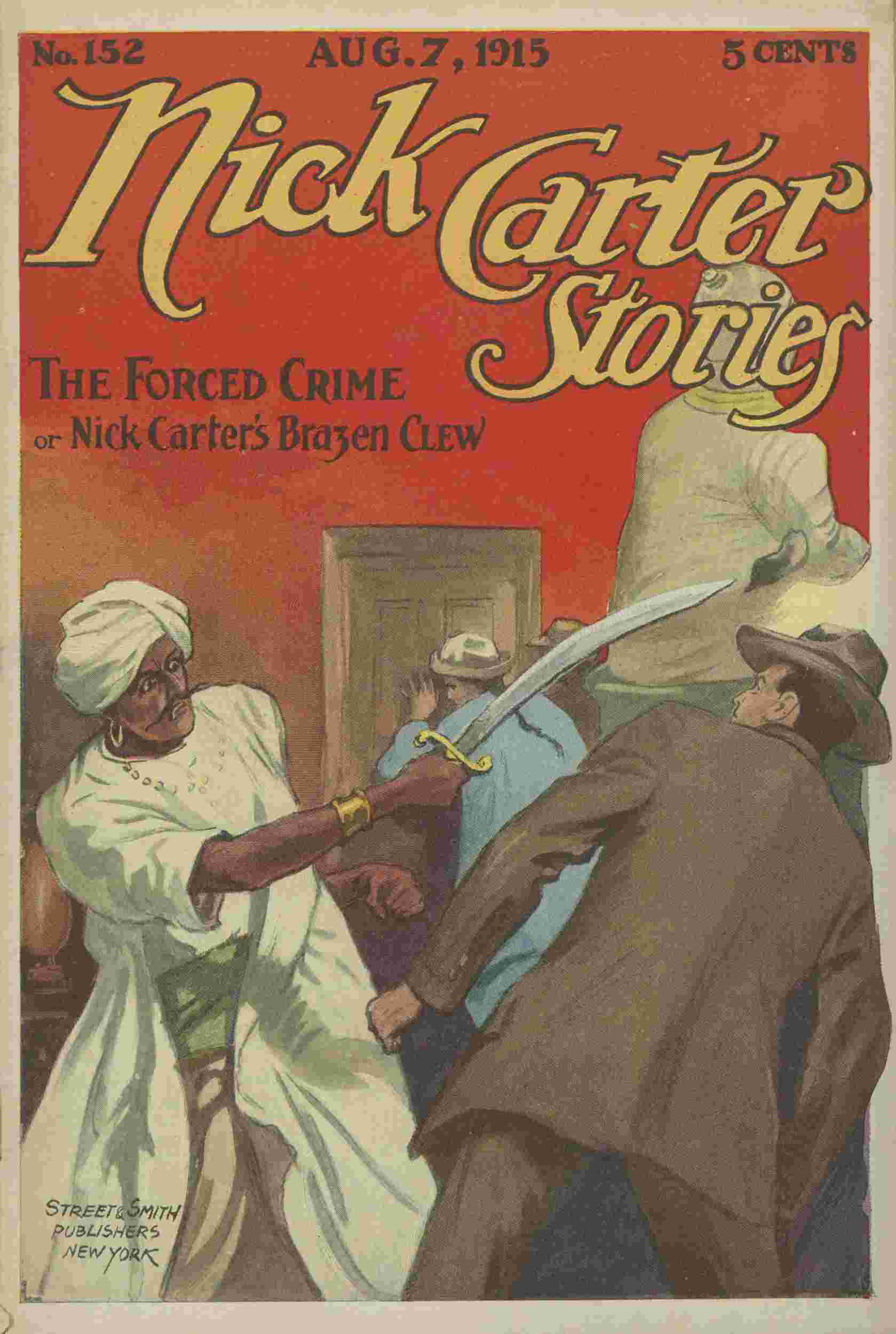
The Nick Carter Stories
ISSUED EVERY SATURDAY BEAUTIFUL COLORED COVERS
When it comes to detective stories worth while, the Nick Carter Stories contain the only ones that should be considered. They are not overdrawn tales of bloodshed. They rather show the working of one of the finest minds ever conceived by a writer. The name of Nick Carter is familiar all over the world, for the stories of his adventures may be read in twenty languages. No other stories have withstood the severe test of time so well as those contained in the Nick Carter Stories. It proves conclusively that they are the best. We give herewith a list of some of the back numbers in print. You can have your news dealer order them, or they will be sent direct by the publishers to any address upon receipt of the price in money or postage stamps.[Pg 69]
714—The Taxicab Riddle.
717—The Master Rogue’s Alibi.
719—The Dead Letter.
720—The Allerton Millions.
728—The Mummy’s Head.
729—The Statue Clue.
730—The Torn Card.
731—Under Desperation’s Spur.
732—The Connecting Link.
733—The Abduction Syndicate.
736—The Toils of a Siren.
738—A Plot Within a Plot.
739—The Dead Accomplice.
741—The Green Scarab.
746—The Secret Entrance.
747—The Cavern Mystery.
748—The Disappearing Fortune.
749—A Voice from the Past.
752—The Spider’s Web.
753—The Man With a Crutch.
754—The Rajah’s Regalia.
755—Saved from Death.
756—The Man Inside.
757—Out for Vengeance.
758—The Poisons of Exili.
759—The Antique Vial.
760—The House of Slumber.
761—A Double Identity.
762—“The Mocker’s” Stratagem.
763—The Man that Came Back.
764—The Tracks in the Snow.
765—The Babbington Case.
766—The Masters of Millions.
767—The Blue Stain.
768—The Lost Clew.
770—The Turn of a Card.
771—A Message in the Dust.
772—A Royal Flush.
774—The Great Buddha Beryl.
775—The Vanishing Heiress.
776—The Unfinished Letter.
777—A Difficult Trail.
782—A Woman’s Stratagem.
783—The Cliff Castle Affair.
784—A Prisoner of the Tomb.
785—A Resourceful Foe.
789—The Great Hotel Tragedies.
795—Zanoni, the Transfigured.
796—The Lure of Gold.
797—The Man With a Chest.
798—A Shadowed Life.
799—The Secret Agent.
800—A Plot for a Crown.
801—The Red Button.
802—Up Against It.
803—The Gold Certificate.
804—Jack Wise’s Hurry Call.
805—Nick Carter’s Ocean Chase.
807—Nick Carter’s Advertisement.
808—The Kregoff Necklace.
811—Nick Carter and the Nihilists.
812—Nick Carter and the Convict Gang.
813—Nick Carter and the Guilty Governor.
814—The Triangled Coin.
815—Ninety-nine—and One.
816—Coin Number 77.
NEW SERIES
NICK CARTER STORIES
1—The Man from Nowhere.
2—The Face at the Window.
3—A Fight for a Million.
4—Nick Carter’s Land Office.
[Pg 70]5—Nick Carter and the Professor.
6—Nick Carter as a Mill Hand.
7—A Single Clew.
8—The Emerald Snake.
9—The Currie Outfit.
10—Nick Carter and the Kidnaped Heiress.
11—Nick Carter Strikes Oil.
12—Nick Carter’s Hunt for a Treasure.
13—A Mystery of the Highway.
14—The Silent Passenger.
15—Jack Dreen’s Secret.
16—Nick Carter’s Pipe Line Case.
17—Nick Carter and the Gold Thieves.
18—Nick Carter’s Auto Chase.
19—The Corrigan Inheritance.
20—The Keen Eye of Denton.
21—The Spider’s Parlor.
22—Nick Carter’s Quick Guess.
23—Nick Carter and the Murderess.
24—Nick Carter and the Pay Car.
25—The Stolen Antique.
26—The Crook League.
27—An English Cracksman.
28—Nick Carter’s Still Hunt.
29—Nick Carter’s Electric Shock.
30—Nick Carter and the Stolen Duchess.
31—The Purple Spot.
32—The Stolen Groom.
33—The Inverted Cross.
34—Nick Carter and Keno McCall.
35—Nick Carter’s Death Trap.
36—Nick Carter’s Siamese Puzzle.
37—The Man Outside.
38—The Death Chamber.
39—The Wind and the Wire.
40—Nick Carter’s Three Cornered Chase.
41—Dazaar, the Arch-Fiend.
42—The Queen of the Seven.
43—Crossed Wires.
44—A Crimson Clew.
45—The Third Man.
46—The Sign of the Dagger.
47—The Devil Worshipers.
48—The Cross of Daggers.
49—At Risk of Life.
50—The Deeper Game.
51—The Code Message.
52—The Last of the Seven.
53—Ten-Ichi, the Wonderful.
54—The Secret Order of Associated Crooks.
55—The Golden Hair Clew.
56—Back From the Dead.
57—Through Dark Ways.
58—When Aces Were Trumps.
59—The Gambler’s Last Hand.
60—The Murder at Linden Fells.
61—A Game for Millions.
62—Under Cover.
63—The Last Call.
64—Mercedes Danton’s Double.
65—The Millionaire’s Nemesis.
66—A Princess of the Underworld.
67—The Crook’s Blind.
68—The Fatal Hour.
69—Blood Money.
70—A Queen of Her Kind.
71—Isabel Benton’s Trump Card.
72—A Princess of Hades.
73—A Prince of Plotters.
74—The Crook’s Double.
75—For Life and Honor.
76—A Compact With Dazaar.
77—In the Shadow of Dazaar.
78—The Crime of a Money King.
79—Birds of Prey.
80—The Unknown Dead.
[Pg 71]81—The Severed Hand.
82—The Terrible Game of Millions.
83—A Dead Man’s Power.
84—The Secrets of an Old House.
85—The Wolf Within.
86—The Yellow Coupon.
87—In the Toils.
88—The Stolen Radium.
89—A Crime in Paradise.
90—Behind Prison Bars.
91—The Blind Man’s Daughter.
92—On the Brink of Ruin.
93—Letter of Fire.
94—The $100,000 Kiss.
95—Outlaws of the Militia.
96—The Opium-Runners.
97—In Record Time.
98—The Wag-Nuk Clew.
99—The Middle Link.
100—The Crystal Maze.
101—A New Serpent in Eden.
102—The Auburn Sensation.
103—A Dying Chance.
104—The Gargoni Girdle.
105—Twice in Jeopardy.
106—The Ghost Launch.
107—Up in the Air.
108—The Girl Prisoner.
109—The Red Plague.
110—The Arson Trust.
111—The King of the Firebugs.
112—“Lifter’s” of the Lofts.
113—French Jimmie and His Forty Thieves.
114—The Death Plot.
115—The Evil Formula.
116—The Blue Button.
117—The Deadly Parallel.
118—The Vivisectionists.
119—The Stolen Brain.
120—An Uncanny Revenge.
121—The Call of Death.
122—The Suicide.
123—Half a Million Ransom.
124—The Girl Kidnaper.
125—The Pirate Yacht.
126—The Crime of the White Hand.
127—Found in the Jungle.
128—Six Men in a Loop.
129—The Jewels of Wat Chang.
130—The Crime in the Tower.
131—The Fatal Message.
132—Broken Bars.
133—Won by Magic.
134—The Secret of Shangore.
135—Straight to the Goal.
136—The Man They Held Back.
137—The Seal of Gijon.
138—The Traitors of the Tropics.
139—The Pressing Peril.
140—The Melting-Pot.
141—The Duplicate Night.
142—The Edge of a Crime.
143—The Sultan’s Pearls.
144—The Clew of the White Collar.
Dated June 19th, 1915.
145—An Unsolved Mystery.
Dated June 26th, 1915.
146—Paying the Price.
Dated July 3d, 1915.
147—On Death’s Trail.
Dated July 10th, 1915.
148—The Mark of Cain.
[Pg 72]
PRICE, FIVE CENTS PER COPY. If you want any back numbers of our weeklies and cannot procure them from your news
dealer, they can be obtained direct from this office. Postage stamps taken the same as money.
STREET & SMITH, Publishers, 79-89 Seventh Ave., NEW YORK CITY