
CHAPTER VI.
NICK CARTER’S FINE WORK.
Chick Carter was not long in coming to a conclusion concerning the two letters Nick had submitted to him.
“By Jove, the writing appears to be identical,” said he, after a careful inspection. “If this one in French is a forgery, Nick, it’s a mighty clever one.”
“Don’t overlook something,” said Nick, smiling a bit oddly.
“What’s that?”
“You already have sized up Pauline Perrot as a clever crook.”
“That’s true,” Chick admitted. “In proof of it, assuming this Gordon letter to be genuine, it shows plainly that she has involved him in some kind of a desperate situation, so desperate that he evidently consented to elope with her, despite that he closes by intimating that he might attempt to kill her.”
“Obviously,” Nick agreed.
“Has he done it?” Chick glanced at the bloodstained[Pg 21] hat, jacket and handkerchief. “Did he really go the limit and execute his threat? These things certainly point to that. Combined with all of the other circumstances, Nick, it establishes an almost sure case of murder.”
“One that, in case Gordon cannot be found, would convince a court and jury?”
“Surely.”
“Suppose the body should not be found?” suggested Nick.
“I think the case still would stand,” Chick replied. “A jury would surely convict on such circumstantial evidence as this.”
Nick smiled again.
“That’s why I have dug into it for all I am worth,” he said dryly. “I will show you a few points that you fail to detect.”
“You mean?”
“These few hairs, Chick, to begin with,” said Nick, taking them from a scrap of paper on which he had placed them. “Mrs. Lord told me that Pauline Perrot had stolen a brush and comb. That suggested something to me.”
“What was that?”
“A hairbrush cannot be entirely cleaned of all the hairs it takes in among its bristles. I reasoned that Pauline Perrot decided that it was much easier to steal the brush than to clean it, and less dangerous than to leave it in her chamber. That set me to hunting for hairs on the rug and carpet. I found these. The devil always leaves a gapway open.”
“What about them?” Chick questioned, a bit perplexedly.
“Use my lens,” said Nick. “Observe that they are exceedingly dry, having none of the oily gloss and pliability of hairs fresh from one’s head. Notice, also, the tiny speck on the end of the longest one. It looks like the root of the hair.”
“I see.”
“But it is not,” Nick quickly added. “It is much too hard and brittle.”
“What do you make of it?”
“Instead of a root, Chick, it’s a speck of glue.”
“By Jove, that is significant,” Chick muttered. “In that case, then, Pauline Perrot probably wears a wig.”
“Gee! it’s a cinch,” declared Patsy, from the opposite side of the table.
“Have you other reasons for thinking so, Nick?” Chick questioned.
“Yes.”
“Namely?”
“Notice these undergarments and stockings,” said Nick. “All of them are new, or very nearly so. I am convinced that none of them have been worn.”
“Why are you so sure of it?”
“Here are Pauline’s button boots,” Nick went on. “Compare the size with the size of the stockings. The stockings are two sizes larger than the boots. Who ever heard of a girl buying hosiery larger than her shoes?”
“By Jove, you are right,” said Chick, carefully inspecting both.
“It was a mistake she made—another devil’s gapway.”
“And you infer from this that she has worn none of the other garments?”
“I am sure of it.”
“But why, then, did she have them in her possession?[Pg 22]” Chick demanded, racking his brain to fathom it. “Why did she leave them in her bureau drawer?”
“She can have had only one logical reason, Chick, consistent with all of the other circumstances,” Nick replied. “She did not buy them to wear. Though she wore feminine outside garments, she preferred another kind next to her evil skin. She left these in her bureau, Chick, only that persons having occasion to seek her, or investigate her conduct, might not for a moment suspect that Pauline Perrot is—not a woman.”
“Not a woman!” echoed Chick, with a gasp of surprise.
“That’s what I said,” Nick nodded.
“But you don’t for a moment suspect her of being a man?”
“That is precisely what I suspect.”
“Nonsense! Remember that she has for several months been employed as Gordon’s stenographer, and that she——”
“Wait a bit,” Nick interrupted. “We quite frequently know of women masquerading as men. Take the case of Murray Hall, who for a quarter of century wore only male attire, blinding all with whom she associated, and the secret of her sex was not discovered until after she died.”
“I know about that, Nick, but——”
“I know what you would say,” Nick again interrupted. “But given the right type of man, Chick, the reverse subterfuge would be just as feasible—a man with an effeminate, mobile, and beardless face, a man with medium figure and consistent voice, together with the subtle art required for such an assumption. We have met just that type of man, Chick, both of us.”
“I cannot recall him,” Chick declared. “Whom do you mean?”
“The man of whom Wilhelmina Strickland has been living in fear since he, by this same artifice, made his escape from a prison hospital,” Nick replied. “The man of whom, though unidentified when she saw him in female attire, she felt an immediate aversion and dread—that is, upon first seeing Pauline Perrot.”
“H’m, I see!” Chick muttered.
“Mina Strickland’s sensitive nature and feminine intuition were more keen than her eyes,” Nick added. “They were far more keen than the eyes of Arthur Gordon. The man I mean, Chick, is a past master of the art of personal disguise and character assumption, and so clever and versatile a crook that for years he eluded the European police and——”
“Oh, I’ve got you,” Chick interrupted. “You mean Mortimer Deland.”
“Exactly.”
“He and Pauline Perrot are one and the same.”
“As sure as you’re a foot high.”
“This French letter, then, is a forgery?”
“Undoubtedly,” said Nick. “Deland is an expert penman. We long have known that. He is wanted in Paris for forging the signature of the prefect of police, a trick by which he escaped from brief custody.”
“Also the letter sent to Miss Strickland?”
“A forgery, Chick, surely.”
“You may be right, by Jove, though it seems almost incredible,” said Chick.
“We shall find I am right,” replied the detective confidently.[Pg 23]
“My money goes on that, chief,” declared Patsy.
“But what’s the game, aside from the robbery?” Chick questioned, pointing to the bloodstained articles. “What’s the meaning of these?”
“That’s what we must discover, as well as the present whereabouts of Deland and his confederates,” said Nick. “Arthur Gordon undoubtedly is a prisoner in their clutches. He knows nothing about the robbery, nor about the case, as we now see it.”
“You reason——”
“That he was in some way trapped by the supposed Pauline Perrot, and it’s up to us to discover how,” Nick went on. “This evidence has obviously been planted only to denote that Gordon has killed his supposed female stenographer. Deland’s deeper game is, I suspect, to subsequently bleed wealthy old Rudolph Strickland out of more money, by approaching him in some crafty way with an offer to produce Gordon and positive evidence of his innocence.”
“Gee whiz! that looks dead right to me,” put in Patsy. “Mr. Strickland would give up handsomely for the sake of his niece and Mr. Gordon.”
“Undoubtedly, under such circumstances,” Nick nodded. “He would, moreover, be a very easy mark. By the way, Chick, did you verify Beckwith’s statements by talking with Dayton?”
“Yes, of course,” said Chick. “He corroborated what Beckwith had told me.”
“And he is the one man, the only one, who saw Gordon departing with a suit case, eh?”
“What do you make of that?” questioned Chick, noting Nick’s subtle intonation.
“Another devil’s gapway,” Nick dryly declared. “It was thought necessary by Deland to have it appear that Gordon carried away the money and bonds in a suit case.”
“Ah, I see, now.”
“With that object in view, Pauline Perrot artfully detained him in his office until all others had gone. If Gordon knew nothing about this foul business, however, it is safe to say that he had no suit case when he left his office. We know that he had none when he arrived here, or Miss Strickland would have informed us.”
“Holy smoke!” cried Patsy. “In that case, then, Dayton must be one of Deland’s confederates.”
“That’s the very point, Patsy,” said Nick.
“By Jove, he should be watched, then,” said Chick. “There would be something in that.”
“I think so, too,” Nick quickly agreed. “You return to town, therefore, and try to pick him up before he leaves his office. Get on his trail by some means, if possible, and don’t lose sight of him.”
“Leave him to me, Nick.”
“In the meantime, with Patsy to help me I have other fish to fry.”
“You mean?”
“The man with a dog—Ginger.”
“Henley?” questioned Chick. “Why do you suspect him?”
“First, because this evidence, if planted, was discovered so quickly after the seeming murder,” said Nick, pointing to the bloodstained articles. “It’s long odds that, in a genuine case of murder, it would not have been found within a few hours of the crime.”
“That’s true,” Chick quickly admitted.
“Second, because Henley is the man who found it, and[Pg 24] he don’t look good to me,” Nick added. “He has a bad eye. Besides, he has been very careful when speaking of the discovery to attribute it to his dog, which convinces me that he fears suspicion, if he takes it upon himself.”
“Gee! I thought of that,” declared Patsy. “You have hit the nail on the head, chief, for fair.”
“I think that these crooks, in order to expedite matters and create a general belief that Gordon has murdered Pauline Perrot, planted this evidence and probably more, and immediately started Henley with it to inform the constable, aiming to get in their work on old Mr. Strickland as soon as possible. I saw that Henley was a bit set back when he discovered my identity and that I already was at work on the case.”
“I noticed that, too, chief,” put in Patsy.
“Henley decided to seize the bull by the horns, however, pretending he wanted to aid me, and I think he now has something up his sleeve,” Nick added. “I’m going to give him a chance to show his hand.”
“How so?” Chick questioned.
“I’m not yet sure what I shall frame up. Be that as it may, Chick, you hike back to town and get after Dayton. It’s dollars to fried holes that he has a hand in this game. Use your own judgment as to the best course to shape, and leave Patsy and me to tie knots in this end of the string. That’s all for the present.”
“Enough said, too, Nick,” replied Chick, seizing his hat. “You have pulled off a clever bit of work, remarkably clever, and we’re now right in line to deliver the goods. Leave Dayton to me. I’ll get him.”
Chick did not wait for an answer. He hurried out of the house and started for town in the taxicab.
CHAPTER VII.
HENLEY SHOWS HIS HAND.
It was, indeed, a clever bit of detective work that had enabled Nick Carter to form a theory consistent with all of the circumstances and the accumulation of evidence denoting that Arthur Gordon was guilty of the basest of treachery and the most heinous of crimes, and which would have been convincing not only to the public, but probably to all other detectives than Nick Carter himself.
He keenly realized, however, that a theory based only upon his own convictions was not enough, that absolute evidence was needed to convince others, and he was not long in hitting upon a plan by which he thought he could obtain it.
Nick hurriedly explained it to Patsy, giving him a few necessary instructions, and he then sent him to call the suspected man from the kitchen.
Henley came slouching into the library a moment later, with Ginger trailing at his heels. He had a more lowering look in his shifty eyes. He had become impatient and suspicious during his long wait. He did not fancy his having been excluded from the conference of the detectives. It smacked of distrust of him, and his resentment was manifest in his swarthy face.
Nick saw it, of course, and at once took steps to dispel it.
“Pardon me, Henley, for keeping you waiting so long,” he apologized with a heartiness well calculated to be convincing. “I had no idea it would take more than a[Pg 25] few minutes to examine these articles. Sorry to have kept you waiting.”
“That’s all right, Mr. Carter,” growled Henley, with countenance lighting. “Time ain’t wuth much to me. I reckoned you’d want a good look at them.”
“I have examined them carefully, Henley.”
“What d’ye think about it?”
“It looks like a bad mess, very bad,” Nick said, more gravely.
“So it does,” Henley nodded. “There ain’t nothing to it but murder, that I can see.”
“I’m inclined to agree with you,” Nick replied.
“Sure thing, chief,” put in Patsy. “What else can you make of it? It’s dead lucky we met Mr. Henley. He sure has put us on the right track.”
“And he can do still more to aid us,” supplemented Nick approvingly. “I suppose, Henley, you are perfectly willing to assist us. You will be well paid for your services. I guarantee that.”
“Your word’s good enough for me, Mr. Carter,” said Henley, consenting with a readiness denoting that his misgivings were entirely dispelled. “I’m right here to lend you a hand. Say what you want, sir, and I’ll do it.”
“Good enough,” Nick declared. “We’ll set about it at once. Find the butler, Patsy, and have him give you a pair of Gordon’s shoes. I will look after those left by the girl. We’ll leave these other articles until we return. I’ll take the precaution, however, to lock the library door. Get Gordon’s shoes and rejoin us in the car.”
Patsy hastened from the room, then started upstairs to say a few encouraging words to Strickland and Wilhelmina.
“I wish to visit the spot where you found these garments, Henley, or where Ginger nosed them out, to be more correct,” said Nick, taking only the pair of button boots from the table and thrusting them into his pocket.
“I’ll show you,” said Henley. “That won’t take long.”
“We will expedite matters by going in my car as far as possible,” Nick added. “Bring along the dog. We may find him useful.”
“He’s some dog, Mr. Carter; you can bet on that.”
“He looks it, Henley, no mistake. One moment while I lock this door and remove the key. Now, then, we’re off.”
Nick led the way out to the touring car, in which Patsy presently joined them, bringing a pair of Gordon’s shoes, and in another moment they were speeding down the long driveway toward the woodland road.
“Take us to the point where we picked Henley up, Danny,” Nick directed. “He then can take the ribbons and show us the way.”
“You can run a quarter mile farther,” said Henley. “That’ll take us to the crossroad. It’s rough going, then, too rough for a buzz car.”
“We will walk the remaining distance, Henley, in that case,” Nick replied, all the while with an air of friendliness and appreciation of his services that appeared to deceive the swarthy ruffian. “I think you said it is less than a mile from the road to the pond you mentioned.”
“’Tain’t more than half a mile.”
“Just where did you see Gordon and the girl last evening?”
“Going through the crossroad.”
“We traced them to the juncture of the two roads.[Pg 26]”
“It was a quarter mile from there that I saw them.”
“Was Gordon carrying a suit case?”
“That’s what,” nodded Henley. “The girl had her jacket over her arm. The man had an ugly look, and they seemed to be in a fuss over something, but I couldn’t hear what they said. I watched them till they turned a bend in the road, and that was the last I saw of them.”
“Gordon looked threatening, did he?”
“I sure would have thought so, Mr. Carter, if he had been looking at me,” Henley forcibly declared. “He looked fit to fight a dog.”
If Nick Carter had wanted further evidence of Henley’s complicity in the knavish game that was being played, these last statements would have convinced him of it, in view of his own discoveries and deductions. He did not betray his suspicions, but pretended to have entire confidence in the rascal, interrogating him along much the same lines until Danny brought the car to a stop at the crossroad.
Nick was the first to alight, followed by Henley and the hound, while Patsy paused to question:
“Am I to go with you, chief?”
Nick hesitated for a moment, as if he had given this matter no previous thought, and he then said abruptly:
“No, you’ll not be needed. Henley and I can look over the ground and accomplish all that can be done.”
“Sure we can,” put in Henley, with ill-concealed eagerness.
“You return with Danny, Patsy, and keep an eye on those things in the library. There is a bare possibility that some one will try to destroy them, in case our suspicions are known.”
“That’s right, too,” Patsy quickly agreed. “I thought you were taking a chance, chief, in leaving them there.”
“You return and look after them,” Nick repeated decidedly. “I’ll hoof it back with Henley after making an investigation. He won’t mind the tramp.”
“Mind it be hanged!” cried Henley. “Tramping round these diggings is the most that I do.”
“That settles it, then,” said Nick. “Back into the crossroad to make a turn, Danny, and wait for us at Gordon’s place.”
“I’ve got you, chief,” nodded Patsy. “We’ll keep an eye on things.”
Nick did not hasten his departure with Henley. He waited until Danny had turned the touring car, then watched it speed away with both of his assistants, till it vanished around a near bend in the road.
Henley stood silently watching him, with his shotgun under his arm. There was a gleam of secret satisfaction deep down in his shifty eyes, an ominous curve in his thin-lipped mouth. Both vanished instantly, however, when Nick turned and said:
“Now, Henley, it’s up to you.”
“I’ll make good, all right,” was the reply, with a covert significance the detective was quick to notice.
“Lead the way, then.”
“I’ll soon show you, Mr. Carter,” Henley added, with the same sinister significance. “Come on, Ginger. He’s some dog, Carter, some dog. Ginger can’t be beat.”
Nick did not reply. He followed the swarthy ruffian over the rough crossroad, stopping at intervals to study the ground, stating that he wanted to examine the footprints of the missing couple, if any could be found. He[Pg 27] delayed frequently in this way—but with an entirely different object in view.
Twenty minutes brought them to a path through the woodland, into which Henley struck without hesitation, remarking grimly:
“They must have gone this way. It was on this side of the pond that Ginger nosed out the bloodstained togs.”
“How far is the pond from here?” Nick inquired, following him.
“Not far,” Henley gruffly assured him. “It’s over the hill and down into the valley. There’s another path on t’other side of it, leading to a road running south.”
“Toward Fordham, then.”
“That’s what. Gordon must have known about the pond. ’Tain’t very big, but it’s as deep as a volcano. The devil himself couldn’t raise a corpse sunk to the bottom of it. Gordon knew that, mebbe.”
“Quite likely, Henley, since he evidently wanted to get rid of the girl,” Nick allowed.
“That’s how it looks to me. Bear off this way, sir.”
Henley strode away to the left and plunged through the bushes and underbrush, Nick following, with Ginger bringing up in the rear.
Ten minutes brought them in sight of the pond, shut in on all sides by a thick belt of woods, and Nick followed his uncouth guide down to the edge of it and to the spot he was seeking, a lonely and suitable place enough for such a crime as superficially appeared to have been committed.
“Here’s the spot,” cried Henley, pointing to some trampled shrubs and underbrush. “There’s the log where Ginger nosed out the girl’s hat and jacket. They were rolled up and thrust under it, then partly covered with dirt and leaves.”
“Yes, yes, I see.”
“Here’s blood on the bushes, and footprints in the ground and dry leaves, as if the girl put up a fight to save herself from——”
“Stop a moment,” said Nick, intently viewing the evidence mentioned. “I want to compare these shoes with the imprints.”
“Gordon’s shoes?”
“Yes. The button boots belong to the girl. She left them in a house where she has been boarding.”
“You went there after them?” questioned Henley, with sinister scrutiny.
“Yes, certainly,” said Nick, without looking up. “By Jove, they correspond perfectly, Henley. There’s no question about it.”
Nick was comparing both pieces of footwear with several impressions found in the damp earth. There was, as he had stated, no question as to the correspondence in size and shape, which was further evidence of who had been there the previous evening.
“It looks bad, bad enough,” he added, after viewing the blood-spattered bushes, the rough ground on all sides, and seeking vainly for evidence showing in which direction Gordon had departed.
“You have made no search for the girl’s body, Henley, you said.”
“What’s the use?” Henley asked, with a growl. “A hundred to one it’s at the bottom of the pond.”
“Very likely,” admitted Nick, with seeming uncertainty as to what course to take.
“Gordon wouldn’t have waited to bury it.[Pg 28]”
“True again,” Nick allowed. “If we only knew in which direction he went——”
“We can find that out easy enough,” Henley interrupted, with eyes gleaming for an instant.
“How so?” asked Nick, though he had expected and been only waiting for these suggestions. “How can we contrive to trace him?”
“Leave it to Ginger.”
“You mean——”
“Ginger will show you,” Henley cut in. “He can trail him like breaking sticks. He’s some dog. Mr. Carter, some dog. Wait a bit and I’ll show you. Gimme one of Gordon’s shoes.”
“By Jove, that’s a good idea, Henley.” Nick cried, as if he had not thought of it. “He can get the scent from this, perhaps, as you suggest. I ought to have been wise to that.”
“Here you, Ginger, come here,” Henley growled harshly. “Come here, you rascal.”
The hound bounded through the bushes and cringed at his master’s feet.
Henley seized him by the scruff of the neck and held to his nostrils the shoe the detective had given him, then pointed to the larger of the imprints in the ground.
“Get after him, Ginger!” he commanded, producing a leather strap and hooking it to the dog’s collar. “Follow him up! After him, Ginger, you rascal!”
The hound brightened up and appeared to know what was wanted. He began to bark, until Henley cuffed him fiercely, and then he thrust his muzzle to the ground, whining and eagerly tugging hard on the leather leash.
Henley seized his shotgun from the ground where he had placed it, crying gruffly:
“I told you, Carter. He’s got the scent. Come on at my heels. Ginger’ll trail him.”
“By Jove, I believe you are right, Henley,” Nick cried, following.
“I know I’m right. He’s some dog, sir, some dog.”
“Some dog, Henley, no mistake.”
“Can you stick close?”
“Bet you!” said Nick, as both plunged on after the hound. “You can’t go too fast for me.”
“Sing out if I do.”
“I’ll hang on, all right. Want me to carry your gun?”
“Not much!” growled Henley. “I’m used to this ’ere business.”
“Gordon evidently went round the pond, instead of back to the crossroad.”
“That’s so. He most likely was heading for the other road.”
“It looks so, for fair.”
“Ginger’ll trail him. Leave it to Ginger.”
The hound was plunging on all the while, with his muzzle to the ground, and was shaping a course through the woods and around the south side of the pond.
“Plainly enough, whoever planted this evidence wore the shoes Gordon had been wearing,” thought Nick, tramping rapidly on behind Henley. “That’s evidence enough, too, that he now is in the hands of this rascal’s confederates. It would be like Mortimer Deland not to overlook a point as essential as that. Where will the trail end? That’s the question.”
It then was, in fact, almost the only important question in Nick Carter’s mind. He felt that he had a cor[Pg 29]rect answer for all of the others. He was not left long in uncertainty, however, for the trail was not a very long one.
Ten minutes brought them to a narrow road on the south side of the pond, though a quarter mile from it, and the hound started off to the left without a moment’s hesitation.
Another eighth of a mile brought them to what evidently was an extensive private estate. There were low walls through the woods, and away off to the right could be seen at intervals, when the trees and foliage did not hide them, the white stones and monuments of a distant cemetery.
“Whose place is this, Henley?” Nick inquired, while both scrambled over a low wall over which the hound had leaped. “Do you know who owns this estate?”
“Sure I know,” growled Henley, over his shoulder. “I know every place in these parts.”
“Whose is it?”
“It’s owned by a man named Barker, Colonel Morgan Barker, but he’s in Europe with his family. The house hasn’t been open for a year.”
Nick remembered the man and the place, also the Barker tomb, in which Mortimer Deland had temporarily concealed the art treasures stolen from Rudolph Strickland’s flat in Fifth Avenue, and from which gruesome confinement Nick had rescued Patsy Garvan on the night of the round-up.
No additional evidence was needed to convince him that he had hit the nail on the head, that Pauline Perrot and Mortimer Deland were one and the same, and that this notorious European crook was back of the knavery then in progress.
“It’s dollars to doughnuts, now, that the rascal has taken secret possession of Barker’s unoccupied house,” Nick said to himself. “It’s the old Barker homestead, and sufficiently isolated to serve Deland admirably for such a job. He knew all about it, too, and that he would ordinarily be safe from intruders. I’ll butt in on him, now, in a way he’ll not fancy.”
The last scarce had crossed Nick’s mind when they emerged into the cleared land back of the large old country house, stable, and outbuildings.
Ginger was still tugging on the leash and leading the way between the buildings and toward the rear of the fine old dwelling.
Not a word now came from Henley.
Nick glanced sharply at the house while they approached it. Shutters protected all of the lower windows. The curtains at those on the upper floors were closely drawn. The surrounding grounds, an eighth of a mile from the nearest road, shut in by the trees of an extensive park, were entirely deserted and running to rank grass and weeds.
When within ten yards of the rear door, toward which the hound was heading, Nick said abruptly:
“Stop a moment, Henley. If our man is here——”
“He’s here, Carter, all right,” Henley cut in gruffly.
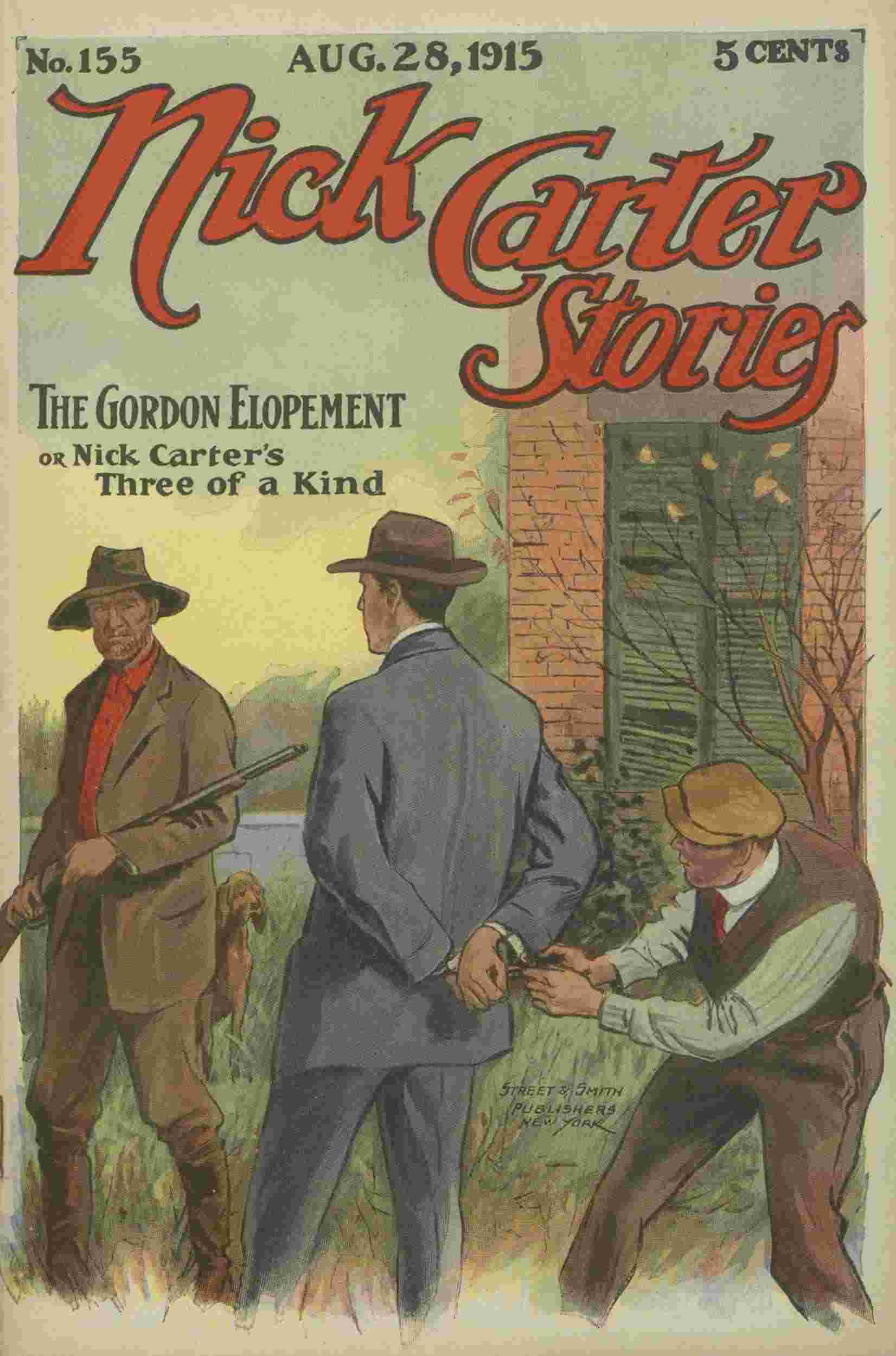
He swung round while he spoke and dropped the leash, then threw his shotgun into the hollow of his arm, instantly covering the detective.
“He’s here, Carter,” he added, with sinister significance. “Don’t you reach for a gun. Don’t move, blast you, or I’ll pepper you so with buckshot that you’ll look like a sieve.[Pg 30]”
CHAPTER VIII.
FACE TO FACE.
Nick Carter’s feelings upon seeing the sudden display of animosity by Pete Henley were not manifest in his face. He gazed at the swarthy ruffian with hardly a change of countenance, apparently indifferent to the double-barreled gun with which he was covered.
“What’s the joke, Henley?” he asked coolly.
The ruffian had murder in his eyes, and looked as black and threatening as a thundercloud.
“You’re the joke, Carter, if there’s any joke to it,” he replied, with a snarl. “You’ve barked up the wrong tree and tackled the wrong bunch. Stick up your hands, and be quick about it.”
“Certainly, Henley, since you insist so politely,” Nick rejoined, raising his hands as high as his head.
“Keep them there, now.”
“But you might answer my question, at least, and explain this sudden change of attitude on your part.”
“You’ll know soon enough,” was the reply, followed by a short, sharp whistle.
Ginger did not respond to it. He had disappeared around a corner of the house.
Instead, the back door was quickly opened and two roughly clad men appeared on the threshold, both still under thirty. One of them instantly darted back through the hall, and Nick heard him shout to another in one of the adjoining rooms.
Henley, meantime, growled harshly, with his evil eyes constantly on the detective:
“Come out here, Foster, and get behind the dick. Feel under his coat and get his guns. Kneel down while doing it, so I’ll not hit you. I’ll plug him, all right, if he moves a finger.”
“There will be no occasion, Henley, you rat,” Nick now said sternly. “I value a whole skin too highly to take any chance against that blunderbuss in such hands as yours. I see, now, that you have served me a scurvy trick. Go as far as you like.”
“You don’t need to tell me that,” snapped Henley. “I’m on the way. Got ’em, Bill?”
“Both of ’em, Jim,” returned Foster, who had hurriedly disarmed the detective and was threatening him with his two weapons. “Who is he?”
“Nick Carter.”
“Thunder! Where did you run up against him? If he——”
“You’re to bring him in, Jim,” cut in the man who had briefly vanished, and now returned to the open door. “His jags says——”
“Is he out here, Brigham?” Henley interrupted, with countenance clearing.
“Sure. Been here ten minutes.”
“That’s more like it,” cried Henley. “He can now take the ribbons. Get a move on, Carter, and—stop a bit!”
Nick halted.
“Feel again, Foster, and fish out his irons. Snap them on his own wrists, hands behind him, as he will on ours if he gets a chance.”
“You’ve told the truth once, Henley, at least,” Nick put in dryly.
“But you’ll never get the chance,” Henley retorted.[Pg 31] “Dukes down and behind you, Carter, or I’ll pull the trigger.”
“Don’t trouble yourself,” said Nick, obeying. “Point the gun another way. It might go off by chance.”
Henley heard the snap of handcuffs around Nick’s wrists and saw Foster straighten up after having secured him, and he then lowered the shotgun and grinned maliciously.
“You thought you were the real thing, didn’t you, Carter?” he demanded. “Get a move on and I’ll show you what you’re up against and where you stand.”
“I can guess.”
“Into the shack, and no funny business, mind you, or you’ll hear something drop, if you live until you hit the floor. Lead the way, Brigham. Where’s his jags?”
“In the dining room, Jim.”
“Head that way. Plug along, Carter, where he leads.”
Nick felt the prod of the ruffian’s gun in the small of his back, but he had no intention of offering any objection. He followed Brigham into the house, a stocky, ill-favored fellow with fiery-red hair, and in another moment he heard the door closed and locked behind him.
The hall was dim when the sunlight was thus excluded. It ran straight through the spacious old colonial house to the front door. A broad, but angular stairway led up to the second floor. There was a damp and musty smell in the long-closed dwelling, and the rooms on each side of the broad hall looked dusty, gloomy, and deserted.
The exception, in the last respect, was the large dining room into which the detective was conducted by the three crooks.
That room contained only one occupant, however; the man in search of whom Chick Carter had left the Gordon residence more than an hour before—Mr. Edgar Hereford Dayton.
He was seated in one of the leather upholstered chairs, pushed back from the polished table. He did not appear disturbed by what had occurred or by the advent of the detective upon the scene, though he gazed at Nick curiously when he entered, flecking the ashes from the end of a cigarette.
His overcoat and hat were lying on a chair near the wall, and near it stood a closed leather suit case.
Nick Carter identified him instantly as Dayton—and somewhat more than that when he spoke.
Henley was the first to open fire, however, addressing Dayton and saying gruffly, the moment he entered:
“You’d better clean out that town office, old sport, or fight shy from it now on. I reckon this dick has sent his right bower to keep an eye on it. Leastwise, I don’t see where else he would have sent him in such a rush.”
Nick suppressed a smile. It amused him to find that Henley was a bit more discerning than he had thought him.
Dayton appeared unmoved by Henley’s announcement and advice. He glanced at the suit case mentioned, then responded with a curious mingling of coolness and assurance that Nick was quick to remember:
“He is welcome, Henley, to inspect that office. It already is cleaned out of all that would interest him. Suppose, instead of giving me needless advice, you tell me just what this meddlesome fellow is after, and what he has been doing.”
“By Jove, I’m not mistaken,” was the thought then in[Pg 32] Nick’s mind. “This rascal has even more strings to his bow than I suspected.”
“That’s quickly told——” Henley began to reply.
“But better told first hand,” Nick cut in curtly, with his gaze intently fixed on the man he addressed. “I’ll give you the information you want. I’ll tell you what I’m after and what I’ve been doing.”
“Ah!” Dayton spoke with an icy drawl. “Better first hand, indeed, as you say. I do not yet place you, however, nor——”
“Oh, a truce to subterfuge,” Nick again interrupted curtly.
“Subterfuge?”
“You know me perfectly well—but not better than I know you.”
“Indeed?”
“You place me, all right, as I sooner or later will again place you where you belong.” Nick went on sternly, disregarding the other’s queries. “A wig, a beard, a reverse curve of the eyebrows, a more florid skin, an altered voice—it takes more than those to blind me, though you might get by others. Fly your true colors, Mr. Mortimer Deland, and I’ll tell you what I am after and what I’ve been doing.”
“Ah! That is a great inducement, so great that I find myself utterly unable to resist it.”
Deland replied with unruffled composure. He drew up a little in his chair, gazed steadily at the detective for a moment, then raised his slender white hands to his head, deftly removing the exceedingly artistic disguise which Nick alone had been able to penetrate, and which had fairly transfigured the mobile, sinister, clean-cut, yet strangely effeminate features of—Mortimer Deland.
Jim Henley and the two frowning crooks near by evinced no surprise nor made any comments. That Deland was the master, and they merely hirelings, was perfectly apparent to the detective.
It appeared obvious, too, that Chick Carter must have arrived too late to have picked up the supposed Dayton before he left his office—a mischance that would seem to have badly aggravated the present desperate situation of the detective.
Deland appeared to think so, too, for he smiled with vicious complacency while he tossed his disguise upon the table, saying with the same frigid voice and insolent assurance which was so characteristic of him that they had at once betrayed him to the detective:
“Now, having met you halfway, Carter, and complied with the stipulation you imposed, it is up to you to perform your part of the brief verbal contract. Sit down, if you prefer; there are plenty of chairs. I regret that I cannot release you, but that would be injudicious for obvious reasons. Tell me, now, as you promised, what are you after and what have you been doing, that my good friend Henley has rounded you up in this fashion?”
CHAPTER IX.
THE ACME OF KNAVERY.
Nick Carter ignored Mortimer Deland’s mocking suavity, the miscreant’s manifest air of superiority and contempt. He sat down directly opposite the notorious crook, replying sternly:
“That may be quickly told, Deland, and I’m right here to tell it.[Pg 33]”
“I am listening.”
“You wish to know what I am after. I am after a rascal who has been playing a very extraordinary game, so extraordinary that he might have won out and accomplished his evil designs—if I had not butted into the game to thwart it.”
“Ah!” drawled Deland. “That makes it very unfortunate for him—but doubly unfortunate for you, perhaps.”
“That last word is well added.”
“Indeed?”
“You will agree with me later.”
“I seldom agree with men of your vocation,” said Deland, smiling ironically. “Be good enough to explain, Mr. Carter. I do not quite get you. For whom are you seeking?”
“For Pauline Perrot—said to have been murdered by Arthur Gordon,” Nick replied curtly.
“Dear me, is that so?” smiled Deland, with eyes narrowing. “I remember Gordon. It was he who started you on my track several months ago, with very disastrous results. I would not grieve deeply, Carter, if evil did befall Mr. Arthur Gordon.”
“I am very well aware of that, Deland,” Nick said dryly. “Your assurance of it is entirely unnecessary.”
“Pauline Perrot, eh?” queried Deland, unruffled. “Said to have been murdered. She is Gordon’s stenographer, I believe. I think I have seen her coming from his business office. Murdered, eh? What are the circumstances, Carter? Have you succeeded in finding her—or what is left of her?”
“Yes,” Nick said shortly.
“Dear me, is that so?”
Deland did not, in fact, then suppose it was so, Henley being the only one of the four crooks then informed of what the detective had discovered.
“I not only have found all that is left of her, but also all that she left behind her,” Nick pointedly added.
Deland’s eyes took on a sharper gleam and glitter, his thin lips a more sinister and threatening curve. The tinge of color in his cheeks waned perceptibly. His long, slender fingers closed involuntarily, until their carefully manicured nails bit into his palms. He laughed, nevertheless, in a cold and mirthless fashion, while he echoed inquiringly:
“All that she left behind her?”
“Exactly,” said Nick.
“You mean——”
“The garments she left in the home of Mrs. Lord, with whom she has been boarding.”
“You have been there?”
Deland’s brows knit closer and fell to a settled frown over his steadily dilating eyes.
“How else could I have found the garments?” Nick demanded. “Yes, I have been there and——”
“And that’s not the only place he’s been to, nor all he——”
“One moment, Henley,” Deland coldly interrupted. “I will hear you presently. Permit Mr. Carter to have his say. What more, Carter; what more?”
“Oh, there is a good deal more, Deland, if I chose to tell you all of my discoveries and deductions,” Nick now said, more sternly.
“Ah, indeed?”
“So much, Deland, that it would reveal in every detail the knavish game you have been playing,” Nick went[Pg 34] on forcibly. “But you have overplayed yourself, over-estimated the value of your cards.”
“My cards?”
“Have you not learned in all the years you have lived in vice and crime that three kings, well played, will invariably beat three knaves?”
“See here, Carter——”
“Oh, you wanted me to have my say,” Nick went on sternly, interrupting. “The three kings you have been up against, Deland, are Patsy Garvan, Chick Carter, and myself—three kings in the detective deck. You, Deland, are single-handed the three knaves—yourself, the man Dayton, and the supposed murdered girl, Pauline Perrot. Three knaves, Deland, never beat three kings.”
“You say—you say that I am Pauline Perrot?” gasped Deland, with his wonderful nerve shaken for the first time.
“I not only say so, but I can also prove it,” cried Nick. “I say, too, that you now have Arthur Gordon confined in this house, and that you and these three rascals——”
“Stop!” Deland leaped to his feet. “I have heard enough from you, Carter. Keep an eye on him, Foster, with a weapon ready. If he utters another word, or makes an aggressive move, shoot him instantly. This way, Henley, into the hall. I prefer to hear your story.”
An expression of devilish ferocity now had settled upon his vicious white face. He strode into the hall, Henley following, and for several minutes the two remained there in a whispered discussion.
Nick Carter waited with apparent indifference.
“There soon will be something doing, I imagine,” he said to himself. “I wonder whether Chick arrived in time to pick up his quarry. That now appears very improbable. Fortunately, however, I have another string to my bow, one that Henley does not even suspect. The odds are considerable, but—ah, well, I have never known him to fail to make good.”
There was a still more vicious look on Deland’s face when he returned with Henley. It was like that which it had worn when, having caught Patsy Garvan as he now had cornered Nick, he left him to die in the Barker tomb.
He came and stood directly in front of Nick, gazing down at him and saying, with icy severity:
“Henley has made it perfectly plain to me. There is no occasion for you to say more.”
“Very well,” Nick returned indifferently.
“You are very clever, Carter, very clever,” Deland went on. “I have never in Europe encountered an inspector who compared at all with you. You are so dangerous, Carter, that the world is too small for both of us.”
“Why don’t you move out?” Nick coolly inquired.
“You have exposed my game, indeed, and thwarted part of it,” Deland went on, as if there had been no interruption. “But I have, at least, the money and bonds stolen from Gordon’s vault. They are in yonder suit case.”
“Thanks for the information,” Nick again put in. “It will save me from searching for them.”
“I also have Gordon, here, as you have inferred,” continued Deland icily. “And, best of all—I have you!”
“I would be foolish to deny it,” Nick dryly allowed.
“And here, Carter, before we bolt for parts unknown, is where I shall get even with you and with him, where[Pg 35] I will forever wipe you out of my path. Gordon is bound hand and foot in a room on the top floor.”
“Thanks again, Deland.”
“I will send you both to the devil.”
“By what route, pray?”
“In a chariot of fire!” cried Deland, with a sudden outburst of ferocity.
“Well, well, that will beat walking,” Nick declared, not in the least daunted by the significance of the miscreant’s threat.
Deland swung around to Foster and Gribham, who had stood listening with stoical indifference to the foregoing colloquy.
“Go and get him, you two,” he fiercely commanded. “Bring Gordon down here. We will wipe them out together. We will leave no evidence here to tell the story. We will bind both, lock them in the library closet, and then fire the house.”
“That’s the stuff!” Henley said, with a growl. “It will burn like tinder. That will finish them.”
“Get Gordon—get Gordon!” Deland fairly shrieked. “Bring him to the library. We can be out of here with our plunder, with the deed done, in less than a dozen minutes. Go and get Gordon. Bring Carter after me, Henley. Bring him into the library. I’ll do it—I long to do it! It shall be my hand that starts the flames!”
In another moment all of them, Nick Carter included, were striding into the dimly lighted hall.
CHAPTER X.
THE OTHER STRINGS.
Patsy Garvan did not ride far with Danny Maloney after their parting from Nick Carter and Henley. Glancing back over his shoulder, Patsy waited only until they had rounded the curve in the road, when he called quickly:
“Slow down, Danny, and drop me. We’re out of sight.”
Danny obeyed at once, saying regretfully:
“Gee! I wish I was going with you. I might be needed.”
“One is better than two,” Patsy replied, leaping down to the road. “There’s only half the risk of being seen. I can fill the bill, all right, single-handed.”
“So long, then, and good luck.”
“Same to you.”
Danny sped on with the car.
Patsy Garvan, however, plunged into the woods, at once shaping a course that would bring him in sight of the crossroad through which Nick and Henley were to pass.
It was to enable Patsy to make this detour that Nick repeatedly stopped on the road, pretending he wanted to find footprints left by the missing couple.
Patsy accomplished the move with no great difficulty, and entirely unsuspected by Henley, owing to the artful attitude toward him that Nick had assumed.
Patsy saw them pass along the road; in fact, saw them on the edge of the pond, and then he followed them at a discreet distance until, from behind one of the outbuildings, he saw Nick held up by Henley and afterward taken into the house.
“Gee! that does settle it,” he said to himself. “I must know who is there and what’s going to come off, but it won’t do for me to approach the house from this side.[Pg 36] Those rats are in the rear rooms, or a side one, or they could not have reached the back door so quickly after Henley whistled. I’ll make a circuit to the front road and have a look.”
It took Patsy several minutes to do so, seeking the shelter of a wall over which he could plainly see the front of the dwelling, and he then met with an agreeable surprise.
A familiar whistle fell upon his ears, and he turned and discovered Chick under the same wall.
“Gee whiz!” he exclaimed, when they met. “This is dead lucky, for fair.”
“It’s not all luck, I guess,” Chick replied. “Give the chief the credit for it.”
“You found your man?”
“I arrived just in time to see him leaving his office.”
“He must be out here, now, since you are here.”
“That’s what,” Chick nodded. “He went round to the back door of the house about ten minutes ago. I’ve been waiting and watching till I could get a line on what’s going on in there.”
“Gee! I can supply that line, all right,” chuckled Patsy.
“Cut loose, then,” said Chick.
Patsy informed him with very few words what had occurred, and the subterfuge Nick had employed.
“It now is up to us, Chick,” he added. “The gang we want is in that house, and probably Arthur Gordon. We must go in and get them. There’s nothing else to it.”
“Only one thing,” corrected Chick, who again was sizing up the house.
“What’s that?”
“The way to get in, Patsy, so as to catch them hands down. It’s a hundred to one that they are on the ground floor, also in one of the rear rooms, as you have said.”
“It’s a safe gamble, Chick, in my opinion.”
“And I am equally sure that we could not force any of the lower windows without being heard. We can take a chance and approach the front of the house, and by climbing that trellis at the east end of the veranda, we can reach the veranda roof and three of the second-floor windows.”
“Like breaking sticks,” nodded Patsy approvingly. “It’s dollars to doughnuts that we then can quietly force one of the windows.”
“I think so, too.”
“Well, what do you say?”
“I say do it, Patsy, and be quick about it,” Chick declared, when unable to discover a sign of any person in the front part of the house.
“I’m with you,” Patsy muttered. “Head straight across the lawn to the east end of the veranda.”
They vaulted the wall while he was speaking, then covered the distance at record speed. After waiting and listening for a few moments, they felt sure that they had not been seen. To climb the trellis and reach the veranda roof then was child’s play, and both then began an inspection of the curtained windows.
Chick found one through which he could work his knife blade, thrusting up between the sashes, and in a very few moments he had succeeded in throwing the lock.
Noiselessly raising the lower section, he then pushed aside the curtain and peered in, finding that the window[Pg 37] opened into the hall on the second floor. Listening, he could faintly hear voices from below, but could not distinguish whose, nor what was said.
“Come on, Patsy,” he whispered, with a significant glance at him. “Have a gun ready. I’ll lead the way.”
“You won’t be far in advance,” muttered Patsy dryly.
Crawling quietly through the window, one after the other, they tiptoed toward the broad, angular stairway leading to the lower hall.
“Keep on, old top,” whispered Patsy, now with a revolver in each hand. “The sooner we get them the better.”
“I think so, too.”
“They’re in one of the side rooms. Ah, that was the chief’s voice.”
“Come on,” Chick muttered, starting down the stairs.
Patsy followed close at his companion’s heels.
They had made only the first turn in the stairway, when the voice of Mortimer Deland, rising high with the last threatening words he was addressing to Nick Carter, coupled with his fierce commands to his three confederates, fell loud and clear on the two detective’s ears.
Chick Carter glanced at Patsy and pulled out a second revolver.
“Fire the house, will he?” he whispered hurriedly. “There’ll be firing of another kind done here, if necessary.”
“You bet!” nodded Patsy, with brows knitting.
“Shoot to kill, if you have to shoot.”
“Kill goes!”
“They’ll come out this way,” Chick said hurriedly, as they reached the foot of the stairway and paused for an instant near the front door.
“Had we better rush in on them?”
“We might meet them on the threshold and get into too close quarters,” said Chick, after an instant’s thought. “We’d better get them after they come into the hall.”
“I guess you’re right.”
“Slip across into that front parlor and be ready to nail them from that side,” Chick directed. “I’ll cover this part of the hall.”
“I’ve got you,” Patsy nodded. “Give a yell when you’re ready.”
He darted across the hall with the last and into the dim, luxuriously furnished parlor.
Chick crouched back of the rise of the stairs.
Both scarce had gained these positions when the four crooks, with Nick in their midst, issued from the dining room and headed toward the front of the hall.
Chick waited until they were midway between the several doors, that no swift leap into either room should save any of them. Then he uttered the yell for which Patsy Garvan was waiting.
“Now, Patsy, get them!”
Nick Carter heard him, and then saw both. As quick as a flash, he shouldered both Deland and Henley to the middle of the hall, then leaped quickly back into the dining room, out of range of a chance bullet.
Chick saw the idea, and a shriek instantly followed his yell.
“Hands up, you fellows! We’ll drop the first man who resists!”
“Every man!” roared Patsy, with both guns leveled.
There were four weapons covering the crooks, with bullets enough in all to have riddled them.[Pg 38]
Only one of them acted under the impulse of desperation—Jim Henley.
His shotgun, with which he had been prodding Nick in the back, leaped to the hollow of his arm.
Bang!
It was Chick’s revolver that barked. The shotgun fell to the floor, and Henley with it, shot through the head.
Nothing more sanguinary and determined was needed. Deland and his other two confederates instantly threw up their hands—and kept them up till Patsy and Nick Carter were ready to fit them with bracelets.
That ended the sensational features of the extraordinary case. Henley died within an hour, and two hours saw the other three in the Tombs, two to be convicted and sentenced a fortnight later, and Mortimer Deland to return to finish his unexpired term in the State’s prison.
Arthur Gordon was found, as stated, bound hand and foot in an upper room of the old house. Though intensely grateful to the Carters for his rescue and liberation, he was a thousand times more surprised at what they told him. Up to that moment he had not dreamed of the true identity of Pauline Perrot, who had, as Nick had inferred, artfully wheedled him into meeting her on a supposed business matter with a friend that evening, only to throw him into the hands of Henley, Foster, and Brigham.
The gratitude of Mr. Rudolph Strickland, and the joy and relief of Wilhelmina, when Gordon was brought home safely and the truth made known, were all that the most vivid imagination could picture. Their reward to Nick and his assistants, too, was in corresponding proportion.
It afterward appeared, too, that all of Nick’s suspicions and deductions were absolutely correct; and that Deland, in assuming the character of Dayton, had done so only to have a quick refuge from Gordon’s office, if it became necessary, and a character in which he could bury Pauline Perrot at a moment’s notice.
Nick Carter had thwarted him completely, however, and had secured him temporarily, at least.
THE END.